POUL-102
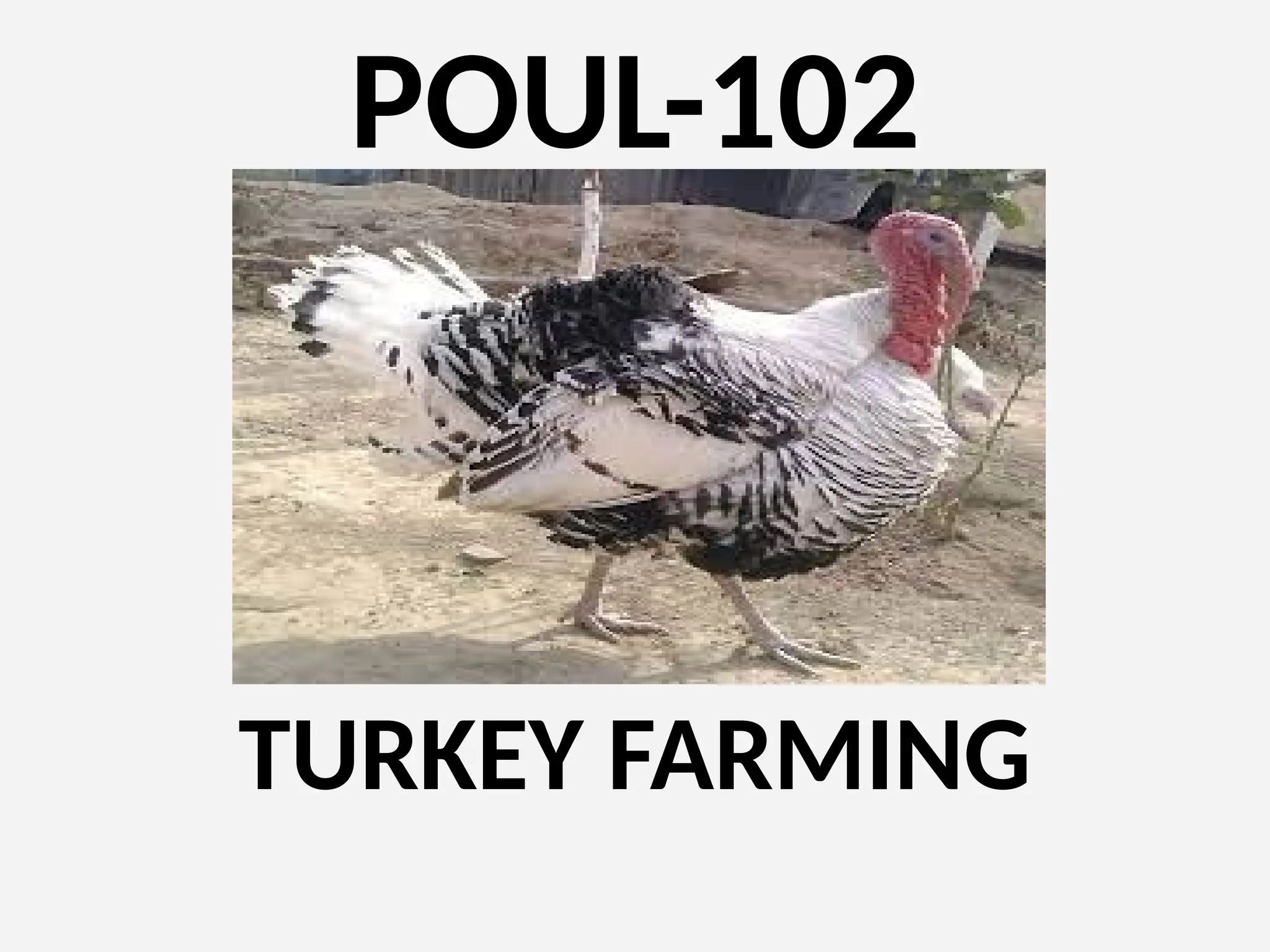
TURKEY FARMING
• Turkey farming is very interesting, and profitable.
• Turkey farming is the process of raising turkeys for the
purpose of producing meat or eggs for food or money.
• Their meat is recognized as the leanest of all poultry
species. The world’s top turkey producing countries
include the United States, Brazil, Germany, France, and
Italy.
Turkey Farming
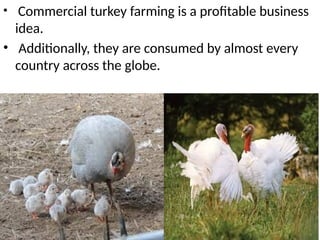
• Commercial turkey farming is a profitable business
idea.
• Additionally, they are consumed by almost every
country across the globe.
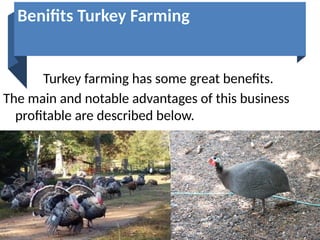
Turkey farming has some great benefits.
The main and notable advantages of this business
profitable are described below.
Benifits Turkey Farming
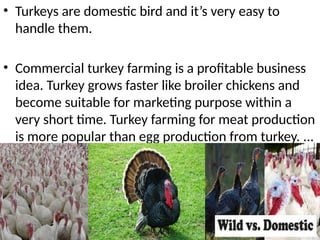
• Turkeys are domestic bird and it’s very easy to
handle them.
• Commercial turkey farming is a profitable business
idea. Turkey grows faster like broiler chickens and
become suitable for marketing purpose within a
very short time. Turkey farming for meat production
is more popular than egg production from turkey. ...
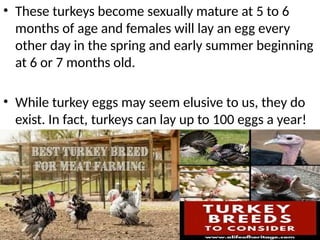
• These turkeys become sexually mature at 5 to 6
months of age and females will lay an egg every
other day in the spring and early summer beginning
at 6 or 7 months old.
• While turkey eggs may seem elusive to us, they do
exist. In fact, turkeys can lay up to 100 eggs a year!
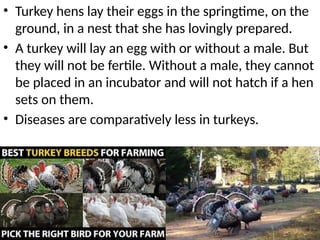
• Turkey hens lay their eggs in the springtime, on the
ground, in a nest that she has lovingly prepared.
• A turkey will lay an egg with or without a male. But
they will not be fertile. Without a male, they cannot
be placed in an incubator and will not hatch if a hen
sets on them.
• Diseases are comparatively less in turkeys.
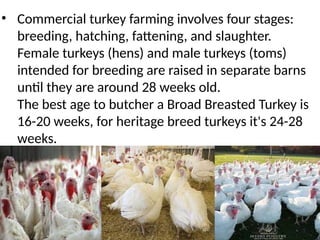
• Commercial turkey farming involves four stages:
breeding, hatching, fattening, and slaughter.
Female turkeys (hens) and male turkeys (toms)
intended for breeding are raised in separate barns
until they are around 28 weeks old.
The best age to butcher a Broad Breasted Turkey is
16-20 weeks, for heritage breed turkeys it's 24-28
weeks.
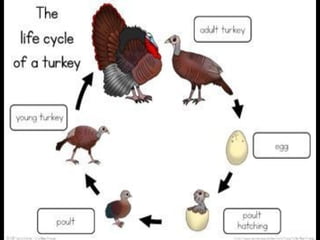
Life cycle
Turkeys raised on factory farms are hatched in
large incubators, without the warmth of a nest or a
mother. After a few weeks, they are moved to large,
warehouse-like sheds. ...
These sheds, called “grower houses,” confine
thousands of turkeys together.
Wild turkey: 3 – 5 years
Domestic turkey: 10 years
Female turkey start laying eggs at the age of 6-7 months
of age.
• A fertile turkey egg has an incubation period
of 28 days. The eggs can be incubated in two
different ways which are:
1.Natural Incubation
2.Artificial Incubation
Usually it takes about 28 days to hatch the eggs.
Day-old Poults are brooded for 4 weeks or to
about 6 weeks in the cold period. Gas brooder
or infra-red bulb could be used as a source of
heat or the traditional brooding systems such
as coal stoves could be adopted.
Turkey Breeds
The six types of wild turkeys are:
Eastern wild turkey, Osceola wild turkey, Gould's wild
turkey, Merriam's wild turkey, Rio Grande wild turkey, and
the Ocellated wild turkey
Ensure a Jump Start with The Best Breeds for Turkey
Farm Business!
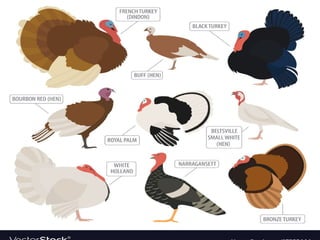
• Broad Breasted Whites.
• Blue Slate Turkey.
• Black Turkey.
• Bourbon Reds.
• Beltsville Small White.
• Midget White.
• Narragansett.
Housing
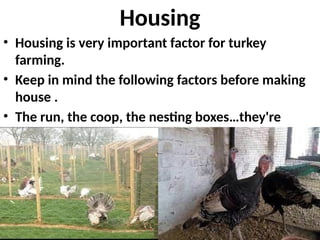
• Housing is very important factor for turkey
farming.
• Keep in mind the following factors before making
house .
• The run, the coop, the nesting boxes…they're
bigger birds, so they need more space.
• Unlike chickens, which can easily be housed in
recycled dog houses, etc., turkeys need more
room; a large shed or small barn work well. The
more space you give them, the better they do.
• Ensure huge flow of air and light inside the house.
• Prevent the entrance of rain water directly inside
the house.
• It need a minimum of 25 square feet of outdoor
space per bird for them to exercise, with predator-
proof fencing on all sides, as well as overhead.
Features of good turkey housing:
• The housing must be able to protect the turkeys
from all types of predators and harmful animals.
• It must ensure that there is sufficient space inside
the house. The space requirement will vary as the
birds grow older.
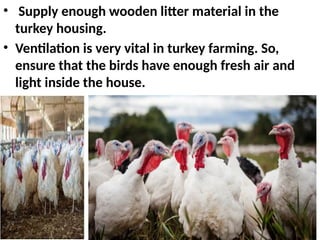
• Supply enough wooden litter material in the
turkey housing.
• Ventilation is very vital in turkey farming. So,
ensure that the birds have enough fresh air and
light inside the house.
• For an intensive turkey farming business, ensure
that you make use of a good ventilation system.
• The turkey housing must be clean at all times to
ensure biosecurity.
• If you are going to use fencing materials, then
make sure that it is high and strong enough to
protect the birds.
• Always try to keep the house clean and dry.
• Clean the house once or twice per month.
• Keep the food and water pot inside the house.
Feeding
Just like most other livestock, feeding takes a major
chunk of the cost of growing turkeys.
That’s because turkey needs good and nutritious food
to stay healthy and productive.
Besides that, the feed requirement of turkeys is
different from other birds.
The birds require more protein in their food for the
first few weeks than other domestic birds.
During this period, the turkey feed should contain at
least 28% protein.
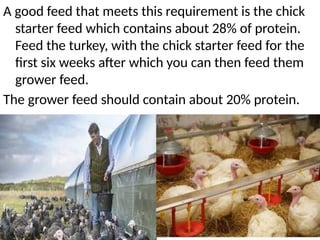
A good feed that meets this requirement is the chick
starter feed which contains about 28% of protein.
Feed the turkey, with the chick starter feed for the
first six weeks after which you can then feed them
grower feed.
The grower feed should contain about 20% protein.
Water
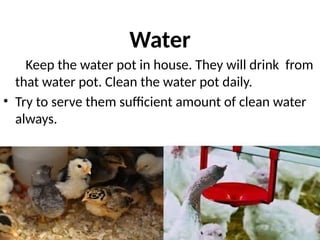
Keep the water pot in house. They will drink from
that water pot. Clean the water pot daily.
• Try to serve them sufficient amount of clean water
always.
Egg production
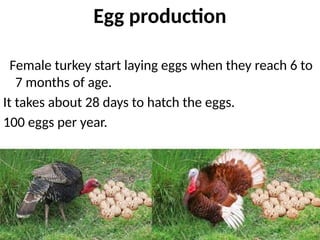
Female turkey start laying eggs when they reach 6 to
7 months of age.
It takes about 28 days to hatch the eggs.
100 eggs per year.
• Diseases:
Some of the commonly encountered diseases in turkeys
are Fowl Cholera, Erysipelas, Hemorrhagic enteritis
and Avian Influenza. The turkeys are protected from
fowl cholera and Erysipelas by vaccination.
Remedy methods
• Follow the advice of an experienced veterinarian.
• Keep the turkey house clean and germ free.
• Separate the disease affected bird from healthy birds.
• Vaccinate them timely.
• Keep them free from worms.
• Feed them balanced food to prevent malnutrition diseases.

Small and Large scale Turkey Farming.pptx

  • 1.
  • 2.
    • Turkey farmingis very interesting, and profitable. • Turkey farming is the process of raising turkeys for the purpose of producing meat or eggs for food or money. • Their meat is recognized as the leanest of all poultry species. The world’s top turkey producing countries include the United States, Brazil, Germany, France, and Italy. Turkey Farming
  • 3.
    • Commercial turkeyfarming is a profitable business idea. • Additionally, they are consumed by almost every country across the globe.
  • 4.
    Turkey farming hassome great benefits. The main and notable advantages of this business profitable are described below. Benifits Turkey Farming
  • 5.
    • Turkeys aredomestic bird and it’s very easy to handle them. • Commercial turkey farming is a profitable business idea. Turkey grows faster like broiler chickens and become suitable for marketing purpose within a very short time. Turkey farming for meat production is more popular than egg production from turkey. ...
  • 6.
    • These turkeysbecome sexually mature at 5 to 6 months of age and females will lay an egg every other day in the spring and early summer beginning at 6 or 7 months old. • While turkey eggs may seem elusive to us, they do exist. In fact, turkeys can lay up to 100 eggs a year!
  • 7.
    • Turkey henslay their eggs in the springtime, on the ground, in a nest that she has lovingly prepared. • A turkey will lay an egg with or without a male. But they will not be fertile. Without a male, they cannot be placed in an incubator and will not hatch if a hen sets on them. • Diseases are comparatively less in turkeys.
  • 8.
    • Commercial turkeyfarming involves four stages: breeding, hatching, fattening, and slaughter. Female turkeys (hens) and male turkeys (toms) intended for breeding are raised in separate barns until they are around 28 weeks old. The best age to butcher a Broad Breasted Turkey is 16-20 weeks, for heritage breed turkeys it's 24-28 weeks.
  • 9.
    Life cycle Turkeys raisedon factory farms are hatched in large incubators, without the warmth of a nest or a mother. After a few weeks, they are moved to large, warehouse-like sheds. ... These sheds, called “grower houses,” confine thousands of turkeys together. Wild turkey: 3 – 5 years Domestic turkey: 10 years Female turkey start laying eggs at the age of 6-7 months of age.
  • 10.
    • A fertileturkey egg has an incubation period of 28 days. The eggs can be incubated in two different ways which are: 1.Natural Incubation 2.Artificial Incubation Usually it takes about 28 days to hatch the eggs. Day-old Poults are brooded for 4 weeks or to about 6 weeks in the cold period. Gas brooder or infra-red bulb could be used as a source of heat or the traditional brooding systems such as coal stoves could be adopted.
  • 12.
    Turkey Breeds The sixtypes of wild turkeys are: Eastern wild turkey, Osceola wild turkey, Gould's wild turkey, Merriam's wild turkey, Rio Grande wild turkey, and the Ocellated wild turkey Ensure a Jump Start with The Best Breeds for Turkey Farm Business! • Broad Breasted Whites. • Blue Slate Turkey. • Black Turkey. • Bourbon Reds. • Beltsville Small White. • Midget White. • Narragansett.
  • 14.
    Housing • Housing isvery important factor for turkey farming. • Keep in mind the following factors before making house . • The run, the coop, the nesting boxes…they're bigger birds, so they need more space.
  • 15.
    • Unlike chickens,which can easily be housed in recycled dog houses, etc., turkeys need more room; a large shed or small barn work well. The more space you give them, the better they do. • Ensure huge flow of air and light inside the house. • Prevent the entrance of rain water directly inside the house.
  • 16.
    • It needa minimum of 25 square feet of outdoor space per bird for them to exercise, with predator- proof fencing on all sides, as well as overhead. Features of good turkey housing: • The housing must be able to protect the turkeys from all types of predators and harmful animals. • It must ensure that there is sufficient space inside the house. The space requirement will vary as the birds grow older.
  • 17.
    • Supply enoughwooden litter material in the turkey housing. • Ventilation is very vital in turkey farming. So, ensure that the birds have enough fresh air and light inside the house.
  • 18.
    • For anintensive turkey farming business, ensure that you make use of a good ventilation system. • The turkey housing must be clean at all times to ensure biosecurity. • If you are going to use fencing materials, then make sure that it is high and strong enough to protect the birds.
  • 19.
    • Always tryto keep the house clean and dry. • Clean the house once or twice per month. • Keep the food and water pot inside the house.
  • 20.
    Feeding Just like mostother livestock, feeding takes a major chunk of the cost of growing turkeys. That’s because turkey needs good and nutritious food to stay healthy and productive. Besides that, the feed requirement of turkeys is different from other birds. The birds require more protein in their food for the first few weeks than other domestic birds.
  • 21.
    During this period,the turkey feed should contain at least 28% protein.
  • 22.
    A good feedthat meets this requirement is the chick starter feed which contains about 28% of protein. Feed the turkey, with the chick starter feed for the first six weeks after which you can then feed them grower feed. The grower feed should contain about 20% protein.
  • 23.
    Water Keep the waterpot in house. They will drink from that water pot. Clean the water pot daily. • Try to serve them sufficient amount of clean water always.
  • 24.
    Egg production Female turkeystart laying eggs when they reach 6 to 7 months of age. It takes about 28 days to hatch the eggs. 100 eggs per year.
  • 25.
    • Diseases: Some ofthe commonly encountered diseases in turkeys are Fowl Cholera, Erysipelas, Hemorrhagic enteritis and Avian Influenza. The turkeys are protected from fowl cholera and Erysipelas by vaccination. Remedy methods • Follow the advice of an experienced veterinarian. • Keep the turkey house clean and germ free. • Separate the disease affected bird from healthy birds. • Vaccinate them timely. • Keep them free from worms. • Feed them balanced food to prevent malnutrition diseases.