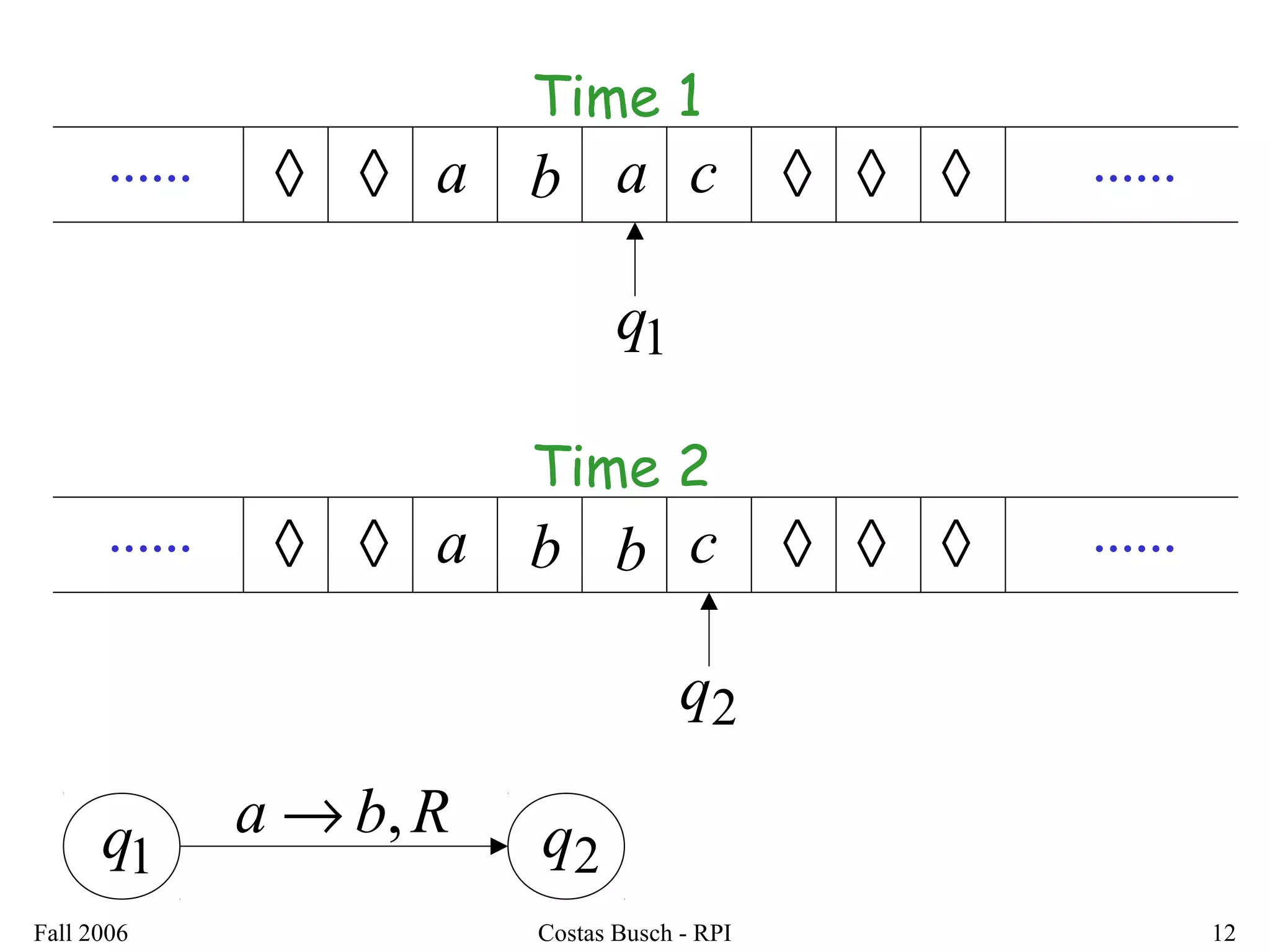
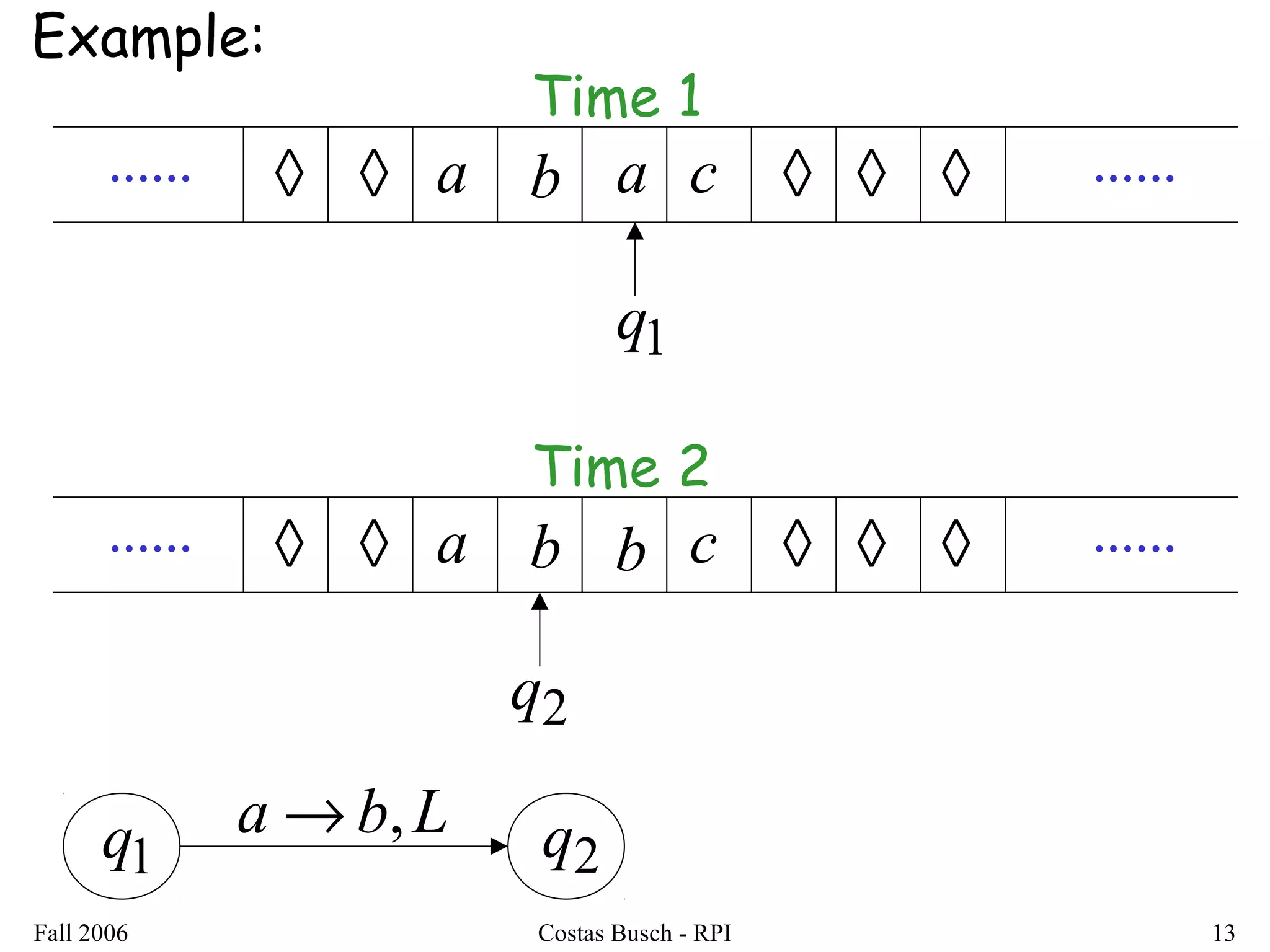
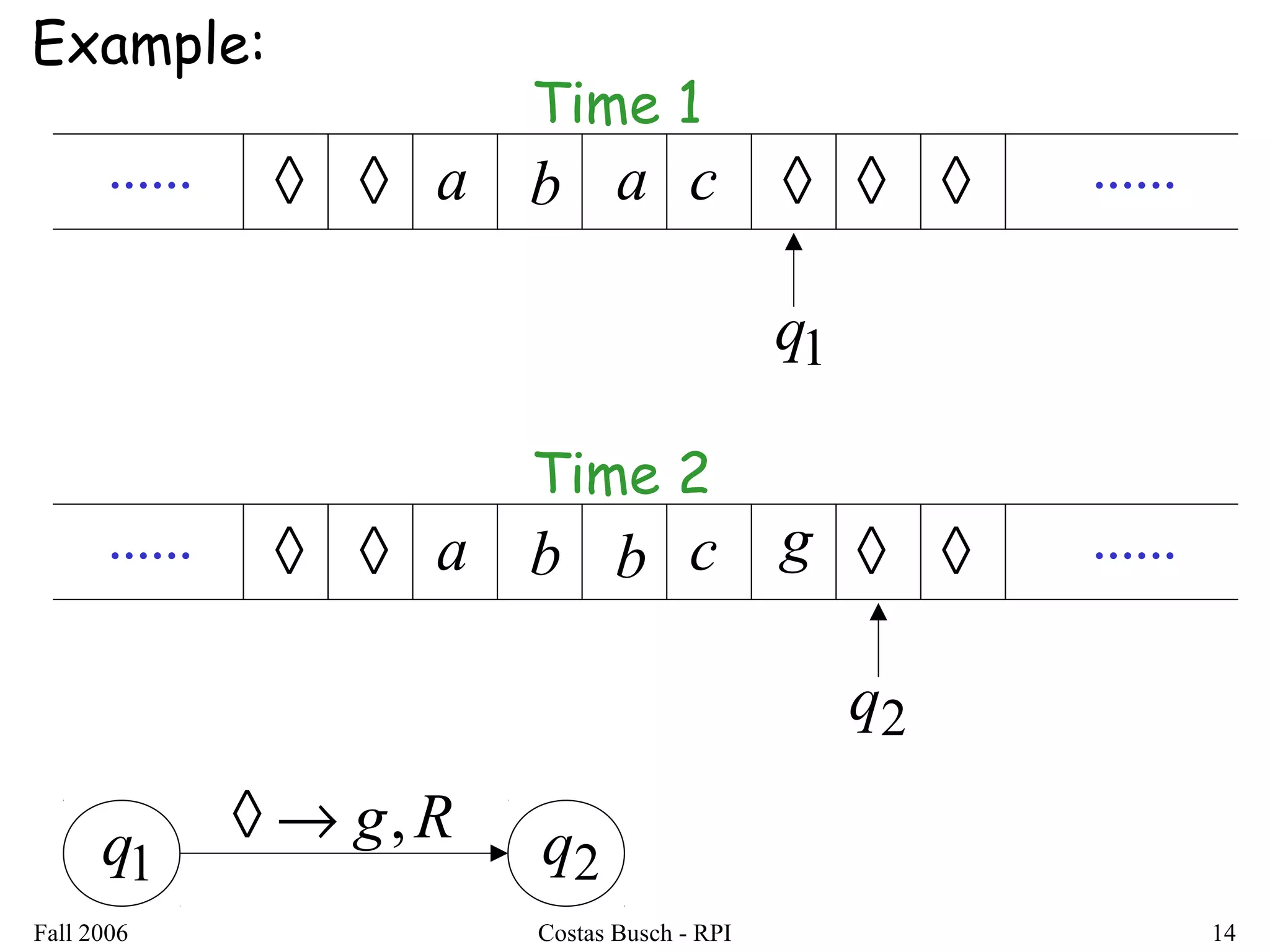
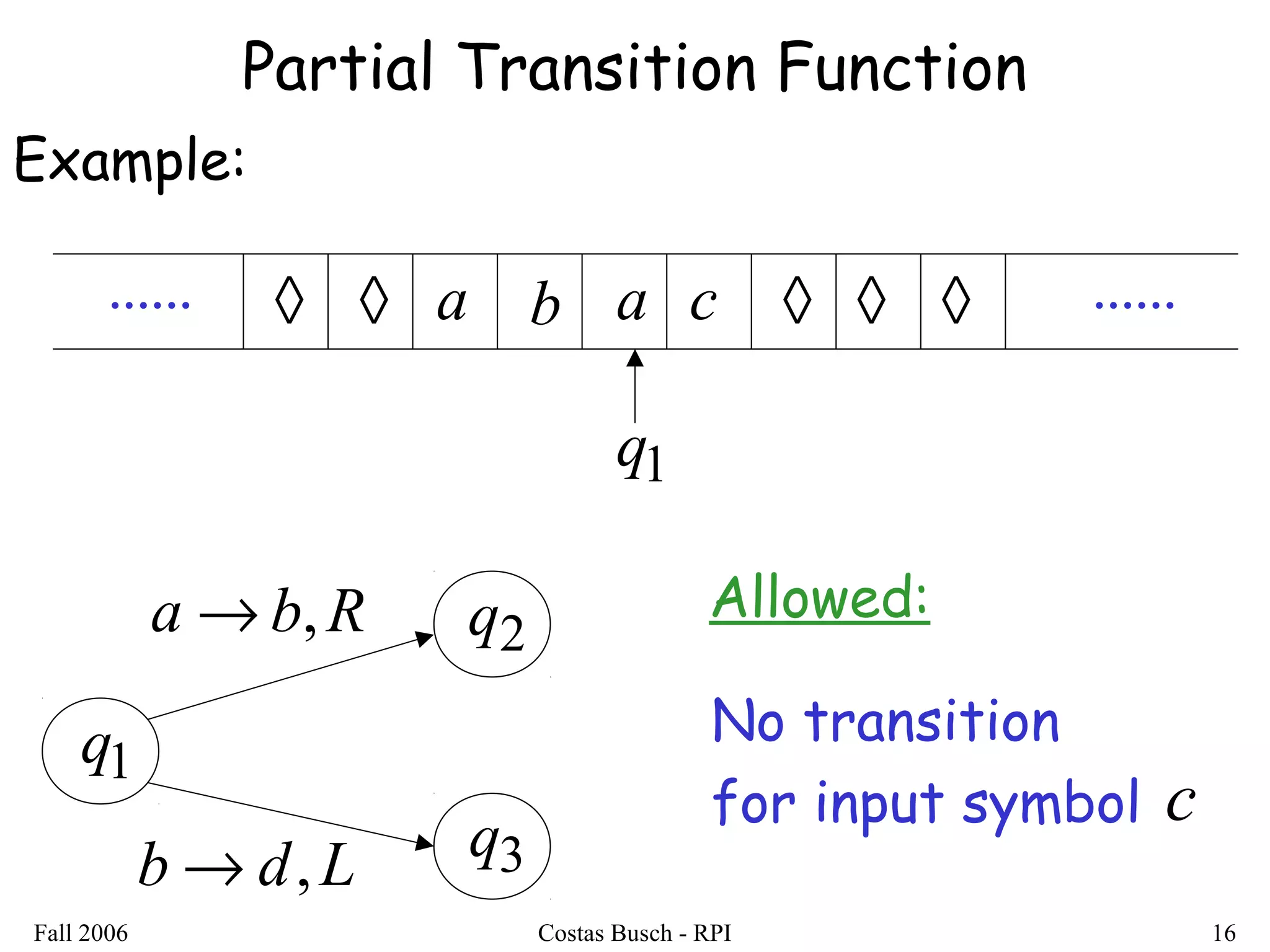
This document provides an overview of Turing machines including their components, operation, and how they are used to recognize formal languages. Key points covered include: Turing machines have a tape, read/write head, and set of states, and transition between states based on the symbol being read on the tape. They can move left/right on the tape and write new symbols. Examples are provided to demonstrate how Turing machines can accept or reject strings and recognize formal languages like {anbn} through transitions that match symbols. Infinite loops cause strings to be rejected. Formal definitions of the transition function and components of a Turing machine are also given.
Fall 2006 CostasBusch - RPI 2
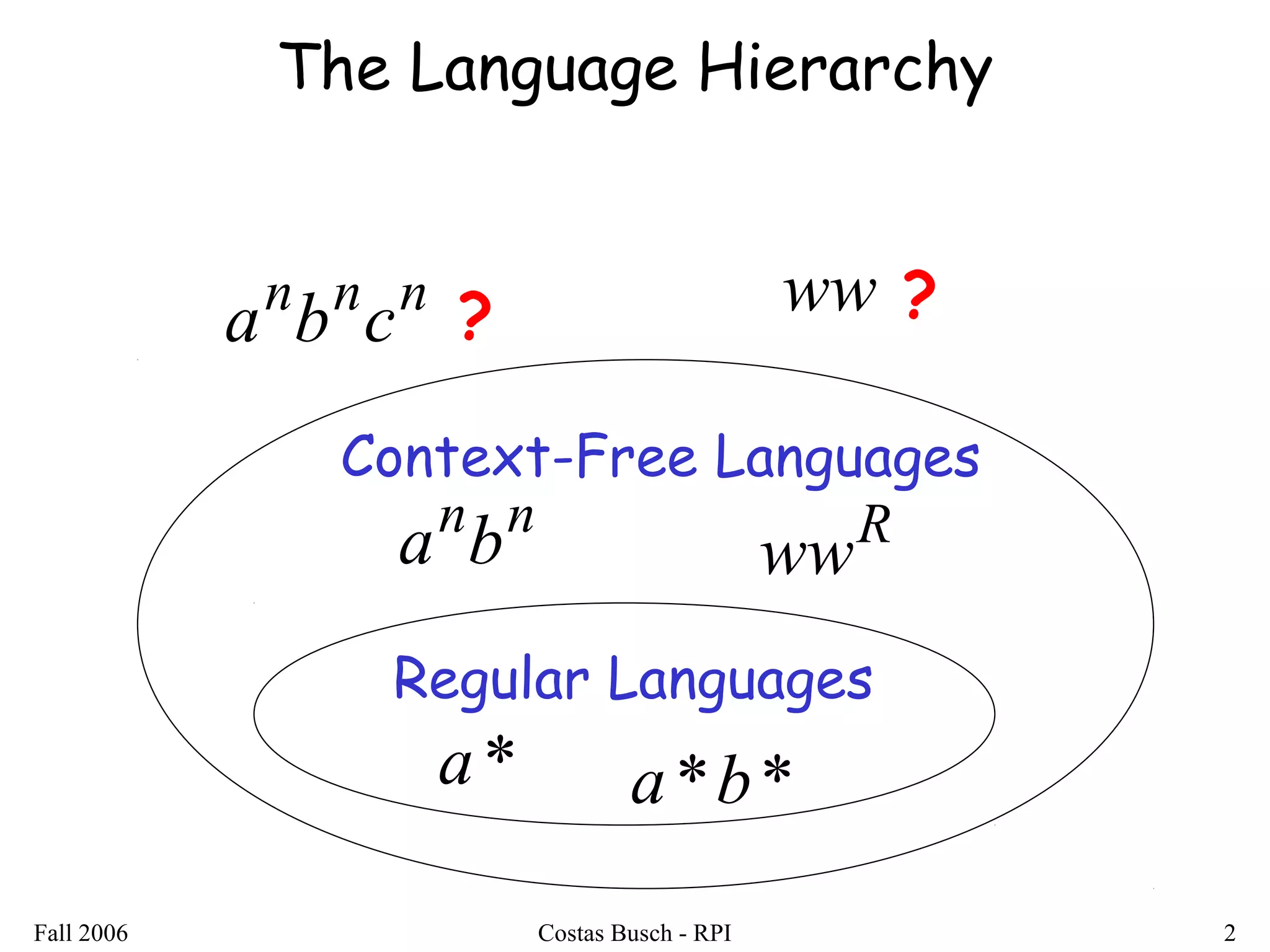
The Language Hierarchy
*a
Regular Languages
Context-Free Languages
nn
ba R
ww
nnn
cba ww?
**ba
?
3.
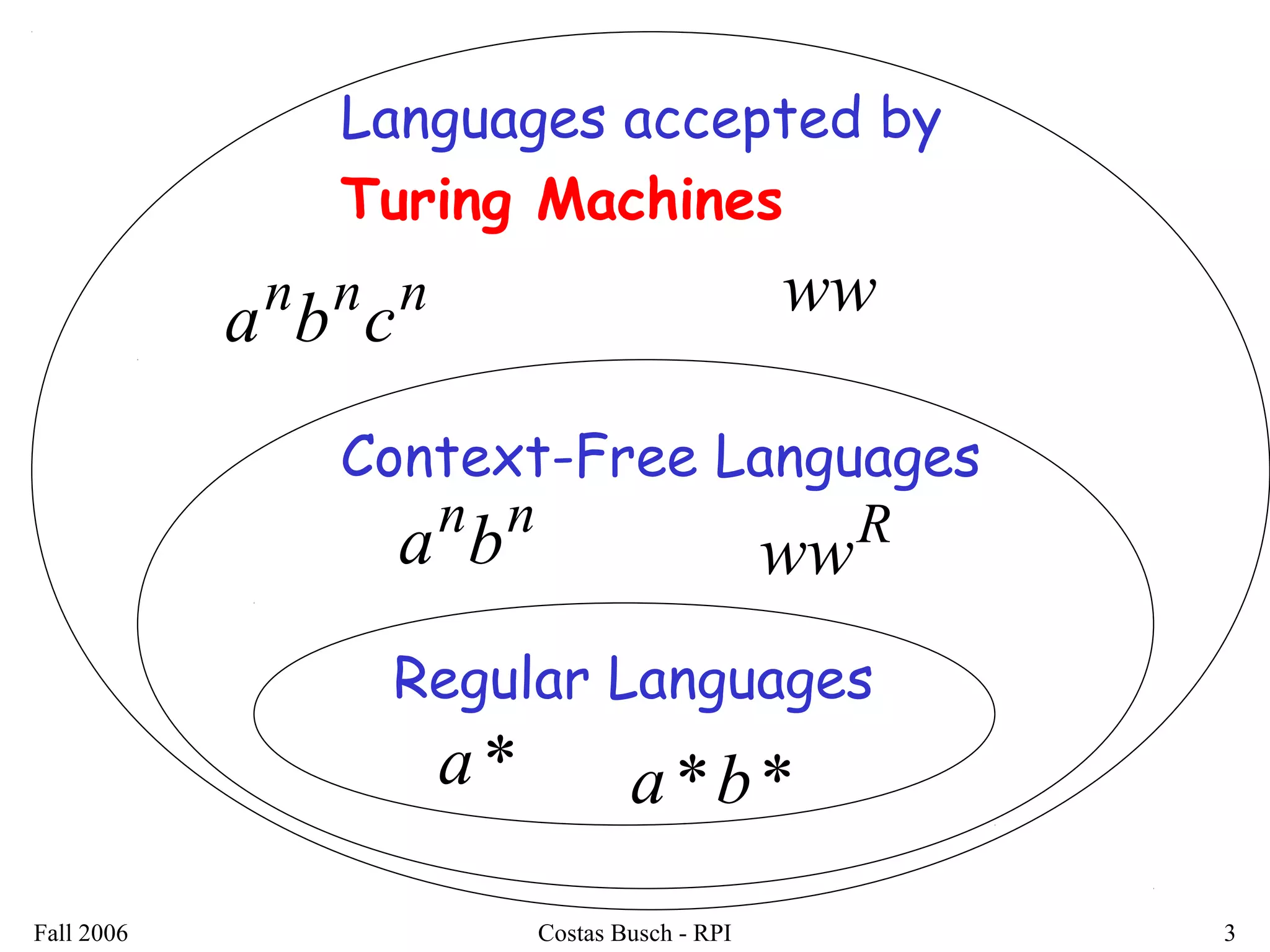
Fall 2006 CostasBusch - RPI 3
*a
Regular Languages
Context-Free Languages
nn
ba R
ww
nnn
cba ww
**ba
Languages accepted by
Turing Machines
4.
Fall 2006 CostasBusch - RPI 4
A Turing Machine
............
Tape
Read-Write head
Control Unit
5.
Fall 2006 CostasBusch - RPI 5
The Tape
............
Read-Write head
No boundaries -- infinite length
The head moves Left or Right
6.
Fall 2006 CostasBusch - RPI 6
............
Read-Write head
The head at each transition (time step):
1. Reads a symbol
2. Writes a symbol
3. Moves Left or Right
7.
Fall 2006 CostasBusch - RPI 7
............
Example:
Time 0
............
Time 1
1. Reads
2. Writes
a a cb
a b k c
a
k
3. Moves Left
8.
Fall 2006 CostasBusch - RPI 8
............
Time 1
a b k c
............
Time 2
a k cf
1. Reads
2. Writes
b
f
3. Moves Right
9.
Fall 2006 CostasBusch - RPI 9
The Input String
............ ◊ ◊ ◊ ◊
Blank symbol
head
◊a b ca
Head starts at the leftmost position
of the input string
Input string
10.
Fall 2006 CostasBusch - RPI 10
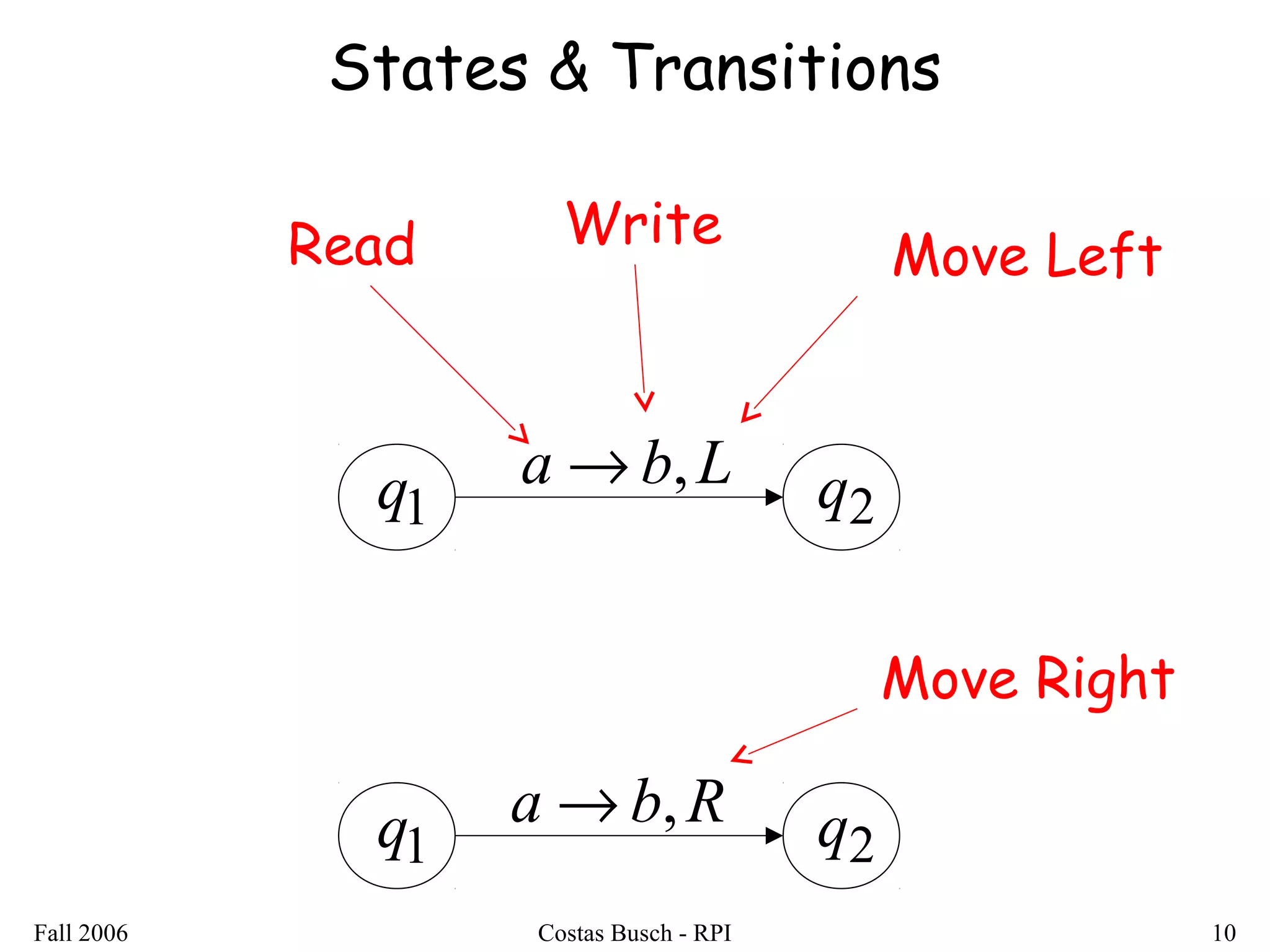
States & Transitions
1q 2qLba ,→
Read Write
Move Left
1q 2qRba ,→
Move Right
11.
Fall 2006 CostasBusch - RPI 11
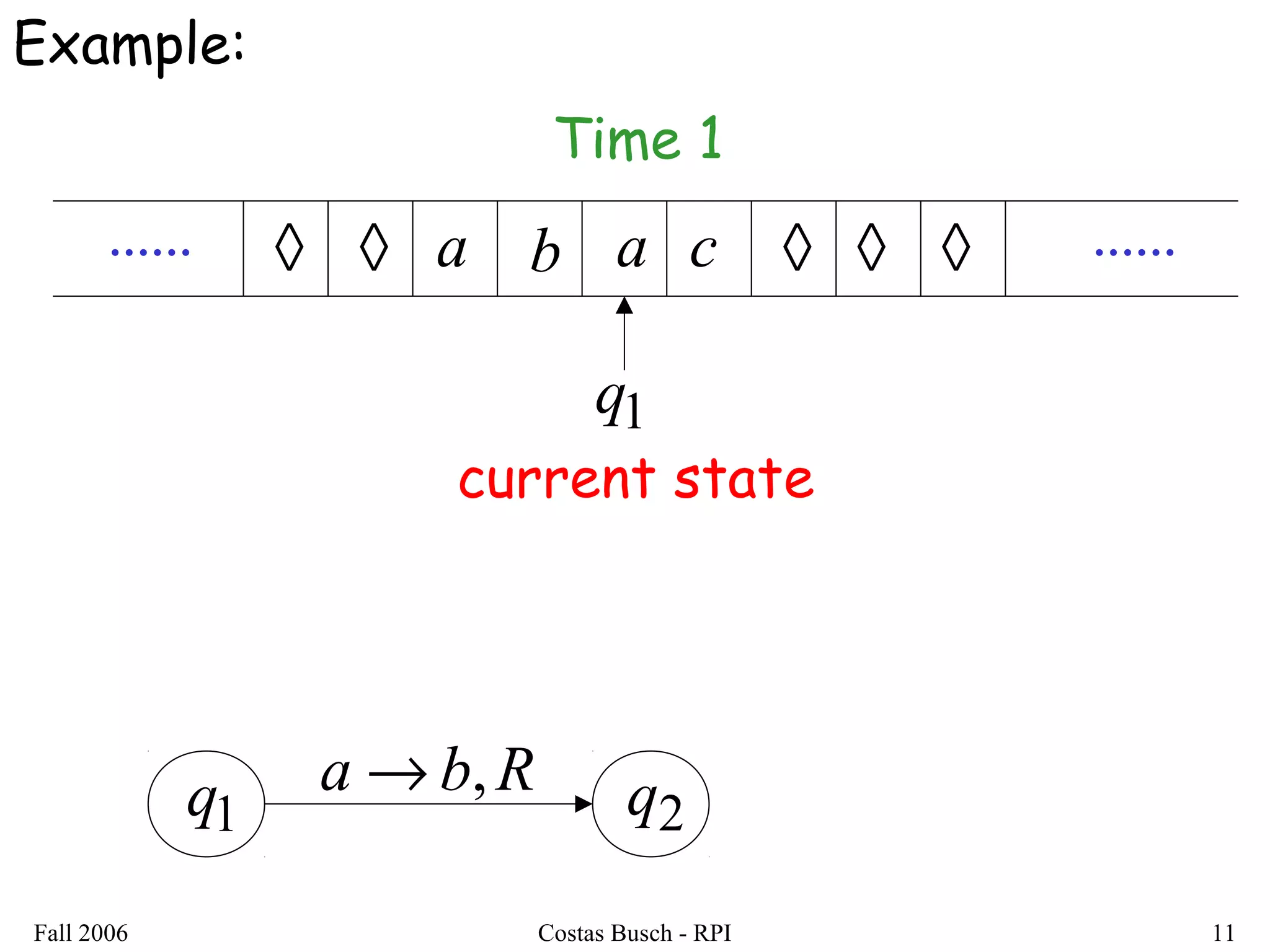
Example:
1q 2qRba ,→
............ ◊ ◊ ◊ ◊◊a b ca
Time 1
1q
current state
12.
Fall 2006 CostasBusch - RPI 12
............ ◊ ◊ ◊ ◊◊a b ca
Time 1
1q 2qRba ,→
............ ◊ ◊ ◊ ◊◊a b cb
Time 2
1q
2q
13.
Fall 2006 CostasBusch - RPI 13
............ ◊ ◊ ◊ ◊◊a b ca
Time 1
1q 2qLba ,→
............ ◊ ◊ ◊ ◊◊a b cb
Time 2
1q
2q
Example:
14.
Fall 2006 CostasBusch - RPI 14
............ ◊ ◊ ◊ ◊◊a b ca
Time 1
1q 2qRg,→◊
............ ◊ ◊ ◊ ◊ga b cb
Time 2
1q
2q
Example:
15.
Fall 2006 CostasBusch - RPI 15
Determinism
1q
2qRba ,→
Allowed Not Allowed
3qLdb ,→
1q
2qRba ,→
3qLda ,→
No lambda transitions allowed
Turing Machines are deterministic
16.
Fall 2006 CostasBusch - RPI 16
Partial Transition Function
1q
2qRba ,→
3qLdb ,→
............ ◊ ◊ ◊ ◊◊a b ca
1q
Example:
No transition
for input symbol c
Allowed:
17.
Fall 2006 CostasBusch - RPI 17
Halting
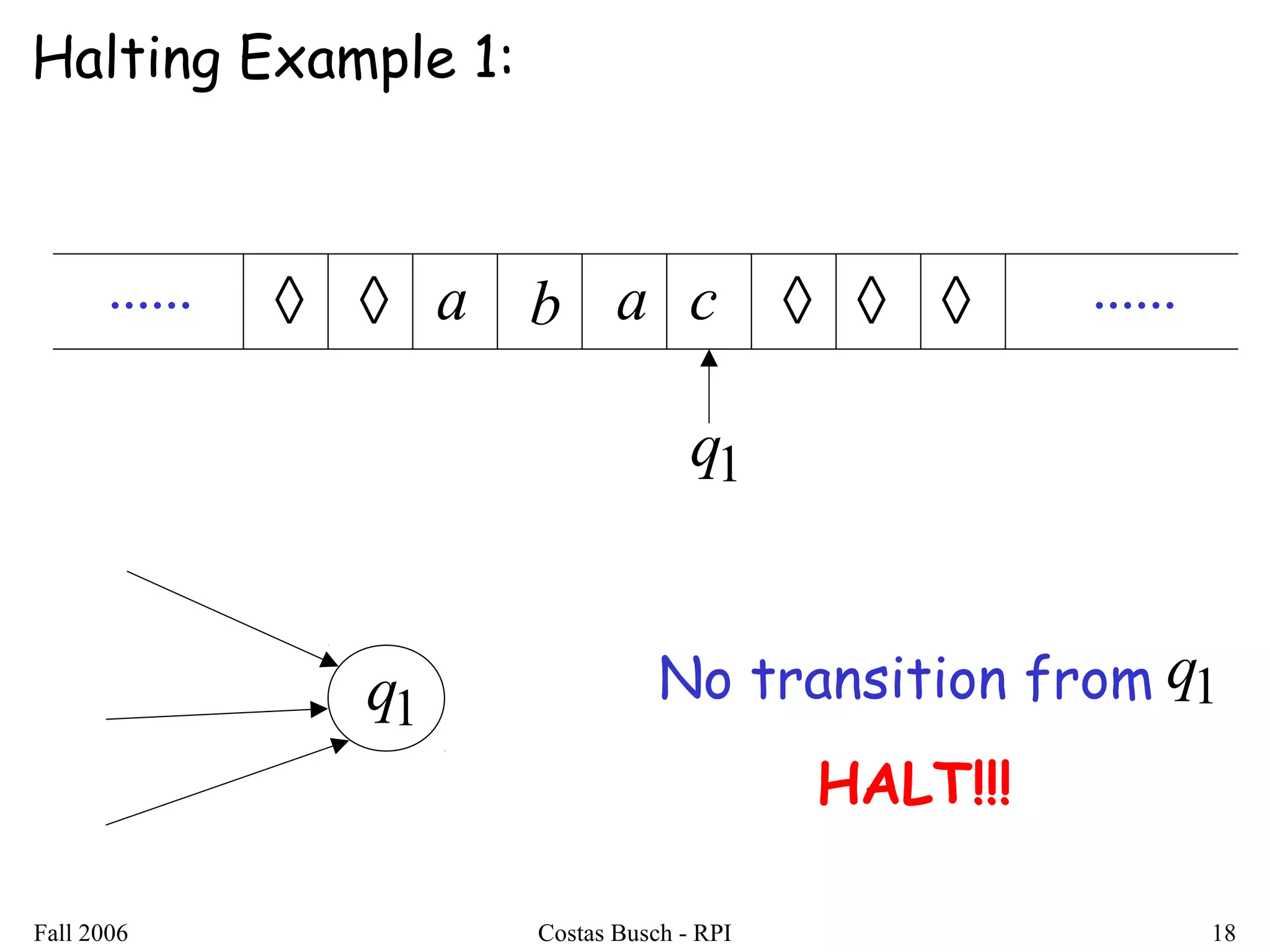
The machine halts in a state if there is
no transition to follow
18.
Fall 2006 CostasBusch - RPI 18
Halting Example 1:
............ ◊ ◊ ◊ ◊◊a b ca
1q
1q No transition from
HALT!!!
1q
19.
Fall 2006 CostasBusch - RPI 19
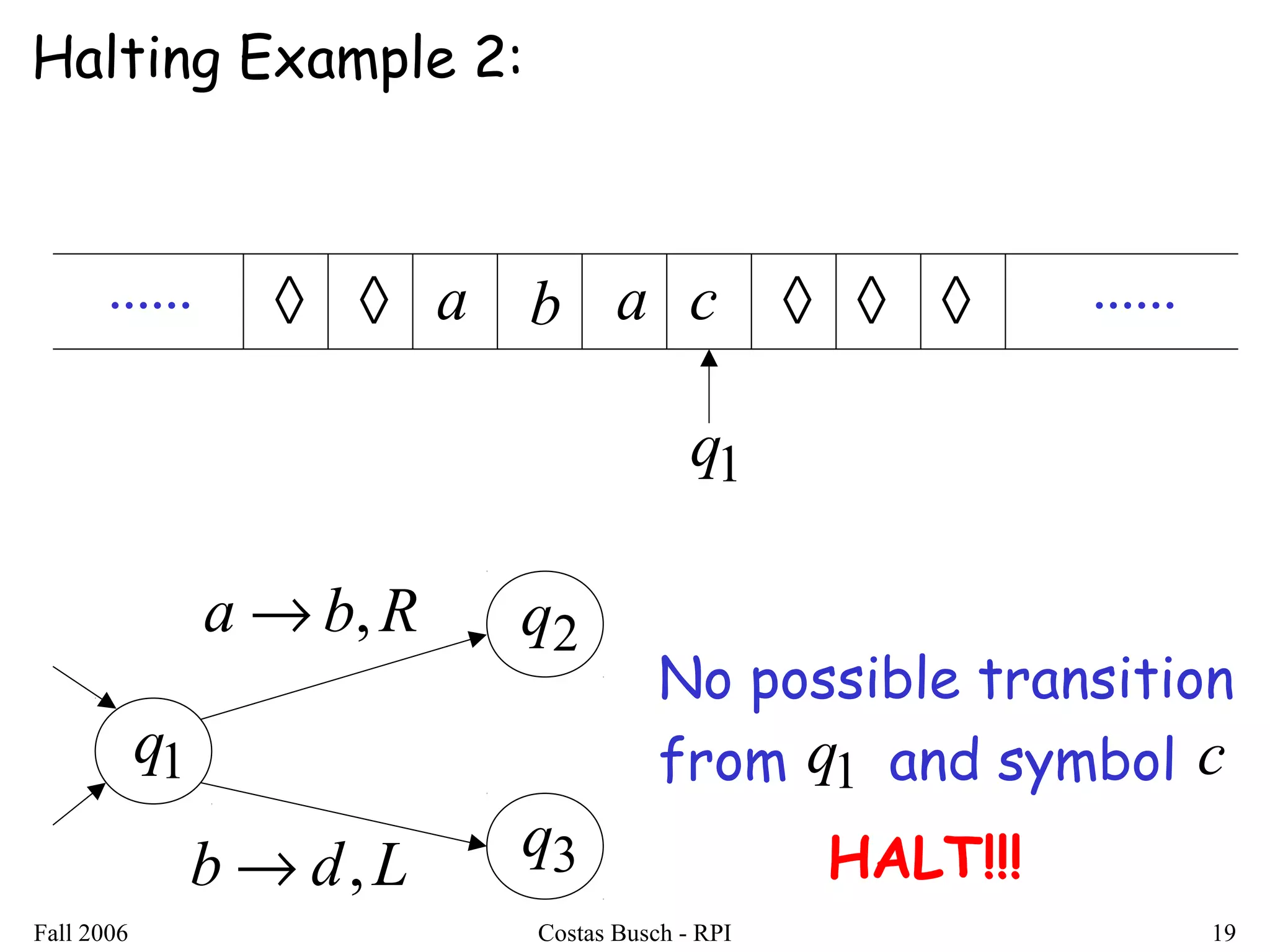
Halting Example 2:
............ ◊ ◊ ◊ ◊◊a b ca
1q
1q
2qRba ,→
3qLdb ,→
No possible transition
from and symbol
HALT!!!
1q c
20.
Fall 2006 CostasBusch - RPI 20
Accepting States
1q 2q Allowed
1q 2q Not Allowed
•Accepting states have no outgoing transitions
•The machine halts and accepts
21.
Fall 2006 CostasBusch - RPI 21
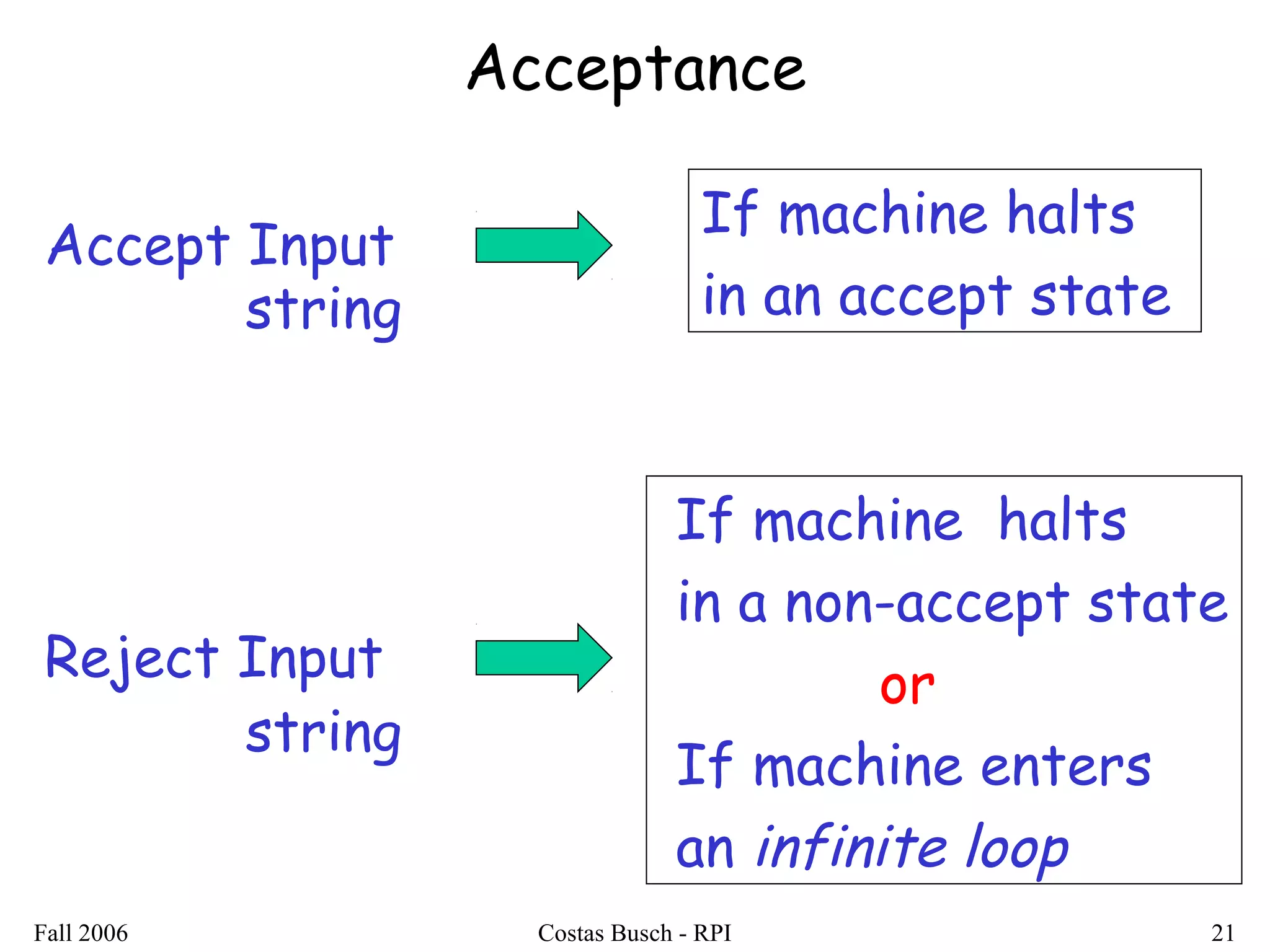
Acceptance
Accept Input
If machine halts
in an accept state
Reject Input
If machine halts
in a non-accept state
or
If machine enters
an infinite loop
string
string
22.
Fall 2006 CostasBusch - RPI 22
Observation:
In order to accept an input string,
it is not necessary to scan all the
symbols in the string
23.
Fall 2006 CostasBusch - RPI 23
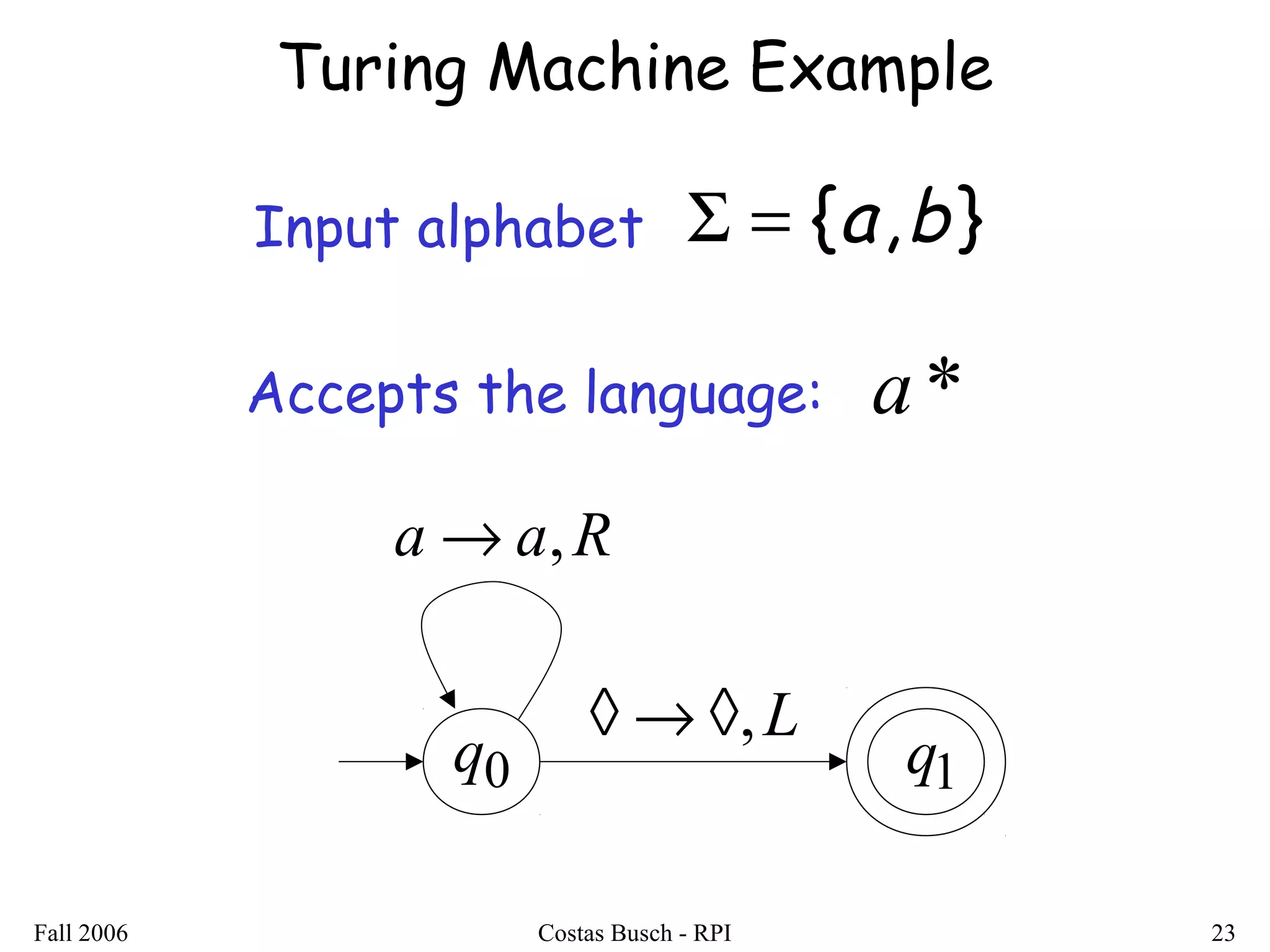
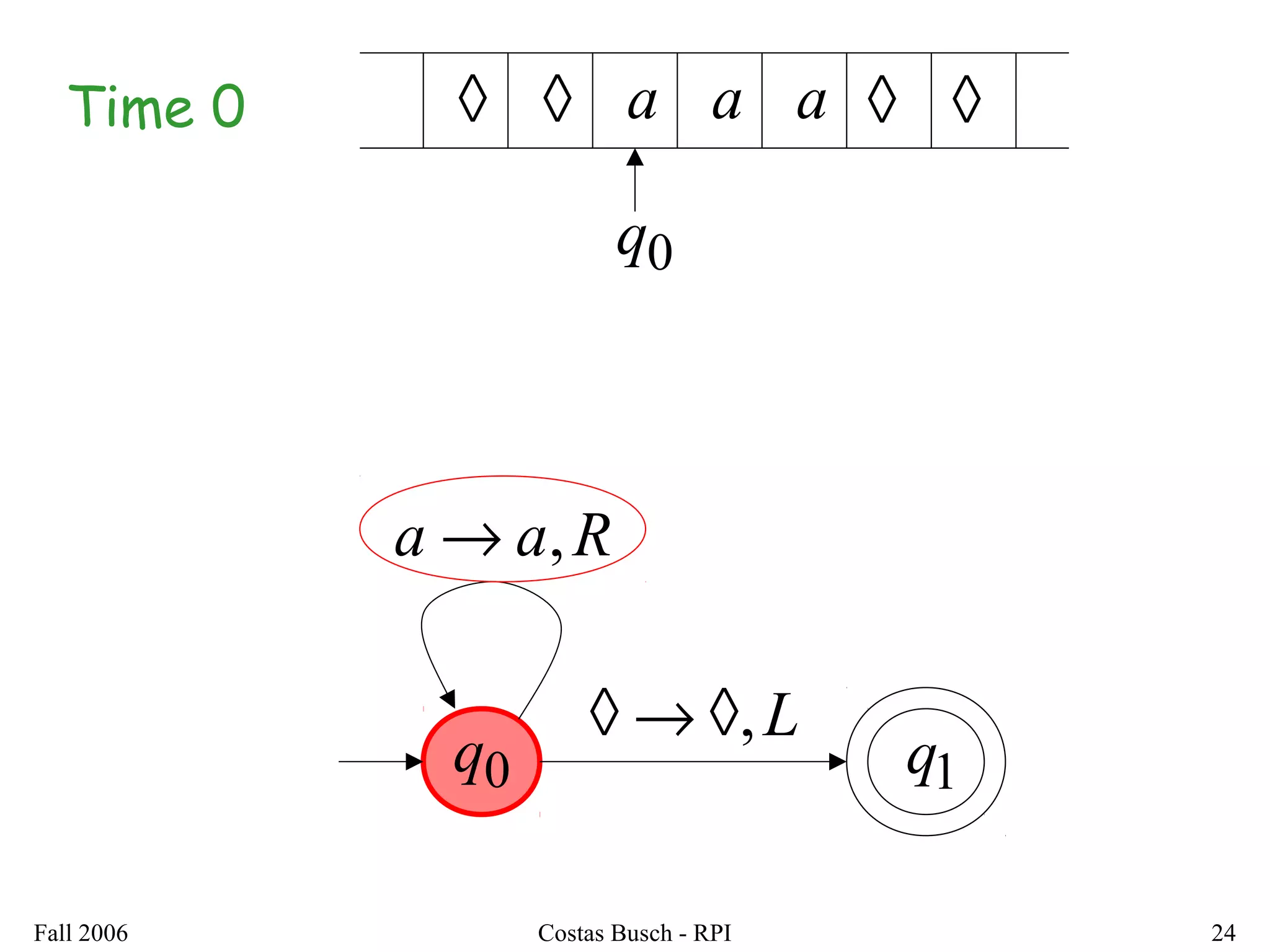
Turing Machine Example
Accepts the language: *a
0q
Raa ,→
L,◊→◊
1q
Input alphabet },{ ba=Σ
24.
Fall 2006 CostasBusch - RPI 24
◊ ◊ ◊ ◊aaTime 0
0q
a
0q
Raa ,→
L,◊→◊
1q
25.
Fall 2006 CostasBusch - RPI 25
◊ ◊ ◊ ◊aaTime 1
0q
a
0q
Raa ,→
L,◊→◊
1q
26.
Fall 2006 CostasBusch - RPI 26
◊ ◊ ◊ ◊aaTime 2
0q
a
0q
Raa ,→
L,◊→◊
1q
27.
Fall 2006 CostasBusch - RPI 27
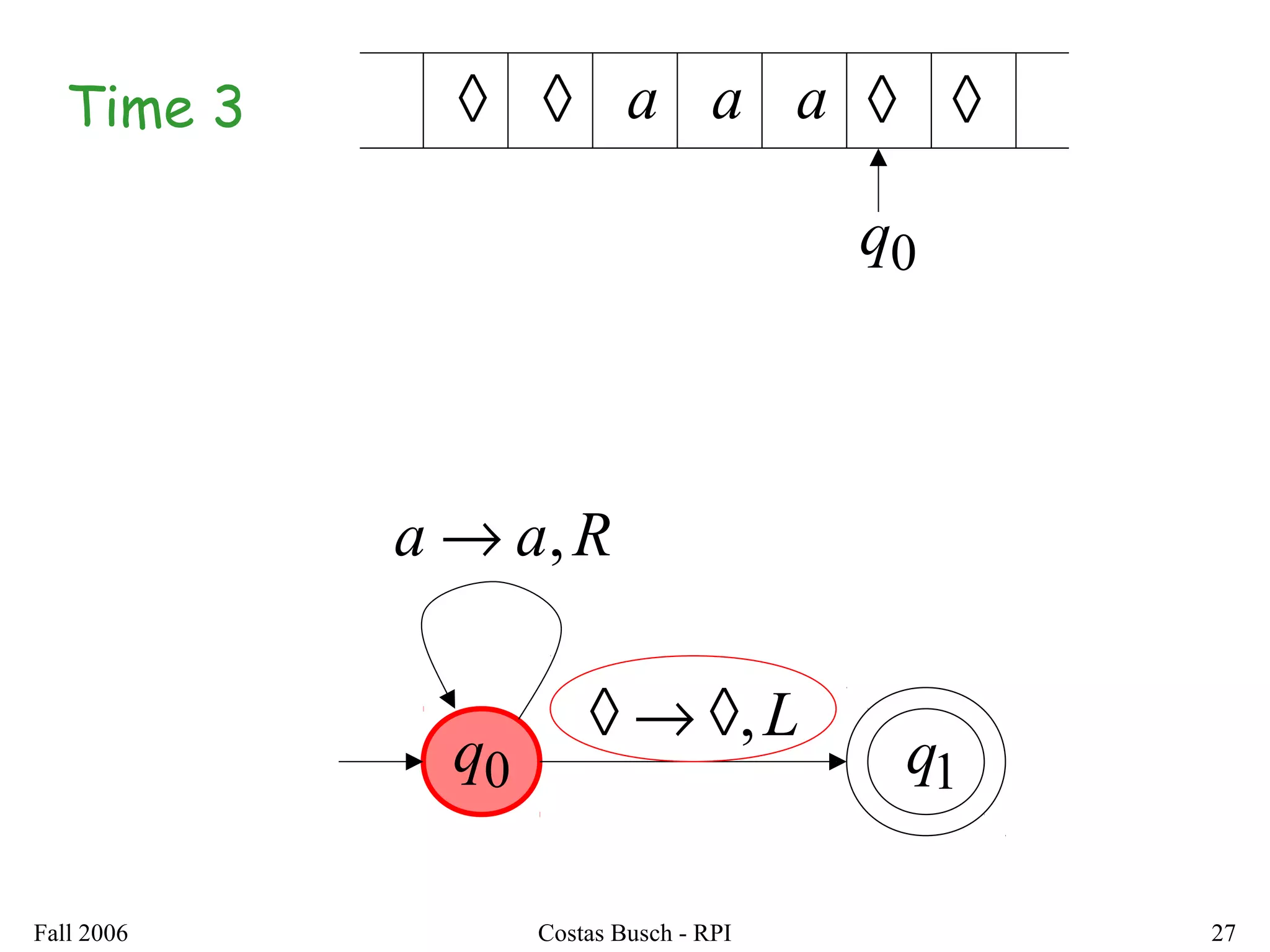
◊ ◊ ◊ ◊aaTime 3
0q
a
0q
Raa ,→
L,◊→◊
1q
28.
Fall 2006 CostasBusch - RPI 28
◊ ◊ ◊ ◊aaTime 4
1q
a
0q
Raa ,→
L,◊→◊
1q
Halt & Accept
29.
Fall 2006 CostasBusch - RPI 29
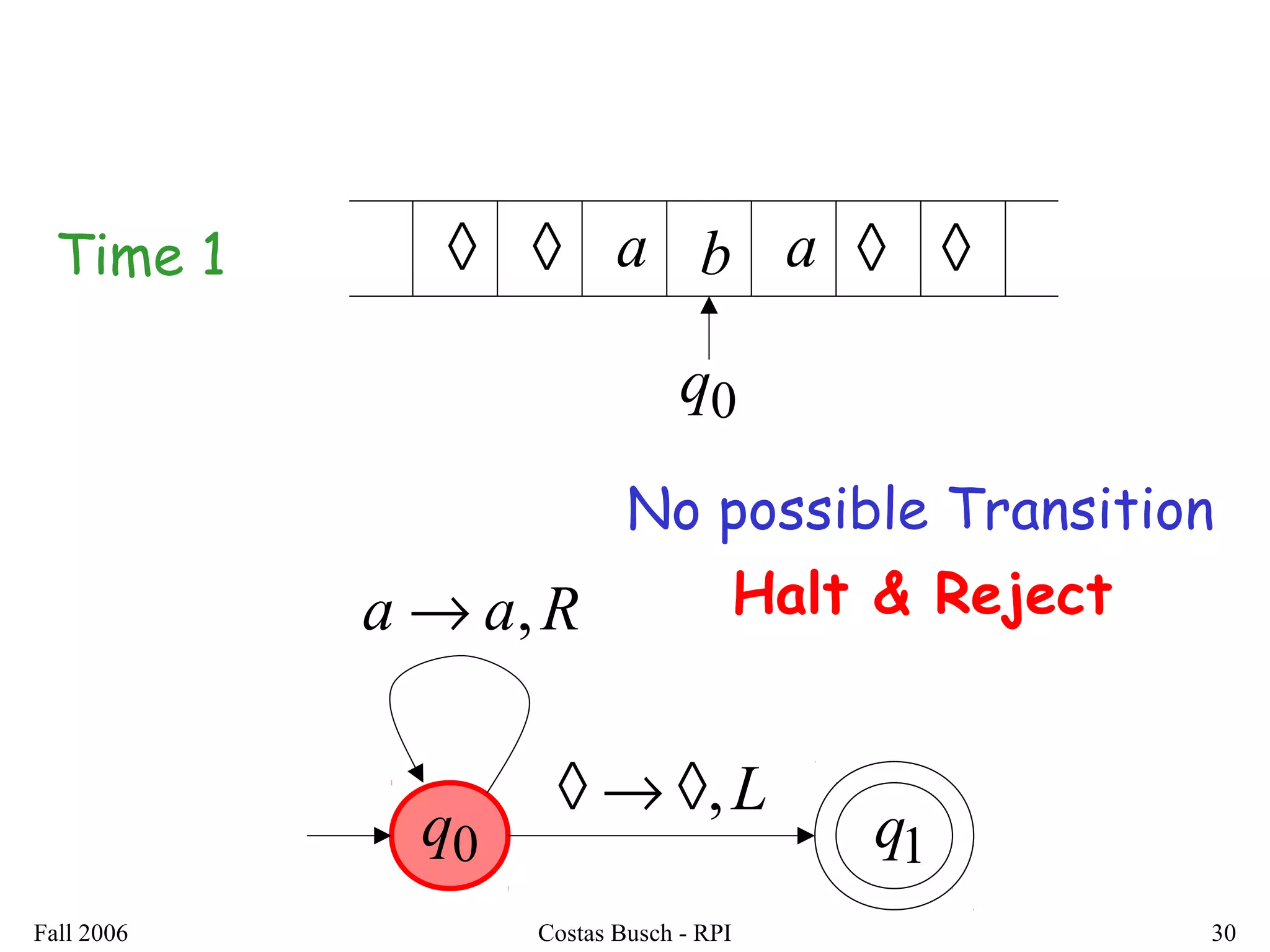
Rejection Example
0q
Raa ,→
L,◊→◊
1q
◊ ◊ ◊ ◊baTime 0
0q
a
30.
Fall 2006 CostasBusch - RPI 30
0q
Raa ,→
L,◊→◊
1q
◊ ◊ ◊ ◊baTime 1
0q
a
No possible Transition
Halt & Reject
31.
Fall 2006 CostasBusch - RPI 31
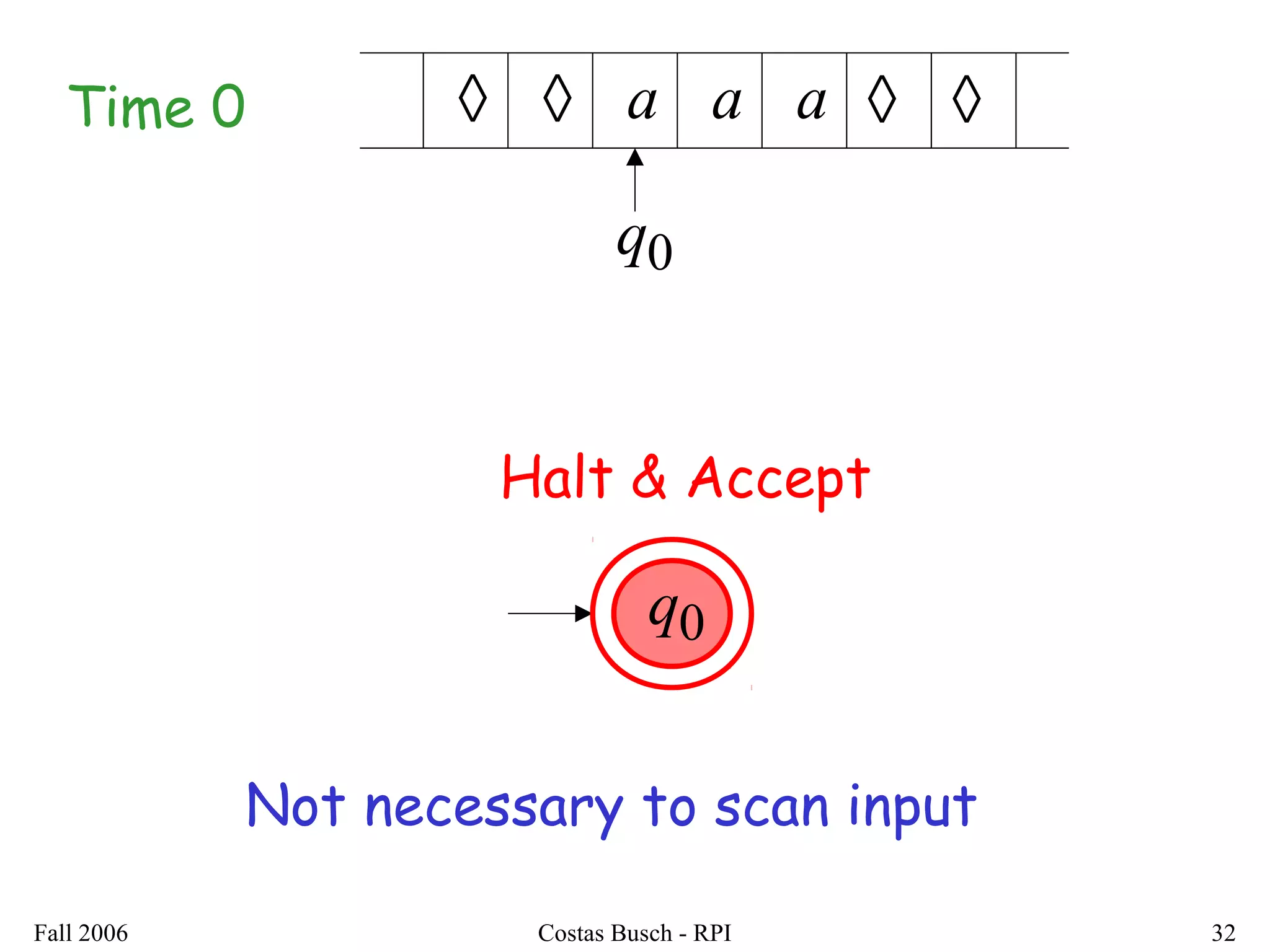
Accepts the language: *a
0q
but for input alphabet }{a=Σ
A simpler machine for same language
32.
Fall 2006 CostasBusch - RPI 32
◊ ◊ ◊ ◊aaTime 0
0q
a
0q
Halt & Accept
Not necessary to scan input
33.
Fall 2006 CostasBusch - RPI 33
Infinite Loop Example
0q
Raa ,→
L,◊→◊
1q
Lbb ,→
A Turing machine
for language *)(* baba ++
34.
Fall 2006 CostasBusch - RPI 34
◊ ◊ ◊ ◊baTime 0
0q
a
0q
Raa ,→
L,◊→◊
1q
Lbb ,→
35.
Fall 2006 CostasBusch - RPI 35
◊ ◊ ◊ ◊baTime 1
0q
a
0q
Raa ,→
L,◊→◊
1q
Lbb ,→
36.
Fall 2006 CostasBusch - RPI 36
◊ ◊ ◊ ◊baTime 2
0q
a
0q
Raa ,→
L,◊→◊
1q
Lbb ,→
37.
Fall 2006 CostasBusch - RPI 37
◊ ◊ ◊ ◊baTime 2
0q
a
◊ ◊ ◊ ◊baTime 3
0q
a
◊ ◊ ◊ ◊baTime 4
0q
a
◊ ◊ ◊ ◊baTime 5
0q
a
Infiniteloop
38.
Fall 2006 CostasBusch - RPI 38
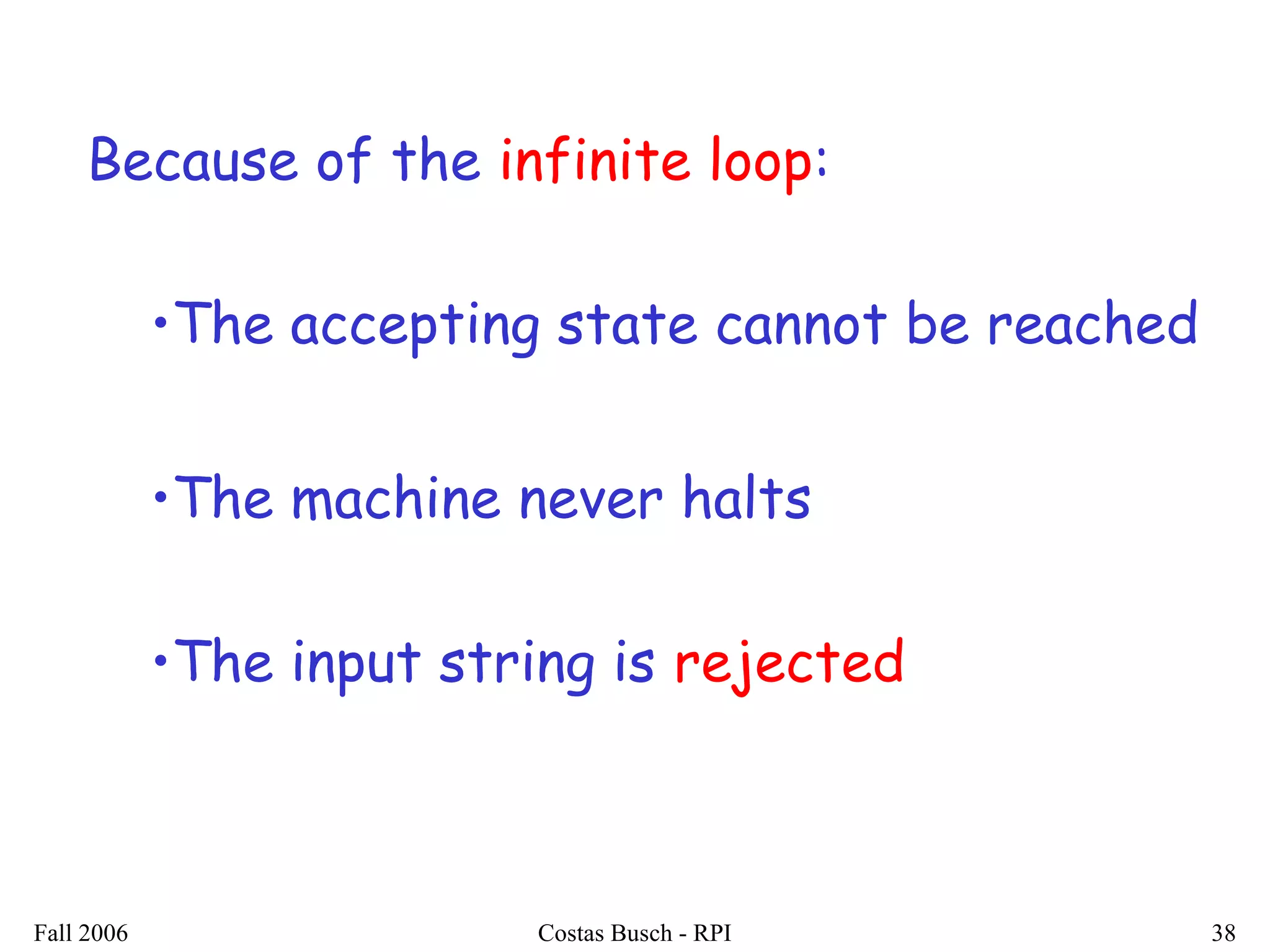
Because of the infinite loop:
•The accepting state cannot be reached
•The machine never halts
•The input string is rejected
39.
Fall 2006 CostasBusch - RPI 39
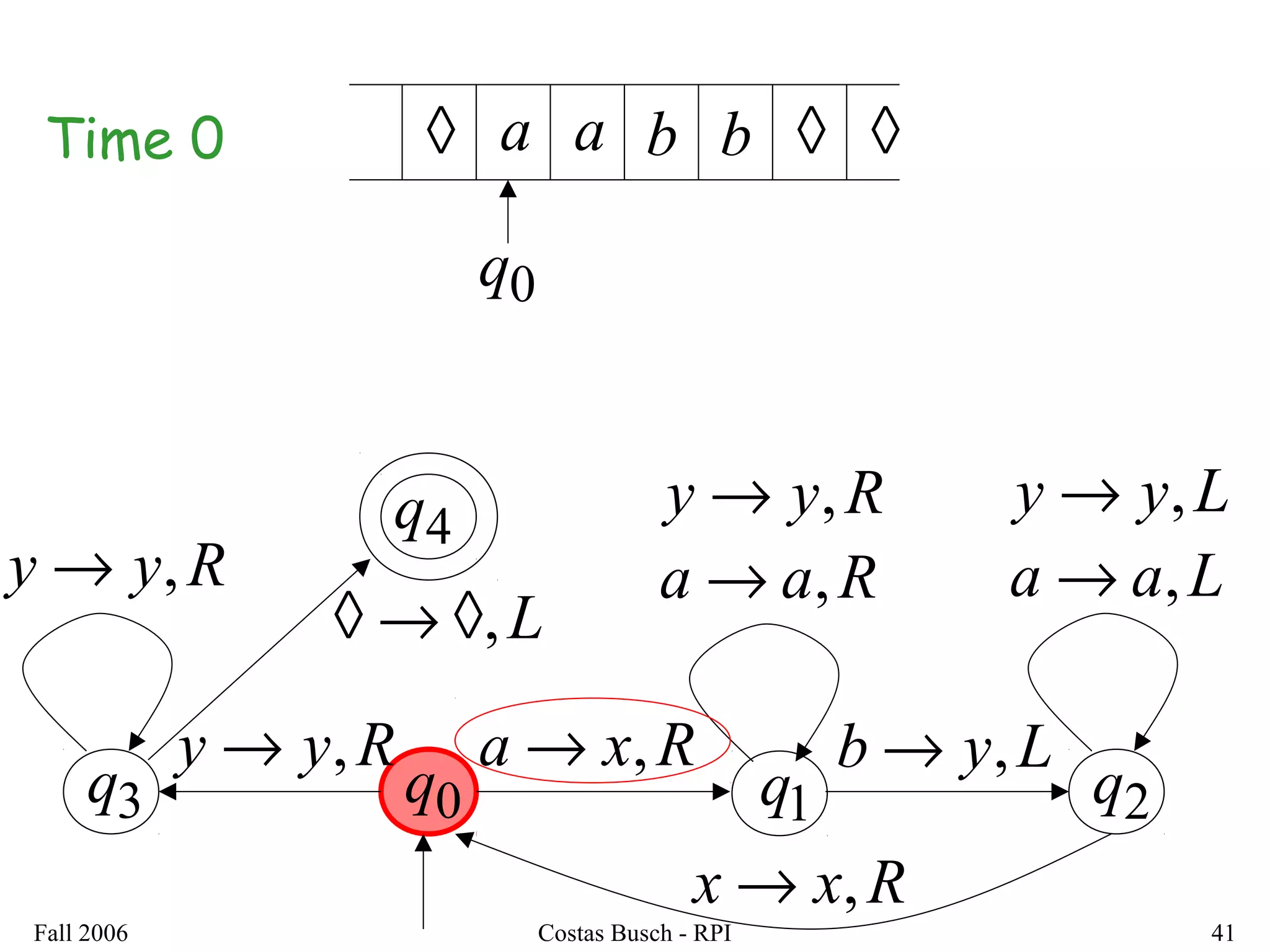
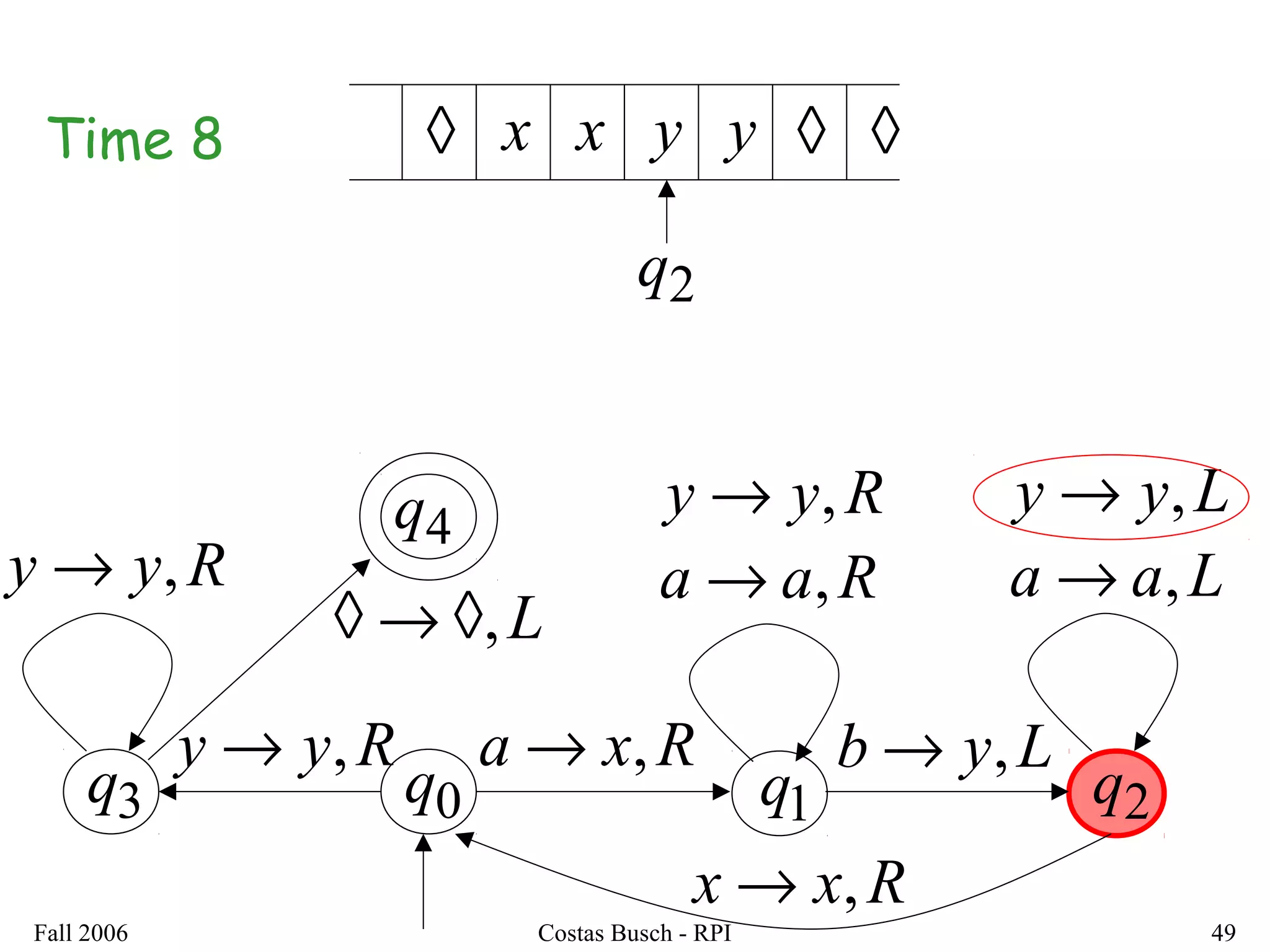
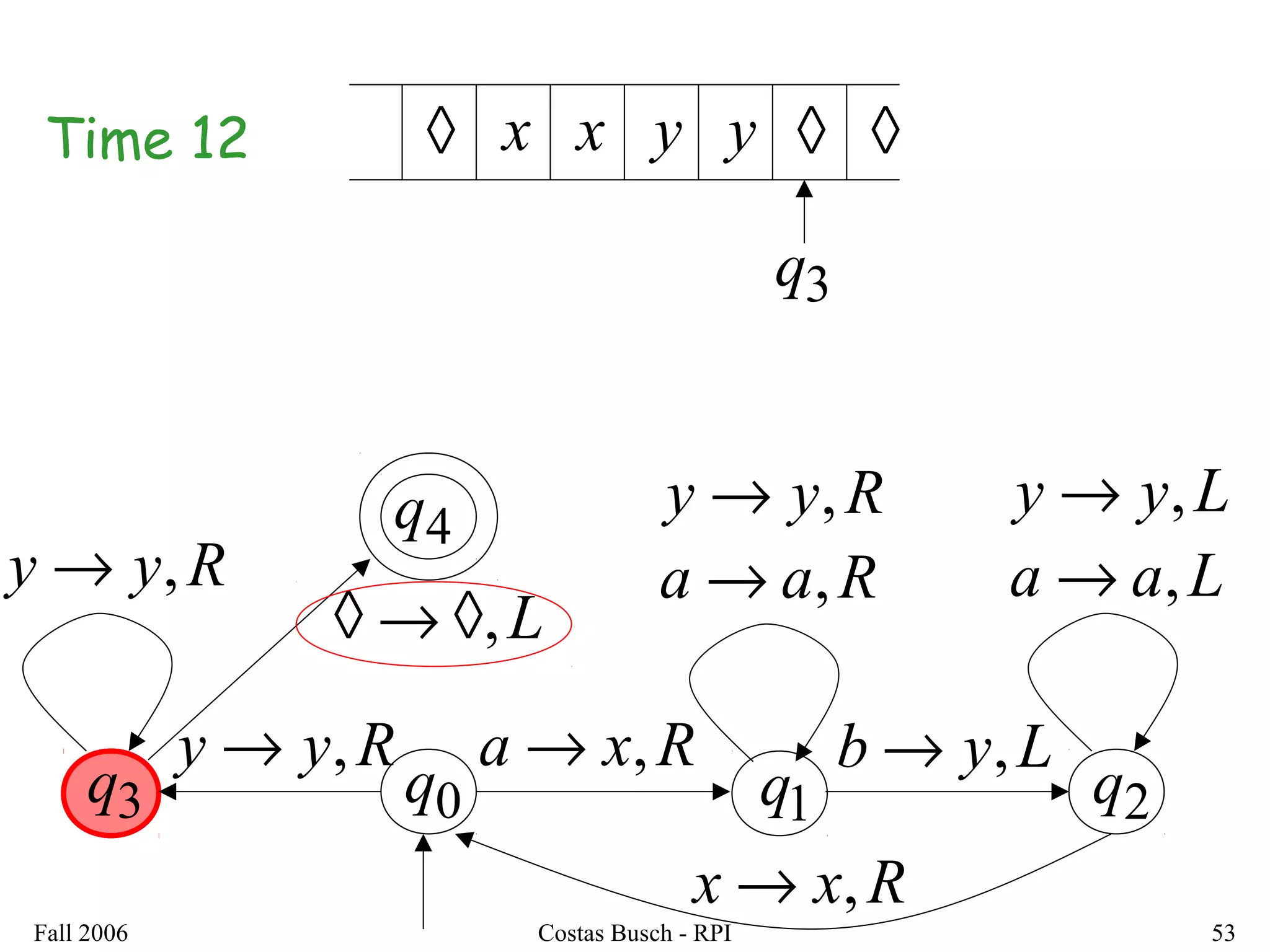
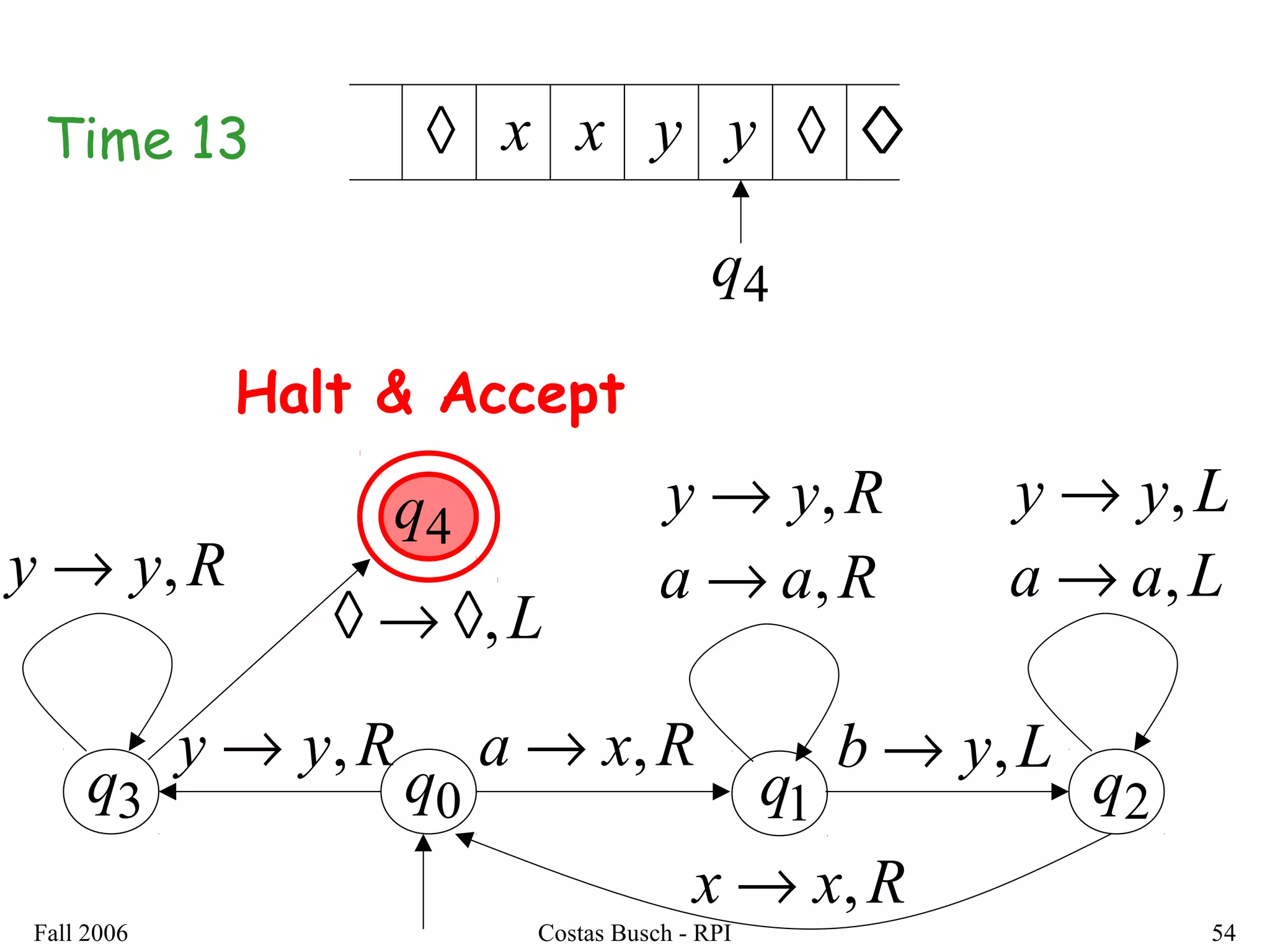
Another Turing Machine Example
Turing machine for the language }{ nn
ba
0q 1q 2q3q
Rxa ,→
Raa ,→
Ryy ,→
Lyb ,→
Laa ,→
Lyy ,→
Rxx ,→
Ryy ,→
Ryy ,→
4q
L,◊→◊
1≥n
40.
Fall 2006 CostasBusch - RPI 40
Match a’s with b’s:
Repeat:
replace leftmost a with x
find leftmost b and replace it with y
Until there are no more a’s or b’s
If there is a remaining a or b reject
Basic Idea:
Fall 2006 CostasBusch - RPI 54
0q 1q 2q3q
Rxa ,→
Raa ,→
Ryy ,→
Lyb ,→
Laa ,→
Lyy ,→
Rxx ,→
Ryy ,→
Ryy ,→
4q
L,◊→◊
◊ ◊yx
4q
x y ◊
Halt & Accept
Time 13
55.
Fall 2006 CostasBusch - RPI 55
If we modify the
machine for the language }{ nn
ba
we can easily construct
a machine for the language }{ nnn
cba
Observation:
56.
Fall 2006 CostasBusch - RPI 56
Formal Definitions
for
Turing Machines
57.
Fall 2006 CostasBusch - RPI 57
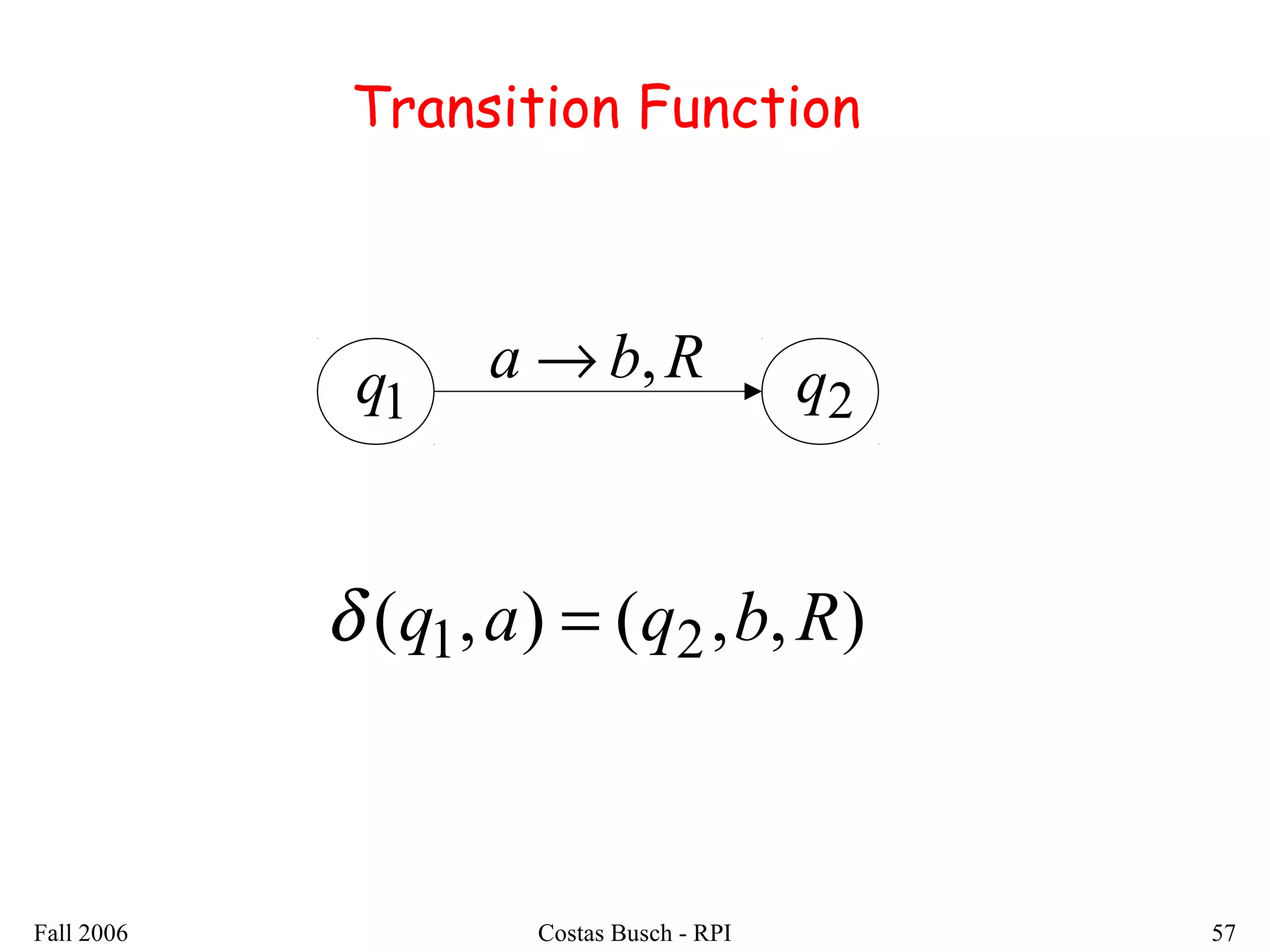
Transition Function
1q 2qRba ,→
),,(),( 21 Rbqaq =δ
58.
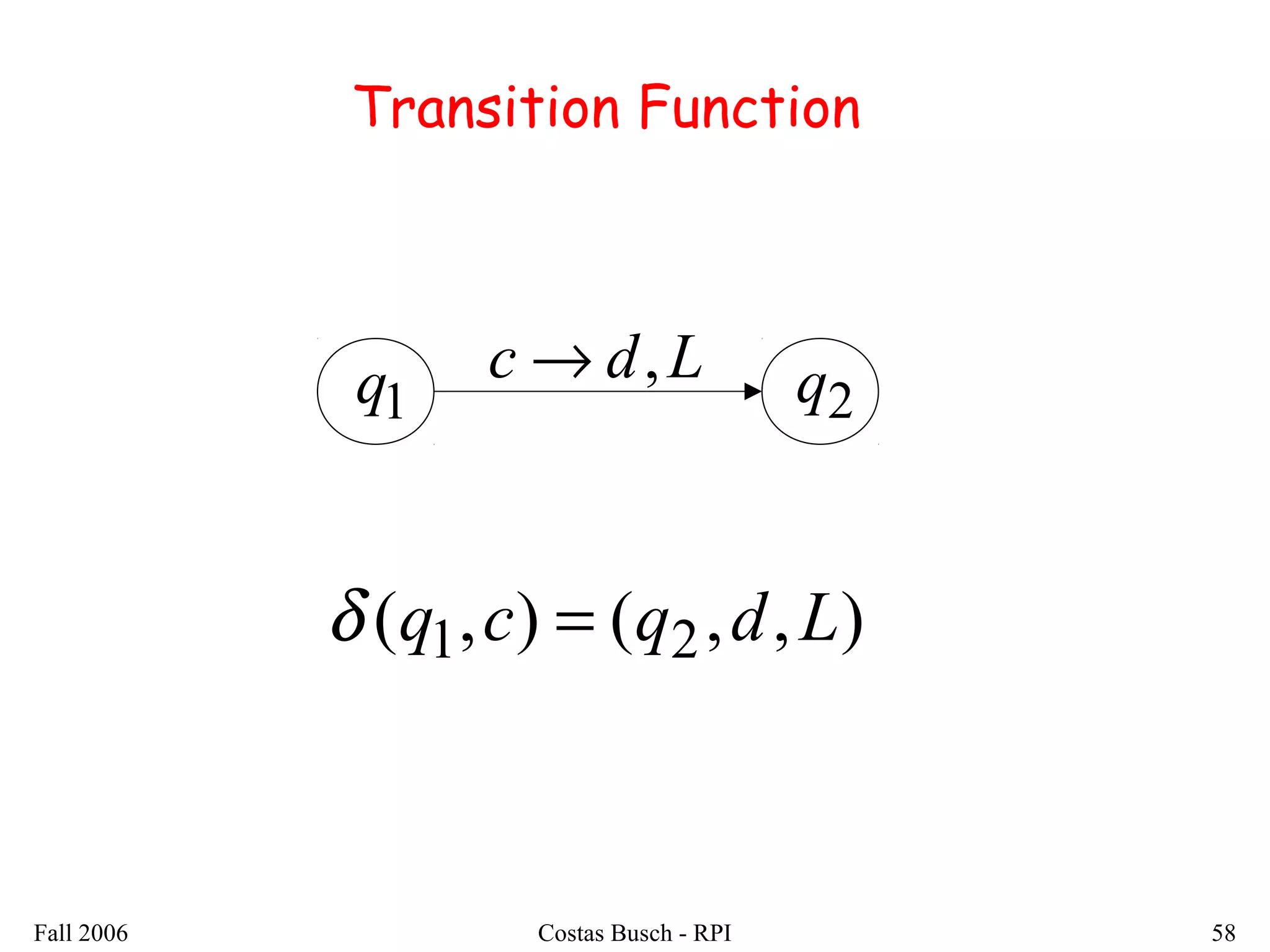
Fall 2006 CostasBusch - RPI 58
1q 2qLdc ,→
),,(),( 21 Ldqcq =δ
Transition Function
59.
Fall 2006 CostasBusch - RPI 59
Turing Machine:
),,,,,,( 0 FqQM ◊ΓΣ= δ
States
Input
alphabet
Tape
alphabet
Transition
function
Initial
state
blank
Accept
states
60.
Fall 2006 CostasBusch - RPI 60
Configuration
◊ ◊ ◊ba
1q
a
Instantaneous description:
c◊
baqca 1
61.
Fall 2006 CostasBusch - RPI 61
◊ ◊yx
2q
a b
Time 4
◊ ◊yx
0q
a b
Time 5
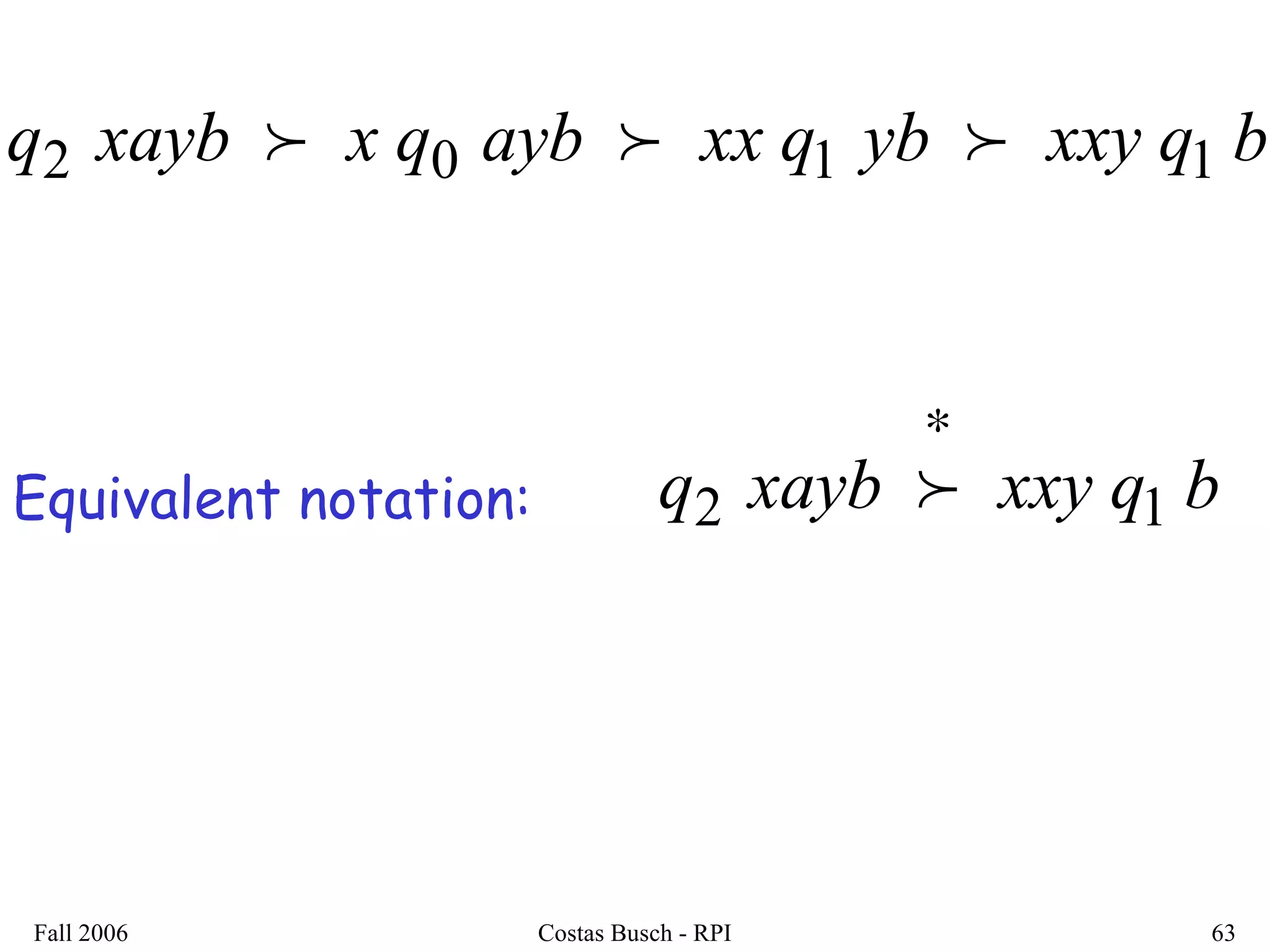
◊ ◊
A Move: aybqxxaybq 02
(yields in one mode)
62.
Fall 2006 CostasBusch - RPI 62
◊ ◊yx
2q
a b
Time 4
◊ ◊yx
0q
a b
Time 5
◊ ◊
bqxxyybqxxaybqxxaybq 1102
◊ ◊yx
1q
x b
Time 6
◊ ◊yx
1q
x b
Time 7
◊ ◊
A computation
Fall 2006 CostasBusch - RPI 64
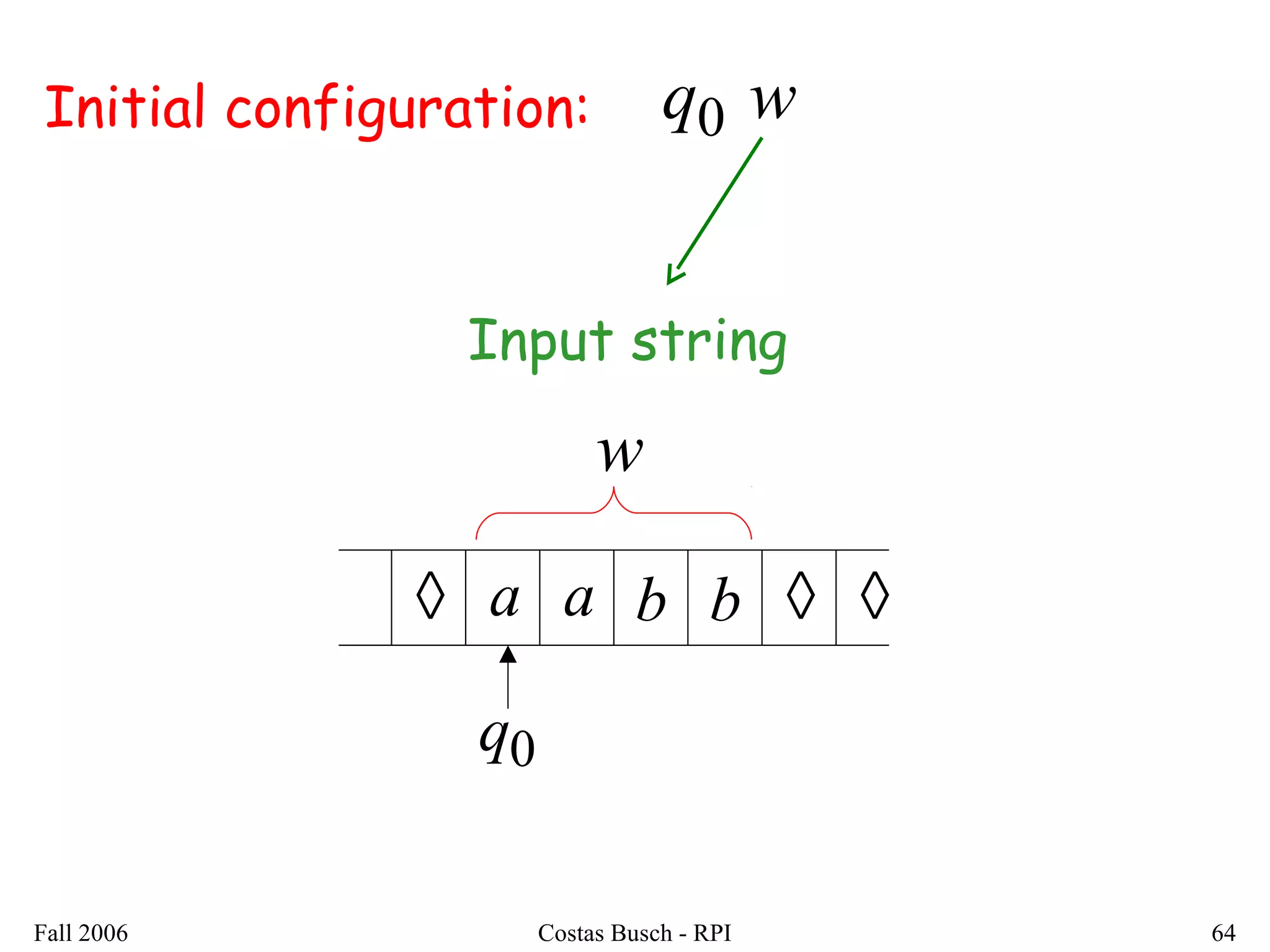
Initial configuration: wq0
◊ ◊ba
0q
a b ◊
w
Input string
65.
Fall 2006 CostasBusch - RPI 65
The Accepted Language
For any Turing Machine M
}:{)( 210 xqxwqwML f
∗
=
Initial state Accept state
66.
Fall 2006 CostasBusch - RPI 66
If a language is accepted
by a Turing machine
then we say that is:
•Turing Acceptable
•Recursively Enumerable
M
L
L
•Turing Recognizable
Other names used:
67.
Fall 2006 CostasBusch - RPI 67
Computing Functions
with
Turing Machines
68.
Fall 2006 CostasBusch - RPI 68
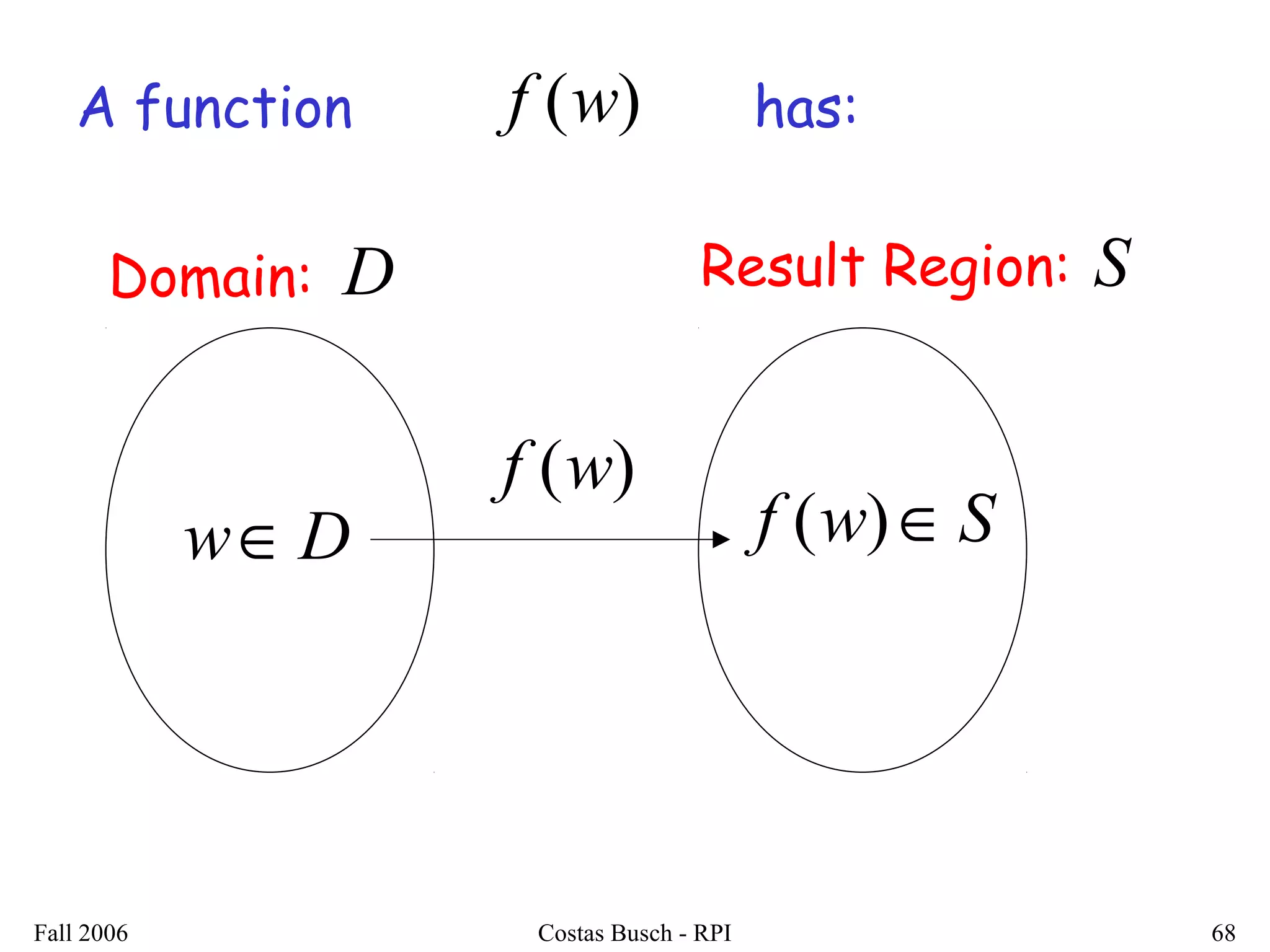
A function )(wf
Domain: Result Region:
has:
D
Dw∈
S
Swf ∈)(
)(wf
69.
Fall 2006 CostasBusch - RPI 69
A function may have many parameters:
yxyxf +=),(
Example: Addition function
70.
Fall 2006 CostasBusch - RPI 70
Integer Domain
Unary:
Binary:
Decimal:
11111
101
5
We prefer unary representation:
easier to manipulate with Turing machines
71.
Fall 2006 CostasBusch - RPI 71
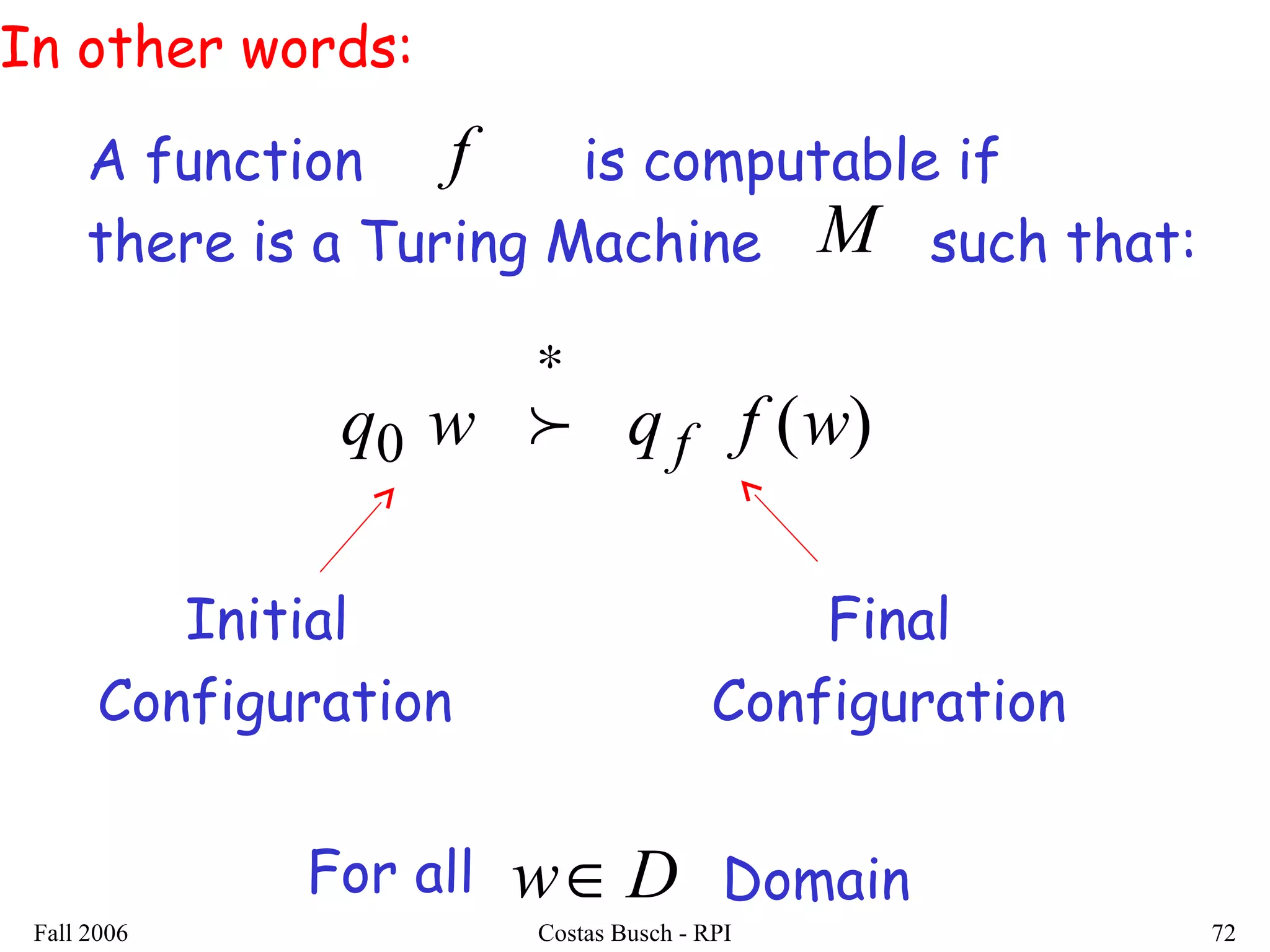
Definition:
A function is computable if
there is a Turing Machine such that:
f
M
Initial configuration Final configuration
Dw∈ Domain
◊
0q
◊w ◊
fq
◊)(wf
accept stateinitial state
For all
72.
Fall 2006 CostasBusch - RPI 72
)(0 wfqwq f
∗
Initial
Configuration
Final
Configuration
A function is computable if
there is a Turing Machine such that:
f
M
In other words:
Dw∈ DomainFor all
73.
Fall 2006 CostasBusch - RPI 73
Example
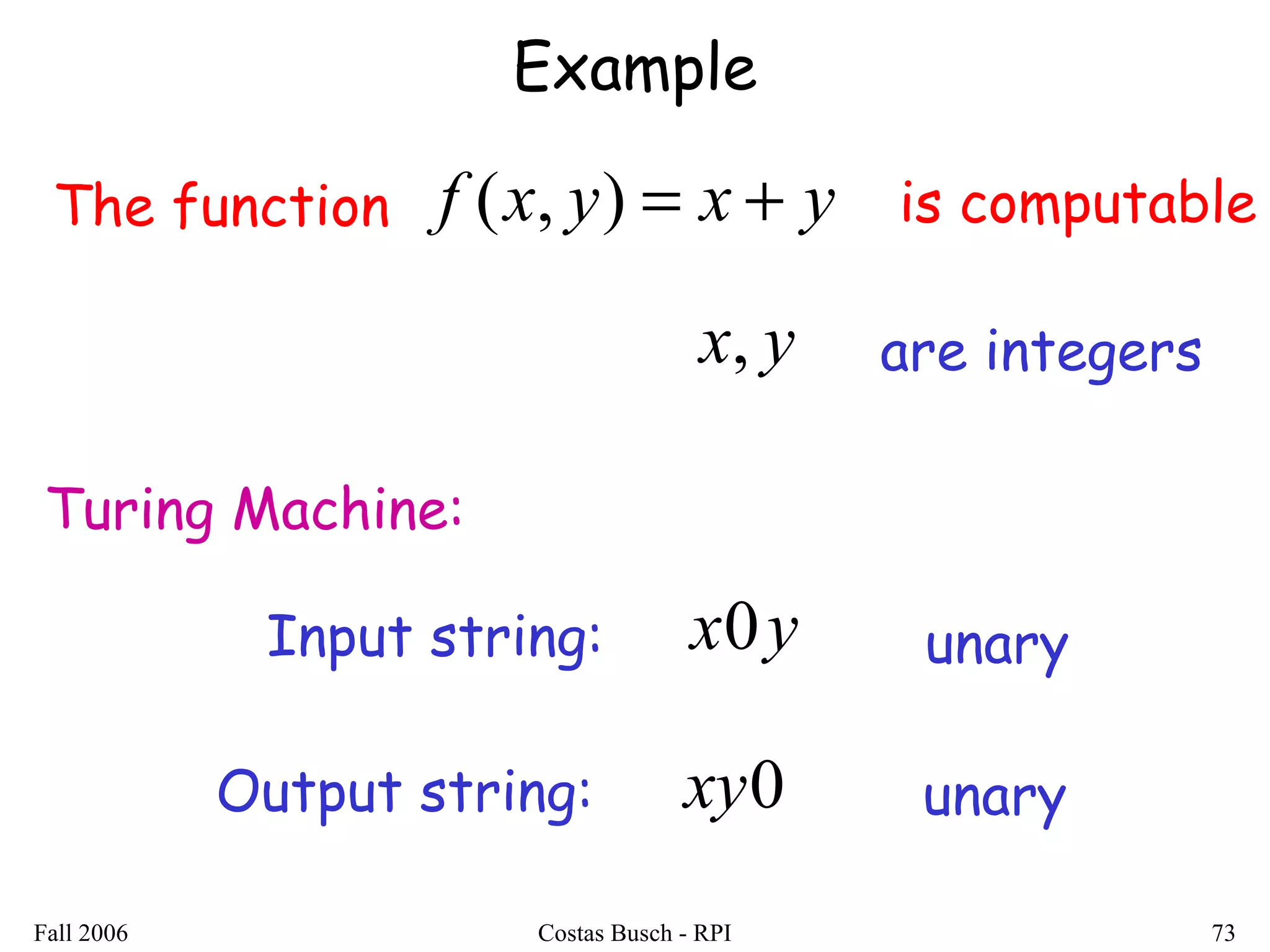
The function yxyxf +=),( is computable
Turing Machine:
Input string: yx0 unary
Output string: 0xy unary
yx, are integers
74.
Fall 2006 CostasBusch - RPI 74
◊ 0
0q
1 1 ◊1 1
x y
1 Start
initial state
The 0 is the delimiter that
separates the two numbers
75.
Fall 2006 CostasBusch - RPI 75
◊ 0
0q
1 1 ◊1 1
x y
1
◊ 0
fq
1 ◊1
yx +
11
Start
Finish
final state
initial state
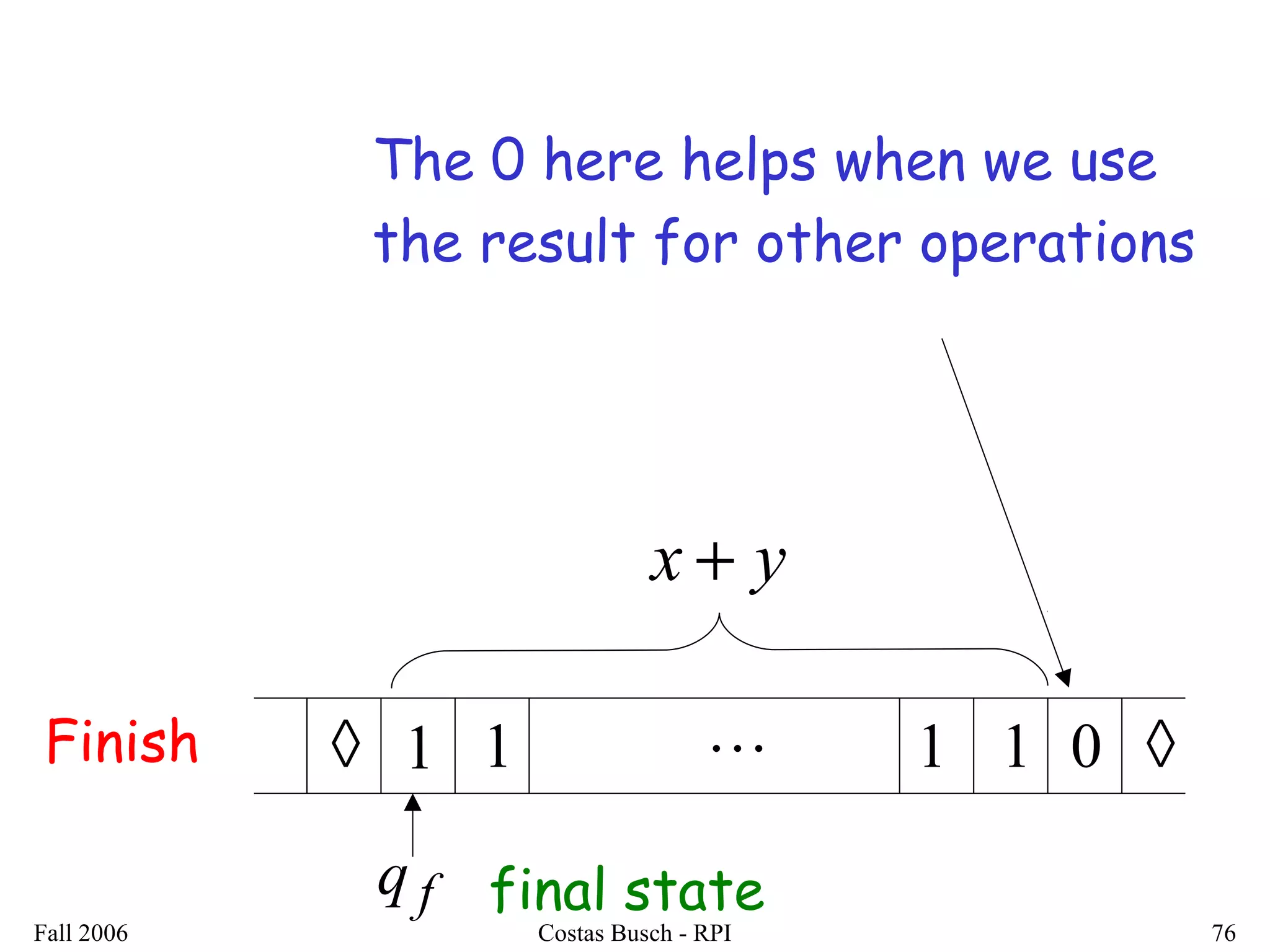
76.
Fall 2006 CostasBusch - RPI 76
◊ 0
fq
1 ◊1
yx +
11Finish
final state
The 0 here helps when we use
the result for other operations
77.
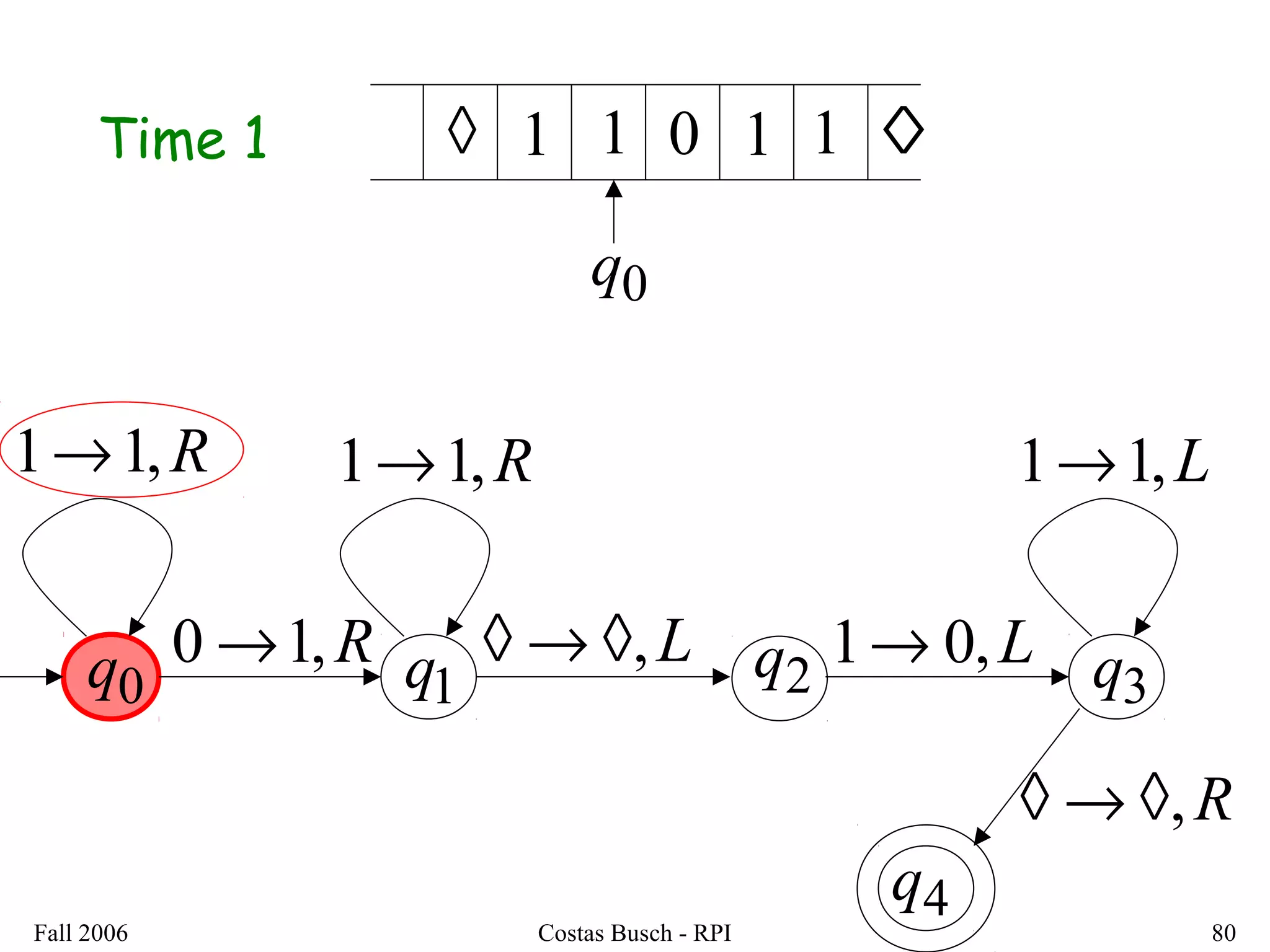
Fall 2006 CostasBusch - RPI 77
0q
Turing machine for function
1q 2q 3qL,◊→◊ L,01→
L,11→
R,◊→◊
R,10 →
R,11→
4q
R,11→
yxyxf +=),(
78.
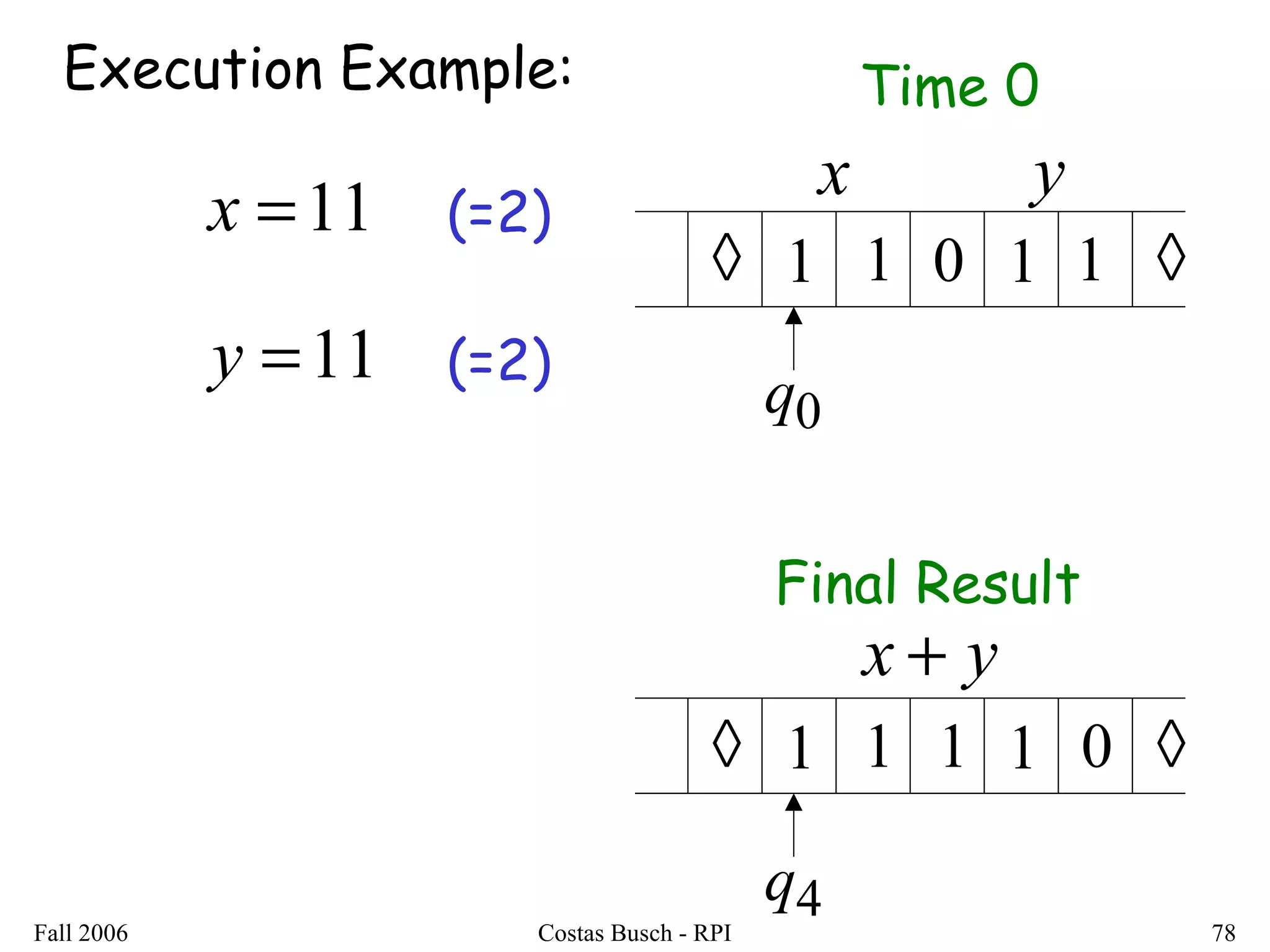
Fall 2006 CostasBusch - RPI 78
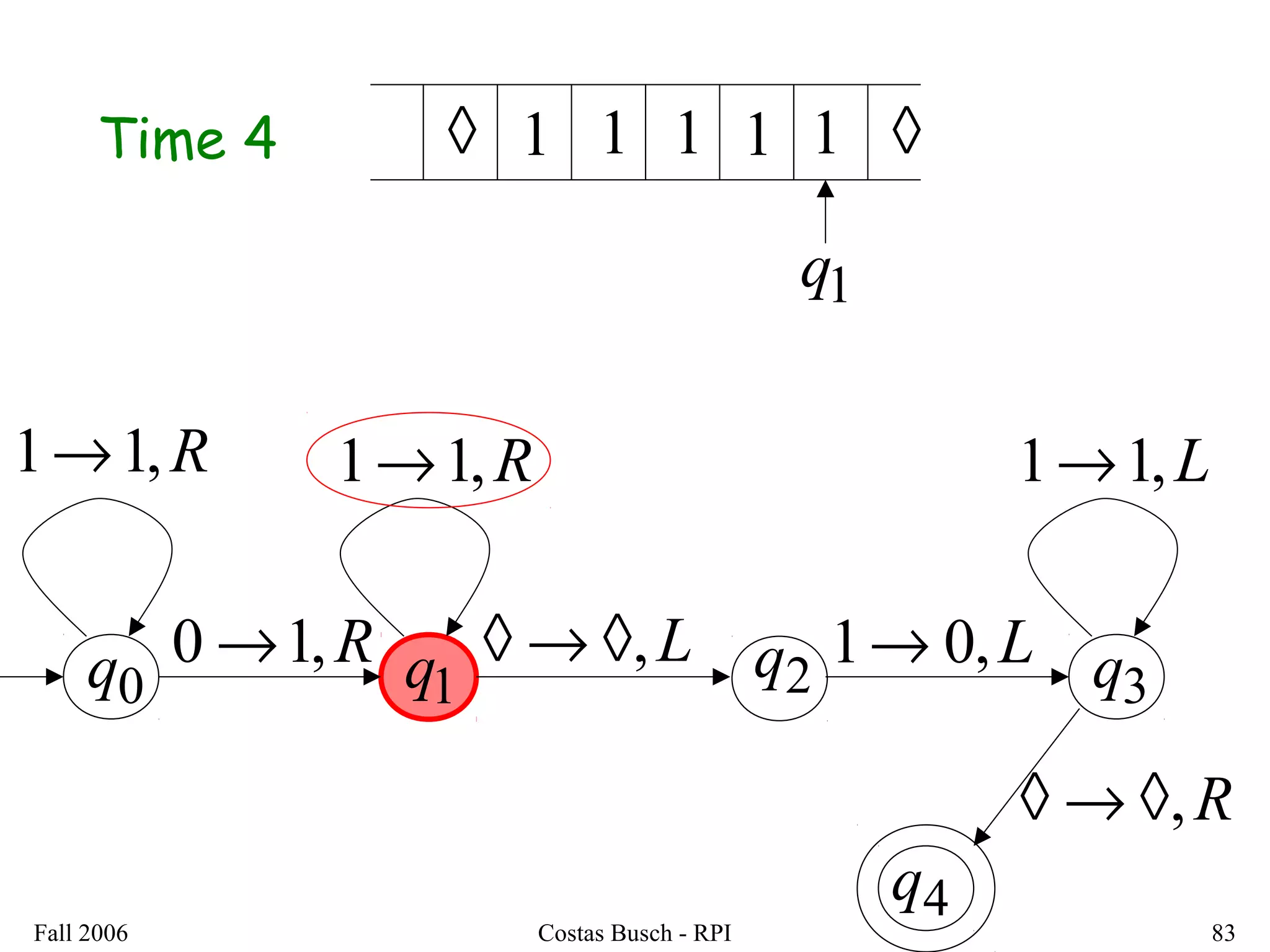
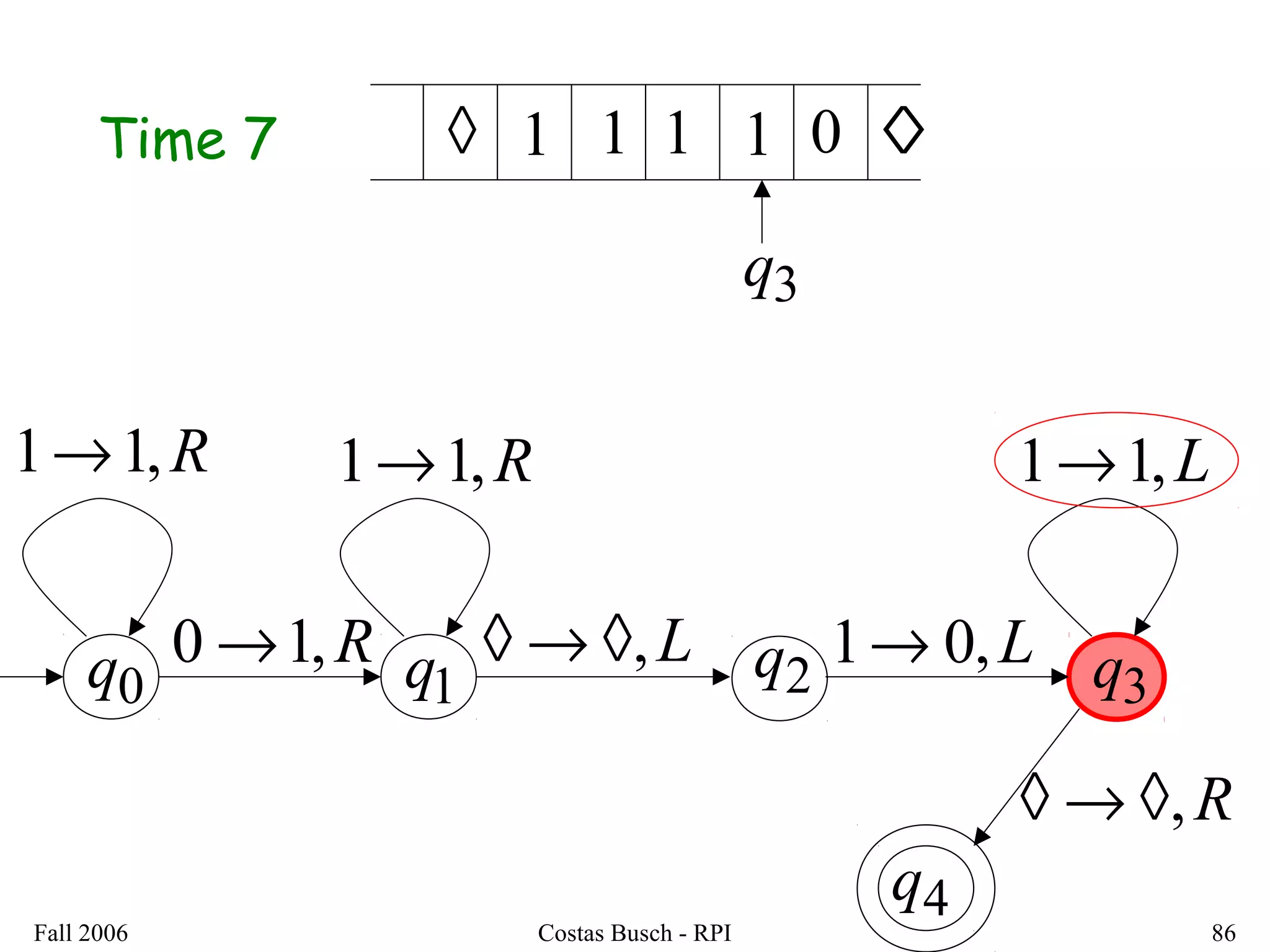
Execution Example:
11=x
11=y
◊ 0
0q
1 1 ◊1 1
Time 0
x y
Final Result
◊ 0
4q
1 1 ◊1 1
yx +
(=2)
(=2)
Fall 2006 CostasBusch - RPI 91
0q 1q 2q 3qL,◊→◊ L,01→
L,11→
R,◊→◊
R,10 →
R,11→
4q
R,11→
◊
4q
1 1 ◊1 01
HALT & accept
Time 12
92.
Fall 2006 CostasBusch - RPI 92
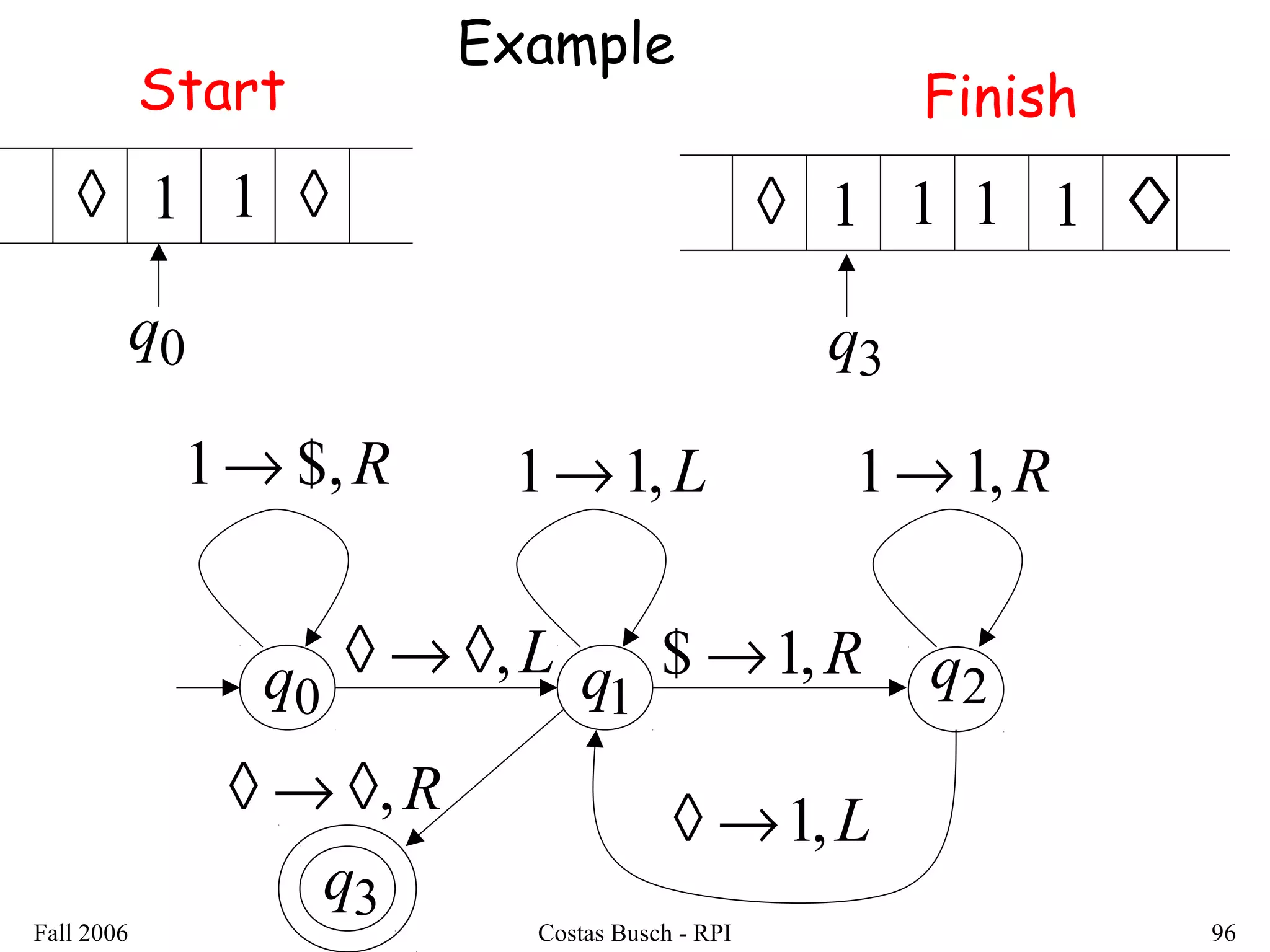
Another Example
The function xxf 2)( = is computable
Turing Machine:
Input string: x unary
Output string: xx unary
x is integer
93.
Fall 2006 CostasBusch - RPI 93
◊
0q
1 ◊1
x
1
◊ 1
fq
1 ◊1
x2
11
Start
Finish
accept state
initial state
94.
Fall 2006 CostasBusch - RPI 94
Turing Machine Pseudocode for xxf 2)( =
• Replace every 1 with $
• Repeat:
• Find rightmost $, replace it with 1
• Go to right end, insert 1
Until no more $ remain
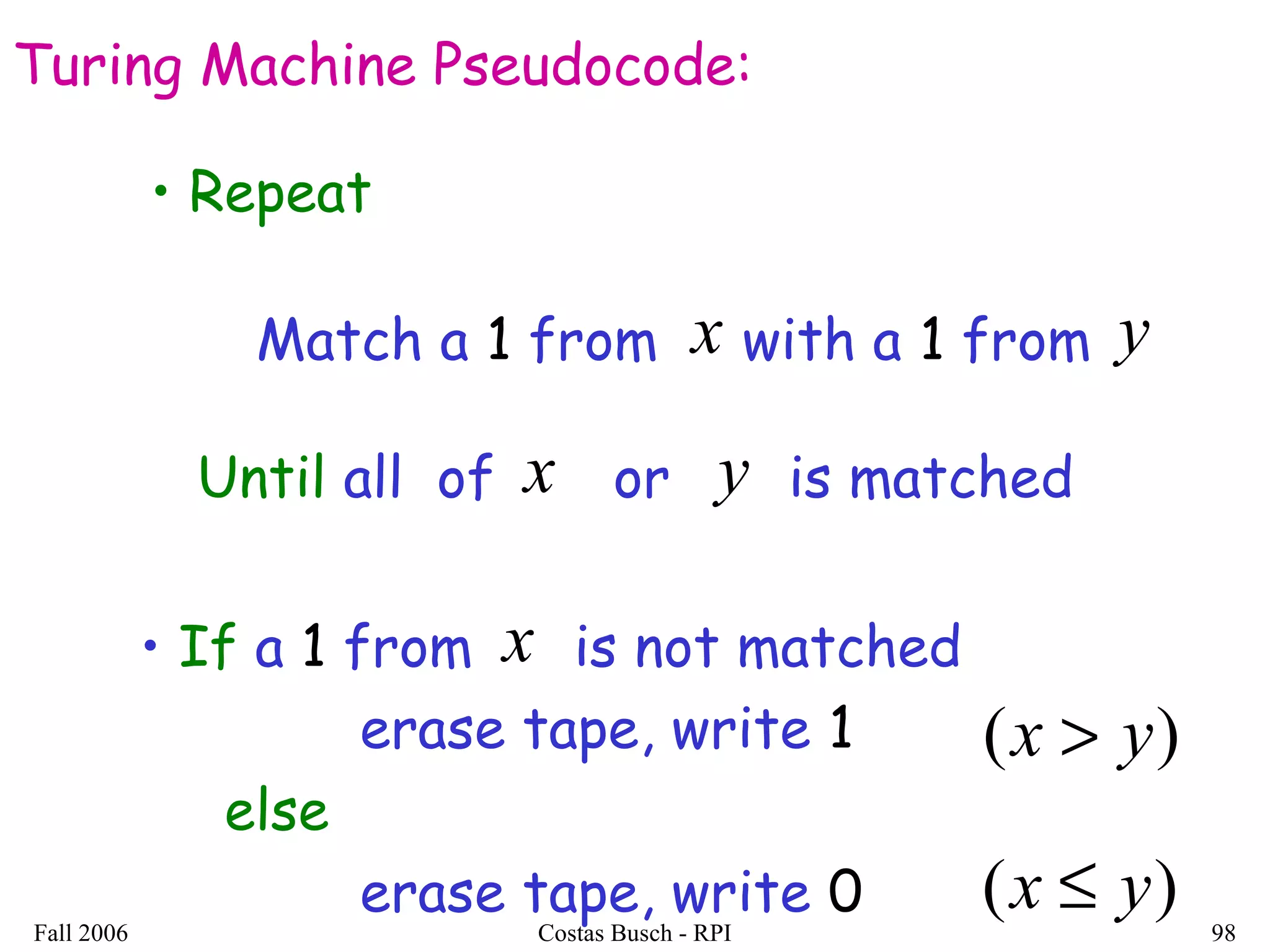
Fall 2006 CostasBusch - RPI 97
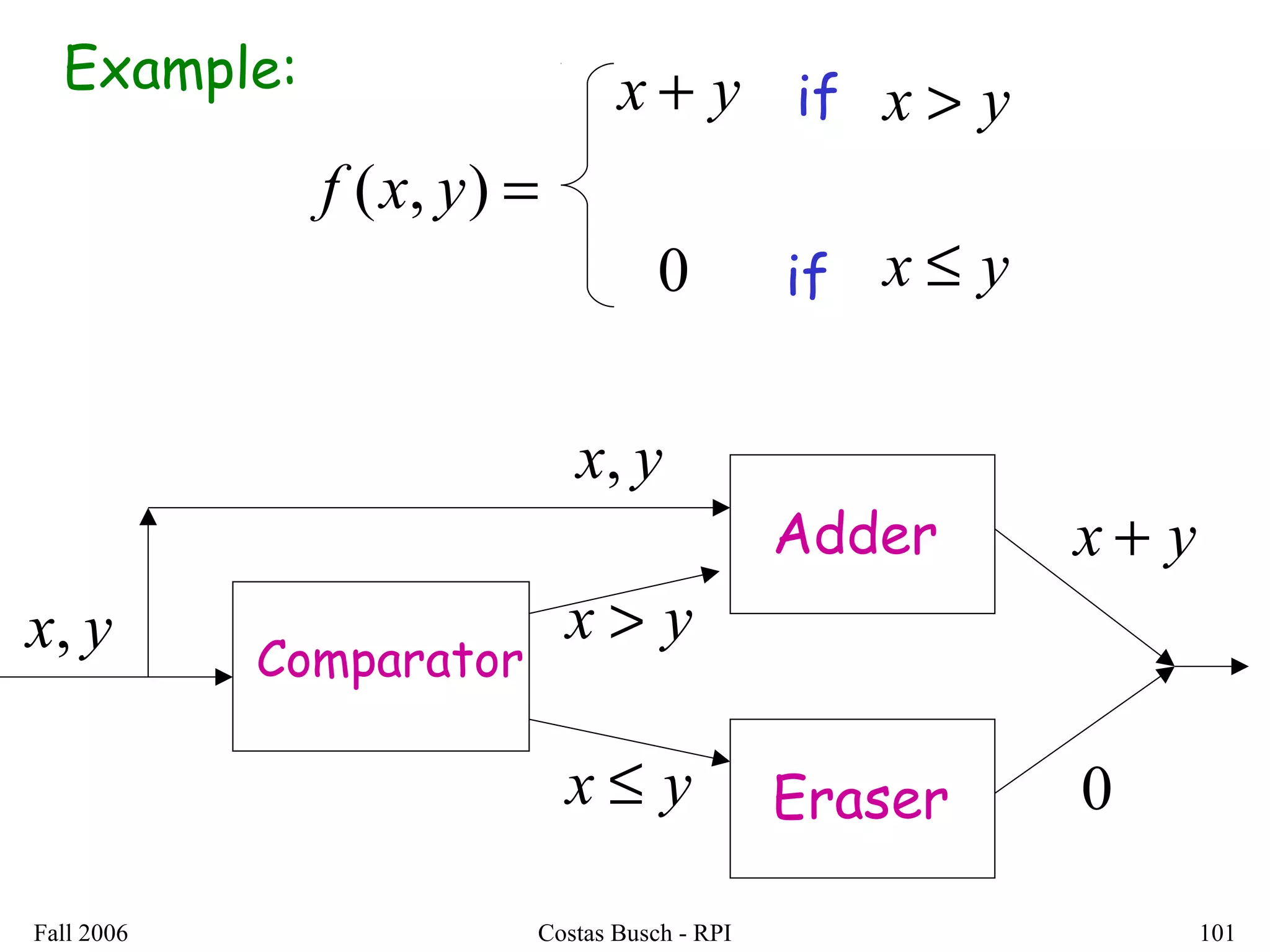
Another Example
The function =),( yxf
is computable 0
1 yx >
yx ≤
if
if
Input: yx0
Output: 1 0or
98.
Fall 2006 CostasBusch - RPI 98
Turing Machine Pseudocode:
Match a 1 from with a 1 fromx y
• Repeat
Until all of or is matchedx y
• If a 1 from is not matched
erase tape, write 1
else
erase tape, write 0
x
)( yx >
)( yx ≤