Turducken
Divide and conquer large GWT apps with
multiple teams

Rob Keane
Google / Ad Exchange Front End
rkeane@google.com
Turducken
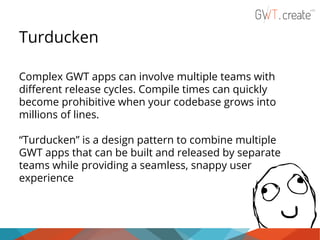
Complex GWT apps can involve multiple teams with
different release cycles. Compile times can quickly
become prohibitive when your codebase grows into
millions of lines.
“Turducken” is a design pattern to combine multiple
GWT apps that can be built and released by separate
teams while providing a seamless, snappy user
experience
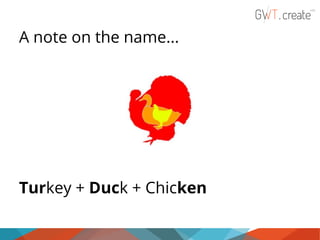
A note on the name...

Turkey + Duck + Chicken
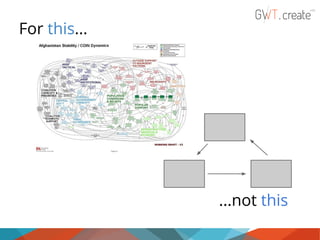
For this...

...not this
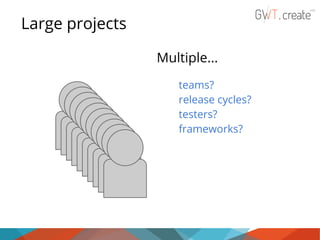
Large projects
Multiple...
teams?
release cycles?
testers?
frameworks?
Terminology
In the context of this talk...

Module == GWT Module with entry point
One last note...
This is a design pattern not a library
Turducken
1. Bob’s Sticker Emporium
2. Conquering Multiple Entry Points
3. Other uses
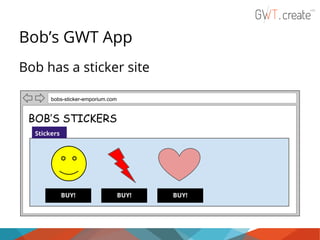
Bob’s GWT App
Bob has a sticker site
bobs-sticker-emporium.com

BOB’S STICKERS
Stickers

BUY!

BUY!

BUY!
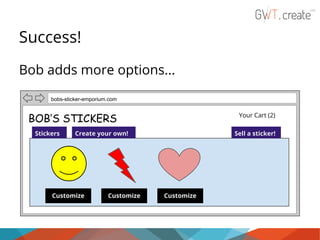
Success!
Bob adds more options...
bobs-sticker-emporium.com

Your Cart (2)

BOB’S STICKERS
Stickers

Create your own!

BUY!
Customize

BUY!
Customize

Sell a sticker!

BUY!
Customize
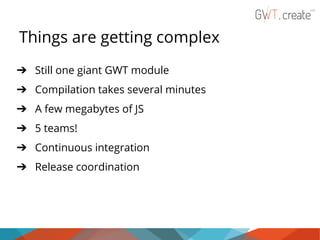
Things are getting complex
➔ Still one giant GWT module
➔ Compilation takes several minutes
➔ A few megabytes of JS
➔ 5 teams!
➔ Continuous integration
➔ Release coordination
What should Bob do?
How do you split up a large GWT project?
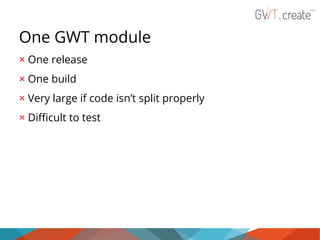
One GWT module
× One release
× One build
× Very large if code isn’t split properly
× Difficult to test
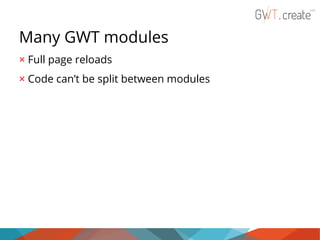
Many GWT modules
× Full page reloads
× Code can’t be split between modules
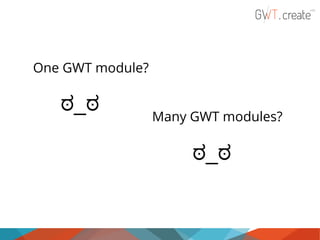
One GWT module?

ಠ_ಠ

Many GWT modules?

ಠ_ಠ
Ultimately multiple GWT modules
is the only real option
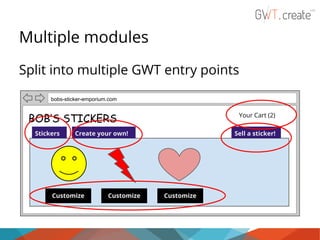
Multiple modules
Split into multiple GWT entry points
bobs-sticker-emporium.com

Your Cart (2)

BOB’S STICKERS
Stickers

Create your own!

BUY!
Customize

BUY!
Customize

Sell a sticker!

BUY!
Customize
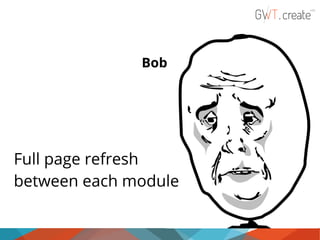
Bob

Full page refresh
between each module
Research showed that

half of aggregate user latency
was due to full page reloads
Turducken
1. Bob’s Sticker Emporium
2. Conquering Multiple Entry Points
3. Other uses
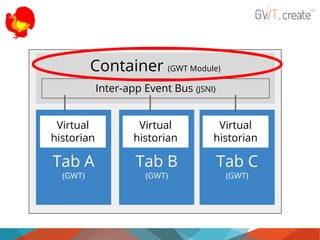
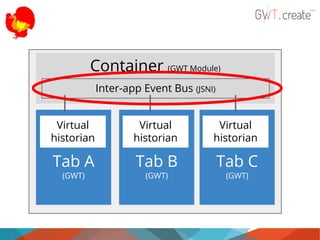
Container (GWT Module)
Inter-app Event Bus (JSNI)
Virtual
historian

Virtual
historian

Virtual
historian

Tab A

Tab B

Tab C

(GWT)

(GWT)

(GWT)
The container
➔
➔
➔
➔

A GWT module (mostly)
The first thing to load on the page
Loads the other modules on demand
Communicates with modules through
inter-app event bus
Loading all of the modules?

Yes.
This actually works
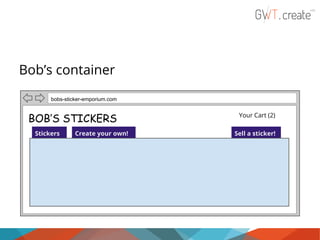
Bob’s container
bobs-sticker-emporium.com

Your Cart (2)

BOB’S STICKERS
Stickers

Create your own!

Sell a sticker!

BUY!
Load multiple GWT modules?
➔ When a module is loaded, a <script> tag is added to
the <head>
➔ Everything lives in the same container
Memory usage
➔ Browsers are good at hiding elements
➔ Memory only increases marginally when
loading new modules
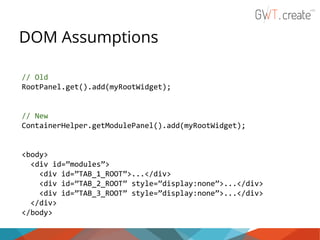
DOM Assumptions
// Old
RootPanel.get().add(myRootWidget);

// New
ContainerHelper.getModulePanel().add(myRootWidget);

<body>
<div id=”modules”>
<div id=”TAB_1_ROOT”>...</div>
<div id=”TAB_2_ROOT” style=”display:none”>...</div>
<div id=”TAB_3_ROOT” style=”display:none”>...</div>
</div>
</body>
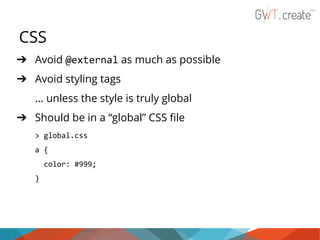
CSS
➔ Avoid @external as much as possible
➔ Avoid styling tags
... unless the style is truly global
➔ Should be in a “global” CSS file
> global.css
a {
color: #999;
}
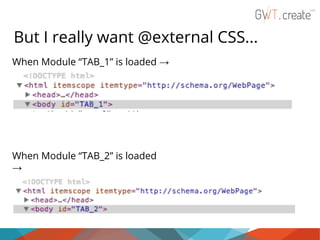
But I really want @external CSS...
When Module “TAB_1” is loaded →

When Module “TAB_2” is loaded
→
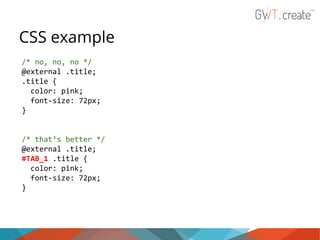
CSS example
/* no, no, no */
@external .title;
.title {
color: pink;
font-size: 72px;
}

/* that’s better */
@external .title;
#TAB_1 .title {
color: pink;
font-size: 72px;
}
There’s just one tiny, little issue...
“

All problems in computer
science can be solved by
another level of indirection

Butler Lampson
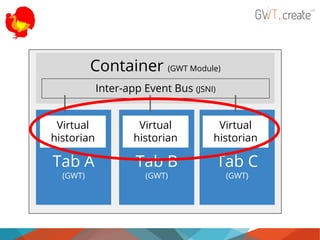
Container (GWT Module)
Inter-app Event Bus (JSNI)
Virtual
historian

Virtual
historian

Virtual
historian

Tab A

Tab B

Tab C

(GWT)

(GWT)

(GWT)
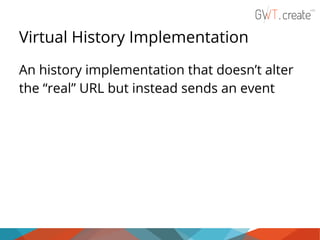
Virtual History Implementation
An history implementation that doesn’t alter
the “real” URL but instead sends an event
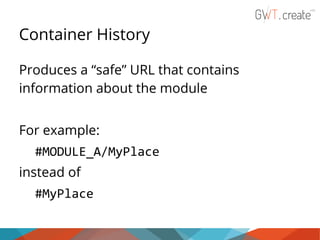
Container History
Produces a “safe” URL that contains
information about the module
For example:
#MODULE_A/MyPlace
instead of
#MyPlace
Container (GWT Module)
Inter-app Event Bus (JSNI)
Virtual
historian

Virtual
historian

Virtual
historian

Tab A

Tab B

Tab C

(GWT)

(GWT)

(GWT)
Event bus implementation
The event bus that broadcasts between
modules needs to be JSNI since it must
communicate between GWT modules
A simple publish/subscribe interface will do
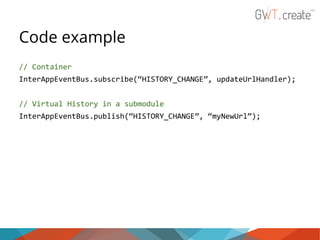
Code example
// Container
InterAppEventBus.subscribe(“HISTORY_CHANGE”, updateUrlHandler);
// Virtual History in a submodule
InterAppEventBus.publish(“HISTORY_CHANGE”, “myNewUrl”);
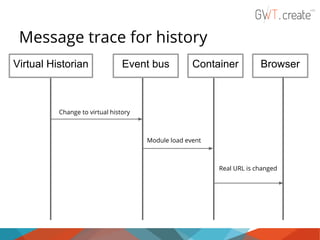
Message trace for history
Virtual Historian

Event bus

Container

Browser

Change to virtual history

Module load event

Real URL is changed
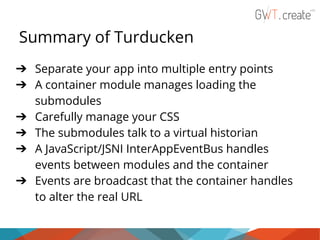
Summary of Turducken
➔ Separate your app into multiple entry points
➔ A container module manages loading the
submodules
➔ Carefully manage your CSS
➔ The submodules talk to a virtual historian
➔ A JavaScript/JSNI InterAppEventBus handles
events between modules and the container
➔ Events are broadcast that the container handles
to alter the real URL
The future
➔ Shadow DOM eliminates a lot of the issues
➔ Eliminate JSNI with GWT 3.0
But wait!
There’s more.
Turducken
1. Bob’s Sticker Emporium
2. Conquering Multiple Entry Points
3. Other uses
It’s all about the event bus
An inter-app event bus opens up some
interesting doors
Inter-app communication
Load another module via an event
➔ Settings Module
◆ Change settings from other modules
◆ Global “Accept ToS” message

➔ Chat module
Example
➔ One team maintains “Chat” functionality
➔ Another team maintains a “Profile” page
➔ Launch a chat with a person from their
profile
➔ Chat module doesn’t always need to be
loaded
➔ Limited coupling between modules
Invisible Modules
There can be “background” modules that
aren’t visible but handle events
➔ Monitoring session
➔ Caching data for multiple modules
Non-GWT “modules”
➔ Follow the same CSS approach
➔ Write an virtual history implementation
➔ Add hashPrefix to $location in Angular
Where’s the code?
➔ A few small parts
➔ A design pattern, not a library
➔ Tends to be application specific
...but we are considering it
Turducken
Complex GWT apps can involve multiple teams with
different release cycles. Compile times can quickly
become prohibitive when your codebase grows into
millions of lines.
“Turducken” is a design pattern to combine multiple
GWT apps that can be built and released by separate
teams while providing a seamless, snappy user
experience
no reloads
many modules

wow

such performance
different releases

wow

Questions?

Turducken - Divide and Conquer large GWT apps with multiple teams