PULMONARY
TUBERCULOSIS (TB)
Pulmonary tuberculosis (TB)
 DEF:Tuberculosis is the infectious disease primarily
affecting lung parenchyma is most often caused
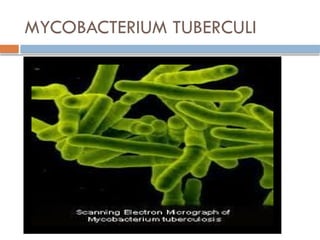
by mycobacterium tuberculosis.it may spread to
any part of the body including
meninges,kidney,bones and lymph nodes.
 It’s the one of the most prevalent infections of human beings
and contributes considerably to illness and death around the
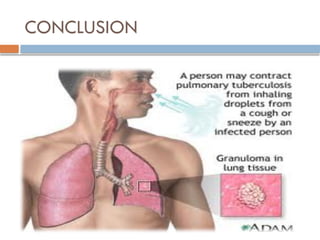
world . It is spread by inhaling tiny droplets of saliva from
the coughs or sneezes of an infected person . It is slowly
spreading ,chronic , granulomatous bacterial infection
characterized by gradual weight loss
MYCOBACTERIUM TUBERCULI
CLASSIFICATION
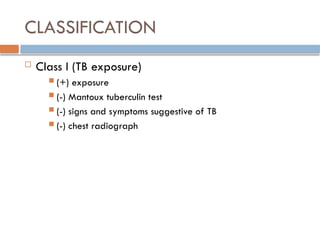
 Class I (TB exposure)
 (+) exposure
 (-) Mantoux tuberculin test
 (-) signs and symptoms suggestive of TB
 (-) chest radiograph
CLASSIFICATION
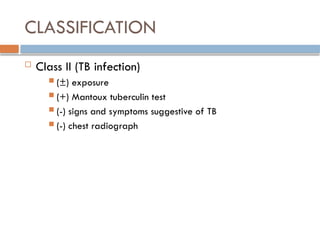
 Class II (TB infection)
 (±) exposure
 (+) Mantoux tuberculin test
 (-) signs and symptoms suggestive of TB
 (-) chest radiograph
CLASSIFICATION
 Class III (TB disease)
 Has three or more of the ff. criteria
 (+) history of exposure to an adult/adolescent with active TB disease
 (+) Mantoux tuberculin test
 (+) signs and symptoms suggestive of TB
 Cough/wheezing > 2 weeks; fever > 2 weeks
 Painless cervical and/or other lymphadenopathy
 Poor weight gain; failure to make a quick return to normal after an
infection (measles, tonsillitis, whooping cough) or failure to respond to
approriate antibiotic therapy (pneumonia, otitis media)
 Abnormal Chest radiograph
 Laboratory findings suggestive of TB (histological, cytological,
biochemical, immunological or molecular)
CLASSIFICATION
 Class IV (TB inactive)
 A child/adolescent with or without history of previous
TB and any of the ff:
 (±) previous chemotherapy
 (+) radiographic evidence of healed/calcified TB
 (+) Mantoux tuberculin test
 (-) signs and symptoms suggestive of TB
 (-) smear/culture for M. tuberculosis
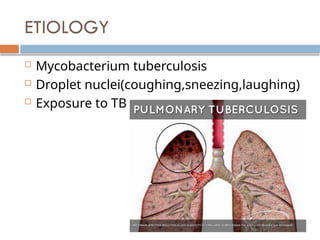
ETIOLOGY
 Mycobacterium tuberculosis
 Droplet nuclei(coughing,sneezing,laughing)
 Exposure to TB
Risk Factors
 Age: infants and adolescents are at highest risk of
disease
 Close contact with an untreated sputum positive
patient
 Impaired host defenses: immunodeficiency states,
particularly that associated with HIV infection;
immunosuppression related to accompanying viral
infection, or drug induced; malnutrition.
Risk Factors
 Persons whose tuberculin skin test results converted to (+) In
the past 1-2 years.
 Persons who have CXR suggestive of old TB.
 IMMUNO COMPROMISED STATUS
(ELDERLY,CANCER).
 DRUG ABUSE AND ALCOHOLISM.
 PEOPLE LACKING ADEQUATE HEALTH CARE.
 IMMIGRANTS FROM COUNTRIES WITH HIGHER
INCIDENCE OF TB.
 INSTITUTIONALISATION(LONG TERM CARE
FACILITIES).
PATHOPHYSIOLOGY
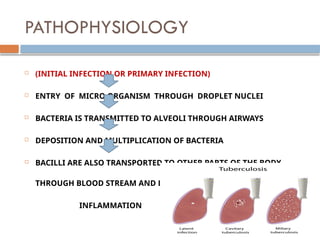
 (INITIAL INFECTION OR PRIMARY INFECTION)
 ENTRY OF MICRO ORGANISM THROUGH DROPLET NUCLEI
 BACTERIA IS TRANSMITTED TO ALVEOLI THROUGH AIRWAYS
 DEPOSITION AND MULTIPLICATION OF BACTERIA
 BACILLI ARE ALSO TRANSPORTED TO OTHER PARTS OF THE BODY
THROUGH BLOOD STREAM AND LYMPHNODE
INFLAMMATION
PATHOPHYSIOLOGY
 PHAGOCYTOSIS BY NEUTROPHILS AND MACROPHAGES
 ACCUMULATION OF EXUDATE IN ALVEOLI
 BRONCHO PNEMONIA
 NEW TISSUE MASSES OF LIVE AND DEAD BACILLI ARE SURROUNDED BY
MACROPHAGES WHICH FORM A PROTECTIVE MASS AROUND GRANULOMAS
 GRANULOMAS THEN TRANSFORMS TO FIBROUS TISSUE MASS AND CENTRAL
PORTION OF WHICH IS CALLED GHON TUBERCLE
PATHOPHYSIOLOGY
 THE MATERIAL (BACTERIA AND MACROPHAGES
BECOMES NECROTIC FORMING CHEESY MASS
 MASS BECOMES CALCIFIED AND BECOMES
COLAGENOUS SCAR
 BACTERIA BECOME DORMANT AND NO
FURTHER PROGRESSION OF ACTIVE DISEASE
 (ACTIVE DISEASE OR RE INFECTION)
 INADEQUATE IMMUNE RESPONSE
 ACTIVATION OF DORMANT BACTERIA
PATHOPHYSIOLOGY
 GHON TUBERCLE ULCERATES AND RELEASING CHEESY MATERIAL INTO
BRONCHI
 BACTERIA THEN BECOME AIRBORNE RESULTING IN FURTHER SPREAD OF
INFECTION
 ULCERATED TUBERCLE HEALS AND BECOMES SCAR TISSUE
 INFECTED LUNG BECOME INFLAMMED
 FURTHER DEVOLOPMENT OF PNEUMONIA AND TUBERCLE FORMATION
 UNLESS THE PROCESS IS ARRESTED IT SPREADS DOWNWARDS TO THE HILUM
OF LUNGS AND LATER EXTENDS TO ADJASCENT LOBES
CLINICAL MANIFESTATIONS
CONSTITUTIONAL SYMPTOMS
 Anorexia
 Low grade fever
 Night sweats
 Fatique
 Weight loss
PULMONARY SYMPTOMS
 Dyspnea
 Non resolving bronchopneumonia
 Chest tightness
 Non productive cough
 Mucopurulent sputum with hemoptpysis
 Chest pain
EXTRA PULMONARY SYMPTOMS
 Pain
 Inflammation
ASSESSMENT AND DIAGNOSTIC FINDINGS
 HISTORY COLLECTION
 PHYSICAL EXAMINATION
 Clubbing of the fingers or toes (in people with advanced disease)
 Swollen or tender lymph nodes in the neck or other areas
 Fluid around a lung (pleural effusion)
 Unusual breath sounds (crackles)
 IF MILIARY TB;
 A physical exam may show:
 Swollen liver
 Swollen lymph nodes

ASSESSMENT AND DIAGNOSTIC FINDINGS
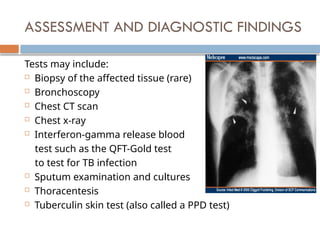
Tests may include:
 Biopsy of the affected tissue (rare)
 Bronchoscopy
 Chest CT scan
 Chest x-ray
 Interferon-gamma release blood
test such as the QFT-Gold test
to test for TB infection
 Sputum examination and cultures
 Thoracentesis
 Tuberculin skin test (also called a PPD test)
COMPLICATIONS
 Bones. Spinal pain and joint destruction may
result from TB that infects your bones(TB spine or
potss spine)
 Brain(meningitis)
 Liver or kidneys
 Heart(cardiac tamponade)
 Pleural effusion
 Tb pneumonia
 Serious reactions to drug therapy(hepato
toxicity;hypersentivity)
MEDICAL MANAGEMENT
 PULMONARY TB is treated primarily with antituberculosis
agents for 6 to 12 months.
 Pharmacological management
 FIRST LINE ANTITUBERCULAR MEDICATIONS
 Streptomycin
 Isoniazid or INH(Nydrazid)
 Rifampin
 Pyrazinamide
 Ethambutol(Myambutol)
MEDICAL MANAGEMENT
 SECOND LINE MEDICATIONS .
 Capreomycin
 Ethionamide
 Paraaminosalycilate sodium
 Cycloserine
 Vitamin b(pyridoxine) usually adminstered
with INH
MEDICAL MANAGEMENT
 THIRD LINE DRUGS
 Other drugs that may be useful, but are not
on the WHO list of SLDs:
 Rifabutin
 Macrolides:e.g.,clarithromycin (CLR)
 Linezolid(LZD)
 Thioacetazone(T)
 Thioridazine
 Arginine
MULTIDRUG THERAPY
 Multiple-drug therapy to treat TB means
taking several different antitubercular
drugs at the same time.
 The standard treatment is to take isoniazid,
rifampin, ethambutol, and pyrazinamide for
2 months. Treatment is then continued for
at least 4months with fewer medicines
Prevention
 ISOLATION
 Ventilate the room
 Cover the mouth
 Wear mask
 Finish entire course of medication
 vaccinations
CONCLUSION

TUBERCULOSIS disease detail .pptxxxxxxxx

  • 1.
  • 2.
    Pulmonary tuberculosis (TB) DEF:Tuberculosis is the infectious disease primarily affecting lung parenchyma is most often caused by mycobacterium tuberculosis.it may spread to any part of the body including meninges,kidney,bones and lymph nodes.  It’s the one of the most prevalent infections of human beings and contributes considerably to illness and death around the world . It is spread by inhaling tiny droplets of saliva from the coughs or sneezes of an infected person . It is slowly spreading ,chronic , granulomatous bacterial infection characterized by gradual weight loss
  • 3.
  • 4.
    CLASSIFICATION  Class I(TB exposure)  (+) exposure  (-) Mantoux tuberculin test  (-) signs and symptoms suggestive of TB  (-) chest radiograph
  • 5.
    CLASSIFICATION  Class II(TB infection)  (±) exposure  (+) Mantoux tuberculin test  (-) signs and symptoms suggestive of TB  (-) chest radiograph
  • 6.
    CLASSIFICATION  Class III(TB disease)  Has three or more of the ff. criteria  (+) history of exposure to an adult/adolescent with active TB disease  (+) Mantoux tuberculin test  (+) signs and symptoms suggestive of TB  Cough/wheezing > 2 weeks; fever > 2 weeks  Painless cervical and/or other lymphadenopathy  Poor weight gain; failure to make a quick return to normal after an infection (measles, tonsillitis, whooping cough) or failure to respond to approriate antibiotic therapy (pneumonia, otitis media)  Abnormal Chest radiograph  Laboratory findings suggestive of TB (histological, cytological, biochemical, immunological or molecular)
  • 7.
    CLASSIFICATION  Class IV(TB inactive)  A child/adolescent with or without history of previous TB and any of the ff:  (±) previous chemotherapy  (+) radiographic evidence of healed/calcified TB  (+) Mantoux tuberculin test  (-) signs and symptoms suggestive of TB  (-) smear/culture for M. tuberculosis
  • 8.
    ETIOLOGY  Mycobacterium tuberculosis Droplet nuclei(coughing,sneezing,laughing)  Exposure to TB
  • 9.
    Risk Factors  Age:infants and adolescents are at highest risk of disease  Close contact with an untreated sputum positive patient  Impaired host defenses: immunodeficiency states, particularly that associated with HIV infection; immunosuppression related to accompanying viral infection, or drug induced; malnutrition.
  • 10.
    Risk Factors  Personswhose tuberculin skin test results converted to (+) In the past 1-2 years.  Persons who have CXR suggestive of old TB.  IMMUNO COMPROMISED STATUS (ELDERLY,CANCER).  DRUG ABUSE AND ALCOHOLISM.  PEOPLE LACKING ADEQUATE HEALTH CARE.  IMMIGRANTS FROM COUNTRIES WITH HIGHER INCIDENCE OF TB.  INSTITUTIONALISATION(LONG TERM CARE FACILITIES).
  • 11.
    PATHOPHYSIOLOGY  (INITIAL INFECTIONOR PRIMARY INFECTION)  ENTRY OF MICRO ORGANISM THROUGH DROPLET NUCLEI  BACTERIA IS TRANSMITTED TO ALVEOLI THROUGH AIRWAYS  DEPOSITION AND MULTIPLICATION OF BACTERIA  BACILLI ARE ALSO TRANSPORTED TO OTHER PARTS OF THE BODY THROUGH BLOOD STREAM AND LYMPHNODE INFLAMMATION
  • 12.
    PATHOPHYSIOLOGY  PHAGOCYTOSIS BYNEUTROPHILS AND MACROPHAGES  ACCUMULATION OF EXUDATE IN ALVEOLI  BRONCHO PNEMONIA  NEW TISSUE MASSES OF LIVE AND DEAD BACILLI ARE SURROUNDED BY MACROPHAGES WHICH FORM A PROTECTIVE MASS AROUND GRANULOMAS  GRANULOMAS THEN TRANSFORMS TO FIBROUS TISSUE MASS AND CENTRAL PORTION OF WHICH IS CALLED GHON TUBERCLE
  • 13.
    PATHOPHYSIOLOGY  THE MATERIAL(BACTERIA AND MACROPHAGES BECOMES NECROTIC FORMING CHEESY MASS  MASS BECOMES CALCIFIED AND BECOMES COLAGENOUS SCAR  BACTERIA BECOME DORMANT AND NO FURTHER PROGRESSION OF ACTIVE DISEASE  (ACTIVE DISEASE OR RE INFECTION)  INADEQUATE IMMUNE RESPONSE  ACTIVATION OF DORMANT BACTERIA
  • 14.
    PATHOPHYSIOLOGY  GHON TUBERCLEULCERATES AND RELEASING CHEESY MATERIAL INTO BRONCHI  BACTERIA THEN BECOME AIRBORNE RESULTING IN FURTHER SPREAD OF INFECTION  ULCERATED TUBERCLE HEALS AND BECOMES SCAR TISSUE  INFECTED LUNG BECOME INFLAMMED  FURTHER DEVOLOPMENT OF PNEUMONIA AND TUBERCLE FORMATION  UNLESS THE PROCESS IS ARRESTED IT SPREADS DOWNWARDS TO THE HILUM OF LUNGS AND LATER EXTENDS TO ADJASCENT LOBES
  • 15.
    CLINICAL MANIFESTATIONS CONSTITUTIONAL SYMPTOMS Anorexia  Low grade fever  Night sweats  Fatique  Weight loss PULMONARY SYMPTOMS  Dyspnea  Non resolving bronchopneumonia  Chest tightness  Non productive cough  Mucopurulent sputum with hemoptpysis  Chest pain EXTRA PULMONARY SYMPTOMS  Pain  Inflammation
  • 16.
    ASSESSMENT AND DIAGNOSTICFINDINGS  HISTORY COLLECTION  PHYSICAL EXAMINATION  Clubbing of the fingers or toes (in people with advanced disease)  Swollen or tender lymph nodes in the neck or other areas  Fluid around a lung (pleural effusion)  Unusual breath sounds (crackles)  IF MILIARY TB;  A physical exam may show:  Swollen liver  Swollen lymph nodes 
  • 17.
    ASSESSMENT AND DIAGNOSTICFINDINGS Tests may include:  Biopsy of the affected tissue (rare)  Bronchoscopy  Chest CT scan  Chest x-ray  Interferon-gamma release blood test such as the QFT-Gold test to test for TB infection  Sputum examination and cultures  Thoracentesis  Tuberculin skin test (also called a PPD test)
  • 18.
    COMPLICATIONS  Bones. Spinalpain and joint destruction may result from TB that infects your bones(TB spine or potss spine)  Brain(meningitis)  Liver or kidneys  Heart(cardiac tamponade)  Pleural effusion  Tb pneumonia  Serious reactions to drug therapy(hepato toxicity;hypersentivity)
  • 19.
    MEDICAL MANAGEMENT  PULMONARYTB is treated primarily with antituberculosis agents for 6 to 12 months.  Pharmacological management  FIRST LINE ANTITUBERCULAR MEDICATIONS  Streptomycin  Isoniazid or INH(Nydrazid)  Rifampin  Pyrazinamide  Ethambutol(Myambutol)
  • 20.
    MEDICAL MANAGEMENT  SECONDLINE MEDICATIONS .  Capreomycin  Ethionamide  Paraaminosalycilate sodium  Cycloserine  Vitamin b(pyridoxine) usually adminstered with INH
  • 21.
    MEDICAL MANAGEMENT  THIRDLINE DRUGS  Other drugs that may be useful, but are not on the WHO list of SLDs:  Rifabutin  Macrolides:e.g.,clarithromycin (CLR)  Linezolid(LZD)  Thioacetazone(T)  Thioridazine  Arginine
  • 22.
    MULTIDRUG THERAPY  Multiple-drugtherapy to treat TB means taking several different antitubercular drugs at the same time.  The standard treatment is to take isoniazid, rifampin, ethambutol, and pyrazinamide for 2 months. Treatment is then continued for at least 4months with fewer medicines
  • 23.
    Prevention  ISOLATION  Ventilatethe room  Cover the mouth  Wear mask  Finish entire course of medication  vaccinations
  • 24.