Trigeminal autonomic cephalalgias
(TACs)
Dr M P Priyacharana
Introduction
• The trigeminal autonomic cephalalgias (TACs) are a group of
uncommon primary headache disorders that share similar clinical
features but differ in frequency, duration, triggers, and treatment
• All TACs share an intense unilateral pain in a trigeminal nerve
distribution associated with ipsilateral cranial autonomic features such
as lacrimation, conjunctival injection, nasal congestion, and rhinorrhea
• A single attack varies in duration from seconds to months
Types of of trigeminal autonomic
cephalalgias
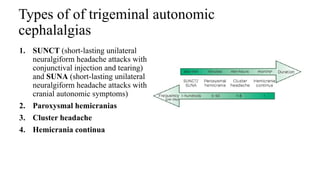
1. SUNCT (short-lasting unilateral
neuralgiform headache attacks with
conjunctival injection and tearing)
and SUNA (short-lasting unilateral
neuralgiform headache attacks with
cranial autonomic symptoms)
2. Paroxysmal hemicranias
3. Cluster headache
4. Hemicrania continua
Pathogenesis of trigeminal autonomic
cephalalgias
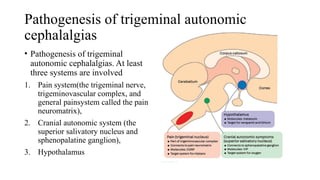
• Pathogenesis of trigeminal
autonomic cephalalgias. At least
three systems are involved
1. Pain system(the trigeminal nerve,
trigeminovascular complex, and
general painsystem called the pain
neuromatrix),
2. Cranial autonomic system (the
superior salivatory nucleus and
sphenopalatine ganglion),
3. Hypothalamus
Pathogenesis of trigeminal autonomic
cephalalgias
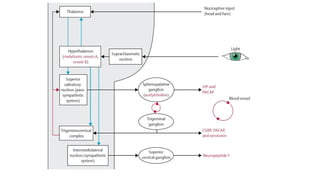
• The trigeminovascular system is the pain component of TACs and starts with the
ophthalmic or V1 branch of the trigeminal nerve, which receives inputs from the
forehead, eye, dura, and large cranial vessels.
• The ophthalmic branch projects to several nociceptive nuclei in the brainstem and
upper cervical cord (together these nuclei are known as the trigeminocervical
complex, which includes the occipital nerve), then to the thalamus, and finally to
the pain neuromatrix.
• The trigeminovascular system has several signaling molecules including
calcitonin gene-related peptide (CGRP), which is elevated during a cluster attack
Pathogenesis of trigeminal autonomic
cephalalgias
• system is responsible for lacrimation, conjunctival injection, and other cranial
autonomic features. Most of these features involve either parasympathetic over
activation or sympathetic inactivation
• The autonomic areas in TACs include a pathway from the superior salivatory
nucleus to the sphenopalatine ganglion
• The autonomic system has several signaling molecules, including vasoactive
intestinal peptide, which is elevated during a cluster attack
Pathogenesis of trigeminal autonomic
cephalalgias
• The hypothalamus includes the circadian system and aggression areas, which may
explain the clocklike regularity of cluster headache and the restlessness seen in
patients with TACs
• Functional imaging has shown activation of the posterior hypothalamus at the
onset of a cluster headache attack
• Ultimately, the hypothalamus appears to be the first area activated during a cluster
attack, followed by trigeminovascular and autonomic activation.
Cluster headache
• Cluster headache is a unilateral headache syndrome with ipsilateral
cranial autonomic features and/or restlessness and is intensely
unpleasant, with pain that is anecdotally worse than migraine,
childbirth, or kidney stones.
• It is unusually responsive to oxygen.
Cluster Headache
• Cluster headache is 3 times more common in men,
• typical age of onset between 20 and 40 years of age.
• The two forms of cluster headache are
• episodic version,where patients have a headache-free period of more than 3
months.
• chronic version, where the headache-free period is less than 3 months
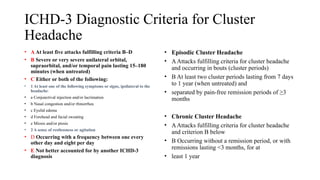
ICHD-3 Diagnostic Criteria for Cluster
Headache
• A At least five attacks fulfilling criteria B–D
• B Severe or very severe unilateral orbital,
supraorbital, and/or temporal pain lasting 15–180
minutes (when untreated)
• C Either or both of the following:
• 1 At least one of the following symptoms or signs, ipsilateral to the
headache:
• a Conjunctival injection and/or lacrimation
• b Nasal congestion and/or rhinorrhea
• c Eyelid edema
• d Forehead and facial sweating
• e Miosis and/or ptosis
• 2 A sense of restlessness or agitation
• D Occurring with a frequency between one every
other day and eight per day
• E Not better accounted for by another ICHD-3
diagnosis
• Episodic Cluster Headache
• AAttacks fulfilling criteria for cluster headache
and occurring in bouts (cluster periods)
• B At least two cluster periods lasting from 7 days
to 1 year (when untreated) and
• separated by pain-free remission periods of ≥3
months
• Chronic Cluster Headache
• AAttacks fulfilling criteria for cluster headache
and criterion B below
• B Occurring without a remission period, or with
remissions lasting <3 months, for at
• least 1 year
Other features that are common in cluster
headache
• Rapid escalation and de-escalation of pain,
• Alcohol as a trigger during the headache period (but not during the remission
period)
• Positive response to subcutaneous sumatriptan
• Positive response to high-flow oxygen
• Clocklike daily pattern of headaches.
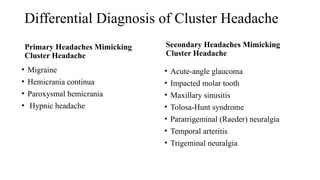
Differential Diagnosis of Cluster Headache
Primary Headaches Mimicking
Cluster Headache
• Migraine
• Hemicrania continua
• Paroxysmal hemicrania
• Hypnic headache
Secondary Headaches Mimicking
Cluster Headache
• Acute-angle glaucoma
• Impacted molar tooth
• Maxillary sinusitis
• Tolosa-Hunt syndrome
• Paratrigeminal (Raeder) neuralgia
• Temporal arteritis
• Trigeminal neuralgia
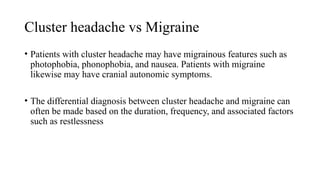
Cluster headache vs Migraine
• Patients with cluster headache may have migrainous features such as
photophobia, phonophobia, and nausea. Patients with migraine
likewise may have cranial autonomic symptoms.
• The differential diagnosis between cluster headache and migraine can
often be made based on the duration, frequency, and associated factors
such as restlessness
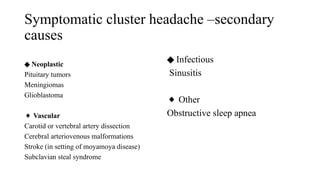
Symptomatic cluster headache –secondary
causes
◆ Neoplastic
Pituitary tumors
Meningiomas
Glioblastoma
◆ Vascular
Carotid or vertebral artery dissection
Cerebral arteriovenous malformations
Stroke (in setting of moyamoya disease)
Subclavian steal syndrome
◆ Infectious
Sinusitis
◆ Other
Obstructive sleep apnea
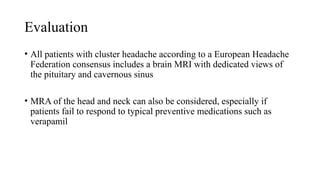
Evaluation
• All patients with cluster headache according to a European Headache
Federation consensus includes a brain MRI with dedicated views of
the pituitary and cavernous sinus
• MRA of the head and neck can also be considered, especially if
patients fail to respond to typical preventive medications such as
verapamil
Management
• Treatment for cluster headache includes a combination of acute,
transitional, and preventive medications
• Lifestyle changes are recommended in patients with cluster headache,
in particular the avoidance of known triggers such as alcohol
Acute management
• The mainstays of acute treatment of patients with cluster headache are high-flow
oxygen and triptans (sumatriptan and zolmitriptan)
• Oxygen should be administered at 100% via a nonrebreather mask at a rate of 12
L/min to 15 L/min for at least 20 minutes and trialed several times before being
considered ineffective
• Subcutaneous triptans being the most effective, followed by nasal and then oral
formulations
• Octreotide subcutaneous
• Lidocaine nasal
• Noninvasive vagus nerve stimulation
Transitional medications
• Transitional medications refer to preventive medications that can be
uptitrated quickly and used for short periods of time and are most
useful in two situations:
• (1) as the lone preventive for patients with short headache cycles,
• (2) as a bridge in patients with longer headache cycles while uptitrating other preventive
Eg-
• Ipsilateral greater occipital nerve block(with local anesthetic plus
steroids)
• Oral steroids-taper over 3 weeks is generally recommended
Preventive medications
First line
• Verapamil (480 mg to 720 mg divided into 3 doses)
Second line
• Lithium
• Melatonin
• Topiramate
• Baclofen
Refractory management
When extensive medication trials are unsuccessful, a sleep study and
pituitary laboratory studies should be considered
• Methods
• Sphenopalatine ganglion stimulation
• Occipital nerve stimulation
• Hypothalamic deep brain stimulation?
Patient selection for these procedures is key, and considerations for their use
include 2 years of daily or almost daily attacks, extensive medication trials,
management by a single provider over at least 1 year, and a psychological
evaluation
Paroxysmal Hemicrania
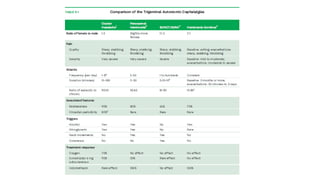
• Paroxysmal hemicrania shares many features with cluster headache but
is slightly shorter in the duration of attacks(2 to 30 minutes)
• Onset between 30 and 40 years of age, common in women
• Like cluster headache, the time to peak pain is rapid, usually fewer than
10 minutes, and the headaches are associated with cranial autonomic
features, with lacrimation being the most common.
• Unlike in cluster headache, restlessness is less common, and the
headaches are rarely circadian
• Can be triggered by alcohol, neck movements, or pressure over the neck
or greater occipital nerves.
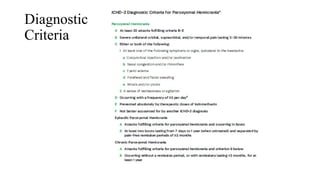
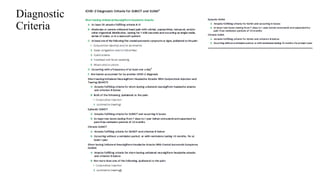
Diagnostic
Criteria
Management
Indomethacin
• demonstrates increased absorption through the blood-brain barrier compared to other
cyclooxygenase inhibitors.
• It also has effects on hypothalamic and autonomic nuclei, causes a reduction in intracranial
pressure, and possesses a unique effect on nitric oxide.
• 25 mg 3 times a day to 75 mg 3 times a day
For patients who cannot tolerate indomethacin, several other medications have been
proposed including cyclooxygenase type 2 inhibitors, verapamil, and topiramate.
SUNCT & SUNA
• They are characterized by brief attacks of unilateral pain with autonomic features
• SUNCT has both conjunctival injection and lacrimation, and SUNA has one or
neither
• Onset is at 40 to 70 years of age, older than other TACs.
• These headaches are slightly more common in men.
Diagnostic
Criteria
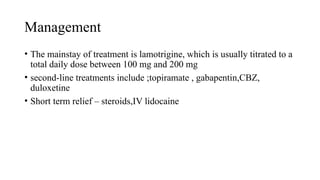
Management
• The mainstay of treatment is lamotrigine, which is usually titrated to a
total daily dose between 100 mg and 200 mg
• second-line treatments include ;topiramate , gabapentin,CBZ,
duloxetine
• Short term relief – steroids,IV lidocaine
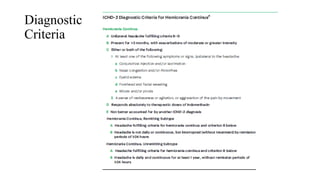
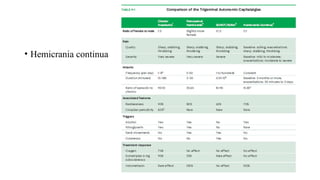
Hemicrania continua
• Hemicrania continua is characterized by continuous unilateral pain as well as pain flares with autonomic
features. It is completely responsive to indomethacin.
• more common in women.
• Hemicrania continua is characterized by unilateral frontal or temporal pain that is usually sharp or
throbbing in nature.
• Many patients have commented on a foreign body sensation or itching of the affected eye
• A baseline persistent headache is present that is usually mild or moderate in intensity and may have
few if any autonomic features.
• The disease is punctuated by headache flares lasting minutes to days that are associated with an increase
in ipsilateral cranial autonomic features as well as the presence of nausea, photophobia, or
phonophobia..
• Hemicrania continua has more prominent migrainous features and less prominent cranial autonomic
features than other TAC
• Triggers for flares include stress, alcohol, and irregular sleep
Diagnostic
Criteria
Management
Indomethacin
• 75mg 3 times a day for 1 to 2weeks, the use of gastroprotective agents, and the
downtitration to a minimum effective dose that is usually less than a total daily
dose of 100mg
• withdrawal of indomethacin should be considered every 6 months. If the
symptoms are to return, they will generally reappear 12 hours to 2 weeks after
indomethacin is stopped
Case 1
A 40-year-old woman presented for evaluation of headaches that had
been occurring intermittently for 8 years and were described as left-sided
throbbing headaches associated with sensitivity to light and noise, nausea,
nasal congestion, and watering of the left eye. She had approximately
two headaches per month, each lasting about 24 hours. Between the
headaches she had a moderate amount of pain on the left side but did not
have any of the associated features. The constant pain, however, was
interfering with her daily life. She had tried ibuprofen, sumatriptan,
rizatriptan, propranolol, and venlafaxine without relief. She could not
recall the last time she was completely headache free. She
also could not recall the headaches ever occurring on the right side.
Brain MRI, magnetic resonance angiogram (MRA) of the head and neck,
andmagnetic resonance venogram (MRV) of the brainwere unremarkable.
Indomethacin was started.Within 24 hours of increasing the dose to 50mg
3 times a day, shewas headache free for the first time in 8 years
• Hemicrania continua
Case 2
A 33-year-old woman with a past history of infrequent tension-type
headaches presented for evaluation of a new type of headache that had
been occurring for 3 years. She reported extreme pain of the right eye,
which lasted approximately 30minutes and occurred 1 to 5 times per
day.
The pain had never occurred on the left side. During a headache, her right
eye became watery, bloodshot, and sensitive to light. The skin around the
right eye felt swollen and hot, and she sat alone and rocked back and
forth. One of the headaches invariably occurred at 2:00 AM and woke her
up from sleep. These headaches occurred every day for 6 weeks in
September and October, then she had only the occasional tension
headache until the following September, when the right-sided
headaches resumed at 2:00 AM. She had tried naproxen, ibuprofen, and
acetaminophen without relief, and hydrocodone “took the edge off
a little.”
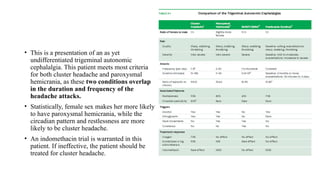
• This is a presentation of an as yet
undifferentiated trigeminal autonomic
cephalalgia. This patient meets most criteria
for both cluster headache and paroxysmal
hemicrania, as these two conditions overlap
in the duration and frequency of the
headache attacks.
• Statistically, female sex makes her more likely
to have paroxysmal hemicrania, while the
circadian pattern and restlessness are more
likely to be cluster headache.
• An indomethacin trial is warranted in this
patient. If ineffective, the patient should be
treated for cluster headache.
Thank you
• 06/04/2022

TTrigeminal autonomic cephalgia - primary hedache

  • 1.
  • 2.
    Introduction • The trigeminalautonomic cephalalgias (TACs) are a group of uncommon primary headache disorders that share similar clinical features but differ in frequency, duration, triggers, and treatment • All TACs share an intense unilateral pain in a trigeminal nerve distribution associated with ipsilateral cranial autonomic features such as lacrimation, conjunctival injection, nasal congestion, and rhinorrhea • A single attack varies in duration from seconds to months
  • 3.
    Types of oftrigeminal autonomic cephalalgias 1. SUNCT (short-lasting unilateral neuralgiform headache attacks with conjunctival injection and tearing) and SUNA (short-lasting unilateral neuralgiform headache attacks with cranial autonomic symptoms) 2. Paroxysmal hemicranias 3. Cluster headache 4. Hemicrania continua
  • 5.
    Pathogenesis of trigeminalautonomic cephalalgias • Pathogenesis of trigeminal autonomic cephalalgias. At least three systems are involved 1. Pain system(the trigeminal nerve, trigeminovascular complex, and general painsystem called the pain neuromatrix), 2. Cranial autonomic system (the superior salivatory nucleus and sphenopalatine ganglion), 3. Hypothalamus
  • 6.
    Pathogenesis of trigeminalautonomic cephalalgias • The trigeminovascular system is the pain component of TACs and starts with the ophthalmic or V1 branch of the trigeminal nerve, which receives inputs from the forehead, eye, dura, and large cranial vessels. • The ophthalmic branch projects to several nociceptive nuclei in the brainstem and upper cervical cord (together these nuclei are known as the trigeminocervical complex, which includes the occipital nerve), then to the thalamus, and finally to the pain neuromatrix. • The trigeminovascular system has several signaling molecules including calcitonin gene-related peptide (CGRP), which is elevated during a cluster attack
  • 7.
    Pathogenesis of trigeminalautonomic cephalalgias • system is responsible for lacrimation, conjunctival injection, and other cranial autonomic features. Most of these features involve either parasympathetic over activation or sympathetic inactivation • The autonomic areas in TACs include a pathway from the superior salivatory nucleus to the sphenopalatine ganglion • The autonomic system has several signaling molecules, including vasoactive intestinal peptide, which is elevated during a cluster attack
  • 8.
    Pathogenesis of trigeminalautonomic cephalalgias • The hypothalamus includes the circadian system and aggression areas, which may explain the clocklike regularity of cluster headache and the restlessness seen in patients with TACs • Functional imaging has shown activation of the posterior hypothalamus at the onset of a cluster headache attack • Ultimately, the hypothalamus appears to be the first area activated during a cluster attack, followed by trigeminovascular and autonomic activation.
  • 10.
    Cluster headache • Clusterheadache is a unilateral headache syndrome with ipsilateral cranial autonomic features and/or restlessness and is intensely unpleasant, with pain that is anecdotally worse than migraine, childbirth, or kidney stones. • It is unusually responsive to oxygen.
  • 11.
    Cluster Headache • Clusterheadache is 3 times more common in men, • typical age of onset between 20 and 40 years of age. • The two forms of cluster headache are • episodic version,where patients have a headache-free period of more than 3 months. • chronic version, where the headache-free period is less than 3 months
  • 12.
    ICHD-3 Diagnostic Criteriafor Cluster Headache • A At least five attacks fulfilling criteria B–D • B Severe or very severe unilateral orbital, supraorbital, and/or temporal pain lasting 15–180 minutes (when untreated) • C Either or both of the following: • 1 At least one of the following symptoms or signs, ipsilateral to the headache: • a Conjunctival injection and/or lacrimation • b Nasal congestion and/or rhinorrhea • c Eyelid edema • d Forehead and facial sweating • e Miosis and/or ptosis • 2 A sense of restlessness or agitation • D Occurring with a frequency between one every other day and eight per day • E Not better accounted for by another ICHD-3 diagnosis • Episodic Cluster Headache • AAttacks fulfilling criteria for cluster headache and occurring in bouts (cluster periods) • B At least two cluster periods lasting from 7 days to 1 year (when untreated) and • separated by pain-free remission periods of ≥3 months • Chronic Cluster Headache • AAttacks fulfilling criteria for cluster headache and criterion B below • B Occurring without a remission period, or with remissions lasting <3 months, for at • least 1 year
  • 13.
    Other features thatare common in cluster headache • Rapid escalation and de-escalation of pain, • Alcohol as a trigger during the headache period (but not during the remission period) • Positive response to subcutaneous sumatriptan • Positive response to high-flow oxygen • Clocklike daily pattern of headaches.
  • 14.
    Differential Diagnosis ofCluster Headache Primary Headaches Mimicking Cluster Headache • Migraine • Hemicrania continua • Paroxysmal hemicrania • Hypnic headache Secondary Headaches Mimicking Cluster Headache • Acute-angle glaucoma • Impacted molar tooth • Maxillary sinusitis • Tolosa-Hunt syndrome • Paratrigeminal (Raeder) neuralgia • Temporal arteritis • Trigeminal neuralgia
  • 15.
    Cluster headache vsMigraine • Patients with cluster headache may have migrainous features such as photophobia, phonophobia, and nausea. Patients with migraine likewise may have cranial autonomic symptoms. • The differential diagnosis between cluster headache and migraine can often be made based on the duration, frequency, and associated factors such as restlessness
  • 16.
    Symptomatic cluster headache–secondary causes ◆ Neoplastic Pituitary tumors Meningiomas Glioblastoma ◆ Vascular Carotid or vertebral artery dissection Cerebral arteriovenous malformations Stroke (in setting of moyamoya disease) Subclavian steal syndrome ◆ Infectious Sinusitis ◆ Other Obstructive sleep apnea
  • 17.
    Evaluation • All patientswith cluster headache according to a European Headache Federation consensus includes a brain MRI with dedicated views of the pituitary and cavernous sinus • MRA of the head and neck can also be considered, especially if patients fail to respond to typical preventive medications such as verapamil
  • 18.
    Management • Treatment forcluster headache includes a combination of acute, transitional, and preventive medications • Lifestyle changes are recommended in patients with cluster headache, in particular the avoidance of known triggers such as alcohol
  • 19.
    Acute management • Themainstays of acute treatment of patients with cluster headache are high-flow oxygen and triptans (sumatriptan and zolmitriptan) • Oxygen should be administered at 100% via a nonrebreather mask at a rate of 12 L/min to 15 L/min for at least 20 minutes and trialed several times before being considered ineffective • Subcutaneous triptans being the most effective, followed by nasal and then oral formulations • Octreotide subcutaneous • Lidocaine nasal • Noninvasive vagus nerve stimulation
  • 20.
    Transitional medications • Transitionalmedications refer to preventive medications that can be uptitrated quickly and used for short periods of time and are most useful in two situations: • (1) as the lone preventive for patients with short headache cycles, • (2) as a bridge in patients with longer headache cycles while uptitrating other preventive Eg- • Ipsilateral greater occipital nerve block(with local anesthetic plus steroids) • Oral steroids-taper over 3 weeks is generally recommended
  • 21.
    Preventive medications First line •Verapamil (480 mg to 720 mg divided into 3 doses) Second line • Lithium • Melatonin • Topiramate • Baclofen
  • 22.
    Refractory management When extensivemedication trials are unsuccessful, a sleep study and pituitary laboratory studies should be considered • Methods • Sphenopalatine ganglion stimulation • Occipital nerve stimulation • Hypothalamic deep brain stimulation? Patient selection for these procedures is key, and considerations for their use include 2 years of daily or almost daily attacks, extensive medication trials, management by a single provider over at least 1 year, and a psychological evaluation
  • 23.
    Paroxysmal Hemicrania • Paroxysmalhemicrania shares many features with cluster headache but is slightly shorter in the duration of attacks(2 to 30 minutes) • Onset between 30 and 40 years of age, common in women • Like cluster headache, the time to peak pain is rapid, usually fewer than 10 minutes, and the headaches are associated with cranial autonomic features, with lacrimation being the most common. • Unlike in cluster headache, restlessness is less common, and the headaches are rarely circadian • Can be triggered by alcohol, neck movements, or pressure over the neck or greater occipital nerves.
  • 24.
  • 25.
    Management Indomethacin • demonstrates increasedabsorption through the blood-brain barrier compared to other cyclooxygenase inhibitors. • It also has effects on hypothalamic and autonomic nuclei, causes a reduction in intracranial pressure, and possesses a unique effect on nitric oxide. • 25 mg 3 times a day to 75 mg 3 times a day For patients who cannot tolerate indomethacin, several other medications have been proposed including cyclooxygenase type 2 inhibitors, verapamil, and topiramate.
  • 26.
    SUNCT & SUNA •They are characterized by brief attacks of unilateral pain with autonomic features • SUNCT has both conjunctival injection and lacrimation, and SUNA has one or neither • Onset is at 40 to 70 years of age, older than other TACs. • These headaches are slightly more common in men.
  • 27.
  • 28.
    Management • The mainstayof treatment is lamotrigine, which is usually titrated to a total daily dose between 100 mg and 200 mg • second-line treatments include ;topiramate , gabapentin,CBZ, duloxetine • Short term relief – steroids,IV lidocaine
  • 29.
    Hemicrania continua • Hemicraniacontinua is characterized by continuous unilateral pain as well as pain flares with autonomic features. It is completely responsive to indomethacin. • more common in women. • Hemicrania continua is characterized by unilateral frontal or temporal pain that is usually sharp or throbbing in nature. • Many patients have commented on a foreign body sensation or itching of the affected eye • A baseline persistent headache is present that is usually mild or moderate in intensity and may have few if any autonomic features. • The disease is punctuated by headache flares lasting minutes to days that are associated with an increase in ipsilateral cranial autonomic features as well as the presence of nausea, photophobia, or phonophobia.. • Hemicrania continua has more prominent migrainous features and less prominent cranial autonomic features than other TAC • Triggers for flares include stress, alcohol, and irregular sleep
  • 30.
  • 31.
    Management Indomethacin • 75mg 3times a day for 1 to 2weeks, the use of gastroprotective agents, and the downtitration to a minimum effective dose that is usually less than a total daily dose of 100mg • withdrawal of indomethacin should be considered every 6 months. If the symptoms are to return, they will generally reappear 12 hours to 2 weeks after indomethacin is stopped
  • 32.
    Case 1 A 40-year-oldwoman presented for evaluation of headaches that had been occurring intermittently for 8 years and were described as left-sided throbbing headaches associated with sensitivity to light and noise, nausea, nasal congestion, and watering of the left eye. She had approximately two headaches per month, each lasting about 24 hours. Between the headaches she had a moderate amount of pain on the left side but did not have any of the associated features. The constant pain, however, was interfering with her daily life. She had tried ibuprofen, sumatriptan, rizatriptan, propranolol, and venlafaxine without relief. She could not recall the last time she was completely headache free. She also could not recall the headaches ever occurring on the right side. Brain MRI, magnetic resonance angiogram (MRA) of the head and neck, andmagnetic resonance venogram (MRV) of the brainwere unremarkable. Indomethacin was started.Within 24 hours of increasing the dose to 50mg 3 times a day, shewas headache free for the first time in 8 years
  • 33.
  • 34.
    Case 2 A 33-year-oldwoman with a past history of infrequent tension-type headaches presented for evaluation of a new type of headache that had been occurring for 3 years. She reported extreme pain of the right eye, which lasted approximately 30minutes and occurred 1 to 5 times per day. The pain had never occurred on the left side. During a headache, her right eye became watery, bloodshot, and sensitive to light. The skin around the right eye felt swollen and hot, and she sat alone and rocked back and forth. One of the headaches invariably occurred at 2:00 AM and woke her up from sleep. These headaches occurred every day for 6 weeks in September and October, then she had only the occasional tension headache until the following September, when the right-sided headaches resumed at 2:00 AM. She had tried naproxen, ibuprofen, and acetaminophen without relief, and hydrocodone “took the edge off a little.”
  • 35.
    • This isa presentation of an as yet undifferentiated trigeminal autonomic cephalalgia. This patient meets most criteria for both cluster headache and paroxysmal hemicrania, as these two conditions overlap in the duration and frequency of the headache attacks. • Statistically, female sex makes her more likely to have paroxysmal hemicrania, while the circadian pattern and restlessness are more likely to be cluster headache. • An indomethacin trial is warranted in this patient. If ineffective, the patient should be treated for cluster headache.
  • 36.