Clinical Neurology
Lecturer :Dr.Bakar Ali Adam
MBChB, MD
Neurology Specialist
MRCP UK PART I, II,
VIGNAN PHARMACYCOLLEGE
VADLAMUDI
CLUSTERHEADACHE
INTRODUCTION
• Cluster headache (CH) is a neurological disorder characterized
by recurrent, severe headaches on one side of the head,
typically around the eye.
• Acluster headache commonly awakens paitent in the middle of
the night with intense pain in or around one eye on one side of
head.
3
AETIOLOGY
Vascular
theory
Genetics
Hypothalamus
abnormalities
smoking Drugs
4
TYPES OF CLUSTER HEADACHES
• Episodic cluster headaches happen in
groups that can last anywhere from 7 days
to a year. Each one may last from 15
minutes to 3 hours, although medicine can.
shorten that time
Episodic cluster
headaches
• These are regular headaches that continue
for a year or longer. If any pain- free
periods, they last for less than a month.
Chronic cluster
headaches
5
PATHOGENESIS
Trigemino vascular activation (CGRP):
Activation of the
trigeminovascular
system
Release of
trigeminovascular
neuropeptides Substance
P and calcitonin gene-
related peptide (CGRP)
production of
neurogenic
inflammation and
dilation of dural blood
vessels leads to pain
6
PATHOGENESIS
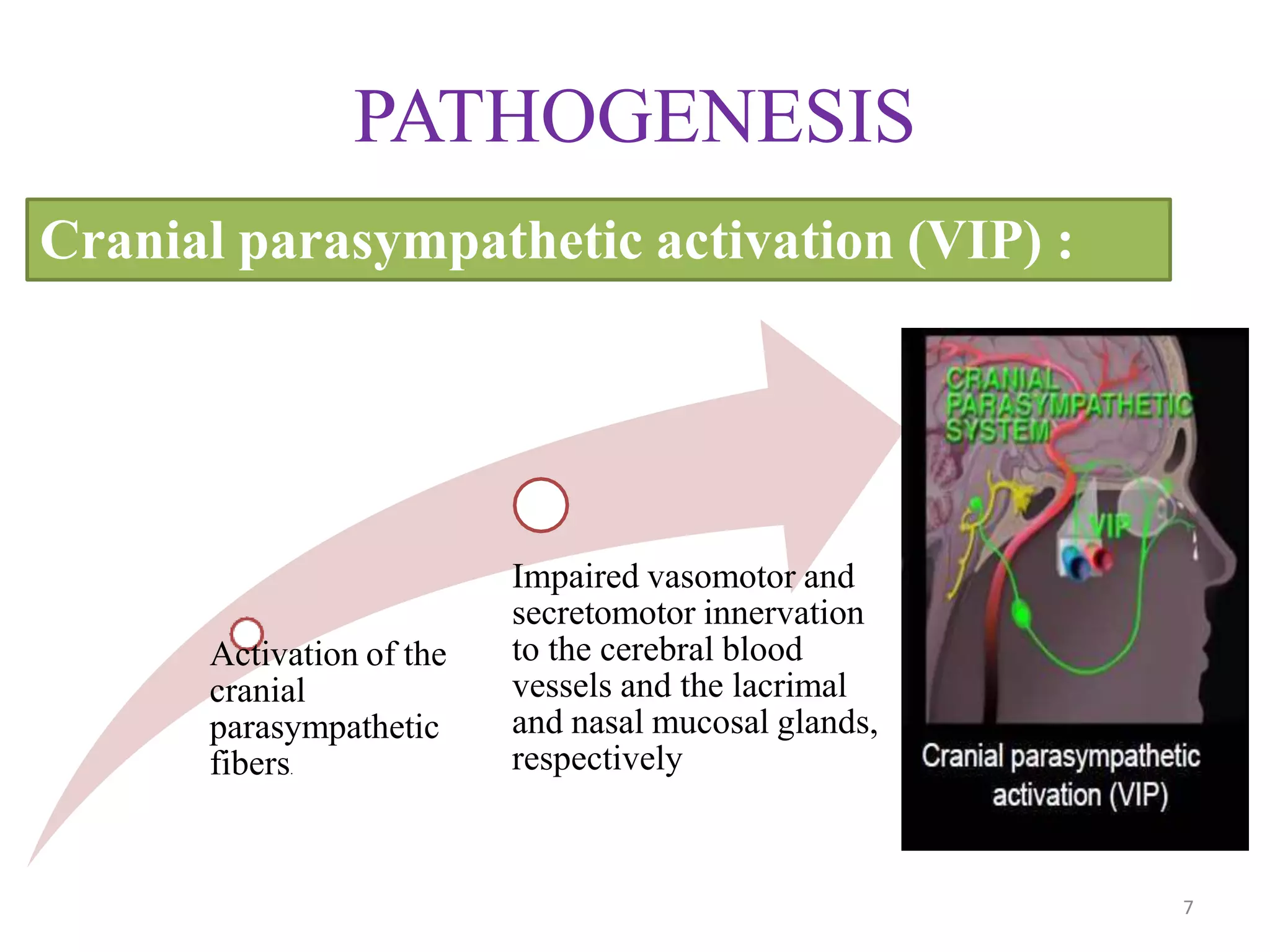
Cranial parasympathetic activation (VIP) :
Activation of the
cranial
parasympathetic
fibers.
Impaired vasomotor and
secretomotor innervation
to the cerebral blood
vessels and the lacrimal
and nasal mucosal glands,
respectively
7
PATHOGENESIS
Internal carotid artery dilation (cavernous)
Arterial dilatation
and venous
outflow
obstruction in the
region of the
cavernous sinus.
pain and
autonomic
features
The activation of these
pathways may lead to
painful vascular changes
within the cavernous
sinus, secondary
involvement of the
sympathetic plexus
overlying the cavernous
carotid artery, and
stimulation of secretory
function of the lacrimal
and other mucosal
glands
8
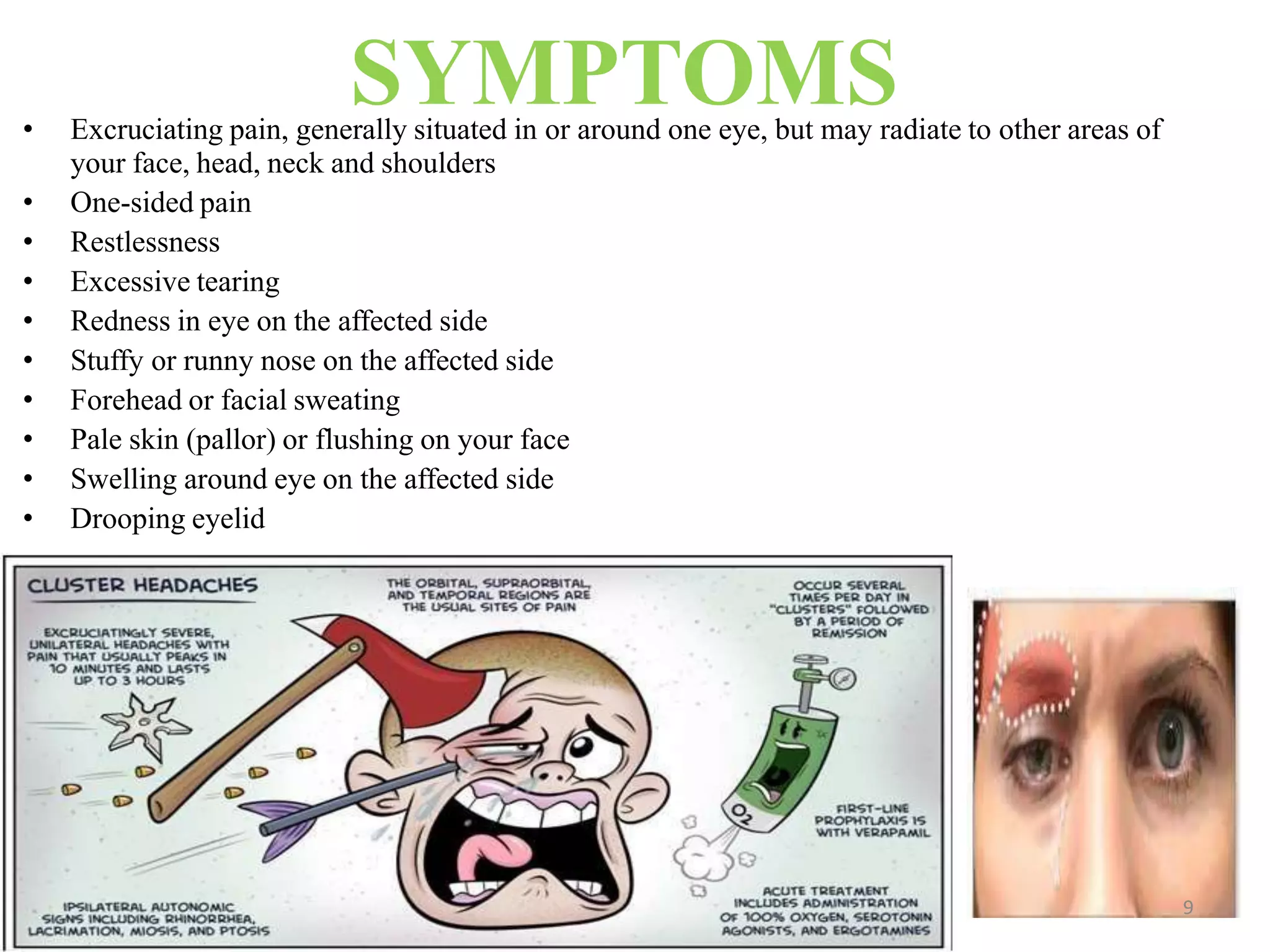
SYMPTOMS
• Excruciating pain, generally situated in or around one eye, but may radiate to other areas of
your face, head, neck and shoulders
• One-sided pain
• Restlessness
• Excessive tearing
• Redness in eye on the affected side
• Stuffy or runny nose on the affected side
• Forehead or facial sweating
• Pale skin (pallor) or flushing on your face
• Swelling around eye on the affected side
• Drooping eyelid
9
Cluster period characteristics
🠶 Acluster period generally lasts from six to 12 weeks.
🠶 The starting date and the duration of each cluster period
might be consistent from period to period. For example,
cluster periods can occur seasonally, such as every spring
or every fall.
🠶 Most people have episodic cluster headaches. In episodic
cluster headaches, the headaches occur for one week to a
year, followed by a pain-free remission period that can last
as long as 12 months before another cluster headache
develops.
🠶 Chronic cluster periods might continue for more than a
year, or pain-free periods might last less than one month
10
cluster period
🠶 Headaches usually occur every day,
sometimes several times a day.
🠶 A single attack can last from 15 minutes
to three hours.
🠶 The attacks often occur at the same time
each day.
🠶 Most attacks occur at night, usually one
to two hours after bed.
🠶 The pain usually ends as suddenly as it
began, with rapidly decreasing intensity.
After attacks, most people are pain-free,
but exhausted.
11
According to the criteria of the International Classification of Headache
Disorders, at least 5 attacks meeting the following are required for
diagnosis:
 Severe unilateral, orbital (around the eye) and/or temporal (around
the temple) pain lasting 15-180 minutes if untreated.
 Headache must be accompanied by at least one of the following:
• Red eye or tearing on the side of the headache
• Nasal congestion or runny nose on the side of the headache
• Eyelid swelling on the side of the headache
• Forehead and facial sweating on the side of the headache
• Small pupil or eyelid droop on the side of the headache
• A sense of restlessness or agitation
 Attacks have a frequency from one every other to 8 per day
12
13
TREATMENT
TREATMENT
Episodic cluster headache treatment
Chronic cluster headache treatment
14
Episodic cluster headache treatment
Therapy Dosage and route of administration Adverse effects
Oxygen 100% via nonrebreather face mask at 12 to 15 none
L per minute for 15 to 20 minutes
Sumatriptan 6 mg subcutaneously; may repeat once at least Mild to moderate; rarely lead to
one hour later discontinuation Injections:
dizziness, fatigue, injection site
reactions,nausea, paresthesias,
Zolmitriptan 20-mg nasal spray; maximum of 40 mg per day Nasal spray: bitter taste
,5-mg nasal spray; may be repeated once after Nasal spray: mild adverse
two hours, 5 mg orally; maximum of 10 mg effects in approximately
per day 25% to 33% of patients
Lidocaine 1 mL of 10% solution applied bilaterally with Nasal congestion, unpleasant
acotton swab for five minutes taste
Octreotide 100 mcg subcutaneously Bloating, diarrhea, dull
background headache
Ergotamine 2 mg sublingually, may repeat dose every 30 Angina, fibrosis, myocardial
minutes to a maximum of 6 mg per day infarction, pruritus,vertigo15
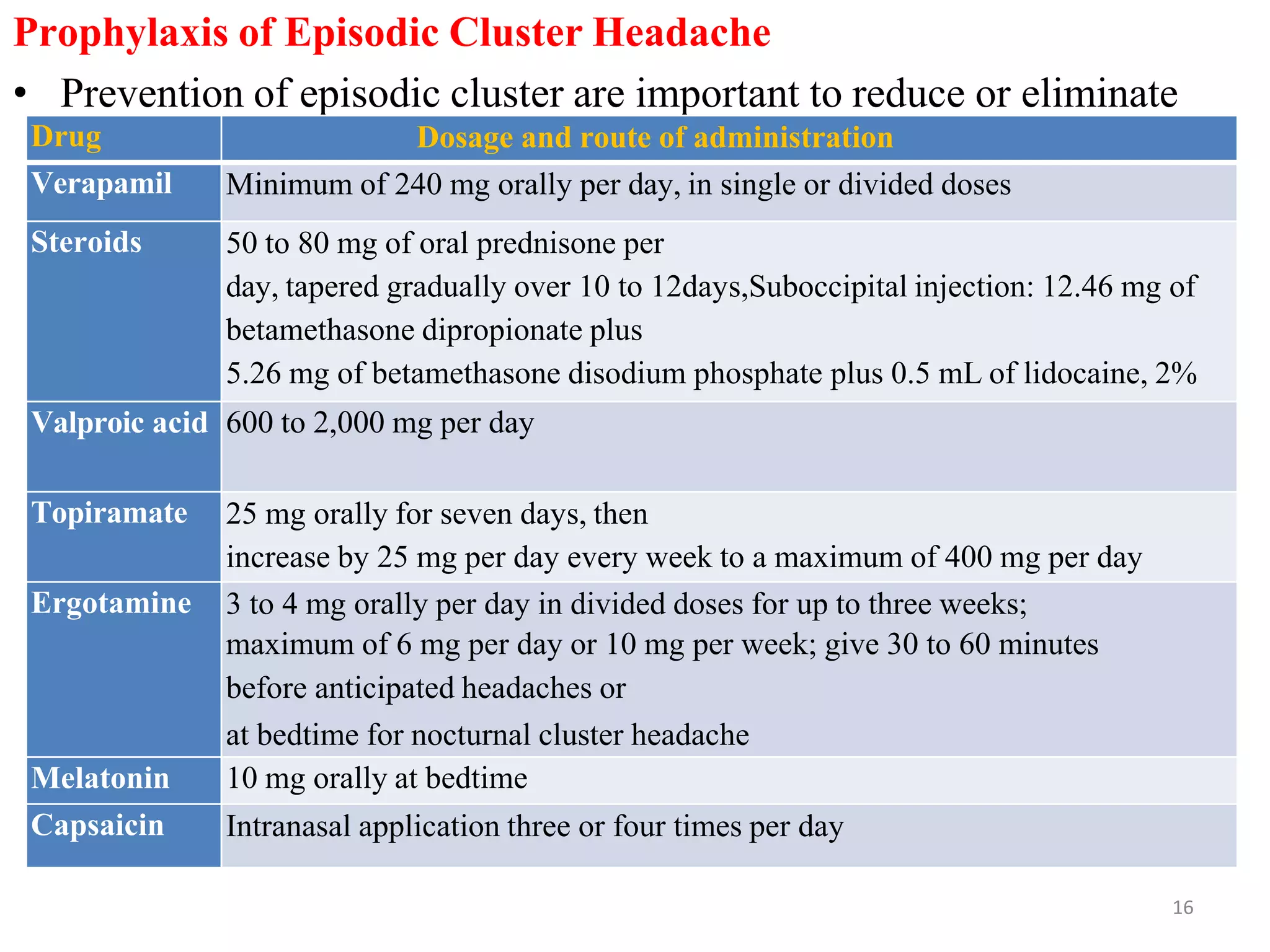
Prophylaxis of Episodic Cluster Headache
• Prevention of episodic cluster are important to reduce or eliminate
cluster headache attacks
Drug Dosage and route of administration
Verapamil Minimum of 240 mg orally per day, in single or divided doses
Steroids 50 to 80 mg of oral prednisone per
day, tapered gradually over 10 to 12days,Suboccipital injection: 12.46 mg of
betamethasone dipropionate plus
5.26 mg of betamethasone disodium phosphate plus 0.5 mL of lidocaine, 2%
Valproic acid 600 to 2,000 mg per day
Topiramate 25 mg orally for seven days, then
increase by 25 mg per day every week to a maximum of 400 mg per day
Ergotamine 3 to 4 mg orally per day in divided doses for up to three weeks;
maximum of 6 mg per day or 10 mg per week; give 30 to 60 minutes
before anticipated headaches or
at bedtime for nocturnal cluster headache
Melatonin 10 mg orally at bedtime
Capsaicin Intranasal application three or four times per day
16
Chronic cluster headache treatment
Therapy Dosage and route of administration Adverse effects Comments
Verapamil Minimum of 240 mg per day, in
single
or divided oral doses
Bradycardia,Constipatio
n,EdemaGastrointestinal
discomfort,Gingival,Hyp
erplasia,Hypotension
Electrocardiography should
be performed to monitor for
heart block
Lithium 800 to 900 mg with meals, in divided
oral doses
Hypothyroidism,
Nephrogenic diabetes
Insipidus,Polyuria
Tremor
Serum lithium levels should
be monitored at least every
six months and with dosage
changes;
Deep brain
Stimulation
- Micturition syncope,
Subcutaneous infection
Transient loss of
consciousness
Used only for refractory
chronic cluster headache;
the effect is not thought to
be related to direct
hypothalamic stimulation,
and failure is not likely
caused by electrode
misplacement
17
18

cluster headache.pptx

  • 1.
    Clinical Neurology Lecturer :Dr.BakarAli Adam MBChB, MD Neurology Specialist MRCP UK PART I, II,
  • 2.
  • 3.
    INTRODUCTION • Cluster headache(CH) is a neurological disorder characterized by recurrent, severe headaches on one side of the head, typically around the eye. • Acluster headache commonly awakens paitent in the middle of the night with intense pain in or around one eye on one side of head. 3
  • 4.
  • 5.
    TYPES OF CLUSTERHEADACHES • Episodic cluster headaches happen in groups that can last anywhere from 7 days to a year. Each one may last from 15 minutes to 3 hours, although medicine can. shorten that time Episodic cluster headaches • These are regular headaches that continue for a year or longer. If any pain- free periods, they last for less than a month. Chronic cluster headaches 5
  • 6.
    PATHOGENESIS Trigemino vascular activation(CGRP): Activation of the trigeminovascular system Release of trigeminovascular neuropeptides Substance P and calcitonin gene- related peptide (CGRP) production of neurogenic inflammation and dilation of dural blood vessels leads to pain 6
  • 7.
    PATHOGENESIS Cranial parasympathetic activation(VIP) : Activation of the cranial parasympathetic fibers. Impaired vasomotor and secretomotor innervation to the cerebral blood vessels and the lacrimal and nasal mucosal glands, respectively 7
  • 8.
    PATHOGENESIS Internal carotid arterydilation (cavernous) Arterial dilatation and venous outflow obstruction in the region of the cavernous sinus. pain and autonomic features The activation of these pathways may lead to painful vascular changes within the cavernous sinus, secondary involvement of the sympathetic plexus overlying the cavernous carotid artery, and stimulation of secretory function of the lacrimal and other mucosal glands 8
  • 9.
    SYMPTOMS • Excruciating pain,generally situated in or around one eye, but may radiate to other areas of your face, head, neck and shoulders • One-sided pain • Restlessness • Excessive tearing • Redness in eye on the affected side • Stuffy or runny nose on the affected side • Forehead or facial sweating • Pale skin (pallor) or flushing on your face • Swelling around eye on the affected side • Drooping eyelid 9
  • 10.
    Cluster period characteristics 🠶Acluster period generally lasts from six to 12 weeks. 🠶 The starting date and the duration of each cluster period might be consistent from period to period. For example, cluster periods can occur seasonally, such as every spring or every fall. 🠶 Most people have episodic cluster headaches. In episodic cluster headaches, the headaches occur for one week to a year, followed by a pain-free remission period that can last as long as 12 months before another cluster headache develops. 🠶 Chronic cluster periods might continue for more than a year, or pain-free periods might last less than one month 10
  • 11.
    cluster period 🠶 Headachesusually occur every day, sometimes several times a day. 🠶 A single attack can last from 15 minutes to three hours. 🠶 The attacks often occur at the same time each day. 🠶 Most attacks occur at night, usually one to two hours after bed. 🠶 The pain usually ends as suddenly as it began, with rapidly decreasing intensity. After attacks, most people are pain-free, but exhausted. 11
  • 12.
    According to thecriteria of the International Classification of Headache Disorders, at least 5 attacks meeting the following are required for diagnosis:  Severe unilateral, orbital (around the eye) and/or temporal (around the temple) pain lasting 15-180 minutes if untreated.  Headache must be accompanied by at least one of the following: • Red eye or tearing on the side of the headache • Nasal congestion or runny nose on the side of the headache • Eyelid swelling on the side of the headache • Forehead and facial sweating on the side of the headache • Small pupil or eyelid droop on the side of the headache • A sense of restlessness or agitation  Attacks have a frequency from one every other to 8 per day 12
  • 13.
  • 14.
    TREATMENT TREATMENT Episodic cluster headachetreatment Chronic cluster headache treatment 14
  • 15.
    Episodic cluster headachetreatment Therapy Dosage and route of administration Adverse effects Oxygen 100% via nonrebreather face mask at 12 to 15 none L per minute for 15 to 20 minutes Sumatriptan 6 mg subcutaneously; may repeat once at least Mild to moderate; rarely lead to one hour later discontinuation Injections: dizziness, fatigue, injection site reactions,nausea, paresthesias, Zolmitriptan 20-mg nasal spray; maximum of 40 mg per day Nasal spray: bitter taste ,5-mg nasal spray; may be repeated once after Nasal spray: mild adverse two hours, 5 mg orally; maximum of 10 mg effects in approximately per day 25% to 33% of patients Lidocaine 1 mL of 10% solution applied bilaterally with Nasal congestion, unpleasant acotton swab for five minutes taste Octreotide 100 mcg subcutaneously Bloating, diarrhea, dull background headache Ergotamine 2 mg sublingually, may repeat dose every 30 Angina, fibrosis, myocardial minutes to a maximum of 6 mg per day infarction, pruritus,vertigo15
  • 16.
    Prophylaxis of EpisodicCluster Headache • Prevention of episodic cluster are important to reduce or eliminate cluster headache attacks Drug Dosage and route of administration Verapamil Minimum of 240 mg orally per day, in single or divided doses Steroids 50 to 80 mg of oral prednisone per day, tapered gradually over 10 to 12days,Suboccipital injection: 12.46 mg of betamethasone dipropionate plus 5.26 mg of betamethasone disodium phosphate plus 0.5 mL of lidocaine, 2% Valproic acid 600 to 2,000 mg per day Topiramate 25 mg orally for seven days, then increase by 25 mg per day every week to a maximum of 400 mg per day Ergotamine 3 to 4 mg orally per day in divided doses for up to three weeks; maximum of 6 mg per day or 10 mg per week; give 30 to 60 minutes before anticipated headaches or at bedtime for nocturnal cluster headache Melatonin 10 mg orally at bedtime Capsaicin Intranasal application three or four times per day 16
  • 17.
    Chronic cluster headachetreatment Therapy Dosage and route of administration Adverse effects Comments Verapamil Minimum of 240 mg per day, in single or divided oral doses Bradycardia,Constipatio n,EdemaGastrointestinal discomfort,Gingival,Hyp erplasia,Hypotension Electrocardiography should be performed to monitor for heart block Lithium 800 to 900 mg with meals, in divided oral doses Hypothyroidism, Nephrogenic diabetes Insipidus,Polyuria Tremor Serum lithium levels should be monitored at least every six months and with dosage changes; Deep brain Stimulation - Micturition syncope, Subcutaneous infection Transient loss of consciousness Used only for refractory chronic cluster headache; the effect is not thought to be related to direct hypothalamic stimulation, and failure is not likely caused by electrode misplacement 17
  • 18.