Headache:
Introduction
 NO pain receptors in the parenchyma [the brain tissue itself]
 Pain receptors ARE present in:
 Blood vessels
 Meninges
 Scalp
 Skull
 Pain sensitive structures are supplied by upper cervical nerves and
trigeminal nerve.
Definition
 Headache is a frequently encountered neurological symptom but is
seldom associated with significant neurological deficit unless
accompanied by other symptoms.
Prevalence
 ½ - ¾ of adults have suffered from a headache within the past
year.
 30% have had a migraine in the past year.
 1.7-4% have had a headache at least 15 days or more each month.
Types
 Migraine
 Medication overuse headache
 Tension type headache
 Cluster headache
 Benign paroxysmal headache
Migraine
Introduction
 Prevalence:
 Women 25% (lifetime)
 Men 8% (lifetime)
 28 million persons have migraine each year in the U.S.
 Highest from 25-50 years of age
 Genetics
 About 70% of migraine patients have a positive family
history in a first-degree relative
 Unknown mode of transmission
Strange (Scary) Facts
 Increased prevalence of:
 HTN
 Stroke
 Epilepsy
 Asthma
 Irritation bowel disorder
 Depression
 Bipolar disease
 Anxiety disorders
 Panic attacks
Migraine
The International Classification of Headache Disorders, 3rd edition
 A. At least five attacks fulfilling criteria B–D
 B. Headache attacks lasting 4–72 hours (when untreated or
unsuccessfully treated)
 C. Headache has at least two of the following four characteristics:
 1. unilateral location
 2. pulsating quality
 3. moderate or severe pain intensity
 4. aggravation by or causing avoidance of routine physical activity (e.g.
walking or climbing stairs)
 D. During headache at least one of the following:
 1. nausea and/or vomiting
 2. photophobia and phonophobia
 E. Not better accounted for by another ICHD-3 diagnosis.
Cephalalgia 2018, Vol. 38(1) 1–211
Migraine
 Migraine without aura [common migraine]
 Migraine with aura [classic migraine]
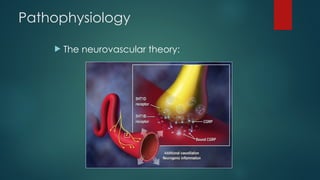
Pathophysiology
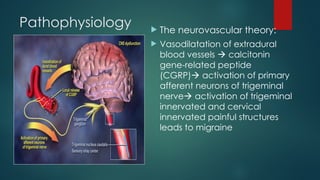
 The neurovascular theory:
Pathophysiology  The neurovascular theory:
 Vasodilatation of extradural
blood vessels  calcitonin
gene-related peptide
(CGRP) activation of primary
afferent neurons of trigeminal
nerve activation of trigeminal
innervated and cervical
innervated painful structures
leads to migraine
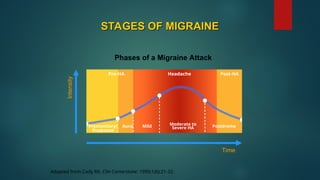
STAGES OF MIGRAINE
STAGES OF MIGRAINE
Adapted from Cady RK. Clin Cornerstone. 1999;1(6):21-32.
Phases of a Migraine Attack
Premonitory/
Prodrome
Aura Mild Moderate to
Severe HA Postdrome
Pre-HA Post-HA
Headache
Time
Intensity
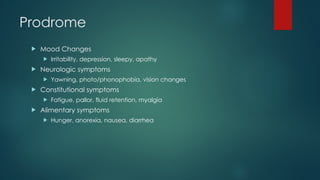
Prodrome
 Mood Changes
 Irritability, depression, sleepy, apathy
 Neurologic symptoms
 Yawning, photo/phonophobia, vision changes
 Constitutional symptoms
 Fatigue, pallor, fluid retention, myalgia
 Alimentary symptoms
 Hunger, anorexia, nausea, diarrhea
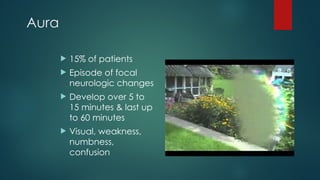
Aura
 15% of patients
 Episode of focal
neurologic changes
 Develop over 5 to
15 minutes & last up
to 60 minutes
 Visual, weakness,
numbness,
confusion
Headache
 Headache lasts hours to days
 Migraine head pain unilateral in 56 – 68% of patients
 90% of patients have coexisting nausea
 Constitutional symptoms common
Postdrome
 Depression
 Drowsiness
 Cognitive changes
 Memory loss
 Difficulty with concentration
Medication Overuse Headache
 Also known as Rebound Headache
 Defined as:
 Headache present on >15 days/month.
 Regular overuse for >3 months of one or more drugs that can be taken
for acute and/or symptomatic treatment of headache.
 Headache has developed or markedly worsened during medication
overuse.
Ther Adv Drug Saf. 2014 Apr; 5(2): 87–99.
Medication Overuse Headache
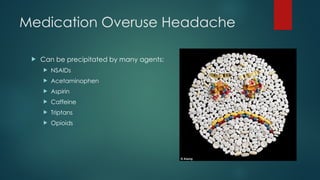
 Can be precipitated by many agents:
 NSAIDs
 Acetaminophen
 Aspirin
 Caffeine
 Triptans
 Opioids
Treatment of Migraine
 If the pain can be stopped early, the cascade
of pain responses can be controlled
 Headache needs to be caught before central
sensitization occurs
 Patients may receive the greatest benefit
from their migraine medication if they:
 Practice early intervention
 Use a fast-acting migraine medication
General Treatment
 Avoid triggers!
 Maintain regular sleep schedule
 Maintain regular meal schedule
 Low tyramine
 Limit caffeine
 Avoid nitrates/nitrites
 Limit chocolate
 Reduce stress
 Adequate water intake
Treatment Options
Two Treatment Approaches
•Acute therapy
 Work quickly to relieve migraine pain and
other symptoms
 Are taken only at migraine onset
•Preventative therapy
 Prevent or reduce the number of migraine
attacks
 Are taken on a daily basis
Acute Treatment
 NSAIDS
 Inhibit prostaglandin formation, thus reducing inflammation
 Naproxen
 Ibuprofen
 ASA
 COX2 inhibitors
Acute Treatment
 Triptans
 Selective 5-HT1B/1D agonists
 Block actions of 5-HT such as dilation of cranial arteries/AV anastomoses, neurogenic
dural plasma extravasation e.g Sumatriptan (Imitrex), Almotriptan (Axert)
 Triptans side effects:
Chest pressure/heaviness, Jaw tightness, Dizziness, Somnolence, Fatigue
Nausea, Paresthesias
 Use early!
 More effective in mild/moderate pain
 Caution about rebound
Prophylactic Treatment
 Start low and go slow!
 Adequate trial with adequate dose
 Consider comorbid conditions when choosing a medication
 May add a second medication
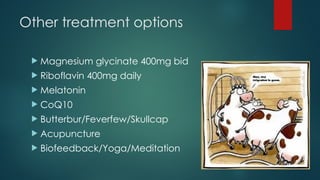
Other treatment options
 Magnesium glycinate 400mg bid
 Riboflavin 400mg daily
 Melatonin
 CoQ10
 Butterbur/Feverfew/Skullcap
 Acupuncture
 Biofeedback/Yoga/Meditation
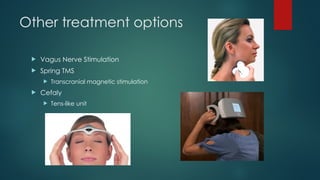
Other treatment options
 Vagus Nerve Stimulation
 Spring TMS
 Transcranial magnetic stimulation
 Cefaly
 Tens-like unit
Tension-type Headache
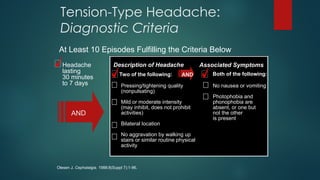
Tension-Type Headache:
Diagnostic Criteria
At Least 10 Episodes Fulfilling the Criteria Below
Olesen J. Cephalalgia. 1988;8(Suppl 7):1-96.
Two of the following: AND
Associated Symptoms
No nausea or vomiting
Photophobia and
phonophobia are
absent, or one but
not the other
is present
Description of Headache
Pressing/tightening quality
(nonpulsating)
Mild or moderate intensity
(may inhibit, does not prohibit
activities)
Bilateral location
No aggravation by walking up
stairs or similar routine physical
activity
Headache
lasting
30 minutes
to 7 days
Both of the following:
AND
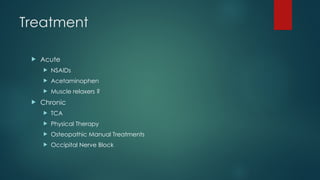
Treatment
 Acute
 NSAIDs
 Acetaminophen
 Muscle relaxers ?
 Chronic
 TCA
 Physical Therapy
 Osteopathic Manual Treatments
 Occipital Nerve Block
Cluster Headache
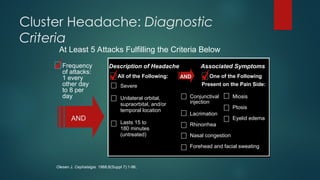
Cluster Headache: Diagnostic
Criteria
At Least 5 Attacks Fulfilling the Criteria Below
Olesen J. Cephalalgia. 1988;8(Suppl 7):1-96.
Associated Symptoms
One of the Following
Description of Headache
All of the Following:
Severe
Unilateral orbital,
supraorbital, and/or
temporal location
Lasts 15 to
180 minutes
(untreated)
Conjunctival
injection
Lacrimation
Rhinorrhea
Nasal congestion
Forehead and facial sweating
Miosis
Ptosis
Eyelid edema
Frequency
of attacks:
1 every
other day
to 8 per
day
Present on the Pain Side:
AND
AND
Cluster Headache
 Location: strictly unilateral, often periorbital or temporal
 Pain characteristics: constant, severe, burning, or boring
 Frequency: 1-6(+) per day
 Demographics: Males : Females  6 : 1
 Duration: 15-180 minutes
 Associated symptoms: autonomic symptoms –
(ipsilateral to pain) tearing, rhinorrhea, conjunctival
injection, eyelid edema, ptosis, pupillary miosis,
restlessness
Cluster Headache
 Triggers: ETOH, REM sleep, diurnal or annual cycles
 Treatment:
 high-flow oxygen, DHE, parenteral triptans
 Steroids
 Prophylactic: Verapamil, Divalproate Sodium, Topirimate, Lithium
Benign Paroxysmal Headache
 It is also known as Sjaastad Syndrome
 It is characterized by chronic solitary limited attackes of unilateral
headae that did not shift sied and this is known as hemicranias
 Pain is generally oculofrontotemporal
 It may radiate or involve ipsilateral shouldef and neck region
 During severe attack ther is excruciating pain that is throbbing,
pulsating.
 It sis triggered by various stimuli like neck movement, excessive
pressure on the neck, extreme light, photophobia ma be present.
 Other associative symptoms are red eyes, increased lacrimation,
nasal congestion, rhinorrhea (leakage of CSF from nose).
Management
 Drugs : NSAIDS – Indomethacin, naproxen sodium, ibuprofen
 Calcium channel blockers – Verpamil
 Corticosteroids – prednisolone
 Anticonvulsants - topiramate

Headaches and management (physiotherapy).ppt

  • 1.
  • 2.
    Introduction  NO painreceptors in the parenchyma [the brain tissue itself]  Pain receptors ARE present in:  Blood vessels  Meninges  Scalp  Skull  Pain sensitive structures are supplied by upper cervical nerves and trigeminal nerve.
  • 3.
    Definition  Headache isa frequently encountered neurological symptom but is seldom associated with significant neurological deficit unless accompanied by other symptoms.
  • 4.
    Prevalence  ½ -¾ of adults have suffered from a headache within the past year.  30% have had a migraine in the past year.  1.7-4% have had a headache at least 15 days or more each month.
  • 5.
    Types  Migraine  Medicationoveruse headache  Tension type headache  Cluster headache  Benign paroxysmal headache
  • 6.
  • 7.
    Introduction  Prevalence:  Women25% (lifetime)  Men 8% (lifetime)  28 million persons have migraine each year in the U.S.  Highest from 25-50 years of age  Genetics  About 70% of migraine patients have a positive family history in a first-degree relative  Unknown mode of transmission
  • 8.
    Strange (Scary) Facts Increased prevalence of:  HTN  Stroke  Epilepsy  Asthma  Irritation bowel disorder  Depression  Bipolar disease  Anxiety disorders  Panic attacks
  • 9.
    Migraine The International Classificationof Headache Disorders, 3rd edition  A. At least five attacks fulfilling criteria B–D  B. Headache attacks lasting 4–72 hours (when untreated or unsuccessfully treated)  C. Headache has at least two of the following four characteristics:  1. unilateral location  2. pulsating quality  3. moderate or severe pain intensity  4. aggravation by or causing avoidance of routine physical activity (e.g. walking or climbing stairs)  D. During headache at least one of the following:  1. nausea and/or vomiting  2. photophobia and phonophobia  E. Not better accounted for by another ICHD-3 diagnosis. Cephalalgia 2018, Vol. 38(1) 1–211
  • 10.
    Migraine  Migraine withoutaura [common migraine]  Migraine with aura [classic migraine]
  • 11.
  • 12.
    Pathophysiology  Theneurovascular theory:  Vasodilatation of extradural blood vessels  calcitonin gene-related peptide (CGRP) activation of primary afferent neurons of trigeminal nerve activation of trigeminal innervated and cervical innervated painful structures leads to migraine
  • 13.
    STAGES OF MIGRAINE STAGESOF MIGRAINE Adapted from Cady RK. Clin Cornerstone. 1999;1(6):21-32. Phases of a Migraine Attack Premonitory/ Prodrome Aura Mild Moderate to Severe HA Postdrome Pre-HA Post-HA Headache Time Intensity
  • 14.
    Prodrome  Mood Changes Irritability, depression, sleepy, apathy  Neurologic symptoms  Yawning, photo/phonophobia, vision changes  Constitutional symptoms  Fatigue, pallor, fluid retention, myalgia  Alimentary symptoms  Hunger, anorexia, nausea, diarrhea
  • 15.
    Aura  15% ofpatients  Episode of focal neurologic changes  Develop over 5 to 15 minutes & last up to 60 minutes  Visual, weakness, numbness, confusion
  • 16.
    Headache  Headache lastshours to days  Migraine head pain unilateral in 56 – 68% of patients  90% of patients have coexisting nausea  Constitutional symptoms common
  • 17.
    Postdrome  Depression  Drowsiness Cognitive changes  Memory loss  Difficulty with concentration
  • 18.
    Medication Overuse Headache Also known as Rebound Headache  Defined as:  Headache present on >15 days/month.  Regular overuse for >3 months of one or more drugs that can be taken for acute and/or symptomatic treatment of headache.  Headache has developed or markedly worsened during medication overuse. Ther Adv Drug Saf. 2014 Apr; 5(2): 87–99.
  • 19.
    Medication Overuse Headache Can be precipitated by many agents:  NSAIDs  Acetaminophen  Aspirin  Caffeine  Triptans  Opioids
  • 20.
    Treatment of Migraine If the pain can be stopped early, the cascade of pain responses can be controlled  Headache needs to be caught before central sensitization occurs  Patients may receive the greatest benefit from their migraine medication if they:  Practice early intervention  Use a fast-acting migraine medication
  • 21.
    General Treatment  Avoidtriggers!  Maintain regular sleep schedule  Maintain regular meal schedule  Low tyramine  Limit caffeine  Avoid nitrates/nitrites  Limit chocolate  Reduce stress  Adequate water intake
  • 22.
    Treatment Options Two TreatmentApproaches •Acute therapy  Work quickly to relieve migraine pain and other symptoms  Are taken only at migraine onset •Preventative therapy  Prevent or reduce the number of migraine attacks  Are taken on a daily basis
  • 23.
    Acute Treatment  NSAIDS Inhibit prostaglandin formation, thus reducing inflammation  Naproxen  Ibuprofen  ASA  COX2 inhibitors
  • 24.
    Acute Treatment  Triptans Selective 5-HT1B/1D agonists  Block actions of 5-HT such as dilation of cranial arteries/AV anastomoses, neurogenic dural plasma extravasation e.g Sumatriptan (Imitrex), Almotriptan (Axert)  Triptans side effects: Chest pressure/heaviness, Jaw tightness, Dizziness, Somnolence, Fatigue Nausea, Paresthesias  Use early!  More effective in mild/moderate pain  Caution about rebound
  • 25.
    Prophylactic Treatment  Startlow and go slow!  Adequate trial with adequate dose  Consider comorbid conditions when choosing a medication  May add a second medication
  • 26.
    Other treatment options Magnesium glycinate 400mg bid  Riboflavin 400mg daily  Melatonin  CoQ10  Butterbur/Feverfew/Skullcap  Acupuncture  Biofeedback/Yoga/Meditation
  • 27.
    Other treatment options Vagus Nerve Stimulation  Spring TMS  Transcranial magnetic stimulation  Cefaly  Tens-like unit
  • 28.
  • 29.
    Tension-Type Headache: Diagnostic Criteria AtLeast 10 Episodes Fulfilling the Criteria Below Olesen J. Cephalalgia. 1988;8(Suppl 7):1-96. Two of the following: AND Associated Symptoms No nausea or vomiting Photophobia and phonophobia are absent, or one but not the other is present Description of Headache Pressing/tightening quality (nonpulsating) Mild or moderate intensity (may inhibit, does not prohibit activities) Bilateral location No aggravation by walking up stairs or similar routine physical activity Headache lasting 30 minutes to 7 days Both of the following: AND
  • 30.
    Treatment  Acute  NSAIDs Acetaminophen  Muscle relaxers ?  Chronic  TCA  Physical Therapy  Osteopathic Manual Treatments  Occipital Nerve Block
  • 31.
  • 32.
    Cluster Headache: Diagnostic Criteria AtLeast 5 Attacks Fulfilling the Criteria Below Olesen J. Cephalalgia. 1988;8(Suppl 7):1-96. Associated Symptoms One of the Following Description of Headache All of the Following: Severe Unilateral orbital, supraorbital, and/or temporal location Lasts 15 to 180 minutes (untreated) Conjunctival injection Lacrimation Rhinorrhea Nasal congestion Forehead and facial sweating Miosis Ptosis Eyelid edema Frequency of attacks: 1 every other day to 8 per day Present on the Pain Side: AND AND
  • 33.
    Cluster Headache  Location:strictly unilateral, often periorbital or temporal  Pain characteristics: constant, severe, burning, or boring  Frequency: 1-6(+) per day  Demographics: Males : Females  6 : 1  Duration: 15-180 minutes  Associated symptoms: autonomic symptoms – (ipsilateral to pain) tearing, rhinorrhea, conjunctival injection, eyelid edema, ptosis, pupillary miosis, restlessness
  • 34.
    Cluster Headache  Triggers:ETOH, REM sleep, diurnal or annual cycles  Treatment:  high-flow oxygen, DHE, parenteral triptans  Steroids  Prophylactic: Verapamil, Divalproate Sodium, Topirimate, Lithium
  • 35.
  • 36.
    Benign Paroxysmal Headache It is also known as Sjaastad Syndrome  It is characterized by chronic solitary limited attackes of unilateral headae that did not shift sied and this is known as hemicranias  Pain is generally oculofrontotemporal  It may radiate or involve ipsilateral shouldef and neck region  During severe attack ther is excruciating pain that is throbbing, pulsating.  It sis triggered by various stimuli like neck movement, excessive pressure on the neck, extreme light, photophobia ma be present.  Other associative symptoms are red eyes, increased lacrimation, nasal congestion, rhinorrhea (leakage of CSF from nose).
  • 37.
    Management  Drugs :NSAIDS – Indomethacin, naproxen sodium, ibuprofen  Calcium channel blockers – Verpamil  Corticosteroids – prednisolone  Anticonvulsants - topiramate

Editor's Notes

  • #22 The good news is that if you are diagnosed with migraines, there are effective medicines that can help you manage your migraines. Most migraine headaches can be effectively treated with acute medicines. Acute medicines work quickly to relieve migraine pain and other symptoms. They are only taken when you have a migraine attack. Some patients with more frequent migraines may benefit from preventative medicines that are taken on a daily basis and can reduce the number of migraine attacks.
  • #29 SLIDE 20. Tension-Type Headache: Diagnostic Criteria Tension-type headache attacks may be variable in duration, lasting from 30 minutes to 7 days Pain associated with tension-type headaches is typically pressing/tightening in quality (often a band around the head), of mild to moderate intensity, and bilateral in location, and is not aggravated by walking up stairs or similar routine physical activity Tension-type headaches are not typically associated with photophobia and phonophobia, but patients may experience one or the other of these symptoms Tension headaches can be differentiated from migraine by: Location: tension headaches are strictly bilateral, whereas migraine is typically, although not exclusively, unilateral Quality: headache pain associated with tension-type headache is characterized as pressing or tightening (ie, nonpulsating), whereas pain associated with migraine is often throbbing or pulsating Intensity: headache pain associated with tension-type headache is mild to moderate in severity and is generally less severe than the headache pain experienced by migraine sufferers Associated symptoms: photophobia and phonophobia are generally absent in tension-type headaches, although one but not the other symptom may be present, and tension-type headache is not associated with nausea or vomiting; migraine is associated with nausea, vomiting, photophobia, and phonophobia Impact of physical activity: tension-type headache is not aggravated by routine physical activity
  • #32 SLIDE 21. Cluster Headache: Diagnostic Criteria Another primary headache type classified by the IHS diagnostic criteria is cluster headache Cluster headache reaches full intensity rapidly and comes in temporal clusters Cluster headache is accompanied by severe, recurrent headache pain Excruciating headache pain is one of the most salient features of cluster headache Cluster headache attacks are characterized by severe, strictly unilateral pain localized to the orbital, supraorbital, and/or temporal regions Cluster headache attacks last 15 to 180 minutes, occurring as little as once every other day to as frequently as 8 times per day over a period of weeks to months, separated by periods of remission Cluster headache is typically associated with at least 1 of the following signs or symptoms, which occur unilaterally on the same side as the headache pain: Conjunctival injection Lacrimation Rhinorrhea Nasal congestion Forehead and facial sweating Miosis (contraction of the pupil) Ptosis (eyelid drooping) Eyelid edema Cluster headaches can be differentiated from migraine by: Location: although cluster headache and migraine are both typically unilateral, cluster headache pain is strictly orbital, supraorbital, or temporal Duration: cluster headache pain occurs in short bursts (15 to 180 minutes) of pain, whereas migraine pain lasts 4 to 72 hours (untreated or treated unsuccessfully) Frequency: during headache attack periods or bouts, cluster headache occurs from once every other day to as many as 8 attacks per day; a period of remission between bouts occurs in episodic cluster headache Associated symptoms: while migraine is associated with nausea, vomiting, photophobia, and phonophobia, cluster headache is associated with unilateral autonomic signs and symptoms (eg, conjunctival injection, nasal congestion, rhinorrhea, lacrimation, ptosis), which occur on the same side as the headache pain