Trust Models for RDF Data: Semantics and Complexity
AAAI 2015
Valeria Fionda1, Gianluigi Greco1
1Department of Mathematics and Computer Science, University of Calabria
Valeria Fionda, Gianluigi Greco ( Department of Mathematics and Computer Science, University ofTrust Models for RDF Data 1 / 28
Outline
1 Introduction
2 Trust Framework
3 Complexity
4 Conclusions
Valeria Fionda, Gianluigi Greco ( Department of Mathematics and Computer Science, University ofTrust Models for RDF Data 2 / 28
Introduction
Outline
1 Introduction
2 Trust Framework
3 Complexity
4 Conclusions
Valeria Fionda, Gianluigi Greco ( Department of Mathematics and Computer Science, University ofTrust Models for RDF Data 3 / 28
Introduction
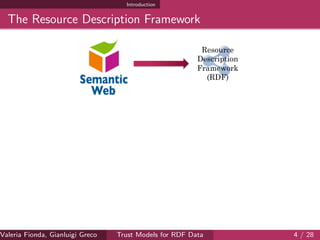
The Resource Description Framework
Resource
Description
Framework
(RDF)
Valeria Fionda, Gianluigi Greco ( Department of Mathematics and Computer Science, University ofTrust Models for RDF Data 4 / 28
Introduction
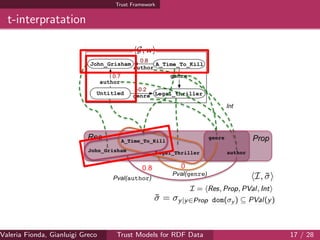
The Resource Description Framework
Resource
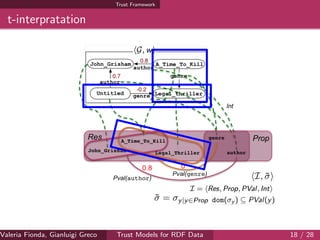
Description
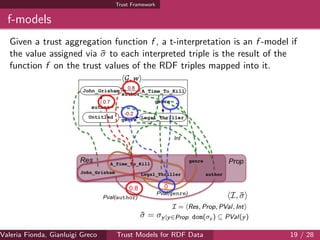
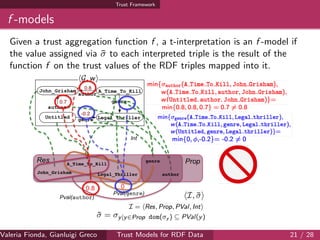
Framework
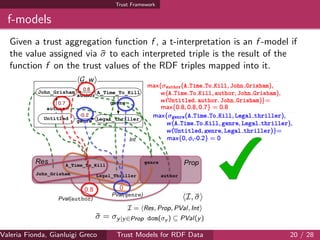
(RDF)
Resource
Description
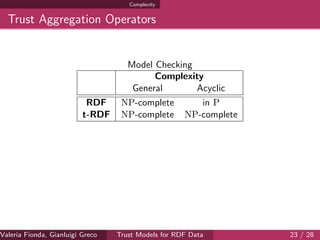
Framework
(RDF)
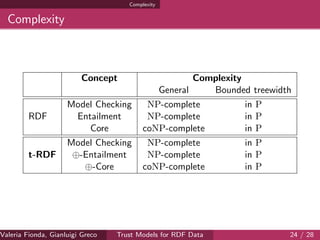
Formalization of the model
Systematic study of the complexity of
entailment
Formalization of the concept of minimal
representation (core) of an RDF graph
Study of the complexity of
core computation
[Gutierrez
et al. 2011]
Foundational
aspects
Valeria Fionda, Gianluigi Greco ( Department of Mathematics and Computer Science, University ofTrust Models for RDF Data 4 / 28
Introduction
Extensions of RDF
[G
utierrez, H
urtado,
and
Vaism
an
2007]
Time
Provenance
[Dividino et al. 2009]
Fuzzy
[Straccia 2009]
Trust
[Hartig 2009;
Tomaszuk, Pak,
and Rybinski 2013]
General annotations
[U
drea,Recupero,
and
Subrahm
anian
2010;
Zim
m
erm
ann
etal.2012]
Resource
Description
Framework
(RDF)
Valeria Fionda, Gianluigi Greco ( Department of Mathematics and Computer Science, University ofTrust Models for RDF Data 5 / 28
Introduction
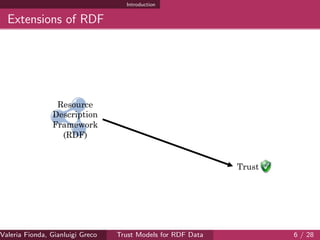
Extensions of RDF
Trust
Resource
Description
Framework
(RDF)
Valeria Fionda, Gianluigi Greco ( Department of Mathematics and Computer Science, University ofTrust Models for RDF Data 6 / 28
Introduction
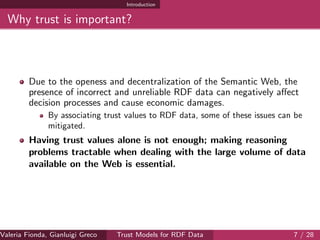
Why trust is important?
Due to the openess and decentralization of the Semantic Web, the
presence of incorrect and unreliable RDF data can negatively affect
decision processes and cause economic damages.
By associating trust values to RDF data, some of these issues can be
mitigated.
Having trust values alone is not enough; making reasoning
problems tractable when dealing with the large volume of data
available on the Web is essential.
Valeria Fionda, Gianluigi Greco ( Department of Mathematics and Computer Science, University ofTrust Models for RDF Data 7 / 28
Introduction
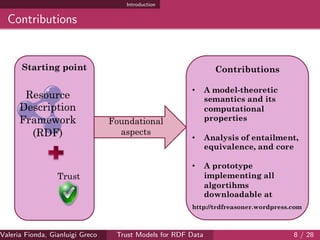
Contributions
Valeria Fionda, Gianluigi Greco ( Department of Mathematics and Computer Science, University ofTrust Models for RDF Data 8 / 28
Introduction
Contributions
Valeria Fionda, Gianluigi Greco ( Department of Mathematics and Computer Science, University ofTrust Models for RDF Data 8 / 28
Introduction
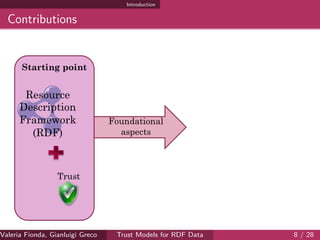
Contributions
Valeria Fionda, Gianluigi Greco ( Department of Mathematics and Computer Science, University ofTrust Models for RDF Data 8 / 28
Trust Framework
Outline
1 Introduction
2 Trust Framework
3 Complexity
4 Conclusions
Valeria Fionda, Gianluigi Greco ( Department of Mathematics and Computer Science, University ofTrust Models for RDF Data 9 / 28
Trust Framework
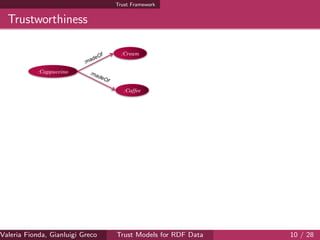
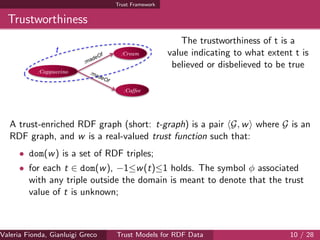
Trustworthiness
Valeria Fionda, Gianluigi Greco ( Department of Mathematics and Computer Science, University ofTrust Models for RDF Data 10 / 28
Trust Framework
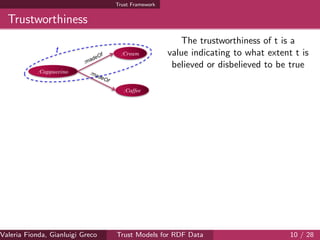
Trustworthiness
The trustworthiness of t is a
value indicating to what extent t is
believed or disbelieved to be true
Valeria Fionda, Gianluigi Greco ( Department of Mathematics and Computer Science, University ofTrust Models for RDF Data 10 / 28
Trust Framework
Trustworthiness
The trustworthiness of t is a
value indicating to what extent t is
believed or disbelieved to be true
A trust-enriched RDF graph (short: t-graph) is a pair G, w where G is an
RDF graph, and w is a real-valued trust function such that:
• dom(w) is a set of RDF triples;
• for each t ∈ dom(w), −1≤w(t)≤1 holds. The symbol φ associated
with any triple outside the domain is meant to denote that the trust
value of t is unknown;
Valeria Fionda, Gianluigi Greco ( Department of Mathematics and Computer Science, University ofTrust Models for RDF Data 10 / 28
Trust Framework
Trust Function - example
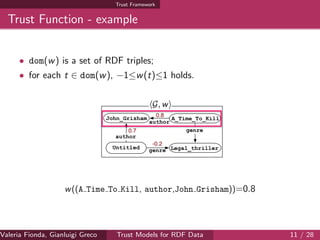
• dom(w) is a set of RDF triples;
• for each t ∈ dom(w), −1≤w(t)≤1 holds.
w((A Time To Kill, author,John Grisham))=0.8
Valeria Fionda, Gianluigi Greco ( Department of Mathematics and Computer Science, University ofTrust Models for RDF Data 11 / 28
Trust Framework
Trust Function - example
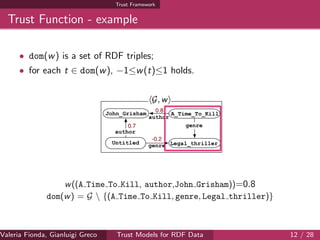
• dom(w) is a set of RDF triples;
• for each t ∈ dom(w), −1≤w(t)≤1 holds.
w((A Time To Kill, author,John Grisham))=0.8
dom(w) = G  {(A Time To Kill, genre, Legal thriller)}
Valeria Fionda, Gianluigi Greco ( Department of Mathematics and Computer Science, University ofTrust Models for RDF Data 12 / 28
Trust Framework
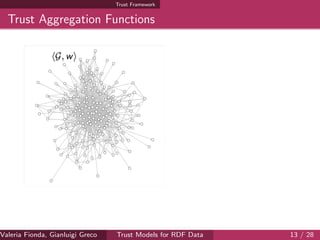
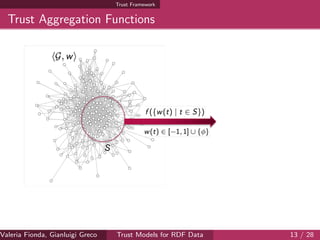
Trust Aggregation Functions
Valeria Fionda, Gianluigi Greco ( Department of Mathematics and Computer Science, University ofTrust Models for RDF Data 13 / 28
Trust Framework
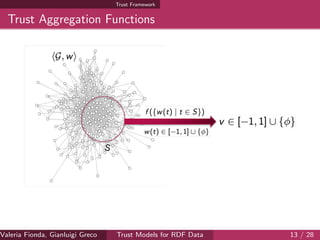
Trust Aggregation Functions
Valeria Fionda, Gianluigi Greco ( Department of Mathematics and Computer Science, University ofTrust Models for RDF Data 13 / 28
Trust Framework
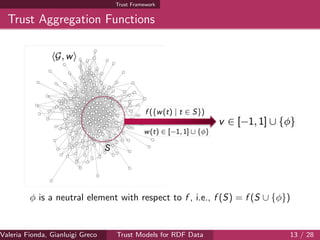
Trust Aggregation Functions
Valeria Fionda, Gianluigi Greco ( Department of Mathematics and Computer Science, University ofTrust Models for RDF Data 13 / 28
Trust Framework
Trust Aggregation Functions
φ is a neutral element with respect to f , i.e., f (S) = f (S ∪ {φ})
Valeria Fionda, Gianluigi Greco ( Department of Mathematics and Computer Science, University ofTrust Models for RDF Data 13 / 28
Trust Framework
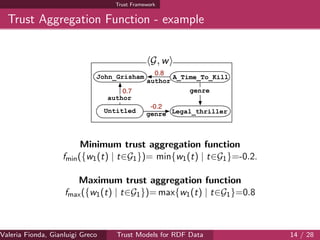
Trust Aggregation Function - example
author
Untitled
author
genre
genre
0.8
0.7
John_Grisham A_Time_To_Kill
Legal_thriller
-0.2
Minimum trust aggregation function
fmin({w1(t) | t∈G1})= min{w1(t) | t∈G1}=-0.2.
Maximum trust aggregation function
fmax({w1(t) | t∈G1})= max{w1(t) | t∈G1}=0.8
Valeria Fionda, Gianluigi Greco ( Department of Mathematics and Computer Science, University ofTrust Models for RDF Data 14 / 28
Trust Framework
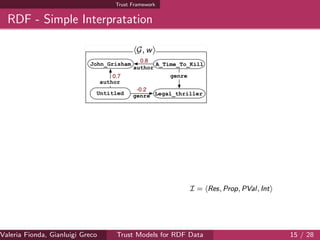
RDF - Simple Interpratation
Valeria Fionda, Gianluigi Greco ( Department of Mathematics and Computer Science, University ofTrust Models for RDF Data 15 / 28
Trust Framework
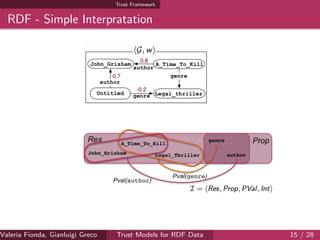
RDF - Simple Interpratation
Valeria Fionda, Gianluigi Greco ( Department of Mathematics and Computer Science, University ofTrust Models for RDF Data 15 / 28
Trust Framework
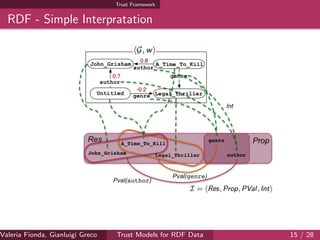
RDF - Simple Interpratation
Valeria Fionda, Gianluigi Greco ( Department of Mathematics and Computer Science, University ofTrust Models for RDF Data 15 / 28
Trust Framework
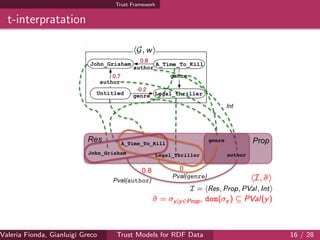
t-interpratation
Valeria Fionda, Gianluigi Greco ( Department of Mathematics and Computer Science, University ofTrust Models for RDF Data 16 / 28
Trust Framework
t-interpratation
Valeria Fionda, Gianluigi Greco ( Department of Mathematics and Computer Science, University ofTrust Models for RDF Data 17 / 28
Trust Framework
t-interpratation
Valeria Fionda, Gianluigi Greco ( Department of Mathematics and Computer Science, University ofTrust Models for RDF Data 18 / 28
Trust Framework
f-models
Given a trust aggregation function f , a t-interpretation is an f -model if
the value assigned via ¯σ to each interpreted triple is the result of the
function f on the trust values of the RDF triples mapped into it.
Valeria Fionda, Gianluigi Greco ( Department of Mathematics and Computer Science, University ofTrust Models for RDF Data 19 / 28
Trust Framework
f-models
Given a trust aggregation function f , a t-interpretation is an f -model if
the value assigned via ¯σ to each interpreted triple is the result of the
function f on the trust values of the RDF triples mapped into it.
Valeria Fionda, Gianluigi Greco ( Department of Mathematics and Computer Science, University ofTrust Models for RDF Data 20 / 28
Trust Framework
f -models
Given a trust aggregation function f , a t-interpretation is an f -model if
the value assigned via ¯σ to each interpreted triple is the result of the
function f on the trust values of the RDF triples mapped into it.
Valeria Fionda, Gianluigi Greco ( Department of Mathematics and Computer Science, University ofTrust Models for RDF Data 21 / 28
Complexity
Outline
1 Introduction
2 Trust Framework
3 Complexity
4 Conclusions
Valeria Fionda, Gianluigi Greco ( Department of Mathematics and Computer Science, University ofTrust Models for RDF Data 22 / 28
Complexity
Trust Aggregation Operators
Model Checking
Complexity
General Acyclic
RDF NP-complete in P
t-RDF NP-complete NP-complete
Valeria Fionda, Gianluigi Greco ( Department of Mathematics and Computer Science, University ofTrust Models for RDF Data 23 / 28
Complexity
Trust Aggregation Operators
Model Checking
Complexity
General Acyclic
RDF NP-complete in P
t-RDF NP-complete NP-complete
We focus on trust aggregation functions (f⊕) that can be built on top
of binary trust aggregation operators (⊕):
A trust (aggregation) operator ⊕ is the binary operator of an
Idempotent Commutative Ordered Monoid ([−1, 1] ∪ {φ}, ⊕, ) where
the partial order is defined as v v if, and only if, v ⊕ v = v.
Valeria Fionda, Gianluigi Greco ( Department of Mathematics and Computer Science, University ofTrust Models for RDF Data 23 / 28
Complexity
Complexity
Concept Complexity
General Bounded treewidth
RDF
Model Checking NP-complete in P
Entailment NP-complete in P
Core coNP-complete in P
t-RDF
Model Checking NP-complete in P
⊕-Entailment NP-complete in P
⊕-Core coNP-complete in P
Valeria Fionda, Gianluigi Greco ( Department of Mathematics and Computer Science, University ofTrust Models for RDF Data 24 / 28
Conclusions
Outline
1 Introduction
2 Trust Framework
3 Complexity
4 Conclusions
Valeria Fionda, Gianluigi Greco ( Department of Mathematics and Computer Science, University ofTrust Models for RDF Data 25 / 28
Conclusions
Conclusions
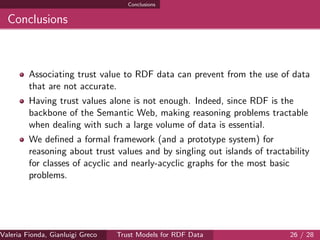
Associating trust value to RDF data can prevent from the use of data
that are not accurate.
Having trust values alone is not enough. Indeed, since RDF is the
backbone of the Semantic Web, making reasoning problems tractable
when dealing with such a large volume of data is essential.
We defined a formal framework (and a prototype system) for
reasoning about trust values and by singling out islands of tractability
for classes of acyclic and nearly-acyclic graphs for the most basic
problems.
Valeria Fionda, Gianluigi Greco ( Department of Mathematics and Computer Science, University ofTrust Models for RDF Data 26 / 28
Download our prototype at http://trdfreasoner.wordpress.com
THANK YOU
Valeria Fionda, Gianluigi Greco ( Department of Mathematics and Computer Science, University ofTrust Models for RDF Data 27 / 28
Reasoning Problems
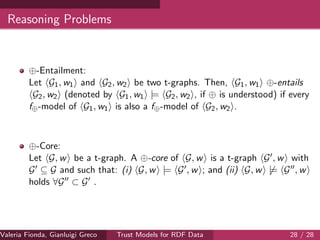
⊕-Entailment:
Let G1, w1 and G2, w2 be two t-graphs. Then, G1, w1 ⊕-entails
G2, w2 (denoted by G1, w1 |= G2, w2 , if ⊕ is understood) if every
f⊕-model of G1, w1 is also a f⊕-model of G2, w2 .
⊕-Core:
Let G, w be a t-graph. A ⊕-core of G, w is a t-graph G , w with
G ⊆ G and such that: (i) G, w |= G , w ; and (ii) G, w |= G , w
holds ∀G ⊂ G .
Valeria Fionda, Gianluigi Greco ( Department of Mathematics and Computer Science, University ofTrust Models for RDF Data 28 / 28

Trust Models for RDF Data: Semantics and Complexity - AAAI2015

  • 1.
    Trust Models forRDF Data: Semantics and Complexity AAAI 2015 Valeria Fionda1, Gianluigi Greco1 1Department of Mathematics and Computer Science, University of Calabria Valeria Fionda, Gianluigi Greco ( Department of Mathematics and Computer Science, University ofTrust Models for RDF Data 1 / 28
  • 2.
    Outline 1 Introduction 2 TrustFramework 3 Complexity 4 Conclusions Valeria Fionda, Gianluigi Greco ( Department of Mathematics and Computer Science, University ofTrust Models for RDF Data 2 / 28
  • 3.
    Introduction Outline 1 Introduction 2 TrustFramework 3 Complexity 4 Conclusions Valeria Fionda, Gianluigi Greco ( Department of Mathematics and Computer Science, University ofTrust Models for RDF Data 3 / 28
  • 4.
    Introduction The Resource DescriptionFramework Resource Description Framework (RDF) Valeria Fionda, Gianluigi Greco ( Department of Mathematics and Computer Science, University ofTrust Models for RDF Data 4 / 28
  • 5.
    Introduction The Resource DescriptionFramework Resource Description Framework (RDF) Resource Description Framework (RDF) Formalization of the model Systematic study of the complexity of entailment Formalization of the concept of minimal representation (core) of an RDF graph Study of the complexity of core computation [Gutierrez et al. 2011] Foundational aspects Valeria Fionda, Gianluigi Greco ( Department of Mathematics and Computer Science, University ofTrust Models for RDF Data 4 / 28
  • 6.
    Introduction Extensions of RDF [G utierrez,H urtado, and Vaism an 2007] Time Provenance [Dividino et al. 2009] Fuzzy [Straccia 2009] Trust [Hartig 2009; Tomaszuk, Pak, and Rybinski 2013] General annotations [U drea,Recupero, and Subrahm anian 2010; Zim m erm ann etal.2012] Resource Description Framework (RDF) Valeria Fionda, Gianluigi Greco ( Department of Mathematics and Computer Science, University ofTrust Models for RDF Data 5 / 28
  • 7.
    Introduction Extensions of RDF Trust Resource Description Framework (RDF) ValeriaFionda, Gianluigi Greco ( Department of Mathematics and Computer Science, University ofTrust Models for RDF Data 6 / 28
  • 8.
    Introduction Why trust isimportant? Due to the openess and decentralization of the Semantic Web, the presence of incorrect and unreliable RDF data can negatively affect decision processes and cause economic damages. By associating trust values to RDF data, some of these issues can be mitigated. Having trust values alone is not enough; making reasoning problems tractable when dealing with the large volume of data available on the Web is essential. Valeria Fionda, Gianluigi Greco ( Department of Mathematics and Computer Science, University ofTrust Models for RDF Data 7 / 28
  • 9.
    Introduction Contributions Valeria Fionda, GianluigiGreco ( Department of Mathematics and Computer Science, University ofTrust Models for RDF Data 8 / 28
  • 10.
    Introduction Contributions Valeria Fionda, GianluigiGreco ( Department of Mathematics and Computer Science, University ofTrust Models for RDF Data 8 / 28
  • 11.
    Introduction Contributions Valeria Fionda, GianluigiGreco ( Department of Mathematics and Computer Science, University ofTrust Models for RDF Data 8 / 28
  • 12.
    Trust Framework Outline 1 Introduction 2Trust Framework 3 Complexity 4 Conclusions Valeria Fionda, Gianluigi Greco ( Department of Mathematics and Computer Science, University ofTrust Models for RDF Data 9 / 28
  • 13.
    Trust Framework Trustworthiness Valeria Fionda,Gianluigi Greco ( Department of Mathematics and Computer Science, University ofTrust Models for RDF Data 10 / 28
  • 14.
    Trust Framework Trustworthiness The trustworthinessof t is a value indicating to what extent t is believed or disbelieved to be true Valeria Fionda, Gianluigi Greco ( Department of Mathematics and Computer Science, University ofTrust Models for RDF Data 10 / 28
  • 15.
    Trust Framework Trustworthiness The trustworthinessof t is a value indicating to what extent t is believed or disbelieved to be true A trust-enriched RDF graph (short: t-graph) is a pair G, w where G is an RDF graph, and w is a real-valued trust function such that: • dom(w) is a set of RDF triples; • for each t ∈ dom(w), −1≤w(t)≤1 holds. The symbol φ associated with any triple outside the domain is meant to denote that the trust value of t is unknown; Valeria Fionda, Gianluigi Greco ( Department of Mathematics and Computer Science, University ofTrust Models for RDF Data 10 / 28
  • 16.
    Trust Framework Trust Function- example • dom(w) is a set of RDF triples; • for each t ∈ dom(w), −1≤w(t)≤1 holds. w((A Time To Kill, author,John Grisham))=0.8 Valeria Fionda, Gianluigi Greco ( Department of Mathematics and Computer Science, University ofTrust Models for RDF Data 11 / 28
  • 17.
    Trust Framework Trust Function- example • dom(w) is a set of RDF triples; • for each t ∈ dom(w), −1≤w(t)≤1 holds. w((A Time To Kill, author,John Grisham))=0.8 dom(w) = G {(A Time To Kill, genre, Legal thriller)} Valeria Fionda, Gianluigi Greco ( Department of Mathematics and Computer Science, University ofTrust Models for RDF Data 12 / 28
  • 18.
    Trust Framework Trust AggregationFunctions Valeria Fionda, Gianluigi Greco ( Department of Mathematics and Computer Science, University ofTrust Models for RDF Data 13 / 28
  • 19.
    Trust Framework Trust AggregationFunctions Valeria Fionda, Gianluigi Greco ( Department of Mathematics and Computer Science, University ofTrust Models for RDF Data 13 / 28
  • 20.
    Trust Framework Trust AggregationFunctions Valeria Fionda, Gianluigi Greco ( Department of Mathematics and Computer Science, University ofTrust Models for RDF Data 13 / 28
  • 21.
    Trust Framework Trust AggregationFunctions φ is a neutral element with respect to f , i.e., f (S) = f (S ∪ {φ}) Valeria Fionda, Gianluigi Greco ( Department of Mathematics and Computer Science, University ofTrust Models for RDF Data 13 / 28
  • 22.
    Trust Framework Trust AggregationFunction - example author Untitled author genre genre 0.8 0.7 John_Grisham A_Time_To_Kill Legal_thriller -0.2 Minimum trust aggregation function fmin({w1(t) | t∈G1})= min{w1(t) | t∈G1}=-0.2. Maximum trust aggregation function fmax({w1(t) | t∈G1})= max{w1(t) | t∈G1}=0.8 Valeria Fionda, Gianluigi Greco ( Department of Mathematics and Computer Science, University ofTrust Models for RDF Data 14 / 28
  • 23.
    Trust Framework RDF -Simple Interpratation Valeria Fionda, Gianluigi Greco ( Department of Mathematics and Computer Science, University ofTrust Models for RDF Data 15 / 28
  • 24.
    Trust Framework RDF -Simple Interpratation Valeria Fionda, Gianluigi Greco ( Department of Mathematics and Computer Science, University ofTrust Models for RDF Data 15 / 28
  • 25.
    Trust Framework RDF -Simple Interpratation Valeria Fionda, Gianluigi Greco ( Department of Mathematics and Computer Science, University ofTrust Models for RDF Data 15 / 28
  • 26.
    Trust Framework t-interpratation Valeria Fionda,Gianluigi Greco ( Department of Mathematics and Computer Science, University ofTrust Models for RDF Data 16 / 28
  • 27.
    Trust Framework t-interpratation Valeria Fionda,Gianluigi Greco ( Department of Mathematics and Computer Science, University ofTrust Models for RDF Data 17 / 28
  • 28.
    Trust Framework t-interpratation Valeria Fionda,Gianluigi Greco ( Department of Mathematics and Computer Science, University ofTrust Models for RDF Data 18 / 28
  • 29.
    Trust Framework f-models Given atrust aggregation function f , a t-interpretation is an f -model if the value assigned via ¯σ to each interpreted triple is the result of the function f on the trust values of the RDF triples mapped into it. Valeria Fionda, Gianluigi Greco ( Department of Mathematics and Computer Science, University ofTrust Models for RDF Data 19 / 28
  • 30.
    Trust Framework f-models Given atrust aggregation function f , a t-interpretation is an f -model if the value assigned via ¯σ to each interpreted triple is the result of the function f on the trust values of the RDF triples mapped into it. Valeria Fionda, Gianluigi Greco ( Department of Mathematics and Computer Science, University ofTrust Models for RDF Data 20 / 28
  • 31.
    Trust Framework f -models Givena trust aggregation function f , a t-interpretation is an f -model if the value assigned via ¯σ to each interpreted triple is the result of the function f on the trust values of the RDF triples mapped into it. Valeria Fionda, Gianluigi Greco ( Department of Mathematics and Computer Science, University ofTrust Models for RDF Data 21 / 28
  • 32.
    Complexity Outline 1 Introduction 2 TrustFramework 3 Complexity 4 Conclusions Valeria Fionda, Gianluigi Greco ( Department of Mathematics and Computer Science, University ofTrust Models for RDF Data 22 / 28
  • 33.
    Complexity Trust Aggregation Operators ModelChecking Complexity General Acyclic RDF NP-complete in P t-RDF NP-complete NP-complete Valeria Fionda, Gianluigi Greco ( Department of Mathematics and Computer Science, University ofTrust Models for RDF Data 23 / 28
  • 34.
    Complexity Trust Aggregation Operators ModelChecking Complexity General Acyclic RDF NP-complete in P t-RDF NP-complete NP-complete We focus on trust aggregation functions (f⊕) that can be built on top of binary trust aggregation operators (⊕): A trust (aggregation) operator ⊕ is the binary operator of an Idempotent Commutative Ordered Monoid ([−1, 1] ∪ {φ}, ⊕, ) where the partial order is defined as v v if, and only if, v ⊕ v = v. Valeria Fionda, Gianluigi Greco ( Department of Mathematics and Computer Science, University ofTrust Models for RDF Data 23 / 28
  • 35.
    Complexity Complexity Concept Complexity General Boundedtreewidth RDF Model Checking NP-complete in P Entailment NP-complete in P Core coNP-complete in P t-RDF Model Checking NP-complete in P ⊕-Entailment NP-complete in P ⊕-Core coNP-complete in P Valeria Fionda, Gianluigi Greco ( Department of Mathematics and Computer Science, University ofTrust Models for RDF Data 24 / 28
  • 36.
    Conclusions Outline 1 Introduction 2 TrustFramework 3 Complexity 4 Conclusions Valeria Fionda, Gianluigi Greco ( Department of Mathematics and Computer Science, University ofTrust Models for RDF Data 25 / 28
  • 37.
    Conclusions Conclusions Associating trust valueto RDF data can prevent from the use of data that are not accurate. Having trust values alone is not enough. Indeed, since RDF is the backbone of the Semantic Web, making reasoning problems tractable when dealing with such a large volume of data is essential. We defined a formal framework (and a prototype system) for reasoning about trust values and by singling out islands of tractability for classes of acyclic and nearly-acyclic graphs for the most basic problems. Valeria Fionda, Gianluigi Greco ( Department of Mathematics and Computer Science, University ofTrust Models for RDF Data 26 / 28
  • 38.
    Download our prototypeat http://trdfreasoner.wordpress.com THANK YOU Valeria Fionda, Gianluigi Greco ( Department of Mathematics and Computer Science, University ofTrust Models for RDF Data 27 / 28
  • 39.
    Reasoning Problems ⊕-Entailment: Let G1,w1 and G2, w2 be two t-graphs. Then, G1, w1 ⊕-entails G2, w2 (denoted by G1, w1 |= G2, w2 , if ⊕ is understood) if every f⊕-model of G1, w1 is also a f⊕-model of G2, w2 . ⊕-Core: Let G, w be a t-graph. A ⊕-core of G, w is a t-graph G , w with G ⊆ G and such that: (i) G, w |= G , w ; and (ii) G, w |= G , w holds ∀G ⊂ G . Valeria Fionda, Gianluigi Greco ( Department of Mathematics and Computer Science, University ofTrust Models for RDF Data 28 / 28