




CONSERVATION IN THE MIDDLE
                   MINNESOTA VALLEY:
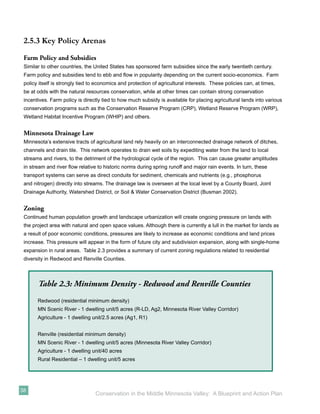
                                 A BLUEPRINT AND ACTION PLAN


Conservation in the Middle Minnesota Valley: A Blueprint and Action Plan
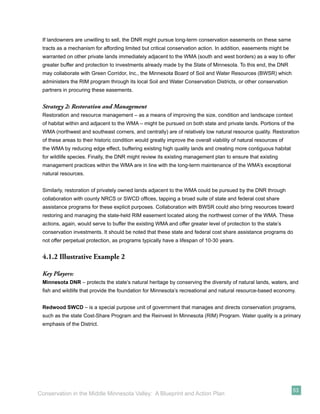
CONSERVATION IN THE MIDDLE MINNESOTA VALLEY:
A BLUEPRINT AND ACTION PLAN


Prepared for Green Corridor, Inc. and Southwest Initiative Foundation
by Great River Greening


Contributing Authors:
Wayne Ostlie, Great River Greening
Todd Rexine, Great River Greening
Loran Kaardal, Green Corridor, Inc.
Brad Cobb, Green Corridor, Inc.


Conservation in the Middle Minnesota Valley: A Blueprint and Action Plan   i
Suggested Citation:
Great River Greening, Green Corridor, Inc. and Southwest Iniative Foundation, 2010. Minnesota River Val-
ley Green Corridor: Long-Term Conservation Plan.

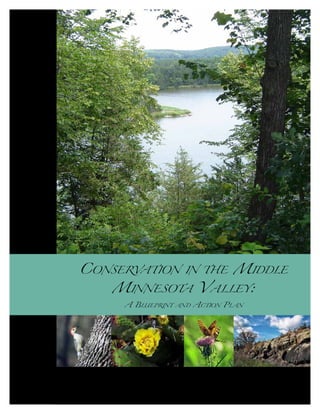
Front Cover Photographs: MN River Valley Overview - ©Brad Cobb; Red-bellied woodpecker, Prickly pear
cactus in bloom, Butterfly, Rock out-cropping - ©Ron Bouoldan.

© 2010 by Great River Greening
Great River Greening
35 W Water Street, Suite 201
St. Paul, MN 55107


              Funding for this project was provided by the Minnesota Environment and Natural
              Resources Trust Fund as recommended by the Legislative-Citizen Commission on
              Minnesota Resources (LCCMR).


               GIS mapping for this publication was made possible by a software grant from the
               ESRI Conservation Program.
 ii                           Conservation in the Middle Minnesota Valley: A Blueprint and Action Plan
About the Authors
Wayne Ostlie, Director of Conservation Programs - Great River Greening
  (M.A., Biology (Botany), University of Kansas).
  Wayne directs new initiatives, projects, and partnerships for Great River Greening, and works to build the
  organization both geographically and programmatically. Wayne comes to Greening with 20 years of experience
  in the natural resources field with The Nature Conservancy, where he served in a variety of capacities
  Science Director for their Iowa and Great Plains programs and as Senior Conservation Scientist within their
  Central Science program. Principal areas of expertise include: conservation planning, prairie conservation
  and management, program management, and biological inventory. Wayne has been the author of several
  publications on natural resource and conservation management.


Todd Rexine, Operations Manager/Design Ecologist - Great River Greening
  (M.L.A., Landscape Architecture, University of Minnesota)
  Todd is Great River Greening’s Conservation Program Operations Manager, and is responsible for providing
  ecologically sensitive and sustainable landscape design services as well as GIS analysis on a variety of Great
  River Greening projects. Projects have included river and stream bank stabilization, shoreline restoration,
  urban stormwater retrofits, rain gardens, and site specific best management practices. Todd is currently
  supervising the trails and interpretive plan for the Pilot Knob project (Mendota Heights) and many of the best
  management practices (BMPs) implemented to improve water quality within the St. Croix River. Todd has been
  the author on several management plans and installation manuals while with Great River Greening.


Loran Kaardal, Community/Conservation/Economic Development Volunteer
  (B.S., Business, University of Minnesota; Blandin CLP and CALP)
  Loran is a 30 year veteran of community, conservation and economic development leadership in the Mid
  Minnesota River Watershed. He has been an early paradigm pioneer of developing multiple recreational
  opportunities over a shared landscape (public habitat corridors/blocks) as a balanced recreation/conservation
  management paradigm, that would result in significant, renewable, corridor economic advantages within the Mid
  Minnesota River Valley. He has been instrumental in the development of various organizations and fundraising
  efforts with in the corridor. Loran has owned the Kaardal Insurance Agency in Redwood Falls since 1977.


Brad Cobb, Program Manager – Green Corridor Inc.
  (B.S., Business, University of Minnesota – Crookston & St. Cloud State University)
  Brad has over 20 years of experience in natural resource acquisitions, program implementation, fundraising,
  public relations, grant writing, and development.
  He has served on numerous local and state wildlife/natural resource advisory boards/committees. He has also
  appeared on dozens of regional and national outdoor radio and TV programs and has been a contributing writer
  to several regional newspapers and outdoor publications.


Conservation in the Middle Minnesota Valley: A Blueprint and Action Plan                                           iii
iv   Conservation in the Middle Minnesota Valley: A Blueprint and Action Plan
Conservation in the Middle Minnesota Valley:
                             A Blueprint and Action Plan

                                         Table of Contents

  Abbreviations Used in This Document                                         vii
  Preface                                                                     1
  Executive Summary                                                           5
  Conservation in the Middle Minnesota Valley: A Blueprint and Action Plan.   7
  1. The Middle Minnesota River Valley - Its Resources and Its People         9
   1.1 Humans in the River Valley                                             11
   1.2 Impacts on Natural Resources                                           15
   1.3 The Minnesota River Valley Today                                       16
     1.3.1 Natural Resources                                                  18

     1.3.2 Cultural                                                           20
  Designing the Conservation Plan                                             21
  2. Natural Resources Conservation Plan                                      22
   2.1 Conservation Targets                                                   22
   2.2 Assessing Viability and Ecological Integrity of Conservation Targets   22
   2.3 Assigning Conservation Priorities                                      24
   2.4 Threats and Ecological Legacies                                        31
   2.5 Conservation Strategies                                                32
     2.5.1 Overarching Strategies                                             32
     2.5.2 Threat-Based Strategies                                            34
     2.5.3 Key Policy Arenas                                                  38

  3. Cultural/Historical Resources Conservation Plan                          41
   3.1 Conservation Targets                                                   41
   3.2 Building the Conservation Plan and Assigning Priorities                41


Conservation in the Middle Minnesota Valley: A Blueprint and Action Plan            v
3.3 Threats and Historical Legacies                                                            44
     3.4 Conservation Strategies                                                                    47
4. Going Forward - Taking Conservation Action                                                       49
     4.1 How to Use the Plan                                                                        49
      4.1.1 Illustrative Example 1                                                                  50
      4.1.2 Illustrative Example 2                                                                  53

     4.2 Next Steps and Feasibility Assessment                                                      57
      4.2.1 Historical/Cultural Resources                                                           57
      4.2.2 Natural Resources                                                                       59

      4.2.3 Over-Arching Strategies                                                                 64

Acknowledgements                                                                                    65
References                                                                                          67
Appendices                                                                                          73
Appendix A: Building a Foundation for Conservation Design                                           75
Appendix B: Documented Rare Flora & Fauna (Minnesota Heritage Data Base)                            79
Appendix C: Documented Native Ecological Systems                                                    83
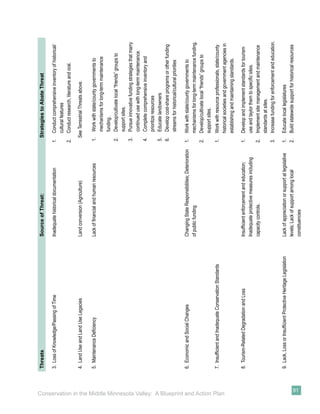
Appendix D: Threats & Strategies                                                                    87
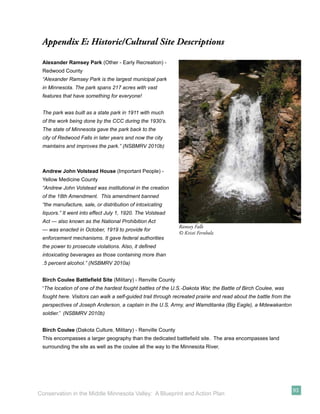
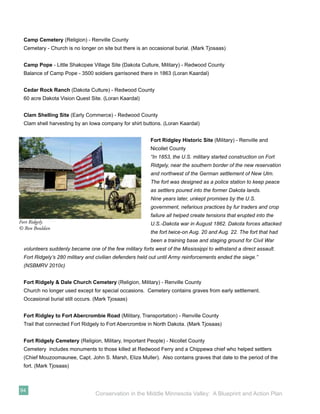
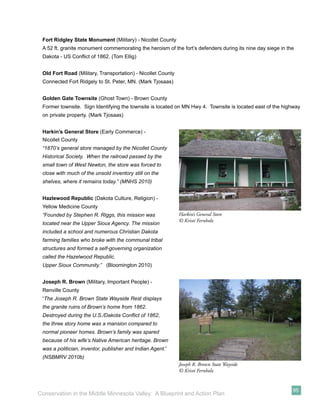
Appendix E: Historic/Cultural Site Descriptions                                                     93


vi                                   Conservation in the Middle Minnesota Valley: A Blueprint and Action Plan
Abbreviations Used in This Document
  AMA         Aquatic Management Area
  BWSR        Board of Water and Soil Resources
  C           Carbon
  CRP         Conservation Reserve Program
  CSP         Conservation Stewardship Program
  DNR         Department of Natural Resources
  EQIP        Environmental Quality Incentive Program
  GIS         Geographic Information Systems
  MCBS        Minnesota County Biological Survey
  MPCA        Minnesota Pollution Control Agency
  N           Nitrogen
  NRCS        Natural Resources Conservation Service
  P           Phosphorus
  RIM         Reinvest in Minnesota
  SGCN        Species of Greatest Conservation Need
  SHPO        State Historic Preservation Office
  SNA         Scientific Natural Area
  SWCD        Soil and Water Conservation District
  TMDL        Total Maximum Daily Loads
  USFWS       United States Fish and Wildlife Service
  WHIP        Wildlife Habitat Incentives Program
  WMA         Wildlife Management Area
  WRP         Wetlands Reserve Program


Conservation in the Middle Minnesota Valley: A Blueprint and Action Plan   vii
viii   Conservation in the Middle Minnesota Valley: A Blueprint and Action Plan
Preface

 Why another study of the Minnesota River Valley?
 This comprehensive conservation plan was initiated in 2008, the sesquicentennial year of the initial
 fragmentation of the northern half of the Minnesota Dakota Reservation, which straddled the Minnesota River
 for 10 miles on both sides from Big Stone Lake to the mouth of Little Rock Creek, just east of Fort Ridgely. In
 1858, this northern portion of the reservation was ceded by the Dakota to the U.S. government through two
 treaties signed in Washington, D.C.; shortly thereafter, the land was opened for homesteading. Following
 the US – Dakota Conflict of 1862, the southern half was forfeited by Congressional Act and also opened to
 homesteading. For a brief moment, reflect upon how this landscape with its unique ecological, cultural and
 historical resources would be different today, if this land sale and subsequent forfeiture had not occurred 150
 years ago. This landscape was once whole and belonged to all of the Dakota people. It is now splintered into
 fragmented, privately-owned land tracts.


 The Minnesota River Valley is a unique and special place with natural, cultural and historical resources that
 need to be protected, preserved and restored for future generations to study, to explore and to enjoy, while
 living or recreating within this landscape. This comprehensive plan focuses on all three resources.


 Understanding the Demographic Opportunity across the Landscape:
 The caretakers of this landscape since the homesteading days of the 1860s have been the grass-fed cattle
 ranching families, who utilized the unique areas that were too rocky or difficult to farm as grazing land for
 their cow/calf herds. The landscape was fragmented into rather large blocks – most in excess of 160 acres
 and some in excess of 600 acres – that served as the foundation for these ranchers. Many of these original
 ranches have remained within the same families for over a century, but a dramatic paradigm shift has occurred
 in the last 30 years: when the parents retired, the younger generation had already chosen career paths other
 than ranching. The majority of these ranches are now rented to others. The average age of the river bottom
 landowners within many of the Minnesota River Valley townships in Redwood and Renville Counties is now over
 75 years old.


                                                                                                                   1
Conservation in the Middle Minnesota Valley: A Blueprint and Action Plan
With this changing of the guard, there is a window of opportunity over the next 25 years – one that has not
been afforded us since that initial opportunity 150 years ago – to usher in a new vision for the Mid Minnesota
River Valley. The unique opportunity to make significant strides in re-connecting this fragmented landscape is
here now, at the same time that the citizens of Minnesota have chosen to constitutionally dedicate funding for
a period of 25 years to preserve, protect and restore these types of natural resources. Although it is hard to
look into a crystal ball and exactly predict the future, the core elements are in place to make lasting change.
As willing landowners step forward, if the monies are available to acquire these connecting properties as part
of Minnesota’s public conservation lands legacy, the vision of reconnecting these fragmented blocks into a
significant “Green Corridor” has the potential of becoming a reality. This Green Corridor along the Minnesota
River would become one of the most significant and visible success stories of Conservation Legacy Funding.


Green Corridor, Inc:
The Green Corridor, Inc. was formed by a coalition of engaged citizens, community and business leaders within
the mid section of the Minnesota River Valley, who recognized the need to protect, restore and enhance the
natural, historical and cultural resources of the Minnesota River Valley and to develop outdoor recreational
opportunities that would promote regional economic growth, development and tourism in this area.


Redwood and Renville Counties are two of the 34 “Minnesota Frontier Counties” that were identified, following
the 2000 census. This is not a compliment! A frontier county in 1860 was the land of opportunity and the
2010 definition is that a Frontier County is a location where there are few job opportunities and where young
families choose not to live and companies choose not to locate, because there is no available work force. The
only viable economic strategy to remove Redwood and Renville Counties from this list is to create a recreation
industry, a recreation economy, that is a competitive regional recreational destination for outdoor activities like
canoeing, hiking, biking, trail riding, hunting, fishing, bird watching and many others; and, for ecological, cultural
and historical education and exploration activities, that will create innovative entrepreneurial opportunities (jobs)
to service this new economy. The Green Corridor board is economically driven to preserve, protect and restore
our natural, cultural and historical resources to serve as the foundational infrastructure to support this outdoor
recreation industry.


With a vision for “creating a landscape of habitat connectivity, public access and economic viability in the
Mid Minnesota River Watershed”, the Green Corridor board and its partners will use this comprehensive
conservation plan to make that vision a reality on the ground. Within those partnerships, we must implement
the full complement of conservation tools to protect, preserve, restore and provide appropriate public access to
these ecological, cultural and historical resources. Certainly, acquisition will be a key strategy, but the partners
must utilize the other tools, such as easements, buffer strips, and private landowner restoration, education and
outreach as part of their long term strategical initiatives.


2
                                 Conservation in the Middle Minnesota Valley: A Blueprint and Action Plan
The Green Corridor board recognizes that we are at the beginning of an on-going project that will involve
 multiple partners and stakeholder groups with ever changing organizational leadership over the ensuing years.
 The challenge will not only be in nurturing those partnerships on our journey, but also preparing the future
 leadership of the Green Corridor and the partnering organizations to grab the baton for this shared landscape
 legacy vision and carry it forward until the window of opportunity closes. This comprehensive conservation
 plan is the baton that will be passed on to the next generation and serve as the connecting foundation, as new
 conservation leaders step up in the future and carry this landscape legacy forward on behalf of the partnering
 organizations.


 Green Corridor, Inc. will partner with the Minnesota DNR and a host of other federal, state and local government
 agencies, non-profit organizations and the public to elevate the development of appropriate recreational
 opportunities tied to these lands (i.e., hunting, fishing, bird watching, park and trail use, and more). In all
 instances, recreational development will be considered in flexible combinations where feasible and with an
 educational component, when appropriate. This shared landscape legacy paradigm will serve as a model for
 balancing the preservation of the important ecological, historical and cultural resources within the Minnesota
 River Valley, while providing for the development of recreational opportunities that can be educational learning
 experiences when visitors are in the field or on the trails.


 The Green Corridor board will regularly meet, discuss and update specific action items related to the
 implementation of this conservation plan, as an ongoing component of its responsibilities. Results and progress
 toward organizational goals will be compiled annually and will be available via the organization’s shared web
 site at: www.tatankabluffs.com


 Start Spinning:
 Rumplestiltskin lamented for his inability to be able to spin straw into gold. Seldom in life are we given
 opportunities to spin straw into gold, but when that opportunity arises, we must not only recognize it, but must
 also start spinning and engage others to follow our lead. The opportunity of re-connecting the fragmented
 habitat blocks within the Minnesota River Valley is one of those rare occurrences. Let’s start spinning and
 reconnect this fragmented landscape. Come, join us in this great endeavor!


 Loran Kaardal
 Board Member
 Green Corridor, Inc


                                                                                                                  3
Conservation in the Middle Minnesota Valley: A Blueprint and Action Plan
4
    Conservation in the Middle Minnesota Valley: A Blueprint and Action Plan
Executive Summary


 T   he Middle Minnesota River Valley is recognized widely for its rich diversity of natural, historical and cultural
 resources. In 2008, funding from the Legislative and Citizens Commission on Minnesota Resources enabled
 the development of a Conservation Blueprint and Action Plan to prioritize and guide program activities of
 Green Corridor, Inc. toward the restoration, conservation and protection of these invaluable resources. This
 plan recognizes the importance of these resources to the State of Minnesota and its residents – Native
 American, Euro-American and other cultures – and provides recommendations that serve to ensure that they
 are both maintained and utilized in manners that balance the needs of today, while preserving them for future
 generations.


 The resources of the Minnesota Valley have origins that extend back thousands of years before the present
 time. The native prairies, woodlands and forests of the region were shaped by climate, fire, and grazing patterns
 and influenced by the local Native American Indian inhabitants. Their village sites, burial mounds and other
 features provide the first historical/cultural sites in the Valley. Arrival by Euro-Americans and their interaction
 with the Dakota added to the historical/cultural story, culminating with the devastating U.S. – Dakota Conflict
 of 1862. The past 150 years has witnessed a considerable loss and degradation of the natural resources of
 the Valley, such that just over 2 percent now remains. Although strides have occurred in protecting some of the
 major historical/cultural resources of the Valley, much has been lost and much remains to be done.


 The Mid-Minnesota Valley Conservation and Action Plan
 The Conservation Blueprint and Action Plan is a bifurcated plan, with two components focusing on natural
 resources, and cultural and historical resources. Both components followed a process of: 1) identification of
 conservation targets that served to focus the plan, and their locations within the project area, 2) identification
 of threats to these resources and their sources, and 3) identification of strategies to abate those threats and
 conserve the resources going forward. The natural resources plan is built around a robust existing data set
 resulting from comprehensive inventories of the Minnesota County Biological Survey. The historical/cultural
 plan, on the other hand, is based on preliminary information obtained through widely available state sources
 and locally through experts; a much more in-depth assessment of the cultural/historical resources of the project
 area is required to bring this plan up to the level presented in the natural resources counterpart.


 The Natural Resources Conservation Plan
 Focal conservation targets of the natural resources plan included all natural ecosystems occurring in the project
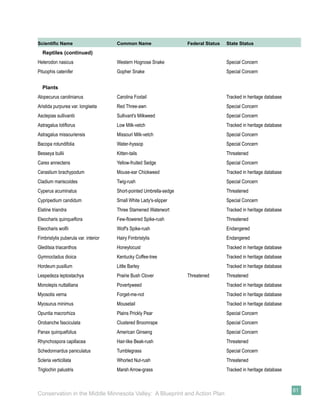
 area and 62 species tracked by the Minnesota Natural Heritage Program as being of statewide significance.
 Conservation priorities stemming from the natural resources plan encompass a mere 9.2 percent (77 square
 miles) of the project area and are located principally within the Minnesota Valley proper. Over 80 percent of the
 project area is considered a low conservation priority, much of these lands being agricultural uplands farther
 removed from the Valley. Although land acquisition efforts by public agencies have done a good job of targeting


                                                                                                                      5
Conservation in the Middle Minnesota Valley: A Blueprint and Action Plan
areas of high resource value, over 75 percent of all lands ranked as good, very good or outstanding value
are held by private landowners, suggesting a need for targeted conservation programs and outreach to these
individuals.


Threat-specific conservation strategies were identified to alleviate impacts associated with seven key threats
to natural resource values: Agriculture, Mining, Invasive Species, Development and Urbanization, Hydrologic
Alterations, Point Source Pollution, and Aquifer Depletion. In addition, five key overarching strategies were
identified to address pervasive issues that impact natural resource conservation as a whole: Civic Engagement,
Capacity Building, Communication, and Economic Development. Finally, three key policy arenas were identified
where engagement with local and state governments might have an impact: Farm Policy and Subsidies;
Minnesota Drainage Law, and Zoning.


The Cultural/Historical Conservation Plan
The cultural/historical conservation plan focused on a suite of nine conservation targets (themes) that served
to capture a full array of historical and cultural sites of significance in the project area: Dakota Culture, Native
American Indian Culture, Early Commerce, Religion, Military, Transportation, Historic (Ghost) Towns, Important
People, and Other. Thirty-nine historical/cultural sites were identified in the plan, occurring in each of the
nine target themes. However, sites principally relate to Military (44 percent) and Dakota (33 percent) themes,
acknowledging the importance of these themes in the project area. Approximately half of all identified sites are
considered protected.


Due to challenges in procuring data related to important sites within these themes, no prioritization was
undertaken. Rather, we point to an overarching need for an in-depth cataloguing of historical/cultural features in
the project area as a pre-requisite to such a prioritization.


Conservation Strategies were developed around 8 principal threats: Development and Urbanization, Loss
of Knowledge, Land Use and Land Use Legacies, Maintenance Deficiency, Economic and Social Changes,
Insufficient and Inadequate Conservation Standards, Tourism-Related Degradation and Loss, and Lack of or
Inadequate Protective Heritage Legislation.


Going Forward
With a vision for “creating a landscape of habitat connectivity, public access and economic viability in the Mid
Minnesota River Watershed,” the Green Corridor Board and its partners will use this conservation and action
plan to make that vision a reality on the ground. Within those partnerships, a full complement of conservation
tools will be employed to protect, preserve, restore and provide appropriate public access to these ecological,
cultural and historical resources.


6
                                 Conservation in the Middle Minnesota Valley: A Blueprint and Action Plan
Conservation in the Middle Minnesota Valley:
               A Blueprint and Action Plan
  G    reen Corridor, Inc. is a 501 (c)(3) non-profit conservation organization based in Redwood Falls, Minnesota
  that has as its mission the creation of a legacy of habitat connectivity, public access, and economic viability in
  the Mid-Minnesota River Valley Watershed. The Minnesota River Valley Green Corridor Blueprint and Action
  Plan was recommended for funding to state legislature by the Legislative Citizen Commission of Minnesota
  Resources through a grant to the Southwest Initiative Foundation and Green Corridors, Inc. Great River
  Greening was contracted to begin the development of this plan in 2008.


  The purpose of this Conservation Blueprint and Action Plan is to prioritize and guide future program activities of
  Green Corridor, Inc. and other stakeholders toward the restoration, conservation and protection of both natural
  and cultural/historical resources of the Middle Minnesota Valley. The Minnesota Valley is recognized widely for
  its rich array and diversity of important resources. This plan recognizes the importance of these resources to
  the State of Minnesota and its residents – Native American, Euro-American and other cultures – and provides
  recommendations that serve to ensure that they are both maintained and utilized in manners that balance the
  needs of today, while preserving them for future generations.


  Balancing the needs of long-term protection and resources use cannot succeed without strong involvement by
  a diversity of key stakeholders with interests in the Valley. This Plan will be a tool to assist and organize future
  stakeholders into a working partnership team committed to the vision for a Green Corridor in the Minnesota
  River Valley, and will assist in planning and implementing strategic activities that create or expand outdoor
  recreational opportunities and foster increased economic vitality and tourism in a region of Minnesota that is
  showing significant signs of population and economic decline.


  To this end, the authors lay out the Plan in a format that first describes the project area and places its current
  natural and historical/cultural resources within a historical context essential in crafting a long-term conservation
  plan. This is followed by a review of existing information pertaining to both natural and cultural/historical
  resources in the Valley and an overview of the methodology utilized for assigning conservation priorities. Finally,
  results of the prioritization are discussed, coupled with a review of identified strategies that may serve to move
  this effort forward in meaningful ways.


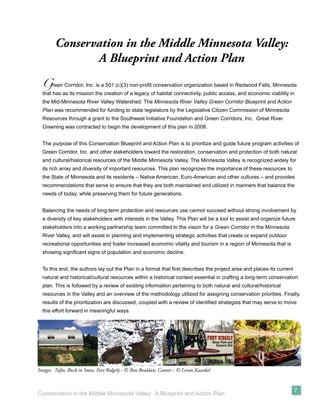
Images: Tufto, Buck in Snow, Fort Ridgely - © Ron Bouldan; Canoer - © Loran Kaardal


                                                                                                                      7
Conservation in the Middle Minnesota Valley: A Blueprint and Action Plan
8
    Conservation in the Middle Minnesota Valley: A Blueprint and Action Plan
1. The Middle Minnesota
                                                        River Valley - Its Resources
                                                        and Its People

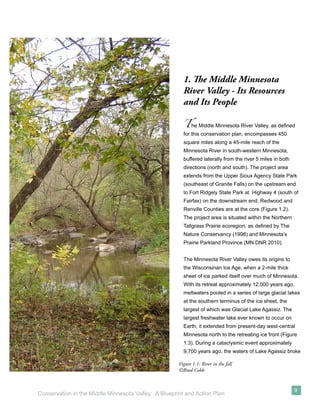
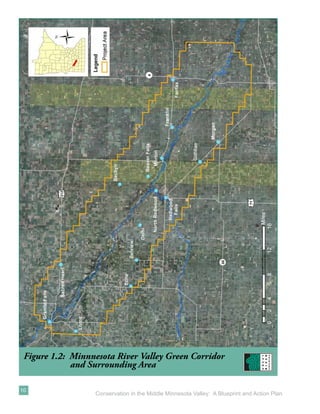
                                                        T   he Middle Minnesota River Valley, as defined
                                                        for this conservation plan, encompasses 450
                                                        square miles along a 45-mile reach of the
                                                        Minnesota River in south-western Minnesota,
                                                        buffered laterally from the river 5 miles in both
                                                        directions (north and south). The project area
                                                        extends from the Upper Sioux Agency State Park
                                                        (southeast of Granite Falls) on the upstream end
                                                        to Fort Ridgely State Park at Highway 4 (south of
                                                        Fairfax) on the downstream end; Redwood and
                                                        Renville Counties are at the core (Figure 1.2).
                                                        The project area is situated within the Northern
                                                        Tallgrass Prairie ecoregion, as defined by The
                                                        Nature Conservancy (1998) and Minnesota’s
                                                        Prairie Parkland Province (MN DNR 2010).


                                                        The Minnesota River Valley owes its origins to
                                                        the Wisconsinan Ice Age, when a 2-mile thick
                                                        sheet of ice parked itself over much of Minnesota.
                                                        With its retreat approximately 12,000 years ago,
                                                        meltwaters pooled in a series of large glacial lakes
                                                        at the southern terminus of the ice sheet, the
                                                        largest of which was Glacial Lake Agassiz. The
                                                        largest freshwater lake ever known to occur on
                                                        Earth, it extended from present-day west-central
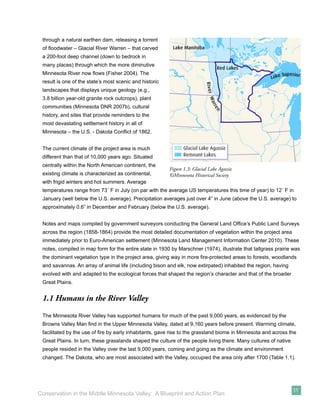
                                                        Minnesota north to the retreating ice front (Figure
                                                        1.3). During a cataclysmic event approximately
                                                        9,700 years ago, the waters of Lake Agassiz broke

                                                      Figure 1.1: River in the fall
                                                      ©Brad Cobb


                                                                                                            9
Conservation in the Middle Minnesota Valley: A Blueprint and Action Plan
Figure 1.2: Minnnesota River Valley Green Corridor
             and Surrounding Area

10
                  Conservation in the Middle Minnesota Valley: A Blueprint and Action Plan
through a natural earthen dam, releasing a torrent
 of floodwater – Glacial River Warren – that carved
 a 200-foot deep channel (down to bedrock in
 many places) through which the more diminutive
 Minnesota River now flows (Fisher 2004). The
 result is one of the state’s most scenic and historic
 landscapes that displays unique geology (e.g.,
 3.8 billion year-old granite rock outcrops), plant
 communities (Minnesota DNR 2007b), cultural
 history, and sites that provide reminders to the
 most devastating settlement history in all of
 Minnesota – the U.S. - Dakota Conflict of 1862.


 The current climate of the project area is much
 different than that of 10,000 years ago. Situated
 centrally within the North American continent, the
                                                         Figure 1.3: Glacial Lake Agassiz
 existing climate is characterized as continental,       ©Minnesota Historical Society
 with frigid winters and hot summers. Average
 temperatures range from 73˚ F in July (on par with the average US temperatures this time of year) to 12˚ F in
 January (well below the U.S. average). Precipitation averages just over 4” in June (above the U.S. average) to
 approximately 0.6” in December and February (below the U.S. average).


 Notes and maps compiled by government surveyors conducting the General Land Office’s Public Land Surveys
 across the region (1858-1864) provide the most detailed documentation of vegetation within the project area
 immediately prior to Euro-American settlement (Minnesota Land Management Information Center 2010). These
 notes, compiled in map form for the entire state in 1930 by Marschner (1974), illustrate that tallgrass prairie was
 the dominant vegetation type in the project area, giving way in more fire-protected areas to forests, woodlands
 and savannas. An array of animal life (including bison and elk, now extirpated) inhabited the region, having
 evolved with and adapted to the ecological forces that shaped the region’s character and that of the broader
 Great Plains.


 1.1 Humans in the River Valley

 The Minnesota River Valley has supported humans for much of the past 9,000 years, as evidenced by the
 Browns Valley Man find in the Upper Minnesota Valley, dated at 9,160 years before present. Warming climate,
 facilitated by the use of fire by early inhabitants, gave rise to the grassland biome in Minnesota and across the
 Great Plains. In turn, these grasslands shaped the culture of the people living there. Many cultures of native
 people resided in the Valley over the last 9,000 years, coming and going as the climate and environment
 changed. The Dakota, who are most associated with the Valley, occupied the area only after 1700 (Table 1.1).


                                                                                                                  11
Conservation in the Middle Minnesota Valley: A Blueprint and Action Plan
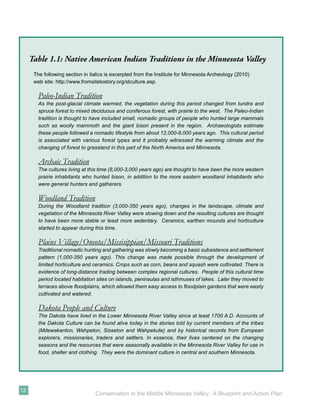
Table 1.1: Native American Indian Traditions in the Minnesota Valley
      The following section in italics is excerpted from the Institute for Minnesota Archeology (2010)
      web site: http://www.fromsitetostory.org/stculture.asp.

        Paleo-Indian Tradition
        As the post-glacial climate warmed, the vegetation during this period changed from tundra and
        spruce forest to mixed deciduous and coniferous forest, with prairie to the west. The Paleo-Indian
        tradition is thought to have included small, nomadic groups of people who hunted large mammals
        such as woolly mammoth and the giant bison present in the region. Archaeologists estimate
        these people followed a nomadic lifestyle from about 12,000-8,000 years ago. This cultural period
        is associated with various forest types and it probably witnessed the warming climate and the
        changing of forest to grassland in this part of the North America and Minnesota.

        Archaic Tradition
        The cultures living at this time (8,000-3,000 years ago) are thought to have been the more western
        prairie inhabitants who hunted bison, in addition to the more eastern woodland inhabitants who
        were general hunters and gatherers.

        Woodland Tradition
        During the Woodland tradition (3,000-350 years ago), changes in the landscape, climate and
        vegetation of the Minnesota River Valley were slowing down and the resulting cultures are thought
        to have been more stable or least more sedentary. Ceramics, earthen mounds and horticulture
        started to appear during this time.

        Plains Village/Oneota/Missisippian/Missouri Traditions
        Traditional nomadic hunting and gathering was slowly becoming a basic subsistence and settlement
        pattern (1,000-350 years ago). This change was made possible through the development of
        limited horticulture and ceramics. Crops such as corn, beans and squash were cultivated. There is
        evidence of long-distance trading between complex regional cultures. People of this cultural time
        period located habitation sites on islands, peninsulas and isthmuses of lakes. Later they moved to
        terraces above floodplains, which allowed them easy access to floodplain gardens that were easily
        cultivated and watered.

        Dakota People and Culture
        The Dakota have lived in the Lower Minnesota River Valley since at least 1700 A.D. Accounts of
        the Dakota Culture can be found alive today in the stories told by current members of the tribes
        (Mdewakanton, Wahpeton, Sisseton and Wahpekute) and by historical records from European
        explorers, missionaries, traders and settlers. In essence, their lives centered on the changing
        seasons and the resources that were seasonally available in the Minnesota River Valley for use in
        food, shelter and clothing. They were the dominant culture in central and southern Minnesota.


12
                                 Conservation in the Middle Minnesota Valley: A Blueprint and Action Plan
Tensions Grow
 Understanding current demographics and
 tensions between cultures in the Minnesota
 Valley necessitates a review of the past two
 centuries and interactions between Euro-American
 explorers, missionaries, traders, settlers, the U.S.
 government, and the Dakota who lived in the area.


 In the mid-1800s, numerous treaties were signed
 between the Dakota and U.S. Government that
 resulted in the ceding of large portions of Dakota
 land to the United States. Of these, the most
 significant occurred in 1851 with the treaties of
 Traverse des Sioux and Mendota. The former
 (between the United States and upper bands of
 Dakota [Sisseton and Wahpeton]) and the latter
 (between the United States and lower bands of
 Dakota [Mdewakanton and Wahpekute]) resulted              Figure 1.4: Treaty of Traverse des Sioux 1851
 in the ceding of 24 million acres of land to the U.S.     ©Minnesota Historical Society
 Government, thereby confining tribes to a 20-mile
 wide reservation along the Minnesota River (10
 miles laterally in both directions from the river) (Figure 1.4). In 1858, the tribes ceded the 10-mile strip on the
 north side of the Minnesota.


 With the signing of the two treaties, the U.S. Government promised payments of approximately $3 million and
 annuities for the ceded lands; in addition, Upper Sioux (near present-day Granite Falls) and the Lower Sioux
 (near Morton) agencies were created at this time.


 The culmination of unfulfilled treaties, reservation encroachment, continued western expansion, and crop
 blight in the spring/summer of 1862 was the tipping point in the Valley. In August 1862, Dakota leaders
 were convinced by tribal members that it was time to rise up against the settlers (Meyer 1993; Neill 1882).
 The resulting war lasted for barely more than a month, but resulted in hundreds of casualties among Euro-
 Americans and Dakota alike. The war ended with a decisive battle at Wood Lake and the release of 262 captive
 white women and children at Camp Release. Many of the Dakota fled to Dakota Territory and north into Canada
 to escape capture or death. After the war, all treaties with the Dakota were declared null and void by the United
 States government and all Dakota were effectively banned from the state.


                                                                                                                       13
Conservation in the Middle Minnesota Valley: A Blueprint and Action Plan
Corn as High as an Elephant’s Eye
 The U.S. - Dakota Conflict led to a lasting change in the landscape of the Minnesota River Valley. Former
 reservation lands were opened for settlement not long after the conflict ceased. By this time, the Homestead Act
 of 1862 (which gave settlers 160 acres of free land for filing a claim and improving the land) had been enacted,
 providing for a ripe opportunity for settlement by Euro-Americans. Change happened quickly.


 Renville County was created by state legislature in 1855, and significant settlement had occurred along the
 north banks of the Minnesota River by the time of the U.S. - Dakota conflict in 1862. Most of these settlements
 were abandoned until the area began repopulating in the mid-1860s, and it was not until 1866 that the county
 was fully organized. Unlike Renville County, Redwood County was not established until 1865, due in large part
 to the fact that it was largely located within the existing Dakota reservation.


       The Homestead Act of 1862 - gave 160 acres of undeveloped land outside of the original thirteen
       colonies to heads of household who were 21 years of age or older, and who had not taken up arms
       against the United States. With this land acquisition, applicants agreed to file a claim, improve the
       land (build a dwelling and cultivate), and file for a deed of title. After five years, the original filer was
       entitled to the land free and clear (NPS 2009).

       The Timber Culture Act of 1873 - gave 160 acres of additional free land if filers set aside 40 acres
       to grow trees to solve the problem of lack of wood on the Plains. After planting the trees, the land
       could only be completely obtained if it was occupied by the same family for at least 5 years. After
       this period of time, a certificate of ownership could be obtained for $30. Lands acquired under this
       Act were frequently called, “Tree Claims.”


 After the Conflict, settlement of both counties began again in the mid-1860s, and then more earnestly in the
 1870s. Lands that had not been surveyed prior to the Conflict were surveyed from 1864-1868, and were
 officially opened for settlement shortly thereafter. In Redwood County, lands were surveyed in 1864, opened for
 settlement in 1865, and offered at public sale in 1867 (Neill 1882).


 Settlers began arriving via the Minnesota River, established roads, and across the prairie. Railroads arrived in
 southern Redwood County in 1872 (Winona and St. Peter Railroad) and reached Redwood Falls in 1878. The
 Chicago, Milwaukee and St. Paul Railroad reached Renville County in 1878, followed by the Minneapolis and
 St. Louis Railroad in 1882.


 Towns of Redwood Falls, Renville, Olivia, Morgan, Fairfax, Morton and others emerged and flourished as
 commerce centers, supporting a diverse economic base catering to the immigrants that were arriving in search
 of free lands and new lives.


14
                                  Conservation in the Middle Minnesota Valley: A Blueprint and Action Plan
The rich agricultural lands of the Minnesota River Valley were readily tilled for agricultural production, and in a
 short 10-year timeframe much of what had been tallgrass prairie a few years prior had been converted. Ditching
 in earnest began in the first decade of the 20th century and continued for the ensuing two decades. By that
 time, Renville County boasted 3000 miles of drainage ditches. Agriculture was the principle economic game in
 town and the fortunes and failures that would ensue over the following century would be in large part tied to this
 agricultural base.


 1.2 Impacts on Natural Resources
 The primary ecological processes that shaped the natural character of the prairies of the Middle Minnesota
 River prior to Euro-American settlement were climate, grazing and fire, each operating at multiple scales,
 frequencies and intensities (Weaver and Albertson 1956, Axelrod 1985, Risser 1985, Anderson 1990). Fire,
 interacting with the effects of grazing and climate, promoted the development of the tallgrass prairie system.
 Seasonal precipitation and temperature patterns influenced the growth of vegetation, and consequently the
 availability of fuels for burning and forage for grazing.


 Seasonal fires created a patchwork of burned and unburned areas across the flat prairie landscape. Bison
 and elk, the principal large herbivores, grazed preferentially on vegetation in burned areas because of greater
 productivity and nutritive quality of forage following fire (Risser 1985, Risser 1990, Collins and Gibson 1990,
 Ostlie et al. 1996). Their transitory grazing patterns allowed the vegetation to recover from intermittent and
 sometimes intensive grazing events. These grazing patterns further impacted the availability of fuel for fire
 and, in turn, impacted and helped maintain a subtle, yet important vegetation mosaic that provided an array of
 habitats for a diverse suite of grassland animal and plant species. People living on the land influenced these
 patterns (by hunting, setting fires, etc.) and thus played a large role in shaping the historic landscape prior to
 Euro-American settlement.


 Yet, this grassland system was quickly moving out of kilter by the early- to-mid-1800s, well before wholesale
 settlement by Euro-Americans occurred. Many of the large native mammals were extirpated or were in serious
 decline prior to settlement and the subsequent conversion of habitat for agricultural purposes (Ostlie et al.
 1996). By the mid-1800s, bison were largely extirpated from the ecoregion, with the last wild bison in Minnesota
 recorded in 1880; elk (Cervuus elaphus) were effectively eliminated by the late 1800s, disappearing from the
 state altogether in 1896 (Nordquist and Birney 1988). Wolves (Canis lupus) persisted in remote areas of the
 state, but were driven out of the prairie lands. Trumpeter swans (Cygnus buccinator) and whooping cranes
 (Grus americana) were extirpated from the ecoregion long before their marshes were drained (Green 1988).


 The vast accumulations of carbon-rich organic soils – some of the most agriculturally productive sites in the
 temperate world – set the stage for settlement and exploitation of the state’s prairie lands. The Homestead Act
 of 1862 was the catalyst that enticed throngs of Yankees and immigrants (Germans, Scandinavians, Irish and
 those of other nationalities) to try their luck in the American Northwest.


                                                                                                                     15
Conservation in the Middle Minnesota Valley: A Blueprint and Action Plan
Euro-American settlement had a major impact on the landscape of the Minnesota Valley. In fact, few places in
 the world have experienced anthropogenic alteration to the extent documented in the tallgrass prairie regions of
 the central United States (Noss et al. 1995). Rapid settlement and conversion of the Minnesota Valley – much
 of it occurring in a mere 10 years (approximately 1870-1880) - transformed the great sea of grass that was
 the tallgrass prairie into an agricultural system with only small vestiges remaining on the landscape (Krenz
 and Leitch 1993). Today, less than 1 percent of the native tallgrass prairie remains in Minnesota; much of what
 remains is relegated to small, highly isolated tracts.


 As upland prairie habitat was converted to agriculture, focus of settlers turned toward improving the productivity
 of land by removing water from the landscape. In 1883, state drainage law gave counties the authority to
 construct ditches or water courses, including the drainage of shallow, grassy, meandered lakes under four feet
 in depth (BWSR 2010). In 1897, the state drainage commission was established to “have care, custody, control
 and supervision of all drainage ditches in the state.” Complex and pervasive systems of tiles, drainage ditches
 and river/stream channelization expedited water runoff from the landscape and did the job in terms of improving
 lands for agricultural purposes.


 Ditching began in earnest in Redwood and Renville counties during the first decade of the 20th century, and
 continued in haste for another two decades. By that time, Renville County was boasting of having installed 3000
 miles of tile and ditches (Rootsweb 2010a). Today, more than 90 percent of the presettlement wetlands have
 been lost from the tallgrass prairie region (Lant et al. 1995).


 The conversion of prairie and other natural systems within the Northern Tallgrass has resulted in increased soil
 loss through wind and water erosion, and resultant water quality degradation within the majority of streams,
 rivers and wetlands in the region. The Minnesota River, for example, has often been referred to as the most
 polluted river in Minnesota, an outcome of the immense sediment and nutrient loads now carried by the
 river. Declines in freshwater mussel (Bright et al. 1990, Williams et al. 1993) and fish (Cross and Moss 1987)
 populations have been directly linked at least in part to the degradation of water quality resulting from erosion of
 agricultural lands.


 1.3 The Minnesota River Valley Today
 The Minnesota Valley today, although greatly altered relative to what it was in 1800, retains a rich cultural,
 historical, and natural heritage. Unlike uplands farther removed and now largely in agricultural production, the
 Valley retains a rich diversity of high-qualiy natural areas that provide home to an array of animal and plant
 species, and a glimpse into what the Valley was like 200 years ago. This rich diversity is reflected in a study
 of the state’s natural resources conducted by the Minnesota DNR, where the Minnesota River Valley was
 identified as its priority focal area (Figue 1.5). Tied to this natural history are robust Dakota and Euro-American
 cultural heritages, each with important sites, events, and individuals that made and are making a mark on the
 local, state and national scene. In this section, we detail the current status of the natural and cultural/historical
 resources of the Mid-Minnesota Valley.


16
                                    Conservation in the Middle Minnesota Valley: A Blueprint and Action Plan
Figure 1.5 Minnesota DNR Southern Region Focus Areas
                                                                                       © Minnesota DNR


                                                                                                  17
Conservation in the Middle Minnesota Valley: A Blueprint and Action Plan
1.3.1 Natural Resources
 The current ecological framework of the Minnesota River Valley
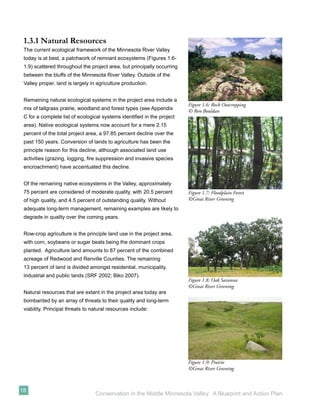
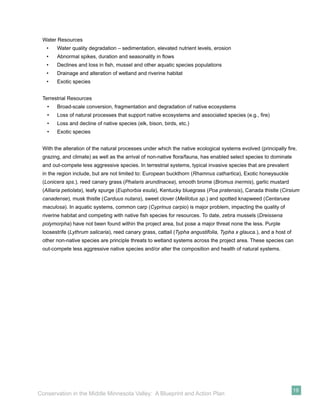
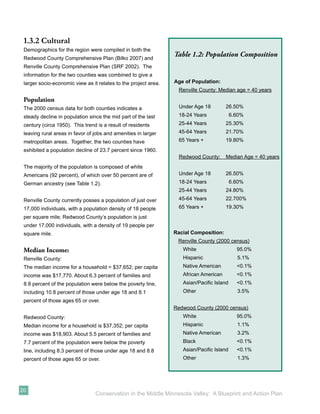
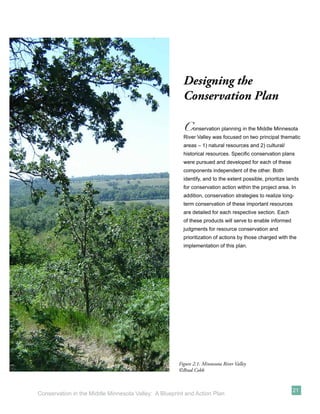
 today is at best, a patchwork of remnant ecosystems (Figures 1.6-
 1.9) scattered throughout the project area, but principally occurring
 between the bluffs of the Minnesota River Valley. Outside of the
 Valley proper, land is largely in agriculture production.


 Remaining natural ecological systems in the project area include a
                                                                         Figure 1.6: Rock Outcropping
 mix of tallgrass prairie, woodland and forest types (see Appendix       © Ron Bouldan
 C for a complete list of ecological systems identified in the project
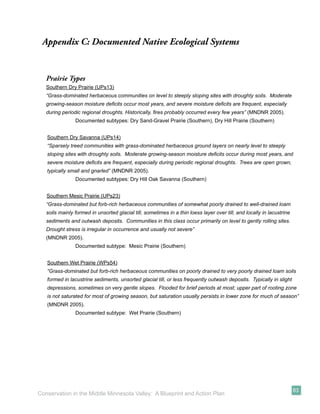
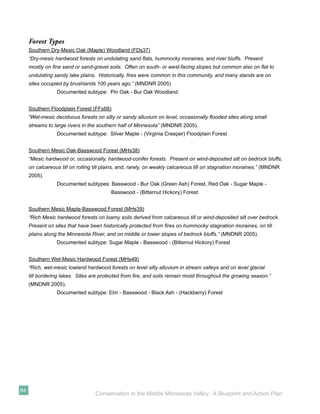
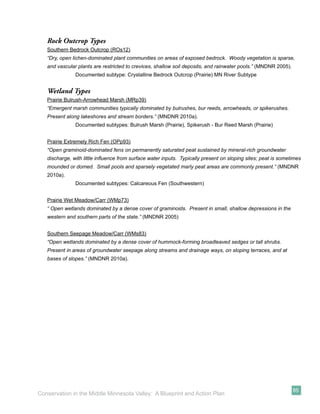
 area). Native ecological systems now account for a mere 2.15
 percent of the total project area, a 97.85 percent decline over the
 past 150 years. Conversion of lands to agriculture has been the
 principle reason for this decline, although associated land use
 activities (grazing, logging, fire suppression and invasive species
 encroachment) have accentuated this decline.


 Of the remaining native ecosystems in the Valley, approximately
 75 percent are considered of moderate quality, with 20.5 percent        Figure 1.7: Floodplain Forest
 of high quality, and 4.5 percent of outstanding quality. Without        ©Great River Greening
 adequate long-term management, remaining examples are likely to
 degrade in quality over the coming years.


 Row-crop agriculture is the principle land use in the project area,
 with corn, soybeans or sugar beats being the dominant crops
 planted. Agriculture land amounts to 87 percent of the combined
 acreage of Redwood and Renville Counties. The remaining
 13 percent of land is divided amongst residential, municipality,
 industrial and public lands (SRF 2002; Biko 2007).
                                                                         Figure 1.8: Oak Savanna
                                                                         ©Great River Greening
 Natural resources that are extant in the project area today are
 bombarded by an array of threats to their quality and long-term
 viability. Principal threats to natural resources include:


                                                                         Figure 1.9: Prairie
                                                                         ©Great River Greening


18
                                  Conservation in the Middle Minnesota Valley: A Blueprint and Action Plan
Water Resources
   •   Water quality degradation – sedimentation, elevated nutrient levels, erosion
   •   Abnormal spikes, duration and seasonality in flows
   •   Declines and loss in fish, mussel and other aquatic species populations
   •   Drainage and alteration of wetland and riverine habitat
   •   Exotic species


 Terrestrial Resources
   •   Broad-scale conversion, fragmentation and degradation of native ecosystems
   •   Loss of natural processes that support native ecosystems and associated species (e.g., fire)
   •   Loss and decline of native species (elk, bison, birds, etc.)
   •   Exotic species


 With the alteration of the natural processes under which the native ecological systems evolved (principally fire,
 grazing, and climate) as well as the arrival of non-native flora/fauna, has enabled select species to dominate
 and out-compete less aggressive species. In terrestrial systems, typical invasive species that are prevalent
 in the region include, but are not limited to: European buckthorn (Rhamnus cathartica), Exotic honeysuckle
 (Lonicera sps.), reed canary grass (Phalaris arundinacea), smooth brome (Bromus inermis), garlic mustard
 (Alliaria petiolata), leafy spurge (Euphorbia esula), Kentucky bluegrass (Poa pratensis), Canada thistle (Cirsium
 canadense), musk thistle (Carduus nutans), sweet clover (Melilotus sp.) and spotted knapweed (Centaruea
 maculosa). In aquatic systems, common carp (Cyprinus carpio) is major problem, impacting the quality of
 riverine habitat and competing with native fish species for resources. To date, zebra mussels (Dreissena
 polymorpha) have not been found within the project area, but pose a major threat none the less. Purple
 loosestrife (Lythrum salicaria), reed canary grass, cattail (Typha angustifolia, Typha x glauca.), and a host of
 other non-native species are principle threats to wetland systems across the project area. These species can
 out-compete less aggressive native species and/or alter the composition and health of natural systems.


                                                                                                                    19
Conservation in the Middle Minnesota Valley: A Blueprint and Action Plan
1.3.2 Cultural
 Demographics for the region were compiled in both the
 Redwood County Comprehensive Plan (Bilko 2007) and
                                                                 Table 1.2: Population Composition
 Renville County Comprehensive Plan (SRF 2002). The
 information for the two counties was combined to give a
 larger socio-economic view as it relates to the project area.   Age of Population:
                                                                  Renville County: Median age = 40 years
 Population
 The 2000 census data for both counties indicates a               Under Age 18         26.50%
 steady decline in population since the mid part of the last      18-24 Years             6.60%
 century (circa 1950). This trend is a result of residents        25-44 Years          25.30%
 leaving rural areas in favor of jobs and amenities in larger     45-64 Years          21.70%
 metropolitan areas. Together, the two counties have              65 Years +           19.80%
 exhibited a population decline of 23.7 percent since 1960.
                                                                  Redwood County:      Median Age = 40 years
 The majority of the population is composed of white
 Americans (92 percent), of which over 50 percent are of          Under Age 18         26.50%
 German ancestry (see Table 1.2).                                 18-24 Years             6.60%
                                                                  25-44 Years          24.80%
 Renville County currently posses a population of just over       45-64 Years          22.700%
 17,000 individuals, with a population density of 18 people       65 Years +           19.30%
 per square mile; Redwood County’s population is just
 under 17,000 individuals, with a density of 19 people per
 square mile.                                                    Racial Composition:
                                                                  Renville County (2000 census)
 Median Income:                                                     White                   95.0%
 Renville County:                                                   Hispanic                5.1%
 The median income for a household = $37,652; per capita            Native American         <0.1%
 income was $17,770. About 6.3 percent of families and              African American        <0.1%
 8.8 percent of the population were below the poverty line,         Asian/Pacific Island     <0.1%
 including 10.8 percent of those under age 18 and 8.1               Other                   3.5%
 percent of those ages 65 or over.
                                                                 Redwood County (2000 census)
 Redwood County:                                                    White                   95.0%
 Median income for a household is $37,352; per capita               Hispanic                1.1%
 income was $18,903. About 5.5 percent of families and              Native American         3.2%
 7.7 percent of the population were below the poverty               Black                   <0.1%
 line, including 8.3 percent of those under age 18 and 8.8          Asian/Pacific Island     <0.1%
 percent of those ages 65 or over.                                  Other                   1.3%


20
                                 Conservation in the Middle Minnesota Valley: A Blueprint and Action Plan
Designing the
                                                        Conservation Plan

                                                        C    onservation planning in the Middle Minnesota
                                                        River Valley was focused on two principal thematic
                                                        areas – 1) natural resources and 2) cultural/
                                                        historical resources. Specific conservation plans
                                                        were pursued and developed for each of these
                                                        components independent of the other. Both
                                                        identify, and to the extent possible, prioritize lands
                                                        for conservation action within the project area. In
                                                        addition, conservation strategies to realize long-
                                                        term conservation of these important resources
                                                        are detailed for each respective section. Each
                                                        of these products will serve to enable informed
                                                        judgments for resource conservation and
                                                        prioritization of actions by those charged with the
                                                        implementation of this plan.


                                                      Figure 2.1: Minnesota River Valley
                                                      ©Brad Cobb


                                                                                                           21
Conservation in the Middle Minnesota Valley: A Blueprint and Action Plan
2. Natural Resources Conservation Plan

 A     standard protocol for assembling a conservation action was used for both natural and cultural/historical
 resources components of the overall plan. This protocol – adapted from The Nature Conservancy (2006) and
 World Wildlife Fund (2004) – uses the following process:


     1. Identify Conservation Targets
     2. Identify Threats to these Targets and their Sources
     3. Develop Strategies to Abate these Threats
     4. Measure Progress toward Established Goals


 2.1 Conservation Targets

 Conservation targets focus a conservation plan. They serve as the elements around which a plan takes
 shape. Targets identified for use in this planning exercise included: 1) all natural ecological system types (both
 terrestrial and aquatic) found within the project area, 2) all species tracked by the Minnesota Natural Heritage
 Program as Endangered, Threatened or of Special Concern, and 3) other species tracked by the Heritage
 Program for a variety of reasons, including Species of Greatest Conservation Need. This resulted in a total of 80
 conservation targets - 17 terrestrial communities (Appendix C) and 62 species (Appendix B).


 2.2 Assessing Viability and Ecological Integrity of Conservation Targets

 In the context of natural resource conservation planning, viability or ecological integrity is the likelihood that
 a conservation target or its component occurrences (e.g., a specific population or example) will persist over
 a given period of time. This concept underpins any credible conservation plan. Viability is a function of a
 conservation target’s condition, size and landscape context.


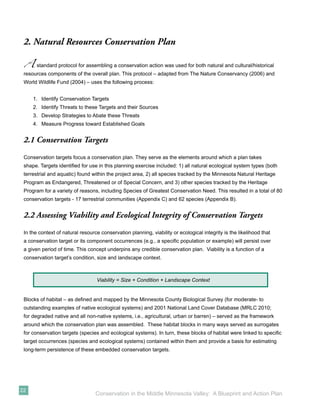
                                  Viability = Size + Condition + Landscape Context


 Blocks of habitat – as defined and mapped by the Minnesota County Biological Survey (for moderate- to
 outstanding examples of native ecological systems) and 2001 National Land Cover Database (MRLC 2010;
 for degraded native and all non-native systems, i.e., agricultural, urban or barren) – served as the framework
 around which the conservation plan was assembled. These habitat blocks in many ways served as surrogates
 for conservation targets (species and ecological systems). In turn, these blocks of habitat were linked to specific
 target occurrences (species and ecological systems) contained within them and provide a basis for estimating
 long-term persistence of these embedded conservation targets.


22
                                  Conservation in the Middle Minnesota Valley: A Blueprint and Action Plan
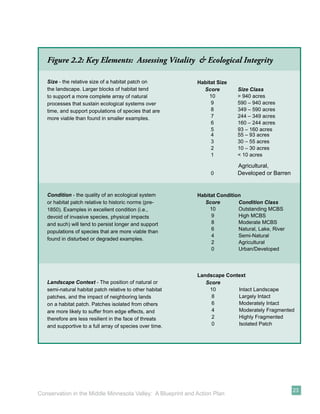
Figure 2.2: Key Elements: Assessing Vitality & Ecological Integrity

   Size - the relative size of a habitat patch on            Habitat Size
   the landscape. Larger blocks of habitat tend                Score         Size Class
   to support a more complete array of natural                   10          > 940 acres
   processes that sustain ecological systems over                 9          590 – 940 acres
   time, and support populations of species that are              8          349 – 590 acres
   more viable than found in smaller examples.                    7          244 – 349 acres
                                                                  6          160 – 244 acres
                                                                  5          93 – 160 acres
                                                                  4          55 – 93 acres
                                                                  3          30 – 55 acres
                                                                  2          10 – 30 acres
                                                                  1          < 10 acres

                                                                             Agricultural,
                                                                  0          Developed or Barren


   Condition - the quality of an ecological system           Habitat Condition
   or habitat patch relative to historic norms (pre-           Score         Condition Class
   1850). Examples in excellent condition (i.e.,                  10         Outstanding MCBS
   devoid of invasive species, physical impacts                    9         High MCBS
   and such) will tend to persist longer and support               8         Moderate MCBS
   populations of species that are more viable than                6         Natural, Lake, River
                                                                   4         Semi-Natural
   found in disturbed or degraded examples.
                                                                   2         Agricultural
                                                                   0         Urban/Developed


                                                             Landscape Context
   Landscape Context - The position of natural or               Score
   semi-natural habitat patch relative to other habitat          10        Intact Landscape
   patches, and the impact of neighboring lands                   8        Largely Intact
   on a habitat patch. Patches isolated from others               6        Moderately Intact
   are more likely to suffer from edge effects, and               4        Moderately Fragmented
   therefore are less resilient in the face of threats            2        Highly Fragmented
   and supportive to a full array of species over time.           0        Isolated Patch


                                                                                                    23
Conservation in the Middle Minnesota Valley: A Blueprint and Action Plan
In this conservation planning process, a protocol was developed for assigning numeric scores for each viability/
 ecological integrity factor (size, condition, or landscape context) to each specific habitat block, as detailed
 in Figure 2.2. Although specific relationships between these three factors are highly target-specific, general
 guidelines related to target viability hold true: 1) large habitats are better than small ones; 2) pristine natural
 conditions are better than degraded ones; and 3) habitats surrounded by other natural habitats are better than
 natural habitats surrounded by highly altered systems (i.e., isolated). With this protocol in hand, numeric scores
 were assigned to blocks of habitat (as opposed to specific occurrences of conservation targets) occurring within
 the project area in order to rank habitat blocks relative to one another.


 2.3 Assigning Conservation Priorities

 Conservation priorities were established by building off of the viability/ecological integrity assessment as
 detailed in Section 2.2 above. Scores for each of the three factors were combined to produce a composite
 Integrity score ranging from a maximum of 30 points to a low of 0.


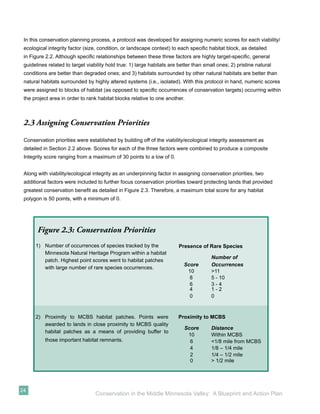
 Along with viability/ecological integrity as an underpinning factor in assigning conservation priorities, two
 additional factors were included to further focus conservation priorities toward protecting lands that provided
 greatest conservation benefit as detailed in Figure 2.3. Therefore, a maximum total score for any habitat
 polygon is 50 points, with a minimum of 0.


       Figure 2.3: Conservation Priorities
      1) Number of occurrences of species tracked by the                 Presence of Rare Species
         Minnesota Natural Heritage Program within a habitat
                                                                                        Number of
         patch. Highest point scores went to habitat patches
                                                                           Score        Occurrences
         with large number of rare species occurrences.
                                                                            10          >11
                                                                             8          5 - 10
                                                                             6          3-4
                                                                             4          1-2
                                                                             0          0


      2) Proximity to MCBS habitat patches. Points were                 Proximity to MCBS
         awarded to lands in close proximity to MCBS quality
                                                                           Score        Distance
         habitat patches as a means of providing buffer to
                                                                            10          Within MCBS
          those important habitat remnants.                                  6          <1/8 mile from MCBS
                                                                             4          1/8 – 1/4 mile
                                                                             2          1/4 – 1/2 mile
                                                                             0          > 1/2 mile


24
                                  Conservation in the Middle Minnesota Valley: A Blueprint and Action Plan
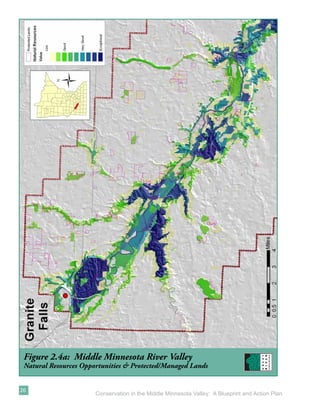
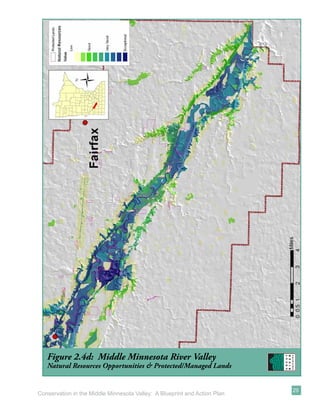
Figure 2.4d
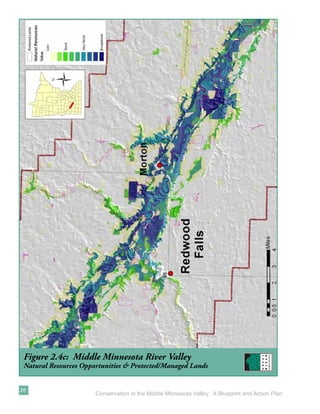
                                                                                Figure 2.4c
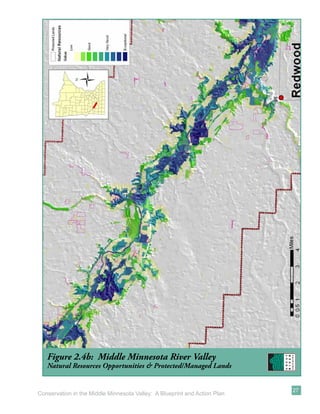
                                                                  Figure 2.4b
                                               Figure 2.4a


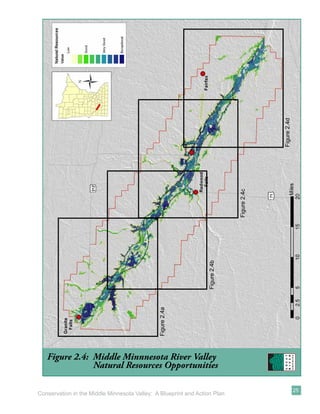
   Figure 2.4: Middle Minnnesota River Valley
               Natural Resources Opportunities

                                                                                                            25
Conservation in the Middle Minnesota Valley: A Blueprint and Action Plan
Figure 2.4a: Middle Minnesota River Valley
 Natural Resources Opportunities & Protected/Managed Lands


26
                       Conservation in the Middle Minnesota Valley: A Blueprint and Action Plan
Figure 2.4b: Middle Minnesota River Valley
   Natural Resources Opportunities & Protected/Managed Lands


                                                                           27
Conservation in the Middle Minnesota Valley: A Blueprint and Action Plan
Figure 2.4c: Middle Minnesota River Valley
 Natural Resources Opportunities & Protected/Managed Lands


28
                       Conservation in the Middle Minnesota Valley: A Blueprint and Action Plan
Figure 2.4d: Middle Minnesota River Valley
   Natural Resources Opportunities & Protected/Managed Lands


                                                                           29
Conservation in the Middle Minnesota Valley: A Blueprint and Action Plan
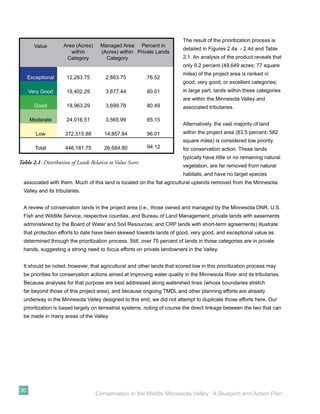
The result of the prioritization process is
       Value         Area (Acres)     Managed Area Percent in
                                                                         detailed in Figures 2.4a - 2.4d and Table
                        within        (Acres) within Private Lands
                      Category          Category                         2.1. An analysis of the product reveals that
                                                                         only 9.2 percent (49,649 acres; 77 square
                                                                         miles) of the project area is ranked in
     Exceptional      12,283.75         2,883.75           76.52
                                                                         good, very good, or excellent categories;
     Very Good        18,402.29         3,677.44           80.01         in large part, lands within these categories
                                                                         are within the Minnesota Valley and
       Good           18,963.29         3,699.78           80.49         associated tributaries.

      Moderate        24,016.51         3,565.99           85.15
                                                                         Alternatively, the vast majority of land
        Low          372,515.88        14,857.84           96.01         within the project area (83.5 percent; 582
                                                                         square miles) is considered low priority
        Total        446,181.75        26,684.80           94.12         for conservation action. These lands
                                                                         typically have little or no remaining natural
Table 2.1: Distribution of Lands Relative to Value Score
                                                                         vegetation, are far removed from natural
                                                                         habitats, and have no target species
  associated with them. Much of this land is located on the flat agricultural uplands removed from the Minnesota
  Valley and its tributaries.


  A review of conservation lands in the project area (i.e., those owned and managed by the Minnesota DNR, U.S.
  Fish and Wildlife Service, respective counties, and Bureau of Land Management; private lands with easements
  administered by the Board of Water and Soil Resources; and CRP lands with short-term agreements) illustrate
  that protection efforts to date have been skewed towards lands of good, very good, and exceptional value as
  determined through the prioritization process. Still, over 75 percent of lands in those categories are in private
  hands, suggesting a strong need to focus efforts on private landowners in the Valley.


  It should be noted, however, that agricultural and other lands that scored low in this prioritization process may
  be priorities for conservation actions aimed at improving water quality in the Minnesota River and its tributaries.
  Because analyses for that purpose are best addressed along watershed lines (whose boundaries stretch
  far beyond those of this project area), and because ongoing TMDL and other planning efforts are already
  underway in the Minnesota Valley designed to this end, we did not attempt to duplicate those efforts here. Our
  prioritization is based largely on terrestrial systems, noting of course the direct linkage between the two that can
  be made in many areas of the Valley.


30
                                    Conservation in the Middle Minnesota Valley: A Blueprint and Action Plan
2.4 Threats and Ecological Legacies
 Conservation, in its simplest term, is the abatement of threats to focal conservation targets. Threats (also
 called stresses), if inadequately addressed, can serve to undermine any action that is carried out under the
 banner of conservation. Without a strong recognition of threats and their sources, strategies embarked upon or
 implemented in the name of conservation can be ill-targeted and often fail. Similarly, restoration efforts initiated
 without an understanding of past activities, events, and the legacy of those actions (ecological legacies) may fail
 to achieve the desired results.


       Threat: An activity or process that has caused, is causing, or may cause the destruction,
       degradation and/or impairment of biodiversity and natural processes.

       Ecological Legacy: Lasting impacts on biodiversity and natural processes as a result of an activity
       or process happening in the past.


 The legacy of past events can reverberate through ecosystems for hundreds to thousands of years (Dupouey
 et al. 2002). These legacies often become drivers of ecosystem function that may be otherwise hidden from a
 static view of landscapes in the present (Rhemtulla and Mladenoff 2007). Studies at forest and grassland sites
 across North America have shown that levels of P, C or N imposed by agriculture can endure for decades and
 centuries after practices have ceased (Foster et al. 2007). Soil horizons may take centuries to rebuild. Native


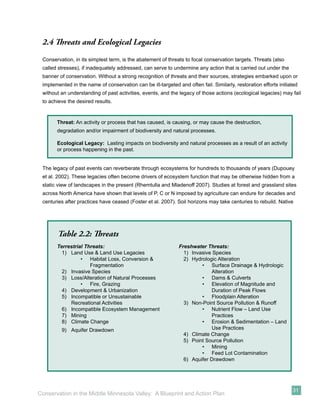
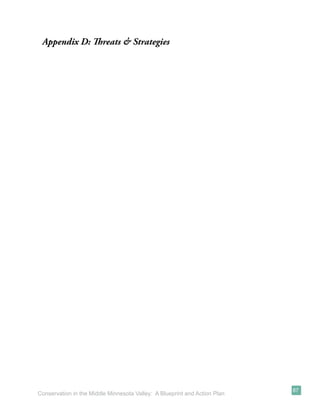
        Table 2.2: Threats
       Terrestrial Threats:                                    Freshwater Threats:
         1) Land Use & Land Use Legacies                         1) Invasive Species
                 • Habitat Loss, Conversion &                    2) Hydrologic Alteration
                     Fragmentation                                      • Surface Drainage & Hydrologic
         2) Invasive Species                                                Alteration
         3) Loss/Alteration of Natural Processes                        • Dams & Culverts
                 • Fire, Grazing                                        • Elevation of Magnitude and
         4) Development & Urbanization                                      Duration of Peak Flows
         5) Incompatible or Unsustainable                               • Floodplain Alteration
            Recreational Activities                              3) Non-Point Source Pollution & Runoff
         6) Incompatible Ecosystem Management                           • Nutrient Flow – Land Use
         7) Mining                                                          Practices
         8) Climate Change                                              • Erosion & Sedimentation – Land
         9) Aquifer Drawdown                                                Use Practices
                                                                 4) Climate Change
                                                                 5) Point Source Pollution
                                                                        • Mining
                                                                        • Feed Lot Contamination
                                                                 6) Aquifer Drawdown


                                                                                                                  31
Conservation in the Middle Minnesota Valley: A Blueprint and Action Plan
prairies that exemplify what occurred pre-1800 may not be possible without reintroduction of bison and other
 herbivores (Collins et al. 1998). Research focused on stream systems has shown that modern composition and
 diversity of fish and invertebrates are best predicted by watershed land use occurring as much as five decades
 earlier (Harding et al. 1998).


 All too often, acquisition is considered the “be all, end all” conservation action pursued, with little consideration
 given to the threats that have occurred, are occurring, or expected to occur at a given site. Often, acquisition
 may not be the most critical action required to maintain natural resource targets at a site. Rather, a robust suite
 of conservation tools designed with an eye toward ameliorating a full spectrum of threats (legacies of past
 actions/processes occurring at present, or expected to occur in the coming years) and targeted toward the
 specific conditions of an area should be considered.


 As a key component of the planning process, principal threats to both terrestrial and freshwater conservation
 targets were drafted and reviewed during a workshop designed to propose a suite of conservation strategies
 to achieve conservation success in the Middle Minnesota River Valley. A list of those threats appears below;
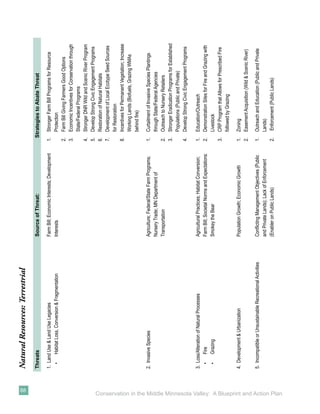
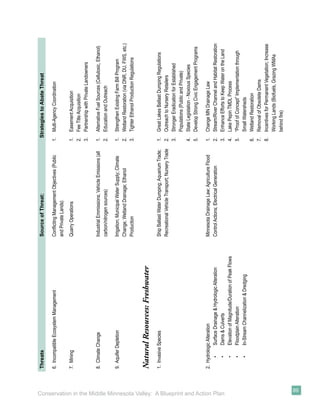
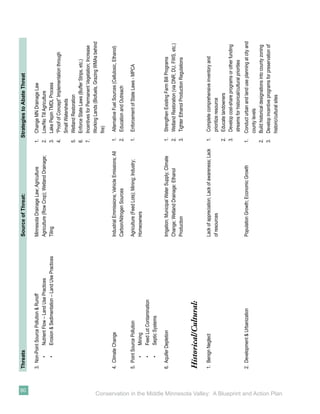
 Appendix D lists these same threats, along with sources of each threat, and strategies identified to abate those
 threats. These strategies are discussed in the following section (2.5).


 2.5 Conservation Strategies

 Four identified for abating threats and conserving the unique and valued natural resources of the Middle
 Minnesota River Valley are numerous and highly varied (see Appendix D). Many of these arose in discussion
 during a Strategies Development meeting held in Redwood Falls on November 30, 2009. What follows below
 is a summary of priority strategies. We lead with several overarching strategies that pertain to conservation of
 natural resources as a whole, then lay out strategies targeting specific threats.


 2.5.1 Overarching Strategies
 Several identified strategies do not pertain specifically to a single or small group of threats, but are broadly
 applicable to natural resources conservation in the Minnesota River Valley as a whole. These include:


 Civic Engagement:
 The Challenge: Local individuals, business men and women, lawmakers, and children do not adequately know,
 respect or appreciate the inherent value of the natural resources in Mid-Minnesota Valley. As such, there exists
 little community support for long-term actions that can serve both to protect these resources and also drive
 economic revitalization in the Valley.


 Strategies to Address the Challenge:
     • Teach conservation and the environment to our students.
     • Educate and inform elected officials.
     • Build a culture of societal responsibility and civic engagement in the protection of natural resources.


32
                                  Conservation in the Middle Minnesota Valley: A Blueprint and Action Plan
Capacity Building:
 The Challenge: Insufficient capacity exists at many levels related to the protection and long-term management
 of the region’s natural resources. These capacity gaps exist among public land management agencies (DNR,
 USFWS, etc.), agencies that deliver services to private land owners (BWSR, SWCDs and NRCS offices), those
 tasked with enforcement of existing laws, and non profit organizations.


 Strategies to Address the Challenge:
     • Identify and procure resources to deliver on-the-ground capacity to address challenges, enforce laws and
       regulations, and implement strategies.
     • Build broad partnerships among local, state and federal government agencies, non profit organizations
       and individuals to share limited resources and elevate impact.


 Communication:
 The Challenge: Strong and effective messages are required to elevate the recognition of the importance of
 natural resources in the Mid-Minnesota Valley, galvanize and inform local stakeholders, and successfully
 implement conservation strategies. These messages can be targeted locally to change an existing culture of
 apathy or to build an engaged citizenry, and at the state and national levels to build support among elected
 officials and government agencies.


 Strategies to Address the Challenge:
     • Develop and deliver focused communications, hitting key messages in a variety of formats, targeting key
       audiences.
     • Market the conservation plan as a key conservation strategy, to build awareness and respect for the
       region’s natural resources and the Minnesota River.


 Economic Development:
 The Challenge: Natural resource conservation is often viewed as the antithesis of economic progress. Yet,
 many vibrant economic centers have successfully blended economic progress with resource conservation,
 making them highly attractive places to live.


 Strategies to Abate the Threat:
     • Where possible and appropriate, link conservation strategies to economic development (e.g., recreational
       trail development).
     • Use full cost accounting techniques to accurately detail costs and benefits related to proposed
       conservation practices.
     • Pursue and showcase successful strategies designed to both build the local economy while building
       appreciation for the region’s natural heritage (e.g., trails, Minnesota Valley History Center).


                                                                                                                33
Conservation in the Middle Minnesota Valley: A Blueprint and Action Plan
2.5.2 Threat-Based Strategies
  What follows is a discussion of the primary threats to natural resources in the Middle Minnesota River Valley,
  and identified strategies to abate these threats.


                                                           Key Threat 1: Agriculture
                                                           With agriculture being the primary use of land within the
                                                           Minnesota Valley, it is not surprising that the majority
                                                           of threats to natural resources stem from actions
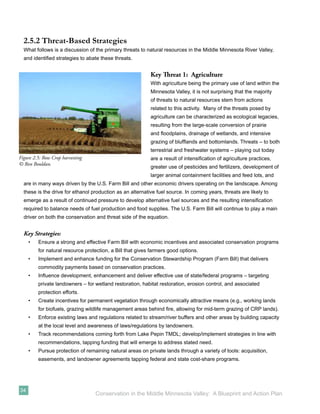
                                                           related to this activity. Many of the threats posed by
                                                           agriculture can be characterized as ecological legacies,
                                                           resulting from the large-scale conversion of prairie
                                                           and floodplains, drainage of wetlands, and intensive
                                                           grazing of blufflands and bottomlands. Threats – to both
                                                           terrestrial and freshwater systems – playing out today
Figure 2.5: Row Crop harvesting                            are a result of intensification of agriculture practices,
© Ron Bouldan.
                                                           greater use of pesticides and fertilizers, development of
                                                           larger animal containment facilities and feed lots, and
  are in many ways driven by the U.S. Farm Bill and other economic drivers operating on the landscape. Among
  these is the drive for ethanol production as an alternative fuel source. In coming years, threats are likely to
  emerge as a result of continued pressure to develop alternative fuel sources and the resulting intensification
  required to balance needs of fuel production and food supplies. The U.S. Farm Bill will continue to play a main
  driver on both the conservation and threat side of the equation.


  Key Strategies:
     •   Ensure a strong and effective Farm Bill with economic incentives and associated conservation programs
         for natural resource protection, a Bill that gives farmers good options.
     •   Implement and enhance funding for the Conservation Stewardship Program (Farm Bill) that delivers
         commodity payments based on conservation practices.
     •   Influence development, enhancement and deliver effective use of state/federal programs – targeting
         private landowners – for wetland restoration, habitat restoration, erosion control, and associated
         protection efforts.
     •   Create incentives for permanent vegetation through economically attractive means (e.g., working lands
         for biofuels, grazing wildlife management areas behind fire, allowing for mid-term grazing of CRP lands).
     •   Enforce existing laws and regulations related to stream/river buffers and other areas by building capacity
         at the local level and awareness of laws/regulations by landowners.
     •   Track recommendations coming forth from Lake Pepin TMDL; develop/implement strategies in line with
         recommendations, tapping funding that will emerge to address stated need.
     •   Pursue protection of remaining natural areas on private lands through a variety of tools: acquisition,
         easements, and landowner agreements tapping federal and state cost-share programs.


34
                                  Conservation in the Middle Minnesota Valley: A Blueprint and Action Plan
Key Threat 2: Mining
 Mining, although limited geographically within the
 project area, has had and is having a significant
 impact on the limited, remaining natural resources
 of the Valley proper. Two types of mining – hard rock
 associated with granite outcrops, and sand/gravel
 associated with alluvium and glacial drift – are found
 in the Valley, and threaten remnant prairies and rock
 outcrops. Quarrying of rock outcrops has emerged as
 a major threat in the Valley in recent years.               Figure 2.6: Sand/Gravel Quarry
                                                             ©Great River Greening
 Key Strategies:
   •   Pursue protection of priority remnant prairies and rock outcrops through conservation easements,
       acquisition, and landowner agreements. Focus RIM program efforts in priority sites; reinvigorate the
       State’s Wild and Scenic River Program and protection that it can afford.


 Key Threat 3: Invasive Species
 Non-native and native species alike can be damaging
 to ecological systems (both freshwater and terrestrial)
 and their associated biota. An array of exotic species
 (e.g., European buckthorn, multiflora rose, leafy
 spurge, reed canary grass, smooth brome, Canada
 thistle, zebra mussel, carp) introduced via federal
 and state agencies, nursery trade, ballast dumping
 in the Great Lakes, and illegal import, are having an
 immediate impact and threaten the future of natural
 areas and lakes and streams within the project area.
 In addition, lack of fire and abatement of other natural     Figure 2.7: Buckthorn closeup
 processes have allowed trees and shrubs to invade           ©Great River Greening
 remnant prairies, rock outcrops and oak savanna
 systems, modifying their composition and placing their
 continued existence at risk.


 Key Strategies:
   •   Collaborate with state and federal agencies to eliminate exotic species currently included in their standard
       planting mixes.
   •   Outreach to the local nursery industry to ensure highly invasive cultivars are eliminated from stock.
   •   Develop and enhance effective eradication programs for invasive species at priority sites by bringing
       resources to bear through state and federal programs, non profit organizations, and local stakeholders.


                                                                                                               35
Conservation in the Middle Minnesota Valley: A Blueprint and Action Plan
•   Build strong programs that bring local communities to bear in elevating resource management on public
         lands.
     •   Enact early detection/rapid response protocols for problematic species that are in very low densities or
         are on the verge of entering the Valley.


                                                             Key Threat 4: Development and Urbanization
                                                             Pressures on the natural resources of the Minnesota
                                                             River Valley stemming from development and
                                                             urbanization are significant. Land holdings along the
                                                             River Valley, particularly in close proximity to existing
                                                             towns, are being subdivided and sold as ranchettes or
                                                             lots for homes. The River Valley, for those wanting to
                                                             escape town living, affords a more attractive housing
                                                             site than agricultural lands. As land ownership changes,
                                                             opportunities for subdivision emerge.


Figure 2.8: Subdivision Development                          The former glacial river bed is primarily riparian and
© Northwest Associated Consultants.                          is subject to annual spring flooding from Upper Sioux
                                                             Agency State Park to Fort Ridgely State Park. The real
                                                             development pressure will not be on the river bed itself,
  but rather along the sides of the former glacial river banks and the blufflands on top. These areas would be
  more susceptible to linear housing developments, which are common in the New Ulm and Mankato areas.


  There is limited development potential on the south side of the Minnesota River in Redwood County due to:
     •   The lack of a township road running along the base of the bluff from Redwood Falls through the Lower
         Sioux Community.       Most of the available upper bluff line has already been developed near Redwood
         Falls and there is a modest amount controlled by three landowners, east of the Lower Sioux Community.
     •   The presence of a commercial rendering facility and previous DNR acquisitions have limited development
         along the river bottom road to the west.


  The greater residential development potential is on the north side of the River in Renville County due to:
     •   Accessibility provided by the river bottom road that stretches from one end of the county to the other,
         providing great access to the side bluffs of the river valley.
     •   Many of the existing coulees were developed a century ago as pioneer farm sites and additional rural
         residential development has occurred over the last three decades.


  Key Strategies:
     •   Strengthen land use planning and zoning at the county level.
     •   Build relationships with key private landowners and acquire conservation easements on priority parcels
         through RIM, DNR Wild & Scenic River Program, or non-profit conservation organizations.


36
                                      Conservation in the Middle Minnesota Valley: A Blueprint and Action Plan
Key Threat 5: Hydrologic Alterations
 Physical modifications to streams and rivers over the years, coupled with exacerbated flows (in magnitude
 and duration) due to wetland drainage and loss of upland vegetation, have had major impacts on freshwater
 systems and associated biota.


 Key Strategies:
   •   Change the Minnesota Drainage Law which drives wetland drainage and stream/river channelization
       across much of the state.
   •   Enhance efforts to keep water on the land through wetland restoration and other practices, tapping and
       delivering funding through BWSR, MPCA, and an array of other state and federal programs, and non-
       profit organizations like Ducks Unlimited.
   •   Track and develop strategies linked to the Lake Pepin TMDL process which will set limits on nitrogen,
       phosphorous and sediment loads in the Minnesota River.
   •   Start small, working to implement an array of practices to achieve demonstrable change in small “proof of
       concept” watersheds.
   •   Remove obsolete dams on waterways to reestablish flow through river sections and allow for free
       movement of fish and other aquatic species.
   •   Create incentives through Farm Bill and other programs for putting permanent vegetation on lands.
   •   Expanding working lands concepts for biofuels production, grazing WMAs behind fire and so forth.


 Key Threat 6: Point Source Pollution
 Several types of point source pollutants pose noteworthy threats to natural resources in the Minnesota Valley,
 most notably mining, feed lot contamination, and septic systems.


 Key Strategies:
   •   Enforce existing laws and regulations.
   •   Conduct assessment of septic systems along the Minnesota River and its tributaries; secure cost-share
       funding to correct problems.


 Key Threat 7: Aquifer Depletion
 Although not a major issue at present, this threat looms significantly larger in the near future as demands
 related to ethanol production expand, and into the future as climate warms and rainfall decreases.


 Key Strategies:
   •   Tighten ethanol production regulations.
   •   Restore wetlands to increase aquifer recharge.


                                                                                                               37
Conservation in the Middle Minnesota Valley: A Blueprint and Action Plan
2.5.3 Key Policy Arenas
 Farm Policy and Subsidies
 Similar to other countries, the United States has sponsored farm subsidies since the early twentieth century.
 Farm policy and subsidies tend to ebb and flow in popularity depending on the current socio-economics. Farm
 policy itself is strongly tied to economics and protection of agricultural interests. These policies can, at times,
 be at odds with the natural resources conservation, while at other times can contain strong conservation
 incentives. Farm policy is directly tied to how much subsidy is available for placing agricultural lands into various
 conservation programs such as the Conservation Reserve Program (CRP), Wetland Reserve Program (WRP),
 Wetland Habitat Incentive Program (WHIP) and others.


 Minnesota Drainage Law
 Minnesota’s extensive tracts of agricultural land rely heavily on an interconnected drainage network of ditches,
 channels and drain tile. This network operates to drain wet soils by expediting water from the land to local
 streams and rivers, to the detriment of the hydrological cycle of the region. This can cause greater amplitudes
 in stream and river flow relative to historic norms during spring runoff and major rain events. In turn, these
 transport systems can serve as direct conduits for sediment, chemicals and nutrients (e.g., phosphorus
 and nitrogen) directly into streams. The drainage law is overseen at the local level by a County Board, Joint
 Drainage Authority, Watershed District, or Soil & Water Conservation District (Busman 2002).


 Zoning
 Continued human population growth and landscape urbanization will create ongoing pressure on lands with
 the project area with natural and open space values. Although there is currently a lull in the market for lands as
 a result of poor economic conditions, pressures are likely to increase as economic conditions and land prices
 increase. This pressure will appear in the form of future city and subdivision expansion, along with single-home
 expansion in rural areas. Table 2.3 provides a summary of current zoning regulations related to residential
 diversity in Redwood and Renville Counties.


       Table 2.3: Minimum Density - Redwood and Renville Counties
       Redwood (residential minimum density)
       MN Scenic River - 1 dwelling unit/5 acres (R-LD, Ag2, Minnesota River Valley Corridor)
       Agriculture - 1 dwelling unit/2.5 acres (Ag1, R1)


       Renville (residential minimum density)
       MN Scenic River - 1 dwelling unit/5 acres (Minnesota River Valley Corridor)
       Agriculture - 1 dwelling unit/40 acres
       Rural Residential – 1 dwelling unit/5 acres


38
                                 Conservation in the Middle Minnesota Valley: A Blueprint and Action Plan
Minnesota Scenic River Regulations
 Both Redwood (Redwood County 2009) and Renville (Renville County 2009) counties have land use
 ordinances that apply to the State of Minnesota’s Scenic River Regulations.


 Permitted uses of land within the scenic river district of both counties are largely identical, and include
 opportunities for governmental campgrounds, public access and trails, agriculture and forestry, sewage
 treatment facilities, private roads, single family residential housing, and governmental open space recreational
 uses.


 Conditional uses (those requiring a conditional use permit), although largely similar between the two counties,
 have some notable differences. Private campgrounds, temporary docks, private open space recreational uses,
 public roads and mining are considered conditional uses in both counties.


      Table 2.4: County Zoning Differences
         Principle differences in Scenic River zoning between the two counties fall in the following areas:


         Conditional Use               Redwood County                     Renville County
         Livestock operations          Not listed                         >300 animal units
         Transmission corridors        Not listed                         Power lines and pipelines


         Zoning Dimensions
         Lot width at building line    250 feet                           300 feet


         Subdivisions
         Land unsuitability            Not addressed                      None for unsuitable lands
         Planned unit development       Not addressed                     If clustering allows for better
                                                                          protection of ag land, open
                                                                          space, scenic views, wetlands
                                                                          and other features.


 Agriculture and Rural Residential Regulations
 Lands within the project area outside of the Minnesota Scenic River District (i.e., uplands beyond the Valley
 proper) are also subject to zoning restrictions. Again, differences between Redwood and Renville Counties
 occur relative to minimum lot size for new residential development. Redwood County provides a minimum
 residential lot size of 2.5 acres, while Renville County requires a lot size of no less than 5 acres [rural
 residential] (Biko 2007, SRF 2002).


                                                                                                                 39
Conservation in the Middle Minnesota Valley: A Blueprint and Action Plan
40
     Conservation in the Middle Minnesota Valley: A Blueprint and Action Plan
3. Cultural/Historical Resources Conservation Plan

 T     he Cultural/Historical Conservation Plan follows the principal framework established for developing the Natural
 Resources Conservation Plan. However, unlike the Natural Resources process, this planning process lacked
 comprehensive data sets to effectively drive a planning and prioritization process. Despite repeated attempts
 to procure data from both state and local sources, a robust data set was not achieved; this paucity of data had
 significant implications related to the outcomes of the plan. These are discussed in the following sections of this
 report. Still, the results of this undertaking are noteworthy.


 3.1 Conservation Targets
 Conservation targets selected for the cultural/historical component of the Middle Minnesota Valley Conservation
 Plan include sites and features that effectively tell the story of the area. Through several workshops and
 meetings, nine principle themes were identified to focus this plan:


   •      Dakota Culture – Historic village sites, sacred sites, etc.
   •      Native American Indian Culture – Archeological sites (pre-1700) timeframe
   •      Early Commerce – Mining, milling, agriculture, quarrying, retail
   •      Religion – Missions, churches, cemeteries, etc.
   •      Military – U.S.- Dakota Conflict of 1862, forts, etc.
   •      Transportation – Railroads, ox cart trails, ferries, early roads, etc.
   •      Historic (Ghost) Towns – Historic towns and associated features
   •      Important People – Local people on a regional/national stage
   •      Other – Noteworthy sites that do not fall into one of the above categories


 3.2 Building the Conservation Plan and Assigning Priorities

 Within each category, identification of sites were pursued that served to capture the full breadth of these
 historical/cultural themes as they played out within the project area.


 Challenges in Procuring Data
 From the onset, the data compilation strategy from which to build this conservation plan hinged on a “top-down,
 bottom-up” process of gathering data available through the State Historic Preservation Office (SHPO) and other
 state and federal sources, augmented by data supplied at the local level through county historical societies and
 local experts.


 This approach, although attractive in many ways, failed to produce the quantity and quality of data required to
 build a robust conservation plan. Although we obtained a full complement of historic and archeological data
 for the project area from SHPO, data restrictions made it impossible to share this site-specific information with


                                                                                                                  41
Conservation in the Middle Minnesota Valley: A Blueprint and Action Plan
Figure 3.1: Minnesota River Valley Green Corridor
 Historical/Cultural Opportunities
           [Adjust Map color layout]
42
                        Conservation in the Middle Minnesota Valley: A Blueprint and Action Plan
project partners or include it in the conservation plan per se. Our approach at the local level was to identify
 and request assistance from experts in providing site nominations, spatial maps, and supporting data related
 to important historical sites within the categories identified above. That approach, although partially successful,
 failed to produce as expected. As a result, the process adopted for assembling a conservation plan around these
 features was considerably different than that described for natural resources. As such, this conservation plan
 – although identifying an array of important historical and cultural sites and strategies to conserve them – lays the
 groundwork for a more robust, locally-led process that should follow in the near term.


 Outcomes
 Local input from knowledgeable experts served to
                                                              Table 3.1: Identified Historical/Cultural Sites by Theme
 identify 39 historic/cultural sites within the project
                                                               Theme                            Number of Sites
 area, representative of each of the 9 principal
                                                               Dakota Culture                       13
 themes (Figure 3.1). However, sites principally relate        Early Commerce                        8
 to Military (44 percent) and Dakota (33percent)               Religion                              7
                                                               Military                             16
 themes, acknowledging the importance of these
                                                               Transportation                        4
 themes in the project area.                                   Historic (Ghost) Towns                5
                                                               Important People                      6
                                                               Pre-Dakota Culture                    0
 For each nominated site, we compiled both a spatial
                                                               Other                                 3
 boundary (to the extent that was obtainable) and
 associated tabular data (see Appendix E). Spatial
 boundaries of sites were drawn to encompass all
 features necessary for the protection and interpretation of the resource from a historical standpoint. Breakdowns
 of identified sites relative to each of the respective themes are detailed in Figure 3.1.


 Pre-1700 archeological sites associated with the broader Native American Indian theme were excluded from
 the mapping exercise due to their sensitivity. Instead, a probability map depicting likelihood of encountering
 archeological resources was developed by Great River Greening, based on distance from existing water sources
 (Table 3.1).


 Assigning Conservation Priorities
 Due to the paucity of data associated with historic sites in the Middle Minnesota Valley, the project managers
 and project Executive Committee determined that it made little sense at this time to assign conservation
 priorities to sites. Rather, a more thorough, locally-led historical assessment should be undertaken in the near
 future to augment data collected through this effort, which would in turn lead to a compelling prioritization
 process. It is unlikely that direct action by Green Corridor, Inc. will be taken specifically to conserve historical
 features in the coming half decade, allowing time to make the historical/cultural plan more robust.


                                                                                                                       43
Conservation in the Middle Minnesota Valley: A Blueprint and Action Plan
When undertaken, we propose that priorities be set around the following criteria:
     •   Historical significance of the site (global, national, regional, statewide, or local)
     •   Condition of the site (excellent to poor/degraded)
     •   Interpretive value (high to low)


 Approximately half of all identified sites are considered protected. The level of protection afforded identified
 sites to date by theme shows that most protected sites in the project area are associated with the U.S. – Dakota
 Conflict of 1862. Few sites related to early commerce, transportation, etc. are protected and their historical story
 is largely untold. A more intensive conservation planning process in the future should ensure that all of these
 themes are adequately addressed.


 3.3 Threats and Historical Legacies

 Cultural and historical resources in the Middle Minnesota Valley are threatened by an array of direct and
 benign stresses. These threats stem from the lack of a thorough assessment and knowledge/understanding
 of historical/cultural resources in the region, insufficient financial resources, capacity, and legal covenants to
 protect and maintain those that are known, and inadequate appreciation/support among local communities and
 legislative representatives to make protection of these resources a priority. A list of identified threats to historical/
 cultural resources in the Middle Minnesota Valley appears below; Appendix D lists these same threats, along
 with sources of each threat, and strategies identified to abate those threats.


 Principal Threats:
     •   Development & Urbanization – loss and degradation of resources due to encroachment via urban sprawl,
         loss through development and urban revitalization, and other associated actions.
     •   Loss of Knowledge – loss and degradation of resources due to inadequate documentation of history
         (especially at the local level) leading to an inability to locate and interpret historical sites, and a failure to
         recognize the importance of sites.
     •   Land Use and Land Use Legacies – loss or degradation that has already occurred stemming from a variety
         of historical sources (agricultural conversion of lands, etc.).
     •   Maintenance Deficiency – loss and degradation through insufficient resources to protect and maintain sites
         over time.
     •   Economic and Social Changes – loss and degradation due to changes in perceived value of sites by
         stakeholders, particularly in dire economic times.
     •   Insufficient and Inadequate Conservation Standards – loss and degradation of resources due to insufficient
         and inadequate application of conservation standards to historical/cultural resources.
     •   Tourism-Related Degradation and Loss – loss and degradation due to the over-use and inadequate
         protection of resources by visitors.
     •   Lack of or Inadequate Protective Heritage Legislation – loss and degradation as a result of inadequate
         protective legislation at the local, state, or national levels, and/or the enforcement of existing legislation.


44
                                   Conservation in the Middle Minnesota Valley: A Blueprint and Action Plan
A global assessment by the International Council on Monuments and Sites (ICMOS 2010) identified a suite
   of resources at risk across the world. Many of these globally threatened resources are also threatened in the
   Middle Minnesota Valley as well, and include:


   Rural and Vernacular Architecture
   Modest, traditional buildings and places are
   especially vulnerable because of their transient
   materials and unassuming character.
   The risks include:
       •   Lack of recognition for simple vernacular
           heritage and thus lack of legal protection;
       •   Loss of traditional building skills;
       •   Loss of function, leading to lack of
           maintenance;
                                                            Figure 3.2: Beaver Falls Town Hall
       •   Redundancy, neglect, abandonment or              ©Gary Revier
           imposed modernization.


   Industrial Heritage
   With rapid changes in technology and socio-
   political structures, industrial complexes of
   heritage significance are under pressure for
   redevelopment or modification. Sites located
   in urban areas are particularly vulnerable, as
   land values, living conditions and environmental
   expectations and controls change. The large
   scale of some redundant sites is often attractive
   for incompatible redevelopment, and their
   pragmatic value as real estate is seen to                Figure 3.3: Kittelsland Water Wheel
   outweigh their heritage values and interpretative        ©Ron Bouldan.

   potential for adaptive reuse.

   Major issues faced by industrial heritage sites include:
       •   Scale and complexity forcing economical rationalism to prevail in reuse decisions;
       •   Lack of widespread vocal support constituency;
       •   Location in prime redevelopment areas;
       •   Environmental management (e.g. remediation) precluding heritage values.


                                                                                                            45
Conservation in the Middle Minnesota Valley: A Blueprint and Action Plan
Religious Heritage
     Changes to religious practice and observances are a major threat to heritage worldwide. The
     complexity of the functions of religious buildings - spiritual, public, social and administrative - can
     support some flexibility of use, but for many the lack of congregation, or changing worship practices
     have led to abandonment or massive internal changes. Parish churches are often neglected or
     adapted for other functions, not always with respect for or regard to the spirit of the place.

     Risks affecting religious buildings include:
         •   Unsuitable use for other purposes;
         •   Lack of maintenance.


     Archaeological Sites
     Lack of adequate inventories to locate archaeological sites is at the root of this problem, as are increasing
     acts of vandalism to these sites. Physical damage through land conversion to agriculture and other practices
     also poses significant threats. Natural forces are also the enemy of these sites - erosion by wind and water
     threaten artifacts and sites alike. Urban development poses the threat of sudden destruction.


     Threats affecting archaeological sites include:
         •   Illicit excavations, particularly in remote sites;
         •   Resource extraction;
         •   Infrastructure development, such as roads, bridges and dams;
         •   The antiquities trade.


                                                              Dakota Values and Places
                                                              An ongoing challenge is the appropriate recognition and
                                                              conservation of Indigenous values in landscapes, sites
                                                              and communities. Much work is needed to negotiate
                                                              appropriate conservation protocols in diverse cultures
                                                              - from the cultural and social necessity of maintaining
                                                              language, to the identification and protection of cultural
                                                              sites, to recognizing the intangible values in spiritual
                                                              landscapes, and to the importance of specific sites of
                                                              conflict or contact.

Figure 3.6: Tepee
Redwood County Historical Society


46
                                    Conservation in the Middle Minnesota Valley: A Blueprint and Action Plan
3.4 Conservation Strategies
 Strategies identified for abating threats and conserving the nationally significant cultural and historical resources
 of the Middle Minnesota River Valley are numerous and highly varied (see Appendix F). Many of these arose
 in discussion during a Strategies Development meeting held in Redwood Falls on November 30, 2009. What
 follows below is a summary of the priority threats and strategies that emerged.


 Development and Urbanization
 Pressures on the historical/cultural resources of the Minnesota Valley stemming from development and
 urbanization are significant. Important features throughout the project area are being lost through development
 and urbanization.


 Key Strategies:
   • Initiate land use planning at the county level.
   • Pass zoning language for historic districts and implement at the county level.
   • Build relationships with key private landowners and acquire historic conservation easements on priority
       features through non-profit organizations.
   • Develop a robust historical/cultural conservation plan to drive conservation action.


 Loss of Knowledge
 Critical information related to historic and cultural sites, unless adequately captured through historical documents,
 is being lost daily as memories fade, local community member pass away, and sites degrade.


 Key Strategies:
   •   Conduct a comprehensive inventory of historical/cultural features in the Middle Minnesota Valley, and
       identify priority sites for conservation action.
   •   Undertake research to accompany the above inventory in order to understand and set priorities for
       conservation action.


                                                                                                                  47
Conservation in the Middle Minnesota Valley: A Blueprint and Action Plan
Maintenance Deficiency
 Lack of maintenance is perhaps the single most important threat facing historical resources in the Middle Minnesota
 Valley. Often, historical surveys have not been conducted to identify buildings and sites of historical value. As a
 result, landowners, communities and government officials fail to recognize the historical significance of a given
 building, site or feature. Buildings – whether occupied or not – degrade over time without sufficient resources put
 toward their maintenance.


 Key Strategies:
     •   Conduct comprehensive inventory of historical/cultural features in the Middle Minnesota Valley, and
         identify priority sites for conservation action.
     •   Develop cost-share funding, tax relief or other funding sources to alleviate cost of maintenance by
         owners.
     •   Develop and implement attractive and convincing marketing/education campaign to raise awareness
         of resources and build endowment to fund maintenance over the long term.
     •   Develop or lure an effective historical/cultural nonprofit organization to the Valley to begin the work of
         conserving and managing these important resources.


 Economic and Social Changes
 Economic downfalls can destroy the best intentions and programs that were put in place when funds were plentiful.
 Successful, long-term solutions are required that provide funding sources that withstand economic downturns and
 social changes within a community.


 Key Strategies:
     •   In companionship with a viable protection campaign, set aside funding for a maintenance
         endowment.
     •   Develop innovative practices that serve to maintain historic buildings while making them attractive for
         continued use.


48
                                    Conservation in the Middle Minnesota Valley: A Blueprint and Action Plan
4. Going Forward - Taking
                                                        Conservation Action
                                                        4.1 How to Use the Plan
                                                        Conservation planning as a discipline has evolved
                                                        significantly over the last decade. Where once
                                                        the emphasis was on a completed plan, the
                                                        focus of conservation planning today lies with its
                                                        products – the underpinning data and maps – and
                                                        how they will be effectively used by the many
                                                        conservation organizations, and federal, state and
                                                        local units of government working within a project
                                                        area. In the end, the strength of a given plan lies
                                                        not with the plan itself, but in how effectively it
                                                        is used in achieving conservation success. This
                                                        change in focus from a hard-copy product to an
                                                        effective decision support tool is at the heart of this
                                                        transformative change in planning. Far too often,
                                                        planning processes have failed to impact on-the-
                                                        ground conservation; although looking nice, many
                                                        have been quickly relegated to the proverbial and
                                                        literal bookshelves.


                                                      Figure 4.1: Looking down a tributary to the Minnesota River
                                                      ©Brad Cobb


                                                                                                              49
Conservation in the Middle Minnesota Valley: A Blueprint and Action Plan
The Middle Minnesota River Conservation and Action Plan reflects this evolution in conservation planning. At
 the onset of the planning process, project managers in conjunction with Executive and Facilitation committees
 reached consensus that this undertaking would result in strong deliverables that could be used by a broad suite
 of practitioners to inform their actions within the project area. To this end, the planning process produced the
 following deliverables:
     •   A conservation plan for both historical/cultural and natural resources (via hard-copy, CD and worldwide
         web),
     •   Large-scale, plotter-sized maps of natural and cultural/historical resources (available on CD and via the
         worldwide web), and
     •   GIS shapefiles for respective coverages (available on CD and via the worldwide web).


 Resource prioritization maps and shapefiles produced through this planning process are intended to serve as:
     •   Vehicles through which the proposed conservation actions of an organization – whether fee-title or
         easement acquisition, restoration, or delivering state cost-share programs to private landowners – are
         vetted.
     •   Visual resources around which groups of stakeholders and conservation practitioners jointly discuss
         collective strategies, laying out long-term game plans to achieve demonstrable impact.
     •   A tool for land management agencies in reviewing existing site-based management plans informed by a
         broader regional context.


 As a means of showcasing the utility of these tools to potential users, we provide two illustrative examples.
 Although drawn from actual data in the Middle Minnesota Conservation Plan, it is important to emphasize that
 these examples are put forward merely for illustrative purposes only, and are not meant to promote or suggest
 that these strategies are being considered by any respective stakeholder.


 4.1.1 Illustrative Example 1
 Key Players:
 Minnesota Department of Natural Resources - protects the state’s natural heritage by conserving the
 diversity of natural lands, waters, and fish and wildlife that provide the foundation for Minnesota’s recreational
 and natural resource-based economy.


 Green Corridor, Inc. - is a non-profit conservation organization dedicated to the conservation and recreational
 use of the Middle Minnesota Valley. The organization is interested in assisting the DNR in meeting its goals in
 the project area, but also providing greater recreational access to and along the river valley corridor.


 Overview:
 The Minnesota DNR manages a state wildlife management area (WMA) along the south bank of the Minnesota
 River. The WMA captures a significant portion of an area characterized as having exceptional natural resource
 value; some areas of lesser quality are also included within the WMA. The DNR has identified this area as being


50
                                  Conservation in the Middle Minnesota Valley: A Blueprint and Action Plan
a cornerstone to its conservation efforts in the Middle Minnesota Valley, and is willing to employ a variety of
 strategies to achieve its goals in protecting areas of exceptional natural resource value and species of greatest
 conservation need that live in the Valley and on the WMA.


 A review of the resource prioritization map relative to existing managed areas (Figure 4.2) finds the following:
   •   Two areas of exceptional natural resource value in private hand immediately adjacent to the WMA. These
       include a large area of approximately 50 acres off the west edge of the WMA, and a smaller 15-acre area
       sandwiched between two legs of the WMA along its south border.
   •   Three areas of lesser quality (very good to low natural resource value) are included within the WMA: 1)
       northwestern corner along the Minnesota River, 2) southeastern corner along the Minnesota River, and 3)
       a small inclusion in the center of the unit.
   •   A small privately-owned tract of land enrolled in the Reinvest in Minnesota (RIM) program (a perpetual
       conservation easement program held by the State of Minnesota) is located adjacent to the Minnesota
       River along the northwest corner of the WMA.


                     Adjacent land
                     of exceptional
                     quality
                                                                                   Potential
                                                      WMA                          Restoration


                                                                Adjacent land of
                                                                exceptional quality

                                                              Figure 4.2: Illustrative Overview Example 1


                                                                                                                   51
Conservation in the Middle Minnesota Valley: A Blueprint and Action Plan
•     Privately owned lands of low to very good natural resource quality are located adjacent to the WMA along
           its south and western borders.


  Illustrative Strategies
  Based on this overview, a number of potential strategies might be employed to enhance conservation of
  existing state investments and areas of exemplary natural resource value located in the project area. These are
  described below, but reference Figure 4.3:


  Strategy 1: Fee Title and Easement Acquisition
  Both areas currently in private ownership but of exceptional natural resource value (given their proximity to the
  existing WMA) are likely candidates for acquisition. Acquisition of these parcels – via directly by MN DNR or via
  Green Corridor, Inc. – would not only protect the high quality resources on these lands, but also afford greater
  protection to resources now partially protected within the WMA. Acquisition of the private land located along the
  managed area’s south border would strengthen the linkage between two existing legs of the WMA and provide
  a better corridor for species movement along the valley.


                                                Restoration


                           Fee title or
                           easement
                           acquisition;
                                                                                  Restoration
                           Restoration                        WMA                 on WMA


         Easement
         acquisition
                                                                    Fee title or easement
                                                                    acquisition; Restoration

Figure 4.3: Illustrative Strategies Example 1


52
                                        Conservation in the Middle Minnesota Valley: A Blueprint and Action Plan
If landowners are unwilling to sell, the DNR might pursue long-term conservation easements on these same
 tracts as a mechanism for affording limited but critical conservation action. In addition, easements might be
 warranted on other private lands immediately adjacent to the WMA (south and west borders) as a way to offer
 greater buffer and protection to investments already made by the State of Minnesota. To this end, the DNR
 may collaborate with Green Corridor, Inc., the Minnesota Board of Soil and Water Resources (BWSR) which
 administers the RIM program through its local Soil and Water Conservation Districts, or other conservation
 partners in procuring these easements.


 Strategy 2: Restoration and Management
 Restoration and resource management – as a means of improving the size, condition and landscape context
 of habitat within and adjacent to the WMA – might be pursued on both state and private lands. Portions of the
 WMA (northwest and southeast corners, and centrally) are of relatively low natural resource quality. Restoration
 of these areas to their historic condition would greatly improve the overall viability of natural resources of
 the WMA by reducing edge effect, buffering existing high quality lands and creating more contiguous habitat
 for wildlife species. Finally, the DNR might review its existing management plan to ensure that existing
 management practices within the WMA are in line with the long-term maintenance of the WMA’s exceptional
 natural resources.


 Similarly, restoration of privately owned lands adjacent to the WMA could be pursued by the DNR through
 collaboration with county NRCS or SWCD offices, tapping a broad suite of state and federal cost share
 assistance programs for these explicit purposes. Collaboration with BWSR could also bring resources toward
 restoring and managing the state-held RIM easement located along the northwest corner of the WMA. These
 actions, again, would serve to buffer the existing WMA and offer greater level of protection to the state’s
 conservation investments. It should be noted that these state and federal cost share assistance programs do
 not offer perpetual protection, as programs typically have a lifespan of 10-30 years.


 4.1.2 Illustrative Example 2

 Key Players:
 Minnesota DNR – protects the state’s natural heritage by conserving the diversity of natural lands, waters, and
 fish and wildlife that provide the foundation for Minnesota’s recreational and natural resource-based economy.


 Redwood SWCD – is a special purpose unit of government that manages and directs conservation programs,
 such as the state Cost-Share Program and the Reinvest In Minnesota (RIM) Program. Water quality is a primary
 emphasis of the District.


                                                                                                                  53
Conservation in the Middle Minnesota Valley: A Blueprint and Action Plan
Overview:
  The Minnesota DNR manages a state Scientific and Natural Area (SNA) that protects a significant portion of an
  area identified for its exceptional natural resource value. SNAs preserve natural features and rare resources
  of exceptional scientific and educational value in the State of Minnesota. The DNR also manages a WMA –
  considered to be of relatively low natural resource value – that lies immediately adjacent to the SNA. A stream
  draining agricultural lands enters the SNA from the south, laden with silt and nutrients, and flooding frequently
  during rain and snow melt events. The creek is having significant negative impacts both on the SNA and other
  lands along its course, and water quality within the Minnesota River.


  A review of the resource prioritization map relative to existing managed areas (Figure 4.4) finds the following:
     •   Approximately half of the land designated as being of exceptional conservation value is on private land,
         and has no formal protection.
     •   The Minnesota DNR manages a WMA of relatively low natural resource value that lies immediately
         adjacent to the SNA.


                               Surrounding private lands of
                               excepetional quality


                                              SNA

                                                         WMA


                                               WMA


                                        Affecting
                                        watershed area


Figure 4.4: Illustrative Overview Example 2


54
                                      Conservation in the Middle Minnesota Valley: A Blueprint and Action Plan
•     A number of privately-owned tracts of land enrolled in the Reinvest in Minnesota (RIM) program (a
         perpetual conservation easement program held by the State of Minnesota) are located immediately
         adjacent to the SNA and WMA. Most of these are considered to be of very good natural resource value.


 Illustrative Strategies
 Based on this overview, a number of potential strategies might be employed to enhance conservation of
 existing state investments and areas of exemplary natural resource value located in the project area. These are
 described below, but reference Figure 4.5:


 Strategy 1: Fee Title and Easement Acquisition
 Areas currently in private ownership but of exceptional natural resource value (given their proximity to the
 existing SNA) are likely candidates for acquisition. Acquisition of these tracts would not only protect the high
 quality resources of these lands, but also afford greater protection to resources now partially protected within
 the SNA.


       Fee title or                                  Restoration
       easement
       acquisition
                                         SNA


                                                     WMA


                                                                      Fee title or
                                                                      easement
                                              WMA                     acquisition


                              State cost share
                              assistance to
                              landowners


                                                              Figure 4.5: Illustrative Strategies Example 2


                                                                                                                    55
Conservation in the Middle Minnesota Valley: A Blueprint and Action Plan
If landowners are unwilling to sell, the DNR working collaboratively Redwood SWCD using the state’s RIM
 program might pursue long-term conservation easements on these same tracts as a mechanism for affording
 limited but critical conservation action. In addition, easements might be pursued on other private lands adjacent
 to or in close proximity to the SNA as a way to offer greater protection to the complex of natural areas.


 Strategy 2: Restoration and Management
 Restoration and resource management is a key strategy for this site. The WMA, when viewed relative to all
 other ownership tracts, ranks low and serves to degrade the integrity of the natural resources at the SNA and
 across the broader complex of private/public lands. Restoration of this WMA to its historic conditions would
 greatly improve the overall viability of natural resources of this complex of lands, reducing edge effect, buffering
 existing high quality lands and creating more contiguous habitat for wildlife species. The DNR might review its
 existing WMA management plan to better complement that of the SNA.


 Aside from the WMA, lands in public and private hands within this portion of the Minnesota Valley generally of
 very good or exceptional natural resource value. Ongoing management of this resource, however, is important
 and likely to be a challenge to private landowners. Collaboration between MN DNR and Redwood SWCD to
 effectively target state cost share programs to private landowners in the area would be an important strategy.
 These actions would serve to buffer the existing SNA and offer greater level of protection to the state’s
 conservation investments. It should be noted that these state and federal cost share assistance programs do
 not offer perpetual protection, as programs typically have a lifespan of 10-30 years.


 Strategy 3: State Cost-Share Assistance to Private Landowners
 Improving the quality and hydrology of the stream running through the SNA is a challenge that must be
 addressed at its source – the agricultural uplands associated with headwaters and mid-stretches of the creek.
 Reducing these threats will require broad application of strategies that serve to retain water on the landscape,
 buffer stream courses, protect highly erodible soils, and reduce tillage. To this end, the Redwood SWCD is a
 logical lead, tapping a variety of state cost share programs. Collaboration with the Redwood County Natural
 Resources Conservation Service (NRCS) office would broaden this resource base to include federal funds.
 Finally, as TMDL assessments and implementation plans are finalized, these will open the door to additional
 funding sources targeting a reduction in phosphorous, nitrogen and other sources of impairment to the
 Minnesota River.


56
                                 Conservation in the Middle Minnesota Valley: A Blueprint and Action Plan
4.2 Next Steps and Feasibility Assessment
 Key strategies to abate major threats and conserve the natural, cultural and historical resources of the Mid-
 Minnesota Valley are outlined in the discussion of conservation strategies (Section 2.5). In this section, the
 authors expand upon that discussion, identifying a small suite of priority strategies designed to move the
 conservation bar significantly forward in the short term. Each of the priorities would require major collaboration
 and planning to fully develop and implement. And so, at this point, we would not presume to suggest whether or
 not moving forward on any particular strategy is feasible.


 We offer here only the outlines of how such a process might begin. Integral to that discussion is:
   1.   A review of organizational capacity within partner organizations at the local and state levels to make
        progress in each respective area,
   2.   An outline of concrete next steps to make demonstrable progress, and
   3.   Identification of who is best poised to lead those efforts and otherwise participate.


 It is acknowledged here that conservation in this or any other region is a moving target. Circumstances on
 the ground regularly change as landowners sell property, as the natural and cultural/historical resource base
 changes, as new laws and regulations are passed, as new conservation programs and funding sources become
 available, and as conservation organizations and their roles grow or morph over time. Although the authors put
 forth a suite of priority conservation strategies for the region, an intentional effort is made to ensure that the plan
 is not overly prescriptive on that front.


 4.2.1 Historical/Cultural Resources
 The conservation plan for historical and cultural resources as pursued through this planning effort failed to
 materialize to the extent that was achieved for natural resources. The principle reason for this was due to a
 lack of robust information from which to draw in developing the plan. As such, the key next steps are targeted
 squarely at pulling together the base information and developing a robust plan to guide historical and cultural
 conservation efforts.


 Strategy 1. Conduct a comprehensive inventory of the cultural/historical resources.
 A solid base of data is critical to the development of a conservation plan that subsequently supports and drives
 conservation of target resources. As such, a first priority is a comprehensive inventory of the cultural/historical
 resources of the Middle Minnesota River Valley, tied to the focal themes identified earlier in this plan.


 Key Players:
   •    Local Organization Leader – There exists a number of individuals with deep knowledge of the history of
        this portion of the Minnesota Valley, but we were unable to effectively tap that knowledge. A locally led
        planning process will likely have better success in engaging these individuals. Tatanka Bluffs Corridor,
        Green Corridor, Inc. and the local county historical societies could play this role effectively.


                                                                                                                    57
Conservation in the Middle Minnesota Valley: A Blueprint and Action Plan
•   Support of Statewide Organizations/Agencies – Capacity and expertise in procuring resources to fund
         the inventory and planning process may be insufficient at the local level. Collaboration with Minnesota
         Historical Society, James Ford Bell Museum of Natural History, Great River Greening, and other
         organizations can greatly facilitate this process.
     •   Technical Expert – Inventory and compilation of historical and cultural features around which the
         conservation plan will be built must engage an individual or organization with deep knowledge and
         abilities in these areas.


 Strategy 2. Complete the Conservation Plan for Historical and Cultural Resources
 Completion of the conservation plan is a critical follow-on step to the inventory of resources within the project
 area. The authors recommend a process similar to that conducted for natural resources, in that a spatial
 prioritization of features – around each individual theme, but also across all themes – is a principle outcome.
 When completed, the historical/cultural planning priorities could be overlaid with those from the natural
 resources plan to identify areas of overlap and complementary conservation strategies.


 Key Players:
     •   Local Organization Leader – Again, as above, this process must be owned and supported locally. In order
         to be effectively implemented, the conservation plan must be derived with the full support and buy-in
         of all key stakeholders in the area. Tatanka Bluffs Corridor, Green Corridor, Inc. or the newly organized
         Minnesota Valley History Learning Center could play this role.
     •   Conservation Planner – Building the conservation plan requires an individual with a strong skill set in
         conservation planning to deliver a product(s) that informs and meets the needs of the conservation
         community. Great River Greening or another organization employing individuals with this skill set could
         play this role effectively.


Strategy 3. Identification, Development and Implementation of Priority Strategies
 Conservation strategies for historical/cultural resources will become more detailed and complex once the
 conservation plan is completed. However, those with an interest in the conservation of these resources should
 begin to assemble and discuss how a robust historical/cultural conservation strategy might be employed in
 the Middle Minnesota Valley. Relative to the arena of natural resource conservation, few effective non-profit
 organizations and government agencies have historical/cultural resource conservation as their mission. In many
 ways, this is indicative of the support and funding base available for this work. A strong, effective organization
 supported by a broad complement of partner organizations and borrowing from the successful strategies of
 natural resource organizations can achieve success in this arena.


58
                                       Conservation in the Middle Minnesota Valley: A Blueprint and Action Plan
Key Players:
   •   Local Organization Leader – Likely the same organization leading the planning process is the one that
       leads its implementation. Regardless of the organization, it must be savvy, talented, driven, and ultimately
       well-funded. As before, Tatanka Bluffs Corridor, Green Corridor, Inc. or Minnesota Valley History Learning
       Center could play this role across the planning area. At individual sites, groups like Wood Lake Battlefield
       Association, Minnesota Historical Society, Friends of Upper Sioux Agency State Park, Friends of Fort
       Ridgely State Park or Minnesota DNR can play leadership roles. Local historical societies can play
       significant roles within respective counties.
   •   Support of Broad Spectrum of Local, State and Federal Organizations and Agencies – Success on this
       front can only occur with the broad backing and support of individuals and organizations at the local
       level, coupled with that of those from outside the Valley. Collaboration with Minnesota Historical Society,
       James Ford Bell Museum of Natural History, National Park Service, and many other individuals and
       organizations can greatly this process.


 4.2.2 Natural Resources
 The conservation plan for natural resources identified geographic priorities in addition to a slate of important key
 strategies to achieve conservation success in the Middle Minnesota Valley. Although each of these identified
 strategies plays a role in the ultimate success of conservation efforts in the Valley, the authors have identified a
 small number that are timely, have capacity in place for implementation, and can have significant impact across
 the project area.


 Strategy 1. Acquisition (Fee Title and Easement)
 Acquisition is a common and important strategy for both protecting and providing public access to natural
 resources. There are a significant number of conservation organizations and state and federal agencies
 conducting this work, and funding for acquisition is at an unprecedented level as a result of the Outdoor
 Heritage Fund. The natural resources conservation plan should serve as a primary resource for determining
 priorities among this collective group of practitioners. Coordination between these organizations will be a key
 requirement to ensure effective conservation.


 Key Players:
   •   Local/Regional Coordinator – With the array of players and the amount of funding on the table,
       coordination among these players is a major need. Although many conservation organizations could play
       this role, Green Corridor, Inc. or the Minnesota DNR’s Southern Region are perhaps best suited for this
       role.
   •   Implementers – A slate of conservation organizations with expertise in acquisition (fee title and
       easements) are required to achieve significant conservation gains. Although each has their own specific
       mission, these overlap between organizations in significant ways. Key acquisition implementers likely
       include: Green Corridor, Inc., Pheasants Forever, Minnesota DNR, BWSR, USFWS and others.


                                                                                                                 59
Conservation in the Middle Minnesota Valley: A Blueprint and Action Plan
Strategy 2. Agriculture-Based Strategies
 The Middle Minnesota Valley sits amidst a broad, highly productive agricultural region. Although being the
 region’s principle economic engine, agriculture has been a major source of many of the threats to the health and
 abundance of the Valley’s natural resources. Since agricultural lands are largely in private hands, organizations
 and agencies with a mission of working with these individuals are likely to play primary roles in implementing
 strategies related to agriculture. Two key agricultural-based strategies are discussed here:


 Cost-Share Incentive Programs to Private Landowners – Federal Farm Bill and State Cost Share programs
 are the principle vehicles through which conservation practices are implemented on private lands in the
 Minnesota Valley. These programs are numerous and varied, and include Conservation Stewardship Program
 (CSP), Conservation Reserve Program (CRP), Environmental Quality Incentive Program (EQIP) and others at
 the federal level, and a host of programs at the state level. Effectively targeting and utilizing these programs can
 achieve significant impact at the local and broader regional scales.


 Key Players:
     •   County NRCS and SWCD Offices – Federal and state cost-share programs to agricultural land owners
         are delivered out of respective county NRCS and SWCD offices. As such, these programs are key to the
         success of this strategy in the Middle Minnesota Valley. Redwood and Renville NRCS and SWCD offices
         are the key players in this geography.
     •   Conservation Organizations and Agencies – Conservation organizations and state and federal land
         management agencies can play a lead role in collaborating with county NRCS and SWCD offices to
         effectively target delivery of funding to private landowners to achieve maximum conservation benefit in
         line with the conservation plan. In addition, non-profit conservation organizations can work effectively
         to shape conservation programs at the state and federal levels and lobby for sufficient funding for
         implementation of these programs on the ground.


 Biofuels Demonstration, Testing, and Feasibility Assessments – As the countries of the World look for new
 energy sources, biofuels are emerging as competitors with food for available farmland. This tension can lead
 to intensification of agricultural practices, but can also – if proven to be economically viable – place perennial
 vegetation on the land, thereby reducing runoff and siltation of streams and serving as a conservation tool. The
 impact on natural resources stemming from biofuel production is likely to be one of the major issues of concern
 and focus of research by conservation organizations, state land management agencies, and universities over
 the coming decades. The Middle Minnesota Valley can serve as a venue for a world-class demonstration site for
 biofuel production.


 Key Players:
     •   County NRCS and SWCD Offices – These two agencies are the primary deliverers of federal and state
         conservation programs to private landowners, particularly farmers. Minnesota’s Board of Soil and Water
         Resources (BWSR) delivers State Cost Share Programs to county SWCD offices. Engagement of these
         agencies will be key in working effectively with private landowners through any related project.


60
                                  Conservation in the Middle Minnesota Valley: A Blueprint and Action Plan
•   Research Facilities – Colleges and universities across the state, including University of Minnesota
       Extension, are conducting ongoing research on all facets of biofuel production and their potential impacts
       on the environment. The University of Minnesota, including its Southwest Research and Outreach Center
       in Lamberton, will be key players on the research side of the equation.
   •   Conservation Organizations and State/Federal Agencies – Groups such as The Nature Conservancy,
       Minnesota DNR and others are working to test the feasibility of conservation-friendly biofuel production
       (cellulosic ethanol, biomass) as a conservation strategy.
   •   Strategy Leader – Strategy development, coordination and fundraising to secure resources to float this
       concept will require a seasoned program manager housed in one of the partner agencies/organizations. ,


 Strategy 3. Strategies to Combat Invasive Species and Enhance Ecosystem Health
 Ecosystem health underpins the ability of the native flora and fauna of the Middle Minnesota Valley to persist
 over time. As such, it is critical that the remaining natural areas of the region be managed effectively to control
 invasive species and enhance the health of these declining ecosystems. Two key strategies are identified here:


 Private Lands Management - Invasive native and exotic species increasingly are posing major threats to
 remaining natural ecological systems. Awareness of and actions to abate these threats, however, have not been
 adequate to stem their impact. Education, awareness and incentives to landowners (cost-share funding) are
 key components of a strategy to better control these species on privately-held lands. In the project area, county
 NRCS and SWCD offices are the principle vehicles through which private cost-share funding is delivered. For a
 detailed description of this strategy, see Strategy 2 (Agriculture-Based Strategies) above.


 Public Lands Management – A state legislative audit of the DNR in 2010 identified that the agency did not
 have the resources to adequately manage the lands that it owned. This audit effectively elevated, in the eyes of
 the conservation community and legislators alike, the need for greater resource management and restoration of
 our treasured public lands. Similarly, inadequate management of state interests on private lands (easements)
 was also flagged. This is a key second strategy related to invasive species control and restoration of ecosystem
 health in the Middle Minnesota Valley.


 Key Players:
   •   Public Land Management Agencies – Government agencies such as the DNR and US Fish and Wildlife
       Service are tasked with managing the natural resources in the state and nation, respectively. Effective
       management and protection of these investments is a critical need in the Valley.
   •   Public and Non-Profit Easement Holders – The State of Minnesota (via DNR and BWSR) and various
       non-profit conservation organizations hold conservation easements on private lands. Effective
       management and protection of these investments is a critical need in the Valley.
   •   Non-Profit Conservation Organizations – Non-profit conservation organizations can assist state and
       federal agencies with management and restoration needs on publicly held lands, and can assist in
       elevating the resource stream to these activities through fundraising, grant writing and other means. Key
       players in this arena include Great River Greening, Pheasants Forever, Ducks Unlimited, and others.


                                                                                                                  61
Conservation in the Middle Minnesota Valley: A Blueprint and Action Plan
Strategy 4. Strategies to Address Water Quality Impairments in Streams and Rivers
 The Minnesota River has long been known for the poor quality of its waters. Excessive sedimentation and
 nutrients within the waters have led to a near complete loss of native freshwater mussel populations and
 degradation in many other associated species. In addition, the river has been flagged as one of the largest
 contributors to the dead zone within the Mississippi Delta region of the Gulf of Mexico. Two strategies to
 address this issue are identified below:


 Lake Pepin TMDL – Strategies designed to enhance the Minnesota River and its tributaries should be identified
 through a basin-wide assessment and planning process, and as such, recommendations put forth here are
 merely preliminary to such an undertaking. Fortunately, such an undertaking is now underway associated with
 the Lake Pepin TMDL (Total Maximum Daily Load) assessment, which will include the entire stretches of the
 Minnesota, St. Croix, and upstream portions of the Mississippi rivers. Implementation strategies will ultimately
 flow from that assessment. Recommended strategies will likely include (among others) practices to: 1) reduce
 runoff and keep water on the land, 2) reduce stream bank erosion, 3) increase permanent vegetation in key
 areas (along stream corridors, etc.), and so forth.


 Key Players:
     •   Minnesota Pollution Control Agency (MPCA) – The MPCA works with Minnesotans to protect, conserve
         and improve our environment and enhance our quality of life and is the lead agency for conducting TMDL
         assessment and for developing subsequent implementation plans in collaboration with local agencies and
         organizations.
     •   Implementation Partners – An array of government agencies and organizations will be tasked with
         identifying implementation strategies to achieve the TMDL recommendations stipulated in the Lake Pepin
         TMDL assessment. Key implementation partners will likely include: Renville and Redwood SWCD and
         NRCS offices, Minnesota DNR, BWSR, and others.


 Conservation Practices with Economic Incentives – Several promising initiatives are underway or proposed
 that could be applied within the Middle Minnesota Valley that serve to create economic incentives for installing
 or managing permanent vegetation. These include: 1) working lands for biofuels, 2) allowing for mid-term
 grazing of CRP lands within the federal Farm Bill, and 3) grazing WMAs following prescribed fire. Each serves
 to mimic natural processes under which native grasslands evolved, yet provide an economic incentive to
 farmers and ranchers.


 Key Players:
     •   Minnesota DNR – The Minnesota DNR is currently exploring a working lands model on WMAs in
         southwest Minnesota that provides a test case for what might be achievable in the Middle Minnesota
         Valley on both WMAs and Aquatic Management Areas (AMAs).


62
                                 Conservation in the Middle Minnesota Valley: A Blueprint and Action Plan
•   Conservation Organization Partners – Groups such as The Nature Conservancy TNC), Minnesota
       DNR and others are working to explore and test the feasibility of these conservation strategies in
       other geographies of the state. Their expertise and knowledge could be brought to bear in the Middle
       Minnesota Valley. In addition, key non-profit conservation organizations like TNC could lobby for
       modification of existing Farm Bill regulations to allow for mid-term CRP grazing.


 Strategy 5. Recreation as a Conservation Strategy
 The Minnesota River has significant potential for development of recreational assets that could serve to drive
 conservation along its corridor. Trail construction (biking, hiking, horse, canoe, birding, etc.) is a hot topic of
 discussion, with planning and trail development well underway. This strategy, relative to all others, has caught
 the eye of local units of government and has served to garner a broad base of participation from conventional
 and non-conventional partners alike.


 Key Players:
   •   Local Organization Leader – A local leader is absolutely key to the development and implementation of
       diverse recreation plan that underpins both the conservation and economic interests of the Minnesota
       Valley. Tatanka Bluffs Corridor is currently playing that role, with broad participation by local, state and
       federal units of government, conservation organizations, recreational user groups and individuals.
   •   Trail Planner – Trails, in many ways, underpin the recreational aspects of the strategy. To that end, an
       experienced trail designer is needed to design trails that link both recreational and natural resources. The
       University of Minnesota’s Center for Changing Landscapes is currently developing a master trail design
       for the project area.
   •   Implementation Leader(s) and Partners – Once designs/plans are put to paper, experienced
       implementation partners are needed to make them become a reality. Given the diversity of interests
       advocating for trails in the project area, a broad base of support is already available. Leadership and
       coordination of these interest groups to pull together funding proposals, gain political clout, and so forth,
       is a key requirement; Tatanka Bluffs Corridor is playing this key role, in collaboration with Renville and
       Redwood Counties, Green Corridor, Inc., Renville County Parks Commission, Minnesota Trail Riders
       Association, National Park Service Rivers & Trails Program, Friends of the Casey Jones Trail, Minnesota
       Valley Sno-Riders Snowmobile Club, Upper Minnesota Valley Trail Riders Association and the DNR Parks
       & Trails Division.


                                                                                                                       63
Conservation in the Middle Minnesota Valley: A Blueprint and Action Plan
4.2.3 Over-Arching Strategies
 Significant progress and success within both natural and cultural/historical components of the plan will require
 strong, broad collaboration among a diverse array of partners and stakeholders along with a continued funding
 stream necessary to achieve the conservation vision. To this end, we identify a final keystone strategy.


 Strategy 1. Keystone Strategy for Landscape Reconciliation Success:
 Development of and continued support by a strong collaboration of local, regional, state and national partners
 in funding and implementing a shared conservation and recreation vision is paramount to the success of this
 venture. This vision calls for a reconciliation of the fragmented landscape to conserve (over the long term)
 the unique ecological, cultural and historical resources of the Middle Minnesota Valley. As this collaborative
 partnership succeeds, the Valley will not only become a Minnesota conservation legacy, but also a national
 recreational and educational destination.


 Key Players:
     •   Local Organization Leader – A local leader is central to the successful implementation of this conservation
         vision for the Middle Minnesota Valley. The Tatanka Bluffs Corridor and the Green Corridor are currently
         sharing that role, with broad participation by local, state and federal units of government, conservation
         organizations, recreational user groups and individuals.
     •   Supportive Community Stakeholders and Willing Landowners – Community stakeholders who understand
         the conservation vision and resulting economic vitality and, who are willing to lead in developing this
         legacy, and willing landowners that will offer their properties to be part of this land legacy are crucial to the
         success of this program.
     •   Local, Regional, State and National Partners – A broad coalition of partners who are willing to share the
         landscape to make the vision happen on the ground is required to make this vision a reality.
     •   Funders – Implementation of this vision cannot happen without continued support of funders at the
         individual, local, state, regional and national levels.


64
                                    Conservation in the Middle Minnesota Valley: A Blueprint and Action Plan
Acknowledgements

 The authors of the Minnesota Valley Green Corridor Conservation and Action Plan wish to acknowledge the
 contributions of the following stakeholders and partners in the development of this plan:

   •   Green Corridor, Inc. - Board of Directors               •   University of Minnesota - Center for Changing
   •   Great River Greening                                        Landscapes
   •   Southwest Initiative Foundation                         •   University of Minnesota – Southwest
   •   Redwood Area Communities Foundation                         Research & Outreach Center
   •   Tatanka Bluffs Corridor, Inc. – Board of                •   Minnesota River Valley National Scenic Byway
       Directors                                                   Alliance
   •   Waukon RIM, Inc. – Board of Directors                   •   Minnesota River Watershed Alliance
   •   Lower Sioux Mdewakanton Community and                   •   National Park Service – Rivers Program
       Tribal Council                                          •   Minnesota Trail Riders Association
   •   Redwood County Commissioners                            •   Upper Minnesota Trail Riders Association
   •   Renville County Commissioners                           •   Redwood Valley Riders Saddle Club
   •   Redwood County SWCD                                     •   Renville County Amigo Riders Saddle Club
   •   Renville County SWCD                                    •   Redwood Falls Sportsmen’s Club
   •   Redwood Area Development Corporation                    •   Morgan Sportsmen’s Club
   •   Renville County Housing & Economic                      •   Minnesota Valley Snoriders Snowmobile Club
       Development Authority                                   •   Pheasants Forever, Inc.
   •   City of Redwood Falls                                   •   Redwood County Pheasants Forever Chapter
   •   Minnesota Valley Regional Rail Authority                •   Renville County Pheasants Forever Chapter
   •   Minnesota Historical Society                            •   Cottonwood County Pheasants Forever
   •   Redwood County Historical Society                           Chapter
   •   Renville County Historical Society                      •   West Metro Pheasants Forever Chapter
   •   Wood Lake Battlefield Preservation                       •   Minnesota Deer Hunters Association (MDHA)
       Association                                             •   MDHA Sunrisers Chapter
   •   Minnesota Valley History Learning Center                •   National Wild Turkey Federation (NWTF)
       – Board of Directors                                        Super Fund
   •   Redwood Area Chamber & Tourism                          •   Redwood River Boss Toms NWTF Chapter
   •   Oliva Chamber of Commerce


 In addition, we extend our thanks to a multitude of friends from the Minnesota Department of Natural Resources
 from the local area offices, the Southern Region 4 office in New Ulm, and from senior staff in St. Paul, including:

   •   Fort Ridgely State Park                                 •   Fisheries Division
   •   Upper Sioux Agency State Park                           •   Ecological Resources Division – Scientific &
   •   Parks & Trails Division                                     Natural Areas
   •   Wildlife Division


                                                                                                              65
Conservation in the Middle Minnesota Valley: A Blueprint and Action Plan
A special acknowledgement is made to some special friends who stepped up and lifted this vision forward at
 critical points. These folks are the paradigm pioneers, who early on saw the potential for doing something very
 special on a shared landscape and kept the engine running:


     •   Blandin Foundation:   for training us to think outside the box.
     •   Vicki Phillips:       for her Minnesota River Valley trails vision
     •   Deborah Karasov:      for her organizational skills
     •   Julie Rath:           for her networking skills & can-do attitude
     •   Nancy Fasching:       for helping make us fiscally viable
     •   John Kvasnicka:       for his constant encouragement & mentoring
     •   Brad Cobb:            for his ability to make it happen on the ground


 Finally, we’d like to acknowledge the tireless commitment of the board members of Green Corridor, Inc.:


     •   Jim Doering                                           •   Robin Nesburg
     •   Joel Harmoning                                        •   Julie Rath (ex-officio)
     •   Royce Heffelfinger                                     •   Nancy Fasching (ex-officio)
     •   Tom Hollatz                                           •   Pat Dingels (ex-officio)
     •   Loran Kaardal                                         •   Kurt Thompson (former)
     •   Clint Knorr (Chair)


66
                                Conservation in the Middle Minnesota Valley: A Blueprint and Action Plan
References
 Anderson, R.C. 1990. The historic role of fire in the North American grassland. In: Collins, S.L. and L.L Wallace,
 L.L., eds., Fire in North American tallgrass prairies. Norman: University of Oklahoma Press, p.8-18.


 Axelrod, D.I. 1985. Rise of the grassland biome, central North America. Botanical Review 51(2): 163-201.


 Biko Associates. 2007. Redwood County, Minnesota comprehensive plan. Available from: http://www.
 co.redwood.mn.us/Final%20Draft%20COMP%20Plan%2010-15-07-A.pdf (accessed October 2009).


 Bright, R.C., Gatenby, C., Olson, D., and Plummer, E. 1990. A survey of the mussels of the Minnesota River,
 1989. Minneapolis: Bell Museum of Natural History, University of Minnesota.


 Busman, L. and Sands, G. 2002. Agricultural drainage publication series: Issues and answers. St. Paul, MN:
 University of Minnesota Extension Service, University of Minnesota. Available from: http://www.extension.umn.
 edu/distribution/cropsystems/components/07740.pdf (accessed December 2009).


 Center for the Changing Landscape. 2009. Linking communities: The Minnesota River trail. Minneapolis, MN:
 Center for Changing Landscapes, University of Minnesota.


 City of Bloomington Minnesota. 2010. Dakota missions on the Minnesota frontier. Available from: http://www.
 ci.bloomington.mn.us/main_top/2_facilities/rec_facility/pond/signs/missions/missions.htm (accessed December
 2009).


 Collins, S.L. and Gibson, D.J.1990. Effects of fire on community structure in tallgrass and mixed-grass prairie.
 In: Collins, S.L. and Wallace, L.L., eds., Fire in the North American tallgrass prairie. Norman: University of
 Oklahoma Press, p.81-98.


 Collins, S.L., Knapp, A.K., Briggs, J.M., Blair, J.M., and Steinauer, E.M. 1998. Modulation of diversity by grazing
 and mowing in native tallgrass prairie. Science 280: 745–747.


 Cross, F. B. and Moss, R.E. 1987. Historic changes in fish communities and aquatic habitats in plains streams
 of Kansas. In: Matthews, W.J., and Heins, D.C., eds., Community and evolutionary ecology of North American
 stream fishes. Norman: Univ. Oklahoma Press, p.155–165.


 Dupouey, J.L., Dambrine, E., Laffite, J.D., and Moares, C. 2002. Irreversible impact of past land use on forest
 soils and biodiversity. Ecology 83:2978–2984.


 Fisher, T.J. 2004. River Warren boulders, Minnesota, USA: catastrophic paleoflow indicators in the southern
 spillway of Glacial Lake Agassiz. Boreas 33: 349-358.


                                                                                                                  67
Conservation in the Middle Minnesota Valley: A Blueprint and Action Plan
Foster, D., Swanson, F., Aber, J., Burke, I., Brokaw, N., Tilman, D., and Knapp, A. 2007. The importance of land-
 use legacies to ecology and conservation. BioScience 53 (1): 77-88.


 Green, J.C. 1988. Birds: introduction. In: Coffin, B. and Pfannmuller, L., eds. Minnesota’s endangered flora and
 fauna. Minneapolis: University of Minnesota Press, p.253-255.


 Harding, J.S., Benfield, E.F., Bolstad, P.V., Helfman, G.S., and Jones, E.D.B. 1998. Stream biodiversity: the
 ghost of land use past. Proceedings of the National Academy of Sciences 95: 14843–14847.


 Historical Marker Society of America. 2010. Yellow Medicine City. Available from: http://www.historicmarkers.
 com/component/content/article/3324-yellow-medicine/84109-yellow-medicine-city (accessed: April 2010).


 Institute for Minnesota Archaeology. 2010. Stories: Upper Mississippi cultural timeline. Available from: http://
 www.fromsitetostory.org/stculture.asp (accessed: April 2010).


 International Council on Monuments and Sites (ICMOS). Heritage at risk: Trends; threats and risk (2001-2002).
 Available from: http://www.international.icomos.org/risk/2001/synthesis.htm (accessed: April 2010).


 Krenz, G. and Leitch, J. 1993. A river runs north: Managing an international river. Red River Water Resources
 Council.


 Lant, C.L., Kraft, S.E. and Gillman, K.R. 1995. The 1990 farm bill and water quality in Corn Belt watersheds:
 Conserving remaining wetlands and restoring farmed wetlands. Journal of Soil and Water Conservation 50:
 201-205.


 Marschner, F.J. 1974. The original vegetation of Minnesota, a map compiled in 1930 by F.J. Marschner under
 the direction of M.L. Heinselman of the U.S. Forest Service [map]. 1:500,000. St. Paul, MN: Cartography
 Laboratory of the Department of Geography, University of Minnesota.


 Meyer, R.W. 1993. History of the Santee Sioux: United States Indian policy on trial. Lincoln: University of
 Nebraska Press.


 Minnesota Board of Soil and Water Resources. 2010. History of wetland regulation and conservation in
 Minnesota. Available from: http://www.bwsr.state.mn.us/wetlands/wca/history.html (accessed: April 2010).


 Minnesota Department of Natural Resources. 2005. Field guide to native plant communities of Minnesota: The
 eastern broadleaf forest province. St. Paul, MN: Ecological Land Classification Program, Minnesota County
 Biological Survey, and Natural Heritage and Nongame Research Program.


68
                                 Conservation in the Middle Minnesota Valley: A Blueprint and Action Plan
_____. 2007a. Minnesota River State Trail Master Plan. Saint Paul, MN: Division of Trails Waterways,
 Minnesota Department of Natural Resources. Available from: http://www.dnr.state.mn.us/state_trails/master_
 plans.html (accessed October 2009).


 _____. 2007b. Native plant communities and rare species of the Minnesota River Valley counties. St. Paul,
 MN: Minnesota County Biological Survey, Division of Ecological Resources, Minnesota Department of Natural
 Resources.


 _____. 2009a. Wild and scenic rivers program. Available from: http://www.dnr.state.mn.us/waters/watermgmt_
 section/wild_scenic/index.html (accessed November 2009).


 _____. 2010. Prairie parkland province. Available from: http://www.dnr.state.mn.us/ecs/251/index.html
 (accessed: April 2010).


 _____. 2010a. Ecological system summaries. Available from: http://www.dnr.state.mn.us/npc/wetlandgrassland.
 html (accessed: April 2010).


 Minnesota Historical Society. 2010. State historic sites, south: Harkin store. Available from: http.//www.mnhs.
 org/places/sites/hs/ (accessed: April 2010).


 Minnesota Land Management Information Center (MLMS). n.d. Original public land survey plat maps of
 Minnesota [maps]. Available from: http://www.mngeo.state.mn.us/glo/Index.htm.


 Multi-Resolution Land Characteristics Consortium (MRLC). 2010. National land cover data base. Available from:
 http://www.mrlc.gov/.


 National Park Service. 2009. The Homestead Act of 1862. Available from: http://www.nps.gov/home/
 historyculture/upload/MW,pdf,Homestead%20Act,txt.pdf (accessed November 2009).


 National Scenic Byway Minnesota River Valley. 2010a. Discovery sites. Available from: http://www.mnrivervalley.
 com/sites/sites.php (accessed March 2010).


 _____. 2010b. Discovery sites: Granite Falls to Redwood Falls. Available from: http://www.mnrivervalley.com/
 sites/sites.new.php?itinid=4 (accessed March 2010).


 _____. 2010c. Discovery sites: Redwood Falls to New Ulm. Available from: http://www.mnrivervalley.com/sites/
 sites.new.php?itinid=5 (accessed March 2010).


 Neill, E.D. 1882. History of the Minnesota valley. Minneapolis, MN: North Star Publishing Co.


                                                                                                                   69
Conservation in the Middle Minnesota Valley: A Blueprint and Action Plan
Nordquist, G.E. and Birney, E.C. 1988. Mammals. In: Coffin, B. and Pfannmuller, L., eds., Minnesota’s
 endangered flora and fauna. Minneapolis: University of Minnesota Press, p. 296-301.


 Noss, R., LaRoe, E., and Scott, J. 1995. Endangered ecosystems of the United States: A preliminary
 assessment of loss and degradation. Biological Report 28. Washington, D.C.: U.S. Department of Interior,
 National Biological Service.


 Ostlie, W.R., Schneider, R.E., Aldrich, J.M., Faust, T.M., McKim, R.L.B. and Chaplin, S.J. 1996. The status of
 biodiversity in the Great Plains. Arlington, VA: The Nature Conservancy.


 Redwood County, MN. 2009. Zoning ordinances. http://www.redwoodcounty-mn.us/ordinances.htm (accessed
 December 2009).


 Redwood Soil and Water Conservation District. 1990. Redwood County comprehensive local water
 management plan. Available from: http://www.redwoodswcd.org/Water%20Management.htm (accessed
 December 2009).


 Renville County, MN. 2009. Renville soil and water conservation district: 2009 annual plan. Available from:
 http://www.renvilleswcd.com/2009%20Annual%20Plan(2).doc (accessed December 2009).


 _____. 2009. Zoning ordinances. Available from: http://www.co.renville.mn.us/index.asp?Type=B_
 BASIC&SEC={A7F1C8F1-32FC-4BE3-8F5F-A1A868E568D5}&DE={564003A1-515E-4AD1-8763-
 999F88554286} (accessed December 2009).


 Rhemtulla, J.M., and Mladenoff, D.J. 2007. Why history matters in landscape ecology. Landscape Ecology 22
 (Supplement 1): 1-3.


 Risser, P.G. 1985. Grasslands. In: Chabot, B.F. and Mooney, H.A., eds. Physiological ecology of North American
 plant communities. New York: Chapman and Hall, p. 232-256.


 _____. 1990. Landscape processes and the vegetation of the North American grassland. In: Collins, S.L. and
 Wallace, L.L., eds. Fire in North American tallgrass prairies. Norman, University of Oklahoma Press, p. 133-146.


 Rootsweb. 2010. Yellow Medicine County. Available from: http://www.rootsweb.ancestry.com/~mnyellow/mngeo.
 htm (accessed March 2010).


 _____. 2010a. A short history of Renville County. Available from: http://www.rootsweb.ancestry.com/~mnrenvil/
 hist-rc.htm (accessed April 2010).


70
                                Conservation in the Middle Minnesota Valley: A Blueprint and Action Plan
Science Views. 2010. Little Crow. Available from: http://www.scienceviews.com/indian/littlecrow.html (accessed
 March 2010).


 SRF Consulting Group. 2002. Renville County comprehensive plan. Available from: http://www.co.renville.
 mn.us/index.asp?Type=B_BASIC&SEC={341192EE-0B12-4090-8E32-A00E00216E2F} (accessed October
 2009).


 The Nature Conservancy. 1998. Ecoregional planning in the northern tallgrass prairie ecoregion. Minneapolis,
 MN: The Nature Conservancy, Midwest Regional Office.


 _____. 2006. Conservation by design: A strategic framework for mission success. Arlington, VA: The Nature
 Conservancy.


 Weaver, J.E. and Albertson, F.W. 1956. Grasslands of the Great Plains: their nature and use. Lincoln, NE:
 Johnsen Publishing Co.


 Weeks, John A. 2010. Minnesota Falls dam. Available from: http://www.johnweeks.com/river_minnesota/pages/
 mnC09.html (accessed March 2010).


 Wikipedia. 2010. Redwood ferry. Available from: http://en.wikipedia.org/wiki/Battle_of_Redwood_Ferry
 (accessed March 2010).


 Williams, J.D., Warren, M.L., Cummings, K.S., Harris, J.L. and Neves, R.J. 1993. Conservation status of
 freshwater mussels of the United States and Canada. Fisheries 18(9): 6-22.


 World Wildlife Fund. 2004. From the vision to the ground: A guide for implementing ecoregion conservation in
 priority areas. Washington, D.C.: World Wildlife Fund.


                                                                                                             71
Conservation in the Middle Minnesota Valley: A Blueprint and Action Plan
72
     Conservation in the Middle Minnesota Valley: A Blueprint and Action Plan
Appendices

                                                          Appendix A: Building a foundation
                                                                      for Conservation
                                                                      Design

                                                          Appendix B: Documented Rare
                                                                      Flora & Fauna

                                                          Appendix C: Documented Natural
                                                                      Communities

                                                          Appendix D: Threats & Strategies

                                                          Appendix E: Historical/Cultural Sites


                                                          Figure A.1: Fall in the Minnesota River Valley
                                                          ©Brad Cobb


                                                                                                           73
Conservation in the Middle Minnesota Valley: A Blueprint and Action Plan
74
     Conservation in the Middle Minnesota Valley: A Blueprint and Action Plan
Appendix A: Building a Foundation for Conservation Design
   Prior to entering into conservation planning for the Middle Minnesota Valley, a group of individuals
   representing key stakeholders met to discuss the scope, direction, team structure, timeline and budget for
   the planning exercise. This meeting – held on August 28, 2008 at Fort Ridgely State Park – cemented a close
   working relationship between the newly established Steering Committee, Core Team, and Assessment and
   Design Team. A brief summary of the process developed for developing the conservation plan is provided
   below.


 Planning Leads, Committees and Teams
   As detailed in Figure A.1 (Team Structure Diagram), there are several key responsibilities related to both
   development of a conservation plan and its subsequent implementation. Individuals, teams, or committees
   assigned these roles are integral to the overall compilation and implementation of the conservation plan.
   These parties and their respective roles are as follows:


              Minnesota River Valley Green Corridor: Long Term
                             Conservation Plan
                                             Team Structure Diagram

                                          Project Sponsor
                                         Green Corridor, Inc.
                                                                                       Finance
                                                                                      Committee
                                        Executive Committee
                                             Clint Knorr
                                         Green Corridor Chair
                                                                                  Communications
                                                                                    Committee
                                          Project Managers
                                         Brad Cobb (Overall)
                                         GC Project Manager
                                        Wayne Ostlie (Plan)
                                        Great River Greening


                                             Facilitation
                                             Committee


                   Natural                                           Cultural &
               Resources Team                                     Historical Team


   Figure A.1: Team Structure Diagram


                                                                                                                75
Conservation in the Middle Minnesota Valley: A Blueprint and Action Plan
1. Project Sponsor: Green Corridor, Inc., the Project Sponsor acts as a vocal and visible champion,
     legitimizes the project’s goals and objectives, keeps abreast of major project activities, and is a decision-
     maker for the project. The Project Sponsor provides support for the Project Manager; assists with major
     issues, problems, and policy conflicts; removes obstacles; is active in planning the scope; approves scope
     changes; signs off on major deliverables; and signs off on approvals to proceed to each succeeding project
     phase. The Project Sponsor generally chairs the steering committee on large projects.


     2. Project Manager: The Project Manager is responsible for ensuring that the project is completed
     on time, within scope and on budget. S/He develops the Project Plan with the team and manages the
     team’s performance of project tasks. It is also his/her responsibility to secure acceptance and approval of
     deliverables from the Project Sponsor and Stakeholders. The project manager for the conservation plan is
     Wayne Ostlie, Great River Greening; the overall project manager is Brad Cobb, projects manager for the
     Green Corridor.


     3. Executive Committee: Led by Clint Knorr and composed of the Green Corridor, Inc.’s Board of Directors,
     the Executive Committee approves the work plan, reviews and approves the conservation plan, and oversees
     the implementation of the conservation plan going forward.


     4. Communications Committee: Represented by members of the Green Corridor Board of Directors and
     others, the committee develops and implements a communication strategy on behalf of the Green Corridor.
     This committee is integral to the development of the Middle Minnesota Conservation Plan, identifying target
     audiences and ensuring that information related to the planning effort meshes with the direction of the
     organization.


     5. Finance Committee: Represented by members of the Green Corridor Board of Directors, the committee
     approves all financial requests (donations and grants) to cover all acquisition, administrative and other
     organizational costs.


     4. Facilitation Committee: The Facilitation Committee is led by the Project Manager and develops/executes
     the project plan in hand with the designated work teams. The Committee staffs and provides direction to the
     work teams to facilitate the completion of the project plan.


     5. Work Teams: The Work Teams are responsible for executing tasks and producing deliverables as outlined
     in the Project Plan and directed by the Project Manager and Facilitation Committee. Two work teams were
     formed: – a Natural Resources Team and a Cultural/Historical Team – to assist with the development of those
     components of the plan.


76
                                   Conservation in the Middle Minnesota Valley: A Blueprint and Action Plan
The Planning Process

 The planning process adopted for use for the Middle Minnesota Valley was comparable to that followed by
 numerous other planning teams across the country and globe, and therefore will not be described in detail here.
 Figures A.2 and A.3 illustrate the major phases of the project, the approximate timeframe for each, and the
 relationship and responsibilities of the teams in developing the plan.


   Figure A.2: Project Timeline


                                                                                                               77
Conservation in the Middle Minnesota Valley: A Blueprint and Action Plan
Minnesota River Valley Green Corridor: Long Term
                              Conservation Plan
                                               Detailed Planning Process


             Identify Project                Select           Implement Work       Use Results and
                  Area                    Conservation           Plan and           Adapt Process
                                          Targets and          Monitoring Plan
                                         Assess Current
                                             Status
            Identify Project                                   Communicate
                Scope                                            Results

                                        Identify Threats to
                                        Success and their
             Identify Key                    Sources
             Stakeholders


                                        Set Conservation
             Develop
                                           Vision and
          Communications
                                            Priorities
              Plan


                                         Set Objectives,
                                        Define Strategies,
                                          and Develop
                                         Implementation


                                              Develop
                                             Monitoring
                                               Plan


     Figure A.3: Detailed Planning Process


78
                                    Conservation in the Middle Minnesota Valley: A Blueprint and Action Plan
Appendix B: Documented Rare Flora & Fauna
  (Minnesota Heritage Data Base)

Scientific Name                Common Name                          Federal Status   State Status
     Birds
Bartramia longicauda          Upland Sandpiper                                      Tracked in heritage database
Botaurus lentiginosus         American Bittern                                      Tracked in heritage database
Buteo lineatus                Red-shouldered Hawk                                   Special Concern
Dendroica cerulea             Cerulean Warbler                                      Special Concern
Haliaeetus leucocephalus      Bald Eagle                                            Special Concern


     Fish
Cycleptus elongatus           Blue Sucker                                           Special Concern
Ictiobus niger                Black Buffalo                                         Special Concern
Polyodon spathula             Paddlefish                                             Threatened


     Insects
Atrytone arogos               Arogos Skipper                                        Special Concern
Hesperia ottoe                Ottoe Skipper                                         Threatened
Speyeria idalia               Regal Fritillary                                      Special Concern


     Lichens
Buellia nigra                 A Species of Lichen                                   Endangered


                                                 Ictiobus niger, Black Buffalo
                                                 © K. Schmidt, MNDNR


                                                                                                                   79
Conservation in the Middle Minnesota Valley: A Blueprint and Action Plan
Scientific Name                 Common Name                Federal Status   State Status
     Mammals
Reithrodontomys megalotis      Western Harvest Mouse                       Tracked in heritage database


     Mussels
Actinonaias ligamentina        Mucket                                      Threatened
Alasmidonta marginata          Elktoe                                      Threatened
Arcidens confragosus           Rock Pocketbook                             Endangered
Elliptio dilatata              Spike                                       Special Concern
Lampsilis teres                Yellow Sandshell                            Endangered
Lasmigona compressa            Creek Heelsplitter                          Special Concern
Lasmigona costata              Fluted-shell                                Special Concern
Ligumia recta                  Black Sandshell                             Special Concern
Obovaria olivaria              Hickorynut                                  Special Concern
Pleurobema coccineum           Round Pigtoe                                Threatened
Quadrula metanevra             Monkeyface                                  Threatened
Quadrula nodulata              Wartyback                                   Endangered
Tritogonia verrucosa           Pistolgrip                                  Threatened
Venustaconcha ellipsiformis    Ellipse                                     Threatened


  Reptiles
Apalone mutica                 Smooth Softshell                            Special Concern
Elaphe vulpina                 Eastern Fox Snake                           Tracked in heritage database
Eumeces fasciatus              Five-lined Skink                            Special Concern


Five-lined Skink
© T.Jessen, MNDNR


80
                              Conservation in the Middle Minnesota Valley: A Blueprint and Action Plan
Scientific Name                        Common Name                    Federal Status   State Status

  Reptiles (continued)
Heterodon nasicus                     Western Hognose Snake                           Special Concern
Pituophis catenifer                   Gopher Snake                                    Special Concern


  Plants
Alopecurus carolinianus               Carolina Foxtail                                Tracked in heritage database
Aristida purpurea var. longiseta      Red Three-awn                                   Special Concern
Asclepias sullivantii                 Sullivant's Milkweed                            Special Concern
Astragalus lotiflorus                  Low Milk-vetch                                  Tracked in heritage database
Astragalus missouriensis              Missouri Milk-vetch                             Special Concern
Bacopa rotundifolia                   Water-hyssop                                    Special Concern
Besseya bullii                        Kitten-tails                                    Threatened
Carex annectens                       Yellow-fruited Sedge                            Special Concern
Cerastium brachypodum                 Mouse-ear Chickweed                             Tracked in heritage database
Cladium mariscoides                   Twig-rush                                       Special Concern
Cyperus acuminatus                    Short-pointed Umbrella-sedge                    Threatened
Cypripedium candidum                  Small White Lady's-slipper                      Special Concern
Elatine triandra                      Three Stamened Waterwort                        Tracked in heritage database
Eleocharis quinqueflora                Few-flowered Spike-rush                          Threatened
Eleocharis wolfii                      Wolf's Spike-rush                               Endangered
Fimbristylis puberula var. interior   Hairy Fimbristylis                              Endangered
Gleditsia triacanthos                 Honeylocust                                     Tracked in heritage database
Gymnocladus dioica                    Kentucky Coffee-tree                            Tracked in heritage database
Hordeum pusillum                      Little Barley                                   Tracked in heritage database
Lespedeza leptostachya                Prairie Bush Clover            Threatened       Threatened
Monolepis nuttalliana                 Povertyweed                                     Tracked in heritage database
Myosotis verna                        Forget-me-not                                   Tracked in heritage database
Myosurus minimus                      Mousetail                                       Tracked in heritage database
Opuntia macrorhiza                    Plains Prickly Pear                             Special Concern
Orobanche fasciculata                 Clustered Broomrape                             Special Concern
Panax quinquefolius                   American Ginseng                                Special Concern
Rhynchospora capillacea               Hair-like Beak-rush                             Threatened
Schedonnardus paniculatus             Tumblegrass                                     Special Concern
Scleria verticillata                  Whorled Nut-rush                                Threatened
Triglochin palustris                  Marsh Arrow-grass                               Tracked in heritage database


                                                                                                                     81
Conservation in the Middle Minnesota Valley: A Blueprint and Action Plan
82
     Conservation in the Middle Minnesota Valley: A Blueprint and Action Plan
Appendix C: Documented Native Ecological Systems


   Prairie Types
   Southern Dry Prairie (UPs13)
   “Grass-dominated herbaceous communities on level to steeply sloping sites with droughty soils. Moderate
   growing-season moisture deficits occur most years, and severe moisture deficits are frequent, especially
   during periodic regional droughts. Historically, fires probably occurred every few years” (MNDNR 2005).
                Documented subtypes: Dry Sand-Gravel Prairie (Southern), Dry Hill Prairie (Southern)


   Southern Dry Savanna (UPs14)
   “Sparsely treed communities with grass-dominated herbaceous ground layers on nearly level to steeply
   sloping sites with droughty soils. Moderate growing-season moisture deficits occur during most years, and
   severe moisture deficits are frequent, especially during periodic regional droughts. Trees are open grown,
   typically small and gnarled” (MNDNR 2005).
                Documented subtypes: Dry Hill Oak Savanna (Southern)


   Southern Mesic Prairie (UPs23)
   “Grass-dominated but forb-rich herbaceous communities of somewhat poorly drained to well-drained loam
   soils mainly formed in unsorted glacial till, sometimes in a thin loess layer over till, and locally in lacustrine
   sediments and outwash deposits. Communities in this class occur primarily on level to gently rolling sites.
   Drought stress is irregular in occurrence and usually not severe”
   (MNDNR 2005).
                Documented subtype: Mesic Prairie (Southern)


   Southern Wet Prairie (WPs54)
   “Grass-dominated but forb-rich herbaceous communities on poorly drained to very poorly drained loam soils
   formed in lacustrine sediments, unsorted glacial till, or less frequently outwash deposits. Typically in slight
   depressions, sometimes on very gentle slopes. Flooded for brief periods at most; upper part of rooting zone
   is not saturated for most of growing season, but saturation usually persists in lower zone for much of season”
   (MNDNR 2005).
                Documented subtype: Wet Prairie (Southern)


                                                                                                                        83
Conservation in the Middle Minnesota Valley: A Blueprint and Action Plan
Forest Types
     Southern Dry-Mesic Oak (Maple) Woodland (FDs37)
     “Dry-mesic hardwood forests on undulating sand flats, hummocky moraines, and river bluffs. Present
     mostly on fine sand or sand-gravel soils. Often on south- or west-facing slopes but common also on flat to
     undulating sandy lake plains. Historically, fires were common in this community, and many stands are on
     sites occupied by brushlands 100 years ago.” (MNDNR 2005)
                 Documented subtype: Pin Oak - Bur Oak Woodland


     Southern Floodplain Forest (FFs68)
     “Wet-mesic deciduous forests on silty or sandy alluvium on level, occasionally flooded sites along small
     streams to large rivers in the southern half of Minnesota” (MNDNR 2005).
                 Documented subtype: Silver Maple - (Virginia Creeper) Floodplain Forest


     Southern Mesic Oak-Basswood Forest (MHs38)
     “Mesic hardwood or, occasionally, hardwood-conifer forests. Present on wind-deposited silt on bedrock bluffs,
     on calcareous till on rolling till plains, and, rarely, on weakly calcareous till on stagnation moraines.” (MNDNR
     2005).
                 Documented subtypes: Basswood - Bur Oak (Green Ash) Forest, Red Oak - Sugar Maple -
                                          Basswood - (Bitternut Hickory) Forest


     Southern Mesic Maple-Basswood Forest (MHs39)
     “Rich Mesic hardwood forests on loamy soils derived from calcareous till or wind-deposited silt over bedrock.
     Present on sites that have been historically protected from fires on hummocky stagnation moraines, on till
     plains along the Minnesota River, and on middle or lower slopes of bedrock bluffs.” (MNDNR 2005).
                 Documented subtype: Sugar Maple - Basswood - (Bitternut Hickory) Forest


     Southern Wet-Mesic Hardwood Forest (MHs49)
     “Rich, wet-mesic lowland hardwood forests on level silty alluvium in stream valleys and on level glacial
     till bordering lakes. Sites are protected from fire, and soils remain moist throughout the growing season.”
     (MNDNR 2005).
                 Documented subtype: Elm - Basswood - Black Ash - (Hackberry) Forest


84
                                   Conservation in the Middle Minnesota Valley: A Blueprint and Action Plan
Rock Outcrop Types
   Southern Bedrock Outcrop (ROs12)
   “Dry, open lichen-dominated plant communities on areas of exposed bedrock. Woody vegetation is sparse,
   and vascular plants are restricted to crevices, shallow soil deposits, and rainwater pools.” (MNDNR 2005).
               Documented subtype: Crystalline Bedrock Outcrop (Prairie) MN River Subtype


   Wetland Types
   Prairie Bulrush-Arrowhead Marsh (MRp39)
   “Emergent marsh communities typically dominated by bulrushes, bur reeds, arrowheads, or spikerushes.
   Present along lakeshores and stream borders.” (MNDNR 2010a).
               Documented subtypes: Bulrush Marsh (Prairie), Spikerush - Bur Reed Marsh (Prairie)


   Prairie Extremely Rich Fen (OPp93)
   “Open graminoid-dominated fens on permanently saturated peat sustained by mineral-rich groundwater
   discharge, with little influence from surface water inputs. Typically present on sloping sites; peat is sometimes
   mounded or domed. Small pools and sparsely vegetated marly peat areas are commonly present.” (MNDNR
   2010a).
               Documented subtypes: Calcareous Fen (Southwestern)


   Prairie Wet Meadow/Carr (WMp73)
   “ Open wetlands dominated by a dense cover of graminoids. Present in small, shallow depressions in the
   western and southern parts of the state.” (MNDNR 2005)


   Southern Seepage Meadow/Carr (WMs83)
   “Open wetlands dominated by a dense cover of hummock-forming broadleaved sedges or tall shrubs.
   Present in areas of groundwater seepage along streams and drainage ways, on sloping terraces, and at
   bases of slopes.” (MNDNR 2010a).


                                                                                                                85
Conservation in the Middle Minnesota Valley: A Blueprint and Action Plan
86
     Conservation in the Middle Minnesota Valley: A Blueprint and Action Plan
Appendix D: Threats & Strategies


                                                                           87
Conservation in the Middle Minnesota Valley: A Blueprint and Action Plan
88
                                                                           Natural Resources: Terrestrial
                                                                           Threats                                                    Source of Threat:                              Strategies to Abate Threat

                                                                           1. Land Use & Land Use Legacies                            Farm Bill; Economic Interests; Development    1.   Stronger Farm Bill Programs for Resource
                                                                             •    Habitat Loss, Conversion & Fragmentation            Interests                                          Protection
                                                                                                                                                                                    2.   Farm Bill Giving Farmers Good Options
                                                                                                                                                                                    3.   Economic Incentives for Conservation through
                                                                                                                                                                                         State/Federal Programs
                                                                                                                                                                                    4.   Stronger DNR Wild and Scenic River Program
                                                                                                                                                                                    5.   Develop Strong Civic Engagement Programs
                                                                                                                                                                                    6.   Restoration of Natural Habitats
                                                                                                                                                                                    7.   Development of Local Ecotype Seed Sources
                                                                                                                                                                                         for Restoration
                                                                                                                                                                                    8.   Incentives for Permanent Vegetation; Increase
                                                                                                                                                                                         Working Lands (Biofuels, Grazing WMAs
                                                                                                                                                                                         behind fire)

                                                                           2. Invasive Species                                        Agriculture; Federal/State Farm Programs;     1.   Curtailment of Invasive Species Plantings
                                                                                                                                      Nursery Trade; MN Department of                    through State/Federal Agencies
                                                                                                                                      Transportation                                2.   Outreach to Nursery Retailers
                                                                                                                                                                                    3.   Stronger Eradication Programs for Established
                                                                                                                                                                                         Populations (Public and Private)
                                                                                                                                                                                    4.   Develop Strong Civic Engagement Programs

                                                                           3. Loss/Alteration of Natural Processes                    Agricultural Practices; Habitat Conversion;   1.   Education/Outreach
                                                                             •    Fire                                                Farm Bill; Societal Norms and Expectations:   2.   Demonstration Sites for Fire and Grazing with
                                                                             •    Grazing                                             Smokey the Bear                                    Livestock
                                                                                                                                                                                    3.   CRP Program that Allows for Prescribed Fire
                                                                                                                                                                                         followed by Grazing

                                                                           4. Development & Urbanization                              Population Growth; Economic Growth            1.   Zoning
                                                                                                                                                                                    2.   Easement Acquisition (Wild & Scenic River)

                                                                           5. Incompatible or Unsustainable Recreational Activities   Conflicting Management Objectives (Public      1.   Outreach and Education (Public and Private
                                                                                                                                      and Private Lands); Lack of Enforcement            Lands)
                                                                                                                                      (Enabler on Public Lands)                     2.   Enforcement (Public Lands)


Conservation in the Middle Minnesota Valley: A Blueprint and Action Plan
Threats                                                    Source of Threat:                                Strategies to Abate Threat

                                                                           6. Incompatible Ecosystem Management                       Conflicting Management Objectives (Public        1.   Multi-Agency Coordination
                                                                                                                                      and Private Lands)
                                                                           7. Mining                                                  Quarry Operations                               1.   Easement Acquisition
                                                                                                                                                                                      2.   Fee Title Acquisition
                                                                                                                                                                                      3.   Partnership with Private Landowners

                                                                           8. Climate Change                                          Industrial Emmissions; Vehicle Emissions (all   1.   Alternative Fuel Sources (Cellulosic, Ethanol)
                                                                                                                                      carbon/nitrogen sources)                        2.   Education and Outreach

                                                                           9. Aquifer Depletion                                       Irrigation; Municipal Water Supply; Climate     1.   Strengthen Existing Farm Bill Program
                                                                                                                                      Change; Wetland Drainage; Ethanol               2.   Wetland Restoration (via DNR, DU, FWS, etc.)
                                                                                                                                      Production                                      3.   Tighter Ethanol Production Regulations

                                                                           Natural Resources: Freshwater
                                                                           1. Invasive Species                                        Ship Ballast Water Dumping; Aquarium Trade;     1.   Great Lakes Ballast Dumping Regulations
                                                                                                                                      Recreational Vehicle Transport; Nursery Trade   2.   Outreach to Nursery Retailers
                                                                                                                                                                                      3.   Stronger Eradication for Established
                                                                                                                                                                                           Populations (Public and Private)
                                                                                                                                                                                      4.   State Legislation - Noxious Species
                                                                                                                                                                                      5.   Develop Strong Civic Engagement Programs

                                                                           2. Hydrologic Alteration                                   Minnesota Drainage Law; Agriculture Flood       1.   Change MN Drainage Law
                                                                                •     Surface Drainage & Hydrologic Alteration        Control Actions; Electrical Generation          2.   Stream/River Channel and Habitat Restoration


Conservation in the Middle Minnesota Valley: A Blueprint and Action Plan
                                                                                •     Dams & Culverts                                                                                 3.   Enhance Efforts to Keep Water on the Land
                                                                                •     Elevation of Magnitude/Duration of Peak Flows                                                   4.   Lake Pepin TMDL Process
                                                                                •     Floodplain Alteration                                                                           5.   “Proof of Concept” Implementation through
                                                                                •     In-Stream Channelization & Dredging                                                                  Small Watersheds
                                                                                                                                                                                      6.   Wetland Restoration
                                                                                                                                                                                      7.   Removal of Obsolete Dams
                                                                                                                                                                                      8.   Incentives for Permanent Vegetation; Increase
                                                                                                                                                                                           Working Lands (Biofuels, Grazing WMAs
                                                                                                                                                                                           behind fire)


                                              89
Threats                                                   Source of Threat:                                    Strategies to Abate Threat


                                               90
                                                                           3. Non-Point Source Pollution & Runoff                    Minnesota Drainage Law; Agriculture             1.    Change MN Drainage Law
                                                                                •     Nutrient Flow – Land Use Practices             Agriculture (Row Crop); Wetland Drainage;       2.    Low/No Till Agriculture
                                                                                •     Erosion & Sedimentation – Land Use Practices   Tiling                                          3.    Lake Pepin TMDL Process
                                                                                                                                                                                     4.    “Proof of Concept” Implementation through
                                                                                                                                                                                           Small Watersheds
                                                                                                                                                                                     5.    Wetland Restoration
                                                                                                                                                                                     6.    Enforce State Laws (Buffer Strips, etc.)
                                                                                                                                                                                     7.    Incentives for Permanent Vegetation; Increase
                                                                                                                                                                                           Working Lands (Biofuels, Grazing WMAs behind
                                                                                                                                                                                           fire)

                                                                           4. Climate Change                                         Industrial Emmissions; Vehicle Emissions; All   1.     Alternative Fuel Sources (Cellulosic, Ethanol)
                                                                                                                                     Carbon/Nitrogen Sources                         2.     Education and Outreach

                                                                           5. Point Source Pollution                                 Agriculture (Feed Lots); Mining; Industry;      1.     Enforcement of State Laws - MPCA
                                                                                •      Mining                                        Homeowners
                                                                                •      Feed Lot Contamination
                                                                                •      Septic Systems

                                                                           6. Aquifer Depletion                                      Irrigation; Municipal Water Supply; Climate     1.     Strengthen Existing Farm Bill Programs
                                                                                                                                     Change; Wetland Drainage: Ethanol               2.     Wetland Restoration (via DNR, DU, FWS, etc.)
                                                                                                                                     Production                                      3.     Tighter Ethanol Production Regulations

                                                                           Historical/Cultural:
                                                                           1. Benign Neglect                                         Lack of appreciation; Lack of awareness; Lack   1.     Complete comprehensive inventory and
                                                                                                                                     of resources                                           prioritize resource
                                                                                                                                                                                     2.     Educate landowners
                                                                                                                                                                                     3.     Develop cost-share programs or other funding
                                                                                                                                                                                            streams for historical/cultural priorities
                                                                           2. Development & Urbanization                             Population Growth; Economic Growth              1.    Conduct urban and land use planning at city and
                                                                                                                                                                                           county levels
                                                                                                                                                                                     2.    Build historical designations into county zoning
                                                                                                                                                                                     3.    Develop incentive programs for preservation of
                                                                                                                                                                                           historic/cultural sites


Conservation in the Middle Minnesota Valley: A Blueprint and Action Plan
Threats                                                        Source of Threat:                                     Strategies to Abate Threat

                                                                           3. Loss of Knowledge/Passing of Time                           Inadequate historical documentation              1.     Conduct comprehensive inventory of historical/
                                                                                                                                                                                                  cultural features
                                                                                                                                                                                           2.     Conduct research, literature and oral.

                                                                           4. Land Use and Land Use Legacies                              Land conversion (Agriculture)                         See Terrestrial Threats above.

                                                                           5. Maintenance Deficiency                                       Lack of financial and human resources             1.      Work with state/county governments to
                                                                                                                                                                                                   mechanisms for long-term maintenance
                                                                                                                                                                                                   funding.
                                                                                                                                                                                           2.      Develop/cultivate local “friends” groups to
                                                                                                                                                                                                   support sites.
                                                                                                                                                                                           3.      Pursue innovative funding strategies that marry
                                                                                                                                                                                                   continued use with long-term maintenance.
                                                                                                                                                                                           4.      Complete comprehensive inventory and
                                                                                                                                                                                                   prioritize resources
                                                                                                                                                                                           5.      Educate landowners
                                                                                                                                                                                           6.      Develop cost-share programs or other funding
                                                                                                                                                                                                   streams for historical/cultural priorities

                                                                           6. Economic and Social Changes                                 Changing State Responsibilities; Deterioration   1.     Work with state/county governments to
                                                                                                                                          of public funding                                       mechanisms for long-term maintenance funding.
                                                                                                                                                                                           2.     Develop/cultivate local “friends” groups to
                                                                                                                                                                                                  support sites.
                                                                           7. Insufficient and Inadequate Conservation Standards                                                            1.     Work with resource professionals, state/county


Conservation in the Middle Minnesota Valley: A Blueprint and Action Plan
                                                                                                                                                                                                  historical societies and government agencies in
                                                                                                                                                                                                  establishing and maintaining standards.

                                                                           8. Tourism-Related Degradation and Loss                        Insufficient enforcement and education;           1.     Develop and implement standards for tourism
                                                                                                                                          Inadequate protective measures including                use and taylor them to specific sites.
                                                                                                                                          capacity controls.                               2.     Implement site management and maintenance
                                                                                                                                                                                                  standards at sites.
                                                                                                                                                                                           3.     Increase funding for enforcement and education.

                                                                           9. Lack, Loss or Insufficient Protective Heritage Legislation   Lack of appreciation or support at legislative   1.     Educate local legislatures
                                                                                                                                          levels; Lack of support among local              2.     Build statewide support for historical resources


                                              91
                                                                                                                                          constituencies
92
     Conservation in the Middle Minnesota Valley: A Blueprint and Action Plan
Appendix E: Historic/Cultural Site Descriptions

 Alexander Ramsey Park (Other - Early Recreation) -
 Redwood County
 “Alexander Ramsey Park is the largest municipal park
 in Minnesota. The park spans 217 acres with vast
 features that have something for everyone!


 The park was built as a state park in 1911 with much
 of the work being done by the CCC during the 1930’s.
 The state of Minnesota gave the park back to the
 city of Redwood Falls in later years and now the city
 maintains and improves the park.” (NSBMRV 2010b)


 Andrew John Volstead House (Important People) -
 Yellow Medicine County
 “Andrew John Volstead was institutional in the creation
 of the 18th Amendment. This amendment banned
 “the manufacture, sale, or distribution of intoxicating
 liquors.” It went into effect July 1, 1920. The Volstead
 Act — also known as the National Prohibition Act
                                                             Ramsey Falls
 — was enacted in October, 1919 to provide for
                                                             © Kristi Fernholz
 enforcement mechanisms. It gave federal authorities
 the power to prosecute violations. Also, it defined
 intoxicating beverages as those containing more than
 .5 percent alcohol.” (NSBMRV 2010a)


 Birch Coulee Battlefield Site (Military) - Renville County
 “The location of one of the hardest fought battles of the U.S.-Dakota War, the Battle of Birch Coulee, was
 fought here. Visitors can walk a self-guided trail through recreated prairie and read about the battle from the
 perspectives of Joseph Anderson, a captain in the U.S. Army, and Wamditanka (Big Eagle), a Mdewakanton
 soldier.” (NSBMRV 2010b)


 Birch Coulee (Dakota Culture, Military) - Renville County
 This encompasses a larger geography than the dedicated battlefield site. The area encompasses land
 surrounding the site as well as the coulee all the way to the Minnesota River.


                                                                                                                   93
Conservation in the Middle Minnesota Valley: A Blueprint and Action Plan
Camp Cemetery (Religion) - Renville County
 Cemetary - Church is no longer on site but there is an occasional burial. (Mark Tjosaas)


 Camp Pope - Little Shakopee Village Site (Dakota Culture, Military) - Redwood County
 Balance of Camp Pope - 3500 soldiers garrisoned there in 1863 (Loran Kaardal)


 Cedar Rock Ranch (Dakota Culture) - Redwood County
 60 acre Dakota Vision Quest Site. (Loran Kaardal)


 Clam Shelling Site (Early Commerce) - Redwood County
 Clam shell harvesting by an Iowa company for shirt buttons. (Loran Kaardal)


                                                         Fort Ridgley Historic Site (Military) - Renville and
                                                         Nicollet County
                                                         “In 1853, the U.S. military started construction on Fort
                                                         Ridgely, near the southern border of the new reservation
                                                         and northwest of the German settlement of New Ulm.
                                                         The fort was designed as a police station to keep peace
                                                         as settlers poured into the former Dakota lands.
                                                         Nine years later, unkept promises by the U.S.
                                                         government, nefarious practices by fur traders and crop
                                                         failure all helped create tensions that erupted into the
Fort Ridgely                                             U.S.-Dakota war in August 1862. Dakota forces attacked
© Ron Bouldan
                                                         the fort twice-on Aug. 20 and Aug. 22. The fort that had
                                                         been a training base and staging ground for Civil War
 volunteers suddenly became one of the few military forts west of the Mississippi to withstand a direct assault.
 Fort Ridgely’s 280 military and civilian defenders held out until Army reinforcements ended the siege.”
 (NSBMRV 2010c)


 Fort Ridgely & Dale Church Cemetery (Religion, Military) - Renville County
 Church no longer used except for special occasions. Cemetery contains graves from early settlement.
 Occasional burial still occurs. (Mark Tjosaas)


 Fort Ridgley to Fort Abercrombie Road (Military, Transportation) - Renville County
 Trail that connected Fort Ridgely to Fort Abercrombie in North Dakota. (Mark Tjosaas)


 Fort Ridgely Cemetery (Religion, Military, Important People) - Nicollet County
 Cemetery includes monuments to those killed at Redwood Ferry and a Chippewa chief who helped settlers
 (Chief Mouzoomaunee, Capt. John S. Marsh, Eliza Muller). Also contains graves that date to the period of the
 fort. (Mark Tjosaas)


94
                                Conservation in the Middle Minnesota Valley: A Blueprint and Action Plan
Fort Ridgley State Monument (Military) - Nicollet County
 A 52 ft. granite monument commemorating the heroism of the fort’s defenders during its nine day siege in the
 Dakota - US Conflict of 1862. (Tom Ellig)


 Old Fort Road (Military, Transportation) - Nicollet County
 Connected Fort Ridgely to St. Peter, MN. (Mark Tjosaas)


 Golden Gate Townsite (Ghost Town) - Brown County
 Former townsite. Sign Identifying the townsite is located on MN Hwy 4. Townsite is located east of the highway
 on private property. (Mark Tjosaas)


 Harkin’s General Store (Early Commerce) -
 Nicollet County
 “1870’s general store managed by the Nicollet County
 Historical Society. When the railroad passed by the
 small town of West Newton, the store was forced to
 close with much of the unsold inventory still on the
 shelves, where it remains today.” (MNHS 2010)


 Hazlewood Republic (Dakota Culture, Religion) -
 Yellow Medicine County
 “Founded by Stephen R. Riggs, this mission was               Harkin’s General Store
                                                              © Kristi Fernholz
 located near the Upper Sioux Agency. The mission
 included a school and numerous Christian Dakota
 farming families who broke with the communal tribal
 structures and formed a self-governing organization
 called the Hazelwood Republic.
 Upper Sioux Community.” (Bloomington 2010)


 Joseph R. Brown (Military, Important People) -
 Renville County
 “The Joseph R. Brown State Wayside Rest displays
 the granite ruins of Brown’s home from 1862.
 Destroyed during the U.S./Dakota Conflict of 1862,
 the three story home was a mansion compared to
 normal pioneer homes. Brown’s family was spared
 because of his wife’s Native American heritage. Brown
 was a politician, inventor, publisher and Indian Agent.”
 (NSBMRV 2010b)
                                                              Joseph R. Brown State Wayside
                                                              © Kristi Fernholz


                                                                                                            95
Conservation in the Middle Minnesota Valley: A Blueprint and Action Plan
Little Crow Village/Camp Site (Dakota Culture, Important People) - Redwood County
 Location of Little Crow’s village. Little Crow was an important chief among the Dakota during the US - Dakota
 conflict (Science View 2010).


                                                         Lower Sioux Agency Historic Site (Dakota Culture,
                                                         Military) - Redwood County
                                                         “In 1853 the U.S. Government established the Agency
                                                         to administer treaty obligations with the Dakota people
                                                         living on reservations along the Minnesota River.
                                                         Explore the history and culture of the Dakota, learn
                                                         how government employees and missionaries sought
                                                         to change their traditional way of life at the agency, and
                                                         discover the roots of the U.S.- Dakota Conflict of 1862 in
                                                         the visitor center exhibit.” (NSBMRV 2010c)


                                                         Lower Sioux Community (Dakota Culture) - Redwood
                                                         County
                                                         “The People of the Lower Sioux Indian Community are
                                                         known as Dakota , and come from the Mdewakanton
Lower Sioux Agency                                       (“Dwellers by Mystic Lake”) band. The Lower Sioux
© Kristi Fernholz
                                                         Indian Community (LSIC) is located on approximately
                                                         1750 acres held in trust status in southwestern
                                                         Minnesota, bounded by Redwood County, MN and the
 Minnesota River. Of the tribal population, 50% live on the reservation with an approximately equal number
 residing within the 10-mile tribal service zone. Historic sites include St. Cornelia’s Church and the Bishop
 Whipple School Trading Post” (NSBMRV 2010c)


 Minnesota Falls Dam (Early Commerce, Other - Early Infrastructure) Yellow Medicine County
 Minnesota Falls Dam was constructed by the Montevideo Power Company in 1905 and was at that time the
 largest long-distance electrical generating plant in the world. Now owned by Xcel Energy.


96
                                 Conservation in the Middle Minnesota Valley: A Blueprint and Action Plan
Morton Monuments (Dakota Culture, Military,
 Important People) - Renville County
 “On a hill overlooking the beautiful Minnesota River
 Valley and the city of Morton, stand two 52-foot tall
 granite monuments. These monuments are known as
 the Birch Coulee and Loyal Indian Monuments. The
 Birch Coulee Monument was erected in 1894 for the
 soldiers who fought at the Battle of Birch Coulee on
 September 2, 1862. The Loyal Indian Monument was
 erected in 1899 to honor 6 Dakota who saved lives
 of whites during the U.S.-Dakota Conflict of 1862.”
 (NSBMRV 2010c)                                             Morton Monuments early years
                                                            Redwood County Historical Society

 Post Newton Cemetery (Religion) - Redwood County
 1 acre pioneer cemetery on bluffs of MN River Valley.
 (Loran Kaardal)


 Red Rock Trading Post (Early Commerce) - Nicollet
 County
 Site is adjacent to the MN River a distance form the
 nearest township road. A historical Marker has been
 placed on the road. (Mark Tjosaas)


 Redwood Ferry (Transportation, Military) - Redwood
 and Renville County
 The Battle of Redwood Ferry was a battle in the
 Dakota War of 1862. On August 18, 1862 Captain
 John S Marsh and his men were ambushed at the
 ferry site upon returning from the Lower Sioux Agency
 (Wikipedia 2010).


 Redwood Rendering (Early Commerce) - Redwood
 County
 Original site of pioneer recycling - rendering business.   Redwood Ferry
                                                            Redwood County Historical Society
 Rice Creek Village (Dakota Culture) - Redwood
 County
 Rice Creek Falls, Village site of “Blanket Indians”, Red
 Middle Voice was chief. (Loran Kaardal)


                                                                                                97
Conservation in the Middle Minnesota Valley: A Blueprint and Action Plan
Riverside (Early Commerce, Transportation, Ghost Towns) - Redwood County
  Riverside existed in the 1870’s. Included a general store, hotel, and grain warehouse. Steam boats from New
  Ulm came with freight and carried grain back down river. (Loran Kaardal)


  Schwandt Memorial (Military) - Renville County
  “The Schwandt Memorial Monument was erected on August 18, 1915, near the spot where the Johan Schwandt
  family was murdered in the U.S.-Dakota Conflict of 1862. It was erected in memory of the 6 Schwandt family
  members and 2 of their friends that were killed on August 18, 1862. Two of the Schwandt children survived the
  attack. The daughter, Mary, was taken captive, but was protected by a Dakota woman, Snana. The son, August,
  managed to crawl away.” (NSBMRV 2010b)


  Springville Mine (Early commerce, Ghost Town, Other - Early Recreation) - Redwood County
  13 acre site of Goldmine and Springville town site. Pioneer recreation site. (Loran Kaardal)


  Town of Minnesota Falls (Ghost Town) - Yellow Medicine County
  “Located on the west side of the Minnesota River near the Minnesota Falls Dam is the site of the abandoned
  town of Minnesota Falls. The town was essentially wiped out in a flood during the spring of 1881.” (Weeks 2010)


  Union (Doncaster) Cemetery (Dakota Culture, Religion) - Yellow Medicine County
  Union Cemetery is also referred to as Doncaster. Chief Big Eagle and other Dakota are buried there.


                                                         Upper Sioux Agency (Dakota Culture, Military) - Yellow
                                                         Medicine County
                                                         “The Upper Sioux Agency (or Yellow Medicine Agency)
                                                         was established by the federal government in 1854 to
                                                         be a center for instructing the Dakota People in farming
                                                         methods. The park offers three campgrounds, 18 miles
                                                         of trails, two picnic areas, river fishing, and two rental
                                                         tipis. It is listed in the National Register of Historic
                                                         Places.”
                                                         (NSBMRV 2010b)
Upper Sioux Agency
© Kristi Fernholz
                                                         Woodlake Battlefield Monument (Military) - Yellow
                                                         Medicine County
  “On September 19, 1862, Col. Henry Hastings Sibley set out from Fort Ridgely with 1,500 volunteers to put
  down the Santee uprising. As they neared Wood Lake on September 23, Sibley’s men escaped an ambush by
  700 warriors under Chief Little Crow and engaged them in a battle. Sibley’s force won the day inflicting heavy
  casualties on the Sioux. For this action, Sibley received a promotion to brigadier general. Wood Lake was the
  first decisive defeat of the Sioux since the uprising began.” (NSBMRV 2010b)


98
                                 Conservation in the Middle Minnesota Valley: A Blueprint and Action Plan
Woodlake Battlefield Site (Military) - Yellow Medicine County
 This encompasses the proposed location of the larger battlefield.


 Yellow Medicine City (Early Commerce, Ghost Town) - Yellow Medicine County
 “The city was founded in 1866 and platted June 10, 1869, was on the south side of the river of this name, about
 a mile west of the site of the former Yellow Medicine or Upper Sioux Agency. This village was designated as
 the county seat early in 1872, but in accordance with the vote of the people in 1874 the county offices were
 removed in December of that year to Granite Falls, which has since been the county seat. During 1875-80 the
 area of the Yellow Medicine village site reverted to farming land.” (Rootsweb 2010)


 “The first village in Yellow Medicine County was located about ½ mile southwest of this marker. John Winter
 settled there in 1866. In 1868 Hoxie established a store and Gorham Powers a law office. In 1869 George Olds
 platted the village, a stage station and a brick hotel were built and Joseph Fortier opened another store.


 A post office and mail route to Redwood Falls was established in 1870. In January 1872 Yellow Medicine City,
 with a population of 40, became the county seat. The county seat of government was moved to Granite Falls in
 1874. Yellow Medicine City was abandoned in 1878.” (HMSA 2010)


 Zoar Mission/ Wabasha Village Site (Dakota Culture, Religion) - Redwood County
 “John P. Williamson, son of Dr. Thomas S. Williamson, founded this mission, which was located near the
 Lower Sioux Agency. Most of its members had been affiliated with the mission at Kaposia. The mission was
 temporarily closed at the outbreak of the U.S. Dakota War of 1862 and resumed operation in November 1862.
 Shortly thereafter, its members were marched under armed guards to the Fort Snelling Dakota Internment
 Camp.” (Bloomington 2010)


                                                                                                               99
Conservation in the Middle Minnesota Valley: A Blueprint and Action Plan
GREEN CORRIDOR, INC.
                                           The mission of Green Corridor, Inc. is to create a legacy of
                                           habitat connectivity, public access, and economic viability in the
                                           Mid-Minnesota River Valley Watershed.


                                           SOUTHWEST INITIATIVE FOUNDATION
                                           The mission of the Southwest Initiative Foundation is to be a
                                           catalyst, facilitating opportunities for economic and social growth
                                           by developing and challenging leaders to build on the region’s
                                           assets.

                                           Southwest Initiative Foundation
                                           15 3rd Ave NW
                                           Hutchinson, MN 55350-1643

                                           (320) 587-4848
                                           www.swifoundation.org


                                           GREAT RIVER GREENING
                                           The mission of Great River Greening is to lead community-
                                           based restoration of forests, prairies and waters, while inspiring
                                           volunteers to lifelong stewardship.

                                           Great River Greening’s team of experienced ecologists brings
                                           over 50 years of combined experience managing and restoring
                                           native habitats, designing and installing systems that improve
                                           the ecosystem services of a site, conducting natural resource
                                           inventories, fundraising for restoration projects on public lands,
                                           and engaging over 21,000 volunteers.

                                           Great River Greening
                                           35 West Water Street, Suite 201
                                           St. Paul, MN 55107

                                           (651) 665-9500
                                           www.greatrivergreening.org


Conservation in the Middle Minnesota Valley: A Blueprint and Action Plan

Conservation In The Middle Mn Valley

  • 1.
    CONSERVATION IN THEMIDDLE MINNESOTA VALLEY: A BLUEPRINT AND ACTION PLAN Conservation in the Middle Minnesota Valley: A Blueprint and Action Plan
  • 2.
    Conservation in theMiddle Minnesota Valley: A Blueprint and Action Plan
  • 3.
    CONSERVATION IN THEMIDDLE MINNESOTA VALLEY: A BLUEPRINT AND ACTION PLAN Prepared for Green Corridor, Inc. and Southwest Initiative Foundation by Great River Greening Contributing Authors: Wayne Ostlie, Great River Greening Todd Rexine, Great River Greening Loran Kaardal, Green Corridor, Inc. Brad Cobb, Green Corridor, Inc. Conservation in the Middle Minnesota Valley: A Blueprint and Action Plan i
  • 4.
    Suggested Citation: Great RiverGreening, Green Corridor, Inc. and Southwest Iniative Foundation, 2010. Minnesota River Val- ley Green Corridor: Long-Term Conservation Plan. Front Cover Photographs: MN River Valley Overview - ©Brad Cobb; Red-bellied woodpecker, Prickly pear cactus in bloom, Butterfly, Rock out-cropping - ©Ron Bouoldan. © 2010 by Great River Greening Great River Greening 35 W Water Street, Suite 201 St. Paul, MN 55107 Funding for this project was provided by the Minnesota Environment and Natural Resources Trust Fund as recommended by the Legislative-Citizen Commission on Minnesota Resources (LCCMR). GIS mapping for this publication was made possible by a software grant from the ESRI Conservation Program. ii Conservation in the Middle Minnesota Valley: A Blueprint and Action Plan
  • 5.
    About the Authors WayneOstlie, Director of Conservation Programs - Great River Greening (M.A., Biology (Botany), University of Kansas). Wayne directs new initiatives, projects, and partnerships for Great River Greening, and works to build the organization both geographically and programmatically. Wayne comes to Greening with 20 years of experience in the natural resources field with The Nature Conservancy, where he served in a variety of capacities Science Director for their Iowa and Great Plains programs and as Senior Conservation Scientist within their Central Science program. Principal areas of expertise include: conservation planning, prairie conservation and management, program management, and biological inventory. Wayne has been the author of several publications on natural resource and conservation management. Todd Rexine, Operations Manager/Design Ecologist - Great River Greening (M.L.A., Landscape Architecture, University of Minnesota) Todd is Great River Greening’s Conservation Program Operations Manager, and is responsible for providing ecologically sensitive and sustainable landscape design services as well as GIS analysis on a variety of Great River Greening projects. Projects have included river and stream bank stabilization, shoreline restoration, urban stormwater retrofits, rain gardens, and site specific best management practices. Todd is currently supervising the trails and interpretive plan for the Pilot Knob project (Mendota Heights) and many of the best management practices (BMPs) implemented to improve water quality within the St. Croix River. Todd has been the author on several management plans and installation manuals while with Great River Greening. Loran Kaardal, Community/Conservation/Economic Development Volunteer (B.S., Business, University of Minnesota; Blandin CLP and CALP) Loran is a 30 year veteran of community, conservation and economic development leadership in the Mid Minnesota River Watershed. He has been an early paradigm pioneer of developing multiple recreational opportunities over a shared landscape (public habitat corridors/blocks) as a balanced recreation/conservation management paradigm, that would result in significant, renewable, corridor economic advantages within the Mid Minnesota River Valley. He has been instrumental in the development of various organizations and fundraising efforts with in the corridor. Loran has owned the Kaardal Insurance Agency in Redwood Falls since 1977. Brad Cobb, Program Manager – Green Corridor Inc. (B.S., Business, University of Minnesota – Crookston & St. Cloud State University) Brad has over 20 years of experience in natural resource acquisitions, program implementation, fundraising, public relations, grant writing, and development. He has served on numerous local and state wildlife/natural resource advisory boards/committees. He has also appeared on dozens of regional and national outdoor radio and TV programs and has been a contributing writer to several regional newspapers and outdoor publications. Conservation in the Middle Minnesota Valley: A Blueprint and Action Plan iii
  • 6.
    iv Conservation in the Middle Minnesota Valley: A Blueprint and Action Plan
  • 7.
    Conservation in theMiddle Minnesota Valley: A Blueprint and Action Plan Table of Contents Abbreviations Used in This Document vii Preface 1 Executive Summary 5 Conservation in the Middle Minnesota Valley: A Blueprint and Action Plan. 7 1. The Middle Minnesota River Valley - Its Resources and Its People 9 1.1 Humans in the River Valley 11 1.2 Impacts on Natural Resources 15 1.3 The Minnesota River Valley Today 16 1.3.1 Natural Resources 18 1.3.2 Cultural 20 Designing the Conservation Plan 21 2. Natural Resources Conservation Plan 22 2.1 Conservation Targets 22 2.2 Assessing Viability and Ecological Integrity of Conservation Targets 22 2.3 Assigning Conservation Priorities 24 2.4 Threats and Ecological Legacies 31 2.5 Conservation Strategies 32 2.5.1 Overarching Strategies 32 2.5.2 Threat-Based Strategies 34 2.5.3 Key Policy Arenas 38 3. Cultural/Historical Resources Conservation Plan 41 3.1 Conservation Targets 41 3.2 Building the Conservation Plan and Assigning Priorities 41 Conservation in the Middle Minnesota Valley: A Blueprint and Action Plan v
  • 8.
    3.3 Threats andHistorical Legacies 44 3.4 Conservation Strategies 47 4. Going Forward - Taking Conservation Action 49 4.1 How to Use the Plan 49 4.1.1 Illustrative Example 1 50 4.1.2 Illustrative Example 2 53 4.2 Next Steps and Feasibility Assessment 57 4.2.1 Historical/Cultural Resources 57 4.2.2 Natural Resources 59 4.2.3 Over-Arching Strategies 64 Acknowledgements 65 References 67 Appendices 73 Appendix A: Building a Foundation for Conservation Design 75 Appendix B: Documented Rare Flora & Fauna (Minnesota Heritage Data Base) 79 Appendix C: Documented Native Ecological Systems 83 Appendix D: Threats & Strategies 87 Appendix E: Historic/Cultural Site Descriptions 93 vi Conservation in the Middle Minnesota Valley: A Blueprint and Action Plan
  • 9.
    Abbreviations Used inThis Document AMA Aquatic Management Area BWSR Board of Water and Soil Resources C Carbon CRP Conservation Reserve Program CSP Conservation Stewardship Program DNR Department of Natural Resources EQIP Environmental Quality Incentive Program GIS Geographic Information Systems MCBS Minnesota County Biological Survey MPCA Minnesota Pollution Control Agency N Nitrogen NRCS Natural Resources Conservation Service P Phosphorus RIM Reinvest in Minnesota SGCN Species of Greatest Conservation Need SHPO State Historic Preservation Office SNA Scientific Natural Area SWCD Soil and Water Conservation District TMDL Total Maximum Daily Loads USFWS United States Fish and Wildlife Service WHIP Wildlife Habitat Incentives Program WMA Wildlife Management Area WRP Wetlands Reserve Program Conservation in the Middle Minnesota Valley: A Blueprint and Action Plan vii
  • 10.
    viii Conservation in the Middle Minnesota Valley: A Blueprint and Action Plan
  • 11.
    Preface Why anotherstudy of the Minnesota River Valley? This comprehensive conservation plan was initiated in 2008, the sesquicentennial year of the initial fragmentation of the northern half of the Minnesota Dakota Reservation, which straddled the Minnesota River for 10 miles on both sides from Big Stone Lake to the mouth of Little Rock Creek, just east of Fort Ridgely. In 1858, this northern portion of the reservation was ceded by the Dakota to the U.S. government through two treaties signed in Washington, D.C.; shortly thereafter, the land was opened for homesteading. Following the US – Dakota Conflict of 1862, the southern half was forfeited by Congressional Act and also opened to homesteading. For a brief moment, reflect upon how this landscape with its unique ecological, cultural and historical resources would be different today, if this land sale and subsequent forfeiture had not occurred 150 years ago. This landscape was once whole and belonged to all of the Dakota people. It is now splintered into fragmented, privately-owned land tracts. The Minnesota River Valley is a unique and special place with natural, cultural and historical resources that need to be protected, preserved and restored for future generations to study, to explore and to enjoy, while living or recreating within this landscape. This comprehensive plan focuses on all three resources. Understanding the Demographic Opportunity across the Landscape: The caretakers of this landscape since the homesteading days of the 1860s have been the grass-fed cattle ranching families, who utilized the unique areas that were too rocky or difficult to farm as grazing land for their cow/calf herds. The landscape was fragmented into rather large blocks – most in excess of 160 acres and some in excess of 600 acres – that served as the foundation for these ranchers. Many of these original ranches have remained within the same families for over a century, but a dramatic paradigm shift has occurred in the last 30 years: when the parents retired, the younger generation had already chosen career paths other than ranching. The majority of these ranches are now rented to others. The average age of the river bottom landowners within many of the Minnesota River Valley townships in Redwood and Renville Counties is now over 75 years old. 1 Conservation in the Middle Minnesota Valley: A Blueprint and Action Plan
  • 12.
    With this changingof the guard, there is a window of opportunity over the next 25 years – one that has not been afforded us since that initial opportunity 150 years ago – to usher in a new vision for the Mid Minnesota River Valley. The unique opportunity to make significant strides in re-connecting this fragmented landscape is here now, at the same time that the citizens of Minnesota have chosen to constitutionally dedicate funding for a period of 25 years to preserve, protect and restore these types of natural resources. Although it is hard to look into a crystal ball and exactly predict the future, the core elements are in place to make lasting change. As willing landowners step forward, if the monies are available to acquire these connecting properties as part of Minnesota’s public conservation lands legacy, the vision of reconnecting these fragmented blocks into a significant “Green Corridor” has the potential of becoming a reality. This Green Corridor along the Minnesota River would become one of the most significant and visible success stories of Conservation Legacy Funding. Green Corridor, Inc: The Green Corridor, Inc. was formed by a coalition of engaged citizens, community and business leaders within the mid section of the Minnesota River Valley, who recognized the need to protect, restore and enhance the natural, historical and cultural resources of the Minnesota River Valley and to develop outdoor recreational opportunities that would promote regional economic growth, development and tourism in this area. Redwood and Renville Counties are two of the 34 “Minnesota Frontier Counties” that were identified, following the 2000 census. This is not a compliment! A frontier county in 1860 was the land of opportunity and the 2010 definition is that a Frontier County is a location where there are few job opportunities and where young families choose not to live and companies choose not to locate, because there is no available work force. The only viable economic strategy to remove Redwood and Renville Counties from this list is to create a recreation industry, a recreation economy, that is a competitive regional recreational destination for outdoor activities like canoeing, hiking, biking, trail riding, hunting, fishing, bird watching and many others; and, for ecological, cultural and historical education and exploration activities, that will create innovative entrepreneurial opportunities (jobs) to service this new economy. The Green Corridor board is economically driven to preserve, protect and restore our natural, cultural and historical resources to serve as the foundational infrastructure to support this outdoor recreation industry. With a vision for “creating a landscape of habitat connectivity, public access and economic viability in the Mid Minnesota River Watershed”, the Green Corridor board and its partners will use this comprehensive conservation plan to make that vision a reality on the ground. Within those partnerships, we must implement the full complement of conservation tools to protect, preserve, restore and provide appropriate public access to these ecological, cultural and historical resources. Certainly, acquisition will be a key strategy, but the partners must utilize the other tools, such as easements, buffer strips, and private landowner restoration, education and outreach as part of their long term strategical initiatives. 2 Conservation in the Middle Minnesota Valley: A Blueprint and Action Plan
  • 13.
    The Green Corridorboard recognizes that we are at the beginning of an on-going project that will involve multiple partners and stakeholder groups with ever changing organizational leadership over the ensuing years. The challenge will not only be in nurturing those partnerships on our journey, but also preparing the future leadership of the Green Corridor and the partnering organizations to grab the baton for this shared landscape legacy vision and carry it forward until the window of opportunity closes. This comprehensive conservation plan is the baton that will be passed on to the next generation and serve as the connecting foundation, as new conservation leaders step up in the future and carry this landscape legacy forward on behalf of the partnering organizations. Green Corridor, Inc. will partner with the Minnesota DNR and a host of other federal, state and local government agencies, non-profit organizations and the public to elevate the development of appropriate recreational opportunities tied to these lands (i.e., hunting, fishing, bird watching, park and trail use, and more). In all instances, recreational development will be considered in flexible combinations where feasible and with an educational component, when appropriate. This shared landscape legacy paradigm will serve as a model for balancing the preservation of the important ecological, historical and cultural resources within the Minnesota River Valley, while providing for the development of recreational opportunities that can be educational learning experiences when visitors are in the field or on the trails. The Green Corridor board will regularly meet, discuss and update specific action items related to the implementation of this conservation plan, as an ongoing component of its responsibilities. Results and progress toward organizational goals will be compiled annually and will be available via the organization’s shared web site at: www.tatankabluffs.com Start Spinning: Rumplestiltskin lamented for his inability to be able to spin straw into gold. Seldom in life are we given opportunities to spin straw into gold, but when that opportunity arises, we must not only recognize it, but must also start spinning and engage others to follow our lead. The opportunity of re-connecting the fragmented habitat blocks within the Minnesota River Valley is one of those rare occurrences. Let’s start spinning and reconnect this fragmented landscape. Come, join us in this great endeavor! Loran Kaardal Board Member Green Corridor, Inc 3 Conservation in the Middle Minnesota Valley: A Blueprint and Action Plan
  • 14.
    4 Conservation in the Middle Minnesota Valley: A Blueprint and Action Plan
  • 15.
    Executive Summary T he Middle Minnesota River Valley is recognized widely for its rich diversity of natural, historical and cultural resources. In 2008, funding from the Legislative and Citizens Commission on Minnesota Resources enabled the development of a Conservation Blueprint and Action Plan to prioritize and guide program activities of Green Corridor, Inc. toward the restoration, conservation and protection of these invaluable resources. This plan recognizes the importance of these resources to the State of Minnesota and its residents – Native American, Euro-American and other cultures – and provides recommendations that serve to ensure that they are both maintained and utilized in manners that balance the needs of today, while preserving them for future generations. The resources of the Minnesota Valley have origins that extend back thousands of years before the present time. The native prairies, woodlands and forests of the region were shaped by climate, fire, and grazing patterns and influenced by the local Native American Indian inhabitants. Their village sites, burial mounds and other features provide the first historical/cultural sites in the Valley. Arrival by Euro-Americans and their interaction with the Dakota added to the historical/cultural story, culminating with the devastating U.S. – Dakota Conflict of 1862. The past 150 years has witnessed a considerable loss and degradation of the natural resources of the Valley, such that just over 2 percent now remains. Although strides have occurred in protecting some of the major historical/cultural resources of the Valley, much has been lost and much remains to be done. The Mid-Minnesota Valley Conservation and Action Plan The Conservation Blueprint and Action Plan is a bifurcated plan, with two components focusing on natural resources, and cultural and historical resources. Both components followed a process of: 1) identification of conservation targets that served to focus the plan, and their locations within the project area, 2) identification of threats to these resources and their sources, and 3) identification of strategies to abate those threats and conserve the resources going forward. The natural resources plan is built around a robust existing data set resulting from comprehensive inventories of the Minnesota County Biological Survey. The historical/cultural plan, on the other hand, is based on preliminary information obtained through widely available state sources and locally through experts; a much more in-depth assessment of the cultural/historical resources of the project area is required to bring this plan up to the level presented in the natural resources counterpart. The Natural Resources Conservation Plan Focal conservation targets of the natural resources plan included all natural ecosystems occurring in the project area and 62 species tracked by the Minnesota Natural Heritage Program as being of statewide significance. Conservation priorities stemming from the natural resources plan encompass a mere 9.2 percent (77 square miles) of the project area and are located principally within the Minnesota Valley proper. Over 80 percent of the project area is considered a low conservation priority, much of these lands being agricultural uplands farther removed from the Valley. Although land acquisition efforts by public agencies have done a good job of targeting 5 Conservation in the Middle Minnesota Valley: A Blueprint and Action Plan
  • 16.
    areas of highresource value, over 75 percent of all lands ranked as good, very good or outstanding value are held by private landowners, suggesting a need for targeted conservation programs and outreach to these individuals. Threat-specific conservation strategies were identified to alleviate impacts associated with seven key threats to natural resource values: Agriculture, Mining, Invasive Species, Development and Urbanization, Hydrologic Alterations, Point Source Pollution, and Aquifer Depletion. In addition, five key overarching strategies were identified to address pervasive issues that impact natural resource conservation as a whole: Civic Engagement, Capacity Building, Communication, and Economic Development. Finally, three key policy arenas were identified where engagement with local and state governments might have an impact: Farm Policy and Subsidies; Minnesota Drainage Law, and Zoning. The Cultural/Historical Conservation Plan The cultural/historical conservation plan focused on a suite of nine conservation targets (themes) that served to capture a full array of historical and cultural sites of significance in the project area: Dakota Culture, Native American Indian Culture, Early Commerce, Religion, Military, Transportation, Historic (Ghost) Towns, Important People, and Other. Thirty-nine historical/cultural sites were identified in the plan, occurring in each of the nine target themes. However, sites principally relate to Military (44 percent) and Dakota (33 percent) themes, acknowledging the importance of these themes in the project area. Approximately half of all identified sites are considered protected. Due to challenges in procuring data related to important sites within these themes, no prioritization was undertaken. Rather, we point to an overarching need for an in-depth cataloguing of historical/cultural features in the project area as a pre-requisite to such a prioritization. Conservation Strategies were developed around 8 principal threats: Development and Urbanization, Loss of Knowledge, Land Use and Land Use Legacies, Maintenance Deficiency, Economic and Social Changes, Insufficient and Inadequate Conservation Standards, Tourism-Related Degradation and Loss, and Lack of or Inadequate Protective Heritage Legislation. Going Forward With a vision for “creating a landscape of habitat connectivity, public access and economic viability in the Mid Minnesota River Watershed,” the Green Corridor Board and its partners will use this conservation and action plan to make that vision a reality on the ground. Within those partnerships, a full complement of conservation tools will be employed to protect, preserve, restore and provide appropriate public access to these ecological, cultural and historical resources. 6 Conservation in the Middle Minnesota Valley: A Blueprint and Action Plan
  • 17.
    Conservation in theMiddle Minnesota Valley: A Blueprint and Action Plan G reen Corridor, Inc. is a 501 (c)(3) non-profit conservation organization based in Redwood Falls, Minnesota that has as its mission the creation of a legacy of habitat connectivity, public access, and economic viability in the Mid-Minnesota River Valley Watershed. The Minnesota River Valley Green Corridor Blueprint and Action Plan was recommended for funding to state legislature by the Legislative Citizen Commission of Minnesota Resources through a grant to the Southwest Initiative Foundation and Green Corridors, Inc. Great River Greening was contracted to begin the development of this plan in 2008. The purpose of this Conservation Blueprint and Action Plan is to prioritize and guide future program activities of Green Corridor, Inc. and other stakeholders toward the restoration, conservation and protection of both natural and cultural/historical resources of the Middle Minnesota Valley. The Minnesota Valley is recognized widely for its rich array and diversity of important resources. This plan recognizes the importance of these resources to the State of Minnesota and its residents – Native American, Euro-American and other cultures – and provides recommendations that serve to ensure that they are both maintained and utilized in manners that balance the needs of today, while preserving them for future generations. Balancing the needs of long-term protection and resources use cannot succeed without strong involvement by a diversity of key stakeholders with interests in the Valley. This Plan will be a tool to assist and organize future stakeholders into a working partnership team committed to the vision for a Green Corridor in the Minnesota River Valley, and will assist in planning and implementing strategic activities that create or expand outdoor recreational opportunities and foster increased economic vitality and tourism in a region of Minnesota that is showing significant signs of population and economic decline. To this end, the authors lay out the Plan in a format that first describes the project area and places its current natural and historical/cultural resources within a historical context essential in crafting a long-term conservation plan. This is followed by a review of existing information pertaining to both natural and cultural/historical resources in the Valley and an overview of the methodology utilized for assigning conservation priorities. Finally, results of the prioritization are discussed, coupled with a review of identified strategies that may serve to move this effort forward in meaningful ways. Images: Tufto, Buck in Snow, Fort Ridgely - © Ron Bouldan; Canoer - © Loran Kaardal 7 Conservation in the Middle Minnesota Valley: A Blueprint and Action Plan
  • 18.
    8 Conservation in the Middle Minnesota Valley: A Blueprint and Action Plan
  • 19.
    1. The MiddleMinnesota River Valley - Its Resources and Its People T he Middle Minnesota River Valley, as defined for this conservation plan, encompasses 450 square miles along a 45-mile reach of the Minnesota River in south-western Minnesota, buffered laterally from the river 5 miles in both directions (north and south). The project area extends from the Upper Sioux Agency State Park (southeast of Granite Falls) on the upstream end to Fort Ridgely State Park at Highway 4 (south of Fairfax) on the downstream end; Redwood and Renville Counties are at the core (Figure 1.2). The project area is situated within the Northern Tallgrass Prairie ecoregion, as defined by The Nature Conservancy (1998) and Minnesota’s Prairie Parkland Province (MN DNR 2010). The Minnesota River Valley owes its origins to the Wisconsinan Ice Age, when a 2-mile thick sheet of ice parked itself over much of Minnesota. With its retreat approximately 12,000 years ago, meltwaters pooled in a series of large glacial lakes at the southern terminus of the ice sheet, the largest of which was Glacial Lake Agassiz. The largest freshwater lake ever known to occur on Earth, it extended from present-day west-central Minnesota north to the retreating ice front (Figure 1.3). During a cataclysmic event approximately 9,700 years ago, the waters of Lake Agassiz broke Figure 1.1: River in the fall ©Brad Cobb 9 Conservation in the Middle Minnesota Valley: A Blueprint and Action Plan
  • 20.
    Figure 1.2: MinnnesotaRiver Valley Green Corridor and Surrounding Area 10 Conservation in the Middle Minnesota Valley: A Blueprint and Action Plan
  • 21.
    through a naturalearthen dam, releasing a torrent of floodwater – Glacial River Warren – that carved a 200-foot deep channel (down to bedrock in many places) through which the more diminutive Minnesota River now flows (Fisher 2004). The result is one of the state’s most scenic and historic landscapes that displays unique geology (e.g., 3.8 billion year-old granite rock outcrops), plant communities (Minnesota DNR 2007b), cultural history, and sites that provide reminders to the most devastating settlement history in all of Minnesota – the U.S. - Dakota Conflict of 1862. The current climate of the project area is much different than that of 10,000 years ago. Situated centrally within the North American continent, the Figure 1.3: Glacial Lake Agassiz existing climate is characterized as continental, ©Minnesota Historical Society with frigid winters and hot summers. Average temperatures range from 73˚ F in July (on par with the average US temperatures this time of year) to 12˚ F in January (well below the U.S. average). Precipitation averages just over 4” in June (above the U.S. average) to approximately 0.6” in December and February (below the U.S. average). Notes and maps compiled by government surveyors conducting the General Land Office’s Public Land Surveys across the region (1858-1864) provide the most detailed documentation of vegetation within the project area immediately prior to Euro-American settlement (Minnesota Land Management Information Center 2010). These notes, compiled in map form for the entire state in 1930 by Marschner (1974), illustrate that tallgrass prairie was the dominant vegetation type in the project area, giving way in more fire-protected areas to forests, woodlands and savannas. An array of animal life (including bison and elk, now extirpated) inhabited the region, having evolved with and adapted to the ecological forces that shaped the region’s character and that of the broader Great Plains. 1.1 Humans in the River Valley The Minnesota River Valley has supported humans for much of the past 9,000 years, as evidenced by the Browns Valley Man find in the Upper Minnesota Valley, dated at 9,160 years before present. Warming climate, facilitated by the use of fire by early inhabitants, gave rise to the grassland biome in Minnesota and across the Great Plains. In turn, these grasslands shaped the culture of the people living there. Many cultures of native people resided in the Valley over the last 9,000 years, coming and going as the climate and environment changed. The Dakota, who are most associated with the Valley, occupied the area only after 1700 (Table 1.1). 11 Conservation in the Middle Minnesota Valley: A Blueprint and Action Plan
  • 22.
    Table 1.1: NativeAmerican Indian Traditions in the Minnesota Valley The following section in italics is excerpted from the Institute for Minnesota Archeology (2010) web site: http://www.fromsitetostory.org/stculture.asp. Paleo-Indian Tradition As the post-glacial climate warmed, the vegetation during this period changed from tundra and spruce forest to mixed deciduous and coniferous forest, with prairie to the west. The Paleo-Indian tradition is thought to have included small, nomadic groups of people who hunted large mammals such as woolly mammoth and the giant bison present in the region. Archaeologists estimate these people followed a nomadic lifestyle from about 12,000-8,000 years ago. This cultural period is associated with various forest types and it probably witnessed the warming climate and the changing of forest to grassland in this part of the North America and Minnesota. Archaic Tradition The cultures living at this time (8,000-3,000 years ago) are thought to have been the more western prairie inhabitants who hunted bison, in addition to the more eastern woodland inhabitants who were general hunters and gatherers. Woodland Tradition During the Woodland tradition (3,000-350 years ago), changes in the landscape, climate and vegetation of the Minnesota River Valley were slowing down and the resulting cultures are thought to have been more stable or least more sedentary. Ceramics, earthen mounds and horticulture started to appear during this time. Plains Village/Oneota/Missisippian/Missouri Traditions Traditional nomadic hunting and gathering was slowly becoming a basic subsistence and settlement pattern (1,000-350 years ago). This change was made possible through the development of limited horticulture and ceramics. Crops such as corn, beans and squash were cultivated. There is evidence of long-distance trading between complex regional cultures. People of this cultural time period located habitation sites on islands, peninsulas and isthmuses of lakes. Later they moved to terraces above floodplains, which allowed them easy access to floodplain gardens that were easily cultivated and watered. Dakota People and Culture The Dakota have lived in the Lower Minnesota River Valley since at least 1700 A.D. Accounts of the Dakota Culture can be found alive today in the stories told by current members of the tribes (Mdewakanton, Wahpeton, Sisseton and Wahpekute) and by historical records from European explorers, missionaries, traders and settlers. In essence, their lives centered on the changing seasons and the resources that were seasonally available in the Minnesota River Valley for use in food, shelter and clothing. They were the dominant culture in central and southern Minnesota. 12 Conservation in the Middle Minnesota Valley: A Blueprint and Action Plan
  • 23.
    Tensions Grow Understandingcurrent demographics and tensions between cultures in the Minnesota Valley necessitates a review of the past two centuries and interactions between Euro-American explorers, missionaries, traders, settlers, the U.S. government, and the Dakota who lived in the area. In the mid-1800s, numerous treaties were signed between the Dakota and U.S. Government that resulted in the ceding of large portions of Dakota land to the United States. Of these, the most significant occurred in 1851 with the treaties of Traverse des Sioux and Mendota. The former (between the United States and upper bands of Dakota [Sisseton and Wahpeton]) and the latter (between the United States and lower bands of Dakota [Mdewakanton and Wahpekute]) resulted Figure 1.4: Treaty of Traverse des Sioux 1851 in the ceding of 24 million acres of land to the U.S. ©Minnesota Historical Society Government, thereby confining tribes to a 20-mile wide reservation along the Minnesota River (10 miles laterally in both directions from the river) (Figure 1.4). In 1858, the tribes ceded the 10-mile strip on the north side of the Minnesota. With the signing of the two treaties, the U.S. Government promised payments of approximately $3 million and annuities for the ceded lands; in addition, Upper Sioux (near present-day Granite Falls) and the Lower Sioux (near Morton) agencies were created at this time. The culmination of unfulfilled treaties, reservation encroachment, continued western expansion, and crop blight in the spring/summer of 1862 was the tipping point in the Valley. In August 1862, Dakota leaders were convinced by tribal members that it was time to rise up against the settlers (Meyer 1993; Neill 1882). The resulting war lasted for barely more than a month, but resulted in hundreds of casualties among Euro- Americans and Dakota alike. The war ended with a decisive battle at Wood Lake and the release of 262 captive white women and children at Camp Release. Many of the Dakota fled to Dakota Territory and north into Canada to escape capture or death. After the war, all treaties with the Dakota were declared null and void by the United States government and all Dakota were effectively banned from the state. 13 Conservation in the Middle Minnesota Valley: A Blueprint and Action Plan
  • 24.
    Corn as Highas an Elephant’s Eye The U.S. - Dakota Conflict led to a lasting change in the landscape of the Minnesota River Valley. Former reservation lands were opened for settlement not long after the conflict ceased. By this time, the Homestead Act of 1862 (which gave settlers 160 acres of free land for filing a claim and improving the land) had been enacted, providing for a ripe opportunity for settlement by Euro-Americans. Change happened quickly. Renville County was created by state legislature in 1855, and significant settlement had occurred along the north banks of the Minnesota River by the time of the U.S. - Dakota conflict in 1862. Most of these settlements were abandoned until the area began repopulating in the mid-1860s, and it was not until 1866 that the county was fully organized. Unlike Renville County, Redwood County was not established until 1865, due in large part to the fact that it was largely located within the existing Dakota reservation. The Homestead Act of 1862 - gave 160 acres of undeveloped land outside of the original thirteen colonies to heads of household who were 21 years of age or older, and who had not taken up arms against the United States. With this land acquisition, applicants agreed to file a claim, improve the land (build a dwelling and cultivate), and file for a deed of title. After five years, the original filer was entitled to the land free and clear (NPS 2009). The Timber Culture Act of 1873 - gave 160 acres of additional free land if filers set aside 40 acres to grow trees to solve the problem of lack of wood on the Plains. After planting the trees, the land could only be completely obtained if it was occupied by the same family for at least 5 years. After this period of time, a certificate of ownership could be obtained for $30. Lands acquired under this Act were frequently called, “Tree Claims.” After the Conflict, settlement of both counties began again in the mid-1860s, and then more earnestly in the 1870s. Lands that had not been surveyed prior to the Conflict were surveyed from 1864-1868, and were officially opened for settlement shortly thereafter. In Redwood County, lands were surveyed in 1864, opened for settlement in 1865, and offered at public sale in 1867 (Neill 1882). Settlers began arriving via the Minnesota River, established roads, and across the prairie. Railroads arrived in southern Redwood County in 1872 (Winona and St. Peter Railroad) and reached Redwood Falls in 1878. The Chicago, Milwaukee and St. Paul Railroad reached Renville County in 1878, followed by the Minneapolis and St. Louis Railroad in 1882. Towns of Redwood Falls, Renville, Olivia, Morgan, Fairfax, Morton and others emerged and flourished as commerce centers, supporting a diverse economic base catering to the immigrants that were arriving in search of free lands and new lives. 14 Conservation in the Middle Minnesota Valley: A Blueprint and Action Plan
  • 25.
    The rich agriculturallands of the Minnesota River Valley were readily tilled for agricultural production, and in a short 10-year timeframe much of what had been tallgrass prairie a few years prior had been converted. Ditching in earnest began in the first decade of the 20th century and continued for the ensuing two decades. By that time, Renville County boasted 3000 miles of drainage ditches. Agriculture was the principle economic game in town and the fortunes and failures that would ensue over the following century would be in large part tied to this agricultural base. 1.2 Impacts on Natural Resources The primary ecological processes that shaped the natural character of the prairies of the Middle Minnesota River prior to Euro-American settlement were climate, grazing and fire, each operating at multiple scales, frequencies and intensities (Weaver and Albertson 1956, Axelrod 1985, Risser 1985, Anderson 1990). Fire, interacting with the effects of grazing and climate, promoted the development of the tallgrass prairie system. Seasonal precipitation and temperature patterns influenced the growth of vegetation, and consequently the availability of fuels for burning and forage for grazing. Seasonal fires created a patchwork of burned and unburned areas across the flat prairie landscape. Bison and elk, the principal large herbivores, grazed preferentially on vegetation in burned areas because of greater productivity and nutritive quality of forage following fire (Risser 1985, Risser 1990, Collins and Gibson 1990, Ostlie et al. 1996). Their transitory grazing patterns allowed the vegetation to recover from intermittent and sometimes intensive grazing events. These grazing patterns further impacted the availability of fuel for fire and, in turn, impacted and helped maintain a subtle, yet important vegetation mosaic that provided an array of habitats for a diverse suite of grassland animal and plant species. People living on the land influenced these patterns (by hunting, setting fires, etc.) and thus played a large role in shaping the historic landscape prior to Euro-American settlement. Yet, this grassland system was quickly moving out of kilter by the early- to-mid-1800s, well before wholesale settlement by Euro-Americans occurred. Many of the large native mammals were extirpated or were in serious decline prior to settlement and the subsequent conversion of habitat for agricultural purposes (Ostlie et al. 1996). By the mid-1800s, bison were largely extirpated from the ecoregion, with the last wild bison in Minnesota recorded in 1880; elk (Cervuus elaphus) were effectively eliminated by the late 1800s, disappearing from the state altogether in 1896 (Nordquist and Birney 1988). Wolves (Canis lupus) persisted in remote areas of the state, but were driven out of the prairie lands. Trumpeter swans (Cygnus buccinator) and whooping cranes (Grus americana) were extirpated from the ecoregion long before their marshes were drained (Green 1988). The vast accumulations of carbon-rich organic soils – some of the most agriculturally productive sites in the temperate world – set the stage for settlement and exploitation of the state’s prairie lands. The Homestead Act of 1862 was the catalyst that enticed throngs of Yankees and immigrants (Germans, Scandinavians, Irish and those of other nationalities) to try their luck in the American Northwest. 15 Conservation in the Middle Minnesota Valley: A Blueprint and Action Plan
  • 26.
    Euro-American settlement hada major impact on the landscape of the Minnesota Valley. In fact, few places in the world have experienced anthropogenic alteration to the extent documented in the tallgrass prairie regions of the central United States (Noss et al. 1995). Rapid settlement and conversion of the Minnesota Valley – much of it occurring in a mere 10 years (approximately 1870-1880) - transformed the great sea of grass that was the tallgrass prairie into an agricultural system with only small vestiges remaining on the landscape (Krenz and Leitch 1993). Today, less than 1 percent of the native tallgrass prairie remains in Minnesota; much of what remains is relegated to small, highly isolated tracts. As upland prairie habitat was converted to agriculture, focus of settlers turned toward improving the productivity of land by removing water from the landscape. In 1883, state drainage law gave counties the authority to construct ditches or water courses, including the drainage of shallow, grassy, meandered lakes under four feet in depth (BWSR 2010). In 1897, the state drainage commission was established to “have care, custody, control and supervision of all drainage ditches in the state.” Complex and pervasive systems of tiles, drainage ditches and river/stream channelization expedited water runoff from the landscape and did the job in terms of improving lands for agricultural purposes. Ditching began in earnest in Redwood and Renville counties during the first decade of the 20th century, and continued in haste for another two decades. By that time, Renville County was boasting of having installed 3000 miles of tile and ditches (Rootsweb 2010a). Today, more than 90 percent of the presettlement wetlands have been lost from the tallgrass prairie region (Lant et al. 1995). The conversion of prairie and other natural systems within the Northern Tallgrass has resulted in increased soil loss through wind and water erosion, and resultant water quality degradation within the majority of streams, rivers and wetlands in the region. The Minnesota River, for example, has often been referred to as the most polluted river in Minnesota, an outcome of the immense sediment and nutrient loads now carried by the river. Declines in freshwater mussel (Bright et al. 1990, Williams et al. 1993) and fish (Cross and Moss 1987) populations have been directly linked at least in part to the degradation of water quality resulting from erosion of agricultural lands. 1.3 The Minnesota River Valley Today The Minnesota Valley today, although greatly altered relative to what it was in 1800, retains a rich cultural, historical, and natural heritage. Unlike uplands farther removed and now largely in agricultural production, the Valley retains a rich diversity of high-qualiy natural areas that provide home to an array of animal and plant species, and a glimpse into what the Valley was like 200 years ago. This rich diversity is reflected in a study of the state’s natural resources conducted by the Minnesota DNR, where the Minnesota River Valley was identified as its priority focal area (Figue 1.5). Tied to this natural history are robust Dakota and Euro-American cultural heritages, each with important sites, events, and individuals that made and are making a mark on the local, state and national scene. In this section, we detail the current status of the natural and cultural/historical resources of the Mid-Minnesota Valley. 16 Conservation in the Middle Minnesota Valley: A Blueprint and Action Plan
  • 27.
    Figure 1.5 MinnesotaDNR Southern Region Focus Areas © Minnesota DNR 17 Conservation in the Middle Minnesota Valley: A Blueprint and Action Plan
  • 28.
    1.3.1 Natural Resources The current ecological framework of the Minnesota River Valley today is at best, a patchwork of remnant ecosystems (Figures 1.6- 1.9) scattered throughout the project area, but principally occurring between the bluffs of the Minnesota River Valley. Outside of the Valley proper, land is largely in agriculture production. Remaining natural ecological systems in the project area include a Figure 1.6: Rock Outcropping mix of tallgrass prairie, woodland and forest types (see Appendix © Ron Bouldan C for a complete list of ecological systems identified in the project area). Native ecological systems now account for a mere 2.15 percent of the total project area, a 97.85 percent decline over the past 150 years. Conversion of lands to agriculture has been the principle reason for this decline, although associated land use activities (grazing, logging, fire suppression and invasive species encroachment) have accentuated this decline. Of the remaining native ecosystems in the Valley, approximately 75 percent are considered of moderate quality, with 20.5 percent Figure 1.7: Floodplain Forest of high quality, and 4.5 percent of outstanding quality. Without ©Great River Greening adequate long-term management, remaining examples are likely to degrade in quality over the coming years. Row-crop agriculture is the principle land use in the project area, with corn, soybeans or sugar beats being the dominant crops planted. Agriculture land amounts to 87 percent of the combined acreage of Redwood and Renville Counties. The remaining 13 percent of land is divided amongst residential, municipality, industrial and public lands (SRF 2002; Biko 2007). Figure 1.8: Oak Savanna ©Great River Greening Natural resources that are extant in the project area today are bombarded by an array of threats to their quality and long-term viability. Principal threats to natural resources include: Figure 1.9: Prairie ©Great River Greening 18 Conservation in the Middle Minnesota Valley: A Blueprint and Action Plan
  • 29.
    Water Resources • Water quality degradation – sedimentation, elevated nutrient levels, erosion • Abnormal spikes, duration and seasonality in flows • Declines and loss in fish, mussel and other aquatic species populations • Drainage and alteration of wetland and riverine habitat • Exotic species Terrestrial Resources • Broad-scale conversion, fragmentation and degradation of native ecosystems • Loss of natural processes that support native ecosystems and associated species (e.g., fire) • Loss and decline of native species (elk, bison, birds, etc.) • Exotic species With the alteration of the natural processes under which the native ecological systems evolved (principally fire, grazing, and climate) as well as the arrival of non-native flora/fauna, has enabled select species to dominate and out-compete less aggressive species. In terrestrial systems, typical invasive species that are prevalent in the region include, but are not limited to: European buckthorn (Rhamnus cathartica), Exotic honeysuckle (Lonicera sps.), reed canary grass (Phalaris arundinacea), smooth brome (Bromus inermis), garlic mustard (Alliaria petiolata), leafy spurge (Euphorbia esula), Kentucky bluegrass (Poa pratensis), Canada thistle (Cirsium canadense), musk thistle (Carduus nutans), sweet clover (Melilotus sp.) and spotted knapweed (Centaruea maculosa). In aquatic systems, common carp (Cyprinus carpio) is major problem, impacting the quality of riverine habitat and competing with native fish species for resources. To date, zebra mussels (Dreissena polymorpha) have not been found within the project area, but pose a major threat none the less. Purple loosestrife (Lythrum salicaria), reed canary grass, cattail (Typha angustifolia, Typha x glauca.), and a host of other non-native species are principle threats to wetland systems across the project area. These species can out-compete less aggressive native species and/or alter the composition and health of natural systems. 19 Conservation in the Middle Minnesota Valley: A Blueprint and Action Plan
  • 30.
    1.3.2 Cultural Demographicsfor the region were compiled in both the Redwood County Comprehensive Plan (Bilko 2007) and Table 1.2: Population Composition Renville County Comprehensive Plan (SRF 2002). The information for the two counties was combined to give a larger socio-economic view as it relates to the project area. Age of Population: Renville County: Median age = 40 years Population The 2000 census data for both counties indicates a Under Age 18 26.50% steady decline in population since the mid part of the last 18-24 Years 6.60% century (circa 1950). This trend is a result of residents 25-44 Years 25.30% leaving rural areas in favor of jobs and amenities in larger 45-64 Years 21.70% metropolitan areas. Together, the two counties have 65 Years + 19.80% exhibited a population decline of 23.7 percent since 1960. Redwood County: Median Age = 40 years The majority of the population is composed of white Americans (92 percent), of which over 50 percent are of Under Age 18 26.50% German ancestry (see Table 1.2). 18-24 Years 6.60% 25-44 Years 24.80% Renville County currently posses a population of just over 45-64 Years 22.700% 17,000 individuals, with a population density of 18 people 65 Years + 19.30% per square mile; Redwood County’s population is just under 17,000 individuals, with a density of 19 people per square mile. Racial Composition: Renville County (2000 census) Median Income: White 95.0% Renville County: Hispanic 5.1% The median income for a household = $37,652; per capita Native American <0.1% income was $17,770. About 6.3 percent of families and African American <0.1% 8.8 percent of the population were below the poverty line, Asian/Pacific Island <0.1% including 10.8 percent of those under age 18 and 8.1 Other 3.5% percent of those ages 65 or over. Redwood County (2000 census) Redwood County: White 95.0% Median income for a household is $37,352; per capita Hispanic 1.1% income was $18,903. About 5.5 percent of families and Native American 3.2% 7.7 percent of the population were below the poverty Black <0.1% line, including 8.3 percent of those under age 18 and 8.8 Asian/Pacific Island <0.1% percent of those ages 65 or over. Other 1.3% 20 Conservation in the Middle Minnesota Valley: A Blueprint and Action Plan
  • 31.
    Designing the Conservation Plan C onservation planning in the Middle Minnesota River Valley was focused on two principal thematic areas – 1) natural resources and 2) cultural/ historical resources. Specific conservation plans were pursued and developed for each of these components independent of the other. Both identify, and to the extent possible, prioritize lands for conservation action within the project area. In addition, conservation strategies to realize long- term conservation of these important resources are detailed for each respective section. Each of these products will serve to enable informed judgments for resource conservation and prioritization of actions by those charged with the implementation of this plan. Figure 2.1: Minnesota River Valley ©Brad Cobb 21 Conservation in the Middle Minnesota Valley: A Blueprint and Action Plan
  • 32.
    2. Natural ResourcesConservation Plan A standard protocol for assembling a conservation action was used for both natural and cultural/historical resources components of the overall plan. This protocol – adapted from The Nature Conservancy (2006) and World Wildlife Fund (2004) – uses the following process: 1. Identify Conservation Targets 2. Identify Threats to these Targets and their Sources 3. Develop Strategies to Abate these Threats 4. Measure Progress toward Established Goals 2.1 Conservation Targets Conservation targets focus a conservation plan. They serve as the elements around which a plan takes shape. Targets identified for use in this planning exercise included: 1) all natural ecological system types (both terrestrial and aquatic) found within the project area, 2) all species tracked by the Minnesota Natural Heritage Program as Endangered, Threatened or of Special Concern, and 3) other species tracked by the Heritage Program for a variety of reasons, including Species of Greatest Conservation Need. This resulted in a total of 80 conservation targets - 17 terrestrial communities (Appendix C) and 62 species (Appendix B). 2.2 Assessing Viability and Ecological Integrity of Conservation Targets In the context of natural resource conservation planning, viability or ecological integrity is the likelihood that a conservation target or its component occurrences (e.g., a specific population or example) will persist over a given period of time. This concept underpins any credible conservation plan. Viability is a function of a conservation target’s condition, size and landscape context. Viability = Size + Condition + Landscape Context Blocks of habitat – as defined and mapped by the Minnesota County Biological Survey (for moderate- to outstanding examples of native ecological systems) and 2001 National Land Cover Database (MRLC 2010; for degraded native and all non-native systems, i.e., agricultural, urban or barren) – served as the framework around which the conservation plan was assembled. These habitat blocks in many ways served as surrogates for conservation targets (species and ecological systems). In turn, these blocks of habitat were linked to specific target occurrences (species and ecological systems) contained within them and provide a basis for estimating long-term persistence of these embedded conservation targets. 22 Conservation in the Middle Minnesota Valley: A Blueprint and Action Plan
  • 33.
    Figure 2.2: KeyElements: Assessing Vitality & Ecological Integrity Size - the relative size of a habitat patch on Habitat Size the landscape. Larger blocks of habitat tend Score Size Class to support a more complete array of natural 10 > 940 acres processes that sustain ecological systems over 9 590 – 940 acres time, and support populations of species that are 8 349 – 590 acres more viable than found in smaller examples. 7 244 – 349 acres 6 160 – 244 acres 5 93 – 160 acres 4 55 – 93 acres 3 30 – 55 acres 2 10 – 30 acres 1 < 10 acres Agricultural, 0 Developed or Barren Condition - the quality of an ecological system Habitat Condition or habitat patch relative to historic norms (pre- Score Condition Class 1850). Examples in excellent condition (i.e., 10 Outstanding MCBS devoid of invasive species, physical impacts 9 High MCBS and such) will tend to persist longer and support 8 Moderate MCBS populations of species that are more viable than 6 Natural, Lake, River 4 Semi-Natural found in disturbed or degraded examples. 2 Agricultural 0 Urban/Developed Landscape Context Landscape Context - The position of natural or Score semi-natural habitat patch relative to other habitat 10 Intact Landscape patches, and the impact of neighboring lands 8 Largely Intact on a habitat patch. Patches isolated from others 6 Moderately Intact are more likely to suffer from edge effects, and 4 Moderately Fragmented therefore are less resilient in the face of threats 2 Highly Fragmented and supportive to a full array of species over time. 0 Isolated Patch 23 Conservation in the Middle Minnesota Valley: A Blueprint and Action Plan
  • 34.
    In this conservationplanning process, a protocol was developed for assigning numeric scores for each viability/ ecological integrity factor (size, condition, or landscape context) to each specific habitat block, as detailed in Figure 2.2. Although specific relationships between these three factors are highly target-specific, general guidelines related to target viability hold true: 1) large habitats are better than small ones; 2) pristine natural conditions are better than degraded ones; and 3) habitats surrounded by other natural habitats are better than natural habitats surrounded by highly altered systems (i.e., isolated). With this protocol in hand, numeric scores were assigned to blocks of habitat (as opposed to specific occurrences of conservation targets) occurring within the project area in order to rank habitat blocks relative to one another. 2.3 Assigning Conservation Priorities Conservation priorities were established by building off of the viability/ecological integrity assessment as detailed in Section 2.2 above. Scores for each of the three factors were combined to produce a composite Integrity score ranging from a maximum of 30 points to a low of 0. Along with viability/ecological integrity as an underpinning factor in assigning conservation priorities, two additional factors were included to further focus conservation priorities toward protecting lands that provided greatest conservation benefit as detailed in Figure 2.3. Therefore, a maximum total score for any habitat polygon is 50 points, with a minimum of 0. Figure 2.3: Conservation Priorities 1) Number of occurrences of species tracked by the Presence of Rare Species Minnesota Natural Heritage Program within a habitat Number of patch. Highest point scores went to habitat patches Score Occurrences with large number of rare species occurrences. 10 >11 8 5 - 10 6 3-4 4 1-2 0 0 2) Proximity to MCBS habitat patches. Points were Proximity to MCBS awarded to lands in close proximity to MCBS quality Score Distance habitat patches as a means of providing buffer to 10 Within MCBS those important habitat remnants. 6 <1/8 mile from MCBS 4 1/8 – 1/4 mile 2 1/4 – 1/2 mile 0 > 1/2 mile 24 Conservation in the Middle Minnesota Valley: A Blueprint and Action Plan
  • 35.
    Figure 2.4d Figure 2.4c Figure 2.4b Figure 2.4a Figure 2.4: Middle Minnnesota River Valley Natural Resources Opportunities 25 Conservation in the Middle Minnesota Valley: A Blueprint and Action Plan
  • 36.
    Figure 2.4a: MiddleMinnesota River Valley Natural Resources Opportunities & Protected/Managed Lands 26 Conservation in the Middle Minnesota Valley: A Blueprint and Action Plan
  • 37.
    Figure 2.4b: MiddleMinnesota River Valley Natural Resources Opportunities & Protected/Managed Lands 27 Conservation in the Middle Minnesota Valley: A Blueprint and Action Plan
  • 38.
    Figure 2.4c: MiddleMinnesota River Valley Natural Resources Opportunities & Protected/Managed Lands 28 Conservation in the Middle Minnesota Valley: A Blueprint and Action Plan
  • 39.
    Figure 2.4d: MiddleMinnesota River Valley Natural Resources Opportunities & Protected/Managed Lands 29 Conservation in the Middle Minnesota Valley: A Blueprint and Action Plan
  • 40.
    The result ofthe prioritization process is Value Area (Acres) Managed Area Percent in detailed in Figures 2.4a - 2.4d and Table within (Acres) within Private Lands Category Category 2.1. An analysis of the product reveals that only 9.2 percent (49,649 acres; 77 square miles) of the project area is ranked in Exceptional 12,283.75 2,883.75 76.52 good, very good, or excellent categories; Very Good 18,402.29 3,677.44 80.01 in large part, lands within these categories are within the Minnesota Valley and Good 18,963.29 3,699.78 80.49 associated tributaries. Moderate 24,016.51 3,565.99 85.15 Alternatively, the vast majority of land Low 372,515.88 14,857.84 96.01 within the project area (83.5 percent; 582 square miles) is considered low priority Total 446,181.75 26,684.80 94.12 for conservation action. These lands typically have little or no remaining natural Table 2.1: Distribution of Lands Relative to Value Score vegetation, are far removed from natural habitats, and have no target species associated with them. Much of this land is located on the flat agricultural uplands removed from the Minnesota Valley and its tributaries. A review of conservation lands in the project area (i.e., those owned and managed by the Minnesota DNR, U.S. Fish and Wildlife Service, respective counties, and Bureau of Land Management; private lands with easements administered by the Board of Water and Soil Resources; and CRP lands with short-term agreements) illustrate that protection efforts to date have been skewed towards lands of good, very good, and exceptional value as determined through the prioritization process. Still, over 75 percent of lands in those categories are in private hands, suggesting a strong need to focus efforts on private landowners in the Valley. It should be noted, however, that agricultural and other lands that scored low in this prioritization process may be priorities for conservation actions aimed at improving water quality in the Minnesota River and its tributaries. Because analyses for that purpose are best addressed along watershed lines (whose boundaries stretch far beyond those of this project area), and because ongoing TMDL and other planning efforts are already underway in the Minnesota Valley designed to this end, we did not attempt to duplicate those efforts here. Our prioritization is based largely on terrestrial systems, noting of course the direct linkage between the two that can be made in many areas of the Valley. 30 Conservation in the Middle Minnesota Valley: A Blueprint and Action Plan
  • 41.
    2.4 Threats andEcological Legacies Conservation, in its simplest term, is the abatement of threats to focal conservation targets. Threats (also called stresses), if inadequately addressed, can serve to undermine any action that is carried out under the banner of conservation. Without a strong recognition of threats and their sources, strategies embarked upon or implemented in the name of conservation can be ill-targeted and often fail. Similarly, restoration efforts initiated without an understanding of past activities, events, and the legacy of those actions (ecological legacies) may fail to achieve the desired results. Threat: An activity or process that has caused, is causing, or may cause the destruction, degradation and/or impairment of biodiversity and natural processes. Ecological Legacy: Lasting impacts on biodiversity and natural processes as a result of an activity or process happening in the past. The legacy of past events can reverberate through ecosystems for hundreds to thousands of years (Dupouey et al. 2002). These legacies often become drivers of ecosystem function that may be otherwise hidden from a static view of landscapes in the present (Rhemtulla and Mladenoff 2007). Studies at forest and grassland sites across North America have shown that levels of P, C or N imposed by agriculture can endure for decades and centuries after practices have ceased (Foster et al. 2007). Soil horizons may take centuries to rebuild. Native Table 2.2: Threats Terrestrial Threats: Freshwater Threats: 1) Land Use & Land Use Legacies 1) Invasive Species • Habitat Loss, Conversion & 2) Hydrologic Alteration Fragmentation • Surface Drainage & Hydrologic 2) Invasive Species Alteration 3) Loss/Alteration of Natural Processes • Dams & Culverts • Fire, Grazing • Elevation of Magnitude and 4) Development & Urbanization Duration of Peak Flows 5) Incompatible or Unsustainable • Floodplain Alteration Recreational Activities 3) Non-Point Source Pollution & Runoff 6) Incompatible Ecosystem Management • Nutrient Flow – Land Use 7) Mining Practices 8) Climate Change • Erosion & Sedimentation – Land 9) Aquifer Drawdown Use Practices 4) Climate Change 5) Point Source Pollution • Mining • Feed Lot Contamination 6) Aquifer Drawdown 31 Conservation in the Middle Minnesota Valley: A Blueprint and Action Plan
  • 42.
    prairies that exemplifywhat occurred pre-1800 may not be possible without reintroduction of bison and other herbivores (Collins et al. 1998). Research focused on stream systems has shown that modern composition and diversity of fish and invertebrates are best predicted by watershed land use occurring as much as five decades earlier (Harding et al. 1998). All too often, acquisition is considered the “be all, end all” conservation action pursued, with little consideration given to the threats that have occurred, are occurring, or expected to occur at a given site. Often, acquisition may not be the most critical action required to maintain natural resource targets at a site. Rather, a robust suite of conservation tools designed with an eye toward ameliorating a full spectrum of threats (legacies of past actions/processes occurring at present, or expected to occur in the coming years) and targeted toward the specific conditions of an area should be considered. As a key component of the planning process, principal threats to both terrestrial and freshwater conservation targets were drafted and reviewed during a workshop designed to propose a suite of conservation strategies to achieve conservation success in the Middle Minnesota River Valley. A list of those threats appears below; Appendix D lists these same threats, along with sources of each threat, and strategies identified to abate those threats. These strategies are discussed in the following section (2.5). 2.5 Conservation Strategies Four identified for abating threats and conserving the unique and valued natural resources of the Middle Minnesota River Valley are numerous and highly varied (see Appendix D). Many of these arose in discussion during a Strategies Development meeting held in Redwood Falls on November 30, 2009. What follows below is a summary of priority strategies. We lead with several overarching strategies that pertain to conservation of natural resources as a whole, then lay out strategies targeting specific threats. 2.5.1 Overarching Strategies Several identified strategies do not pertain specifically to a single or small group of threats, but are broadly applicable to natural resources conservation in the Minnesota River Valley as a whole. These include: Civic Engagement: The Challenge: Local individuals, business men and women, lawmakers, and children do not adequately know, respect or appreciate the inherent value of the natural resources in Mid-Minnesota Valley. As such, there exists little community support for long-term actions that can serve both to protect these resources and also drive economic revitalization in the Valley. Strategies to Address the Challenge: • Teach conservation and the environment to our students. • Educate and inform elected officials. • Build a culture of societal responsibility and civic engagement in the protection of natural resources. 32 Conservation in the Middle Minnesota Valley: A Blueprint and Action Plan
  • 43.
    Capacity Building: TheChallenge: Insufficient capacity exists at many levels related to the protection and long-term management of the region’s natural resources. These capacity gaps exist among public land management agencies (DNR, USFWS, etc.), agencies that deliver services to private land owners (BWSR, SWCDs and NRCS offices), those tasked with enforcement of existing laws, and non profit organizations. Strategies to Address the Challenge: • Identify and procure resources to deliver on-the-ground capacity to address challenges, enforce laws and regulations, and implement strategies. • Build broad partnerships among local, state and federal government agencies, non profit organizations and individuals to share limited resources and elevate impact. Communication: The Challenge: Strong and effective messages are required to elevate the recognition of the importance of natural resources in the Mid-Minnesota Valley, galvanize and inform local stakeholders, and successfully implement conservation strategies. These messages can be targeted locally to change an existing culture of apathy or to build an engaged citizenry, and at the state and national levels to build support among elected officials and government agencies. Strategies to Address the Challenge: • Develop and deliver focused communications, hitting key messages in a variety of formats, targeting key audiences. • Market the conservation plan as a key conservation strategy, to build awareness and respect for the region’s natural resources and the Minnesota River. Economic Development: The Challenge: Natural resource conservation is often viewed as the antithesis of economic progress. Yet, many vibrant economic centers have successfully blended economic progress with resource conservation, making them highly attractive places to live. Strategies to Abate the Threat: • Where possible and appropriate, link conservation strategies to economic development (e.g., recreational trail development). • Use full cost accounting techniques to accurately detail costs and benefits related to proposed conservation practices. • Pursue and showcase successful strategies designed to both build the local economy while building appreciation for the region’s natural heritage (e.g., trails, Minnesota Valley History Center). 33 Conservation in the Middle Minnesota Valley: A Blueprint and Action Plan
  • 44.
    2.5.2 Threat-Based Strategies What follows is a discussion of the primary threats to natural resources in the Middle Minnesota River Valley, and identified strategies to abate these threats. Key Threat 1: Agriculture With agriculture being the primary use of land within the Minnesota Valley, it is not surprising that the majority of threats to natural resources stem from actions related to this activity. Many of the threats posed by agriculture can be characterized as ecological legacies, resulting from the large-scale conversion of prairie and floodplains, drainage of wetlands, and intensive grazing of blufflands and bottomlands. Threats – to both terrestrial and freshwater systems – playing out today Figure 2.5: Row Crop harvesting are a result of intensification of agriculture practices, © Ron Bouldan. greater use of pesticides and fertilizers, development of larger animal containment facilities and feed lots, and are in many ways driven by the U.S. Farm Bill and other economic drivers operating on the landscape. Among these is the drive for ethanol production as an alternative fuel source. In coming years, threats are likely to emerge as a result of continued pressure to develop alternative fuel sources and the resulting intensification required to balance needs of fuel production and food supplies. The U.S. Farm Bill will continue to play a main driver on both the conservation and threat side of the equation. Key Strategies: • Ensure a strong and effective Farm Bill with economic incentives and associated conservation programs for natural resource protection, a Bill that gives farmers good options. • Implement and enhance funding for the Conservation Stewardship Program (Farm Bill) that delivers commodity payments based on conservation practices. • Influence development, enhancement and deliver effective use of state/federal programs – targeting private landowners – for wetland restoration, habitat restoration, erosion control, and associated protection efforts. • Create incentives for permanent vegetation through economically attractive means (e.g., working lands for biofuels, grazing wildlife management areas behind fire, allowing for mid-term grazing of CRP lands). • Enforce existing laws and regulations related to stream/river buffers and other areas by building capacity at the local level and awareness of laws/regulations by landowners. • Track recommendations coming forth from Lake Pepin TMDL; develop/implement strategies in line with recommendations, tapping funding that will emerge to address stated need. • Pursue protection of remaining natural areas on private lands through a variety of tools: acquisition, easements, and landowner agreements tapping federal and state cost-share programs. 34 Conservation in the Middle Minnesota Valley: A Blueprint and Action Plan
  • 45.
    Key Threat 2:Mining Mining, although limited geographically within the project area, has had and is having a significant impact on the limited, remaining natural resources of the Valley proper. Two types of mining – hard rock associated with granite outcrops, and sand/gravel associated with alluvium and glacial drift – are found in the Valley, and threaten remnant prairies and rock outcrops. Quarrying of rock outcrops has emerged as a major threat in the Valley in recent years. Figure 2.6: Sand/Gravel Quarry ©Great River Greening Key Strategies: • Pursue protection of priority remnant prairies and rock outcrops through conservation easements, acquisition, and landowner agreements. Focus RIM program efforts in priority sites; reinvigorate the State’s Wild and Scenic River Program and protection that it can afford. Key Threat 3: Invasive Species Non-native and native species alike can be damaging to ecological systems (both freshwater and terrestrial) and their associated biota. An array of exotic species (e.g., European buckthorn, multiflora rose, leafy spurge, reed canary grass, smooth brome, Canada thistle, zebra mussel, carp) introduced via federal and state agencies, nursery trade, ballast dumping in the Great Lakes, and illegal import, are having an immediate impact and threaten the future of natural areas and lakes and streams within the project area. In addition, lack of fire and abatement of other natural Figure 2.7: Buckthorn closeup processes have allowed trees and shrubs to invade ©Great River Greening remnant prairies, rock outcrops and oak savanna systems, modifying their composition and placing their continued existence at risk. Key Strategies: • Collaborate with state and federal agencies to eliminate exotic species currently included in their standard planting mixes. • Outreach to the local nursery industry to ensure highly invasive cultivars are eliminated from stock. • Develop and enhance effective eradication programs for invasive species at priority sites by bringing resources to bear through state and federal programs, non profit organizations, and local stakeholders. 35 Conservation in the Middle Minnesota Valley: A Blueprint and Action Plan
  • 46.
    Build strong programs that bring local communities to bear in elevating resource management on public lands. • Enact early detection/rapid response protocols for problematic species that are in very low densities or are on the verge of entering the Valley. Key Threat 4: Development and Urbanization Pressures on the natural resources of the Minnesota River Valley stemming from development and urbanization are significant. Land holdings along the River Valley, particularly in close proximity to existing towns, are being subdivided and sold as ranchettes or lots for homes. The River Valley, for those wanting to escape town living, affords a more attractive housing site than agricultural lands. As land ownership changes, opportunities for subdivision emerge. Figure 2.8: Subdivision Development The former glacial river bed is primarily riparian and © Northwest Associated Consultants. is subject to annual spring flooding from Upper Sioux Agency State Park to Fort Ridgely State Park. The real development pressure will not be on the river bed itself, but rather along the sides of the former glacial river banks and the blufflands on top. These areas would be more susceptible to linear housing developments, which are common in the New Ulm and Mankato areas. There is limited development potential on the south side of the Minnesota River in Redwood County due to: • The lack of a township road running along the base of the bluff from Redwood Falls through the Lower Sioux Community. Most of the available upper bluff line has already been developed near Redwood Falls and there is a modest amount controlled by three landowners, east of the Lower Sioux Community. • The presence of a commercial rendering facility and previous DNR acquisitions have limited development along the river bottom road to the west. The greater residential development potential is on the north side of the River in Renville County due to: • Accessibility provided by the river bottom road that stretches from one end of the county to the other, providing great access to the side bluffs of the river valley. • Many of the existing coulees were developed a century ago as pioneer farm sites and additional rural residential development has occurred over the last three decades. Key Strategies: • Strengthen land use planning and zoning at the county level. • Build relationships with key private landowners and acquire conservation easements on priority parcels through RIM, DNR Wild & Scenic River Program, or non-profit conservation organizations. 36 Conservation in the Middle Minnesota Valley: A Blueprint and Action Plan
  • 47.
    Key Threat 5:Hydrologic Alterations Physical modifications to streams and rivers over the years, coupled with exacerbated flows (in magnitude and duration) due to wetland drainage and loss of upland vegetation, have had major impacts on freshwater systems and associated biota. Key Strategies: • Change the Minnesota Drainage Law which drives wetland drainage and stream/river channelization across much of the state. • Enhance efforts to keep water on the land through wetland restoration and other practices, tapping and delivering funding through BWSR, MPCA, and an array of other state and federal programs, and non- profit organizations like Ducks Unlimited. • Track and develop strategies linked to the Lake Pepin TMDL process which will set limits on nitrogen, phosphorous and sediment loads in the Minnesota River. • Start small, working to implement an array of practices to achieve demonstrable change in small “proof of concept” watersheds. • Remove obsolete dams on waterways to reestablish flow through river sections and allow for free movement of fish and other aquatic species. • Create incentives through Farm Bill and other programs for putting permanent vegetation on lands. • Expanding working lands concepts for biofuels production, grazing WMAs behind fire and so forth. Key Threat 6: Point Source Pollution Several types of point source pollutants pose noteworthy threats to natural resources in the Minnesota Valley, most notably mining, feed lot contamination, and septic systems. Key Strategies: • Enforce existing laws and regulations. • Conduct assessment of septic systems along the Minnesota River and its tributaries; secure cost-share funding to correct problems. Key Threat 7: Aquifer Depletion Although not a major issue at present, this threat looms significantly larger in the near future as demands related to ethanol production expand, and into the future as climate warms and rainfall decreases. Key Strategies: • Tighten ethanol production regulations. • Restore wetlands to increase aquifer recharge. 37 Conservation in the Middle Minnesota Valley: A Blueprint and Action Plan
  • 48.
    2.5.3 Key PolicyArenas Farm Policy and Subsidies Similar to other countries, the United States has sponsored farm subsidies since the early twentieth century. Farm policy and subsidies tend to ebb and flow in popularity depending on the current socio-economics. Farm policy itself is strongly tied to economics and protection of agricultural interests. These policies can, at times, be at odds with the natural resources conservation, while at other times can contain strong conservation incentives. Farm policy is directly tied to how much subsidy is available for placing agricultural lands into various conservation programs such as the Conservation Reserve Program (CRP), Wetland Reserve Program (WRP), Wetland Habitat Incentive Program (WHIP) and others. Minnesota Drainage Law Minnesota’s extensive tracts of agricultural land rely heavily on an interconnected drainage network of ditches, channels and drain tile. This network operates to drain wet soils by expediting water from the land to local streams and rivers, to the detriment of the hydrological cycle of the region. This can cause greater amplitudes in stream and river flow relative to historic norms during spring runoff and major rain events. In turn, these transport systems can serve as direct conduits for sediment, chemicals and nutrients (e.g., phosphorus and nitrogen) directly into streams. The drainage law is overseen at the local level by a County Board, Joint Drainage Authority, Watershed District, or Soil & Water Conservation District (Busman 2002). Zoning Continued human population growth and landscape urbanization will create ongoing pressure on lands with the project area with natural and open space values. Although there is currently a lull in the market for lands as a result of poor economic conditions, pressures are likely to increase as economic conditions and land prices increase. This pressure will appear in the form of future city and subdivision expansion, along with single-home expansion in rural areas. Table 2.3 provides a summary of current zoning regulations related to residential diversity in Redwood and Renville Counties. Table 2.3: Minimum Density - Redwood and Renville Counties Redwood (residential minimum density) MN Scenic River - 1 dwelling unit/5 acres (R-LD, Ag2, Minnesota River Valley Corridor) Agriculture - 1 dwelling unit/2.5 acres (Ag1, R1) Renville (residential minimum density) MN Scenic River - 1 dwelling unit/5 acres (Minnesota River Valley Corridor) Agriculture - 1 dwelling unit/40 acres Rural Residential – 1 dwelling unit/5 acres 38 Conservation in the Middle Minnesota Valley: A Blueprint and Action Plan
  • 49.
    Minnesota Scenic RiverRegulations Both Redwood (Redwood County 2009) and Renville (Renville County 2009) counties have land use ordinances that apply to the State of Minnesota’s Scenic River Regulations. Permitted uses of land within the scenic river district of both counties are largely identical, and include opportunities for governmental campgrounds, public access and trails, agriculture and forestry, sewage treatment facilities, private roads, single family residential housing, and governmental open space recreational uses. Conditional uses (those requiring a conditional use permit), although largely similar between the two counties, have some notable differences. Private campgrounds, temporary docks, private open space recreational uses, public roads and mining are considered conditional uses in both counties. Table 2.4: County Zoning Differences Principle differences in Scenic River zoning between the two counties fall in the following areas: Conditional Use Redwood County Renville County Livestock operations Not listed >300 animal units Transmission corridors Not listed Power lines and pipelines Zoning Dimensions Lot width at building line 250 feet 300 feet Subdivisions Land unsuitability Not addressed None for unsuitable lands Planned unit development Not addressed If clustering allows for better protection of ag land, open space, scenic views, wetlands and other features. Agriculture and Rural Residential Regulations Lands within the project area outside of the Minnesota Scenic River District (i.e., uplands beyond the Valley proper) are also subject to zoning restrictions. Again, differences between Redwood and Renville Counties occur relative to minimum lot size for new residential development. Redwood County provides a minimum residential lot size of 2.5 acres, while Renville County requires a lot size of no less than 5 acres [rural residential] (Biko 2007, SRF 2002). 39 Conservation in the Middle Minnesota Valley: A Blueprint and Action Plan
  • 50.
    40 Conservation in the Middle Minnesota Valley: A Blueprint and Action Plan
  • 51.
    3. Cultural/Historical ResourcesConservation Plan T he Cultural/Historical Conservation Plan follows the principal framework established for developing the Natural Resources Conservation Plan. However, unlike the Natural Resources process, this planning process lacked comprehensive data sets to effectively drive a planning and prioritization process. Despite repeated attempts to procure data from both state and local sources, a robust data set was not achieved; this paucity of data had significant implications related to the outcomes of the plan. These are discussed in the following sections of this report. Still, the results of this undertaking are noteworthy. 3.1 Conservation Targets Conservation targets selected for the cultural/historical component of the Middle Minnesota Valley Conservation Plan include sites and features that effectively tell the story of the area. Through several workshops and meetings, nine principle themes were identified to focus this plan: • Dakota Culture – Historic village sites, sacred sites, etc. • Native American Indian Culture – Archeological sites (pre-1700) timeframe • Early Commerce – Mining, milling, agriculture, quarrying, retail • Religion – Missions, churches, cemeteries, etc. • Military – U.S.- Dakota Conflict of 1862, forts, etc. • Transportation – Railroads, ox cart trails, ferries, early roads, etc. • Historic (Ghost) Towns – Historic towns and associated features • Important People – Local people on a regional/national stage • Other – Noteworthy sites that do not fall into one of the above categories 3.2 Building the Conservation Plan and Assigning Priorities Within each category, identification of sites were pursued that served to capture the full breadth of these historical/cultural themes as they played out within the project area. Challenges in Procuring Data From the onset, the data compilation strategy from which to build this conservation plan hinged on a “top-down, bottom-up” process of gathering data available through the State Historic Preservation Office (SHPO) and other state and federal sources, augmented by data supplied at the local level through county historical societies and local experts. This approach, although attractive in many ways, failed to produce the quantity and quality of data required to build a robust conservation plan. Although we obtained a full complement of historic and archeological data for the project area from SHPO, data restrictions made it impossible to share this site-specific information with 41 Conservation in the Middle Minnesota Valley: A Blueprint and Action Plan
  • 52.
    Figure 3.1: MinnesotaRiver Valley Green Corridor Historical/Cultural Opportunities [Adjust Map color layout] 42 Conservation in the Middle Minnesota Valley: A Blueprint and Action Plan
  • 53.
    project partners orinclude it in the conservation plan per se. Our approach at the local level was to identify and request assistance from experts in providing site nominations, spatial maps, and supporting data related to important historical sites within the categories identified above. That approach, although partially successful, failed to produce as expected. As a result, the process adopted for assembling a conservation plan around these features was considerably different than that described for natural resources. As such, this conservation plan – although identifying an array of important historical and cultural sites and strategies to conserve them – lays the groundwork for a more robust, locally-led process that should follow in the near term. Outcomes Local input from knowledgeable experts served to Table 3.1: Identified Historical/Cultural Sites by Theme identify 39 historic/cultural sites within the project Theme Number of Sites area, representative of each of the 9 principal Dakota Culture 13 themes (Figure 3.1). However, sites principally relate Early Commerce 8 to Military (44 percent) and Dakota (33percent) Religion 7 Military 16 themes, acknowledging the importance of these Transportation 4 themes in the project area. Historic (Ghost) Towns 5 Important People 6 Pre-Dakota Culture 0 For each nominated site, we compiled both a spatial Other 3 boundary (to the extent that was obtainable) and associated tabular data (see Appendix E). Spatial boundaries of sites were drawn to encompass all features necessary for the protection and interpretation of the resource from a historical standpoint. Breakdowns of identified sites relative to each of the respective themes are detailed in Figure 3.1. Pre-1700 archeological sites associated with the broader Native American Indian theme were excluded from the mapping exercise due to their sensitivity. Instead, a probability map depicting likelihood of encountering archeological resources was developed by Great River Greening, based on distance from existing water sources (Table 3.1). Assigning Conservation Priorities Due to the paucity of data associated with historic sites in the Middle Minnesota Valley, the project managers and project Executive Committee determined that it made little sense at this time to assign conservation priorities to sites. Rather, a more thorough, locally-led historical assessment should be undertaken in the near future to augment data collected through this effort, which would in turn lead to a compelling prioritization process. It is unlikely that direct action by Green Corridor, Inc. will be taken specifically to conserve historical features in the coming half decade, allowing time to make the historical/cultural plan more robust. 43 Conservation in the Middle Minnesota Valley: A Blueprint and Action Plan
  • 54.
    When undertaken, wepropose that priorities be set around the following criteria: • Historical significance of the site (global, national, regional, statewide, or local) • Condition of the site (excellent to poor/degraded) • Interpretive value (high to low) Approximately half of all identified sites are considered protected. The level of protection afforded identified sites to date by theme shows that most protected sites in the project area are associated with the U.S. – Dakota Conflict of 1862. Few sites related to early commerce, transportation, etc. are protected and their historical story is largely untold. A more intensive conservation planning process in the future should ensure that all of these themes are adequately addressed. 3.3 Threats and Historical Legacies Cultural and historical resources in the Middle Minnesota Valley are threatened by an array of direct and benign stresses. These threats stem from the lack of a thorough assessment and knowledge/understanding of historical/cultural resources in the region, insufficient financial resources, capacity, and legal covenants to protect and maintain those that are known, and inadequate appreciation/support among local communities and legislative representatives to make protection of these resources a priority. A list of identified threats to historical/ cultural resources in the Middle Minnesota Valley appears below; Appendix D lists these same threats, along with sources of each threat, and strategies identified to abate those threats. Principal Threats: • Development & Urbanization – loss and degradation of resources due to encroachment via urban sprawl, loss through development and urban revitalization, and other associated actions. • Loss of Knowledge – loss and degradation of resources due to inadequate documentation of history (especially at the local level) leading to an inability to locate and interpret historical sites, and a failure to recognize the importance of sites. • Land Use and Land Use Legacies – loss or degradation that has already occurred stemming from a variety of historical sources (agricultural conversion of lands, etc.). • Maintenance Deficiency – loss and degradation through insufficient resources to protect and maintain sites over time. • Economic and Social Changes – loss and degradation due to changes in perceived value of sites by stakeholders, particularly in dire economic times. • Insufficient and Inadequate Conservation Standards – loss and degradation of resources due to insufficient and inadequate application of conservation standards to historical/cultural resources. • Tourism-Related Degradation and Loss – loss and degradation due to the over-use and inadequate protection of resources by visitors. • Lack of or Inadequate Protective Heritage Legislation – loss and degradation as a result of inadequate protective legislation at the local, state, or national levels, and/or the enforcement of existing legislation. 44 Conservation in the Middle Minnesota Valley: A Blueprint and Action Plan
  • 55.
    A global assessmentby the International Council on Monuments and Sites (ICMOS 2010) identified a suite of resources at risk across the world. Many of these globally threatened resources are also threatened in the Middle Minnesota Valley as well, and include: Rural and Vernacular Architecture Modest, traditional buildings and places are especially vulnerable because of their transient materials and unassuming character. The risks include: • Lack of recognition for simple vernacular heritage and thus lack of legal protection; • Loss of traditional building skills; • Loss of function, leading to lack of maintenance; Figure 3.2: Beaver Falls Town Hall • Redundancy, neglect, abandonment or ©Gary Revier imposed modernization. Industrial Heritage With rapid changes in technology and socio- political structures, industrial complexes of heritage significance are under pressure for redevelopment or modification. Sites located in urban areas are particularly vulnerable, as land values, living conditions and environmental expectations and controls change. The large scale of some redundant sites is often attractive for incompatible redevelopment, and their pragmatic value as real estate is seen to Figure 3.3: Kittelsland Water Wheel outweigh their heritage values and interpretative ©Ron Bouldan. potential for adaptive reuse. Major issues faced by industrial heritage sites include: • Scale and complexity forcing economical rationalism to prevail in reuse decisions; • Lack of widespread vocal support constituency; • Location in prime redevelopment areas; • Environmental management (e.g. remediation) precluding heritage values. 45 Conservation in the Middle Minnesota Valley: A Blueprint and Action Plan
  • 56.
    Religious Heritage Changes to religious practice and observances are a major threat to heritage worldwide. The complexity of the functions of religious buildings - spiritual, public, social and administrative - can support some flexibility of use, but for many the lack of congregation, or changing worship practices have led to abandonment or massive internal changes. Parish churches are often neglected or adapted for other functions, not always with respect for or regard to the spirit of the place. Risks affecting religious buildings include: • Unsuitable use for other purposes; • Lack of maintenance. Archaeological Sites Lack of adequate inventories to locate archaeological sites is at the root of this problem, as are increasing acts of vandalism to these sites. Physical damage through land conversion to agriculture and other practices also poses significant threats. Natural forces are also the enemy of these sites - erosion by wind and water threaten artifacts and sites alike. Urban development poses the threat of sudden destruction. Threats affecting archaeological sites include: • Illicit excavations, particularly in remote sites; • Resource extraction; • Infrastructure development, such as roads, bridges and dams; • The antiquities trade. Dakota Values and Places An ongoing challenge is the appropriate recognition and conservation of Indigenous values in landscapes, sites and communities. Much work is needed to negotiate appropriate conservation protocols in diverse cultures - from the cultural and social necessity of maintaining language, to the identification and protection of cultural sites, to recognizing the intangible values in spiritual landscapes, and to the importance of specific sites of conflict or contact. Figure 3.6: Tepee Redwood County Historical Society 46 Conservation in the Middle Minnesota Valley: A Blueprint and Action Plan
  • 57.
    3.4 Conservation Strategies Strategies identified for abating threats and conserving the nationally significant cultural and historical resources of the Middle Minnesota River Valley are numerous and highly varied (see Appendix F). Many of these arose in discussion during a Strategies Development meeting held in Redwood Falls on November 30, 2009. What follows below is a summary of the priority threats and strategies that emerged. Development and Urbanization Pressures on the historical/cultural resources of the Minnesota Valley stemming from development and urbanization are significant. Important features throughout the project area are being lost through development and urbanization. Key Strategies: • Initiate land use planning at the county level. • Pass zoning language for historic districts and implement at the county level. • Build relationships with key private landowners and acquire historic conservation easements on priority features through non-profit organizations. • Develop a robust historical/cultural conservation plan to drive conservation action. Loss of Knowledge Critical information related to historic and cultural sites, unless adequately captured through historical documents, is being lost daily as memories fade, local community member pass away, and sites degrade. Key Strategies: • Conduct a comprehensive inventory of historical/cultural features in the Middle Minnesota Valley, and identify priority sites for conservation action. • Undertake research to accompany the above inventory in order to understand and set priorities for conservation action. 47 Conservation in the Middle Minnesota Valley: A Blueprint and Action Plan
  • 58.
    Maintenance Deficiency Lackof maintenance is perhaps the single most important threat facing historical resources in the Middle Minnesota Valley. Often, historical surveys have not been conducted to identify buildings and sites of historical value. As a result, landowners, communities and government officials fail to recognize the historical significance of a given building, site or feature. Buildings – whether occupied or not – degrade over time without sufficient resources put toward their maintenance. Key Strategies: • Conduct comprehensive inventory of historical/cultural features in the Middle Minnesota Valley, and identify priority sites for conservation action. • Develop cost-share funding, tax relief or other funding sources to alleviate cost of maintenance by owners. • Develop and implement attractive and convincing marketing/education campaign to raise awareness of resources and build endowment to fund maintenance over the long term. • Develop or lure an effective historical/cultural nonprofit organization to the Valley to begin the work of conserving and managing these important resources. Economic and Social Changes Economic downfalls can destroy the best intentions and programs that were put in place when funds were plentiful. Successful, long-term solutions are required that provide funding sources that withstand economic downturns and social changes within a community. Key Strategies: • In companionship with a viable protection campaign, set aside funding for a maintenance endowment. • Develop innovative practices that serve to maintain historic buildings while making them attractive for continued use. 48 Conservation in the Middle Minnesota Valley: A Blueprint and Action Plan
  • 59.
    4. Going Forward- Taking Conservation Action 4.1 How to Use the Plan Conservation planning as a discipline has evolved significantly over the last decade. Where once the emphasis was on a completed plan, the focus of conservation planning today lies with its products – the underpinning data and maps – and how they will be effectively used by the many conservation organizations, and federal, state and local units of government working within a project area. In the end, the strength of a given plan lies not with the plan itself, but in how effectively it is used in achieving conservation success. This change in focus from a hard-copy product to an effective decision support tool is at the heart of this transformative change in planning. Far too often, planning processes have failed to impact on-the- ground conservation; although looking nice, many have been quickly relegated to the proverbial and literal bookshelves. Figure 4.1: Looking down a tributary to the Minnesota River ©Brad Cobb 49 Conservation in the Middle Minnesota Valley: A Blueprint and Action Plan
  • 60.
    The Middle MinnesotaRiver Conservation and Action Plan reflects this evolution in conservation planning. At the onset of the planning process, project managers in conjunction with Executive and Facilitation committees reached consensus that this undertaking would result in strong deliverables that could be used by a broad suite of practitioners to inform their actions within the project area. To this end, the planning process produced the following deliverables: • A conservation plan for both historical/cultural and natural resources (via hard-copy, CD and worldwide web), • Large-scale, plotter-sized maps of natural and cultural/historical resources (available on CD and via the worldwide web), and • GIS shapefiles for respective coverages (available on CD and via the worldwide web). Resource prioritization maps and shapefiles produced through this planning process are intended to serve as: • Vehicles through which the proposed conservation actions of an organization – whether fee-title or easement acquisition, restoration, or delivering state cost-share programs to private landowners – are vetted. • Visual resources around which groups of stakeholders and conservation practitioners jointly discuss collective strategies, laying out long-term game plans to achieve demonstrable impact. • A tool for land management agencies in reviewing existing site-based management plans informed by a broader regional context. As a means of showcasing the utility of these tools to potential users, we provide two illustrative examples. Although drawn from actual data in the Middle Minnesota Conservation Plan, it is important to emphasize that these examples are put forward merely for illustrative purposes only, and are not meant to promote or suggest that these strategies are being considered by any respective stakeholder. 4.1.1 Illustrative Example 1 Key Players: Minnesota Department of Natural Resources - protects the state’s natural heritage by conserving the diversity of natural lands, waters, and fish and wildlife that provide the foundation for Minnesota’s recreational and natural resource-based economy. Green Corridor, Inc. - is a non-profit conservation organization dedicated to the conservation and recreational use of the Middle Minnesota Valley. The organization is interested in assisting the DNR in meeting its goals in the project area, but also providing greater recreational access to and along the river valley corridor. Overview: The Minnesota DNR manages a state wildlife management area (WMA) along the south bank of the Minnesota River. The WMA captures a significant portion of an area characterized as having exceptional natural resource value; some areas of lesser quality are also included within the WMA. The DNR has identified this area as being 50 Conservation in the Middle Minnesota Valley: A Blueprint and Action Plan
  • 61.
    a cornerstone toits conservation efforts in the Middle Minnesota Valley, and is willing to employ a variety of strategies to achieve its goals in protecting areas of exceptional natural resource value and species of greatest conservation need that live in the Valley and on the WMA. A review of the resource prioritization map relative to existing managed areas (Figure 4.2) finds the following: • Two areas of exceptional natural resource value in private hand immediately adjacent to the WMA. These include a large area of approximately 50 acres off the west edge of the WMA, and a smaller 15-acre area sandwiched between two legs of the WMA along its south border. • Three areas of lesser quality (very good to low natural resource value) are included within the WMA: 1) northwestern corner along the Minnesota River, 2) southeastern corner along the Minnesota River, and 3) a small inclusion in the center of the unit. • A small privately-owned tract of land enrolled in the Reinvest in Minnesota (RIM) program (a perpetual conservation easement program held by the State of Minnesota) is located adjacent to the Minnesota River along the northwest corner of the WMA. Adjacent land of exceptional quality Potential WMA Restoration Adjacent land of exceptional quality Figure 4.2: Illustrative Overview Example 1 51 Conservation in the Middle Minnesota Valley: A Blueprint and Action Plan
  • 62.
    Privately owned lands of low to very good natural resource quality are located adjacent to the WMA along its south and western borders. Illustrative Strategies Based on this overview, a number of potential strategies might be employed to enhance conservation of existing state investments and areas of exemplary natural resource value located in the project area. These are described below, but reference Figure 4.3: Strategy 1: Fee Title and Easement Acquisition Both areas currently in private ownership but of exceptional natural resource value (given their proximity to the existing WMA) are likely candidates for acquisition. Acquisition of these parcels – via directly by MN DNR or via Green Corridor, Inc. – would not only protect the high quality resources on these lands, but also afford greater protection to resources now partially protected within the WMA. Acquisition of the private land located along the managed area’s south border would strengthen the linkage between two existing legs of the WMA and provide a better corridor for species movement along the valley. Restoration Fee title or easement acquisition; Restoration Restoration WMA on WMA Easement acquisition Fee title or easement acquisition; Restoration Figure 4.3: Illustrative Strategies Example 1 52 Conservation in the Middle Minnesota Valley: A Blueprint and Action Plan
  • 63.
    If landowners areunwilling to sell, the DNR might pursue long-term conservation easements on these same tracts as a mechanism for affording limited but critical conservation action. In addition, easements might be warranted on other private lands immediately adjacent to the WMA (south and west borders) as a way to offer greater buffer and protection to investments already made by the State of Minnesota. To this end, the DNR may collaborate with Green Corridor, Inc., the Minnesota Board of Soil and Water Resources (BWSR) which administers the RIM program through its local Soil and Water Conservation Districts, or other conservation partners in procuring these easements. Strategy 2: Restoration and Management Restoration and resource management – as a means of improving the size, condition and landscape context of habitat within and adjacent to the WMA – might be pursued on both state and private lands. Portions of the WMA (northwest and southeast corners, and centrally) are of relatively low natural resource quality. Restoration of these areas to their historic condition would greatly improve the overall viability of natural resources of the WMA by reducing edge effect, buffering existing high quality lands and creating more contiguous habitat for wildlife species. Finally, the DNR might review its existing management plan to ensure that existing management practices within the WMA are in line with the long-term maintenance of the WMA’s exceptional natural resources. Similarly, restoration of privately owned lands adjacent to the WMA could be pursued by the DNR through collaboration with county NRCS or SWCD offices, tapping a broad suite of state and federal cost share assistance programs for these explicit purposes. Collaboration with BWSR could also bring resources toward restoring and managing the state-held RIM easement located along the northwest corner of the WMA. These actions, again, would serve to buffer the existing WMA and offer greater level of protection to the state’s conservation investments. It should be noted that these state and federal cost share assistance programs do not offer perpetual protection, as programs typically have a lifespan of 10-30 years. 4.1.2 Illustrative Example 2 Key Players: Minnesota DNR – protects the state’s natural heritage by conserving the diversity of natural lands, waters, and fish and wildlife that provide the foundation for Minnesota’s recreational and natural resource-based economy. Redwood SWCD – is a special purpose unit of government that manages and directs conservation programs, such as the state Cost-Share Program and the Reinvest In Minnesota (RIM) Program. Water quality is a primary emphasis of the District. 53 Conservation in the Middle Minnesota Valley: A Blueprint and Action Plan
  • 64.
    Overview: TheMinnesota DNR manages a state Scientific and Natural Area (SNA) that protects a significant portion of an area identified for its exceptional natural resource value. SNAs preserve natural features and rare resources of exceptional scientific and educational value in the State of Minnesota. The DNR also manages a WMA – considered to be of relatively low natural resource value – that lies immediately adjacent to the SNA. A stream draining agricultural lands enters the SNA from the south, laden with silt and nutrients, and flooding frequently during rain and snow melt events. The creek is having significant negative impacts both on the SNA and other lands along its course, and water quality within the Minnesota River. A review of the resource prioritization map relative to existing managed areas (Figure 4.4) finds the following: • Approximately half of the land designated as being of exceptional conservation value is on private land, and has no formal protection. • The Minnesota DNR manages a WMA of relatively low natural resource value that lies immediately adjacent to the SNA. Surrounding private lands of excepetional quality SNA WMA WMA Affecting watershed area Figure 4.4: Illustrative Overview Example 2 54 Conservation in the Middle Minnesota Valley: A Blueprint and Action Plan
  • 65.
    A number of privately-owned tracts of land enrolled in the Reinvest in Minnesota (RIM) program (a perpetual conservation easement program held by the State of Minnesota) are located immediately adjacent to the SNA and WMA. Most of these are considered to be of very good natural resource value. Illustrative Strategies Based on this overview, a number of potential strategies might be employed to enhance conservation of existing state investments and areas of exemplary natural resource value located in the project area. These are described below, but reference Figure 4.5: Strategy 1: Fee Title and Easement Acquisition Areas currently in private ownership but of exceptional natural resource value (given their proximity to the existing SNA) are likely candidates for acquisition. Acquisition of these tracts would not only protect the high quality resources of these lands, but also afford greater protection to resources now partially protected within the SNA. Fee title or Restoration easement acquisition SNA WMA Fee title or easement WMA acquisition State cost share assistance to landowners Figure 4.5: Illustrative Strategies Example 2 55 Conservation in the Middle Minnesota Valley: A Blueprint and Action Plan
  • 66.
    If landowners areunwilling to sell, the DNR working collaboratively Redwood SWCD using the state’s RIM program might pursue long-term conservation easements on these same tracts as a mechanism for affording limited but critical conservation action. In addition, easements might be pursued on other private lands adjacent to or in close proximity to the SNA as a way to offer greater protection to the complex of natural areas. Strategy 2: Restoration and Management Restoration and resource management is a key strategy for this site. The WMA, when viewed relative to all other ownership tracts, ranks low and serves to degrade the integrity of the natural resources at the SNA and across the broader complex of private/public lands. Restoration of this WMA to its historic conditions would greatly improve the overall viability of natural resources of this complex of lands, reducing edge effect, buffering existing high quality lands and creating more contiguous habitat for wildlife species. The DNR might review its existing WMA management plan to better complement that of the SNA. Aside from the WMA, lands in public and private hands within this portion of the Minnesota Valley generally of very good or exceptional natural resource value. Ongoing management of this resource, however, is important and likely to be a challenge to private landowners. Collaboration between MN DNR and Redwood SWCD to effectively target state cost share programs to private landowners in the area would be an important strategy. These actions would serve to buffer the existing SNA and offer greater level of protection to the state’s conservation investments. It should be noted that these state and federal cost share assistance programs do not offer perpetual protection, as programs typically have a lifespan of 10-30 years. Strategy 3: State Cost-Share Assistance to Private Landowners Improving the quality and hydrology of the stream running through the SNA is a challenge that must be addressed at its source – the agricultural uplands associated with headwaters and mid-stretches of the creek. Reducing these threats will require broad application of strategies that serve to retain water on the landscape, buffer stream courses, protect highly erodible soils, and reduce tillage. To this end, the Redwood SWCD is a logical lead, tapping a variety of state cost share programs. Collaboration with the Redwood County Natural Resources Conservation Service (NRCS) office would broaden this resource base to include federal funds. Finally, as TMDL assessments and implementation plans are finalized, these will open the door to additional funding sources targeting a reduction in phosphorous, nitrogen and other sources of impairment to the Minnesota River. 56 Conservation in the Middle Minnesota Valley: A Blueprint and Action Plan
  • 67.
    4.2 Next Stepsand Feasibility Assessment Key strategies to abate major threats and conserve the natural, cultural and historical resources of the Mid- Minnesota Valley are outlined in the discussion of conservation strategies (Section 2.5). In this section, the authors expand upon that discussion, identifying a small suite of priority strategies designed to move the conservation bar significantly forward in the short term. Each of the priorities would require major collaboration and planning to fully develop and implement. And so, at this point, we would not presume to suggest whether or not moving forward on any particular strategy is feasible. We offer here only the outlines of how such a process might begin. Integral to that discussion is: 1. A review of organizational capacity within partner organizations at the local and state levels to make progress in each respective area, 2. An outline of concrete next steps to make demonstrable progress, and 3. Identification of who is best poised to lead those efforts and otherwise participate. It is acknowledged here that conservation in this or any other region is a moving target. Circumstances on the ground regularly change as landowners sell property, as the natural and cultural/historical resource base changes, as new laws and regulations are passed, as new conservation programs and funding sources become available, and as conservation organizations and their roles grow or morph over time. Although the authors put forth a suite of priority conservation strategies for the region, an intentional effort is made to ensure that the plan is not overly prescriptive on that front. 4.2.1 Historical/Cultural Resources The conservation plan for historical and cultural resources as pursued through this planning effort failed to materialize to the extent that was achieved for natural resources. The principle reason for this was due to a lack of robust information from which to draw in developing the plan. As such, the key next steps are targeted squarely at pulling together the base information and developing a robust plan to guide historical and cultural conservation efforts. Strategy 1. Conduct a comprehensive inventory of the cultural/historical resources. A solid base of data is critical to the development of a conservation plan that subsequently supports and drives conservation of target resources. As such, a first priority is a comprehensive inventory of the cultural/historical resources of the Middle Minnesota River Valley, tied to the focal themes identified earlier in this plan. Key Players: • Local Organization Leader – There exists a number of individuals with deep knowledge of the history of this portion of the Minnesota Valley, but we were unable to effectively tap that knowledge. A locally led planning process will likely have better success in engaging these individuals. Tatanka Bluffs Corridor, Green Corridor, Inc. and the local county historical societies could play this role effectively. 57 Conservation in the Middle Minnesota Valley: A Blueprint and Action Plan
  • 68.
    Support of Statewide Organizations/Agencies – Capacity and expertise in procuring resources to fund the inventory and planning process may be insufficient at the local level. Collaboration with Minnesota Historical Society, James Ford Bell Museum of Natural History, Great River Greening, and other organizations can greatly facilitate this process. • Technical Expert – Inventory and compilation of historical and cultural features around which the conservation plan will be built must engage an individual or organization with deep knowledge and abilities in these areas. Strategy 2. Complete the Conservation Plan for Historical and Cultural Resources Completion of the conservation plan is a critical follow-on step to the inventory of resources within the project area. The authors recommend a process similar to that conducted for natural resources, in that a spatial prioritization of features – around each individual theme, but also across all themes – is a principle outcome. When completed, the historical/cultural planning priorities could be overlaid with those from the natural resources plan to identify areas of overlap and complementary conservation strategies. Key Players: • Local Organization Leader – Again, as above, this process must be owned and supported locally. In order to be effectively implemented, the conservation plan must be derived with the full support and buy-in of all key stakeholders in the area. Tatanka Bluffs Corridor, Green Corridor, Inc. or the newly organized Minnesota Valley History Learning Center could play this role. • Conservation Planner – Building the conservation plan requires an individual with a strong skill set in conservation planning to deliver a product(s) that informs and meets the needs of the conservation community. Great River Greening or another organization employing individuals with this skill set could play this role effectively. Strategy 3. Identification, Development and Implementation of Priority Strategies Conservation strategies for historical/cultural resources will become more detailed and complex once the conservation plan is completed. However, those with an interest in the conservation of these resources should begin to assemble and discuss how a robust historical/cultural conservation strategy might be employed in the Middle Minnesota Valley. Relative to the arena of natural resource conservation, few effective non-profit organizations and government agencies have historical/cultural resource conservation as their mission. In many ways, this is indicative of the support and funding base available for this work. A strong, effective organization supported by a broad complement of partner organizations and borrowing from the successful strategies of natural resource organizations can achieve success in this arena. 58 Conservation in the Middle Minnesota Valley: A Blueprint and Action Plan
  • 69.
    Key Players: • Local Organization Leader – Likely the same organization leading the planning process is the one that leads its implementation. Regardless of the organization, it must be savvy, talented, driven, and ultimately well-funded. As before, Tatanka Bluffs Corridor, Green Corridor, Inc. or Minnesota Valley History Learning Center could play this role across the planning area. At individual sites, groups like Wood Lake Battlefield Association, Minnesota Historical Society, Friends of Upper Sioux Agency State Park, Friends of Fort Ridgely State Park or Minnesota DNR can play leadership roles. Local historical societies can play significant roles within respective counties. • Support of Broad Spectrum of Local, State and Federal Organizations and Agencies – Success on this front can only occur with the broad backing and support of individuals and organizations at the local level, coupled with that of those from outside the Valley. Collaboration with Minnesota Historical Society, James Ford Bell Museum of Natural History, National Park Service, and many other individuals and organizations can greatly this process. 4.2.2 Natural Resources The conservation plan for natural resources identified geographic priorities in addition to a slate of important key strategies to achieve conservation success in the Middle Minnesota Valley. Although each of these identified strategies plays a role in the ultimate success of conservation efforts in the Valley, the authors have identified a small number that are timely, have capacity in place for implementation, and can have significant impact across the project area. Strategy 1. Acquisition (Fee Title and Easement) Acquisition is a common and important strategy for both protecting and providing public access to natural resources. There are a significant number of conservation organizations and state and federal agencies conducting this work, and funding for acquisition is at an unprecedented level as a result of the Outdoor Heritage Fund. The natural resources conservation plan should serve as a primary resource for determining priorities among this collective group of practitioners. Coordination between these organizations will be a key requirement to ensure effective conservation. Key Players: • Local/Regional Coordinator – With the array of players and the amount of funding on the table, coordination among these players is a major need. Although many conservation organizations could play this role, Green Corridor, Inc. or the Minnesota DNR’s Southern Region are perhaps best suited for this role. • Implementers – A slate of conservation organizations with expertise in acquisition (fee title and easements) are required to achieve significant conservation gains. Although each has their own specific mission, these overlap between organizations in significant ways. Key acquisition implementers likely include: Green Corridor, Inc., Pheasants Forever, Minnesota DNR, BWSR, USFWS and others. 59 Conservation in the Middle Minnesota Valley: A Blueprint and Action Plan
  • 70.
    Strategy 2. Agriculture-BasedStrategies The Middle Minnesota Valley sits amidst a broad, highly productive agricultural region. Although being the region’s principle economic engine, agriculture has been a major source of many of the threats to the health and abundance of the Valley’s natural resources. Since agricultural lands are largely in private hands, organizations and agencies with a mission of working with these individuals are likely to play primary roles in implementing strategies related to agriculture. Two key agricultural-based strategies are discussed here: Cost-Share Incentive Programs to Private Landowners – Federal Farm Bill and State Cost Share programs are the principle vehicles through which conservation practices are implemented on private lands in the Minnesota Valley. These programs are numerous and varied, and include Conservation Stewardship Program (CSP), Conservation Reserve Program (CRP), Environmental Quality Incentive Program (EQIP) and others at the federal level, and a host of programs at the state level. Effectively targeting and utilizing these programs can achieve significant impact at the local and broader regional scales. Key Players: • County NRCS and SWCD Offices – Federal and state cost-share programs to agricultural land owners are delivered out of respective county NRCS and SWCD offices. As such, these programs are key to the success of this strategy in the Middle Minnesota Valley. Redwood and Renville NRCS and SWCD offices are the key players in this geography. • Conservation Organizations and Agencies – Conservation organizations and state and federal land management agencies can play a lead role in collaborating with county NRCS and SWCD offices to effectively target delivery of funding to private landowners to achieve maximum conservation benefit in line with the conservation plan. In addition, non-profit conservation organizations can work effectively to shape conservation programs at the state and federal levels and lobby for sufficient funding for implementation of these programs on the ground. Biofuels Demonstration, Testing, and Feasibility Assessments – As the countries of the World look for new energy sources, biofuels are emerging as competitors with food for available farmland. This tension can lead to intensification of agricultural practices, but can also – if proven to be economically viable – place perennial vegetation on the land, thereby reducing runoff and siltation of streams and serving as a conservation tool. The impact on natural resources stemming from biofuel production is likely to be one of the major issues of concern and focus of research by conservation organizations, state land management agencies, and universities over the coming decades. The Middle Minnesota Valley can serve as a venue for a world-class demonstration site for biofuel production. Key Players: • County NRCS and SWCD Offices – These two agencies are the primary deliverers of federal and state conservation programs to private landowners, particularly farmers. Minnesota’s Board of Soil and Water Resources (BWSR) delivers State Cost Share Programs to county SWCD offices. Engagement of these agencies will be key in working effectively with private landowners through any related project. 60 Conservation in the Middle Minnesota Valley: A Blueprint and Action Plan
  • 71.
    Research Facilities – Colleges and universities across the state, including University of Minnesota Extension, are conducting ongoing research on all facets of biofuel production and their potential impacts on the environment. The University of Minnesota, including its Southwest Research and Outreach Center in Lamberton, will be key players on the research side of the equation. • Conservation Organizations and State/Federal Agencies – Groups such as The Nature Conservancy, Minnesota DNR and others are working to test the feasibility of conservation-friendly biofuel production (cellulosic ethanol, biomass) as a conservation strategy. • Strategy Leader – Strategy development, coordination and fundraising to secure resources to float this concept will require a seasoned program manager housed in one of the partner agencies/organizations. , Strategy 3. Strategies to Combat Invasive Species and Enhance Ecosystem Health Ecosystem health underpins the ability of the native flora and fauna of the Middle Minnesota Valley to persist over time. As such, it is critical that the remaining natural areas of the region be managed effectively to control invasive species and enhance the health of these declining ecosystems. Two key strategies are identified here: Private Lands Management - Invasive native and exotic species increasingly are posing major threats to remaining natural ecological systems. Awareness of and actions to abate these threats, however, have not been adequate to stem their impact. Education, awareness and incentives to landowners (cost-share funding) are key components of a strategy to better control these species on privately-held lands. In the project area, county NRCS and SWCD offices are the principle vehicles through which private cost-share funding is delivered. For a detailed description of this strategy, see Strategy 2 (Agriculture-Based Strategies) above. Public Lands Management – A state legislative audit of the DNR in 2010 identified that the agency did not have the resources to adequately manage the lands that it owned. This audit effectively elevated, in the eyes of the conservation community and legislators alike, the need for greater resource management and restoration of our treasured public lands. Similarly, inadequate management of state interests on private lands (easements) was also flagged. This is a key second strategy related to invasive species control and restoration of ecosystem health in the Middle Minnesota Valley. Key Players: • Public Land Management Agencies – Government agencies such as the DNR and US Fish and Wildlife Service are tasked with managing the natural resources in the state and nation, respectively. Effective management and protection of these investments is a critical need in the Valley. • Public and Non-Profit Easement Holders – The State of Minnesota (via DNR and BWSR) and various non-profit conservation organizations hold conservation easements on private lands. Effective management and protection of these investments is a critical need in the Valley. • Non-Profit Conservation Organizations – Non-profit conservation organizations can assist state and federal agencies with management and restoration needs on publicly held lands, and can assist in elevating the resource stream to these activities through fundraising, grant writing and other means. Key players in this arena include Great River Greening, Pheasants Forever, Ducks Unlimited, and others. 61 Conservation in the Middle Minnesota Valley: A Blueprint and Action Plan
  • 72.
    Strategy 4. Strategiesto Address Water Quality Impairments in Streams and Rivers The Minnesota River has long been known for the poor quality of its waters. Excessive sedimentation and nutrients within the waters have led to a near complete loss of native freshwater mussel populations and degradation in many other associated species. In addition, the river has been flagged as one of the largest contributors to the dead zone within the Mississippi Delta region of the Gulf of Mexico. Two strategies to address this issue are identified below: Lake Pepin TMDL – Strategies designed to enhance the Minnesota River and its tributaries should be identified through a basin-wide assessment and planning process, and as such, recommendations put forth here are merely preliminary to such an undertaking. Fortunately, such an undertaking is now underway associated with the Lake Pepin TMDL (Total Maximum Daily Load) assessment, which will include the entire stretches of the Minnesota, St. Croix, and upstream portions of the Mississippi rivers. Implementation strategies will ultimately flow from that assessment. Recommended strategies will likely include (among others) practices to: 1) reduce runoff and keep water on the land, 2) reduce stream bank erosion, 3) increase permanent vegetation in key areas (along stream corridors, etc.), and so forth. Key Players: • Minnesota Pollution Control Agency (MPCA) – The MPCA works with Minnesotans to protect, conserve and improve our environment and enhance our quality of life and is the lead agency for conducting TMDL assessment and for developing subsequent implementation plans in collaboration with local agencies and organizations. • Implementation Partners – An array of government agencies and organizations will be tasked with identifying implementation strategies to achieve the TMDL recommendations stipulated in the Lake Pepin TMDL assessment. Key implementation partners will likely include: Renville and Redwood SWCD and NRCS offices, Minnesota DNR, BWSR, and others. Conservation Practices with Economic Incentives – Several promising initiatives are underway or proposed that could be applied within the Middle Minnesota Valley that serve to create economic incentives for installing or managing permanent vegetation. These include: 1) working lands for biofuels, 2) allowing for mid-term grazing of CRP lands within the federal Farm Bill, and 3) grazing WMAs following prescribed fire. Each serves to mimic natural processes under which native grasslands evolved, yet provide an economic incentive to farmers and ranchers. Key Players: • Minnesota DNR – The Minnesota DNR is currently exploring a working lands model on WMAs in southwest Minnesota that provides a test case for what might be achievable in the Middle Minnesota Valley on both WMAs and Aquatic Management Areas (AMAs). 62 Conservation in the Middle Minnesota Valley: A Blueprint and Action Plan
  • 73.
    Conservation Organization Partners – Groups such as The Nature Conservancy TNC), Minnesota DNR and others are working to explore and test the feasibility of these conservation strategies in other geographies of the state. Their expertise and knowledge could be brought to bear in the Middle Minnesota Valley. In addition, key non-profit conservation organizations like TNC could lobby for modification of existing Farm Bill regulations to allow for mid-term CRP grazing. Strategy 5. Recreation as a Conservation Strategy The Minnesota River has significant potential for development of recreational assets that could serve to drive conservation along its corridor. Trail construction (biking, hiking, horse, canoe, birding, etc.) is a hot topic of discussion, with planning and trail development well underway. This strategy, relative to all others, has caught the eye of local units of government and has served to garner a broad base of participation from conventional and non-conventional partners alike. Key Players: • Local Organization Leader – A local leader is absolutely key to the development and implementation of diverse recreation plan that underpins both the conservation and economic interests of the Minnesota Valley. Tatanka Bluffs Corridor is currently playing that role, with broad participation by local, state and federal units of government, conservation organizations, recreational user groups and individuals. • Trail Planner – Trails, in many ways, underpin the recreational aspects of the strategy. To that end, an experienced trail designer is needed to design trails that link both recreational and natural resources. The University of Minnesota’s Center for Changing Landscapes is currently developing a master trail design for the project area. • Implementation Leader(s) and Partners – Once designs/plans are put to paper, experienced implementation partners are needed to make them become a reality. Given the diversity of interests advocating for trails in the project area, a broad base of support is already available. Leadership and coordination of these interest groups to pull together funding proposals, gain political clout, and so forth, is a key requirement; Tatanka Bluffs Corridor is playing this key role, in collaboration with Renville and Redwood Counties, Green Corridor, Inc., Renville County Parks Commission, Minnesota Trail Riders Association, National Park Service Rivers & Trails Program, Friends of the Casey Jones Trail, Minnesota Valley Sno-Riders Snowmobile Club, Upper Minnesota Valley Trail Riders Association and the DNR Parks & Trails Division. 63 Conservation in the Middle Minnesota Valley: A Blueprint and Action Plan
  • 74.
    4.2.3 Over-Arching Strategies Significant progress and success within both natural and cultural/historical components of the plan will require strong, broad collaboration among a diverse array of partners and stakeholders along with a continued funding stream necessary to achieve the conservation vision. To this end, we identify a final keystone strategy. Strategy 1. Keystone Strategy for Landscape Reconciliation Success: Development of and continued support by a strong collaboration of local, regional, state and national partners in funding and implementing a shared conservation and recreation vision is paramount to the success of this venture. This vision calls for a reconciliation of the fragmented landscape to conserve (over the long term) the unique ecological, cultural and historical resources of the Middle Minnesota Valley. As this collaborative partnership succeeds, the Valley will not only become a Minnesota conservation legacy, but also a national recreational and educational destination. Key Players: • Local Organization Leader – A local leader is central to the successful implementation of this conservation vision for the Middle Minnesota Valley. The Tatanka Bluffs Corridor and the Green Corridor are currently sharing that role, with broad participation by local, state and federal units of government, conservation organizations, recreational user groups and individuals. • Supportive Community Stakeholders and Willing Landowners – Community stakeholders who understand the conservation vision and resulting economic vitality and, who are willing to lead in developing this legacy, and willing landowners that will offer their properties to be part of this land legacy are crucial to the success of this program. • Local, Regional, State and National Partners – A broad coalition of partners who are willing to share the landscape to make the vision happen on the ground is required to make this vision a reality. • Funders – Implementation of this vision cannot happen without continued support of funders at the individual, local, state, regional and national levels. 64 Conservation in the Middle Minnesota Valley: A Blueprint and Action Plan
  • 75.
    Acknowledgements The authorsof the Minnesota Valley Green Corridor Conservation and Action Plan wish to acknowledge the contributions of the following stakeholders and partners in the development of this plan: • Green Corridor, Inc. - Board of Directors • University of Minnesota - Center for Changing • Great River Greening Landscapes • Southwest Initiative Foundation • University of Minnesota – Southwest • Redwood Area Communities Foundation Research & Outreach Center • Tatanka Bluffs Corridor, Inc. – Board of • Minnesota River Valley National Scenic Byway Directors Alliance • Waukon RIM, Inc. – Board of Directors • Minnesota River Watershed Alliance • Lower Sioux Mdewakanton Community and • National Park Service – Rivers Program Tribal Council • Minnesota Trail Riders Association • Redwood County Commissioners • Upper Minnesota Trail Riders Association • Renville County Commissioners • Redwood Valley Riders Saddle Club • Redwood County SWCD • Renville County Amigo Riders Saddle Club • Renville County SWCD • Redwood Falls Sportsmen’s Club • Redwood Area Development Corporation • Morgan Sportsmen’s Club • Renville County Housing & Economic • Minnesota Valley Snoriders Snowmobile Club Development Authority • Pheasants Forever, Inc. • City of Redwood Falls • Redwood County Pheasants Forever Chapter • Minnesota Valley Regional Rail Authority • Renville County Pheasants Forever Chapter • Minnesota Historical Society • Cottonwood County Pheasants Forever • Redwood County Historical Society Chapter • Renville County Historical Society • West Metro Pheasants Forever Chapter • Wood Lake Battlefield Preservation • Minnesota Deer Hunters Association (MDHA) Association • MDHA Sunrisers Chapter • Minnesota Valley History Learning Center • National Wild Turkey Federation (NWTF) – Board of Directors Super Fund • Redwood Area Chamber & Tourism • Redwood River Boss Toms NWTF Chapter • Oliva Chamber of Commerce In addition, we extend our thanks to a multitude of friends from the Minnesota Department of Natural Resources from the local area offices, the Southern Region 4 office in New Ulm, and from senior staff in St. Paul, including: • Fort Ridgely State Park • Fisheries Division • Upper Sioux Agency State Park • Ecological Resources Division – Scientific & • Parks & Trails Division Natural Areas • Wildlife Division 65 Conservation in the Middle Minnesota Valley: A Blueprint and Action Plan
  • 76.
    A special acknowledgementis made to some special friends who stepped up and lifted this vision forward at critical points. These folks are the paradigm pioneers, who early on saw the potential for doing something very special on a shared landscape and kept the engine running: • Blandin Foundation: for training us to think outside the box. • Vicki Phillips: for her Minnesota River Valley trails vision • Deborah Karasov: for her organizational skills • Julie Rath: for her networking skills & can-do attitude • Nancy Fasching: for helping make us fiscally viable • John Kvasnicka: for his constant encouragement & mentoring • Brad Cobb: for his ability to make it happen on the ground Finally, we’d like to acknowledge the tireless commitment of the board members of Green Corridor, Inc.: • Jim Doering • Robin Nesburg • Joel Harmoning • Julie Rath (ex-officio) • Royce Heffelfinger • Nancy Fasching (ex-officio) • Tom Hollatz • Pat Dingels (ex-officio) • Loran Kaardal • Kurt Thompson (former) • Clint Knorr (Chair) 66 Conservation in the Middle Minnesota Valley: A Blueprint and Action Plan
  • 77.
    References Anderson, R.C.1990. The historic role of fire in the North American grassland. In: Collins, S.L. and L.L Wallace, L.L., eds., Fire in North American tallgrass prairies. Norman: University of Oklahoma Press, p.8-18. Axelrod, D.I. 1985. Rise of the grassland biome, central North America. Botanical Review 51(2): 163-201. Biko Associates. 2007. Redwood County, Minnesota comprehensive plan. Available from: http://www. co.redwood.mn.us/Final%20Draft%20COMP%20Plan%2010-15-07-A.pdf (accessed October 2009). Bright, R.C., Gatenby, C., Olson, D., and Plummer, E. 1990. A survey of the mussels of the Minnesota River, 1989. Minneapolis: Bell Museum of Natural History, University of Minnesota. Busman, L. and Sands, G. 2002. Agricultural drainage publication series: Issues and answers. St. Paul, MN: University of Minnesota Extension Service, University of Minnesota. Available from: http://www.extension.umn. edu/distribution/cropsystems/components/07740.pdf (accessed December 2009). Center for the Changing Landscape. 2009. Linking communities: The Minnesota River trail. Minneapolis, MN: Center for Changing Landscapes, University of Minnesota. City of Bloomington Minnesota. 2010. Dakota missions on the Minnesota frontier. Available from: http://www. ci.bloomington.mn.us/main_top/2_facilities/rec_facility/pond/signs/missions/missions.htm (accessed December 2009). Collins, S.L. and Gibson, D.J.1990. Effects of fire on community structure in tallgrass and mixed-grass prairie. In: Collins, S.L. and Wallace, L.L., eds., Fire in the North American tallgrass prairie. Norman: University of Oklahoma Press, p.81-98. Collins, S.L., Knapp, A.K., Briggs, J.M., Blair, J.M., and Steinauer, E.M. 1998. Modulation of diversity by grazing and mowing in native tallgrass prairie. Science 280: 745–747. Cross, F. B. and Moss, R.E. 1987. Historic changes in fish communities and aquatic habitats in plains streams of Kansas. In: Matthews, W.J., and Heins, D.C., eds., Community and evolutionary ecology of North American stream fishes. Norman: Univ. Oklahoma Press, p.155–165. Dupouey, J.L., Dambrine, E., Laffite, J.D., and Moares, C. 2002. Irreversible impact of past land use on forest soils and biodiversity. Ecology 83:2978–2984. Fisher, T.J. 2004. River Warren boulders, Minnesota, USA: catastrophic paleoflow indicators in the southern spillway of Glacial Lake Agassiz. Boreas 33: 349-358. 67 Conservation in the Middle Minnesota Valley: A Blueprint and Action Plan
  • 78.
    Foster, D., Swanson,F., Aber, J., Burke, I., Brokaw, N., Tilman, D., and Knapp, A. 2007. The importance of land- use legacies to ecology and conservation. BioScience 53 (1): 77-88. Green, J.C. 1988. Birds: introduction. In: Coffin, B. and Pfannmuller, L., eds. Minnesota’s endangered flora and fauna. Minneapolis: University of Minnesota Press, p.253-255. Harding, J.S., Benfield, E.F., Bolstad, P.V., Helfman, G.S., and Jones, E.D.B. 1998. Stream biodiversity: the ghost of land use past. Proceedings of the National Academy of Sciences 95: 14843–14847. Historical Marker Society of America. 2010. Yellow Medicine City. Available from: http://www.historicmarkers. com/component/content/article/3324-yellow-medicine/84109-yellow-medicine-city (accessed: April 2010). Institute for Minnesota Archaeology. 2010. Stories: Upper Mississippi cultural timeline. Available from: http:// www.fromsitetostory.org/stculture.asp (accessed: April 2010). International Council on Monuments and Sites (ICMOS). Heritage at risk: Trends; threats and risk (2001-2002). Available from: http://www.international.icomos.org/risk/2001/synthesis.htm (accessed: April 2010). Krenz, G. and Leitch, J. 1993. A river runs north: Managing an international river. Red River Water Resources Council. Lant, C.L., Kraft, S.E. and Gillman, K.R. 1995. The 1990 farm bill and water quality in Corn Belt watersheds: Conserving remaining wetlands and restoring farmed wetlands. Journal of Soil and Water Conservation 50: 201-205. Marschner, F.J. 1974. The original vegetation of Minnesota, a map compiled in 1930 by F.J. Marschner under the direction of M.L. Heinselman of the U.S. Forest Service [map]. 1:500,000. St. Paul, MN: Cartography Laboratory of the Department of Geography, University of Minnesota. Meyer, R.W. 1993. History of the Santee Sioux: United States Indian policy on trial. Lincoln: University of Nebraska Press. Minnesota Board of Soil and Water Resources. 2010. History of wetland regulation and conservation in Minnesota. Available from: http://www.bwsr.state.mn.us/wetlands/wca/history.html (accessed: April 2010). Minnesota Department of Natural Resources. 2005. Field guide to native plant communities of Minnesota: The eastern broadleaf forest province. St. Paul, MN: Ecological Land Classification Program, Minnesota County Biological Survey, and Natural Heritage and Nongame Research Program. 68 Conservation in the Middle Minnesota Valley: A Blueprint and Action Plan
  • 79.
    _____. 2007a. MinnesotaRiver State Trail Master Plan. Saint Paul, MN: Division of Trails Waterways, Minnesota Department of Natural Resources. Available from: http://www.dnr.state.mn.us/state_trails/master_ plans.html (accessed October 2009). _____. 2007b. Native plant communities and rare species of the Minnesota River Valley counties. St. Paul, MN: Minnesota County Biological Survey, Division of Ecological Resources, Minnesota Department of Natural Resources. _____. 2009a. Wild and scenic rivers program. Available from: http://www.dnr.state.mn.us/waters/watermgmt_ section/wild_scenic/index.html (accessed November 2009). _____. 2010. Prairie parkland province. Available from: http://www.dnr.state.mn.us/ecs/251/index.html (accessed: April 2010). _____. 2010a. Ecological system summaries. Available from: http://www.dnr.state.mn.us/npc/wetlandgrassland. html (accessed: April 2010). Minnesota Historical Society. 2010. State historic sites, south: Harkin store. Available from: http.//www.mnhs. org/places/sites/hs/ (accessed: April 2010). Minnesota Land Management Information Center (MLMS). n.d. Original public land survey plat maps of Minnesota [maps]. Available from: http://www.mngeo.state.mn.us/glo/Index.htm. Multi-Resolution Land Characteristics Consortium (MRLC). 2010. National land cover data base. Available from: http://www.mrlc.gov/. National Park Service. 2009. The Homestead Act of 1862. Available from: http://www.nps.gov/home/ historyculture/upload/MW,pdf,Homestead%20Act,txt.pdf (accessed November 2009). National Scenic Byway Minnesota River Valley. 2010a. Discovery sites. Available from: http://www.mnrivervalley. com/sites/sites.php (accessed March 2010). _____. 2010b. Discovery sites: Granite Falls to Redwood Falls. Available from: http://www.mnrivervalley.com/ sites/sites.new.php?itinid=4 (accessed March 2010). _____. 2010c. Discovery sites: Redwood Falls to New Ulm. Available from: http://www.mnrivervalley.com/sites/ sites.new.php?itinid=5 (accessed March 2010). Neill, E.D. 1882. History of the Minnesota valley. Minneapolis, MN: North Star Publishing Co. 69 Conservation in the Middle Minnesota Valley: A Blueprint and Action Plan
  • 80.
    Nordquist, G.E. andBirney, E.C. 1988. Mammals. In: Coffin, B. and Pfannmuller, L., eds., Minnesota’s endangered flora and fauna. Minneapolis: University of Minnesota Press, p. 296-301. Noss, R., LaRoe, E., and Scott, J. 1995. Endangered ecosystems of the United States: A preliminary assessment of loss and degradation. Biological Report 28. Washington, D.C.: U.S. Department of Interior, National Biological Service. Ostlie, W.R., Schneider, R.E., Aldrich, J.M., Faust, T.M., McKim, R.L.B. and Chaplin, S.J. 1996. The status of biodiversity in the Great Plains. Arlington, VA: The Nature Conservancy. Redwood County, MN. 2009. Zoning ordinances. http://www.redwoodcounty-mn.us/ordinances.htm (accessed December 2009). Redwood Soil and Water Conservation District. 1990. Redwood County comprehensive local water management plan. Available from: http://www.redwoodswcd.org/Water%20Management.htm (accessed December 2009). Renville County, MN. 2009. Renville soil and water conservation district: 2009 annual plan. Available from: http://www.renvilleswcd.com/2009%20Annual%20Plan(2).doc (accessed December 2009). _____. 2009. Zoning ordinances. Available from: http://www.co.renville.mn.us/index.asp?Type=B_ BASIC&SEC={A7F1C8F1-32FC-4BE3-8F5F-A1A868E568D5}&DE={564003A1-515E-4AD1-8763- 999F88554286} (accessed December 2009). Rhemtulla, J.M., and Mladenoff, D.J. 2007. Why history matters in landscape ecology. Landscape Ecology 22 (Supplement 1): 1-3. Risser, P.G. 1985. Grasslands. In: Chabot, B.F. and Mooney, H.A., eds. Physiological ecology of North American plant communities. New York: Chapman and Hall, p. 232-256. _____. 1990. Landscape processes and the vegetation of the North American grassland. In: Collins, S.L. and Wallace, L.L., eds. Fire in North American tallgrass prairies. Norman, University of Oklahoma Press, p. 133-146. Rootsweb. 2010. Yellow Medicine County. Available from: http://www.rootsweb.ancestry.com/~mnyellow/mngeo. htm (accessed March 2010). _____. 2010a. A short history of Renville County. Available from: http://www.rootsweb.ancestry.com/~mnrenvil/ hist-rc.htm (accessed April 2010). 70 Conservation in the Middle Minnesota Valley: A Blueprint and Action Plan
  • 81.
    Science Views. 2010.Little Crow. Available from: http://www.scienceviews.com/indian/littlecrow.html (accessed March 2010). SRF Consulting Group. 2002. Renville County comprehensive plan. Available from: http://www.co.renville. mn.us/index.asp?Type=B_BASIC&SEC={341192EE-0B12-4090-8E32-A00E00216E2F} (accessed October 2009). The Nature Conservancy. 1998. Ecoregional planning in the northern tallgrass prairie ecoregion. Minneapolis, MN: The Nature Conservancy, Midwest Regional Office. _____. 2006. Conservation by design: A strategic framework for mission success. Arlington, VA: The Nature Conservancy. Weaver, J.E. and Albertson, F.W. 1956. Grasslands of the Great Plains: their nature and use. Lincoln, NE: Johnsen Publishing Co. Weeks, John A. 2010. Minnesota Falls dam. Available from: http://www.johnweeks.com/river_minnesota/pages/ mnC09.html (accessed March 2010). Wikipedia. 2010. Redwood ferry. Available from: http://en.wikipedia.org/wiki/Battle_of_Redwood_Ferry (accessed March 2010). Williams, J.D., Warren, M.L., Cummings, K.S., Harris, J.L. and Neves, R.J. 1993. Conservation status of freshwater mussels of the United States and Canada. Fisheries 18(9): 6-22. World Wildlife Fund. 2004. From the vision to the ground: A guide for implementing ecoregion conservation in priority areas. Washington, D.C.: World Wildlife Fund. 71 Conservation in the Middle Minnesota Valley: A Blueprint and Action Plan
  • 82.
    72 Conservation in the Middle Minnesota Valley: A Blueprint and Action Plan
  • 83.
    Appendices Appendix A: Building a foundation for Conservation Design Appendix B: Documented Rare Flora & Fauna Appendix C: Documented Natural Communities Appendix D: Threats & Strategies Appendix E: Historical/Cultural Sites Figure A.1: Fall in the Minnesota River Valley ©Brad Cobb 73 Conservation in the Middle Minnesota Valley: A Blueprint and Action Plan
  • 84.
    74 Conservation in the Middle Minnesota Valley: A Blueprint and Action Plan
  • 85.
    Appendix A: Buildinga Foundation for Conservation Design Prior to entering into conservation planning for the Middle Minnesota Valley, a group of individuals representing key stakeholders met to discuss the scope, direction, team structure, timeline and budget for the planning exercise. This meeting – held on August 28, 2008 at Fort Ridgely State Park – cemented a close working relationship between the newly established Steering Committee, Core Team, and Assessment and Design Team. A brief summary of the process developed for developing the conservation plan is provided below. Planning Leads, Committees and Teams As detailed in Figure A.1 (Team Structure Diagram), there are several key responsibilities related to both development of a conservation plan and its subsequent implementation. Individuals, teams, or committees assigned these roles are integral to the overall compilation and implementation of the conservation plan. These parties and their respective roles are as follows: Minnesota River Valley Green Corridor: Long Term Conservation Plan Team Structure Diagram Project Sponsor Green Corridor, Inc. Finance Committee Executive Committee Clint Knorr Green Corridor Chair Communications Committee Project Managers Brad Cobb (Overall) GC Project Manager Wayne Ostlie (Plan) Great River Greening Facilitation Committee Natural Cultural & Resources Team Historical Team Figure A.1: Team Structure Diagram 75 Conservation in the Middle Minnesota Valley: A Blueprint and Action Plan
  • 86.
    1. Project Sponsor:Green Corridor, Inc., the Project Sponsor acts as a vocal and visible champion, legitimizes the project’s goals and objectives, keeps abreast of major project activities, and is a decision- maker for the project. The Project Sponsor provides support for the Project Manager; assists with major issues, problems, and policy conflicts; removes obstacles; is active in planning the scope; approves scope changes; signs off on major deliverables; and signs off on approvals to proceed to each succeeding project phase. The Project Sponsor generally chairs the steering committee on large projects. 2. Project Manager: The Project Manager is responsible for ensuring that the project is completed on time, within scope and on budget. S/He develops the Project Plan with the team and manages the team’s performance of project tasks. It is also his/her responsibility to secure acceptance and approval of deliverables from the Project Sponsor and Stakeholders. The project manager for the conservation plan is Wayne Ostlie, Great River Greening; the overall project manager is Brad Cobb, projects manager for the Green Corridor. 3. Executive Committee: Led by Clint Knorr and composed of the Green Corridor, Inc.’s Board of Directors, the Executive Committee approves the work plan, reviews and approves the conservation plan, and oversees the implementation of the conservation plan going forward. 4. Communications Committee: Represented by members of the Green Corridor Board of Directors and others, the committee develops and implements a communication strategy on behalf of the Green Corridor. This committee is integral to the development of the Middle Minnesota Conservation Plan, identifying target audiences and ensuring that information related to the planning effort meshes with the direction of the organization. 5. Finance Committee: Represented by members of the Green Corridor Board of Directors, the committee approves all financial requests (donations and grants) to cover all acquisition, administrative and other organizational costs. 4. Facilitation Committee: The Facilitation Committee is led by the Project Manager and develops/executes the project plan in hand with the designated work teams. The Committee staffs and provides direction to the work teams to facilitate the completion of the project plan. 5. Work Teams: The Work Teams are responsible for executing tasks and producing deliverables as outlined in the Project Plan and directed by the Project Manager and Facilitation Committee. Two work teams were formed: – a Natural Resources Team and a Cultural/Historical Team – to assist with the development of those components of the plan. 76 Conservation in the Middle Minnesota Valley: A Blueprint and Action Plan
  • 87.
    The Planning Process The planning process adopted for use for the Middle Minnesota Valley was comparable to that followed by numerous other planning teams across the country and globe, and therefore will not be described in detail here. Figures A.2 and A.3 illustrate the major phases of the project, the approximate timeframe for each, and the relationship and responsibilities of the teams in developing the plan. Figure A.2: Project Timeline 77 Conservation in the Middle Minnesota Valley: A Blueprint and Action Plan
  • 88.
    Minnesota River ValleyGreen Corridor: Long Term Conservation Plan Detailed Planning Process Identify Project Select Implement Work Use Results and Area Conservation Plan and Adapt Process Targets and Monitoring Plan Assess Current Status Identify Project Communicate Scope Results Identify Threats to Success and their Identify Key Sources Stakeholders Set Conservation Develop Vision and Communications Priorities Plan Set Objectives, Define Strategies, and Develop Implementation Develop Monitoring Plan Figure A.3: Detailed Planning Process 78 Conservation in the Middle Minnesota Valley: A Blueprint and Action Plan
  • 89.
    Appendix B: DocumentedRare Flora & Fauna (Minnesota Heritage Data Base) Scientific Name Common Name Federal Status State Status Birds Bartramia longicauda Upland Sandpiper Tracked in heritage database Botaurus lentiginosus American Bittern Tracked in heritage database Buteo lineatus Red-shouldered Hawk Special Concern Dendroica cerulea Cerulean Warbler Special Concern Haliaeetus leucocephalus Bald Eagle Special Concern Fish Cycleptus elongatus Blue Sucker Special Concern Ictiobus niger Black Buffalo Special Concern Polyodon spathula Paddlefish Threatened Insects Atrytone arogos Arogos Skipper Special Concern Hesperia ottoe Ottoe Skipper Threatened Speyeria idalia Regal Fritillary Special Concern Lichens Buellia nigra A Species of Lichen Endangered Ictiobus niger, Black Buffalo © K. Schmidt, MNDNR 79 Conservation in the Middle Minnesota Valley: A Blueprint and Action Plan
  • 90.
    Scientific Name Common Name Federal Status State Status Mammals Reithrodontomys megalotis Western Harvest Mouse Tracked in heritage database Mussels Actinonaias ligamentina Mucket Threatened Alasmidonta marginata Elktoe Threatened Arcidens confragosus Rock Pocketbook Endangered Elliptio dilatata Spike Special Concern Lampsilis teres Yellow Sandshell Endangered Lasmigona compressa Creek Heelsplitter Special Concern Lasmigona costata Fluted-shell Special Concern Ligumia recta Black Sandshell Special Concern Obovaria olivaria Hickorynut Special Concern Pleurobema coccineum Round Pigtoe Threatened Quadrula metanevra Monkeyface Threatened Quadrula nodulata Wartyback Endangered Tritogonia verrucosa Pistolgrip Threatened Venustaconcha ellipsiformis Ellipse Threatened Reptiles Apalone mutica Smooth Softshell Special Concern Elaphe vulpina Eastern Fox Snake Tracked in heritage database Eumeces fasciatus Five-lined Skink Special Concern Five-lined Skink © T.Jessen, MNDNR 80 Conservation in the Middle Minnesota Valley: A Blueprint and Action Plan
  • 91.
    Scientific Name Common Name Federal Status State Status Reptiles (continued) Heterodon nasicus Western Hognose Snake Special Concern Pituophis catenifer Gopher Snake Special Concern Plants Alopecurus carolinianus Carolina Foxtail Tracked in heritage database Aristida purpurea var. longiseta Red Three-awn Special Concern Asclepias sullivantii Sullivant's Milkweed Special Concern Astragalus lotiflorus Low Milk-vetch Tracked in heritage database Astragalus missouriensis Missouri Milk-vetch Special Concern Bacopa rotundifolia Water-hyssop Special Concern Besseya bullii Kitten-tails Threatened Carex annectens Yellow-fruited Sedge Special Concern Cerastium brachypodum Mouse-ear Chickweed Tracked in heritage database Cladium mariscoides Twig-rush Special Concern Cyperus acuminatus Short-pointed Umbrella-sedge Threatened Cypripedium candidum Small White Lady's-slipper Special Concern Elatine triandra Three Stamened Waterwort Tracked in heritage database Eleocharis quinqueflora Few-flowered Spike-rush Threatened Eleocharis wolfii Wolf's Spike-rush Endangered Fimbristylis puberula var. interior Hairy Fimbristylis Endangered Gleditsia triacanthos Honeylocust Tracked in heritage database Gymnocladus dioica Kentucky Coffee-tree Tracked in heritage database Hordeum pusillum Little Barley Tracked in heritage database Lespedeza leptostachya Prairie Bush Clover Threatened Threatened Monolepis nuttalliana Povertyweed Tracked in heritage database Myosotis verna Forget-me-not Tracked in heritage database Myosurus minimus Mousetail Tracked in heritage database Opuntia macrorhiza Plains Prickly Pear Special Concern Orobanche fasciculata Clustered Broomrape Special Concern Panax quinquefolius American Ginseng Special Concern Rhynchospora capillacea Hair-like Beak-rush Threatened Schedonnardus paniculatus Tumblegrass Special Concern Scleria verticillata Whorled Nut-rush Threatened Triglochin palustris Marsh Arrow-grass Tracked in heritage database 81 Conservation in the Middle Minnesota Valley: A Blueprint and Action Plan
  • 92.
    82 Conservation in the Middle Minnesota Valley: A Blueprint and Action Plan
  • 93.
    Appendix C: DocumentedNative Ecological Systems Prairie Types Southern Dry Prairie (UPs13) “Grass-dominated herbaceous communities on level to steeply sloping sites with droughty soils. Moderate growing-season moisture deficits occur most years, and severe moisture deficits are frequent, especially during periodic regional droughts. Historically, fires probably occurred every few years” (MNDNR 2005). Documented subtypes: Dry Sand-Gravel Prairie (Southern), Dry Hill Prairie (Southern) Southern Dry Savanna (UPs14) “Sparsely treed communities with grass-dominated herbaceous ground layers on nearly level to steeply sloping sites with droughty soils. Moderate growing-season moisture deficits occur during most years, and severe moisture deficits are frequent, especially during periodic regional droughts. Trees are open grown, typically small and gnarled” (MNDNR 2005). Documented subtypes: Dry Hill Oak Savanna (Southern) Southern Mesic Prairie (UPs23) “Grass-dominated but forb-rich herbaceous communities of somewhat poorly drained to well-drained loam soils mainly formed in unsorted glacial till, sometimes in a thin loess layer over till, and locally in lacustrine sediments and outwash deposits. Communities in this class occur primarily on level to gently rolling sites. Drought stress is irregular in occurrence and usually not severe” (MNDNR 2005). Documented subtype: Mesic Prairie (Southern) Southern Wet Prairie (WPs54) “Grass-dominated but forb-rich herbaceous communities on poorly drained to very poorly drained loam soils formed in lacustrine sediments, unsorted glacial till, or less frequently outwash deposits. Typically in slight depressions, sometimes on very gentle slopes. Flooded for brief periods at most; upper part of rooting zone is not saturated for most of growing season, but saturation usually persists in lower zone for much of season” (MNDNR 2005). Documented subtype: Wet Prairie (Southern) 83 Conservation in the Middle Minnesota Valley: A Blueprint and Action Plan
  • 94.
    Forest Types Southern Dry-Mesic Oak (Maple) Woodland (FDs37) “Dry-mesic hardwood forests on undulating sand flats, hummocky moraines, and river bluffs. Present mostly on fine sand or sand-gravel soils. Often on south- or west-facing slopes but common also on flat to undulating sandy lake plains. Historically, fires were common in this community, and many stands are on sites occupied by brushlands 100 years ago.” (MNDNR 2005) Documented subtype: Pin Oak - Bur Oak Woodland Southern Floodplain Forest (FFs68) “Wet-mesic deciduous forests on silty or sandy alluvium on level, occasionally flooded sites along small streams to large rivers in the southern half of Minnesota” (MNDNR 2005). Documented subtype: Silver Maple - (Virginia Creeper) Floodplain Forest Southern Mesic Oak-Basswood Forest (MHs38) “Mesic hardwood or, occasionally, hardwood-conifer forests. Present on wind-deposited silt on bedrock bluffs, on calcareous till on rolling till plains, and, rarely, on weakly calcareous till on stagnation moraines.” (MNDNR 2005). Documented subtypes: Basswood - Bur Oak (Green Ash) Forest, Red Oak - Sugar Maple - Basswood - (Bitternut Hickory) Forest Southern Mesic Maple-Basswood Forest (MHs39) “Rich Mesic hardwood forests on loamy soils derived from calcareous till or wind-deposited silt over bedrock. Present on sites that have been historically protected from fires on hummocky stagnation moraines, on till plains along the Minnesota River, and on middle or lower slopes of bedrock bluffs.” (MNDNR 2005). Documented subtype: Sugar Maple - Basswood - (Bitternut Hickory) Forest Southern Wet-Mesic Hardwood Forest (MHs49) “Rich, wet-mesic lowland hardwood forests on level silty alluvium in stream valleys and on level glacial till bordering lakes. Sites are protected from fire, and soils remain moist throughout the growing season.” (MNDNR 2005). Documented subtype: Elm - Basswood - Black Ash - (Hackberry) Forest 84 Conservation in the Middle Minnesota Valley: A Blueprint and Action Plan
  • 95.
    Rock Outcrop Types Southern Bedrock Outcrop (ROs12) “Dry, open lichen-dominated plant communities on areas of exposed bedrock. Woody vegetation is sparse, and vascular plants are restricted to crevices, shallow soil deposits, and rainwater pools.” (MNDNR 2005). Documented subtype: Crystalline Bedrock Outcrop (Prairie) MN River Subtype Wetland Types Prairie Bulrush-Arrowhead Marsh (MRp39) “Emergent marsh communities typically dominated by bulrushes, bur reeds, arrowheads, or spikerushes. Present along lakeshores and stream borders.” (MNDNR 2010a). Documented subtypes: Bulrush Marsh (Prairie), Spikerush - Bur Reed Marsh (Prairie) Prairie Extremely Rich Fen (OPp93) “Open graminoid-dominated fens on permanently saturated peat sustained by mineral-rich groundwater discharge, with little influence from surface water inputs. Typically present on sloping sites; peat is sometimes mounded or domed. Small pools and sparsely vegetated marly peat areas are commonly present.” (MNDNR 2010a). Documented subtypes: Calcareous Fen (Southwestern) Prairie Wet Meadow/Carr (WMp73) “ Open wetlands dominated by a dense cover of graminoids. Present in small, shallow depressions in the western and southern parts of the state.” (MNDNR 2005) Southern Seepage Meadow/Carr (WMs83) “Open wetlands dominated by a dense cover of hummock-forming broadleaved sedges or tall shrubs. Present in areas of groundwater seepage along streams and drainage ways, on sloping terraces, and at bases of slopes.” (MNDNR 2010a). 85 Conservation in the Middle Minnesota Valley: A Blueprint and Action Plan
  • 96.
    86 Conservation in the Middle Minnesota Valley: A Blueprint and Action Plan
  • 97.
    Appendix D: Threats& Strategies 87 Conservation in the Middle Minnesota Valley: A Blueprint and Action Plan
  • 98.
    88 Natural Resources: Terrestrial Threats Source of Threat: Strategies to Abate Threat 1. Land Use & Land Use Legacies Farm Bill; Economic Interests; Development 1. Stronger Farm Bill Programs for Resource • Habitat Loss, Conversion & Fragmentation Interests Protection 2. Farm Bill Giving Farmers Good Options 3. Economic Incentives for Conservation through State/Federal Programs 4. Stronger DNR Wild and Scenic River Program 5. Develop Strong Civic Engagement Programs 6. Restoration of Natural Habitats 7. Development of Local Ecotype Seed Sources for Restoration 8. Incentives for Permanent Vegetation; Increase Working Lands (Biofuels, Grazing WMAs behind fire) 2. Invasive Species Agriculture; Federal/State Farm Programs; 1. Curtailment of Invasive Species Plantings Nursery Trade; MN Department of through State/Federal Agencies Transportation 2. Outreach to Nursery Retailers 3. Stronger Eradication Programs for Established Populations (Public and Private) 4. Develop Strong Civic Engagement Programs 3. Loss/Alteration of Natural Processes Agricultural Practices; Habitat Conversion; 1. Education/Outreach • Fire Farm Bill; Societal Norms and Expectations: 2. Demonstration Sites for Fire and Grazing with • Grazing Smokey the Bear Livestock 3. CRP Program that Allows for Prescribed Fire followed by Grazing 4. Development & Urbanization Population Growth; Economic Growth 1. Zoning 2. Easement Acquisition (Wild & Scenic River) 5. Incompatible or Unsustainable Recreational Activities Conflicting Management Objectives (Public 1. Outreach and Education (Public and Private and Private Lands); Lack of Enforcement Lands) (Enabler on Public Lands) 2. Enforcement (Public Lands) Conservation in the Middle Minnesota Valley: A Blueprint and Action Plan
  • 99.
    Threats Source of Threat: Strategies to Abate Threat 6. Incompatible Ecosystem Management Conflicting Management Objectives (Public 1. Multi-Agency Coordination and Private Lands) 7. Mining Quarry Operations 1. Easement Acquisition 2. Fee Title Acquisition 3. Partnership with Private Landowners 8. Climate Change Industrial Emmissions; Vehicle Emissions (all 1. Alternative Fuel Sources (Cellulosic, Ethanol) carbon/nitrogen sources) 2. Education and Outreach 9. Aquifer Depletion Irrigation; Municipal Water Supply; Climate 1. Strengthen Existing Farm Bill Program Change; Wetland Drainage; Ethanol 2. Wetland Restoration (via DNR, DU, FWS, etc.) Production 3. Tighter Ethanol Production Regulations Natural Resources: Freshwater 1. Invasive Species Ship Ballast Water Dumping; Aquarium Trade; 1. Great Lakes Ballast Dumping Regulations Recreational Vehicle Transport; Nursery Trade 2. Outreach to Nursery Retailers 3. Stronger Eradication for Established Populations (Public and Private) 4. State Legislation - Noxious Species 5. Develop Strong Civic Engagement Programs 2. Hydrologic Alteration Minnesota Drainage Law; Agriculture Flood 1. Change MN Drainage Law • Surface Drainage & Hydrologic Alteration Control Actions; Electrical Generation 2. Stream/River Channel and Habitat Restoration Conservation in the Middle Minnesota Valley: A Blueprint and Action Plan • Dams & Culverts 3. Enhance Efforts to Keep Water on the Land • Elevation of Magnitude/Duration of Peak Flows 4. Lake Pepin TMDL Process • Floodplain Alteration 5. “Proof of Concept” Implementation through • In-Stream Channelization & Dredging Small Watersheds 6. Wetland Restoration 7. Removal of Obsolete Dams 8. Incentives for Permanent Vegetation; Increase Working Lands (Biofuels, Grazing WMAs behind fire) 89
  • 100.
    Threats Source of Threat: Strategies to Abate Threat 90 3. Non-Point Source Pollution & Runoff Minnesota Drainage Law; Agriculture 1. Change MN Drainage Law • Nutrient Flow – Land Use Practices Agriculture (Row Crop); Wetland Drainage; 2. Low/No Till Agriculture • Erosion & Sedimentation – Land Use Practices Tiling 3. Lake Pepin TMDL Process 4. “Proof of Concept” Implementation through Small Watersheds 5. Wetland Restoration 6. Enforce State Laws (Buffer Strips, etc.) 7. Incentives for Permanent Vegetation; Increase Working Lands (Biofuels, Grazing WMAs behind fire) 4. Climate Change Industrial Emmissions; Vehicle Emissions; All 1. Alternative Fuel Sources (Cellulosic, Ethanol) Carbon/Nitrogen Sources 2. Education and Outreach 5. Point Source Pollution Agriculture (Feed Lots); Mining; Industry; 1. Enforcement of State Laws - MPCA • Mining Homeowners • Feed Lot Contamination • Septic Systems 6. Aquifer Depletion Irrigation; Municipal Water Supply; Climate 1. Strengthen Existing Farm Bill Programs Change; Wetland Drainage: Ethanol 2. Wetland Restoration (via DNR, DU, FWS, etc.) Production 3. Tighter Ethanol Production Regulations Historical/Cultural: 1. Benign Neglect Lack of appreciation; Lack of awareness; Lack 1. Complete comprehensive inventory and of resources prioritize resource 2. Educate landowners 3. Develop cost-share programs or other funding streams for historical/cultural priorities 2. Development & Urbanization Population Growth; Economic Growth 1. Conduct urban and land use planning at city and county levels 2. Build historical designations into county zoning 3. Develop incentive programs for preservation of historic/cultural sites Conservation in the Middle Minnesota Valley: A Blueprint and Action Plan
  • 101.
    Threats Source of Threat: Strategies to Abate Threat 3. Loss of Knowledge/Passing of Time Inadequate historical documentation 1. Conduct comprehensive inventory of historical/ cultural features 2. Conduct research, literature and oral. 4. Land Use and Land Use Legacies Land conversion (Agriculture) See Terrestrial Threats above. 5. Maintenance Deficiency Lack of financial and human resources 1. Work with state/county governments to mechanisms for long-term maintenance funding. 2. Develop/cultivate local “friends” groups to support sites. 3. Pursue innovative funding strategies that marry continued use with long-term maintenance. 4. Complete comprehensive inventory and prioritize resources 5. Educate landowners 6. Develop cost-share programs or other funding streams for historical/cultural priorities 6. Economic and Social Changes Changing State Responsibilities; Deterioration 1. Work with state/county governments to of public funding mechanisms for long-term maintenance funding. 2. Develop/cultivate local “friends” groups to support sites. 7. Insufficient and Inadequate Conservation Standards 1. Work with resource professionals, state/county Conservation in the Middle Minnesota Valley: A Blueprint and Action Plan historical societies and government agencies in establishing and maintaining standards. 8. Tourism-Related Degradation and Loss Insufficient enforcement and education; 1. Develop and implement standards for tourism Inadequate protective measures including use and taylor them to specific sites. capacity controls. 2. Implement site management and maintenance standards at sites. 3. Increase funding for enforcement and education. 9. Lack, Loss or Insufficient Protective Heritage Legislation Lack of appreciation or support at legislative 1. Educate local legislatures levels; Lack of support among local 2. Build statewide support for historical resources 91 constituencies
  • 102.
    92 Conservation in the Middle Minnesota Valley: A Blueprint and Action Plan
  • 103.
    Appendix E: Historic/CulturalSite Descriptions Alexander Ramsey Park (Other - Early Recreation) - Redwood County “Alexander Ramsey Park is the largest municipal park in Minnesota. The park spans 217 acres with vast features that have something for everyone! The park was built as a state park in 1911 with much of the work being done by the CCC during the 1930’s. The state of Minnesota gave the park back to the city of Redwood Falls in later years and now the city maintains and improves the park.” (NSBMRV 2010b) Andrew John Volstead House (Important People) - Yellow Medicine County “Andrew John Volstead was institutional in the creation of the 18th Amendment. This amendment banned “the manufacture, sale, or distribution of intoxicating liquors.” It went into effect July 1, 1920. The Volstead Act — also known as the National Prohibition Act Ramsey Falls — was enacted in October, 1919 to provide for © Kristi Fernholz enforcement mechanisms. It gave federal authorities the power to prosecute violations. Also, it defined intoxicating beverages as those containing more than .5 percent alcohol.” (NSBMRV 2010a) Birch Coulee Battlefield Site (Military) - Renville County “The location of one of the hardest fought battles of the U.S.-Dakota War, the Battle of Birch Coulee, was fought here. Visitors can walk a self-guided trail through recreated prairie and read about the battle from the perspectives of Joseph Anderson, a captain in the U.S. Army, and Wamditanka (Big Eagle), a Mdewakanton soldier.” (NSBMRV 2010b) Birch Coulee (Dakota Culture, Military) - Renville County This encompasses a larger geography than the dedicated battlefield site. The area encompasses land surrounding the site as well as the coulee all the way to the Minnesota River. 93 Conservation in the Middle Minnesota Valley: A Blueprint and Action Plan
  • 104.
    Camp Cemetery (Religion)- Renville County Cemetary - Church is no longer on site but there is an occasional burial. (Mark Tjosaas) Camp Pope - Little Shakopee Village Site (Dakota Culture, Military) - Redwood County Balance of Camp Pope - 3500 soldiers garrisoned there in 1863 (Loran Kaardal) Cedar Rock Ranch (Dakota Culture) - Redwood County 60 acre Dakota Vision Quest Site. (Loran Kaardal) Clam Shelling Site (Early Commerce) - Redwood County Clam shell harvesting by an Iowa company for shirt buttons. (Loran Kaardal) Fort Ridgley Historic Site (Military) - Renville and Nicollet County “In 1853, the U.S. military started construction on Fort Ridgely, near the southern border of the new reservation and northwest of the German settlement of New Ulm. The fort was designed as a police station to keep peace as settlers poured into the former Dakota lands. Nine years later, unkept promises by the U.S. government, nefarious practices by fur traders and crop failure all helped create tensions that erupted into the Fort Ridgely U.S.-Dakota war in August 1862. Dakota forces attacked © Ron Bouldan the fort twice-on Aug. 20 and Aug. 22. The fort that had been a training base and staging ground for Civil War volunteers suddenly became one of the few military forts west of the Mississippi to withstand a direct assault. Fort Ridgely’s 280 military and civilian defenders held out until Army reinforcements ended the siege.” (NSBMRV 2010c) Fort Ridgely & Dale Church Cemetery (Religion, Military) - Renville County Church no longer used except for special occasions. Cemetery contains graves from early settlement. Occasional burial still occurs. (Mark Tjosaas) Fort Ridgley to Fort Abercrombie Road (Military, Transportation) - Renville County Trail that connected Fort Ridgely to Fort Abercrombie in North Dakota. (Mark Tjosaas) Fort Ridgely Cemetery (Religion, Military, Important People) - Nicollet County Cemetery includes monuments to those killed at Redwood Ferry and a Chippewa chief who helped settlers (Chief Mouzoomaunee, Capt. John S. Marsh, Eliza Muller). Also contains graves that date to the period of the fort. (Mark Tjosaas) 94 Conservation in the Middle Minnesota Valley: A Blueprint and Action Plan
  • 105.
    Fort Ridgley StateMonument (Military) - Nicollet County A 52 ft. granite monument commemorating the heroism of the fort’s defenders during its nine day siege in the Dakota - US Conflict of 1862. (Tom Ellig) Old Fort Road (Military, Transportation) - Nicollet County Connected Fort Ridgely to St. Peter, MN. (Mark Tjosaas) Golden Gate Townsite (Ghost Town) - Brown County Former townsite. Sign Identifying the townsite is located on MN Hwy 4. Townsite is located east of the highway on private property. (Mark Tjosaas) Harkin’s General Store (Early Commerce) - Nicollet County “1870’s general store managed by the Nicollet County Historical Society. When the railroad passed by the small town of West Newton, the store was forced to close with much of the unsold inventory still on the shelves, where it remains today.” (MNHS 2010) Hazlewood Republic (Dakota Culture, Religion) - Yellow Medicine County “Founded by Stephen R. Riggs, this mission was Harkin’s General Store © Kristi Fernholz located near the Upper Sioux Agency. The mission included a school and numerous Christian Dakota farming families who broke with the communal tribal structures and formed a self-governing organization called the Hazelwood Republic. Upper Sioux Community.” (Bloomington 2010) Joseph R. Brown (Military, Important People) - Renville County “The Joseph R. Brown State Wayside Rest displays the granite ruins of Brown’s home from 1862. Destroyed during the U.S./Dakota Conflict of 1862, the three story home was a mansion compared to normal pioneer homes. Brown’s family was spared because of his wife’s Native American heritage. Brown was a politician, inventor, publisher and Indian Agent.” (NSBMRV 2010b) Joseph R. Brown State Wayside © Kristi Fernholz 95 Conservation in the Middle Minnesota Valley: A Blueprint and Action Plan
  • 106.
    Little Crow Village/CampSite (Dakota Culture, Important People) - Redwood County Location of Little Crow’s village. Little Crow was an important chief among the Dakota during the US - Dakota conflict (Science View 2010). Lower Sioux Agency Historic Site (Dakota Culture, Military) - Redwood County “In 1853 the U.S. Government established the Agency to administer treaty obligations with the Dakota people living on reservations along the Minnesota River. Explore the history and culture of the Dakota, learn how government employees and missionaries sought to change their traditional way of life at the agency, and discover the roots of the U.S.- Dakota Conflict of 1862 in the visitor center exhibit.” (NSBMRV 2010c) Lower Sioux Community (Dakota Culture) - Redwood County “The People of the Lower Sioux Indian Community are known as Dakota , and come from the Mdewakanton Lower Sioux Agency (“Dwellers by Mystic Lake”) band. The Lower Sioux © Kristi Fernholz Indian Community (LSIC) is located on approximately 1750 acres held in trust status in southwestern Minnesota, bounded by Redwood County, MN and the Minnesota River. Of the tribal population, 50% live on the reservation with an approximately equal number residing within the 10-mile tribal service zone. Historic sites include St. Cornelia’s Church and the Bishop Whipple School Trading Post” (NSBMRV 2010c) Minnesota Falls Dam (Early Commerce, Other - Early Infrastructure) Yellow Medicine County Minnesota Falls Dam was constructed by the Montevideo Power Company in 1905 and was at that time the largest long-distance electrical generating plant in the world. Now owned by Xcel Energy. 96 Conservation in the Middle Minnesota Valley: A Blueprint and Action Plan
  • 107.
    Morton Monuments (DakotaCulture, Military, Important People) - Renville County “On a hill overlooking the beautiful Minnesota River Valley and the city of Morton, stand two 52-foot tall granite monuments. These monuments are known as the Birch Coulee and Loyal Indian Monuments. The Birch Coulee Monument was erected in 1894 for the soldiers who fought at the Battle of Birch Coulee on September 2, 1862. The Loyal Indian Monument was erected in 1899 to honor 6 Dakota who saved lives of whites during the U.S.-Dakota Conflict of 1862.” (NSBMRV 2010c) Morton Monuments early years Redwood County Historical Society Post Newton Cemetery (Religion) - Redwood County 1 acre pioneer cemetery on bluffs of MN River Valley. (Loran Kaardal) Red Rock Trading Post (Early Commerce) - Nicollet County Site is adjacent to the MN River a distance form the nearest township road. A historical Marker has been placed on the road. (Mark Tjosaas) Redwood Ferry (Transportation, Military) - Redwood and Renville County The Battle of Redwood Ferry was a battle in the Dakota War of 1862. On August 18, 1862 Captain John S Marsh and his men were ambushed at the ferry site upon returning from the Lower Sioux Agency (Wikipedia 2010). Redwood Rendering (Early Commerce) - Redwood County Original site of pioneer recycling - rendering business. Redwood Ferry Redwood County Historical Society Rice Creek Village (Dakota Culture) - Redwood County Rice Creek Falls, Village site of “Blanket Indians”, Red Middle Voice was chief. (Loran Kaardal) 97 Conservation in the Middle Minnesota Valley: A Blueprint and Action Plan
  • 108.
    Riverside (Early Commerce,Transportation, Ghost Towns) - Redwood County Riverside existed in the 1870’s. Included a general store, hotel, and grain warehouse. Steam boats from New Ulm came with freight and carried grain back down river. (Loran Kaardal) Schwandt Memorial (Military) - Renville County “The Schwandt Memorial Monument was erected on August 18, 1915, near the spot where the Johan Schwandt family was murdered in the U.S.-Dakota Conflict of 1862. It was erected in memory of the 6 Schwandt family members and 2 of their friends that were killed on August 18, 1862. Two of the Schwandt children survived the attack. The daughter, Mary, was taken captive, but was protected by a Dakota woman, Snana. The son, August, managed to crawl away.” (NSBMRV 2010b) Springville Mine (Early commerce, Ghost Town, Other - Early Recreation) - Redwood County 13 acre site of Goldmine and Springville town site. Pioneer recreation site. (Loran Kaardal) Town of Minnesota Falls (Ghost Town) - Yellow Medicine County “Located on the west side of the Minnesota River near the Minnesota Falls Dam is the site of the abandoned town of Minnesota Falls. The town was essentially wiped out in a flood during the spring of 1881.” (Weeks 2010) Union (Doncaster) Cemetery (Dakota Culture, Religion) - Yellow Medicine County Union Cemetery is also referred to as Doncaster. Chief Big Eagle and other Dakota are buried there. Upper Sioux Agency (Dakota Culture, Military) - Yellow Medicine County “The Upper Sioux Agency (or Yellow Medicine Agency) was established by the federal government in 1854 to be a center for instructing the Dakota People in farming methods. The park offers three campgrounds, 18 miles of trails, two picnic areas, river fishing, and two rental tipis. It is listed in the National Register of Historic Places.” (NSBMRV 2010b) Upper Sioux Agency © Kristi Fernholz Woodlake Battlefield Monument (Military) - Yellow Medicine County “On September 19, 1862, Col. Henry Hastings Sibley set out from Fort Ridgely with 1,500 volunteers to put down the Santee uprising. As they neared Wood Lake on September 23, Sibley’s men escaped an ambush by 700 warriors under Chief Little Crow and engaged them in a battle. Sibley’s force won the day inflicting heavy casualties on the Sioux. For this action, Sibley received a promotion to brigadier general. Wood Lake was the first decisive defeat of the Sioux since the uprising began.” (NSBMRV 2010b) 98 Conservation in the Middle Minnesota Valley: A Blueprint and Action Plan
  • 109.
    Woodlake Battlefield Site(Military) - Yellow Medicine County This encompasses the proposed location of the larger battlefield. Yellow Medicine City (Early Commerce, Ghost Town) - Yellow Medicine County “The city was founded in 1866 and platted June 10, 1869, was on the south side of the river of this name, about a mile west of the site of the former Yellow Medicine or Upper Sioux Agency. This village was designated as the county seat early in 1872, but in accordance with the vote of the people in 1874 the county offices were removed in December of that year to Granite Falls, which has since been the county seat. During 1875-80 the area of the Yellow Medicine village site reverted to farming land.” (Rootsweb 2010) “The first village in Yellow Medicine County was located about ½ mile southwest of this marker. John Winter settled there in 1866. In 1868 Hoxie established a store and Gorham Powers a law office. In 1869 George Olds platted the village, a stage station and a brick hotel were built and Joseph Fortier opened another store. A post office and mail route to Redwood Falls was established in 1870. In January 1872 Yellow Medicine City, with a population of 40, became the county seat. The county seat of government was moved to Granite Falls in 1874. Yellow Medicine City was abandoned in 1878.” (HMSA 2010) Zoar Mission/ Wabasha Village Site (Dakota Culture, Religion) - Redwood County “John P. Williamson, son of Dr. Thomas S. Williamson, founded this mission, which was located near the Lower Sioux Agency. Most of its members had been affiliated with the mission at Kaposia. The mission was temporarily closed at the outbreak of the U.S. Dakota War of 1862 and resumed operation in November 1862. Shortly thereafter, its members were marched under armed guards to the Fort Snelling Dakota Internment Camp.” (Bloomington 2010) 99 Conservation in the Middle Minnesota Valley: A Blueprint and Action Plan
  • 110.
    Conservation in theMiddle Minnesota Valley: A Blueprint and Action Plan
  • 111.
    GREEN CORRIDOR, INC. The mission of Green Corridor, Inc. is to create a legacy of habitat connectivity, public access, and economic viability in the Mid-Minnesota River Valley Watershed. SOUTHWEST INITIATIVE FOUNDATION The mission of the Southwest Initiative Foundation is to be a catalyst, facilitating opportunities for economic and social growth by developing and challenging leaders to build on the region’s assets. Southwest Initiative Foundation 15 3rd Ave NW Hutchinson, MN 55350-1643 (320) 587-4848 www.swifoundation.org GREAT RIVER GREENING The mission of Great River Greening is to lead community- based restoration of forests, prairies and waters, while inspiring volunteers to lifelong stewardship. Great River Greening’s team of experienced ecologists brings over 50 years of combined experience managing and restoring native habitats, designing and installing systems that improve the ecosystem services of a site, conducting natural resource inventories, fundraising for restoration projects on public lands, and engaging over 21,000 volunteers. Great River Greening 35 West Water Street, Suite 201 St. Paul, MN 55107 (651) 665-9500 www.greatrivergreening.org Conservation in the Middle Minnesota Valley: A Blueprint and Action Plan