Edmonton Zone 
Triple Aim 
Presentation to 
Canada's Fourth Annual Forum on Patient Safety and 
Quality Improvement 
October 28, 2014 
Stephanie Donaldson Kelly, Director, Primary Care & CDM
2 
Edmonton Zone 
What is Triple Aim? 
A learning collaborative with the Institute for Healthcare 
Improvement and about 40 sites in Canada, Denmark, Sweden and 
the United States, with three interdependent objectives: 
• improve the health status of a population 
• improve individuals’ experience of care 
• reduce per capita health care costs, (or reduce the rate of 
increase of costs) 
“Act with the individual, learn for the population” 
.
3 
Edmonton Zone 
Managing Health for a Population 
Using 66% of healthcare 
resources, for some the 
system is not working
4 
Edmonton Zone 
Triple Aim Goals in Edmonton 
• Our healthcare system is not meeting the needs of 
people with multiple and complex needs 
• Our aim is to: 
• understand the needs and challenges for the 
segment of patients in the top 5% of costs and 
• to design and provide care that meets their needs, 
improves outcomes and lowers overall costs. 
• A focus on greater health equity for people who are 
homeless or have unstable housing and/or 
compromised determinants of health.
5 
Edmonton Zone 
Challenges with Transitions 
• Interruptions in communication among all care 
partners and on-going communication requires 
will at all levels 
• Information systems that don’t talk to each other 
or contain information needed for care 
• Care providers in community are not able to 
correct or add to information in Netcare 
• Constrained interpretations of the Health 
Information Act
6 
Edmonton Zone 
Client Case : Joe 
A. Inner City Support Team, Addiction & Mental Health: 
Assertive Engagement and Case Management 
B. Homecare Professional Services: Occupational 
Therapist and RN Case Manager 
C. Addiction & Mental Health Temporary 
Funding to Shelter Society to hire a personal support 
worker and provide tolerant residence. 
D. Homecare Contracted Services - Missing Link Agency: 
Health Care Aide to assist with Joe’s personal care 
needs. 
E. Homecare Contracted Services - Missing Link Agency: 
Increase in hours of service.
7 
Edmonton Zone 
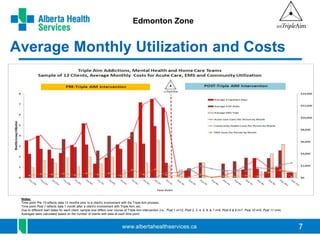
Average Monthly Utilization and Costs 
Notes: 
Time point Pre 13 reflects data 13 months prior to a client's involvement with the Triple Aim process. 
Time point Post 1 reflects data 1 month after a client's involvement with Triple Aim, etc. 
Due to different start dates for each client, sample size differs over course of Triple Aim intervention (i.e., Post 1 n=12; Post 2, 3, 4, 5, 6, & 7 n=9; Post 8 & 9 n=7; Post 10 n=5; Post 11 n=4). 
Averages were calculated based on the number of clients with data at each time point.
8 
Edmonton Zone 
Average Monthly Costs, by Type
9 
Edmonton Zone 
Key Learning from Year 2 
1. Permanent Supportive Housing 
2. Beyond Housing 
3. Complexity 
4. The Process is Very Important 
5. Integrating Mental Health & Addictions 
6. Sharing Information 
7. Coordinated Care in the Community Reduces Costs: 
– The sample we costed showed a reduction in cost of 
more than half with intense integrated community 
services vs. acute care
10 
Edmonton Zone 
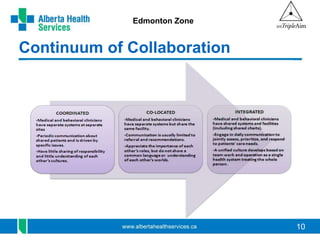
Continuum of Collaboration
11 
Edmonton Zone 
How is what we have learned changing our work? 
Integrated Inner City Support Team, in the Eastwood area 
• Maintain intensive support to 1306 individuals currently 
engaged 
• Step down care (including to primary care & NGO contracted 
support) for an estimated 500 engaged individuals per year 
• Assertively & intensively support additional 991 clients per year 
• Understand and effectively support 143 of the frail elderly 
group 
• Reach scale up target of 3,568 individuals within 24 months.
12 
Edmonton Zone 
Questions? 
“And, …We will celebrate ourselves, because 
the patients whose lives we save cannot join 
us, because their names can never be known. 
Our contribution will be what did not happen to 
them….”Don Berwick, IHI,100,000 Lives Campaign

Triple aim

  • 1.
    Edmonton Zone TripleAim Presentation to Canada's Fourth Annual Forum on Patient Safety and Quality Improvement October 28, 2014 Stephanie Donaldson Kelly, Director, Primary Care & CDM
  • 2.
    2 Edmonton Zone What is Triple Aim? A learning collaborative with the Institute for Healthcare Improvement and about 40 sites in Canada, Denmark, Sweden and the United States, with three interdependent objectives: • improve the health status of a population • improve individuals’ experience of care • reduce per capita health care costs, (or reduce the rate of increase of costs) “Act with the individual, learn for the population” .
  • 3.
    3 Edmonton Zone Managing Health for a Population Using 66% of healthcare resources, for some the system is not working
  • 4.
    4 Edmonton Zone Triple Aim Goals in Edmonton • Our healthcare system is not meeting the needs of people with multiple and complex needs • Our aim is to: • understand the needs and challenges for the segment of patients in the top 5% of costs and • to design and provide care that meets their needs, improves outcomes and lowers overall costs. • A focus on greater health equity for people who are homeless or have unstable housing and/or compromised determinants of health.
  • 5.
    5 Edmonton Zone Challenges with Transitions • Interruptions in communication among all care partners and on-going communication requires will at all levels • Information systems that don’t talk to each other or contain information needed for care • Care providers in community are not able to correct or add to information in Netcare • Constrained interpretations of the Health Information Act
  • 6.
    6 Edmonton Zone Client Case : Joe A. Inner City Support Team, Addiction & Mental Health: Assertive Engagement and Case Management B. Homecare Professional Services: Occupational Therapist and RN Case Manager C. Addiction & Mental Health Temporary Funding to Shelter Society to hire a personal support worker and provide tolerant residence. D. Homecare Contracted Services - Missing Link Agency: Health Care Aide to assist with Joe’s personal care needs. E. Homecare Contracted Services - Missing Link Agency: Increase in hours of service.
  • 7.
    7 Edmonton Zone Average Monthly Utilization and Costs Notes: Time point Pre 13 reflects data 13 months prior to a client's involvement with the Triple Aim process. Time point Post 1 reflects data 1 month after a client's involvement with Triple Aim, etc. Due to different start dates for each client, sample size differs over course of Triple Aim intervention (i.e., Post 1 n=12; Post 2, 3, 4, 5, 6, & 7 n=9; Post 8 & 9 n=7; Post 10 n=5; Post 11 n=4). Averages were calculated based on the number of clients with data at each time point.
  • 8.
    8 Edmonton Zone Average Monthly Costs, by Type
  • 9.
    9 Edmonton Zone Key Learning from Year 2 1. Permanent Supportive Housing 2. Beyond Housing 3. Complexity 4. The Process is Very Important 5. Integrating Mental Health & Addictions 6. Sharing Information 7. Coordinated Care in the Community Reduces Costs: – The sample we costed showed a reduction in cost of more than half with intense integrated community services vs. acute care
  • 10.
    10 Edmonton Zone Continuum of Collaboration
  • 11.
    11 Edmonton Zone How is what we have learned changing our work? Integrated Inner City Support Team, in the Eastwood area • Maintain intensive support to 1306 individuals currently engaged • Step down care (including to primary care & NGO contracted support) for an estimated 500 engaged individuals per year • Assertively & intensively support additional 991 clients per year • Understand and effectively support 143 of the frail elderly group • Reach scale up target of 3,568 individuals within 24 months.
  • 12.
    12 Edmonton Zone Questions? “And, …We will celebrate ourselves, because the patients whose lives we save cannot join us, because their names can never be known. Our contribution will be what did not happen to them….”Don Berwick, IHI,100,000 Lives Campaign

Editor's Notes

  • #3 Improving health status implies knowing what the health status is – i.e. being able to measure it, and being able to tell if health status has improved Experience of care is interpreted as individuals’ reported experience: scales/single question, as well as indicators of quality: accessible, safe, effective, acceptable, appropriate and efficient We have known for a long time that health care services are a small part of what determines health status in a population, yet we put a larger proportion of society’s funds into health care. The long term goal of reducing health care costs is to be able to shift funds to impact broader determinants of health.
  • #4 Many of you will be familiar with the Care coordination triangle. It illustrates the segmentation of the population and degree of care coordination required. Within Triple Aim we have been very interested in the top 5 %.And actually, within the Eastwood area it is actually more like 7 % of the population of the 78,000 residents. The way our society and our health system works, we are producing and probably growing the top 5% as we speak. In Alberta we have built a system that works for middle class resourced Albertans. Our current system is not working for the vulnerable populations we are working with in the Eastwood geography who are costing the system the most
  • #5 Our healthcare system is not meeting the needs of people with multiple and complex needs, as evidenced by high emergency visits and inpatient admissions, poor continuity of care and outcomes for these individuals and high overall costs. Our aim is to understand the needs and challenges for the segment of patients in the top 5% of costs and design and provide care that meets their needs, improves outcomes and lowers overall costs. We strive for greater health equity by focusing on people who are homeless or have unstable housing and/or compromised determinants of health. Our Triple Aim goals are to improve the health of the population while improving the experience of care and controlling costs. We will strive toward greater health equity by focusing on high risk and high cost members of the population. This focus on improved health outcomes will be achieved within the constraints of Alberta’s Health Action Plan (2013 – 2016) and budget.
  • #7 This case example clearly shows some of the challenges in managing transitions in care. “Joe” was staying at a shelter with special arrangements made for continuity of care. When “Joe” had acute care episodes, first he was discharged without communication to any of his care team in the community. The team worked on communicating with acute care and with each other. On subsequent admissions, hospital staff would communicate with Home Care, but not with the shelter staff – interpreted they were not covered by the Health Information Act – so if he was discharged with new medications on Friday, Home Care was notified, but did not work till Monday and he did not get the new prescription till the next week.
  • #8 Displayed here are both: Average Frequencies (# Inpatient Days, # ED Visits, # EMS Trips) Average Costs (Acute Care, Community Health, EMS) Case cost data: There were four (4) clients whose data we were able to case-cost in acute care: Home Care (2), Addictions – Women’s Health (2) Costing Fields: NET_DRUG_COST   PATIENT_SUPPLY_COST     PATIENT_DRUG_COST       MEDICAL_STAFF_COST      PATIENT_CARE_COST       OTHER_DIRECT_COST       MEDICAL_COMP    DIRECT_COST     The remainder (8) were unit cost (average costing data)    Cluster Analysis: These data are compiled from several different sources, including the Alberta Health Care Plan Insurance Plan Registry, the physician claims database, the inpatient discharge-admission abstract (DAD) database, the national ambulatory care reporting system (NACRS) database, and census data by various groups in DIMR and Population and Public Health (The Strategic Analytics Group of DIMR did the most heavy lifting).
  • #9 Average Monthly Cost Types: Acute Care Community Health EMS For these 12 patients we saw the average monthly acute care costs decline remarkably while the community costs increased somewhat. In particular we saw an increase in costs for the Women with Addictions and pregnancy. These women were not well connected to health services and had very poor continuity of care prior to triple aim. A positive result and good outcome is that they are costing the system more during this time so we have better mom and baby outcome at the other end. So to recap on these 12 patients we have substantially reduced acute care and EMS costs and visits to the Eds We have increased costs and visits to community Resulting in reductions in overall expenditures for these 12 patients So what’s different about using the Triple Aim systematic approach to client care….. (flip slide)
  • #10 Most of the people we have identified with complex high health needs are homeless or have unstable housing. We are working with many community partners, including our partners in organizations that coordinate housing and shelters to address these issues, but actual supply of affordable housing spaces with flexible rules and regulation falls significantly short of the need. We have learned that it is very important to consider all the determinants of health when engaging people with complex high health needs in care. We are learning to define complexity as the interface between people and the system, specifically when people have to navigate a complex system that does not align with their capacities and needs. Outreach workers and other non-traditional health care workers are key to this support.- Reference HR here The Process is Very Important – we have learned that we can build trusting relationships with people with complex high health needs and that it is necessary to base the relationship on doing what is important to the person, as well as maintaining continuity with the same provider Integrating Mental Health & Addictions – most of the people we have identified in East Edmonton with complex high health needs have chronic diseases as well as addiction and mental health diagnoses. We have learned that in order to achieve comprehensive coordinated care, we need to truly integrate mental health and addictions capability (complexity Capability) into primary care, community care and acute care also throughout the health system. Coordinated Care in the Community Reduces Costs – the care in the community is intense with these individuals, even so, we have demonstrated that it costs less than repetitive use of EDs and acute care stays and that people’s experience of care and health status are improved. Sharing Information – the Alberta Government’s developing initiative to support inter-sector sharing of information to help coordinate care with vulnerable individuals and assist them to meet their goals is an important system response that helps providers overcome barriers.
  • #11 The biggest thing that we learned is that the issues driving the high costs for our clients are not issues we can fix on our own. Although intensive case management will assist these clients, the system integration piece is key to the success. Of the population we can most easily identify through high ED admissions and inpatient use, the majority of these clients would benefit from a team that could address all aspects of their care including Mental Health and Primary Care with a variety of approaches.
  • #12  Integration is critical: All the participating programs had some contact with this client population prior to Triple Aim. What we all did was start to test a different way of assessing need and helping those individuals to meet those needs or meet them in a more appropriate (and less costly) way. What we learned was that this new way of working, while very effective, is very labour intensive, requires the establishment of trusting relationships; with clients AND WITH EACH OTHER!!, and is not short term interventions. Our request for FTE is to be able to actually assign this work to a dedicated, integrated team that will still need to be linked to all the other participating staff and teams, for example, the Addictions and Mental Health team would continue to assign the existing Inner City Supports team to this integrated Triple Aim team.