MATHEMATIC
SAN INEVITABLE PART OF
THIS UNIVERSE
For more than two thousand years, mathematics has been a part of the human
search for understanding. Mathematical discoveries have come both from the
attempt to describe the natural world and from the desire to arrive at a form
of inescapable truth from careful reasoning. These remain fruitful and
important motivations for mathematical thinking, but in the last century
mathematics has been successfully applied to many other aspects of t
he human world: voting trends in politics, the dating of ancient artifacts, the
analysis of automobile traffic patterns, and long-term strategies for the
sustainable harvest of deciduous forests, to mention a few. Today,
mathematics as a mode of thought and expression is more valuable than ever
before. Learning to think in mathematical terms is an essential part of
becoming a liberally educated person.
Introduction
What is mathematics?
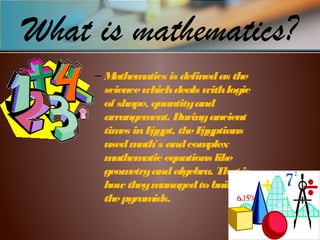
– Mathematics is definedas the
sciencewhichdeals withlogic
of shape, quantityand
arrangement. Duringancient
times inEgypt, theEgyptians
usedmath's andcomplex
mathematic equations like
geometryandalgebra. That is
how theymanagedtobuild
thepyramids.
Mathematics first arose from the practical need to
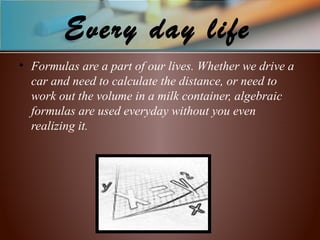
measure time and to count. The earliest evidence of
primitive forms of counting occurs in notched bones and
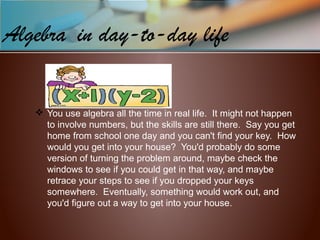
scored pieces of wood and stone. Early uses of
geometry are revealed in patterns found on ancient cave
walls and pottery.
As civilisations arose in Asia and the Near East,
sophisticated number systems and basic knowledge
of arithmetic, geometry, and algebra began to develop.
The History of Mathematics
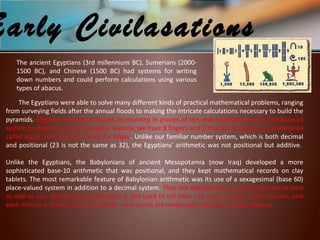
The Egyptians were able to solve many different kinds of practical mathematical problems, ranging
from surveying fields after the annual floods to making the intricate calculations necessary to build the
pyramids. Egyptian arithmetic, based on counting in groups of ten, was relatively simple. This Base-10
system probably arose for biological reasons, we have 8 fingers and 2 thumbs. Numbers are sometimes
called digits from the Latin word for finger. Unlike our familiar number system, which is both decimal
and positional (23 is not the same as 32), the Egyptians' arithmetic was not positional but additive.
Unlike the Egyptians, the Babylonians of ancient Mesopotamia (now Iraq) developed a more
sophisticated base-10 arithmetic that was positional, and they kept mathematical records on clay
tablets. The most remarkable feature of Babylonian arithmetic was its use of a sexagesimal (base 60)
place-valued system in addition to a decimal system. Thus the Babylonians counted in groups of sixty
as well as ten. Babylonian mathematics is still used to tell time - an hour consists of 60 minutes, and
each minute is divided into 60 seconds - and circles are measured in divisions of 360 degrees.
Early Civilasations
The ancient Egyptians (3rd millennium BC), Sumerians (2000-
1500 BC), and Chinese (1500 BC) had systems for writing
down numbers and could perform calculations using various
types of abacus.
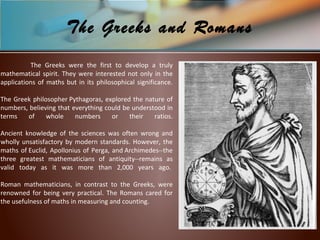
The Greeks were the first to develop a truly
mathematical spirit. They were interested not only in the
applications of maths but in its philosophical significance.
The Greek philosopher Pythagoras, explored the nature of
numbers, believing that everything could be understood in
terms of whole numbers or their ratios.
Ancient knowledge of the sciences was often wrong and
wholly unsatisfactory by modern standards. However, the
maths of Euclid, Apollonius of Perga, and Archimedes--the
three greatest mathematicians of antiquity--remains as
valid today as it was more than 2,000 years ago.
Roman mathematicians, in contrast to the Greeks, were
renowned for being very practical. The Romans cared for
the usefulness of maths in measuring and counting.
The Greeks and Romans
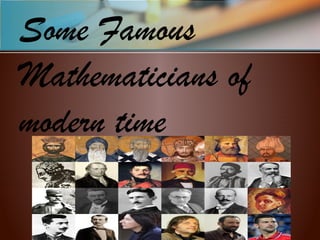
Some Famous
Mathematicians of
modern time
Indian mathematicians were especially skilled in arithmetic, methods of calculation, algebra, and trigonometry. Their
decimal place-valued number system, including zero, was especially suited for easy calculation. Aryabhata (476-550?) an
ndian astronomer and the earliest Hindu mathematician was one of the first to use algebra. Aryabhata calculated pi to a
very accurate value of 3.1416.
When the Greek civilization declined, Greek mathematics and the rest of Greek science was kept alive by the Arabs. The
Arabs also learned of the considerable scientific achievements of the Indians, including the invention of a system of
numerals (now called `arabic´ numerals) which could be used to write down calculations instead of having to resort to an
abacus.
One of the greatest scientific minds of Islam was al-Khwarizmi, who introduced the name (al-jabr) that became known as
algebra. By the end of the 8th century the influence of Islam had extended as far west as Spain. It was there, primarily, that
Arabic, Jewish, and Western scholars eventually translated Greek and Islamic manuscripts into Latin.
By the 13th century, original mathematical work by European authors had begun to appear. It was the demands of
commerce which gave the major impetus to mathematical development and north Italy, the centre of trade at the time,
produced a succession of important mathematicians beginning with Italian mathematician Leonardo Fibonacci who
ntroduced Arabic numerals. The Italians made considerable advances in elementary arithmetic which was needed for
money-changing and for the technique of double-entry book-keeping invented in Venice.
The Middle Ages
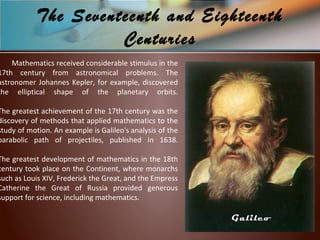
Mathematics received considerable stimulus in the
17th century from astronomical problems. The
astronomer Johannes Kepler, for example, discovered
the elliptical shape of the planetary orbits.
The greatest achievement of the 17th century was the
discovery of methods that applied mathematics to the
study of motion. An example is Galileo's analysis of the
parabolic path of projectiles, published in 1638.
The greatest development of mathematics in the 18th
century took place on the Continent, where monarchs
such as Louis XIV, Frederick the Great, and the Empress
Catherine the Great of Russia provided generous
support for science, including mathematics.
The Seventeenth and Eighteenth
Centuries
Galileo
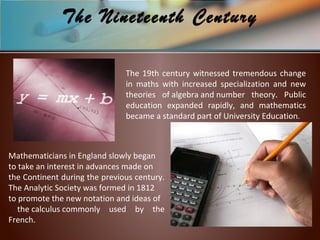
The Nineteenth Century
The 19th century witnessed tremendous change
in maths with increased specialization and new
theories of algebra and number theory. Public
education expanded rapidly, and mathematics
became a standard part of University Education.
Mathematicians in England slowly began
to take an interest in advances made on
the Continent during the previous century.
The Analytic Society was formed in 1812
to promote the new notation and ideas of
the calculus commonly used by the
French.
In the 20th century, mathematics has become much more diversified. Each specialist
subject is being studied in far greater depth and advanced work in some fields may be
unintelligible to researchers in other fields. Mathematicians working in universities have had
the economic freedom to pursue the subject for its own sake. Nevertheless, new branches of
mathematics have been developed which are of great practical importance and which have
basic ideas simple enough to be taught in secondary schools. Probably the most important of
these is the mathematical theory of statistics in which much pioneering work was done by
Karl Pearson.
Another new development is operations research, which is concerned with finding optimum
courses of action in practical situations, particularly in economics and management.
As in the late medieval period, commerce began to emerge again as a major impetus for the
development of mathematics. Higher mathematics has a powerful tool in the high-speed
electronic computer, which can create and manipulate mathematical `models´ of various
systems in science, technology, and commerce.
The Twentieth Century
The topics which are mainly useful in daily life are :
 Commercial Mathematics
Algebra
Statistics
Calculus
Number Theory
Graph Theory
Geometry
Mechanics
Use Of Maths In Our Daily Life
This include the following topics :
Discount
Banking
Foreign Exchange
Stock and Share
Arithmetic ( Profit & Loss, Percentage, Ratio and
Proposition , Time problems)
Commercial Mathematics
Discount
Discount : Reduction from the full amount of a
price
The following are the six types of discounts which we see are
• Simple Discount. Offer a price reduction on a product by a
percentage. For example, buy a shirt and receive 25 % off the original
price.
• Minimum Purchase Discount. Offer a price reduction on a minimum
quantity purchase. For example, buy two shirts and receive 20 % off
each shirt.
• Buy N, Get one Free. Offer a free gift with a minimum quantity purchase. For example, buy
two shirts and receive a third shirt for free.• Paired Discount. Offer a price reduction on a product if another
product is purchased. For example, buy a shirt and receive Rs.10 off a
pair of jeans.
• Paired Set Discount. Offer a price reduction on an item if a certain quantity of another
item is purchased. For example, buy three shirts and receive 30 % off a pair of jeans.
• Order Discount. Offer a price reduction or free shipping on the order
total, if a certain amount is purchased. For example, buy Rs. 5000
worth of merchandise, and receive 10 % off the total order.
Banking
Banking : A system of trading in money which involved
safeguarding deposits and making funds available for
borrowers.
• Bank is full of transactions. In turn the transaction is
nothing but mathematics
• Banks are also involved in stocks and bonds. Bond
calculations are mathematical. Stock options are
also quite mathematical.
• Transaction in Maths.
• Stocks and Bonds
Foreign Exchange Market
The foreign exchange (currency)
market refers to the market for
currencies. Transactions in this
market typically involve one
party purchasing a quantity of
one currency in exchange for paying a quantity of
another.
Stock and Share
Stock and Share :In business and finance, a share (also referred to as equity
share) of stock means a
share of ownership in a corporation (company). In the
plural, stocks is often used as a synonym for shares
• A stock is at a premium ( above par) , at par or at a discount (below par ) according
as its market value is greater than , equal to or less than the face value .
• Generally stocks are sold and purchased through brokers. The amount paid to
them in selling and purchasing stocks are called Brokerage.
so ,C.P.=M.V. + Brokerage
Arithmetic ( Profit & Loss, Percentage, Ratio and Proposition ,
Time related problems): The word refers to a branch of
mathematics which records elementary properties of certain
operations on numbers.
Arithmetic operations:
 The traditional arithmetic operations are addition,
subtraction, multiplication and division, although more
advanced operations (such as manipulations of
percentages, square root, exponentiation, and logarithmic
functions) are also sometimes included in this subject.
Arithematic
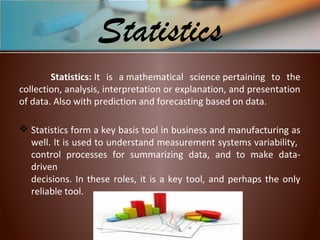
Statistics: It is a mathematical science pertaining to the
collection, analysis, interpretation or explanation, and presentation
of data. Also with prediction and forecasting based on data.
 Statistics form a key basis tool in business and manufacturing as
well. It is used to understand measurement systems variability,
control processes for summarizing data, and to make data-
driven
decisions. In these roles, it is a key tool, and perhaps the only
reliable tool.
Statistics
Some fields of inquiry use applied  statistics  so
extensively that they have  specialized terminology.
These disciplines include:
• Actuarial science
• Applied information economics Social statistics
• Statistical literacy
• Statistical modeling
• Statistical surveys
• Chemo metrics (for analysis of data from chemistry)
• Biostatistics
• Business statistics
• Data mining
• Engineering statistics
• Environmental Statistics
• Epidemiology
• Geography and Geographic Information Systems
• Psychological statistics
• Quality
• Structured data analysis (statistics)
• Statistics in various sports, particularly baseball and cricket
How the concept of mean, median and mode is used in
daily life ?????
 A shopkeeper, selling shirts, keeps more stock of that size of
shirt which has more sale. Here the size of that shirt is the
mode among other .
 If in a tour, the total money spent by 10 students is Rs. 500.
Then the average money spent by each student is Rs. 50.
Here Rs. 50 is the mean.
 If you have 25 people lined up next to each other by age, the
median age will be the age of the person in the very middle.
Here the age of the middle person is the median.
Algebra : It is a branch of mathematics concerning the study of structure, relation,
and quantity.
Classification :Algebra may be divided into the following categories:
 Elementary algebra, in which the properties of operations on the real number
system are recorded using symbols as "place holders" to denote constants and
variables, and the rules governing mathematical expressions and equations involving
these symbols are studied
 Abstract algebra, sometimes also called modern  algebra, in which algebraic
structures such as groups, rings and fields are axiomatically defined and investigated.
 Linear algebra, in which the specific properties of vector spaces are studied (including
matrices);
 Universal algebra, in which properties common to all algebraic structures are studied.
 Algebraic number theory, in which the properties of numbers are studied through
algebraic systems. Number theory inspired much of the original abstraction in algebra.
 Algebraic geometry in its algebraic aspect.
Algebra
How Algebra is useful in daily life ????
 While taking loan interest on the loan should be
paid. It is calculated using formulas using the
algebraic language. Business have finance day to
day operations as well is calculated using the
complex algebraic calculations.
 To convert US dollars to the local currency of the
country and sell or buy products from foreign
countries , the conversion is possible through
algebra.
 In data entry algebra has an important role. When
working on the computer with spread sheet
algebraic skill is needed to enter design and plan
Why Algebra is important in your life ?
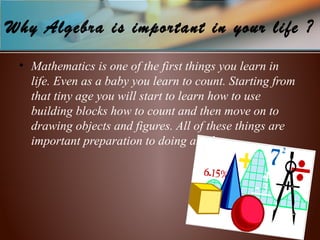
• Mathematics is one of the first things you learn in
life. Even as a baby you learn to count. Starting from
that tiny age you will start to learn how to use
building blocks how to count and then move on to
drawing objects and figures. All of these things are
important preparation to doing algebra.
The key to opportunity
• These are the years of small beginnings
until the day comes that you have to be
able to do something as intricate as
algebra. Algebra is the key that will
unlock the door before you. Having the
ability to do algebra will help you
excel into the field that you want to
specialize in. We live in a world where
only the best succeed.
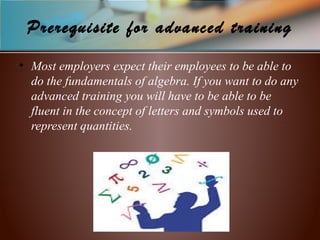
Prerequisite for advanced training
• Most employers expect their employees to be able to
do the fundamentals of algebra. If you want to do any
advanced training you will have to be able to be
fluent in the concept of letters and symbols used to
represent quantities.
Science
When doing any form of science, whether just a
project or a lifetime career choice, you will have to be
able to do and understand how to use and apply
algebra.
Every day life
• Formulas are a part of our lives. Whether we drive a
car and need to calculate the distance, or need to
work out the volume in a milk container, algebraic
formulas are used everyday without you even
realizing it.
Data entry
• What about the entering of any
data. Your use of algebraic
expressions and the use of
equations will be like a corner
stone when working with data
entry. When working on the
computer with spreadsheets
you will need algebraic skills
to enter, design and plan.
Algebra in day-to-day life
 You use algebra all the time in real life. It might not happen
to involve numbers, but the skills are still there. Say you get
home from school one day and you can't find your key. How
would you get into your house? You'd probably do some
version of turning the problem around, maybe check the
windows to see if you could get in that way, and maybe
retrace your steps to see if you dropped your keys
somewhere. Eventually, something would work out, and
you'd figure out a way to get into your house.
Uses of algebra
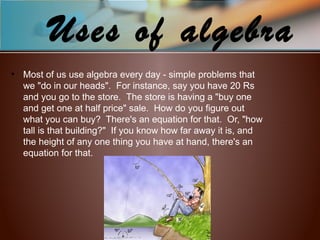
• Most of us use algebra every day - simple problems that
we "do in our heads". For instance, say you have 20 Rs
and you go to the store. The store is having a "buy one
and get one at half price" sale. How do you figure out
what you can buy? There's an equation for that. Or, "how
tall is that building?" If you know how far away it is, and
the height of any one thing you have at hand, there's an
equation for that.
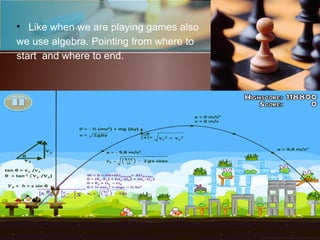
• Like when we are playing games also
we use algebra. Pointing from where to
start and where to end.
What is Trigonometry??????
Trigonometry is the branch of
mathematics that studies triangles and
their relationships.
Trigonometry:
 
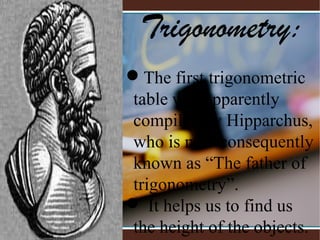
The first trigonometric 
table was apparently 
compiled by Hipparchus, 
who is now consequently 
known as “The father of 
trigonometry”.
 It helps us to find us 
the height of the objects.
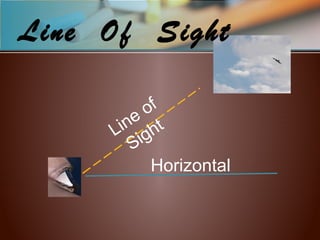
Line of Sight
We observe generally that children
usually look up to see an aero plane
when it passes overhead. This line
joining their eye to the plane, while
looking up is called Line of sight
Line of
Sight
Horizontal
Line Of Sight
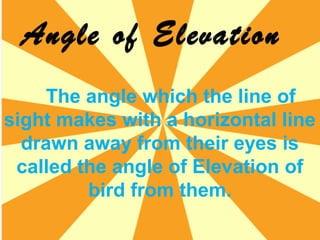
Angle of Elevation
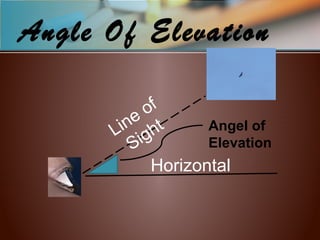
The angle which the line of
sight makes with a horizontal line
drawn away from their eyes is
called the angle of Elevation of
bird from them.
Line of
Sight
Horizontal
Angel of
Elevation
Angle Of Elevation
Angel of Depression
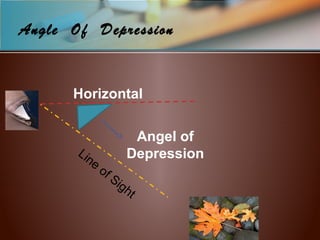
If a boy looks downwards at
any object on the ground then
the Angle between his line of
sight and horizontal line drawn
away from his eyes is called
Angel of Depression
Line
of Sight
Horizontal
Angel of
Depression
Angle Of Depression
Architecture
In architecture, trigonometry plays a massive role in the
compilation of building plans.
For example, architects would have to calculate exact angles of
intersection for components of their structure to ensure stability
and safety.
Some instances of trigonometric use in architecture include
arches, domes, support beams, and suspension bridges.
Architecture remains one of the most important sectors of our
society as they plan the design of buildings and ensure that they
are able to withstand pressures from inside.
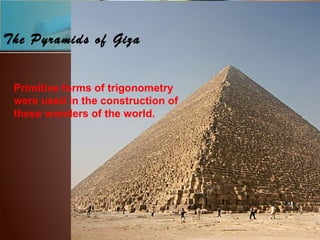
The Pyramids of Giza
Primitive forms of trigonometry
were used in the construction of
these wonders of the world.
Astronomy
Astronomy has been studied for millennia by civilizations in all
regions of the world.
In our modern age, being able to apply Astronomy helps us to
calculate distances between stars and learn more about the
universe.
Astronomers use the method of parallax, or the movement of the
star against the background as we orbit the sun, to discover new
information about galaxies.
Menelaus’ Theorem helps astronomers gather information by
providing a backdrop in spherical triangle calculation.
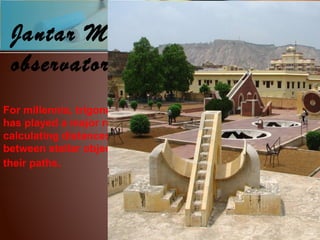
Jantar Mantar
observatory
For millennia, trigonometry
has played a major role in
calculating distances
between stellar objects and
their paths.
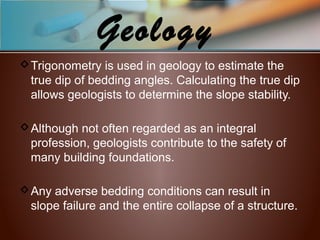
Geology
Trigonometry is used in geology to estimate the
true dip of bedding angles. Calculating the true dip
allows geologists to determine the slope stability.
Although not often regarded as an integral
profession, geologists contribute to the safety of
many building foundations.
Any adverse bedding conditions can result in
slope failure and the entire collapse of a structure.
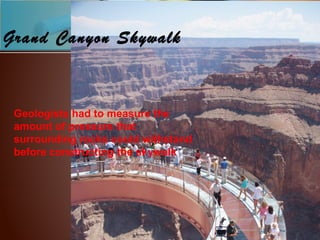
Grand Canyon Skywalk
Geologists had to measure the
amount of pressure that
surrounding rocks could withstand
before constructing the skywalk.
Calculus: It  is  the  study  of  change,  in  the  same  way  that 
geometry is the study of space. It includes the study  of limits, 
derivative , integrals, and infinite series.
 Calculus  has  widespread  applications  in  science and 
engineering and  is  used  to  solve  problems  for  which 
algebra alone  is  insufficient.  Calculus  builds  on 
algebra, trigonometry,  and analytic  geometry  and    includes 
two  major  branches, differential calculus and integral
calculus,  that  are  related  by  the  fundamental  theorem  of 
calculus. 
Calculus
How is Integral and differential calculus useful in daily
life ?
 Integration is used to find areas of figures which are not geometric. Suppose
you spill water on the floor and want to find out what area the water has
covered, you can do so by integration. What it does is that it breaks up the
non-geometric shape into a number of tiny geometric shapes. It then calculates
the area of each of the tiny figures and adds them up. This of course gives
only an approximation to the actual area.
 Let us consider the movement of a car on a highway. Here we can clearly
visualize that if the highway is clear the driver would look forward to increase
the speed to an optimum level after which he will drive with the same speed.
With the help of calculus we can easily estimate the car's acceleration if we
know the initial speed and the speed when he settled.
Acceleration is therefore defined as the first order derivative of velocity,
which in turn is the first order derivative of displacement.
Mathematics is applied to
clarity the blurred image to
clear image.
This is done by using
differential and integral
calculus.
Forensic
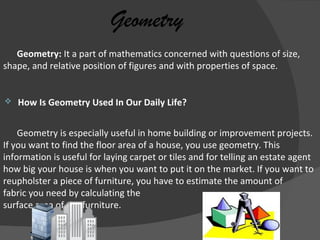
Geometry: It a part of mathematics concerned with questions of size, 
shape, and relative position of figures and with properties of space.
 How Is Geometry Used In Our Daily Life?
      Geometry is especially useful in home building or improvement projects. 
If you want to find the floor area of a house, you use geometry. This 
information is useful for laying carpet or tiles and for telling an estate agent 
how big your house is when you want to put it on the market. If you want to 
reupholster a piece of furniture, you have to estimate the amount of 
fabric you need by calculating the
surface area of the furniture.
Geometry
Symmetry In Tower
Geometry In
Nature
 
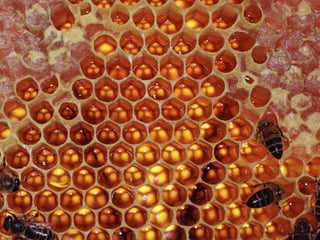
A honeycomb is an array of hexagonal (six sided) 
cells, made of wax produced by worker bees. 
Hexagons fit together to fill all the available space, 
giving a strong structure with no gaps. Squares would 
also fill the space, but would not give a rigid structure. 
Triangles would fill the space and be rigid, but it 
would be difficult to get honey out of their corners.
Honey Comb
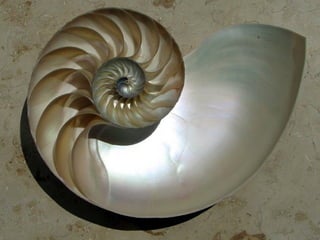
Nautilus Shell
In addition to plants, some animals, like the nautilus, exhibit
Fibonacci numbers. For instance, the shell of a nautilus is
grown in a “Fibonacci spiral.” The spiral occurs because of the
shell’s attempt to maintain the same proportional shape as it
grows outward. In the case of the nautilus, this growth pattern
allows it to maintain the same shape throughout its whole life
(unlike humans, whose bodies change proportion as they age).
As is often the case, there are exceptions to the rule—so not
every nautilus shell makes a Fibonacci spiral. But they all
adhere to some type of logarithmic spiral. And before you start
thinking that these cephalopods could have kicked your butt in
math class, remember that they’re not consciously aware of
how their shells are growing, and are simply benefiting from an
evolutionary design that lets the mollusk grow without changing
shape.
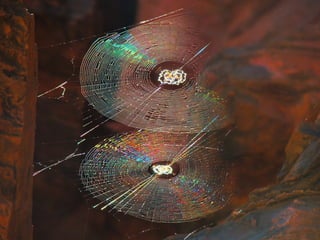
Spider Web
There are around 5,000 types of orb web spiders, and all create
nearly perfect circular webs with almost equidistant radial supports
coming out of the middle and a spiral woven to catch prey. Scientists
aren’t entirely sure why orb spiders are so geometry inclined since
tests have shown that orbed webs don’t ensnare food any better than
irregularly shaped webs.
Some scientists theorize that the orb webs are built for strength, and
the radial symmetry helps to evenly distribute the force of impact
when prey hits the web, resulting in less rips in the thread. But the
question remains: if it really is a better web design, then why aren’t all
spiders utilizing it? Some non-orb spiders seem to have the capacity,
and just don’t seem to be bothered.
 
Much of the function of a protein is determined by 
its shape and how the pieces move. Mad cow 
disease is caused by the introduction of a “shape” 
into the brain (a shape carried by a protein).Many 
drugs are designed to change the shape or motions 
of a protein something that we are just now 
working to model, even approximately, in 
computers, using geometry and related areas.
Maths In Medicine(Protein modeling):
Rectangle And Circles
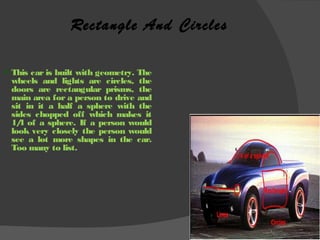
This car is built with geometry. The
wheels and lights are circles, the
doors are rectangular prisms, the
main area for a person to drive and
sit in it a half a sphere with the
sides chopped off which makes it
1/4 of a sphere. If a person would
look very closely the person would
see a lot more shapes in the car.
Too many to list.
Importance of mathematics
for a future career
Most of university degree require mathematics.
Students who choose not to take mathematics
seriously orto ignore it in high school forfeit many
future careeropportunities that they could have.
They essentially turn theirbacks on more than half
the job market. The importance of mathematics for
potential careers cannot be overemphasized. To get
degrees in the following areas one need to have good
knowledge of mathematics and statistics.
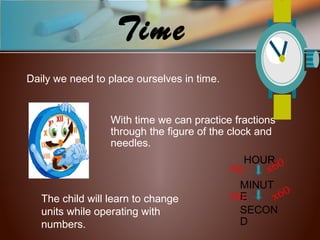
Time
Daily we need to place ourselves in time.
With time we can practice fractions
through the figure of the clock and
needles.
The child will learn to change
units while operating with
numbers.
HOUR
MINUT
E
SECON
D
x60
x60
:60
:60
If it is rainy and cold outside, you will be happy to stay at a home 
while longer and have a nice hot cup of tea. But someone has built 
the house you are in, made sure it keeps the cold out and the 
warmth in, and provided you with running water for the tea. This 
someone is most likely an engineer.
Engineers are responsible for just about everything we take for 
granted in the world around us, from tall buildings, tunnels and 
football stadiums, to access to clean drinking water. They also 
design and build vehicles, aircraft, boats and ships. What’s more, 
engineers help to develop things which are important for the 
future, such as generating energy from the sun, wind or waves. 
Mathematics is involved in everything an engineer does, whether 
it is working out how much concrete is needed to build a bridge, 
or determining the amount of solar energy to power a car.
Engineering
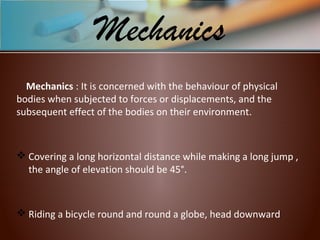
Mechanics : It is concerned with the behaviour of physical
bodies when subjected to forces or displacements, and the
subsequent effect of the bodies on their environment.
 Covering a long horizontal distance while making a long jump ,
the angle of elevation should be 45°.
 Riding a bicycle round and round a globe, head downward
Mechanics
Conclusion
Maths is unavoidable. It's a deeply
fundamental thing. Without math, there would
be no science, no music, no art. Maths is part of
all of those things. If it's got structure, then
there's an aspect of it that's mathematical.
THANK YOU
PRESENTED BY
ABINDAS.D
X-B

maths

  • 1.
  • 2.
    For more thantwo thousand years, mathematics has been a part of the human search for understanding. Mathematical discoveries have come both from the attempt to describe the natural world and from the desire to arrive at a form of inescapable truth from careful reasoning. These remain fruitful and important motivations for mathematical thinking, but in the last century mathematics has been successfully applied to many other aspects of t he human world: voting trends in politics, the dating of ancient artifacts, the analysis of automobile traffic patterns, and long-term strategies for the sustainable harvest of deciduous forests, to mention a few. Today, mathematics as a mode of thought and expression is more valuable than ever before. Learning to think in mathematical terms is an essential part of becoming a liberally educated person. Introduction
  • 3.
    What is mathematics? –Mathematics is definedas the sciencewhichdeals withlogic of shape, quantityand arrangement. Duringancient times inEgypt, theEgyptians usedmath's andcomplex mathematic equations like geometryandalgebra. That is how theymanagedtobuild thepyramids.
  • 4.
    Mathematics first arosefrom the practical need to measure time and to count. The earliest evidence of primitive forms of counting occurs in notched bones and scored pieces of wood and stone. Early uses of geometry are revealed in patterns found on ancient cave walls and pottery. As civilisations arose in Asia and the Near East, sophisticated number systems and basic knowledge of arithmetic, geometry, and algebra began to develop. The History of Mathematics
  • 5.
    The Egyptians wereable to solve many different kinds of practical mathematical problems, ranging from surveying fields after the annual floods to making the intricate calculations necessary to build the pyramids. Egyptian arithmetic, based on counting in groups of ten, was relatively simple. This Base-10 system probably arose for biological reasons, we have 8 fingers and 2 thumbs. Numbers are sometimes called digits from the Latin word for finger. Unlike our familiar number system, which is both decimal and positional (23 is not the same as 32), the Egyptians' arithmetic was not positional but additive. Unlike the Egyptians, the Babylonians of ancient Mesopotamia (now Iraq) developed a more sophisticated base-10 arithmetic that was positional, and they kept mathematical records on clay tablets. The most remarkable feature of Babylonian arithmetic was its use of a sexagesimal (base 60) place-valued system in addition to a decimal system. Thus the Babylonians counted in groups of sixty as well as ten. Babylonian mathematics is still used to tell time - an hour consists of 60 minutes, and each minute is divided into 60 seconds - and circles are measured in divisions of 360 degrees. Early Civilasations The ancient Egyptians (3rd millennium BC), Sumerians (2000- 1500 BC), and Chinese (1500 BC) had systems for writing down numbers and could perform calculations using various types of abacus.
  • 6.
    The Greeks werethe first to develop a truly mathematical spirit. They were interested not only in the applications of maths but in its philosophical significance. The Greek philosopher Pythagoras, explored the nature of numbers, believing that everything could be understood in terms of whole numbers or their ratios. Ancient knowledge of the sciences was often wrong and wholly unsatisfactory by modern standards. However, the maths of Euclid, Apollonius of Perga, and Archimedes--the three greatest mathematicians of antiquity--remains as valid today as it was more than 2,000 years ago. Roman mathematicians, in contrast to the Greeks, were renowned for being very practical. The Romans cared for the usefulness of maths in measuring and counting. The Greeks and Romans
  • 7.
  • 8.
    Indian mathematicians wereespecially skilled in arithmetic, methods of calculation, algebra, and trigonometry. Their decimal place-valued number system, including zero, was especially suited for easy calculation. Aryabhata (476-550?) an ndian astronomer and the earliest Hindu mathematician was one of the first to use algebra. Aryabhata calculated pi to a very accurate value of 3.1416. When the Greek civilization declined, Greek mathematics and the rest of Greek science was kept alive by the Arabs. The Arabs also learned of the considerable scientific achievements of the Indians, including the invention of a system of numerals (now called `arabic´ numerals) which could be used to write down calculations instead of having to resort to an abacus. One of the greatest scientific minds of Islam was al-Khwarizmi, who introduced the name (al-jabr) that became known as algebra. By the end of the 8th century the influence of Islam had extended as far west as Spain. It was there, primarily, that Arabic, Jewish, and Western scholars eventually translated Greek and Islamic manuscripts into Latin. By the 13th century, original mathematical work by European authors had begun to appear. It was the demands of commerce which gave the major impetus to mathematical development and north Italy, the centre of trade at the time, produced a succession of important mathematicians beginning with Italian mathematician Leonardo Fibonacci who ntroduced Arabic numerals. The Italians made considerable advances in elementary arithmetic which was needed for money-changing and for the technique of double-entry book-keeping invented in Venice. The Middle Ages
  • 9.
    Mathematics received considerablestimulus in the 17th century from astronomical problems. The astronomer Johannes Kepler, for example, discovered the elliptical shape of the planetary orbits. The greatest achievement of the 17th century was the discovery of methods that applied mathematics to the study of motion. An example is Galileo's analysis of the parabolic path of projectiles, published in 1638. The greatest development of mathematics in the 18th century took place on the Continent, where monarchs such as Louis XIV, Frederick the Great, and the Empress Catherine the Great of Russia provided generous support for science, including mathematics. The Seventeenth and Eighteenth Centuries Galileo
  • 10.
    The Nineteenth Century The19th century witnessed tremendous change in maths with increased specialization and new theories of algebra and number theory. Public education expanded rapidly, and mathematics became a standard part of University Education. Mathematicians in England slowly began to take an interest in advances made on the Continent during the previous century. The Analytic Society was formed in 1812 to promote the new notation and ideas of the calculus commonly used by the French.
  • 11.
    In the 20thcentury, mathematics has become much more diversified. Each specialist subject is being studied in far greater depth and advanced work in some fields may be unintelligible to researchers in other fields. Mathematicians working in universities have had the economic freedom to pursue the subject for its own sake. Nevertheless, new branches of mathematics have been developed which are of great practical importance and which have basic ideas simple enough to be taught in secondary schools. Probably the most important of these is the mathematical theory of statistics in which much pioneering work was done by Karl Pearson. Another new development is operations research, which is concerned with finding optimum courses of action in practical situations, particularly in economics and management. As in the late medieval period, commerce began to emerge again as a major impetus for the development of mathematics. Higher mathematics has a powerful tool in the high-speed electronic computer, which can create and manipulate mathematical `models´ of various systems in science, technology, and commerce. The Twentieth Century
  • 12.
    The topics whichare mainly useful in daily life are :  Commercial Mathematics Algebra Statistics Calculus Number Theory Graph Theory Geometry Mechanics Use Of Maths In Our Daily Life
  • 13.
    This include thefollowing topics : Discount Banking Foreign Exchange Stock and Share Arithmetic ( Profit & Loss, Percentage, Ratio and Proposition , Time problems) Commercial Mathematics
  • 14.
    Discount Discount : Reduction from thefull amount of a price The following are the six types of discounts which we see are • Simple Discount. Offer a price reduction on a product by a percentage. For example, buy a shirt and receive 25 % off the original price. • Minimum Purchase Discount. Offer a price reduction on a minimum quantity purchase. For example, buy two shirts and receive 20 % off each shirt. • Buy N, Get one Free. Offer a free gift with a minimum quantity purchase. For example, buy two shirts and receive a third shirt for free.• Paired Discount. Offer a price reduction on a product if another product is purchased. For example, buy a shirt and receive Rs.10 off a pair of jeans. • Paired Set Discount. Offer a price reduction on an item if a certain quantity of another item is purchased. For example, buy three shirts and receive 30 % off a pair of jeans. • Order Discount. Offer a price reduction or free shipping on the order total, if a certain amount is purchased. For example, buy Rs. 5000 worth of merchandise, and receive 10 % off the total order.
  • 15.
    Banking Banking : Asystem of trading in money which involved safeguarding deposits and making funds available for borrowers. • Bank is full of transactions. In turn the transaction is nothing but mathematics • Banks are also involved in stocks and bonds. Bond calculations are mathematical. Stock options are also quite mathematical. • Transaction in Maths. • Stocks and Bonds
  • 16.
    Foreign Exchange Market Theforeign exchange (currency) market refers to the market for currencies. Transactions in this market typically involve one party purchasing a quantity of one currency in exchange for paying a quantity of another.
  • 17.
    Stock and Share Stockand Share :In business and finance, a share (also referred to as equity share) of stock means a share of ownership in a corporation (company). In the plural, stocks is often used as a synonym for shares • A stock is at a premium ( above par) , at par or at a discount (below par ) according as its market value is greater than , equal to or less than the face value . • Generally stocks are sold and purchased through brokers. The amount paid to them in selling and purchasing stocks are called Brokerage. so ,C.P.=M.V. + Brokerage
  • 18.
    Arithmetic ( Profit& Loss, Percentage, Ratio and Proposition , Time related problems): The word refers to a branch of mathematics which records elementary properties of certain operations on numbers. Arithmetic operations:  The traditional arithmetic operations are addition, subtraction, multiplication and division, although more advanced operations (such as manipulations of percentages, square root, exponentiation, and logarithmic functions) are also sometimes included in this subject. Arithematic
  • 19.
    Statistics: It isa mathematical science pertaining to the collection, analysis, interpretation or explanation, and presentation of data. Also with prediction and forecasting based on data.  Statistics form a key basis tool in business and manufacturing as well. It is used to understand measurement systems variability, control processes for summarizing data, and to make data- driven decisions. In these roles, it is a key tool, and perhaps the only reliable tool. Statistics
  • 20.
    Some fields ofinquiry use applied  statistics  so extensively that they have  specialized terminology. These disciplines include: • Actuarial science • Applied information economics Social statistics • Statistical literacy • Statistical modeling • Statistical surveys • Chemo metrics (for analysis of data from chemistry) • Biostatistics • Business statistics • Data mining • Engineering statistics • Environmental Statistics • Epidemiology • Geography and Geographic Information Systems • Psychological statistics • Quality • Structured data analysis (statistics) • Statistics in various sports, particularly baseball and cricket
  • 21.
    How the conceptof mean, median and mode is used in daily life ?????  A shopkeeper, selling shirts, keeps more stock of that size of shirt which has more sale. Here the size of that shirt is the mode among other .  If in a tour, the total money spent by 10 students is Rs. 500. Then the average money spent by each student is Rs. 50. Here Rs. 50 is the mean.  If you have 25 people lined up next to each other by age, the median age will be the age of the person in the very middle. Here the age of the middle person is the median.
  • 22.
    Algebra : Itis a branch of mathematics concerning the study of structure, relation, and quantity. Classification :Algebra may be divided into the following categories:  Elementary algebra, in which the properties of operations on the real number system are recorded using symbols as "place holders" to denote constants and variables, and the rules governing mathematical expressions and equations involving these symbols are studied  Abstract algebra, sometimes also called modern  algebra, in which algebraic structures such as groups, rings and fields are axiomatically defined and investigated.  Linear algebra, in which the specific properties of vector spaces are studied (including matrices);  Universal algebra, in which properties common to all algebraic structures are studied.  Algebraic number theory, in which the properties of numbers are studied through algebraic systems. Number theory inspired much of the original abstraction in algebra.  Algebraic geometry in its algebraic aspect. Algebra
  • 23.
    How Algebra isuseful in daily life ????  While taking loan interest on the loan should be paid. It is calculated using formulas using the algebraic language. Business have finance day to day operations as well is calculated using the complex algebraic calculations.  To convert US dollars to the local currency of the country and sell or buy products from foreign countries , the conversion is possible through algebra.  In data entry algebra has an important role. When working on the computer with spread sheet algebraic skill is needed to enter design and plan
  • 24.
    Why Algebra isimportant in your life ? • Mathematics is one of the first things you learn in life. Even as a baby you learn to count. Starting from that tiny age you will start to learn how to use building blocks how to count and then move on to drawing objects and figures. All of these things are important preparation to doing algebra.
  • 25.
    The key toopportunity • These are the years of small beginnings until the day comes that you have to be able to do something as intricate as algebra. Algebra is the key that will unlock the door before you. Having the ability to do algebra will help you excel into the field that you want to specialize in. We live in a world where only the best succeed.
  • 26.
    Prerequisite for advancedtraining • Most employers expect their employees to be able to do the fundamentals of algebra. If you want to do any advanced training you will have to be able to be fluent in the concept of letters and symbols used to represent quantities.
  • 27.
    Science When doing anyform of science, whether just a project or a lifetime career choice, you will have to be able to do and understand how to use and apply algebra.
  • 28.
    Every day life •Formulas are a part of our lives. Whether we drive a car and need to calculate the distance, or need to work out the volume in a milk container, algebraic formulas are used everyday without you even realizing it.
  • 29.
    Data entry • Whatabout the entering of any data. Your use of algebraic expressions and the use of equations will be like a corner stone when working with data entry. When working on the computer with spreadsheets you will need algebraic skills to enter, design and plan.
  • 30.
    Algebra in day-to-daylife  You use algebra all the time in real life. It might not happen to involve numbers, but the skills are still there. Say you get home from school one day and you can't find your key. How would you get into your house? You'd probably do some version of turning the problem around, maybe check the windows to see if you could get in that way, and maybe retrace your steps to see if you dropped your keys somewhere. Eventually, something would work out, and you'd figure out a way to get into your house.
  • 31.
    Uses of algebra •Most of us use algebra every day - simple problems that we "do in our heads". For instance, say you have 20 Rs and you go to the store. The store is having a "buy one and get one at half price" sale. How do you figure out what you can buy? There's an equation for that. Or, "how tall is that building?" If you know how far away it is, and the height of any one thing you have at hand, there's an equation for that.
  • 32.
    • Like whenwe are playing games also we use algebra. Pointing from where to start and where to end.
  • 33.
    What is Trigonometry?????? Trigonometryis the branch of mathematics that studies triangles and their relationships.
  • 34.
  • 35.
    Line of Sight Weobserve generally that children usually look up to see an aero plane when it passes overhead. This line joining their eye to the plane, while looking up is called Line of sight
  • 36.
  • 37.
    Angle of Elevation Theangle which the line of sight makes with a horizontal line drawn away from their eyes is called the angle of Elevation of bird from them.
  • 38.
  • 39.
    Angel of Depression Ifa boy looks downwards at any object on the ground then the Angle between his line of sight and horizontal line drawn away from his eyes is called Angel of Depression
  • 40.
  • 41.
    Architecture In architecture, trigonometryplays a massive role in the compilation of building plans. For example, architects would have to calculate exact angles of intersection for components of their structure to ensure stability and safety. Some instances of trigonometric use in architecture include arches, domes, support beams, and suspension bridges. Architecture remains one of the most important sectors of our society as they plan the design of buildings and ensure that they are able to withstand pressures from inside.
  • 42.
    The Pyramids ofGiza Primitive forms of trigonometry were used in the construction of these wonders of the world.
  • 43.
    Astronomy Astronomy has beenstudied for millennia by civilizations in all regions of the world. In our modern age, being able to apply Astronomy helps us to calculate distances between stars and learn more about the universe. Astronomers use the method of parallax, or the movement of the star against the background as we orbit the sun, to discover new information about galaxies. Menelaus’ Theorem helps astronomers gather information by providing a backdrop in spherical triangle calculation.
  • 44.
    Jantar Mantar observatory For millennia,trigonometry has played a major role in calculating distances between stellar objects and their paths.
  • 45.
    Geology Trigonometry is usedin geology to estimate the true dip of bedding angles. Calculating the true dip allows geologists to determine the slope stability. Although not often regarded as an integral profession, geologists contribute to the safety of many building foundations. Any adverse bedding conditions can result in slope failure and the entire collapse of a structure.
  • 46.
    Grand Canyon Skywalk Geologistshad to measure the amount of pressure that surrounding rocks could withstand before constructing the skywalk.
  • 47.
    Calculus: It  is  the study  of  change,  in  the  same  way  that  geometry is the study of space. It includes the study  of limits,  derivative , integrals, and infinite series.  Calculus  has  widespread  applications  in  science and  engineering and  is  used  to  solve  problems  for  which  algebra alone  is  insufficient.  Calculus  builds  on  algebra, trigonometry,  and analytic  geometry  and    includes  two  major  branches, differential calculus and integral calculus,  that  are  related  by  the  fundamental  theorem  of  calculus.  Calculus
  • 48.
    How is Integraland differential calculus useful in daily life ?  Integration is used to find areas of figures which are not geometric. Suppose you spill water on the floor and want to find out what area the water has covered, you can do so by integration. What it does is that it breaks up the non-geometric shape into a number of tiny geometric shapes. It then calculates the area of each of the tiny figures and adds them up. This of course gives only an approximation to the actual area.  Let us consider the movement of a car on a highway. Here we can clearly visualize that if the highway is clear the driver would look forward to increase the speed to an optimum level after which he will drive with the same speed. With the help of calculus we can easily estimate the car's acceleration if we know the initial speed and the speed when he settled. Acceleration is therefore defined as the first order derivative of velocity, which in turn is the first order derivative of displacement.

  • 49.
    Mathematics is appliedto clarity the blurred image to clear image. This is done by using differential and integral calculus. Forensic
  • 50.
    Geometry: It a part of mathematics concerned with questions of size,  shape, and relative position of figures and with properties of space.  How IsGeometry Used In Our Daily Life?       Geometry is especially useful in home building or improvement projects.  If you want to find the floor area of a house, you use geometry. This  information is useful for laying carpet or tiles and for telling an estate agent  how big your house is when you want to put it on the market. If you want to  reupholster a piece of furniture, you have to estimate the amount of  fabric you need by calculating the surface area of the furniture. Geometry
  • 51.
  • 52.
  • 53.
  • 55.
    Nautilus Shell In additionto plants, some animals, like the nautilus, exhibit Fibonacci numbers. For instance, the shell of a nautilus is grown in a “Fibonacci spiral.” The spiral occurs because of the shell’s attempt to maintain the same proportional shape as it grows outward. In the case of the nautilus, this growth pattern allows it to maintain the same shape throughout its whole life (unlike humans, whose bodies change proportion as they age). As is often the case, there are exceptions to the rule—so not every nautilus shell makes a Fibonacci spiral. But they all adhere to some type of logarithmic spiral. And before you start thinking that these cephalopods could have kicked your butt in math class, remember that they’re not consciously aware of how their shells are growing, and are simply benefiting from an evolutionary design that lets the mollusk grow without changing shape.
  • 57.
    Spider Web There arearound 5,000 types of orb web spiders, and all create nearly perfect circular webs with almost equidistant radial supports coming out of the middle and a spiral woven to catch prey. Scientists aren’t entirely sure why orb spiders are so geometry inclined since tests have shown that orbed webs don’t ensnare food any better than irregularly shaped webs. Some scientists theorize that the orb webs are built for strength, and the radial symmetry helps to evenly distribute the force of impact when prey hits the web, resulting in less rips in the thread. But the question remains: if it really is a better web design, then why aren’t all spiders utilizing it? Some non-orb spiders seem to have the capacity, and just don’t seem to be bothered.
  • 59.
  • 60.
    Rectangle And Circles Thiscar is built with geometry. The wheels and lights are circles, the doors are rectangular prisms, the main area for a person to drive and sit in it a half a sphere with the sides chopped off which makes it 1/4 of a sphere. If a person would look very closely the person would see a lot more shapes in the car. Too many to list.
  • 61.
    Importance of mathematics fora future career Most of university degree require mathematics. Students who choose not to take mathematics seriously orto ignore it in high school forfeit many future careeropportunities that they could have. They essentially turn theirbacks on more than half the job market. The importance of mathematics for potential careers cannot be overemphasized. To get degrees in the following areas one need to have good knowledge of mathematics and statistics.
  • 62.
    Time Daily we needto place ourselves in time. With time we can practice fractions through the figure of the clock and needles. The child will learn to change units while operating with numbers. HOUR MINUT E SECON D x60 x60 :60 :60
  • 63.
    If it is rainy and cold outside, you will be happy to stay at a home  while longer and have a nice hot cup of tea. But someone has built  the house you are in, made sure it keeps the cold out and the  warmth in, and provided you with running water for the tea. This  someone is most likely an engineer. Engineers are responsible for just about everything we take for  granted in the world around us, from tall buildings, tunnels and  football stadiums, to access to clean drinking water. They also  design and build vehicles, aircraft, boats and ships. What’s more,  engineers help to develop things which are important for the  future, such as generating energy from the sun, wind or waves.  Mathematics is involved in everything an engineer does, whether  it is working out how much concrete is needed to build a bridge,  or determining the amount of solar energy to power a car. Engineering
  • 64.
    Mechanics : Itis concerned with the behaviour of physical bodies when subjected to forces or displacements, and the subsequent effect of the bodies on their environment.  Covering a long horizontal distance while making a long jump , the angle of elevation should be 45°.  Riding a bicycle round and round a globe, head downward Mechanics
  • 65.
    Conclusion Maths is unavoidable.It's a deeply fundamental thing. Without math, there would be no science, no music, no art. Maths is part of all of those things. If it's got structure, then there's an aspect of it that's mathematical.
  • 66.
  • 67.

Editor's Notes

  • #2 <number>
  • #15 <number>
  • #17 <number>
  • #36 <number>
  • #37 <number>
  • #38 <number>
  • #39 <number>
  • #40 <number>
  • #41 <number>
  • #51 <number>