TRIANGULATION
METHOD
By
Jasmine . J
DEFINITION
• Triangulation is an attempt to map out , explain more fully, the richness and
complexity human behavior by studying it from more than one stand point.
COHEN AND MANIAN
Triangulation is a method of cross checking data from multiple sources to
search for regularities in the research data.
O’ DONOGHUE
TRIANGULATION IN QUANTITATIVE
STUDY
• In a quantitative study, this might mean having multiple operational
definitions of a dependent variable to determine whether predicted effects
are consistent.
TRIANGULATION IN QULITATIVE
STUDY
• In a qualitative study, triangulation might involve trying to understand the full
complexity of a poorly understood phenomenon by using multiple means of
data collection to converge on the truth.
BENIFITS
• Additional sources of information often give more insight into a topic
• Inadequacies found in one-source data is minimized when multiple sources
confirm the same data
• Multiple sources provide verification and validity while complementing
similar data
CONT....
• More comprehensive data is obtained
• Data and information is supported in multiple places/types of research,
which makes it easier to analyze data to draw conclusions and outcomes
• Inconsistencies in data sets are more easily recognized
TYPES
• Data Triangulation
• Investigator Triangulation
• Method Triangulation
• Theoretical Triangulation
• Multiple Triangulation
DATA TRIANGULATION
• Denzin described three types of data triangulation
Time
Space
Person
TIME TRIANGULATION
• Researchers collect data about a phenomenon at different point in time.
• E.g Time of the day, day of the week and month of the year.
SPACE TRIANGULATION
• Space triangulation consists of collecting data at more than one site.
PERSON TRIANGULATION
• Researches collect data from more than one level of person, that is a set of
individuals, groups or collectives.
• Groups can be dyads, families or circumscribed groups.
• Collectives are communities, organization or societies.
• Investigator choose the various levels of a person relevant to the study.
INVESTIGATOR TRIANGULATION
• Investigator triangulation occurs when two or more researches with divergent
backgrounds and expertise work together on a same study.
• Multiple investigator each must have prominent roles in the study, and their
areas of expertise must be complementary.
• Use of methods triangulation usually requires investigator triangulation.
Methodological Research
 Researchers use methodological triangulation when they incorporate two or
more research methods in one investigation
 It occurs at the level of design or data collection
 At the design level it is called Between Method Triangulation
 At the data collection level it is called Within Method Triangulation
Cont....
• Design methods triangulation most often uses quantitative methods
combined with qualitative methods
 Researchers should consider the purpose of the research and they should
decide whether the question calls for simultaneous or sequential
implementation of the two method
 If they choose simultaneous implementation they will use the qualitative and
quantitative method simultaneously.
Cont...
• In a sequential implementation they will complete one method first , then
based on findings of the first technique plan and implement the 2nd
technique.
.
Theoretical triangulation
• It incorporates the use of more than one lens or theory in the analysis of
the same data set.
• In a quantitative study researchers identify two theories a priori and article
rival hypotheses.
CONT...
• Through the investigation, the researchers test and compare the rival
theories.
• The result might be accepting one theory over the other or merging the
theories to farm a new and more comprehensive theory.
• Researchers investigate the utility and power of these emerging theories by
cycling between data generation and data analysis until they reach a
conclusion.
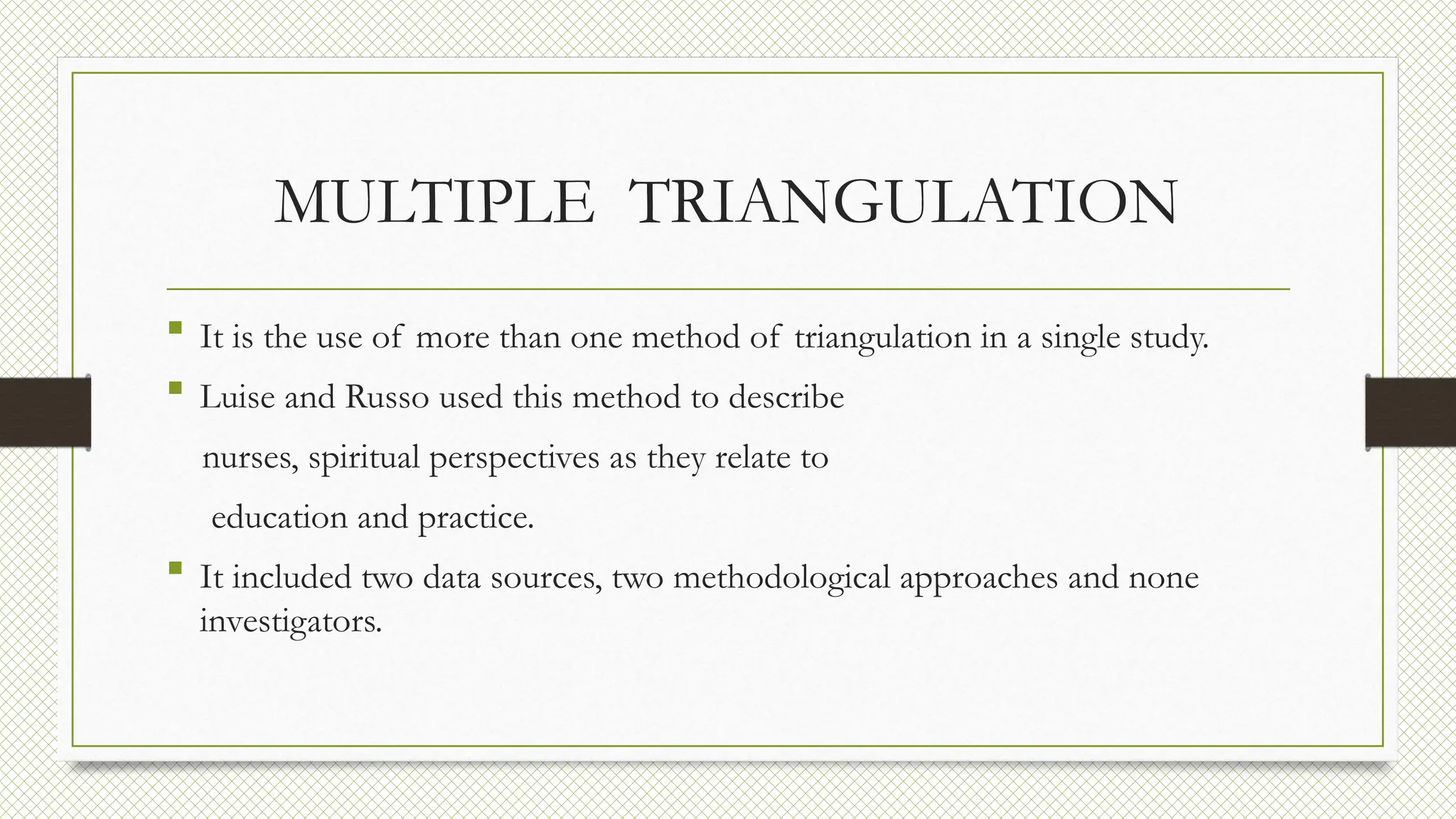
MULTIPLE TRIANGULATION
 It is the use of more than one method of triangulation in a single study.
 Luise and Russo used this method to describe
nurses, spiritual perspectives as they relate to
education and practice.
 It included two data sources, two methodological approaches and none
investigators.
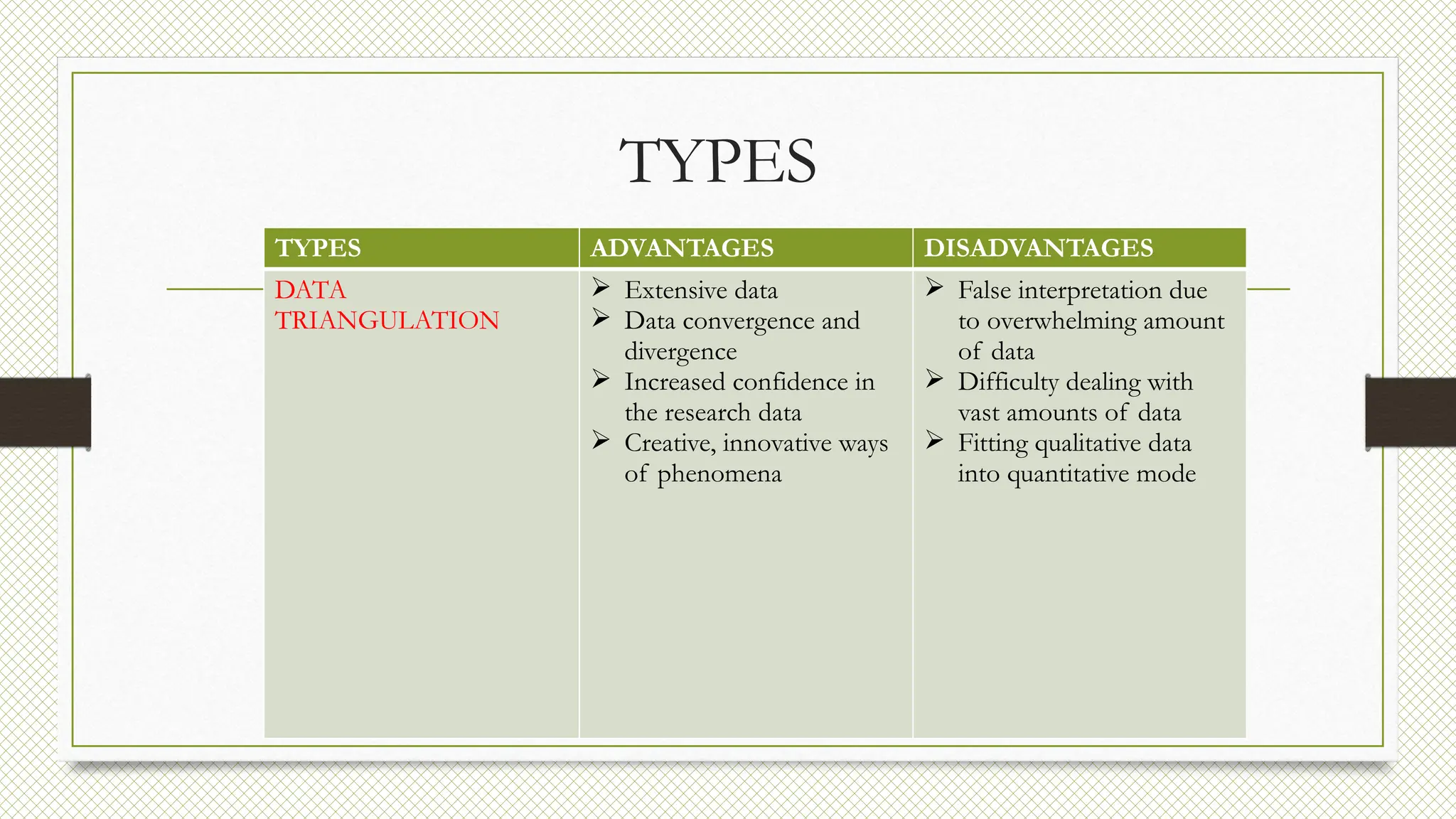
TYPES
TYPES ADVANTAGES DISADVANTAGES
DATA
TRIANGULATION
 Extensive data
 Data convergence and
divergence
 Increased confidence in
the research data
 Creative, innovative ways
of phenomena
 False interpretation due
to overwhelming amount
of data
 Difficulty dealing with
vast amounts of data
 Fitting qualitative data
into quantitative mode
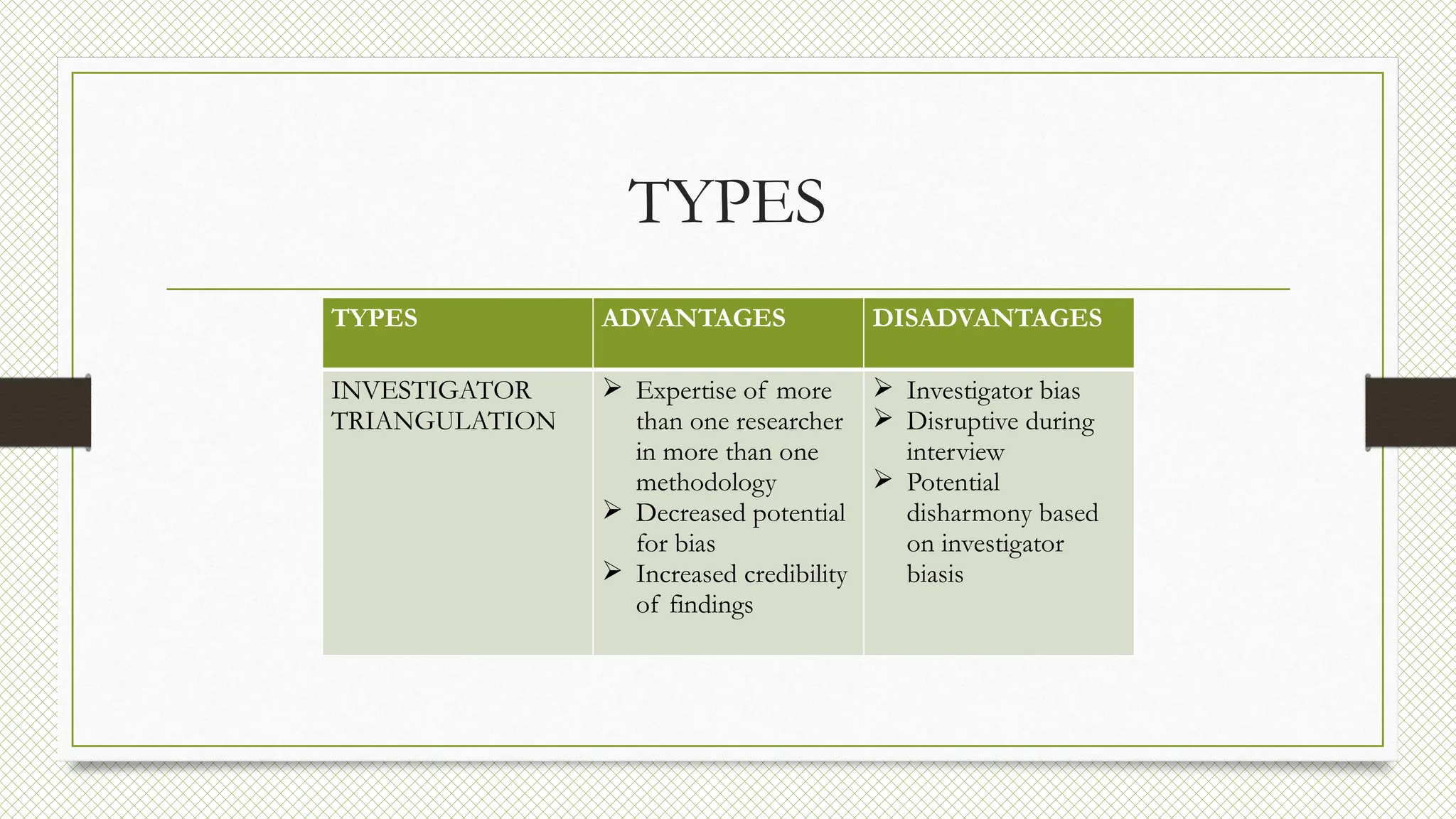
TYPES
TYPES ADVANTAGES DISADVANTAGES
INVESTIGATOR
TRIANGULATION
 Expertise of more
than one researcher
in more than one
methodology
 Decreased potential
for bias
 Increased credibility
of findings
 Investigator bias
 Disruptive during
interview
 Potential
disharmony based
on investigator
biasis
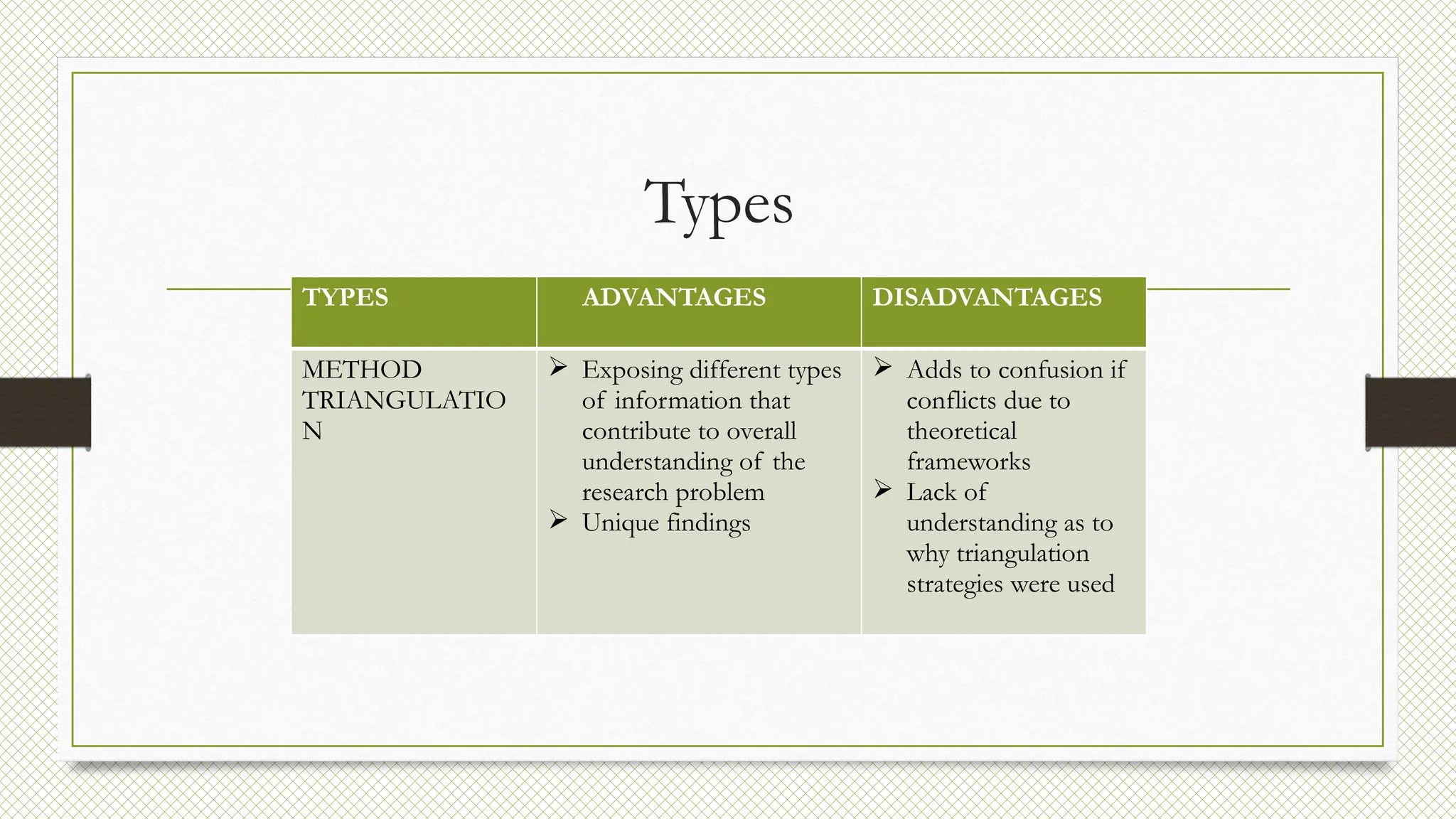
Types
TYPES ADVANTAGES DISADVANTAGES
METHOD
TRIANGULATIO
N
 Exposing different types
of information that
contribute to overall
understanding of the
research problem
 Unique findings
 Adds to confusion if
conflicts due to
theoretical
frameworks
 Lack of
understanding as to
why triangulation
strategies were used
Summary
• Triangulation can be a useful tool for qualitative as well as
quantitative researches.
• It contributes to the completeness and conformation of findings
necessary in qualitative research investigations.
• As researchers, plan and carry out investigations, they should
strive to provide the most complete understanding
• They should complete gaps in data using methods and data
triangulation
CONT....
• Nursing phenomena are complex and multifaceted
• Rarely one research method will provide complete understandings.
• Triangulation will help to ensure that the researchers implement each method
according to its requirement
CONCLUSION
• In our efforts to understand our world around us we recognize many
technical barriers, but we use the best methods we can.
• By inquiring more carefully about what the data mean, we can also bridge
gaps between the research culture of those commited to varifying types of
methods

TRIANGULATION METHOD .pptx NURSING RESEARCH

TRIANGULATION METHOD .pptx NURSING RESEARCH

  • 1.
  • 2.
    DEFINITION • Triangulation isan attempt to map out , explain more fully, the richness and complexity human behavior by studying it from more than one stand point. COHEN AND MANIAN Triangulation is a method of cross checking data from multiple sources to search for regularities in the research data. O’ DONOGHUE
  • 3.
    TRIANGULATION IN QUANTITATIVE STUDY •In a quantitative study, this might mean having multiple operational definitions of a dependent variable to determine whether predicted effects are consistent.
  • 4.
    TRIANGULATION IN QULITATIVE STUDY •In a qualitative study, triangulation might involve trying to understand the full complexity of a poorly understood phenomenon by using multiple means of data collection to converge on the truth.
  • 5.
    BENIFITS • Additional sourcesof information often give more insight into a topic • Inadequacies found in one-source data is minimized when multiple sources confirm the same data • Multiple sources provide verification and validity while complementing similar data
  • 6.
    CONT.... • More comprehensivedata is obtained • Data and information is supported in multiple places/types of research, which makes it easier to analyze data to draw conclusions and outcomes • Inconsistencies in data sets are more easily recognized
  • 7.
    TYPES • Data Triangulation •Investigator Triangulation • Method Triangulation • Theoretical Triangulation • Multiple Triangulation
  • 8.
    DATA TRIANGULATION • Denzindescribed three types of data triangulation Time Space Person
  • 9.
    TIME TRIANGULATION • Researcherscollect data about a phenomenon at different point in time. • E.g Time of the day, day of the week and month of the year.
  • 10.
    SPACE TRIANGULATION • Spacetriangulation consists of collecting data at more than one site.
  • 11.
    PERSON TRIANGULATION • Researchescollect data from more than one level of person, that is a set of individuals, groups or collectives. • Groups can be dyads, families or circumscribed groups. • Collectives are communities, organization or societies. • Investigator choose the various levels of a person relevant to the study.
  • 12.
    INVESTIGATOR TRIANGULATION • Investigatortriangulation occurs when two or more researches with divergent backgrounds and expertise work together on a same study. • Multiple investigator each must have prominent roles in the study, and their areas of expertise must be complementary. • Use of methods triangulation usually requires investigator triangulation.
  • 13.
    Methodological Research  Researchersuse methodological triangulation when they incorporate two or more research methods in one investigation  It occurs at the level of design or data collection  At the design level it is called Between Method Triangulation  At the data collection level it is called Within Method Triangulation
  • 14.
    Cont.... • Design methodstriangulation most often uses quantitative methods combined with qualitative methods  Researchers should consider the purpose of the research and they should decide whether the question calls for simultaneous or sequential implementation of the two method  If they choose simultaneous implementation they will use the qualitative and quantitative method simultaneously.
  • 15.
    Cont... • In asequential implementation they will complete one method first , then based on findings of the first technique plan and implement the 2nd technique. .
  • 16.
    Theoretical triangulation • Itincorporates the use of more than one lens or theory in the analysis of the same data set. • In a quantitative study researchers identify two theories a priori and article rival hypotheses.
  • 17.
    CONT... • Through theinvestigation, the researchers test and compare the rival theories. • The result might be accepting one theory over the other or merging the theories to farm a new and more comprehensive theory. • Researchers investigate the utility and power of these emerging theories by cycling between data generation and data analysis until they reach a conclusion.
  • 18.
    MULTIPLE TRIANGULATION  Itis the use of more than one method of triangulation in a single study.  Luise and Russo used this method to describe nurses, spiritual perspectives as they relate to education and practice.  It included two data sources, two methodological approaches and none investigators.
  • 19.
    TYPES TYPES ADVANTAGES DISADVANTAGES DATA TRIANGULATION Extensive data  Data convergence and divergence  Increased confidence in the research data  Creative, innovative ways of phenomena  False interpretation due to overwhelming amount of data  Difficulty dealing with vast amounts of data  Fitting qualitative data into quantitative mode
  • 20.
    TYPES TYPES ADVANTAGES DISADVANTAGES INVESTIGATOR TRIANGULATION Expertise of more than one researcher in more than one methodology  Decreased potential for bias  Increased credibility of findings  Investigator bias  Disruptive during interview  Potential disharmony based on investigator biasis
  • 21.
    Types TYPES ADVANTAGES DISADVANTAGES METHOD TRIANGULATIO N Exposing different types of information that contribute to overall understanding of the research problem  Unique findings  Adds to confusion if conflicts due to theoretical frameworks  Lack of understanding as to why triangulation strategies were used
  • 22.
    Summary • Triangulation canbe a useful tool for qualitative as well as quantitative researches. • It contributes to the completeness and conformation of findings necessary in qualitative research investigations. • As researchers, plan and carry out investigations, they should strive to provide the most complete understanding • They should complete gaps in data using methods and data triangulation
  • 23.
    CONT.... • Nursing phenomenaare complex and multifaceted • Rarely one research method will provide complete understandings. • Triangulation will help to ensure that the researchers implement each method according to its requirement
  • 24.
    CONCLUSION • In ourefforts to understand our world around us we recognize many technical barriers, but we use the best methods we can. • By inquiring more carefully about what the data mean, we can also bridge gaps between the research culture of those commited to varifying types of methods