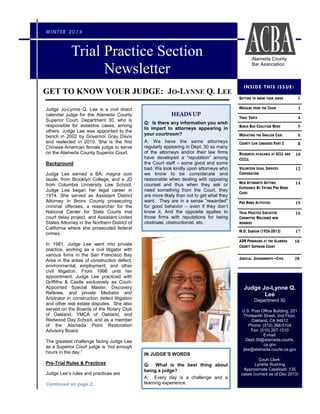
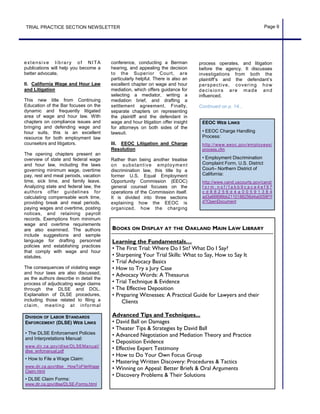
Judge Jo-Lynne Q. Lee is a civil direct
calendar judge for the Alameda County
Superior Court, Department 30, who is
responsible for asbestos cases, among
others. Judge Lee was appointed to the
bench in 2002 by Governor Gray Davis
and reelected in 2010. She is the first
Chinese-American female judge to serve
on the Alameda County Superior Court.
Background
Judge Lee earned a BA, magna cum
laude, from Brooklyn College, and a JD
from Columbia University Law School.
Judge Lee began her legal career in
1974. She served as Assistant District
Attorney in Bronx County prosecuting
criminal offenses, a researcher for the
National Center for State Courts trial
court delay project, and Assistant United
States Attorney in the Northern District of
California where she prosecuted federal
crimes.
In 1981, Judge Lee went into private
practice, working as a civil litigator with
various firms in the San Francisco Bay
Area in the areas of construction defect,
environmental, employment, and other
civil litigation. From 1998 until her
appointment, Judge Lee practiced with
Griffiths & Castle exclusively as Court-
Appointed Special Master, Discovery
Referee, and private Mediator and
Arbitrator in construction defect litigation
and other real estate disputes. She also
served on the Boards of the Rotary Club
of Oakland, YMCA of Oakland, and
Redwood Day School, and as a member
of the Alameda Point Restoration
Advisory Board.
The greatest challenge facing Judge Lee
as a Superior Court judge is “not enough
hours in the day.”
Pre-Trial Rules & Practices
Judge Lee’s rules and practices are
Continued on page 2...
Trial Practice Section
Newsletter
WINTER 2014
GETTING TO KNOW YOUR JUDGE 1
MESSAGE FROM THE CHAIR 3
TOXIC TORTS 4
BENCH BAR COALITION NEWS 5
MEDIATING THE SMALLER CASE 6
COUNTY LAW LIBRARIES PART 2 8
RESOURCES AVAILABLE AT ACLL AND
CCCLL
10
VOLUNTEER LEGAL SERVICES
CORPORATION
12
NEW ATTORNEYS GETTING
EXPERIENCE BY TRYING PRO BONO
CASES
14
PRO BONO ACTIVITIES 15
TRIAL PRACTICE EXECUTIVE
COMMITTEE WELCOMES NEW
MEMBERS
16
M.O. SABRAW (1926-2013) 17
ADR PROGRAMS AT THE ALAMEDA
COUNTY SUPERIOR COURT
18
JUDICIAL ASSIGNMENTS –CIVIL 20
INSIDE THIS ISSUE:
Judge Jo-Lynne Q.
Lee
Department 30
U.S. Post Office Building, 201
Thirteenth Street, 2nd Floor,
Oakland, CA 94612
Phone: (510) 268-5104
Fax: (510) 267-1510
E-mail:
Dept.30@alameda.courts.
ca.gov
jlee@alameda.courts.ca.gov
Court Clerk:
Lynette Rushing
Approximate Caseload: 135
cases (current as of Dec 2013)
Alameda County
Bar Association
IN JUDGE’S WORDS
Q: What is the best thing about
being a judge?
A: Every day is a challenge and a
learning experience.
Q: Is there any information you wish
to impart to attorneys appearing in
your courtroom?
A: We have the same attorneys
regularly appearing in Dept. 30 so many
of the attorneys and/or their law firms
have developed a “reputation” among
the Court staff – some good and some
bad. We look kindly upon attorneys who
we know to be considerate and
reasonable when dealing with opposing
counsel and thus when they ask or
need something from the Court, they
are more likely than not to get what they
want. They are in a sense “rewarded”
for good behavior – even if they don’t
know it. And the opposite applies to
those firms with reputations for being
obstinate, obstructionist, etc.
GET TO KNOW YOUR JUDGE: JO-LYNNE Q. LEE
tailored to issues common to
asbestos cases. For example, ADR
is not mandatory and parties are not
referred to some form of ADR. While
Judge Lee wishes parties would
more frequently consider ADR, it
has been her experience that ADR
is not commonly used in asbestos
cases. In selecting a particular form
of ADR, Judge Lee recommends
that parties consider mediator’s
experience with asbestos cases and
familiarity with the insurance carriers
and national counsel who regularly
handle asbestos claims settlements.
When reviewing Case Management
Conference (CMC) statements for
cases not yet set for trial, Judge Lee
is most interested in learning
whether there are issues that
require judicial intervention. If the
case is set for trial, Judge Lee is
interested in whether the parties
truly are ready to proceed on the
scheduled date or if they have run
into problems getting the case
readied for trial. Judge Lee prefers
counsel to use pleading paper and
provide info in a few paragraphs,
rather than fill out the Judicial
Council Form, which she does not
find particularly informative.
Settlement Conferences & Trials
Mandatory Settlement Conferences
(MSCs) are set in Judge Lee’s
JUDGE LEE, continued from p. 1
department on a case-specific basis,
typically one month in advance of
trial. Generally, settlement
conferences are assigned to Judge
Evelio Grillo at Department 31 (see
Judge Grillo’s profile in the Summer
2013 Edition of the Newsletter). Two
weeks prior to an MSC, the plaintiff
is required to make a written
demand so that the defendant has
an opportunity to discuss the
demand with its attorneys and
insurance carriers prior to the MSC.
Judge Grillo allows parties and
carriers to appear telephonically at
the first MSC, and then determines
whether he will require personal
attendance if further MSCs are
needed. Judge Grillo generally
conducts multiple MSCs with parties
prior to and during trial because
asbestos case trials typically are
lengthy and time consuming.
Further, counsel and their clients in
asbestos cases are notorious for
settling on the eve of trial or in trial.
This is a significant waste of judicial
resources and jury panels, so every
effort is made to settle the case –
which means extended and multiple
MSCs.
Pre-trial conferences with trial
counsel are required and are
scheduled two weeks before the trial
date unless it is a preference case.
In preference cases, the pre-trial
conference is held the first day of
trial. Counsel may request a pre-trial
conference if there is an issue that
needs determination before the case
can be settled. Trials are held
Monday through Thursday, with no
lunch on short days, and a 1.5-hour
lunch during full days. Breaks are
taken about every 1.5 hours to give
court reporters a break.
Juror questionnaires are permitted
in virtually all cases. Counsel are
urged to be non-argumentative in
framing the questions and not to use
them to “educate” the jury as to
party’s positions on any issue. When
voir dire is conducted, Judge Lee
uses a "six-pack" (18-juror)
approach, and she expects that the
voir dire concentrate on follow-up
questions and issues that need to
be discussed with the juror based
upon that juror’s answers in the
questionnaire. After the voir dire of
the initial 18 prospective jurors,
Judge Lee hears challenges for
cause and peremptory challenges in
chambers with the court reporter
present. She expects that the panel
can be selected in one full day of
oral questioning.
The website for Dept. 30 contains
the following documents in Word
format:
 Judge Burr's Asbestos Issues
Conference Order
 Judge Burr's Asbestos Juror
Questionnaire
 Juror Contact Sheet
 Juror Questionnaire Instruction
Cover Sheet
 Model Protective Order – Civil
 Pretrial Order
 Pretrial Order re Defendant's
Standard Interrogatories (Loss
of Consortium)
 Pretrial Order re Defendant's
Standard Interrogatories
(Personal Injury)
 Pretrial Order re Defendant's
Standard Interrogatories
(Wrongful Death)
 Pretrial Order re Plaintiff's
Standard Interrogatories
Page 2
Scheduling Information for Dept. 30
Trial Schedule
Mon – Thu from 9:00 a.m. to 4:30 p.m.
or 9:00 a.m. to 1:30 p.m.
CMC Schedule Fri mornings beginning at 9:15 a.m.
L&M Schedule Fri mornings beginning at 9:30 p.m.1
Settlement Conf. Fri mornings beginning at 10:00 a.m.2
Ex Parte Schedule Fri at 9:00 a.m.
Scheduling of all hearings should be made by e-mail only. Litigants must
copy opposing counsel on all correspondence.
1
In exceptional circumstances, motions may be set at other
times with leave of Court.
2
Asbestos cases.
ACBA TRIAL PRACTICE NEWSLETTER TEAM
Mistakes and Sanctions
According to Judge Lee, the biggest
mistakes lawyers make in her
courtroom include failing to use the
jury instructions and verdict forms
approved by the Court in their
Closing Argument to assist the jury
when they are deliberating. In
addition, it is a mistake to be
inconsiderate of the Court and the
jurors’ time by failing to
appropriately schedule witnesses so
as to avoid constantly going minutes
beyond the time when the trial is
supposed to begin or end for the
day or, alternatively, having to
excuse the jury early or lose days
because of scheduling problems
that should have been anticipated.
Judge Lee is most likely to impose
monetary sanctions for failure to
timely file CMC statements and in
discovery disputes involving failure
to verify discovery or adequately
meet-and-confer. Evidentiary
sanctions are rare, but may be
issued for severe conduct such as
misrepresentations or misleading
the Court. Terminating sanctions
are not typically issued.
Written by Marin County-based trial
lawyer Michael Shklovsky. Mr.
Shklovsky handles business, real
estate, and employment litigation in
state and federal courts.
Welcome to our Winter 2014 installment of the ACBA Trial Practice
Section Newsletter!
I first wish to thank Mark Mosley for his dedicated leadership of our
Section in 2013. Last year saw our section re-energized. We launched
and published three editions of the Newsletter, produced six MCLE
programs that were attended by more than 140 lawyers, and offered
exciting pro bono and mentorship opportunities to trial attorneys.
This year, I expect us to maintain the same trajectory. We will continue
publishing the quarterly Newsletter, delivering news and information from
the bench and beyond. We are developing five new MCLE programs on
topics including retention and use of expert witnesses, debt collection
defense, mediation and criminal law issues relevant to trial attorneys, and
liens. In addition, we plan on improving our webpage, as well as
increasing cooperation with Bay Area community organizations that work
to promote equal access to justice.
We are also committed to continue facilitating and expanding pro bono
opportunities available to young lawyers looking for more experience and
more accomplished litigators looking to give back to their communities.
Our pilot program with the East Bay Community Law Center defending
debt collection cases will continue and hopefully expand. We now also
offer an opportunity for lawyers to represent individuals in federal courts,
with a current need for employment lawyers. Please read our articles
concerning these programs in this edition of the Newsletter and contact
me at mshklovsky@gmail.com to get involved.
Finally, we are always on the lookout for MCLE suggestions and topical
articles of interest to local practitioners. If you have a recommendation for
an MCLE program, or if you are interested in publishing an article in our
Newsletter, please email me, Erin Daly at edaly@alumni.duke.edu, or
Hadassah Hayashi at hadassah@acbanet.org.
See you in court!
Michael Shklovsky
Chair, ACBA Trial Practice Section
MESSAGE FROM THE CHAIR
PAGE 3
Q: What single tip can you
provide to young lawyers
appearing in your courtroom?
A: Be prepared. Read the file and
know as much as you can about the
case – even if you are only
appearing for CMC. Attorneys who
appear and can’t answer a question
do not look good in front of the
judge and may hurt their reputation
with the Court. Judges do talk to
each other about attorneys who
appear before them. If you impress
a judge, other judges will likely hear
about you (and vice versa).
Reputation counts.
Michael Shklovsky
CREATIVE DIRECTOR &
CO-EDITOR-IN-CHIEF
mshklovsky@gmail.com
Erin Daly
CO-EDITOR-IN-CHIEF
edaly@alumni.duke.edu
TRIAL PRACTICE SECTION NEWSLETTER
1000 Broadway
Suite 480
Oakland, CA 94607
Phone: 510-302-ACBA (2222)
Web: www.acbanet.org
Page 4
with asbestos exposure.
The jury found Owens-Illinois liable
under multiple causes of action.
Owens-Illinois argued that it had no
duty to Mrs. Grigg as a bystander
under the recent Campbell v. Ford
decision. 206 Cal.App.4th 15
(2012).
The jury awarded Mrs. Grigg
$12,000,000 in damages for her
pain and suffering, Mr. Grigg
$4,000,000 in damages for his loss
of consortium, and $342,500 in
economic damages. The jury also
levied an $11,000,000 punitive
damages verdict against Owens-
Illinois.
Asbestos cases continue to be at
BY Justin Bosl, of Kazan, McClain,
Satterley & Greenwood
I’m often asked by other lawyers
what I practice. When I respond that
I mostly handle asbestos cases, I
often hear “People still file those?”
Here in Alameda County, asbestos
litigation has been going strong for
over 35 years.
Judge Jo-Lynne Q. Lee presides
over Alameda County’s asbestos
personal injury docket for all pre-
trial matters and many trials.
Alameda County is one of four
counties in California to have a
dedicated asbestos court. Most
plaintiffs with asbestos-caused
disease are terminally ill. As a
result, many asbestos plaintiffs
receive preferential trial dates within
120 days under C.C.P. § 36. Given
the incredibly compressed time
frame of these complex cases,
having one designated judge for all
pre-trial matters is extremely helpful
and efficient.
A notable verdict in the last year
was the case of Rose-Marie and
Martin Grigg, tried in front of Judge
Ioana Petrou by Joseph Satterley,
Andrea Huston and Ryan Harris
from Kazan, McClain, Satterley &
Greenwood. Mrs. Grigg, now 82,
was exposed to asbestos in the
course of shaking out and washing
her husband’s work clothing. Mrs.
Grigg’s then husband was an
insulator for a company that used
Owens-Illinois, Inc. Kaylo brand
insulation products from 1950-1958.
Evidence introduced during trial
showed that Owens-Illinois knew
that asbestos exposure could cause
death as early as the 1930s and
that test results on Kaylo showed
that exposure to the asbestos in the
product could cause fatal disease.
Owens -Illinois nonetheless
advertised Kaylo as “non-toxic” and
did not state that the product
contained asbestos. Kaylo was
packaged in boxes without warning
about the health hazards associated
the forefront of the law in California
in issues of product liability,
evidence, and punitive damages.
Justin Bosl is a partner at Kazan,
McClain, Satterley & Greenwood in
Oakland, California. He handles
mesothelioma and other toxic tort
cases.
TOXIC TORTS
TRIAL PRACTICE SECTION NEWSLETTER Page 5
Key links:
Governor’s Budget Proposal: http://www.ebudget.ca.gov/
Three-Year Blueprint: http://www.courts.ca.gov/documents/JudicialBranchBlueprint.pdf
BY Pelayo Llamas, of the Oakland City Attorney’s
Office
On January 9, 2014, Governor Brown announced
his 2014-2015 budget proposal. In light of higher-
than-expected state revenues, the proposal
includes an increase of $105 million to the judicial
branch ($100 million to trial courts and $5 million
to the state-level judiciary). That is just over three
percent of the $3.2 billion total operating budget
for the judicial branch. Should we be jumping for
joy? This article will give a very brief overview of
recent judicial branch budget facts and an
introduction to the Chief Justice’s campaign to
restore court funding.
The basics: in the last five years, state General
Fund expenditures on the judicial branch was
reduced from 56% in 2008-2009, to just 25% in
2013-2014. That equates to a total net reduction of
$367.2 million in General Fund support of the
judicial branch. The cuts impacted the public in a
variety of ways including shortened court hours,
courtroom closures, and staff reductions.
Individual county courts were able to temper some
of the negative impacts of these extreme cuts, and
maintained services by raising fees, laying off
staff, spending cash reserves or borrowing funds.
The ability of local trial courts to use cash reserves
and other one-time measures is going to be
severely restricted by next fiscal year, so
reductions will likely continue in 2014-2015.
Chief Justice Tani Cantil-Sakauye, as head of the
judicial branch, has designed a “three-year
blueprint” to seek the restoration of court funding,
with the goal of using restored funding to
reestablish and improve public access to justice in
a cost-effective way. The blueprint calls for an
additional $266 million in funding “just to tread
water” in 2014-2015, and a total of $1.2 billion in
additional funds over the next three years to
restore and improve court capacity and public
access to justice in California. Specific proposals
include: technological modernization (electronic
filing, electronic forms), facilities repair and
modernization, and adding funding for 50
judgeships authorized in 2007. Budget meetings,
legislative hearings, and a flurry of legislative
activity will take place over the coming months,
culminating by the June 15, 2014 balanced budget
deadline. The Chief Justice, Administrative Office
of the Courts, the Judicial Council, and other
representatives of the local courts and bars will be
working with the Governor and Legislature and
advocating for the restoration of the judiciary’s
funding.
Future articles will provide updates on the budget
proposal and explain in more detail, some of the
main law and policy changes that will affect how
Alameda County Superior Court can respond to
reductions in state funding.
Mr. Llamas is a Deputy with the Oakland City
Attorney’s Office, and has practiced law since
1992, almost entirely based in Oakland. He is
also a Director on the ACBA Board, and is its
appointee to the Bench Bar Coalition (BBC).
The BBC is composed of judges and leaders of
bar associations and legal services organizations,
and is designed to enhance communication,
perform legislative outreach, and coordinate the
activities of the judicial community with the state.
BENCH BAR COALITION NEWS – IS JUDICIARY BUDGET RELIEF IN
SIGHT?
By Eric Ivary, of ADR Services
There are a lot of things that can
make a case difficult to settle. But of
all the cases I see, it’s often the
smaller ones that are most difficult
to settle. This is especially true of
personal injury cases. Insurance
carriers often don’t treat them
seriously. So, how can a small case
be mediated effectively?
Mediating Too Early: A Problem
for Both Sides
One problem is that courts routinely
refer all cases to ADR too early,
often as early as the first status or
issue conference. In that situation, it
is difficult for either side to be fully
prepared. The carrier may not have
set adequate reserves because it
doesn’t know much about the case.
Additionally, without documentation,
insurance carriers probably are not
going to offer much money. As a
result, early court-generated
mediations often wind up being little
more than an information exchange
and hardly worth the expense of
hiring a private mediator.
However, there are steps that either
side can take to make a voluntary
mediation worthwhile. Of course,
this assumes that the parties are
going into mediation to make a
serious effort to settle the case, not
just to have a polite discussion that
lasts eight hours.
If you represent the plaintiff:
I. Plan Ahead—Way Ahead
Don’t underestimate how long it
sometimes takes for a carrier to
process all the information it needs
to get authority to settle a claim. I
suggest that you initiate the process
and ask the defense exactly what it
needs to fully evaluate the case.
Don’t wait for them to ask you for
the information. Remember that
insurance carriers operate in a
different world. They operate in a
world of reserves, claims
committees, reporting letters, and
documentation. They are not going
to take your word for anything. So,
even if it seems redundant to you,
my advice is to send them what they
ask for. If they lose it, send it again.
And send it as early as possible to
allow adequate time for your
information to make the rounds
within the claims division. Then,
periodically check to be sure they
have received everything.
II. Set Some Conditions
Because carriers tend to treat small
cases very dismissively, often they
will send someone to the mediation
who has little authority. This can be
very frustrating. One way to prevent
that from happening is to contact the
other side to set some parameters
for even going to mediation. In a
voluntary mediation you are free to
structure it any way you want, so
consider getting some commitments
before investing time and money in
a private mediation. Insist that the
carrier send someone with authority.
Even insist that negotiations begin
with a minimum value for the case.
If you’re still not convinced that the
carrier is willing to send someone
with meaningful authority, my
suggestion is to simply cancel the
mediation.
III. Fully Prepare Your Client for
the Session
Too often I see plaintiffs who are
really at sea about what to expect at
mediation. It is essential to not only
prepare your client for the whole
range of things that might happen,
but also to be very specific. For
example, consider telling your client
that sometimes the offer might seem
like an insult. Prepare your client
ahead of time to hear what kinds of
claims the other side is likely to
make, some of which may not even
be true. Once you get to the
mediation, it’s too late to try to
explain surprises like that to your
client. If your client becomes
emotionally unstable, you probably
aren’t going to be able to settle them
down.
Remember, even though you may
be used to the process, your client is
not. Lastly, in order to be fully
prepared, you need to make sure
that all of the people who have input
about settlement are present on
your side. If a parent, sibling, or
close friend is going to affect your
client’s decision-making process,
she should be there.
IV. Don’t Just Show Up—Have a
Plan
Arrive with a plan. Have an
objective, but be flexible. Keep the
tone of your brief real but geared
toward producing a settlement, not
provoking resentment. It is not a trial
brief. If your attitude is
Page 6
MEDIATING THE SMALLER CASE
Plaintiff Defense
confrontational or insulting, nobody
will respond positively. Don’t lose
sight of the fact that you are asking
for money. After all, you want to
make it as easy as possible for the
other side to see the case your way.
Las tly, don’t dispute the
indisputable. You’ll lose credibility
on all your valid points.
V. Cover the “Hot Spots” with
Your Client Before the Mediation
Th is reall y c om es under
“preparation” but is important
enough to deserve a separate
mention. Be sure you thoroughly
explore in advance all of the things
in your client’s life that may impact
the negotiations. Not just the
weaknesses and strengths of the
case itself. This takes more than a
one-hour meeting. Remember
mediation is really a human process
not a science. Many times things
like kids in college, mortgages, and
other life pressures can have a huge
effect on how your client views his
case and its value. People
frequently are affected by things that
have nothing whatsoever to do with
their case. Outside pressures can
drive your client’s expectations
about his case. Once again, you
can’t afford to discover these things
for the first time in the middle of a
mediation.
Also, prepare your client to handle
hard questions. Remember that
when the mediator asks a tough
question, it doesn’t mean he’s not
on your side. It just means he has a
question. But if you or your client
doesn’t have a good answer, you
might want to think again about the
question. Sometimes the most
fundamental things can sink a case.
This is worth a discussion all by
itself.
VI. Make a Real Demand
A ridiculously high demand is
guaranteed to produce a ridiculously
low offer. So think long and hard
about your opening demand. If you
haven’t already made a demand
before the mediation, talk over your
strategy with the mediator. If the
other side doesn’t think you’re
serious, they won’t respond
PAGE 7TRIAL PRACTICE SECTION NEWSLETTER
s erious l y. My as s um ption
throughout this article is that you are
there to try to settle your case. If so,
don’t posture or play games. A
realistic start will almost always
produce a better response. Further,
you’ll find that if you’re completely
straight about your case from the
outset, it will give the mediator a lot
of ammunition to use when meeting
with the other side. Sometimes the
best kind of mediation you can have
is one where the mediator spends
most of the day in the other side’s
room.
If you represent the defense:
I. First, a Disclaimer
With my background it’s always
been easy for me to talk to the
plaintiff’s side. As for your side, no
disrespect, but experience has
taught me that I don’t need to worry
much about offending your side with
a few questions. Claims people and
most defense attorneys are usually
very professional and are used to
the process and have done some
kind of risk assessment in advance
of the mediation. For you, I simply
highlight the things that would worry
me if I were in your shoes. They will
either resonate with you or they
won’t. I don’t bring up the cost of
defense. (For some unknown
reason the plaintiff always wants me
to remind you as if you didn’t
already know).
II. Think Like a Plaintiff
Mediation is a pause in the litigation.
Take advantage of it. In mediation,
the tone of the case changes
direction from adversarial to
conciliatory. Surprisingly, instead of
being reassuring to the plaintiff, this
can often be anxiety provoking.
Additionally, the sudden shifting
from litigation to settlement mode
can even be confusing. Having been
told that he has this great case, why
now should he give the defendant a
break? The plaintiff starts thinking
about his future. What’s going to
happen if he settles his case? How
will he live? Will his future expenses
be covered? This can make any
plaintiff anxious.
The calm space provided by
mediation allows the plaintiff and his
attorney to put down their armor and
take an honest look at what they’ve
got. The preparation for mediation
allows time and space for the
plaintiff to discover his real case, not
the one he wishes he had. The
plaintiff and plaintiff’s attorney are
thinking not just about what they
stand to gain, but also about what
they could lose. By the time you go
to mediation, the plaintiff has
already invested a lot of time,
money, and energy in the case.
And, if the case doesn’t settle, he’s
about to invest a whole lot more.
That creates an ideal time to make
the proverbial “offer they can’t
refuse” – an offer that may not be
exactly what he wants, but is not so
far off the mark that it doesn’t make
sense for him to consider it anyway.
III. Make Sure All the Decision
Makers are Present
I mentioned earlier how important it
is for the plaintiff to have present all
the people who will have input into
settlement at the mediation. It’s just
as important for your side that the
plaintiff has all the right people
there. Nothing can sabotage a
mediation like someone who isn’t
there. The missing influence can be
a spouse, parent, or adult child.
Sometimes, the plaintiff will even
have a “financial” or “spiritual”
advisor.
Even though it’s the plaintiff’s
attorney’s job to make sure all the
pieces are in place on his side in
order to have a successful
mediation, it’s even more important
for your side to know exactly who
you are talking to. If you don’t know
who is calling the shots on the other
side, the negotiations may be a
bewildering series of exchanges.
Just as the “claims manager on the
phone” can be frustrating for the
plaintiff, so too can the absent
authority figure be a problem for
you.
The plaintiff may actually need the
permission of this person to settle
the case.
Continued on p. 17…
stage of the litigation process.
Practical and highly readable, these
titles can be checked-out of the
library by registered borrowers.
Whether you are an experienced
litigator looking to add weapons to
your arsenal, or a new attorney
researching the fundamentals, you
can benefit from the wisdom and
experience of leading trial
advocates.
To support the practice of local trial
attorneys, the Alameda County Law
Library has recently acquired a large
selection of titles published by the
National Institute for Trial Advocacy
(NITA). A non-profit organization,
In this article we continue to explore
the wealth of resources available to
busy, cost‑conscious litigators at
the Alameda County Law Library
(ACLL) and the Contra Costa
County Law Library (CCCLL). Our
series describes how law libraries
can save attorneys time and money
and provides an overview of the
extensive, balanced collections
available in your local law library.
This issue focuses on specialized
trial advocacy publications,
collections of materials of interest to
employment lawyers, as well as
MCLE materials. Our next edition
will focus on other specific practice
areas, including personal injury.
I. National Institute for Trial
Advocacy (NITA) Titles
Prepare for your next courtroom
battle by arming yourself with a
winning strategy. Written by top
litigators, judges, professors, trial
consultants, and legal scholars, the
large collection of monographs
maintained by the Alameda County
Law Library offers techniques for
improving performance at every
NITA seeks to nurture the
development of ethical and
competent litigators through the
creation of quality educational
programs and publications.
Recruiting master advocates like
David Ball and Steven Lubet to
author its publications,
NITA materials are used by law
schools and law firms nationwide to
teach trial techniques. NITA
publications prepare attorneys for
the courtroom by focusing on skill-
building in the following areas: (i)
Pretrial; (ii) Evidence; (iii) Trial
Advocacy; (iv) Expert Witnesses; (v)
Criminal Practice; (vi) ADR; and (vii)
Appellate Advocacy.
Offering fresh approaches to
conducting depositions, presenting
arguments, making and responding
to objections, examining witnesses,
and connecting with a jury, ACLL’s
Alameda County Law Library
Oakland (Main)
125 Twelfth St.
Oakland, CA 94607
M,W,F 8:30am-6pm
T,Th 8:30am-9pm
(510) 208-4832
Hayward
224 W. Winton Ave.
Hayward, CA 94544
M-F 8:30am-5:00pm
(510) 670-5230
Contra Costa County Law Library
Martinez (Main)
A.F. Bray Courts
Building
1020 Ward St., 1st
Floor
Martinez, CA 94553
(925) 646-2783
M-F 8am - 5pm
Pittsburg
Richard E. Arnason
Justice Center
1000 Center Dr. #1045
Pittsburg, CA 94565
(925) 252-2800
M-F 8am-12pm; and
12:30-4:30pm
Richmond
George C. Carroll
Courthouse
100 37th
St. #237
Richmond, CA 94805
(510) 374-3019
M-F 8am-12pm; and
12:30-4:30pm
To view the first article in this
series, discussing databases,
collections and services that are
of interest to most litigators and
trial attorneys, we encourage you
to view the Fall Edition of the
Newsletter on ACBA’s website:
h t t p s : / / w w w . a c b a n e t . o r g /
U s e r F i l e s / f i l e s / T r i a l %
2 0 P r a c t i c e % 2 0 S e c t i o n %
20Newsletter%20October%
202013%20FINAL.pdf
Reference charts covering some of
the resources available at ACLL
and CCCLL are included on pages
10 and 11 of this Newsletter.
Page 8
COUNTY LAW LIBRARIES: REDISCOVER GREAT RESOURCE FOR
LITIGATORS – PART 2
conference, conducting a Berman
hearing, and appealing the decision
to the Superior Court, are
particularly helpful. There is also an
excellent chapter on wage and hour
mediation, which offers guidance for
selecting a mediator, writing a
mediation brief, and drafting a
settlement agreement. Finally,
separate chapters on representing
the plaintiff and the defendant in
wage and hour litigation offer insight
for attorneys on both sides of the
lawsuit.
III. EEOC Litigation and Charge
Resolution
Rather than being another treatise
on substantive employment
discrimination law, this title by a
former U.S. Equal Employment
Opportunity Commission (EEOC)
general counsel focuses on the
operations of the Commission itself.
It is divided into three sections
explaining how the EEOC is
organized, how the charging
extensive library of NITA
publications will help you become a
better advocate.
II. California Wage and Hour Law
and Litigation
This new title from Continuing
Education of the Bar focuses on the
dynamic and frequently litigated
area of wage and hour law. With
chapters on compliance issues and
bringing and defending wage and
hour suits, this is an excellent
resource for both employment law
counselors and litigators.
The opening chapters present an
overview of state and federal wage
and hour law, including the laws
governing minimum wage, overtime
pay, rest and meal periods, vacation
time, sick time, and family leave.
Analyzing state and federal law, the
authors offer guidelines for
calculating compensable work time,
providing break and meal periods,
paying wages and overtime, posting
notices, and retaining payroll
records. Exemptions from minimum
wage and overtime requirements
are also examined. The authors
include suggestions and sample
language for drafting personnel
policies and establishing practices
that comply with wage and hour
statutes.
The consequences of violating wage
and hour laws are also discussed,
as the authors describe in detail the
process of adjudicating wage claims
through the DLSE and DOL.
Explanation of DLSE procedures,
including those related to filing a
claim, meeting at informal
TRIAL PRACTICE SECTION NEWSLETTER Page 9
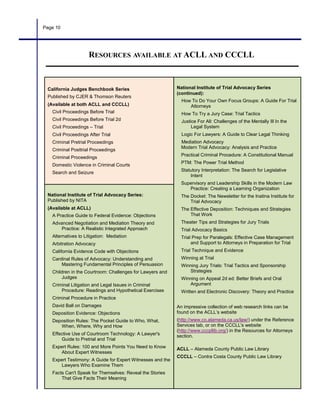
BOOKS ON DISPLAY AT THE OAKLAND MAIN LAW LIBRARY
Learning the Fundamentals…
• The First Trial: Where Do I Sit? What Do I Say?
• Sharpening Your Trial Skills: What to Say, How to Say It
• Trial Advocacy Basics
• How to Try a Jury Case
• Advocacy Words: A Thesaurus
• Trial Technique & Evidence
• The Effective Deposition
• Preparing Witnesses: A Practical Guide for Lawyers and their
Clients
Advanced Tips and Techniques...
• David Ball on Damages
• Theater Tips & Strategies by David Ball
• Advanced Negotiation and Mediation Theory and Practice
• Deposition Evidence
• Effective Expert Testimony
• How to Do Your Own Focus Group
• Mastering Written Discovery: Procedures & Tactics
• Winning on Appeal: Better Briefs & Oral Arguments
• Discovery Problems & Their Solutions
DIVISION OF LABOR STANDARDS
ENFORCEMENT (DLSE) WEB LINKS
• The DLSE Enforcement Policies
and Interpretations Manual:
www.dir.ca.gov/dlse/DLSEManual/
dlse_enfcmanual.pdf
• How to File a Wage Claim:
www.dir.ca.gov/dlse HowToFileWage
Claim.html
• DLSE Claim Forms:
www.dir.ca.gov/dlse/DLSE-Forms.html
EEOC WEB LINKS
• EEOC Charge Handling
Process:
http://www.eeoc.gov/employees/
process.cfm
• Employment Discrimination
Complaint Form, U.S. District
Court– Northern District of
California:
http://www.cand.uscourts.gov/cand/
f o r m . n s f / f a b b 9 c a c a 4 e f 9 7
c d 8 8 2 5 6 d 4 a 0 0 5 9 1 3 8 4
ad3a66898bb2110188256d4a0058f1f
d?OpenDocument
process operates, and litigation
before the agency. It discusses
investigations from both the
plaintiff’s and the defendant’s
perspective, covering how
decisions are made and
influenced.
Continued on p. 14...
Page 10
California Judges Benchbook Series
Published by CJER & Thomson Reuters
(Available at both ACLL and CCCLL)
Civil Proceedings Before Trial
Civil Proceedings Before Trial 2d
Civil Proceedings – Trial
Civil Proceedings After Trial
Criminal Pretrial Proceedings
Criminal Posttrial Proceedings
Criminal Proceedings
Domestic Violence in Criminal Courts
Search and Seizure
National Institute of Trial Advocacy Series
(continued):
How To Do Your Own Focus Groups: A Guide For Trial
Attorneys
How To Try a Jury Case: Trial Tactics
Justice For All: Challenges of the Mentally Ill In the
Legal System
Logic For Lawyers: A Guide to Clear Legal Thinking
Mediation Advocacy
Modern Trial Advocacy: Analysis and Practice
Practical Criminal Procedure: A Constitutional Manual
PTM: The Power Trial Method
Statutory Interpretation: The Search for Legislative
Intent
Supervisory and Leadership Skills in the Modern Law
Practice: Creating a Learning Organization
The Docket: The Newsletter for the Inatina Institute for
Trial Advocacy
The Effective Deposition: Techniques and Strategies
That Work
Theater Tips and Strategies for Jury Trials
Trial Advocacy Basics
Trial Prep for Paralegals: Effective Case Management
and Support to Attorneys in Preparation for Trial
Trial Technique and Evidence
Winning at Trial
Winning Jury Trials: Trial Tactics and Sponsorship
Strategies
Winning on Appeal 2d ed: Better Briefs and Oral
Argument
Written and Electronic Discovery: Theory and Practice
An impressive collection of web research links can be
found on the ACLL’s website
(http://www.co.alameda.ca.us/law/) under the Reference
Services tab, or on the CCCLL's website
(http://www.cccpllib.org/) in the Resources for Attorneys
section.
ACLL – Alameda County Public Law Library
CCCLL – Contra Costa County Public Law Library
National Institute of Trial Advocacy Series:
Published by NITA
(Available at ACLL)
A Practice Guide to Federal Evidence: Objections
Advanced Negotiation and Mediation Theory and
Practice: A Realistic Integrated Approach
Alternatives to Litigation: Mediation
Arbitration Advocacy
California Evidence Code with Objections
Cardinal Rules of Advocacy: Understanding and
Mastering Fundamental Principles of Persuasion
Children in the Courtroom: Challenges for Lawyers and
Judges
Criminal Litigation and Legal Issues in Criminal
Procedure: Readings and Hypothetical Exercises
Criminal Procedure in Practice
David Ball on Damages
Deposition Evidence: Objections
Deposition Rules: The Pocket Guide to Who, What,
When, Where, Why and How
Effective Use of Courtroom Technology: A Lawyer's
Guide to Pretrial and Trial
Expert Rules: 100 and More Points You Need to Know
About Expert Witnesses
Expert Testimony: A Guide for Expert Witnesses and the
Lawyers Who Examine Them
Facts Can't Speak for Themselves: Reveal the Stories
That Give Facts Their Meaning
RESOURCES AVAILABLE AT ACLL AND CCCLL
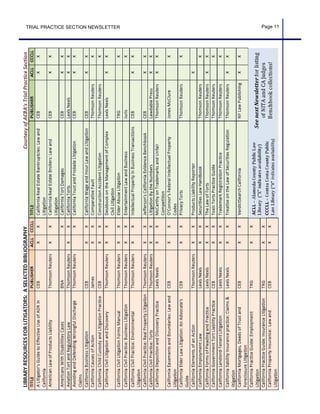
TRIAL PRACTICE SECTION NEWSLETTER Page 11
bankruptcy, dissolution and other
family law matters, guardianships,
immigration, and low-income
landlord eviction matters.
Over the past year and a half, VLSC
has developed and expanded legal
services in areas of family law and
bankruptcy. The monthly family law
clinic at the Fremont Family
Resource Center has been
especially popular, with experienced
VLSC family law attorneys helping
south county clients with dissolution,
child support, and custody matters.
VLSC also holds a monthly clinic on
bankruptcy, informing clients about
bankruptcy consequences, assisting
clients in determining whether
bankruptcy is the best course of
action, and helping them complete
the very detailed and often complex
forms needed to file for bankruptcy.
Another important way in which
VLSC provides legal assistance is
through direct placement of clients
with attorneys from its pro bono
panels. Each year VLSC places an
average of 50 pro bono cases with
volunteer attorneys. Before a case
is assigned to a volunteer, each
client is screened to establish that
VOLUNTEER LEGAL SERVICES CORPORATION:
PROMOTING EQUAL ACCESS TO JUSTICE WITH THE HELP OF PRO BONO VOLUNTEERS AND
COMMUNITY DONORS
The Trial Practice Section is excited
to continue this series of articles
with a profile of the Volunteer Legal
Services Corporation (VLSC), the
pro bono arm of the Alameda
County Bar Association (ACBA).
Established in 1983, VLSC provides
free legal services to low-income
people in Alameda County and is
the largest provider of pro bono
legal services in the county. Over
the past three decades, VLSC has
grown tremendously from a
committee of the ACBA to a
separately incorporated program
that has served more than 35,000
clients. VLSC volunteers have
logged approximately 60,000 pro
bono hours, which translates to $18
million worth of free legal services
for Alameda County.
I. Clinics & Direct Placement of
Cases
VLSC serves the majority of its
clients through pro per legal clinics
offered throughout the county where
clients learn how to represent
themselves, with approximately 30
legal clinics held each month.
Clinics are offered in areas of
PART OF THE GET TO KNOW YOUR LOCAL COMMUNITY ORGANIZATION SERIES
his or her income and resources are
within VLSC’s eligibility guidelines.
Staff also completes a thorough
intake regarding the client’s legal
matter.
II. Training and Mentorship
By volunteering their time with
VLSC, newer attorneys can gain
valuable hands-on experience, as
well as receive assistance from a
more experienced VLSC mentor.
More seasoned attorneys, in
addition to helping clients, can help
guide the next generation of
volunteers by serving as mentors or
trainers. Opportunities are also
available to paralegals, legal
Last year, 13% of the 1.5 million
people residing in Alameda
County were living at or below
poverty level, on an annual
income of $23,550 or less. Today,
a family of four qualifies for VLSC
services if it makes $49,688 a year
or less. With this higher income
guideline, VLSC is able to help
many more clients, particularly the
working poor and under employed.
PAGE 12
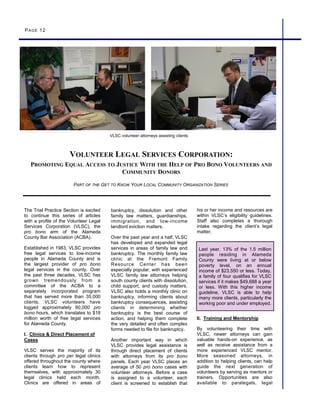
VLSC volunteer attorneys assisting clients
community, dedicated to supporting
and training talented and dedicated
volunteer attorneys, and grateful for
the generous donors who make this
work possible.
All of us at the Trial Practice Section
salute the work of VLSC and we
encourage you to get involved.
doc um ent as sis tants , and
interpreters. All volunteers are
covered by VLSC’s errors and
omissions insurance for all pro bono
work performed through VLSC.
VLSC strives to support all of its
volunteers with regular and
formalized MCLE training by experts
in substantive areas of law from the
bench and bar. Each year, VLSC
trains approximately 100 attorneys
through live and recorded trainings
in exchange for volunteers’
commitment to provide pro bono
legal services following the training.
VLSC produces a comprehensive
family law training every October, as
well as frequent trainings throughout
the year in areas of law most in
demand amongst VLSC clients.
III. Community Partnerships
VLSC has also created partnerships
with the Court and nearly every
single local legal services provider
to ensure that coordinated quality
legal services are provided without
duplication of resources. For
example, in 2009, VLSC partnered
with other Bay Area legal services
providers and the Bankruptcy Bench
Bar to fill a gap in services in the
community and develop legal clinics
to assist clients after their
bankruptcy filing. VLSC’s latest
partnership is with Centro Legal de
la Raza where the two organizations
collaborate to hold a monthly
Spanish language family law clinic.
A lot has changed in the past 30
years, and VLSC is still working
hard to adapt with changing times.
However the fundamentals that
made VLSC into a well-respected
provider of free legal services in
Alameda County still remain. VLSC
is as committed as ever to filling the
critical niche in the local safety net
system for delivery of essential legal
services to low-income people in our
Contact Information:
Elizabeth Hom, Director of Access
Programs
1000 Broadway, Suite 480
Oakland, California 94607
(510) 302-2216
Fax: (510) 452-2224
elizabeth@acbanet.org
www.acbanet.org
Elizabeth Pimentel, VLSC Clinics
Coordinator
(510) 302-2219
elizabethp@acbanet.org
Whitney Ward, Operations and
Development Coordinator
(510) 302-2209
whitney@acbanet.org
Intake phone number and hours:
(510) 302-2222, option 4; Mon-Fri
8:30 a.m. to 4:30 p.m.
In 2013, VLSC provided free legal
services to more than 1,000 clients
through pro per advice clinics and
referrals with the help of 429
volunteers and only 3.3 full time
equivalent staff members on a
budget of $450,945.
VLSC SERVICES AND
VOLUNTEER
OPPORTUNITIES:
Adoption
Bankruptcy
Domestic Violence
(Restraining Orders)
Family Law
Guardianship
Immigration
Low-Income Landlord
(Unlawful Detainers)
Nonprofit Corporations
Wills & Trusts
TRIAL PRACTICE SECTION NEWSLETTER
PAGE 13
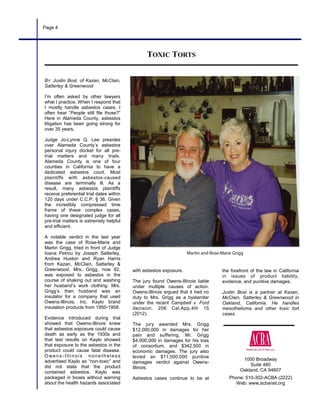
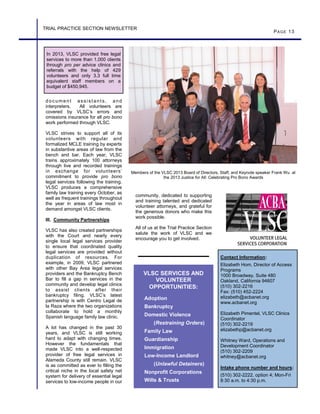
Members of the VLSC 2013 Board of Directors, Staff, and Keynote speaker Frank Wu at
the 2013 Justice for All: Celebrating Pro Bono Awards
The Trial Practice Section has
developed a pilot program in
collaboration with EBCLC’s
Neighborhood Justice Clinic where
experienced trial attorneys assist
pro bono volunteers in defending
indigent clients in debt collection
actions.
Page 14
An impressive collection of
web research links can be
found on the ACLL’s website
(www.co.alameda.ca.us/law/)
under the Reference Services
tab, or on the CCCLL's website
(www.cccpllib.org/) in the
Resources for Attorneys
section.
Zev Hardman is an attorney
admitted to the California bar in
May 2013. In September, having a
few of his own clients, he was
looking for more ways to get in-the-
trenches experience. I told him
about a new pilot program
launched by the Trial Practice
Section (TPS) where a new
attorney can take on a debt
collection case set for trial through
the East Bay Community Law
Center (EBCLC). The new attorney
will defend the case as the attorney
of record and benefit from the
assistance and supervision of more
experienced trial attorneys provided
by the TPS.
Three months later, Zev has taken
two pro bono debt collection
defense cases from the EBCLC.
With the help of EBCLC’s Megan
Ryan and Evonne Silva, and with
my assistance, Zev handled his first
two cases to impressive resolutions
for his clients. Zev recently met with
his third debt‑collection defendant
client.
Defense of debt collection cases
typically centers on plaintiff
collection agency’s lack of
standing. Before plaintiff acquired
the debt, the original creditor bank
may have bundled it with hundreds
or thousands of other individuals’
delinquent accounts and sold these
bundles for pennies on the dollar to
one of the giant collection
agencies. Commonly, an account
changes hands two or three times
before it is assigned to plaintiff
collection agency that then files a
lawsuit against the alleged debtor.
LIBRARIES, continued from
p. 9...
By suing thousands of typically
indigent individuals, many of whom
did not incur the underlying debt,
collection agencies cast a wide net
in hopes of obtaining default
judgments that will generate income
for years to come from garnished
wages or attached properties. Many
defendants default because they
lack the means to hire a lawyer or
skills to defend themselves in pro
per. As a result, most debt
collection cases end in victory by
default for the collection agencies,
even though more often than not the
agencies lack the requisite evidence
to prove their case.
While most of us agree people
should pay their debts, justice
prevails when plaintiffs meet their
burden of proof and all viable
defenses are considered by the
court. Zev says his clients’
satisfaction with the results of his
work is what matters most to him in
his practice as an attorney. “Getting
litigation and negotiation and client-
management experience is
obviously very valuable,” says
Zev. “But being able to help people
is really why I became an attorney.”
Referring to the tens of thousands of
dollars he has saved for his clients,
Zev is of the opinion that “the
collection agencies are in the
business of profiting from others’
misfortune, so the Robin Hood
aspect of it also is fun.”
New attorneys can find satisfaction
in taking on pro bono cases under
the supervision of a more
experienced lawyer. They gain
invaluable litigation, negotiation, and
client management experience. If
you are a new attorney or an
attorney seeking more experience, I
strongly encourage you to contact
me to find out more about this
program!
Prepared by Michael Shklovsky
Chair, Trial Practice Section
mshklovsky@gmail.com
Remember that the main
branches for both ACLL and
CCCLL are conveniently located
next to the main courthouses in
each County, with knowledgeable
law library staff ready to help
expedite research, ways to
electronically save your search
results, and conference rooms
available at low cost.
NEW ATTORNEYS GETTING EXPERIENCE BY
TRYING PRO BONO CASES
In addition, this title explains how
the EEOC handles injunctive
relief, appeals, and amicus
participation. Sample filings,
form s , s ettlem ents , and
conciliation agreements are
provided. This title is essential for
anyone involved in an EEOC
action.
IV. MCLE Credits
It is important to note that ACLL
rents DVDs and CDs that are
good for CLE credit. The Alameda
County Law Library also hosts,
sponsors, and presents CLE
programs on-site.
In the Spring of 2012, the Trial Practice Section of the ACBA announced its collaboration with the ACBA Volunteer
Legal Services Corporation (VLSC) and the East Bay Community Law Center (EBCLC). Through this collaboration,
Section members and their professional colleagues have enjoyed exciting new pro bono opportunities to represent
VLSC and EBCLC clients in a number of practice areas, including debt collection defense, family law, low income
landlord, clean slate, and probate law.
This winter, we are continuing our recruitment efforts in an effort to expand our pilot mentorship program. We seek a
handful of individual attorney volunteers to take on debt collection defense matters with pending trial dates.
Each volunteer will be paired up with an experienced trial attorney who will supervise and assist the volunteer at
every stage, from client interview to trial.
We are also introducing a pro bono opportunity with the federal court. The Federal Pro Bono Project is a joint
effort of the Northern District Court of California and the Justice and Diversity Center of the Bar Association of San
Francisco, in coordination with VLSC. At the request of the Northern District of California, the Federal Pro Bono
Project arranges volunteer counsel for pro se litigants who lack the financial resources to retain counsel.
Appointments may be for full-scope or limited-scope representation, including representation at a settlement
conference before a Magistrate Judge or opposing a dispositive motion. Cases may involve any civil cause of action
that can be heard in federal court. There is currently a great need for attorneys to handle employment claims, and
the ACBA Trial Practice Section offers to locate experienced mentors to assist younger pro bono attorneys.
For pro bono volunteers, this presents a rare opportunity to learn from skilled trial attorneys, gain real courtroom and
trial experience, and improve their oral advocacy skills. They will also give back to the community, and receive great
satisfaction from lending their immense talents to appreciative clients in need.
I sincerely hope that you take advantage of this unique and promising program. To get involved in this or other
available pro bono opportunities, please contact me at mshklovsky@gmail.com.
Warm regards,
Michael Shklovsky
Chair, ACBA Trial Practice Section
CALL TO GET INVOLVED IN
PRO BONO ACTIVITIES
TRIAL PRACTICE SECTION NEWSLETTER Page 15
NEW MCLE: HOW TO RETAIN AND PREPARE EXPERTS
AND EFFECTIVELY PRESENT EXPERT TESTIMONY
An experienced trial lawyer, a forensic pathologist and an accident reconstruction engineer will discuss the
mechanics of retaining, controlling and preparing expert witnesses, and powerfully presenting expert testimony at
deposition, mediation, and trial. To register, and for more information, please visit www.acbanet/calendar or
contact Membership and Education Coordinator Hadassah Hayashi at hadassah@acbanet.org or (510) 302-2200.
SPEAKERS:
Mark Mosley is a civil trial lawyer
who has tried more than thirty jury
trials to verdict and over a dozen
bench trials to judgment with a
“win record” over 85%.
Dr. Judy Melinek is a American
Board of Pathology board-certified
forensic pathologist practicing
forensic medicine. Dr. Melinek is
also an expert witness in forensic
pathology, neuropathology and
wound interpretation.
Craig Fries is CEO of Precision
Simulations Inc. (“PSI”), a firm that
performs accident reconstruction
and 3-D accident scene
visualizations for trial.
Tuesday, April 8, 2014 from 6:00 p.m. to 7:30 p.m.
IMAGINE YOUR
AD HERE
Do you have a service, product or
event you want to let ACBA
members and other professionals
know about? Place an ad in our
Newsletter! The electronic version
is made available to approximately
1,500 lawyers, judges and law
students, with hard copies
distributed to civil departments in
Alameda County, as well as Bay
Area public law libraries.
Ads are $500 for a full page, $250
for a half page, and $150 for a
quarter page, with discounts for non
-profits. Please contact Valerie
Brown, at valerie@acbanet.org if
you are interested in placing an ad!
TRIAL PRACTICE EXECUTIVE
COMMITTEE WELCOMES NEW MEMBERS
Page 16
Justin Bosl is a partner at Kazan, McClain, Satterley & Greenwood in Oakland, California. He
started at Kazan, McClain in law school and has made his career handling mesothelioma and
other toxic tort cases. While the majority of Mr. Bosl's practice is here in Alameda County, he
also regularly litigates and tries cases in Los Angeles. Mr. Bosl was nominated by his peers as
a Northern California Rising Star in San Francisco Magazine in 2011, 2012 and 2013. He was
named to the Top 40 Under 40 list by The National Trial Lawyers in 2012 and 2013. He lives
with his wife and four children in San Leandro.
Suizi Lin began her legal career at Furtado, Jaspovice & Simons representing plaintiffs in
automobile collisions, governmental torts, sexual abuse, medical malpractice and elder neglect
cases. In 2011, Ms. Lin opened the Law Offices of Suizi Lin and represents plaintiffs in
personal injury cases, will and trust litigation, and special education matters. Ms. Lin is on the
executive board of the Alameda Contra Costa Trial Lawyers Association and is a volunteer with
VLSC’s Guardianship Clinic and Wills and with AABA's APILO. Ms. Lin was awarded Super
Lawyers Northern California Rising Star from 2010 to 2013 and National Trial Lawyer Top 40
Under 40 from 2012 to 2013.
Colin Bowen is a trial attorney in private practice, specializing in criminal defense and juvenile/
children’s rights litigation. Mr. Bowen has conducted a substantial number of trials ranging from
juvenile delinquency proceedings to special circumstance homicide prosecutions. Prior to
private practice, Mr. Bowen was an Alameda County Deputy Public Defender for over 15 years.
Mr. Bowen additionally devotes significant time to youth “pipeline” efforts, and has developed a
number of programs and workshops concerning youth and their interaction with the legal
system. Mr. Bowen is graduate of Berkeley (Boalt Hall) Law School. He is active in ACBA, and
has served on the Judicial Appointments Evaluation Committee and the Long Range Strategic
Planning Committee.
SAVE THE DATE
JusticeforAll:
CelebratingProBono
for VLSC’s 2014
the Fremont area where he was
active in many civic organizations. He
was appointed to the Municipal Court
in 1968 and the Superior Court in
1971, where he served until 1985
when he was elevated to the
California Court of Appeals, First
District. At the end of the 1980s,
Justice Sabraw left the court to serve
as a private Mediator and arbitrator.
Mo leaves an extensive family of
children, grandchildren, and great-
grandchildren too numerous to list
here.
But Mo belonged to a judicial family
as well, consisting of his wife of 18
years, Bonnie Sabraw (who refers to
him as “Mody”) and his son, the Hon.
Ron Sabraw, both of whom served on
the Alameda Superior court bench.
I and many of my peers who
appeared before Justice Sabraw can
attest to the near-perfect judicial
temperament he always exhibited. He
was unflappable and paid close
attention to what was going on in his
courtroom but never gave a clue to
what he was thinking. Even though
he was very smart, he never once
embarrassed a fumbling young
lawyer, despite many opportunities
to do so (a few of which I can
personally vouch for). But, more
importantly, besides having an ideal
judicial manner, Justice Sabraw saw
his role as a judge as doing the right
thing, not just following the law. As
one colleague of mine put it, “he
followed the law with a
compassionate heart.”
It was not until he was off the bench
that I discovered what a terrific
sense of humor he had. I only wish I
had the chance to know him better.
-Eric Ivary, ADR Services
TRIAL PRACTICE SECTION NEWSLETTER Page 17
I usually explore this with the parties
on the phone before the mediation.
But neither side should count on the
mediator to do this for you.
IV. The Value of Putting an End to
the Case
I know that you recognize that
there’s inherent value for an
insurance carrier to “close the book”
on any claim. This is particularly true
where there will be ongoing litigation
that will drain your side’s resources.
However, I urge you to recognize
the psychological and very real
value that ending the case has for
the plaintiff.
This is important enough to bear
repeating: Do not underestimate
what an end of the case means to
the plaintiff. It has real value in and
of itself. Just the thought of putting
an end to the litigation, the end of all
that uncertainty and all those
sleepless nights can set off a whole
array of emotions from fear to
elation. The more you can address
and satisfy these concerns in your
mediation strategy the greater the
chance of success.
Both sides:
I. The “Joint Session”
I have one final issue to talk about
and it applies equally to the plaintiff
and the defense: joint sessions.
Some mediators firmly believe every
case should have a joint session. In
my experience, joint sessions with
“opening statements” only tend to
reinforce already entrenched
positions and seldom have helped
me settle a case. Sometimes, joint
sessions are necessary for
information exchanges, apologies, or
where one side needs to hear from
the other side on a personal level.
Typically, joint sessions are great for
video presentations and for claims
people to see the plaintiff firsthand.
But, in general, I have found that
they tend to make the process more
like a trial. Additionally, the plaintiff
can be confused by the process.
After first hearing his attorney tell
everyone what a great case he has,
he is urged to compromise a few
minutes later. They create an all
round bad dynamic. Besides, we
have briefs that should adequately
set out everybody’s position.
Conclusion
In a mediation we need to get past
the parties legal positions and into
the real case. That requires
honesty and a willingness to see
that “no matter how flat the
pancake, it has two sides” A good
mediator is someone who will help
you identify and talk about your
real case, not the one you wish you
had. I consider my job done when
both sides have reached a point
where they have a hard choice.
The decision whether to make that
choice is always, in the end, up to
the parties.
Eric Ivary is a full time Neutral with
ADR Services Inc., resolving
disputes involving employment,
medical malpractice, and insurance
cases.
M.O. SABRAW (1926-2013)
MEDIATING THE SMALL CASE, continued from p. 7...
The Honorable
Justice M.O.
Sabraw or, as
he modestly
i n t r o d u c e d
himself, “Mo
Sabraw” was a
member of what
Tom Brokaw
called “The Greatest Generation
any society has ever produced.”
Born in Canada in the twenties and
having grown up during the great
depression, Mo and his family
moved to the Bay Area in 1937. As
a teenager, he joined the U.S. Army
Air Corps, where he served as a
paratrooper in the South Pacific
during WWII. (Mo was only 15 years
old at the time of Pearl Harbor.)
Following the war, Mo went to U.C.
Berkeley to get his undergraduate
degree and then to Boalt Hall
School of Law. He then settled in
Page 18
Today’s civil litigators engage in
some type of dispute resolution
process in almost every case
that they handle. In Alameda
County, fewer than 5% of all civil
filings go to trial, and judges
typically recommend and
sometimes require parties in a
civil dispute to engage in a
mediation or arbitration program
administered by the Superior
Court.
There are six types of ADR
programs that one may
encounter in Alameda County
Superior Court. In charge of
these programs is Jason Stein,
Administrator of the ADR Office
of the Court. This article follows
our interview of Mr. Stein and a
careful review of the extensive
information available on the
court’s website.
I. Court Mediation Program
The Court Mediation program
allows the parties to select a
mediator who will help them
ADR PROGRAMS AT THE ALAMEDA COUNTY SUPERIOR COURT
communicate, clarify facts,
explore settlement options, and
agree on a solution that is
acceptable to all sides. A
mediator does not impose an
outcome and the process is
voluntary. This is the most
popular ADR program because
it gives litigants the freedom to
creatively craft a settlement, as
compared to a resolution that
would be imposed on them in
binding arbitration.
The court maintains a panel of
mediators who volunteer their
time for the first two hours of
mediation, and charge their
regular fees if the parties need
more time. The panel members
provide mediation services at a
reduced rate only when the
parties are referred through the
Court Mediation Program, or
they stipulate to Court Mediation
and select a mediator from the
Court Mediation Panel. Parties
may alternatively engage in
private mediation and choose a
mediator outside the court’s
panel.
II. Judicial Arbitration
Program
In the Judicial Arbitration
Program, an arbitrator hears
arguments and evidence from
each side and then decides the
outcome of the dispute. The
decision of the arbitrator is not
binding and there is no fee for
his or her service. The arbitrator
must send the decision (award
of the arbitrator) to the court,
and the parties have the right to
reject the award and proceed to
trial.
The parties select an arbitrator
from a list provided by the court.
The panel is comprised of
experienced private attorneys,
many of whom are retired
The Superior Court of
California, County of Alameda
strongly encourages the
parties to use some form of
Alternative Dispute Resolution
before proceeding to trial.
Currently there are 112
volunteer mediators on the
court’s panel. If you are
interested in joining the court
mediation panel, please
submit an application through
the court’s website.
From April 2009 to September
2013, a total of 3,766 cases
were referred to the Court
Mediation Program in Alameda
County. Out of this total, 901
cases were mediated and 55%
of them settled. Other cases
settled before mediation,
vacated to another form of
ADR, or did not mediate.
INVITATION FOR COMMENTS &
ARTICLES:
If you would like to see any particular information in the Newsletter, or
if you have an article you would like to submit for publication, please
email either of our co-editors-in-chief, Erin Daly at
edaly@alumni.duke.edu or Michael Shklovsky at
mshklovsky@gmail.com.
We welcome your ideas and look forward to your submissions!
TRIAL PRACTICE SECTION NEWSLETTER Page 19
judges. Attorneys may apply to
join the panel of arbitrators by
submitting the arbitrator profile
form to the ADR office of the
court. The decision of whether to
add the applicant to the roster is
made by the ADR Administrative
Committee (currently chaired by
Judge John True, III) made up of
judges, private attorneys,
mediators and arbitrators.
III. Private Arbitration
An alternative to the judicial
arbitration program is private
arbitration, which can be either
binding or non-binding. Private
arbitration occurs when parties
involved in a dispute agree or are
contractually obligated to
participate in this form of ADR.
This option takes place outside of
the courts and is typically binding
on the parties.
IV. Discovery Facilitation
Program
Discovery facilitation is a pilot
program that applies to cases
assigned to Departments 20
(Judge Robert Freedman) and 23
(Judge John True, III). This
program has been in development
since Fall 2012, and it was
launched in September 2013. As
explained on Judge True’s
webpage: “No discovery motion
shall be filed without prior serious
efforts to resolve it. If those efforts
are unsuccessful, the parties
should jointly send an e-mail to
the court outlining the dispute in a
few sentences. The court will then
confer with counsel and determine
whether there is a way to resolve
the matter short of motion.”
In addition, the parties can request
the assistance of a discovery
facilitator who can be selected
from the panel maintained by the
court. The panel is comprised of
private attorneys with at least ten
years of experience. One hour of
preparation time and the first two
hours of the session with the
facilitator are free. Often the
involvement of the discovery
facilitator resolves the dispute and
If you have questions
concerning the Court’s ADR
Program or about joining the
mediator or arbitration panel, or
if you wish to report on the
status of ADR in your case,
please email Jason Stein, ADR
Program Administrator, at
adrprogram@alameda.courts.ca
.gov or call at (510) 891-6261.
A party may choose a form of
ADR by:
1. Indicating its preference on
Case Management Form
CM-110;
2. Filing the Stipulation to
Attend ADR and Delay Initial
CMC for 90 Days (Form
ADR-001); or
3. Agreeing to ADR at the
Initial CMC
sometimes settles the entire case.
If the dispute is not settled, the
facilitator writes an opinion that is
then presented to the court for
consideration. The opinion is
confidential and is not published
on DomainWeb.
V. Day of the Court Neutral
Program
If the judge thinks the case has a
good chance of settling on the day
of trial, a neutral evaluator is
asked to appear on the day of
trial. A neutral listens to both sides
and reviews short written
statements from each party. Then,
the evaluator offers an opinion on
the strong and weak points of
each party’s case. The evaluator’s
opinion can help parties better
understand the most important
legal issues in the case and give
an idea of the value and likely
outcome of the case if it went to
trial.
VI. Small Claims and Civil
Harassment Mediations
In small claims and restraining
order cases, there are two
community groups that provide
mediators who come to the court
before trial or on the day of the
hearing and assist parties in
mediating their dispute.
Discussions are currently
underway concerning court-wide
implementation of the discovery
facilitation program.
The first organization is SEEDS
Community Resolution Center.
SEEDS mediators may be present
at the hearing to explain the
mediation process to litigants in
the courtroom, and mediators will
then be available to speak to
individual parties before the judge
begins hearing cases. If both
sides agree to mediation,
mediators will inform the court and
take the parties to a private room
for the mediation session.
The second organization is the
Center for Community Dispute
Settlement. Founded it 1995, it
provides mediators to assist in
dispute resolution. Please contact
these organizations for more
details.
Page 20 TRIAL PRACTICE SECTION NEWSLETTER
SUPERIOR COURT OF CALIFORNIA, COUNTY OF ALAMEDA
JUDICIALASSIGNMENTS – CIVIL
TENTATIVE RULINGS
(866) 223-2244
EMAILING THE COURT
Court clerks may be emailed by using the following email:
Dept.[insert#]@alameda.courts.ca.gov
Dept Judge Type of Calendar Clerk Phone Number
510 Gee, Delbert Civil Direct Calendar Labrecque, Danielle (510) 690-2719
511
Jacobson, Morris
(APJ/SJ)
UD Court Trials Hives, Brenda (510) 690-2720
514 Kaus, Stephen Civil Direct Calendar Stewart, Kristie (510) 690-2723
516 Harbin-Forte, Brenda Civil Direct Calendar Rose, Nancy (510) 690-2725
520 Kolakowski, Victoria Open Civil Trials Ferreira, Susan (510) 690-2729
522 Hayashi, Dennis Civil Direct Calendar Hyatt, Dianne (510) 690-2731
UPDATED INFORMATION
Entries in bold represent
updates in the current edition.

Trial Practice Section Newsletter Winter 2014

  • 1.
    Judge Jo-Lynne Q.Lee is a civil direct calendar judge for the Alameda County Superior Court, Department 30, who is responsible for asbestos cases, among others. Judge Lee was appointed to the bench in 2002 by Governor Gray Davis and reelected in 2010. She is the first Chinese-American female judge to serve on the Alameda County Superior Court. Background Judge Lee earned a BA, magna cum laude, from Brooklyn College, and a JD from Columbia University Law School. Judge Lee began her legal career in 1974. She served as Assistant District Attorney in Bronx County prosecuting criminal offenses, a researcher for the National Center for State Courts trial court delay project, and Assistant United States Attorney in the Northern District of California where she prosecuted federal crimes. In 1981, Judge Lee went into private practice, working as a civil litigator with various firms in the San Francisco Bay Area in the areas of construction defect, environmental, employment, and other civil litigation. From 1998 until her appointment, Judge Lee practiced with Griffiths & Castle exclusively as Court- Appointed Special Master, Discovery Referee, and private Mediator and Arbitrator in construction defect litigation and other real estate disputes. She also served on the Boards of the Rotary Club of Oakland, YMCA of Oakland, and Redwood Day School, and as a member of the Alameda Point Restoration Advisory Board. The greatest challenge facing Judge Lee as a Superior Court judge is “not enough hours in the day.” Pre-Trial Rules & Practices Judge Lee’s rules and practices are Continued on page 2... Trial Practice Section Newsletter WINTER 2014 GETTING TO KNOW YOUR JUDGE 1 MESSAGE FROM THE CHAIR 3 TOXIC TORTS 4 BENCH BAR COALITION NEWS 5 MEDIATING THE SMALLER CASE 6 COUNTY LAW LIBRARIES PART 2 8 RESOURCES AVAILABLE AT ACLL AND CCCLL 10 VOLUNTEER LEGAL SERVICES CORPORATION 12 NEW ATTORNEYS GETTING EXPERIENCE BY TRYING PRO BONO CASES 14 PRO BONO ACTIVITIES 15 TRIAL PRACTICE EXECUTIVE COMMITTEE WELCOMES NEW MEMBERS 16 M.O. SABRAW (1926-2013) 17 ADR PROGRAMS AT THE ALAMEDA COUNTY SUPERIOR COURT 18 JUDICIAL ASSIGNMENTS –CIVIL 20 INSIDE THIS ISSUE: Judge Jo-Lynne Q. Lee Department 30 U.S. Post Office Building, 201 Thirteenth Street, 2nd Floor, Oakland, CA 94612 Phone: (510) 268-5104 Fax: (510) 267-1510 E-mail: Dept.30@alameda.courts. ca.gov jlee@alameda.courts.ca.gov Court Clerk: Lynette Rushing Approximate Caseload: 135 cases (current as of Dec 2013) Alameda County Bar Association IN JUDGE’S WORDS Q: What is the best thing about being a judge? A: Every day is a challenge and a learning experience. Q: Is there any information you wish to impart to attorneys appearing in your courtroom? A: We have the same attorneys regularly appearing in Dept. 30 so many of the attorneys and/or their law firms have developed a “reputation” among the Court staff – some good and some bad. We look kindly upon attorneys who we know to be considerate and reasonable when dealing with opposing counsel and thus when they ask or need something from the Court, they are more likely than not to get what they want. They are in a sense “rewarded” for good behavior – even if they don’t know it. And the opposite applies to those firms with reputations for being obstinate, obstructionist, etc. GET TO KNOW YOUR JUDGE: JO-LYNNE Q. LEE
  • 2.
    tailored to issuescommon to asbestos cases. For example, ADR is not mandatory and parties are not referred to some form of ADR. While Judge Lee wishes parties would more frequently consider ADR, it has been her experience that ADR is not commonly used in asbestos cases. In selecting a particular form of ADR, Judge Lee recommends that parties consider mediator’s experience with asbestos cases and familiarity with the insurance carriers and national counsel who regularly handle asbestos claims settlements. When reviewing Case Management Conference (CMC) statements for cases not yet set for trial, Judge Lee is most interested in learning whether there are issues that require judicial intervention. If the case is set for trial, Judge Lee is interested in whether the parties truly are ready to proceed on the scheduled date or if they have run into problems getting the case readied for trial. Judge Lee prefers counsel to use pleading paper and provide info in a few paragraphs, rather than fill out the Judicial Council Form, which she does not find particularly informative. Settlement Conferences & Trials Mandatory Settlement Conferences (MSCs) are set in Judge Lee’s JUDGE LEE, continued from p. 1 department on a case-specific basis, typically one month in advance of trial. Generally, settlement conferences are assigned to Judge Evelio Grillo at Department 31 (see Judge Grillo’s profile in the Summer 2013 Edition of the Newsletter). Two weeks prior to an MSC, the plaintiff is required to make a written demand so that the defendant has an opportunity to discuss the demand with its attorneys and insurance carriers prior to the MSC. Judge Grillo allows parties and carriers to appear telephonically at the first MSC, and then determines whether he will require personal attendance if further MSCs are needed. Judge Grillo generally conducts multiple MSCs with parties prior to and during trial because asbestos case trials typically are lengthy and time consuming. Further, counsel and their clients in asbestos cases are notorious for settling on the eve of trial or in trial. This is a significant waste of judicial resources and jury panels, so every effort is made to settle the case – which means extended and multiple MSCs. Pre-trial conferences with trial counsel are required and are scheduled two weeks before the trial date unless it is a preference case. In preference cases, the pre-trial conference is held the first day of trial. Counsel may request a pre-trial conference if there is an issue that needs determination before the case can be settled. Trials are held Monday through Thursday, with no lunch on short days, and a 1.5-hour lunch during full days. Breaks are taken about every 1.5 hours to give court reporters a break. Juror questionnaires are permitted in virtually all cases. Counsel are urged to be non-argumentative in framing the questions and not to use them to “educate” the jury as to party’s positions on any issue. When voir dire is conducted, Judge Lee uses a "six-pack" (18-juror) approach, and she expects that the voir dire concentrate on follow-up questions and issues that need to be discussed with the juror based upon that juror’s answers in the questionnaire. After the voir dire of the initial 18 prospective jurors, Judge Lee hears challenges for cause and peremptory challenges in chambers with the court reporter present. She expects that the panel can be selected in one full day of oral questioning. The website for Dept. 30 contains the following documents in Word format:  Judge Burr's Asbestos Issues Conference Order  Judge Burr's Asbestos Juror Questionnaire  Juror Contact Sheet  Juror Questionnaire Instruction Cover Sheet  Model Protective Order – Civil  Pretrial Order  Pretrial Order re Defendant's Standard Interrogatories (Loss of Consortium)  Pretrial Order re Defendant's Standard Interrogatories (Personal Injury)  Pretrial Order re Defendant's Standard Interrogatories (Wrongful Death)  Pretrial Order re Plaintiff's Standard Interrogatories Page 2 Scheduling Information for Dept. 30 Trial Schedule Mon – Thu from 9:00 a.m. to 4:30 p.m. or 9:00 a.m. to 1:30 p.m. CMC Schedule Fri mornings beginning at 9:15 a.m. L&M Schedule Fri mornings beginning at 9:30 p.m.1 Settlement Conf. Fri mornings beginning at 10:00 a.m.2 Ex Parte Schedule Fri at 9:00 a.m. Scheduling of all hearings should be made by e-mail only. Litigants must copy opposing counsel on all correspondence. 1 In exceptional circumstances, motions may be set at other times with leave of Court. 2 Asbestos cases.
  • 3.
    ACBA TRIAL PRACTICENEWSLETTER TEAM Mistakes and Sanctions According to Judge Lee, the biggest mistakes lawyers make in her courtroom include failing to use the jury instructions and verdict forms approved by the Court in their Closing Argument to assist the jury when they are deliberating. In addition, it is a mistake to be inconsiderate of the Court and the jurors’ time by failing to appropriately schedule witnesses so as to avoid constantly going minutes beyond the time when the trial is supposed to begin or end for the day or, alternatively, having to excuse the jury early or lose days because of scheduling problems that should have been anticipated. Judge Lee is most likely to impose monetary sanctions for failure to timely file CMC statements and in discovery disputes involving failure to verify discovery or adequately meet-and-confer. Evidentiary sanctions are rare, but may be issued for severe conduct such as misrepresentations or misleading the Court. Terminating sanctions are not typically issued. Written by Marin County-based trial lawyer Michael Shklovsky. Mr. Shklovsky handles business, real estate, and employment litigation in state and federal courts. Welcome to our Winter 2014 installment of the ACBA Trial Practice Section Newsletter! I first wish to thank Mark Mosley for his dedicated leadership of our Section in 2013. Last year saw our section re-energized. We launched and published three editions of the Newsletter, produced six MCLE programs that were attended by more than 140 lawyers, and offered exciting pro bono and mentorship opportunities to trial attorneys. This year, I expect us to maintain the same trajectory. We will continue publishing the quarterly Newsletter, delivering news and information from the bench and beyond. We are developing five new MCLE programs on topics including retention and use of expert witnesses, debt collection defense, mediation and criminal law issues relevant to trial attorneys, and liens. In addition, we plan on improving our webpage, as well as increasing cooperation with Bay Area community organizations that work to promote equal access to justice. We are also committed to continue facilitating and expanding pro bono opportunities available to young lawyers looking for more experience and more accomplished litigators looking to give back to their communities. Our pilot program with the East Bay Community Law Center defending debt collection cases will continue and hopefully expand. We now also offer an opportunity for lawyers to represent individuals in federal courts, with a current need for employment lawyers. Please read our articles concerning these programs in this edition of the Newsletter and contact me at mshklovsky@gmail.com to get involved. Finally, we are always on the lookout for MCLE suggestions and topical articles of interest to local practitioners. If you have a recommendation for an MCLE program, or if you are interested in publishing an article in our Newsletter, please email me, Erin Daly at edaly@alumni.duke.edu, or Hadassah Hayashi at hadassah@acbanet.org. See you in court! Michael Shklovsky Chair, ACBA Trial Practice Section MESSAGE FROM THE CHAIR PAGE 3 Q: What single tip can you provide to young lawyers appearing in your courtroom? A: Be prepared. Read the file and know as much as you can about the case – even if you are only appearing for CMC. Attorneys who appear and can’t answer a question do not look good in front of the judge and may hurt their reputation with the Court. Judges do talk to each other about attorneys who appear before them. If you impress a judge, other judges will likely hear about you (and vice versa). Reputation counts. Michael Shklovsky CREATIVE DIRECTOR & CO-EDITOR-IN-CHIEF mshklovsky@gmail.com Erin Daly CO-EDITOR-IN-CHIEF edaly@alumni.duke.edu TRIAL PRACTICE SECTION NEWSLETTER
  • 4.
    1000 Broadway Suite 480 Oakland,CA 94607 Phone: 510-302-ACBA (2222) Web: www.acbanet.org Page 4 with asbestos exposure. The jury found Owens-Illinois liable under multiple causes of action. Owens-Illinois argued that it had no duty to Mrs. Grigg as a bystander under the recent Campbell v. Ford decision. 206 Cal.App.4th 15 (2012). The jury awarded Mrs. Grigg $12,000,000 in damages for her pain and suffering, Mr. Grigg $4,000,000 in damages for his loss of consortium, and $342,500 in economic damages. The jury also levied an $11,000,000 punitive damages verdict against Owens- Illinois. Asbestos cases continue to be at BY Justin Bosl, of Kazan, McClain, Satterley & Greenwood I’m often asked by other lawyers what I practice. When I respond that I mostly handle asbestos cases, I often hear “People still file those?” Here in Alameda County, asbestos litigation has been going strong for over 35 years. Judge Jo-Lynne Q. Lee presides over Alameda County’s asbestos personal injury docket for all pre- trial matters and many trials. Alameda County is one of four counties in California to have a dedicated asbestos court. Most plaintiffs with asbestos-caused disease are terminally ill. As a result, many asbestos plaintiffs receive preferential trial dates within 120 days under C.C.P. § 36. Given the incredibly compressed time frame of these complex cases, having one designated judge for all pre-trial matters is extremely helpful and efficient. A notable verdict in the last year was the case of Rose-Marie and Martin Grigg, tried in front of Judge Ioana Petrou by Joseph Satterley, Andrea Huston and Ryan Harris from Kazan, McClain, Satterley & Greenwood. Mrs. Grigg, now 82, was exposed to asbestos in the course of shaking out and washing her husband’s work clothing. Mrs. Grigg’s then husband was an insulator for a company that used Owens-Illinois, Inc. Kaylo brand insulation products from 1950-1958. Evidence introduced during trial showed that Owens-Illinois knew that asbestos exposure could cause death as early as the 1930s and that test results on Kaylo showed that exposure to the asbestos in the product could cause fatal disease. Owens -Illinois nonetheless advertised Kaylo as “non-toxic” and did not state that the product contained asbestos. Kaylo was packaged in boxes without warning about the health hazards associated the forefront of the law in California in issues of product liability, evidence, and punitive damages. Justin Bosl is a partner at Kazan, McClain, Satterley & Greenwood in Oakland, California. He handles mesothelioma and other toxic tort cases. TOXIC TORTS
  • 5.
    TRIAL PRACTICE SECTIONNEWSLETTER Page 5 Key links: Governor’s Budget Proposal: http://www.ebudget.ca.gov/ Three-Year Blueprint: http://www.courts.ca.gov/documents/JudicialBranchBlueprint.pdf BY Pelayo Llamas, of the Oakland City Attorney’s Office On January 9, 2014, Governor Brown announced his 2014-2015 budget proposal. In light of higher- than-expected state revenues, the proposal includes an increase of $105 million to the judicial branch ($100 million to trial courts and $5 million to the state-level judiciary). That is just over three percent of the $3.2 billion total operating budget for the judicial branch. Should we be jumping for joy? This article will give a very brief overview of recent judicial branch budget facts and an introduction to the Chief Justice’s campaign to restore court funding. The basics: in the last five years, state General Fund expenditures on the judicial branch was reduced from 56% in 2008-2009, to just 25% in 2013-2014. That equates to a total net reduction of $367.2 million in General Fund support of the judicial branch. The cuts impacted the public in a variety of ways including shortened court hours, courtroom closures, and staff reductions. Individual county courts were able to temper some of the negative impacts of these extreme cuts, and maintained services by raising fees, laying off staff, spending cash reserves or borrowing funds. The ability of local trial courts to use cash reserves and other one-time measures is going to be severely restricted by next fiscal year, so reductions will likely continue in 2014-2015. Chief Justice Tani Cantil-Sakauye, as head of the judicial branch, has designed a “three-year blueprint” to seek the restoration of court funding, with the goal of using restored funding to reestablish and improve public access to justice in a cost-effective way. The blueprint calls for an additional $266 million in funding “just to tread water” in 2014-2015, and a total of $1.2 billion in additional funds over the next three years to restore and improve court capacity and public access to justice in California. Specific proposals include: technological modernization (electronic filing, electronic forms), facilities repair and modernization, and adding funding for 50 judgeships authorized in 2007. Budget meetings, legislative hearings, and a flurry of legislative activity will take place over the coming months, culminating by the June 15, 2014 balanced budget deadline. The Chief Justice, Administrative Office of the Courts, the Judicial Council, and other representatives of the local courts and bars will be working with the Governor and Legislature and advocating for the restoration of the judiciary’s funding. Future articles will provide updates on the budget proposal and explain in more detail, some of the main law and policy changes that will affect how Alameda County Superior Court can respond to reductions in state funding. Mr. Llamas is a Deputy with the Oakland City Attorney’s Office, and has practiced law since 1992, almost entirely based in Oakland. He is also a Director on the ACBA Board, and is its appointee to the Bench Bar Coalition (BBC). The BBC is composed of judges and leaders of bar associations and legal services organizations, and is designed to enhance communication, perform legislative outreach, and coordinate the activities of the judicial community with the state. BENCH BAR COALITION NEWS – IS JUDICIARY BUDGET RELIEF IN SIGHT?
  • 6.
    By Eric Ivary,of ADR Services There are a lot of things that can make a case difficult to settle. But of all the cases I see, it’s often the smaller ones that are most difficult to settle. This is especially true of personal injury cases. Insurance carriers often don’t treat them seriously. So, how can a small case be mediated effectively? Mediating Too Early: A Problem for Both Sides One problem is that courts routinely refer all cases to ADR too early, often as early as the first status or issue conference. In that situation, it is difficult for either side to be fully prepared. The carrier may not have set adequate reserves because it doesn’t know much about the case. Additionally, without documentation, insurance carriers probably are not going to offer much money. As a result, early court-generated mediations often wind up being little more than an information exchange and hardly worth the expense of hiring a private mediator. However, there are steps that either side can take to make a voluntary mediation worthwhile. Of course, this assumes that the parties are going into mediation to make a serious effort to settle the case, not just to have a polite discussion that lasts eight hours. If you represent the plaintiff: I. Plan Ahead—Way Ahead Don’t underestimate how long it sometimes takes for a carrier to process all the information it needs to get authority to settle a claim. I suggest that you initiate the process and ask the defense exactly what it needs to fully evaluate the case. Don’t wait for them to ask you for the information. Remember that insurance carriers operate in a different world. They operate in a world of reserves, claims committees, reporting letters, and documentation. They are not going to take your word for anything. So, even if it seems redundant to you, my advice is to send them what they ask for. If they lose it, send it again. And send it as early as possible to allow adequate time for your information to make the rounds within the claims division. Then, periodically check to be sure they have received everything. II. Set Some Conditions Because carriers tend to treat small cases very dismissively, often they will send someone to the mediation who has little authority. This can be very frustrating. One way to prevent that from happening is to contact the other side to set some parameters for even going to mediation. In a voluntary mediation you are free to structure it any way you want, so consider getting some commitments before investing time and money in a private mediation. Insist that the carrier send someone with authority. Even insist that negotiations begin with a minimum value for the case. If you’re still not convinced that the carrier is willing to send someone with meaningful authority, my suggestion is to simply cancel the mediation. III. Fully Prepare Your Client for the Session Too often I see plaintiffs who are really at sea about what to expect at mediation. It is essential to not only prepare your client for the whole range of things that might happen, but also to be very specific. For example, consider telling your client that sometimes the offer might seem like an insult. Prepare your client ahead of time to hear what kinds of claims the other side is likely to make, some of which may not even be true. Once you get to the mediation, it’s too late to try to explain surprises like that to your client. If your client becomes emotionally unstable, you probably aren’t going to be able to settle them down. Remember, even though you may be used to the process, your client is not. Lastly, in order to be fully prepared, you need to make sure that all of the people who have input about settlement are present on your side. If a parent, sibling, or close friend is going to affect your client’s decision-making process, she should be there. IV. Don’t Just Show Up—Have a Plan Arrive with a plan. Have an objective, but be flexible. Keep the tone of your brief real but geared toward producing a settlement, not provoking resentment. It is not a trial brief. If your attitude is Page 6 MEDIATING THE SMALLER CASE Plaintiff Defense
  • 7.
    confrontational or insulting,nobody will respond positively. Don’t lose sight of the fact that you are asking for money. After all, you want to make it as easy as possible for the other side to see the case your way. Las tly, don’t dispute the indisputable. You’ll lose credibility on all your valid points. V. Cover the “Hot Spots” with Your Client Before the Mediation Th is reall y c om es under “preparation” but is important enough to deserve a separate mention. Be sure you thoroughly explore in advance all of the things in your client’s life that may impact the negotiations. Not just the weaknesses and strengths of the case itself. This takes more than a one-hour meeting. Remember mediation is really a human process not a science. Many times things like kids in college, mortgages, and other life pressures can have a huge effect on how your client views his case and its value. People frequently are affected by things that have nothing whatsoever to do with their case. Outside pressures can drive your client’s expectations about his case. Once again, you can’t afford to discover these things for the first time in the middle of a mediation. Also, prepare your client to handle hard questions. Remember that when the mediator asks a tough question, it doesn’t mean he’s not on your side. It just means he has a question. But if you or your client doesn’t have a good answer, you might want to think again about the question. Sometimes the most fundamental things can sink a case. This is worth a discussion all by itself. VI. Make a Real Demand A ridiculously high demand is guaranteed to produce a ridiculously low offer. So think long and hard about your opening demand. If you haven’t already made a demand before the mediation, talk over your strategy with the mediator. If the other side doesn’t think you’re serious, they won’t respond PAGE 7TRIAL PRACTICE SECTION NEWSLETTER s erious l y. My as s um ption throughout this article is that you are there to try to settle your case. If so, don’t posture or play games. A realistic start will almost always produce a better response. Further, you’ll find that if you’re completely straight about your case from the outset, it will give the mediator a lot of ammunition to use when meeting with the other side. Sometimes the best kind of mediation you can have is one where the mediator spends most of the day in the other side’s room. If you represent the defense: I. First, a Disclaimer With my background it’s always been easy for me to talk to the plaintiff’s side. As for your side, no disrespect, but experience has taught me that I don’t need to worry much about offending your side with a few questions. Claims people and most defense attorneys are usually very professional and are used to the process and have done some kind of risk assessment in advance of the mediation. For you, I simply highlight the things that would worry me if I were in your shoes. They will either resonate with you or they won’t. I don’t bring up the cost of defense. (For some unknown reason the plaintiff always wants me to remind you as if you didn’t already know). II. Think Like a Plaintiff Mediation is a pause in the litigation. Take advantage of it. In mediation, the tone of the case changes direction from adversarial to conciliatory. Surprisingly, instead of being reassuring to the plaintiff, this can often be anxiety provoking. Additionally, the sudden shifting from litigation to settlement mode can even be confusing. Having been told that he has this great case, why now should he give the defendant a break? The plaintiff starts thinking about his future. What’s going to happen if he settles his case? How will he live? Will his future expenses be covered? This can make any plaintiff anxious. The calm space provided by mediation allows the plaintiff and his attorney to put down their armor and take an honest look at what they’ve got. The preparation for mediation allows time and space for the plaintiff to discover his real case, not the one he wishes he had. The plaintiff and plaintiff’s attorney are thinking not just about what they stand to gain, but also about what they could lose. By the time you go to mediation, the plaintiff has already invested a lot of time, money, and energy in the case. And, if the case doesn’t settle, he’s about to invest a whole lot more. That creates an ideal time to make the proverbial “offer they can’t refuse” – an offer that may not be exactly what he wants, but is not so far off the mark that it doesn’t make sense for him to consider it anyway. III. Make Sure All the Decision Makers are Present I mentioned earlier how important it is for the plaintiff to have present all the people who will have input into settlement at the mediation. It’s just as important for your side that the plaintiff has all the right people there. Nothing can sabotage a mediation like someone who isn’t there. The missing influence can be a spouse, parent, or adult child. Sometimes, the plaintiff will even have a “financial” or “spiritual” advisor. Even though it’s the plaintiff’s attorney’s job to make sure all the pieces are in place on his side in order to have a successful mediation, it’s even more important for your side to know exactly who you are talking to. If you don’t know who is calling the shots on the other side, the negotiations may be a bewildering series of exchanges. Just as the “claims manager on the phone” can be frustrating for the plaintiff, so too can the absent authority figure be a problem for you. The plaintiff may actually need the permission of this person to settle the case. Continued on p. 17…
  • 8.
    stage of thelitigation process. Practical and highly readable, these titles can be checked-out of the library by registered borrowers. Whether you are an experienced litigator looking to add weapons to your arsenal, or a new attorney researching the fundamentals, you can benefit from the wisdom and experience of leading trial advocates. To support the practice of local trial attorneys, the Alameda County Law Library has recently acquired a large selection of titles published by the National Institute for Trial Advocacy (NITA). A non-profit organization, In this article we continue to explore the wealth of resources available to busy, cost‑conscious litigators at the Alameda County Law Library (ACLL) and the Contra Costa County Law Library (CCCLL). Our series describes how law libraries can save attorneys time and money and provides an overview of the extensive, balanced collections available in your local law library. This issue focuses on specialized trial advocacy publications, collections of materials of interest to employment lawyers, as well as MCLE materials. Our next edition will focus on other specific practice areas, including personal injury. I. National Institute for Trial Advocacy (NITA) Titles Prepare for your next courtroom battle by arming yourself with a winning strategy. Written by top litigators, judges, professors, trial consultants, and legal scholars, the large collection of monographs maintained by the Alameda County Law Library offers techniques for improving performance at every NITA seeks to nurture the development of ethical and competent litigators through the creation of quality educational programs and publications. Recruiting master advocates like David Ball and Steven Lubet to author its publications, NITA materials are used by law schools and law firms nationwide to teach trial techniques. NITA publications prepare attorneys for the courtroom by focusing on skill- building in the following areas: (i) Pretrial; (ii) Evidence; (iii) Trial Advocacy; (iv) Expert Witnesses; (v) Criminal Practice; (vi) ADR; and (vii) Appellate Advocacy. Offering fresh approaches to conducting depositions, presenting arguments, making and responding to objections, examining witnesses, and connecting with a jury, ACLL’s Alameda County Law Library Oakland (Main) 125 Twelfth St. Oakland, CA 94607 M,W,F 8:30am-6pm T,Th 8:30am-9pm (510) 208-4832 Hayward 224 W. Winton Ave. Hayward, CA 94544 M-F 8:30am-5:00pm (510) 670-5230 Contra Costa County Law Library Martinez (Main) A.F. Bray Courts Building 1020 Ward St., 1st Floor Martinez, CA 94553 (925) 646-2783 M-F 8am - 5pm Pittsburg Richard E. Arnason Justice Center 1000 Center Dr. #1045 Pittsburg, CA 94565 (925) 252-2800 M-F 8am-12pm; and 12:30-4:30pm Richmond George C. Carroll Courthouse 100 37th St. #237 Richmond, CA 94805 (510) 374-3019 M-F 8am-12pm; and 12:30-4:30pm To view the first article in this series, discussing databases, collections and services that are of interest to most litigators and trial attorneys, we encourage you to view the Fall Edition of the Newsletter on ACBA’s website: h t t p s : / / w w w . a c b a n e t . o r g / U s e r F i l e s / f i l e s / T r i a l % 2 0 P r a c t i c e % 2 0 S e c t i o n % 20Newsletter%20October% 202013%20FINAL.pdf Reference charts covering some of the resources available at ACLL and CCCLL are included on pages 10 and 11 of this Newsletter. Page 8 COUNTY LAW LIBRARIES: REDISCOVER GREAT RESOURCE FOR LITIGATORS – PART 2
  • 9.
    conference, conducting aBerman hearing, and appealing the decision to the Superior Court, are particularly helpful. There is also an excellent chapter on wage and hour mediation, which offers guidance for selecting a mediator, writing a mediation brief, and drafting a settlement agreement. Finally, separate chapters on representing the plaintiff and the defendant in wage and hour litigation offer insight for attorneys on both sides of the lawsuit. III. EEOC Litigation and Charge Resolution Rather than being another treatise on substantive employment discrimination law, this title by a former U.S. Equal Employment Opportunity Commission (EEOC) general counsel focuses on the operations of the Commission itself. It is divided into three sections explaining how the EEOC is organized, how the charging extensive library of NITA publications will help you become a better advocate. II. California Wage and Hour Law and Litigation This new title from Continuing Education of the Bar focuses on the dynamic and frequently litigated area of wage and hour law. With chapters on compliance issues and bringing and defending wage and hour suits, this is an excellent resource for both employment law counselors and litigators. The opening chapters present an overview of state and federal wage and hour law, including the laws governing minimum wage, overtime pay, rest and meal periods, vacation time, sick time, and family leave. Analyzing state and federal law, the authors offer guidelines for calculating compensable work time, providing break and meal periods, paying wages and overtime, posting notices, and retaining payroll records. Exemptions from minimum wage and overtime requirements are also examined. The authors include suggestions and sample language for drafting personnel policies and establishing practices that comply with wage and hour statutes. The consequences of violating wage and hour laws are also discussed, as the authors describe in detail the process of adjudicating wage claims through the DLSE and DOL. Explanation of DLSE procedures, including those related to filing a claim, meeting at informal TRIAL PRACTICE SECTION NEWSLETTER Page 9 BOOKS ON DISPLAY AT THE OAKLAND MAIN LAW LIBRARY Learning the Fundamentals… • The First Trial: Where Do I Sit? What Do I Say? • Sharpening Your Trial Skills: What to Say, How to Say It • Trial Advocacy Basics • How to Try a Jury Case • Advocacy Words: A Thesaurus • Trial Technique & Evidence • The Effective Deposition • Preparing Witnesses: A Practical Guide for Lawyers and their Clients Advanced Tips and Techniques... • David Ball on Damages • Theater Tips & Strategies by David Ball • Advanced Negotiation and Mediation Theory and Practice • Deposition Evidence • Effective Expert Testimony • How to Do Your Own Focus Group • Mastering Written Discovery: Procedures & Tactics • Winning on Appeal: Better Briefs & Oral Arguments • Discovery Problems & Their Solutions DIVISION OF LABOR STANDARDS ENFORCEMENT (DLSE) WEB LINKS • The DLSE Enforcement Policies and Interpretations Manual: www.dir.ca.gov/dlse/DLSEManual/ dlse_enfcmanual.pdf • How to File a Wage Claim: www.dir.ca.gov/dlse HowToFileWage Claim.html • DLSE Claim Forms: www.dir.ca.gov/dlse/DLSE-Forms.html EEOC WEB LINKS • EEOC Charge Handling Process: http://www.eeoc.gov/employees/ process.cfm • Employment Discrimination Complaint Form, U.S. District Court– Northern District of California: http://www.cand.uscourts.gov/cand/ f o r m . n s f / f a b b 9 c a c a 4 e f 9 7 c d 8 8 2 5 6 d 4 a 0 0 5 9 1 3 8 4 ad3a66898bb2110188256d4a0058f1f d?OpenDocument process operates, and litigation before the agency. It discusses investigations from both the plaintiff’s and the defendant’s perspective, covering how decisions are made and influenced. Continued on p. 14...
  • 10.
    Page 10 California JudgesBenchbook Series Published by CJER & Thomson Reuters (Available at both ACLL and CCCLL) Civil Proceedings Before Trial Civil Proceedings Before Trial 2d Civil Proceedings – Trial Civil Proceedings After Trial Criminal Pretrial Proceedings Criminal Posttrial Proceedings Criminal Proceedings Domestic Violence in Criminal Courts Search and Seizure National Institute of Trial Advocacy Series (continued): How To Do Your Own Focus Groups: A Guide For Trial Attorneys How To Try a Jury Case: Trial Tactics Justice For All: Challenges of the Mentally Ill In the Legal System Logic For Lawyers: A Guide to Clear Legal Thinking Mediation Advocacy Modern Trial Advocacy: Analysis and Practice Practical Criminal Procedure: A Constitutional Manual PTM: The Power Trial Method Statutory Interpretation: The Search for Legislative Intent Supervisory and Leadership Skills in the Modern Law Practice: Creating a Learning Organization The Docket: The Newsletter for the Inatina Institute for Trial Advocacy The Effective Deposition: Techniques and Strategies That Work Theater Tips and Strategies for Jury Trials Trial Advocacy Basics Trial Prep for Paralegals: Effective Case Management and Support to Attorneys in Preparation for Trial Trial Technique and Evidence Winning at Trial Winning Jury Trials: Trial Tactics and Sponsorship Strategies Winning on Appeal 2d ed: Better Briefs and Oral Argument Written and Electronic Discovery: Theory and Practice An impressive collection of web research links can be found on the ACLL’s website (http://www.co.alameda.ca.us/law/) under the Reference Services tab, or on the CCCLL's website (http://www.cccpllib.org/) in the Resources for Attorneys section. ACLL – Alameda County Public Law Library CCCLL – Contra Costa County Public Law Library National Institute of Trial Advocacy Series: Published by NITA (Available at ACLL) A Practice Guide to Federal Evidence: Objections Advanced Negotiation and Mediation Theory and Practice: A Realistic Integrated Approach Alternatives to Litigation: Mediation Arbitration Advocacy California Evidence Code with Objections Cardinal Rules of Advocacy: Understanding and Mastering Fundamental Principles of Persuasion Children in the Courtroom: Challenges for Lawyers and Judges Criminal Litigation and Legal Issues in Criminal Procedure: Readings and Hypothetical Exercises Criminal Procedure in Practice David Ball on Damages Deposition Evidence: Objections Deposition Rules: The Pocket Guide to Who, What, When, Where, Why and How Effective Use of Courtroom Technology: A Lawyer's Guide to Pretrial and Trial Expert Rules: 100 and More Points You Need to Know About Expert Witnesses Expert Testimony: A Guide for Expert Witnesses and the Lawyers Who Examine Them Facts Can't Speak for Themselves: Reveal the Stories That Give Facts Their Meaning RESOURCES AVAILABLE AT ACLL AND CCCLL
  • 11.
    TRIAL PRACTICE SECTIONNEWSLETTER Page 11
  • 12.
    bankruptcy, dissolution andother family law matters, guardianships, immigration, and low-income landlord eviction matters. Over the past year and a half, VLSC has developed and expanded legal services in areas of family law and bankruptcy. The monthly family law clinic at the Fremont Family Resource Center has been especially popular, with experienced VLSC family law attorneys helping south county clients with dissolution, child support, and custody matters. VLSC also holds a monthly clinic on bankruptcy, informing clients about bankruptcy consequences, assisting clients in determining whether bankruptcy is the best course of action, and helping them complete the very detailed and often complex forms needed to file for bankruptcy. Another important way in which VLSC provides legal assistance is through direct placement of clients with attorneys from its pro bono panels. Each year VLSC places an average of 50 pro bono cases with volunteer attorneys. Before a case is assigned to a volunteer, each client is screened to establish that VOLUNTEER LEGAL SERVICES CORPORATION: PROMOTING EQUAL ACCESS TO JUSTICE WITH THE HELP OF PRO BONO VOLUNTEERS AND COMMUNITY DONORS The Trial Practice Section is excited to continue this series of articles with a profile of the Volunteer Legal Services Corporation (VLSC), the pro bono arm of the Alameda County Bar Association (ACBA). Established in 1983, VLSC provides free legal services to low-income people in Alameda County and is the largest provider of pro bono legal services in the county. Over the past three decades, VLSC has grown tremendously from a committee of the ACBA to a separately incorporated program that has served more than 35,000 clients. VLSC volunteers have logged approximately 60,000 pro bono hours, which translates to $18 million worth of free legal services for Alameda County. I. Clinics & Direct Placement of Cases VLSC serves the majority of its clients through pro per legal clinics offered throughout the county where clients learn how to represent themselves, with approximately 30 legal clinics held each month. Clinics are offered in areas of PART OF THE GET TO KNOW YOUR LOCAL COMMUNITY ORGANIZATION SERIES his or her income and resources are within VLSC’s eligibility guidelines. Staff also completes a thorough intake regarding the client’s legal matter. II. Training and Mentorship By volunteering their time with VLSC, newer attorneys can gain valuable hands-on experience, as well as receive assistance from a more experienced VLSC mentor. More seasoned attorneys, in addition to helping clients, can help guide the next generation of volunteers by serving as mentors or trainers. Opportunities are also available to paralegals, legal Last year, 13% of the 1.5 million people residing in Alameda County were living at or below poverty level, on an annual income of $23,550 or less. Today, a family of four qualifies for VLSC services if it makes $49,688 a year or less. With this higher income guideline, VLSC is able to help many more clients, particularly the working poor and under employed. PAGE 12 VLSC volunteer attorneys assisting clients
  • 13.
    community, dedicated tosupporting and training talented and dedicated volunteer attorneys, and grateful for the generous donors who make this work possible. All of us at the Trial Practice Section salute the work of VLSC and we encourage you to get involved. doc um ent as sis tants , and interpreters. All volunteers are covered by VLSC’s errors and omissions insurance for all pro bono work performed through VLSC. VLSC strives to support all of its volunteers with regular and formalized MCLE training by experts in substantive areas of law from the bench and bar. Each year, VLSC trains approximately 100 attorneys through live and recorded trainings in exchange for volunteers’ commitment to provide pro bono legal services following the training. VLSC produces a comprehensive family law training every October, as well as frequent trainings throughout the year in areas of law most in demand amongst VLSC clients. III. Community Partnerships VLSC has also created partnerships with the Court and nearly every single local legal services provider to ensure that coordinated quality legal services are provided without duplication of resources. For example, in 2009, VLSC partnered with other Bay Area legal services providers and the Bankruptcy Bench Bar to fill a gap in services in the community and develop legal clinics to assist clients after their bankruptcy filing. VLSC’s latest partnership is with Centro Legal de la Raza where the two organizations collaborate to hold a monthly Spanish language family law clinic. A lot has changed in the past 30 years, and VLSC is still working hard to adapt with changing times. However the fundamentals that made VLSC into a well-respected provider of free legal services in Alameda County still remain. VLSC is as committed as ever to filling the critical niche in the local safety net system for delivery of essential legal services to low-income people in our Contact Information: Elizabeth Hom, Director of Access Programs 1000 Broadway, Suite 480 Oakland, California 94607 (510) 302-2216 Fax: (510) 452-2224 elizabeth@acbanet.org www.acbanet.org Elizabeth Pimentel, VLSC Clinics Coordinator (510) 302-2219 elizabethp@acbanet.org Whitney Ward, Operations and Development Coordinator (510) 302-2209 whitney@acbanet.org Intake phone number and hours: (510) 302-2222, option 4; Mon-Fri 8:30 a.m. to 4:30 p.m. In 2013, VLSC provided free legal services to more than 1,000 clients through pro per advice clinics and referrals with the help of 429 volunteers and only 3.3 full time equivalent staff members on a budget of $450,945. VLSC SERVICES AND VOLUNTEER OPPORTUNITIES: Adoption Bankruptcy Domestic Violence (Restraining Orders) Family Law Guardianship Immigration Low-Income Landlord (Unlawful Detainers) Nonprofit Corporations Wills & Trusts TRIAL PRACTICE SECTION NEWSLETTER PAGE 13 Members of the VLSC 2013 Board of Directors, Staff, and Keynote speaker Frank Wu at the 2013 Justice for All: Celebrating Pro Bono Awards
  • 14.
    The Trial PracticeSection has developed a pilot program in collaboration with EBCLC’s Neighborhood Justice Clinic where experienced trial attorneys assist pro bono volunteers in defending indigent clients in debt collection actions. Page 14 An impressive collection of web research links can be found on the ACLL’s website (www.co.alameda.ca.us/law/) under the Reference Services tab, or on the CCCLL's website (www.cccpllib.org/) in the Resources for Attorneys section. Zev Hardman is an attorney admitted to the California bar in May 2013. In September, having a few of his own clients, he was looking for more ways to get in-the- trenches experience. I told him about a new pilot program launched by the Trial Practice Section (TPS) where a new attorney can take on a debt collection case set for trial through the East Bay Community Law Center (EBCLC). The new attorney will defend the case as the attorney of record and benefit from the assistance and supervision of more experienced trial attorneys provided by the TPS. Three months later, Zev has taken two pro bono debt collection defense cases from the EBCLC. With the help of EBCLC’s Megan Ryan and Evonne Silva, and with my assistance, Zev handled his first two cases to impressive resolutions for his clients. Zev recently met with his third debt‑collection defendant client. Defense of debt collection cases typically centers on plaintiff collection agency’s lack of standing. Before plaintiff acquired the debt, the original creditor bank may have bundled it with hundreds or thousands of other individuals’ delinquent accounts and sold these bundles for pennies on the dollar to one of the giant collection agencies. Commonly, an account changes hands two or three times before it is assigned to plaintiff collection agency that then files a lawsuit against the alleged debtor. LIBRARIES, continued from p. 9... By suing thousands of typically indigent individuals, many of whom did not incur the underlying debt, collection agencies cast a wide net in hopes of obtaining default judgments that will generate income for years to come from garnished wages or attached properties. Many defendants default because they lack the means to hire a lawyer or skills to defend themselves in pro per. As a result, most debt collection cases end in victory by default for the collection agencies, even though more often than not the agencies lack the requisite evidence to prove their case. While most of us agree people should pay their debts, justice prevails when plaintiffs meet their burden of proof and all viable defenses are considered by the court. Zev says his clients’ satisfaction with the results of his work is what matters most to him in his practice as an attorney. “Getting litigation and negotiation and client- management experience is obviously very valuable,” says Zev. “But being able to help people is really why I became an attorney.” Referring to the tens of thousands of dollars he has saved for his clients, Zev is of the opinion that “the collection agencies are in the business of profiting from others’ misfortune, so the Robin Hood aspect of it also is fun.” New attorneys can find satisfaction in taking on pro bono cases under the supervision of a more experienced lawyer. They gain invaluable litigation, negotiation, and client management experience. If you are a new attorney or an attorney seeking more experience, I strongly encourage you to contact me to find out more about this program! Prepared by Michael Shklovsky Chair, Trial Practice Section mshklovsky@gmail.com Remember that the main branches for both ACLL and CCCLL are conveniently located next to the main courthouses in each County, with knowledgeable law library staff ready to help expedite research, ways to electronically save your search results, and conference rooms available at low cost. NEW ATTORNEYS GETTING EXPERIENCE BY TRYING PRO BONO CASES In addition, this title explains how the EEOC handles injunctive relief, appeals, and amicus participation. Sample filings, form s , s ettlem ents , and conciliation agreements are provided. This title is essential for anyone involved in an EEOC action. IV. MCLE Credits It is important to note that ACLL rents DVDs and CDs that are good for CLE credit. The Alameda County Law Library also hosts, sponsors, and presents CLE programs on-site.
  • 15.
    In the Springof 2012, the Trial Practice Section of the ACBA announced its collaboration with the ACBA Volunteer Legal Services Corporation (VLSC) and the East Bay Community Law Center (EBCLC). Through this collaboration, Section members and their professional colleagues have enjoyed exciting new pro bono opportunities to represent VLSC and EBCLC clients in a number of practice areas, including debt collection defense, family law, low income landlord, clean slate, and probate law. This winter, we are continuing our recruitment efforts in an effort to expand our pilot mentorship program. We seek a handful of individual attorney volunteers to take on debt collection defense matters with pending trial dates. Each volunteer will be paired up with an experienced trial attorney who will supervise and assist the volunteer at every stage, from client interview to trial. We are also introducing a pro bono opportunity with the federal court. The Federal Pro Bono Project is a joint effort of the Northern District Court of California and the Justice and Diversity Center of the Bar Association of San Francisco, in coordination with VLSC. At the request of the Northern District of California, the Federal Pro Bono Project arranges volunteer counsel for pro se litigants who lack the financial resources to retain counsel. Appointments may be for full-scope or limited-scope representation, including representation at a settlement conference before a Magistrate Judge or opposing a dispositive motion. Cases may involve any civil cause of action that can be heard in federal court. There is currently a great need for attorneys to handle employment claims, and the ACBA Trial Practice Section offers to locate experienced mentors to assist younger pro bono attorneys. For pro bono volunteers, this presents a rare opportunity to learn from skilled trial attorneys, gain real courtroom and trial experience, and improve their oral advocacy skills. They will also give back to the community, and receive great satisfaction from lending their immense talents to appreciative clients in need. I sincerely hope that you take advantage of this unique and promising program. To get involved in this or other available pro bono opportunities, please contact me at mshklovsky@gmail.com. Warm regards, Michael Shklovsky Chair, ACBA Trial Practice Section CALL TO GET INVOLVED IN PRO BONO ACTIVITIES TRIAL PRACTICE SECTION NEWSLETTER Page 15 NEW MCLE: HOW TO RETAIN AND PREPARE EXPERTS AND EFFECTIVELY PRESENT EXPERT TESTIMONY An experienced trial lawyer, a forensic pathologist and an accident reconstruction engineer will discuss the mechanics of retaining, controlling and preparing expert witnesses, and powerfully presenting expert testimony at deposition, mediation, and trial. To register, and for more information, please visit www.acbanet/calendar or contact Membership and Education Coordinator Hadassah Hayashi at hadassah@acbanet.org or (510) 302-2200. SPEAKERS: Mark Mosley is a civil trial lawyer who has tried more than thirty jury trials to verdict and over a dozen bench trials to judgment with a “win record” over 85%. Dr. Judy Melinek is a American Board of Pathology board-certified forensic pathologist practicing forensic medicine. Dr. Melinek is also an expert witness in forensic pathology, neuropathology and wound interpretation. Craig Fries is CEO of Precision Simulations Inc. (“PSI”), a firm that performs accident reconstruction and 3-D accident scene visualizations for trial. Tuesday, April 8, 2014 from 6:00 p.m. to 7:30 p.m.
  • 16.
    IMAGINE YOUR AD HERE Doyou have a service, product or event you want to let ACBA members and other professionals know about? Place an ad in our Newsletter! The electronic version is made available to approximately 1,500 lawyers, judges and law students, with hard copies distributed to civil departments in Alameda County, as well as Bay Area public law libraries. Ads are $500 for a full page, $250 for a half page, and $150 for a quarter page, with discounts for non -profits. Please contact Valerie Brown, at valerie@acbanet.org if you are interested in placing an ad! TRIAL PRACTICE EXECUTIVE COMMITTEE WELCOMES NEW MEMBERS Page 16 Justin Bosl is a partner at Kazan, McClain, Satterley & Greenwood in Oakland, California. He started at Kazan, McClain in law school and has made his career handling mesothelioma and other toxic tort cases. While the majority of Mr. Bosl's practice is here in Alameda County, he also regularly litigates and tries cases in Los Angeles. Mr. Bosl was nominated by his peers as a Northern California Rising Star in San Francisco Magazine in 2011, 2012 and 2013. He was named to the Top 40 Under 40 list by The National Trial Lawyers in 2012 and 2013. He lives with his wife and four children in San Leandro. Suizi Lin began her legal career at Furtado, Jaspovice & Simons representing plaintiffs in automobile collisions, governmental torts, sexual abuse, medical malpractice and elder neglect cases. In 2011, Ms. Lin opened the Law Offices of Suizi Lin and represents plaintiffs in personal injury cases, will and trust litigation, and special education matters. Ms. Lin is on the executive board of the Alameda Contra Costa Trial Lawyers Association and is a volunteer with VLSC’s Guardianship Clinic and Wills and with AABA's APILO. Ms. Lin was awarded Super Lawyers Northern California Rising Star from 2010 to 2013 and National Trial Lawyer Top 40 Under 40 from 2012 to 2013. Colin Bowen is a trial attorney in private practice, specializing in criminal defense and juvenile/ children’s rights litigation. Mr. Bowen has conducted a substantial number of trials ranging from juvenile delinquency proceedings to special circumstance homicide prosecutions. Prior to private practice, Mr. Bowen was an Alameda County Deputy Public Defender for over 15 years. Mr. Bowen additionally devotes significant time to youth “pipeline” efforts, and has developed a number of programs and workshops concerning youth and their interaction with the legal system. Mr. Bowen is graduate of Berkeley (Boalt Hall) Law School. He is active in ACBA, and has served on the Judicial Appointments Evaluation Committee and the Long Range Strategic Planning Committee. SAVE THE DATE JusticeforAll: CelebratingProBono for VLSC’s 2014
  • 17.
    the Fremont areawhere he was active in many civic organizations. He was appointed to the Municipal Court in 1968 and the Superior Court in 1971, where he served until 1985 when he was elevated to the California Court of Appeals, First District. At the end of the 1980s, Justice Sabraw left the court to serve as a private Mediator and arbitrator. Mo leaves an extensive family of children, grandchildren, and great- grandchildren too numerous to list here. But Mo belonged to a judicial family as well, consisting of his wife of 18 years, Bonnie Sabraw (who refers to him as “Mody”) and his son, the Hon. Ron Sabraw, both of whom served on the Alameda Superior court bench. I and many of my peers who appeared before Justice Sabraw can attest to the near-perfect judicial temperament he always exhibited. He was unflappable and paid close attention to what was going on in his courtroom but never gave a clue to what he was thinking. Even though he was very smart, he never once embarrassed a fumbling young lawyer, despite many opportunities to do so (a few of which I can personally vouch for). But, more importantly, besides having an ideal judicial manner, Justice Sabraw saw his role as a judge as doing the right thing, not just following the law. As one colleague of mine put it, “he followed the law with a compassionate heart.” It was not until he was off the bench that I discovered what a terrific sense of humor he had. I only wish I had the chance to know him better. -Eric Ivary, ADR Services TRIAL PRACTICE SECTION NEWSLETTER Page 17 I usually explore this with the parties on the phone before the mediation. But neither side should count on the mediator to do this for you. IV. The Value of Putting an End to the Case I know that you recognize that there’s inherent value for an insurance carrier to “close the book” on any claim. This is particularly true where there will be ongoing litigation that will drain your side’s resources. However, I urge you to recognize the psychological and very real value that ending the case has for the plaintiff. This is important enough to bear repeating: Do not underestimate what an end of the case means to the plaintiff. It has real value in and of itself. Just the thought of putting an end to the litigation, the end of all that uncertainty and all those sleepless nights can set off a whole array of emotions from fear to elation. The more you can address and satisfy these concerns in your mediation strategy the greater the chance of success. Both sides: I. The “Joint Session” I have one final issue to talk about and it applies equally to the plaintiff and the defense: joint sessions. Some mediators firmly believe every case should have a joint session. In my experience, joint sessions with “opening statements” only tend to reinforce already entrenched positions and seldom have helped me settle a case. Sometimes, joint sessions are necessary for information exchanges, apologies, or where one side needs to hear from the other side on a personal level. Typically, joint sessions are great for video presentations and for claims people to see the plaintiff firsthand. But, in general, I have found that they tend to make the process more like a trial. Additionally, the plaintiff can be confused by the process. After first hearing his attorney tell everyone what a great case he has, he is urged to compromise a few minutes later. They create an all round bad dynamic. Besides, we have briefs that should adequately set out everybody’s position. Conclusion In a mediation we need to get past the parties legal positions and into the real case. That requires honesty and a willingness to see that “no matter how flat the pancake, it has two sides” A good mediator is someone who will help you identify and talk about your real case, not the one you wish you had. I consider my job done when both sides have reached a point where they have a hard choice. The decision whether to make that choice is always, in the end, up to the parties. Eric Ivary is a full time Neutral with ADR Services Inc., resolving disputes involving employment, medical malpractice, and insurance cases. M.O. SABRAW (1926-2013) MEDIATING THE SMALL CASE, continued from p. 7... The Honorable Justice M.O. Sabraw or, as he modestly i n t r o d u c e d himself, “Mo Sabraw” was a member of what Tom Brokaw called “The Greatest Generation any society has ever produced.” Born in Canada in the twenties and having grown up during the great depression, Mo and his family moved to the Bay Area in 1937. As a teenager, he joined the U.S. Army Air Corps, where he served as a paratrooper in the South Pacific during WWII. (Mo was only 15 years old at the time of Pearl Harbor.) Following the war, Mo went to U.C. Berkeley to get his undergraduate degree and then to Boalt Hall School of Law. He then settled in
  • 18.
    Page 18 Today’s civillitigators engage in some type of dispute resolution process in almost every case that they handle. In Alameda County, fewer than 5% of all civil filings go to trial, and judges typically recommend and sometimes require parties in a civil dispute to engage in a mediation or arbitration program administered by the Superior Court. There are six types of ADR programs that one may encounter in Alameda County Superior Court. In charge of these programs is Jason Stein, Administrator of the ADR Office of the Court. This article follows our interview of Mr. Stein and a careful review of the extensive information available on the court’s website. I. Court Mediation Program The Court Mediation program allows the parties to select a mediator who will help them ADR PROGRAMS AT THE ALAMEDA COUNTY SUPERIOR COURT communicate, clarify facts, explore settlement options, and agree on a solution that is acceptable to all sides. A mediator does not impose an outcome and the process is voluntary. This is the most popular ADR program because it gives litigants the freedom to creatively craft a settlement, as compared to a resolution that would be imposed on them in binding arbitration. The court maintains a panel of mediators who volunteer their time for the first two hours of mediation, and charge their regular fees if the parties need more time. The panel members provide mediation services at a reduced rate only when the parties are referred through the Court Mediation Program, or they stipulate to Court Mediation and select a mediator from the Court Mediation Panel. Parties may alternatively engage in private mediation and choose a mediator outside the court’s panel. II. Judicial Arbitration Program In the Judicial Arbitration Program, an arbitrator hears arguments and evidence from each side and then decides the outcome of the dispute. The decision of the arbitrator is not binding and there is no fee for his or her service. The arbitrator must send the decision (award of the arbitrator) to the court, and the parties have the right to reject the award and proceed to trial. The parties select an arbitrator from a list provided by the court. The panel is comprised of experienced private attorneys, many of whom are retired The Superior Court of California, County of Alameda strongly encourages the parties to use some form of Alternative Dispute Resolution before proceeding to trial. Currently there are 112 volunteer mediators on the court’s panel. If you are interested in joining the court mediation panel, please submit an application through the court’s website. From April 2009 to September 2013, a total of 3,766 cases were referred to the Court Mediation Program in Alameda County. Out of this total, 901 cases were mediated and 55% of them settled. Other cases settled before mediation, vacated to another form of ADR, or did not mediate.
  • 19.
    INVITATION FOR COMMENTS& ARTICLES: If you would like to see any particular information in the Newsletter, or if you have an article you would like to submit for publication, please email either of our co-editors-in-chief, Erin Daly at edaly@alumni.duke.edu or Michael Shklovsky at mshklovsky@gmail.com. We welcome your ideas and look forward to your submissions! TRIAL PRACTICE SECTION NEWSLETTER Page 19 judges. Attorneys may apply to join the panel of arbitrators by submitting the arbitrator profile form to the ADR office of the court. The decision of whether to add the applicant to the roster is made by the ADR Administrative Committee (currently chaired by Judge John True, III) made up of judges, private attorneys, mediators and arbitrators. III. Private Arbitration An alternative to the judicial arbitration program is private arbitration, which can be either binding or non-binding. Private arbitration occurs when parties involved in a dispute agree or are contractually obligated to participate in this form of ADR. This option takes place outside of the courts and is typically binding on the parties. IV. Discovery Facilitation Program Discovery facilitation is a pilot program that applies to cases assigned to Departments 20 (Judge Robert Freedman) and 23 (Judge John True, III). This program has been in development since Fall 2012, and it was launched in September 2013. As explained on Judge True’s webpage: “No discovery motion shall be filed without prior serious efforts to resolve it. If those efforts are unsuccessful, the parties should jointly send an e-mail to the court outlining the dispute in a few sentences. The court will then confer with counsel and determine whether there is a way to resolve the matter short of motion.” In addition, the parties can request the assistance of a discovery facilitator who can be selected from the panel maintained by the court. The panel is comprised of private attorneys with at least ten years of experience. One hour of preparation time and the first two hours of the session with the facilitator are free. Often the involvement of the discovery facilitator resolves the dispute and If you have questions concerning the Court’s ADR Program or about joining the mediator or arbitration panel, or if you wish to report on the status of ADR in your case, please email Jason Stein, ADR Program Administrator, at adrprogram@alameda.courts.ca .gov or call at (510) 891-6261. A party may choose a form of ADR by: 1. Indicating its preference on Case Management Form CM-110; 2. Filing the Stipulation to Attend ADR and Delay Initial CMC for 90 Days (Form ADR-001); or 3. Agreeing to ADR at the Initial CMC sometimes settles the entire case. If the dispute is not settled, the facilitator writes an opinion that is then presented to the court for consideration. The opinion is confidential and is not published on DomainWeb. V. Day of the Court Neutral Program If the judge thinks the case has a good chance of settling on the day of trial, a neutral evaluator is asked to appear on the day of trial. A neutral listens to both sides and reviews short written statements from each party. Then, the evaluator offers an opinion on the strong and weak points of each party’s case. The evaluator’s opinion can help parties better understand the most important legal issues in the case and give an idea of the value and likely outcome of the case if it went to trial. VI. Small Claims and Civil Harassment Mediations In small claims and restraining order cases, there are two community groups that provide mediators who come to the court before trial or on the day of the hearing and assist parties in mediating their dispute. Discussions are currently underway concerning court-wide implementation of the discovery facilitation program. The first organization is SEEDS Community Resolution Center. SEEDS mediators may be present at the hearing to explain the mediation process to litigants in the courtroom, and mediators will then be available to speak to individual parties before the judge begins hearing cases. If both sides agree to mediation, mediators will inform the court and take the parties to a private room for the mediation session. The second organization is the Center for Community Dispute Settlement. Founded it 1995, it provides mediators to assist in dispute resolution. Please contact these organizations for more details.
  • 20.
    Page 20 TRIALPRACTICE SECTION NEWSLETTER SUPERIOR COURT OF CALIFORNIA, COUNTY OF ALAMEDA JUDICIALASSIGNMENTS – CIVIL TENTATIVE RULINGS (866) 223-2244 EMAILING THE COURT Court clerks may be emailed by using the following email: Dept.[insert#]@alameda.courts.ca.gov Dept Judge Type of Calendar Clerk Phone Number 510 Gee, Delbert Civil Direct Calendar Labrecque, Danielle (510) 690-2719 511 Jacobson, Morris (APJ/SJ) UD Court Trials Hives, Brenda (510) 690-2720 514 Kaus, Stephen Civil Direct Calendar Stewart, Kristie (510) 690-2723 516 Harbin-Forte, Brenda Civil Direct Calendar Rose, Nancy (510) 690-2725 520 Kolakowski, Victoria Open Civil Trials Ferreira, Susan (510) 690-2729 522 Hayashi, Dennis Civil Direct Calendar Hyatt, Dianne (510) 690-2731 UPDATED INFORMATION Entries in bold represent updates in the current edition.