“LITIGATION PRACTICE AND PLEADINGS”
Preliminary issues;
– Always be able to identify your cause of action or defence before drafting a plaint or
pleading, the cause of action or defence must have some possibility of success,
otherwise, you risk the possibility of the suit or defence being struck out;
– Confirm whether the action is founded within the limitation period;
– Verify the names of the parties to confirm that they have been sued in the proper
names and they are capable of suing and being sued;
– If suing in a certain capacity you must state so e.g you must state if a minor, if suing as
an administrator or executrix, representative suit, trustee, consider if you need the
signed consent of others e.g in a representative suit; if suing the Government or a
department of the Government, or a State Corporation ensure that the notice under the
Government Proceedings Act has been issued or any other relevant notice under the
establishing Act of Parliament, e.g, Kenya Railways, Kenya Civil Aviation Authority etc;
Preliminary issues;
– Carry out a searches before you sue a company or establishment, consider how you
sue an NGO or a partnership or the proper forum in which to file your claim, eg, the
Cooperatives Tribunal, the Business Premises and Rent Tribunal etc;
– Confirm that the reliefs sought are available as a matter of law and are within the
jurisdiction of the Court in which the claim is filed; e.g, Judicial Review
– There are different courts and tribunals within which one can file a claim; establish
the correct forum before filing. The Civil Procedure Act is clear on the place of suing.
The Chief Justice also issues practise notes regularly.
– Check the procedure under which the claim is brought to see whether it is the
proper procedure; Consider whether you should institute the suit by other modes
other than a plaint such as originating summons e.g for adverse possession claims
or by judicial review;
Preliminary issues;
– All plaints must be accompanied by a verifying affidavit, each
plaintiff to swear one, if too many, annex written authority
from the rest to one of them to swear affidavit on behalf of
the others; if a company, board resolutions may be necessary.
– Confirm that the plaint discloses pending suits if any, or states
that there is no pending suit and that demand has been made.
– All pleadings, applications and affidavits must be signed and
dated.
Sequence after the filing of a Plaint
– Ensure you apply to the court for summons to enter appearance and have them
served on the other party. There are different modes of service of the summons to
enter appearance under the Civil Procedure Rules e.g, if on a company, the
summons to enter appearance can be served on a principal officer of the company;
– If you are served with a Plaint, you must enter an appearance by filing a
Memorandum of Appearance within the days prescribed in the summons and you
must file a defence within 15 days from the date of entering appearance; if you are
not served with the summons to enter appearance, you must file your notice of
appointment of advocate, which then enables you to file replying papers on behalf
of the defendant.
– Consider whether you should be entering appearance under protest when you have
been served with a plaint (e.g when you are disputing the jurisdiction of the Court,
when alleging that the claim is time barred or that you are immune from suit
Sequence after the filing of a Plaint
– You have 7 days to file a reply to a defence if you consider it necessary to do so;
– Consider whether you need to put in a counter claim or a set off;
– Consider whether you should issue a third party notice and seek indemnification
from the third party, you need to seek leave from the Court to issue a third party
notice, third party must enter an appearance;
Rules of pleading
– Always remember that it is a cardinal rule that you are bound by your
pleadings;
– Simple, clear and concise;
– Try and raise each new point in a new paragraph;
– Actual words used not material, except in defamation or libel cases, the
purport of the words is enough;
– If you allege negligence, malice or fraud you must provide particulars;
– Keep your sentences short and simple, do not lump too many ideas in one
paragraph;
Rules of pleading
– Limit yourself to the facts as your client understands them, do not plead evidence;
– Do not plead law although you can raise a point of law e.g limitation, res ipsa loquitor;
– Address each allegation point by point, blow to blow,
– What is not denied is deemed to be admitted so you must be careful to deny every allegation specifically;
– There is a joinder of issues for defences so you need not deny allegations in a defence, only file a reply to
defence if necessary;
– Inconsistent allegations may be raised in the alternative and without prejudice ,
– Limitation must be raised in the defence because it is easy to for the other party to argue that you
waived it if you do not raise it at the first instance;
– When drafting pleadings, always refer to Bullen & Leak
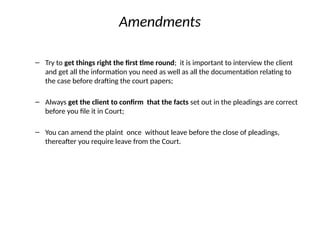
Amendments
– Try to get things right the first time round; it is important to interview the client
and get all the information you need as well as all the documentation relating to
the case before drafting the court papers;
– Always get the client to confirm that the facts set out in the pleadings are correct
before you file it in Court;
– You can amend the plaint once without leave before the close of pleadings,
thereafter you require leave from the Court.
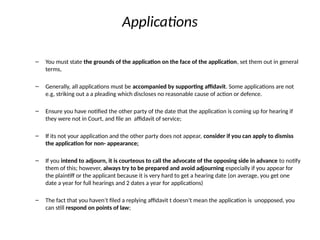
Applications
– You must state the grounds of the application on the face of the application, set them out in general
terms,
– Generally, all applications must be accompanied by supporting affidavit. Some applications are not
e.g, striking out a a pleading which discloses no reasonable cause of action or defence.
– Ensure you have notified the other party of the date that the application is coming up for hearing if
they were not in Court, and file an affidavit of service;
– If its not your application and the other party does not appear, consider if you can apply to dismiss
the application for non- appearance;
– If you intend to adjourn, it is courteous to call the advocate of the opposing side in advance to notify
them of this; however, always try to be prepared and avoid adjourning especially if you appear for
the plaintiff or the applicant because it is very hard to get a hearing date (on average, you get one
date a year for full hearings and 2 dates a year for applications)
– The fact that you haven’t filed a replying affidavit t doesn’t mean the application is unopposed, you
can still respond on points of law;
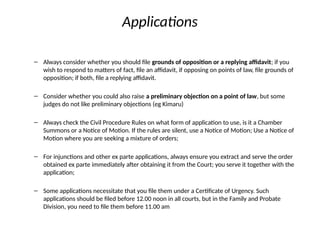
Applications
– Always consider whether you should file grounds of opposition or a replying affidavit; if you
wish to respond to matters of fact, file an affidavit, if opposing on points of law, file grounds of
opposition; if both, file a replying affidavit.
– Consider whether you could also raise a preliminary objection on a point of law, but some
judges do not like preliminary objections (eg Kimaru)
– Always check the Civil Procedure Rules on what form of application to use, is it a Chamber
Summons or a Notice of Motion. If the rules are silent, use a Notice of Motion; Use a Notice of
Motion where you are seeking a mixture of orders;
– For injunctions and other ex parte applications, always ensure you extract and serve the order
obtained ex parte immediately after obtaining it from the Court; you serve it together with the
application;
– Some applications necessitate that you file them under a Certificate of Urgency. Such
applications should be filed before 12.00 noon in all courts, but in the Family and Probate
Division, you need to file them before 11.00 am
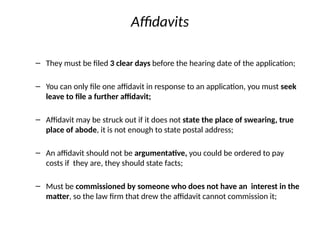
Affidavits
– They must be filed 3 clear days before the hearing date of the application;
– You can only file one affidavit in response to an application, you must seek
leave to file a further affidavit;
– Affidavit may be struck out if it does not state the place of swearing, true
place of abode, it is not enough to state postal address;
– An affidavit should not be argumentative, you could be ordered to pay
costs if they are, they should state facts;
– Must be commissioned by someone who does not have an interest in the
matter, so the law firm that drew the affidavit cannot commission it;
Affidavits:
– Must always state source of information in the affidavit where
the information contained in the affidavit is otherwise than
from the personal knowledge of the deponent;
– Where you are swearing on behalf of a company, you must
state that you have been duly authorised by the plaintiff
company to swear the affidavit on its behalf;
– For affidavits sworn outside Kenya, ensure they are notarised;
Case Preparation
– Always remember to prepare, it can win you a bad case, or lose you a good case;
– How you prove your case is very essential and the Evidence Act is very vital;
– Try and get all the documentation you need as early as possible so that when you are drafting you have
all the documentary information available;
– When arranging the list of documents, ensure your client gives you all the documents, even those not
favourable to you,
– Confirm that the client has the original documents and if not, advise him to begin looking for them early;
– Ask for originals as soon as possible, and if they are not available, consider whether you can rely on
copies under the Evidence Act;
– It is preferable that the documents are arranged in chronological order or in the alternative, in the
order in which the evidence shall be given;
Case Preparation
– Always interview the client and prepare a witness statement ;
– You are not allowed to coach your witness but you go through the case with
them,
– Ensure the client reads and confirms that the witness statement is correct;
have him sign , date and have it witnessed by anyone in his office;
– Ensure you do not disclose confidential documents in your list of documents;
e.g, correspondence passing between you as the advocate and the client.
– Framing issues, they should arise from the pleadings, the trick is to ensure
that you do not cast a heavy burden on your client;
File Management
– Always keep a copy of the letter in the file and always print out two copies of the letter so that
one can be used to acknowledge receipt;
– Scan and send an advance copy if necessary so that the hard copy of the letter can be saved in
file site
– Endorsement of files after court attendance (names of parties present, judge, orders made and
entering the dates in the litigation calendar)
– Documents (originals must not be punched, try and keep copies only, all originals can be kept
with the client or in the safe in the Office)
– Keep a record of meetings and telephone conferences, (note the names of people in attendance,
the time/duration of the meeting, date and place of the meeting), always have the attending
partner or associate confirm that the details recorded are correct and sign at the bottom before
filing it away;
Court Attendance
– Always record everything that is said in Court by the judge and all
the parties, keep the notes in the file;
– After a court attendance always think of the things that you must
do next; complete the court attendance note, note the date in the
litigation diary, update the client of the court attendance and on
what you plan to do next;
Research
– Always begin your research with the relevant statute, then a relevant text book and then
finally, look at case law;
– Try as much as possible to get Kenyan Court of Appeal decisions and if these are not available,
High Court decisions should suffice; English case law is always persuasive but not binding,
– Make a copy of any relevant case even if it is not in your favour, it is good to be aware of the
decision so that you can anticipate the arguments that may be made by the opposing side and
you can try to distinguish the case in advance;
– Always prepare a list of authorities and ensure it is filed in Court and served on the other side
before the hearing date so as to avoid an adjournment on grounds that they need to consider
the cases;
– Always highlight the relevant sections and make sufficient copies for all the parties including the
judge’s copy; for the Court of Appeal the list of authorities must be filed before 9am of the day
before the hearing)

LITIGATION PRACTICE AtND PLEADINGS.pptx

  • 1.
  • 2.
    Preliminary issues; – Alwaysbe able to identify your cause of action or defence before drafting a plaint or pleading, the cause of action or defence must have some possibility of success, otherwise, you risk the possibility of the suit or defence being struck out; – Confirm whether the action is founded within the limitation period; – Verify the names of the parties to confirm that they have been sued in the proper names and they are capable of suing and being sued; – If suing in a certain capacity you must state so e.g you must state if a minor, if suing as an administrator or executrix, representative suit, trustee, consider if you need the signed consent of others e.g in a representative suit; if suing the Government or a department of the Government, or a State Corporation ensure that the notice under the Government Proceedings Act has been issued or any other relevant notice under the establishing Act of Parliament, e.g, Kenya Railways, Kenya Civil Aviation Authority etc;
  • 3.
    Preliminary issues; – Carryout a searches before you sue a company or establishment, consider how you sue an NGO or a partnership or the proper forum in which to file your claim, eg, the Cooperatives Tribunal, the Business Premises and Rent Tribunal etc; – Confirm that the reliefs sought are available as a matter of law and are within the jurisdiction of the Court in which the claim is filed; e.g, Judicial Review – There are different courts and tribunals within which one can file a claim; establish the correct forum before filing. The Civil Procedure Act is clear on the place of suing. The Chief Justice also issues practise notes regularly. – Check the procedure under which the claim is brought to see whether it is the proper procedure; Consider whether you should institute the suit by other modes other than a plaint such as originating summons e.g for adverse possession claims or by judicial review;
  • 4.
    Preliminary issues; – Allplaints must be accompanied by a verifying affidavit, each plaintiff to swear one, if too many, annex written authority from the rest to one of them to swear affidavit on behalf of the others; if a company, board resolutions may be necessary. – Confirm that the plaint discloses pending suits if any, or states that there is no pending suit and that demand has been made. – All pleadings, applications and affidavits must be signed and dated.
  • 5.
    Sequence after thefiling of a Plaint – Ensure you apply to the court for summons to enter appearance and have them served on the other party. There are different modes of service of the summons to enter appearance under the Civil Procedure Rules e.g, if on a company, the summons to enter appearance can be served on a principal officer of the company; – If you are served with a Plaint, you must enter an appearance by filing a Memorandum of Appearance within the days prescribed in the summons and you must file a defence within 15 days from the date of entering appearance; if you are not served with the summons to enter appearance, you must file your notice of appointment of advocate, which then enables you to file replying papers on behalf of the defendant. – Consider whether you should be entering appearance under protest when you have been served with a plaint (e.g when you are disputing the jurisdiction of the Court, when alleging that the claim is time barred or that you are immune from suit
  • 6.
    Sequence after thefiling of a Plaint – You have 7 days to file a reply to a defence if you consider it necessary to do so; – Consider whether you need to put in a counter claim or a set off; – Consider whether you should issue a third party notice and seek indemnification from the third party, you need to seek leave from the Court to issue a third party notice, third party must enter an appearance;
  • 7.
    Rules of pleading –Always remember that it is a cardinal rule that you are bound by your pleadings; – Simple, clear and concise; – Try and raise each new point in a new paragraph; – Actual words used not material, except in defamation or libel cases, the purport of the words is enough; – If you allege negligence, malice or fraud you must provide particulars; – Keep your sentences short and simple, do not lump too many ideas in one paragraph;
  • 8.
    Rules of pleading –Limit yourself to the facts as your client understands them, do not plead evidence; – Do not plead law although you can raise a point of law e.g limitation, res ipsa loquitor; – Address each allegation point by point, blow to blow, – What is not denied is deemed to be admitted so you must be careful to deny every allegation specifically; – There is a joinder of issues for defences so you need not deny allegations in a defence, only file a reply to defence if necessary; – Inconsistent allegations may be raised in the alternative and without prejudice , – Limitation must be raised in the defence because it is easy to for the other party to argue that you waived it if you do not raise it at the first instance; – When drafting pleadings, always refer to Bullen & Leak
  • 9.
    Amendments – Try toget things right the first time round; it is important to interview the client and get all the information you need as well as all the documentation relating to the case before drafting the court papers; – Always get the client to confirm that the facts set out in the pleadings are correct before you file it in Court; – You can amend the plaint once without leave before the close of pleadings, thereafter you require leave from the Court.
  • 10.
    Applications – You muststate the grounds of the application on the face of the application, set them out in general terms, – Generally, all applications must be accompanied by supporting affidavit. Some applications are not e.g, striking out a a pleading which discloses no reasonable cause of action or defence. – Ensure you have notified the other party of the date that the application is coming up for hearing if they were not in Court, and file an affidavit of service; – If its not your application and the other party does not appear, consider if you can apply to dismiss the application for non- appearance; – If you intend to adjourn, it is courteous to call the advocate of the opposing side in advance to notify them of this; however, always try to be prepared and avoid adjourning especially if you appear for the plaintiff or the applicant because it is very hard to get a hearing date (on average, you get one date a year for full hearings and 2 dates a year for applications) – The fact that you haven’t filed a replying affidavit t doesn’t mean the application is unopposed, you can still respond on points of law;
  • 11.
    Applications – Always considerwhether you should file grounds of opposition or a replying affidavit; if you wish to respond to matters of fact, file an affidavit, if opposing on points of law, file grounds of opposition; if both, file a replying affidavit. – Consider whether you could also raise a preliminary objection on a point of law, but some judges do not like preliminary objections (eg Kimaru) – Always check the Civil Procedure Rules on what form of application to use, is it a Chamber Summons or a Notice of Motion. If the rules are silent, use a Notice of Motion; Use a Notice of Motion where you are seeking a mixture of orders; – For injunctions and other ex parte applications, always ensure you extract and serve the order obtained ex parte immediately after obtaining it from the Court; you serve it together with the application; – Some applications necessitate that you file them under a Certificate of Urgency. Such applications should be filed before 12.00 noon in all courts, but in the Family and Probate Division, you need to file them before 11.00 am
  • 12.
    Affidavits – They mustbe filed 3 clear days before the hearing date of the application; – You can only file one affidavit in response to an application, you must seek leave to file a further affidavit; – Affidavit may be struck out if it does not state the place of swearing, true place of abode, it is not enough to state postal address; – An affidavit should not be argumentative, you could be ordered to pay costs if they are, they should state facts; – Must be commissioned by someone who does not have an interest in the matter, so the law firm that drew the affidavit cannot commission it;
  • 13.
    Affidavits: – Must alwaysstate source of information in the affidavit where the information contained in the affidavit is otherwise than from the personal knowledge of the deponent; – Where you are swearing on behalf of a company, you must state that you have been duly authorised by the plaintiff company to swear the affidavit on its behalf; – For affidavits sworn outside Kenya, ensure they are notarised;
  • 14.
    Case Preparation – Alwaysremember to prepare, it can win you a bad case, or lose you a good case; – How you prove your case is very essential and the Evidence Act is very vital; – Try and get all the documentation you need as early as possible so that when you are drafting you have all the documentary information available; – When arranging the list of documents, ensure your client gives you all the documents, even those not favourable to you, – Confirm that the client has the original documents and if not, advise him to begin looking for them early; – Ask for originals as soon as possible, and if they are not available, consider whether you can rely on copies under the Evidence Act; – It is preferable that the documents are arranged in chronological order or in the alternative, in the order in which the evidence shall be given;
  • 15.
    Case Preparation – Alwaysinterview the client and prepare a witness statement ; – You are not allowed to coach your witness but you go through the case with them, – Ensure the client reads and confirms that the witness statement is correct; have him sign , date and have it witnessed by anyone in his office; – Ensure you do not disclose confidential documents in your list of documents; e.g, correspondence passing between you as the advocate and the client. – Framing issues, they should arise from the pleadings, the trick is to ensure that you do not cast a heavy burden on your client;
  • 16.
    File Management – Alwayskeep a copy of the letter in the file and always print out two copies of the letter so that one can be used to acknowledge receipt; – Scan and send an advance copy if necessary so that the hard copy of the letter can be saved in file site – Endorsement of files after court attendance (names of parties present, judge, orders made and entering the dates in the litigation calendar) – Documents (originals must not be punched, try and keep copies only, all originals can be kept with the client or in the safe in the Office) – Keep a record of meetings and telephone conferences, (note the names of people in attendance, the time/duration of the meeting, date and place of the meeting), always have the attending partner or associate confirm that the details recorded are correct and sign at the bottom before filing it away;
  • 17.
    Court Attendance – Alwaysrecord everything that is said in Court by the judge and all the parties, keep the notes in the file; – After a court attendance always think of the things that you must do next; complete the court attendance note, note the date in the litigation diary, update the client of the court attendance and on what you plan to do next;
  • 18.
    Research – Always beginyour research with the relevant statute, then a relevant text book and then finally, look at case law; – Try as much as possible to get Kenyan Court of Appeal decisions and if these are not available, High Court decisions should suffice; English case law is always persuasive but not binding, – Make a copy of any relevant case even if it is not in your favour, it is good to be aware of the decision so that you can anticipate the arguments that may be made by the opposing side and you can try to distinguish the case in advance; – Always prepare a list of authorities and ensure it is filed in Court and served on the other side before the hearing date so as to avoid an adjournment on grounds that they need to consider the cases; – Always highlight the relevant sections and make sufficient copies for all the parties including the judge’s copy; for the Court of Appeal the list of authorities must be filed before 9am of the day before the hearing)