Team A: Week 4-5 Discussion
Emerging Supply Chain Strategies
Henrich Edimo, MBA
Seminar in Global Supply Chain Management (DDBA 8510-3)
Moutaz Abou-Robieh, PhD
July 26, 2015
1
Robert E. Davis
Table of Contents
• Synthesis of Assigned Literature
• Gaps in Assigned Literature
• Research Topic Background
• References
• Annotated Bibliography
2
Robert E. Davis
Synthesis of Assigned Literature
(1 of 6)
• The purpose of this presentation is to explore emerging supply
chain management strategies associated with new product
developments considering trends and innovations.
• Reflective questions:
– What is a supply chain innovation?
– When should inter-organizational collaboration occur for new product
developments?
– How does supply chain strategies align with corporate strategies?
– What are the implications of diffusion in a supply chain?
– What are the supply chain management (SCM) trends applicable to
emerging supply chain strategies?
– What are the organizational customization best practices for global supply
chains?
3
Robert E. Davis
Synthesis of Assigned Literature
(2 of 6)
• Drawing on information gathered during interviews, along with
the findings of a literature review; Cassivi, Hadaya, Lefebvre, and
Lefebvre (2008) delineated innovations as process, relational, or
product. Cassivi et al. suggested process innovation influences
product innovation for the downstream design while relational
innovation effects product innovation for the upstream design.
• Concerning process integration; Parker, Zsidisin, and Ragatz
(2008) found newer products signify the need for earlier supplier
integration. Additionally, Parker et al. found prior positive
experience with the supplier and the procurement of highly
strategic items indicated the need for tighter integration.
4
Robert E. Davis
Synthesis of Assigned Literature
(3 of 6)
• In addressing relational innovation, businesses with a supply chain
strategy require integration, cooperation and collaboration
(Soosay, Hyland, & Ferrer, 2008). Soosay, Hyland, and Ferrer
(2008) described that meeting these requirements in turn demand
aligned objectives, open communication, sharing of resources,
risks and rewards. Soosay et al. found differing relationships
could affect the operation of firms and their capacities to innovate.
• Based on a mixed method study, Handfield and Lawson (2007)
found that an early supplier capabilities assessment and setting
shared technology goals can enhance the effectiveness of new
product development (NPD) project teams. Handfield and Lawson
also found performing these tasks can lead to improved product
design and financial outcomes for the enterprise.
5
Robert E. Davis
Synthesis of Assigned Literature
(4 of 6)
• Azadegan, Dooley, Carter, and Carter (2008) stated that some
enterprises have a better external knowledge absorption capacity.
Accordingly, firms with a better absorption capacity will perform
better at transforming supplier based innovations into
organizational improvements (Azadegan, Dooley, Carter, &
Carter, 2008).
• Wisma (2008) analyzed recent global supply chain management
(GSCM) trends and practices. Resultantly, Wisma suggested
contextual culture; corporate governance; politics and law; and
technology factors are critical to successful international supply
chains and risk management.
6
Robert E. Davis
Synthesis of Assigned Literature
(5 of 6)
• Supply chain management identified trends include alignment,
assessment, contractual issues, as well as management and
controls (Wisma, 2008).
– Manufactures should consider alignment between their own learning style
and that of the suppliers (Azadegan et al., 2008).
– Supply chain actions, whether strategic or tactical, should always be
aligned with the business strategy of the firm (Cassivi, 2008).
– Buyers should conduct a detailed supplier assessment prior to project
commencement (Handfield & Lawson, 2007).
– Some organizations will pay little attention to relational innovations by
developing tangible means of collaboration such as contracts (Cassivi,
2008; Soosay et al., 2008).
– Supply chain integration should be applied selectively (Parker, Zsidisin, &
Ragatz, 2008).
7
Robert E. Davis
Synthesis of Assigned Literature
(6 of 6)
• Identified organizational best practices include understanding
value sources, finding virtuousness, and tailoring business streams
(Wisma, 2008).
– Soosay et al. (2008) demonstrated how collaborative relationships can
positively affect the operation of firms and their capability to innovate.
– Considering empirical evidence, knowing with whom you are going to do
business rather than knowing how you are going to do business is a
significant issue (Cassivi et al., 2008).
– Parker et al. (2008) concluded that high levels of trust lead to tighter
integration.
– Handfield et al. (2007) indicated firms that are successful at supplier
integration employ a systematic process.
8
Robert E. Davis
Gaps in Literature
(1 of 2)
• Parker et al. (2008) explored how contingency factors affected
timing and level of supplier integration into NPD. Moreover, the
authors explored how varying levels of integration affect project
performance and reported the following gaps in literature.
– Parker et al. suggested extending the ambit of their findings by examining
the contextual factors appropriate for integrating other supply chain
organizations in NPD and their effect on project performance deserves
further research.
– Parker et al. also suggested examining NPD effects beyond the first tier in
the upstream or downstream supply chain, as well as reverse reverse logists
channels when developing new products.
9
Robert E. Davis
Gaps in Literature
(2 of 2)
• Azadegan et al. (2008) used organizational learning theory as a
framework for exploring how manufacturers can best learn from
their suppliers' innovations. The authors only expected stronger
buyer-supplier relationships to generate more effectual learning
and the impact of innovativeness to be greater when the
outsourced item is critical versus noncritical (Azadegan et al.,
2008). Consequently, the researchers reported that future research
consider other contingencies (Azadegan et al., 2008).
10
Robert E. Davis
Research Topic Background
SCM is typically considered a multidisciplinary system for
integrating domains such as strategic management, marketing, and
organizational behavior (Mentzer, Myers, & Stank, 2007; Vries &
Huijsman, 2011, p. 160). As for activities, SCM identifies,
quantifies, assesses and manages the flow of commodities through
value chains with the common goal of lessening waste and
maximizing resource efficiency (Vries & Huijsman, 2011). By
definition, SCM commodities are generic categories of purchased
items (Handfield, Sroufe, & Walton, 2005, p. 3). Therefore, a
commodity strategy is the firm’s managerial decisions addressing the
number of suppliers, sources of supply, the number of warehouses,
and supplier relationships for any single product; while remaining
purchasing policy compliant (Handfield et al., 2005, p. 3).
11
Robert E. Davis
Research Topic Background
According to Porter (as cited in Haag & Cummings, 2008), there
are three strategies available for outperforming the competition in
any industry: cost leadership, differentiation, and focus (p. 21). Cost
leadership refers to providing the same commodity priced less than
what market rivals can offer (Haag & Cummings, 2008, p. 21).
Differentiation reflects provisioning a product or service seen as
distinctive in the marketplace by customers (Haag & Cummings,
2008, p. 22). Last, focus reflects centering on presenting a
commodity to a bounded market segment or buyer group, or within a
targeted product line section (Haag & Cummings, 2008, p. 22). Of
these strategies, manufacturers utilizing a lean supply strategy are
commonly seeking competitive advantage through cost leadership
(Christopher & Towill, 2002; Mentzer et al., 2007).
12
Robert E. Davis
Research Topic Background
Quality, delivery, and cost typically dominate supplier
relationship considerations (Parker et al., 2008; Simpson & Power,
2005, p. 61). However, firms may adopt broader logistic objectives
than just ensuring the supply of materials for manufacturing products
(Simpson & Power, 2005). These additional objectives may
encompass waste reduction, innovation, or social responsibility
(Simpson & Power, 2005). Achievement of these objectives within
the supply chain requires forming and sustaining supplier
relationships through collaboration or compliance (Harms, Hansen,
& Schaltegger, 2011). Collaboration enables achieving the
objectives as mentioned above through trust, whereas compliance is
achieved through organizational power utilization (Harms et al.,
2011). Nonetheless, information sharing and a mutual commitment
13
Robert E. Davis
Research Topic Background
to performance improvement are required for both approaches; while
appropriately managing safeguards that prevent opportunism
(Simpson & Power, 2005, p. 64).
Reducing waste to produce cost leadership is the essential focal
of the lean approach (Christopher & Towill, 2002, p. 8). Whereby,
management of the supply relationship is a key lean production
component (Simpson & Power, 2005, p. 63). Regarding this matter;
lean manufacturing requires customer-supplier relationships
generating an exceptional degree of motivated learning and trust
(Simpson & Power, 2005, p. 61). In securing and maintaining lean
manufacturing benefits, lean supply deployments should reflect high-
levels of information sharing, supplier rapid performance
improvements, and low transaction costs (Simpson & Power, 2005,
14
Robert E. Davis
Research Topic Background
p. 61). Consequently, the lean supply methodology expects suppliers
to participate actively in eliminating all removable waste (Simpson &
Power, 2005, p. 63) within the commodity pipeline.
SCM strategies commonly involve inter-functional and inter-
organizational integration, coordination, and collaboration
throughout the links (Stank, Keller, & Daugherty, 2001). As a case
in point, enabling alignment flexibility to create differentiation
through service levels is the principal agile supply chain approach
objective (Christopher & Towill, 2002; Ismail & Sharifi, 2006).
Whereby, central agile administration elements are material
adjustment to market and competition requirements, reconfiguration
of processes, as well as behavioral and relationship issues resolution
(Ismail & Sharifi, 2006, p. 431). Therefore, agile methodology
15
Robert E. Davis
Research Topic Background
deployments require customer-supplier relationships generating an
exceptional degree of coordination and trust (Ismail & Sharifi, 2006).
Nonetheless, the primary challenge to inter-functional and inter-
organizational coordination is the elimination of behavioral
isolationism by organizational unit employees (Mentzer et al., 2007).
16
Robert E. Davis
References
17
Robert E. Davis
Azadegan, A., Dooley, K. J., Carter, P. L., & Carter, J. R. (2008).
Supplier innovativeness and the role of interorganizational learning
in enhancing manufacturer capabilities. Journal of Supply Chain
Management, 44(4), 14-35. doi:10.1111/j.1745-
493X.2008.00070.x
Cassivi, L., Hadaya, P., Lefebvre, E., & Lefebvre, L. A. (2008). The
role of collaboration on process, relational, and product
innovations in a supply chain. International Journal of E-
Collaboration, 4(4), 11-32. doi:10.4018/jec.2008100102
Christopher, M., & Towill, D. R. (2002). Developing market specific
supply chain strategies. International Journal of Logistics
Management, 13(1), 1-14. doi:10.1108/09574090210806324
References
18
Robert E. Davis
Haag, S., & Cummings, M. (2008). Management information systems
for the information age (Laureate Education, Inc., custom ed.).
Boston, MA: McGraw-Hill/Irwin.
Handfield, R., Sroufe, R., & Walton, S. (2005). Integrating
environmental management and supply chain strategies. Business
Strategy and the Environment, 14(1), 1-19. doi:10.1002/bse.422
Handfield, R. B., & Lawson, B. (2007). Integrating suppliers into new
product development. Research Technology Management, 50(5),
44-51. Retrieved from https://www.iriweb.org
References
19
Robert E. Davis
Harms, D., Hansen, E. G., & Schaltegger, S. (2013). Strategies in
sustainable supply chain management: An empirical investigation
of large German companies. Corporate Social Responsibility &
Environmental Management, 20(4), 205-218. doi:10.1002/csr.1293
Ismail, H. S., & Sharifi, H. (2006). A balanced approach to building
agile supply chains. International Journal of Physical Distribution
& Logistics Management, 36(6), 431-444.
doi:10.1108/09600030610677384
Mentzer, J. T., Myers, M. B., & Stank, T. P. (Eds.). (2007).
Handbook of global supply chain management. Thousand Oaks,
CA: Sage.
References
20
Robert E. Davis
Parker, D. B., Zsidisin, G. A., & Ragatz, G. L. (2008). Timing and the
extent of supplier integration in new product development: A
contingency approach. Journal of Supply Chain Management,
44(1), 71-83. doi:10.1111/j.1745-493X.2008.00046.x
Simpson, D. F., & Power, D. J. (2005). Use the supply relationship to
develop lean and green suppliers. Supply Chain Management,
10(1), 60-68. doi:10.1108/13598540510578388
Soosay, C. A., Hyland, P. W., & Ferrer, M. (2008). Supply chain
collaboration: Capabilities for continuous innovation. Supply
Chain Management, 13(2), 160-169.
doi:10.1108/13598540810860994
References
21
Robert E. Davis
Stank, T. P., Keller, S. B., & Daugherty, P. J. (2001). Supply chain
collaboration and logistical service performance. Journal of
Business Logistics, 22(1), 29-48. doi:10.1002/j.2158-
1592.2001.tb00158.x
Vries, J., & Huijsman, R. (2011). Supply chain management in health
services: An overview. Supply Chain Management: An
International Journal, 16(3), 159-165.
doi:10.1108/13598541111127146
Wisma, M. (2008). Global business management: Current trends and
practices. The Journal of Applied Business and Economics, 8, 96-
109. Retrieved from http://www.aebrjournal.org
Annotated Bibliography
(1 of 10)
22
Robert E. Davis
Evanschitzky, H., Eisend, M., Calantone, R. J., & Jiang, Y. (2012). Success factors of product
innovation: An updated meta-analysis success factors of product innovation. Journal of Product
Innovation Management 29, 21-37. doi:10.1111/j.1540-5885.2012.00964.x
Evanschitzky, Eisend, Calantone, and Jiang conducted an updated and extended the meta-
analytic investigation of the factors affecting new product success. The researchers concluded
that decreased effects of common success factors occur over time. The authors also revealed that
culture emerges as an important moderating factor on effect sizes. Moreover, the authors
identified a significant shift in research interest in NPD success factors.
The authors furnished insights concerning what implications the resource-based view implies for
product innovation, development, and launch. Moreover, the authors provided insights regarding
the variety of moderations that affect each asset basis differentially. The author suggested
scholars employ more differentiated investigations of culture as a critical factor moderating the
significance of NPD success. Additionally, the authors suggested researchers conduct further
assessments of market orientation and dedicated human resources as potentially significant
success factors.
Annotated Bibliography
(2 of 10)
23
Robert E. Davis
Gimenez, C., Vaart, T., & Donk, D. P. (2012). Supply chain integration and performance: The
moderating effect of supply complexity. International Journal of Operations & Production
Management, 32(5), 583-610. doi:10.1108/01443571211226506
Gimenez, Vaart, and Donk conducted a quantitative methods study addressing the effectiveness
of supply chain integration in different contexts. The authors found that supply chain integration
increases performance if supply complexity is high. The authors also found very limited or no
influence of supply chain integration detected in the case of low supply complexity. Moreover,
the authors found in a high supply complexity environment that structured communication use
effects cost performance adversely when pursuing supply chain integration.
This quantitative research is useful for understanding how supply complexity moderates the
relationship between integration and performance. First, the authors suggested future studies
examine the interrelationships of the constructs on cooperative behavior. Second, the authors
suggested further research to investigate if structured communication increases costs in large
firms. Third, the authors suggested future studies analyze the interrelationships between the
different integration dimensions and their effects on performance. Fourth, the authors suggested
further research to examine in more detail the integration profiles required under various levels of
supply complexity.
Annotated Bibliography
(3 of 10)
24
Robert E. Davis
Gunasekaran, A., Hong, P., & Fujimoto, T. (2014). Building supply chain system capabilities in the
age of global complexity: Emerging theories and practices. International Journal of Production
Economics, 147, 189-197. doi:10.1016/j.ijpe.2013.11.012
Gunasekaran, Hong, and Fujimoto provided a special issue editorial of the International Journal
of Production Economics. Gunasekaran et al. suggested emerging theories and practices deserve
careful examination. The authors concluded that selected special issue articles brought out the
problem associated with constructing sustainable supply chain capabilities in the era of global
complexity. The authors indicated the special publication included innovative and conceptual,
analytical, and empirical studies that addressed design and implementation issues of sustainable
development strategies and techniques or related issues for building sustainable supply chain
capabilities.
Gunasekaran et al. furnished insights concerning suitable strategies, and relevant methods and
technologies for building sustainable supply chain capabilities in the global complexity era.
Gunasekaran et al. suggested the special issue provides a basis for exploring the emerging
theories and practices of global complexity. Moreover, the authors suggested that resultantly
further development, as well as refinement through future research, could occur.
Annotated Bibliography
(4 of 10)
25
Robert E. Davis
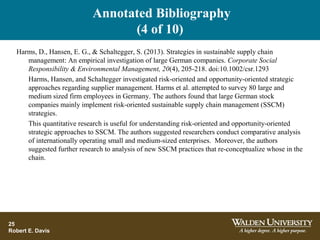
Harms, D., Hansen, E. G., & Schaltegger, S. (2013). Strategies in sustainable supply chain
management: An empirical investigation of large German companies. Corporate Social
Responsibility & Environmental Management, 20(4), 205-218. doi:10.1002/csr.1293
Harms, Hansen, and Schaltegger investigated risk-oriented and opportunity-oriented strategic
approaches regarding supplier management. Harms et al. attempted to survey 80 large and
medium sized firm employees in Germany. The authors found that large German stock
companies mainly implement risk-oriented sustainable supply chain management (SSCM)
strategies.
This quantitative research is useful for understanding risk-oriented and opportunity-oriented
strategic approaches to SSCM. The authors suggested researchers conduct comparative analysis
of internationally operating small and medium-sized enterprises. Moreover, the authors
suggested further research to analysis of new SSCM practices that re-conceptualize whose in the
chain.
Annotated Bibliography
(5 of 10)
26
Robert E. Davis
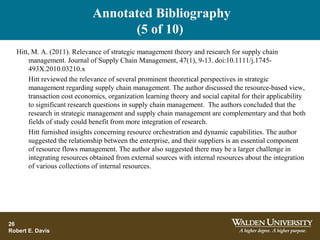
Hitt, M. A. (2011). Relevance of strategic management theory and research for supply chain
management. Journal of Supply Chain Management, 47(1), 9-13. doi:10.1111/j.1745-
493X.2010.03210.x
Hitt reviewed the relevance of several prominent theoretical perspectives in strategic
management regarding supply chain management. The author discussed the resource-based view,
transaction cost economics, organization learning theory and social capital for their applicability
to significant research questions in supply chain management. The authors concluded that the
research in strategic management and supply chain management are complementary and that both
fields of study could benefit from more integration of research.
Hitt furnished insights concerning resource orchestration and dynamic capabilities. The author
suggested the relationship between the enterprise, and their suppliers is an essential component
of resource flows management. The author also suggested there may be a larger challenge in
integrating resources obtained from external sources with internal resources about the integration
of various collections of internal resources.
Annotated Bibliography
(6 of 10)
27
Robert E. Davis
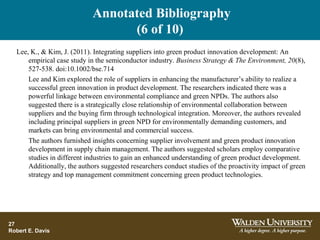
Lee, K., & Kim, J. (2011). Integrating suppliers into green product innovation development: An
empirical case study in the semiconductor industry. Business Strategy & The Environment, 20(8),
527-538. doi:10.1002/bse.714
Lee and Kim explored the role of suppliers in enhancing the manufacturer’s ability to realize a
successful green innovation in product development. The researchers indicated there was a
powerful linkage between environmental compliance and green NPDs. The authors also
suggested there is a strategically close relationship of environmental collaboration between
suppliers and the buying firm through technological integration. Moreover, the authors revealed
including principal suppliers in green NPD for environmentally demanding customers, and
markets can bring environmental and commercial success.
The authors furnished insights concerning supplier involvement and green product innovation
development in supply chain management. The authors suggested scholars employ comparative
studies in different industries to gain an enhanced understanding of green product development.
Additionally, the authors suggested researchers conduct studies of the proactivity impact of green
strategy and top management commitment concerning green product technologies.
Annotated Bibliography
(7 of 10)
28
Robert E. Davis
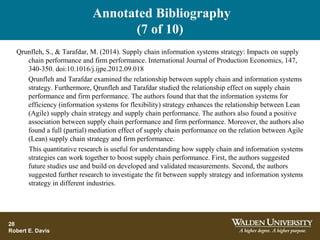
Qrunfleh, S., & Tarafdar, M. (2014). Supply chain information systems strategy: Impacts on supply
chain performance and firm performance. International Journal of Production Economics, 147,
340-350. doi:10.1016/j.ijpe.2012.09.018
Qrunfleh and Tarafdar examined the relationship between supply chain and information systems
strategy. Furthermore, Qrunfleh and Tarafdar studied the relationship effect on supply chain
performance and firm performance. The authors found that that the information systems for
efficiency (information systems for flexibility) strategy enhances the relationship between Lean
(Agile) supply chain strategy and supply chain performance. The authors also found a positive
association between supply chain performance and firm performance. Moreover, the authors also
found a full (partial) mediation effect of supply chain performance on the relation between Agile
(Lean) supply chain strategy and firm performance.
This quantitative research is useful for understanding how supply chain and information systems
strategies can work together to boost supply chain performance. First, the authors suggested
future studies use and build on developed and validated measurements. Second, the authors
suggested further research to investigate the fit between supply strategy and information systems
strategy in different industries.
Annotated Bibliography
(8 of 10)
29
Robert E. Davis
Roh, J., Hong, P., & Min, H. (2014). Implementation of a responsive supply chain strategy in global
complexity: The case of manufacturing firms. International Journal of Production Economics,
147, 198-210. doi:10.1016/j.ijpe.2013.04.013
Roh, Hong and Min examined how firms construct a responsive supply chain in global
manufacturing environments. Built upon a synthesis of the existing literature and relevant
theories, Roh et al., presented a research model that defined the drivers, strategy, and practices of
a responsive supply chain and the performance outcomes. The authors showed that effectual
implementation of a responsive supply chain strategy involves the integration of inter-
organizational resources across the global supply chain to enhance pull production capabilities.
This quantitative research is useful for understanding the definitional requirement for a
responsive supply chain strategy in terms of the product range, as well as the frequency and
innovativeness of the product offerings. The author suggested that the foundational contextual
factors that affect the extent of a responsive supply chain strategy deployment are mostly the size
of firms, industry characteristics, and customer as well as supplier bases. Moreover, the authors
suggested researchers conduct studies considering how firms effectively respond through their
supply chains to changing market requirements while identifying and incorporating emerging
supply chain practices. Last, the authors suggest researchers elaborate on the multiple dimensions
of various types of supply chains..
.
Annotated Bibliography
(9 of 10)
30
Robert E. Davis
West, J., & Bogers, M. (2014). Leveraging external sources of innovation: A review of research on
open innovation. Journal of Product Innovation Management, 31(4), 814-831.
doi:10.1111/jpim.12125
West and Bogers conducted a meta-analytic investigation of open innovation considering how
and why firms commercialize external sources of innovations. The researchers concluded there
was a trend to ignore the importance of business models. Moreover, the authors identified a trend
in open innovation to employ innovation in a way inconsistent with earlier innovation
management definitions.
The authors furnished insights concerning the convergence, divergence, and gaps in the academic
literature on leveraging external sources of innovation. The author suggested scholars examine
the end-to-end innovation commercialization process. Additionally, the authors suggested
researchers investigate the moderators and boundaries of leveraging external sources of
innovation.
Annotated Bibliography
(10 of 10)
31
Robert E. Davis
Zhu, Q., Sarkis, J., & Lai, K. H. (2012). Green supply chain management innovation diffusion and its
relationship to organizational improvement: An ecological modernization perspective. Journal of
Engineering and Technology Management, 29(1), 168-185.
doi:10.1016/j.jengtecman.2011.09.012
Zhu, Sarkis, and Lai presented an overview of green supply chain management (GSCM)
innovation diffusion. Drawing on innovation diffusion and ecological modernization theories,
Zhu et al., identified three types of industrial manufacturers based on the adoption of GSCM
practices. The researchers indicated that differences exist between the three types of GSCM
adopters in terms of their environmental, operational, and economic performance.
The authors furnished insights concerning the benchmarking for environmental management
practices and performance improvement. The authors suggested scholars examine if and how
Chinese manufacturers can learn from similar foreign manufacturers. Moreover, the authors
suggested researchers investigate early adopter diffusion to the followers as well as the laggards.
Last, the authors suggested researchers examine alternative motivations for adopting GSCM and
how they influence innovation diffusion as well as the link to performance outcomes.

Week 5 Presentation

  • 1.
    Team A: Week4-5 Discussion Emerging Supply Chain Strategies Henrich Edimo, MBA Seminar in Global Supply Chain Management (DDBA 8510-3) Moutaz Abou-Robieh, PhD July 26, 2015 1 Robert E. Davis
  • 2.
    Table of Contents •Synthesis of Assigned Literature • Gaps in Assigned Literature • Research Topic Background • References • Annotated Bibliography 2 Robert E. Davis
  • 3.
    Synthesis of AssignedLiterature (1 of 6) • The purpose of this presentation is to explore emerging supply chain management strategies associated with new product developments considering trends and innovations. • Reflective questions: – What is a supply chain innovation? – When should inter-organizational collaboration occur for new product developments? – How does supply chain strategies align with corporate strategies? – What are the implications of diffusion in a supply chain? – What are the supply chain management (SCM) trends applicable to emerging supply chain strategies? – What are the organizational customization best practices for global supply chains? 3 Robert E. Davis
  • 4.
    Synthesis of AssignedLiterature (2 of 6) • Drawing on information gathered during interviews, along with the findings of a literature review; Cassivi, Hadaya, Lefebvre, and Lefebvre (2008) delineated innovations as process, relational, or product. Cassivi et al. suggested process innovation influences product innovation for the downstream design while relational innovation effects product innovation for the upstream design. • Concerning process integration; Parker, Zsidisin, and Ragatz (2008) found newer products signify the need for earlier supplier integration. Additionally, Parker et al. found prior positive experience with the supplier and the procurement of highly strategic items indicated the need for tighter integration. 4 Robert E. Davis
  • 5.
    Synthesis of AssignedLiterature (3 of 6) • In addressing relational innovation, businesses with a supply chain strategy require integration, cooperation and collaboration (Soosay, Hyland, & Ferrer, 2008). Soosay, Hyland, and Ferrer (2008) described that meeting these requirements in turn demand aligned objectives, open communication, sharing of resources, risks and rewards. Soosay et al. found differing relationships could affect the operation of firms and their capacities to innovate. • Based on a mixed method study, Handfield and Lawson (2007) found that an early supplier capabilities assessment and setting shared technology goals can enhance the effectiveness of new product development (NPD) project teams. Handfield and Lawson also found performing these tasks can lead to improved product design and financial outcomes for the enterprise. 5 Robert E. Davis
  • 6.
    Synthesis of AssignedLiterature (4 of 6) • Azadegan, Dooley, Carter, and Carter (2008) stated that some enterprises have a better external knowledge absorption capacity. Accordingly, firms with a better absorption capacity will perform better at transforming supplier based innovations into organizational improvements (Azadegan, Dooley, Carter, & Carter, 2008). • Wisma (2008) analyzed recent global supply chain management (GSCM) trends and practices. Resultantly, Wisma suggested contextual culture; corporate governance; politics and law; and technology factors are critical to successful international supply chains and risk management. 6 Robert E. Davis
  • 7.
    Synthesis of AssignedLiterature (5 of 6) • Supply chain management identified trends include alignment, assessment, contractual issues, as well as management and controls (Wisma, 2008). – Manufactures should consider alignment between their own learning style and that of the suppliers (Azadegan et al., 2008). – Supply chain actions, whether strategic or tactical, should always be aligned with the business strategy of the firm (Cassivi, 2008). – Buyers should conduct a detailed supplier assessment prior to project commencement (Handfield & Lawson, 2007). – Some organizations will pay little attention to relational innovations by developing tangible means of collaboration such as contracts (Cassivi, 2008; Soosay et al., 2008). – Supply chain integration should be applied selectively (Parker, Zsidisin, & Ragatz, 2008). 7 Robert E. Davis
  • 8.
    Synthesis of AssignedLiterature (6 of 6) • Identified organizational best practices include understanding value sources, finding virtuousness, and tailoring business streams (Wisma, 2008). – Soosay et al. (2008) demonstrated how collaborative relationships can positively affect the operation of firms and their capability to innovate. – Considering empirical evidence, knowing with whom you are going to do business rather than knowing how you are going to do business is a significant issue (Cassivi et al., 2008). – Parker et al. (2008) concluded that high levels of trust lead to tighter integration. – Handfield et al. (2007) indicated firms that are successful at supplier integration employ a systematic process. 8 Robert E. Davis
  • 9.
    Gaps in Literature (1of 2) • Parker et al. (2008) explored how contingency factors affected timing and level of supplier integration into NPD. Moreover, the authors explored how varying levels of integration affect project performance and reported the following gaps in literature. – Parker et al. suggested extending the ambit of their findings by examining the contextual factors appropriate for integrating other supply chain organizations in NPD and their effect on project performance deserves further research. – Parker et al. also suggested examining NPD effects beyond the first tier in the upstream or downstream supply chain, as well as reverse reverse logists channels when developing new products. 9 Robert E. Davis
  • 10.
    Gaps in Literature (2of 2) • Azadegan et al. (2008) used organizational learning theory as a framework for exploring how manufacturers can best learn from their suppliers' innovations. The authors only expected stronger buyer-supplier relationships to generate more effectual learning and the impact of innovativeness to be greater when the outsourced item is critical versus noncritical (Azadegan et al., 2008). Consequently, the researchers reported that future research consider other contingencies (Azadegan et al., 2008). 10 Robert E. Davis
  • 11.
    Research Topic Background SCMis typically considered a multidisciplinary system for integrating domains such as strategic management, marketing, and organizational behavior (Mentzer, Myers, & Stank, 2007; Vries & Huijsman, 2011, p. 160). As for activities, SCM identifies, quantifies, assesses and manages the flow of commodities through value chains with the common goal of lessening waste and maximizing resource efficiency (Vries & Huijsman, 2011). By definition, SCM commodities are generic categories of purchased items (Handfield, Sroufe, & Walton, 2005, p. 3). Therefore, a commodity strategy is the firm’s managerial decisions addressing the number of suppliers, sources of supply, the number of warehouses, and supplier relationships for any single product; while remaining purchasing policy compliant (Handfield et al., 2005, p. 3). 11 Robert E. Davis
  • 12.
    Research Topic Background Accordingto Porter (as cited in Haag & Cummings, 2008), there are three strategies available for outperforming the competition in any industry: cost leadership, differentiation, and focus (p. 21). Cost leadership refers to providing the same commodity priced less than what market rivals can offer (Haag & Cummings, 2008, p. 21). Differentiation reflects provisioning a product or service seen as distinctive in the marketplace by customers (Haag & Cummings, 2008, p. 22). Last, focus reflects centering on presenting a commodity to a bounded market segment or buyer group, or within a targeted product line section (Haag & Cummings, 2008, p. 22). Of these strategies, manufacturers utilizing a lean supply strategy are commonly seeking competitive advantage through cost leadership (Christopher & Towill, 2002; Mentzer et al., 2007). 12 Robert E. Davis
  • 13.
    Research Topic Background Quality,delivery, and cost typically dominate supplier relationship considerations (Parker et al., 2008; Simpson & Power, 2005, p. 61). However, firms may adopt broader logistic objectives than just ensuring the supply of materials for manufacturing products (Simpson & Power, 2005). These additional objectives may encompass waste reduction, innovation, or social responsibility (Simpson & Power, 2005). Achievement of these objectives within the supply chain requires forming and sustaining supplier relationships through collaboration or compliance (Harms, Hansen, & Schaltegger, 2011). Collaboration enables achieving the objectives as mentioned above through trust, whereas compliance is achieved through organizational power utilization (Harms et al., 2011). Nonetheless, information sharing and a mutual commitment 13 Robert E. Davis
  • 14.
    Research Topic Background toperformance improvement are required for both approaches; while appropriately managing safeguards that prevent opportunism (Simpson & Power, 2005, p. 64). Reducing waste to produce cost leadership is the essential focal of the lean approach (Christopher & Towill, 2002, p. 8). Whereby, management of the supply relationship is a key lean production component (Simpson & Power, 2005, p. 63). Regarding this matter; lean manufacturing requires customer-supplier relationships generating an exceptional degree of motivated learning and trust (Simpson & Power, 2005, p. 61). In securing and maintaining lean manufacturing benefits, lean supply deployments should reflect high- levels of information sharing, supplier rapid performance improvements, and low transaction costs (Simpson & Power, 2005, 14 Robert E. Davis
  • 15.
    Research Topic Background p.61). Consequently, the lean supply methodology expects suppliers to participate actively in eliminating all removable waste (Simpson & Power, 2005, p. 63) within the commodity pipeline. SCM strategies commonly involve inter-functional and inter- organizational integration, coordination, and collaboration throughout the links (Stank, Keller, & Daugherty, 2001). As a case in point, enabling alignment flexibility to create differentiation through service levels is the principal agile supply chain approach objective (Christopher & Towill, 2002; Ismail & Sharifi, 2006). Whereby, central agile administration elements are material adjustment to market and competition requirements, reconfiguration of processes, as well as behavioral and relationship issues resolution (Ismail & Sharifi, 2006, p. 431). Therefore, agile methodology 15 Robert E. Davis
  • 16.
    Research Topic Background deploymentsrequire customer-supplier relationships generating an exceptional degree of coordination and trust (Ismail & Sharifi, 2006). Nonetheless, the primary challenge to inter-functional and inter- organizational coordination is the elimination of behavioral isolationism by organizational unit employees (Mentzer et al., 2007). 16 Robert E. Davis
  • 17.
    References 17 Robert E. Davis Azadegan,A., Dooley, K. J., Carter, P. L., & Carter, J. R. (2008). Supplier innovativeness and the role of interorganizational learning in enhancing manufacturer capabilities. Journal of Supply Chain Management, 44(4), 14-35. doi:10.1111/j.1745- 493X.2008.00070.x Cassivi, L., Hadaya, P., Lefebvre, E., & Lefebvre, L. A. (2008). The role of collaboration on process, relational, and product innovations in a supply chain. International Journal of E- Collaboration, 4(4), 11-32. doi:10.4018/jec.2008100102 Christopher, M., & Towill, D. R. (2002). Developing market specific supply chain strategies. International Journal of Logistics Management, 13(1), 1-14. doi:10.1108/09574090210806324
  • 18.
    References 18 Robert E. Davis Haag,S., & Cummings, M. (2008). Management information systems for the information age (Laureate Education, Inc., custom ed.). Boston, MA: McGraw-Hill/Irwin. Handfield, R., Sroufe, R., & Walton, S. (2005). Integrating environmental management and supply chain strategies. Business Strategy and the Environment, 14(1), 1-19. doi:10.1002/bse.422 Handfield, R. B., & Lawson, B. (2007). Integrating suppliers into new product development. Research Technology Management, 50(5), 44-51. Retrieved from https://www.iriweb.org
  • 19.
    References 19 Robert E. Davis Harms,D., Hansen, E. G., & Schaltegger, S. (2013). Strategies in sustainable supply chain management: An empirical investigation of large German companies. Corporate Social Responsibility & Environmental Management, 20(4), 205-218. doi:10.1002/csr.1293 Ismail, H. S., & Sharifi, H. (2006). A balanced approach to building agile supply chains. International Journal of Physical Distribution & Logistics Management, 36(6), 431-444. doi:10.1108/09600030610677384 Mentzer, J. T., Myers, M. B., & Stank, T. P. (Eds.). (2007). Handbook of global supply chain management. Thousand Oaks, CA: Sage.
  • 20.
    References 20 Robert E. Davis Parker,D. B., Zsidisin, G. A., & Ragatz, G. L. (2008). Timing and the extent of supplier integration in new product development: A contingency approach. Journal of Supply Chain Management, 44(1), 71-83. doi:10.1111/j.1745-493X.2008.00046.x Simpson, D. F., & Power, D. J. (2005). Use the supply relationship to develop lean and green suppliers. Supply Chain Management, 10(1), 60-68. doi:10.1108/13598540510578388 Soosay, C. A., Hyland, P. W., & Ferrer, M. (2008). Supply chain collaboration: Capabilities for continuous innovation. Supply Chain Management, 13(2), 160-169. doi:10.1108/13598540810860994
  • 21.
    References 21 Robert E. Davis Stank,T. P., Keller, S. B., & Daugherty, P. J. (2001). Supply chain collaboration and logistical service performance. Journal of Business Logistics, 22(1), 29-48. doi:10.1002/j.2158- 1592.2001.tb00158.x Vries, J., & Huijsman, R. (2011). Supply chain management in health services: An overview. Supply Chain Management: An International Journal, 16(3), 159-165. doi:10.1108/13598541111127146 Wisma, M. (2008). Global business management: Current trends and practices. The Journal of Applied Business and Economics, 8, 96- 109. Retrieved from http://www.aebrjournal.org
  • 22.
    Annotated Bibliography (1 of10) 22 Robert E. Davis Evanschitzky, H., Eisend, M., Calantone, R. J., & Jiang, Y. (2012). Success factors of product innovation: An updated meta-analysis success factors of product innovation. Journal of Product Innovation Management 29, 21-37. doi:10.1111/j.1540-5885.2012.00964.x Evanschitzky, Eisend, Calantone, and Jiang conducted an updated and extended the meta- analytic investigation of the factors affecting new product success. The researchers concluded that decreased effects of common success factors occur over time. The authors also revealed that culture emerges as an important moderating factor on effect sizes. Moreover, the authors identified a significant shift in research interest in NPD success factors. The authors furnished insights concerning what implications the resource-based view implies for product innovation, development, and launch. Moreover, the authors provided insights regarding the variety of moderations that affect each asset basis differentially. The author suggested scholars employ more differentiated investigations of culture as a critical factor moderating the significance of NPD success. Additionally, the authors suggested researchers conduct further assessments of market orientation and dedicated human resources as potentially significant success factors.
  • 23.
    Annotated Bibliography (2 of10) 23 Robert E. Davis Gimenez, C., Vaart, T., & Donk, D. P. (2012). Supply chain integration and performance: The moderating effect of supply complexity. International Journal of Operations & Production Management, 32(5), 583-610. doi:10.1108/01443571211226506 Gimenez, Vaart, and Donk conducted a quantitative methods study addressing the effectiveness of supply chain integration in different contexts. The authors found that supply chain integration increases performance if supply complexity is high. The authors also found very limited or no influence of supply chain integration detected in the case of low supply complexity. Moreover, the authors found in a high supply complexity environment that structured communication use effects cost performance adversely when pursuing supply chain integration. This quantitative research is useful for understanding how supply complexity moderates the relationship between integration and performance. First, the authors suggested future studies examine the interrelationships of the constructs on cooperative behavior. Second, the authors suggested further research to investigate if structured communication increases costs in large firms. Third, the authors suggested future studies analyze the interrelationships between the different integration dimensions and their effects on performance. Fourth, the authors suggested further research to examine in more detail the integration profiles required under various levels of supply complexity.
  • 24.
    Annotated Bibliography (3 of10) 24 Robert E. Davis Gunasekaran, A., Hong, P., & Fujimoto, T. (2014). Building supply chain system capabilities in the age of global complexity: Emerging theories and practices. International Journal of Production Economics, 147, 189-197. doi:10.1016/j.ijpe.2013.11.012 Gunasekaran, Hong, and Fujimoto provided a special issue editorial of the International Journal of Production Economics. Gunasekaran et al. suggested emerging theories and practices deserve careful examination. The authors concluded that selected special issue articles brought out the problem associated with constructing sustainable supply chain capabilities in the era of global complexity. The authors indicated the special publication included innovative and conceptual, analytical, and empirical studies that addressed design and implementation issues of sustainable development strategies and techniques or related issues for building sustainable supply chain capabilities. Gunasekaran et al. furnished insights concerning suitable strategies, and relevant methods and technologies for building sustainable supply chain capabilities in the global complexity era. Gunasekaran et al. suggested the special issue provides a basis for exploring the emerging theories and practices of global complexity. Moreover, the authors suggested that resultantly further development, as well as refinement through future research, could occur.
  • 25.
    Annotated Bibliography (4 of10) 25 Robert E. Davis Harms, D., Hansen, E. G., & Schaltegger, S. (2013). Strategies in sustainable supply chain management: An empirical investigation of large German companies. Corporate Social Responsibility & Environmental Management, 20(4), 205-218. doi:10.1002/csr.1293 Harms, Hansen, and Schaltegger investigated risk-oriented and opportunity-oriented strategic approaches regarding supplier management. Harms et al. attempted to survey 80 large and medium sized firm employees in Germany. The authors found that large German stock companies mainly implement risk-oriented sustainable supply chain management (SSCM) strategies. This quantitative research is useful for understanding risk-oriented and opportunity-oriented strategic approaches to SSCM. The authors suggested researchers conduct comparative analysis of internationally operating small and medium-sized enterprises. Moreover, the authors suggested further research to analysis of new SSCM practices that re-conceptualize whose in the chain.
  • 26.
    Annotated Bibliography (5 of10) 26 Robert E. Davis Hitt, M. A. (2011). Relevance of strategic management theory and research for supply chain management. Journal of Supply Chain Management, 47(1), 9-13. doi:10.1111/j.1745- 493X.2010.03210.x Hitt reviewed the relevance of several prominent theoretical perspectives in strategic management regarding supply chain management. The author discussed the resource-based view, transaction cost economics, organization learning theory and social capital for their applicability to significant research questions in supply chain management. The authors concluded that the research in strategic management and supply chain management are complementary and that both fields of study could benefit from more integration of research. Hitt furnished insights concerning resource orchestration and dynamic capabilities. The author suggested the relationship between the enterprise, and their suppliers is an essential component of resource flows management. The author also suggested there may be a larger challenge in integrating resources obtained from external sources with internal resources about the integration of various collections of internal resources.
  • 27.
    Annotated Bibliography (6 of10) 27 Robert E. Davis Lee, K., & Kim, J. (2011). Integrating suppliers into green product innovation development: An empirical case study in the semiconductor industry. Business Strategy & The Environment, 20(8), 527-538. doi:10.1002/bse.714 Lee and Kim explored the role of suppliers in enhancing the manufacturer’s ability to realize a successful green innovation in product development. The researchers indicated there was a powerful linkage between environmental compliance and green NPDs. The authors also suggested there is a strategically close relationship of environmental collaboration between suppliers and the buying firm through technological integration. Moreover, the authors revealed including principal suppliers in green NPD for environmentally demanding customers, and markets can bring environmental and commercial success. The authors furnished insights concerning supplier involvement and green product innovation development in supply chain management. The authors suggested scholars employ comparative studies in different industries to gain an enhanced understanding of green product development. Additionally, the authors suggested researchers conduct studies of the proactivity impact of green strategy and top management commitment concerning green product technologies.
  • 28.
    Annotated Bibliography (7 of10) 28 Robert E. Davis Qrunfleh, S., & Tarafdar, M. (2014). Supply chain information systems strategy: Impacts on supply chain performance and firm performance. International Journal of Production Economics, 147, 340-350. doi:10.1016/j.ijpe.2012.09.018 Qrunfleh and Tarafdar examined the relationship between supply chain and information systems strategy. Furthermore, Qrunfleh and Tarafdar studied the relationship effect on supply chain performance and firm performance. The authors found that that the information systems for efficiency (information systems for flexibility) strategy enhances the relationship between Lean (Agile) supply chain strategy and supply chain performance. The authors also found a positive association between supply chain performance and firm performance. Moreover, the authors also found a full (partial) mediation effect of supply chain performance on the relation between Agile (Lean) supply chain strategy and firm performance. This quantitative research is useful for understanding how supply chain and information systems strategies can work together to boost supply chain performance. First, the authors suggested future studies use and build on developed and validated measurements. Second, the authors suggested further research to investigate the fit between supply strategy and information systems strategy in different industries.
  • 29.
    Annotated Bibliography (8 of10) 29 Robert E. Davis Roh, J., Hong, P., & Min, H. (2014). Implementation of a responsive supply chain strategy in global complexity: The case of manufacturing firms. International Journal of Production Economics, 147, 198-210. doi:10.1016/j.ijpe.2013.04.013 Roh, Hong and Min examined how firms construct a responsive supply chain in global manufacturing environments. Built upon a synthesis of the existing literature and relevant theories, Roh et al., presented a research model that defined the drivers, strategy, and practices of a responsive supply chain and the performance outcomes. The authors showed that effectual implementation of a responsive supply chain strategy involves the integration of inter- organizational resources across the global supply chain to enhance pull production capabilities. This quantitative research is useful for understanding the definitional requirement for a responsive supply chain strategy in terms of the product range, as well as the frequency and innovativeness of the product offerings. The author suggested that the foundational contextual factors that affect the extent of a responsive supply chain strategy deployment are mostly the size of firms, industry characteristics, and customer as well as supplier bases. Moreover, the authors suggested researchers conduct studies considering how firms effectively respond through their supply chains to changing market requirements while identifying and incorporating emerging supply chain practices. Last, the authors suggest researchers elaborate on the multiple dimensions of various types of supply chains.. .
  • 30.
    Annotated Bibliography (9 of10) 30 Robert E. Davis West, J., & Bogers, M. (2014). Leveraging external sources of innovation: A review of research on open innovation. Journal of Product Innovation Management, 31(4), 814-831. doi:10.1111/jpim.12125 West and Bogers conducted a meta-analytic investigation of open innovation considering how and why firms commercialize external sources of innovations. The researchers concluded there was a trend to ignore the importance of business models. Moreover, the authors identified a trend in open innovation to employ innovation in a way inconsistent with earlier innovation management definitions. The authors furnished insights concerning the convergence, divergence, and gaps in the academic literature on leveraging external sources of innovation. The author suggested scholars examine the end-to-end innovation commercialization process. Additionally, the authors suggested researchers investigate the moderators and boundaries of leveraging external sources of innovation.
  • 31.
    Annotated Bibliography (10 of10) 31 Robert E. Davis Zhu, Q., Sarkis, J., & Lai, K. H. (2012). Green supply chain management innovation diffusion and its relationship to organizational improvement: An ecological modernization perspective. Journal of Engineering and Technology Management, 29(1), 168-185. doi:10.1016/j.jengtecman.2011.09.012 Zhu, Sarkis, and Lai presented an overview of green supply chain management (GSCM) innovation diffusion. Drawing on innovation diffusion and ecological modernization theories, Zhu et al., identified three types of industrial manufacturers based on the adoption of GSCM practices. The researchers indicated that differences exist between the three types of GSCM adopters in terms of their environmental, operational, and economic performance. The authors furnished insights concerning the benchmarking for environmental management practices and performance improvement. The authors suggested scholars examine if and how Chinese manufacturers can learn from similar foreign manufacturers. Moreover, the authors suggested researchers investigate early adopter diffusion to the followers as well as the laggards. Last, the authors suggested researchers examine alternative motivations for adopting GSCM and how they influence innovation diffusion as well as the link to performance outcomes.