Solution Manual for Organizational Behavior:
Bridging Science and Practice Version 3.0 download

pdf
http://testbankbell.com/product/solution-manual-for-organizational-
behavior-bridging-science-and-practice-version-3-0/
Visit testbankbell.com today to download the complete set of
test banks or solution manuals!
We have selected some products that you may be interested in
Click the link to download now or visit testbankbell.com
for more options!.
Test Bank for Organizational Behavior: Bridging Science
and Practice Version 3.0

http://testbankbell.com/product/test-bank-for-organizational-behavior-
bridging-science-and-practice-version-3-0/
Solution Manual for Organizational Behavior Science, The
Real World, and You, 8th Edition
http://testbankbell.com/product/solution-manual-for-organizational-
behavior-science-the-real-world-and-you-8th-edition/
Test Bank for Principles of Economics Version: 3.0
Rittenberg
http://testbankbell.com/product/test-bank-for-principles-of-economics-
version-3-0-rittenberg/
Solution Manual for Elementary Statistics, 7th Edition,
Ron Larson, Betsy Farber
http://testbankbell.com/product/solution-manual-for-elementary-
statistics-7th-edition-ron-larson-betsy-farber/
Test Bank for General, Organic, & Biological Chemistry 4th
by Gorzynski
http://testbankbell.com/product/test-bank-for-general-organic-
biological-chemistry-4th-by-gorzynski/
Physics Walker 4th Edition Test Bank
http://testbankbell.com/product/physics-walker-4th-edition-test-bank/
Test Bank for Principles of Economics 2nd Edition Coppock
http://testbankbell.com/product/test-bank-for-principles-of-
economics-2nd-edition-coppock/
Test Bank for American Pageant, Volume 1, 16th Edition
http://testbankbell.com/product/test-bank-for-american-pageant-
volume-1-16th-edition/
Fundamental Accounting Principles Wild 19th Edition
Solutions Manual
http://testbankbell.com/product/fundamental-accounting-principles-
wild-19th-edition-solutions-manual/
Test Bank for International Financial Management 13th
Edition
http://testbankbell.com/product/test-bank-for-international-financial-
management-13th-edition/
Solution Manual for Organizational
Behavior: Bridging Science and Practice
Version 3.0

Full download chapter at: https://testbankbell.com/product/solution-
manual-for-organizational-behavior-bridging-science-and-practice-
version-3-0/
When purchased from FlatWorld (the publisher), this Color Print Textbook includes
Online Access, Quizzes, Flashcards and Homework (if professor uses Homework
system). Online textbook is accessible. By expertly weaving together the equally
important strands of management theory and practice, Organizational Behavior:
Bridging Science and Practice provides students with the key vocabulary, conceptual
frameworks, and critical thinking skills necessary to diagnose work-based interactions,
ask pertinent questions, evaluate gathered data, and act in an effective and ethical
manner regardless of situational characteristics.
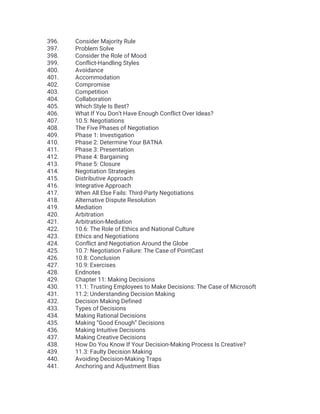
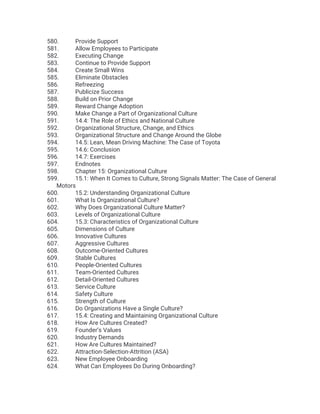
1. Brief Contents
2. Contents
3. About the Authors
4. Acknowledgments
5. Dedications
6. Preface
7. Chapter 1: Organizational Behavior
8. 1.1: Employee Engagement in Organizational Change Toward B Corp Status: The
Case of Townshend’s Te
9. 1.2: Understanding Organizational Behavior
10. About This Book
11. What Is Organizational Behavior?
12. Why Organizational Behavior Matters
13. Adding to Your OB Toolbox
14. Isn’t OB Just Common Sense?
15. 1.3: Learning and Retention
16. Learning and Retaining Information
17. Learning Style Preferences
18. Internships as Learning Opportunities
19. 1.4: Organizational Behavior Research Methods
20. Research Concepts, Tools, and Approaches
21. Surveys
22. Field Studies
23. Laboratory Studies
24. Case Studies
25. Meta-Analysis
26. Machine Learning
27. Measurement Issues in OB
28. Analytics
29. 1.5: Trends Influencing Organizational Behavior
30. Challenges and Opportunities
31. Ethical Challenges
32. Online Data Privacy Concerns
33. Lack of Employee Engagement
34. Technology: Processing Power, Billions of Emails, and Automation
35. Uneven Information Quality
36. Sustainability and Green Business Practices
37. Aging Workforce
38. The Global Marketplace for Staffing
39. 1.6: Maintaining a Customer Service Culture: The Case of Les Schwab Tires
40. 1.7: Conclusion
41. 1.8: Exercises
42. Endnotes
43. Chapter 2: Diversity in the Workplace
44. 2.1: Equality as a Core Value: The Case of Salesforce.com
45. 2.2: Demographic Diversity
46. Benefits of Diversity and Inclusion
47. Higher Creativity in Decision Making
48. Better Understanding and Service of Customers
49. More Satisfied Workforce
50. Higher Stock Prices
51. Lower Litigation Expenses
52. Higher Company Performance
53. Challenges of Diversity
54. Similarity-Attraction Phenomenon
55. Faultlines
56. Stereotypes and Unconscious Biases
57. Specific Diversity Issues
58. Gender Diversity in the Workplace
59. Earnings Gap
60. Glass Ceiling
61. Sexual Harassment
62. Race Diversity in the Workplace
63. Age Diversity in the Workplace
64. Religious Diversity in the Workplace
65. Employees with Disabilities in the Workplace
66. Sexual Orientation Diversity in the Workplace
67. Suggestions for Managing Demographic Diversity
68. Build an Inclusive Culture
69. Make Managers Accountable for Diversity
70. Diversity Training Programs
71. Review Recruitment Practices
72. Affirmative Action Programs
73. 2.3: Cultural Diversity
74. Individualism-Collectivism
75. Power Distance
76. Uncertainty Avoidance
77. Aggressive-Nurturing (Masculinity–Femininity)
78. Suggestions for Managing Cultural Diversity
79. Help Employees Build Cultural Intelligence
80. Avoid Ethnocentrism
81. Listen to Locals
82. Recognize That Culture Changes
83. Do Not Always Assume That Culture Is the Problem
84. 2.4: The Role of Ethics and National Culture
85. Diversity and Ethics
86. Diversity Around the Globe
87. 2.5: Managing Diversity for Success: The Case of IBM
88. 2.6: Conclusion
89. 2.7: Exercises
90. Endnotes
91. Chapter 3: Understanding People at Work: Individual Differences and Perception
92. 3.1: Hiring for Match: The Case of Netflix
93. 3.2: The Interactionist Perspective: The Role of Fit
94. 3.3: Individual Differences: Values and Personality
95. Values
96. Personality
97. Big Five Personality Traits
98. Myers-Briggs Type Indicator
99. Positive and Negative Affectivity
100. Self-Monitoring
101. Proactive Personality
102. Self-Esteem
103. Self-Efficacy
104. Locus of Control
105. Personality Testing in Employee Selection
106. 3.4: Perception
107. Visual Perception
108. Self-Perception
109. Social Perception
110. Attributions
111. 3.5: The Role of Ethics and National Culture
112. Individual Differences and Ethics
113. Individual Differences Around the Globe
114. 3.6: Using Big Data to Match Applicants to Jobs: The Case of Cornerstone
OnDemand
115. 3.7: Conclusion
116. 3.8: Exercises
117. Endnotes
118. Chapter 4: Individual Attitudes and Behaviors
119. 4.1: Fostering Positive Job Attitudes and Professional Development: The
Case of Enterprise Holding
120. 4.2: Work Attitudes
121. What Causes Positive Work Attitudes?
122. Personality
123. Person–Environment Fit
124. Job Characteristics
125. Psychological Contract
126. Organizational Justice
127. Relationships at Work
128. Stress
129. Work-Life Balance
130. Consequences of Positive Work Attitudes
131. Assessing Work Attitudes in the Workplace
132. 4.3: Work Behaviors
133. Job Performance
134. What Are the Major Predictors of Job Performance?
135. Organizational Citizenship Behaviors
136. Absenteeism
137. Turnover
138. 4.4: The Role of Ethics and National Culture
139. Job Attitudes, Behaviors, and Ethics
140. Job Attitudes Around the Globe
141. 4.5: People Come First: The Case of SAS
142. 4.6: Conclusion
143. 4.7: Exercises
144. Endnotes
145. Chapter 5: Theories of Motivation
146. 5.1: Creating Happiness Through Motivation: The Case of The Walt Disney
Company
147. 5.2: Need-Based Theories of Motivation
148. Maslow’s Hierarchy of Needs
149. ERG Theory
150. Two-Factor Theory
151. Acquired-Needs Theory
152. 5.3: Process-Based Theories
153. Equity Theory
154. What Are Inputs and Outcomes?
155. Who Is the Referent?
156. Reactions to Unfairness
157. Overpayment Inequity
158. Individual Differences in Reactions to Inequity
159. Fairness Beyond Equity: Procedural and Interactional Justice
160. Expectancy Theory
161. Influencing Expectancy Perceptions
162. Influencing Instrumentality Perceptions
163. Influencing Valence
164. Reinforcement Theory
165. Reinforcement Interventions
166. Reinforcement Schedules
167. 5.4: The Role of Ethics and National Culture
168. Motivation and Ethics
169. Motivation Around the Globe
170. 5.5: A Motivating Place to Work: The Case of Zappos
171. 5.6: Conclusion
172. 5.7: Exercises
173. Endnotes
174. Chapter 6: Designing a Motivating Work Environment
175. 6.1: Retail with a Purpose: The Case of REI
176. 6.2: Motivating Employees Through Job Design
177. Importance of Job Design
178. Scientific Management and Job Specialization
179. Alternatives to Job Specialization
180. Job Characteristics Model
181. Empowerment
182. 6.3: Motivating Employees Through Goal Setting
183. Goal-Setting Theory
184. Setting SMART Goals
185. Specific and Measurable
186. Aggressive
187. Realistic
188. Time-Bound
189. Why Do SMART Goals Motivate?
190. When Are Goals More Effective?
191. Feedback
192. Ability
193. Goal Commitment
194. Are There Downsides to Goal Setting?
195. Ensuring Goal Alignment Through Management by Objectives (MBO)
196. 6.4: Motivating Employees Through Performance Appraisals
197. What Is Performance Management?
198. What Is the Purpose of a Performance Appraisal?
199. Who Is the Rater?
200. What Makes an Effective Appraisal System?
201. Absolute Rating versus Relative Ranking Appraisals
202. Conducting the Appraisal Meeting
203. Managing Potential Bias in Performance Appraisals
204. Liking
205. Leniency
206. Stereotypes
207. 6.5: Motivating Employees Through Performance Incentives
208. Performance Incentives
209. Piece Rate Systems
210. Individual Bonuses
211. Merit Pay
212. Sales Commissions
213. Employee Recognition Awards
214. Team Bonuses
215. Gainsharing
216. Profit Sharing
217. Stock Options
218. 6.6: The Role of Ethics and National Culture
219. Designing a Motivating Work Environment and Ethics
220. Designing a Motivating Work Environment Around the Globe
221. 6.7: Motivating Steel Workers Works: The Case of Nucor
222. 6.8: Conclusion
223. 6.9: Exercises
224. Endnotes
225. Chapter 7: Managing Stress and Emotions
226. 7.1: Managing Stress and Emotions: The Case of NASA’s Mission to Mars
227. 7.2: What Is Stress?
228. Models of Stress
229. General Adaptation Syndrome
230. Demand-Control Model
231. Job Demands-Resources (JD-R) Model
232. Causes of Stress at Work
233. Role Demands
234. Information Overload
235. Work-Life Conflict
236. Interpersonal Stressors
237. Life Changes
238. Unemployment and Job Insecurity
239. Organizational Change
240. Anticipatory Stress and Rumination
241. Outcomes of Stress
242. Physiological
243. Psychological
244. Work Outcomes
245. Individual Differences in Experienced Stress
246. 7.3: Managing Stress
247. Individual Approaches to Managing Stress
248. The Corporate Athlete
249. Flow
250. Diet
251. Exercise
252. Detachment and Relaxation
253. Mindfulness and Meditation
254. Psychological Coping
255. Create a Social Support Network
256. Time Management
257. Organizational Approaches to Managing Stress
258. Give Employees Autonomy
259. Create Fair Work Environments
260. Provide Social Support
261. Telecommuting
262. Training
263. Employee Sabbaticals
264. Employee Assistance Programs
265. Wellness Programs
266. 7.4: What Are Emotions?
267. Types of Emotions
268. Emotional Contagion
269. 7.5: Emotions at Work
270. Emotions Affect Attitudes and Behaviors at Work
271. Emotional Labor
272. Emotional Intelligence
273. 7.6: The Role of Ethics and National Culture
274. Emotions and Ethics
275. Stress and Emotions Around the Globe
276. 7.7: Facing Foreclosure: The Case of Camden Property Trust
277. 7.8: Conclusion
278. 7.9: Exercises
279. Endnotes
280. Chapter 8: Communication
281. 8.1: Instant Messaging in the Workplace: The Case of Slack
282. 8.2: Understanding Communication
283. The Communication Process
284. 8.3: Communication Barriers
285. Barriers to Effective Communication
286. Filtering
287. Selective Perception
288. Information Overload and the Illusion of Multitasking
289. Emotional Disconnects
290. Lack of Source Familiarity or Credibility
291. Workplace Gossip
292. Semantics
293. Gender Differences in Communication
294. Biased Language
295. Poor Listening and Active Listening
296. 8.4: Different Types of Communication
297. Types of Communication
298. Verbal Communication
299. Storytelling
300. Crucial Conversations
301. Written Communication
302. Nonverbal Communication
303. Body Language
304. Eye Contact
305. Facial Expressions
306. Posture
307. Touch
308. Space
309. Communication Channels
310. Direction of Communication Within Organizations
311. External Communications
312. Press Releases
313. Ads
314. Web Pages
315. Customer Communications
316. 8.5: The Role of Ethics and National Culture
317. Ethics and Communication
318. Cross-Cultural Communication
319. 8.6: Employee Satisfaction Translates to Success: The Case of Edward Jones
320. 8.7: Conclusion
321. 8.8: Exercises
322. Endnotes
323. Chapter 9: Managing Groups and Teams
324. 9.1: Four Generations of Teamwork: The Case of the Lego Group
325. 9.2: Group Dynamics
326. Types of Groups: Formal and Informal
327. Stages of Group Development
328. Forming, Storming, Norming, and Performing
329. Forming
330. Storming
331. Norming
332. Performing
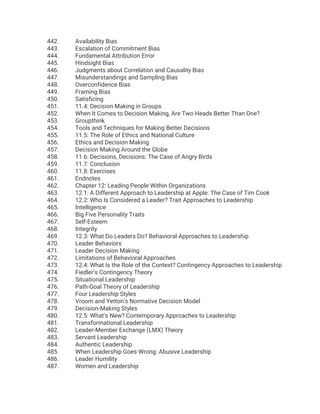
333. Adjourning
334. The Punctuated-Equilibrium Model
335. Cohesion
336. Can a Group Have Too Much Cohesion?
337. Social Loafing
338. Collective Efficacy
339. 9.3: Understanding Team Design Characteristics
340. Differences Between Groups and Teams
341. Team Tasks
342. Team Roles
343. Task Roles
344. Social Roles
345. Boundary-Spanning Roles
346. Types of Teams
347. Team Leadership and Autonomy
348. Designing Effective Teams: Team Composition
349. Who Are the Best Individuals for the Team?
350. How Large Should My Team Be?
351. How Diverse Should My Team Be?
352. 9.4: Management of Teams
353. Managing Effective Teams: Team Processes
354. Team Norms
355. Team Contracts
356. Team Meetings
357. Before the Meeting
358. During the Meeting
359. After the Meeting
360. Establish Psychological Safety
361. 9.5: Barriers to Effective Teams
362. Common Problems Faced by Teams
363. Challenges of Knowing Where to Begin
364. Dominating Team Members
365. Poor Performance of Some Team Members
366. Poorly Managed Team Conflict
367. 9.6: The Role of Ethics and National Culture
368. Ethics and Teams
369. Teams Around the Globe
370. 9.7: Putting Peer Pressure to Work: The Case of Pret a Manger
371. 9.8: Conclusion
372. 9.9: Exercises
373. Endnotes
374. Chapter 10: Conflict and Negotiations
375. 10.1: When Conflict Is Productive: The Case of Amazon
376. 10.2: Understanding Conflict
377. Types of Conflict
378. Intrapersonal Conflict
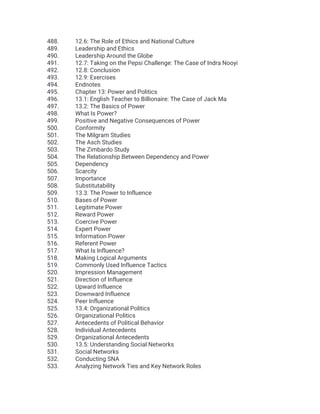
379. Interpersonal Conflict
380. Intergroup Conflict
381. Is Conflict Always Bad?
382. 10.3: Causes and Outcomes of Conflict
383. Causes of Conflict
384. Organizational Structure
385. Limited Resources
386. Task Interdependence
387. Incompatible Goals
388. Personality Differences
389. Communication Problems
390. Outcomes of Conflict
391. 10.4: Conflict Management
392. Ways to Manage Conflict
393. Change the Structure
394. Change the Composition of the Team
395. Create a Common Opposing Force
396. Consider Majority Rule
397. Problem Solve
398. Consider the Role of Mood
399. Conflict-Handling Styles
400. Avoidance
401. Accommodation
402. Compromise
403. Competition
404. Collaboration
405. Which Style Is Best?
406. What If You Don’t Have Enough Conflict Over Ideas?
407. 10.5: Negotiations
408. The Five Phases of Negotiation
409. Phase 1: Investigation
410. Phase 2: Determine Your BATNA
411. Phase 3: Presentation
412. Phase 4: Bargaining
413. Phase 5: Closure
414. Negotiation Strategies
415. Distributive Approach
416. Integrative Approach
417. When All Else Fails: Third-Party Negotiations
418. Alternative Dispute Resolution
419. Mediation
420. Arbitration
421. Arbitration-Mediation
422. 10.6: The Role of Ethics and National Culture
423. Ethics and Negotiations
424. Conflict and Negotiation Around the Globe
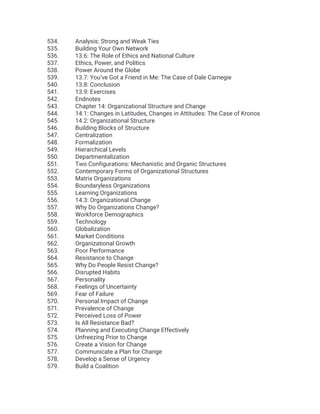
425. 10.7: Negotiation Failure: The Case of PointCast
426. 10.8: Conclusion
427. 10.9: Exercises
428. Endnotes
429. Chapter 11: Making Decisions
430. 11.1: Trusting Employees to Make Decisions: The Case of Microsoft
431. 11.2: Understanding Decision Making
432. Decision Making Defined
433. Types of Decisions
434. Making Rational Decisions
435. Making “Good Enough” Decisions
436. Making Intuitive Decisions
437. Making Creative Decisions
438. How Do You Know If Your Decision-Making Process Is Creative?
439. 11.3: Faulty Decision Making
440. Avoiding Decision-Making Traps
441. Anchoring and Adjustment Bias
442. Availability Bias
443. Escalation of Commitment Bias
444. Fundamental Attribution Error
445. Hindsight Bias
446. Judgments about Correlation and Causality Bias
447. Misunderstandings and Sampling Bias
448. Overconfidence Bias
449. Framing Bias
450. Satisficing
451. 11.4: Decision Making in Groups
452. When It Comes to Decision Making, Are Two Heads Better Than One?
453. Groupthink
454. Tools and Techniques for Making Better Decisions
455. 11.5: The Role of Ethics and National Culture
456. Ethics and Decision Making
457. Decision Making Around the Globe
458. 11.6: Decisions, Decisions: The Case of Angry Birds
459. 11.7: Conclusion
460. 11.8: Exercises
461. Endnotes
462. Chapter 12: Leading People Within Organizations
463. 12.1: A Different Approach to Leadership at Apple: The Case of Tim Cook
464. 12.2: Who Is Considered a Leader? Trait Approaches to Leadership
465. Intelligence
466. Big Five Personality Traits
467. Self-Esteem
468. Integrity
469. 12.3: What Do Leaders Do? Behavioral Approaches to Leadership
470. Leader Behaviors
471. Leader Decision Making
472. Limitations of Behavioral Approaches
473. 12.4: What Is the Role of the Context? Contingency Approaches to Leadership
474. Fiedler’s Contingency Theory
475. Situational Leadership
476. Path-Goal Theory of Leadership
477. Four Leadership Styles
478. Vroom and Yetton’s Normative Decision Model
479. Decision-Making Styles
480. 12.5: What’s New? Contemporary Approaches to Leadership
481. Transformational Leadership
482. Leader-Member Exchange (LMX) Theory
483. Servant Leadership
484. Authentic Leadership
485. When Leadership Goes Wrong: Abusive Leadership
486. Leader Humility
487. Women and Leadership
488. 12.6: The Role of Ethics and National Culture
489. Leadership and Ethics
490. Leadership Around the Globe
491. 12.7: Taking on the Pepsi Challenge: The Case of Indra Nooyi
492. 12.8: Conclusion
493. 12.9: Exercises
494. Endnotes
495. Chapter 13: Power and Politics
496. 13.1: English Teacher to Billionaire: The Case of Jack Ma
497. 13.2: The Basics of Power
498. What Is Power?
499. Positive and Negative Consequences of Power
500. Conformity
501. The Milgram Studies
502. The Asch Studies
503. The Zimbardo Study
504. The Relationship Between Dependency and Power
505. Dependency
506. Scarcity
507. Importance
508. Substitutability
509. 13.3: The Power to Influence
510. Bases of Power
511. Legitimate Power
512. Reward Power
513. Coercive Power
514. Expert Power
515. Information Power
516. Referent Power
517. What Is Influence?
518. Making Logical Arguments
519. Commonly Used Influence Tactics
520. Impression Management
521. Direction of Influence
522. Upward Influence
523. Downward Influence
524. Peer Influence
525. 13.4: Organizational Politics
526. Organizational Politics
527. Antecedents of Political Behavior
528. Individual Antecedents
529. Organizational Antecedents
530. 13.5: Understanding Social Networks
531. Social Networks
532. Conducting SNA
533. Analyzing Network Ties and Key Network Roles
534. Analysis: Strong and Weak Ties
535. Building Your Own Network
536. 13.6: The Role of Ethics and National Culture
537. Ethics, Power, and Politics
538. Power Around the Globe
539. 13.7: You’ve Got a Friend in Me: The Case of Dale Carnegie
540. 13.8: Conclusion
541. 13.9: Exercises
542. Endnotes
543. Chapter 14: Organizational Structure and Change
544. 14.1: Changes in Latitudes, Changes in Attitudes: The Case of Kronos
545. 14.2: Organizational Structure
546. Building Blocks of Structure
547. Centralization
548. Formalization
549. Hierarchical Levels
550. Departmentalization
551. Two Configurations: Mechanistic and Organic Structures
552. Contemporary Forms of Organizational Structures
553. Matrix Organizations
554. Boundaryless Organizations
555. Learning Organizations
556. 14.3: Organizational Change
557. Why Do Organizations Change?
558. Workforce Demographics
559. Technology
560. Globalization
561. Market Conditions
562. Organizational Growth
563. Poor Performance
564. Resistance to Change
565. Why Do People Resist Change?
566. Disrupted Habits
567. Personality
568. Feelings of Uncertainty
569. Fear of Failure
570. Personal Impact of Change
571. Prevalence of Change
572. Perceived Loss of Power
573. Is All Resistance Bad?
574. Planning and Executing Change Effectively
575. Unfreezing Prior to Change
576. Create a Vision for Change
577. Communicate a Plan for Change
578. Develop a Sense of Urgency
579. Build a Coalition
580. Provide Support
581. Allow Employees to Participate
582. Executing Change
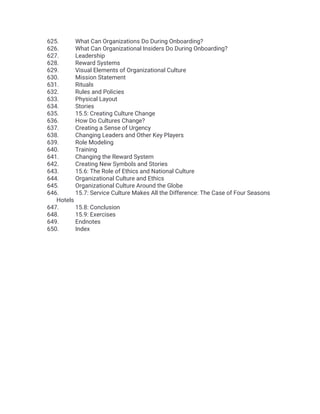
583. Continue to Provide Support
584. Create Small Wins
585. Eliminate Obstacles
586. Refreezing
587. Publicize Success
588. Build on Prior Change
589. Reward Change Adoption
590. Make Change a Part of Organizational Culture
591. 14.4: The Role of Ethics and National Culture
592. Organizational Structure, Change, and Ethics
593. Organizational Structure and Change Around the Globe
594. 14.5: Lean, Mean Driving Machine: The Case of Toyota
595. 14.6: Conclusion
596. 14.7: Exercises
597. Endnotes
598. Chapter 15: Organizational Culture
599. 15.1: When It Comes to Culture, Strong Signals Matter: The Case of General
Motors
600. 15.2: Understanding Organizational Culture
601. What Is Organizational Culture?
602. Why Does Organizational Culture Matter?
603. Levels of Organizational Culture
604. 15.3: Characteristics of Organizational Culture
605. Dimensions of Culture
606. Innovative Cultures
607. Aggressive Cultures
608. Outcome-Oriented Cultures
609. Stable Cultures
610. People-Oriented Cultures
611. Team-Oriented Cultures
612. Detail-Oriented Cultures
613. Service Culture
614. Safety Culture
615. Strength of Culture
616. Do Organizations Have a Single Culture?
617. 15.4: Creating and Maintaining Organizational Culture
618. How Are Cultures Created?
619. Founder’s Values
620. Industry Demands
621. How Are Cultures Maintained?
622. Attraction-Selection-Attrition (ASA)
623. New Employee Onboarding
624. What Can Employees Do During Onboarding?
625. What Can Organizations Do During Onboarding?
626. What Can Organizational Insiders Do During Onboarding?
627. Leadership
628. Reward Systems
629. Visual Elements of Organizational Culture
630. Mission Statement
631. Rituals
632. Rules and Policies
633. Physical Layout
634. Stories
635. 15.5: Creating Culture Change
636. How Do Cultures Change?
637. Creating a Sense of Urgency
638. Changing Leaders and Other Key Players
639. Role Modeling
640. Training
641. Changing the Reward System
642. Creating New Symbols and Stories
643. 15.6: The Role of Ethics and National Culture
644. Organizational Culture and Ethics
645. Organizational Culture Around the Globe
646. 15.7: Service Culture Makes All the Difference: The Case of Four Seasons
Hotels
647. 15.8: Conclusion
648. 15.9: Exercises
649. Endnotes
650. Index
Random documents with unrelated
content Scribd suggests to you:
propounds, we should at once encounter a multitude of authentic
documents and a serried phalanx of convincing arguments. In France
and Germany we are too much accustomed to receive hypotheses for
historic laws, and doubtful anecdotes for attested events. We too
often see whole systems established, from day to day, according to
the caprice of a writer; a sort of castles in the air, whose regular
arrangement stimulates the appearance of genuine edifices, and
which vanish at a breath, when we come to touch them. We have all
made theories, in a fireside discussion, in case of need, when for lack
of argument we required some fictitious reasoning, like those
Chinese generals who, to terrify their enemies, placed amongst their
troops formidable monsters of painted card-board. We have judged
men at random, under the impression of the moment, on a detached
action, an isolated document; and we have dressed them up with
vices or virtues, folly or genius, without controlling by logic or
criticism the hazardous decisions to which our precipitation had
carried us. Thus we feel a deep satisfaction and a sort of internal
peace, on leaving so many doctrines of ephemeral bloom in our
books or reviews, to follow the steady gait of a guide so clear-
sighted, reflective, instructed, able to lead us aright. We understand
why the English accuse the French of being frivolous, and the
Germans of being chimerical. Macaulay brings to the moral sciences
that spirit of circumspection, that desire for certainty, and that
instinct of truth, which make up the practical mind, and which from
the time of Bacon have constituted the scientific merit and power of
his nation. If art and beauty lose by this, truth and certainty are
gained; and no one, for instance, would blame our author for
inserting the following demonstration in the life of Addison:
"He (Pope) asked Addison's advice. Addison said that the poem
as it stood was a delicious little thing, and entreated Pope not to
run the risk of marring what was so excellent in trying to mend
it. Pope afterwards declared that this insidious counsel first
opened his eyes to the baseness of him who gave it.
"Now there can be no doubt that Pope's plan was most
ingenious, and that he afterwards executed it with great skill and
success. But does it necessarily follow that Addison's advice was
bad? And if Addison's advice was bad, does it necessarily follow
that it was given from bad motives? If a friend were to ask us
whether we would advise him to risk his all in a lottery, of which
the chances were ten to one against him, we should do our best
to dissuade him from running such a risk. Even if he were so
lucky as to get the thirty thousand pound prize, we should not
admit that we had counselled him ill; and we should certainly
think it the height of injustice in him to accuse us of having been
actuated by malice. We think Addison's advice good advice. It
rested on a sound principle, the result of long and wide
experience. The general rule undoubtedly is that when a
successful work of the imagination has been produced, it should
not be recast. We cannot, at this moment, call to mind a single
instance in which this rule has been transgressed with happy
effect, except the instance of the 'Rape of the Lock.' Tasso recast
his 'Jerusalem,' Akenside recast his 'Pleasures of the
Imagination' and his 'Epistle to Curio.' Pope himself, emboldened
no doubt by the success with which he had expanded and
remodelled the 'Rape of the Lock,' made the same experiment
on the 'Dunciad.' All these attempts failed. Who was to foresee
that Pope would, once in his life, be able to do what he could
not himself do twice, and what nobody else has ever done?
"Addison's advice was good. But had it been bad, why should we
pronounce it dishonest? Scott tells us that one of his best friends
predicted the failure of Waverley. Herder adjured Goethe not to
take so unpromising a subject as Faust. Hume tried to dissuade
Robertson from writing the 'History of Charles the Fifth.' Nay,
Pope himself was one of those who prophesied that Cato would
never succeed on the stage, and advised Addison to print it
without risking a representation. But Scott, Goethe, Robertson,
Addison, had the good sense and generosity to give their
advisers credit for the best intentions. Pope's heart was not of
the same kind with theirs."[305]
What does the reader think of this dilemma, and this double series of
inductions? The demonstrations would not be more studied or
rigorous, if a physical law were in question.
This demonstrative talent was increased by his talent for
development. Macaulay enlightens inattentive minds, as well as he
convinces opposing minds; he manifests, as well as he persuades,
and spreads as much evidence over obscure questions as certitude
over doubtful points. It is impossible not to understand him; he
approaches the subject under every aspect, he turns it over on every
side; it seems as though he addressed himself to every spectator,
and studied to make himself understood by every individual; he
calculates the scope of every mind, and seeks for each a fit mode of
exposition; he takes us all by the hand, and leads us alternately to
the end which he has marked out beforehand. He sets out from the
simplest facts, he descends to our level, he brings himself even with
our mind; he spares us the pain of the slightest effort; then he leads
us on, and smoothes the road throughout; we rise gradually, without
perceiving the slope, and at the end we find ourselves at the top,
after having walked as easily as on the plain. When a subject is
obscure, he is not content with a first explanation; he gives a second,
then a third: he sheds light in abundance from all sides, he searches
for it in all regions of history; and the wonderful thing is, that he is
never prolix. In reading him we find ourselves in our proper sphere;
we feel as though we could understand; we are annoyed to have
taken twilight so long for day; we rejoice to see this abounding light
rising and leaping forth in torrents; the exact style, the antithesis of
ideas, the harmonious construction, the artfully balanced paragraphs,
the vigorous summaries, the regular sequence of thoughts, the
frequent comparisons, the fine arrangement of the whole—not an
idea or phrase of his writings in which the talent and the desire to
explain, the characteristic of an orator, does not shine forth.
Macaulay was a member of Parliament, and spoke so well, we are
told, that he was listened to for the mere pleasure of listening. The
habit of public speaking is, perhaps, the cause of this incomparable
lucidity. To convince a great assembly, we must address all the
members; to rivet the attention of absentminded and weary men, we
must save them from all fatigue; they must take in too much in order
to take in enough. Public speaking vulgarizes ideas; it drags truth
from the height at which it dwells, with some thinkers, to bring it
amongst the crowd: it reduces it to the level of ordinary minds, who,
without this intervention, would only have seen it from afar, and high
above them. Thus, when great orators consent to write, they are the
most powerful of writers; they make philosophy popular; they lift all
minds a stage higher, and seem to enlarge human intelligence. In the
hands of Cicero, the dogmas of the Stoics and the dialectics of the
Academicians lose their prickles. The subtle Greek arguments
become united and easy; the hard problems of providence,
immortality, highest good, become public property. Senators, men of
business, lawyers, lovers of formulas and procedure, the massive and
narrow intelligence of publicists, comprehend the deductions of
Chrysippus; and the book "De Officiis" has made the morality of
Panætius popular. In our days, M. Thiers, in his two great histories,
has placed within reach of everybody the most involved questions of
strategy and finance; if he would write a course of political economy
for street-porters, I am sure he would be understood; and pupils of
the lower classes at school have been able to read M. Guizot's
"History of Civilization."
When, with the faculty for proof and explanation, a man feels the
desire of proving, he arrives at vehemence. These serried and
multiplied arguments which all tend to a single aim, these reiterated
logical points, returning every instant, one upon the other, to shake
the opponent, give heat and passion to the style. Rarely was
eloquence more captivating than Macaulay's. He has the oratorical
afflatus; all his phrases have a tone; we feel that he would govern
minds, that he is irritated by resistance, that he fights as he
discusses. In his books the discussion always seizes and carries away
the reader; it advances evenly, with accumulating force,
straightforward, like those great American rivers, impetuous as a
torrent and wide as a sea. This abundance of thought and style, this
multitude of explanations, ideas, and facts, this vast aggregate of
historical knowledge goes rolling on, urged forward by internal
passion, sweeping away objections in its course, and adding to the
dash of eloquence the irresistible force of its mass and weight. We
might say that the history of James II. is a discourse in two volumes,
spoken without stopping, and with never-failing voice. We see the
oppression and discontent begin, increase, widen, the partisans of
James abandoning him one by one, the idea of revolution arise in all
hearts, confirmed, fixed, the preparations made, the event
approaching, growing imminent, then suddenly falling on the blind
and unjust monarch, and sweeping away his throne and dynasty,
with the violence of a foreseen and fatal tempest. True eloquence is
that which thus perfects argument by emotion, which reproduces the
unity of events by the unity of passion, which repeats the motion and
the chain of facts by the motion and the chain of ideas. It is a
genuine imitation of nature; more complete than pure analysis; it
reanimates beings; its dash and vehemence form part of science and
of truth. Of whatever subject Macaulay treats, political economy,
morality, philosophy, literature, history, he is impassioned for his
subject. The current which bears away events, excites in him, as
soon as he sees it, a current which bears forward his thought. He
does not set forth his opinion; he pleads it. He has that energetic,
sustained, and vibrating tone which bows down opposition and
conquers belief. His thought is an active force; it is imposed on the
hearer; it attacks him with such superiority, falls upon him with such
a train of proofs, such a manifest and legitimate authority, such a
powerful impulse, that we never think of resisting it; and it masters
the heart by its vehemence, whilst at the same time it masters the
reason by its evidence.
All these gifts are common to orators; they are found in different
proportions and degrees, in men like Cicero and Livy, Bourdaloue and
Bossuet, Fox and Burke. These fine and solid minds form a natural
family, and all have for their chief feature the habit and talent of
passing from particular to general ideas, orderly and successively, as
we climb a ladder by setting our feet one after the other on every
round. The inconvenience of this art is the use of commonplace.
They who practise it do not depict objects with precision; they fall
easily into vague rhetoric. They hold in their hands ready-made
developments, a sort of portable scales, equally applicable on both
sides of the same and every question. They continue willingly in a
middle region, amongst the tirades and arguments of the special
pleader, with an indifferent knowledge of the human heart, and a fair
number of amplifications on that which is useful and just. In France
and at Rome, amongst the Latin races, especially in the seventeenth
century, these men love to hover above the earth, amidst grand
words or general considerations, in the style of the drawing-room
and the academy. They do not descend to minor facts, convincing
details, circumstantial examples of every-day life. They are more
inclined to plead than to prove. In this Macaulay is distinguished from
them. His principle is, that a special fact has more hold on the mind
than a general reflection. He knows that, to give men a clear and
vivid idea, they must be brought back to their personal experience.
He remarks[306] that, in order to make them realize a storm, the only
method is to recall to them some storm which they have themselves
seen and heard, with which their memory is still charged, and which
still re-echoes through all their senses. He practises, in his style, the
philosophy of Bacon and Locke. With him, as well as with them, the
origin of every idea is a sensation. Every complicated argument,
every entire conception, has certain particular facts for its only
support. It is so for every structure of ideas, as well as for a scientific
theory. Beneath long calculations, algebraical formulas, subtle
deductions, written volumes which contain the combinations and
elaborations of learned minds, there are two or three sensible
experiences, two or three little facts on which we may lay our finger,
a turn of the wheel in a machine, a scalpel-cut in a living body, an
unlooked-for color in a liquid. These are decisive specimens. The
whole substance of theory, the whole force of proof, is contained in
this. Truth is here, as a nut in its shell: painful and ingenious
discussion adds nothing thereto; it only extracts the nut. Thus, if we
would rightly prove, we must before everything present these
specimens, insist upon them, make them visible and tangible to the
reader, as far as may be done in words. This is difficult, for words are
not things. The only resource of the writer is to employ words which
bring things before the eyes. For this he must appeal to the reader's
personal observation, set out from his experience, compare the
unknown objects presented to him with the known objects which he
sees every day: place past events beside contemporary events.
Macaulay always has before his mind English imaginations, full of
English images: I mean full of the detailed and present recollections
of a London street, a dram-shop, a wretched alley, an afternoon in
Hyde Park, a moist green landscape, a white ivy-covered country-
house, a clergyman in a white tie, a sailor in a sou'-wester. He has
recourse to such recollections; he makes them still more precise by
descriptions and statistics; he notes colors and qualities; he has a
passion for exactness; his descriptions are worthy both of a painter
and a topographer; he writes like a man who sees a physical and
sensible object, and who at the same time classifies and weighs it.
We will see him carry his figures even to moral or literary worth,
assign to an action, a virtue, a book, a talent, its compartment and
its step in the scale, with such clearness and relief, that we could
easily imagine ourselves in a classified museum, not of stuffed skins,
but of feeling, suffering, living animals.
Consider, for instance, these phrases, by which he tries to render
visible to an English public, events in India:
"During that interval the business of a servant of the Company
was simply to wring out of the natives a hundred or two hundred
thousand pounds as speedily as possible, that he might return
home before his constitution had suffered from the heat, to
marry a peer's daughter, to buy rotten boroughs in Cornwall, and
to give balls in St. James's Square.[307]... There was still a nabob
of Bengal, who stood to the English rulers of his country in the
same relation in which Augustulus stood to Odoacer, or the last
Merovingians to Charles Martel and Pepin. He lived at
Moorshedabad, surrounded by princely magnificence. He was
approached with outward marks of reverence, and his name was
used in public instruments. But in the government of the country
he had less real share than the youngest writer or cadet in the
Company's service."[308]
Of Nuncomar, the native servant of the Company, he writes:
"Of his moral character it is difficult to give a notion to those
who are acquainted with human nature only as it appears in our
island. What the Italian is to the Englishman, what the Hindoo is
to the Italian, what the Bengalee is to other Hindoos, that was
Nuncomar to other Bengalees. The physical organization of the
Bengalee is feeble, even to effeminacy. He lives in a constant
vapour bath. His pursuits are sedentary, his limbs delicate, his
movements languid. During many ages he has been trampled
upon by men of bolder and more hardy breeds. Courage,
independence, veracity, are qualities to which his constitution
and his situation are equally unfavorable. His mind bears a
singular analogy to his body. It is weak even to helplessness, for
purposes of manly resistance; but its suppleness and its tact
move the children of sterner climates to admiration not
unmingled with contempt. All those arts which are the natural
defence of the weak are more familiar to this subtle race than to
the Ionian of the time of Juvenal, or to the Jew of the dark ages.
What the horns are to the buffalo, what the paw is to the tiger,
what the sting is to the bee, what beauty, according to the old
Greek song, is to woman, deceit is to the Bengalee. Large
promises, smooth excuses, elaborate tissues of circumstantial
falsehood, chicanery, perjury, forgery, are the weapons, offensive
and defensive, of the people of the Lower Ganges. All those
millions do not furnish one sepoy to the armies of the Company.
But as usurers, as money-changers, as sharp legal practitioners,
no class of human beings can bear a comparison with them."
[309]
It was such men and such affairs, which were to provide Burke with
the amplest and most brilliant subject-matter for his eloquence; and
when Macaulay described the distinctive talent of the great orator, he
described his own:
"He (Burke) had, in the highest degree, that noble faculty
whereby man is able to live in the past and in the future, in the
distant and in the unreal. India and its inhabitants were not to
him, as to most Englishmen, mere names and abstractions, but a
real country and a real people. The burning sun, the strange
vegetation of the palm and the cocoa-tree, the rice-field, the
tank, the huge trees, older than the Mogul empire, under which
the village crowds assemble; the thatched roof of the peasant's
hut; the rich tracery of the mosque where the imaum prays with
his face to Mecca, the drums, and banners, and gaudy idols, the
devotee swinging in the air, the graceful maiden, with the pitcher
on her head, descending the steps to the river-side, the black
faces, the long beards, the yellow streaks of sect, the turbans
and the flowing robes, the spears and the silver maces, the
elephants with their canopies of state, the gorgeous palanquin of
the prince, and the close litter of the noble lady, all those things
were to him as the objects amidst which his own life had been
passed, as the objects which lay on the road between
Beaconsfield and St. James's Street. All India was present to the
eye of his mind, from the halls where suitors laid gold and
perfumes at the feet of sovereigns, to the wild moor where the
gipsy camp was pitched, from the bazaar, humming like a bee-
hive with the crowd of buyers and sellers, to the jungle where
the lonely courier shakes his bunch of iron rings to scare away
the hyenas. He had just as lively an idea of the insurrection at
Benares as of Lord George Gordon's riots, and of the execution
of Nuncomar as of the execution of Dr. Dodd. Oppression in
Bengal was to him the same thing as oppression in the streets of
London."[310]
Section VI.—His Rudeness and Humor
Other forms of his talent are more peculiarly English. Macaulay has a
rough touch; when he strikes, he knocks down. Béranger sings:
"Chez nous, point.
Point de ces coups de poing
Qui font tant d'honneur à l'Angleterre."[311]
And a French reader would be astonished if he heard a great
historian treat an illustrious poet in this style:
"But in all those works in which Mr. Southey has completely
abandoned narration, and has undertaken to argue moral and
political questions, his failure has been complete and
ignominious. On such occasions his writings are rescued from
utter contempt and derision solely by the beauty and purity of
the English. We find, we confess, so great a charm in Mr.
Southey's style that, even when he writes nonsense, we
generally read it with pleasure, except indeed when he tries to
be droll. A more insufferable jester never existed. He very often
attempts to be humorous, and yet we do not remember a single
occasion on which he has succeeded, further than to be quaintly
and flippantly dull. In one of his works he tells us that Bishop
Spratt was very properly so-called, inasmuch as he was a very
small poet. And in the book now before us he cannot quote
Francis Bugg, the renegade Quaker, without a remark on his
unsavoury name. A wise man might talk folly like this by his own
fireside; but that any human being, after having made such a
joke should write it down, and copy it out, and transmit it to the
printer, and correct the proof-sheets, and send it forth into the
world, is enough to make us ashamed of our species."[312]
We may imagine that Macaulay does not treat the dead better than
the living. Thus he speaks of Archbishop Laud:
"The severest punishment which the two Houses could have
inflicted on him would have been to set him at liberty and send
him to Oxford. There he might have staid, tortured by his own
diabolical temper, hungering for Puritans to pillory and mangle,
plaguing the Cavaliers, for want of somebody else to plague,
with his peevishness and absurdity, performing grimaces and
antics in the cathedral, continuing that incomparable diary, which
we never see without forgetting the vices of his heart in the
imbecility of his intellect, minuting down his dreams, counting
the drops of blood which fell from his nose, watching the
direction of the salt, and listening for the note of the screech-
owls. Contemptuous mercy was the only vengeance which it
became the Parliament to take on such a ridiculous old bigot."
[313]
While he jests he remains grave, as do almost all the writers of his
country. Humor consists in saying extremely comical things in a
solemn tone, and in preserving a lofty style and ample phraseology,
at the very moment when the author is making all his hearers laugh.
Such is the beginning of an article on a new historian of Burleigh:
"The work of Dr. Nares has filled us with astonishment similar to
that which Captain Lemuel Gulliver felt when first he landed in
Brobdingnag, and saw corn as high as the oaks in the New
Forest, thimbles as large as buckets, and wrens of the bulk of
turkeys. The whole book, and every component part of it, is on a
gigantic scale. The title is as long as an ordinary preface; the
prefatory matter would furnish out an ordinary book: and the
book contains as much reading as an ordinary library. We cannot
sum up the merits of the stupendous mass of paper which lies
before us better than by saying that it consists of about two
thousand closely printed quarto pages, that it occupies fifteen
hundred inches cubic measure, and that it weighs sixty pounds
avoir-du-pois. Such a book might, before the deluge, have been
considered as light reading by Hilpah and Shalum. But unhappily
the life of man is now threescore years and ten; and we cannot
but think it somewhat unfair in Dr. Nares to demand from us so
large a portion of so short an existence."[314]
This comparison, borrowed from Swift, is a mockery in Swift's taste.
Mathematics become in English hands an excellent means of raillery;
and we remember how the Dean, comparing Roman and English
generosity by numbers, overwhelmed Marlborough by a sum in
addition. Humor employs against the people it attacks, positive facts,
commercial arguments, odd contrasts drawn from ordinary life. This
surprises and perplexes the reader, without warning; he falls abruptly
into some familiar and grotesque detail; the shock is violent; he
bursts out laughing without being much amused; the trigger is pulled
so suddenly and so roughly that it is like a knockdown blow. For
instance, Macaulay is refuting those who would not print the indecent
classical authors:
"We find it difficult to believe that, in a world so full of
temptations as this, any gentleman whose life would have been
virtuous if he had not read Aristophanes and Juvenal will be
made vicious by reading them. A man who, exposed to all the
influences of such a state of society as that in which we live, is
yet afraid of exposing himself to the influence of a few Greek or
Latin verses, acts, we think, much like the felon who begged the
sheriffs to let him have an umbrella held over his head from the
door of Newgate to the gallows, because it was a drizzling
morning, and he was apt to take cold."[315]
Irony, sarcasm, the bitterest kinds of pleasantry, are the rule with
Englishmen. They tear when they scratch. To be convinced of this,
we should compare French scandal, as Molière represents it in the
"Misanthrope," with English scandal as Sheridan represents it,
imitating Molière and the "Misanthrope." Célimène pricks, but does
not wound; Lady Sneerwell's friends wound, and leave bloody marks
on all the reputations which they handle. The raillery, which I am
about to give, is one of Macaulay's tenderest:
"They (the ministers) therefore gave the command to Lord
Galway, an experienced veteran, a man who was in war what
Molière's doctors were in medicine, who thought it much more
honorable to fail according to rule, than to succeed by
innovation, and who would have been very much ashamed of
himself if he had taken Monjuich by means so strange as those
which Peterborough employed. This great commander conducted
the campaign of 1707 in the most scientific manner. On the plain
of Almanza he encountered the army of the Bourbons. He drew
up his troops according to the methods prescribed by the best
writers, and in a few hours lost eighteen thousand men, a
hundred and twenty standards, all his baggage and all his
artillery."[316]
These incivilities are all the stronger, because the ordinary tone is
noble and serious.
Hitherto we have seen only the reasoner, the scholar, the orator, and
the wit: there is still in Macaulay a poet; and if we had not read his
"Lays of Ancient Rome," it would suffice to read a few of his periods,
in which the imagination, long held in check by the severity of the
proof, breaks out suddenly in splendid metaphors, and expands into
magnificent comparisons, worthy by their amplitude of being
introduced into an epic:
"Ariosto tells a pretty story of a fairy, who, by some mysterious
law of her nature, was condemned to appear at certain seasons
in the form of a foul and poisonous snake. Those who injured
her during the period of her disguise were forever excluded from
participation in the blessings which she bestowed. But to those
who, in spite of her loathsome aspect, pitied and protected her,
she afterwards revealed herself in the beautiful and celestial
form which was natural to her, accompanied their steps, granted
all their wishes, filled their houses with wealth, made them
happy in love and victorious in war. Such a spirit is Liberty. At
times she takes the form of a hateful reptile. She grovels, she
hisses, she stings. But woe to those who in disgust shall venture
to crush her! And happy are those who, having dared to receive
her in her degraded and frightful shape, shall at length be
rewarded by her in the time of her beauty and her glory!"[317]
These noble words come from the heart; the fount is full, and though
it flows, it never becomes dry. As soon as the writer speaks of a
cause which he loves, as soon as he sees Liberty rise before him,
with Humanity and Justice, Poetry bursts forth spontaneously from
his soul and sets her crown on the brows of her noble sisters:
"The Reformation is an event long past. That volcano has spent
its rage. The wide waste produced by its outbreak is forgotten.
The landmarks which were swept away have been replaced. The
ruined edifices have been repaired. The lava has covered with a
rich incrustation the fields which it once devastated, and, after
having turned a beautiful and fruitful garden into a desert, has
again turned the desert into a still more beautiful and fruitful
garden. The second great eruption is not yet over. The marks of
its ravages are still all around us. The ashes are still hot beneath
our feet. In some directions, the deluge of fire still continues to
spread. Yet experience surely entitles us to believe that this
explosion, like that which preceded it, will fertilize the soil which
it has devastated. Already, in those parts which have suffered
most severely, rich cultivation and secure dwellings have begun
to appear amidst the waste. The more we read of the history of
past ages, the more we observe the signs of our own times, the
more do we feel our hearts filled and swelled up by a good hope
for the future destinies of the human race."[318]
I ought, perhaps, in concluding this analysis, to point out the
imperfections caused by these high qualities; how ease, charm, a
vein of amiability, variety, simplicity, playfulness, are wanting in this
manly eloquence, this solid reasoning, and this glowing dialectic; why
the art of writing and classical purity are not always found in this
partisan, fighting from his platform; in short, why an Englishman is
not a Frenchman or an Athenian. I prefer to transcribe another
passage, the solemnity and magnificence of which will give some
idea of the grave and rich ornament, which Macaulay throws over his
narrative, a sort of potent vegetation, flowers of brilliant purple, like
those which are spread over every page of "Paradise Lost" and
"Childe Harold." Warren Hastings had returned from India, and had
just been placed on his trial:
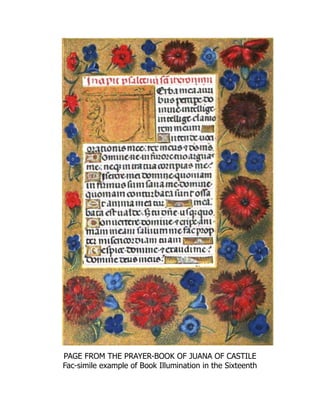
PAGE FROM THE PRAYER-BOOK OF JUANA OF CASTILE
Fac-simile example of Book Illumination in the Sixteenth
Century.
"On the thirteenth of February, 1788, the sittings of the Court
commenced. There have been spectacles more dazzling to the
eye, more gorgeous with jewellery and cloth of gold, more
attractive to grown-up children, than that which was then
exhibited at Westminster; but, perhaps, there never was a
spectacle so well calculated to strike a highly cultivated, a
reflecting, an imaginative mind. All the various kinds of interests
which belong to the near and to the distant, to the present and
to the past, were collected on one spot, and in one hour. All the
talents and all the accomplishments which are developed by
liberty and civilization were now displayed, with every
advantage that could be derived both from co-operation and
from contrast. Every step in the proceedings carried the mind
either backward, through many troubled centuries, to the days
when the foundations of our constitution were laid; or far away,
over boundless seas and deserts, to dusky nations living under
strange stars, worshipping strange gods, and writing strange
characters from right to left. The High Court of Parliament was
to sit, according to forms handed down from the days of the
Plantagenets, on an Englishman accused of exercising tyranny
over the lord of the holy city of Benares, and over the ladies of
the princely house of Oude.
"The place was worthy of such a trial. It was the great Hall of
William Rufus, the hall which had resounded with acclamations
at the inauguration of thirty kings, the hall which had witnessed
the just sentence of Bacon and the just absolution of Somers,
the hall where the eloquence of Strafford had for a moment
awed and melted a victorious party inflamed with just
resentment, the hall where Charles had confronted the High
Court of Justice with the placid courage which has half
redeemed his fame. Neither military nor civil pomp was wanting.
The avenues were lined with grenadiers. The streets were kept
clear by cavalry. The peers, robed in gold and ermine, were
marshalled by the heralds under Garter King at-arms. The
judges in their vestments of state attended to give advice on
points of law. Near a hundred and seventy lords, three-fourths
of the Upper House as the Upper House then was, walked in
solemn order from their usual place of assembling to the
tribunal. The junior baron present led the way, George Eliot Lord
Heathfield, recently ennobled for his memorable defence of
Gibraltar against the fleets and armies of France and Spain. The
long procession was closed by the Duke of Norfolk, Earl Marshal
of the realm, by the great dignitaries, and by the brothers and
sons of the King. Last of all came the Prince of Wales,
conspicuous by his fine person and noble bearing. The gray old
walls were hung with scarlet. The long galleries were crowded
by an audience such as has rarely excited the fears or the
emulation of an orator. There were gathered together, from all
parts of a great, free, enlightened, and prosperous empire,
grace and female loveliness, wit and learning, the
representatives of every science and of every art. There were
seated round the Queen the fair-haired young daughters of the
house of Brunswick. There the Ambassadors of great Kings and
Commonwealths gazed with admiration on a spectacle which no
other country in the world could present. There Siddons, in the
prime of her majestic beauty, looked with emotion on a scene
surpassing all the imitations of the stage. There the historian of
the Roman Empire thought of the days when Cicero pleaded the
cause of Sicily against Verres, and when, before a senate which
still retained some show of freedom, Tacitus thundered against
the oppressor of Africa. There were seen, side by side, the
greatest painter and the greatest scholar of the age. The
spectacle had allured Reynolds from that easel which has
preserved to us the thoughtful foreheads of so many writers and
statesmen, and the sweet smiles of so many noble matrons. It
had induced Parr to suspend his labors in that dark and
profound mine from which he had extracted a vast treasure of
erudition, a treasure too often buried in the earth, too often
paraded with injudicious and inelegant ostentation, but still
precious, massive, and splendid. There appeared the voluptuous
charms of her to whom the heir of the throne had in secret
plighted his faith. There too was she, the beautiful mother of a
beautiful race, the Saint Cecilia whose delicate features, lighted
up by love and music, art has rescued from the common decay.
There were the members of that brilliant society which quoted,
criticised, and exchanged repartees, under the rich peacock-
hangings of Mrs. Montague. And there the ladies whose lips,
more persuasive than those of Fox himself, had carried the
Westminster election against palace and treasury, shone round
Georgiana, Duchess of Devonshire."[319]
This evocation of the national history, glory, and constitution forms a
picture of a unique kind. The species of patriotism and poetry which
it reveals is an abstract of Macaulay's talent; and the talent, like the
picture, is thoroughly English.
Section VII.—Estimate of Macaulay's Work
Thus prepared, he entered upon the history of England; and he
chose therefrom the period best suited to his political opinions, his
style, his passion, his knowledge, the national taste, the sympathy of
Europe. He related the establishment of the English constitution, and
concentrated all the rest of history about this unique event, "the
finest in the world," to the mind of an Englishman and a politician.
He brought to this work a new method of great beauty, extreme
power; its success has been extraordinary. When the second volume
appeared, 30,000 copies were ordered beforehand. Let us try to
describe this history, to connect it with that method, and that
method to that order of mind.
The history is universal and not broken. It comprehends events of
every kind, and treats of them simultaneously. Some have related
the history of races, others of classes, others of governments, others
of sentiments, ideas, and manner; Macaulay has related all.
"I should very imperfectly execute the task which I have
undertaken if I were merely to treat of battles and sieges, of the
rise and fall of administrations, of intrigues in the palace, and of
debates in the parliament. It will be my endeavor to relate the
history of the people as well as the history of the government,
to trace the progress of useful and ornamental arts, to describe
the rise of religious sects and the changes of literary taste, to
portray the manners of successive generations, and not to pass
by with neglect even the revolutions which have taken place in
dress, furniture, repasts, and public amusements. I shall
cheerfully bear the reproach of having descended below the
dignity of history, if I can succeed in placing before the English
of the nineteenth century a true picture of the life of their
ancestors."[320]
He kept his word. He has omitted nothing, and passed nothing by.
His portraits are mingled with his narrative. We find those of Danby,
Nottingham, Shrewsbury, Howe, during the account of a session,
between two parliamentary divisions. Short, curious anecdotes,
domestic details, the description of furniture, intersect without
disjointing, the record of a war. Quitting the narrative of important
business, we gladly look upon the Dutch tastes of William, the
Chinese museum, the grottoes, the mazes, aviaries, ponds,
geometrical garden-beds, with which he defaced Hampton Court. A
political dissertation precedes or follows the relation of a battle; at
other times the author is a tourist or a psychologist before becoming
a politician or a tactician. He describes the Highlands of Scotland,
semi-papistical and semi-pagan, the seers wrapped in bulls' hides to
await the moment of inspiration, Christians making libations of milk
or beer to the demons of the place; pregnant women, girls of
eighteen, working a wretched patch of oats, whilst their husbands or
fathers, athletic men, basked in the sun; robbery and barbarities
looked upon as honorable deeds; men stabbed from behind or burnt
alive; repulsive food, coarse oats, and cakes made of the blood of a
live cow, offered to guests as a mark of favor and politeness;
infected hovels where men lay on the bare ground, and where they
woke up half smothered, half blinded by the smoke, and half mad
with the itch. The next instant he stops to mark a change in the
public taste, the horror then experienced on account of these
brigands' retreats, this country of wild rocks and barren moors; the
admiration now felt for this land of heroic warriors, this country of
grand mountains, seething waterfalls, picturesque defiles. He finds in
the progress of physical welfare the causes of this moral revolution,
and concludes that, if we praise mountains and an uncivilized life, it
is because we are satiated with security. He is successively an
economist, a literary man, a publicist, an artist, a historian, a
biographer, a story-teller, even a philosopher; by this diversity of
parts he imitates the diversity of human life, and presents to the
eyes, heart, mind, all the faculties of man, the complete history of
the civilization of his country.
Others, like Hume, have tried, or are trying to do it. They set forth
now religious matters, a little further political events, then literary
details, finally general considerations on the change of society and
government, believing that a collection of histories is history, and
that parts joined endwise are a body. Macaulay did not believe it and
he did well. Though English, he had the spirit of harmony. So many
accumulated events form with him not a total, but a whole.
Explanations, accounts, dissertations, anecdotes, illustrations,
comparisons, allusions to modern events, everything is connected in
his book. It is because everything is connected in his mind. He had a
most lively consciousness of causes; and causes unite facts. By them
scattered events are assembled into a single event; they unite them
because they produce them, and the historian, who seeks them all
out, cannot fail to perceive or to feel the unity which is their effect.
Read, for instance, the voyage of James II to Ireland: no picture is
more curious. Is it, however, nothing more than a curious picture?
When the king arrived at Cork there were no horses to be found.
The country is a desert. No more industry, cultivation, civilization,
since the English and Protestant colonists were driven out, robbed
and slain. James was received between two hedges of half-naked
Rapparees, armed with skeans, stakes, and half-pikes; under his
horse's feet they spread by way of carpet the rough frieze mantles,
such as the brigands and shepherds wore. He was offered garlands
of cabbage stalks for crowns of laurel. In a large district he only
found two carts. The palace of the lord-lieutenant in Dublin was so
ill-built that the rain drenched the rooms. The king left for Ulster; the
French officers thought they were travelling "through the deserts of
Arabia." The Count d'Avaux wrote to the French court that to get
one truss of hay they had to send five or six miles. At Charlemont,
with great difficulty, as a matter of favor, they obtained a bag of
oatmeal for the French legation. The superior officers lay in dens
which they would have thought too foul for their dogs. The Irish
soldiers were half-savage marauders, who could only shout, cut
throats, and disband. Ill fed on potatoes and sour milk, they cast
themselves like starved men on the great flocks belonging to the
Protestants. They greedily tore the flesh of oxen and sheep, and
swallowed it half raw and half rotten. For lack of kettles, they cooked
it in the skin. When Lent began, the plunderers generally ceased to
devour, but continued to destroy. A peasant would kill a cow merely
in order to get a pair of brogues. At times a band slaughtered fifty or
sixty beasts, took the skins, and left the bodies to poison the air. The
French ambassador reckoned that in six weeks there had been slain
50,000 horned cattle, which were rotting on the ground. They
counted the number of the sheep and lambs slain at 400,000.
Cannot the result of the rebellion be seen before-hand? What could
be expected of these gluttonous serfs, so stupid and savage? What
could be drawn from a devastated land, peopled with robbers? To
what kind of discipline could these marauders and butchers be
subjected? What resistance will they make on the Boyne, when they
see William's old regiments, the furious squadrons of French
refugees, the enraged and insulted Protestants of Londonderry and
Enniskillen, leap into the river and run with uplifted swords against
their muskets? They will flee, the king at their head; and the minute
anecdotes scattered amidst the account of receptions, voyages, and
ceremonies, will have announced the victory of the Protestants. The
history of manners is thus seen to be involved in the history of
events; the one is the cause of the other, and the description
explains the narrative.
It is not enough to see some causes; we must see a great many of
them. Every event has a multitude. Is it enough for me, if I wish to
understand the action of Marlborough or of James, to be reminded
of a disposition or a quality which explains it? No; for, since it has for
a cause a whole situation and a whole character, I must see at one
glance and in abstract the whole character and situation which
produced it. Genius concentrates. It is measured by the number of
recollections and ideas which it assembles in one point. That which
Macaulay has assembled is enormous. I know no historian who has
a surer, better furnished, better regulated memory. When he is
relating the actions of a man or a party, he sees in an instant all the
events of his history, and all the*maxims of his conduct; he has all
the details present; he remembers them every moment, and a great
many of them. He has forgotten nothing; he runs through them as
easily, as completely, as surely, as on the day when he enumerated
or wrote them. No one has so well taught or known history. He is as
much steeped in it as his personages. The ardent Whig or Tory,
experienced, trained to business, who rose and shook the House,
had not more numerous, better arranged, more precise arguments.
He did not better know the strength and weakness of his cause; he
was not more familiar with the intrigues, rancors, variation of
parties, the chances of the strife, individual and public interests. The
great novelists penetrate the soul of their characters, assume their
feelings, ideas, language; it seems as if Balzac had been a
commercial traveller, a female doorkeeper, a courtesan, an old maid,
a poet, and that he had spent his life in being each of these
personages: his existence is multiplied, and his name is legion. With
a different talent, Macaulay has the same power: an incomparable
advocate, he pleads an infinite number of causes; and he is master
of each cause, as fully as his client. He has answers for all
objections, explanations for all obscurities, reasons for all tribunals.
He is ready at every moment, and on all parts of his case. It seems
as if he had been Whig, Tory, Puritan, Member of the Privy Council,
Ambassador. He is not a poet like Michelet; he is not a philosopher
like Guizot; but he possesses so well all the oratorical powers, he
accumulates and arranges so many facts, he holds them so closely in
his hand, he manages them with so much ease and vigor, that he
succeeds in recomposing the whole and harmonious woof of history,
not losing or separating one thread. The poet reanimates the dead;
the philosopher formulates creative laws; the orator knows,
expounds, and pleads causes. The poet resuscitates souls, the
philosopher composes a system, the orator redisposes chains of
arguments; but all three march towards the same end by different
routes, and the orator, as well as his rivals, and by other means than
his rivals, reproduces in his work the unity and complexity of life.
A second feature of this history is clearness. It is popular; no one
explains better, or so much, as Macaulay. It seems as if he were
making a wager with his reader, and said to him: Be as absent in
mind, as stupid, as ignorant as you please; in vain you will be absent
in mind, you shall listen to me; in vain you will be stupid, you shall
understand; in vain you will be ignorant, you shall learn. I will repeat
the same idea in so many different forms, I will make it sensible by
such familiar and precise examples, I will announce it so clearly at
the beginning, I will resumé it so carefully at the end, I will mark the
divisions so well, follow the order of ideas so exactly, I will display so
great a desire to enlighten and convince you, that you cannot help
being enlightened and convinced. He certainly thought thus when he
was preparing the following passage on the law which, for the first
time, granted to Dissenters the liberty of exercising their worship:
"Of all the Acts that have ever been passed by Parliament, the
Toleration Act is perhaps that which most strikingly illustrates
the peculiar vices and the peculiar excellences of English
legislation. The science of Politics bears in one respect a close
analogy to the science of Mechanics. The mathematician can
easily demonstrate that a certain power, applied by means of a
certain lever or of a certain system of pulleys, will suffice to
raise a certain weight. But his demonstration proceeds on the
supposition that the machinery is such as no load will bend or
break. If the engineer, who has to lift a great mass of real
granite by the instrumentality of real timber and real hemp,
should absolutely rely on the propositions which he finds in
treatises on Dynamics, and should make no allowance for the
imperfection of his materials, his whole apparatus of beams,
wheels, and ropes would soon come down in ruin, and, with all
his geometrical skill, he would be found a far inferior builder to
those painted barbarians who, though they never heard of the
parallelogram of forces, managed to pile up Stonehenge. What
the engineer is to the mathematician, the active statesman is to
the contemplative statesman. It is indeed most important that
legislators and administrators should be versed in the
philosophy of government, as it is most important that the
architect who has to fix an obelisk on its pedestal, or to hang a
tubular bridge over an estuary, should be versed in the
philosophy of equilibrium and motion. But, as he who has
actually to build must bear in mind many things never noticed
by D'Alembert and Euler, so must he who has actually to govern
be perpetually guided by considerations to which no allusion can
be found in the writings of Adam Smith or Jeremy Bentham.
The perfect law-giver is a just temper between the mere man of
theory, who can see nothing but general principles, and the
mere man of business, who can see nothing but particular
circumstances. Of law-givers, in whom the speculative element
has prevailed to the exclusion of the practical, the world has
during the last eighty years been singularly fruitful. To their
wisdom Europe and America have owed scores of abortive
constitutions, scores of constitutions which have lived just long
enough to make a miserable noise, and have then gone off in
convulsions. But in English legislation the practical element has
always predominated, and not seldom unduly predominated,
over the speculative. To think nothing of symmetry and much of
convenience; never to remove an anomaly merely because it is
an anomaly; never to innovate except when some grievance is
felt; never to innovate except so far as to get rid of the
grievance; never to lay down any proposition of wider extent
than the particular case for which it is necessary to provide;
these are the rules which have, from the age of John to the age
of Victoria, generally guided the deliberations of our two
hundred and fifty Parliaments."[321]
Is the idea still obscure or doubtful? Does it still need proofs,
illustrations? Do we wish for anything more? You answer, No;
Macaulay answers, Yes. After the general explanation comes the
particular; after the theory, the application; after the theoretical
demonstration, the practical. We would fain stop; but he proceeds:
"The Toleration Act approaches very near to the idea of a great
English law. To a jurist, versed in the theory of legislation, but
not intimately acquainted with the temper of the sects and
parties into which the nation was divided at the time of the
Revolution, that Act would seem to be a mere chaos of
absurdities and contradictions. It will not bear to be tried by
sound general principles. Nay, it will not bear to be tried by any
principle, sound or unsound. The sound principle undoubtedly
is, that mere theological error ought not to be punished by the
civil magistrate. This principle the Toleration Act not only does
not recognize, but positively disclaims. Not a single one of the
cruel laws enacted against non-conformists by the Tudors or the
Stuarts is repealed. Persecution continues to be the general
rule. Toleration is the exception. Nor is this all. The freedom
which is given to conscience is given in the most capricious
manner. A Quaker, by making a declaration of faith in general
terms, obtains the full benefit of the Act without signing one of
the thirty-nine Articles. An Independent minister, who is
perfectly willing to make the declaration required from the
Quaker, but who has doubts about six or seven of the Articles,
remains still subject to the penal laws. Howe is liable to
punishment if he preaches before he has solemnly declared his
assent to the Anglican doctrine touching the Eucharist. Penn,
who altogether rejects the Eucharist, is at perfect liberty to
preach without making any declaration whatever on the subject.
"These are some of the obvious faults which must strike every
person who examines the Toleration Act by that standard of just
reason which is the same in all countries and in all ages. But
these very faults may perhaps appear to be merits, when we
take into consideration the passions and prejudices of those for
whom the Toleration Act was framed. This law, abounding with
contradictions which every smatterer in political philosophy can
detect, did what a law framed by the utmost skill of the greatest
masters of political philosophy might have failed to do. That the
provisions which have been recapitulated are cumbrous, puerile,
inconsistent with each other, inconsistent with the true theory of
religious liberty, must be acknowledged. All that can be said in
their defence is this: that they removed a vast mass of evil,
without shocking a vast mass of prejudice; that they put an
end, at once and forever, without one division in either House of
Parliament, without one riot in the streets, with scarcely one
audible murmur even from the classes most deeply tainted with
bigotry, to a persecution which had raged during four
generations, which had broken innumerable hearts, which had
made innumerable firesides desolate, which had filled the
prisons with men of whom the world was not worthy, which had
driven thousands of those honest, diligent and god-fearing
yeomen and artisans, who are the true strength of a nation, to
seek a refuge beyond the ocean among the wigwams of red
Indians and the lairs of panthers. Such a defence, however
weak it may appear to some shallow speculators, will probably
be thought complete by statesmen."[322]
What I find complete in this, is the art of developing. This antithesis
of ideas, sustained by the antithesis of words, the symmetrical
periods, the expressions designedly repeated to attract attention, the
exhaustion of proof, set before our eyes the special-pleader's and
oratorical talent, which we just before encountered in the art of
pleading all causes, of employing an infinite number of methods, of
mastering them all and always, during every incident of the lawsuit.
The final manifestation of a mind of this sort is the faults into which
its talent draws it. By dint of development, he protracts. More than
once his explications are commonplace. He proves what all allow. He
makes clear what is already clear. In one of his works there is a
passage on the necessity of reactions which reads like the verbosity
of a clever schoolboy. Other passages, excellent and novel, can only
be read with pleasure once. On the second reading they appear too
true; we have seen it all at a glance, and are wearied. I have
omitted one-third of the passage on the Act of Toleration, and acute
minds will think that I ought to have omitted another third.
The last feature, the most singular, the least English of this history,
is, that it is interesting. Macaulay wrote, in the "Edinburgh Review,"
several volumes of essays; and everyone knows that the first merit
of a reviewer or a journalist is to make himself readable. A thick
volume naturally bores us; it is not thick for nothing; its bulk
demands at the outset the attention of him who opens it. The solid
binding, the table of contents, the preface, the substantial chapters,
drawn up like soldiers in battle-array, all bid us take an arm-chair,
put on a dressing-gown, place our feet on the fender, and study; we
owe no less to the grave man who presents himself to us, armed
with 600 pages of text and three years of reflection. But a
newspaper which we glance at in a club, a review which we finger in
a drawing-room in the evening, before sitting down to dinner, must
needs attract the eyes, overcome absence of mind, conquer readers.
Macaulay attained, through practice, this gift of readableness, and
he retains in his history the habits which he acquired in periodicals.
He employs every means of keeping up attention, good or
indifferent, worthy or unworthy of his great talent; amongst others,
allusion to actual circumstances. You may have heard the saying of
an editor, to whom Pierre Leroux offered an article on God, "God!
there is no actuality about it!" Macaulay profits by this remark. He
never forgets the actual. If he mentions a regiment, he points out in
a few lines the splendid deeds which it has done since its formation
up to our own day; thus the officers of this regiment, encamped in
the Crimea, stationed at Malta, or at Calcutta, are obliged to read his
history. He relates the reception of Schomberg in the House: who is
interested in Schomberg? Forthwith he adds that Wellington, a
hundred years later, was received, under like circumstances, with a
ceremony copied from the first: what Englishman is not interested in
Wellington? He relates the siege of Londonderry, he points out the
spot which the ancient bastions occupy in the present town, the field
which was covered by the Irish camp, the well at which the
besiegers drank: what citizen of Londonderry can help buying his
book? Whatever town he comes upon, he notes the changes which it
has undergone, the new streets added, the buildings repaired or
constructed, the increase of commerce, the introduction of new
industries: hence all the aldermen and merchants are constrained to
subscribe to his work. Elsewhere we find an anecdote of an actor
and actress: as the superlative degree is interesting, he begins by
saying that William Mountford was the most agreeable comedian,
that Anne Bracegirdle was the most popular actress of the time. If
he introduces a statesman, he always announces him by some great
word: he was the most insinuating, or the most equitable, or the
best informed, or the most inveterately debauched, of all the
politicians of the day. But Macaulay's great qualities serve him as
well in this matter as his literary machinery: a little too manifest, a
little too copious, a little too coarse. The astonishing number of
details, the medley of psychological and moral dissertations,
descriptions, relations, opinions, pleadings, portraits, beyond all,
good composition and the continuous stream of eloquence, seize
and retain the attention to the end. We have hard work to finish a
volume of Lingard or Robertson; we should have hard work not to
finish a volume of Macaulay.
Here is a detached narrative which shows very well, and in the
abstract, the means of interesting which he employs, and the great
interest which he excites. The subject is the Massacre of Glencoe.
Macaulay begins by describing the spot like a traveller who has seen
Welcome to our website – the perfect destination for book lovers and
knowledge seekers. We believe that every book holds a new world,
offering opportunities for learning, discovery, and personal growth.
That’s why we are dedicated to bringing you a diverse collection of
books, ranging from classic literature and specialized publications to
self-development guides and children's books.
More than just a book-buying platform, we strive to be a bridge
connecting you with timeless cultural and intellectual values. With an
elegant, user-friendly interface and a smart search system, you can
quickly find the books that best suit your interests. Additionally,
our special promotions and home delivery services help you save time
and fully enjoy the joy of reading.
Join us on a journey of knowledge exploration, passion nurturing, and
personal growth every day!
testbankbell.com

Solution Manual for Organizational Behavior: Bridging Science and Practice Version 3.0

  • 1.
    Solution Manual forOrganizational Behavior: Bridging Science and Practice Version 3.0 download pdf http://testbankbell.com/product/solution-manual-for-organizational- behavior-bridging-science-and-practice-version-3-0/ Visit testbankbell.com today to download the complete set of test banks or solution manuals!

  • 2.
    We have selectedsome products that you may be interested in Click the link to download now or visit testbankbell.com for more options!. Test Bank for Organizational Behavior: Bridging Science and Practice Version 3.0 http://testbankbell.com/product/test-bank-for-organizational-behavior- bridging-science-and-practice-version-3-0/ Solution Manual for Organizational Behavior Science, The Real World, and You, 8th Edition http://testbankbell.com/product/solution-manual-for-organizational- behavior-science-the-real-world-and-you-8th-edition/ Test Bank for Principles of Economics Version: 3.0 Rittenberg http://testbankbell.com/product/test-bank-for-principles-of-economics- version-3-0-rittenberg/ Solution Manual for Elementary Statistics, 7th Edition, Ron Larson, Betsy Farber http://testbankbell.com/product/solution-manual-for-elementary- statistics-7th-edition-ron-larson-betsy-farber/
  • 3.
    Test Bank forGeneral, Organic, & Biological Chemistry 4th by Gorzynski http://testbankbell.com/product/test-bank-for-general-organic- biological-chemistry-4th-by-gorzynski/ Physics Walker 4th Edition Test Bank http://testbankbell.com/product/physics-walker-4th-edition-test-bank/ Test Bank for Principles of Economics 2nd Edition Coppock http://testbankbell.com/product/test-bank-for-principles-of- economics-2nd-edition-coppock/ Test Bank for American Pageant, Volume 1, 16th Edition http://testbankbell.com/product/test-bank-for-american-pageant- volume-1-16th-edition/ Fundamental Accounting Principles Wild 19th Edition Solutions Manual http://testbankbell.com/product/fundamental-accounting-principles- wild-19th-edition-solutions-manual/
  • 4.
    Test Bank forInternational Financial Management 13th Edition http://testbankbell.com/product/test-bank-for-international-financial- management-13th-edition/
  • 5.
    Solution Manual forOrganizational Behavior: Bridging Science and Practice Version 3.0 Full download chapter at: https://testbankbell.com/product/solution- manual-for-organizational-behavior-bridging-science-and-practice- version-3-0/
  • 6.
    When purchased fromFlatWorld (the publisher), this Color Print Textbook includes Online Access, Quizzes, Flashcards and Homework (if professor uses Homework system). Online textbook is accessible. By expertly weaving together the equally important strands of management theory and practice, Organizational Behavior: Bridging Science and Practice provides students with the key vocabulary, conceptual frameworks, and critical thinking skills necessary to diagnose work-based interactions, ask pertinent questions, evaluate gathered data, and act in an effective and ethical manner regardless of situational characteristics. 1. Brief Contents 2. Contents 3. About the Authors 4. Acknowledgments 5. Dedications 6. Preface 7. Chapter 1: Organizational Behavior 8. 1.1: Employee Engagement in Organizational Change Toward B Corp Status: The Case of Townshend’s Te 9. 1.2: Understanding Organizational Behavior 10. About This Book 11. What Is Organizational Behavior? 12. Why Organizational Behavior Matters 13. Adding to Your OB Toolbox 14. Isn’t OB Just Common Sense? 15. 1.3: Learning and Retention 16. Learning and Retaining Information 17. Learning Style Preferences 18. Internships as Learning Opportunities 19. 1.4: Organizational Behavior Research Methods 20. Research Concepts, Tools, and Approaches 21. Surveys 22. Field Studies 23. Laboratory Studies 24. Case Studies 25. Meta-Analysis 26. Machine Learning 27. Measurement Issues in OB 28. Analytics 29. 1.5: Trends Influencing Organizational Behavior 30. Challenges and Opportunities
  • 7.
    31. Ethical Challenges 32.Online Data Privacy Concerns 33. Lack of Employee Engagement 34. Technology: Processing Power, Billions of Emails, and Automation 35. Uneven Information Quality 36. Sustainability and Green Business Practices 37. Aging Workforce 38. The Global Marketplace for Staffing 39. 1.6: Maintaining a Customer Service Culture: The Case of Les Schwab Tires 40. 1.7: Conclusion 41. 1.8: Exercises 42. Endnotes 43. Chapter 2: Diversity in the Workplace 44. 2.1: Equality as a Core Value: The Case of Salesforce.com 45. 2.2: Demographic Diversity 46. Benefits of Diversity and Inclusion 47. Higher Creativity in Decision Making 48. Better Understanding and Service of Customers 49. More Satisfied Workforce 50. Higher Stock Prices 51. Lower Litigation Expenses 52. Higher Company Performance 53. Challenges of Diversity 54. Similarity-Attraction Phenomenon 55. Faultlines 56. Stereotypes and Unconscious Biases 57. Specific Diversity Issues 58. Gender Diversity in the Workplace 59. Earnings Gap 60. Glass Ceiling 61. Sexual Harassment 62. Race Diversity in the Workplace 63. Age Diversity in the Workplace 64. Religious Diversity in the Workplace 65. Employees with Disabilities in the Workplace 66. Sexual Orientation Diversity in the Workplace 67. Suggestions for Managing Demographic Diversity 68. Build an Inclusive Culture 69. Make Managers Accountable for Diversity 70. Diversity Training Programs 71. Review Recruitment Practices 72. Affirmative Action Programs 73. 2.3: Cultural Diversity 74. Individualism-Collectivism 75. Power Distance 76. Uncertainty Avoidance
  • 8.
    77. Aggressive-Nurturing (Masculinity–Femininity) 78.Suggestions for Managing Cultural Diversity 79. Help Employees Build Cultural Intelligence 80. Avoid Ethnocentrism 81. Listen to Locals 82. Recognize That Culture Changes 83. Do Not Always Assume That Culture Is the Problem 84. 2.4: The Role of Ethics and National Culture 85. Diversity and Ethics 86. Diversity Around the Globe 87. 2.5: Managing Diversity for Success: The Case of IBM 88. 2.6: Conclusion 89. 2.7: Exercises 90. Endnotes 91. Chapter 3: Understanding People at Work: Individual Differences and Perception 92. 3.1: Hiring for Match: The Case of Netflix 93. 3.2: The Interactionist Perspective: The Role of Fit 94. 3.3: Individual Differences: Values and Personality 95. Values 96. Personality 97. Big Five Personality Traits 98. Myers-Briggs Type Indicator 99. Positive and Negative Affectivity 100. Self-Monitoring 101. Proactive Personality 102. Self-Esteem 103. Self-Efficacy 104. Locus of Control 105. Personality Testing in Employee Selection 106. 3.4: Perception 107. Visual Perception 108. Self-Perception 109. Social Perception 110. Attributions 111. 3.5: The Role of Ethics and National Culture 112. Individual Differences and Ethics 113. Individual Differences Around the Globe 114. 3.6: Using Big Data to Match Applicants to Jobs: The Case of Cornerstone OnDemand 115. 3.7: Conclusion 116. 3.8: Exercises 117. Endnotes 118. Chapter 4: Individual Attitudes and Behaviors 119. 4.1: Fostering Positive Job Attitudes and Professional Development: The Case of Enterprise Holding 120. 4.2: Work Attitudes
  • 9.
    121. What CausesPositive Work Attitudes? 122. Personality 123. Person–Environment Fit 124. Job Characteristics 125. Psychological Contract 126. Organizational Justice 127. Relationships at Work 128. Stress 129. Work-Life Balance 130. Consequences of Positive Work Attitudes 131. Assessing Work Attitudes in the Workplace 132. 4.3: Work Behaviors 133. Job Performance 134. What Are the Major Predictors of Job Performance? 135. Organizational Citizenship Behaviors 136. Absenteeism 137. Turnover 138. 4.4: The Role of Ethics and National Culture 139. Job Attitudes, Behaviors, and Ethics 140. Job Attitudes Around the Globe 141. 4.5: People Come First: The Case of SAS 142. 4.6: Conclusion 143. 4.7: Exercises 144. Endnotes 145. Chapter 5: Theories of Motivation 146. 5.1: Creating Happiness Through Motivation: The Case of The Walt Disney Company 147. 5.2: Need-Based Theories of Motivation 148. Maslow’s Hierarchy of Needs 149. ERG Theory 150. Two-Factor Theory 151. Acquired-Needs Theory 152. 5.3: Process-Based Theories 153. Equity Theory 154. What Are Inputs and Outcomes? 155. Who Is the Referent? 156. Reactions to Unfairness 157. Overpayment Inequity 158. Individual Differences in Reactions to Inequity 159. Fairness Beyond Equity: Procedural and Interactional Justice 160. Expectancy Theory 161. Influencing Expectancy Perceptions 162. Influencing Instrumentality Perceptions 163. Influencing Valence 164. Reinforcement Theory 165. Reinforcement Interventions
  • 10.
    166. Reinforcement Schedules 167.5.4: The Role of Ethics and National Culture 168. Motivation and Ethics 169. Motivation Around the Globe 170. 5.5: A Motivating Place to Work: The Case of Zappos 171. 5.6: Conclusion 172. 5.7: Exercises 173. Endnotes 174. Chapter 6: Designing a Motivating Work Environment 175. 6.1: Retail with a Purpose: The Case of REI 176. 6.2: Motivating Employees Through Job Design 177. Importance of Job Design 178. Scientific Management and Job Specialization 179. Alternatives to Job Specialization 180. Job Characteristics Model 181. Empowerment 182. 6.3: Motivating Employees Through Goal Setting 183. Goal-Setting Theory 184. Setting SMART Goals 185. Specific and Measurable 186. Aggressive 187. Realistic 188. Time-Bound 189. Why Do SMART Goals Motivate? 190. When Are Goals More Effective? 191. Feedback 192. Ability 193. Goal Commitment 194. Are There Downsides to Goal Setting? 195. Ensuring Goal Alignment Through Management by Objectives (MBO) 196. 6.4: Motivating Employees Through Performance Appraisals 197. What Is Performance Management? 198. What Is the Purpose of a Performance Appraisal? 199. Who Is the Rater? 200. What Makes an Effective Appraisal System? 201. Absolute Rating versus Relative Ranking Appraisals 202. Conducting the Appraisal Meeting 203. Managing Potential Bias in Performance Appraisals 204. Liking 205. Leniency 206. Stereotypes 207. 6.5: Motivating Employees Through Performance Incentives 208. Performance Incentives 209. Piece Rate Systems 210. Individual Bonuses 211. Merit Pay
  • 11.
    212. Sales Commissions 213.Employee Recognition Awards 214. Team Bonuses 215. Gainsharing 216. Profit Sharing 217. Stock Options 218. 6.6: The Role of Ethics and National Culture 219. Designing a Motivating Work Environment and Ethics 220. Designing a Motivating Work Environment Around the Globe 221. 6.7: Motivating Steel Workers Works: The Case of Nucor 222. 6.8: Conclusion 223. 6.9: Exercises 224. Endnotes 225. Chapter 7: Managing Stress and Emotions 226. 7.1: Managing Stress and Emotions: The Case of NASA’s Mission to Mars 227. 7.2: What Is Stress? 228. Models of Stress 229. General Adaptation Syndrome 230. Demand-Control Model 231. Job Demands-Resources (JD-R) Model 232. Causes of Stress at Work 233. Role Demands 234. Information Overload 235. Work-Life Conflict 236. Interpersonal Stressors 237. Life Changes 238. Unemployment and Job Insecurity 239. Organizational Change 240. Anticipatory Stress and Rumination 241. Outcomes of Stress 242. Physiological 243. Psychological 244. Work Outcomes 245. Individual Differences in Experienced Stress 246. 7.3: Managing Stress 247. Individual Approaches to Managing Stress 248. The Corporate Athlete 249. Flow 250. Diet 251. Exercise 252. Detachment and Relaxation 253. Mindfulness and Meditation 254. Psychological Coping 255. Create a Social Support Network 256. Time Management 257. Organizational Approaches to Managing Stress
  • 12.
    258. Give EmployeesAutonomy 259. Create Fair Work Environments 260. Provide Social Support 261. Telecommuting 262. Training 263. Employee Sabbaticals 264. Employee Assistance Programs 265. Wellness Programs 266. 7.4: What Are Emotions? 267. Types of Emotions 268. Emotional Contagion 269. 7.5: Emotions at Work 270. Emotions Affect Attitudes and Behaviors at Work 271. Emotional Labor 272. Emotional Intelligence 273. 7.6: The Role of Ethics and National Culture 274. Emotions and Ethics 275. Stress and Emotions Around the Globe 276. 7.7: Facing Foreclosure: The Case of Camden Property Trust 277. 7.8: Conclusion 278. 7.9: Exercises 279. Endnotes 280. Chapter 8: Communication 281. 8.1: Instant Messaging in the Workplace: The Case of Slack 282. 8.2: Understanding Communication 283. The Communication Process 284. 8.3: Communication Barriers 285. Barriers to Effective Communication 286. Filtering 287. Selective Perception 288. Information Overload and the Illusion of Multitasking 289. Emotional Disconnects 290. Lack of Source Familiarity or Credibility 291. Workplace Gossip 292. Semantics 293. Gender Differences in Communication 294. Biased Language 295. Poor Listening and Active Listening 296. 8.4: Different Types of Communication 297. Types of Communication 298. Verbal Communication 299. Storytelling 300. Crucial Conversations 301. Written Communication 302. Nonverbal Communication 303. Body Language
  • 13.
    304. Eye Contact 305.Facial Expressions 306. Posture 307. Touch 308. Space 309. Communication Channels 310. Direction of Communication Within Organizations 311. External Communications 312. Press Releases 313. Ads 314. Web Pages 315. Customer Communications 316. 8.5: The Role of Ethics and National Culture 317. Ethics and Communication 318. Cross-Cultural Communication 319. 8.6: Employee Satisfaction Translates to Success: The Case of Edward Jones 320. 8.7: Conclusion 321. 8.8: Exercises 322. Endnotes 323. Chapter 9: Managing Groups and Teams 324. 9.1: Four Generations of Teamwork: The Case of the Lego Group 325. 9.2: Group Dynamics 326. Types of Groups: Formal and Informal 327. Stages of Group Development 328. Forming, Storming, Norming, and Performing 329. Forming 330. Storming 331. Norming 332. Performing 333. Adjourning 334. The Punctuated-Equilibrium Model 335. Cohesion 336. Can a Group Have Too Much Cohesion? 337. Social Loafing 338. Collective Efficacy 339. 9.3: Understanding Team Design Characteristics 340. Differences Between Groups and Teams 341. Team Tasks 342. Team Roles 343. Task Roles 344. Social Roles 345. Boundary-Spanning Roles 346. Types of Teams 347. Team Leadership and Autonomy 348. Designing Effective Teams: Team Composition 349. Who Are the Best Individuals for the Team?
  • 14.
    350. How LargeShould My Team Be? 351. How Diverse Should My Team Be? 352. 9.4: Management of Teams 353. Managing Effective Teams: Team Processes 354. Team Norms 355. Team Contracts 356. Team Meetings 357. Before the Meeting 358. During the Meeting 359. After the Meeting 360. Establish Psychological Safety 361. 9.5: Barriers to Effective Teams 362. Common Problems Faced by Teams 363. Challenges of Knowing Where to Begin 364. Dominating Team Members 365. Poor Performance of Some Team Members 366. Poorly Managed Team Conflict 367. 9.6: The Role of Ethics and National Culture 368. Ethics and Teams 369. Teams Around the Globe 370. 9.7: Putting Peer Pressure to Work: The Case of Pret a Manger 371. 9.8: Conclusion 372. 9.9: Exercises 373. Endnotes 374. Chapter 10: Conflict and Negotiations 375. 10.1: When Conflict Is Productive: The Case of Amazon 376. 10.2: Understanding Conflict 377. Types of Conflict 378. Intrapersonal Conflict 379. Interpersonal Conflict 380. Intergroup Conflict 381. Is Conflict Always Bad? 382. 10.3: Causes and Outcomes of Conflict 383. Causes of Conflict 384. Organizational Structure 385. Limited Resources 386. Task Interdependence 387. Incompatible Goals 388. Personality Differences 389. Communication Problems 390. Outcomes of Conflict 391. 10.4: Conflict Management 392. Ways to Manage Conflict 393. Change the Structure 394. Change the Composition of the Team 395. Create a Common Opposing Force
  • 15.
    396. Consider MajorityRule 397. Problem Solve 398. Consider the Role of Mood 399. Conflict-Handling Styles 400. Avoidance 401. Accommodation 402. Compromise 403. Competition 404. Collaboration 405. Which Style Is Best? 406. What If You Don’t Have Enough Conflict Over Ideas? 407. 10.5: Negotiations 408. The Five Phases of Negotiation 409. Phase 1: Investigation 410. Phase 2: Determine Your BATNA 411. Phase 3: Presentation 412. Phase 4: Bargaining 413. Phase 5: Closure 414. Negotiation Strategies 415. Distributive Approach 416. Integrative Approach 417. When All Else Fails: Third-Party Negotiations 418. Alternative Dispute Resolution 419. Mediation 420. Arbitration 421. Arbitration-Mediation 422. 10.6: The Role of Ethics and National Culture 423. Ethics and Negotiations 424. Conflict and Negotiation Around the Globe 425. 10.7: Negotiation Failure: The Case of PointCast 426. 10.8: Conclusion 427. 10.9: Exercises 428. Endnotes 429. Chapter 11: Making Decisions 430. 11.1: Trusting Employees to Make Decisions: The Case of Microsoft 431. 11.2: Understanding Decision Making 432. Decision Making Defined 433. Types of Decisions 434. Making Rational Decisions 435. Making “Good Enough” Decisions 436. Making Intuitive Decisions 437. Making Creative Decisions 438. How Do You Know If Your Decision-Making Process Is Creative? 439. 11.3: Faulty Decision Making 440. Avoiding Decision-Making Traps 441. Anchoring and Adjustment Bias
  • 16.
    442. Availability Bias 443.Escalation of Commitment Bias 444. Fundamental Attribution Error 445. Hindsight Bias 446. Judgments about Correlation and Causality Bias 447. Misunderstandings and Sampling Bias 448. Overconfidence Bias 449. Framing Bias 450. Satisficing 451. 11.4: Decision Making in Groups 452. When It Comes to Decision Making, Are Two Heads Better Than One? 453. Groupthink 454. Tools and Techniques for Making Better Decisions 455. 11.5: The Role of Ethics and National Culture 456. Ethics and Decision Making 457. Decision Making Around the Globe 458. 11.6: Decisions, Decisions: The Case of Angry Birds 459. 11.7: Conclusion 460. 11.8: Exercises 461. Endnotes 462. Chapter 12: Leading People Within Organizations 463. 12.1: A Different Approach to Leadership at Apple: The Case of Tim Cook 464. 12.2: Who Is Considered a Leader? Trait Approaches to Leadership 465. Intelligence 466. Big Five Personality Traits 467. Self-Esteem 468. Integrity 469. 12.3: What Do Leaders Do? Behavioral Approaches to Leadership 470. Leader Behaviors 471. Leader Decision Making 472. Limitations of Behavioral Approaches 473. 12.4: What Is the Role of the Context? Contingency Approaches to Leadership 474. Fiedler’s Contingency Theory 475. Situational Leadership 476. Path-Goal Theory of Leadership 477. Four Leadership Styles 478. Vroom and Yetton’s Normative Decision Model 479. Decision-Making Styles 480. 12.5: What’s New? Contemporary Approaches to Leadership 481. Transformational Leadership 482. Leader-Member Exchange (LMX) Theory 483. Servant Leadership 484. Authentic Leadership 485. When Leadership Goes Wrong: Abusive Leadership 486. Leader Humility 487. Women and Leadership
  • 17.
    488. 12.6: TheRole of Ethics and National Culture 489. Leadership and Ethics 490. Leadership Around the Globe 491. 12.7: Taking on the Pepsi Challenge: The Case of Indra Nooyi 492. 12.8: Conclusion 493. 12.9: Exercises 494. Endnotes 495. Chapter 13: Power and Politics 496. 13.1: English Teacher to Billionaire: The Case of Jack Ma 497. 13.2: The Basics of Power 498. What Is Power? 499. Positive and Negative Consequences of Power 500. Conformity 501. The Milgram Studies 502. The Asch Studies 503. The Zimbardo Study 504. The Relationship Between Dependency and Power 505. Dependency 506. Scarcity 507. Importance 508. Substitutability 509. 13.3: The Power to Influence 510. Bases of Power 511. Legitimate Power 512. Reward Power 513. Coercive Power 514. Expert Power 515. Information Power 516. Referent Power 517. What Is Influence? 518. Making Logical Arguments 519. Commonly Used Influence Tactics 520. Impression Management 521. Direction of Influence 522. Upward Influence 523. Downward Influence 524. Peer Influence 525. 13.4: Organizational Politics 526. Organizational Politics 527. Antecedents of Political Behavior 528. Individual Antecedents 529. Organizational Antecedents 530. 13.5: Understanding Social Networks 531. Social Networks 532. Conducting SNA 533. Analyzing Network Ties and Key Network Roles
  • 18.
    534. Analysis: Strongand Weak Ties 535. Building Your Own Network 536. 13.6: The Role of Ethics and National Culture 537. Ethics, Power, and Politics 538. Power Around the Globe 539. 13.7: You’ve Got a Friend in Me: The Case of Dale Carnegie 540. 13.8: Conclusion 541. 13.9: Exercises 542. Endnotes 543. Chapter 14: Organizational Structure and Change 544. 14.1: Changes in Latitudes, Changes in Attitudes: The Case of Kronos 545. 14.2: Organizational Structure 546. Building Blocks of Structure 547. Centralization 548. Formalization 549. Hierarchical Levels 550. Departmentalization 551. Two Configurations: Mechanistic and Organic Structures 552. Contemporary Forms of Organizational Structures 553. Matrix Organizations 554. Boundaryless Organizations 555. Learning Organizations 556. 14.3: Organizational Change 557. Why Do Organizations Change? 558. Workforce Demographics 559. Technology 560. Globalization 561. Market Conditions 562. Organizational Growth 563. Poor Performance 564. Resistance to Change 565. Why Do People Resist Change? 566. Disrupted Habits 567. Personality 568. Feelings of Uncertainty 569. Fear of Failure 570. Personal Impact of Change 571. Prevalence of Change 572. Perceived Loss of Power 573. Is All Resistance Bad? 574. Planning and Executing Change Effectively 575. Unfreezing Prior to Change 576. Create a Vision for Change 577. Communicate a Plan for Change 578. Develop a Sense of Urgency 579. Build a Coalition
  • 19.
    580. Provide Support 581.Allow Employees to Participate 582. Executing Change 583. Continue to Provide Support 584. Create Small Wins 585. Eliminate Obstacles 586. Refreezing 587. Publicize Success 588. Build on Prior Change 589. Reward Change Adoption 590. Make Change a Part of Organizational Culture 591. 14.4: The Role of Ethics and National Culture 592. Organizational Structure, Change, and Ethics 593. Organizational Structure and Change Around the Globe 594. 14.5: Lean, Mean Driving Machine: The Case of Toyota 595. 14.6: Conclusion 596. 14.7: Exercises 597. Endnotes 598. Chapter 15: Organizational Culture 599. 15.1: When It Comes to Culture, Strong Signals Matter: The Case of General Motors 600. 15.2: Understanding Organizational Culture 601. What Is Organizational Culture? 602. Why Does Organizational Culture Matter? 603. Levels of Organizational Culture 604. 15.3: Characteristics of Organizational Culture 605. Dimensions of Culture 606. Innovative Cultures 607. Aggressive Cultures 608. Outcome-Oriented Cultures 609. Stable Cultures 610. People-Oriented Cultures 611. Team-Oriented Cultures 612. Detail-Oriented Cultures 613. Service Culture 614. Safety Culture 615. Strength of Culture 616. Do Organizations Have a Single Culture? 617. 15.4: Creating and Maintaining Organizational Culture 618. How Are Cultures Created? 619. Founder’s Values 620. Industry Demands 621. How Are Cultures Maintained? 622. Attraction-Selection-Attrition (ASA) 623. New Employee Onboarding 624. What Can Employees Do During Onboarding?
  • 20.
    625. What CanOrganizations Do During Onboarding? 626. What Can Organizational Insiders Do During Onboarding? 627. Leadership 628. Reward Systems 629. Visual Elements of Organizational Culture 630. Mission Statement 631. Rituals 632. Rules and Policies 633. Physical Layout 634. Stories 635. 15.5: Creating Culture Change 636. How Do Cultures Change? 637. Creating a Sense of Urgency 638. Changing Leaders and Other Key Players 639. Role Modeling 640. Training 641. Changing the Reward System 642. Creating New Symbols and Stories 643. 15.6: The Role of Ethics and National Culture 644. Organizational Culture and Ethics 645. Organizational Culture Around the Globe 646. 15.7: Service Culture Makes All the Difference: The Case of Four Seasons Hotels 647. 15.8: Conclusion 648. 15.9: Exercises 649. Endnotes 650. Index
  • 21.
    Random documents withunrelated content Scribd suggests to you:
  • 22.
    propounds, we shouldat once encounter a multitude of authentic documents and a serried phalanx of convincing arguments. In France and Germany we are too much accustomed to receive hypotheses for historic laws, and doubtful anecdotes for attested events. We too often see whole systems established, from day to day, according to the caprice of a writer; a sort of castles in the air, whose regular arrangement stimulates the appearance of genuine edifices, and which vanish at a breath, when we come to touch them. We have all made theories, in a fireside discussion, in case of need, when for lack of argument we required some fictitious reasoning, like those Chinese generals who, to terrify their enemies, placed amongst their troops formidable monsters of painted card-board. We have judged men at random, under the impression of the moment, on a detached action, an isolated document; and we have dressed them up with vices or virtues, folly or genius, without controlling by logic or criticism the hazardous decisions to which our precipitation had carried us. Thus we feel a deep satisfaction and a sort of internal peace, on leaving so many doctrines of ephemeral bloom in our books or reviews, to follow the steady gait of a guide so clear- sighted, reflective, instructed, able to lead us aright. We understand why the English accuse the French of being frivolous, and the Germans of being chimerical. Macaulay brings to the moral sciences that spirit of circumspection, that desire for certainty, and that instinct of truth, which make up the practical mind, and which from the time of Bacon have constituted the scientific merit and power of his nation. If art and beauty lose by this, truth and certainty are gained; and no one, for instance, would blame our author for inserting the following demonstration in the life of Addison: "He (Pope) asked Addison's advice. Addison said that the poem as it stood was a delicious little thing, and entreated Pope not to run the risk of marring what was so excellent in trying to mend it. Pope afterwards declared that this insidious counsel first opened his eyes to the baseness of him who gave it. "Now there can be no doubt that Pope's plan was most ingenious, and that he afterwards executed it with great skill and
  • 23.
    success. But doesit necessarily follow that Addison's advice was bad? And if Addison's advice was bad, does it necessarily follow that it was given from bad motives? If a friend were to ask us whether we would advise him to risk his all in a lottery, of which the chances were ten to one against him, we should do our best to dissuade him from running such a risk. Even if he were so lucky as to get the thirty thousand pound prize, we should not admit that we had counselled him ill; and we should certainly think it the height of injustice in him to accuse us of having been actuated by malice. We think Addison's advice good advice. It rested on a sound principle, the result of long and wide experience. The general rule undoubtedly is that when a successful work of the imagination has been produced, it should not be recast. We cannot, at this moment, call to mind a single instance in which this rule has been transgressed with happy effect, except the instance of the 'Rape of the Lock.' Tasso recast his 'Jerusalem,' Akenside recast his 'Pleasures of the Imagination' and his 'Epistle to Curio.' Pope himself, emboldened no doubt by the success with which he had expanded and remodelled the 'Rape of the Lock,' made the same experiment on the 'Dunciad.' All these attempts failed. Who was to foresee that Pope would, once in his life, be able to do what he could not himself do twice, and what nobody else has ever done? "Addison's advice was good. But had it been bad, why should we pronounce it dishonest? Scott tells us that one of his best friends predicted the failure of Waverley. Herder adjured Goethe not to take so unpromising a subject as Faust. Hume tried to dissuade Robertson from writing the 'History of Charles the Fifth.' Nay, Pope himself was one of those who prophesied that Cato would never succeed on the stage, and advised Addison to print it without risking a representation. But Scott, Goethe, Robertson, Addison, had the good sense and generosity to give their advisers credit for the best intentions. Pope's heart was not of the same kind with theirs."[305]
  • 24.
    What does thereader think of this dilemma, and this double series of inductions? The demonstrations would not be more studied or rigorous, if a physical law were in question. This demonstrative talent was increased by his talent for development. Macaulay enlightens inattentive minds, as well as he convinces opposing minds; he manifests, as well as he persuades, and spreads as much evidence over obscure questions as certitude over doubtful points. It is impossible not to understand him; he approaches the subject under every aspect, he turns it over on every side; it seems as though he addressed himself to every spectator, and studied to make himself understood by every individual; he calculates the scope of every mind, and seeks for each a fit mode of exposition; he takes us all by the hand, and leads us alternately to the end which he has marked out beforehand. He sets out from the simplest facts, he descends to our level, he brings himself even with our mind; he spares us the pain of the slightest effort; then he leads us on, and smoothes the road throughout; we rise gradually, without perceiving the slope, and at the end we find ourselves at the top, after having walked as easily as on the plain. When a subject is obscure, he is not content with a first explanation; he gives a second, then a third: he sheds light in abundance from all sides, he searches for it in all regions of history; and the wonderful thing is, that he is never prolix. In reading him we find ourselves in our proper sphere; we feel as though we could understand; we are annoyed to have taken twilight so long for day; we rejoice to see this abounding light rising and leaping forth in torrents; the exact style, the antithesis of ideas, the harmonious construction, the artfully balanced paragraphs, the vigorous summaries, the regular sequence of thoughts, the frequent comparisons, the fine arrangement of the whole—not an idea or phrase of his writings in which the talent and the desire to explain, the characteristic of an orator, does not shine forth. Macaulay was a member of Parliament, and spoke so well, we are told, that he was listened to for the mere pleasure of listening. The habit of public speaking is, perhaps, the cause of this incomparable lucidity. To convince a great assembly, we must address all the
  • 25.
    members; to rivetthe attention of absentminded and weary men, we must save them from all fatigue; they must take in too much in order to take in enough. Public speaking vulgarizes ideas; it drags truth from the height at which it dwells, with some thinkers, to bring it amongst the crowd: it reduces it to the level of ordinary minds, who, without this intervention, would only have seen it from afar, and high above them. Thus, when great orators consent to write, they are the most powerful of writers; they make philosophy popular; they lift all minds a stage higher, and seem to enlarge human intelligence. In the hands of Cicero, the dogmas of the Stoics and the dialectics of the Academicians lose their prickles. The subtle Greek arguments become united and easy; the hard problems of providence, immortality, highest good, become public property. Senators, men of business, lawyers, lovers of formulas and procedure, the massive and narrow intelligence of publicists, comprehend the deductions of Chrysippus; and the book "De Officiis" has made the morality of Panætius popular. In our days, M. Thiers, in his two great histories, has placed within reach of everybody the most involved questions of strategy and finance; if he would write a course of political economy for street-porters, I am sure he would be understood; and pupils of the lower classes at school have been able to read M. Guizot's "History of Civilization." When, with the faculty for proof and explanation, a man feels the desire of proving, he arrives at vehemence. These serried and multiplied arguments which all tend to a single aim, these reiterated logical points, returning every instant, one upon the other, to shake the opponent, give heat and passion to the style. Rarely was eloquence more captivating than Macaulay's. He has the oratorical afflatus; all his phrases have a tone; we feel that he would govern minds, that he is irritated by resistance, that he fights as he discusses. In his books the discussion always seizes and carries away the reader; it advances evenly, with accumulating force, straightforward, like those great American rivers, impetuous as a torrent and wide as a sea. This abundance of thought and style, this multitude of explanations, ideas, and facts, this vast aggregate of
  • 26.
    historical knowledge goesrolling on, urged forward by internal passion, sweeping away objections in its course, and adding to the dash of eloquence the irresistible force of its mass and weight. We might say that the history of James II. is a discourse in two volumes, spoken without stopping, and with never-failing voice. We see the oppression and discontent begin, increase, widen, the partisans of James abandoning him one by one, the idea of revolution arise in all hearts, confirmed, fixed, the preparations made, the event approaching, growing imminent, then suddenly falling on the blind and unjust monarch, and sweeping away his throne and dynasty, with the violence of a foreseen and fatal tempest. True eloquence is that which thus perfects argument by emotion, which reproduces the unity of events by the unity of passion, which repeats the motion and the chain of facts by the motion and the chain of ideas. It is a genuine imitation of nature; more complete than pure analysis; it reanimates beings; its dash and vehemence form part of science and of truth. Of whatever subject Macaulay treats, political economy, morality, philosophy, literature, history, he is impassioned for his subject. The current which bears away events, excites in him, as soon as he sees it, a current which bears forward his thought. He does not set forth his opinion; he pleads it. He has that energetic, sustained, and vibrating tone which bows down opposition and conquers belief. His thought is an active force; it is imposed on the hearer; it attacks him with such superiority, falls upon him with such a train of proofs, such a manifest and legitimate authority, such a powerful impulse, that we never think of resisting it; and it masters the heart by its vehemence, whilst at the same time it masters the reason by its evidence. All these gifts are common to orators; they are found in different proportions and degrees, in men like Cicero and Livy, Bourdaloue and Bossuet, Fox and Burke. These fine and solid minds form a natural family, and all have for their chief feature the habit and talent of passing from particular to general ideas, orderly and successively, as we climb a ladder by setting our feet one after the other on every round. The inconvenience of this art is the use of commonplace.
  • 27.
    They who practiseit do not depict objects with precision; they fall easily into vague rhetoric. They hold in their hands ready-made developments, a sort of portable scales, equally applicable on both sides of the same and every question. They continue willingly in a middle region, amongst the tirades and arguments of the special pleader, with an indifferent knowledge of the human heart, and a fair number of amplifications on that which is useful and just. In France and at Rome, amongst the Latin races, especially in the seventeenth century, these men love to hover above the earth, amidst grand words or general considerations, in the style of the drawing-room and the academy. They do not descend to minor facts, convincing details, circumstantial examples of every-day life. They are more inclined to plead than to prove. In this Macaulay is distinguished from them. His principle is, that a special fact has more hold on the mind than a general reflection. He knows that, to give men a clear and vivid idea, they must be brought back to their personal experience. He remarks[306] that, in order to make them realize a storm, the only method is to recall to them some storm which they have themselves seen and heard, with which their memory is still charged, and which still re-echoes through all their senses. He practises, in his style, the philosophy of Bacon and Locke. With him, as well as with them, the origin of every idea is a sensation. Every complicated argument, every entire conception, has certain particular facts for its only support. It is so for every structure of ideas, as well as for a scientific theory. Beneath long calculations, algebraical formulas, subtle deductions, written volumes which contain the combinations and elaborations of learned minds, there are two or three sensible experiences, two or three little facts on which we may lay our finger, a turn of the wheel in a machine, a scalpel-cut in a living body, an unlooked-for color in a liquid. These are decisive specimens. The whole substance of theory, the whole force of proof, is contained in this. Truth is here, as a nut in its shell: painful and ingenious discussion adds nothing thereto; it only extracts the nut. Thus, if we would rightly prove, we must before everything present these specimens, insist upon them, make them visible and tangible to the reader, as far as may be done in words. This is difficult, for words are
  • 28.
    not things. Theonly resource of the writer is to employ words which bring things before the eyes. For this he must appeal to the reader's personal observation, set out from his experience, compare the unknown objects presented to him with the known objects which he sees every day: place past events beside contemporary events. Macaulay always has before his mind English imaginations, full of English images: I mean full of the detailed and present recollections of a London street, a dram-shop, a wretched alley, an afternoon in Hyde Park, a moist green landscape, a white ivy-covered country- house, a clergyman in a white tie, a sailor in a sou'-wester. He has recourse to such recollections; he makes them still more precise by descriptions and statistics; he notes colors and qualities; he has a passion for exactness; his descriptions are worthy both of a painter and a topographer; he writes like a man who sees a physical and sensible object, and who at the same time classifies and weighs it. We will see him carry his figures even to moral or literary worth, assign to an action, a virtue, a book, a talent, its compartment and its step in the scale, with such clearness and relief, that we could easily imagine ourselves in a classified museum, not of stuffed skins, but of feeling, suffering, living animals. Consider, for instance, these phrases, by which he tries to render visible to an English public, events in India: "During that interval the business of a servant of the Company was simply to wring out of the natives a hundred or two hundred thousand pounds as speedily as possible, that he might return home before his constitution had suffered from the heat, to marry a peer's daughter, to buy rotten boroughs in Cornwall, and to give balls in St. James's Square.[307]... There was still a nabob of Bengal, who stood to the English rulers of his country in the same relation in which Augustulus stood to Odoacer, or the last Merovingians to Charles Martel and Pepin. He lived at Moorshedabad, surrounded by princely magnificence. He was approached with outward marks of reverence, and his name was used in public instruments. But in the government of the country
  • 29.
    he had lessreal share than the youngest writer or cadet in the Company's service."[308] Of Nuncomar, the native servant of the Company, he writes: "Of his moral character it is difficult to give a notion to those who are acquainted with human nature only as it appears in our island. What the Italian is to the Englishman, what the Hindoo is to the Italian, what the Bengalee is to other Hindoos, that was Nuncomar to other Bengalees. The physical organization of the Bengalee is feeble, even to effeminacy. He lives in a constant vapour bath. His pursuits are sedentary, his limbs delicate, his movements languid. During many ages he has been trampled upon by men of bolder and more hardy breeds. Courage, independence, veracity, are qualities to which his constitution and his situation are equally unfavorable. His mind bears a singular analogy to his body. It is weak even to helplessness, for purposes of manly resistance; but its suppleness and its tact move the children of sterner climates to admiration not unmingled with contempt. All those arts which are the natural defence of the weak are more familiar to this subtle race than to the Ionian of the time of Juvenal, or to the Jew of the dark ages. What the horns are to the buffalo, what the paw is to the tiger, what the sting is to the bee, what beauty, according to the old Greek song, is to woman, deceit is to the Bengalee. Large promises, smooth excuses, elaborate tissues of circumstantial falsehood, chicanery, perjury, forgery, are the weapons, offensive and defensive, of the people of the Lower Ganges. All those millions do not furnish one sepoy to the armies of the Company. But as usurers, as money-changers, as sharp legal practitioners, no class of human beings can bear a comparison with them." [309] It was such men and such affairs, which were to provide Burke with the amplest and most brilliant subject-matter for his eloquence; and
  • 30.
    when Macaulay describedthe distinctive talent of the great orator, he described his own: "He (Burke) had, in the highest degree, that noble faculty whereby man is able to live in the past and in the future, in the distant and in the unreal. India and its inhabitants were not to him, as to most Englishmen, mere names and abstractions, but a real country and a real people. The burning sun, the strange vegetation of the palm and the cocoa-tree, the rice-field, the tank, the huge trees, older than the Mogul empire, under which the village crowds assemble; the thatched roof of the peasant's hut; the rich tracery of the mosque where the imaum prays with his face to Mecca, the drums, and banners, and gaudy idols, the devotee swinging in the air, the graceful maiden, with the pitcher on her head, descending the steps to the river-side, the black faces, the long beards, the yellow streaks of sect, the turbans and the flowing robes, the spears and the silver maces, the elephants with their canopies of state, the gorgeous palanquin of the prince, and the close litter of the noble lady, all those things were to him as the objects amidst which his own life had been passed, as the objects which lay on the road between Beaconsfield and St. James's Street. All India was present to the eye of his mind, from the halls where suitors laid gold and perfumes at the feet of sovereigns, to the wild moor where the gipsy camp was pitched, from the bazaar, humming like a bee- hive with the crowd of buyers and sellers, to the jungle where the lonely courier shakes his bunch of iron rings to scare away the hyenas. He had just as lively an idea of the insurrection at Benares as of Lord George Gordon's riots, and of the execution of Nuncomar as of the execution of Dr. Dodd. Oppression in Bengal was to him the same thing as oppression in the streets of London."[310] Section VI.—His Rudeness and Humor
  • 31.
    Other forms ofhis talent are more peculiarly English. Macaulay has a rough touch; when he strikes, he knocks down. Béranger sings: "Chez nous, point. Point de ces coups de poing Qui font tant d'honneur à l'Angleterre."[311] And a French reader would be astonished if he heard a great historian treat an illustrious poet in this style: "But in all those works in which Mr. Southey has completely abandoned narration, and has undertaken to argue moral and political questions, his failure has been complete and ignominious. On such occasions his writings are rescued from utter contempt and derision solely by the beauty and purity of the English. We find, we confess, so great a charm in Mr. Southey's style that, even when he writes nonsense, we generally read it with pleasure, except indeed when he tries to be droll. A more insufferable jester never existed. He very often attempts to be humorous, and yet we do not remember a single occasion on which he has succeeded, further than to be quaintly and flippantly dull. In one of his works he tells us that Bishop Spratt was very properly so-called, inasmuch as he was a very small poet. And in the book now before us he cannot quote Francis Bugg, the renegade Quaker, without a remark on his unsavoury name. A wise man might talk folly like this by his own fireside; but that any human being, after having made such a joke should write it down, and copy it out, and transmit it to the printer, and correct the proof-sheets, and send it forth into the world, is enough to make us ashamed of our species."[312] We may imagine that Macaulay does not treat the dead better than the living. Thus he speaks of Archbishop Laud: "The severest punishment which the two Houses could have inflicted on him would have been to set him at liberty and send him to Oxford. There he might have staid, tortured by his own
  • 32.
    diabolical temper, hungeringfor Puritans to pillory and mangle, plaguing the Cavaliers, for want of somebody else to plague, with his peevishness and absurdity, performing grimaces and antics in the cathedral, continuing that incomparable diary, which we never see without forgetting the vices of his heart in the imbecility of his intellect, minuting down his dreams, counting the drops of blood which fell from his nose, watching the direction of the salt, and listening for the note of the screech- owls. Contemptuous mercy was the only vengeance which it became the Parliament to take on such a ridiculous old bigot." [313] While he jests he remains grave, as do almost all the writers of his country. Humor consists in saying extremely comical things in a solemn tone, and in preserving a lofty style and ample phraseology, at the very moment when the author is making all his hearers laugh. Such is the beginning of an article on a new historian of Burleigh: "The work of Dr. Nares has filled us with astonishment similar to that which Captain Lemuel Gulliver felt when first he landed in Brobdingnag, and saw corn as high as the oaks in the New Forest, thimbles as large as buckets, and wrens of the bulk of turkeys. The whole book, and every component part of it, is on a gigantic scale. The title is as long as an ordinary preface; the prefatory matter would furnish out an ordinary book: and the book contains as much reading as an ordinary library. We cannot sum up the merits of the stupendous mass of paper which lies before us better than by saying that it consists of about two thousand closely printed quarto pages, that it occupies fifteen hundred inches cubic measure, and that it weighs sixty pounds avoir-du-pois. Such a book might, before the deluge, have been considered as light reading by Hilpah and Shalum. But unhappily the life of man is now threescore years and ten; and we cannot but think it somewhat unfair in Dr. Nares to demand from us so large a portion of so short an existence."[314]
  • 33.
    This comparison, borrowedfrom Swift, is a mockery in Swift's taste. Mathematics become in English hands an excellent means of raillery; and we remember how the Dean, comparing Roman and English generosity by numbers, overwhelmed Marlborough by a sum in addition. Humor employs against the people it attacks, positive facts, commercial arguments, odd contrasts drawn from ordinary life. This surprises and perplexes the reader, without warning; he falls abruptly into some familiar and grotesque detail; the shock is violent; he bursts out laughing without being much amused; the trigger is pulled so suddenly and so roughly that it is like a knockdown blow. For instance, Macaulay is refuting those who would not print the indecent classical authors: "We find it difficult to believe that, in a world so full of temptations as this, any gentleman whose life would have been virtuous if he had not read Aristophanes and Juvenal will be made vicious by reading them. A man who, exposed to all the influences of such a state of society as that in which we live, is yet afraid of exposing himself to the influence of a few Greek or Latin verses, acts, we think, much like the felon who begged the sheriffs to let him have an umbrella held over his head from the door of Newgate to the gallows, because it was a drizzling morning, and he was apt to take cold."[315] Irony, sarcasm, the bitterest kinds of pleasantry, are the rule with Englishmen. They tear when they scratch. To be convinced of this, we should compare French scandal, as Molière represents it in the "Misanthrope," with English scandal as Sheridan represents it, imitating Molière and the "Misanthrope." Célimène pricks, but does not wound; Lady Sneerwell's friends wound, and leave bloody marks on all the reputations which they handle. The raillery, which I am about to give, is one of Macaulay's tenderest: "They (the ministers) therefore gave the command to Lord Galway, an experienced veteran, a man who was in war what Molière's doctors were in medicine, who thought it much more
  • 34.
    honorable to failaccording to rule, than to succeed by innovation, and who would have been very much ashamed of himself if he had taken Monjuich by means so strange as those which Peterborough employed. This great commander conducted the campaign of 1707 in the most scientific manner. On the plain of Almanza he encountered the army of the Bourbons. He drew up his troops according to the methods prescribed by the best writers, and in a few hours lost eighteen thousand men, a hundred and twenty standards, all his baggage and all his artillery."[316] These incivilities are all the stronger, because the ordinary tone is noble and serious. Hitherto we have seen only the reasoner, the scholar, the orator, and the wit: there is still in Macaulay a poet; and if we had not read his "Lays of Ancient Rome," it would suffice to read a few of his periods, in which the imagination, long held in check by the severity of the proof, breaks out suddenly in splendid metaphors, and expands into magnificent comparisons, worthy by their amplitude of being introduced into an epic: "Ariosto tells a pretty story of a fairy, who, by some mysterious law of her nature, was condemned to appear at certain seasons in the form of a foul and poisonous snake. Those who injured her during the period of her disguise were forever excluded from participation in the blessings which she bestowed. But to those who, in spite of her loathsome aspect, pitied and protected her, she afterwards revealed herself in the beautiful and celestial form which was natural to her, accompanied their steps, granted all their wishes, filled their houses with wealth, made them happy in love and victorious in war. Such a spirit is Liberty. At times she takes the form of a hateful reptile. She grovels, she hisses, she stings. But woe to those who in disgust shall venture to crush her! And happy are those who, having dared to receive
  • 35.
    her in herdegraded and frightful shape, shall at length be rewarded by her in the time of her beauty and her glory!"[317] These noble words come from the heart; the fount is full, and though it flows, it never becomes dry. As soon as the writer speaks of a cause which he loves, as soon as he sees Liberty rise before him, with Humanity and Justice, Poetry bursts forth spontaneously from his soul and sets her crown on the brows of her noble sisters: "The Reformation is an event long past. That volcano has spent its rage. The wide waste produced by its outbreak is forgotten. The landmarks which were swept away have been replaced. The ruined edifices have been repaired. The lava has covered with a rich incrustation the fields which it once devastated, and, after having turned a beautiful and fruitful garden into a desert, has again turned the desert into a still more beautiful and fruitful garden. The second great eruption is not yet over. The marks of its ravages are still all around us. The ashes are still hot beneath our feet. In some directions, the deluge of fire still continues to spread. Yet experience surely entitles us to believe that this explosion, like that which preceded it, will fertilize the soil which it has devastated. Already, in those parts which have suffered most severely, rich cultivation and secure dwellings have begun to appear amidst the waste. The more we read of the history of past ages, the more we observe the signs of our own times, the more do we feel our hearts filled and swelled up by a good hope for the future destinies of the human race."[318] I ought, perhaps, in concluding this analysis, to point out the imperfections caused by these high qualities; how ease, charm, a vein of amiability, variety, simplicity, playfulness, are wanting in this manly eloquence, this solid reasoning, and this glowing dialectic; why the art of writing and classical purity are not always found in this partisan, fighting from his platform; in short, why an Englishman is not a Frenchman or an Athenian. I prefer to transcribe another passage, the solemnity and magnificence of which will give some
  • 36.
    idea of thegrave and rich ornament, which Macaulay throws over his narrative, a sort of potent vegetation, flowers of brilliant purple, like those which are spread over every page of "Paradise Lost" and "Childe Harold." Warren Hastings had returned from India, and had just been placed on his trial:
  • 37.
    PAGE FROM THEPRAYER-BOOK OF JUANA OF CASTILE Fac-simile example of Book Illumination in the Sixteenth
  • 38.
    Century. "On the thirteenthof February, 1788, the sittings of the Court commenced. There have been spectacles more dazzling to the eye, more gorgeous with jewellery and cloth of gold, more attractive to grown-up children, than that which was then exhibited at Westminster; but, perhaps, there never was a spectacle so well calculated to strike a highly cultivated, a reflecting, an imaginative mind. All the various kinds of interests which belong to the near and to the distant, to the present and to the past, were collected on one spot, and in one hour. All the talents and all the accomplishments which are developed by liberty and civilization were now displayed, with every advantage that could be derived both from co-operation and from contrast. Every step in the proceedings carried the mind either backward, through many troubled centuries, to the days when the foundations of our constitution were laid; or far away, over boundless seas and deserts, to dusky nations living under strange stars, worshipping strange gods, and writing strange characters from right to left. The High Court of Parliament was to sit, according to forms handed down from the days of the Plantagenets, on an Englishman accused of exercising tyranny over the lord of the holy city of Benares, and over the ladies of the princely house of Oude. "The place was worthy of such a trial. It was the great Hall of William Rufus, the hall which had resounded with acclamations at the inauguration of thirty kings, the hall which had witnessed the just sentence of Bacon and the just absolution of Somers, the hall where the eloquence of Strafford had for a moment awed and melted a victorious party inflamed with just resentment, the hall where Charles had confronted the High Court of Justice with the placid courage which has half redeemed his fame. Neither military nor civil pomp was wanting. The avenues were lined with grenadiers. The streets were kept clear by cavalry. The peers, robed in gold and ermine, were
  • 39.
    marshalled by theheralds under Garter King at-arms. The judges in their vestments of state attended to give advice on points of law. Near a hundred and seventy lords, three-fourths of the Upper House as the Upper House then was, walked in solemn order from their usual place of assembling to the tribunal. The junior baron present led the way, George Eliot Lord Heathfield, recently ennobled for his memorable defence of Gibraltar against the fleets and armies of France and Spain. The long procession was closed by the Duke of Norfolk, Earl Marshal of the realm, by the great dignitaries, and by the brothers and sons of the King. Last of all came the Prince of Wales, conspicuous by his fine person and noble bearing. The gray old walls were hung with scarlet. The long galleries were crowded by an audience such as has rarely excited the fears or the emulation of an orator. There were gathered together, from all parts of a great, free, enlightened, and prosperous empire, grace and female loveliness, wit and learning, the representatives of every science and of every art. There were seated round the Queen the fair-haired young daughters of the house of Brunswick. There the Ambassadors of great Kings and Commonwealths gazed with admiration on a spectacle which no other country in the world could present. There Siddons, in the prime of her majestic beauty, looked with emotion on a scene surpassing all the imitations of the stage. There the historian of the Roman Empire thought of the days when Cicero pleaded the cause of Sicily against Verres, and when, before a senate which still retained some show of freedom, Tacitus thundered against the oppressor of Africa. There were seen, side by side, the greatest painter and the greatest scholar of the age. The spectacle had allured Reynolds from that easel which has preserved to us the thoughtful foreheads of so many writers and statesmen, and the sweet smiles of so many noble matrons. It had induced Parr to suspend his labors in that dark and profound mine from which he had extracted a vast treasure of erudition, a treasure too often buried in the earth, too often paraded with injudicious and inelegant ostentation, but still
  • 40.
    precious, massive, andsplendid. There appeared the voluptuous charms of her to whom the heir of the throne had in secret plighted his faith. There too was she, the beautiful mother of a beautiful race, the Saint Cecilia whose delicate features, lighted up by love and music, art has rescued from the common decay. There were the members of that brilliant society which quoted, criticised, and exchanged repartees, under the rich peacock- hangings of Mrs. Montague. And there the ladies whose lips, more persuasive than those of Fox himself, had carried the Westminster election against palace and treasury, shone round Georgiana, Duchess of Devonshire."[319] This evocation of the national history, glory, and constitution forms a picture of a unique kind. The species of patriotism and poetry which it reveals is an abstract of Macaulay's talent; and the talent, like the picture, is thoroughly English. Section VII.—Estimate of Macaulay's Work Thus prepared, he entered upon the history of England; and he chose therefrom the period best suited to his political opinions, his style, his passion, his knowledge, the national taste, the sympathy of Europe. He related the establishment of the English constitution, and concentrated all the rest of history about this unique event, "the finest in the world," to the mind of an Englishman and a politician. He brought to this work a new method of great beauty, extreme power; its success has been extraordinary. When the second volume appeared, 30,000 copies were ordered beforehand. Let us try to describe this history, to connect it with that method, and that method to that order of mind. The history is universal and not broken. It comprehends events of every kind, and treats of them simultaneously. Some have related the history of races, others of classes, others of governments, others of sentiments, ideas, and manner; Macaulay has related all.
  • 41.
    "I should veryimperfectly execute the task which I have undertaken if I were merely to treat of battles and sieges, of the rise and fall of administrations, of intrigues in the palace, and of debates in the parliament. It will be my endeavor to relate the history of the people as well as the history of the government, to trace the progress of useful and ornamental arts, to describe the rise of religious sects and the changes of literary taste, to portray the manners of successive generations, and not to pass by with neglect even the revolutions which have taken place in dress, furniture, repasts, and public amusements. I shall cheerfully bear the reproach of having descended below the dignity of history, if I can succeed in placing before the English of the nineteenth century a true picture of the life of their ancestors."[320] He kept his word. He has omitted nothing, and passed nothing by. His portraits are mingled with his narrative. We find those of Danby, Nottingham, Shrewsbury, Howe, during the account of a session, between two parliamentary divisions. Short, curious anecdotes, domestic details, the description of furniture, intersect without disjointing, the record of a war. Quitting the narrative of important business, we gladly look upon the Dutch tastes of William, the Chinese museum, the grottoes, the mazes, aviaries, ponds, geometrical garden-beds, with which he defaced Hampton Court. A political dissertation precedes or follows the relation of a battle; at other times the author is a tourist or a psychologist before becoming a politician or a tactician. He describes the Highlands of Scotland, semi-papistical and semi-pagan, the seers wrapped in bulls' hides to await the moment of inspiration, Christians making libations of milk or beer to the demons of the place; pregnant women, girls of eighteen, working a wretched patch of oats, whilst their husbands or fathers, athletic men, basked in the sun; robbery and barbarities looked upon as honorable deeds; men stabbed from behind or burnt alive; repulsive food, coarse oats, and cakes made of the blood of a live cow, offered to guests as a mark of favor and politeness;
  • 42.
    infected hovels wheremen lay on the bare ground, and where they woke up half smothered, half blinded by the smoke, and half mad with the itch. The next instant he stops to mark a change in the public taste, the horror then experienced on account of these brigands' retreats, this country of wild rocks and barren moors; the admiration now felt for this land of heroic warriors, this country of grand mountains, seething waterfalls, picturesque defiles. He finds in the progress of physical welfare the causes of this moral revolution, and concludes that, if we praise mountains and an uncivilized life, it is because we are satiated with security. He is successively an economist, a literary man, a publicist, an artist, a historian, a biographer, a story-teller, even a philosopher; by this diversity of parts he imitates the diversity of human life, and presents to the eyes, heart, mind, all the faculties of man, the complete history of the civilization of his country. Others, like Hume, have tried, or are trying to do it. They set forth now religious matters, a little further political events, then literary details, finally general considerations on the change of society and government, believing that a collection of histories is history, and that parts joined endwise are a body. Macaulay did not believe it and he did well. Though English, he had the spirit of harmony. So many accumulated events form with him not a total, but a whole. Explanations, accounts, dissertations, anecdotes, illustrations, comparisons, allusions to modern events, everything is connected in his book. It is because everything is connected in his mind. He had a most lively consciousness of causes; and causes unite facts. By them scattered events are assembled into a single event; they unite them because they produce them, and the historian, who seeks them all out, cannot fail to perceive or to feel the unity which is their effect. Read, for instance, the voyage of James II to Ireland: no picture is more curious. Is it, however, nothing more than a curious picture? When the king arrived at Cork there were no horses to be found. The country is a desert. No more industry, cultivation, civilization, since the English and Protestant colonists were driven out, robbed and slain. James was received between two hedges of half-naked
  • 43.
    Rapparees, armed withskeans, stakes, and half-pikes; under his horse's feet they spread by way of carpet the rough frieze mantles, such as the brigands and shepherds wore. He was offered garlands of cabbage stalks for crowns of laurel. In a large district he only found two carts. The palace of the lord-lieutenant in Dublin was so ill-built that the rain drenched the rooms. The king left for Ulster; the French officers thought they were travelling "through the deserts of Arabia." The Count d'Avaux wrote to the French court that to get one truss of hay they had to send five or six miles. At Charlemont, with great difficulty, as a matter of favor, they obtained a bag of oatmeal for the French legation. The superior officers lay in dens which they would have thought too foul for their dogs. The Irish soldiers were half-savage marauders, who could only shout, cut throats, and disband. Ill fed on potatoes and sour milk, they cast themselves like starved men on the great flocks belonging to the Protestants. They greedily tore the flesh of oxen and sheep, and swallowed it half raw and half rotten. For lack of kettles, they cooked it in the skin. When Lent began, the plunderers generally ceased to devour, but continued to destroy. A peasant would kill a cow merely in order to get a pair of brogues. At times a band slaughtered fifty or sixty beasts, took the skins, and left the bodies to poison the air. The French ambassador reckoned that in six weeks there had been slain 50,000 horned cattle, which were rotting on the ground. They counted the number of the sheep and lambs slain at 400,000. Cannot the result of the rebellion be seen before-hand? What could be expected of these gluttonous serfs, so stupid and savage? What could be drawn from a devastated land, peopled with robbers? To what kind of discipline could these marauders and butchers be subjected? What resistance will they make on the Boyne, when they see William's old regiments, the furious squadrons of French refugees, the enraged and insulted Protestants of Londonderry and Enniskillen, leap into the river and run with uplifted swords against their muskets? They will flee, the king at their head; and the minute anecdotes scattered amidst the account of receptions, voyages, and ceremonies, will have announced the victory of the Protestants. The history of manners is thus seen to be involved in the history of
  • 44.
    events; the oneis the cause of the other, and the description explains the narrative. It is not enough to see some causes; we must see a great many of them. Every event has a multitude. Is it enough for me, if I wish to understand the action of Marlborough or of James, to be reminded of a disposition or a quality which explains it? No; for, since it has for a cause a whole situation and a whole character, I must see at one glance and in abstract the whole character and situation which produced it. Genius concentrates. It is measured by the number of recollections and ideas which it assembles in one point. That which Macaulay has assembled is enormous. I know no historian who has a surer, better furnished, better regulated memory. When he is relating the actions of a man or a party, he sees in an instant all the events of his history, and all the*maxims of his conduct; he has all the details present; he remembers them every moment, and a great many of them. He has forgotten nothing; he runs through them as easily, as completely, as surely, as on the day when he enumerated or wrote them. No one has so well taught or known history. He is as much steeped in it as his personages. The ardent Whig or Tory, experienced, trained to business, who rose and shook the House, had not more numerous, better arranged, more precise arguments. He did not better know the strength and weakness of his cause; he was not more familiar with the intrigues, rancors, variation of parties, the chances of the strife, individual and public interests. The great novelists penetrate the soul of their characters, assume their feelings, ideas, language; it seems as if Balzac had been a commercial traveller, a female doorkeeper, a courtesan, an old maid, a poet, and that he had spent his life in being each of these personages: his existence is multiplied, and his name is legion. With a different talent, Macaulay has the same power: an incomparable advocate, he pleads an infinite number of causes; and he is master of each cause, as fully as his client. He has answers for all objections, explanations for all obscurities, reasons for all tribunals. He is ready at every moment, and on all parts of his case. It seems as if he had been Whig, Tory, Puritan, Member of the Privy Council,
  • 45.
    Ambassador. He isnot a poet like Michelet; he is not a philosopher like Guizot; but he possesses so well all the oratorical powers, he accumulates and arranges so many facts, he holds them so closely in his hand, he manages them with so much ease and vigor, that he succeeds in recomposing the whole and harmonious woof of history, not losing or separating one thread. The poet reanimates the dead; the philosopher formulates creative laws; the orator knows, expounds, and pleads causes. The poet resuscitates souls, the philosopher composes a system, the orator redisposes chains of arguments; but all three march towards the same end by different routes, and the orator, as well as his rivals, and by other means than his rivals, reproduces in his work the unity and complexity of life. A second feature of this history is clearness. It is popular; no one explains better, or so much, as Macaulay. It seems as if he were making a wager with his reader, and said to him: Be as absent in mind, as stupid, as ignorant as you please; in vain you will be absent in mind, you shall listen to me; in vain you will be stupid, you shall understand; in vain you will be ignorant, you shall learn. I will repeat the same idea in so many different forms, I will make it sensible by such familiar and precise examples, I will announce it so clearly at the beginning, I will resumé it so carefully at the end, I will mark the divisions so well, follow the order of ideas so exactly, I will display so great a desire to enlighten and convince you, that you cannot help being enlightened and convinced. He certainly thought thus when he was preparing the following passage on the law which, for the first time, granted to Dissenters the liberty of exercising their worship: "Of all the Acts that have ever been passed by Parliament, the Toleration Act is perhaps that which most strikingly illustrates the peculiar vices and the peculiar excellences of English legislation. The science of Politics bears in one respect a close analogy to the science of Mechanics. The mathematician can easily demonstrate that a certain power, applied by means of a certain lever or of a certain system of pulleys, will suffice to raise a certain weight. But his demonstration proceeds on the
  • 46.
    supposition that themachinery is such as no load will bend or break. If the engineer, who has to lift a great mass of real granite by the instrumentality of real timber and real hemp, should absolutely rely on the propositions which he finds in treatises on Dynamics, and should make no allowance for the imperfection of his materials, his whole apparatus of beams, wheels, and ropes would soon come down in ruin, and, with all his geometrical skill, he would be found a far inferior builder to those painted barbarians who, though they never heard of the parallelogram of forces, managed to pile up Stonehenge. What the engineer is to the mathematician, the active statesman is to the contemplative statesman. It is indeed most important that legislators and administrators should be versed in the philosophy of government, as it is most important that the architect who has to fix an obelisk on its pedestal, or to hang a tubular bridge over an estuary, should be versed in the philosophy of equilibrium and motion. But, as he who has actually to build must bear in mind many things never noticed by D'Alembert and Euler, so must he who has actually to govern be perpetually guided by considerations to which no allusion can be found in the writings of Adam Smith or Jeremy Bentham. The perfect law-giver is a just temper between the mere man of theory, who can see nothing but general principles, and the mere man of business, who can see nothing but particular circumstances. Of law-givers, in whom the speculative element has prevailed to the exclusion of the practical, the world has during the last eighty years been singularly fruitful. To their wisdom Europe and America have owed scores of abortive constitutions, scores of constitutions which have lived just long enough to make a miserable noise, and have then gone off in convulsions. But in English legislation the practical element has always predominated, and not seldom unduly predominated, over the speculative. To think nothing of symmetry and much of convenience; never to remove an anomaly merely because it is an anomaly; never to innovate except when some grievance is felt; never to innovate except so far as to get rid of the
  • 47.
    grievance; never tolay down any proposition of wider extent than the particular case for which it is necessary to provide; these are the rules which have, from the age of John to the age of Victoria, generally guided the deliberations of our two hundred and fifty Parliaments."[321] Is the idea still obscure or doubtful? Does it still need proofs, illustrations? Do we wish for anything more? You answer, No; Macaulay answers, Yes. After the general explanation comes the particular; after the theory, the application; after the theoretical demonstration, the practical. We would fain stop; but he proceeds: "The Toleration Act approaches very near to the idea of a great English law. To a jurist, versed in the theory of legislation, but not intimately acquainted with the temper of the sects and parties into which the nation was divided at the time of the Revolution, that Act would seem to be a mere chaos of absurdities and contradictions. It will not bear to be tried by sound general principles. Nay, it will not bear to be tried by any principle, sound or unsound. The sound principle undoubtedly is, that mere theological error ought not to be punished by the civil magistrate. This principle the Toleration Act not only does not recognize, but positively disclaims. Not a single one of the cruel laws enacted against non-conformists by the Tudors or the Stuarts is repealed. Persecution continues to be the general rule. Toleration is the exception. Nor is this all. The freedom which is given to conscience is given in the most capricious manner. A Quaker, by making a declaration of faith in general terms, obtains the full benefit of the Act without signing one of the thirty-nine Articles. An Independent minister, who is perfectly willing to make the declaration required from the Quaker, but who has doubts about six or seven of the Articles, remains still subject to the penal laws. Howe is liable to punishment if he preaches before he has solemnly declared his assent to the Anglican doctrine touching the Eucharist. Penn,
  • 48.
    who altogether rejectsthe Eucharist, is at perfect liberty to preach without making any declaration whatever on the subject. "These are some of the obvious faults which must strike every person who examines the Toleration Act by that standard of just reason which is the same in all countries and in all ages. But these very faults may perhaps appear to be merits, when we take into consideration the passions and prejudices of those for whom the Toleration Act was framed. This law, abounding with contradictions which every smatterer in political philosophy can detect, did what a law framed by the utmost skill of the greatest masters of political philosophy might have failed to do. That the provisions which have been recapitulated are cumbrous, puerile, inconsistent with each other, inconsistent with the true theory of religious liberty, must be acknowledged. All that can be said in their defence is this: that they removed a vast mass of evil, without shocking a vast mass of prejudice; that they put an end, at once and forever, without one division in either House of Parliament, without one riot in the streets, with scarcely one audible murmur even from the classes most deeply tainted with bigotry, to a persecution which had raged during four generations, which had broken innumerable hearts, which had made innumerable firesides desolate, which had filled the prisons with men of whom the world was not worthy, which had driven thousands of those honest, diligent and god-fearing yeomen and artisans, who are the true strength of a nation, to seek a refuge beyond the ocean among the wigwams of red Indians and the lairs of panthers. Such a defence, however weak it may appear to some shallow speculators, will probably be thought complete by statesmen."[322] What I find complete in this, is the art of developing. This antithesis of ideas, sustained by the antithesis of words, the symmetrical periods, the expressions designedly repeated to attract attention, the exhaustion of proof, set before our eyes the special-pleader's and oratorical talent, which we just before encountered in the art of
  • 49.
    pleading all causes,of employing an infinite number of methods, of mastering them all and always, during every incident of the lawsuit. The final manifestation of a mind of this sort is the faults into which its talent draws it. By dint of development, he protracts. More than once his explications are commonplace. He proves what all allow. He makes clear what is already clear. In one of his works there is a passage on the necessity of reactions which reads like the verbosity of a clever schoolboy. Other passages, excellent and novel, can only be read with pleasure once. On the second reading they appear too true; we have seen it all at a glance, and are wearied. I have omitted one-third of the passage on the Act of Toleration, and acute minds will think that I ought to have omitted another third. The last feature, the most singular, the least English of this history, is, that it is interesting. Macaulay wrote, in the "Edinburgh Review," several volumes of essays; and everyone knows that the first merit of a reviewer or a journalist is to make himself readable. A thick volume naturally bores us; it is not thick for nothing; its bulk demands at the outset the attention of him who opens it. The solid binding, the table of contents, the preface, the substantial chapters, drawn up like soldiers in battle-array, all bid us take an arm-chair, put on a dressing-gown, place our feet on the fender, and study; we owe no less to the grave man who presents himself to us, armed with 600 pages of text and three years of reflection. But a newspaper which we glance at in a club, a review which we finger in a drawing-room in the evening, before sitting down to dinner, must needs attract the eyes, overcome absence of mind, conquer readers. Macaulay attained, through practice, this gift of readableness, and he retains in his history the habits which he acquired in periodicals. He employs every means of keeping up attention, good or indifferent, worthy or unworthy of his great talent; amongst others, allusion to actual circumstances. You may have heard the saying of an editor, to whom Pierre Leroux offered an article on God, "God! there is no actuality about it!" Macaulay profits by this remark. He never forgets the actual. If he mentions a regiment, he points out in a few lines the splendid deeds which it has done since its formation
  • 50.
    up to ourown day; thus the officers of this regiment, encamped in the Crimea, stationed at Malta, or at Calcutta, are obliged to read his history. He relates the reception of Schomberg in the House: who is interested in Schomberg? Forthwith he adds that Wellington, a hundred years later, was received, under like circumstances, with a ceremony copied from the first: what Englishman is not interested in Wellington? He relates the siege of Londonderry, he points out the spot which the ancient bastions occupy in the present town, the field which was covered by the Irish camp, the well at which the besiegers drank: what citizen of Londonderry can help buying his book? Whatever town he comes upon, he notes the changes which it has undergone, the new streets added, the buildings repaired or constructed, the increase of commerce, the introduction of new industries: hence all the aldermen and merchants are constrained to subscribe to his work. Elsewhere we find an anecdote of an actor and actress: as the superlative degree is interesting, he begins by saying that William Mountford was the most agreeable comedian, that Anne Bracegirdle was the most popular actress of the time. If he introduces a statesman, he always announces him by some great word: he was the most insinuating, or the most equitable, or the best informed, or the most inveterately debauched, of all the politicians of the day. But Macaulay's great qualities serve him as well in this matter as his literary machinery: a little too manifest, a little too copious, a little too coarse. The astonishing number of details, the medley of psychological and moral dissertations, descriptions, relations, opinions, pleadings, portraits, beyond all, good composition and the continuous stream of eloquence, seize and retain the attention to the end. We have hard work to finish a volume of Lingard or Robertson; we should have hard work not to finish a volume of Macaulay. Here is a detached narrative which shows very well, and in the abstract, the means of interesting which he employs, and the great interest which he excites. The subject is the Massacre of Glencoe. Macaulay begins by describing the spot like a traveller who has seen
  • 51.
    Welcome to ourwebsite – the perfect destination for book lovers and knowledge seekers. We believe that every book holds a new world, offering opportunities for learning, discovery, and personal growth. That’s why we are dedicated to bringing you a diverse collection of books, ranging from classic literature and specialized publications to self-development guides and children's books. More than just a book-buying platform, we strive to be a bridge connecting you with timeless cultural and intellectual values. With an elegant, user-friendly interface and a smart search system, you can quickly find the books that best suit your interests. Additionally, our special promotions and home delivery services help you save time and fully enjoy the joy of reading. Join us on a journey of knowledge exploration, passion nurturing, and personal growth every day! testbankbell.com