Trees
Department of CSE, MLRITM
Definition
• In non-linear data structure, data is
organized in random order.
• Tree is a very popular data structure used
in wide range of applications.
• Tree is a non-linear data structure which
organizes data in hierarchical structure
and this is a recursive definition.
Department of CSE, MLRITM
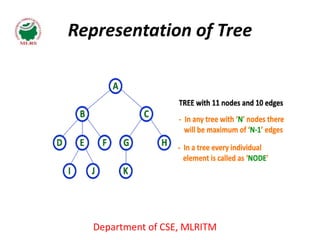
Representation of Tree
Department of CSE, MLRITM
• In tree data structure, every individual
element is called as Node.
• Node stores the actual data of that
particular element and link to next
element in hierarchical structure.
• In a tree data structure, if we have N
number of nodes then we can have a
maximum of N-1 number of links.
Department of CSE, MLRITM
Terminology
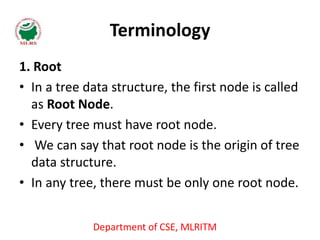
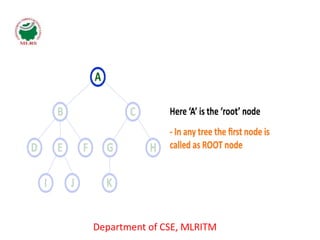
1. Root
• In a tree data structure, the first node is called
as Root Node.
• Every tree must have root node.
• We can say that root node is the origin of tree
data structure.
• In any tree, there must be only one root node.
Department of CSE, MLRITM
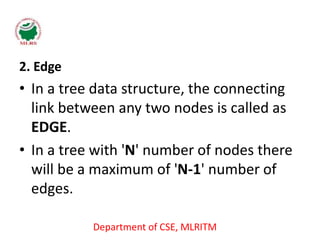
2. Edge
• In a tree data structure, the connecting
link between any two nodes is called as
EDGE.
• In a tree with 'N' number of nodes there
will be a maximum of 'N-1' number of
edges.
Department of CSE, MLRITM
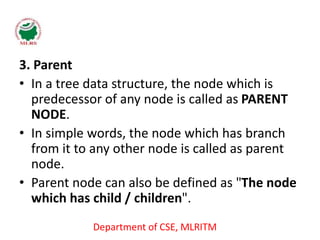
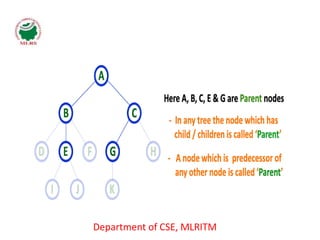
3. Parent
• In a tree data structure, the node which is
predecessor of any node is called as PARENT
NODE.
• In simple words, the node which has branch
from it to any other node is called as parent
node.
• Parent node can also be defined as "The node
which has child / children".
Department of CSE, MLRITM
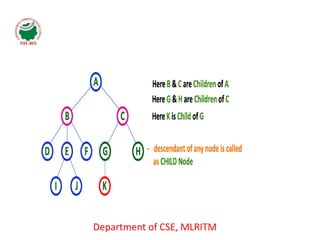
4. Child
• In a tree data structure, the node which is
descendant of any node is called as CHILD
Node.
• In simple words, the node which has a link
from its parent node is called as child node.
• In a tree, any parent node can have any
number of child nodes. In a tree, all the nodes
except root are child nodes.
Department of CSE, MLRITM
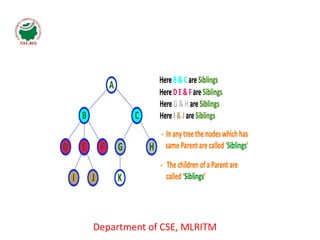
5. Siblings
• In a tree data structure, nodes which
belong to same Parent are called as
SIBLINGS.
• In simple words, the nodes with same
parent are called as Sibling nodes.
Department of CSE, MLRITM
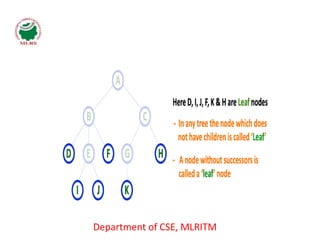
6. Leaf
• In a tree data structure, the node which does
not have a child is called as LEAF Node.
• In a tree data structure, the leaf nodes are
also called as External Nodes.
• In a tree, leaf node is also called as 'Terminal'
node.
Department of CSE, MLRITM
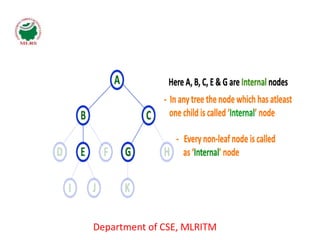
7. Internal Nodes
• In a tree data structure, the node which has
atleast one child is called as INTERNAL Node.
• In a tree data structure, nodes other than leaf
nodes are called as Internal Nodes.
• Internal nodes are also called as 'Non-
Terminal' nodes.
Department of CSE, MLRITM
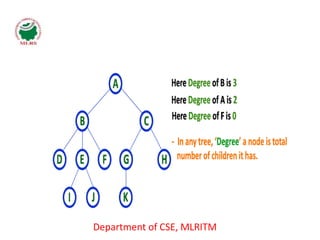
8. Degree
• In a tree data structure, the total number of
children of a node is called as DEGREE of that
Node.
• The highest degree of a node among all the
nodes in a tree is called as 'Degree of Tree'
Department of CSE, MLRITM
9. Level
• In a tree data structure, the root node is said to
be at Level 0 and the children of root node are at
Level 1 and the children of the nodes which are at
Level 1 will be at Level 2 and so on...
• In simple words, in a tree each step from top to
bottom is called as a Level and the Level count
starts with '0' and incremented by one at each
level (Step).
Department of CSE, MLRITM
10. Height
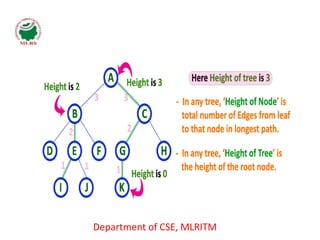
• The total number of egdes from leaf node to a
particular node in the longest path is called as
HEIGHT of that Node.
• In a tree, height of the root node is said to be
height of the tree.
• In a tree, height of all leaf nodes is '0'.
Department of CSE, MLRITM
11. Depth
• In a tree data structure, the total number of
edges from root node to a particular node is
called as DEPTH of that Node.
• In a tree, the total number of edges from root
node to a leaf node in the longest path is said
to be Depth of the tree.
• Depth of the root node is '0'.
Department of CSE, MLRITM
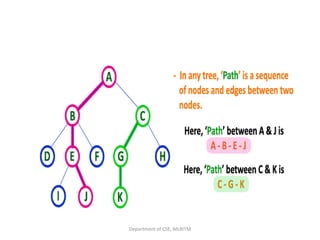
12. Path
• In a tree data structure, the sequence of Nodes and
Edges from one node to another node is called as
PATH between that two Nodes.
• Length of a Path is total number of nodes in that
path.
• In below example the path A - B - E - J has length 4.
Department of CSE, MLRITM
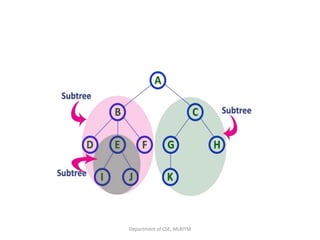
13. Sub Tree
• In a tree data structure, each child from a
node forms a subtree recursively.
• Every child node will form a subtree on its
parent node.
Department of CSE, MLRITM
THANK YOU
Department of CSE, MLRITM

Trees-Terminology.pptx

  • 1.
  • 2.
    Definition • In non-lineardata structure, data is organized in random order. • Tree is a very popular data structure used in wide range of applications. • Tree is a non-linear data structure which organizes data in hierarchical structure and this is a recursive definition. Department of CSE, MLRITM
  • 3.
  • 4.
    • In treedata structure, every individual element is called as Node. • Node stores the actual data of that particular element and link to next element in hierarchical structure. • In a tree data structure, if we have N number of nodes then we can have a maximum of N-1 number of links. Department of CSE, MLRITM
  • 5.
    Terminology 1. Root • Ina tree data structure, the first node is called as Root Node. • Every tree must have root node. • We can say that root node is the origin of tree data structure. • In any tree, there must be only one root node. Department of CSE, MLRITM
  • 6.
  • 7.
    2. Edge • Ina tree data structure, the connecting link between any two nodes is called as EDGE. • In a tree with 'N' number of nodes there will be a maximum of 'N-1' number of edges. Department of CSE, MLRITM
  • 8.
  • 9.
    3. Parent • Ina tree data structure, the node which is predecessor of any node is called as PARENT NODE. • In simple words, the node which has branch from it to any other node is called as parent node. • Parent node can also be defined as "The node which has child / children". Department of CSE, MLRITM
  • 10.
  • 11.
    4. Child • Ina tree data structure, the node which is descendant of any node is called as CHILD Node. • In simple words, the node which has a link from its parent node is called as child node. • In a tree, any parent node can have any number of child nodes. In a tree, all the nodes except root are child nodes. Department of CSE, MLRITM
  • 12.
  • 13.
    5. Siblings • Ina tree data structure, nodes which belong to same Parent are called as SIBLINGS. • In simple words, the nodes with same parent are called as Sibling nodes. Department of CSE, MLRITM
  • 14.
  • 15.
    6. Leaf • Ina tree data structure, the node which does not have a child is called as LEAF Node. • In a tree data structure, the leaf nodes are also called as External Nodes. • In a tree, leaf node is also called as 'Terminal' node. Department of CSE, MLRITM
  • 16.
  • 17.
    7. Internal Nodes •In a tree data structure, the node which has atleast one child is called as INTERNAL Node. • In a tree data structure, nodes other than leaf nodes are called as Internal Nodes. • Internal nodes are also called as 'Non- Terminal' nodes. Department of CSE, MLRITM
  • 18.
  • 19.
    8. Degree • Ina tree data structure, the total number of children of a node is called as DEGREE of that Node. • The highest degree of a node among all the nodes in a tree is called as 'Degree of Tree' Department of CSE, MLRITM
  • 20.
  • 21.
    9. Level • Ina tree data structure, the root node is said to be at Level 0 and the children of root node are at Level 1 and the children of the nodes which are at Level 1 will be at Level 2 and so on... • In simple words, in a tree each step from top to bottom is called as a Level and the Level count starts with '0' and incremented by one at each level (Step). Department of CSE, MLRITM
  • 22.
  • 23.
    10. Height • Thetotal number of egdes from leaf node to a particular node in the longest path is called as HEIGHT of that Node. • In a tree, height of the root node is said to be height of the tree. • In a tree, height of all leaf nodes is '0'. Department of CSE, MLRITM
  • 24.
  • 25.
    11. Depth • Ina tree data structure, the total number of edges from root node to a particular node is called as DEPTH of that Node. • In a tree, the total number of edges from root node to a leaf node in the longest path is said to be Depth of the tree. • Depth of the root node is '0'. Department of CSE, MLRITM
  • 26.
  • 27.
    12. Path • Ina tree data structure, the sequence of Nodes and Edges from one node to another node is called as PATH between that two Nodes. • Length of a Path is total number of nodes in that path. • In below example the path A - B - E - J has length 4. Department of CSE, MLRITM
  • 28.
  • 29.
    13. Sub Tree •In a tree data structure, each child from a node forms a subtree recursively. • Every child node will form a subtree on its parent node. Department of CSE, MLRITM
  • 30.
  • 31.