INNOVATION AND RESEARCH
INNOVATION:
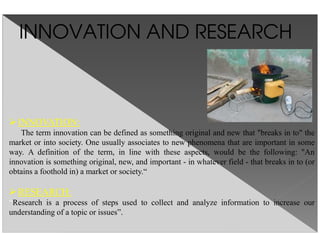
The term innovation can be defined as something original and new that "breaks in to" the
market or into society. One usually associates to new phenomena that are important in some
way. A definition of the term, in line with these aspects, would be the following: "An
innovation is something original, new, and important - in whatever field - that breaks in to (or
obtains a foothold in) a market or society.“
RESEARCH:
“Research is a process of steps used to collect and analyze information to increase our
understanding of a topic or issues”.
0
20
40
60
80
100
120
Avg.
innovation
intensity
Proportion of
highly
innovative
firms
Avg.
innovation
expenditure
Percentage of
firms that
collabrate with
R&D
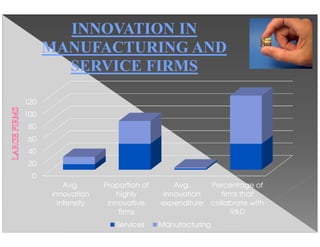
INNOVATION IN
MANUFACTURING AND
SERVICE FIRMS
Services Manufacturing
The poor design and enforcement of Intellectual Property Rights (IPR) laws and the weak
mechanisms for filing patents . Issues such as pendency, validity and stockpiling need to be
addressed.
Poor research infrastructure. Low spending on R&D in the country, which is paltry when
compared to that of other developing economies.
Low industry-to-lab linkages result in unviable or unutilized research.
The poor quality of education in the country.
For SMEs, the most important external barriers are: “excessive government Regulation”
Inefficient knowledge management systems within the company; and poor understanding of
customer needs and market dynamics.
Tendency to force-fit best practices in innovation from unrelated businesses to your own
business model
Inability to move beyond the first successful innovation and develop a sustainable model for
continuous innovation
.
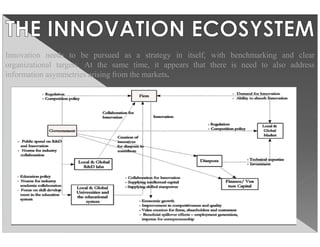
Innovation needs to be pursued as a strategy in itself, with benchmarking and clear
organizational targets. At the same time, it appears that there is need to also address
information asymmetries arising from the markets.
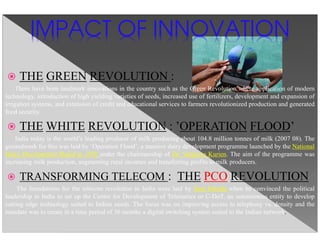
THE GREEN REVOLUTION :
There have been landmark innovations in the country such as the Green Revolution where application of modern
technology, introduction of high yielding varieties of seeds, increased use of fertilizers, development and expansion of
irrigation systems, and extension of credit and educational services to farmers revolutionized production and generated
food security.
THE WHITE REVOLUTION : ’OPERATION FLOOD’
India today is the world’s leading producer of milk producing about 104.8 million tonnes of milk (2007 08). The
groundwork for this was laid by ‘Operation Flood’, a massive dairy development programme launched by the National
Dairy Development Board in 1970 under the chairmanship of Dr. Varghese Kurien. The aim of the programme was
increasing milk production, augmenting rural incomes and transferring profits to milk producers.
TRANSFORMING TELECOM : THE PCO REVOLUTION
The foundations for the telecom revolution in India were laid by Sam Pitroda when he convinced the political
leadership in India to set up the Centre for Development of Telematics or C-DoT, an autonomous entity to develop
cutting edge technology suited to Indian needs. The focus was on improving access to telephony vs. density and the
mandate was to create in a time period of 36 months a digital switching system suited to the Indian network.
IMPACT OF INNOVATION
0
5
10
15
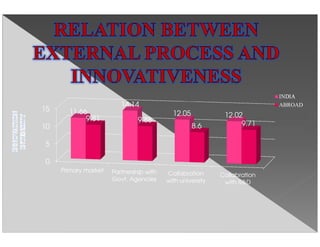
Primary market Partnership with
Govt. Agencies
Collabration
with university
Collabration
with R&D
11.66
14.14
12.05 12.029.81 9.88
8.6 9.71
INDIA
ABROAD
1. More attention towards policy preparation and evaluation :
If governments want to have major impact, they need to take decisions based on well thought visions. They have to
understand the current day situation, the potential needs and evolutions, the agenda’s of all relevant stakeholders.
Based on scenario building they have to take decisions on pursued strategy, build the platforms to execute and monitor
the outcomes and the impact of the government role.
2. More regulatory impact in a complex society :
An effective government is a good instrument to safeguard the well being in our society. Our complex society
needs an intelligent government who supports opportunities for further growth towards a harmonious organization and
an effective and safe society. Regulatory issues should have a positive impact on these ambitions.
3. New delivery via partnerships :
Volumes of activities, industrial production methods and the complexity of the industrial society has as a
consequence that governments can no longer have the monopoly in safeguarding security on products and services and
protection of the rights of the citizens.
Proposed Solution
EDUCATION
An essential step is systematic reform of the higher education system in India, which would act as an enabler
for. In order to unleash India’s developing the required intellectual capital as well as in laying the foundation for
effective collaboration between industry and educational institutions.
R&D COLLABRATION
1. Give universities and research institutions ownership and patent rights over inventions arising out of government
funded research
2. Create an enabling environment for universities and research institutions to commercialize such inventions
through licensing arrangements/partnerships where inventors would also be allowed to receive a share of the
royalty; and also thereby generally facilitate more collaborative efforts with industry.
GOVERNMENT PARTNERSHIPS
Several government programs have been established with the explicit purpose of driving Innovation in the Indian
economy – notable amongst these are the NMITLI (New Millennium India Technology Leadership Initiative), TePP
(Techno-Entrepreneurs Promotion Program), the National Innovation Foundation, TDB (Technology Development
Board), HGT (Home Grown Technology Program), etc.
1. Begin with a problem :
The innovation process starts with a problem or possibly a goal. All businesses have problems. Sales could be better,
products could be better, processes could be more efficient, costs could be reduced and so on.
2. Convert the problem into a challenge :
Once a problem has been identified, it needs to be converted into a challenge. A challenge is a short, terse question that
invites creative solutions
3. Challenge colleagues to suggest creative solutions :
Once you have a terrific innovation challenge, you need to communicate it to colleagues -- or others such as business
partners, customers or even the public -- so that they can generate ideas.
4. Collaborative idea generation :
Idea generation might be in the form of a brainstorming activity, through the use of real idea management software or
a team may be assigned to devise and develop ideas. You could even generate ideas yourself, but as a general rule,
diverse teams generate more creative than individuals -- at least in the right circumstances.

Tree

  • 2.
    INNOVATION AND RESEARCH INNOVATION: Theterm innovation can be defined as something original and new that "breaks in to" the market or into society. One usually associates to new phenomena that are important in some way. A definition of the term, in line with these aspects, would be the following: "An innovation is something original, new, and important - in whatever field - that breaks in to (or obtains a foothold in) a market or society.“ RESEARCH: “Research is a process of steps used to collect and analyze information to increase our understanding of a topic or issues”.
  • 3.
    0 20 40 60 80 100 120 Avg. innovation intensity Proportion of highly innovative firms Avg. innovation expenditure Percentage of firmsthat collabrate with R&D INNOVATION IN MANUFACTURING AND SERVICE FIRMS Services Manufacturing
  • 4.
    The poor designand enforcement of Intellectual Property Rights (IPR) laws and the weak mechanisms for filing patents . Issues such as pendency, validity and stockpiling need to be addressed. Poor research infrastructure. Low spending on R&D in the country, which is paltry when compared to that of other developing economies. Low industry-to-lab linkages result in unviable or unutilized research. The poor quality of education in the country. For SMEs, the most important external barriers are: “excessive government Regulation” Inefficient knowledge management systems within the company; and poor understanding of customer needs and market dynamics. Tendency to force-fit best practices in innovation from unrelated businesses to your own business model Inability to move beyond the first successful innovation and develop a sustainable model for continuous innovation .
  • 5.
    Innovation needs tobe pursued as a strategy in itself, with benchmarking and clear organizational targets. At the same time, it appears that there is need to also address information asymmetries arising from the markets.
  • 6.
    THE GREEN REVOLUTION: There have been landmark innovations in the country such as the Green Revolution where application of modern technology, introduction of high yielding varieties of seeds, increased use of fertilizers, development and expansion of irrigation systems, and extension of credit and educational services to farmers revolutionized production and generated food security. THE WHITE REVOLUTION : ’OPERATION FLOOD’ India today is the world’s leading producer of milk producing about 104.8 million tonnes of milk (2007 08). The groundwork for this was laid by ‘Operation Flood’, a massive dairy development programme launched by the National Dairy Development Board in 1970 under the chairmanship of Dr. Varghese Kurien. The aim of the programme was increasing milk production, augmenting rural incomes and transferring profits to milk producers. TRANSFORMING TELECOM : THE PCO REVOLUTION The foundations for the telecom revolution in India were laid by Sam Pitroda when he convinced the political leadership in India to set up the Centre for Development of Telematics or C-DoT, an autonomous entity to develop cutting edge technology suited to Indian needs. The focus was on improving access to telephony vs. density and the mandate was to create in a time period of 36 months a digital switching system suited to the Indian network. IMPACT OF INNOVATION
  • 7.
    0 5 10 15 Primary market Partnershipwith Govt. Agencies Collabration with university Collabration with R&D 11.66 14.14 12.05 12.029.81 9.88 8.6 9.71 INDIA ABROAD
  • 8.
    1. More attentiontowards policy preparation and evaluation : If governments want to have major impact, they need to take decisions based on well thought visions. They have to understand the current day situation, the potential needs and evolutions, the agenda’s of all relevant stakeholders. Based on scenario building they have to take decisions on pursued strategy, build the platforms to execute and monitor the outcomes and the impact of the government role. 2. More regulatory impact in a complex society : An effective government is a good instrument to safeguard the well being in our society. Our complex society needs an intelligent government who supports opportunities for further growth towards a harmonious organization and an effective and safe society. Regulatory issues should have a positive impact on these ambitions. 3. New delivery via partnerships : Volumes of activities, industrial production methods and the complexity of the industrial society has as a consequence that governments can no longer have the monopoly in safeguarding security on products and services and protection of the rights of the citizens.
  • 9.
    Proposed Solution EDUCATION An essentialstep is systematic reform of the higher education system in India, which would act as an enabler for. In order to unleash India’s developing the required intellectual capital as well as in laying the foundation for effective collaboration between industry and educational institutions. R&D COLLABRATION 1. Give universities and research institutions ownership and patent rights over inventions arising out of government funded research 2. Create an enabling environment for universities and research institutions to commercialize such inventions through licensing arrangements/partnerships where inventors would also be allowed to receive a share of the royalty; and also thereby generally facilitate more collaborative efforts with industry. GOVERNMENT PARTNERSHIPS Several government programs have been established with the explicit purpose of driving Innovation in the Indian economy – notable amongst these are the NMITLI (New Millennium India Technology Leadership Initiative), TePP (Techno-Entrepreneurs Promotion Program), the National Innovation Foundation, TDB (Technology Development Board), HGT (Home Grown Technology Program), etc.
  • 10.
    1. Begin witha problem : The innovation process starts with a problem or possibly a goal. All businesses have problems. Sales could be better, products could be better, processes could be more efficient, costs could be reduced and so on. 2. Convert the problem into a challenge : Once a problem has been identified, it needs to be converted into a challenge. A challenge is a short, terse question that invites creative solutions 3. Challenge colleagues to suggest creative solutions : Once you have a terrific innovation challenge, you need to communicate it to colleagues -- or others such as business partners, customers or even the public -- so that they can generate ideas. 4. Collaborative idea generation : Idea generation might be in the form of a brainstorming activity, through the use of real idea management software or a team may be assigned to devise and develop ideas. You could even generate ideas yourself, but as a general rule, diverse teams generate more creative than individuals -- at least in the right circumstances.