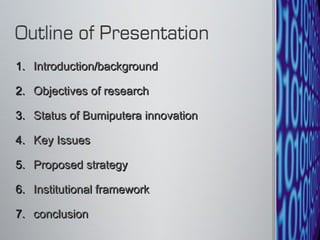


Introduction/background Objectives of research Status of Bumiputera innovation Key Issues Proposed strategy Institutional framework conclusion
 
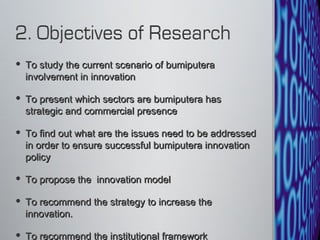
To study the current scenario of bumiputera involvement in innovation To present which sectors are bumiputera has strategic and commercial presence To find out what are the issues need to be addressed in order to ensure successful bumiputera innovation policy To propose the  innovation model To recommend the strategy to increase the innovation.  To recommend the institutional framework
 
Any  idea  or  knowledge  in whatever form which brings about  changes  in the form of product, service or process resulting in  positive impact to the economy ,  business ,  public service delivery system ,  social wellbeing  or  the environment  – Agensi Inovasi Malaysia Bill, 2010
“ Innovation consists of all of those  scientific, technical, commercial and financial steps  necessary for the successful  development and marketing of new or improved  manufactured products, the  commercial use of new or improved process or equipment  or the introduction of a new approach to a social service”  - OECD
Innovation . . . is generally understood as the  successful introduction of a new thing or method  . . . Innovation is the  embodiment, combination , or  synthesis of knowledge  in original, relevant,  valued new products, processes, or services  – Luecke & Katz (2003)
All innovation begins with  creative ideas  . . . We define  innovation as the successful implementation of creative ideas  within an organization. In this view,  creativity by individuals and teams is a starting point for innovation ; the first is necessary but not sufficient condition for the second – Amabile (1996)
Innovation, like many business functions, is a  management process  that requires specific  tools, rules, and discipline  – Davila et. al. (2006)
A  strategic process  which: Consists of  scientific, technical, commercial, financial steps and risk evaluation Involves  creativity  or implementation of  new ideas  (or  old ideas in new environment ) Requires  tools, rules and disciplines for change Has  commercial values
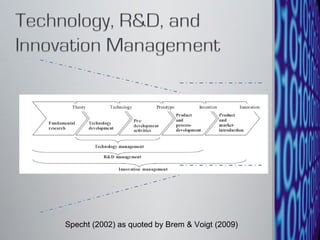
Specht (2002) as quoted by Brem & Voigt (2009)
 
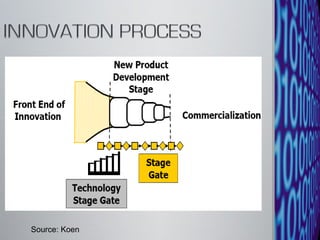
Source: Koen
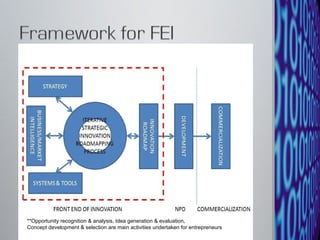
**Opportunity recognition & analysis, Idea generation & evaluation,  Concept development & selection are main activities undertaken for entrepreneurs
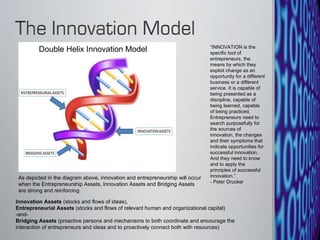
As depicted in the diagram above, innovation and entrepreneurship will occur when the Entrepreneurship Assets, Innovation Assets and Bridging Assets are strong and reinforcing.  Innovation Assets  (stocks and flows of ideas), Entrepreneurial Assets  (stocks and flows of relevant human and organizational capital) -and- Bridging Assets  (proactive persons and mechanisms to both coordinate and encourage the interaction of entrepreneurs and ideas and to proactively connect both with resources) “ INNOVATION is the specific tool of entrepreneurs, the means by which they exploit change as an opportunity for a different business or a different service. It is capable of being presented as a discipline, capable of being learned, capable of being practiced. Entrepreneurs need to search purposefully for the sources of innovation, the changes and their symptoms that indicate opportunities for successful innovation. And they need to know and to apply the principles of successful innovation.” - Peter Drucker  Double Helix Innovation Model
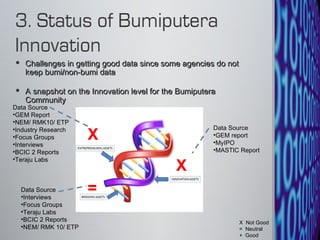
Challenges in getting good data since some agencies do not keep bumi/non-bumi data A snapshot on the Innovation level for the Bumiputera Community X  X  =  X  Not Good =  Neutral +  Good  Data Source GEM report MyIPO MASTIC Report  Data Source Interviews Focus Groups Teraju Labs  BCIC 2 Reports  NEM/ RMK 10/ ETP Data Source GEM Report NEM/ RMK10/ ETP Industry Research Focus Groups  Interviews BCIC 2 Reports  Teraju Labs
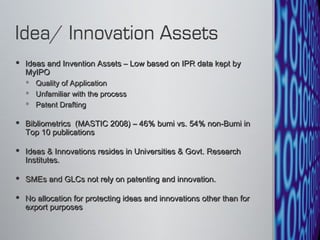
Ideas and Invention Assets – Low based on IPR data kept by MyIPO Quality of Application Unfamiliar with the process Patent Drafting Bibliometrics  (MASTIC 2008) – 46% bumi vs. 54% non-Bumi in Top 10 publications Ideas & Innovations resides in Universities & Govt. Research Institutes.  SMEs and GLCs not rely on patenting and innovation. No allocation for protecting ideas and innovations other than for export purposes
Factors Inhibiting Innovation & R&D (Mastic) Lack of Skill R&D Personnel Lack of Financial and increased in capital cost Lack of Infrastructure for R&D Lack of information on new technology
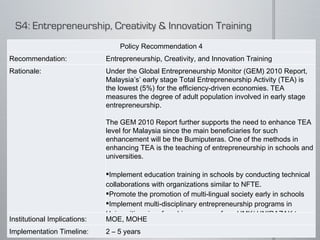
Low Total Entrepreneurial Activity (TEA) Malaysia’s early stage TEA is the lowest (5%) among the efficiency-driven economies The intention to be entrepreneurs is very low at 5.1% compared to world average of 23.2% Only 55.7% see Entrepreneurship as good career choice compared to an average of 72.8% Therefore the Malaysia lacks source entrepreneurs compared to other countries.
 
 
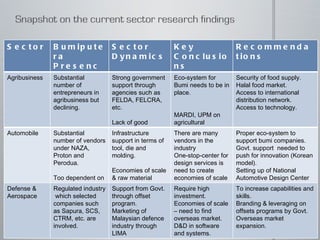
Sector Bumiputera Presence Sector Dynamics Key Conclusions Recommendations Agribusiness Substantial number of entrepreneurs in agribusiness but declining. Strong government support through agencies such as FELDA, FELCRA, etc. Lack of good business partners Eco-system for Bumi needs to be in place. MARDI, UPM on agricultural research Security of food supply. Halal food market. Access to international distribution network. Access to technology. Automobile  Substantial number of vendors under NAZA, Proton and Perodua.  Too dependent on a single customer  Infrastructure support in terms of tool, die and molding.  Economies of scale & raw material issues There are many vendors in the industry One-stop-center for design services is need to create economies of scale Proper eco-system to support bumi companies. Govt. support  needed to push for innovation (Korean model). Setting up of National Automotive Design Center Defense & Aerospace Regulated industry  which selected companies such as Sapura, SCS, CTRM, etc. are involved. Support from Govt. through offset program. Marketing of  Malaysian defence industry through LIMA  Require high investment. Economies of scale – need to find overseas market. D&D in software and systems. To increase capabilities and skills. Branding & leveraging on offsets programs by Govt. Overseas market expansion.
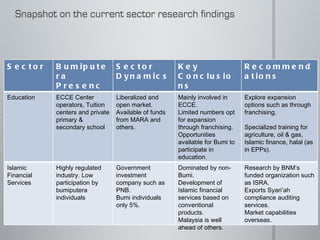
Sector Bumiputera Presence Sector Dynamics Key Conclusions Recommendations Education ECCE Center operators, Tuition centers and private primary & secondary school  Liberalized and open market. Available of funds from MARA and others. Mainly involved in ECCE. Limited numbers opt for expansion through franchising. Opportunities available for Bumi to participate in education. Explore expansion options such as through franchising. Specialized training for agriculture, oil & gas, Islamic finance, halal (as in EPPs). Islamic Financial Services Highly regulated industry. Low participation by bumiputera individuals Government investment company such as PNB. Bumi individuals only 5%. Dominated by non-Bumi. Development of Islamic financial services based on conventional products. Malaysia is well ahead of others. Research by BNM’s funded organization such as ISRA. Exports Syari’ah compliance auditing services. Market capabilities overseas.
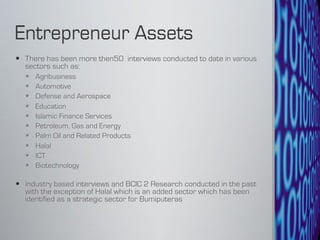
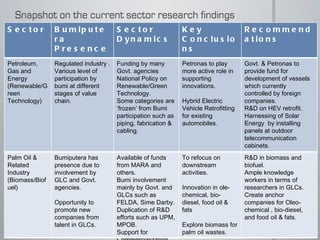
Sector Bumiputera Presence Sector Dynamics Key Conclusions Recommendations Petroleum, Gas and Energy (Renewable/Green Technology) Regulated industry . Various level of participation by bumi at different stages of value chain. Funding by many Govt. agencies National Policy on Renewable/Green Technology. Some categories are ‘frozen’ from Bumi participation such as piping, fabrication & cabling. Petronas to play more active role in supporting innovations. Hybrid Electric Vehicle Retrofitting for existing automobiles. Govt. & Petronas to provide fund for development of vessels which currently controlled by foreign companies. R&D on HEV retrofit. Harnessing of Solar Energy  by installing panels at outdoor telecommunication cabinets. Palm Oil & Related Industry (Biomass/Biofuel) Bumiputera has presence due to involvement by GLC and Govt. agencies. Opportunity to promote new companies from talent in GLCs.  Available of funds from MARA and others. Bumi involvement mainly by Govt. and GLCs such as FELDA, Sime Darby. Duplication of R&D efforts such as UPM, MPOB. Support for Commercialization To refocus on downstream activities. Innovation in ole-chemical, bio-diesel, food oil & fats Explore biomass for palm oil wastes. R&D in biomass and biofuel. Ample knowledge workers in terms of researchers in GLCs. Create anchor companies for Oleo-chemical , bio-diesel, and food oil & fats.
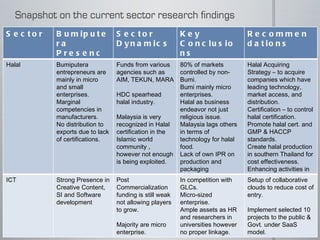
Sector Bumiputera Presence Sector Dynamics Key Conclusions Recommendations Halal Bumiputera entrepreneurs are mainly in micro and small enterprises. Marginal competencies in manufacturers.  No distribution to exports due to lack of certifications.  Funds from various agencies such as AIM, TEKUN, MARA HDC spearhead halal industry. Malaysia is very recognized in Halal certification in the Islamic world community , however not enough is being exploited.  80% of markets controlled by non-Bumi. Bumi mainly micro enterprises. Halal as business endeavor not just religious issue. Malaysia lags others in terms of technology for halal food. Lack of own IPR on production and packaging technologies Halal Acquiring Strategy – to acquire companies which have leading technology, market access, and distribution. Certification – to control halal certification. Promote halal cert. and GMP & HACCP standards. Create halal production in southern Thailand for cost effectiveness. Enhancing activities in Lima Dasar  region. ICT Strong Presence in Creative Content, SI and Software development  Post Commercialization funding is still weak not allowing players to grow. Majority are micro enterprise. In competition with GLCs. Micro-sized enterprise. Ample assets as HR and researchers in universities however no proper linkage. Setup of collaborative clouds to reduce cost of entry. Implement selected 10 projects to the public & Govt. under SaaS model.
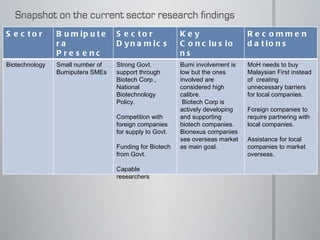
Sector Bumiputera Presence Sector Dynamics Key Conclusions Recommendations Biotechnology  Small number of Bumiputera SMEs Strong Govt. support through Biotech Corp.,  National Biotechnology Policy. Competition with foreign companies for supply to Govt.  Funding for Biotech from Govt. Capable researchers Bumi involvement is low but the ones involved are considered high calibre. Biotech Corp is actively developing and supporting biotech companies. Bionexus companies see overseas market as main goal. MoH needs to buy Malaysian First instead of  creating unnecessary barriers for local companies. Foreign companies to require partnering with local companies. Assistance for local companies to market overseas.
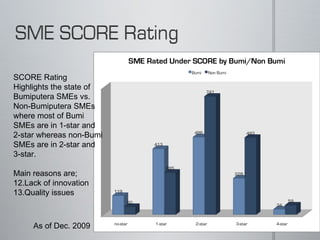
SCORE Rating  Highlights the state of Bumiputera SMEs vs. Non-Bumiputera SMEs where most of Bumi SMEs are in 1-star and 2-star whereas non-Bumi SMEs are in 2-star and 3-star. Main reasons are; Lack of innovation Quality issues As of Dec. 2009
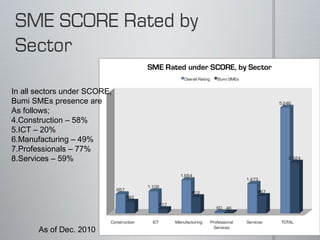
In all sectors under SCORE, Bumi SMEs presence are As follows; Construction – 58% ICT – 20% Manufacturing – 49% Professionals – 77% Services – 59% As of Dec. 2010
 
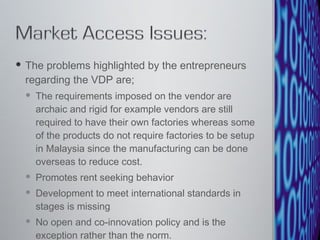
The problems highlighted by the entrepreneurs regarding the VDP are; The requirements imposed on the vendor are archaic and rigid for example vendors are still required to have their own factories whereas some of the products do not require factories to be setup in Malaysia since the manufacturing can be done overseas to reduce cost. Promotes rent seeking behavior Development to meet international standards in stages is missing No open and co-innovation policy and is the exception rather than the norm.
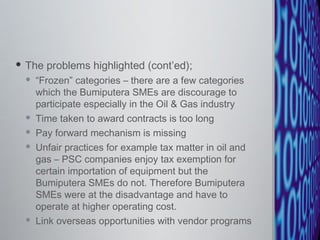
The problems highlighted (cont’ed); “ Frozen” categories – there are a few categories which the Bumiputera SMEs are discourage to participate especially in the Oil & Gas industry  Time taken to award contracts is too long Pay forward mechanism is missing  Unfair practices for example tax matter in oil and gas – PSC companies enjoy tax exemption for certain importation of equipment but the Bumiputera SMEs do not. Therefore Bumiputera SMEs were at the disadvantage and have to operate at higher operating cost. Link overseas opportunities with vendor programs
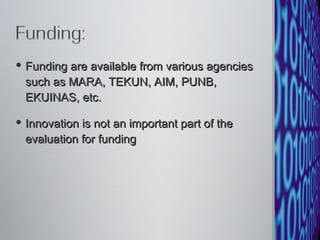
Funding are available from various agencies such as MARA, TEKUN, AIM, PUNB, EKUINAS, etc. Innovation is not an important part of the evaluation for funding
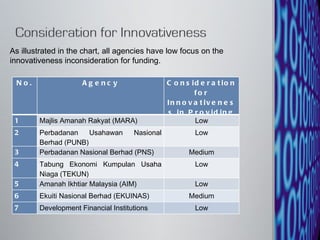
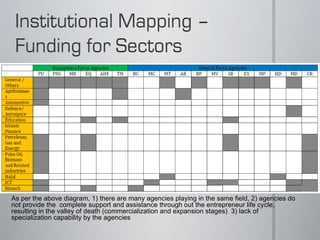
As illustrated in the chart, all agencies have low focus on the innovativeness inconsideration for funding. No. Agency Consideration for Innovativeness in Providing Funding 1 Majlis Amanah Rakyat (MARA) Low 2 Perbadanan Usahawan Nasional Berhad (PUNB) Low 3 Perbadanan Nasional Berhad (PNS) Medium 4 Tabung Ekonomi Kumpulan Usaha Niaga (TEKUN) Low 5 Amanah Ikhtiar Malaysia (AIM) Low 6 Ekuiti Nasional Berhad (EKUINAS) Medium 7 Development Financial Institutions Low
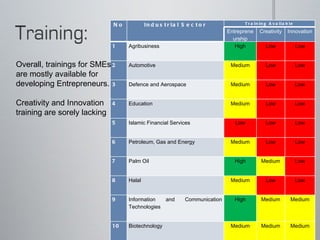
Overall, trainings for SMEs are mostly available for  developing Entrepreneurs. Creativity and Innovation  training are sorely lacking No Industrial Sector Training Available Entrepreneurship Creativity Innovation 1 Agribusiness   High Low Low 2 Automotive   Medium Low Low 3 Defence and Aerospace   Medium Low Low 4 Education   Medium Low Low 5 Islamic Financial Services   Low Low Low 6 Petroleum, Gas and Energy   Medium Low Low 7 Palm Oil   High Medium Low 8 Halal   Medium Low Low 9 Information and Communication Technologies   High Medium Medium 10 Biotechnology   Medium Medium Medium
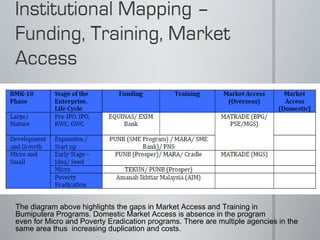
The diagram above highlights the gaps in Market Access and Training in Bumiputera Programs. Domestic Market Access is absence in the program even for Micro and Poverty Eradication programs. There are multiple agencies in the same area thus  increasing duplication and costs.
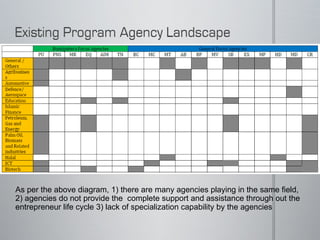
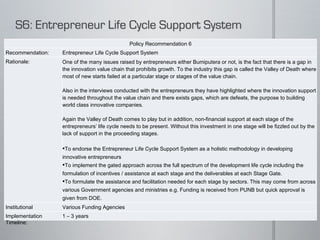
As per the above diagram, 1) there are many agencies playing in the same field, 2) agencies do not provide the  complete support and assistance through out the entrepreneur life cycle, resulting in the valley of death (commercialization and expansion stages)  3) lack of specialization capability by the agencies
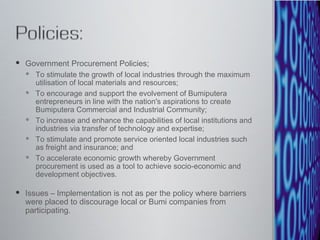
Government Procurement Policies;  To stimulate the growth of local industries through the maximum utilisation of local materials and resources; To encourage and support the evolvement of Bumiputera entrepreneurs in line with the nation's aspirations to create Bumiputera Commercial and Industrial Community; To increase and enhance the capabilities of local institutions and industries via transfer of technology and expertise; To stimulate and promote service oriented local industries such as freight and insurance; and To accelerate economic growth whereby Government procurement is used as a tool to achieve socio-economic and development objectives. Issues – Implementation is not as per the policy where barriers were placed to discourage local or Bumi companies from participating.
 
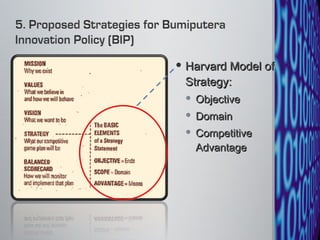
Harvard Model of Strategy: Objective Domain Competitive Advantage
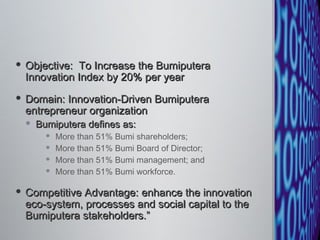
Objective:  To Increase the Bumiputera Innovation Index by 20% per year Domain: Innovation-Driven Bumiputera entrepreneur organization Bumiputera defines as: More than 51% Bumi shareholders; More than 51% Bumi Board of Director;  More than 51% Bumi management; and  More than 51% Bumi workforce.  Competitive Advantage: enhance the innovation eco-system, processes and social capital to the Bumiputera stakeholders.”
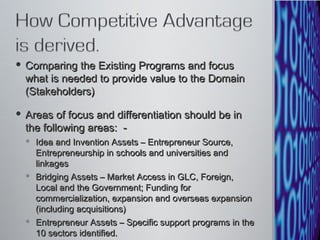
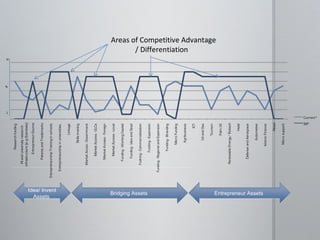
Comparing the Existing Programs and focus what is needed to provide value to the Domain (Stakeholders)  Areas of focus and differentiation should be in the following areas:  -  Idea and Invention Assets – Entrepreneur Source, Entrepreneurship in schools and universities and linkages  Bridging Assets – Market Access in GLC, Foreign, Local and the Government; Funding for commercialization, expansion and overseas expansion (including acquisitions)  Entrepreneur Assets – Specific support programs in the 10 sectors identified.
Areas of Competitive Advantage / Differentiation  H M L Idea/ Invent Assets  Bridging Assets  Entrepreneur Assets
Areas of focus and differentiation should be in the following areas:  -  Idea and Invention Assets – Entrepreneur Source, Entrepreneurship in schools and universities and linkages  Bridging Assets – Market Access in GLC, Foreign, Local and the Government; Funding for commercialization, expansion and overseas expansion (including acquisitions)  Entrepreneur Assets – Specific support programs in the 10 sectors identified.
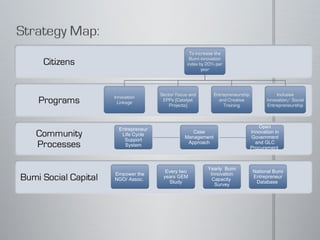
4-layer strategy map; Citizen – ultimate beneficiaries of the policy Programs – initiatives including funding and support programs Community process – integrated process within the eco-system Bumi Social Capital – social network to support innovative culture and values
Entrepreneur Life Cycle Support System Case Management Approach Open Innovation in Government and GLC Procurement  Empower the NGO/ Assoc.  Every two years GEM Study Yearly  Bumi Innovation Capacity  Survey National Bumi Entrepreneur Database
“ To increase the Bumiputera Innovation Index by 20% per year by implementing and monitoring the policies. Programs and initiatives that will strengthen the innovation eco-system, process and social capital to the Bumiputera stakeholders”
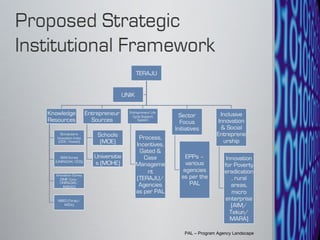
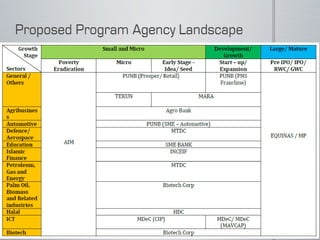
The institutional framework is very important to organize the key players that will be critical to achieving the Strategy. This is the Strategic Institutional Framework.  In addition to the above, the agencies implementing the programs  the that are involve in providing funds training and market access progress to the Bumiputera community will need to reorganized and to un-clutter the landscape. This will allow the relevant agencies to focus in a specialization and allow support at the full spectrum (early to late stage) of that particular  industry/ sector. This will be the Program Agency Landscape.  The above will also allow the ease of implementation for the Entrepreneur Life Cycle and Case Management.
PAL – Program Agency Landscape
As per the above diagram, 1) there are many agencies playing in the same field, 2) agencies do not provide the  complete support and assistance through out the entrepreneur life cycle 3) lack of specialization capability by the agencies
Identification of 10 priority sectors to promote  1 Agency 1 sector/ industry concept but implemented in stages . Full support from early stage to maturity Criteria of Participation Innovation Driven. A minimum level of 1-InnoCERT  compliance is needed Membership in a designated in NGO/ Association is mandatory for Innovation tracking and monitoring. Gated Approach  Case/ Portfolio Approach to Innovation. Open Innovation with GLC and Government. Proposing 5% as a initial target.  Double Tax breaks for investing in 1-InnoCERT company.
Focus on Innovation - A minimum level for 1-InnoCERT  Empowering Community Associations/ NGOs  Paid members of mandated associations and NGOS.  1 NGO/ Associations per sector or  industry Very high audit on the association and NGO to ensure the highest in governance  NGO/ Association will have to maintain the membership data as part of the National Bumiputera Entrepreneurs Database (NBED)
Entrepreneurs given assistance are given pre-determined deliverables to meet.  Once meet the entrepreneur automatically graduates to the next stage. No need for committee approval. No need go to other agencies since it will be under a single agency.  Assistance will be funding, market access and training.  Deliverables will be financial, market, innovation and/ or developmental (e.g. jobs created or partner development)
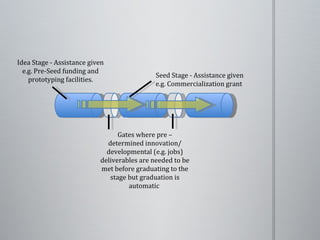
Gates where pre – determined innovation/ developmental (e.g. jobs) deliverables are needed to be met before graduating to the stage but graduation is automatic  Idea Stage - Assistance given e.g. Pre-Seed funding and prototyping facilities. Seed Stage - Assistance given e.g. Commercialization grant
Also called Portfolio approach  An agency officer is designated to entrepreneur until the entrepreneur is at post IPO stage Main objective of the case manager to ensure the entrepreneur grows and develops. Incentives are given to the case manager upon successful deliverables met at the “gate” The above is to ensure joint ownership with the entrepreneur.
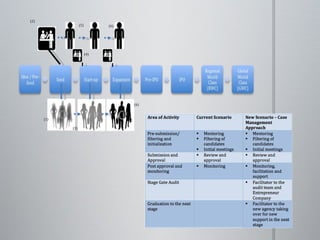
(1) (2) (3) (3) (4) (5) (6) (6)
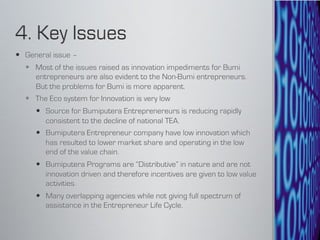
Bumiputera contribution to national GNI/ capital is only low at 14% or RM3,754 Innovation is proven to uplift a community's income level.  But innovation is a long term program, requires political will and investment.  Innovation is currently not measured. If it is not measured it will not be met. There is a critical need to put a system to measure this and provide continuous feedback on the Bumiputera innovation level.
If Bumiputera innovation is to flourish the community - entrepreneurs, the government and the public needs to relook and redefine how it promotes entrepreneurship. The current status is not sustainable and will contribute to Bumiputeras being marginalized. Using the Double Helix Model, it is found that innovation among the Bumiptuera community is low.  To fuse innovation, a strategy has to be implemented with a clear statement and involves programs, community processes and social capital. Key recommendations are a realignment in agencies involve in Bumiputera assistance, Domestic Market Access and change in the process of evaluation, assistance of entrepreneurs.  Recommend for the proposed policies to be adopted as part of the National Innovation Policy
 
 
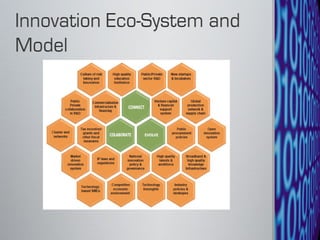
The relevant designated agency or ministry (government instrument) will implement and monitor such sanctioned policies, programs and initiatives relating to the Bumiputera Innovation  Innovation Eco-System consists of the Idea/ Invention, Bridging and Entrepreneur Assets highlighted in the Double Helix Innovation Model. Preliminary focus will be in areas highlighted in section 6.2.4 as per the Competition Landscape.  Processes and Social Capital is depicted in the Strategy Map and is defined as i) Community Processes  - the integrated process that goes across stakeholder organizations from the Government, NGOs and others. i) Bumiputera Social Capital – this is similar to the organizations’ culture and values  “… per year by  implementing and monitoring the policies, programs and initiatives that will strengthen the innovation eco-system, processes and social capital ….”
Innovation Driven is defined as the stakeholders that requires and intends to innovate in their activities.  Innovation is defined as to commercialize ideas or inventions.  Innovation in this context does not include distributive programs that are of “starting a business” natures where there are no innovation criteria or elements.  Bumiputera Stakeholders are defined as Malaysian citizens that are of Bumiputera legal status which includes individuals, entrepreneurs and companies.  Bumiputera companies are considered Bumiputera if they meet the criteria “… to  Innovation Driven Bumiputera Stakeholders”
Merger of PNS with PUNB where PNS franchise program will merge with PUNB Prosper Program PUNB SME Program to focus in Automotive only and will cover the full life cycle of the organization.  MARA to focus on other sectors other than the 10 priority sectors but more on Development and Growth companies.  Equinas to expand their sectors to Agribusiness, Automative, Defense/ Aerospace, Islamic Finance, Palm Oil/ Biomass, Halal, and ICT. Equinas will still focus at the large and mature companies.  No changes to the direction of AIM No changes to TEKUN but they will focus in other sectors but will not focus in the 10 priority areas  Biotech Corp will extend their portfolio to biotechnology related to Palm Oil and Biomass.  No changes to MDeC except that Cradle will be merged with MDeC thus leaving Cradle to focusing in ICT No changes to MATRADE but they will not focus to Halal unless by capitalizing their overseas channels. Promotion of the Halal industry will remain with HDC as its sole focus. However, HDC will work with MATRADE to capitalize on their overseas channels. This is a similar model in which MATRADE is working with MDeC in promoting ICT.
No changes in AgroBank  No changes in the Bank Pembangunan other than that they will not focus in the 10 priority sectors.  MAVCAP will be merged as a VC arm of MDeC and will only focus in ICT.  SME Bank will focus in providing financing to other sectors other than the 10 priority sectors but will also include Education sector  Modal Perdana will focus in later stage VC funding in Development/ Growth and Large/ Mature firms but in sectors that are not the 10 priority focus areas.  No changes in HDC  MTDC will now focus on Defense/ Aerospace and Petroleum/ Gas/ Energy. However their investments will be limited to Development / Growth and Micro/ Small.  A new stakeholder will be introduced and that will be INCEIF, which is a subsidiary of Bank Negara Malaysia (BNM). INCEIF will lead the entrepreneur and industry development for Islamic Finance including funding, market access and training. However, funding will only be focused up to Development / Growth including Micro/ Small.
Policy Recommendation 1 Recommendation: Bumiputera Innovation Index to be designed and collated to measure the degree of Innovation in the community Rationale: The edict “what gets measured gets managed” holds true in this instance. In conducting this research it was a challenge to determine the degree of innovation in the Bumiputera community due to the lack of data or the lack of access to data. There are many models of an innovation index but the challenge is to i) to have an index that is relative to Malaysia’s participation in the global scene ii) that it has measurements that can be measured in the Bumiputera community and not broad macro measurements that measures a country’s innovation level and iii) the measurements can be compared to the performance of the Bumiputera with the national performance i.e. if the Bumiputeras are either below or above the national level. The Innovation Index will be able to gauge the innovation level among sections of societies in Malaysia.   Global Innovation Index to be used - It is proposed that the Global Innovation Index is used to measure the Bumiputera Innovation Index since it has more indicators to the Bumputera as compared to the Global Competitive ranking.  Department of Statistics as lead agency - That the lead agency for this initiative be undertaken by the Department of Statistics working in collaboration with other agencies and ministries.  Database System  - That an integrated information system be implemented that will collate, store and distribute the information to relevant stakeholders  INSEAD Collaboration - That in short term (1 – 2 years) collaboration be formed between INSEAD and the Department of Statistics to implement the Bumiputera Innovation Index. Key parameters and knowledge transfer should be in place for the methodology to be implemented by the Department of Statistics after the Second year.    Institutional Implications: Department of Statistics Implementation Timeline: Immediate (1-2 years)
Policy Recommendation 2 Recommendation: Linking Innovation to Existing and New Bumiputera Programs Rationale: A general analysis was conducted by obtaining applications of the Bumiputera programs, which has identified that innovation as a criteria for approval is below 20%.  This means that most of the Bumiputera programs are more distributive in nature and funding and support are designed to encourage “starting a business” and not innovation driven, which may lead to low contribution to the national economy and high failure rates.   From the recent Global Entrepreneurship Monitor (GEM) 2010 Global Report, Malaysia ranking in terms of innovation in early-stage entrepreneurial is behind compared to other countries and also similar efficiency-driven countries.   Relook and redesign the investment and financing mandate of EDOs and DFI to promote financing in innovative products  Approval criteria to have at least 40% innovation in future applications and submissions.  Institutional Implications: MARA, TEKUN, PUNB, PNS, EKUINAS, AIM, EXIM Bank, SME Bank and other funding agencies.  Implementation Timeline: Immediate within 1 year
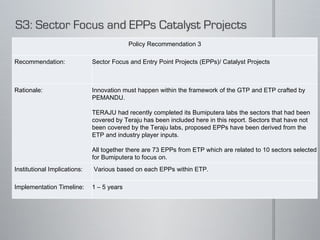
Policy Recommendation 3 Recommendation: Sector Focus and Entry Point Projects (EPPs)/ Catalyst Projects Rationale: Innovation must happen within the framework of the GTP and ETP crafted by PEMANDU.    TERAJU had recently completed its Bumiputera labs the sectors that had been covered by Teraju has been included here in this report. Sectors that have not been covered by the Teraju labs, proposed EPPs have been derived from the ETP and industry player inputs.   All together there are 73 EPPs from ETP which are related to 10 sectors selected for Bumiputera to focus on. Institutional Implications: Various based on each EPPs within ETP. Implementation Timeline: 1 – 5 years
Policy Recommendation 4 Recommendation: Entrepreneurship, Creativity, and Innovation Training Rationale: Under the Global Entrepreneurship Monitor (GEM) 2010 Report, Malaysia’s’ early stage Total Entrepreneurship Activity (TEA) is the lowest (5%) for the efficiency-driven economies. TEA measures the degree of adult population involved in early stage entrepreneurship.   The GEM 2010 Report further supports the need to enhance TEA level for Malaysia since the main beneficiaries for such enhancement will be the Bumiputeras. One of the methods in enhancing TEA is the teaching of entrepreneurship in schools and universities.   Implement education training in schools by conducting technical collaborations with organizations similar to NFTE.  Promote the promotion of multi-lingual society early in schools  Implement multi-disciplinary entrepreneurship programs in Universities via a franchise program from UMK/ UNIRAZAK to other universities.  Institutional Implications: MOE, MOHE Implementation Timeline: 2 – 5 years
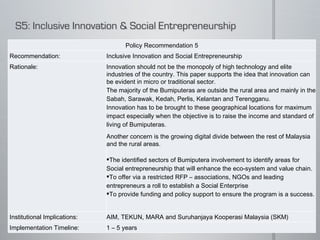
Policy Recommendation 5 Recommendation: Inclusive Innovation and Social Entrepreneurship Rationale: Innovation should not be the monopoly of high technology and elite industries of the country. This paper supports the idea that innovation can be evident in micro or traditional sector.  The majority of the Bumiputeras are outside the rural area and mainly in the Sabah, Sarawak, Kedah, Perlis, Kelantan and Terengganu.  Innovation has to be brought to these geographical locations for maximum impact especially when the objective is to raise the income and standard of living of Bumiputeras.  Another concern is the growing digital divide between the rest of Malaysia and the rural areas.   The identified sectors of Bumiputera involvement to identify areas for Social entrepreneurship that will enhance the eco-system and value chain.  To offer via a restricted RFP – associations, NGOs and leading entrepreneurs a roll to establish a Social Enterprise To provide funding and policy support to ensure the program is a success.    Institutional Implications: AIM, TEKUN, MARA and Suruhanjaya Kooperasi Malaysia (SKM) Implementation Timeline: 1 – 5 years
Policy Recommendation 6 Recommendation: Entrepreneur Life Cycle Support System Rationale: One of the many issues raised by entrepreneurs either Bumiputera or not, is the fact that there is a gap in the innovation value chain that prohibits growth. To the industry this gap is called the Valley of Death where most of new starts failed at a particular stage or stages of the value chain.   Also in the interviews conducted with the entrepreneurs they have highlighted where the innovation support is needed throughout the value chain and there exists gaps, which are defeats, the purpose to building world class innovative companies.    Again the Valley of Death comes to play but in addition, non-financial support at each stage of the entrepreneurs’ life cycle needs to be present. Without this investment in one stage will be fizzled out by the lack of support in the proceeding stages.   To endorse the Entrepreneur Life Cycle Support System as a holistic methodology in developing innovative entrepreneurs  To implement the gated approach across the full spectrum of the development life cycle including the formulation of incentives / assistance at each stage and the deliverables at each Stage Gate.  To formulate the assistance and facilitation needed for each stage by sectors. This may come from across various Government agencies and ministries e.g. Funding is received from PUNB but quick approval is given from DOE.  To ensure that at each passing Gate, automatic approval is given with the required assistance given in the preceding stage. Institutional Implications: Various Funding Agencies Implementation Timeline: 1 – 3 years
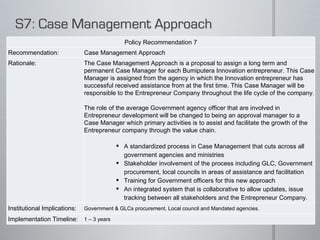
Policy Recommendation 7 Recommendation: Case Management Approach Rationale: The Case Management Approach is a proposal to assign a long term and permanent Case Manager for each Bumiputera Innovation entrepreneur. This Case Manager is assigned from the agency in which the Innovation entrepreneur has successful received assistance from at the first time. This Case Manager will be responsible to the Entrepreneur Company throughout the life cycle of the company.   The role of the average Government agency officer that are involved in Entrepreneur development will be changed to being an approval manager to a Case Manager which primary activities is to assist and facilitate the growth of the Entrepreneur company through the value chain.   A standardized process in Case Management that cuts across all government agencies and ministries  Stakeholder involvement of the process including GLC, Government procurement, local councils in areas of assistance and facilitation  Training for Government officers for this new approach  An integrated system that is collaborative to allow updates, issue tracking between all stakeholders and the Entrepreneur Company.  Institutional Implications: Government & GLCs procurement, Local council and Mandated agencies.  Implementation Timeline: 1 – 3 years
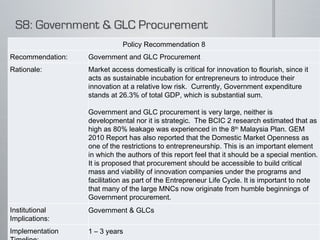
Policy Recommendation 8 Recommendation: Government and GLC Procurement Rationale: Market access domestically is critical for innovation to flourish, since it acts as sustainable incubation for entrepreneurs to introduce their innovation at a relative low risk.  Currently, Government expenditure stands at 26.3% of total GDP, which is substantial sum.   Government and GLC procurement is very large, neither is developmental nor it is strategic.  The BCIC 2 research estimated that as high as 80% leakage was experienced in the 8 th  Malaysia Plan. GEM 2010 Report has also reported that the Domestic Market Openness as one of the restrictions to entrepreneurship. This is an important element in which the authors of this report feel that it should be a special mention.  It is proposed that procurement should be accessible to build critical mass and viability of innovation companies under the programs and facilitation as part of the Entrepreneur Life Cycle. It is important to note that many of the large MNCs now originate from humble beginnings of Government procurement. Institutional Implications: Government & GLCs Implementation Timeline: 1 – 3 years
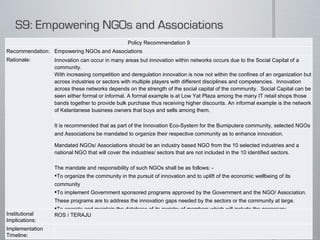
Policy Recommendation 9 Recommendation: Empowering NGOs and Associations Rationale: Innovation can occur in many areas but innovation within networks occurs due to the Social Capital of a community.  With increasing competition and deregulation innovation is now not within the confines of an organization but across industries or sectors with multiple players with different disciplines and competencies.  Innovation across these networks depends on the strength of the social capital of the community.  Social Capital can be seen either formal or informal. A formal example is at Low Yat Plaza among the many IT retail shops those bands together to provide bulk purchase thus receiving higher discounts. An informal example is the network of Kelantanese business owners that buys and sells among them.   It is recommended that as part of the Innovation Eco-System for the Bumiputera community, selected NGOs and Associations be mandated to organize their respective community as to enhance innovation.  Mandated NGOs/ Associations should be an industry based NGO from the 10 selected industries and a national NGO that will cover the industries/ sectors that are not included in the 10 identified sectors.   The mandate and responsibility of such NGOs shall be as follows: -  To organize the community in the pursuit of innovation and to uplift of the economic wellbeing of its community  To implement Government sponsored programs approved by the Government and the NGO/ Association. These programs are to address the innovation gaps needed by the sectors or the community at large.  To operate and maintain the database of its registry of members which will include the necessary information for the Bumiputera Innovation Index and the National Bumiputera Entrepreneurs Database  To ensure that only paid members are included in the Bumiputera Entrepreneurs Database    Institutional Implications: ROS / TERAJU  Implementation Timeline:  
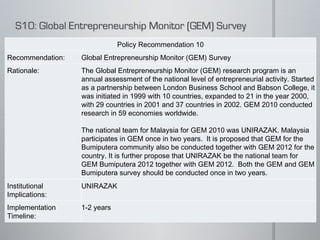
Policy Recommendation 10 Recommendation: Global Entrepreneurship Monitor (GEM) Survey Rationale: The Global Entrepreneurship Monitor (GEM) research program is an annual assessment of the national level of entrepreneurial activity. Started as a partnership between London Business School and Babson College, it was initiated in 1999 with 10 countries, expanded to 21 in the year 2000, with 29 countries in 2001 and 37 countries in 2002. GEM 2010 conducted research in 59 economies worldwide.   The national team for Malaysia for GEM 2010 was UNIRAZAK. Malaysia participates in GEM once in two years.  It is proposed that GEM for the Bumiputera community also be conducted together with GEM 2012 for the country. It is further propose that UNIRAZAK be the national team for GEM Bumiputera 2012 together with GEM 2012.  Both the GEM and GEM Bumiputera survey should be conducted once in two years. Institutional Implications: UNIRAZAK Implementation Timeline: 1-2 years
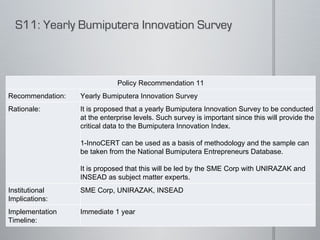
Policy Recommendation 11 Recommendation: Yearly Bumiputera Innovation Survey Rationale: It is proposed that a yearly Bumiputera Innovation Survey to be conducted at the enterprise levels. Such survey is important since this will provide the critical data to the Bumiputera Innovation Index.    1-InnoCERT can be used as a basis of methodology and the sample can be taken from the National Bumiputera Entrepreneurs Database.   It is proposed that this will be led by the SME Corp with UNIRAZAK and INSEAD as subject matter experts.  Institutional Implications: SME Corp, UNIRAZAK, INSEAD Implementation Timeline: Immediate 1 year
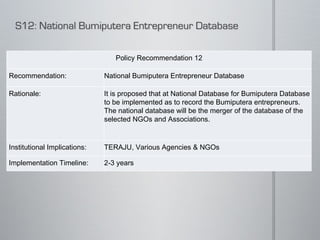
Policy Recommendation 12 Recommendation: National Bumiputera Entrepreneur Database Rationale: It is proposed that at National Database for Bumiputera Database to be implemented as to record the Bumiputera entrepreneurs. The national database will be the merger of the database of the selected NGOs and Associations. Institutional Implications: TERAJU, Various Agencies & NGOs Implementation Timeline: 2-3 years
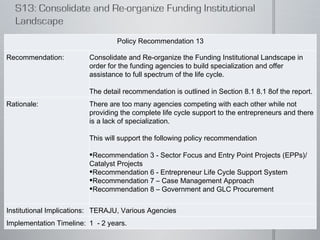
Policy Recommendation 13 Recommendation: Consolidate and Re-organize the Funding Institutional Landscape in order for the funding agencies to build specialization and offer assistance to full spectrum of the life cycle.    The detail recommendation is outlined in Section 8.1 8.1 8of the report.  Rationale: There are too many agencies competing with each other while not providing the complete life cycle support to the entrepreneurs and there is a lack of specialization.    This will support the following policy recommendation    Recommendation 3 - Sector Focus and Entry Point Projects (EPPs)/ Catalyst Projects Recommendation 6 - Entrepreneur Life Cycle Support System Recommendation 7 – Case Management Approach Recommendation 8 – Government and GLC Procurement    Institutional Implications: TERAJU, Various Agencies  Implementation Timeline: 1  - 2 years.
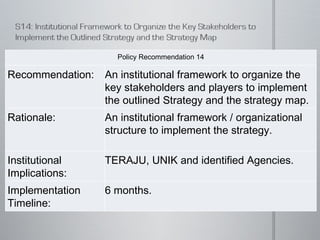
Policy Recommendation 14 Recommendation: An institutional framework to organize the key stakeholders and players to implement the outlined Strategy and the strategy map.  Rationale: An institutional framework / organizational structure to implement the strategy.    Institutional Implications: TERAJU, UNIK and identified Agencies.  Implementation Timeline: 6 months.
 

BumiInov-slides-ind dialogue-4Comments

  • 1.
  • 2.
    Introduction/background Objectives ofresearch Status of Bumiputera innovation Key Issues Proposed strategy Institutional framework conclusion
  • 3.
  • 4.
    To study thecurrent scenario of bumiputera involvement in innovation To present which sectors are bumiputera has strategic and commercial presence To find out what are the issues need to be addressed in order to ensure successful bumiputera innovation policy To propose the innovation model To recommend the strategy to increase the innovation. To recommend the institutional framework
  • 5.
  • 6.
    Any idea or knowledge in whatever form which brings about changes in the form of product, service or process resulting in positive impact to the economy , business , public service delivery system , social wellbeing or the environment – Agensi Inovasi Malaysia Bill, 2010
  • 7.
    “ Innovation consistsof all of those scientific, technical, commercial and financial steps necessary for the successful development and marketing of new or improved manufactured products, the commercial use of new or improved process or equipment or the introduction of a new approach to a social service” - OECD
  • 8.
    Innovation . .. is generally understood as the successful introduction of a new thing or method . . . Innovation is the embodiment, combination , or synthesis of knowledge in original, relevant, valued new products, processes, or services – Luecke & Katz (2003)
  • 9.
    All innovation beginswith creative ideas . . . We define innovation as the successful implementation of creative ideas within an organization. In this view, creativity by individuals and teams is a starting point for innovation ; the first is necessary but not sufficient condition for the second – Amabile (1996)
  • 10.
    Innovation, like manybusiness functions, is a management process that requires specific tools, rules, and discipline – Davila et. al. (2006)
  • 11.
    A strategicprocess which: Consists of scientific, technical, commercial, financial steps and risk evaluation Involves creativity or implementation of new ideas (or old ideas in new environment ) Requires tools, rules and disciplines for change Has commercial values
  • 12.
    Specht (2002) asquoted by Brem & Voigt (2009)
  • 13.
  • 14.
  • 15.
    **Opportunity recognition &analysis, Idea generation & evaluation, Concept development & selection are main activities undertaken for entrepreneurs
  • 16.
    As depicted inthe diagram above, innovation and entrepreneurship will occur when the Entrepreneurship Assets, Innovation Assets and Bridging Assets are strong and reinforcing. Innovation Assets (stocks and flows of ideas), Entrepreneurial Assets (stocks and flows of relevant human and organizational capital) -and- Bridging Assets (proactive persons and mechanisms to both coordinate and encourage the interaction of entrepreneurs and ideas and to proactively connect both with resources) “ INNOVATION is the specific tool of entrepreneurs, the means by which they exploit change as an opportunity for a different business or a different service. It is capable of being presented as a discipline, capable of being learned, capable of being practiced. Entrepreneurs need to search purposefully for the sources of innovation, the changes and their symptoms that indicate opportunities for successful innovation. And they need to know and to apply the principles of successful innovation.” - Peter Drucker Double Helix Innovation Model
  • 17.
    Challenges in gettinggood data since some agencies do not keep bumi/non-bumi data A snapshot on the Innovation level for the Bumiputera Community X X = X Not Good = Neutral + Good Data Source GEM report MyIPO MASTIC Report Data Source Interviews Focus Groups Teraju Labs BCIC 2 Reports NEM/ RMK 10/ ETP Data Source GEM Report NEM/ RMK10/ ETP Industry Research Focus Groups Interviews BCIC 2 Reports Teraju Labs
  • 18.
    Ideas and InventionAssets – Low based on IPR data kept by MyIPO Quality of Application Unfamiliar with the process Patent Drafting Bibliometrics (MASTIC 2008) – 46% bumi vs. 54% non-Bumi in Top 10 publications Ideas & Innovations resides in Universities & Govt. Research Institutes. SMEs and GLCs not rely on patenting and innovation. No allocation for protecting ideas and innovations other than for export purposes
  • 19.
    Factors Inhibiting Innovation& R&D (Mastic) Lack of Skill R&D Personnel Lack of Financial and increased in capital cost Lack of Infrastructure for R&D Lack of information on new technology
  • 20.
    Low Total EntrepreneurialActivity (TEA) Malaysia’s early stage TEA is the lowest (5%) among the efficiency-driven economies The intention to be entrepreneurs is very low at 5.1% compared to world average of 23.2% Only 55.7% see Entrepreneurship as good career choice compared to an average of 72.8% Therefore the Malaysia lacks source entrepreneurs compared to other countries.
  • 21.
  • 22.
  • 23.
    Sector Bumiputera PresenceSector Dynamics Key Conclusions Recommendations Agribusiness Substantial number of entrepreneurs in agribusiness but declining. Strong government support through agencies such as FELDA, FELCRA, etc. Lack of good business partners Eco-system for Bumi needs to be in place. MARDI, UPM on agricultural research Security of food supply. Halal food market. Access to international distribution network. Access to technology. Automobile Substantial number of vendors under NAZA, Proton and Perodua. Too dependent on a single customer Infrastructure support in terms of tool, die and molding. Economies of scale & raw material issues There are many vendors in the industry One-stop-center for design services is need to create economies of scale Proper eco-system to support bumi companies. Govt. support needed to push for innovation (Korean model). Setting up of National Automotive Design Center Defense & Aerospace Regulated industry which selected companies such as Sapura, SCS, CTRM, etc. are involved. Support from Govt. through offset program. Marketing of Malaysian defence industry through LIMA Require high investment. Economies of scale – need to find overseas market. D&D in software and systems. To increase capabilities and skills. Branding & leveraging on offsets programs by Govt. Overseas market expansion.
  • 24.
    Sector Bumiputera PresenceSector Dynamics Key Conclusions Recommendations Education ECCE Center operators, Tuition centers and private primary & secondary school Liberalized and open market. Available of funds from MARA and others. Mainly involved in ECCE. Limited numbers opt for expansion through franchising. Opportunities available for Bumi to participate in education. Explore expansion options such as through franchising. Specialized training for agriculture, oil & gas, Islamic finance, halal (as in EPPs). Islamic Financial Services Highly regulated industry. Low participation by bumiputera individuals Government investment company such as PNB. Bumi individuals only 5%. Dominated by non-Bumi. Development of Islamic financial services based on conventional products. Malaysia is well ahead of others. Research by BNM’s funded organization such as ISRA. Exports Syari’ah compliance auditing services. Market capabilities overseas.
  • 25.
    Sector Bumiputera PresenceSector Dynamics Key Conclusions Recommendations Petroleum, Gas and Energy (Renewable/Green Technology) Regulated industry . Various level of participation by bumi at different stages of value chain. Funding by many Govt. agencies National Policy on Renewable/Green Technology. Some categories are ‘frozen’ from Bumi participation such as piping, fabrication & cabling. Petronas to play more active role in supporting innovations. Hybrid Electric Vehicle Retrofitting for existing automobiles. Govt. & Petronas to provide fund for development of vessels which currently controlled by foreign companies. R&D on HEV retrofit. Harnessing of Solar Energy by installing panels at outdoor telecommunication cabinets. Palm Oil & Related Industry (Biomass/Biofuel) Bumiputera has presence due to involvement by GLC and Govt. agencies. Opportunity to promote new companies from talent in GLCs. Available of funds from MARA and others. Bumi involvement mainly by Govt. and GLCs such as FELDA, Sime Darby. Duplication of R&D efforts such as UPM, MPOB. Support for Commercialization To refocus on downstream activities. Innovation in ole-chemical, bio-diesel, food oil & fats Explore biomass for palm oil wastes. R&D in biomass and biofuel. Ample knowledge workers in terms of researchers in GLCs. Create anchor companies for Oleo-chemical , bio-diesel, and food oil & fats.
  • 26.
    Sector Bumiputera PresenceSector Dynamics Key Conclusions Recommendations Halal Bumiputera entrepreneurs are mainly in micro and small enterprises. Marginal competencies in manufacturers. No distribution to exports due to lack of certifications. Funds from various agencies such as AIM, TEKUN, MARA HDC spearhead halal industry. Malaysia is very recognized in Halal certification in the Islamic world community , however not enough is being exploited. 80% of markets controlled by non-Bumi. Bumi mainly micro enterprises. Halal as business endeavor not just religious issue. Malaysia lags others in terms of technology for halal food. Lack of own IPR on production and packaging technologies Halal Acquiring Strategy – to acquire companies which have leading technology, market access, and distribution. Certification – to control halal certification. Promote halal cert. and GMP & HACCP standards. Create halal production in southern Thailand for cost effectiveness. Enhancing activities in Lima Dasar region. ICT Strong Presence in Creative Content, SI and Software development Post Commercialization funding is still weak not allowing players to grow. Majority are micro enterprise. In competition with GLCs. Micro-sized enterprise. Ample assets as HR and researchers in universities however no proper linkage. Setup of collaborative clouds to reduce cost of entry. Implement selected 10 projects to the public & Govt. under SaaS model.
  • 27.
    Sector Bumiputera PresenceSector Dynamics Key Conclusions Recommendations Biotechnology Small number of Bumiputera SMEs Strong Govt. support through Biotech Corp., National Biotechnology Policy. Competition with foreign companies for supply to Govt. Funding for Biotech from Govt. Capable researchers Bumi involvement is low but the ones involved are considered high calibre. Biotech Corp is actively developing and supporting biotech companies. Bionexus companies see overseas market as main goal. MoH needs to buy Malaysian First instead of creating unnecessary barriers for local companies. Foreign companies to require partnering with local companies. Assistance for local companies to market overseas.
  • 28.
    SCORE Rating Highlights the state of Bumiputera SMEs vs. Non-Bumiputera SMEs where most of Bumi SMEs are in 1-star and 2-star whereas non-Bumi SMEs are in 2-star and 3-star. Main reasons are; Lack of innovation Quality issues As of Dec. 2009
  • 29.
    In all sectorsunder SCORE, Bumi SMEs presence are As follows; Construction – 58% ICT – 20% Manufacturing – 49% Professionals – 77% Services – 59% As of Dec. 2010
  • 30.
  • 31.
    The problems highlightedby the entrepreneurs regarding the VDP are; The requirements imposed on the vendor are archaic and rigid for example vendors are still required to have their own factories whereas some of the products do not require factories to be setup in Malaysia since the manufacturing can be done overseas to reduce cost. Promotes rent seeking behavior Development to meet international standards in stages is missing No open and co-innovation policy and is the exception rather than the norm.
  • 32.
    The problems highlighted(cont’ed); “ Frozen” categories – there are a few categories which the Bumiputera SMEs are discourage to participate especially in the Oil & Gas industry Time taken to award contracts is too long Pay forward mechanism is missing Unfair practices for example tax matter in oil and gas – PSC companies enjoy tax exemption for certain importation of equipment but the Bumiputera SMEs do not. Therefore Bumiputera SMEs were at the disadvantage and have to operate at higher operating cost. Link overseas opportunities with vendor programs
  • 33.
    Funding are availablefrom various agencies such as MARA, TEKUN, AIM, PUNB, EKUINAS, etc. Innovation is not an important part of the evaluation for funding
  • 34.
    As illustrated inthe chart, all agencies have low focus on the innovativeness inconsideration for funding. No. Agency Consideration for Innovativeness in Providing Funding 1 Majlis Amanah Rakyat (MARA) Low 2 Perbadanan Usahawan Nasional Berhad (PUNB) Low 3 Perbadanan Nasional Berhad (PNS) Medium 4 Tabung Ekonomi Kumpulan Usaha Niaga (TEKUN) Low 5 Amanah Ikhtiar Malaysia (AIM) Low 6 Ekuiti Nasional Berhad (EKUINAS) Medium 7 Development Financial Institutions Low
  • 35.
    Overall, trainings forSMEs are mostly available for developing Entrepreneurs. Creativity and Innovation training are sorely lacking No Industrial Sector Training Available Entrepreneurship Creativity Innovation 1 Agribusiness   High Low Low 2 Automotive   Medium Low Low 3 Defence and Aerospace   Medium Low Low 4 Education   Medium Low Low 5 Islamic Financial Services   Low Low Low 6 Petroleum, Gas and Energy   Medium Low Low 7 Palm Oil   High Medium Low 8 Halal   Medium Low Low 9 Information and Communication Technologies   High Medium Medium 10 Biotechnology   Medium Medium Medium
  • 36.
    The diagram abovehighlights the gaps in Market Access and Training in Bumiputera Programs. Domestic Market Access is absence in the program even for Micro and Poverty Eradication programs. There are multiple agencies in the same area thus increasing duplication and costs.
  • 37.
    As per theabove diagram, 1) there are many agencies playing in the same field, 2) agencies do not provide the complete support and assistance through out the entrepreneur life cycle, resulting in the valley of death (commercialization and expansion stages) 3) lack of specialization capability by the agencies
  • 38.
    Government Procurement Policies; To stimulate the growth of local industries through the maximum utilisation of local materials and resources; To encourage and support the evolvement of Bumiputera entrepreneurs in line with the nation's aspirations to create Bumiputera Commercial and Industrial Community; To increase and enhance the capabilities of local institutions and industries via transfer of technology and expertise; To stimulate and promote service oriented local industries such as freight and insurance; and To accelerate economic growth whereby Government procurement is used as a tool to achieve socio-economic and development objectives. Issues – Implementation is not as per the policy where barriers were placed to discourage local or Bumi companies from participating.
  • 39.
  • 40.
    Harvard Model ofStrategy: Objective Domain Competitive Advantage
  • 41.
    Objective: ToIncrease the Bumiputera Innovation Index by 20% per year Domain: Innovation-Driven Bumiputera entrepreneur organization Bumiputera defines as: More than 51% Bumi shareholders; More than 51% Bumi Board of Director; More than 51% Bumi management; and More than 51% Bumi workforce. Competitive Advantage: enhance the innovation eco-system, processes and social capital to the Bumiputera stakeholders.”
  • 42.
    Comparing the ExistingPrograms and focus what is needed to provide value to the Domain (Stakeholders) Areas of focus and differentiation should be in the following areas: - Idea and Invention Assets – Entrepreneur Source, Entrepreneurship in schools and universities and linkages Bridging Assets – Market Access in GLC, Foreign, Local and the Government; Funding for commercialization, expansion and overseas expansion (including acquisitions) Entrepreneur Assets – Specific support programs in the 10 sectors identified.
  • 43.
    Areas of CompetitiveAdvantage / Differentiation H M L Idea/ Invent Assets Bridging Assets Entrepreneur Assets
  • 44.
    Areas of focusand differentiation should be in the following areas: - Idea and Invention Assets – Entrepreneur Source, Entrepreneurship in schools and universities and linkages Bridging Assets – Market Access in GLC, Foreign, Local and the Government; Funding for commercialization, expansion and overseas expansion (including acquisitions) Entrepreneur Assets – Specific support programs in the 10 sectors identified.
  • 45.
    4-layer strategy map;Citizen – ultimate beneficiaries of the policy Programs – initiatives including funding and support programs Community process – integrated process within the eco-system Bumi Social Capital – social network to support innovative culture and values
  • 46.
    Entrepreneur Life CycleSupport System Case Management Approach Open Innovation in Government and GLC Procurement Empower the NGO/ Assoc. Every two years GEM Study Yearly Bumi Innovation Capacity Survey National Bumi Entrepreneur Database
  • 47.
    “ To increasethe Bumiputera Innovation Index by 20% per year by implementing and monitoring the policies. Programs and initiatives that will strengthen the innovation eco-system, process and social capital to the Bumiputera stakeholders”
  • 48.
    The institutional frameworkis very important to organize the key players that will be critical to achieving the Strategy. This is the Strategic Institutional Framework. In addition to the above, the agencies implementing the programs the that are involve in providing funds training and market access progress to the Bumiputera community will need to reorganized and to un-clutter the landscape. This will allow the relevant agencies to focus in a specialization and allow support at the full spectrum (early to late stage) of that particular industry/ sector. This will be the Program Agency Landscape. The above will also allow the ease of implementation for the Entrepreneur Life Cycle and Case Management.
  • 49.
    PAL – ProgramAgency Landscape
  • 50.
    As per theabove diagram, 1) there are many agencies playing in the same field, 2) agencies do not provide the complete support and assistance through out the entrepreneur life cycle 3) lack of specialization capability by the agencies
  • 51.
    Identification of 10priority sectors to promote 1 Agency 1 sector/ industry concept but implemented in stages . Full support from early stage to maturity Criteria of Participation Innovation Driven. A minimum level of 1-InnoCERT compliance is needed Membership in a designated in NGO/ Association is mandatory for Innovation tracking and monitoring. Gated Approach Case/ Portfolio Approach to Innovation. Open Innovation with GLC and Government. Proposing 5% as a initial target. Double Tax breaks for investing in 1-InnoCERT company.
  • 52.
    Focus on Innovation- A minimum level for 1-InnoCERT Empowering Community Associations/ NGOs Paid members of mandated associations and NGOS. 1 NGO/ Associations per sector or industry Very high audit on the association and NGO to ensure the highest in governance NGO/ Association will have to maintain the membership data as part of the National Bumiputera Entrepreneurs Database (NBED)
  • 53.
    Entrepreneurs given assistanceare given pre-determined deliverables to meet. Once meet the entrepreneur automatically graduates to the next stage. No need for committee approval. No need go to other agencies since it will be under a single agency. Assistance will be funding, market access and training. Deliverables will be financial, market, innovation and/ or developmental (e.g. jobs created or partner development)
  • 54.
    Gates where pre– determined innovation/ developmental (e.g. jobs) deliverables are needed to be met before graduating to the stage but graduation is automatic Idea Stage - Assistance given e.g. Pre-Seed funding and prototyping facilities. Seed Stage - Assistance given e.g. Commercialization grant
  • 55.
    Also called Portfolioapproach An agency officer is designated to entrepreneur until the entrepreneur is at post IPO stage Main objective of the case manager to ensure the entrepreneur grows and develops. Incentives are given to the case manager upon successful deliverables met at the “gate” The above is to ensure joint ownership with the entrepreneur.
  • 56.
    (1) (2) (3)(3) (4) (5) (6) (6)
  • 57.
    Bumiputera contribution tonational GNI/ capital is only low at 14% or RM3,754 Innovation is proven to uplift a community's income level. But innovation is a long term program, requires political will and investment. Innovation is currently not measured. If it is not measured it will not be met. There is a critical need to put a system to measure this and provide continuous feedback on the Bumiputera innovation level.
  • 58.
    If Bumiputera innovationis to flourish the community - entrepreneurs, the government and the public needs to relook and redefine how it promotes entrepreneurship. The current status is not sustainable and will contribute to Bumiputeras being marginalized. Using the Double Helix Model, it is found that innovation among the Bumiptuera community is low. To fuse innovation, a strategy has to be implemented with a clear statement and involves programs, community processes and social capital. Key recommendations are a realignment in agencies involve in Bumiputera assistance, Domestic Market Access and change in the process of evaluation, assistance of entrepreneurs. Recommend for the proposed policies to be adopted as part of the National Innovation Policy
  • 59.
  • 60.
  • 61.
    The relevant designatedagency or ministry (government instrument) will implement and monitor such sanctioned policies, programs and initiatives relating to the Bumiputera Innovation Innovation Eco-System consists of the Idea/ Invention, Bridging and Entrepreneur Assets highlighted in the Double Helix Innovation Model. Preliminary focus will be in areas highlighted in section 6.2.4 as per the Competition Landscape. Processes and Social Capital is depicted in the Strategy Map and is defined as i) Community Processes - the integrated process that goes across stakeholder organizations from the Government, NGOs and others. i) Bumiputera Social Capital – this is similar to the organizations’ culture and values “… per year by implementing and monitoring the policies, programs and initiatives that will strengthen the innovation eco-system, processes and social capital ….”
  • 62.
    Innovation Driven isdefined as the stakeholders that requires and intends to innovate in their activities. Innovation is defined as to commercialize ideas or inventions. Innovation in this context does not include distributive programs that are of “starting a business” natures where there are no innovation criteria or elements. Bumiputera Stakeholders are defined as Malaysian citizens that are of Bumiputera legal status which includes individuals, entrepreneurs and companies. Bumiputera companies are considered Bumiputera if they meet the criteria “… to Innovation Driven Bumiputera Stakeholders”
  • 63.
    Merger of PNSwith PUNB where PNS franchise program will merge with PUNB Prosper Program PUNB SME Program to focus in Automotive only and will cover the full life cycle of the organization. MARA to focus on other sectors other than the 10 priority sectors but more on Development and Growth companies. Equinas to expand their sectors to Agribusiness, Automative, Defense/ Aerospace, Islamic Finance, Palm Oil/ Biomass, Halal, and ICT. Equinas will still focus at the large and mature companies. No changes to the direction of AIM No changes to TEKUN but they will focus in other sectors but will not focus in the 10 priority areas Biotech Corp will extend their portfolio to biotechnology related to Palm Oil and Biomass. No changes to MDeC except that Cradle will be merged with MDeC thus leaving Cradle to focusing in ICT No changes to MATRADE but they will not focus to Halal unless by capitalizing their overseas channels. Promotion of the Halal industry will remain with HDC as its sole focus. However, HDC will work with MATRADE to capitalize on their overseas channels. This is a similar model in which MATRADE is working with MDeC in promoting ICT.
  • 64.
    No changes inAgroBank No changes in the Bank Pembangunan other than that they will not focus in the 10 priority sectors. MAVCAP will be merged as a VC arm of MDeC and will only focus in ICT. SME Bank will focus in providing financing to other sectors other than the 10 priority sectors but will also include Education sector Modal Perdana will focus in later stage VC funding in Development/ Growth and Large/ Mature firms but in sectors that are not the 10 priority focus areas. No changes in HDC MTDC will now focus on Defense/ Aerospace and Petroleum/ Gas/ Energy. However their investments will be limited to Development / Growth and Micro/ Small. A new stakeholder will be introduced and that will be INCEIF, which is a subsidiary of Bank Negara Malaysia (BNM). INCEIF will lead the entrepreneur and industry development for Islamic Finance including funding, market access and training. However, funding will only be focused up to Development / Growth including Micro/ Small.
  • 65.
    Policy Recommendation 1Recommendation: Bumiputera Innovation Index to be designed and collated to measure the degree of Innovation in the community Rationale: The edict “what gets measured gets managed” holds true in this instance. In conducting this research it was a challenge to determine the degree of innovation in the Bumiputera community due to the lack of data or the lack of access to data. There are many models of an innovation index but the challenge is to i) to have an index that is relative to Malaysia’s participation in the global scene ii) that it has measurements that can be measured in the Bumiputera community and not broad macro measurements that measures a country’s innovation level and iii) the measurements can be compared to the performance of the Bumiputera with the national performance i.e. if the Bumiputeras are either below or above the national level. The Innovation Index will be able to gauge the innovation level among sections of societies in Malaysia.   Global Innovation Index to be used - It is proposed that the Global Innovation Index is used to measure the Bumiputera Innovation Index since it has more indicators to the Bumputera as compared to the Global Competitive ranking. Department of Statistics as lead agency - That the lead agency for this initiative be undertaken by the Department of Statistics working in collaboration with other agencies and ministries. Database System - That an integrated information system be implemented that will collate, store and distribute the information to relevant stakeholders INSEAD Collaboration - That in short term (1 – 2 years) collaboration be formed between INSEAD and the Department of Statistics to implement the Bumiputera Innovation Index. Key parameters and knowledge transfer should be in place for the methodology to be implemented by the Department of Statistics after the Second year.   Institutional Implications: Department of Statistics Implementation Timeline: Immediate (1-2 years)
  • 66.
    Policy Recommendation 2Recommendation: Linking Innovation to Existing and New Bumiputera Programs Rationale: A general analysis was conducted by obtaining applications of the Bumiputera programs, which has identified that innovation as a criteria for approval is below 20%. This means that most of the Bumiputera programs are more distributive in nature and funding and support are designed to encourage “starting a business” and not innovation driven, which may lead to low contribution to the national economy and high failure rates.   From the recent Global Entrepreneurship Monitor (GEM) 2010 Global Report, Malaysia ranking in terms of innovation in early-stage entrepreneurial is behind compared to other countries and also similar efficiency-driven countries.   Relook and redesign the investment and financing mandate of EDOs and DFI to promote financing in innovative products Approval criteria to have at least 40% innovation in future applications and submissions. Institutional Implications: MARA, TEKUN, PUNB, PNS, EKUINAS, AIM, EXIM Bank, SME Bank and other funding agencies. Implementation Timeline: Immediate within 1 year
  • 67.
    Policy Recommendation 3Recommendation: Sector Focus and Entry Point Projects (EPPs)/ Catalyst Projects Rationale: Innovation must happen within the framework of the GTP and ETP crafted by PEMANDU.   TERAJU had recently completed its Bumiputera labs the sectors that had been covered by Teraju has been included here in this report. Sectors that have not been covered by the Teraju labs, proposed EPPs have been derived from the ETP and industry player inputs.   All together there are 73 EPPs from ETP which are related to 10 sectors selected for Bumiputera to focus on. Institutional Implications: Various based on each EPPs within ETP. Implementation Timeline: 1 – 5 years
  • 68.
    Policy Recommendation 4Recommendation: Entrepreneurship, Creativity, and Innovation Training Rationale: Under the Global Entrepreneurship Monitor (GEM) 2010 Report, Malaysia’s’ early stage Total Entrepreneurship Activity (TEA) is the lowest (5%) for the efficiency-driven economies. TEA measures the degree of adult population involved in early stage entrepreneurship.   The GEM 2010 Report further supports the need to enhance TEA level for Malaysia since the main beneficiaries for such enhancement will be the Bumiputeras. One of the methods in enhancing TEA is the teaching of entrepreneurship in schools and universities.   Implement education training in schools by conducting technical collaborations with organizations similar to NFTE. Promote the promotion of multi-lingual society early in schools Implement multi-disciplinary entrepreneurship programs in Universities via a franchise program from UMK/ UNIRAZAK to other universities. Institutional Implications: MOE, MOHE Implementation Timeline: 2 – 5 years
  • 69.
    Policy Recommendation 5Recommendation: Inclusive Innovation and Social Entrepreneurship Rationale: Innovation should not be the monopoly of high technology and elite industries of the country. This paper supports the idea that innovation can be evident in micro or traditional sector. The majority of the Bumiputeras are outside the rural area and mainly in the Sabah, Sarawak, Kedah, Perlis, Kelantan and Terengganu. Innovation has to be brought to these geographical locations for maximum impact especially when the objective is to raise the income and standard of living of Bumiputeras. Another concern is the growing digital divide between the rest of Malaysia and the rural areas.   The identified sectors of Bumiputera involvement to identify areas for Social entrepreneurship that will enhance the eco-system and value chain. To offer via a restricted RFP – associations, NGOs and leading entrepreneurs a roll to establish a Social Enterprise To provide funding and policy support to ensure the program is a success.   Institutional Implications: AIM, TEKUN, MARA and Suruhanjaya Kooperasi Malaysia (SKM) Implementation Timeline: 1 – 5 years
  • 70.
    Policy Recommendation 6Recommendation: Entrepreneur Life Cycle Support System Rationale: One of the many issues raised by entrepreneurs either Bumiputera or not, is the fact that there is a gap in the innovation value chain that prohibits growth. To the industry this gap is called the Valley of Death where most of new starts failed at a particular stage or stages of the value chain.   Also in the interviews conducted with the entrepreneurs they have highlighted where the innovation support is needed throughout the value chain and there exists gaps, which are defeats, the purpose to building world class innovative companies.   Again the Valley of Death comes to play but in addition, non-financial support at each stage of the entrepreneurs’ life cycle needs to be present. Without this investment in one stage will be fizzled out by the lack of support in the proceeding stages.   To endorse the Entrepreneur Life Cycle Support System as a holistic methodology in developing innovative entrepreneurs To implement the gated approach across the full spectrum of the development life cycle including the formulation of incentives / assistance at each stage and the deliverables at each Stage Gate. To formulate the assistance and facilitation needed for each stage by sectors. This may come from across various Government agencies and ministries e.g. Funding is received from PUNB but quick approval is given from DOE. To ensure that at each passing Gate, automatic approval is given with the required assistance given in the preceding stage. Institutional Implications: Various Funding Agencies Implementation Timeline: 1 – 3 years
  • 71.
    Policy Recommendation 7Recommendation: Case Management Approach Rationale: The Case Management Approach is a proposal to assign a long term and permanent Case Manager for each Bumiputera Innovation entrepreneur. This Case Manager is assigned from the agency in which the Innovation entrepreneur has successful received assistance from at the first time. This Case Manager will be responsible to the Entrepreneur Company throughout the life cycle of the company.   The role of the average Government agency officer that are involved in Entrepreneur development will be changed to being an approval manager to a Case Manager which primary activities is to assist and facilitate the growth of the Entrepreneur company through the value chain.   A standardized process in Case Management that cuts across all government agencies and ministries Stakeholder involvement of the process including GLC, Government procurement, local councils in areas of assistance and facilitation Training for Government officers for this new approach An integrated system that is collaborative to allow updates, issue tracking between all stakeholders and the Entrepreneur Company. Institutional Implications: Government & GLCs procurement, Local council and Mandated agencies. Implementation Timeline: 1 – 3 years
  • 72.
    Policy Recommendation 8Recommendation: Government and GLC Procurement Rationale: Market access domestically is critical for innovation to flourish, since it acts as sustainable incubation for entrepreneurs to introduce their innovation at a relative low risk. Currently, Government expenditure stands at 26.3% of total GDP, which is substantial sum.   Government and GLC procurement is very large, neither is developmental nor it is strategic. The BCIC 2 research estimated that as high as 80% leakage was experienced in the 8 th Malaysia Plan. GEM 2010 Report has also reported that the Domestic Market Openness as one of the restrictions to entrepreneurship. This is an important element in which the authors of this report feel that it should be a special mention. It is proposed that procurement should be accessible to build critical mass and viability of innovation companies under the programs and facilitation as part of the Entrepreneur Life Cycle. It is important to note that many of the large MNCs now originate from humble beginnings of Government procurement. Institutional Implications: Government & GLCs Implementation Timeline: 1 – 3 years
  • 73.
    Policy Recommendation 9Recommendation: Empowering NGOs and Associations Rationale: Innovation can occur in many areas but innovation within networks occurs due to the Social Capital of a community. With increasing competition and deregulation innovation is now not within the confines of an organization but across industries or sectors with multiple players with different disciplines and competencies. Innovation across these networks depends on the strength of the social capital of the community. Social Capital can be seen either formal or informal. A formal example is at Low Yat Plaza among the many IT retail shops those bands together to provide bulk purchase thus receiving higher discounts. An informal example is the network of Kelantanese business owners that buys and sells among them.   It is recommended that as part of the Innovation Eco-System for the Bumiputera community, selected NGOs and Associations be mandated to organize their respective community as to enhance innovation. Mandated NGOs/ Associations should be an industry based NGO from the 10 selected industries and a national NGO that will cover the industries/ sectors that are not included in the 10 identified sectors.   The mandate and responsibility of such NGOs shall be as follows: - To organize the community in the pursuit of innovation and to uplift of the economic wellbeing of its community To implement Government sponsored programs approved by the Government and the NGO/ Association. These programs are to address the innovation gaps needed by the sectors or the community at large. To operate and maintain the database of its registry of members which will include the necessary information for the Bumiputera Innovation Index and the National Bumiputera Entrepreneurs Database To ensure that only paid members are included in the Bumiputera Entrepreneurs Database   Institutional Implications: ROS / TERAJU Implementation Timeline:  
  • 74.
    Policy Recommendation 10Recommendation: Global Entrepreneurship Monitor (GEM) Survey Rationale: The Global Entrepreneurship Monitor (GEM) research program is an annual assessment of the national level of entrepreneurial activity. Started as a partnership between London Business School and Babson College, it was initiated in 1999 with 10 countries, expanded to 21 in the year 2000, with 29 countries in 2001 and 37 countries in 2002. GEM 2010 conducted research in 59 economies worldwide.   The national team for Malaysia for GEM 2010 was UNIRAZAK. Malaysia participates in GEM once in two years. It is proposed that GEM for the Bumiputera community also be conducted together with GEM 2012 for the country. It is further propose that UNIRAZAK be the national team for GEM Bumiputera 2012 together with GEM 2012. Both the GEM and GEM Bumiputera survey should be conducted once in two years. Institutional Implications: UNIRAZAK Implementation Timeline: 1-2 years
  • 75.
    Policy Recommendation 11Recommendation: Yearly Bumiputera Innovation Survey Rationale: It is proposed that a yearly Bumiputera Innovation Survey to be conducted at the enterprise levels. Such survey is important since this will provide the critical data to the Bumiputera Innovation Index.   1-InnoCERT can be used as a basis of methodology and the sample can be taken from the National Bumiputera Entrepreneurs Database.   It is proposed that this will be led by the SME Corp with UNIRAZAK and INSEAD as subject matter experts. Institutional Implications: SME Corp, UNIRAZAK, INSEAD Implementation Timeline: Immediate 1 year
  • 76.
    Policy Recommendation 12Recommendation: National Bumiputera Entrepreneur Database Rationale: It is proposed that at National Database for Bumiputera Database to be implemented as to record the Bumiputera entrepreneurs. The national database will be the merger of the database of the selected NGOs and Associations. Institutional Implications: TERAJU, Various Agencies & NGOs Implementation Timeline: 2-3 years
  • 77.
    Policy Recommendation 13Recommendation: Consolidate and Re-organize the Funding Institutional Landscape in order for the funding agencies to build specialization and offer assistance to full spectrum of the life cycle.   The detail recommendation is outlined in Section 8.1 8.1 8of the report. Rationale: There are too many agencies competing with each other while not providing the complete life cycle support to the entrepreneurs and there is a lack of specialization.   This will support the following policy recommendation   Recommendation 3 - Sector Focus and Entry Point Projects (EPPs)/ Catalyst Projects Recommendation 6 - Entrepreneur Life Cycle Support System Recommendation 7 – Case Management Approach Recommendation 8 – Government and GLC Procurement   Institutional Implications: TERAJU, Various Agencies Implementation Timeline: 1 - 2 years.
  • 78.
    Policy Recommendation 14Recommendation: An institutional framework to organize the key stakeholders and players to implement the outlined Strategy and the strategy map. Rationale: An institutional framework / organizational structure to implement the strategy.   Institutional Implications: TERAJU, UNIK and identified Agencies. Implementation Timeline: 6 months.
  • 79.