Treatment choices for negative
outcomes with non-surgical root
canal treatment: non-surgical
retreatment vs. surgical retreatment
vs. implants
STEVEN A. COHN
Endodontic Topics 2005
• The primary reason for a negative outcome
with endodontic treatment is the persistence
of bacteria within the intricacies of the root
canal system.
• Failure may also be attributed to the
persistence of bacteria in the periapical
tissues, foreign body reactions to overfilled
root canals, and the presence of cysts.
• 5 levels of evidence
– Prospective randomized-controlled trials (RCT)
considered the highest level of evidence (LOE 1).
• No papers dealing with non-surgical retreatment
and surgical revision that reach the highest LOE.
• The primary consideration is the patient’s values
and expectations.
Non-surgical retreatment
• The incidence of periapical lesions following
root canal procedures surveyed in many
countries is 20–60%.
Non-surgical retreatment
• Apical periodontitis
– apical periodontitis is the most important variable
influencing a positive outcome with non-surgical
retreatment.
– Hepworth&Friedman: the retreatment of teeth
without periapical lesions has a positive outcome of
95%, but in their study and others, this declines to 56–
84% in the presence of a periapical lesion.
– The true negative outcome rate may be only 10–16%.
Non-surgical retreatment
• Role of primary endodontic treatment
– Sjøgren found that 94% of periapical lesions
healed when the root filling was within 2mm of
the apex, a significant difference when compared
with overfilled canals (76%) and those more than
2mm short of the apex (68%).
Non-surgical retreatment
• Bacterial and technical considerations
– Farzanehet found that a positive outcome was most
influenced by the presence of a preoperative
perforation.
– Other negative factors were the quality of the root
filling, the lack of a final restoration, and preoperative
apical periodontitis. The overall success (or
‘healed’)rate was 81.
– 93% when asymptomatic and functional teeth were
included.
Reference set of radiographs with corresponding line drawings and their associated PAI score
• Occlusion
– The role of the occlusion following endodontic
treatment requires further investigation
• Restoration
– The quality of the restoration affects the outcome
because of the possibility of leakage.
– Teeth not crowned following endodontic
treatment were lost at 6 times the rate of those
teeth that did receive crowns.
Outcome of periradicular surgery
• Surgical retreatment
– Positive outcomes for surgical retreatment in
excess of 90% can be achieved with careful case
selection and a skilled and experienced operator
Outcome of periradicular surgery
• Lesion size and characteristics
– No clear consensus that small (less 5 mm) lesions
heal more favorably than larger lesions
• Tooth location
– be less important than the access to it and the
anatomy of the roots in determining a successful
outcome
Outcome of periradicular surgery
• Preoperative symptoms
– Symptoms do not appear to affect the outcome of
surgery
• Age and gender
– Neither the age nor the sex of the patient appears
to influence the outcome of surgery
Outcome of periradicular surgery
• Quality of the root filling
– Non-surgical retreatment of the root canals before
surgery improves the prognosis for surgery
– Short root fillings had a better outcome then roots
filled to the apex or overfilled
Outcome of periradicular surgery
• Repeat surgery
– A repeat of surgery is associated with a worse
outcome than surgery performed the first time
• Resection
– Resection of 3mm is considered sufficient to eliminate
apical pathology
• Root-end filling and materials
– IRM and MTA no significant diff.
Outcome of periradicular surgery
• Operator skill
– The complete healing rate in the endodontic unit
was approximately double that of the oral surgery
department.
Intentional replantation
• Intentional replantation is a viable alternative
to tooth extraction in selected cases.
Transplantation
– Endodontic treatment is indicated for teeth with
closed apices, usually within a month after
transplantation. The prognosis for both closed and
open apices is considered favorable
Endodontics or implants?
• Implant studies - when the criteria of EBD are
applied, there are no papers that reach the
highest level of evidence.
• Ruskin state that an immediate implant has a
more predictable outcome than an
endodontically treated tooth as a basis for
restorative dentistry.
– “The best candidate for endodontic treatment is a
single rooted tooth with an intact crown that has
become devitalized due to trauma, and that also
fulfills an esthetic need.”
Endodontics and implants: ‘success’
vs. ‘survival’
– concept of ‘survival’ is applied to implant studies
– 1.5 million teeth from an insurance company
database. The treatments were provided both by
general dentists and endodontists, and a 97%
retention rate followed up for 8 years was
reported
– the high success rates for implants may not be
duplicated at the general practitioner level
Indications for an implant
• Root resection?
– Langer reported a 38% failure rate of 100 molar
teeth that had undergone a root resection
– Blömlof reported on a 10-year follow-up of root-
resected molars compared with root-filled single
rooted teeth. The survival rate was similar.
CDA Journal , vol 36 , 2008
• The preliminary electronic and manual
searches identifed 5,346 endodontic and
4,361 dental implant studies.
– Inclusion criterias:
• At least 25 cases with a minimum two-year follow-up
(endodontics - from obturation time; implant - from
placement); with treatment units described as being
single individual, implant-supported restorations,
and/or endodontically treated teeth
– Exlusion criterias:
• did not define criteria for success/survival outcomes, if
they reported on treatments no longer used in practice,
or if the patients were described as having moderate or
severe periodontal disease
• Following full-text review, 24 endodontic, and
46 implant studies were included
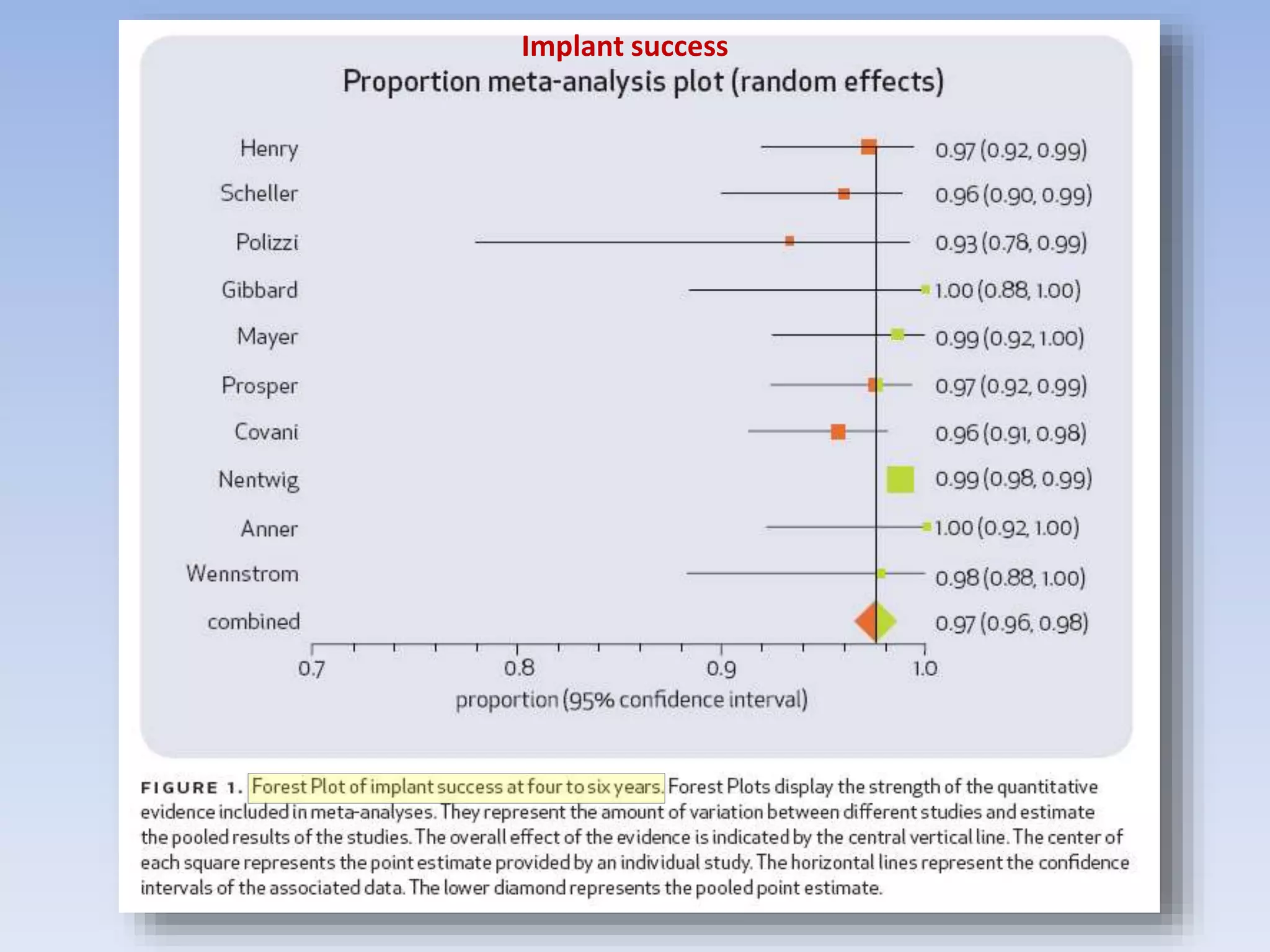
Implant success
Endodontic success
Implant survival
Endodontic survival
Retrospective cross sectional
comparison of initial nonsurgical
endodontic treatment and
single-tooth implants.
Doyle SL, Hodges JS, Pesun IJ, Law AS,
Bowles WR.
J Endod. 2006 Sep;32(9):822-7.
Endodontics vs implant
• Compared 196 implant restorations and 196
matched initial nonsurgical root canal
treatment (NSRCT) teeth in patients for four
possible outcomes - success, survival, survival
with subsequent treatment intervention and
failure
Endodontics vs implant
0
20
40
60
80
100
Prosent
Endo Impl
Success Survival Repair Failure
Doyle SL, Hodges JS, Pesun IJ, Law AS, Bowles WR. Retrospective cross sectional comparison of initial nonsurgical
endodontic treatment and single-tooth implants. J Endod. 2006 Sep;32(9):822-7. NSRCT outcomes were affected by
periradicular periodontitis (p = 0.001), post placement (p = 0.013), and overfilling (p = 0.003).
Endodontics vs implant
Estimated fraction not failing at each recall time

Treatment choices NO.ppt

  • 1.
    Treatment choices fornegative outcomes with non-surgical root canal treatment: non-surgical retreatment vs. surgical retreatment vs. implants STEVEN A. COHN Endodontic Topics 2005
  • 2.
    • The primaryreason for a negative outcome with endodontic treatment is the persistence of bacteria within the intricacies of the root canal system. • Failure may also be attributed to the persistence of bacteria in the periapical tissues, foreign body reactions to overfilled root canals, and the presence of cysts.
  • 3.
    • 5 levelsof evidence – Prospective randomized-controlled trials (RCT) considered the highest level of evidence (LOE 1). • No papers dealing with non-surgical retreatment and surgical revision that reach the highest LOE. • The primary consideration is the patient’s values and expectations.
  • 4.
    Non-surgical retreatment • Theincidence of periapical lesions following root canal procedures surveyed in many countries is 20–60%.
  • 5.
    Non-surgical retreatment • Apicalperiodontitis – apical periodontitis is the most important variable influencing a positive outcome with non-surgical retreatment. – Hepworth&Friedman: the retreatment of teeth without periapical lesions has a positive outcome of 95%, but in their study and others, this declines to 56– 84% in the presence of a periapical lesion. – The true negative outcome rate may be only 10–16%.
  • 6.
    Non-surgical retreatment • Roleof primary endodontic treatment – Sjøgren found that 94% of periapical lesions healed when the root filling was within 2mm of the apex, a significant difference when compared with overfilled canals (76%) and those more than 2mm short of the apex (68%).
  • 7.
    Non-surgical retreatment • Bacterialand technical considerations – Farzanehet found that a positive outcome was most influenced by the presence of a preoperative perforation. – Other negative factors were the quality of the root filling, the lack of a final restoration, and preoperative apical periodontitis. The overall success (or ‘healed’)rate was 81. – 93% when asymptomatic and functional teeth were included.
  • 8.
    Reference set ofradiographs with corresponding line drawings and their associated PAI score
  • 9.
    • Occlusion – Therole of the occlusion following endodontic treatment requires further investigation
  • 10.
    • Restoration – Thequality of the restoration affects the outcome because of the possibility of leakage. – Teeth not crowned following endodontic treatment were lost at 6 times the rate of those teeth that did receive crowns.
  • 11.
    Outcome of periradicularsurgery • Surgical retreatment – Positive outcomes for surgical retreatment in excess of 90% can be achieved with careful case selection and a skilled and experienced operator
  • 12.
    Outcome of periradicularsurgery • Lesion size and characteristics – No clear consensus that small (less 5 mm) lesions heal more favorably than larger lesions • Tooth location – be less important than the access to it and the anatomy of the roots in determining a successful outcome
  • 13.
    Outcome of periradicularsurgery • Preoperative symptoms – Symptoms do not appear to affect the outcome of surgery • Age and gender – Neither the age nor the sex of the patient appears to influence the outcome of surgery
  • 14.
    Outcome of periradicularsurgery • Quality of the root filling – Non-surgical retreatment of the root canals before surgery improves the prognosis for surgery – Short root fillings had a better outcome then roots filled to the apex or overfilled
  • 15.
    Outcome of periradicularsurgery • Repeat surgery – A repeat of surgery is associated with a worse outcome than surgery performed the first time • Resection – Resection of 3mm is considered sufficient to eliminate apical pathology • Root-end filling and materials – IRM and MTA no significant diff.
  • 16.
    Outcome of periradicularsurgery • Operator skill – The complete healing rate in the endodontic unit was approximately double that of the oral surgery department.
  • 17.
    Intentional replantation • Intentionalreplantation is a viable alternative to tooth extraction in selected cases.
  • 18.
    Transplantation – Endodontic treatmentis indicated for teeth with closed apices, usually within a month after transplantation. The prognosis for both closed and open apices is considered favorable
  • 19.
    Endodontics or implants? •Implant studies - when the criteria of EBD are applied, there are no papers that reach the highest level of evidence.
  • 20.
    • Ruskin statethat an immediate implant has a more predictable outcome than an endodontically treated tooth as a basis for restorative dentistry. – “The best candidate for endodontic treatment is a single rooted tooth with an intact crown that has become devitalized due to trauma, and that also fulfills an esthetic need.”
  • 21.
    Endodontics and implants:‘success’ vs. ‘survival’ – concept of ‘survival’ is applied to implant studies – 1.5 million teeth from an insurance company database. The treatments were provided both by general dentists and endodontists, and a 97% retention rate followed up for 8 years was reported – the high success rates for implants may not be duplicated at the general practitioner level
  • 22.
    Indications for animplant • Root resection? – Langer reported a 38% failure rate of 100 molar teeth that had undergone a root resection – Blömlof reported on a 10-year follow-up of root- resected molars compared with root-filled single rooted teeth. The survival rate was similar.
  • 23.
    CDA Journal ,vol 36 , 2008
  • 24.
    • The preliminaryelectronic and manual searches identifed 5,346 endodontic and 4,361 dental implant studies. – Inclusion criterias: • At least 25 cases with a minimum two-year follow-up (endodontics - from obturation time; implant - from placement); with treatment units described as being single individual, implant-supported restorations, and/or endodontically treated teeth – Exlusion criterias: • did not define criteria for success/survival outcomes, if they reported on treatments no longer used in practice, or if the patients were described as having moderate or severe periodontal disease
  • 25.
    • Following full-textreview, 24 endodontic, and 46 implant studies were included
  • 27.
  • 28.
  • 29.
  • 30.
  • 31.
    Retrospective cross sectional comparisonof initial nonsurgical endodontic treatment and single-tooth implants. Doyle SL, Hodges JS, Pesun IJ, Law AS, Bowles WR. J Endod. 2006 Sep;32(9):822-7.
  • 32.
    Endodontics vs implant •Compared 196 implant restorations and 196 matched initial nonsurgical root canal treatment (NSRCT) teeth in patients for four possible outcomes - success, survival, survival with subsequent treatment intervention and failure
  • 33.
    Endodontics vs implant 0 20 40 60 80 100 Prosent EndoImpl Success Survival Repair Failure Doyle SL, Hodges JS, Pesun IJ, Law AS, Bowles WR. Retrospective cross sectional comparison of initial nonsurgical endodontic treatment and single-tooth implants. J Endod. 2006 Sep;32(9):822-7. NSRCT outcomes were affected by periradicular periodontitis (p = 0.001), post placement (p = 0.013), and overfilling (p = 0.003).
  • 34.
    Endodontics vs implant Estimatedfraction not failing at each recall time

Editor's Notes

  • #28 A forest plot is a graphical display that shows the strength of the evidence in quantitative scientific studies. It was developed for use in medical research as a means of graphically representing a meta-analysis of the results of randomized controlled trials