Tourism in Peru
[Marissa Khoukaz: GBUS 492]
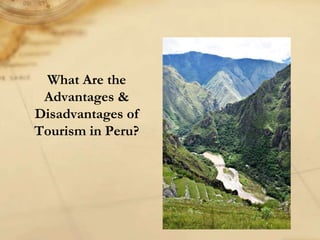
What Are the
Advantages &
Disadvantages of
Tourism in Peru?
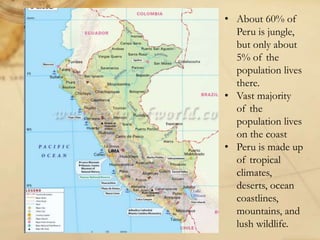
• About 60% of
Peru is jungle,
but only about
5% of the
population lives
there.
• Vast majority
of the
population lives
on the coast
• Peru is made up
of tropical
climates,
deserts, ocean
coastlines,
mountains, and
lush wildlife.
Tourist Demographics
1. Chilean
2. Americans (USA)
3. Ecuadorians
4. Argentinians
5. Colombians
6. Brazilians
7. Spanish
8. Bolivians
9. French
10. Venezuelans
11. Germans
12. Canadians
13. Japanese
14. English
15. Mexican
Tourist Attractions in Peru
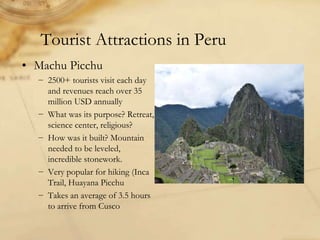
• Machu Picchu
− 2500+ tourists visit each day
and revenues reach over 35
million USD annually
− What was its purpose? Retreat,
science center, religious?
− How was it built? Mountain
needed to be leveled,
incredible stonework.
− Very popular for hiking (Inca
Trail, Huayana Picchu
− Takes an average of 3.5 hours
to arrive from Cusco
Tourist Attractions…
• Madre de Dios
− Ecotourism hotspot
− Located in the Amazon jungle
− Lush wildlife and landscape – over 1000 types
of insects and birds, hundreds of mammals
Tourist Attractions...
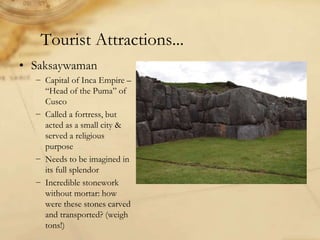
• Saksaywaman
− Capital of Inca Empire –
“Head of the Puma” of
Cusco
− Called a fortress, but
acted as a small city &
served a religious
purpose
− Needs to be imagined in
its full splendor
− Incredible stonework
without mortar: how
were these stones carved
and transported? (weigh
tons!)
Tourist Attractions…
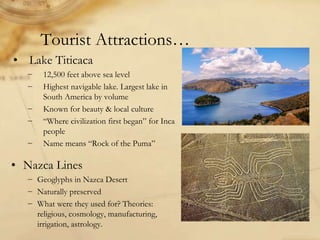
• Lake Titicaca
− 12,500 feet above sea level
− Highest navigable lake. Largest lake in
South America by volume
− Known for beauty & local culture
− “Where civilization first began” for Inca
people
− Name means “Rock of the Puma”
• Nazca Lines
− Geoglyphs in Nazca Desert
− Naturally preserved
− What were they used for? Theories:
religious, cosmology, manufacturing,
irrigation, astrology.
Effect on Peruvian Economy
• 3.16 million Int’l visitors in 2013
• Growing 25%/year as of 2012
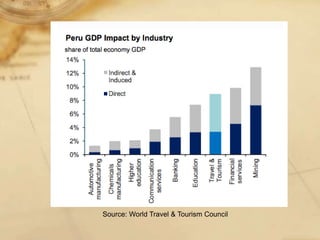
• T&T contributes est. 3.4% to GDP directly & 9% indirectly
• 300,000+ jobs & 2.3% of employment directly (7.4% and 1
million jobs directly)
• Government invests about 3% in tourism
• Peru is efficient at using very little space to create a positive
economic impact. 1 hectare of land = 10,000 jobs and 1
million USD in revenue for hospitality.
Source: World Travel & Tourism Council
Ease of Being a Tourist in Peru
• Affordable: strong USD + low prices
• USD accepted widely
• Uber & Air Bnb
• Friendly locals
• Decent English-speaking population
Difficulty of Being a Tourist In Peru
• Infrastructure lacking
• Crime, terrorism, & drug trafficking
• Altitude sickness
• Disease: contamination, mosquito-borne, etc.
• Unlicensed taxis, limited means of transportation
• Inauthentic goods
• Illegal artifact trade is huge problem
• Peruvian gov’t has had success combatting
− Offering money
− Have retrieved some artifacts from other countries
− Checking at airports and borders
• Looters dig or steal at night
− Over 100,000 Moche tombs looted
• Sell to tourists and collectors
• Special order looting
Illegal Activities & Tourism
Areas for Improvement
• Safety: terrorism, crime, drug trade
• Infrastructure: transportation, water, internet
• Sanitation facilities: water, sewer, disease
• Price competitiveness in travel industry: hotels pricier
than neighboring countries, airlines subject to lots of
taxes
• Environmental: preservation of resources (limiting
tourists), historical sites, damaging practices (logging,
looting, etc.)
QUESTIONS?
Sources:
• http://traveltips.usatoday.com/lake-titicaca-1299.html
• http://www.wttc.org/-
/media/files/reports/benchmark%20reports/country%20results/peru%20benchmarking%202013.pdf
• http://www.perunature.com/madre-de-dios-region-peru.html
• World Economic Forum Competitiveness Report 2013
• http://www.peruthisweek.com/news-machu-picchu-draws-us35-million-in-revenue-annually-103199
• http://www.cusco-peru.org/cusco-surroundings-cusco-sacsayhuaman.shtml
• http://www.theguardian.com/world/2011/mar/21/looters-latin-america-archaeological-heritage
• http://www.examiner.com/article/looting-of-peru-s-ancient-treasures-is-worse-now-than-spanish-colonial-times
• http://ngm.nationalgeographic.com/2010/03/nasca/hall-text/1

Travel & Tourism Presentation

  • 1.
    Tourism in Peru [MarissaKhoukaz: GBUS 492]
  • 2.
    What Are the Advantages& Disadvantages of Tourism in Peru?
  • 3.
    • About 60%of Peru is jungle, but only about 5% of the population lives there. • Vast majority of the population lives on the coast • Peru is made up of tropical climates, deserts, ocean coastlines, mountains, and lush wildlife.
  • 4.
    Tourist Demographics 1. Chilean 2.Americans (USA) 3. Ecuadorians 4. Argentinians 5. Colombians 6. Brazilians 7. Spanish 8. Bolivians 9. French 10. Venezuelans 11. Germans 12. Canadians 13. Japanese 14. English 15. Mexican
  • 5.
    Tourist Attractions inPeru • Machu Picchu − 2500+ tourists visit each day and revenues reach over 35 million USD annually − What was its purpose? Retreat, science center, religious? − How was it built? Mountain needed to be leveled, incredible stonework. − Very popular for hiking (Inca Trail, Huayana Picchu − Takes an average of 3.5 hours to arrive from Cusco
  • 6.
    Tourist Attractions… • Madrede Dios − Ecotourism hotspot − Located in the Amazon jungle − Lush wildlife and landscape – over 1000 types of insects and birds, hundreds of mammals
  • 7.
    Tourist Attractions... • Saksaywaman −Capital of Inca Empire – “Head of the Puma” of Cusco − Called a fortress, but acted as a small city & served a religious purpose − Needs to be imagined in its full splendor − Incredible stonework without mortar: how were these stones carved and transported? (weigh tons!)
  • 8.
    Tourist Attractions… • LakeTiticaca − 12,500 feet above sea level − Highest navigable lake. Largest lake in South America by volume − Known for beauty & local culture − “Where civilization first began” for Inca people − Name means “Rock of the Puma” • Nazca Lines − Geoglyphs in Nazca Desert − Naturally preserved − What were they used for? Theories: religious, cosmology, manufacturing, irrigation, astrology.
  • 9.
    Effect on PeruvianEconomy • 3.16 million Int’l visitors in 2013 • Growing 25%/year as of 2012 • T&T contributes est. 3.4% to GDP directly & 9% indirectly • 300,000+ jobs & 2.3% of employment directly (7.4% and 1 million jobs directly) • Government invests about 3% in tourism • Peru is efficient at using very little space to create a positive economic impact. 1 hectare of land = 10,000 jobs and 1 million USD in revenue for hospitality.
  • 10.
    Source: World Travel& Tourism Council
  • 11.
    Ease of Beinga Tourist in Peru • Affordable: strong USD + low prices • USD accepted widely • Uber & Air Bnb • Friendly locals • Decent English-speaking population
  • 12.
    Difficulty of Beinga Tourist In Peru • Infrastructure lacking • Crime, terrorism, & drug trafficking • Altitude sickness • Disease: contamination, mosquito-borne, etc. • Unlicensed taxis, limited means of transportation • Inauthentic goods
  • 13.
    • Illegal artifacttrade is huge problem • Peruvian gov’t has had success combatting − Offering money − Have retrieved some artifacts from other countries − Checking at airports and borders • Looters dig or steal at night − Over 100,000 Moche tombs looted • Sell to tourists and collectors • Special order looting Illegal Activities & Tourism
  • 14.
    Areas for Improvement •Safety: terrorism, crime, drug trade • Infrastructure: transportation, water, internet • Sanitation facilities: water, sewer, disease • Price competitiveness in travel industry: hotels pricier than neighboring countries, airlines subject to lots of taxes • Environmental: preservation of resources (limiting tourists), historical sites, damaging practices (logging, looting, etc.)
  • 15.
  • 16.
    Sources: • http://traveltips.usatoday.com/lake-titicaca-1299.html • http://www.wttc.org/- /media/files/reports/benchmark%20reports/country%20results/peru%20benchmarking%202013.pdf •http://www.perunature.com/madre-de-dios-region-peru.html • World Economic Forum Competitiveness Report 2013 • http://www.peruthisweek.com/news-machu-picchu-draws-us35-million-in-revenue-annually-103199 • http://www.cusco-peru.org/cusco-surroundings-cusco-sacsayhuaman.shtml • http://www.theguardian.com/world/2011/mar/21/looters-latin-america-archaeological-heritage • http://www.examiner.com/article/looting-of-peru-s-ancient-treasures-is-worse-now-than-spanish-colonial-times • http://ngm.nationalgeographic.com/2010/03/nasca/hall-text/1

Editor's Notes

  • #4 About 60% of Peru is jungle, But only about 5% of the population lives here Vast majority live on the flat coast Andes mountains Tropical climate, desert climate, ocean, mountains, wildlife
  • #6 More than 2500 tourists per day, revenues over 35 million USD annually What was purpose: retreat? Science center? Religious? Very popular for hiking: Inca train, Huyana Picchu Takes an avg of 3.5 hours of mixed transport to arrive Plans to make more accessible and quick
  • #8 Head of the Puma Called a fortress, but also acted as a small city and served a religious purpose Need to imagine in its full splendor Some stones weigh tons: how were they carved and how did they get there? Madre: Amazon jungle Natural wildlife reserves, thousands of species of birds, insects, mammals
  • #9 Nazca: geoglyphs Religious, cosmology, Astronomy, cosmology, irrigation? Spider, condor, astronaut, monkey, hummingbird, shapes, lines Lake Titicaca: Highest navigable lake, border of peru and bolivia Largest lake in south america (by volume) Pollution and decreasing water levels a concern Name means: Rock of the Puma
  • #10 7.4% of employment both directly and indirectly, 1 million direct and indirect jobs Expected to grow at 6.3% in future 1 square km to create 10000 jobs and produce 1 mill USD (Hospitality Industry)
  • #14 Over 100,000 est tombs looted for Moche Civilizations Special order looting Refers to both colonial and modern day era Hundreds of artifacts returned from other countries
  • #15 Safety: drug trade Hotels higher prices over surrounding regions, airlines met with high taxes Environmental: too many tourists wear sites over time, pros and cons of new approach, illegal logging, looting, and other harmful practices. Building lodges, etc.