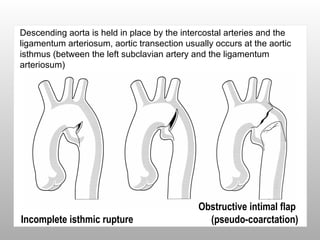
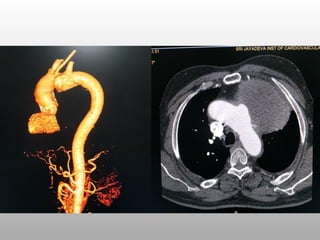
Descending aorta is held in place by the intercostal arteries and the ligamentum arteriosum, aortic transection usually occurs at the aortic isthmus (between the left subclavian artery and the ligamentum arteriosum)
Causes
Deceleration injury orBlunt trauma
Motor vehicle accidents (side or frontal impact)
Fall from height
Explosion
Pathophysiology
Rapid deceleration produces shearing injury between
fixed and mobile portions of the aorta
3.
Incomplete isthmic rupture
Obstructiveintimal flap
(pseudo-coarctation)
Descending aorta is held in place by the intercostal arteries and the
ligamentum arteriosum, aortic transection usually occurs at the aortic
isthmus (between the left subclavian artery and the ligamentum
arteriosum)
4.
CLINICAL FEATURES
Following severeblunt chest trauma, especially in those with upper
ribs (1st-2nd), sternal, scapula fractures
Retrosternal or interscapular pain
Haemodynamic compromise producing tachycardia, hypotension and
oliguria
Peri-aortic haematoma causing compression of surrounding structures
resulting in dysphagia, stridor, dyspnoea or hoarseness



![Cells and Organs of immune system [Autosaved].pptx](https://cdn.slidesharecdn.com/ss_thumbnails/cellsandorgansofimmunesystemautosaved-260123152717-ea0cb261-thumbnail.jpg?width=640&height=640&fit=bounds)


![Hypothalamus short notes on location, function and disorders by Dr. Neha [PT]...](https://cdn.slidesharecdn.com/ss_thumbnails/hypothalamusbydr-260124142231-2b48143d-thumbnail.jpg?width=640&height=640&fit=bounds)


