Plasmid construction and Formulation of
Trastuzumab (Herceptin ) to manifest genetic disorder
PresentedBy
ID: 161-29-870
ID:161-29-876
ID:161-29-890
ID:161-29-907
DaffodilInternationalUniversity
B. Pharm
Introduction
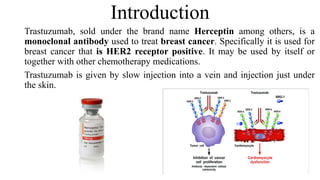
Trastuzumab, sold under the brand name Herceptin among others, is a
monoclonal antibody used to treat breast cancer. Specifically it is used for
breast cancer that is HER2 receptor positive. It may be used by itself or
together with other chemotherapy medications.
Trastuzumab is given by slow injection into a vein and injection just under
the skin.
Herceptin
Active substance : Trastuzumab
 Recombinant humanised IgG1 monoclonal antibody
 Directed against extracellular domain of HER2 receptor
Powder for infusion
Intravenous use
Produced in CHO cell cultures, trastuzumab is a recombinant IgG1
kappa, humanized monoclonal antibody 6 that selectively binds with
high affinity in a cell-based assay to the extracellular domain of the
human epidermal growth factor receptor protein (HER2) Label.
It is used as a treatment of human epidermal growth factor receptor
(HER)-2+ metastatic breast cancer, where there is a proven
amplification of the HER-2 oncogene or over-expression of the HER-2
protein in tumours.
It is suggested that the overexpression or gene amplification of HER2
has been found in about 20–30% of breast cancers and elevated
activation of HER2 triggers multiple downstream pathways leading to
abnormal proliferation of cancer cells 4.
Trastuzumab binds to HER2 and suppresses cancer cells growth,
proliferation, and survival directly and indirectly
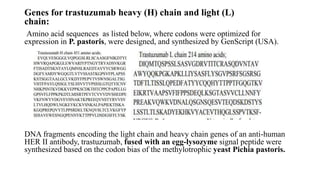
Genes for trastuzumab heavy (H) chain and light (L)
chain:
Amino acid sequences as listed below, where codons were optimized for
expression in P. pastoris, were designed, and synthesized by GenScript (USA).
DNA fragments encoding the light chain and heavy chain genes of an anti-human
HER II antibody, trastuzumab, fused with an egg-lysozyme signal peptide were
synthesized based on the codon bias of the methylotrophic yeast Pichia pastoris.
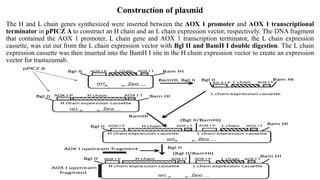
Construction of plasmid
The H and L chain genes synthesized were inserted between the AOX 1 promoter and AOX 1 transcriptional
terminator in pPICZ A to construct an H chain and an L chain expression vector, respectively. The DNA fragment
that contained the AOX 1 promoter, L chain gene and AOX 1 transcription terminator, the L chain expression
cassette, was cut out from the L chain expression vector with Bgl II and BamH I double digestion. The L chain
expression cassette was then inserted into the BamH I site in the H chain expression vector to create an expression
vector for trastuzumab.
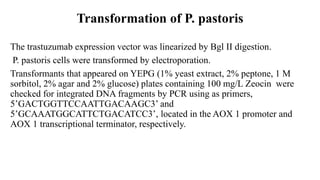
Transformation of P. pastoris
The trastuzumab expression vector was linearized by Bgl II digestion.
P. pastoris cells were transformed by electroporation.
Transformants that appeared on YEPG (1% yeast extract, 2% peptone, 1 M
sorbitol, 2% agar and 2% glucose) plates containing 100 mg/L Zeocin were
checked for integrated DNA fragments by PCR using as primers,
5’GACTGGTTCCAATTGACAAGC3’ and
5’GCAAATGGCATTCTGACATCC3’, located in the AOX 1 promoter and
AOX 1 transcriptional terminator, respectively.
Production of Trastuzumab
• P. pastoris conaining the trastuzumab expression vector was cultured from in
10 mL of BMGY medium [1% yeast extract, 2% peptone, 1.34% yeast
nitrogen base, 100 mM potassium phosphate (pH 6.0), 4 × 10⁻⁵% biotin, and
1% glycerol] overnight at 30˚C with shaking at 275 rpm.
• A 100-mL volume of BMGY medium was inoculated with 1 ml of the starting
culture. The second culture was incubated for approximately 12 h at 30˚C
with shaking at 275 rpm. Cells were harvested at an OD600nm of between 1
and 4 and pelleted by centrifugation for 10 min at 5000 rpm at 4˚C.
• Induction of protein expression was initiated by resuspending the yeast
cells in 100 mL of BMMY medium [1% yeast extract, 2% peptone, 1.34%
yeast nitrogen base, 100 mM potassium phosphate (pH 6.0), 4 × 10⁻⁵ %
biotin, and 1% methanol]. Incubation was continued at 30˚C with shaking
at 300 rpm for 24 h. A supplemental volume of methanol equal to 1/100
of the culture volume was added at 16 h.
• Following induction for 24 h, the culture was chilled on ice, and the cells
and culture medium were separated by centrifugation for 10 min at 5000
rpm at 4˚C. The culture medium was stored at 4˚C.
Secretion of Trastuzumab, and Its Characterization:
After cultivation and induction of the transformant selected, the culture medium
was separated from the cells by centrifugation.
The production of the antibody in the culture medium was checked by western
blotting using anti-human IgG Fc and anti-human κ .
The heavy chain produced by P. pastoris was detected as two bands. The main was
at a slightly higher molecular weight position than the one produced by CHO, but
the weaker band was seen at the same position.
 The light chain was detected as one band almost at the same position as that
produced by CHO.
The antibody in the culture medium was then affinity-purified with a Protein A
column, and the product was analyzed by SDS-PAGE under reduced and non-
reduced conditions. Under non- reduced conditions, the molecular weight of the
antibody was approximately 250 kDa, and almost the same as that produced by
CHO
Purification of Trastuzumab from Culture Media:
Trastuzumab was recovered from the culture medium with an AKTA
explorer 100A using Streamline rProtein A .
The rProtein A resin was equilibrated, and washed with 20 mM Tris-
HCl pH 7.0. The culture supernatant was loaded at a maximum capacity
of 32 mg/mL resin at a residence time in excess of 6 min.
Trastuzumab was eluted using a pH gradient from 4.0 to 3.0 in 100 mM
sodium citrate. Eluate fractions were adjusted to pH 5.0 with 1 M
Na2HPO4, before being diluted five-fold with H2O.
The pH was then re-adjusted to 4.5 with 1 M acetic acid before being
loaded on a Source 30S column equilibrated with 25 mM sodium
acetate, pH 4.5.
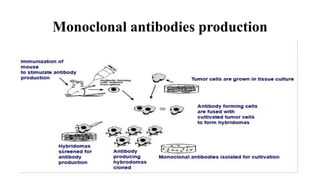
Monoclonal antibodies production
Composition:
Trastuzumab is formulated as a lyophilised powder and each vial is designed to
deliver 150 mg trastuzumab.
The finished product also includes 3.36 mg L-Histidine HCl, 2.16 mg L-Histidine,
136.2mg trehalose dihydrate, and 0.6 mg polysorbate 20.
The sterile solution is filled aseptically into 15 ml Type I borosilicate glass vials
with 20 mm lyophilised stoppers and lyophilised using validated methods.
Trastuzumab

Trastuzumab

  • 1.
    Plasmid construction andFormulation of Trastuzumab (Herceptin ) to manifest genetic disorder PresentedBy ID: 161-29-870 ID:161-29-876 ID:161-29-890 ID:161-29-907 DaffodilInternationalUniversity B. Pharm
  • 2.
    Introduction Trastuzumab, sold underthe brand name Herceptin among others, is a monoclonal antibody used to treat breast cancer. Specifically it is used for breast cancer that is HER2 receptor positive. It may be used by itself or together with other chemotherapy medications. Trastuzumab is given by slow injection into a vein and injection just under the skin.
  • 3.
    Herceptin Active substance :Trastuzumab  Recombinant humanised IgG1 monoclonal antibody  Directed against extracellular domain of HER2 receptor Powder for infusion Intravenous use
  • 4.
    Produced in CHOcell cultures, trastuzumab is a recombinant IgG1 kappa, humanized monoclonal antibody 6 that selectively binds with high affinity in a cell-based assay to the extracellular domain of the human epidermal growth factor receptor protein (HER2) Label. It is used as a treatment of human epidermal growth factor receptor (HER)-2+ metastatic breast cancer, where there is a proven amplification of the HER-2 oncogene or over-expression of the HER-2 protein in tumours. It is suggested that the overexpression or gene amplification of HER2 has been found in about 20–30% of breast cancers and elevated activation of HER2 triggers multiple downstream pathways leading to abnormal proliferation of cancer cells 4. Trastuzumab binds to HER2 and suppresses cancer cells growth, proliferation, and survival directly and indirectly
  • 5.
    Genes for trastuzumabheavy (H) chain and light (L) chain: Amino acid sequences as listed below, where codons were optimized for expression in P. pastoris, were designed, and synthesized by GenScript (USA). DNA fragments encoding the light chain and heavy chain genes of an anti-human HER II antibody, trastuzumab, fused with an egg-lysozyme signal peptide were synthesized based on the codon bias of the methylotrophic yeast Pichia pastoris.
  • 6.
    Construction of plasmid TheH and L chain genes synthesized were inserted between the AOX 1 promoter and AOX 1 transcriptional terminator in pPICZ A to construct an H chain and an L chain expression vector, respectively. The DNA fragment that contained the AOX 1 promoter, L chain gene and AOX 1 transcription terminator, the L chain expression cassette, was cut out from the L chain expression vector with Bgl II and BamH I double digestion. The L chain expression cassette was then inserted into the BamH I site in the H chain expression vector to create an expression vector for trastuzumab.
  • 7.
    Transformation of P.pastoris The trastuzumab expression vector was linearized by Bgl II digestion. P. pastoris cells were transformed by electroporation. Transformants that appeared on YEPG (1% yeast extract, 2% peptone, 1 M sorbitol, 2% agar and 2% glucose) plates containing 100 mg/L Zeocin were checked for integrated DNA fragments by PCR using as primers, 5’GACTGGTTCCAATTGACAAGC3’ and 5’GCAAATGGCATTCTGACATCC3’, located in the AOX 1 promoter and AOX 1 transcriptional terminator, respectively.
  • 8.
    Production of Trastuzumab •P. pastoris conaining the trastuzumab expression vector was cultured from in 10 mL of BMGY medium [1% yeast extract, 2% peptone, 1.34% yeast nitrogen base, 100 mM potassium phosphate (pH 6.0), 4 × 10⁻⁵% biotin, and 1% glycerol] overnight at 30˚C with shaking at 275 rpm. • A 100-mL volume of BMGY medium was inoculated with 1 ml of the starting culture. The second culture was incubated for approximately 12 h at 30˚C with shaking at 275 rpm. Cells were harvested at an OD600nm of between 1 and 4 and pelleted by centrifugation for 10 min at 5000 rpm at 4˚C.
  • 9.
    • Induction ofprotein expression was initiated by resuspending the yeast cells in 100 mL of BMMY medium [1% yeast extract, 2% peptone, 1.34% yeast nitrogen base, 100 mM potassium phosphate (pH 6.0), 4 × 10⁻⁵ % biotin, and 1% methanol]. Incubation was continued at 30˚C with shaking at 300 rpm for 24 h. A supplemental volume of methanol equal to 1/100 of the culture volume was added at 16 h. • Following induction for 24 h, the culture was chilled on ice, and the cells and culture medium were separated by centrifugation for 10 min at 5000 rpm at 4˚C. The culture medium was stored at 4˚C.
  • 10.
    Secretion of Trastuzumab,and Its Characterization: After cultivation and induction of the transformant selected, the culture medium was separated from the cells by centrifugation. The production of the antibody in the culture medium was checked by western blotting using anti-human IgG Fc and anti-human κ . The heavy chain produced by P. pastoris was detected as two bands. The main was at a slightly higher molecular weight position than the one produced by CHO, but the weaker band was seen at the same position.  The light chain was detected as one band almost at the same position as that produced by CHO. The antibody in the culture medium was then affinity-purified with a Protein A column, and the product was analyzed by SDS-PAGE under reduced and non- reduced conditions. Under non- reduced conditions, the molecular weight of the antibody was approximately 250 kDa, and almost the same as that produced by CHO
  • 11.
    Purification of Trastuzumabfrom Culture Media: Trastuzumab was recovered from the culture medium with an AKTA explorer 100A using Streamline rProtein A . The rProtein A resin was equilibrated, and washed with 20 mM Tris- HCl pH 7.0. The culture supernatant was loaded at a maximum capacity of 32 mg/mL resin at a residence time in excess of 6 min. Trastuzumab was eluted using a pH gradient from 4.0 to 3.0 in 100 mM sodium citrate. Eluate fractions were adjusted to pH 5.0 with 1 M Na2HPO4, before being diluted five-fold with H2O. The pH was then re-adjusted to 4.5 with 1 M acetic acid before being loaded on a Source 30S column equilibrated with 25 mM sodium acetate, pH 4.5.
  • 12.
  • 13.
    Composition: Trastuzumab is formulatedas a lyophilised powder and each vial is designed to deliver 150 mg trastuzumab. The finished product also includes 3.36 mg L-Histidine HCl, 2.16 mg L-Histidine, 136.2mg trehalose dihydrate, and 0.6 mg polysorbate 20. The sterile solution is filled aseptically into 15 ml Type I borosilicate glass vials with 20 mm lyophilised stoppers and lyophilised using validated methods.