Structure of the plasma membrane.
Body fluids. Extracellular matrix.
Categories of transport across the
plasma membrane. diffusion through
the plasma membrane. Rate of
diffusion. Osmosis
PLASMA MEMBRANE AND
ASSOCIATED STRUCTURES
The cell is the basic unit of structure and function
in the body.
Many of the functions of cells are performed by
particular subcellular structures known as
organelles.
The plasma (cell) membrane allows selective
communication between the intracellular and
extracellular compartments and aids cellular
movement.
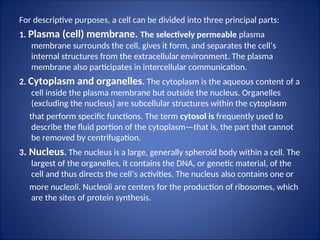
For descriptive purposes, a cell can be divided into three principal parts:
1. Plasma (cell) membrane. The selectively permeable plasma
membrane surrounds the cell, gives it form, and separates the cell’s
internal structures from the extracellular environment. The plasma
membrane also participates in intercellular communication.
2. Cytoplasm and organelles. The cytoplasm is the aqueous content of a
cell inside the plasma membrane but outside the nucleus. Organelles
(excluding the nucleus) are subcellular structures within the cytoplasm
that perform specific functions. The term cytosol is frequently used to
describe the fluid portion of the cytoplasm—that is, the part that cannot
be removed by centrifugation.
3. Nucleus. The nucleus is a large, generally spheroid body within a cell. The
largest of the organelles, it contains the DNA, or genetic material, of the
cell and thus directs the cell’s activities. The nucleus also contains one or
more nucleoli. Nucleoli are centers for the production of ribosomes, which
are the sites of protein synthesis.
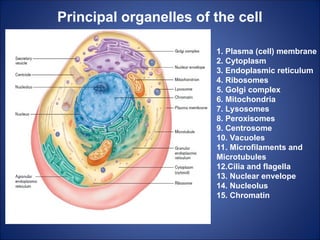
Principal organelles of the cell
1. Plasma (cell) membrane
2. Cytoplasm
3. Endoplasmic reticulum
4. Ribosomes
5. Golgi complex
6. Mitochondria
7. Lysosomes
8. Peroxisomes
9. Centrosome
10. Vacuoles
11. Microfilaments and
Microtubules
12.Cilia and flagella
13. Nuclear envelope
14. Nucleolus
15. Chromatin
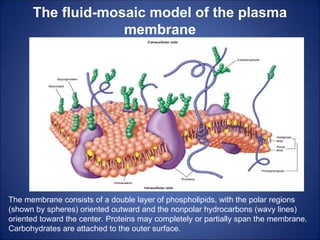
The fluid-mosaic model of the plasma
membrane
The membrane consists of a double layer of phospholipids, with the polar regions
(shown by spheres) oriented outward and the nonpolar hydrocarbons (wavy lines)
oriented toward the center. Proteins may completely or partially span the membrane.
Carbohydrates are attached to the outer surface.
EXTRACELLULAR ENVIRONMENT
The extracellular environment surrounding cells
consists of a fluid compartment in which
molecules are dissolved, and a matrix of
polysaccharides and proteins that give form to
the tissues.
Interactions between the intracellular and
extracellular environment occur across the
plasma membrane.
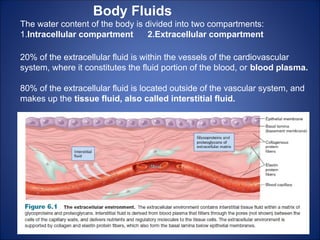
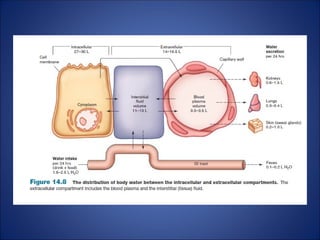
Body Fluids
The water content of the body is divided into two compartments:
1.Intracellular compartment 2.Extracellular compartment
20% of the extracellular fluid is within the vessels of the cardiovascular
system, where it constitutes the fluid portion of the blood, or blood plasma.
80% of the extracellular fluid is located outside of the vascular system, and
makes up the tissue fluid, also called interstitial fluid.
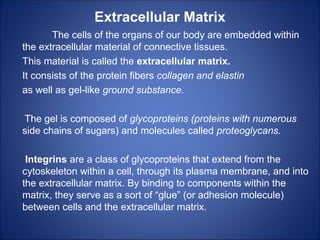
Extracellular Matrix
The cells of the organs of our body are embedded within
the extracellular material of connective tissues.
This material is called the extracellular matrix.
It consists of the protein fibers collagen and elastin
as well as gel-like ground substance.
The gel is composed of glycoproteins (proteins with numerous
side chains of sugars) and molecules called proteoglycans.
Integrins are a class of glycoproteins that extend from the
cytoskeleton within a cell, through its plasma membrane, and into
the extracellular matrix. By binding to components within the
matrix, they serve as a sort of “glue” (or adhesion molecule)
between cells and the extracellular matrix.
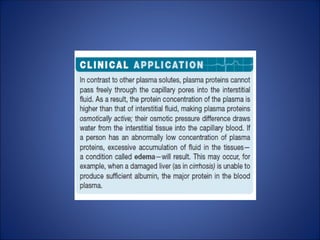
Clinical Application
Categories of Transport Across
the Plasma Membrane
1. Carrier-mediated transport
a. Facilitated diffusion
b. Active transport
2. Non-carrier-mediated transport
a. Simple diffusion of lipid-soluble molecules through the
phospholipid layers of the plasma membrane.
b. Simple diffusion of ions through membrane channel
proteins in the plasma membrane.
c. Simple diffusion of water molecules (osmosis) through
aquaporin (water) channels in the plasma membrane.
Membrane transport categorized by their energy requirement:
1. Passive transport
2. Active transport
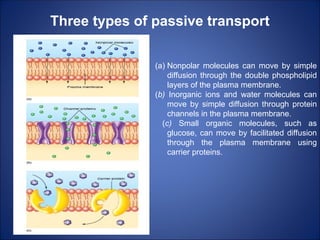
Three types of passive transport
(a) Nonpolar molecules can move by simple
diffusion through the double phospholipid
layers of the plasma membrane.
(b) Inorganic ions and water molecules can
move by simple diffusion through protein
channels in the plasma membrane.
(c) Small organic molecules, such as
glucose, can move by facilitated diffusion
through the plasma membrane using
carrier proteins.
DIFFUSION AND OSMOSIS
Net diffusion of a molecule or ion through a
membrane always occurs in the direction of its
lower concentration.
Nonpolar molecules can penetrate the
phospholipid barrier of the plasma membrane,
and small inorganic ions can pass through
protein channels in the plasma membrane.
The net diffusion of water through a membrane is
known as osmosis.
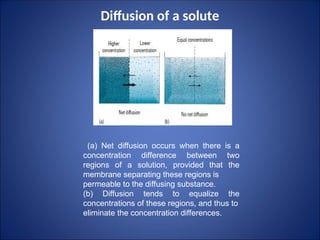
Diffusion of a solute
(a) Net diffusion occurs when there is a
concentration difference between two
regions of a solution, provided that the
membrane separating these regions is
permeable to the diffusing substance.
(b) Diffusion tends to equalize the
concentrations of these regions, and thus to
eliminate the concentration differences.
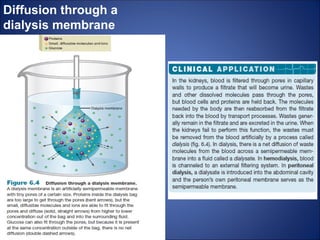
Diffusion through a
dialysis membrane
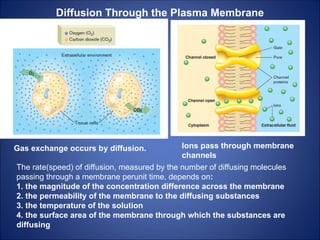
Diffusion Through the Plasma Membrane
Gas exchange occurs by diffusion. Ions pass through membrane
channels
The rate(speed) of diffusion, measured by the number of diffusing molecules
passing through a membrane perunit time, depends on:
1. the magnitude of the concentration difference across the membrane
2. the permeability of the membrane to the diffusing substances
3. the temperature of the solution
4. the surface area of the membrane through which the substances are
diffusing
Clinical Application
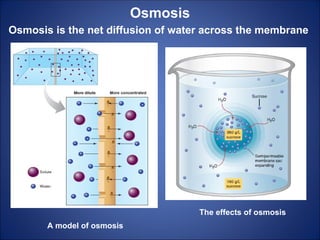
Osmosis
Osmosis is the net diffusion of water across the
membrane
There are thus two requirements for osmosis:
(1) there must be a difference in the concentration of a
solute on the two sides of a selectively permeable
membrane;
(2) the membrane must be relatively impermeable to the
solute.
Solutes that cannot freely pass through the membrane can
promote the osmotic movement of water and are said to
be osmotically active.
Osmosis
Osmosis is the net diffusion of water across the membrane
A model of osmosis
The effects of osmosis
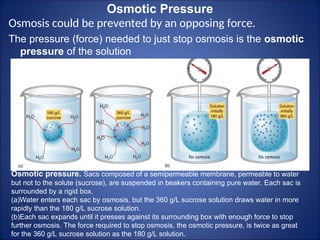
Osmotic Pressure
Osmosis could be prevented by an opposing force.
The pressure (force) needed to just stop osmosis is the osmotic
pressure of the solution
Osmotic pressure. Sacs composed of a semipermeable membrane, permeable to water
but not to the solute (sucrose), are suspended in beakers containing pure water. Each sac is
surrounded by a rigid box.
(a)Water enters each sac by osmosis, but the 360 g/L sucrose solution draws water in more
rapidly than the 180 g/L sucrose solution.
(b)Each sac expands until it presses against its surrounding box with enough force to stop
further osmosis. The force required to stop osmosis, the osmotic pressure, is twice as great
for the 360 g/L sucrose solution as the 180 g/L solution.
Molarity and Molality
An amount of any compound equal to its molecular weight
in grams must contain the same number of molecules as
an amount of any other compound equal to its molecular
weight in grams.
This unit of weight, a mole, always contains 6.02 × 10 23
molecules (Avogadro’s number).
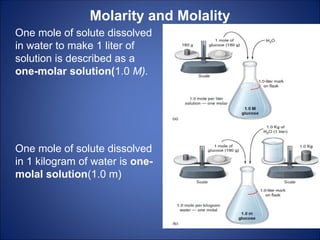
One mole of solute dissolved in water to make 1 liter of
solution is described as a one-molar solution
(abbreviated 1.0 M)
One mole of solute dissolved in 1 kilogram of water is one-
molal solution(1.0 m)
Molarity and Molality
One mole of solute dissolved
in water to make 1 liter of
solution is described as a
one-molar solution(1.0 M).
One mole of solute dissolved
in 1 kilogram of water is one-
molal solution(1.0 m)
Isotonic, hypertonic and hypotonic solutions
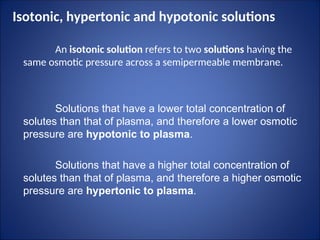
An isotonic solution refers to two solutions having the
same osmotic pressure across a semipermeable membrane.
Solutions that have a lower total concentration of
solutes than that of plasma, and therefore a lower osmotic
pressure are hypotonic to plasma.
Solutions that have a higher total concentration of
solutes than that of plasma, and therefore a higher osmotic
pressure are hypertonic to plasma.
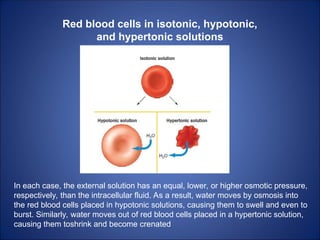
Red blood cells in isotonic, hypotonic,
and hypertonic solutions
In each case, the external solution has an equal, lower, or higher osmotic pressure,
respectively, than the intracellular fluid. As a result, water moves by osmosis into
the red blood cells placed in hypotonic solutions, causing them to swell and even to
burst. Similarly, water moves out of red blood cells placed in a hypertonic solution,
causing them toshrink and become crenated
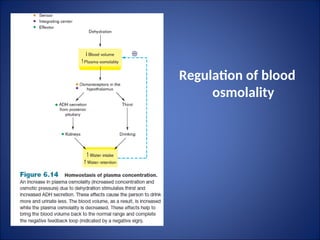
Regulation of blood
osmolality
Thank you for attention!

Transport across the plasma membrane -.ppt

  • 1.
    Structure of theplasma membrane. Body fluids. Extracellular matrix. Categories of transport across the plasma membrane. diffusion through the plasma membrane. Rate of diffusion. Osmosis
  • 2.
    PLASMA MEMBRANE AND ASSOCIATEDSTRUCTURES The cell is the basic unit of structure and function in the body. Many of the functions of cells are performed by particular subcellular structures known as organelles. The plasma (cell) membrane allows selective communication between the intracellular and extracellular compartments and aids cellular movement.
  • 3.
    For descriptive purposes,a cell can be divided into three principal parts: 1. Plasma (cell) membrane. The selectively permeable plasma membrane surrounds the cell, gives it form, and separates the cell’s internal structures from the extracellular environment. The plasma membrane also participates in intercellular communication. 2. Cytoplasm and organelles. The cytoplasm is the aqueous content of a cell inside the plasma membrane but outside the nucleus. Organelles (excluding the nucleus) are subcellular structures within the cytoplasm that perform specific functions. The term cytosol is frequently used to describe the fluid portion of the cytoplasm—that is, the part that cannot be removed by centrifugation. 3. Nucleus. The nucleus is a large, generally spheroid body within a cell. The largest of the organelles, it contains the DNA, or genetic material, of the cell and thus directs the cell’s activities. The nucleus also contains one or more nucleoli. Nucleoli are centers for the production of ribosomes, which are the sites of protein synthesis.
  • 4.
    Principal organelles ofthe cell 1. Plasma (cell) membrane 2. Cytoplasm 3. Endoplasmic reticulum 4. Ribosomes 5. Golgi complex 6. Mitochondria 7. Lysosomes 8. Peroxisomes 9. Centrosome 10. Vacuoles 11. Microfilaments and Microtubules 12.Cilia and flagella 13. Nuclear envelope 14. Nucleolus 15. Chromatin
  • 5.
    The fluid-mosaic modelof the plasma membrane The membrane consists of a double layer of phospholipids, with the polar regions (shown by spheres) oriented outward and the nonpolar hydrocarbons (wavy lines) oriented toward the center. Proteins may completely or partially span the membrane. Carbohydrates are attached to the outer surface.
  • 6.
    EXTRACELLULAR ENVIRONMENT The extracellularenvironment surrounding cells consists of a fluid compartment in which molecules are dissolved, and a matrix of polysaccharides and proteins that give form to the tissues. Interactions between the intracellular and extracellular environment occur across the plasma membrane.
  • 7.
    Body Fluids The watercontent of the body is divided into two compartments: 1.Intracellular compartment 2.Extracellular compartment 20% of the extracellular fluid is within the vessels of the cardiovascular system, where it constitutes the fluid portion of the blood, or blood plasma. 80% of the extracellular fluid is located outside of the vascular system, and makes up the tissue fluid, also called interstitial fluid.
  • 9.
    Extracellular Matrix The cellsof the organs of our body are embedded within the extracellular material of connective tissues. This material is called the extracellular matrix. It consists of the protein fibers collagen and elastin as well as gel-like ground substance. The gel is composed of glycoproteins (proteins with numerous side chains of sugars) and molecules called proteoglycans. Integrins are a class of glycoproteins that extend from the cytoskeleton within a cell, through its plasma membrane, and into the extracellular matrix. By binding to components within the matrix, they serve as a sort of “glue” (or adhesion molecule) between cells and the extracellular matrix.
  • 10.
  • 11.
    Categories of TransportAcross the Plasma Membrane 1. Carrier-mediated transport a. Facilitated diffusion b. Active transport 2. Non-carrier-mediated transport a. Simple diffusion of lipid-soluble molecules through the phospholipid layers of the plasma membrane. b. Simple diffusion of ions through membrane channel proteins in the plasma membrane. c. Simple diffusion of water molecules (osmosis) through aquaporin (water) channels in the plasma membrane. Membrane transport categorized by their energy requirement: 1. Passive transport 2. Active transport
  • 12.
    Three types ofpassive transport (a) Nonpolar molecules can move by simple diffusion through the double phospholipid layers of the plasma membrane. (b) Inorganic ions and water molecules can move by simple diffusion through protein channels in the plasma membrane. (c) Small organic molecules, such as glucose, can move by facilitated diffusion through the plasma membrane using carrier proteins.
  • 13.
    DIFFUSION AND OSMOSIS Netdiffusion of a molecule or ion through a membrane always occurs in the direction of its lower concentration. Nonpolar molecules can penetrate the phospholipid barrier of the plasma membrane, and small inorganic ions can pass through protein channels in the plasma membrane. The net diffusion of water through a membrane is known as osmosis.
  • 14.
    Diffusion of asolute (a) Net diffusion occurs when there is a concentration difference between two regions of a solution, provided that the membrane separating these regions is permeable to the diffusing substance. (b) Diffusion tends to equalize the concentrations of these regions, and thus to eliminate the concentration differences.
  • 15.
  • 16.
    Diffusion Through thePlasma Membrane Gas exchange occurs by diffusion. Ions pass through membrane channels The rate(speed) of diffusion, measured by the number of diffusing molecules passing through a membrane perunit time, depends on: 1. the magnitude of the concentration difference across the membrane 2. the permeability of the membrane to the diffusing substances 3. the temperature of the solution 4. the surface area of the membrane through which the substances are diffusing
  • 17.
  • 18.
    Osmosis Osmosis is thenet diffusion of water across the membrane There are thus two requirements for osmosis: (1) there must be a difference in the concentration of a solute on the two sides of a selectively permeable membrane; (2) the membrane must be relatively impermeable to the solute. Solutes that cannot freely pass through the membrane can promote the osmotic movement of water and are said to be osmotically active.
  • 19.
    Osmosis Osmosis is thenet diffusion of water across the membrane A model of osmosis The effects of osmosis
  • 21.
    Osmotic Pressure Osmosis couldbe prevented by an opposing force. The pressure (force) needed to just stop osmosis is the osmotic pressure of the solution Osmotic pressure. Sacs composed of a semipermeable membrane, permeable to water but not to the solute (sucrose), are suspended in beakers containing pure water. Each sac is surrounded by a rigid box. (a)Water enters each sac by osmosis, but the 360 g/L sucrose solution draws water in more rapidly than the 180 g/L sucrose solution. (b)Each sac expands until it presses against its surrounding box with enough force to stop further osmosis. The force required to stop osmosis, the osmotic pressure, is twice as great for the 360 g/L sucrose solution as the 180 g/L solution.
  • 22.
    Molarity and Molality Anamount of any compound equal to its molecular weight in grams must contain the same number of molecules as an amount of any other compound equal to its molecular weight in grams. This unit of weight, a mole, always contains 6.02 × 10 23 molecules (Avogadro’s number). One mole of solute dissolved in water to make 1 liter of solution is described as a one-molar solution (abbreviated 1.0 M) One mole of solute dissolved in 1 kilogram of water is one- molal solution(1.0 m)
  • 23.
    Molarity and Molality Onemole of solute dissolved in water to make 1 liter of solution is described as a one-molar solution(1.0 M). One mole of solute dissolved in 1 kilogram of water is one- molal solution(1.0 m)
  • 24.
    Isotonic, hypertonic andhypotonic solutions An isotonic solution refers to two solutions having the same osmotic pressure across a semipermeable membrane. Solutions that have a lower total concentration of solutes than that of plasma, and therefore a lower osmotic pressure are hypotonic to plasma. Solutions that have a higher total concentration of solutes than that of plasma, and therefore a higher osmotic pressure are hypertonic to plasma.
  • 25.
    Red blood cellsin isotonic, hypotonic, and hypertonic solutions In each case, the external solution has an equal, lower, or higher osmotic pressure, respectively, than the intracellular fluid. As a result, water moves by osmosis into the red blood cells placed in hypotonic solutions, causing them to swell and even to burst. Similarly, water moves out of red blood cells placed in a hypertonic solution, causing them toshrink and become crenated
  • 27.
  • 28.
    Thank you forattention!