Sonnets
”A sonnet by any other name
would sound as sweet…”
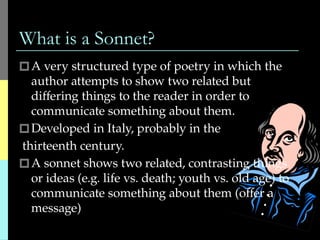
What is a Sonnet?
🞐A very structured type of poetry in which the
author attempts to show two related but
differing things to the reader in order to
communicate something about them.
🞐Developed in Italy, probably in the
thirteenth century.
🞐A sonnet shows two related, contrasting things
or ideas (e.g. life vs. death; youth vs. old age) to
communicate something about them (offer a
message)
Sonnets (cont.)
🞐Consists of fourteen lines and follows one of
several set rhyme schemes:
■English (Shakespearean)
■Italian (Petrarchan)
■Spenserian
Sonnet Vocabulary
🞐 Quatrain:
■A stanza of four lines.
🞐 Octave:
■An eight line stanza. Used primarily to denote the first
eight-line division of the Italian Sonnet as separate from
the last six-line division, the sestet.
🞐 Iambic pentameter:
■A ten syllable line, consisting of five iambic feet
(alternating an unstressed/stressed pattern)
🞐 Poetic Foot:
■A group of two syllables
Vocab. (cont.)
🞐 Sestet:
■The second six-line division of an Italian Sonnet.
Following the eight-line division (octave), the sestet
usually makes specific a general statement that has
been presented in the octave or indicates the
personal emotion of the author in a situation that
the octave has developed.
🞐 Volta (The Turn):
■The turn in thought– from question to answer,
problem to solution– that occurs at the beginning of
the sestet (line 9) in the Italian sonnet. Sometimes
occurs in the English sonnet between the twelfth
and thirteenth lines. Marked by “but,” “yet,” or
“and yet.”
Italian Sonnets (Petrarchan)
🞐Distinguished by its
division into the octave
and sestet:
■The octave rhyming
abbaabba
■The sestet rhyming
cdecde, cdcdcd or
cdedce
English Sonnets (Shakespearean)
🞐 Four divisions are used:
■Three quatrains
🞐Each with a rhyme scheme of its own, usually
rhyming alternating lines.
■And a rhymed concluding couplet.
🞐 The typical rhyme scheme is
■Abab cdcd efef gg
English (cont.)
🞐each quatrain develops a specific idea, but one
closely related to the ideas in the other quatrains.
🞐Not only is the English sonnet the easiest in
terms of its rhyme scheme, calling for only pairs
of rhyming words rather than groups of 4, but it
is the most flexible in terms of the placement of
the volta. Shakespeare often places the "turn," as
in the Italian, at L9
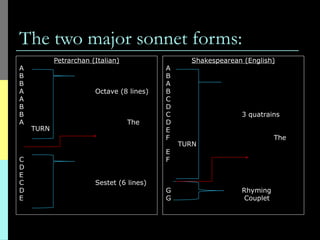
The two major sonnet forms:
Petrarchan (Italian)
A
B
B
A Octave (8 lines)
A
B
B
A The
TURN
C
D
E
C Sestet (6 lines)
D
E
Shakespearean (English)
A
B
A
B
C
D
C 3 quatrains
D
E
F The
TURN
E
F
G Rhyming
G Couplet
http://www.shakespeare-online.com/sonnets/116detail.html
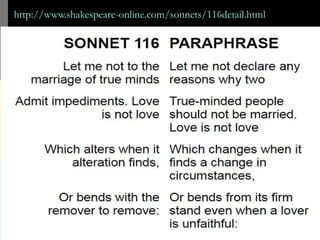
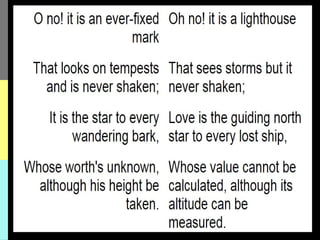
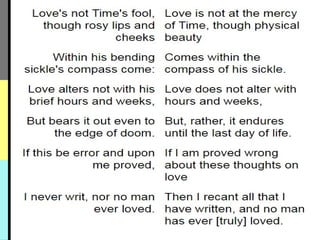
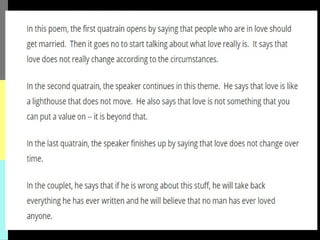
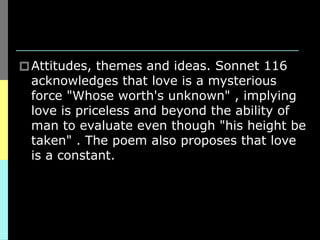
🞐Attitudes, themes and ideas. Sonnet 116
acknowledges that love is a mysterious
force "Whose worth's unknown" , implying
love is priceless and beyond the ability of
man to evaluate even though "his height be
taken" . The poem also proposes that love
is a constant.
Works Cited
🞐mrslivaudais.com/wp-content/
uploads/.../An-Introduction-to-
Sonnets.ppt
🞐www.rhs.rc
🞐s.k12.tn.us/teachers/starrettk/
Sonnets.ppt

Sonnet Introduction.pptxshdjdkdbdjdjhdhh

  • 1.
    Sonnets ”A sonnet byany other name would sound as sweet…”
  • 2.
    What is aSonnet? 🞐A very structured type of poetry in which the author attempts to show two related but differing things to the reader in order to communicate something about them. 🞐Developed in Italy, probably in the thirteenth century. 🞐A sonnet shows two related, contrasting things or ideas (e.g. life vs. death; youth vs. old age) to communicate something about them (offer a message)
  • 3.
    Sonnets (cont.) 🞐Consists offourteen lines and follows one of several set rhyme schemes: ■English (Shakespearean) ■Italian (Petrarchan) ■Spenserian
  • 4.
    Sonnet Vocabulary 🞐 Quatrain: ■Astanza of four lines. 🞐 Octave: ■An eight line stanza. Used primarily to denote the first eight-line division of the Italian Sonnet as separate from the last six-line division, the sestet. 🞐 Iambic pentameter: ■A ten syllable line, consisting of five iambic feet (alternating an unstressed/stressed pattern) 🞐 Poetic Foot: ■A group of two syllables
  • 5.
    Vocab. (cont.) 🞐 Sestet: ■Thesecond six-line division of an Italian Sonnet. Following the eight-line division (octave), the sestet usually makes specific a general statement that has been presented in the octave or indicates the personal emotion of the author in a situation that the octave has developed. 🞐 Volta (The Turn): ■The turn in thought– from question to answer, problem to solution– that occurs at the beginning of the sestet (line 9) in the Italian sonnet. Sometimes occurs in the English sonnet between the twelfth and thirteenth lines. Marked by “but,” “yet,” or “and yet.”
  • 6.
    Italian Sonnets (Petrarchan) 🞐Distinguishedby its division into the octave and sestet: ■The octave rhyming abbaabba ■The sestet rhyming cdecde, cdcdcd or cdedce
  • 7.
    English Sonnets (Shakespearean) 🞐Four divisions are used: ■Three quatrains 🞐Each with a rhyme scheme of its own, usually rhyming alternating lines. ■And a rhymed concluding couplet. 🞐 The typical rhyme scheme is ■Abab cdcd efef gg
  • 8.
    English (cont.) 🞐each quatraindevelops a specific idea, but one closely related to the ideas in the other quatrains. 🞐Not only is the English sonnet the easiest in terms of its rhyme scheme, calling for only pairs of rhyming words rather than groups of 4, but it is the most flexible in terms of the placement of the volta. Shakespeare often places the "turn," as in the Italian, at L9
  • 9.
    The two majorsonnet forms: Petrarchan (Italian) A B B A Octave (8 lines) A B B A The TURN C D E C Sestet (6 lines) D E Shakespearean (English) A B A B C D C 3 quatrains D E F The TURN E F G Rhyming G Couplet
  • 10.
  • 14.
    🞐Attitudes, themes andideas. Sonnet 116 acknowledges that love is a mysterious force "Whose worth's unknown" , implying love is priceless and beyond the ability of man to evaluate even though "his height be taken" . The poem also proposes that love is a constant.
  • 15.