Word Order/Clusters
Translation and interpretation practice
Clusters
• It is important to avoid automatically following the word order and
structure of the source language when translating and interpreting.
The words of the source language must be recognized, and the
sentences must be understood.
• But the words are only the trees, and it is more important to see the
forest. The “meaningful structures” with which translators and
interpreters deal are neither words nor sentences. They are units of
meaning, which may comprise a number of words, or part of a
sentence, or more than one sentence at a time.
Let’s translate this text. Which are the units of
meaning?
Once upon a time there was a lovely little girl by the name of
Little Red Riding Hood. One fine day she decided to go and
Visit her poor, dear old grandmother, who lay sick in bed. Taking
a basket filled with flowers and fruit under her arm, Little Red
Riding Hood set out happily through the forest. Little did she
Know that deep in those dark woods lurked the Big Bad Wolf!
the units of meaning in the text, marked off with brackets, do not
correspond to single words or to whole sentences:
[Once upon a time] [there was] [a lovely little girl] [by the name of]
[Little Red Riding Hood]. [One fine day] [she decided] [to go and
visit] [her poor, dear old grandmother], [who lay sick in bed]. [Taking
a basket] [filled with flowers and fruit] [under her arm], [Little Red
Riding Hood] [set out happily] [through the forest]. [Little did she
know] [that] [deep in those dark woods] [lurked] [the Big Bad Wolf]!
It is important quickly to identify units of meaning by scanning
a speech as you hear it for phrases or clusters of words that can be
translated into corresponding clusters of words in the target language.
The way words are organized into clusters in the source language will
not necessarily correspond to the way they should be organized in the
target language. But the meaning will correspond.
Two kinds of clusters are especially important:
• noun + adjective clusters
• verb + object clusters
• Noun + adjective clusters must be dealt with as units because
adjectives in different languages fall into different sequences in a
noun phrase. For example, in English, the adjective of size must come
before the adjective of color (“big black dog”, not “black big dog”).
Moreover, in English, adjectives of age generally precede adjectives of
color (“old blue car”, not “blue old car”), adjectives of size precede
adjectives of age (“big old house”, not “old big house”), and all of the
foregoing precede an adjective of nationality (“old blue French car”,
not “French old blue car”).
• Phrases containing several adjectives will become unmanageable for
for a simultaneous interpreter unless they are mentally processed as
a unit.
• Verb + object clusters should be dealt with as units because, as a
practical matter of usage, some verbs will not work with some objects
and vice versa. Treating clusters as single units of meaning will also
help you to identify those cases where you can compress wordiness
by translating several words with one, which is especially useful in
interpreting a fast speech.
• E.g. “para facilitar la comprensión de nuestra propuesta . . .” = “to
clarify our proposal”. A good way to identify these cases is to “listen
for definitions” and then use the word corresponding to the
definition you have just heard. To develop this skill, it is helpful to
browse dictionaries and do crossword puzzles.
• Form the habit of looking for word clusters whenever you read, and
learn to “scan” the text for them when you interpret. You will find
that, very often, if you can think of the right verb in the target
language, it will remind you of the word you are searching for to
translate the object. And, if you can think of the right word for the
object, it will remind you of the word you need to translate the verb.
Similarly, calling the right adjective to mind will often remind you of
the noun you need, and vice versa.
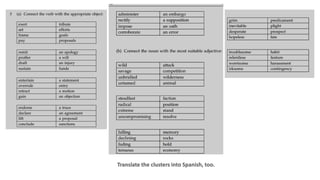
Exercises
Translation technique Clusters.pdf

Translation technique Clusters.pdf

  • 1.
    Word Order/Clusters Translation andinterpretation practice
  • 3.
    Clusters • It isimportant to avoid automatically following the word order and structure of the source language when translating and interpreting. The words of the source language must be recognized, and the sentences must be understood. • But the words are only the trees, and it is more important to see the forest. The “meaningful structures” with which translators and interpreters deal are neither words nor sentences. They are units of meaning, which may comprise a number of words, or part of a sentence, or more than one sentence at a time.
  • 4.
    Let’s translate thistext. Which are the units of meaning? Once upon a time there was a lovely little girl by the name of Little Red Riding Hood. One fine day she decided to go and Visit her poor, dear old grandmother, who lay sick in bed. Taking a basket filled with flowers and fruit under her arm, Little Red Riding Hood set out happily through the forest. Little did she Know that deep in those dark woods lurked the Big Bad Wolf!
  • 5.
    the units ofmeaning in the text, marked off with brackets, do not correspond to single words or to whole sentences: [Once upon a time] [there was] [a lovely little girl] [by the name of] [Little Red Riding Hood]. [One fine day] [she decided] [to go and visit] [her poor, dear old grandmother], [who lay sick in bed]. [Taking a basket] [filled with flowers and fruit] [under her arm], [Little Red Riding Hood] [set out happily] [through the forest]. [Little did she know] [that] [deep in those dark woods] [lurked] [the Big Bad Wolf]!
  • 6.
    It is importantquickly to identify units of meaning by scanning a speech as you hear it for phrases or clusters of words that can be translated into corresponding clusters of words in the target language. The way words are organized into clusters in the source language will not necessarily correspond to the way they should be organized in the target language. But the meaning will correspond. Two kinds of clusters are especially important: • noun + adjective clusters • verb + object clusters
  • 7.
    • Noun +adjective clusters must be dealt with as units because adjectives in different languages fall into different sequences in a noun phrase. For example, in English, the adjective of size must come before the adjective of color (“big black dog”, not “black big dog”). Moreover, in English, adjectives of age generally precede adjectives of color (“old blue car”, not “blue old car”), adjectives of size precede adjectives of age (“big old house”, not “old big house”), and all of the foregoing precede an adjective of nationality (“old blue French car”, not “French old blue car”). • Phrases containing several adjectives will become unmanageable for for a simultaneous interpreter unless they are mentally processed as a unit.
  • 8.
    • Verb +object clusters should be dealt with as units because, as a practical matter of usage, some verbs will not work with some objects and vice versa. Treating clusters as single units of meaning will also help you to identify those cases where you can compress wordiness by translating several words with one, which is especially useful in interpreting a fast speech. • E.g. “para facilitar la comprensión de nuestra propuesta . . .” = “to clarify our proposal”. A good way to identify these cases is to “listen for definitions” and then use the word corresponding to the definition you have just heard. To develop this skill, it is helpful to browse dictionaries and do crossword puzzles.
  • 9.
    • Form thehabit of looking for word clusters whenever you read, and learn to “scan” the text for them when you interpret. You will find that, very often, if you can think of the right verb in the target language, it will remind you of the word you are searching for to translate the object. And, if you can think of the right word for the object, it will remind you of the word you need to translate the verb. Similarly, calling the right adjective to mind will often remind you of the noun you need, and vice versa.
  • 10.