Transitive Vs. Intransitive Verbs
To receive an action, or not to receive an action? That is the question!!!
Read and then compare…
Example 1) The batter hit the ball.
Example 2) The bird sang.
• What is the difference between the two verbs in the above
sentences? At first thought, you may say the definition but
forget about the meaning. Instead, concentrate on the
grammar. How do the verbs differ grammatically?
• Notice that the first sentence has two words following the
verb hit. The second sentence doesn’t have words after the
verb sang. These two facts lead us to a discussion on transitive
and intransitive verbs.
Transitive Verbs
Transitive Verbs
Q: What are transitive verbs?
A: Transitive verbs are action verbs that have an object (person, place, thing) to
receive that action. In the first sentence (from the previous slide), the direct
object, ball,
received the action of the verb, hit.
Here are some other examples….
1) He baked some cookies.
2) She rode the bike.
3) They ate ice cream.
All of the verbs in the above sentences are transitive
because an object is receiving the action of the verb.
But what about the sentence from the previous slide (The bird sang)?
Is the verb in that sentence a transitive verb?
No, in this case the verb sang is an intransitive verb.
Intransitive Verbs
Intransitive Verbs
Q: What are intransitive verbs?
A. Intransitive verbs are action verbs, but unlike
transitive verbs, they do not have an object receiving the
action. **Notice there are no words after the verb sang.
Here are some examples…
1) I fell.
2) He laughed.
3) The sun set.
4) I cried.
In all of the above cases the subject is performing
the action of the verb and nothing is receiving the action.
Summary
Summary
To recap, a transitive verb must be an action verb
plus there must be an object to receive that action.
An intransitive verb is when there is an action verb,
but an object does not receive the action.
Practice
Practice
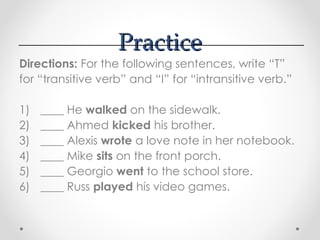
Directions: For the following sentences, write “T”
for “transitive verb” and “I” for “intransitive verb.”
1) ____ He walked on the sidewalk.
2) ____ Ahmed kicked his brother.
3) ____ Alexis wrote a love note in her notebook.
4) ____ Mike sits on the front porch.
5) ____ Georgio went to the school store.
6) ____ Russ played his video games.
• http://www.myenglishpages.com/site_php_files/gra
mmar-lesson-linking-verbs.php
• http://www.myenglishpages.com/site_php_files/gra
mmar-lesson-stative-dynamic-verbs.php

transitive and intransitive-verbs with examples ppt

  • 1.
    Transitive Vs. IntransitiveVerbs Transitive Vs. Intransitive Verbs To receive an action, or not to receive an action? That is the question!!!
  • 2.
    Read and thencompare… Read and then compare… Example 1) The batter hit the ball. Example 2) The bird sang. • What is the difference between the two verbs in the above sentences? At first thought, you may say the definition but forget about the meaning. Instead, concentrate on the grammar. How do the verbs differ grammatically? • Notice that the first sentence has two words following the verb hit. The second sentence doesn’t have words after the verb sang. These two facts lead us to a discussion on transitive and intransitive verbs.
  • 3.
    Transitive Verbs Transitive Verbs Q:What are transitive verbs? A: Transitive verbs are action verbs that have an object (person, place, thing) to receive that action. In the first sentence (from the previous slide), the direct object, ball, received the action of the verb, hit. Here are some other examples…. 1) He baked some cookies. 2) She rode the bike. 3) They ate ice cream. All of the verbs in the above sentences are transitive because an object is receiving the action of the verb. But what about the sentence from the previous slide (The bird sang)? Is the verb in that sentence a transitive verb? No, in this case the verb sang is an intransitive verb.
  • 4.
    Intransitive Verbs Intransitive Verbs Q:What are intransitive verbs? A. Intransitive verbs are action verbs, but unlike transitive verbs, they do not have an object receiving the action. **Notice there are no words after the verb sang. Here are some examples… 1) I fell. 2) He laughed. 3) The sun set. 4) I cried. In all of the above cases the subject is performing the action of the verb and nothing is receiving the action.
  • 5.
    Summary Summary To recap, atransitive verb must be an action verb plus there must be an object to receive that action. An intransitive verb is when there is an action verb, but an object does not receive the action.
  • 6.
    Practice Practice Directions: For thefollowing sentences, write “T” for “transitive verb” and “I” for “intransitive verb.” 1) ____ He walked on the sidewalk. 2) ____ Ahmed kicked his brother. 3) ____ Alexis wrote a love note in her notebook. 4) ____ Mike sits on the front porch. 5) ____ Georgio went to the school store. 6) ____ Russ played his video games.
  • 9.