Digital Literacies & Transition
Nadia Ashrafi & Zainab Kalokoh
The Transition Journey
(Student Questionnaires)
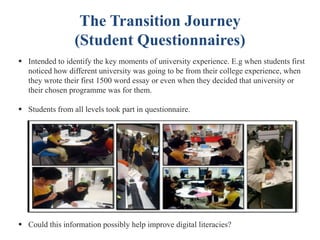
 Intended to identify the key moments of university experience. E.g when students first
noticed how different university was going to be from their college experience, when
they wrote their first 1500 word essay or even when they decided that university or
their chosen programme was for them.
 Students from all levels took part in questionnaire.
 Could this information possibly help improve digital literacies?
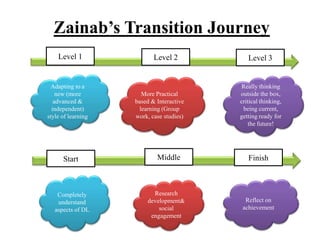
Zainab’s Transition Journey
Level 1 Level 2 Level 3
Start FinishMiddle
Adapting to a
new (more
advanced &
independent)
style of learning
More Practical
based & Interactive
learning (Group
work, case studies)
Really thinking
outside the box,
critical thinking,
being current,
getting ready for
the future!
Completely
understand
aspects of DL
Research
development&
social
engagement
Reflect on
achievement
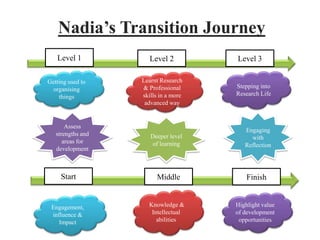
Level 1 Level 2 Level 3
Start FinishMiddle
Getting used to
organising
things
Learnt Research
& Professional
skills in a more
advanced way
Stepping into
Research Life
Engagement,
influence &
Impact
Knowledge &
Intellectual
abilities
Highlight value
of development
opportunities
Assess
strengths and
areas for
development
Deeper level
of learning
Engaging
with
Reflection
Nadia’s Transition Journey
Key Issues
• Are transition points early enough for students to be
comfortable in university education?
• Can digital devices aid their transition?
• Are students fully equipped with DL skills to
progress through their course and find employment
thereafter?
• Do they have these devices/technology at their
disposal?
• What can university/Staff do about this?
Action Plan
WHAT SHOULD STAFF DO?
• Recognise that students arrive with their own digital
practices
• Begin by exploring the ways in which the group are
already using mobile and web based technologies
• Understand learners personal digital literacies before
ploughing into 'supporting' them
• Integrate Digital Literacies into teaching curriculum
and assessment through study skills
i.e Providing authentic contexts for practice,
including digitally-mediated contexts
• Supporting the use of e-portfolios for reflection,
planning and self-presentation
Disappointing however….
• Most students were reluctant to fill forms or talk
about their transition in a short video
• Some only identified transition point towards the end
of their course (3rd year)
• When asked ‘what digital devices have you used
today’, most students did not mention mobile phones.
Do students not realise the importance of such digital
device.
Students experience in digital Literacy Transitions

Transition

  • 1.
    Digital Literacies &Transition Nadia Ashrafi & Zainab Kalokoh
  • 2.
    The Transition Journey (StudentQuestionnaires)  Intended to identify the key moments of university experience. E.g when students first noticed how different university was going to be from their college experience, when they wrote their first 1500 word essay or even when they decided that university or their chosen programme was for them.  Students from all levels took part in questionnaire.  Could this information possibly help improve digital literacies?
  • 3.
    Zainab’s Transition Journey Level1 Level 2 Level 3 Start FinishMiddle Adapting to a new (more advanced & independent) style of learning More Practical based & Interactive learning (Group work, case studies) Really thinking outside the box, critical thinking, being current, getting ready for the future! Completely understand aspects of DL Research development& social engagement Reflect on achievement
  • 4.
    Level 1 Level2 Level 3 Start FinishMiddle Getting used to organising things Learnt Research & Professional skills in a more advanced way Stepping into Research Life Engagement, influence & Impact Knowledge & Intellectual abilities Highlight value of development opportunities Assess strengths and areas for development Deeper level of learning Engaging with Reflection Nadia’s Transition Journey
  • 5.
    Key Issues • Aretransition points early enough for students to be comfortable in university education? • Can digital devices aid their transition? • Are students fully equipped with DL skills to progress through their course and find employment thereafter? • Do they have these devices/technology at their disposal? • What can university/Staff do about this?
  • 6.
    Action Plan WHAT SHOULDSTAFF DO? • Recognise that students arrive with their own digital practices • Begin by exploring the ways in which the group are already using mobile and web based technologies • Understand learners personal digital literacies before ploughing into 'supporting' them
  • 7.
    • Integrate DigitalLiteracies into teaching curriculum and assessment through study skills i.e Providing authentic contexts for practice, including digitally-mediated contexts • Supporting the use of e-portfolios for reflection, planning and self-presentation
  • 8.
    Disappointing however…. • Moststudents were reluctant to fill forms or talk about their transition in a short video • Some only identified transition point towards the end of their course (3rd year) • When asked ‘what digital devices have you used today’, most students did not mention mobile phones. Do students not realise the importance of such digital device.
  • 9.
    Students experience indigital Literacy Transitions