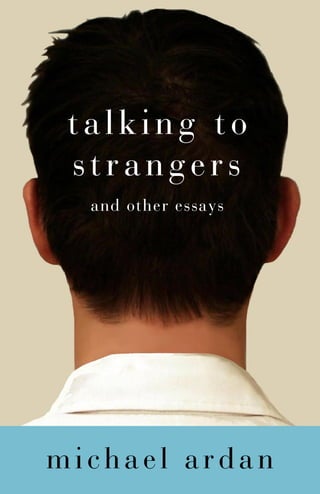
m i c h a e l a r d a n
ta l k i n g t o
and other essays
str a n g e r s
talking to strangers
and other essays
michael ardan
This is an unedited proof not intended for sale or to be quoted in review.
NEW YORK
Copyright © 2013 by Michael Ardan
All rights reserved.
No part of this book may be used or
reproduced in any manner whatsoever without the
written permission of the publisher, except by a reviewer
who may quote brief passages in review.
Published by:
Grand Street Books
An imprint of Tribeca Publishing
154 Grand Street
New York, NY 10013
Author’s note:
The events described in these essays are true. Some
names and identifying characteristics have been changed.
COVER PHOTOGRAPH BY STEPHEN MITCHELL
BOOK DESIGN BY HYPE&BOND
ISBN-13: 978-1456404819
ISBN-10: 1456404841
FIRST EDITION
10 9 8 7 6 5 4 3 2 1
This is an unedited proof not intended for sale or to be quoted in review.
For my parents;
and for Tad G.
“Your life would not make a good book.
Don’t even try.”
—Fran Lebowitz
talking to strangers
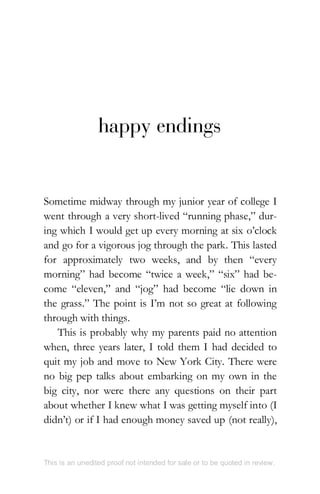
happy endings
Sometime midway through my junior year of college I
went through a very short-lived “running phase,” dur-
ing which I would get up every morning at six o’clock
and go for a vigorous jog through the park. This lasted
for approximately two weeks, and by then “every
morning” had become “twice a week,” “six” had be-
come “eleven,” and “jog” had become “lie down in
the grass.” The point is I’m not so great at following
through with things.
This is probably why my parents paid no attention
when, three years later, I told them I had decided to
quit my job and move to New York City. There were
no big pep talks about embarking on my own in the
big city, nor were there any questions on their part
about whether I knew what I was getting myself into (I
didn’t) or if I had enough money saved up (not really),
This is an unedited proof not intended for sale or to be quoted in review.
or even if I knew where I was going to live once I got
there (nope). At first I was a little bummed that they
didn’t seem to be concerned at all with the fact that I
was making a huge, life-altering decision, let alone that
I was going to be moving halfway across the country,
until I realized that it wasn’t that they didn’t care; they
just didn’t believe it would ever actually happen.
I guess this shouldn’t have come as a surprise. At
this point I had been living back at home for a few
months after a summer internship I’d taken in Wash-
ington, D.C., didn’t lead to the exciting career in the
Capital that I’d expected, and in that time I had started
and subsequently not finished no less than ten home
improvement projects around my parents’ house. A
chest of drawers I had decided to strip and varnish had
been sitting for weeks with all but one drawer com-
pleted (to this day it sits unfinished in my parents’
bathroom, a constant reminder of my inadequacy to
anyone in need of a guest towel). A box of new tiles
for the kitchen was placed, unopened, on the dining
room table and then forgotten. Perhaps most glaringly,
an upstairs bedroom I’d decided to paint mint green
remained a work in progress after I took a break for
lunch and forgot to go back to complete the job.
“I think I’m going to rent out my friend Mark’s
apartment in Queens while he’s out of town next
This is an unedited proof not intended for sale or to be quoted in review.
month. At least until I can find a place of my own,” I
said to my parents over dinner one evening, as if to
prove to them that I was serious about this whole
moving thing.
“Uh huh,” my mom said. “Oh, how’s the paint job
upstairs coming?”
My dad’s reaction was more subtle, but equally im-
passive. “Have you seen my fingernail clippers?” he
replied.
To their credit, my parents have never exactly dis-
couraged my wild ideas. They always just kind of let
me do my own thing, even when they thought I was
being stupid (like when I called them from my fresh-
man dorm room to tell them I’d decided to double-
major in English Literature and Acting, or when I de-
cided to fly out to Los Angeles on a whim to audition
for The Bold and the Beautiful. If you’re wondering how
that turned out, let’s just say I am not on The Bold and
the Beautiful.). All in all, they’ve always been pretty cool
as far as moms and dads go.
The other thing about my parents is that they’re
really kind of polar opposites—she is bold and unfal-
tering while he is calm and cool and subdued—yet
they always seem to see eye-to-eye. As a child I didn’t
fully understand the dynamic of their marriage until
This is an unedited proof not intended for sale or to be quoted in review.
popular culture taught me about the intricate minutiae
of successful relationships. For instance, I remember
being ten years old and contemplating the totally illog-
ical pairing of Jessie Spano and A.C. Slater on Saved By
the Bell, one of my favorite childhood television shows.
On the surface, that relationship made no sense it all.
What could have made Jessie, the überfeminist
straight-arrow (unless, of course, you count her brief
and destructive addiction to caffeine pills) fall for Slat-
er, the misogynistic jock? Was it because he was the
so-called “bad boy?” Perhaps, but even at ten I could
tell that he was pretty vanilla as far as bad boys go.
Was it a purely physical attraction? Maybe—mind you,
this was the nineties, so no one seemed to notice or
care that he wore his hair in a Jheri curled mullet—but
a purely physical attraction can only get you so far,
right? Well, whatever the reason, these two opposites
managed to keep the love alive for four seasons, so
they clearly had something real there.
Now, for the record, my father is not a misogynist
and neither of my parents has a Jheri curl, but you get
the idea. They complimented each other, even when it
seemed like their personalities were made to clash.
And never were their differences and similarities more
evident to me than when it finally began to sink in that
for once I really wasn’t going to flake out on my plans.
This is an unedited proof not intended for sale or to be quoted in review.
I’m not sure when it fully registered, but at some
point after I’d bought my plane ticket to LaGuardia,
was fully packed, and had made arrangements to crash
on a friend’s couch in the city, my mother stopped
making not-so-subtle comments about my inability to
follow through with things and instead began making
not-so-subtle comments about how I was definitely
going to get murdered if I moved to New York.
“Someone got killed in that city on Law & Order
again last night,” she said on one occasion. “This time
it was with a hammer. Can you imagine? Getting beat-
en to death with a hammer?” I assumed this was her
way of saying, “I love you.”
My dad, on the other hand, took a different ap-
proach. One night, a few days before my flight, I
found him sitting out on the front porch drinking a
beer and taking in the silence of the little Kansas town
where he and my mother had lived for the past five
years.
“What are you doing?” I asked him.
“Just sitting,” he said. “Want a beer?”
“Sure,” I said.
That was essentially the end of the conversation,
and for the next hour or so we sat together in relative
silence. It wasn’t uncomfortable, though; no words
were needed. We were simply a father and son drink-
This is an unedited proof not intended for sale or to be quoted in review.
ing a beer under a clear, starry Midwestern sky, neither
of us knowing when or if we would get to do this
again. In the moment, I remember having an over-
whelming feeling that things were changing. There was
a definite sense that something was inexplicably ending
and beginning all at once.
Later that night, I found myself lying in bed wide
awake at around one in the morning, my mind flooded
with thoughts of big changes and fresh starts and end-
ings and beginnings. Unable to fall asleep, I slipped
out of bed, grabbed some supplies from the storage
closet under the stairs, and put a fresh coat of mint
green paint on the walls of the upstairs bedroom.
This is an unedited proof not intended for sale or to be quoted in review.
the great
train robbery
For all new residents of New York City, there is a rite
of passage, and with that comes a moment when we
can at last say “I’m a real New Yorker.” For some, it’s
finally being able to navigate through the underground
labyrinth of the subway system. For others, it’s the
first time telling a tourist to please walk faster or get
the fuck out of the way. For me, it was when I got
mugged.
Actually, “got mugged” is kind of a misleading
term, and not entirely accurate. I wasn’t held up and
gunpoint, and there was no knife fight or anything
wacky like that. In fact, the events leading up to the
crime happened like this: it was a hot Friday afternoon
in May, and I had just finished a grueling week at my
first real New York job (more on that later). As I made
my way down to the Lincoln Center subway station, I
This is an unedited proof not intended for sale or to be quoted in review.
A memoir. Kind of.
Michael Ardan is a writer, performer, and host.
He has frequently appeared onstage at the D-Lounge
in Manhattan’s Union Square and at various dive bars
around New York City.
Follow him on twitter @michaelardan.
www.michaelardan.com
COVER DESIGN BY HYPE&BOND
COVER PHOGRPAPH BY STEPHEN MITCHELL
AUTHOR PHOTOGRAPH BY ALEXANDER VASILJEV MEMOIR/HUMOR
Whether he’s being berated on the phone while working as a telemarketer,
getting robbed by a friendly mugger on the subway, or bombing onstage
performing a one-man show, Michael Ardan knows the risks of talking to
strangers. But he also knows that life is all about taking risks. In his first col-
lection of personal essays and pop culture anecdotes, Michael takes on a
familiar subject—moving from small town America to the big city—and turns
it into a sweet, funny, and surprisingly original story of the adventures of a
young man searching for new experiences and meaningful personal rela-
tionships in an increasingly disjointed world.
AVAILABLE FALL 2013

Talking to Strangers- Excerpt

  • 1.
    m i ch a e l a r d a n ta l k i n g t o and other essays str a n g e r s
  • 2.
  • 3.
    talking to strangers andother essays michael ardan This is an unedited proof not intended for sale or to be quoted in review. NEW YORK
  • 4.
    Copyright © 2013by Michael Ardan All rights reserved. No part of this book may be used or reproduced in any manner whatsoever without the written permission of the publisher, except by a reviewer who may quote brief passages in review. Published by: Grand Street Books An imprint of Tribeca Publishing 154 Grand Street New York, NY 10013 Author’s note: The events described in these essays are true. Some names and identifying characteristics have been changed. COVER PHOTOGRAPH BY STEPHEN MITCHELL BOOK DESIGN BY HYPE&BOND ISBN-13: 978-1456404819 ISBN-10: 1456404841 FIRST EDITION 10 9 8 7 6 5 4 3 2 1 This is an unedited proof not intended for sale or to be quoted in review.
  • 5.
  • 6.
    “Your life wouldnot make a good book. Don’t even try.” —Fran Lebowitz
  • 7.
  • 8.
    happy endings Sometime midwaythrough my junior year of college I went through a very short-lived “running phase,” dur- ing which I would get up every morning at six o’clock and go for a vigorous jog through the park. This lasted for approximately two weeks, and by then “every morning” had become “twice a week,” “six” had be- come “eleven,” and “jog” had become “lie down in the grass.” The point is I’m not so great at following through with things. This is probably why my parents paid no attention when, three years later, I told them I had decided to quit my job and move to New York City. There were no big pep talks about embarking on my own in the big city, nor were there any questions on their part about whether I knew what I was getting myself into (I didn’t) or if I had enough money saved up (not really), This is an unedited proof not intended for sale or to be quoted in review.
  • 9.
    or even ifI knew where I was going to live once I got there (nope). At first I was a little bummed that they didn’t seem to be concerned at all with the fact that I was making a huge, life-altering decision, let alone that I was going to be moving halfway across the country, until I realized that it wasn’t that they didn’t care; they just didn’t believe it would ever actually happen. I guess this shouldn’t have come as a surprise. At this point I had been living back at home for a few months after a summer internship I’d taken in Wash- ington, D.C., didn’t lead to the exciting career in the Capital that I’d expected, and in that time I had started and subsequently not finished no less than ten home improvement projects around my parents’ house. A chest of drawers I had decided to strip and varnish had been sitting for weeks with all but one drawer com- pleted (to this day it sits unfinished in my parents’ bathroom, a constant reminder of my inadequacy to anyone in need of a guest towel). A box of new tiles for the kitchen was placed, unopened, on the dining room table and then forgotten. Perhaps most glaringly, an upstairs bedroom I’d decided to paint mint green remained a work in progress after I took a break for lunch and forgot to go back to complete the job. “I think I’m going to rent out my friend Mark’s apartment in Queens while he’s out of town next This is an unedited proof not intended for sale or to be quoted in review.
  • 10.
    month. At leastuntil I can find a place of my own,” I said to my parents over dinner one evening, as if to prove to them that I was serious about this whole moving thing. “Uh huh,” my mom said. “Oh, how’s the paint job upstairs coming?” My dad’s reaction was more subtle, but equally im- passive. “Have you seen my fingernail clippers?” he replied. To their credit, my parents have never exactly dis- couraged my wild ideas. They always just kind of let me do my own thing, even when they thought I was being stupid (like when I called them from my fresh- man dorm room to tell them I’d decided to double- major in English Literature and Acting, or when I de- cided to fly out to Los Angeles on a whim to audition for The Bold and the Beautiful. If you’re wondering how that turned out, let’s just say I am not on The Bold and the Beautiful.). All in all, they’ve always been pretty cool as far as moms and dads go. The other thing about my parents is that they’re really kind of polar opposites—she is bold and unfal- tering while he is calm and cool and subdued—yet they always seem to see eye-to-eye. As a child I didn’t fully understand the dynamic of their marriage until This is an unedited proof not intended for sale or to be quoted in review.
  • 11.
    popular culture taughtme about the intricate minutiae of successful relationships. For instance, I remember being ten years old and contemplating the totally illog- ical pairing of Jessie Spano and A.C. Slater on Saved By the Bell, one of my favorite childhood television shows. On the surface, that relationship made no sense it all. What could have made Jessie, the überfeminist straight-arrow (unless, of course, you count her brief and destructive addiction to caffeine pills) fall for Slat- er, the misogynistic jock? Was it because he was the so-called “bad boy?” Perhaps, but even at ten I could tell that he was pretty vanilla as far as bad boys go. Was it a purely physical attraction? Maybe—mind you, this was the nineties, so no one seemed to notice or care that he wore his hair in a Jheri curled mullet—but a purely physical attraction can only get you so far, right? Well, whatever the reason, these two opposites managed to keep the love alive for four seasons, so they clearly had something real there. Now, for the record, my father is not a misogynist and neither of my parents has a Jheri curl, but you get the idea. They complimented each other, even when it seemed like their personalities were made to clash. And never were their differences and similarities more evident to me than when it finally began to sink in that for once I really wasn’t going to flake out on my plans. This is an unedited proof not intended for sale or to be quoted in review.
  • 12.
    I’m not surewhen it fully registered, but at some point after I’d bought my plane ticket to LaGuardia, was fully packed, and had made arrangements to crash on a friend’s couch in the city, my mother stopped making not-so-subtle comments about my inability to follow through with things and instead began making not-so-subtle comments about how I was definitely going to get murdered if I moved to New York. “Someone got killed in that city on Law & Order again last night,” she said on one occasion. “This time it was with a hammer. Can you imagine? Getting beat- en to death with a hammer?” I assumed this was her way of saying, “I love you.” My dad, on the other hand, took a different ap- proach. One night, a few days before my flight, I found him sitting out on the front porch drinking a beer and taking in the silence of the little Kansas town where he and my mother had lived for the past five years. “What are you doing?” I asked him. “Just sitting,” he said. “Want a beer?” “Sure,” I said. That was essentially the end of the conversation, and for the next hour or so we sat together in relative silence. It wasn’t uncomfortable, though; no words were needed. We were simply a father and son drink- This is an unedited proof not intended for sale or to be quoted in review.
  • 13.
    ing a beerunder a clear, starry Midwestern sky, neither of us knowing when or if we would get to do this again. In the moment, I remember having an over- whelming feeling that things were changing. There was a definite sense that something was inexplicably ending and beginning all at once. Later that night, I found myself lying in bed wide awake at around one in the morning, my mind flooded with thoughts of big changes and fresh starts and end- ings and beginnings. Unable to fall asleep, I slipped out of bed, grabbed some supplies from the storage closet under the stairs, and put a fresh coat of mint green paint on the walls of the upstairs bedroom. This is an unedited proof not intended for sale or to be quoted in review.
  • 14.
    the great train robbery Forall new residents of New York City, there is a rite of passage, and with that comes a moment when we can at last say “I’m a real New Yorker.” For some, it’s finally being able to navigate through the underground labyrinth of the subway system. For others, it’s the first time telling a tourist to please walk faster or get the fuck out of the way. For me, it was when I got mugged. Actually, “got mugged” is kind of a misleading term, and not entirely accurate. I wasn’t held up and gunpoint, and there was no knife fight or anything wacky like that. In fact, the events leading up to the crime happened like this: it was a hot Friday afternoon in May, and I had just finished a grueling week at my first real New York job (more on that later). As I made my way down to the Lincoln Center subway station, I This is an unedited proof not intended for sale or to be quoted in review.
  • 15.
    A memoir. Kindof. Michael Ardan is a writer, performer, and host. He has frequently appeared onstage at the D-Lounge in Manhattan’s Union Square and at various dive bars around New York City. Follow him on twitter @michaelardan. www.michaelardan.com COVER DESIGN BY HYPE&BOND COVER PHOGRPAPH BY STEPHEN MITCHELL AUTHOR PHOTOGRAPH BY ALEXANDER VASILJEV MEMOIR/HUMOR Whether he’s being berated on the phone while working as a telemarketer, getting robbed by a friendly mugger on the subway, or bombing onstage performing a one-man show, Michael Ardan knows the risks of talking to strangers. But he also knows that life is all about taking risks. In his first col- lection of personal essays and pop culture anecdotes, Michael takes on a familiar subject—moving from small town America to the big city—and turns it into a sweet, funny, and surprisingly original story of the adventures of a young man searching for new experiences and meaningful personal rela- tionships in an increasingly disjointed world. AVAILABLE FALL 2013