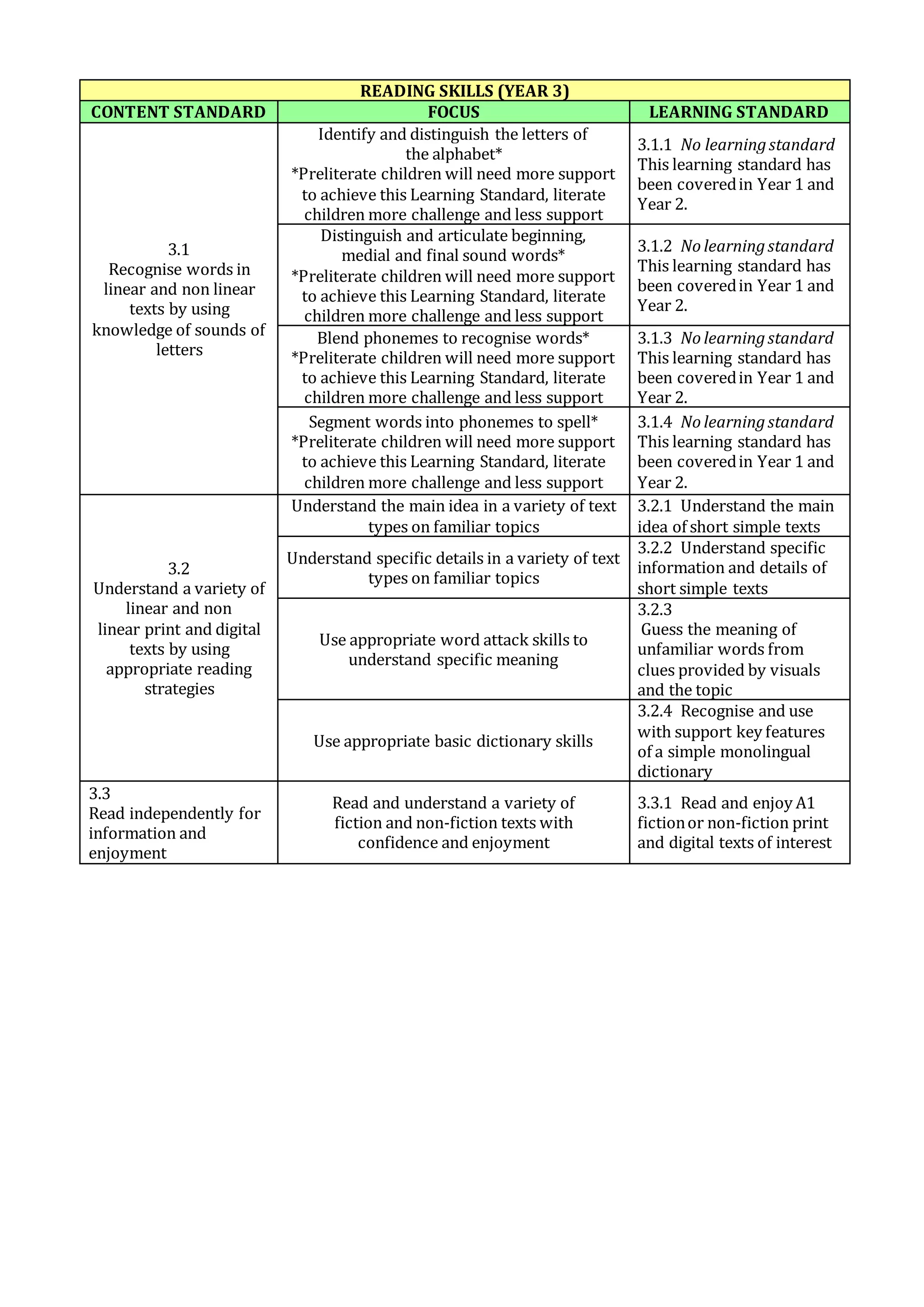
READING SKILLS (YEAR 3)
CONTENT STANDARD FOCUS LEARNING STANDARD
3.1
Recognise words in
linear and non linear
texts by using
knowledge of sounds of
letters
Identify and distinguish the letters of
the alphabet*
*Preliterate children will need more support
to achieve this Learning Standard, literate
children more challenge and less support
3.1.1 No learningstandard
This learning standard has
been coveredin Year 1 and
Year 2.
Distinguish and articulate beginning,
medial and final sound words*
*Preliterate children will need more support
to achieve this Learning Standard, literate
children more challenge and less support
3.1.2 No learningstandard
This learning standard has
been coveredin Year 1 and
Year 2.
Blend phonemes to recognise words*
*Preliterate children will need more support
to achieve this Learning Standard, literate
children more challenge and less support
3.1.3 No learningstandard
This learning standard has
been coveredin Year 1 and
Year 2.
Segment words into phonemes to spell*
*Preliterate children will need more support
to achieve this Learning Standard, literate
children more challenge and less support
3.1.4 No learningstandard
This learning standard has
been coveredin Year 1 and
Year 2.
3.2
Understand a variety of
linear and non
linear print and digital
texts by using
appropriate reading
strategies
Understand the main idea in a variety of text
types on familiar topics
3.2.1 Understand the main
idea of short simple texts
Understand specific details in a variety of text
types on familiar topics
3.2.2 Understand specific
information and details of
short simple texts
Use appropriate word attack skills to
understand specific meaning
3.2.3
Guess the meaning of
unfamiliar words from
clues provided by visuals
and the topic
Use appropriate basic dictionary skills
3.2.4 Recognise and use
with support key features
of a simple monolingual
dictionary
3.3
Read independently for
information and
enjoyment
Read and understand a variety of
fiction and non-fiction texts with
confidence and enjoyment
3.3.1 Read and enjoy A1
fictionor non-fiction print
and digital texts of interest
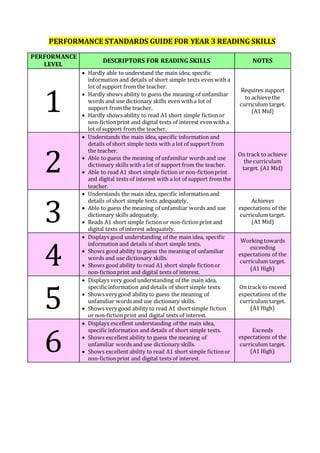
PERFORMANCE STANDARDS GUIDE FOR YEAR 3 READING SKILLS
PERFORMANCE
LEVEL
DESCRIPTORS FOR READING SKILLS NOTES
1
 Hardly able to understand the main idea, specific
information and details of short simple texts even with a
lot of support from the teacher.
 Hardly shows ability to guess the meaning of unfamiliar
words and use dictionary skills even witha lot of
support from the teacher.
 Hardly shows ability to read A1 short simple fictionor
non-fictionprint and digital texts of interest even with a
lot of support from the teacher.
Requires support
to achieve the
curriculum target.
(A1 Mid)
2
 Understands the main idea, specific information and
details of short simple texts with a lot of support from
the teacher.
 Able to guess the meaning of unfamiliar words and use
dictionary skills with a lot of support from the teacher.
 Able to read A1 short simple fiction or non-fictionprint
and digital texts of interest with a lot of support from the
teacher.
On track to achieve
the curriculum
target. (A1 Mid)
3
 Understands the main idea, specific information and
details of short simple texts adequately.
 Able to guess the meaning of unfamiliar words and use
dictionary skills adequately.
 Reads A1 short simple fictionor non-fictionprint and
digital texts of interest adequately.
Achieves
expectations of the
curriculum target.
(A1 Mid)
4
 Displays good understanding of the main idea, specific
information and details of short simple texts.
 Shows good ability to guess the meaning of unfamiliar
words and use dictionary skills.
 Shows good ability to read A1 short simple fictionor
non-fictionprint and digital texts of interest.
Working towards
exceeding
expectations of the
curriculum target.
(A1 High)
5
 Displays very good understanding of the main idea,
specific information and details of short simple texts.
 Shows very good ability to guess the meaning of
unfamiliar words and use dictionary skills.
 Shows very good ability to read A1 short simple fiction
or non-fictionprint and digital texts of interest.
On track to exceed
expectations of the
curriculum target.
(A1 High)
6
 Displays excellent understanding of the main idea,
specific information and details of short simple texts.
 Shows excellent ability to guess the meaning of
unfamiliar words and use dictionary skills.
 Shows excellent ability to read A1 short simple fictionor
non-fictionprint and digital texts of interest.
Exceeds
expectations of the
curriculum target.
(A1 High)
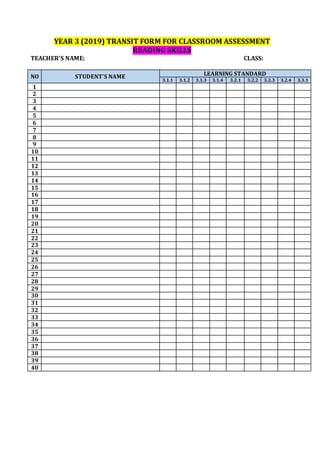
YEAR 3 (2019) TRANSIT FORM FOR CLASSROOM ASSESSMENT
READING SKILLS
TEACHER’S NAME: CLASS:
NO STUDENT’S NAME LEARNING STANDARD
3.1.1 3.1.2 3.1.3 3.1.4 3.2.1 3.2.2 3.2.3 3.2.4 3.3.1
1
2
3
4
5
6
7
8
9
10
11
12
13
14
15
16
17
18
19
20
21
22
23
24
25
26
27
28
29
30
31
32
33
34
35
36
37
38
39
40

Transit form reading skills y3 2019

  • 1.
    READING SKILLS (YEAR3) CONTENT STANDARD FOCUS LEARNING STANDARD 3.1 Recognise words in linear and non linear texts by using knowledge of sounds of letters Identify and distinguish the letters of the alphabet* *Preliterate children will need more support to achieve this Learning Standard, literate children more challenge and less support 3.1.1 No learningstandard This learning standard has been coveredin Year 1 and Year 2. Distinguish and articulate beginning, medial and final sound words* *Preliterate children will need more support to achieve this Learning Standard, literate children more challenge and less support 3.1.2 No learningstandard This learning standard has been coveredin Year 1 and Year 2. Blend phonemes to recognise words* *Preliterate children will need more support to achieve this Learning Standard, literate children more challenge and less support 3.1.3 No learningstandard This learning standard has been coveredin Year 1 and Year 2. Segment words into phonemes to spell* *Preliterate children will need more support to achieve this Learning Standard, literate children more challenge and less support 3.1.4 No learningstandard This learning standard has been coveredin Year 1 and Year 2. 3.2 Understand a variety of linear and non linear print and digital texts by using appropriate reading strategies Understand the main idea in a variety of text types on familiar topics 3.2.1 Understand the main idea of short simple texts Understand specific details in a variety of text types on familiar topics 3.2.2 Understand specific information and details of short simple texts Use appropriate word attack skills to understand specific meaning 3.2.3 Guess the meaning of unfamiliar words from clues provided by visuals and the topic Use appropriate basic dictionary skills 3.2.4 Recognise and use with support key features of a simple monolingual dictionary 3.3 Read independently for information and enjoyment Read and understand a variety of fiction and non-fiction texts with confidence and enjoyment 3.3.1 Read and enjoy A1 fictionor non-fiction print and digital texts of interest
  • 2.
    PERFORMANCE STANDARDS GUIDEFOR YEAR 3 READING SKILLS PERFORMANCE LEVEL DESCRIPTORS FOR READING SKILLS NOTES 1  Hardly able to understand the main idea, specific information and details of short simple texts even with a lot of support from the teacher.  Hardly shows ability to guess the meaning of unfamiliar words and use dictionary skills even witha lot of support from the teacher.  Hardly shows ability to read A1 short simple fictionor non-fictionprint and digital texts of interest even with a lot of support from the teacher. Requires support to achieve the curriculum target. (A1 Mid) 2  Understands the main idea, specific information and details of short simple texts with a lot of support from the teacher.  Able to guess the meaning of unfamiliar words and use dictionary skills with a lot of support from the teacher.  Able to read A1 short simple fiction or non-fictionprint and digital texts of interest with a lot of support from the teacher. On track to achieve the curriculum target. (A1 Mid) 3  Understands the main idea, specific information and details of short simple texts adequately.  Able to guess the meaning of unfamiliar words and use dictionary skills adequately.  Reads A1 short simple fictionor non-fictionprint and digital texts of interest adequately. Achieves expectations of the curriculum target. (A1 Mid) 4  Displays good understanding of the main idea, specific information and details of short simple texts.  Shows good ability to guess the meaning of unfamiliar words and use dictionary skills.  Shows good ability to read A1 short simple fictionor non-fictionprint and digital texts of interest. Working towards exceeding expectations of the curriculum target. (A1 High) 5  Displays very good understanding of the main idea, specific information and details of short simple texts.  Shows very good ability to guess the meaning of unfamiliar words and use dictionary skills.  Shows very good ability to read A1 short simple fiction or non-fictionprint and digital texts of interest. On track to exceed expectations of the curriculum target. (A1 High) 6  Displays excellent understanding of the main idea, specific information and details of short simple texts.  Shows excellent ability to guess the meaning of unfamiliar words and use dictionary skills.  Shows excellent ability to read A1 short simple fictionor non-fictionprint and digital texts of interest. Exceeds expectations of the curriculum target. (A1 High)
  • 3.
    YEAR 3 (2019)TRANSIT FORM FOR CLASSROOM ASSESSMENT READING SKILLS TEACHER’S NAME: CLASS: NO STUDENT’S NAME LEARNING STANDARD 3.1.1 3.1.2 3.1.3 3.1.4 3.2.1 3.2.2 3.2.3 3.2.4 3.3.1 1 2 3 4 5 6 7 8 9 10 11 12 13 14 15 16 17 18 19 20 21 22 23 24 25 26 27 28 29 30 31 32 33 34 35 36 37 38 39 40