By Group 3 Biobusters
TRANSGENIC
ANIMALS
CONTENTS
Definition of Transgenic Animals
History of Transgenic Animals
1
2
CONTENTS
Application of Transgenic Animals
Importance of Transgenic Animals
SHORT Q&A
1
2
3
LEARNING
OUTCOMES
• Describe the application of
transgenic animals
• Learn how did the transgenic
animals came to be.
Transgenic
Animals
DEFINITION
are the animals with the
modified genome. A
foreign gene is inserted
into the genome of the
animal to alter its DNA.
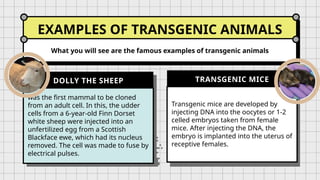
EXAMPLES OF TRANSGENIC ANIMALS
What you will see are the famous examples of transgenic animals
was the first mammal to be cloned
from an adult cell. In this, the udder
cells from a 6-year-old Finn Dorset
white sheep were injected into an
unfertilized egg from a Scottish
Blackface ewe, which had its nucleus
removed. The cell was made to fuse by
electrical pulses.
DOLLY THE SHEEP
Transgenic mice are developed by
injecting DNA into the oocytes or 1-2
celled embryos taken from female
mice. After injecting the DNA, the
embryo is implanted into the uterus of
receptive females.
TRANSGENIC MICE
HISTORY
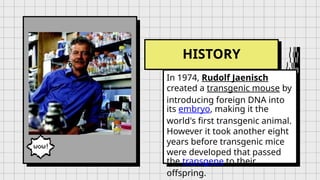
In 1974, Rudolf Jaenisch
created a transgenic mouse by
introducing foreign DNA into
its embryo, making it the
world's first transgenic animal.
However it took another eight
years before transgenic mice
were developed that passed
the transgene to their
offspring.
HISTORY
Genetically modified mice were
created in 1984 that carried cloned
oncogenes, predisposing them to
developing cancer. Mice with genes
knocked out (knockout mouse) were
created in 1989. The first transgenic
livestock were produced in 1985 and
the first animal to synthesise
transgenic proteins in their milk
were mice,engineered to produce
human tissue plasminogen activator
in 1987.
The first genetically modified animal to
be commercialised was the GloFish, a
Zebra fish with a fluorescent gene
added that allows it to glow in the dark
under ultraviolet light.It was released to
the US market in 2003.The first
genetically modified animal to be
approved for food use was
AquAdvantage salmon in 2015.The
salmon were transformed with a
growth hormone-regulating gene from
a Pacific Chinook salmon and a
promoter from an ocean pout enabling
it to grow year-round instead of only
HISTORY
APPLICATION
Such animals are most commonly created by the microinjection
of DNA into the pronuclei of a fertilised egg which is
subsequently implanted into the oviduct of a pseudopregnant
surrogate mother. This results in the recipient animal giving
birth to genetically modified offspring. The progeny are then
bred with other transgenic offspring to establish a transgenic
line. Transgenic animals can also be created by inserting DNA
into embryonic stem cells which are then micro-injected into an
embryo which has developed for five or six days after
fertilisation, or infecting an embryo with viruses that carry a
DNA of interest. This final method is commonly used to
manipulate a single gene, in most cases this involves removing
Transgenic animals are animals (most commonly
mice) that have had a foreign gene deliberately
inserted into their genome.
APPLICATION
Since the mid-1980s transgenic mice have become a key
model for investigating disease. Mice are the model of
choice not only because there is extensive analysis of its
completed genome sequence, but its genome is similar to
the human. Moreover, physiologic and behavioural tests
performed on mice can be extrapolated directly to human
disease. Robust and sophisticated techniques are also
easily available for the generic manipulation of mouse
cells and embryos. Another advantage of mice is the fact
that they have a short reproduction cycle. Other
transgenic species, such as pig, sheep and rats are also
used, but their use in pharmaceutical research has so far
been limited due to technical constraints. Recent
GENETIC
MODIFICATION
APPLICATION
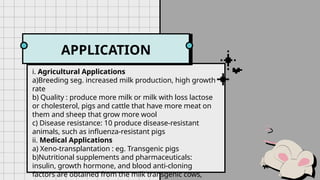
i. Agricultural Applications
a)Breeding seg. increased milk production, high growth
rate
b) Quality : produce more milk or milk with loss lactose
or cholesterol, pigs and cattle that have more meat on
them and sheep that grow more wool
c) Disease resistance: 10 produce disease-resistant
animals, such as influenza-resistant pigs
ii. Medical Applications
a) Xeno-transplantation : eg. Transgenic pigs
b)Nutritional supplements and pharmaceuticals:
insulin, growth hormone, and blood anti-cloning
factors are obtained from the milk transgenic cows,
IMPORTANCE OF TRANSGENIC
ANIMALS
GENETIC
MODIFICATION
IMPORTANCE
Transgenic animals are routinely used in the
laboratory as models in biomedical research.
Over 95 percent of those used are genetically
modified rodents, predominantly mice. They
are important tools for researching human
diseases, being used to understand gene
function in the context of disease susceptibility,
progression and to determine responses to a
GENETIC
MODIFICATION
IMPORTANCE
Mice have also been genetically modified to naturally produce
human antibodies for use as therapeutics. Seven out of the
eleven monoclonal antibody drugs approved by the FDA
between 2006 and 2011 were derived from transgenic
mice.Transgenic farm animals are being used to produce
complex human proteins for treating human diseases.
Currently, these proteins are produced in mammalian cell-
based reactors, but this is expensive. A cheaper alternative is
to produce recombinant proteins in transgenic animals' milk,
blood, or eggs. Only two biomedical products have received
regulatory approval: human antithrombin III and a
recombinant human C12 esterase inhibitorior. Both products
ARE U READYYYYY?
Q AND A
1.WHO CREATED THE TRANSGENIC MOUSE?
Q AND A
2.WHAT ARE THE TWO FAMOUS EXAMPLES OF TRANSGENIC
ANIMALS?
Q AND A
3. WHAT YEAR WAS THE TRANSGENIC MICE CREATED?
By Group 3 Biobusters
THANK YOU

tRANSGENIC ANIMALS.pptx Biotechnology 88

  • 1.
    By Group 3Biobusters TRANSGENIC ANIMALS
  • 2.
    CONTENTS Definition of TransgenicAnimals History of Transgenic Animals 1 2
  • 3.
    CONTENTS Application of TransgenicAnimals Importance of Transgenic Animals SHORT Q&A 1 2 3
  • 4.
    LEARNING OUTCOMES • Describe theapplication of transgenic animals • Learn how did the transgenic animals came to be.
  • 5.
    Transgenic Animals DEFINITION are the animalswith the modified genome. A foreign gene is inserted into the genome of the animal to alter its DNA.
  • 6.
    EXAMPLES OF TRANSGENICANIMALS What you will see are the famous examples of transgenic animals was the first mammal to be cloned from an adult cell. In this, the udder cells from a 6-year-old Finn Dorset white sheep were injected into an unfertilized egg from a Scottish Blackface ewe, which had its nucleus removed. The cell was made to fuse by electrical pulses. DOLLY THE SHEEP Transgenic mice are developed by injecting DNA into the oocytes or 1-2 celled embryos taken from female mice. After injecting the DNA, the embryo is implanted into the uterus of receptive females. TRANSGENIC MICE
  • 7.
    HISTORY In 1974, RudolfJaenisch created a transgenic mouse by introducing foreign DNA into its embryo, making it the world's first transgenic animal. However it took another eight years before transgenic mice were developed that passed the transgene to their offspring.
  • 8.
    HISTORY Genetically modified micewere created in 1984 that carried cloned oncogenes, predisposing them to developing cancer. Mice with genes knocked out (knockout mouse) were created in 1989. The first transgenic livestock were produced in 1985 and the first animal to synthesise transgenic proteins in their milk were mice,engineered to produce human tissue plasminogen activator in 1987.
  • 9.
    The first geneticallymodified animal to be commercialised was the GloFish, a Zebra fish with a fluorescent gene added that allows it to glow in the dark under ultraviolet light.It was released to the US market in 2003.The first genetically modified animal to be approved for food use was AquAdvantage salmon in 2015.The salmon were transformed with a growth hormone-regulating gene from a Pacific Chinook salmon and a promoter from an ocean pout enabling it to grow year-round instead of only HISTORY
  • 10.
    APPLICATION Such animals aremost commonly created by the microinjection of DNA into the pronuclei of a fertilised egg which is subsequently implanted into the oviduct of a pseudopregnant surrogate mother. This results in the recipient animal giving birth to genetically modified offspring. The progeny are then bred with other transgenic offspring to establish a transgenic line. Transgenic animals can also be created by inserting DNA into embryonic stem cells which are then micro-injected into an embryo which has developed for five or six days after fertilisation, or infecting an embryo with viruses that carry a DNA of interest. This final method is commonly used to manipulate a single gene, in most cases this involves removing Transgenic animals are animals (most commonly mice) that have had a foreign gene deliberately inserted into their genome.
  • 11.
    APPLICATION Since the mid-1980stransgenic mice have become a key model for investigating disease. Mice are the model of choice not only because there is extensive analysis of its completed genome sequence, but its genome is similar to the human. Moreover, physiologic and behavioural tests performed on mice can be extrapolated directly to human disease. Robust and sophisticated techniques are also easily available for the generic manipulation of mouse cells and embryos. Another advantage of mice is the fact that they have a short reproduction cycle. Other transgenic species, such as pig, sheep and rats are also used, but their use in pharmaceutical research has so far been limited due to technical constraints. Recent
  • 12.
    GENETIC MODIFICATION APPLICATION i. Agricultural Applications a)Breedingseg. increased milk production, high growth rate b) Quality : produce more milk or milk with loss lactose or cholesterol, pigs and cattle that have more meat on them and sheep that grow more wool c) Disease resistance: 10 produce disease-resistant animals, such as influenza-resistant pigs ii. Medical Applications a) Xeno-transplantation : eg. Transgenic pigs b)Nutritional supplements and pharmaceuticals: insulin, growth hormone, and blood anti-cloning factors are obtained from the milk transgenic cows,
  • 13.
  • 14.
    GENETIC MODIFICATION IMPORTANCE Transgenic animals areroutinely used in the laboratory as models in biomedical research. Over 95 percent of those used are genetically modified rodents, predominantly mice. They are important tools for researching human diseases, being used to understand gene function in the context of disease susceptibility, progression and to determine responses to a
  • 15.
    GENETIC MODIFICATION IMPORTANCE Mice have alsobeen genetically modified to naturally produce human antibodies for use as therapeutics. Seven out of the eleven monoclonal antibody drugs approved by the FDA between 2006 and 2011 were derived from transgenic mice.Transgenic farm animals are being used to produce complex human proteins for treating human diseases. Currently, these proteins are produced in mammalian cell- based reactors, but this is expensive. A cheaper alternative is to produce recombinant proteins in transgenic animals' milk, blood, or eggs. Only two biomedical products have received regulatory approval: human antithrombin III and a recombinant human C12 esterase inhibitorior. Both products
  • 16.
  • 17.
    Q AND A 1.WHOCREATED THE TRANSGENIC MOUSE?
  • 18.
    Q AND A 2.WHATARE THE TWO FAMOUS EXAMPLES OF TRANSGENIC ANIMALS?
  • 19.
    Q AND A 3.WHAT YEAR WAS THE TRANSGENIC MICE CREATED?
  • 20.
    By Group 3Biobusters THANK YOU