MOSTEMPLOYEESWANTDIGITALTRANSFORMATION.
91% 43%
IT’SNOTJUSTMILLENNIALSINTHETECHSECTOR. And spans all industries
WEASKEDEMPLOYEESABOUTTHE DIGITALMATURITYOFTHEIRORGANIZATION.
26% 45% 29%
CULTURE LEADERSHIP
Early Developing Maturing
CHALLENGESVARYDEPENDINGONTHESTAGEOFDIGITALADOPTION...
ANDSODOESTHELEVELOFEMPLOYEESATISFACTIONWITHDIGITALSTRATEGY.
STRATEGY,CULTURE,ANDLEADERSHIPCANMAKEDIGITALTRANSFORMATIONHAPPEN.
The time is now. Rethink the fundamentals of strategy, culture, and
leadership to help your organization transform with digital.
Improving
processes
Engaging talent,
organization-wide
It’s an organization, reimagined through digital that is:
Driving new
business models
believe digital technologies have
the potential to fundamentally
transform the way people in their
organization work.
are satisfied with their
organization’s current reaction
to digital trends.
BUTONLY
50%
100%
83% 85%
80% 81% 79% 76% 72%
WHATDOESADIGITALLYTRANSFORMEDBUSINESSLOOKLIKE?
0-21 22-27 28-35 36-44 45-52 53-59 60+
“It is important for me to work for an organization
that is digitally enabled or is a digital leader.”
Think long term, then
work backwards to develop
a clear strategy, focused
on transformation.
The digital agenda starts from
the top, based on possibilities
at the intersection of business
and technology.
Shift cultural mindsets to
increase collaboration and
encourage risk-taking.
“Digital technologies have the potential to fundamentally
transform the way people in our organization work.”
No sector with fewer than 85%
Lack of strategy
Too many priorities
Lack of management
understanding
10%
Percentage of respondents satisfied with their company’s reaction to digital trends
38% 81%
71% of early stage employees are not merely indifferent, they are dissatisfied.
STRATEGY
Professional Services
Telecommunications/communications
Manufacturing
IT and Technology
Healthcare Services
Government/Public Sector
Financial Services
Entertainment, Media and Publishing
Energy and Utilities
Education
Consumer Goods
95%
90%
88%
93%
96%
93%
90%
93%
86%
91%
95%
Respondents rated their organization on a scale of 1 to 10, based on its degree of digital transformation,
defined by: 1) process improvement, 2) talent engagement, and 3) business innovation.
1 2 3 4 5 6 7 8 9 10
TRANSFORMING
DIGITALENTERPRISE
It crosses age groups
Early (1-3) Maturing (7-10)Developing (4-6)
Early Maturing
Developing
1
2
3
Too many priorities
Security concerns
Insufficient tech skills
1
2
3
Lack of strategy
Too many priorities
Insufficient tech skills
1
2
3
Lorem ipsum dolor sit amet, tantas complectitur cu eum, accusam mednoluisse per. DUPRESS LOGO
TO READ THE FULL REPORT, VISIT SLOANREVIEW.MIT.EDU/DIGITAL2015.
Review, in collaboration with Deloitte*, conducted a fourth annual survey of more than 4,800 business executives, managers,
and analysts from organizations around the world.
*As used in this document, “Deloitte” means Deloitte Consulting LLP and Deloitte Services LP, which are separate subsidiaries of Deloitte LLP. Please see www.deloitte.com/us/about for a
detailed description of the legal structure of Deloitte LLP and its subsidiaries. Certain services may not available to attest clients under the rules and regulations of public accounting.
Respondents who answered “Strongly agree” or “Agree”Respondents who answered “Strongly agree” or “Agree”

Transforming the digital enterprise

  • 1.
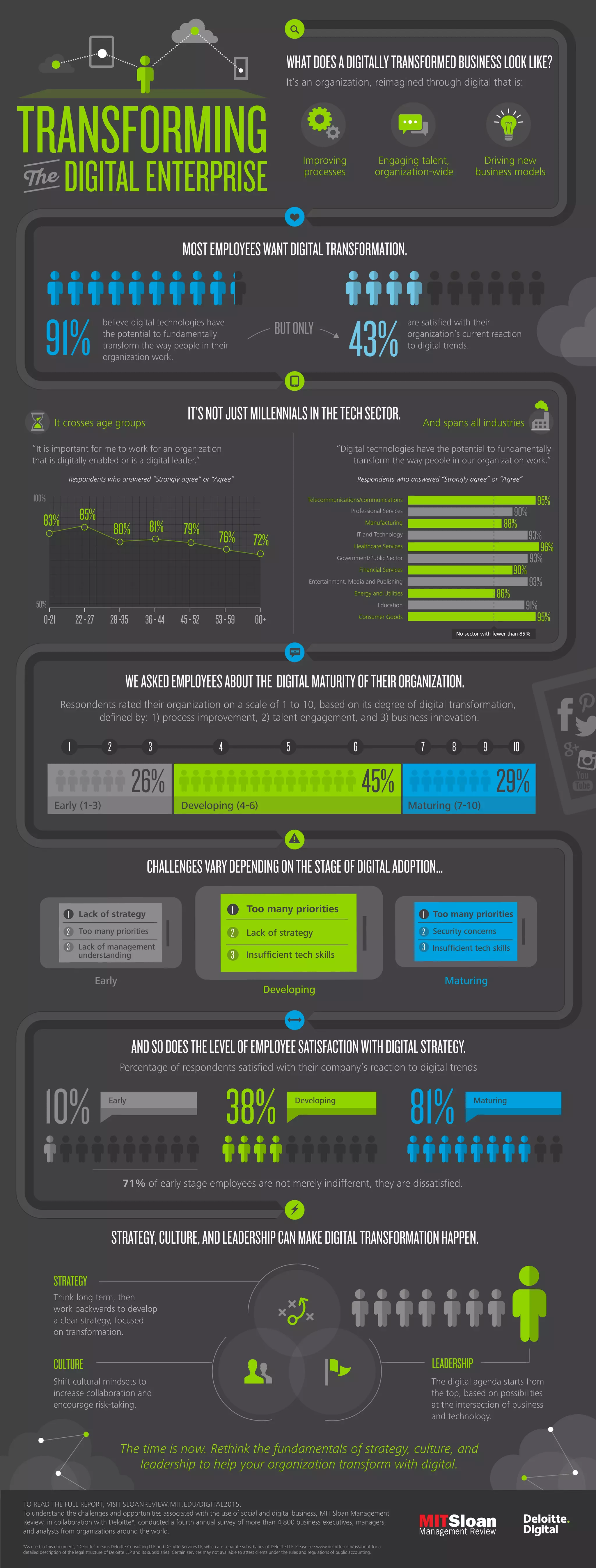
    MOSTEMPLOYEESWANTDIGITALTRANSFORMATION. 91% 43% IT’SNOTJUSTMILLENNIALSINTHETECHSECTOR. Andspans all industries WEASKEDEMPLOYEESABOUTTHE DIGITALMATURITYOFTHEIRORGANIZATION. 26% 45% 29% CULTURE LEADERSHIP Early Developing Maturing CHALLENGESVARYDEPENDINGONTHESTAGEOFDIGITALADOPTION... ANDSODOESTHELEVELOFEMPLOYEESATISFACTIONWITHDIGITALSTRATEGY. STRATEGY,CULTURE,ANDLEADERSHIPCANMAKEDIGITALTRANSFORMATIONHAPPEN. The time is now. Rethink the fundamentals of strategy, culture, and leadership to help your organization transform with digital. Improving processes Engaging talent, organization-wide It’s an organization, reimagined through digital that is: Driving new business models believe digital technologies have the potential to fundamentally transform the way people in their organization work. are satisfied with their organization’s current reaction to digital trends. BUTONLY 50% 100% 83% 85% 80% 81% 79% 76% 72% WHATDOESADIGITALLYTRANSFORMEDBUSINESSLOOKLIKE? 0-21 22-27 28-35 36-44 45-52 53-59 60+ “It is important for me to work for an organization that is digitally enabled or is a digital leader.” Think long term, then work backwards to develop a clear strategy, focused on transformation. The digital agenda starts from the top, based on possibilities at the intersection of business and technology. Shift cultural mindsets to increase collaboration and encourage risk-taking. “Digital technologies have the potential to fundamentally transform the way people in our organization work.” No sector with fewer than 85% Lack of strategy Too many priorities Lack of management understanding 10% Percentage of respondents satisfied with their company’s reaction to digital trends 38% 81% 71% of early stage employees are not merely indifferent, they are dissatisfied. STRATEGY Professional Services Telecommunications/communications Manufacturing IT and Technology Healthcare Services Government/Public Sector Financial Services Entertainment, Media and Publishing Energy and Utilities Education Consumer Goods 95% 90% 88% 93% 96% 93% 90% 93% 86% 91% 95% Respondents rated their organization on a scale of 1 to 10, based on its degree of digital transformation, defined by: 1) process improvement, 2) talent engagement, and 3) business innovation. 1 2 3 4 5 6 7 8 9 10 TRANSFORMING DIGITALENTERPRISE It crosses age groups Early (1-3) Maturing (7-10)Developing (4-6) Early Maturing Developing 1 2 3 Too many priorities Security concerns Insufficient tech skills 1 2 3 Lack of strategy Too many priorities Insufficient tech skills 1 2 3 Lorem ipsum dolor sit amet, tantas complectitur cu eum, accusam mednoluisse per. DUPRESS LOGO TO READ THE FULL REPORT, VISIT SLOANREVIEW.MIT.EDU/DIGITAL2015. Review, in collaboration with Deloitte*, conducted a fourth annual survey of more than 4,800 business executives, managers, and analysts from organizations around the world. *As used in this document, “Deloitte” means Deloitte Consulting LLP and Deloitte Services LP, which are separate subsidiaries of Deloitte LLP. Please see www.deloitte.com/us/about for a detailed description of the legal structure of Deloitte LLP and its subsidiaries. Certain services may not available to attest clients under the rules and regulations of public accounting. Respondents who answered “Strongly agree” or “Agree”Respondents who answered “Strongly agree” or “Agree”