McKinsey Global Institute


May 2011


Internet matters: The Net’s
sweeping impact on growth,
jobs, and prosperity
The McKinsey Global Institute
  The McKinsey Global Institute (MGI), established in 1990, is McKinsey &
  Company’s business and economics research arm.

  MGI’s mission is to help leaders in the commercial, public, and social sectors
  develop a deeper understanding of the evolution of the global economy and to
  provide a fact base that contributes to decision making on critical management
  and policy issues.

  MGI research combines two disciplines: economics and management.
  Economists often have limited access to the practical problems facing
  senior managers, while senior managers often lack the time and incentive
  to look beyond their own industry to the larger issues of the global economy.
  By integrating these perspectives, MGI is able to gain insights into the
  microeconomic underpinnings of the long-term macroeconomic trends
  affecting business strategy and policy making. For nearly two decades, MGI
  has utilized this “micro-to-macro” approach in research covering more than 20
  countries and 30 industry sectors.

  MGI’s current research agenda focuses on three broad areas: productivity,
  competitiveness, and growth; the evolution of global financial markets; and the
  economic impact of technology. Recent research has examined a program
  of reform to bolster growth and renewal in Europe and the United States
  through accelerated productivity growth; Africa’s economic potential; debt
  and deleveraging and the end of cheap capital; the impact of multinational
  companies on the US economy; technology-enabled business trends;
  urbanization in India and China; and the competitiveness of sectors and
  industrial policy.

  MGI is led by three McKinsey & Company directors: Richard Dobbs, James
  Manyika, and Charles Roxburgh. Susan Lund serves as MGI’s director of
  research. MGI project teams are led by a group of senior fellows and include
  consultants from McKinsey’s offices around the world. These teams draw on
  McKinsey’s global network of industry and management experts and partners.
  In addition, MGI works with leading economists, including Nobel laureates, who
  act as advisers to MGI projects.

  The partners of McKinsey & Company fund MGI’s research, which is not
  commissioned by any business, government, or other institution.

  Further information about MGI and copies of MGI’s published reports can be
  found at www.mckinsey.com/mgi.


Copyright © McKinsey & Company 2011
McKinsey Global Institute


May 2011


Internet matters: The Net’s
sweeping impact on growth,
jobs, and prosperity

Matthieu Pélissié du Rausas
James Manyika
Eric Hazan
Jacques Bughin
Michael Chui
Rémi Said
McKinsey Global Institute
Internet matters: The Net’s sweeping impact on growth, jobs, and prosperity


                 Preface


                 It has become obvious that the Internet is changing our lives—the way we work, shop,
                 search for information, communicate, and meet people. Two billion people are now
                 connected to the Internet, and this number is growing by 200 million each year. But
                 the magnitude of the economic impact of Internet-related activities is not obvious.
                 Indeed, debate rages about what transformational effect the Internet is having and
                 how best to harness its power for the common good. There are many studies on the
                 impact of IT or telecommunications but little analysis, to our knowledge, on the global
                 impact of the Internet on growth, jobs, and wealth creation. Does the Internet really
                 create wealth or just displace it? Does the Internet in fact favor just one or two types
                 of actors (e.g., big Internet companies and consumers) or all stakeholders? And how
                 large is the economic impact of the Internet in objective terms?

                 The mission of the McKinsey Global Institute (MGI), McKinsey & Company’s business
                 and economics research arm, is to help leaders in the commercial, public, and
                 social sectors to develop a deeper understanding of the evolution of the global
                 economy and to provide a fact base that contributes to decision making on critical
                 management topics. In that spirit, we publish this independent report and release it in
                 time for the e-G8 Forum in Paris in May. Our aim is to make a contribution to e-G8 and
                 G8 debates by providing data, statistical analyses, measures, and indicators about
                 the impact of the Internet, and contribute to the discussion about its current and
                 future impact to growth and prosperity, and how companies, sectors and countries
                 can fully capitalize its potential.

                 Our primary aim in this report is to estimate the magnitude of the impact of the
                 Internet on the world economy. We focus on 13 countries that account for more than
                 70 percent of global GDP. These countries are at different stages of development.
                 We include the G8 as well as South Korea and Sweden, because they have very
                 high Internet penetration, and the large, high-growth economies of Brazil, China,
                 and India. Our analysis offers a quantitative view of this topic and new insights,
                 from a holistic perspective that examines a range of players from enterprises and
                 consumers to companies that form part of the Internet supply chain and those that
                 leverage the technologies for their own business needs—companies that range
                 from large corporations in the United States to small and medium-sized businesses
                 in China. This study is by no means the final word on the Internet’s impact, given its
                 continuous evolution, as users, entrepreneurs, companies, and other organizations
                 find new uses and develop new innovations that capitalize on the power and reach of
                 the Internet, and as the Internet and its related technologies and devices continue to
                 advance.

                 However, there are some key insights that emerge from our research. This report
                 finds that the Internet has delivered substantial economic growth and created jobs
                 on a large scale. Internet maturity correlates with wealth creation, and we find that the
                 Internet is, and will remain over coming decades, one of the biggest drivers of global
                 economic growth.
vi


     To measure the impact of the Internet on the economy, we looked at both
     expenditures and supply, following three original, quantitative, and complementary
     approaches:

     ƒ A macroeconomic approach using national accounts to calculate the contribution
       of GDP via a classical macroeconomic spending approach, where the
       Internet economy is simply the sum of Internet consumption (service, access,
       e-commerce, etc.), private investment, public expenditure, and the trade balance
       in Internetrelated goods and services

     ƒ A statistical econometric approach analyzing the correlation between Internet
       maturity and a country’s GDP per capita growth, leveraging the theory of
       endogenous economic growth

     ƒ A microeconomic approach, analyzing the results of a survey of 4,800 small and
       medium-sized businesses in 12 countries we studied

     We believe that it is important to understand the Internet better and to monitor its
     progress. For now, we propose an initial set of four key indicators to measure both
     consumption and supply but, in an “open-source” spirit, we welcome suggestions for
     more and improved metrics that we might use to analyze the impact of the Internet—
     and even criticism and rebuttal of the approach we have taken. We propose to
     publish an annual summary of the debates that we hope our work will spark.

     This report leverages MGI’s “micro-based macro” approach that draws from
     McKinsey’s work with its clients, practice research on technology, and more than
     ten years of MGI research on technology trends and on the impact of technology
     on business and the economy published in more than ten reports, including US
     productivity growth, 1995–2000 (October 2001); How IT enables productivity
     growth (October 2002); Reaching higher productivity growth in France and Germany
     (October 2002); Beyond austerity: A path to economic growth and renewal in Europe
     (October 2010); Growth and competitiveness in the United States: The role of its
     multinational companies (June 2010); and Big data: The next frontier for innovation,
     competition, and productivity (May 2011).

     This project was led by Matthieu Pélissié du Rausas, a director in Paris; James
     Manyika, a director in San Francisco, and Director of MGI, Eric Hazan, a principal
     in Paris, Jacques Bughin, a director in Brussels. Rémi Said managed the project
     team of Vincent Luciani and Yves Matton. The team also worked closely with Eric
     Labaye, a director in Paris and chair of MGI, Michael Chui, MGI senior fellow, and
     Patrice Navarre, an associate principal in Paris. We are grateful for the vital input and
     support of numerous McKinsey colleagues around the world, including Adam Bird,
     Endre Holen, and Jurgen Meffert, all three directors and leaders of McKinsey’s Global
     Technology, Media, and Telecom Practice.
McKinsey Global Institute
Internet matters: The Net’s sweeping impact on growth, jobs, and prosperity


                Distinguished experts outside McKinsey reviewed our work and provided invaluable
                insights and advice. We should particularly thank our academic advisers Martin N.
                Baily, Schwartz Chair and senior fellow of the Brookings Institution and former chair
                of the US President’s Council of Economic Advisers; and Christian Saint-Etienne,
                professor of business economics at the Conservatoire National des Arts et Métiers
                in Paris and member of the Conseil d’Analyse Economique, reporting to the French
                Prime Minister.


                M. Pélissié du Rausas
                Director, Paris

                J. Manyika
                Director, San Francisco
                Director, McKinsey Global Institute

                J. Bughin
                Director, Brussels

                E. Hazan
                Principal, Paris

                E. Labaye
                Director, Paris
                Chairman, McKinsey Global Institute


                May 2011
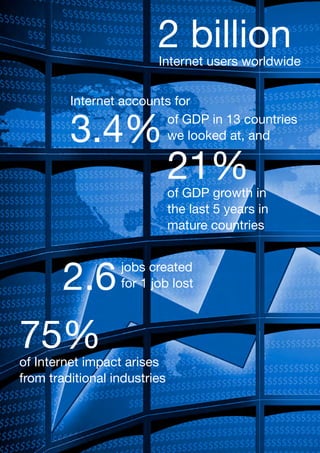
2 billion
                         Internet users worldwide


         Internet accounts for

         3.4%            of GDP in 13 countries
                         we looked at, and


                              21%
                              of GDP growth in
                              the last 5 years in
                              mature countries


       2.6        jobs created
                  for 1 job lost


75%
of Internet impact arises
from traditional industries
10%
                increase in productivity for
                small and medium businesses
                from Internet usage


    Small and medium businesses heavily
    using Web technologies grow and
    export
          2x      as much as others


Up to

€20       per Internet user
          per month of
          consumer surplus
McKinsey Global Institute
Internet matters: The Net’s sweeping impact on growth, jobs, and prosperity


                 Contents


                 Executive summary                                                                   1


                 Introduction                                                                        7


                 1. The Internet is contributing strongly to wealth                                  9

                    1.1. How we define Internet-related activities                                  10

                    1.2. Internet consumption and expenditure contributes significantly to
                         the economy                                                                11

                    1.3. While countries with a high Internet contribution to GDP tend to have
                         a strong Internet supply ecosystem, the Internet supply landscape
                         offers contrasts                                                           24

                    1.4. Public and private should focus on four critical areas to build a strong
                         supply ecosystem                                                           28


                 2. Leveraging the Internet to revive the engine of growth                          33

                    2.1. Public decision makers should act as catalysts to unleash the
                         Internet’s growth potential                                                33

                    2.2. All business leaders, not just e-CEOs, should put the Internet at the
                         top of their strategic agenda                                              36

                    2.3. All stakeholders should take part in a continuous and fact-based
                         public-private dialogue                                                    38


                 3. Monitoring the progress of the Internet using four critical indicators          39

                    3.1 The consumption indicators                                                  39

                    3.2 The supply indicators                                                       40


                 Conclusion                                                                         41


                 Postscript
                 by Martin N. Baily and Christian Saint-Etienne                                     42


                 Appendix: Methodology and approach specifics                                       45


                 Bibliography                                                                       55
McKinsey Global Institute
Internet matters: The Net’s sweeping impact on growth, jobs, and prosperity                                      1


                 Executive summary


                 Two billion people are connected to the Internet. Almost $8 trillion exchange hands
                 each year through e-commerce. In some developed markets, about two-thirds of all
                 businesses have a Web presence of some kind, and one-third of small and medium-
                 sized businesses extensively use Web technologies.1 The Internet has transformed
                 the way we live, the way we work, the way we socialize and meet, and the way our
                 countries develop and grow. In two decades, the Internet has changed from a
                 network for researchers and geeks to a day-to-day reality for billions of people. Our
                 research sheds new light on this revolution and helps explain the direct link between
                 the Internet and economic vitality.

                 Many have compared the dawn of the Internet to another communications game
                 changer, the introduction of the Gutenberg press five centuries earlier. But a
                 comparison with the development and commercialization of electric power may be
                 more appropriate.2 Among its many other consequences, electricity changed the
                 landscape of cities around the world, allowing elevators that can travel great heights
                 and heralding the dawn of massive skyscrapers. As with electricity, the Internet
                 has changed the global landscape. The Internet bridges vast distances and has
                 made the world flatter by allowing instant access to an almost endless stream of
                 information that can be immediately brought into play. Its impact on economic wealth
                 reaches well beyond pure players in the industry. Indeed, the brunt of its economic
                 contribution derives from established industries that, in the shadow of the Internet,
                 have become more productive, have created more jobs, have increased standards of
                 living, and have contributed more to real growth. Our research shows that more than
                 75 percent of the value added created by the Internet is in traditional industries.

                 Also, as with electricity, the Internet has influenced every corner of the world, not
                 just those countries that pushed its original development or were instrumental in its
                 growth. As Internet usage spreads to even the most remote communities—where
                 gas-powered generators and satellite links make the connection—its observable
                 positive effects grow. As evidence, the United Nations in its Millennium Development
                 Goals lists Internet penetration as a key metric in efforts to reduce poverty and
                 encourage rational development.

                 Yet despite its ubiquity, little is known about how much value the Internet contributes
                 to national economies. To help fill this gap, McKinsey has conducted extensive
                 research on the contribution of the Internet to GDP and economic growth in the G8
                 economies and five other key countries at various levels of development: Brazil,
                 China, India, South Korea, and Sweden.


                 1   The sources for these statistics are the World Bank, 2009; Gartner, 2010; Eurostat, 2010;
                     and a McKinsey & Company Internet survey of more than 4,800 small and medium-sized
                     enterprises.
                 2   Nicholas Carr, The big switch: Rewiring the world, from Edison to Google, New York: W.W.
                     Norton & Company, 2009.
2


    The study, drawn from public sources and targeted surveys, examines the Internet
    ecosystem, how it is being framed, and who is doing the framing. For the first time,
    we believe, this work offers a quantitative assessment of the impact of the Internet
    on GDP and growth while also considering the most relevant tools governments and
    businesses can use to get the most benefit from the Internet.


    THE INTERNET IS CONTRIBUTING STRONGLY TO WEALTH
    The Internet embraces all of us: businesses, individuals, governments, and
    entrepreneurs. The Web has made possible new waves of business models and
    entrepreneurship but has also led to radical innovations for accessing, using, and
    delivering goods and services for everyone. It has transformed industries and
    governments through innovative approaches and changed how users engage the
    world.

    The Internet is already a significant contributor to the economies of the 13 countries
    we studied—economies that account for more than 70 percent of global GDP—
    exerting a strong influence on economic growth rates particularly in mature
    economies.

    To measure the Internet’s impact on a country’s economy and to understand how
    the Internet is framed worldwide, we structured the analysis around its two primary
    components: consumption and expenditure on one hand, and supply on the other.

    Internet consumption and expenditure contributes significantly to the
    economy
    Looking at Internet-related usage through expenditure and consumption first, we see:

    ƒ The Internet is big and continues to grow and reach everywhere. The
      Internet is now used in every country, in every sector, in most companies, and by
      more than 2bn people and it is still growing. Internet-related consumption and
      expenditure is now bigger than agriculture or energy, and our research shows that
      the Internet accounts for, on average, 3.4 percent of GDP in the 13 countries we
      studied. If Internet consumption and expenditure were a sector, its weight in GDP
      would be bigger than energy, agriculture, or several other critical industries. The
      Internet’s total contribution to the GDP is bigger than the GDP of Spain or Canada,
      and it is growing faster than Brazil.

    ƒ The Internet is still in its infancy, and the weight of the Internet in GDP varies
      drastically, even among countries at the same stage of development. While
      the Internet accounts for around 6 percent of GDP in advanced countries such as
      Sweden and the United Kingdom, in 9 out of the 13 countries its contribution is
      below 4 percent, leaving tremendous room for further Internet development.

    ƒ The Internet is a critical element of growth. Both our macroeconomic
      approach and our statistical approach show that, in the mature countries we
      studied, the Internet accounted for 10 percent of GDP growth over the past
      15 years. And its influence is expanding. Over the past five years, the Internet’s
      contribution to GDP growth in these countries doubled to 21 percent. If we look
      at all 13 countries in our analysis, the Internet contributed 7 percent of growth
      over the past 15 years and 11 percent over the past five. This is a reflection of
      small and medium-sized enterprises (SMEs) receiving a performance boost from
      the Internet. As part of our research, we surveyed more than 4,800 SMEs in the
McKinsey Global Institute
Internet matters: The Net’s sweeping impact on growth, jobs, and prosperity                                         3


                    countries we studied.3 We found that those with a strong Web presence grew
                    more than twice as quickly as those that had minimal or no presence, an outcome
                    that holds across sectors. In addition, SMEs that took advantage of the Internet
                    reported the share of total revenues that they earned from exports was more than
                    twice as large as that reported by others. They also created more than twice the
                    number of jobs as others.

                ƒ The maturity of the Internet correlates with rising living standards.
                  Leveraging endogenous economic growth theory, we have been able to show
                  that Internet maturity correlates with growth in per capita GDP. Using the results
                  of the correlation, a simulation shows that an increase in Internet maturity similar
                  to the one experienced in mature countries over the past 15 years creates an
                  increase in real GDP per capita of $500 on average during this period. It took the
                  Industrial Revolution of the 19th century 50 years to achieve same results.4 This
                  shows both the magnitude of the positive impact of the Web at all levels of society
                  and the speed at which it delivers benefits.

                ƒ The Internet is a powerful catalyst for job creation. Some jobs have been
                  destroyed by the emergence of the Internet. However, a detailed analysis of the
                  French economy showed that while the Internet has destroyed 500,000 jobs
                  over the past 15 years, it has created 1.2 million others, a net addition of 700,000
                  jobs or 2.4 jobs created for every job destroyed. This conclusion is supported by
                  McKinsey’s global SME survey, which found 2.6 jobs were created for every one
                  destroyed.

                ƒ The Internet drives economic modernization. The Internet’s main impact
                  is through the modernization of traditional activities. Although the Internet has
                  resulted in significant value shifts between sectors in the global economy, our
                  research demonstrates that all industries have benefited from the Web. Indeed, in
                  McKinsey’s global SME survey, we found that 75 percent of the economic impact
                  of the Internet arises from traditional companies that don’t define themselves as
                  pure Internet players. The businesses that have seen the greatest value creation
                  have benefits from innovation leading to higher productivity triggered by the
                  Internet.

                ƒ The impact of the Internet goes beyond GDP, generating astonishing
                  consumer surplus. Beyond its impact on GDP, the Internet creates substantial
                  value for users, ranging from €13 ($18) a month per user in Germany to €20 ($28)
                  in the United Kingdom.5 In total, the consumer surplus generated by the Internet in
                  2009 ranged from €7 billion ($10 billion) in France to €46 billion ($64 billion) in the
                  United States.


                3   Excluding Brazil.
                4   See Angus Maddison, The World Economy: Historical Statistics, Paris: OECD, 2003.
                5   Internet Advertising Board, Assessing the consumer benefits of online advertising, July 2010.
4


    The rapidly shifting supply side offers some contrasts
    Looking at the “supply” of the Internet globally, we find that countries with a strong
    Internet ecosystem also have a high Internet contribution to GDP. However, the global
    Internet landscape is shifting rapidly and offers some interesting contrasts:

    ƒ The United States leads the global Internet supply ecosystem. The United
      States captures more than 30 percent of global Internet revenues and more
      than 40 percent of net income. Using a proprietary model, the McKinsey Internet
      Supply Leadership Index, we show that the United States remains the largest
      player in the Internet supply ecosystem. It is the country with the most diverse
      structure within the global ecosystem among the 13 we analyzed in this research,
      garnering relatively equal contributions from hardware, software and services,
      and telecommunications.

    ƒ The United Kingdom and Sweden are changing the game. These two
      countries have leveraged very strong Internet usage across the board to gain
      greater importance within the global Internet ecosystem. This move is helped by
      the strength and strong performance of their telecom operators.

    ƒ India and China are strengthening their position in the global Internet
      ecosystem rapidly. Both countries show growth rates of more than 20 percent.

    ƒ France, Canada, and Germany have strong Internet usage. All three could
      leverage this usage to increase their presence in the global supply ecosystem.

    ƒ South Korea is rapidly accelerating its influence on the Internet economy at a
      faster rate than Japan.

    ƒ Brazil, Russia, and Italy are in the early stages of Internet supply. They all
      have strong potential for growth.

    Only strong Internet ecosystems can capture maximum value. We find that to build a
    strong ecosystem, the best performers focus their efforts on four critical areas:

    ƒ Promote human capital. The United States in particular has used its vast talent
      pool effectively compared to other countries. Its relative attractiveness to talent
      with the right skills has been critical in the creation of a strong Internet ecosystem,
      and this human capital has been nurtured in universities, corporate research and
      development centers, startups and elsewhere. However, the US will increasingly
      compete for such talent with other countries.

    ƒ Ease access to financial capital. The United States, Israel, and South Korea
      have all ensured sufficient financial capital is available and the mechanism for
      capital formation in place to nurture innovation and support entrepreneurial
      resolve.

    ƒ Develop infrastructure. Infrastructure, the backbone of the entire Internet
      ecosystem, is an irreplaceable prerequisite. It creates the platforms upon which
      users, and organizations experience the Internet, and upon which entrepreneurs
      and businesses innovate.
McKinsey Global Institute
Internet matters: The Net’s sweeping impact on growth, jobs, and prosperity                              5


                ƒ Create an attractive business environment. The context in which business
                  operates is critical to the growth of the Internet ecosystem and will hold
                  back its growth if the environment does not encourage expansion of usage,
                  encouragement of innovation, and business investment and participation.
                  To ensure such an attractive environment requires ongoing assessment of
                  the frameworks that govern access, usage, protection of various rights, and
                  considerations of security.


                LEVERAGING THE INTERNET TO REVIVE THE ENGINE OF
                GROWTH
                Armed with a better understanding of how—and how much—the Internet contributes
                to national economies, policy makers and business executives can focus their efforts
                more acutely and effectively to promote and strengthen their domestic Internet
                ecosystems. In particular, they should consider the following immediate practical
                steps:

                ƒ Public decision makers should act as catalysts to unleash the Internet’s
                  growth potential. Governments could leverage Internet public spending as a
                  catalyst for innovation. Indeed, countries with the highest public investment in the
                  Internet are also those with the largest nonpublic Internet contribution to GDP.
                  Governments’ own use of the Internet encourages citizens to use it. Government
                  e-transformation creates large-scale, complex demand that stimulates the supply
                  ecosystem. In addition, governments must promote Internet usage by informing
                  and training businesses and individuals.

                ƒ All business leaders, not just e-CEOs, should put the Internet at the top of
                  their strategic agenda. Business leaders must optimize the benefits gleaned
                  from the Internet through innovation and change. . It is no longer a choice, given
                  that many businesses face competitors who capitalize on the power of the
                  Internet to innovate business models. Business leaders should play a significant
                  role in the spread of the Internet and systematically review how the Internet allows
                  them to innovate more aggressively and even reinvent their business models to
                  boost growth, performance, and productivity. In particular, businesses should
                  constantly try to identify up-and-coming Internet trends that have the potential to
                  increase the impact of their efforts—e.g., by applying statistical analyses to the
                  mass of data available from the Internet or using IT-enabled services to improve
                  production capabilities.

                ƒ All stakeholders should take part in a fact-based, public-private dialogue
                  to assure optimal conditions for the development of the Internet ecosystem
                  within each country, as well as internationally. Open discussions between
                  government and business leaders should work toward creating a nurturing
                  environment in which the benefits of the Internet can be better understood and the
                  Internet ecosystem can grow. Issues such as standards for digital identities and
                  intellectual property protection must be addressed as countries strive to stimulate
                  usage, while topics relevant to improving the supply ecosystem include net
                  neutrality, the availability of talent, and the overall business environment.
6


    MONITORING THE PROGRESS OF THE INTERNET USING FOUR
    CRITICAL INDICATORS
    Behind our analysis and recommendations are four indicators to measure the
    impact and evolution of the Internet in individual countries. Two, the “e3” index
    and the “iGDP,” focus on Internet expenditures and consumption. The other
    two, the McKinsey Internet Supply Leadership Index and the i4F indicator, track
    supply trends. Our aim is to improve and track them yearly and to review the global
    economy’s progress toward reaping optimal economic benefits from the Internet.
    Also, as we know that our indicators are still imperfect, we encourage “open-source”
    improvements to our methodology. We’ve made public the details and welcome any
    suggestions for refining our approach.
McKinsey Global Institute
Internet matters: The Net’s sweeping impact on growth, jobs, and prosperity                              7


                 Introduction


                 The Internet seems to be everywhere around us today. Yet the extent of its economic
                 impact has been relatively unclear. Much of the economic impact of the Internet
                 and the way that it contributes to growth and raising standards of living have gone
                 unmeasured.

                 New McKinsey research has shown that the Internet not only delivers value to
                 companies and users, it delivers astonishing value to national economies. Using
                 an approach based on Internet-enabled consumption patterns by individuals,
                 businesses, and governments, we found that in a broad range of countries the
                 Internet contributes more to GDP than agriculture, energy, and several other
                 traditional sectors do. In addition, it is a critical component of economic growth,
                 especially in countries that embrace its utility and encourage usage at all levels.

                 In our study, we examined the impact of the Internet on 13 countries, accounting for
                 more than 70 percent of global GDP: the members of the G8; Brazil, China, and India,
                 as representative of emerging markets; and South Korea and Sweden, as countries
                 with the most advanced broadband penetration. In addition to looking at economic
                 impact, we developed the McKinsey Internet Supply Leadership Index and other
                 indexes, which we calculated for each country to understand who is structuring the
                 Internet’s international landscape. The results showed economic value from the
                 Internet beyond what most observers –even staunch Internet supporters–might
                 suspect.

                 Our findings build on and go beyond earlier studies that have generally focused on
                 one piece of the overall puzzle, for example productivity gains linked to information
                 technologies. Our research quantifies the importance of the Internet to national
                 economies. We also expose national differences in the Internet’s impact and
                 consider how governments should work toward building a stronger ecosystem, such
                 as seeking ways to maximize Internet usage by individuals, businesses, and the
                 government itself. Developing a strong Internet ecosystem requires harnessing the
                 public’s natural demand to attract talent and resources to the industry, building the
                 necessary infrastructure, and creating an attractive business environment.

                 The Internet has become a significant and essential factor in national economies
                 and, indeed, the global economy itself. As countries continue to navigate the
                 aftermath of the global economic crisis, they must not lose sight of longer-term
                 imperatives that could safeguard their economic health. Among other economic
                 benefits, the Internet offers increased productivity, opportunities to expand reach
                 into domestic and foreign markets, the means for radical product development, and
                 the rapid deployment of game-changing ideas. Public leaders and executives who
                 underestimate its contribution may be ignoring one of the strongest tools at their
                 disposal.
McKinsey Global Institute
Internet matters: The Net’s sweeping impact on growth, jobs, and prosperity                               9


                 1. The Internet is contributing strongly
                 to wealth


                 The Internet has clearly grown to dazzling proportions since the 1990s, when
                 computer networks developed by governments, businesses, and academia began
                 to catch the public eye. Today, about 2.0 billion users worldwide, almost a third of
                 the global population, connect to the Internet every day. Almost $8 trillion a year is
                 spent through e-commerce (both business to business and business to consumer).
                 In the European Union, about two-thirds of all businesses have a Web presence.
                 Individuals, businesses, and governments have all been forever changed by the
                 Internet.

                 ƒ Companies keep costs down in many ways, including tapping into a broader
                   range of suppliers for their needs and optimizing myriad processes. They have
                   also changed the way they target customers: online marketing represents
                   15 percent of total marketing spending.6 Companies are also able to bring their
                   goods and services to markets around the world much more easily. The Internet
                   has also enabled a new wave of business models and made possible a new type
                   of entrepreneurship. For instance, in the United States, Internet-specific venture
                   capital deals represent around 20 percent of total deals in terms of both numbers
                   and investments.

                 ƒ Individuals derive countless benefits. They compare prices. In France, the United
                   States, and Germany, 40 percent of Internet users visit a price comparison Web
                   site every month. They search for hard-to-find items or information (total search
                   requests totaled more than 1 trillion in 2009).7 They communicate and play without
                   leaving their keyboards as new means of communication replace traditional
                   ones. While landline and mobile voice share of the communications portfolio
                   decreased by 7 percent between 2008 and 2010, Internet users spent 11 percent
                   more time using social networking Web sites. They now spend as much time on
                   social network Web sites as they do writing e-mails. The way people learn is also
                   changing. Online video classes have allowed teachers to remove the one-size-
                   fits-all lecture from the classroom, enabling students to learn at their own pace
                   with online content and using class time for exercises and interactive activities.
                   The Internet also allows teachers to follow each student individually and spot
                   difficulties more quickly.

                 ƒ Governments can serve citizens much more quickly and at a much lower cost
                   with the development of e-government services such as online tax services or
                   e-visas. In addition, a variety of government services can be delivered more cost
                   effectively, and faster leveraging the Internet, examples range from public health
                   and safety information to the renewal of driver’s licenses.


                 6   MagnaGlobal, Global Ad spend by channel (including mobile), 2000–2016, 2010.
                 7   Comscore annual release, 2010.
10


     The Internet embraces us all, and yet nobody has really measured its economic
     impact. The results of our study show that the Internet is already a significant
     contributor to the economies of the 13 countries we studied. In addition to its intrinsic
     weight in terms of GDP share, the Internet exerts a strong influence on economic
     dynamics—especially in the more mature countries—through its impact on growth,
     increased standards of living, and job creation. Moreover, beyond this direct
     contribution, the Internet has become a key contributor to the prosperity of nations
     through its indirect effects on traditional economy thanks to the productivity gains it
     offers to economic agents in all industries and all sectors, both private and public.


     1.1. How we define Internet-related activities
     The scope of our study includes all the activities linked to both the creation and
     usage of Internet networks as well as Internet services. Four types of activities are
     covered, and for each of those, we took the value of those activities, pro rata of their
     utilization of the Internet (see methodological appendix for more details):

     ƒ Web activities using Web as a support (e.g., e-commerce, content, online
       advertising)

     ƒ Telecommunication on IP or linked to IP communication (mainly Internet service
       providers)

     ƒ Software and services activities linked to Web (e.g., IT consulting, software
       development)

     ƒ Hardware manufacturers or maintenance providers of Web-specific tools (e.g.,
       computers, smartphones, hardware equipment, servers used for the Internet)

     Internet-related activities as we define them correspond to the totality of Internet
     activities (e.g., e-commerce) and to a portion of the information and communication
     technologies (ICT) sector delineated by activities, technologies, and services linked
     to the Web. This definition likely underestimates the full impact of the Internet, but has
     the benefit of providing a consistent definition that allows for direct analysis across
     multiple economies. Future research will be required to more fully account for the
     impact.

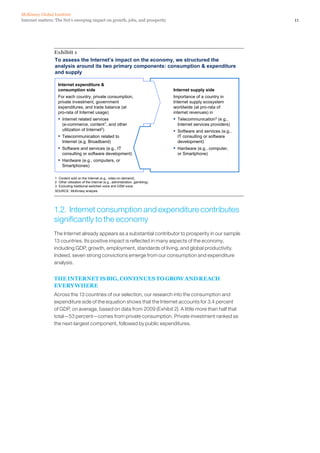
     To measure the Internet’s impact on a country economy and to understand how
     the Internet is framed worldwide, we structured the analysis around two parts:
     consumption and expenditure on one hand and supply on the other (Exhibit 1).

     On the expenditure and consumption side, we focused on usage by companies,
     governments, and individuals of the four types of activities mentioned previously.
     Using this approach, we are able to measure the impact of the Internet on the
     economy on all types of actors, including nonpure Internet players using Web
     technologies and deriving benefits from it.

     On the supply side, we focused on industries that are structuring and enabling
     the Internet worldwide. These are grouped as telecommunications, hardware
     manufacturers or maintenance providers, software, and services.8


     8   For telecommunications, excluding traditional switched voice and GSM (Global System for
         Mobile Communications) voice.
McKinsey Global Institute
Internet matters: The Net’s sweeping impact on growth, jobs, and prosperity                                                 11


                Exhibit 1
                To assess the Internet’s impact on the economy, we structured the
                analysis around its two primary components: consumption & expenditure
                and supply

                   Internet expenditure &
                   consumption side                                                      Internet supply side
                   For each country, private consumption,                                Importance of a country in
                   private investment, government                                        Internet supply ecosystem
                   expenditures, and trade balance (at                                   worldwide (at pro-rata of
                   pro-rata of Internet usage)                                           internet revenues) in
                   ▪   Internet related services                                         ▪   Telecommunication3 (e.g.,
                       (e-commerce, content1, and other                                      Internet services providers)
                       utilization of Internet2)                                         ▪   Software and services (e.g.,
                   ▪   Telecommunication related to                                          IT consulting or software
                       Internet (e.g. Broadband)                                             development)
                   ▪   Software and services (e.g., IT                                   ▪   Hardware (e.g., computer,
                       consulting or software development)                                   or Smartphone)
                   ▪   Hardware (e.g., computers, or
                       Smartphones)

                 1 Content sold on the Internet (e.g., video on demand).
                 2 Other utilization of the Internet (e.g., administration, gambling).
                 3 Excluding traditional switched voice and GSM voice.
                 SOURCE: McKinsey analysis


                1.2. Internet consumption and expenditure contributes
                significantly to the economy
                The Internet already appears as a substantial contributor to prosperity in our sample
                13 countries. Its positive impact is reflected in many aspects of the economy,
                including GDP, growth, employment, standards of living, and global productivity.
                Indeed, seven strong convictions emerge from our consumption and expenditure
                analysis.


                THE INTERNET IS BIG, CONTINUES TO GROW AND REACH
                EVERYWHERE
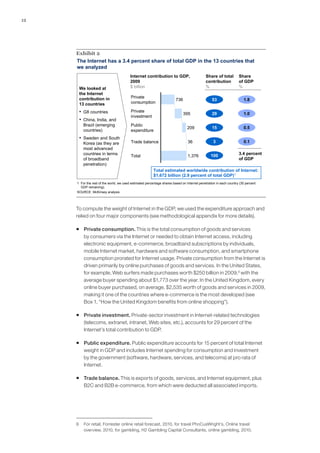
                Across the 13 countries of our selection, our research into the consumption and
                expenditure side of the equation shows that the Internet accounts for 3.4 percent
                of GDP, on average, based on data from 2009 (Exhibit 2). A little more than half that
                total—53 percent—comes from private consumption. Private investment ranked as
                the next-largest component, followed by public expenditures.
12


     Exhibit 2
     The Internet has a 3.4 percent share of total GDP in the 13 countries that
     we analyzed
                                         Internet contribution to GDP,                      Share of total         Share
                                         2009                                               contribution           of GDP
         We looked at                    $ billion                                          %                      %
         the Internet
         contribution in                 Private
                                                                        736                      53                   1.8
         13 countries                    consumption

         ▪   G8 countries                Private
                                                                              395                29                   1.0
                                         investment
         ▪   China, India, and
             Brazil (emerging            Public
                                                                                209              15                   0.5
             countries)                  expenditure
         ▪   Sweden and South
             Korea (as they are          Trade balance                          36                3                   0.1
             most advanced
             countries in terms                                                                 100                3.4 percent
                                         Total                                  1,376
             of broadband                                                                                          of GDP
             penetration)
                                                         Total estimated worldwide contribution of Internet:
                                                         $1,672 billion (2.9 percent of total GDP)1
     1 For the rest of the world, we used estimated percentage shares based on Internet penetration in each country (30 percent
       GDP remaining).
     SOURCE: McKinsey analysis


     To compute the weight of Internet in the GDP, we used the expenditure approach and
     relied on four major components (see methodological appendix for more details).

     ƒ Private consumption. This is the total consumption of goods and services
       by consumers via the Internet or needed to obtain Internet access, including
       electronic equipment, e-commerce, broadband subscriptions by individuals,
       mobile Internet market, hardware and software consumption, and smartphone
       consumption prorated for Internet usage. Private consumption from the Internet is
       driven primarily by online purchases of goods and services. In the United States,
       for example, Web surfers made purchases worth $250 billion in 2009,9 with the
       average buyer spending about $1,773 over the year. In the United Kingdom, every
       online buyer purchased, on average, $2,535 worth of goods and services in 2009,
       making it one of the countries where e-commerce is the most developed (see
       Box 1, “How the United Kingdom benefits from online shopping”).

     ƒ Private investment. Private-sector investment in Internet-related technologies
       (telecoms, extranet, intranet, Web sites, etc.), accounts for 29 percent of the
       Internet’s total contribution to GDP.

     ƒ Public expenditure. Public expenditure accounts for 15 percent of total Internet
       weight in GDP and includes Internet spending for consumption and investment
       by the government (software, hardware, services, and telecoms) at pro rata of
       Internet.

     ƒ Trade balance. This is exports of goods, services, and Internet equipment, plus
       B2C and B2B e-commerce, from which were deducted all associated imports.


     9       For retail, Forrester online retail forecast, 2010, for travel PhoCusWright’s, Online travel
             overview, 2010, for gambling, H2 Gambling Capital Consultants, online gambling, 2010.
McKinsey Global Institute
Internet matters: The Net’s sweeping impact on growth, jobs, and prosperity                                            13


                    Box 1. How the United Kingdom benefits from online shopping
                    To the surprise of many—except perhaps online retailers active in Britain—
                    residents of the United Kingdom are avid online shoppers, ringing the virtual till
                    far more often than their US cousins or their French neighbors. In 2009, online
                    shoppers in the United Kingdom bought, on average, $2,535 worth of goods
                    and services ($1,016 per capita in the country), or 1.4 times the amount of the
                    average US online shopper and 1.8 times that of the average French shopper.
                    Our research shows that it’s not that more people in Britain use the Internet or
                    that more shop on the Internet. In both categories, the United Kingdom is in the
                    middle, with the United States leading and France third. British shoppers simply
                    ring up more purchases, totaling $1,016 per capita in 2009 and accounting
                    for $63 billion or 2.9 percent of GDP.1 US shoppers bought just $814 in goods
                    and services per capita in 2009 ($250 billion or 1.8 percent of GDP) and French
                    shoppers $555 ($35 billion or 1.3 percent of GDP).2

                    Looking behind the aggregate numbers, a primary difference behind these
                    differences in contribution to GDP comes directly from the structure of the
                    economy itself, with the United States boasting a higher per capita GDP than
                    the United Kingdom or France. But another critical difference is the amount
                    British online shoppers spend on travel and groceries leading to larger online
                    baskets. UK residents generally spend about 25 percent more on travel than
                    those in United States, and the pattern continues online. British shoppers spent
                    on average $1,067 on travel in 2009, compared $717 for French shoppers and
                    $631 for US shoppers. In addition, online grocery shopping is much better
                    established in Britain than the other countries. In the United Kingdom, the
                    average online shopper bought $228 in groceries in 2009, compared with $79
                    in France and $33 in the United States, in part because Tesco embraced the
                    Internet very early in the United Kingdom.

                    1   For retail, Forrester online retail forecast, 2010, for travel PhoCusWright’s, Online travel
                        overview, 2010, for gambling, H2 Gambling Capital Consultants, online gambling, 2010.
                    2   Fédération e-commerce et vente à distance annual release, 2010.
14


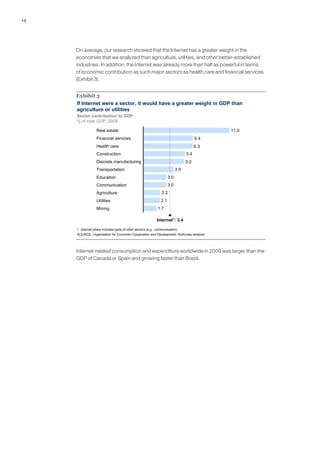
     On average, our research showed that the Internet has a greater weight in the
     economies that we analyzed than agriculture, utilities, and other better-established
     industries. In addition, the Internet was already more than half as powerful in terms
     of economic contribution as such major sectors as health care and financial services
     (Exhibit 3).


     Exhibit 3
     If Internet were a sector, it would have a greater weight in GDP than
     agriculture or utilities
     Sector contribution to GDP
     % of total GDP, 2009

                  Real estate                                                                11.0
                  Financial services                                                   6.4
                  Health care                                                          6.3
                  Construction                                                   5.4
                  Discrete manufacturing                                         5.2
                  Transportation                                           3.9
                  Education                                          3.0
                  Communication                                      3.0
                  Agriculture                                   2.2
                  Utilities                                    2.1
                  Mining                                     1.7

                                                            Internet1: 3.4

     1 Internet share includes parts of other sectors (e.g., communication).
     SOURCE: Organisation for Economic Cooperation and Development; McKinsey analysis


     Internet-related consumption and expenditure worldwide in 2009 was larger than the
     GDP of Canada or Spain and growing faster than Brazil.
McKinsey Global Institute
Internet matters: The Net’s sweeping impact on growth, jobs, and prosperity                                                                          15


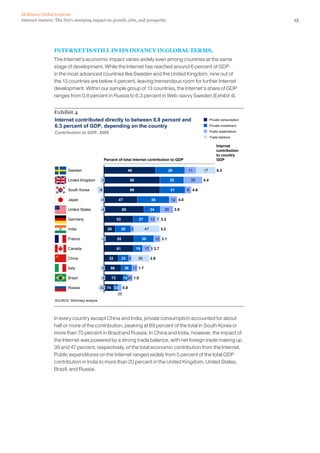
                INTERNET IS STILL IN ITS INFANCY IN GLOBAL TERMS.
                The Internet’s economic impact varies widely even among countries at the same
                stage of development. While the Internet has reached around 6 percent of GDP
                in the most advanced countries like Sweden and the United Kingdom, nine out of
                the 13 countries are below 4 percent, leaving tremendous room for further Internet
                development. Within our sample group of 13 countries, the Internet’s share of GDP
                ranges from 0.8 percent in Russia to 6.3 percent in Web-savvy Sweden (Exhibit 4).


                Exhibit 4
                Internet contributed directly to between 0.8 percent and                                                       Private consumption

                6.3 percent of GDP, depending on the country                                                                   Private investment

                 Contribution to GDP, 2009                                                                                     Public expenditure
                                                                                                                               Trade balance

                                                                                                                                   Internet
                                                                                                                                   contribution
                                                                                                                                   to country
                                                  Percent of total Internet contribution to GDP                                    GDP

                        Sweden                                       46                               26         11      17        6.3

                        United Kingdom        -3                      58                              25          20     5.4

                        South Korea          -8                       69                               31        8 4.6

                        Japan                 -4           47                           45             12 4.0

                        United States         -4                60                      24       20        3.8

                        Germany                            53                27         13 7 3.2

                        India                       20          28     5           47          3.2

                        France                -2           55                   35           12 3.1

                        Canada                             61              19      17 3 2.7

                        China                       32          23 6         39         2.6

                        Italy                 -9     56          36       17 1.7

                        Brazil                -8      73        15 20 1.5

                        Russia               -32 74 33          0.8
                                                           25
                 SOURCE: McKinsey analysis


                In every country except China and India, private consumption accounted for about
                half or more of the contribution, peaking at 69 percent of the total in South Korea or
                more than 70 percent in Brazil and Russia. In China and India, however, the impact of
                the Internet was powered by a strong trade balance, with net foreign trade making up
                39 and 47 percent, respectively, of the total economic contribution from the Internet.
                Public expenditures on the Internet ranged widely from 5 percent of the total GDP
                contribution in India to more than 20 percent in the United Kingdom, United States,
                Brazil, and Russia.
16


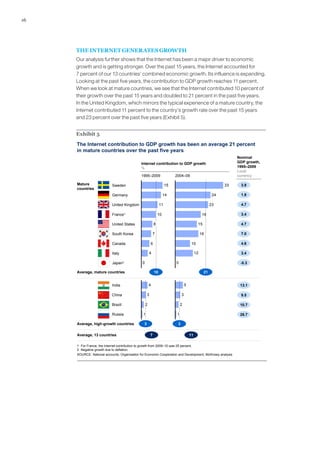
     THE INTERNET GENERATES GROWTH
     Our analysis further shows that the Internet has been a major driver to economic
     growth and is getting stronger. Over the past 15 years, the Internet accounted for
     7 percent of our 13 countries’ combined economic growth. Its influence is expanding.
     Looking at the past five years, the contribution to GDP growth reaches 11 percent.
     When we look at mature countries, we see that the Internet contributed 10 percent of
     their growth over the past 15 years and doubled to 21 percent in the past five years.
     In the United Kingdom, which mirrors the typical experience of a mature country, the
     Internet contributed 11 percent to the country’s growth rate over the past 15 years
     and 23 percent over the past five years (Exhibit 5).


     Exhibit 5

     The Internet contribution to GDP growth has been an average 21 percent
     in mature countries over the past five years
                                                                                                                   Nominal
                                             Internet contribution to GDP growth                                   GDP growth,
                                             %                                                                     1995–2009
                                                                                                                   Local
                                             1995–2009                     2004–09                                 currency

     Mature                Sweden                                     15                                      33    3.9
     countries
                           Germany                                   14                                  24         1.9

                           United Kingdom                        11                                     23          4.7

                           France1                              10                                 18               3.4

                           United States                    8                                 15                    4.7

                           South Korea                    7                                       16                7.0

                           Canada                       6                                10                         4.6

                           Italy                      4                                      12                     3.4

                           Japan2             0                            0                                        -0.3

     Average, mature countries                              10                                     21


                           India                      4                             5                               13.1

                           China                    3                           3                                   9.5

                           Brazil                 2                             2                                   10.7

                           Russia              1                            1                                       26.7

     Average, high-growth countries             3                           3

     Average, 13 countries                              7                               11

     1 For France, the Internet contribution to growth from 2009–10 was 25 percent.
     2 Negative growth due to deflation.
     SOURCE: National accounts, Organisation for Economic Cooperation and Development; McKinsey analysis
McKinsey Global Institute
Internet matters: The Net’s sweeping impact on growth, jobs, and prosperity                                                                 17


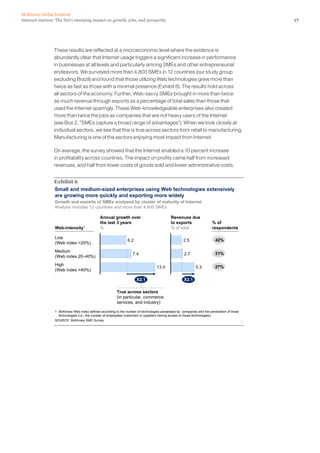
                These results are reflected at a microeconomic level where the evidence is
                abundantly clear that Internet usage triggers a significant increase in performance
                in businesses at all levels and particularly among SMEs and other entrepreneurial
                endeavors. We surveyed more than 4,800 SMEs in 12 countries (our study group
                excluding Brazil) and found that those utilizing Web technologies grew more than
                twice as fast as those with a minimal presence (Exhibit 6). The results hold across
                all sectors of the economy. Further, Web-savvy SMEs brought in more than twice
                as much revenue through exports as a percentage of total sales than those that
                used the Internet sparingly. These Web-knowledgeable enterprises also created
                more than twice the jobs as companies that are not heavy users of the Internet
                (see Box 2, ”SMEs capture a broad range of advantages”). When we look closely at
                individual sectors, we see that this is true across sectors from retail to manufacturing.
                Manufacturing is one of the sectors enjoying most impact from Internet.

                On average, the survey showed that the Internet enabled a 10 percent increase
                in profitability across countries. The impact on profits came half from increased
                revenues, and half from lower costs of goods sold and lower administrative costs.


                Exhibit 6
                Small and medium-sized enterprises using Web technologies extensively
                are growing more quickly and exporting more widely
                 Growth and exports of SMEs analyzed by cluster of maturity of Internet
                 Analysis includes 12 countries and more than 4,800 SMEs

                                              Annual growth over                            Revenues due
                                              the last 3 years                              to exports                 % of
                 Web-intensity1               %                                             % of total                 respondents

                 Low
                                                                6.2                                 2.5                  42%
                 (Web index <20%)
                 Medium
                                                                   7.4                               2.7                 31%
                 (Web index 20–40%)
                 High                                                                                                    27%
                                                                                   13.0                     5.3
                 (Web index >40%)

                                                                      X2.1                           X2.1

                                                         True across sectors
                                                         (in particular, commerce,
                                                         services, and industry)

                 1 McKinsey Web index defined according to the number of technologies possessed by companies and the penetration of those
                   technologies (i.e., the number of employees/ customers or suppliers having access to those technologies).
                 SOURCE: McKinsey SME Survey
18


     Box 2. SMEs capture a broad range of advantages
     Accelerated growth and a more accessible export market are just two of the
     many advantages the Internet brings to SMEs that invest in a substantial Web
     presence.

     We produced an index reflecting the penetration and usage of Internet
     technologies, called the SME Internet Maturity Index. This index shows
     penetration of Internet technology and its usage by employees, clients, and
     suppliers. On the basis of the Index, we placed each of the companies in our
     sample into one of three categories: low Web intensity, medium Web intensity,
     and high Web intensity.

     Our survey of more than 4,800 SMEs in 12 countries showed that on average,
     companies using Internet with a high intensity grow twice as quickly as low-
     Web-intensity companies, export twice as much as they do, and create more
     than twice as many jobs.

     In addition—and not surprisingly—we found that countries where a greater
     proportion of SMEs have a strong presence on the Internet are also those with
     a greater contribution from the Internet to the national economy. For example,
     in the United Kingdom our survey showed that about 71 percent of the SMEs
     use the Internet with high or medium intensity, and our analysis concluded that
     the Internet contributes about 5.4 percent to the British GDP. In Russia, on
     the other hand, only about 41 percent of SMEs have high or medium Internet
     engagement, and the Internet contributes about 0.8 percent to the Russian
     GDP.
McKinsey Global Institute
Internet matters: The Net’s sweeping impact on growth, jobs, and prosperity                                   19


                INTERNET MATURITY CORRELATES WITH A RISING STANDARD
                OF LIVING
                Leveraging endogenous growth theory, we were able to assess the Web’s impact on
                per capita GDP increase within the countries surveyed. The analysis showed a clear
                correlation between per capita GDP growth and a country’s Internet maturity based
                on its e3 index.

                We developed the e3 index to reflect Internet maturity of a country, measuring
                e-ngagement, e-nvironment, and e-xpenditure, which are themselves largely
                based on numbers provided by the World Economic Forum and OECD. Weighing
                these three components, the e3 index represents the depth of a country’s maturity
                in access infrastructure and Internet usage by individuals, businesses, and
                governments. Scandinavian and North American countries, three north European
                countries (the Netherlands, Switzerland, and the United Kingdom), and South Korea
                capture the top ten positions in our e3 rankings.

                A positive correlation has been established in the past between broadband
                penetration and per capita GDP growth. However, for the first time, to our knowledge,
                using the e3 index as an indicator of Internet maturity, we have been able to show
                statistically that the Internet correlates positively with net per capita GDP growth and
                therefore to increasing standards of living in the countries we examined. Our e3 index
                also correlates with labor productivity growth. Another regression we ran, based on
                the total Internet expenses of individuals, businesses, and government in a country,
                shows the same result (see Box 3, “Statistical approach”). Combined with very strong
                statistical evidence, these two regressions clearly show that use of the Internet
                correlates with higher growth in both per capita GDP and labor productivity.

                Using the results of these correlations, a simulation shows the Internet has enabled
                an increase in real per capita GDP of $500 on average in mature countries over the
                last 15 years. The Industrial Revolution took 50 years to achieve the same result.10
                This analysis shows both the magnitude of the positive impact of the Web at all levels
                of society and the speed of the benefits it brings.

                Of course, these are just correlations. Causality still needs to be fully proved and we
                welcome additional work in this field.

                Our conclusions are consistent with earlier academic studies that explored the
                Internet’s impact on economies. For example, a 2003 study at Myongji University in
                South Korea examined 207 countries and found Internet penetration has a positive
                impact on economic growth. 11 A more recent study by professors at the University
                of Munich in 2009 found a clear path from the introduction of broadband and its
                increased penetration to per capita GDP, concluding that every 10-percentage-point
                increase in broadband penetration adds 0.9 to 1.5 percentage points to per capita
                GDP growth.12


                10 Angus Maddison, The World Economy: Historical Statistics, Paris: OECD, 2003.
                11 Changkyu Choi and Myung Hoon Yi, The effect of the Internet on economic growth: Evidence
                   from cross-country panel data, 2003.
                12 Nina Czernich, Olivier Falck, Tobias Kretzchmer, and Ludger Woessmann, Broadband
                   infrastructure and economic growth, CESIFO working paper, December 2009.
20


     Box 3. Statistical approach
     To complete our bottom-up analysis of the contribution of the Internet to GDP based
     on the expenditure approach, we used statistical analysis to correlate the evolution of
     Internet economy with per capita GDP in a given country.

     The analysis was based on three main rationales:

     ƒ Confirm, using econometrical analysis, our first macroeconomic methodology on the
       contribution of the Internet to GDP growth.

     ƒ Isolate the net contribution of the Internet from the substitutive effect between
       the Internet and non-Internet spending (e.g., e-commerce) that could have been
       included in our contribution of the Internet to GDP.

     ƒ Determine the spillover effect from the Internet economy to the non-Internet
       economy. Some spillover, for instance, could be retail purchases that result from
       online price comparisons and searches, while many free services bundled with
       access contracts, such as e-mail, are driving some amount of economic productivity.

     We ran two regressions to determine the net link between growth and Internet usage.

     Methodology

     The model relies on economic growth theory and extends a total factor productivity
     growth equation with Internet-specific data used as an additional factor of production.

     Assuming a macroeconomic function between per capita GDP and input of production
     of Cobb-Douglas:

                                                 Y = AKaLb
     where Y is the per capita GDP, A is the state of technology, K is physical capital per
     capita, and L is human capital.

     Assuming that A is a combination of Internet contribution and a fixed effect, we can
     write growth of per capita GDP as a linear combination between Internet usage,
     physical capital growth, and human capital growth:

     ƒ As a measure of growth, we used real per capita GDP growth (in 2005 US dollars)
       provided by the World Bank database.

     ƒ As a measure of Internet use in a country, we used our McKinsey e3 index, which
       indicates Internet maturity.

     ƒ For measuring contribution of capital and labor, we used growth of fixed capital per
       capita (in 2005 US dollars) and growth of labor per capita, both provided by the World
       Bank database.

     ƒ We also applied controlling variables, such as lagged level of per capita GDP 2005
       and dummy variable per years.

     The second regression replaces the e3 index with total Internet expenses in each
     country,1 leveraging endogenous growth theory and using Internet-related ICT as an
     extra factor of production in Cobb-Douglas equation.

     We examined nine countries (the 13 countries is our study sample, excluding China,
     Brazil, India, and Russia, where some data were unavailable) and five years for
     regression for a total of 45 data points.

     1   ICT expenses given by Gartner each year to which we apply Internet ratios to derive Internet
         expenses.
McKinsey Global Institute
Internet matters: The Net’s sweeping impact on growth, jobs, and prosperity                                        21


                    Box 3. Statistical approach (continued)
                    Findings

                    Both equations provide the same magnitude of impact of the Internet to GDP and show
                    positive correlation between per capita GDP growth and Internet maturity of a country:

                    The first regression gives results statistically significant, with an R square of 89 percent
                    and a Tstat of 2.3 for the contribution of e3 to growth. Statistical contribution of e3 to
                    growth is evaluated at 2.6 percent. This would mean that an increase of 10 points of e3
                    would result in an increase of real per capita GDP growth of 0.26 percentage point.

                    The second regression gives the same statistically significant results with an R square
                    of 91 percent and Tstat = 3.2 for the contribution of Internet expenses to per capita
                    GDP growth. For every 10 percent increase in Internet expenses, real per capita GDP
                    grows an additional 1.2 percentage point.

                    When comparing this statistical approach with a macroeconomic approach, we see
                    that the two approaches converge and show that the Internet creates net value to an
                    economy through GDP growth.

                    However, we see some differences between the two approaches at the country level:

                    In some countries (e.g., South Korea and Sweden) the statistical contribution of the
                    Internet to growth is lower than under the macroeconomic approach, showing a
                    substitutive effect of e-commerce.

                    In some countries (e.g., Canada and the United States) the statistical contribution to
                    growth is higher than under the macroeconomic approach, showing strong spillover
                    effects on the non-Internet economy.


                THE INTERNET CREATES JOBS
                Common wisdom tends to consider that the Web has a negative or neutral impact
                on employment. This is derived from the idea that the Internet has favored massive
                disintermediation. But this is a misconception. As we have demonstrated, the Internet
                is a contributor to net job creation in the sample countries. While some jobs have
                been destroyed by the emergence of the Internet, many more have been created
                during the same period, including jobs directly linked to the Internet such as software
                engineers and online marketers as well as more traditional jobs, for example in
                logistics to deliver online purchases.

                A detailed analysis of France over the past 15 years shows that the Internet created
                1.2 million jobs and destroyed 500 000 jobs, creating a net 700,000 jobs or 2.4 jobs
                for every one destroyed. This result is also reflected in our survey of more than 4,800
                SMEs in the countries we studied, which shows that 2.6 jobs were created for every
                one destroyed, confirming the Internet’s capacity for creating jobs across all sectors.
                Further, companies that have fully integrated the technology and use it extensively
                create more than twice as many jobs as the average, while the Internet has a neutral
                to slightly negative effect on companies using it only sparingly or not at all.
22


     THE INTERNET IS A MODERNIZATION FACTOR FOR THE WHOLE
     ECONOMY
     Although the Internet has resulted in significant value shifts between sectors in the
     economy, our study demonstrates that all industries have benefited from the Web.

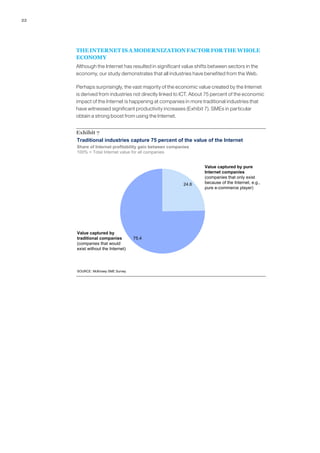
     Perhaps surprisingly, the vast majority of the economic value created by the Internet
     is derived from industries not directly linked to ICT. About 75 percent of the economic
     impact of the Internet is happening at companies in more traditional industries that
     have witnessed significant productivity increases (Exhibit 7). SMEs in particular
     obtain a strong boost from using the Internet.


     Exhibit 7
     Traditional industries capture 75 percent of the value of the Internet
     Share of Internet profitability gain between companies
     100% = Total Internet value for all companies


                                                                 Value captured by pure
                                                                 Internet companies
                                                                 (companies that only exist
                                                        24.6     because of the Internet, e.g.,
                                                                 pure e-commerce player)


     Value captured by
     traditional companies         75.4
     (companies that would
     exist without the Internet)


     SOURCE: McKinsey SME Survey
McKinsey Global Institute
Internet matters: The Net’s sweeping impact on growth, jobs, and prosperity                                                  23


                THE INTERNET GOES BEYOND GDP, GENERATING CONSUMER
                SURPLUS
                The Internet has changed our lives, giving us access to a large set of free services
                from e-mail and browsing to information services and search, or collaborative
                services such as wikis, blogs, and social networks. This access has given users
                substantial surplus value beyond the impact of the Internet on GDP. Our research
                shows that this value ranges from €13 ($18) a month per user in Germany to €20 ($28)
                in the United Kingdom (Exhibit 8). All told, the Internet generated substantial annual
                consumer surpluses, from €7 billion ($10 billion) in France to €46 billion ($64 billion) in
                the United States.


                Exhibit 8
                The value of the surplus accruing to users of the Internet varies between
                €13 and €20 per user per month in each country


                                                                                                           Total Internet
                                                          Net value per Internet user1                     user surplus
                                                          €                                                € billion


                                     United Kingdom                                                 20         9


                                     United States                                               19            46


                                     France                                               16                   7


                                     Germany                                         13                        7


                 1 All in the same currency based on Organisation for Economic Cooperation and Development exchange rates.
                 SOURCE: McKinsey study (with Internet Advisory Board); Yankee; McKinsey analysis


                In general, this surplus is generated from the exceptional value users place on
                Internet services such as e-mail, social networks, search facilities, and online
                reservation services, among many others. This value far outweighs the costs, both
                actual costs such as access and subscription fees and annoyances such as spam,
                excessive advertising, and the need to disclose personal data for some services. In
                the United States, for example, research conducted with the Interactive Advertising
                Board13 found that consumers placed a value of almost €61 billion on the services
                they got from the Internet, while they would pay about €15 billion to get rid of the
                annoyances, suggesting a net consumer surplus of about €46 billion.


                13 Internet Advertising Board, Assessing the consumer benefits of online advertising, July 2010.
24


     1.3. While countries with a high Internet contribution to
     GDP tend to have a strong Internet supply ecosystem,
     the Internet supply landscape offers contrasts
     Along with the Internet’s economic contribution within the countries in our study
     sample, we also examined supply, looking at the participation of each country in the
     framing of the global Internet ecosystem. To do this, we crafted the McKinsey Internet
     Supply Leadership Index, based on four subindexes (Exhibit 9):

     ƒ Importance index, measuring the country’s overall contribution to the global
       ecosystem

     ƒ Performance index, measuring the profitability of a country in the Internet
       ecosystem

     ƒ Growth index, measuring the growth of the country in the Internet ecosystem

     ƒ Preparation for the future, measuring how well a country prepares for the
       future (e.g., in anticipating forthcoming trends and making R&D investments
       accordingly)


     Exhibit 9
     To understand the importance of an individual country to the Internet
     supply ecosystem worldwide, we built the McKinsey Internet leadership
     supply index using four indicators

                                         McKinsey Internet leadership supply index1

               Importance                   Performance                      Growth                       Preparation
                                                                                                         for the future

       ▪   Share by country of       ▪   Gross operating           ▪   2000-09 growth of top      ▪   Number of Internet-
           top 250 Internet-             surplus3 for Internet-        250 Internet-related           related patents per
           related firms’ revenue        related2 activities per       companies per country          capita between
           where their                   capita by country                                            2000–07
           headquarters is           ▪   Net income of top 250                                    ▪   R&D expenses related
           located                       Internet-related firms                                       to Internet per capita
       ▪   Share by country of           by FTE                                                   ▪   Publications related to
           gross Internet-related2   ▪   Net income as % of                                           Internet per capita in
           GDP output                    revenues of top 250                                          the last 10 years
                                         Internet-related firms
                                     ▪   Dividends distributed
                                         by ICT/Internet-related
                                         companies in the top
                                         250 Internet-related
                                         firms

     1 Non-weighted average of all sub-indexes.
     2 Computer and related activities, office, accounting and computing machinery, and post and telecommunication.
     3 Organisation for Economic Cooperation and Development denomination.
     SOURCE: McKinsey analysis


     The McKinsey Internet Leadership Supply Index is the average of each subindex,
     while each subindex is the average of its components. The score for the leading
     country in each subindex is set at 100, and the scores for the other countries are
     based on their positions relative to the leader.
McKinsey Global Institute
Internet matters: The Net’s sweeping impact on growth, jobs, and prosperity                                                               25


                THE UNITED STATES LEADS THE GLOBAL INTERNET SUPPLY
                ECOSYSTEM MAINLY BECAUSE OF ITS IMPORTANCE WITHIN THE
                SYSTEM
                Unsurprisingly, the United States leads the McKinsey Internet Supply Leadership
                Index with an overall score of 58, almost 40 percent higher than that for Sweden, the
                next-closest country (Exhibit 10).

                The United States’ leading position rests primarily on its economic importance
                within the system, where it scores more than twice as high as Japan, which ranked
                second on importance. For example, in measuring importance, we noted that from
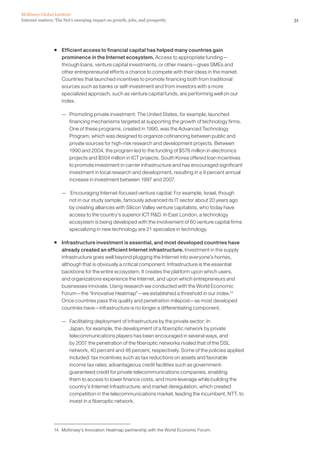
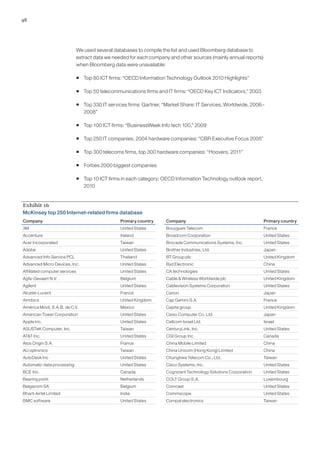
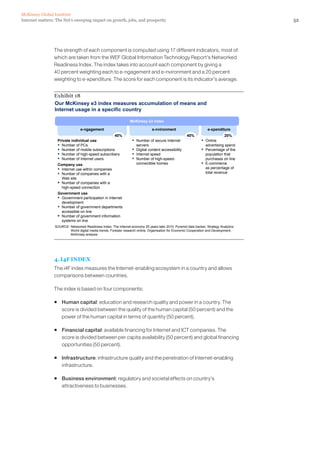
                among the 13 countries in our study, 38 percent of the production needed to build
                the Internet—hardware, software, and content—originated in the United States,
                compared to 14 percent from Japan and 10 percent from China. In addition, US
                companies captured 35 percent of the total Internet revenues earned by the global
                top 250 Internet-related companies, followed by Japan with 20 percent.


                Exhibit 10
                The United States leads the Internet supply ecosystem
                                                                                                                            McKinsey
                                               Indicators (indexes)1                                                         Internet
                                                                   Perfor-                           Preparation           leadership
                                              Importance           mance           Growth            for the future       supply index2


                           United States                     100             58         22                      50                  58

                           Sweden              3                              69    9                                87            42

                           United Kingdom          17                         79        32                 27                      39

                           India               5                        32                     100    0                         34

                           Japan                        47              30          8                           51              34

                           China                   19                   32                    81      1                        33

                           South Korea          12                       43              35                31                  30

                           France               14                       45             25                 23                  27

                           Germany                 16                   30              23                 31                  25

                           Canada              5                         45         9                      27                 22

                           Italy                7                       41           19                8                      19

                           Russia              2                        40                            0                       14

                           Brazil              4                    6                    42           1                       13

                 1 Each index is the average of component sub-indexes. See appendix for detail on sub-indexes.
                 2 Arithmetic mean of the four indicators.
                 SOURCE: Organisation for Economic Cooperation and Development; McKinsey Internet-related top 250 firm database;
                         McKinsey analysis
26


     Part of the explanation for this leadership may be the United States’ mixed structure
     among the ICT industries. US companies in the top 250 Internet-related companies
     are spread over all the Internet-related supply domains: 42 percent of revenues
     are hardware, 26 percent are software and services revenues, and 30 percent are
     telecoms revenues (see methodological appendix on McKinsey Internet Supply
     Leadership Index for more details).

     Other components of the McKinsey Internet Supply Leadership Index highlight the
     role played by other countries.

     ƒ The United Kingdom and Sweden companies show the best performance. In
       the performance portion, the United Kingdom and Sweden rank first and second,
       respectively, with the United Kingdom strong in per capita gross income from
       Internet-related companies and in net income per employee in these industries
       and Sweden ahead in dividends paid per capita. This is mainly because of
       the strong performance and importance of their telecoms operators. Indeed,
       telecommunications companies in European countries generally exhibit strong
       performance. For instance, in France, telecoms account for about 60 percent of
       all Internet revenues and in the United Kingdom, 87 percent.

     ƒ With high-growth companies, India and China are catching up fast. India
       is leading in the growth component with China second, followed closely by
       Brazil and South Korea, while Japan is near the bottom of the growth rankings.
       A critical difference appears to be Japan’s inability to monetize its research and
       development expenditures, while companies in the leading countries have done
       better at turning ideas into revenue.

     ƒ Japan and Sweden are investing in the future, but other players are rapidly
       emerging. Innovation is important in Japan and Sweden. Each country has
       strong R&D investments and a high number of patents per capita.

     Change could come swiftly. As the world has become more wired, developing an
     Internet ecosystem has taken less and less time. For example, in the 1970s and
     1980s it took Israel about 14 years to grow from 50 to 200 new patents a year. Starting
     in the mid-1990s, it took Singapore about six years to cross this threshold, and most
     recently the Indian city of Bangalore crossed it in just four years.
McKinsey Global Institute
Internet matters: The Net’s sweeping impact on growth, jobs, and prosperity                                                                27


                We also see an Internet ecosystem that offers contrasts (Exhibit 11). The United
                States is well ahead in our index, collecting fair contributions to GDP from the Internet
                and enjoying strong growth in these industries. The United Kingdom and Sweden
                are also strong performers, very much focused on telecommunications. Canada,
                France, and Germany could take better advantage of their high Internet usage to gain
                prominence on the supply side. The developing countries we studied—Brazil, China,
                and India—are growing quickly, as is South Korea, while Japan is having difficulty
                capitalizing on its relatively high importance to the Internet supply ecosystem
                because of performance challenges.


                Exhibit 11
                Countries with a high Internet contribution to GDP correlate                                                 Growth >10%

                to those with a strong Internet supply ecosystem
                                                      ▪ United Kingdom and Sweden are very
                                       Internet contribution to GDP               strong performers
                                       %                                     ▪    Telecoms are driving high contribution
                 ▪   Similar           7.0
                                                                                                                     ▪   The United
                     hardware-                                                                                           States is
                     driven            6.0
                                                                                                                         capturing ~40%
                     profiles: South                                                                                     of Internet/ICT
                     Korea is          5.0
                                                                                                                         share
                     growing fast                                                                                    ▪   Lower
                                       4.0
                     and Japan is                                                                                        consumption of
                     capturing high    3.0                                                                               Internet by
                     proportion of                                                                                       individuals and
                     Internet/ICT      2.0                                                  No country with              higher per
                     supply but is                                                          strong ecosystem             capita GDP
                     decelerating      1.0                                                  and low Internet             generate lower
                     mainly due to                                                          consumption                  contribution
                     low                                                                                                 than in the
                     performance             0    5    10   15 20 25 30 35 40 45 50 55 60                                United Kingdom
                                                             McKinsey Internet ecosystem supply index                    or Sweden

                                       ▪   France, Germany, and          ▪       China and India fast catching up
                                           Canada should leverage                both in terms of GDP contribution
                                           strong usage to participate           and supply ecosystem, followed
                                           more in the supply side               by Brazil with strong growth
                 SOURCE: McKinsey analysis


                A detailed look at consumption and supply tells the same story. Beneath the flashy
                successes of Google, Facebook, eBay, and other megasites and bolstered by
                uncounted smaller efforts, the Internet has become a sizable contributor to national
                economies, giving economic growth a much larger push than most observers might
                guess.
28


     1.4. Public and private should focus on four critical
     areas to build a strong supply ecosystem
     To develop a strong Internet ecosystem, public and private attention must be
     focused on supply and in particular on four areas critical to the development of the
     network. Infrastructure is obvious and usually receives the bulk of public and private
     investment, but the other areas—human capital, financial capital, and the business
     environment—are also important components of a healthy and vibrant system. The
     McKinsey i4F (Internet 4 Foundations) index (see Exhibit 12) takes these areas into
     account.


     Exhibit 12
     We built a McKinsey i4F index to gauge the capacity of                                                           Quality drivers

     individual countries on the four foundations of the Internet                                                     Quantity drivers


                                  McKinsey i4F (Internet 4 Foundations) Ecosystem index

             Human capital                 Financial capital                Infrastructure1                   Business
                                                                                                             environment

        ▪   University/industry        ▪   Ease of access to          ▪   Government                 ▪   State of cluster
            research                       loans                          procurement of                 development
            collaboration              ▪   Venture capital                advanced tech              ▪   Time required to start
        ▪   FDI and technology             availability                   products                       a new business
            transfer                   ▪   Financing through          ▪   Overall infrastructure     ▪   Burden of
        ▪   Brain drain                    local equity market            quality                        government
        ▪   Quality of math and        ▪   Value per capita of        ▪   Quality of electricity         regulations
            science education              venture capita (VC)            supply                     ▪   Intellectual property
        ▪   Tertiary education             investment (semi           ▪   Secure Internet                protection
            enrollment rate                conductor/other                servers per capita         ▪   Effectiveness. of
        ▪   Availability of                electronics, Internet,                                        antitrust policy
            Scientists and                 software computer,                                        ▪   Ease of doing
            engineers                      hardware computer)                                            business index
        ▪   Researchers in R&D         ▪   Number of VC deals                                        ▪   Capacity for
            per capita                     per capita                                                    innovation
        ▪   Personnel in R&D                                                                         ▪   Irregular payments
            FTE per capita                    50%                                                        and bribes
                                                       50%
              50%
                       50%             ▪   Value of VC
                                           investment (Semi
        ▪   Researchers in R&D             conductor/other
        ▪   Personnel in R&D               electronics, Internet,
            FTE                            Software computer,
        ▪   Graduate in Science            Hardware computer)
        ▪   Doctorate in all S&E       ▪   Number of VC deals
            fields

     1 Infrastructure is viewed as being a "threshold" factor where increases above a certain threshold do not confer additional
       advantage. All ratings above 60 (our defined threshold) are set to 60.
     SOURCE: World Economic Forum; United Nations Educational, Scientific and Cultural Organization; Venture Expert;
             International Institute for Management Development; World Bank; McKinsey analysis


     Countries such as Sweden and the United States that rank high across the board
     (Exhibit 13) are also the ones that generate the most value from the Internet. Indeed,
     we see a correlation between Internet i4F indicator and Internet McKinsey Supply
     Leadership Index showing how important it is for a country wishing to build a strong
     Internet ecosystem to focus on these four areas (Exhibit 14).
McKinsey Global Institute
Internet matters: The Net’s sweeping impact on growth, jobs, and prosperity                                                                             29


                Exhibit 13
                The United States and Sweden are outperforming the McKinsey i4F index
                                                                                                                                    McKinsey i4F
                                                 Indicators (indexes)1                                                                Internet
                                                Human                 Financial            Infra-          Business                  ecosystem
                                                capital               capital              structure3      environment                 index2


                           United States                      83                     84               60              76                           76

                           Sweden                        54                     41                    60                   92                 62

                           Japan                         59                17                         60                  83                  55

                           Canada                        55                 26                        60                  81                  55

                           United Kingdom                53                 26                        60              75                      54

                           Germany                      49                 17                         60                  79                  51

                           France                       47                  26                        60              72                      51

                           South Korea                   53                     34                    60             56                       51

                           China                         53                20                    46                  64                   46

                           Russia                       47                  26                31                29                       33

                           India                    31                     21                 26                 51                      32

                           Italy                    27                     10                    37              51                      31

                           Brazil                  24                      14                    39             34                       28

                 1 Each index is the average of component sub-indexes. See appendix for detail on sub-indexes.
                 2 Arithmetic mean of the four indicators.
                 3 Infrastructure is viewed as being a "threshold" factor where increases above a certain threshold do not confer additional
                   advantage. All ratings above 60 (our defined threshold) are set to 60.
                 SOURCE: Organisation for Economic Cooperation and Development; McKinsey Internet-related top 250 firm database;
                         McKinsey analysis


                Exhibit 14
                The correlation between our i4F and supply indexes shows that a
                favorable environment enables a strong performance in Internet supply
                 Correlation between i4F index and McKinsey supply index, 2009
                 %
                 McKinsey supply index
                 60
                                                                                                                          United States
                          R2 = 63%
                 50       (89% without India
                          and Canada)1                                                                          Sweden
                                                                                           United Kingdom
                 40
                                                                   India              Korea        China    Japan
                 30
                                                                                                           France
                                                                      Italy                                   Canada
                 20                                                                         Germany
                                                        Brazil
                 10                                                    Russia

                  0
                      0      5      10     15      20         25     30         35    40    45        50   55    60            65   70   75        80
                                                                                                                          McKinsey i4F index
                 1 Canada: Low score mainly due to Nortel collapse. India: High McKinsey supply leadership index mainly due to Bangalore and
                   not whole India.
                 SOURCE: World Economic Forum; United Nations Educational, Scientific and Cultural Organization; Venture Expert;
                           International Institute for Management Development; World Bank; McKinsey analysis
30


     ƒ Human capital has been a clear advantage for the United States. The United
       States has historically produced and attracted a large quality and quantity of
       trained professionals to provide the talent required by its Internet ecosystem.

        — Focusing on education: The breadth and depth of education, particularly
          in math and sciences, is among the key indicators in this area. The United
          States, which ranked highest on this indicator, is home to some of the world’s
          top universities, attracting high-potential domestic and foreign scholars. For
          example, 43 percent of all doctoral candidates in US science and engineering
          programs are foreign students brought to the country by the strong
          reputations of its universities, a scholastic marketing program targeting foreign
          students, opportunities to earn high salaries, and administrative processes
          that ease their integration into the programs. In Sweden, the government
          has started several initiatives to increase the number of highly-qualified ICT
          graduates, including a program that provided IT training to 75,000 primary
          and elementary school teachers, who then brought these skills to students at
          all levels. The Swedish government also increased the capacity of university
          science and engineering programs, allowing a 7 percent increase in graduate
          students studying science between 1998 and 2004, and helped to finance
          new positions in the Royal Institute of Technology. However, even the US now
          faces potential shortfalls in creating the talent needed in the STEM (Science
          Technology Engineering and Mathematics) disciplines that are critical to the
          Internet ecosystem.

        — Bringing in talent: Countries also deepen their talent pools by bringing in
          skilled workers from abroad. For example, compared to other countries, US
          immigration policy has historically created a favorable climate for attracting
          ICT foreign workers, allowing employment visas to be distributed based on
          employment and educational qualifications and for employers to sponsor
          incoming employees. And the Internet ecosystem has been a disproportionate
          beneficiary of these policies. In 2003, for example, 40 percent of H-1B
          nonimmigrant visas were granted to ICT workers.

        — Creating technological clusters: Technology clusters can create a virtuous
          cycle for the creation and attraction of talent–examples include Silicon
          Valley in the United States and Bangalore in India. Some technology clusters
          have emerged naturally, while others have benefited from proactive policies
          and private-public partnerships. For example, to increase the number of
          high qualified ICT graduates, Sweden developed a research center in new
          technologies. However, the success record of setting up technology clusters
          has been mixed and many of the lessons learned well documented.

        — Diversifying the employer landscape: Countries benefit by bringing in
          foreign multinationals that help build human capital through knowledge and
          technological exchanges.
McKinsey Global Institute
Internet matters: The Net’s sweeping impact on growth, jobs, and prosperity                            31


                ƒ Efficient access to financial capital has helped many countries gain
                  prominence in the Internet ecosystem. Access to appropriate funding—
                  through loans, venture capital investments, or other means—gives SMEs and
                  other entrepreneurial efforts a chance to compete with their ideas in the market.
                  Countries that launched incentives to promote financing both from traditional
                  sources such as banks or self-investment and from investors with a more
                  specialized approach, such as venture capital funds, are performing well on our
                  index.

                    — Promoting private investment: The United States, for example, launched
                      financing mechanisms targeted at supporting the growth of technology firms.
                      One of these programs, created in 1990, was the Advanced Technology
                      Program, which was designed to organize cofinancing between public and
                      private sources for high-risk research and development projects. Between
                      1990 and 2004, the program led to the funding of $576 million in electronics
                      projects and $504 million in ICT projects. South Korea offered loan incentives
                      to promote investment in carrier infrastructure and has encouraged significant
                      investment in local research and development, resulting in a 9 percent annual
                      increase in investment between 1997 and 2007.

                    — Encouraging Internet-focused venture capital: For example, Israel, though
                      not in our study sample, famously advanced its IT sector about 20 years ago
                      by creating alliances with Silicon Valley venture capitalists, who today have
                      access to the country’s superior ICT R&D. In East London, a technology
                      ecosystem is being developed with the involvement of 60 venture capital firms
                      specializing in new technology are 21 specialize in technology.

                ƒ Infrastructure investment is essential, and most developed countries have
                  already created an efficient Internet infrastructure. Investment in the supply
                  infrastructure goes well beyond plugging the Internet into everyone’s homes,
                  although that is obviously a critical component. Infrastructure is the essential
                  backbone for the entire ecosystem. It creates the platform upon which users,
                  and organizations experience the Internet, and upon which entrepreneurs and
                  businesses innovate. Using research we conducted with the World Economic
                  Forum—the “Innovative Heatmap”—we established a threshold in our index.14
                  Once countries pass this quality and penetration milepost—as most developed
                  countries have—infrastructure is no longer a differentiating component.

                    — Facilitating deployment of infrastructure by the private sector: In
                      Japan, for example, the development of a fiberoptic network by private
                      telecommunications players has been encouraged in several ways, and
                      by 2007 the penetration of the fiberoptic networks rivaled that of the DSL
                      network, 40 percent and 46 percent, respectively. Some of the policies applied
                      included: tax incentives such as tax reductions on assets and favorable
                      income tax rates; advantageous credit facilities such as government-
                      guaranteed credit for private telecommunications companies, enabling
                      them to access to lower finance costs, and more leverage while building the
                      country’s Internet infrastructure; and market deregulation, which created
                      competition in the telecommunications market, leading the incumbent, NTT, to
                      invest in a fiberoptic network.


                14 McKinsey’s Innovation Heatmap partnership with the World Economic Forum.
32


        — Direct public investment in infrastructure, especially in areas with limited
          profitability: The Swedish government, for example, has promised Internet
          access to everyone and backed this with a €570 million project to bring
          broadband to low-density areas.

     ƒ Creating the right business environment is critical. An attractive business
       environment can accelerate the growth of a vibrant Internet ecosystem, while the
       wrong environment could stifle growth. A wide range of factors from tax incentives
       and the level of corruption to encouragement of innovation work together to create
       a nurturing environment for developing an Internet ecosystem.

        — Promoting deregulation: Deregulation often brings increased competition,
          which can motivate established companies to increase their investments or
          push for greater innovation. In the United States, deregulation triggered a
          series of new offers from incumbents AT&T and Verizon, while in Japan NTT
          moved forward with building a fiberoptic network.

        — Creating an appropriate legal framework: Protecting intellectual property
          rights and strengthening antipiracy laws, as South Korea did in the late 1990s,
          can contribute to an attractive business environment.

        — Offering a favorable taxation environment for specific industries: India, for
          example, gives hardware and IT companies a tax holiday of up to five years to
          encourage entrepreneurship, while the United Kingdom offers partial tax relief
          to investors in specific businesses.

     France offers a fitting example of how our analysis can help countries consider
     ways to gain a stronger presence on the global Internet ecosystem and increase the
     contribution the Internet delivers to the national economy (see Box 4, “The French
     experience”).


       Box 4. The French experience
       Though France sits in the middle ranks of the McKinsey Internet Supply
       Leadership Index, the country is moving forward with clear strengths. It has a
       strong user base, solid infrastructure, and quality math and science education.
       It is also one of the countries with higher contribution of Internet to growth and
       among mature countries, one of the countries where Internet contribution is
       growing the most.

       France could build on these advantages while targeting areas that remain
       underdeveloped to create a more powerful ecosystem. Specifically, analysis
       based on the i4F indicator suggests that a focus on three areas—improved
       research collaboration between academia and industry, more aggressive
       development of technology clusters, and clear policies to attract top talent in
       the country—could bring substantial improvements. Some efforts have begun
       including, for instance, new tax credits for research (a 30 percent tax reduction
       for an R&D investment of up to €100 million and a 5 percent reduction above
       that threshold), and greater autonomy for universities. However, further work
       on these areas are likely to deliver promising results. In addition, efforts to
       build a critical mass and take advantage of the European large size could be
       accelerated.
McKinsey Global Institute
Internet matters: The Net’s sweeping impact on growth, jobs, and prosperity                              33


                 2. Leveraging the Internet to revive
                 the engine of growth


                 Understanding how much the Internet contributes to national economies and
                 how this value is created lays a solid foundation for moving national policy and
                 business strategy forward in a way that maximizes the benefits gained. Initiatives
                 can be championed by government policy makers, by business executives, or by
                 a partnership between the two groups, but in every instance the goal should be
                 strengthening the domestic Internet ecosystem—consumption and supply—and
                 delivering as much value to the economy as possible.


                 2.1. Public decision makers should act as catalysts to
                 unleash the Internet’s growth potential
                 Public spending can be used as a catalyst to boost both usage and ecosystem.
                 Public expenditures are a proven vehicle for getting more people and businesses
                 online. Countries that have the highest public investment in the Internet as share of
                 GDP tend also to gain the greatest contribution to GDP from the Internet. The United
                 Kingdom, the United States, Sweden, and South Korea posted the highest average
                 levels of investment in the Internet between 2000 and 2009, and each rank among
                 the highest on the McKinsey Internet Supply Leadership Index and in contribution
                 to GDP from the Internet. Sweden has pushed the development of e-government
                 services and was ranked first in e-government advancement index in 2008 by the
                 United Nations.

                 Public policy leaders could work to stimulate Internet usage among individuals,
                 businesses, and government bodies. This can be accomplished by providing
                 government-sponsored training sessions that instruct individuals and
                 businesspeople on how to access the advantages offered by the Internet,
                 offering incentives to the private sector to expand and improve infrastructure, and
                 encouraging public agencies to develop e-government applications, allowing
                 people and businesses to access government services and conduct business with
                 the government online. The government’s own usage encourages citizen use, and
                 government e-transformation creates a large-scale, complex demand that stimulates
                 the supply ecosystem (see Box 5, “Pushing Internet usage on three fronts”).
34


     Box 5. Pushing Internet usage on three fronts
     Sweden and South Korea have both focused intense public energy on
     encouraging Internet usage on all fronts: individuals, businesses, and public
     bodies. These efforts are among the reasons these countries ranked high in
     many of the categories we examined while determining the economic impact of
     the Internet.

     Sweden initiated numerous programs to push individual usage. Among the
     many efforts, it invested about €570 million to bring broadband Internet services
     to small towns and areas with low population densities, it launched an IT in
     Schools program to train 75,000 elementary and secondary teachers, it was
     quick to liberalize the telecommunications markets, and it offered subsidies to
     promote broadband expansion.

     The government also focused attention on bringing the Internet to businesses.
     One program, financed jointly by the government and private sources, focused
     on teaching IT capabilities to businesses with fewer than ten employees. In
     another, the National IT Training Program, the government sought to teach IT
     skills to unemployed workers who lacked such training.

     The government also turned the mirror on itself. In an effort called the 24/7
     Agency, the government moved to modernize public administration and bring
     government services online. The diverse approach included allowing digital
     transmission of medical prescriptions and developing the world’s first “virtual
     embassy” in the online environment Second Life. In 2008, Sweden was ranked
     first on the e-government advancement index by the United Nations.

     In South Korea, the government launched a program called Ten-Million-People
     Internet Education, which focused on demographics not usually associated
     with Web activity, including the elderly, farmers, the disabled, prisoners, and
     housewives. The program offered government-subsidized training and reached
     4 million people in 2000.

     The government also encourages infrastructure investment, for example
     through certification programs for buildings larger than 3,300 square meters
     stating they are broadband ready and creating a broadband backbone between
     Seoul and Taejon using a mix of public and private financing. And the South
     Korean government works to boost Internet usage at schools, for instance by
     encouraging online homework.
McKinsey Global Institute
Internet matters: The Net’s sweeping impact on growth, jobs, and prosperity                                        35


                Governments could also create a business environment that promotes technological
                development and innovation. Using regulations to maintain constructive competition;
                encouraging the deployment of advanced technologies; building top-level education
                and training centers in science, engineering, and other relevant fields; pushing
                companies to target the global market; and publically applauding successes
                are among the themes public leaders can embrace to put together an attractive
                environment.

                Public officials could also focus some of their attention on SMEs, which as we have
                seen are critical to job creation and can garner large advantages from Internet
                proficiency. This can be done by assuring high-speed and very-high-speed access
                to the Internet and adopting policies that encourage SME owners and managers to
                invest in digital technologies and to become adept at exploiting them.

                These are among the many measures that will cultivate the four core areas of
                Internet ecosystems: human capital, financial capital, infrastructure, and the
                business environment (see Box 6, “Strength in the four critical areas is at the core of
                Bangalore’s ecosystem”).


                    Box 6. Strength in the four critical areas is at the core of
                    Bangalore’s ecosystem
                    India has become synonymous with taking advantage of IT and the Internet for
                    economic growth, and Bangalore is at the epicenter. India accounts for more
                    than two-thirds of IT services imports to developed countries from developing
                    countries, and Bangalore, a city of 5.5 million people, accounts for just more
                    than a third of it.1 This success was built on a thriving Internet ecosystem
                    supported by public policy and private investment across all four critical areas.

                    To develop human capital, the region established a broad network of premier
                    technical and business educational institutions, including 12 universities,
                    98 engineering colleges, and 107 medical colleges. The effort included the
                    opening of national institutes for advanced studies, which have become leading
                    research and development centers.

                    Among its infrastructure initiatives, India helped create IT and electronic
                    business clusters, such as Software Technology Parks created in 1991
                    and Electronic City. In addition, private investment led to such world-class
                    campuses as the DBS Business Center in Bangalore. The introduction of
                    incubators and datacom services, along with efficient transportation networks,
                    create convenient locations for new companies.

                    Favorable tax policies, such limited-time exemptions on taxes for computer
                    hardware and IT companies, and subsidies, including guarantees and favorable
                    rates for electricity, contributed to an attractive business environment.

                    The government nurtured financial capital by leveraging the Bangalore
                    stock exchange and promoting the growth of domestic venture capital funds.
                    Bangalore offers strong financial support to entrepreneurs through several
                    state government institutions, including the Karnataka Information Technology
                    Venture Capital Fund (KITVEN), Bangalore.

                    1   Deepak K. Sareen, Innovation and IT in India (Bangalore case study), presentation at the
                        2nd International conference on the process of innovation and learning in dynamic city
                        regions, July 2005, Bangalore.
36


     2.2. All business leaders, not just e-CEOs, should put
     the Internet at the top of their strategic agenda
     Business leaders, including those leading companies that are not directly involved
     with the Internet, must be proactive in taking advantage of benefits the Internet offers.
     This is especially true for entrepreneurs leading SMEs. With technology changing
     so rapidly, executives must regularly review their businesses, looking for ways the
     Internet can help them innovate more aggressively or reach new markets more
     rapidly. They must in particular be prepared to reinvent their business models to
     capture productivity and performance improvements unlocked by the Internet.

     Managers also must not let the distractions of day-to-day business prevent them
     from contemplating the future. They must find time to consider the changes new
     technologies could soon bring to their businesses. Up-and-coming trends such as
     distributed co-creation and networks as organizations could radically change the
     way talent and work are organized. Operations are also evolving thanks to ideas such
     as the Internet of things, where chips create highly efficient networks from almost
     any physical product, and wiring for a sustainable world, where technology is put up
     against the world’s environmental challenges.

     The Internet is also spawning innovative business models such as innovation from
     the bottom of the pyramid, in which new ideas come from efforts to serve the lowest-
     income households, and multisided models that look for additional value from assets
     created operating a core business, such as selling market data. The Internet can
     also create opportunities in social goods, such as using new technologies to solve
     community problems (see Box 7, “Two trends to follow for decision makers”).
McKinsey Global Institute
Internet matters: The Net’s sweeping impact on growth, jobs, and prosperity                                             37


   Box 7. Trends to follow for decision makers
   Developments occur quickly around the Internet. And while it is important that businesses work diligently to
   squeeze as much benefit as they can from today’s technology, leaders must also keep a watchful eye on new
   ideas that could drastically change the environment, lavishing advantages on the prepared, and perhaps taking
   from those caught unaware.

   In our research we have been tracking many of these trends (See “Clouds, big data, and smart assets: Ten
   tech-enabled business trends to watch”). Here we highlight three developments seem particularly promising.

   Cloud computing. Cloud computing separates IT resources, such as files and programs, from the devices
   used to access them. This can create many advantages, such as resource pooling and a near unlimited ability
   to enlarge or reduce available resources rapidly. By 2015, cloud computing could represent a $70 billion to
   $85 billion opportunity, with the market doubling every two years. Some technology watchers forecast that
   by 2015 cloud computing infrastructure and applications could account for 20 percent of total spend in these
   areas.

   Fast movers in this technology could quickly gain substantial market share, displacing incumbents with new
   cloud-based solutions and reaching into new markets. The impact could reach 20 to 30 percent of the total IT
   budget for businesses willing to leverage this new technology.

   Internet of Things.1 In a rapidly developing trend called the Internet of Things, sensors and actuators
   embedded in physical objects—from roadways to pacemakers—are becoming linked through wired and
   wireless networks, often using the same Internet Protocol (IP) that connects the Internet. These networks churn
   out huge volumes of data that flow to computers for analysis. This merging of the physical and virtual worlds
   creates news ways of capturing value. Customer buying preferences can be associated in real time at a specific
   location, enabling more timely and relevant offers to be provided. Sensors on objects can enable companies
   to turn product sales into services sales, including everything from proactive maintenance, to selling usage
   instead of a capital good (e.g., car-sharing services in urban areas). Instrumenting complex systems such as
   electrical grids allows them to be operated with higher levels of efficiency and reliability, and can even be used
   to introduce dynamic pricing to further manage peak demand. Remote health monitoring can reduce the costs
   of treating patients while simultaneously improving their health outcomes. The numerous benefits of this trend
   result in an estimated growth rate of connected nodes on the Internet of Things of 35 percent annually for at
   least the next five years. As this trend continues to accelerate globally, companies and governments that move
   first into using the Internet of Things stand to gain knowledge that will enable competitive advantage.

   Big data 2 . Companies with the capability to use the Internet, including the Internet of Thngs, to collect
   operational, consumer, and market data, could find their databases quickly overflowing with information.
   And while the Internet may no longer be “a wasteland of unfiltered data,” as Clifford Stoll once feared, these
   databases, if left unmanaged, could become mammoth junkyards of useless bytes.

   Big data is a movement toward finding ways to manage databases that have become so massive that
   conventional tools are not adequate for capturing, storing, searching, sharing, analyzing, and visualizing this
   information. Enterprises that develop expertise in handling big data will find rich opportunities in areas such as
   creating transparency around these databases, reducing search time and easing concurrent processes, sifting
   through the data to uncover variabilities and areas for potential performance improvements, and segmenting
   large populations into usable groups based on a broad range of variables.

   Looking at how advances in big data might affect various industries, we estimate the US health care industry
   could see annual productivity improvements of almost 1 percent over the next decade, creating potential value
   of more than $300 billion. The public sector in developed European countries could witness annual productivity
   gains of about 0.5 percent with a potential value of €255 billion.

   1   Michael Chui, Markus Löffler, and Roger Roberts, “The Internet of Things,” McKinsey Quarterly, March 2010.
   2   Big data: The next frontier for innovation, competition, and productivity, McKinsey Global Institute, May 2011
       (www.mckinsey.com).
38


     2.3. All stakeholders should take part in a continuous
     and fact-based public-private dialogue
     In addition to the individual efforts by government and business leaders, there are
     initiatives that require public-private dialogue for the greatest impact from the Internet
     ecosystem. Within individual countries and globally, open discussions between
     government and businesses are needed to make progress across a variety of issues,
     such as intellectual property in the digital age or data privacy.

     To spur consumption, public and private leaders should explore solutions to such
     pressing issues as standards for legally valid digital identities, which would create
     even greater efficiencies in online business transactions, and intellectual property
     protection, which would unleash new markets and encourage greater creativity. The
     supply side also requires attention from all parties on vexing topics including net
     neutrality, talent availability, and the overall business environment.

     A strong and continuous public-private dialogue is necessary to assure optimal
     conditions within each country and internationally.
McKinsey Global Institute
Internet matters: The Net’s sweeping impact on growth, jobs, and prosperity                                 39


                 3. Monitoring the progress of the
                 Internet using four critical indicators


                 Putting a numerical value on the benefits that the Internet delivers to national
                 economies requires sorting volumes of data from divergent sources. To ease the
                 analysis and provide a “language” and tools to discuss the impact of the Internet,
                 we developed four indexes that examine separate parts of the picture and together
                 provide the full panorama. The first two—the e3 index and the iGDP—examine input
                 and output indicators centered on expenditures and consumption. The next two—
                 the McKinsey Internet supply leadership index and the i4F indicator—examine input
                 and output indicators focused on data related to the supply side. Countries earnestly
                 wishing to strengthen their domestic Internet ecosystem could review their progress
                 against these indicators at least annually and make whatever adjustments are
                 needed to assure a steady course.

                 As part of our effort to closely track how the Internet is affecting national economies,
                 we plan to publish an annual report that follows and analyzes changes in these
                 indexes. In addition, we have made public the details of our methodology of our
                 indicators in an effort to encourage open-source-type improvements. We welcome
                 any criticisms and suggestions on how our analyses can be improved.

                 We will receive all contributions, synthesize them, and publish them to improve the
                 way we measure the impact of the Internet.


                 3.1 The consumption indicators
                 The e3 index measures the maturity of a country’s Internet ecosystem by considering
                 input indicators linked to consumption. Data are collected in three essential areas:
                 engagement, environment, and expenditures. Engagement, which weighs heavily
                 in the index, covers private, corporate, and government use and gathers data on
                 aspects such as number of personal computers in use, number of companies with a
                 Web site or high-speed access, and number of government departments that can be
                 reached online.

                 The iGDP indicator, reflecting direct Internet contribution to GDP, also examines
                 consumption but in addition looks at output. Data gathered for this indicator help
                 determine the overall contribution the Internet makes to a country’s economy.

                 Our e3 index and contribution to GDP are correlated (Exhibit 15).
40


     Exhibit 15
     Internet maturity is measured through internal consumption and
     correlated to the Internet contribution to GDP
     Correlation between McKinsey e3 index and Internet contribution to GDP, 2009
     Internet contribution to GDP1
     % of GDP
     6
                                                                                                United Kingdom
             R2 = 76%
     5       (89% without Canada)                                                               Korea               Sweden

                                                                                   Japan
     4
                                                                                                             United States

     3                                                                                          Germany
                                                                                   France                         Canada
                     Brazil China
     2                                           Italy
             India
     1
              Russia
     0
         0     5      10    15      20     25     30     35     40       45   50    55     60    65     70     75    80      85
                                                                                                      McKinsey e3 index
                                                                                                                     %
     1 Excluding imports and exports to restrict to local consumption.
     SOURCE: World Economic Forum; McKinsey analysis


     3.2 The supply indicators
     The McKinsey Internet Supply Leadership Index, as we’ve noted, measures a
     country’s overall participation in the global Internet ecosystem by examining supply-
     side inputs. The analysis is broken down into four key sections: current importance
     to the global ecosystem, performance within the ecosystem, recent growth, and
     activities that prepare a country for future developments. Taken together, these data
     represent each country’s power within the dynamic Internet ecosystem and can help
     predict how the system might evolve

     Supply outputs are gathered into the i4F indicator, which offers a valid representation
     of the vibrancy of a country’s ecosystem. This indicator focuses on the four core
     areas of Internet development that we discussed earlier: human capital, financial
     capital, infrastructure, and the business environment.
McKinsey Global Institute
Internet matters: The Net’s sweeping impact on growth, jobs, and prosperity                                41


                Conclusion


                 Common sense tells us that the Internet is a vital part of a modern, healthy, growing
                 economy. And while previous studies have examined parts of the picture, McKinsey
                 research for the first time shows the full extent of the Internet’s economic power. And
                 that power is massive.

                 In the 13 countries we studied, the Internet has contributed on average 3.4 percent
                 to GDP, weighting more than agriculture, energy, and other better-established
                 industries, and it adds considerable vigor to economic growth. Perhaps surprisingly,
                 the brunt of this impact—about 75 percent—is from industries that are not directly
                 linked to the Internet, except of course by their computers. This value comes primarily
                 from increased productivity.

                 Understanding just how much the Internet contributes to national economies should
                 spur government and business leaders to seek ways to optimize their participation
                 in the global Internet ecosystem. Encouraging usage is an unavoidable first step in
                 leveraging public spending, but leaders must also focus on providing human capital,
                 financial capital, infrastructure, and the appropriate business environment.
42


     Postscript
     by Martin N. Baily and Christian Saint-Etienne


     The global economy is emerging from the deep recession that followed the recent
     financial crisis and, in the advanced economies, growth remains weak. One
     response to slow growth and persistent unemployment might be to hunker down,
     avoid change, and discourage innovative ideas and the spread of new products and
     services. This study by McKinsey has taken a different view, documenting for the
     first time the substantial contributions to past growth made by the Internet and the
     potential that this exciting, and still relatively new, technology will contribute to future
     growth.

     Embracing new technology is the right way for the G8 economies to move forward.
     The reality of severe budget constraints has made it impossible to launch a new fiscal
     stimulus; indeed, many in the G8 have decided they must start fiscal consolidation.
     So if traditional pump-priming fiscal policy is not available, what will power a stronger
     recovery? An important part of the answer is that new technologies will encourage
     investment and hiring, generating new demand by consumers and businesses
     even as they expand supply. Increasing access to the Internet and developing
     its applications form a vital part of the latest technological revolution that can
     contribute to recovery and rising living standards. It is important not to overstate
     what technology by itself can do, as we learned in 2001 when many computers and
     fiberoptic cables sat idle after the high-tech bust. It is not enough to buy the software
     and hardware—it is what we do with technology that counts, particularly in the case
     of the Internet, which is an enabling technology. But innovation and new technology
     do provide the opportunity to grow, and, if the G8 countries are able to seize the
     opportunity, they will generate a new growth cycle based on a firmer footing than the
     finance-driven bubble that burst in 2007.

     Last year, a pioneering study of the impact of the Internet on the French economy
     was released by the French office of McKinsey. This work has now been expanded
     in this study to cover all of the G8 economies, a fearsome task that has been
     completed in record time with fascinating results. Having worked with McKinsey,
     we appreciate the power that comes from combining traditional economic data
     with business knowledge and insight. This report points to important correlations
     between economic growth and Internet investment and usage, and it documents
     that companies that use the Internet are the ones that grow more rapidly and are
     more profitable. But it also describes the ways in which businesses are using the
     Internet to streamline processes, manage supply chains, and create new services
     for consumers that were not even imagined a few years ago. Rapid changes in
     technology can be bewildering, so it is very welcome to get from this report a new
     understanding of both the nature and the potential of the Internet.
McKinsey Global Institute
Internet matters: The Net’s sweeping impact on growth, jobs, and prosperity                                     43


                There are important lessons for government policy makers from this report. It shows
                that countries that helped put in place the Internet infrastructure and promoted
                usage reaped the benefits of their efforts and saw a larger growth contribution.
                The dynamism of the private sector has been key to the speed of deployment
                of the Internet and to developing its applications, but the origins of the Internet
                and its transition into a global network also owe something to the contributions
                of governments. Governments as users are also a key catalyst to the spread of
                Internet technologies. The future growth of the Internet will require cooperation
                among governments and the right kind of smart regulation and support, at both
                the national and international levels. Another important lesson for policy is that the
                Internet is one of the emerging technologies that is forcing economic change and that
                demands flexibility. This report finds that the Internet is a net job creator but that it has
                contributed to some job losses as well as job gains. Countries can take advantage
                of new technologies only if they can manage and facilitate the migration of economic
                activities induced by innovation.

                It is a wonderful opportunity for learning and the exchange of ideas by convening the
                e-G8 meeting prior to the formal meeting of G8 leaders. This report from McKinsey
                provides a powerful tool to push forward the economic debate and to better
                understand the power of technology to add to growth.


                Martin N. Baily
                Schwartz Chair and senior fellow of the Brookings Institution
                Former chair of the US President’s Council of Economic Advisers

                Christian Saint-Etienne
                Professor of business economics at the Conservatoire National des Arts et Métiers
                in Paris
                Member of the Conseil d’Analyse Economique reporting to the French prime minister


                May 2011
McKinsey Global Institute
Internet matters: The Net’s sweeping impact on growth, jobs, and prosperity                                           45


                 Appendix: Methodology and
                 approach specifics


                 1. THE INTERNET’S CONTRIBUTION TO GDP
                 Although there are three different methods for calculating the contribution a sector
                 makes to GDP, none take into account the total value contributed by the Internet to
                 the overall economy of a country or a society. These are the three common methods:

                 ƒ Production method measures the value added by companies by producing
                   goods and services

                 ƒ Revenue method measures the gross revenues of institutional sectors, including
                   employee pay

                 ƒ Expenditure method measures the total spending by consumers and
                   government on goods and services

                 The contribution a sector makes to GDP is usually measured by calculating
                 production. However, to quantify the Internet’s contribution in detail using this
                 method, we would have had to obtain data on the proportion of revenue attributable
                 to the Internet with associated margins for all companies in all sectors. Such an
                 approach would have required too many unreliable estimates.

                 We therefore decided to use the expenditure method based on OECD data.

                 This method looks at four factors: private consumption, public expenditures, private
                 investment, and trade balance. We included for the contribution of each of these
                 factors all categories of goods and services enabled by the Internet and attributed an
                 underlying portion of this to the Internet.

                 We tried as much as possible to use a same data source for each category across the
                 13 countries in our study to provide comparable figures. These were:

                 ƒ Private consumption. This is the total consumption of goods and services
                   by consumers via the Internet or needed to obtain Internet access, including
                   electronic equipment, e-commerce broadband turnover of telecoms operators
                   on the retail market, mobile Internet market, hardware and software consumption,
                   and smartphone consumption.15

                 ƒ Public expenses. These include Internet spending for consumption and
                   investment by the government (software, hardware, services, and telecoms)16 at
                   pro rata of Internet.


                 15 For e-commerce: Retail, Forrester online retail forecast, 2010, Euromonitor from trade sources/
                    national statistics, 2010, euromarketer database, 2010; Travel : PhoCusWright’s, Online travel
                    overview, 2010; gambling : H2 Gambling Capital Consultants, online gambling, 2010. For
                    Broadband private revenues, global connected view forecasts, Yankee, 2010. For mobile data,
                    GlobalMediaForecast, Strategy Analytics, 2010. For PCs : Worldwide Quarterly PC Tracker,
                    IDC, 2010. For smartphones : Top Forecast Mobile devices worldwide, Gartner, 2010.
                 16 IT spending by industry market worldwide, 2007–2013, Gartner 2010.
46


     ƒ Private investment. This is private-sector investment in Internet-related
       technologies17 (telecoms, extranet, intranet, Web sites, etc.).

     ƒ Trade balance. Trade balance includes exports of goods, services, and Internet
       equipment, plus B2C and B2B e-commerce, from which were deducted all
       associated imports.18 We estimated B2B e-commerce based on numbers
       provided by academic studies,19 and we developed a methodology based on
       overall size of e-commerce, Internet maturity of a country, and offline trade
       balance. We estimated B2C overall trade balance based on academic studies20 as
       well as on Internet maturity of a country and size of e-commerce.

     For each component of the contribution to GDP, we then looked at the assumptions
     regarding the underlying portion related to the Internet:

     ƒ For electronic equipment (computers and smartphones), we applied a ratio based
       on the overall time spent on the Internet against the total time using the product.

     ƒ For goods and services sold on the Internet, we recognized them at their full
       e-commerce value because they indicate the importance of the Internet industry
       as a link in the distribution chain, even though certain Internet transactions might
       have occurred even in the absence of the Internet.

     ƒ For Internet mobile and fixed subscriptions, we took 100 percent of individual
       expenses.

     ƒ For ICT goods and services investments and trade balance, we used a bottom-
       up analysis based on the description of each subcategory (software, hardware,
       services, and telecoms) made by McKinsey TMT database 2009. This allowed
       us to allocate the part of Internet within ICT goods and services (70 percent for
       software and services, 40 percent for hardware and telecoms).

     All exchange rates used were extracted from Organisation for Economic Cooperation
     and Development StatExtracts database.


     17 Organisation for economic cooperation and development StatExtracts data projected in 2009
        using IT spending by industry market worldwide, 2007-2013, Gartner 2010, growth.
     18 Organisation for economic cooperation and development StatExtracts data and e-commerce
        sources.
     19 For example, Evaluer l’impact du développement d’Internet sur les finances de l’Etat, study on
        the behalf of the French Senate, October 2009.
     20 For example, European Commission Flash Eurobarometer, Consumer attitudes towards
        cross-border trade and consumer protection, September 2010; European Commission Flash
        Eurobarometer, Retailers’ attitudes towards cross-border trade and consumer protection,
        October 2010.
McKinsey Global Institute
Internet matters: The Net’s sweeping impact on growth, jobs, and prosperity                                      47


                2. THE MCKINSEY INTERNET SUPPLY LEADERSHIP INDEX
                To help understand how a country fits into the global Internet ecosystem, we
                developed the McKinsey Internet Supply Leadership Index, which considers
                a country’s participation in the global network across four essential areas: its
                importance to the network, its overall performance within the network, recent growth
                rates, and how the country is preparing for the future.

                ƒ Importance. This measure looks at a country’s overall contribution to the global
                  ecosystem. Among the data considered are the share of the world’s top 250
                  Internet companies that are headquartered in the country and the share delivered
                  by that country of the world’s gross Internet output,21 including hardware,
                  software, services, and telecommunications pro-rata of share of Internet.

                ƒ Performance. The quality of a country’s Internet contribution is measured under
                  this metric. Net income per employee from the top 250 Internet companies,
                  comparative dividend payments, and economic surplus per capita 22 generated by
                  Internet-related companies are among the data collected here.

                ƒ Growth. To look at a country’s dynamism within the ecosystem, we also examine
                  growth trends within a country’s Internet industry. Growth rates between 2000
                  and 2009 of the top 250 Internet-related companies within a country is a key
                  indicator.

                ƒ Preparation for the future. We also try to ascertain how well a country is
                  preparing for the future. To do this, we look at, on a per capita basis, the number
                  of Internet-related patents23 granted in recent years, research and development
                  expenditures,24 and relevant publications25 over the past ten years.

                Principal sources used in compiling the index were OECD data and the McKinsey top
                250 Internet-related companies.

                Top 250 ICT firms
                To build our top 250 Internet-related firms (see Exhibit 16), we used different
                database sources and aggregated a final list of ICT firms based on revenue. We
                considered public and private companies that were not subsidiaries. In particular,
                to avoid double counting, we took care to check across the database to ensure that
                each company was independent and did not belong to a parent already included
                in our listing. We wanted to reflect the “supply side” of the Internet and therefore
                excluded e-commerce or content companies and included as “Internet-related
                supply companies”26 every software, hardware, services, and telecommunications
                company.


                21 Organisation for economic cooperation and development StatExtracts data projected in 2009
                   using IT spending by industry market worldwide, 2007–2013, Gartner 2010, growth.
                22 Organisation for economic cooperation and development StatExtracts data projected in
                   2009 : office accounting, computer and related activities, and telecommunications, using IT
                   spending by industry market worldwide, 2007–2013, Gartner 2010, growth.
                23 OECD database 2010; share of Patents ICT Internet from 2000 to 2007.
                24 OECD database 2006: office accounting, computer and related activities, and
                   telecommunications.
                25 Thomson Scientific, 2006.
                26 Including search engines such as Google and Yahoo.com.
48


                               We used several databases to compile the list and used Bloomberg database to
                               extract data we needed for each company and other sources (mainly annual reports)
                               when Bloomberg data were unavailable:

                               ƒ Top 80 ICT firms: “OECD Information Technology Outlook 2010 Highlights”

                               ƒ Top 50 telecommunications firms and IT firms: “OECD Key ICT Indicators,” 2003

                               ƒ Top 330 IT services firms: Gartner, “Market Share: IT Services, Worldwide, 2006–
                                 2008”

                               ƒ Top 100 ICT firms: “BusinessWeek Info tech 100,” 2009

                               ƒ Top 250 IT companies, 2004 hardware companies: “CBR Executive Focus 2005”

                               ƒ Top 300 telecoms firms, top 300 hardware companies: “Hoovers, 2011”

                               ƒ Forbes 2000 biggest companies

                               ƒ Top 10 ICT firms in each category: OECD Information Technology outlook report,
                                 2010


Exhibit 16
McKinsey top 250 Internet-related firms database
Company                                           Primary country     Company                                      Primary country
3M                                                United States       Bouygues Telecom                             France
Accenture                                         Ireland             Broadcom Corporation                         United States
Acer Incorporated                                 Taiwan              Brocade Communications Systems, Inc.         United States
Adobe                                             United States       Brother Industries, Ltd.                     Japan
Advanced Info Service PCL                         Thailand            BT Group plc                                 United Kingdom
Advanced Micro Devices, Inc.                      United States       Byd Electronic                               China
Affiliated computer services                      United States       CA technologies                              United States
Agfa-Gevaert N.V.                                 Belgium             Cable & Wireless Worldwide plc               United Kingdom
Agilent                                           United States       Cablevision Systems Corporation              United States
Alcatel-Lucent                                    France              Canon                                        Japan
Amdocs                                            United Kingdom      Cap Gemini S.A.                              France
América Móvil, S.A.B. de C.V.                     Mexico              Capita group                                 United Kingdom
American Tower Corporation                        United States       Casio Computer Co. Ltd.                      Japan
Apple Inc.                                        United States       Cellcom Israel Ltd.                          Israel
ASUSTeK Computer, Inc.                            Taiwan              CenturyLink, Inc.                            United States
AT&T Inc.                                         United States       CGI Group Inc                                Canada
Atos Origin S.A.                                  France              China Mobile Limited                         China
AU optronics                                      Taiwan              China Unicom (Hong Kong) Limited             China
AutoDesk Inc                                      United States       Chunghwa Telecom Co., Ltd.                   Taiwan
Automatic data processing                         United States       Cisco Systems, Inc.                          United States
BCE Inc.                                          Canada              Cognizant Technology Solutions Corporation   United States
Bearing point                                     Netherlands         COLT Group S.A.                              Luxembourg
Belgacom SA                                       Belgium             Comcast                                      United States
Bharti Airtel Limited                             India               Commscope                                    United States
BMC software                                      United States       Compal electronics                           Taiwan
McKinsey Global Institute
Internet matters: The Net’s sweeping impact on growth, jobs, and prosperity                                                             49


Exhibit 16
McKinsey top 250 Internet-related firms database (continued)
Company                                            Primary country        Company                                       Primary country
Computacenter                                      United Kingdom         Infineon Technology                           Germany
Computer Sciences Corporation                      United States          Infosys Technologies Limited                  India
COMSYS Holdings Corporation                        Japan                  Intel Corporation                             United States
Convergys Corp                                     United States          International Business Machines Corporation   United States
Crown Castle International Corp.                   United States          Intuit                                        United States
CSK HOLDINGS corporation                           Japan                  Inventec                                      Taiwan
Dassault Systemes SA                               France                 Israel Telecommunications Corp. Limited       Israel
Dell Inc.                                          United States          Itissalat Al-Maghrib                          Morocco
Deutsche Telekom AG                                Germany                Juniper Networks, Inc.                        United States
Diebold, Incorporated                              United States          Jupiter Telecommunications Co., Ltd.          Japan
Dimension data holding                             South Africa           KDDI                                          Japan
DISH Network Corporation                           United States          Konami                                        Japan
DST systems                                        United States          Konica Minolta Holdings, Inc.                 Japan
Electronic Arts                                    United States          Koninklijke KPN N.V.                          Netherlands
Elisa Corporation                                  Finland                KT Corporation                                South Korea
Elpida Memory, Inc.                                Japan                  KYOWA EXEO CORPORATION                        Japan
EMC                                                United States          L3                                            United States
Emerson Electric                                   United States          Leap Wireless International, Inc.             United States
Everything Everywhere Ltd.                         United Kingdom         Lenovo Group Limited                          China
Far EasTone Telecommunications Co., Ltd.           Taiwan                 Level 3 Communications, Inc.                  United States
First Data                                         United States          Lexmark                                       United States
Fiserv                                             United States          LG Electronics                                South Korea
Flextronics                                        Singapore              LG Uplus Corp.                                South Korea
Foxconn Technology Co., Ltd.                       Taiwan                 Liberty Global, Inc.                          United States
France Telecom                                     France                 Logica plc                                    United Kingdom
freenet AG                                         Germany                Logitech Internation SA                       Switzerland
Freescale Semiconductor                            United States          LSI Corporation                               United States
Frontier Communications Corporation                United States          Manitoba Telecom Services Inc.                Canada
Fujitsu Limited                                    Japan                  MasTec, Inc.                                  United States
Gemalto                                            France                 Matsushita Electric                           Japan
Global Crossing Limited                            Bermuda                MEDION AG                                     Germany
Google Inc.                                        United States          MegaFon OAO                                   Russia
Group Bull SA                                      France                 MetroPCS Communications, Inc.                 United States
Groupe Steria SCA                                  France                 Micron Technology, Inc.                       United States
Harris Corporation                                 United States          Microsoft Corporation                         United States
HCL Technologies                                   India                  Micro-Star International Co., Ltd.            Taiwan
Hellenic Telecommunications Organization S.A.      Greece                 Millicom International Cellular S.A.          Luxembourg
Hewlett-Packard Company                            United States          Mitsubishi Electric                           Japan
Hitachi, Ltd.                                      Japan                  Mitsumi Electric Co., Ltd.                    Japan
Hon Hai Precision Industry                         Taiwan                 Mobile TeleSystems OJSC                       Russia
HTC                                                Taiwan                 Motorola Solutions, Inc.                      United States
Huawei                                             China                  MPS Group Inc                                 United States
Hynix Semiconductor Inc.                           South Korea            MTN Group Limited                             South Africa
Idea Cellular Limited                              India                  NCR Corporation                               United States
IDT Corporation                                    United States          NEC Corporation                               Japan
Iliad S.A.                                         France                 NetApp, Inc.                                  United States
Illinois Tool Works Inc.                           United States          NII Holdings, Inc.                            United States
Imation Corp                                       United States          Nippon Telegraph and Telephone Corporation    Japan
Imtech N.V.                                        Netherlands            Nokia Corporation                             Finland
INDRA                                              Spain                  Nortel Networks                               Canada
50


Exhibit 16
McKinsey top 250 Internet-related firms database (continued)
Company                                      Primary country   Company                                      Primary country
NS Solutions                                 Japan             Taiwan Semiconductor Manufacturing           Taiwan
Nividia                                      United States     TalkTalk Telecom Group PLC                   United Kingdom
NXP semiconductors                           Netherlands       Tata consultancy services                    India
OI, Brasil                                   Brazil            TCL Corporation                              China
Oki Electric Industry Company, Limited       Japan             TDC Denmark                                  Denmak
Oracle Corporation                           United States     Tech Data                                    United States
Otsuka Corporation                           Japan             Tele2 AB                                     Sweden
P.T. Telekomunikasi Indonesia Tbk.           Indonesia         Telecom Corporation of New Zealand Limited   New Zealand
PAETEC Holding Corp.                         United States     Telecom Italia S.p.A.                        Italy
Panasonic Corporation                        Japan             Telefonaktiebolaget LM Ericsson              Sweden
PCCW Limited                                 China             Telefónica, S.A.                             Spain
Philippine Long Distance Telephone Company   Philippines       Telefonos de Mexico                          Mexico
Pioneer Corporation                          Japan             Telekom Austria AG                           Austria
Pitney Bowes Inc.                            United States     Telekom Malaysia Berhad                      Malaysia
Portugal Telecom, SGPS, S.A.                 Portugal          Telekomunikacja Polska S.A.                  Poland
QUALCOMM Incorporated                        United States     Telenor ASA                                  Norway
Quanta computer                              Taiwan            Telephone and Data Systems, Inc.             United States
Qwest                                        United States     TeliaSonera AB                               Sweden
Reliance Communications Ltd.                 India             Telkom SA Limited                            South Africa
Renesas Electronics Corporation              Japan             Tellabs Inc                                  United States
Research In Motion Limited                   Canada            Telstra Corporation Limited                  Australia
Ricoh                                        Japan             TELUS Corporation                            Canada
Rogers Communications Inc.                   Canada            Tencent Holdings Limited                     China
Rostelecom                                   Russia            Teradata Corporation                         United States
Royal Philips Electronics N.V.               Netherlands       Texas instrument                             United States
Sage Group plc                               United Kingdom    Thomson Reuters                              United States
SAIC, Inc.                                   United States     Tieto                                        Finland
Samsung Electronics Co., Ltd.                South Korea       Tokyo electron                               Japan
SanDisk Corporation                          United States     Toshiba Corporation                          Japan
Sanyo Electric                               Japan             Total Access Communications PLC              Thailand
SAP                                          Germany           True Corporation Public Company Limited      Thailand
Seagate technology Corp                      United States     Unisys Corporation                           United States
Seiko                                        Japan             United Internet                              Germany
SES S.A.                                     Luxembourg        Veritas                                      United States
Sharp                                        Japan             Verizon Communications Inc.                  United States
Shaw communication                           Canada            Vimplecom                                    Russia
Siemens                                      Germany           Virgin Media Inc.                            United Kingdom
Singapore Telecommunications Limited         Singapore         Vivendi                                      France
SK Telecom Co., Ltd.                         South Korea       Vivo Participações S.A.                      Brazil
Softbank                                     Japan             Vodafone Group Plc                           United Kingdom
Sony Corporation                             Japan             Western Digital Corporation                  United States
Sony Ericsson Mobile Communications AB       Japan             Wincor-Nixdorf                               Germany
Sopra                                        France            Wind telecommunicazioni                      Italy
Sprint Nextel Corporation                    United States     Windstream Corporation                       United States
Stmicroelectronics                           Switzerland       Wipro Limited                                India
Storage technology Corporation               United States     Wistron                                      Taiwan
Sungard data systems                         United States     Xerox                                        United States
Swisscom                                     Switzerland       Yahoo Japan                                  Japan
Symantec                                     United States     Yahoo! Inc.                                  United States
Taiwan Mobile Co., Ltd.                      Taiwan            ZTE Corporation                              China
McKinsey Global Institute
Internet matters: The Net’s sweeping impact on growth, jobs, and prosperity                                                                     51


                Annual revenues of companies in our database range from $1.5 billion to $123 billion.
                This list enabled us to understand the importance (revenues), performance (as
                net income per FTE or as percentage of revenues, dividends), and growth of each
                country’s companies present in the 250 top Internet-related firms and to understand
                the underlying mix among hardware, software and services, and telecoms in each
                country (Exhibit 17).


                Exhibit 17
                 The United States is the only fully mixed ecosystem whereas
                 European countries are telecom-driven
                 Split by sector of the revenue share of the top 250 Internet-related companies
                 %

                 Mixed                 United States                     42                    2          26                         30

                 Telecom-              Brazil                                                       100
                 driven
                                       Russia                                                       100

                                       Italy                                                        100

                                       United Kingdom         13                                          87

                                       France                 14           15                                    70

                                       Canada                         35                   5                          59

                                       Sweden                                    58                                             42

                                       Germany                                  52                        7                     41

                                       China                             40                                           60

                 Hardware                                                                                                                  16
                                       South Korea                                             84

                                       Japan                                          70                                   7              22

                 Services              India                                    54                                             46

                                                                Hardware              Internet1           Software/                 Telecom
                                                                                                          services
                          Average EBITDA margin                    11%                 39%                    21%                     33%
                          %
                          EBITDA per employee                      $31                 $185                    $40                    $140
                          $ thousand
                 1 Pure Internet players excluding e-commerce.
                 SOURCE: McKinsey Internet-related top 250 firms database; Bloomberg; Hoovers; McKinsey analysis


                3. E3 INDEX
                The e3 index measures Internet connectivity in a country and allows comparisons
                between countries.

                The index is based on three components (see Exhibit 18):

                ƒ e-ngagement: usage of the Internet by individuals, companies, and the public
                  bodies

                ƒ e-nvironment: infrastructure quality and speed and Internet penetration of the
                  home

                ƒ e-xpenditure: expenditure on the Internet, including advertising and
                  e-commerce
McKinsey Global Institute
Internet matters: The Net’s sweeping impact on growth, jobs, and prosperity                                                               52


                The strength of each component is computed using 17 different indicators, most of
                which are taken from the WEF Global Information Technology Report's Networked
                Readiness Index. The index takes into account each component by giving a
                40 percent weighting each to e-ngagement and e-nvironment and a 20 percent
                weighting to e-xpenditure. The score for each component is its indicator’s average.


                Exhibit 18
                Our McKinsey e3 index measures accumulation of means and
                Internet usage in a specific country

                                                                  McKinsey e3 index

                                 e-ngagement                                     e-nvironment                         e-xpenditure
                                                        40%                                            40%                       20%
                  Private individual use                           ▪   Number of secure Internet                 ▪   Online
                  ▪ Number of PCs                                      servers                                       advertising spend
                  ▪ Number of mobile subscriptions                 ▪   Digital content accessibility             ▪   Percentage of the
                  ▪ Number of high-speed subscribers               ▪   Internet speed                                population that
                  ▪ Number of Internet users                       ▪   Number of high-speed-                         purchases on line
                  Company use                                          connectible homes                         ▪   E-commerce
                  ▪ Internet use within companies                                                                    as percentage of
                  ▪ Number of companies with a                                                                       total revenue
                    Web site
                  ▪ Number of companies with a
                    high-speed connection
                  Government use
                  ▪ Government participation in Internet
                    development
                  ▪ Number of government departments
                    accessible on line
                  ▪ Number of government information
                    systems on line
                 SOURCE: Networked Readiness Index; The Internet economy 25 years later 2010; Pyramid data tracker; Strategy Analytics;
                         World digital media trends; Forester research online; Organisation for Economic Cooperation and Development;
                         McKinsey analysis


                 4. I4F INDEX
                 The i4F index measures the Internet-enabling ecosystem in a country and allows
                 comparisons between countries.

                 The index is based on four components:

                 ƒ Human capital: education and research quality and power in a country. The
                   score is divided between the quality of the human capital (50 percent) and the
                   power of the human capital in terms of quantity (50 percent).

                 ƒ Financial capital: available financing for Internet and ICT companies. The
                   score is divided between per capita availability (50 percent) and global financing
                   opportunities (50 percent).

                 ƒ Infrastructure: infrastructure quality and the penetration of Internet-enabling
                   infrastructure.

                 ƒ Business environment: regulatory and societal effects on country’s
                   attractiveness to businesses.
McKinsey Global Institute
Internet matters: The Net’s sweeping impact on growth, jobs, and prosperity                            53


                The strength of each component is calculated using 31 different indicators, most of
                which are taken from the WEF Global Competitiveness Report. Other sources include
                the World Bank database, IMD world competitiveness, UNESCO database, and
                Venture Expert. The index takes into account each of the four components, giving
                them equal weight. The score for each component is its indicator’s average.

                We established a threshold at 60 percent for the infrastructure component, because
                infrastructure is a differentiating parameter for only those countries that have not
                reached a certain level of infrastructure development and quality.


                5. SME SURVEY
                In May 2011 we surveyed a sample of SMEs in 12 countries (Canada, China, France,
                Germany, India, Italy, Japan, Russia, South Korea, Sweden, the United Kingdom,
                and the United States). The purpose of the survey was to determine the significance
                of Internet technologies on performance and industrial dynamism for SMEs with
                fewer than 250 employees and turnover below €250 million. More than 4,800 SMEs
                completed the survey. Selected companies have all invested in Internet technologies.

                ƒ Representative sample. To select our sample, we checked with local statistical
                  agencies in each country to ensure we approached a representative sample of
                  the SME population in each country, with appropriate distribution in terms of
                  region, sector, and number of employees. This assured that for each country, our
                  respondents were representative of the local economy.

                ƒ Technologies considered. The survey considered e-mail, intranet, extranet,
                  Web sites, Web 2.0 technologies, and online marketing.

                ƒ Survey questionnaire. There were four parts to the survey: company details, key
                  figures and the company’s position in its sector, Internet technology penetration
                  of the company, and the impact of Internet technologies on the company’s
                  development and performance. The section considering the Internet’s impact on
                  economic performance was based primarily on a 2002 survey by US economist
                  Hal Varian.

                ƒ The SME Internet Maturity Index. We then produced an index reflecting the
                  penetration and usage of Internet technologies, which we called the “index of
                  SME Internet maturity.” This index shows penetration of Internet technology and
                  its usage by employees, clients, and suppliers, weighted for the importance
                  attributed to each technology by our sample.

                On the basis of the index, we placed each of the companies in our sample in one of
                three categories:

                ƒ Low Web intensity: companies with a score of 0–20 percent on the Internet index
                  (43 percent of the sample)

                ƒ Medium Web intensity: companies with a score of 20–40 percent on the Internet
                  index (30 percent of the sample)

                ƒ High Web intensity: companies with a score of more than 40 percent on the
                  Internet index (27 percent of the sample)
54


     6. CONSUMER SURPLUS
     Scope
     McKinsey and Company published a white paper 27 offering primary market-
     research-based estimates of the value of online services, derived from an online
     survey administered in the spring of 2010 in six countries: France, Germany, Russia,
     Spain, the United Kingdom, and the United States. The survey targeted the current
     broadband population. The value of Internet services was estimated from a list of
     16 services clustered in three major blocks: communication (e.g., e-mail, social
     networks), entertainment (e.g., gaming, podcasts), and information services (e.g.,
     search/comparison, wikis).

     The original sample size encompassed 4,500 online interviews, representative of the
     online population. The questionnaire included sociodemographic elements, Internet
     usage, stated services interest, and willingness to pay as well as a conjoint-analysis-
     based trade-off of services with price and privacy risk.

     Definitions
     The paper addressed the value of online services through the concept of service
     surplus. For the consumer, the service surplus is the value to the consumer of the
     online services minus any costs associated with using those online services (e.g.,
     paid services) and any form of pollution.

     The consumer service value is the value of the benefit consumers derive by being
     able to consume a product or service for a price lower than the most that they would
     be willing to pay.

     The pollution factor is the negative value consumers assign to advertising interruption
     and private information collection while using Internet services. This pollution effect
     is measured by calculating the amount a consumer is willing to pay to avoid being
     disturbed by advertising formats and to limit private-information abuse while using
     ad-funded Internet services.

     Therefore, the consumer service surplus is the value derived by the consumer from
     Internet services usage that is not countered by pollution.


     27 Internet Advertising Board, Assessing the consumer benefits of online advertising, July 2010.
McKinsey Global Institute
Internet matters: The Net’s sweeping impact on growth, jobs, and prosperity                             55


                 Bibliography


                 Bughin, Jacques, Michael Chui, and James Manyika, “Clouds, big data, and smart
                 assets: Ten tech-enabled business trends to watch,” McKinsey Quarterly, August
                 2010.

                 Carr, Nicholas, The big switch: Rewiring the world, from Edison to Google, New York:
                 W.W. Norton & Company, 2009.

                 Czernich, Nina, Oliver Falck, Tobias Kretschmer, and Ludger Woessmann,
                 Broadband infrastructure and economic growth, CESIFO working paper, December
                 2009.

                 Dunnewijk, Theo, Huub Meijers, and Adriaan van Zon, Accounting for the impact of
                 information and communication technologies on total factor productivity: Towards
                 an endogenous growth approach, European Commission Joint Research Centre
                 Institute for Prospective Technological Studies, 2007.

                 European Commission, Report on cross-border e-commerce in the EU, staff working
                 document, March 2009.

                 European Commission Flash Eurobarometer, Consumer attitudes towards cross-
                 border trade and consumer protection, September 2010.

                 European Commission Flash Eurobarometer, Retailers’ attitudes towards cross-
                 border trade and consumer protection, October 2010.

                 European Commission Joint Research Centre Institute for Prospective Technological
                 Studies, The 2010 report on R&D in ICT in the European Union, 2010.

                 Fornefeld, Martin, Gilles Delaunay, and Dieter Elixmann, The impact of broadband
                 on growth and productivity, study on behalf of the European Commission (DG
                 Information Society and Media), Micus, 2008.

                 Greenwich Consulting, Evaluer l’impact du développement d’Internet sur les finances
                 de l’Etat, study on the behalf of the French Senate, October 2009.

                 Hamilton Consultants, The economic value of the advertising-supported Internet
                 ecosystem, Internet Advertising Board report, June 2009.

                 McKinsey & Company, East London: World-class center for digital enterprise, March
                 2011.

                 McKinsey & Company, Impact d’Internet sur l’économie française: Comment Internet
                 transforme notre pays, March 2011.

                 McKinsey Global Institute, Beyond austerity: A path to economic growth and renewal
                 in Europe, October 2010.
56


     The Information Technology & Innovative Foundation, The Internet economy 25 years
     after .com: Transforming commerce & life, March 2010.

     Internet Advertising Board, Assessing the consumer benefits of online advertising,
     July 2010.

     Maddison, Angus, The World Economy: Historical Statistics, Paris: OECD, 2003.

     Manyika, James, Roger Roberts, and Kara Sprague, “Eight business technology
     trends to watch,” McKinsey Quarterly, December 2007.

     McKinsey proprietary database: iConsumer survey, 2008–2010.

     Organisation for Economic Co-operation and Development, OECD information
     technology outlook, 2010.

     Sareen, Deepak K., Innovation and IT in India (Bangalore case study), presentation
     at the 2nd International conference on the process of innovation and learning in
     dynamic city regions, July 2005, Bangalore.

     UNESCO Institute for Statistics, Global education digest, comparing education
     statistics across the world, 2010.

     Varian, Hal, Robert Litan, Andrew Eder, and Jay Shutter, The net impact study: The
     projected economic benefits of the Internet in the US, UK, France and Germany,
     University of California, Berkeley working paper, January 2002.

     World Economic Forum, The global competitiveness report, 2010.

     World Economic Forum, The global technological report, 2010.

     Zhen-Wei Qiang, Christine, and Carlo M. Rossotto, Economic impacts of broadband,
     Information and Communications for Development, 2009.
Relevant McKinsey Global Institute publications

                                                                                                                                                             Big data: The next frontier for innovation, competition, and productivity
                       McKinsey Global Institute
                                                                                                                                                             (May 2011)
                                                                                                                                                             Big data will become a key basis of competition, underpinning new waves of
                                                                                                                                                             productivity growth, innovation, and consumer surplus-as long as the right
                       May 2011


                       Big data: The next frontier
                       for innovation, competition,
                       and productivity                                                                                                                      policies and enablers are in place.


                                                                                                                                                             Growth and renewal in the United States: Retooling America’s economic
             McKinsey Global Institute
                                                                                                                                                             engine (February 2011)
                                                                                                                                                             To match the GDP growth rates of the past 20 years, the United States needs
                                                                                                                                                             a 34 percent acceleration in productivity growth to a rate not achieved since
              February 2011


              Growth and renewal in the
              United States: Retooling
              America’s economic engine                                                                                                                      the 1960s. Three-quarters of the necessary productivity growth acceleration
                                                                                                                                                             can come from companies adopting best practice and implementing emerging
                                                                                                                                                             business and technology innovations. The remaining one-quarter—and more—
                                                                                                                                                             can come from government and business working together to address barriers
                                                                                                                                                             that today limit productivity growth.

                                                                                                                                                             Beyond austerity: A path to economic growth and renewal in Europe
                      McKinsey Global Institute
                                                                                                                                                             (October 2010)
                                                                                                                                                             With multiple pressures on growth and constrained public finances, Europe
                                                                                                                                                             needs structural reform even to match past GDP growth rates. Parts of Europe
                      October 2010


                      Beyond austerity:
                      A path to economic
                      growth and renewal
                      in Europe
                                                                                                                                                             have begun to reform with demonstrable success. If the rest of Europe emulated
                                                                                                                                                             their best practice, the region could add 4 to 11 percent to per capita GDP,
                                                                                                                                                             without cutting holidays and leave.


                                                                                                                                                             Clouds, big data, and smart assets: Ten tech-enabled business trends to
                                                                                                                                                             watch (August 2010)
                                                                                                                                                             Advancing technologies and their swift adoption are upending traditional
                                                                                                                                               Angus Greig


  Clouds, big data, and
  smart assets: Ten tech-enabled
  business trends to watch                                                                                                                                   business models. Senior executives need to think strategically about how to
                                                                                                                                                             prepare their organizations for the challenging new environment.
                                    Advancing technologies and their swift adoption are upending traditional business
                                    models. Senior executives need to think strategically about how to prepare their
                                    organizations for the challenging new environment.


  Jacques Bughin,                   Two-and-a-half years ago, we described eight         information technologies are deployed are chang-
  Michael Chui, and                 technology-enabled business trends that were pro-    ing too, as new developments such as virtualization
  James Manyika
                                    foundly reshaping strategy across a wide swath of    and cloud computing reallocate technology costs
                                    industries.1 We showed how the combined effects      and usage patterns while creating new ways for
                                    of emerging Internet technologies, increased com-    individuals to consume goods and services and for
                                    puting power, and fast, pervasive digital communi-   entrepreneurs and enterprises to dream up viable
 1 James M. Manyika, Roger P.       cations were spawning new ways to manage talent      business models. The dizzying pace of change has
   Roberts, and Kara L. Sprague,    and assets as well as new thinking about organiza-   affected our original eight trends, which have con-
 “Eight business technology
   trends to watch,”
                                    tional structures.                                   tinued to spread (though often at a more rapid pace
   mckinseyquarterly.com,                                                                than we anticipated), morph in unexpected ways,
   December 2007.
 2
   Two of the original              Since then, the technology landscape has contin-     and grow in number to an even ten.2
   eight trends merged to form a    ued to evolve rapidly. Facebook, in just over two
   megatrend around distributed
   cocreation. We also identified   short years, has quintupled in size to a network     The rapidly shifting technology environment raises
   three additional trends          that touches more than 500 million users. More       serious questions for executives about how to help
   centered on the relationship
   between technology and           than 4 billion people around the world now use       their companies capitalize on the transforma-
   emerging markets,
                                    cell phones, and for 450 million of those people     tion under way. Exploiting these trends typically
   environmental sustainability,
   and public goods.                the Web is a fully mobile experience. The ways       doesn’t fall to any one executive—and as change


                                                                                                                                                             The Internet of Things (March 2010)
                                                                                                                                                             More objects are becoming embedded with sensors and gaining the ability to
                                                                                                                                                             communicate. The resulting new information networks promise to create new
                                                                                                                                                             business models, improve business processes, and reduce costs and risks.


                                                                                                               Artwork by Harry Campbell


                                                                                                                                                             How IT enables productivity growth (October 2002)
                                                                                                                                                             Looking at the retail banking, retail trade, and semiconductor sectors in detail,
                                                                                                                                                             MGI finds that while IT enabled productivity gains in each sector, its impact
                                                                                                                                                             was complex and varied. IT applications that had a high impact on productivity
                                                                                                                                                             shared three characteristics: they were tailored to sector-specific business
                                                                                                                                                             processes and linked to performance levers; they were deployed in a sequence
                                                                                                                                                             that allowed companies to leverage their previous IT investments effectively; and
                                                                                                                                                             they evolved in conjunction with managerial innovation.


www.mckinsey.com/mgi
eBook versions of selected MGI reports are available on MGI’s website,
on Amazon’s Kindle bookstore, and on Apple’s iBookstore.
Download and listen to MGI podcasts on iTunes or at
http://www.mckinsey.com/mgi/publications/multimedia/
McKinsey Global Institute
May 2011
Copyright © McKinsey & Company
www.mckinsey.com/mgi

Internet Impact on Global GDP - Worldwide Statistics

  • 1.
    McKinsey Global Institute May2011 Internet matters: The Net’s sweeping impact on growth, jobs, and prosperity
  • 2.
    The McKinsey GlobalInstitute The McKinsey Global Institute (MGI), established in 1990, is McKinsey & Company’s business and economics research arm. MGI’s mission is to help leaders in the commercial, public, and social sectors develop a deeper understanding of the evolution of the global economy and to provide a fact base that contributes to decision making on critical management and policy issues. MGI research combines two disciplines: economics and management. Economists often have limited access to the practical problems facing senior managers, while senior managers often lack the time and incentive to look beyond their own industry to the larger issues of the global economy. By integrating these perspectives, MGI is able to gain insights into the microeconomic underpinnings of the long-term macroeconomic trends affecting business strategy and policy making. For nearly two decades, MGI has utilized this “micro-to-macro” approach in research covering more than 20 countries and 30 industry sectors. MGI’s current research agenda focuses on three broad areas: productivity, competitiveness, and growth; the evolution of global financial markets; and the economic impact of technology. Recent research has examined a program of reform to bolster growth and renewal in Europe and the United States through accelerated productivity growth; Africa’s economic potential; debt and deleveraging and the end of cheap capital; the impact of multinational companies on the US economy; technology-enabled business trends; urbanization in India and China; and the competitiveness of sectors and industrial policy. MGI is led by three McKinsey & Company directors: Richard Dobbs, James Manyika, and Charles Roxburgh. Susan Lund serves as MGI’s director of research. MGI project teams are led by a group of senior fellows and include consultants from McKinsey’s offices around the world. These teams draw on McKinsey’s global network of industry and management experts and partners. In addition, MGI works with leading economists, including Nobel laureates, who act as advisers to MGI projects. The partners of McKinsey & Company fund MGI’s research, which is not commissioned by any business, government, or other institution. Further information about MGI and copies of MGI’s published reports can be found at www.mckinsey.com/mgi. Copyright © McKinsey & Company 2011
  • 3.
    McKinsey Global Institute May2011 Internet matters: The Net’s sweeping impact on growth, jobs, and prosperity Matthieu Pélissié du Rausas James Manyika Eric Hazan Jacques Bughin Michael Chui Rémi Said
  • 5.
    McKinsey Global Institute Internetmatters: The Net’s sweeping impact on growth, jobs, and prosperity Preface It has become obvious that the Internet is changing our lives—the way we work, shop, search for information, communicate, and meet people. Two billion people are now connected to the Internet, and this number is growing by 200 million each year. But the magnitude of the economic impact of Internet-related activities is not obvious. Indeed, debate rages about what transformational effect the Internet is having and how best to harness its power for the common good. There are many studies on the impact of IT or telecommunications but little analysis, to our knowledge, on the global impact of the Internet on growth, jobs, and wealth creation. Does the Internet really create wealth or just displace it? Does the Internet in fact favor just one or two types of actors (e.g., big Internet companies and consumers) or all stakeholders? And how large is the economic impact of the Internet in objective terms? The mission of the McKinsey Global Institute (MGI), McKinsey & Company’s business and economics research arm, is to help leaders in the commercial, public, and social sectors to develop a deeper understanding of the evolution of the global economy and to provide a fact base that contributes to decision making on critical management topics. In that spirit, we publish this independent report and release it in time for the e-G8 Forum in Paris in May. Our aim is to make a contribution to e-G8 and G8 debates by providing data, statistical analyses, measures, and indicators about the impact of the Internet, and contribute to the discussion about its current and future impact to growth and prosperity, and how companies, sectors and countries can fully capitalize its potential. Our primary aim in this report is to estimate the magnitude of the impact of the Internet on the world economy. We focus on 13 countries that account for more than 70 percent of global GDP. These countries are at different stages of development. We include the G8 as well as South Korea and Sweden, because they have very high Internet penetration, and the large, high-growth economies of Brazil, China, and India. Our analysis offers a quantitative view of this topic and new insights, from a holistic perspective that examines a range of players from enterprises and consumers to companies that form part of the Internet supply chain and those that leverage the technologies for their own business needs—companies that range from large corporations in the United States to small and medium-sized businesses in China. This study is by no means the final word on the Internet’s impact, given its continuous evolution, as users, entrepreneurs, companies, and other organizations find new uses and develop new innovations that capitalize on the power and reach of the Internet, and as the Internet and its related technologies and devices continue to advance. However, there are some key insights that emerge from our research. This report finds that the Internet has delivered substantial economic growth and created jobs on a large scale. Internet maturity correlates with wealth creation, and we find that the Internet is, and will remain over coming decades, one of the biggest drivers of global economic growth.
  • 6.
    vi To measure the impact of the Internet on the economy, we looked at both expenditures and supply, following three original, quantitative, and complementary approaches: ƒ A macroeconomic approach using national accounts to calculate the contribution of GDP via a classical macroeconomic spending approach, where the Internet economy is simply the sum of Internet consumption (service, access, e-commerce, etc.), private investment, public expenditure, and the trade balance in Internetrelated goods and services ƒ A statistical econometric approach analyzing the correlation between Internet maturity and a country’s GDP per capita growth, leveraging the theory of endogenous economic growth ƒ A microeconomic approach, analyzing the results of a survey of 4,800 small and medium-sized businesses in 12 countries we studied We believe that it is important to understand the Internet better and to monitor its progress. For now, we propose an initial set of four key indicators to measure both consumption and supply but, in an “open-source” spirit, we welcome suggestions for more and improved metrics that we might use to analyze the impact of the Internet— and even criticism and rebuttal of the approach we have taken. We propose to publish an annual summary of the debates that we hope our work will spark. This report leverages MGI’s “micro-based macro” approach that draws from McKinsey’s work with its clients, practice research on technology, and more than ten years of MGI research on technology trends and on the impact of technology on business and the economy published in more than ten reports, including US productivity growth, 1995–2000 (October 2001); How IT enables productivity growth (October 2002); Reaching higher productivity growth in France and Germany (October 2002); Beyond austerity: A path to economic growth and renewal in Europe (October 2010); Growth and competitiveness in the United States: The role of its multinational companies (June 2010); and Big data: The next frontier for innovation, competition, and productivity (May 2011). This project was led by Matthieu Pélissié du Rausas, a director in Paris; James Manyika, a director in San Francisco, and Director of MGI, Eric Hazan, a principal in Paris, Jacques Bughin, a director in Brussels. Rémi Said managed the project team of Vincent Luciani and Yves Matton. The team also worked closely with Eric Labaye, a director in Paris and chair of MGI, Michael Chui, MGI senior fellow, and Patrice Navarre, an associate principal in Paris. We are grateful for the vital input and support of numerous McKinsey colleagues around the world, including Adam Bird, Endre Holen, and Jurgen Meffert, all three directors and leaders of McKinsey’s Global Technology, Media, and Telecom Practice.
  • 7.
    McKinsey Global Institute Internetmatters: The Net’s sweeping impact on growth, jobs, and prosperity Distinguished experts outside McKinsey reviewed our work and provided invaluable insights and advice. We should particularly thank our academic advisers Martin N. Baily, Schwartz Chair and senior fellow of the Brookings Institution and former chair of the US President’s Council of Economic Advisers; and Christian Saint-Etienne, professor of business economics at the Conservatoire National des Arts et Métiers in Paris and member of the Conseil d’Analyse Economique, reporting to the French Prime Minister. M. Pélissié du Rausas Director, Paris J. Manyika Director, San Francisco Director, McKinsey Global Institute J. Bughin Director, Brussels E. Hazan Principal, Paris E. Labaye Director, Paris Chairman, McKinsey Global Institute May 2011
  • 8.
    2 billion Internet users worldwide Internet accounts for 3.4% of GDP in 13 countries we looked at, and 21% of GDP growth in the last 5 years in mature countries 2.6 jobs created for 1 job lost 75% of Internet impact arises from traditional industries
  • 9.
    10% increase in productivity for small and medium businesses from Internet usage Small and medium businesses heavily using Web technologies grow and export 2x as much as others Up to €20 per Internet user per month of consumer surplus
  • 11.
    McKinsey Global Institute Internetmatters: The Net’s sweeping impact on growth, jobs, and prosperity Contents Executive summary 1 Introduction 7 1. The Internet is contributing strongly to wealth 9 1.1. How we define Internet-related activities 10 1.2. Internet consumption and expenditure contributes significantly to the economy 11 1.3. While countries with a high Internet contribution to GDP tend to have a strong Internet supply ecosystem, the Internet supply landscape offers contrasts 24 1.4. Public and private should focus on four critical areas to build a strong supply ecosystem 28 2. Leveraging the Internet to revive the engine of growth 33 2.1. Public decision makers should act as catalysts to unleash the Internet’s growth potential 33 2.2. All business leaders, not just e-CEOs, should put the Internet at the top of their strategic agenda 36 2.3. All stakeholders should take part in a continuous and fact-based public-private dialogue 38 3. Monitoring the progress of the Internet using four critical indicators 39 3.1 The consumption indicators 39 3.2 The supply indicators 40 Conclusion 41 Postscript by Martin N. Baily and Christian Saint-Etienne 42 Appendix: Methodology and approach specifics 45 Bibliography 55
  • 13.
    McKinsey Global Institute Internetmatters: The Net’s sweeping impact on growth, jobs, and prosperity 1 Executive summary Two billion people are connected to the Internet. Almost $8 trillion exchange hands each year through e-commerce. In some developed markets, about two-thirds of all businesses have a Web presence of some kind, and one-third of small and medium- sized businesses extensively use Web technologies.1 The Internet has transformed the way we live, the way we work, the way we socialize and meet, and the way our countries develop and grow. In two decades, the Internet has changed from a network for researchers and geeks to a day-to-day reality for billions of people. Our research sheds new light on this revolution and helps explain the direct link between the Internet and economic vitality. Many have compared the dawn of the Internet to another communications game changer, the introduction of the Gutenberg press five centuries earlier. But a comparison with the development and commercialization of electric power may be more appropriate.2 Among its many other consequences, electricity changed the landscape of cities around the world, allowing elevators that can travel great heights and heralding the dawn of massive skyscrapers. As with electricity, the Internet has changed the global landscape. The Internet bridges vast distances and has made the world flatter by allowing instant access to an almost endless stream of information that can be immediately brought into play. Its impact on economic wealth reaches well beyond pure players in the industry. Indeed, the brunt of its economic contribution derives from established industries that, in the shadow of the Internet, have become more productive, have created more jobs, have increased standards of living, and have contributed more to real growth. Our research shows that more than 75 percent of the value added created by the Internet is in traditional industries. Also, as with electricity, the Internet has influenced every corner of the world, not just those countries that pushed its original development or were instrumental in its growth. As Internet usage spreads to even the most remote communities—where gas-powered generators and satellite links make the connection—its observable positive effects grow. As evidence, the United Nations in its Millennium Development Goals lists Internet penetration as a key metric in efforts to reduce poverty and encourage rational development. Yet despite its ubiquity, little is known about how much value the Internet contributes to national economies. To help fill this gap, McKinsey has conducted extensive research on the contribution of the Internet to GDP and economic growth in the G8 economies and five other key countries at various levels of development: Brazil, China, India, South Korea, and Sweden. 1 The sources for these statistics are the World Bank, 2009; Gartner, 2010; Eurostat, 2010; and a McKinsey & Company Internet survey of more than 4,800 small and medium-sized enterprises. 2 Nicholas Carr, The big switch: Rewiring the world, from Edison to Google, New York: W.W. Norton & Company, 2009.
  • 14.
    2 The study, drawn from public sources and targeted surveys, examines the Internet ecosystem, how it is being framed, and who is doing the framing. For the first time, we believe, this work offers a quantitative assessment of the impact of the Internet on GDP and growth while also considering the most relevant tools governments and businesses can use to get the most benefit from the Internet. THE INTERNET IS CONTRIBUTING STRONGLY TO WEALTH The Internet embraces all of us: businesses, individuals, governments, and entrepreneurs. The Web has made possible new waves of business models and entrepreneurship but has also led to radical innovations for accessing, using, and delivering goods and services for everyone. It has transformed industries and governments through innovative approaches and changed how users engage the world. The Internet is already a significant contributor to the economies of the 13 countries we studied—economies that account for more than 70 percent of global GDP— exerting a strong influence on economic growth rates particularly in mature economies. To measure the Internet’s impact on a country’s economy and to understand how the Internet is framed worldwide, we structured the analysis around its two primary components: consumption and expenditure on one hand, and supply on the other. Internet consumption and expenditure contributes significantly to the economy Looking at Internet-related usage through expenditure and consumption first, we see: ƒ The Internet is big and continues to grow and reach everywhere. The Internet is now used in every country, in every sector, in most companies, and by more than 2bn people and it is still growing. Internet-related consumption and expenditure is now bigger than agriculture or energy, and our research shows that the Internet accounts for, on average, 3.4 percent of GDP in the 13 countries we studied. If Internet consumption and expenditure were a sector, its weight in GDP would be bigger than energy, agriculture, or several other critical industries. The Internet’s total contribution to the GDP is bigger than the GDP of Spain or Canada, and it is growing faster than Brazil. ƒ The Internet is still in its infancy, and the weight of the Internet in GDP varies drastically, even among countries at the same stage of development. While the Internet accounts for around 6 percent of GDP in advanced countries such as Sweden and the United Kingdom, in 9 out of the 13 countries its contribution is below 4 percent, leaving tremendous room for further Internet development. ƒ The Internet is a critical element of growth. Both our macroeconomic approach and our statistical approach show that, in the mature countries we studied, the Internet accounted for 10 percent of GDP growth over the past 15 years. And its influence is expanding. Over the past five years, the Internet’s contribution to GDP growth in these countries doubled to 21 percent. If we look at all 13 countries in our analysis, the Internet contributed 7 percent of growth over the past 15 years and 11 percent over the past five. This is a reflection of small and medium-sized enterprises (SMEs) receiving a performance boost from the Internet. As part of our research, we surveyed more than 4,800 SMEs in the
  • 15.
    McKinsey Global Institute Internetmatters: The Net’s sweeping impact on growth, jobs, and prosperity 3 countries we studied.3 We found that those with a strong Web presence grew more than twice as quickly as those that had minimal or no presence, an outcome that holds across sectors. In addition, SMEs that took advantage of the Internet reported the share of total revenues that they earned from exports was more than twice as large as that reported by others. They also created more than twice the number of jobs as others. ƒ The maturity of the Internet correlates with rising living standards. Leveraging endogenous economic growth theory, we have been able to show that Internet maturity correlates with growth in per capita GDP. Using the results of the correlation, a simulation shows that an increase in Internet maturity similar to the one experienced in mature countries over the past 15 years creates an increase in real GDP per capita of $500 on average during this period. It took the Industrial Revolution of the 19th century 50 years to achieve same results.4 This shows both the magnitude of the positive impact of the Web at all levels of society and the speed at which it delivers benefits. ƒ The Internet is a powerful catalyst for job creation. Some jobs have been destroyed by the emergence of the Internet. However, a detailed analysis of the French economy showed that while the Internet has destroyed 500,000 jobs over the past 15 years, it has created 1.2 million others, a net addition of 700,000 jobs or 2.4 jobs created for every job destroyed. This conclusion is supported by McKinsey’s global SME survey, which found 2.6 jobs were created for every one destroyed. ƒ The Internet drives economic modernization. The Internet’s main impact is through the modernization of traditional activities. Although the Internet has resulted in significant value shifts between sectors in the global economy, our research demonstrates that all industries have benefited from the Web. Indeed, in McKinsey’s global SME survey, we found that 75 percent of the economic impact of the Internet arises from traditional companies that don’t define themselves as pure Internet players. The businesses that have seen the greatest value creation have benefits from innovation leading to higher productivity triggered by the Internet. ƒ The impact of the Internet goes beyond GDP, generating astonishing consumer surplus. Beyond its impact on GDP, the Internet creates substantial value for users, ranging from €13 ($18) a month per user in Germany to €20 ($28) in the United Kingdom.5 In total, the consumer surplus generated by the Internet in 2009 ranged from €7 billion ($10 billion) in France to €46 billion ($64 billion) in the United States. 3 Excluding Brazil. 4 See Angus Maddison, The World Economy: Historical Statistics, Paris: OECD, 2003. 5 Internet Advertising Board, Assessing the consumer benefits of online advertising, July 2010.
  • 16.
    4 The rapidly shifting supply side offers some contrasts Looking at the “supply” of the Internet globally, we find that countries with a strong Internet ecosystem also have a high Internet contribution to GDP. However, the global Internet landscape is shifting rapidly and offers some interesting contrasts: ƒ The United States leads the global Internet supply ecosystem. The United States captures more than 30 percent of global Internet revenues and more than 40 percent of net income. Using a proprietary model, the McKinsey Internet Supply Leadership Index, we show that the United States remains the largest player in the Internet supply ecosystem. It is the country with the most diverse structure within the global ecosystem among the 13 we analyzed in this research, garnering relatively equal contributions from hardware, software and services, and telecommunications. ƒ The United Kingdom and Sweden are changing the game. These two countries have leveraged very strong Internet usage across the board to gain greater importance within the global Internet ecosystem. This move is helped by the strength and strong performance of their telecom operators. ƒ India and China are strengthening their position in the global Internet ecosystem rapidly. Both countries show growth rates of more than 20 percent. ƒ France, Canada, and Germany have strong Internet usage. All three could leverage this usage to increase their presence in the global supply ecosystem. ƒ South Korea is rapidly accelerating its influence on the Internet economy at a faster rate than Japan. ƒ Brazil, Russia, and Italy are in the early stages of Internet supply. They all have strong potential for growth. Only strong Internet ecosystems can capture maximum value. We find that to build a strong ecosystem, the best performers focus their efforts on four critical areas: ƒ Promote human capital. The United States in particular has used its vast talent pool effectively compared to other countries. Its relative attractiveness to talent with the right skills has been critical in the creation of a strong Internet ecosystem, and this human capital has been nurtured in universities, corporate research and development centers, startups and elsewhere. However, the US will increasingly compete for such talent with other countries. ƒ Ease access to financial capital. The United States, Israel, and South Korea have all ensured sufficient financial capital is available and the mechanism for capital formation in place to nurture innovation and support entrepreneurial resolve. ƒ Develop infrastructure. Infrastructure, the backbone of the entire Internet ecosystem, is an irreplaceable prerequisite. It creates the platforms upon which users, and organizations experience the Internet, and upon which entrepreneurs and businesses innovate.
  • 17.
    McKinsey Global Institute Internetmatters: The Net’s sweeping impact on growth, jobs, and prosperity 5 ƒ Create an attractive business environment. The context in which business operates is critical to the growth of the Internet ecosystem and will hold back its growth if the environment does not encourage expansion of usage, encouragement of innovation, and business investment and participation. To ensure such an attractive environment requires ongoing assessment of the frameworks that govern access, usage, protection of various rights, and considerations of security. LEVERAGING THE INTERNET TO REVIVE THE ENGINE OF GROWTH Armed with a better understanding of how—and how much—the Internet contributes to national economies, policy makers and business executives can focus their efforts more acutely and effectively to promote and strengthen their domestic Internet ecosystems. In particular, they should consider the following immediate practical steps: ƒ Public decision makers should act as catalysts to unleash the Internet’s growth potential. Governments could leverage Internet public spending as a catalyst for innovation. Indeed, countries with the highest public investment in the Internet are also those with the largest nonpublic Internet contribution to GDP. Governments’ own use of the Internet encourages citizens to use it. Government e-transformation creates large-scale, complex demand that stimulates the supply ecosystem. In addition, governments must promote Internet usage by informing and training businesses and individuals. ƒ All business leaders, not just e-CEOs, should put the Internet at the top of their strategic agenda. Business leaders must optimize the benefits gleaned from the Internet through innovation and change. . It is no longer a choice, given that many businesses face competitors who capitalize on the power of the Internet to innovate business models. Business leaders should play a significant role in the spread of the Internet and systematically review how the Internet allows them to innovate more aggressively and even reinvent their business models to boost growth, performance, and productivity. In particular, businesses should constantly try to identify up-and-coming Internet trends that have the potential to increase the impact of their efforts—e.g., by applying statistical analyses to the mass of data available from the Internet or using IT-enabled services to improve production capabilities. ƒ All stakeholders should take part in a fact-based, public-private dialogue to assure optimal conditions for the development of the Internet ecosystem within each country, as well as internationally. Open discussions between government and business leaders should work toward creating a nurturing environment in which the benefits of the Internet can be better understood and the Internet ecosystem can grow. Issues such as standards for digital identities and intellectual property protection must be addressed as countries strive to stimulate usage, while topics relevant to improving the supply ecosystem include net neutrality, the availability of talent, and the overall business environment.
  • 18.
    6 MONITORING THE PROGRESS OF THE INTERNET USING FOUR CRITICAL INDICATORS Behind our analysis and recommendations are four indicators to measure the impact and evolution of the Internet in individual countries. Two, the “e3” index and the “iGDP,” focus on Internet expenditures and consumption. The other two, the McKinsey Internet Supply Leadership Index and the i4F indicator, track supply trends. Our aim is to improve and track them yearly and to review the global economy’s progress toward reaping optimal economic benefits from the Internet. Also, as we know that our indicators are still imperfect, we encourage “open-source” improvements to our methodology. We’ve made public the details and welcome any suggestions for refining our approach.
  • 19.
    McKinsey Global Institute Internetmatters: The Net’s sweeping impact on growth, jobs, and prosperity 7 Introduction The Internet seems to be everywhere around us today. Yet the extent of its economic impact has been relatively unclear. Much of the economic impact of the Internet and the way that it contributes to growth and raising standards of living have gone unmeasured. New McKinsey research has shown that the Internet not only delivers value to companies and users, it delivers astonishing value to national economies. Using an approach based on Internet-enabled consumption patterns by individuals, businesses, and governments, we found that in a broad range of countries the Internet contributes more to GDP than agriculture, energy, and several other traditional sectors do. In addition, it is a critical component of economic growth, especially in countries that embrace its utility and encourage usage at all levels. In our study, we examined the impact of the Internet on 13 countries, accounting for more than 70 percent of global GDP: the members of the G8; Brazil, China, and India, as representative of emerging markets; and South Korea and Sweden, as countries with the most advanced broadband penetration. In addition to looking at economic impact, we developed the McKinsey Internet Supply Leadership Index and other indexes, which we calculated for each country to understand who is structuring the Internet’s international landscape. The results showed economic value from the Internet beyond what most observers –even staunch Internet supporters–might suspect. Our findings build on and go beyond earlier studies that have generally focused on one piece of the overall puzzle, for example productivity gains linked to information technologies. Our research quantifies the importance of the Internet to national economies. We also expose national differences in the Internet’s impact and consider how governments should work toward building a stronger ecosystem, such as seeking ways to maximize Internet usage by individuals, businesses, and the government itself. Developing a strong Internet ecosystem requires harnessing the public’s natural demand to attract talent and resources to the industry, building the necessary infrastructure, and creating an attractive business environment. The Internet has become a significant and essential factor in national economies and, indeed, the global economy itself. As countries continue to navigate the aftermath of the global economic crisis, they must not lose sight of longer-term imperatives that could safeguard their economic health. Among other economic benefits, the Internet offers increased productivity, opportunities to expand reach into domestic and foreign markets, the means for radical product development, and the rapid deployment of game-changing ideas. Public leaders and executives who underestimate its contribution may be ignoring one of the strongest tools at their disposal.
  • 21.
    McKinsey Global Institute Internetmatters: The Net’s sweeping impact on growth, jobs, and prosperity 9 1. The Internet is contributing strongly to wealth The Internet has clearly grown to dazzling proportions since the 1990s, when computer networks developed by governments, businesses, and academia began to catch the public eye. Today, about 2.0 billion users worldwide, almost a third of the global population, connect to the Internet every day. Almost $8 trillion a year is spent through e-commerce (both business to business and business to consumer). In the European Union, about two-thirds of all businesses have a Web presence. Individuals, businesses, and governments have all been forever changed by the Internet. ƒ Companies keep costs down in many ways, including tapping into a broader range of suppliers for their needs and optimizing myriad processes. They have also changed the way they target customers: online marketing represents 15 percent of total marketing spending.6 Companies are also able to bring their goods and services to markets around the world much more easily. The Internet has also enabled a new wave of business models and made possible a new type of entrepreneurship. For instance, in the United States, Internet-specific venture capital deals represent around 20 percent of total deals in terms of both numbers and investments. ƒ Individuals derive countless benefits. They compare prices. In France, the United States, and Germany, 40 percent of Internet users visit a price comparison Web site every month. They search for hard-to-find items or information (total search requests totaled more than 1 trillion in 2009).7 They communicate and play without leaving their keyboards as new means of communication replace traditional ones. While landline and mobile voice share of the communications portfolio decreased by 7 percent between 2008 and 2010, Internet users spent 11 percent more time using social networking Web sites. They now spend as much time on social network Web sites as they do writing e-mails. The way people learn is also changing. Online video classes have allowed teachers to remove the one-size- fits-all lecture from the classroom, enabling students to learn at their own pace with online content and using class time for exercises and interactive activities. The Internet also allows teachers to follow each student individually and spot difficulties more quickly. ƒ Governments can serve citizens much more quickly and at a much lower cost with the development of e-government services such as online tax services or e-visas. In addition, a variety of government services can be delivered more cost effectively, and faster leveraging the Internet, examples range from public health and safety information to the renewal of driver’s licenses. 6 MagnaGlobal, Global Ad spend by channel (including mobile), 2000–2016, 2010. 7 Comscore annual release, 2010.
  • 22.
    10 The Internet embraces us all, and yet nobody has really measured its economic impact. The results of our study show that the Internet is already a significant contributor to the economies of the 13 countries we studied. In addition to its intrinsic weight in terms of GDP share, the Internet exerts a strong influence on economic dynamics—especially in the more mature countries—through its impact on growth, increased standards of living, and job creation. Moreover, beyond this direct contribution, the Internet has become a key contributor to the prosperity of nations through its indirect effects on traditional economy thanks to the productivity gains it offers to economic agents in all industries and all sectors, both private and public. 1.1. How we define Internet-related activities The scope of our study includes all the activities linked to both the creation and usage of Internet networks as well as Internet services. Four types of activities are covered, and for each of those, we took the value of those activities, pro rata of their utilization of the Internet (see methodological appendix for more details): ƒ Web activities using Web as a support (e.g., e-commerce, content, online advertising) ƒ Telecommunication on IP or linked to IP communication (mainly Internet service providers) ƒ Software and services activities linked to Web (e.g., IT consulting, software development) ƒ Hardware manufacturers or maintenance providers of Web-specific tools (e.g., computers, smartphones, hardware equipment, servers used for the Internet) Internet-related activities as we define them correspond to the totality of Internet activities (e.g., e-commerce) and to a portion of the information and communication technologies (ICT) sector delineated by activities, technologies, and services linked to the Web. This definition likely underestimates the full impact of the Internet, but has the benefit of providing a consistent definition that allows for direct analysis across multiple economies. Future research will be required to more fully account for the impact. To measure the Internet’s impact on a country economy and to understand how the Internet is framed worldwide, we structured the analysis around two parts: consumption and expenditure on one hand and supply on the other (Exhibit 1). On the expenditure and consumption side, we focused on usage by companies, governments, and individuals of the four types of activities mentioned previously. Using this approach, we are able to measure the impact of the Internet on the economy on all types of actors, including nonpure Internet players using Web technologies and deriving benefits from it. On the supply side, we focused on industries that are structuring and enabling the Internet worldwide. These are grouped as telecommunications, hardware manufacturers or maintenance providers, software, and services.8 8 For telecommunications, excluding traditional switched voice and GSM (Global System for Mobile Communications) voice.
  • 23.
    McKinsey Global Institute Internetmatters: The Net’s sweeping impact on growth, jobs, and prosperity 11 Exhibit 1 To assess the Internet’s impact on the economy, we structured the analysis around its two primary components: consumption & expenditure and supply Internet expenditure & consumption side Internet supply side For each country, private consumption, Importance of a country in private investment, government Internet supply ecosystem expenditures, and trade balance (at worldwide (at pro-rata of pro-rata of Internet usage) internet revenues) in ▪ Internet related services ▪ Telecommunication3 (e.g., (e-commerce, content1, and other Internet services providers) utilization of Internet2) ▪ Software and services (e.g., ▪ Telecommunication related to IT consulting or software Internet (e.g. Broadband) development) ▪ Software and services (e.g., IT ▪ Hardware (e.g., computer, consulting or software development) or Smartphone) ▪ Hardware (e.g., computers, or Smartphones) 1 Content sold on the Internet (e.g., video on demand). 2 Other utilization of the Internet (e.g., administration, gambling). 3 Excluding traditional switched voice and GSM voice. SOURCE: McKinsey analysis 1.2. Internet consumption and expenditure contributes significantly to the economy The Internet already appears as a substantial contributor to prosperity in our sample 13 countries. Its positive impact is reflected in many aspects of the economy, including GDP, growth, employment, standards of living, and global productivity. Indeed, seven strong convictions emerge from our consumption and expenditure analysis. THE INTERNET IS BIG, CONTINUES TO GROW AND REACH EVERYWHERE Across the 13 countries of our selection, our research into the consumption and expenditure side of the equation shows that the Internet accounts for 3.4 percent of GDP, on average, based on data from 2009 (Exhibit 2). A little more than half that total—53 percent—comes from private consumption. Private investment ranked as the next-largest component, followed by public expenditures.
  • 24.
    12 Exhibit 2 The Internet has a 3.4 percent share of total GDP in the 13 countries that we analyzed Internet contribution to GDP, Share of total Share 2009 contribution of GDP We looked at $ billion % % the Internet contribution in Private 736 53 1.8 13 countries consumption ▪ G8 countries Private 395 29 1.0 investment ▪ China, India, and Brazil (emerging Public 209 15 0.5 countries) expenditure ▪ Sweden and South Korea (as they are Trade balance 36 3 0.1 most advanced countries in terms 100 3.4 percent Total 1,376 of broadband of GDP penetration) Total estimated worldwide contribution of Internet: $1,672 billion (2.9 percent of total GDP)1 1 For the rest of the world, we used estimated percentage shares based on Internet penetration in each country (30 percent GDP remaining). SOURCE: McKinsey analysis To compute the weight of Internet in the GDP, we used the expenditure approach and relied on four major components (see methodological appendix for more details). ƒ Private consumption. This is the total consumption of goods and services by consumers via the Internet or needed to obtain Internet access, including electronic equipment, e-commerce, broadband subscriptions by individuals, mobile Internet market, hardware and software consumption, and smartphone consumption prorated for Internet usage. Private consumption from the Internet is driven primarily by online purchases of goods and services. In the United States, for example, Web surfers made purchases worth $250 billion in 2009,9 with the average buyer spending about $1,773 over the year. In the United Kingdom, every online buyer purchased, on average, $2,535 worth of goods and services in 2009, making it one of the countries where e-commerce is the most developed (see Box 1, “How the United Kingdom benefits from online shopping”). ƒ Private investment. Private-sector investment in Internet-related technologies (telecoms, extranet, intranet, Web sites, etc.), accounts for 29 percent of the Internet’s total contribution to GDP. ƒ Public expenditure. Public expenditure accounts for 15 percent of total Internet weight in GDP and includes Internet spending for consumption and investment by the government (software, hardware, services, and telecoms) at pro rata of Internet. ƒ Trade balance. This is exports of goods, services, and Internet equipment, plus B2C and B2B e-commerce, from which were deducted all associated imports. 9 For retail, Forrester online retail forecast, 2010, for travel PhoCusWright’s, Online travel overview, 2010, for gambling, H2 Gambling Capital Consultants, online gambling, 2010.
  • 25.
    McKinsey Global Institute Internetmatters: The Net’s sweeping impact on growth, jobs, and prosperity 13 Box 1. How the United Kingdom benefits from online shopping To the surprise of many—except perhaps online retailers active in Britain— residents of the United Kingdom are avid online shoppers, ringing the virtual till far more often than their US cousins or their French neighbors. In 2009, online shoppers in the United Kingdom bought, on average, $2,535 worth of goods and services ($1,016 per capita in the country), or 1.4 times the amount of the average US online shopper and 1.8 times that of the average French shopper. Our research shows that it’s not that more people in Britain use the Internet or that more shop on the Internet. In both categories, the United Kingdom is in the middle, with the United States leading and France third. British shoppers simply ring up more purchases, totaling $1,016 per capita in 2009 and accounting for $63 billion or 2.9 percent of GDP.1 US shoppers bought just $814 in goods and services per capita in 2009 ($250 billion or 1.8 percent of GDP) and French shoppers $555 ($35 billion or 1.3 percent of GDP).2 Looking behind the aggregate numbers, a primary difference behind these differences in contribution to GDP comes directly from the structure of the economy itself, with the United States boasting a higher per capita GDP than the United Kingdom or France. But another critical difference is the amount British online shoppers spend on travel and groceries leading to larger online baskets. UK residents generally spend about 25 percent more on travel than those in United States, and the pattern continues online. British shoppers spent on average $1,067 on travel in 2009, compared $717 for French shoppers and $631 for US shoppers. In addition, online grocery shopping is much better established in Britain than the other countries. In the United Kingdom, the average online shopper bought $228 in groceries in 2009, compared with $79 in France and $33 in the United States, in part because Tesco embraced the Internet very early in the United Kingdom. 1 For retail, Forrester online retail forecast, 2010, for travel PhoCusWright’s, Online travel overview, 2010, for gambling, H2 Gambling Capital Consultants, online gambling, 2010. 2 Fédération e-commerce et vente à distance annual release, 2010.
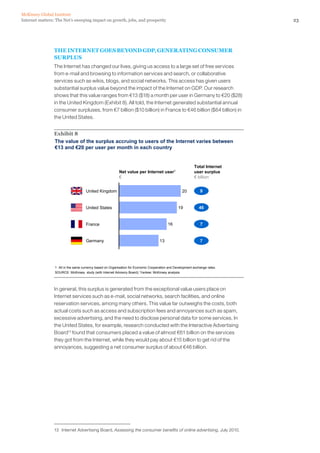
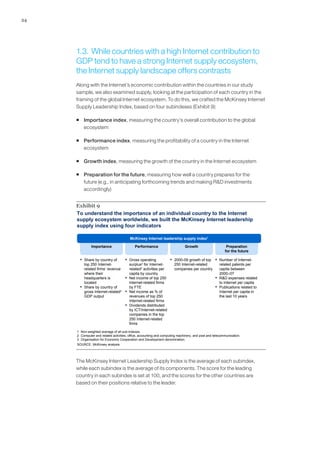
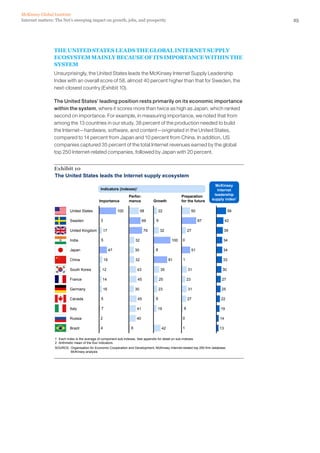
  • 26.
    14 On average, our research showed that the Internet has a greater weight in the economies that we analyzed than agriculture, utilities, and other better-established industries. In addition, the Internet was already more than half as powerful in terms of economic contribution as such major sectors as health care and financial services (Exhibit 3). Exhibit 3 If Internet were a sector, it would have a greater weight in GDP than agriculture or utilities Sector contribution to GDP % of total GDP, 2009 Real estate 11.0 Financial services 6.4 Health care 6.3 Construction 5.4 Discrete manufacturing 5.2 Transportation 3.9 Education 3.0 Communication 3.0 Agriculture 2.2 Utilities 2.1 Mining 1.7 Internet1: 3.4 1 Internet share includes parts of other sectors (e.g., communication). SOURCE: Organisation for Economic Cooperation and Development; McKinsey analysis Internet-related consumption and expenditure worldwide in 2009 was larger than the GDP of Canada or Spain and growing faster than Brazil.
  • 27.
    McKinsey Global Institute Internetmatters: The Net’s sweeping impact on growth, jobs, and prosperity 15 INTERNET IS STILL IN ITS INFANCY IN GLOBAL TERMS. The Internet’s economic impact varies widely even among countries at the same stage of development. While the Internet has reached around 6 percent of GDP in the most advanced countries like Sweden and the United Kingdom, nine out of the 13 countries are below 4 percent, leaving tremendous room for further Internet development. Within our sample group of 13 countries, the Internet’s share of GDP ranges from 0.8 percent in Russia to 6.3 percent in Web-savvy Sweden (Exhibit 4). Exhibit 4 Internet contributed directly to between 0.8 percent and Private consumption 6.3 percent of GDP, depending on the country Private investment Contribution to GDP, 2009 Public expenditure Trade balance Internet contribution to country Percent of total Internet contribution to GDP GDP Sweden 46 26 11 17 6.3 United Kingdom -3 58 25 20 5.4 South Korea -8 69 31 8 4.6 Japan -4 47 45 12 4.0 United States -4 60 24 20 3.8 Germany 53 27 13 7 3.2 India 20 28 5 47 3.2 France -2 55 35 12 3.1 Canada 61 19 17 3 2.7 China 32 23 6 39 2.6 Italy -9 56 36 17 1.7 Brazil -8 73 15 20 1.5 Russia -32 74 33 0.8 25 SOURCE: McKinsey analysis In every country except China and India, private consumption accounted for about half or more of the contribution, peaking at 69 percent of the total in South Korea or more than 70 percent in Brazil and Russia. In China and India, however, the impact of the Internet was powered by a strong trade balance, with net foreign trade making up 39 and 47 percent, respectively, of the total economic contribution from the Internet. Public expenditures on the Internet ranged widely from 5 percent of the total GDP contribution in India to more than 20 percent in the United Kingdom, United States, Brazil, and Russia.
  • 28.
    16 THE INTERNET GENERATES GROWTH Our analysis further shows that the Internet has been a major driver to economic growth and is getting stronger. Over the past 15 years, the Internet accounted for 7 percent of our 13 countries’ combined economic growth. Its influence is expanding. Looking at the past five years, the contribution to GDP growth reaches 11 percent. When we look at mature countries, we see that the Internet contributed 10 percent of their growth over the past 15 years and doubled to 21 percent in the past five years. In the United Kingdom, which mirrors the typical experience of a mature country, the Internet contributed 11 percent to the country’s growth rate over the past 15 years and 23 percent over the past five years (Exhibit 5). Exhibit 5 The Internet contribution to GDP growth has been an average 21 percent in mature countries over the past five years Nominal Internet contribution to GDP growth GDP growth, % 1995–2009 Local 1995–2009 2004–09 currency Mature Sweden 15 33 3.9 countries Germany 14 24 1.9 United Kingdom 11 23 4.7 France1 10 18 3.4 United States 8 15 4.7 South Korea 7 16 7.0 Canada 6 10 4.6 Italy 4 12 3.4 Japan2 0 0 -0.3 Average, mature countries 10 21 India 4 5 13.1 China 3 3 9.5 Brazil 2 2 10.7 Russia 1 1 26.7 Average, high-growth countries 3 3 Average, 13 countries 7 11 1 For France, the Internet contribution to growth from 2009–10 was 25 percent. 2 Negative growth due to deflation. SOURCE: National accounts, Organisation for Economic Cooperation and Development; McKinsey analysis
  • 29.
    McKinsey Global Institute Internetmatters: The Net’s sweeping impact on growth, jobs, and prosperity 17 These results are reflected at a microeconomic level where the evidence is abundantly clear that Internet usage triggers a significant increase in performance in businesses at all levels and particularly among SMEs and other entrepreneurial endeavors. We surveyed more than 4,800 SMEs in 12 countries (our study group excluding Brazil) and found that those utilizing Web technologies grew more than twice as fast as those with a minimal presence (Exhibit 6). The results hold across all sectors of the economy. Further, Web-savvy SMEs brought in more than twice as much revenue through exports as a percentage of total sales than those that used the Internet sparingly. These Web-knowledgeable enterprises also created more than twice the jobs as companies that are not heavy users of the Internet (see Box 2, ”SMEs capture a broad range of advantages”). When we look closely at individual sectors, we see that this is true across sectors from retail to manufacturing. Manufacturing is one of the sectors enjoying most impact from Internet. On average, the survey showed that the Internet enabled a 10 percent increase in profitability across countries. The impact on profits came half from increased revenues, and half from lower costs of goods sold and lower administrative costs. Exhibit 6 Small and medium-sized enterprises using Web technologies extensively are growing more quickly and exporting more widely Growth and exports of SMEs analyzed by cluster of maturity of Internet Analysis includes 12 countries and more than 4,800 SMEs Annual growth over Revenues due the last 3 years to exports % of Web-intensity1 % % of total respondents Low 6.2 2.5 42% (Web index <20%) Medium 7.4 2.7 31% (Web index 20–40%) High 27% 13.0 5.3 (Web index >40%) X2.1 X2.1 True across sectors (in particular, commerce, services, and industry) 1 McKinsey Web index defined according to the number of technologies possessed by companies and the penetration of those technologies (i.e., the number of employees/ customers or suppliers having access to those technologies). SOURCE: McKinsey SME Survey
  • 30.
    18 Box 2. SMEs capture a broad range of advantages Accelerated growth and a more accessible export market are just two of the many advantages the Internet brings to SMEs that invest in a substantial Web presence. We produced an index reflecting the penetration and usage of Internet technologies, called the SME Internet Maturity Index. This index shows penetration of Internet technology and its usage by employees, clients, and suppliers. On the basis of the Index, we placed each of the companies in our sample into one of three categories: low Web intensity, medium Web intensity, and high Web intensity. Our survey of more than 4,800 SMEs in 12 countries showed that on average, companies using Internet with a high intensity grow twice as quickly as low- Web-intensity companies, export twice as much as they do, and create more than twice as many jobs. In addition—and not surprisingly—we found that countries where a greater proportion of SMEs have a strong presence on the Internet are also those with a greater contribution from the Internet to the national economy. For example, in the United Kingdom our survey showed that about 71 percent of the SMEs use the Internet with high or medium intensity, and our analysis concluded that the Internet contributes about 5.4 percent to the British GDP. In Russia, on the other hand, only about 41 percent of SMEs have high or medium Internet engagement, and the Internet contributes about 0.8 percent to the Russian GDP.
  • 31.
    McKinsey Global Institute Internetmatters: The Net’s sweeping impact on growth, jobs, and prosperity 19 INTERNET MATURITY CORRELATES WITH A RISING STANDARD OF LIVING Leveraging endogenous growth theory, we were able to assess the Web’s impact on per capita GDP increase within the countries surveyed. The analysis showed a clear correlation between per capita GDP growth and a country’s Internet maturity based on its e3 index. We developed the e3 index to reflect Internet maturity of a country, measuring e-ngagement, e-nvironment, and e-xpenditure, which are themselves largely based on numbers provided by the World Economic Forum and OECD. Weighing these three components, the e3 index represents the depth of a country’s maturity in access infrastructure and Internet usage by individuals, businesses, and governments. Scandinavian and North American countries, three north European countries (the Netherlands, Switzerland, and the United Kingdom), and South Korea capture the top ten positions in our e3 rankings. A positive correlation has been established in the past between broadband penetration and per capita GDP growth. However, for the first time, to our knowledge, using the e3 index as an indicator of Internet maturity, we have been able to show statistically that the Internet correlates positively with net per capita GDP growth and therefore to increasing standards of living in the countries we examined. Our e3 index also correlates with labor productivity growth. Another regression we ran, based on the total Internet expenses of individuals, businesses, and government in a country, shows the same result (see Box 3, “Statistical approach”). Combined with very strong statistical evidence, these two regressions clearly show that use of the Internet correlates with higher growth in both per capita GDP and labor productivity. Using the results of these correlations, a simulation shows the Internet has enabled an increase in real per capita GDP of $500 on average in mature countries over the last 15 years. The Industrial Revolution took 50 years to achieve the same result.10 This analysis shows both the magnitude of the positive impact of the Web at all levels of society and the speed of the benefits it brings. Of course, these are just correlations. Causality still needs to be fully proved and we welcome additional work in this field. Our conclusions are consistent with earlier academic studies that explored the Internet’s impact on economies. For example, a 2003 study at Myongji University in South Korea examined 207 countries and found Internet penetration has a positive impact on economic growth. 11 A more recent study by professors at the University of Munich in 2009 found a clear path from the introduction of broadband and its increased penetration to per capita GDP, concluding that every 10-percentage-point increase in broadband penetration adds 0.9 to 1.5 percentage points to per capita GDP growth.12 10 Angus Maddison, The World Economy: Historical Statistics, Paris: OECD, 2003. 11 Changkyu Choi and Myung Hoon Yi, The effect of the Internet on economic growth: Evidence from cross-country panel data, 2003. 12 Nina Czernich, Olivier Falck, Tobias Kretzchmer, and Ludger Woessmann, Broadband infrastructure and economic growth, CESIFO working paper, December 2009.
  • 32.
    20 Box 3. Statistical approach To complete our bottom-up analysis of the contribution of the Internet to GDP based on the expenditure approach, we used statistical analysis to correlate the evolution of Internet economy with per capita GDP in a given country. The analysis was based on three main rationales: ƒ Confirm, using econometrical analysis, our first macroeconomic methodology on the contribution of the Internet to GDP growth. ƒ Isolate the net contribution of the Internet from the substitutive effect between the Internet and non-Internet spending (e.g., e-commerce) that could have been included in our contribution of the Internet to GDP. ƒ Determine the spillover effect from the Internet economy to the non-Internet economy. Some spillover, for instance, could be retail purchases that result from online price comparisons and searches, while many free services bundled with access contracts, such as e-mail, are driving some amount of economic productivity. We ran two regressions to determine the net link between growth and Internet usage. Methodology The model relies on economic growth theory and extends a total factor productivity growth equation with Internet-specific data used as an additional factor of production. Assuming a macroeconomic function between per capita GDP and input of production of Cobb-Douglas: Y = AKaLb where Y is the per capita GDP, A is the state of technology, K is physical capital per capita, and L is human capital. Assuming that A is a combination of Internet contribution and a fixed effect, we can write growth of per capita GDP as a linear combination between Internet usage, physical capital growth, and human capital growth: ƒ As a measure of growth, we used real per capita GDP growth (in 2005 US dollars) provided by the World Bank database. ƒ As a measure of Internet use in a country, we used our McKinsey e3 index, which indicates Internet maturity. ƒ For measuring contribution of capital and labor, we used growth of fixed capital per capita (in 2005 US dollars) and growth of labor per capita, both provided by the World Bank database. ƒ We also applied controlling variables, such as lagged level of per capita GDP 2005 and dummy variable per years. The second regression replaces the e3 index with total Internet expenses in each country,1 leveraging endogenous growth theory and using Internet-related ICT as an extra factor of production in Cobb-Douglas equation. We examined nine countries (the 13 countries is our study sample, excluding China, Brazil, India, and Russia, where some data were unavailable) and five years for regression for a total of 45 data points. 1 ICT expenses given by Gartner each year to which we apply Internet ratios to derive Internet expenses.
  • 33.
    McKinsey Global Institute Internetmatters: The Net’s sweeping impact on growth, jobs, and prosperity 21 Box 3. Statistical approach (continued) Findings Both equations provide the same magnitude of impact of the Internet to GDP and show positive correlation between per capita GDP growth and Internet maturity of a country: The first regression gives results statistically significant, with an R square of 89 percent and a Tstat of 2.3 for the contribution of e3 to growth. Statistical contribution of e3 to growth is evaluated at 2.6 percent. This would mean that an increase of 10 points of e3 would result in an increase of real per capita GDP growth of 0.26 percentage point. The second regression gives the same statistically significant results with an R square of 91 percent and Tstat = 3.2 for the contribution of Internet expenses to per capita GDP growth. For every 10 percent increase in Internet expenses, real per capita GDP grows an additional 1.2 percentage point. When comparing this statistical approach with a macroeconomic approach, we see that the two approaches converge and show that the Internet creates net value to an economy through GDP growth. However, we see some differences between the two approaches at the country level: In some countries (e.g., South Korea and Sweden) the statistical contribution of the Internet to growth is lower than under the macroeconomic approach, showing a substitutive effect of e-commerce. In some countries (e.g., Canada and the United States) the statistical contribution to growth is higher than under the macroeconomic approach, showing strong spillover effects on the non-Internet economy. THE INTERNET CREATES JOBS Common wisdom tends to consider that the Web has a negative or neutral impact on employment. This is derived from the idea that the Internet has favored massive disintermediation. But this is a misconception. As we have demonstrated, the Internet is a contributor to net job creation in the sample countries. While some jobs have been destroyed by the emergence of the Internet, many more have been created during the same period, including jobs directly linked to the Internet such as software engineers and online marketers as well as more traditional jobs, for example in logistics to deliver online purchases. A detailed analysis of France over the past 15 years shows that the Internet created 1.2 million jobs and destroyed 500 000 jobs, creating a net 700,000 jobs or 2.4 jobs for every one destroyed. This result is also reflected in our survey of more than 4,800 SMEs in the countries we studied, which shows that 2.6 jobs were created for every one destroyed, confirming the Internet’s capacity for creating jobs across all sectors. Further, companies that have fully integrated the technology and use it extensively create more than twice as many jobs as the average, while the Internet has a neutral to slightly negative effect on companies using it only sparingly or not at all.
  • 34.
    22 THE INTERNET IS A MODERNIZATION FACTOR FOR THE WHOLE ECONOMY Although the Internet has resulted in significant value shifts between sectors in the economy, our study demonstrates that all industries have benefited from the Web. Perhaps surprisingly, the vast majority of the economic value created by the Internet is derived from industries not directly linked to ICT. About 75 percent of the economic impact of the Internet is happening at companies in more traditional industries that have witnessed significant productivity increases (Exhibit 7). SMEs in particular obtain a strong boost from using the Internet. Exhibit 7 Traditional industries capture 75 percent of the value of the Internet Share of Internet profitability gain between companies 100% = Total Internet value for all companies Value captured by pure Internet companies (companies that only exist 24.6 because of the Internet, e.g., pure e-commerce player) Value captured by traditional companies 75.4 (companies that would exist without the Internet) SOURCE: McKinsey SME Survey
  • 35.
    McKinsey Global Institute Internetmatters: The Net’s sweeping impact on growth, jobs, and prosperity 23 THE INTERNET GOES BEYOND GDP, GENERATING CONSUMER SURPLUS The Internet has changed our lives, giving us access to a large set of free services from e-mail and browsing to information services and search, or collaborative services such as wikis, blogs, and social networks. This access has given users substantial surplus value beyond the impact of the Internet on GDP. Our research shows that this value ranges from €13 ($18) a month per user in Germany to €20 ($28) in the United Kingdom (Exhibit 8). All told, the Internet generated substantial annual consumer surpluses, from €7 billion ($10 billion) in France to €46 billion ($64 billion) in the United States. Exhibit 8 The value of the surplus accruing to users of the Internet varies between €13 and €20 per user per month in each country Total Internet Net value per Internet user1 user surplus € € billion United Kingdom 20 9 United States 19 46 France 16 7 Germany 13 7 1 All in the same currency based on Organisation for Economic Cooperation and Development exchange rates. SOURCE: McKinsey study (with Internet Advisory Board); Yankee; McKinsey analysis In general, this surplus is generated from the exceptional value users place on Internet services such as e-mail, social networks, search facilities, and online reservation services, among many others. This value far outweighs the costs, both actual costs such as access and subscription fees and annoyances such as spam, excessive advertising, and the need to disclose personal data for some services. In the United States, for example, research conducted with the Interactive Advertising Board13 found that consumers placed a value of almost €61 billion on the services they got from the Internet, while they would pay about €15 billion to get rid of the annoyances, suggesting a net consumer surplus of about €46 billion. 13 Internet Advertising Board, Assessing the consumer benefits of online advertising, July 2010.
  • 36.
    24 1.3. While countries with a high Internet contribution to GDP tend to have a strong Internet supply ecosystem, the Internet supply landscape offers contrasts Along with the Internet’s economic contribution within the countries in our study sample, we also examined supply, looking at the participation of each country in the framing of the global Internet ecosystem. To do this, we crafted the McKinsey Internet Supply Leadership Index, based on four subindexes (Exhibit 9): ƒ Importance index, measuring the country’s overall contribution to the global ecosystem ƒ Performance index, measuring the profitability of a country in the Internet ecosystem ƒ Growth index, measuring the growth of the country in the Internet ecosystem ƒ Preparation for the future, measuring how well a country prepares for the future (e.g., in anticipating forthcoming trends and making R&D investments accordingly) Exhibit 9 To understand the importance of an individual country to the Internet supply ecosystem worldwide, we built the McKinsey Internet leadership supply index using four indicators McKinsey Internet leadership supply index1 Importance Performance Growth Preparation for the future ▪ Share by country of ▪ Gross operating ▪ 2000-09 growth of top ▪ Number of Internet- top 250 Internet- surplus3 for Internet- 250 Internet-related related patents per related firms’ revenue related2 activities per companies per country capita between where their capita by country 2000–07 headquarters is ▪ Net income of top 250 ▪ R&D expenses related located Internet-related firms to Internet per capita ▪ Share by country of by FTE ▪ Publications related to gross Internet-related2 ▪ Net income as % of Internet per capita in GDP output revenues of top 250 the last 10 years Internet-related firms ▪ Dividends distributed by ICT/Internet-related companies in the top 250 Internet-related firms 1 Non-weighted average of all sub-indexes. 2 Computer and related activities, office, accounting and computing machinery, and post and telecommunication. 3 Organisation for Economic Cooperation and Development denomination. SOURCE: McKinsey analysis The McKinsey Internet Leadership Supply Index is the average of each subindex, while each subindex is the average of its components. The score for the leading country in each subindex is set at 100, and the scores for the other countries are based on their positions relative to the leader.
  • 37.
    McKinsey Global Institute Internetmatters: The Net’s sweeping impact on growth, jobs, and prosperity 25 THE UNITED STATES LEADS THE GLOBAL INTERNET SUPPLY ECOSYSTEM MAINLY BECAUSE OF ITS IMPORTANCE WITHIN THE SYSTEM Unsurprisingly, the United States leads the McKinsey Internet Supply Leadership Index with an overall score of 58, almost 40 percent higher than that for Sweden, the next-closest country (Exhibit 10). The United States’ leading position rests primarily on its economic importance within the system, where it scores more than twice as high as Japan, which ranked second on importance. For example, in measuring importance, we noted that from among the 13 countries in our study, 38 percent of the production needed to build the Internet—hardware, software, and content—originated in the United States, compared to 14 percent from Japan and 10 percent from China. In addition, US companies captured 35 percent of the total Internet revenues earned by the global top 250 Internet-related companies, followed by Japan with 20 percent. Exhibit 10 The United States leads the Internet supply ecosystem McKinsey Indicators (indexes)1 Internet Perfor- Preparation leadership Importance mance Growth for the future supply index2 United States 100 58 22 50 58 Sweden 3 69 9 87 42 United Kingdom 17 79 32 27 39 India 5 32 100 0 34 Japan 47 30 8 51 34 China 19 32 81 1 33 South Korea 12 43 35 31 30 France 14 45 25 23 27 Germany 16 30 23 31 25 Canada 5 45 9 27 22 Italy 7 41 19 8 19 Russia 2 40 0 14 Brazil 4 6 42 1 13 1 Each index is the average of component sub-indexes. See appendix for detail on sub-indexes. 2 Arithmetic mean of the four indicators. SOURCE: Organisation for Economic Cooperation and Development; McKinsey Internet-related top 250 firm database; McKinsey analysis
  • 38.
    26 Part of the explanation for this leadership may be the United States’ mixed structure among the ICT industries. US companies in the top 250 Internet-related companies are spread over all the Internet-related supply domains: 42 percent of revenues are hardware, 26 percent are software and services revenues, and 30 percent are telecoms revenues (see methodological appendix on McKinsey Internet Supply Leadership Index for more details). Other components of the McKinsey Internet Supply Leadership Index highlight the role played by other countries. ƒ The United Kingdom and Sweden companies show the best performance. In the performance portion, the United Kingdom and Sweden rank first and second, respectively, with the United Kingdom strong in per capita gross income from Internet-related companies and in net income per employee in these industries and Sweden ahead in dividends paid per capita. This is mainly because of the strong performance and importance of their telecoms operators. Indeed, telecommunications companies in European countries generally exhibit strong performance. For instance, in France, telecoms account for about 60 percent of all Internet revenues and in the United Kingdom, 87 percent. ƒ With high-growth companies, India and China are catching up fast. India is leading in the growth component with China second, followed closely by Brazil and South Korea, while Japan is near the bottom of the growth rankings. A critical difference appears to be Japan’s inability to monetize its research and development expenditures, while companies in the leading countries have done better at turning ideas into revenue. ƒ Japan and Sweden are investing in the future, but other players are rapidly emerging. Innovation is important in Japan and Sweden. Each country has strong R&D investments and a high number of patents per capita. Change could come swiftly. As the world has become more wired, developing an Internet ecosystem has taken less and less time. For example, in the 1970s and 1980s it took Israel about 14 years to grow from 50 to 200 new patents a year. Starting in the mid-1990s, it took Singapore about six years to cross this threshold, and most recently the Indian city of Bangalore crossed it in just four years.
  • 39.
    McKinsey Global Institute Internetmatters: The Net’s sweeping impact on growth, jobs, and prosperity 27 We also see an Internet ecosystem that offers contrasts (Exhibit 11). The United States is well ahead in our index, collecting fair contributions to GDP from the Internet and enjoying strong growth in these industries. The United Kingdom and Sweden are also strong performers, very much focused on telecommunications. Canada, France, and Germany could take better advantage of their high Internet usage to gain prominence on the supply side. The developing countries we studied—Brazil, China, and India—are growing quickly, as is South Korea, while Japan is having difficulty capitalizing on its relatively high importance to the Internet supply ecosystem because of performance challenges. Exhibit 11 Countries with a high Internet contribution to GDP correlate Growth >10% to those with a strong Internet supply ecosystem ▪ United Kingdom and Sweden are very Internet contribution to GDP strong performers % ▪ Telecoms are driving high contribution ▪ Similar 7.0 ▪ The United hardware- States is driven 6.0 capturing ~40% profiles: South of Internet/ICT Korea is 5.0 share growing fast ▪ Lower 4.0 and Japan is consumption of capturing high 3.0 Internet by proportion of individuals and Internet/ICT 2.0 No country with higher per supply but is strong ecosystem capita GDP decelerating 1.0 and low Internet generate lower mainly due to consumption contribution low than in the performance 0 5 10 15 20 25 30 35 40 45 50 55 60 United Kingdom McKinsey Internet ecosystem supply index or Sweden ▪ France, Germany, and ▪ China and India fast catching up Canada should leverage both in terms of GDP contribution strong usage to participate and supply ecosystem, followed more in the supply side by Brazil with strong growth SOURCE: McKinsey analysis A detailed look at consumption and supply tells the same story. Beneath the flashy successes of Google, Facebook, eBay, and other megasites and bolstered by uncounted smaller efforts, the Internet has become a sizable contributor to national economies, giving economic growth a much larger push than most observers might guess.
  • 40.
    28 1.4. Public and private should focus on four critical areas to build a strong supply ecosystem To develop a strong Internet ecosystem, public and private attention must be focused on supply and in particular on four areas critical to the development of the network. Infrastructure is obvious and usually receives the bulk of public and private investment, but the other areas—human capital, financial capital, and the business environment—are also important components of a healthy and vibrant system. The McKinsey i4F (Internet 4 Foundations) index (see Exhibit 12) takes these areas into account. Exhibit 12 We built a McKinsey i4F index to gauge the capacity of Quality drivers individual countries on the four foundations of the Internet Quantity drivers McKinsey i4F (Internet 4 Foundations) Ecosystem index Human capital Financial capital Infrastructure1 Business environment ▪ University/industry ▪ Ease of access to ▪ Government ▪ State of cluster research loans procurement of development collaboration ▪ Venture capital advanced tech ▪ Time required to start ▪ FDI and technology availability products a new business transfer ▪ Financing through ▪ Overall infrastructure ▪ Burden of ▪ Brain drain local equity market quality government ▪ Quality of math and ▪ Value per capita of ▪ Quality of electricity regulations science education venture capita (VC) supply ▪ Intellectual property ▪ Tertiary education investment (semi ▪ Secure Internet protection enrollment rate conductor/other servers per capita ▪ Effectiveness. of ▪ Availability of electronics, Internet, antitrust policy Scientists and software computer, ▪ Ease of doing engineers hardware computer) business index ▪ Researchers in R&D ▪ Number of VC deals ▪ Capacity for per capita per capita innovation ▪ Personnel in R&D ▪ Irregular payments FTE per capita 50% and bribes 50% 50% 50% ▪ Value of VC investment (Semi ▪ Researchers in R&D conductor/other ▪ Personnel in R&D electronics, Internet, FTE Software computer, ▪ Graduate in Science Hardware computer) ▪ Doctorate in all S&E ▪ Number of VC deals fields 1 Infrastructure is viewed as being a "threshold" factor where increases above a certain threshold do not confer additional advantage. All ratings above 60 (our defined threshold) are set to 60. SOURCE: World Economic Forum; United Nations Educational, Scientific and Cultural Organization; Venture Expert; International Institute for Management Development; World Bank; McKinsey analysis Countries such as Sweden and the United States that rank high across the board (Exhibit 13) are also the ones that generate the most value from the Internet. Indeed, we see a correlation between Internet i4F indicator and Internet McKinsey Supply Leadership Index showing how important it is for a country wishing to build a strong Internet ecosystem to focus on these four areas (Exhibit 14).
  • 41.
    McKinsey Global Institute Internetmatters: The Net’s sweeping impact on growth, jobs, and prosperity 29 Exhibit 13 The United States and Sweden are outperforming the McKinsey i4F index McKinsey i4F Indicators (indexes)1 Internet Human Financial Infra- Business ecosystem capital capital structure3 environment index2 United States 83 84 60 76 76 Sweden 54 41 60 92 62 Japan 59 17 60 83 55 Canada 55 26 60 81 55 United Kingdom 53 26 60 75 54 Germany 49 17 60 79 51 France 47 26 60 72 51 South Korea 53 34 60 56 51 China 53 20 46 64 46 Russia 47 26 31 29 33 India 31 21 26 51 32 Italy 27 10 37 51 31 Brazil 24 14 39 34 28 1 Each index is the average of component sub-indexes. See appendix for detail on sub-indexes. 2 Arithmetic mean of the four indicators. 3 Infrastructure is viewed as being a "threshold" factor where increases above a certain threshold do not confer additional advantage. All ratings above 60 (our defined threshold) are set to 60. SOURCE: Organisation for Economic Cooperation and Development; McKinsey Internet-related top 250 firm database; McKinsey analysis Exhibit 14 The correlation between our i4F and supply indexes shows that a favorable environment enables a strong performance in Internet supply Correlation between i4F index and McKinsey supply index, 2009 % McKinsey supply index 60 United States R2 = 63% 50 (89% without India and Canada)1 Sweden United Kingdom 40 India Korea China Japan 30 France Italy Canada 20 Germany Brazil 10 Russia 0 0 5 10 15 20 25 30 35 40 45 50 55 60 65 70 75 80 McKinsey i4F index 1 Canada: Low score mainly due to Nortel collapse. India: High McKinsey supply leadership index mainly due to Bangalore and not whole India. SOURCE: World Economic Forum; United Nations Educational, Scientific and Cultural Organization; Venture Expert; International Institute for Management Development; World Bank; McKinsey analysis
  • 42.
    30 ƒ Human capital has been a clear advantage for the United States. The United States has historically produced and attracted a large quality and quantity of trained professionals to provide the talent required by its Internet ecosystem. — Focusing on education: The breadth and depth of education, particularly in math and sciences, is among the key indicators in this area. The United States, which ranked highest on this indicator, is home to some of the world’s top universities, attracting high-potential domestic and foreign scholars. For example, 43 percent of all doctoral candidates in US science and engineering programs are foreign students brought to the country by the strong reputations of its universities, a scholastic marketing program targeting foreign students, opportunities to earn high salaries, and administrative processes that ease their integration into the programs. In Sweden, the government has started several initiatives to increase the number of highly-qualified ICT graduates, including a program that provided IT training to 75,000 primary and elementary school teachers, who then brought these skills to students at all levels. The Swedish government also increased the capacity of university science and engineering programs, allowing a 7 percent increase in graduate students studying science between 1998 and 2004, and helped to finance new positions in the Royal Institute of Technology. However, even the US now faces potential shortfalls in creating the talent needed in the STEM (Science Technology Engineering and Mathematics) disciplines that are critical to the Internet ecosystem. — Bringing in talent: Countries also deepen their talent pools by bringing in skilled workers from abroad. For example, compared to other countries, US immigration policy has historically created a favorable climate for attracting ICT foreign workers, allowing employment visas to be distributed based on employment and educational qualifications and for employers to sponsor incoming employees. And the Internet ecosystem has been a disproportionate beneficiary of these policies. In 2003, for example, 40 percent of H-1B nonimmigrant visas were granted to ICT workers. — Creating technological clusters: Technology clusters can create a virtuous cycle for the creation and attraction of talent–examples include Silicon Valley in the United States and Bangalore in India. Some technology clusters have emerged naturally, while others have benefited from proactive policies and private-public partnerships. For example, to increase the number of high qualified ICT graduates, Sweden developed a research center in new technologies. However, the success record of setting up technology clusters has been mixed and many of the lessons learned well documented. — Diversifying the employer landscape: Countries benefit by bringing in foreign multinationals that help build human capital through knowledge and technological exchanges.
  • 43.
    McKinsey Global Institute Internetmatters: The Net’s sweeping impact on growth, jobs, and prosperity 31 ƒ Efficient access to financial capital has helped many countries gain prominence in the Internet ecosystem. Access to appropriate funding— through loans, venture capital investments, or other means—gives SMEs and other entrepreneurial efforts a chance to compete with their ideas in the market. Countries that launched incentives to promote financing both from traditional sources such as banks or self-investment and from investors with a more specialized approach, such as venture capital funds, are performing well on our index. — Promoting private investment: The United States, for example, launched financing mechanisms targeted at supporting the growth of technology firms. One of these programs, created in 1990, was the Advanced Technology Program, which was designed to organize cofinancing between public and private sources for high-risk research and development projects. Between 1990 and 2004, the program led to the funding of $576 million in electronics projects and $504 million in ICT projects. South Korea offered loan incentives to promote investment in carrier infrastructure and has encouraged significant investment in local research and development, resulting in a 9 percent annual increase in investment between 1997 and 2007. — Encouraging Internet-focused venture capital: For example, Israel, though not in our study sample, famously advanced its IT sector about 20 years ago by creating alliances with Silicon Valley venture capitalists, who today have access to the country’s superior ICT R&D. In East London, a technology ecosystem is being developed with the involvement of 60 venture capital firms specializing in new technology are 21 specialize in technology. ƒ Infrastructure investment is essential, and most developed countries have already created an efficient Internet infrastructure. Investment in the supply infrastructure goes well beyond plugging the Internet into everyone’s homes, although that is obviously a critical component. Infrastructure is the essential backbone for the entire ecosystem. It creates the platform upon which users, and organizations experience the Internet, and upon which entrepreneurs and businesses innovate. Using research we conducted with the World Economic Forum—the “Innovative Heatmap”—we established a threshold in our index.14 Once countries pass this quality and penetration milepost—as most developed countries have—infrastructure is no longer a differentiating component. — Facilitating deployment of infrastructure by the private sector: In Japan, for example, the development of a fiberoptic network by private telecommunications players has been encouraged in several ways, and by 2007 the penetration of the fiberoptic networks rivaled that of the DSL network, 40 percent and 46 percent, respectively. Some of the policies applied included: tax incentives such as tax reductions on assets and favorable income tax rates; advantageous credit facilities such as government- guaranteed credit for private telecommunications companies, enabling them to access to lower finance costs, and more leverage while building the country’s Internet infrastructure; and market deregulation, which created competition in the telecommunications market, leading the incumbent, NTT, to invest in a fiberoptic network. 14 McKinsey’s Innovation Heatmap partnership with the World Economic Forum.
  • 44.
    32 — Direct public investment in infrastructure, especially in areas with limited profitability: The Swedish government, for example, has promised Internet access to everyone and backed this with a €570 million project to bring broadband to low-density areas. ƒ Creating the right business environment is critical. An attractive business environment can accelerate the growth of a vibrant Internet ecosystem, while the wrong environment could stifle growth. A wide range of factors from tax incentives and the level of corruption to encouragement of innovation work together to create a nurturing environment for developing an Internet ecosystem. — Promoting deregulation: Deregulation often brings increased competition, which can motivate established companies to increase their investments or push for greater innovation. In the United States, deregulation triggered a series of new offers from incumbents AT&T and Verizon, while in Japan NTT moved forward with building a fiberoptic network. — Creating an appropriate legal framework: Protecting intellectual property rights and strengthening antipiracy laws, as South Korea did in the late 1990s, can contribute to an attractive business environment. — Offering a favorable taxation environment for specific industries: India, for example, gives hardware and IT companies a tax holiday of up to five years to encourage entrepreneurship, while the United Kingdom offers partial tax relief to investors in specific businesses. France offers a fitting example of how our analysis can help countries consider ways to gain a stronger presence on the global Internet ecosystem and increase the contribution the Internet delivers to the national economy (see Box 4, “The French experience”). Box 4. The French experience Though France sits in the middle ranks of the McKinsey Internet Supply Leadership Index, the country is moving forward with clear strengths. It has a strong user base, solid infrastructure, and quality math and science education. It is also one of the countries with higher contribution of Internet to growth and among mature countries, one of the countries where Internet contribution is growing the most. France could build on these advantages while targeting areas that remain underdeveloped to create a more powerful ecosystem. Specifically, analysis based on the i4F indicator suggests that a focus on three areas—improved research collaboration between academia and industry, more aggressive development of technology clusters, and clear policies to attract top talent in the country—could bring substantial improvements. Some efforts have begun including, for instance, new tax credits for research (a 30 percent tax reduction for an R&D investment of up to €100 million and a 5 percent reduction above that threshold), and greater autonomy for universities. However, further work on these areas are likely to deliver promising results. In addition, efforts to build a critical mass and take advantage of the European large size could be accelerated.
  • 45.
    McKinsey Global Institute Internetmatters: The Net’s sweeping impact on growth, jobs, and prosperity 33 2. Leveraging the Internet to revive the engine of growth Understanding how much the Internet contributes to national economies and how this value is created lays a solid foundation for moving national policy and business strategy forward in a way that maximizes the benefits gained. Initiatives can be championed by government policy makers, by business executives, or by a partnership between the two groups, but in every instance the goal should be strengthening the domestic Internet ecosystem—consumption and supply—and delivering as much value to the economy as possible. 2.1. Public decision makers should act as catalysts to unleash the Internet’s growth potential Public spending can be used as a catalyst to boost both usage and ecosystem. Public expenditures are a proven vehicle for getting more people and businesses online. Countries that have the highest public investment in the Internet as share of GDP tend also to gain the greatest contribution to GDP from the Internet. The United Kingdom, the United States, Sweden, and South Korea posted the highest average levels of investment in the Internet between 2000 and 2009, and each rank among the highest on the McKinsey Internet Supply Leadership Index and in contribution to GDP from the Internet. Sweden has pushed the development of e-government services and was ranked first in e-government advancement index in 2008 by the United Nations. Public policy leaders could work to stimulate Internet usage among individuals, businesses, and government bodies. This can be accomplished by providing government-sponsored training sessions that instruct individuals and businesspeople on how to access the advantages offered by the Internet, offering incentives to the private sector to expand and improve infrastructure, and encouraging public agencies to develop e-government applications, allowing people and businesses to access government services and conduct business with the government online. The government’s own usage encourages citizen use, and government e-transformation creates a large-scale, complex demand that stimulates the supply ecosystem (see Box 5, “Pushing Internet usage on three fronts”).
  • 46.
    34 Box 5. Pushing Internet usage on three fronts Sweden and South Korea have both focused intense public energy on encouraging Internet usage on all fronts: individuals, businesses, and public bodies. These efforts are among the reasons these countries ranked high in many of the categories we examined while determining the economic impact of the Internet. Sweden initiated numerous programs to push individual usage. Among the many efforts, it invested about €570 million to bring broadband Internet services to small towns and areas with low population densities, it launched an IT in Schools program to train 75,000 elementary and secondary teachers, it was quick to liberalize the telecommunications markets, and it offered subsidies to promote broadband expansion. The government also focused attention on bringing the Internet to businesses. One program, financed jointly by the government and private sources, focused on teaching IT capabilities to businesses with fewer than ten employees. In another, the National IT Training Program, the government sought to teach IT skills to unemployed workers who lacked such training. The government also turned the mirror on itself. In an effort called the 24/7 Agency, the government moved to modernize public administration and bring government services online. The diverse approach included allowing digital transmission of medical prescriptions and developing the world’s first “virtual embassy” in the online environment Second Life. In 2008, Sweden was ranked first on the e-government advancement index by the United Nations. In South Korea, the government launched a program called Ten-Million-People Internet Education, which focused on demographics not usually associated with Web activity, including the elderly, farmers, the disabled, prisoners, and housewives. The program offered government-subsidized training and reached 4 million people in 2000. The government also encourages infrastructure investment, for example through certification programs for buildings larger than 3,300 square meters stating they are broadband ready and creating a broadband backbone between Seoul and Taejon using a mix of public and private financing. And the South Korean government works to boost Internet usage at schools, for instance by encouraging online homework.
  • 47.
    McKinsey Global Institute Internetmatters: The Net’s sweeping impact on growth, jobs, and prosperity 35 Governments could also create a business environment that promotes technological development and innovation. Using regulations to maintain constructive competition; encouraging the deployment of advanced technologies; building top-level education and training centers in science, engineering, and other relevant fields; pushing companies to target the global market; and publically applauding successes are among the themes public leaders can embrace to put together an attractive environment. Public officials could also focus some of their attention on SMEs, which as we have seen are critical to job creation and can garner large advantages from Internet proficiency. This can be done by assuring high-speed and very-high-speed access to the Internet and adopting policies that encourage SME owners and managers to invest in digital technologies and to become adept at exploiting them. These are among the many measures that will cultivate the four core areas of Internet ecosystems: human capital, financial capital, infrastructure, and the business environment (see Box 6, “Strength in the four critical areas is at the core of Bangalore’s ecosystem”). Box 6. Strength in the four critical areas is at the core of Bangalore’s ecosystem India has become synonymous with taking advantage of IT and the Internet for economic growth, and Bangalore is at the epicenter. India accounts for more than two-thirds of IT services imports to developed countries from developing countries, and Bangalore, a city of 5.5 million people, accounts for just more than a third of it.1 This success was built on a thriving Internet ecosystem supported by public policy and private investment across all four critical areas. To develop human capital, the region established a broad network of premier technical and business educational institutions, including 12 universities, 98 engineering colleges, and 107 medical colleges. The effort included the opening of national institutes for advanced studies, which have become leading research and development centers. Among its infrastructure initiatives, India helped create IT and electronic business clusters, such as Software Technology Parks created in 1991 and Electronic City. In addition, private investment led to such world-class campuses as the DBS Business Center in Bangalore. The introduction of incubators and datacom services, along with efficient transportation networks, create convenient locations for new companies. Favorable tax policies, such limited-time exemptions on taxes for computer hardware and IT companies, and subsidies, including guarantees and favorable rates for electricity, contributed to an attractive business environment. The government nurtured financial capital by leveraging the Bangalore stock exchange and promoting the growth of domestic venture capital funds. Bangalore offers strong financial support to entrepreneurs through several state government institutions, including the Karnataka Information Technology Venture Capital Fund (KITVEN), Bangalore. 1 Deepak K. Sareen, Innovation and IT in India (Bangalore case study), presentation at the 2nd International conference on the process of innovation and learning in dynamic city regions, July 2005, Bangalore.
  • 48.
    36 2.2. All business leaders, not just e-CEOs, should put the Internet at the top of their strategic agenda Business leaders, including those leading companies that are not directly involved with the Internet, must be proactive in taking advantage of benefits the Internet offers. This is especially true for entrepreneurs leading SMEs. With technology changing so rapidly, executives must regularly review their businesses, looking for ways the Internet can help them innovate more aggressively or reach new markets more rapidly. They must in particular be prepared to reinvent their business models to capture productivity and performance improvements unlocked by the Internet. Managers also must not let the distractions of day-to-day business prevent them from contemplating the future. They must find time to consider the changes new technologies could soon bring to their businesses. Up-and-coming trends such as distributed co-creation and networks as organizations could radically change the way talent and work are organized. Operations are also evolving thanks to ideas such as the Internet of things, where chips create highly efficient networks from almost any physical product, and wiring for a sustainable world, where technology is put up against the world’s environmental challenges. The Internet is also spawning innovative business models such as innovation from the bottom of the pyramid, in which new ideas come from efforts to serve the lowest- income households, and multisided models that look for additional value from assets created operating a core business, such as selling market data. The Internet can also create opportunities in social goods, such as using new technologies to solve community problems (see Box 7, “Two trends to follow for decision makers”).
  • 49.
    McKinsey Global Institute Internetmatters: The Net’s sweeping impact on growth, jobs, and prosperity 37 Box 7. Trends to follow for decision makers Developments occur quickly around the Internet. And while it is important that businesses work diligently to squeeze as much benefit as they can from today’s technology, leaders must also keep a watchful eye on new ideas that could drastically change the environment, lavishing advantages on the prepared, and perhaps taking from those caught unaware. In our research we have been tracking many of these trends (See “Clouds, big data, and smart assets: Ten tech-enabled business trends to watch”). Here we highlight three developments seem particularly promising. Cloud computing. Cloud computing separates IT resources, such as files and programs, from the devices used to access them. This can create many advantages, such as resource pooling and a near unlimited ability to enlarge or reduce available resources rapidly. By 2015, cloud computing could represent a $70 billion to $85 billion opportunity, with the market doubling every two years. Some technology watchers forecast that by 2015 cloud computing infrastructure and applications could account for 20 percent of total spend in these areas. Fast movers in this technology could quickly gain substantial market share, displacing incumbents with new cloud-based solutions and reaching into new markets. The impact could reach 20 to 30 percent of the total IT budget for businesses willing to leverage this new technology. Internet of Things.1 In a rapidly developing trend called the Internet of Things, sensors and actuators embedded in physical objects—from roadways to pacemakers—are becoming linked through wired and wireless networks, often using the same Internet Protocol (IP) that connects the Internet. These networks churn out huge volumes of data that flow to computers for analysis. This merging of the physical and virtual worlds creates news ways of capturing value. Customer buying preferences can be associated in real time at a specific location, enabling more timely and relevant offers to be provided. Sensors on objects can enable companies to turn product sales into services sales, including everything from proactive maintenance, to selling usage instead of a capital good (e.g., car-sharing services in urban areas). Instrumenting complex systems such as electrical grids allows them to be operated with higher levels of efficiency and reliability, and can even be used to introduce dynamic pricing to further manage peak demand. Remote health monitoring can reduce the costs of treating patients while simultaneously improving their health outcomes. The numerous benefits of this trend result in an estimated growth rate of connected nodes on the Internet of Things of 35 percent annually for at least the next five years. As this trend continues to accelerate globally, companies and governments that move first into using the Internet of Things stand to gain knowledge that will enable competitive advantage. Big data 2 . Companies with the capability to use the Internet, including the Internet of Thngs, to collect operational, consumer, and market data, could find their databases quickly overflowing with information. And while the Internet may no longer be “a wasteland of unfiltered data,” as Clifford Stoll once feared, these databases, if left unmanaged, could become mammoth junkyards of useless bytes. Big data is a movement toward finding ways to manage databases that have become so massive that conventional tools are not adequate for capturing, storing, searching, sharing, analyzing, and visualizing this information. Enterprises that develop expertise in handling big data will find rich opportunities in areas such as creating transparency around these databases, reducing search time and easing concurrent processes, sifting through the data to uncover variabilities and areas for potential performance improvements, and segmenting large populations into usable groups based on a broad range of variables. Looking at how advances in big data might affect various industries, we estimate the US health care industry could see annual productivity improvements of almost 1 percent over the next decade, creating potential value of more than $300 billion. The public sector in developed European countries could witness annual productivity gains of about 0.5 percent with a potential value of €255 billion. 1 Michael Chui, Markus Löffler, and Roger Roberts, “The Internet of Things,” McKinsey Quarterly, March 2010. 2 Big data: The next frontier for innovation, competition, and productivity, McKinsey Global Institute, May 2011 (www.mckinsey.com).
  • 50.
    38 2.3. All stakeholders should take part in a continuous and fact-based public-private dialogue In addition to the individual efforts by government and business leaders, there are initiatives that require public-private dialogue for the greatest impact from the Internet ecosystem. Within individual countries and globally, open discussions between government and businesses are needed to make progress across a variety of issues, such as intellectual property in the digital age or data privacy. To spur consumption, public and private leaders should explore solutions to such pressing issues as standards for legally valid digital identities, which would create even greater efficiencies in online business transactions, and intellectual property protection, which would unleash new markets and encourage greater creativity. The supply side also requires attention from all parties on vexing topics including net neutrality, talent availability, and the overall business environment. A strong and continuous public-private dialogue is necessary to assure optimal conditions within each country and internationally.
  • 51.
    McKinsey Global Institute Internetmatters: The Net’s sweeping impact on growth, jobs, and prosperity 39 3. Monitoring the progress of the Internet using four critical indicators Putting a numerical value on the benefits that the Internet delivers to national economies requires sorting volumes of data from divergent sources. To ease the analysis and provide a “language” and tools to discuss the impact of the Internet, we developed four indexes that examine separate parts of the picture and together provide the full panorama. The first two—the e3 index and the iGDP—examine input and output indicators centered on expenditures and consumption. The next two— the McKinsey Internet supply leadership index and the i4F indicator—examine input and output indicators focused on data related to the supply side. Countries earnestly wishing to strengthen their domestic Internet ecosystem could review their progress against these indicators at least annually and make whatever adjustments are needed to assure a steady course. As part of our effort to closely track how the Internet is affecting national economies, we plan to publish an annual report that follows and analyzes changes in these indexes. In addition, we have made public the details of our methodology of our indicators in an effort to encourage open-source-type improvements. We welcome any criticisms and suggestions on how our analyses can be improved. We will receive all contributions, synthesize them, and publish them to improve the way we measure the impact of the Internet. 3.1 The consumption indicators The e3 index measures the maturity of a country’s Internet ecosystem by considering input indicators linked to consumption. Data are collected in three essential areas: engagement, environment, and expenditures. Engagement, which weighs heavily in the index, covers private, corporate, and government use and gathers data on aspects such as number of personal computers in use, number of companies with a Web site or high-speed access, and number of government departments that can be reached online. The iGDP indicator, reflecting direct Internet contribution to GDP, also examines consumption but in addition looks at output. Data gathered for this indicator help determine the overall contribution the Internet makes to a country’s economy. Our e3 index and contribution to GDP are correlated (Exhibit 15).
  • 52.
    40 Exhibit 15 Internet maturity is measured through internal consumption and correlated to the Internet contribution to GDP Correlation between McKinsey e3 index and Internet contribution to GDP, 2009 Internet contribution to GDP1 % of GDP 6 United Kingdom R2 = 76% 5 (89% without Canada) Korea Sweden Japan 4 United States 3 Germany France Canada Brazil China 2 Italy India 1 Russia 0 0 5 10 15 20 25 30 35 40 45 50 55 60 65 70 75 80 85 McKinsey e3 index % 1 Excluding imports and exports to restrict to local consumption. SOURCE: World Economic Forum; McKinsey analysis 3.2 The supply indicators The McKinsey Internet Supply Leadership Index, as we’ve noted, measures a country’s overall participation in the global Internet ecosystem by examining supply- side inputs. The analysis is broken down into four key sections: current importance to the global ecosystem, performance within the ecosystem, recent growth, and activities that prepare a country for future developments. Taken together, these data represent each country’s power within the dynamic Internet ecosystem and can help predict how the system might evolve Supply outputs are gathered into the i4F indicator, which offers a valid representation of the vibrancy of a country’s ecosystem. This indicator focuses on the four core areas of Internet development that we discussed earlier: human capital, financial capital, infrastructure, and the business environment.
  • 53.
    McKinsey Global Institute Internetmatters: The Net’s sweeping impact on growth, jobs, and prosperity 41 Conclusion Common sense tells us that the Internet is a vital part of a modern, healthy, growing economy. And while previous studies have examined parts of the picture, McKinsey research for the first time shows the full extent of the Internet’s economic power. And that power is massive. In the 13 countries we studied, the Internet has contributed on average 3.4 percent to GDP, weighting more than agriculture, energy, and other better-established industries, and it adds considerable vigor to economic growth. Perhaps surprisingly, the brunt of this impact—about 75 percent—is from industries that are not directly linked to the Internet, except of course by their computers. This value comes primarily from increased productivity. Understanding just how much the Internet contributes to national economies should spur government and business leaders to seek ways to optimize their participation in the global Internet ecosystem. Encouraging usage is an unavoidable first step in leveraging public spending, but leaders must also focus on providing human capital, financial capital, infrastructure, and the appropriate business environment.
  • 54.
    42 Postscript by Martin N. Baily and Christian Saint-Etienne The global economy is emerging from the deep recession that followed the recent financial crisis and, in the advanced economies, growth remains weak. One response to slow growth and persistent unemployment might be to hunker down, avoid change, and discourage innovative ideas and the spread of new products and services. This study by McKinsey has taken a different view, documenting for the first time the substantial contributions to past growth made by the Internet and the potential that this exciting, and still relatively new, technology will contribute to future growth. Embracing new technology is the right way for the G8 economies to move forward. The reality of severe budget constraints has made it impossible to launch a new fiscal stimulus; indeed, many in the G8 have decided they must start fiscal consolidation. So if traditional pump-priming fiscal policy is not available, what will power a stronger recovery? An important part of the answer is that new technologies will encourage investment and hiring, generating new demand by consumers and businesses even as they expand supply. Increasing access to the Internet and developing its applications form a vital part of the latest technological revolution that can contribute to recovery and rising living standards. It is important not to overstate what technology by itself can do, as we learned in 2001 when many computers and fiberoptic cables sat idle after the high-tech bust. It is not enough to buy the software and hardware—it is what we do with technology that counts, particularly in the case of the Internet, which is an enabling technology. But innovation and new technology do provide the opportunity to grow, and, if the G8 countries are able to seize the opportunity, they will generate a new growth cycle based on a firmer footing than the finance-driven bubble that burst in 2007. Last year, a pioneering study of the impact of the Internet on the French economy was released by the French office of McKinsey. This work has now been expanded in this study to cover all of the G8 economies, a fearsome task that has been completed in record time with fascinating results. Having worked with McKinsey, we appreciate the power that comes from combining traditional economic data with business knowledge and insight. This report points to important correlations between economic growth and Internet investment and usage, and it documents that companies that use the Internet are the ones that grow more rapidly and are more profitable. But it also describes the ways in which businesses are using the Internet to streamline processes, manage supply chains, and create new services for consumers that were not even imagined a few years ago. Rapid changes in technology can be bewildering, so it is very welcome to get from this report a new understanding of both the nature and the potential of the Internet.
  • 55.
    McKinsey Global Institute Internetmatters: The Net’s sweeping impact on growth, jobs, and prosperity 43 There are important lessons for government policy makers from this report. It shows that countries that helped put in place the Internet infrastructure and promoted usage reaped the benefits of their efforts and saw a larger growth contribution. The dynamism of the private sector has been key to the speed of deployment of the Internet and to developing its applications, but the origins of the Internet and its transition into a global network also owe something to the contributions of governments. Governments as users are also a key catalyst to the spread of Internet technologies. The future growth of the Internet will require cooperation among governments and the right kind of smart regulation and support, at both the national and international levels. Another important lesson for policy is that the Internet is one of the emerging technologies that is forcing economic change and that demands flexibility. This report finds that the Internet is a net job creator but that it has contributed to some job losses as well as job gains. Countries can take advantage of new technologies only if they can manage and facilitate the migration of economic activities induced by innovation. It is a wonderful opportunity for learning and the exchange of ideas by convening the e-G8 meeting prior to the formal meeting of G8 leaders. This report from McKinsey provides a powerful tool to push forward the economic debate and to better understand the power of technology to add to growth. Martin N. Baily Schwartz Chair and senior fellow of the Brookings Institution Former chair of the US President’s Council of Economic Advisers Christian Saint-Etienne Professor of business economics at the Conservatoire National des Arts et Métiers in Paris Member of the Conseil d’Analyse Economique reporting to the French prime minister May 2011
  • 57.
    McKinsey Global Institute Internetmatters: The Net’s sweeping impact on growth, jobs, and prosperity 45 Appendix: Methodology and approach specifics 1. THE INTERNET’S CONTRIBUTION TO GDP Although there are three different methods for calculating the contribution a sector makes to GDP, none take into account the total value contributed by the Internet to the overall economy of a country or a society. These are the three common methods: ƒ Production method measures the value added by companies by producing goods and services ƒ Revenue method measures the gross revenues of institutional sectors, including employee pay ƒ Expenditure method measures the total spending by consumers and government on goods and services The contribution a sector makes to GDP is usually measured by calculating production. However, to quantify the Internet’s contribution in detail using this method, we would have had to obtain data on the proportion of revenue attributable to the Internet with associated margins for all companies in all sectors. Such an approach would have required too many unreliable estimates. We therefore decided to use the expenditure method based on OECD data. This method looks at four factors: private consumption, public expenditures, private investment, and trade balance. We included for the contribution of each of these factors all categories of goods and services enabled by the Internet and attributed an underlying portion of this to the Internet. We tried as much as possible to use a same data source for each category across the 13 countries in our study to provide comparable figures. These were: ƒ Private consumption. This is the total consumption of goods and services by consumers via the Internet or needed to obtain Internet access, including electronic equipment, e-commerce broadband turnover of telecoms operators on the retail market, mobile Internet market, hardware and software consumption, and smartphone consumption.15 ƒ Public expenses. These include Internet spending for consumption and investment by the government (software, hardware, services, and telecoms)16 at pro rata of Internet. 15 For e-commerce: Retail, Forrester online retail forecast, 2010, Euromonitor from trade sources/ national statistics, 2010, euromarketer database, 2010; Travel : PhoCusWright’s, Online travel overview, 2010; gambling : H2 Gambling Capital Consultants, online gambling, 2010. For Broadband private revenues, global connected view forecasts, Yankee, 2010. For mobile data, GlobalMediaForecast, Strategy Analytics, 2010. For PCs : Worldwide Quarterly PC Tracker, IDC, 2010. For smartphones : Top Forecast Mobile devices worldwide, Gartner, 2010. 16 IT spending by industry market worldwide, 2007–2013, Gartner 2010.
  • 58.
    46 ƒ Private investment. This is private-sector investment in Internet-related technologies17 (telecoms, extranet, intranet, Web sites, etc.). ƒ Trade balance. Trade balance includes exports of goods, services, and Internet equipment, plus B2C and B2B e-commerce, from which were deducted all associated imports.18 We estimated B2B e-commerce based on numbers provided by academic studies,19 and we developed a methodology based on overall size of e-commerce, Internet maturity of a country, and offline trade balance. We estimated B2C overall trade balance based on academic studies20 as well as on Internet maturity of a country and size of e-commerce. For each component of the contribution to GDP, we then looked at the assumptions regarding the underlying portion related to the Internet: ƒ For electronic equipment (computers and smartphones), we applied a ratio based on the overall time spent on the Internet against the total time using the product. ƒ For goods and services sold on the Internet, we recognized them at their full e-commerce value because they indicate the importance of the Internet industry as a link in the distribution chain, even though certain Internet transactions might have occurred even in the absence of the Internet. ƒ For Internet mobile and fixed subscriptions, we took 100 percent of individual expenses. ƒ For ICT goods and services investments and trade balance, we used a bottom- up analysis based on the description of each subcategory (software, hardware, services, and telecoms) made by McKinsey TMT database 2009. This allowed us to allocate the part of Internet within ICT goods and services (70 percent for software and services, 40 percent for hardware and telecoms). All exchange rates used were extracted from Organisation for Economic Cooperation and Development StatExtracts database. 17 Organisation for economic cooperation and development StatExtracts data projected in 2009 using IT spending by industry market worldwide, 2007-2013, Gartner 2010, growth. 18 Organisation for economic cooperation and development StatExtracts data and e-commerce sources. 19 For example, Evaluer l’impact du développement d’Internet sur les finances de l’Etat, study on the behalf of the French Senate, October 2009. 20 For example, European Commission Flash Eurobarometer, Consumer attitudes towards cross-border trade and consumer protection, September 2010; European Commission Flash Eurobarometer, Retailers’ attitudes towards cross-border trade and consumer protection, October 2010.
  • 59.
    McKinsey Global Institute Internetmatters: The Net’s sweeping impact on growth, jobs, and prosperity 47 2. THE MCKINSEY INTERNET SUPPLY LEADERSHIP INDEX To help understand how a country fits into the global Internet ecosystem, we developed the McKinsey Internet Supply Leadership Index, which considers a country’s participation in the global network across four essential areas: its importance to the network, its overall performance within the network, recent growth rates, and how the country is preparing for the future. ƒ Importance. This measure looks at a country’s overall contribution to the global ecosystem. Among the data considered are the share of the world’s top 250 Internet companies that are headquartered in the country and the share delivered by that country of the world’s gross Internet output,21 including hardware, software, services, and telecommunications pro-rata of share of Internet. ƒ Performance. The quality of a country’s Internet contribution is measured under this metric. Net income per employee from the top 250 Internet companies, comparative dividend payments, and economic surplus per capita 22 generated by Internet-related companies are among the data collected here. ƒ Growth. To look at a country’s dynamism within the ecosystem, we also examine growth trends within a country’s Internet industry. Growth rates between 2000 and 2009 of the top 250 Internet-related companies within a country is a key indicator. ƒ Preparation for the future. We also try to ascertain how well a country is preparing for the future. To do this, we look at, on a per capita basis, the number of Internet-related patents23 granted in recent years, research and development expenditures,24 and relevant publications25 over the past ten years. Principal sources used in compiling the index were OECD data and the McKinsey top 250 Internet-related companies. Top 250 ICT firms To build our top 250 Internet-related firms (see Exhibit 16), we used different database sources and aggregated a final list of ICT firms based on revenue. We considered public and private companies that were not subsidiaries. In particular, to avoid double counting, we took care to check across the database to ensure that each company was independent and did not belong to a parent already included in our listing. We wanted to reflect the “supply side” of the Internet and therefore excluded e-commerce or content companies and included as “Internet-related supply companies”26 every software, hardware, services, and telecommunications company. 21 Organisation for economic cooperation and development StatExtracts data projected in 2009 using IT spending by industry market worldwide, 2007–2013, Gartner 2010, growth. 22 Organisation for economic cooperation and development StatExtracts data projected in 2009 : office accounting, computer and related activities, and telecommunications, using IT spending by industry market worldwide, 2007–2013, Gartner 2010, growth. 23 OECD database 2010; share of Patents ICT Internet from 2000 to 2007. 24 OECD database 2006: office accounting, computer and related activities, and telecommunications. 25 Thomson Scientific, 2006. 26 Including search engines such as Google and Yahoo.com.
  • 60.
    48 We used several databases to compile the list and used Bloomberg database to extract data we needed for each company and other sources (mainly annual reports) when Bloomberg data were unavailable: ƒ Top 80 ICT firms: “OECD Information Technology Outlook 2010 Highlights” ƒ Top 50 telecommunications firms and IT firms: “OECD Key ICT Indicators,” 2003 ƒ Top 330 IT services firms: Gartner, “Market Share: IT Services, Worldwide, 2006– 2008” ƒ Top 100 ICT firms: “BusinessWeek Info tech 100,” 2009 ƒ Top 250 IT companies, 2004 hardware companies: “CBR Executive Focus 2005” ƒ Top 300 telecoms firms, top 300 hardware companies: “Hoovers, 2011” ƒ Forbes 2000 biggest companies ƒ Top 10 ICT firms in each category: OECD Information Technology outlook report, 2010 Exhibit 16 McKinsey top 250 Internet-related firms database Company Primary country Company Primary country 3M United States Bouygues Telecom France Accenture Ireland Broadcom Corporation United States Acer Incorporated Taiwan Brocade Communications Systems, Inc. United States Adobe United States Brother Industries, Ltd. Japan Advanced Info Service PCL Thailand BT Group plc United Kingdom Advanced Micro Devices, Inc. United States Byd Electronic China Affiliated computer services United States CA technologies United States Agfa-Gevaert N.V. Belgium Cable & Wireless Worldwide plc United Kingdom Agilent United States Cablevision Systems Corporation United States Alcatel-Lucent France Canon Japan Amdocs United Kingdom Cap Gemini S.A. France América Móvil, S.A.B. de C.V. Mexico Capita group United Kingdom American Tower Corporation United States Casio Computer Co. Ltd. Japan Apple Inc. United States Cellcom Israel Ltd. Israel ASUSTeK Computer, Inc. Taiwan CenturyLink, Inc. United States AT&T Inc. United States CGI Group Inc Canada Atos Origin S.A. France China Mobile Limited China AU optronics Taiwan China Unicom (Hong Kong) Limited China AutoDesk Inc United States Chunghwa Telecom Co., Ltd. Taiwan Automatic data processing United States Cisco Systems, Inc. United States BCE Inc. Canada Cognizant Technology Solutions Corporation United States Bearing point Netherlands COLT Group S.A. Luxembourg Belgacom SA Belgium Comcast United States Bharti Airtel Limited India Commscope United States BMC software United States Compal electronics Taiwan
  • 61.
    McKinsey Global Institute Internetmatters: The Net’s sweeping impact on growth, jobs, and prosperity 49 Exhibit 16 McKinsey top 250 Internet-related firms database (continued) Company Primary country Company Primary country Computacenter United Kingdom Infineon Technology Germany Computer Sciences Corporation United States Infosys Technologies Limited India COMSYS Holdings Corporation Japan Intel Corporation United States Convergys Corp United States International Business Machines Corporation United States Crown Castle International Corp. United States Intuit United States CSK HOLDINGS corporation Japan Inventec Taiwan Dassault Systemes SA France Israel Telecommunications Corp. Limited Israel Dell Inc. United States Itissalat Al-Maghrib Morocco Deutsche Telekom AG Germany Juniper Networks, Inc. United States Diebold, Incorporated United States Jupiter Telecommunications Co., Ltd. Japan Dimension data holding South Africa KDDI Japan DISH Network Corporation United States Konami Japan DST systems United States Konica Minolta Holdings, Inc. Japan Electronic Arts United States Koninklijke KPN N.V. Netherlands Elisa Corporation Finland KT Corporation South Korea Elpida Memory, Inc. Japan KYOWA EXEO CORPORATION Japan EMC United States L3 United States Emerson Electric United States Leap Wireless International, Inc. United States Everything Everywhere Ltd. United Kingdom Lenovo Group Limited China Far EasTone Telecommunications Co., Ltd. Taiwan Level 3 Communications, Inc. United States First Data United States Lexmark United States Fiserv United States LG Electronics South Korea Flextronics Singapore LG Uplus Corp. South Korea Foxconn Technology Co., Ltd. Taiwan Liberty Global, Inc. United States France Telecom France Logica plc United Kingdom freenet AG Germany Logitech Internation SA Switzerland Freescale Semiconductor United States LSI Corporation United States Frontier Communications Corporation United States Manitoba Telecom Services Inc. Canada Fujitsu Limited Japan MasTec, Inc. United States Gemalto France Matsushita Electric Japan Global Crossing Limited Bermuda MEDION AG Germany Google Inc. United States MegaFon OAO Russia Group Bull SA France MetroPCS Communications, Inc. United States Groupe Steria SCA France Micron Technology, Inc. United States Harris Corporation United States Microsoft Corporation United States HCL Technologies India Micro-Star International Co., Ltd. Taiwan Hellenic Telecommunications Organization S.A. Greece Millicom International Cellular S.A. Luxembourg Hewlett-Packard Company United States Mitsubishi Electric Japan Hitachi, Ltd. Japan Mitsumi Electric Co., Ltd. Japan Hon Hai Precision Industry Taiwan Mobile TeleSystems OJSC Russia HTC Taiwan Motorola Solutions, Inc. United States Huawei China MPS Group Inc United States Hynix Semiconductor Inc. South Korea MTN Group Limited South Africa Idea Cellular Limited India NCR Corporation United States IDT Corporation United States NEC Corporation Japan Iliad S.A. France NetApp, Inc. United States Illinois Tool Works Inc. United States NII Holdings, Inc. United States Imation Corp United States Nippon Telegraph and Telephone Corporation Japan Imtech N.V. Netherlands Nokia Corporation Finland INDRA Spain Nortel Networks Canada
  • 62.
    50 Exhibit 16 McKinsey top250 Internet-related firms database (continued) Company Primary country Company Primary country NS Solutions Japan Taiwan Semiconductor Manufacturing Taiwan Nividia United States TalkTalk Telecom Group PLC United Kingdom NXP semiconductors Netherlands Tata consultancy services India OI, Brasil Brazil TCL Corporation China Oki Electric Industry Company, Limited Japan TDC Denmark Denmak Oracle Corporation United States Tech Data United States Otsuka Corporation Japan Tele2 AB Sweden P.T. Telekomunikasi Indonesia Tbk. Indonesia Telecom Corporation of New Zealand Limited New Zealand PAETEC Holding Corp. United States Telecom Italia S.p.A. Italy Panasonic Corporation Japan Telefonaktiebolaget LM Ericsson Sweden PCCW Limited China Telefónica, S.A. Spain Philippine Long Distance Telephone Company Philippines Telefonos de Mexico Mexico Pioneer Corporation Japan Telekom Austria AG Austria Pitney Bowes Inc. United States Telekom Malaysia Berhad Malaysia Portugal Telecom, SGPS, S.A. Portugal Telekomunikacja Polska S.A. Poland QUALCOMM Incorporated United States Telenor ASA Norway Quanta computer Taiwan Telephone and Data Systems, Inc. United States Qwest United States TeliaSonera AB Sweden Reliance Communications Ltd. India Telkom SA Limited South Africa Renesas Electronics Corporation Japan Tellabs Inc United States Research In Motion Limited Canada Telstra Corporation Limited Australia Ricoh Japan TELUS Corporation Canada Rogers Communications Inc. Canada Tencent Holdings Limited China Rostelecom Russia Teradata Corporation United States Royal Philips Electronics N.V. Netherlands Texas instrument United States Sage Group plc United Kingdom Thomson Reuters United States SAIC, Inc. United States Tieto Finland Samsung Electronics Co., Ltd. South Korea Tokyo electron Japan SanDisk Corporation United States Toshiba Corporation Japan Sanyo Electric Japan Total Access Communications PLC Thailand SAP Germany True Corporation Public Company Limited Thailand Seagate technology Corp United States Unisys Corporation United States Seiko Japan United Internet Germany SES S.A. Luxembourg Veritas United States Sharp Japan Verizon Communications Inc. United States Shaw communication Canada Vimplecom Russia Siemens Germany Virgin Media Inc. United Kingdom Singapore Telecommunications Limited Singapore Vivendi France SK Telecom Co., Ltd. South Korea Vivo Participações S.A. Brazil Softbank Japan Vodafone Group Plc United Kingdom Sony Corporation Japan Western Digital Corporation United States Sony Ericsson Mobile Communications AB Japan Wincor-Nixdorf Germany Sopra France Wind telecommunicazioni Italy Sprint Nextel Corporation United States Windstream Corporation United States Stmicroelectronics Switzerland Wipro Limited India Storage technology Corporation United States Wistron Taiwan Sungard data systems United States Xerox United States Swisscom Switzerland Yahoo Japan Japan Symantec United States Yahoo! Inc. United States Taiwan Mobile Co., Ltd. Taiwan ZTE Corporation China
  • 63.
    McKinsey Global Institute Internetmatters: The Net’s sweeping impact on growth, jobs, and prosperity 51 Annual revenues of companies in our database range from $1.5 billion to $123 billion. This list enabled us to understand the importance (revenues), performance (as net income per FTE or as percentage of revenues, dividends), and growth of each country’s companies present in the 250 top Internet-related firms and to understand the underlying mix among hardware, software and services, and telecoms in each country (Exhibit 17). Exhibit 17 The United States is the only fully mixed ecosystem whereas European countries are telecom-driven Split by sector of the revenue share of the top 250 Internet-related companies % Mixed United States 42 2 26 30 Telecom- Brazil 100 driven Russia 100 Italy 100 United Kingdom 13 87 France 14 15 70 Canada 35 5 59 Sweden 58 42 Germany 52 7 41 China 40 60 Hardware 16 South Korea 84 Japan 70 7 22 Services India 54 46 Hardware Internet1 Software/ Telecom services Average EBITDA margin 11% 39% 21% 33% % EBITDA per employee $31 $185 $40 $140 $ thousand 1 Pure Internet players excluding e-commerce. SOURCE: McKinsey Internet-related top 250 firms database; Bloomberg; Hoovers; McKinsey analysis 3. E3 INDEX The e3 index measures Internet connectivity in a country and allows comparisons between countries. The index is based on three components (see Exhibit 18): ƒ e-ngagement: usage of the Internet by individuals, companies, and the public bodies ƒ e-nvironment: infrastructure quality and speed and Internet penetration of the home ƒ e-xpenditure: expenditure on the Internet, including advertising and e-commerce
  • 64.
    McKinsey Global Institute Internetmatters: The Net’s sweeping impact on growth, jobs, and prosperity 52 The strength of each component is computed using 17 different indicators, most of which are taken from the WEF Global Information Technology Report's Networked Readiness Index. The index takes into account each component by giving a 40 percent weighting each to e-ngagement and e-nvironment and a 20 percent weighting to e-xpenditure. The score for each component is its indicator’s average. Exhibit 18 Our McKinsey e3 index measures accumulation of means and Internet usage in a specific country McKinsey e3 index e-ngagement e-nvironment e-xpenditure 40% 40% 20% Private individual use ▪ Number of secure Internet ▪ Online ▪ Number of PCs servers advertising spend ▪ Number of mobile subscriptions ▪ Digital content accessibility ▪ Percentage of the ▪ Number of high-speed subscribers ▪ Internet speed population that ▪ Number of Internet users ▪ Number of high-speed- purchases on line Company use connectible homes ▪ E-commerce ▪ Internet use within companies as percentage of ▪ Number of companies with a total revenue Web site ▪ Number of companies with a high-speed connection Government use ▪ Government participation in Internet development ▪ Number of government departments accessible on line ▪ Number of government information systems on line SOURCE: Networked Readiness Index; The Internet economy 25 years later 2010; Pyramid data tracker; Strategy Analytics; World digital media trends; Forester research online; Organisation for Economic Cooperation and Development; McKinsey analysis 4. I4F INDEX The i4F index measures the Internet-enabling ecosystem in a country and allows comparisons between countries. The index is based on four components: ƒ Human capital: education and research quality and power in a country. The score is divided between the quality of the human capital (50 percent) and the power of the human capital in terms of quantity (50 percent). ƒ Financial capital: available financing for Internet and ICT companies. The score is divided between per capita availability (50 percent) and global financing opportunities (50 percent). ƒ Infrastructure: infrastructure quality and the penetration of Internet-enabling infrastructure. ƒ Business environment: regulatory and societal effects on country’s attractiveness to businesses.
  • 65.
    McKinsey Global Institute Internetmatters: The Net’s sweeping impact on growth, jobs, and prosperity 53 The strength of each component is calculated using 31 different indicators, most of which are taken from the WEF Global Competitiveness Report. Other sources include the World Bank database, IMD world competitiveness, UNESCO database, and Venture Expert. The index takes into account each of the four components, giving them equal weight. The score for each component is its indicator’s average. We established a threshold at 60 percent for the infrastructure component, because infrastructure is a differentiating parameter for only those countries that have not reached a certain level of infrastructure development and quality. 5. SME SURVEY In May 2011 we surveyed a sample of SMEs in 12 countries (Canada, China, France, Germany, India, Italy, Japan, Russia, South Korea, Sweden, the United Kingdom, and the United States). The purpose of the survey was to determine the significance of Internet technologies on performance and industrial dynamism for SMEs with fewer than 250 employees and turnover below €250 million. More than 4,800 SMEs completed the survey. Selected companies have all invested in Internet technologies. ƒ Representative sample. To select our sample, we checked with local statistical agencies in each country to ensure we approached a representative sample of the SME population in each country, with appropriate distribution in terms of region, sector, and number of employees. This assured that for each country, our respondents were representative of the local economy. ƒ Technologies considered. The survey considered e-mail, intranet, extranet, Web sites, Web 2.0 technologies, and online marketing. ƒ Survey questionnaire. There were four parts to the survey: company details, key figures and the company’s position in its sector, Internet technology penetration of the company, and the impact of Internet technologies on the company’s development and performance. The section considering the Internet’s impact on economic performance was based primarily on a 2002 survey by US economist Hal Varian. ƒ The SME Internet Maturity Index. We then produced an index reflecting the penetration and usage of Internet technologies, which we called the “index of SME Internet maturity.” This index shows penetration of Internet technology and its usage by employees, clients, and suppliers, weighted for the importance attributed to each technology by our sample. On the basis of the index, we placed each of the companies in our sample in one of three categories: ƒ Low Web intensity: companies with a score of 0–20 percent on the Internet index (43 percent of the sample) ƒ Medium Web intensity: companies with a score of 20–40 percent on the Internet index (30 percent of the sample) ƒ High Web intensity: companies with a score of more than 40 percent on the Internet index (27 percent of the sample)
  • 66.
    54 6. CONSUMER SURPLUS Scope McKinsey and Company published a white paper 27 offering primary market- research-based estimates of the value of online services, derived from an online survey administered in the spring of 2010 in six countries: France, Germany, Russia, Spain, the United Kingdom, and the United States. The survey targeted the current broadband population. The value of Internet services was estimated from a list of 16 services clustered in three major blocks: communication (e.g., e-mail, social networks), entertainment (e.g., gaming, podcasts), and information services (e.g., search/comparison, wikis). The original sample size encompassed 4,500 online interviews, representative of the online population. The questionnaire included sociodemographic elements, Internet usage, stated services interest, and willingness to pay as well as a conjoint-analysis- based trade-off of services with price and privacy risk. Definitions The paper addressed the value of online services through the concept of service surplus. For the consumer, the service surplus is the value to the consumer of the online services minus any costs associated with using those online services (e.g., paid services) and any form of pollution. The consumer service value is the value of the benefit consumers derive by being able to consume a product or service for a price lower than the most that they would be willing to pay. The pollution factor is the negative value consumers assign to advertising interruption and private information collection while using Internet services. This pollution effect is measured by calculating the amount a consumer is willing to pay to avoid being disturbed by advertising formats and to limit private-information abuse while using ad-funded Internet services. Therefore, the consumer service surplus is the value derived by the consumer from Internet services usage that is not countered by pollution. 27 Internet Advertising Board, Assessing the consumer benefits of online advertising, July 2010.
  • 67.
    McKinsey Global Institute Internetmatters: The Net’s sweeping impact on growth, jobs, and prosperity 55 Bibliography Bughin, Jacques, Michael Chui, and James Manyika, “Clouds, big data, and smart assets: Ten tech-enabled business trends to watch,” McKinsey Quarterly, August 2010. Carr, Nicholas, The big switch: Rewiring the world, from Edison to Google, New York: W.W. Norton & Company, 2009. Czernich, Nina, Oliver Falck, Tobias Kretschmer, and Ludger Woessmann, Broadband infrastructure and economic growth, CESIFO working paper, December 2009. Dunnewijk, Theo, Huub Meijers, and Adriaan van Zon, Accounting for the impact of information and communication technologies on total factor productivity: Towards an endogenous growth approach, European Commission Joint Research Centre Institute for Prospective Technological Studies, 2007. European Commission, Report on cross-border e-commerce in the EU, staff working document, March 2009. European Commission Flash Eurobarometer, Consumer attitudes towards cross- border trade and consumer protection, September 2010. European Commission Flash Eurobarometer, Retailers’ attitudes towards cross- border trade and consumer protection, October 2010. European Commission Joint Research Centre Institute for Prospective Technological Studies, The 2010 report on R&D in ICT in the European Union, 2010. Fornefeld, Martin, Gilles Delaunay, and Dieter Elixmann, The impact of broadband on growth and productivity, study on behalf of the European Commission (DG Information Society and Media), Micus, 2008. Greenwich Consulting, Evaluer l’impact du développement d’Internet sur les finances de l’Etat, study on the behalf of the French Senate, October 2009. Hamilton Consultants, The economic value of the advertising-supported Internet ecosystem, Internet Advertising Board report, June 2009. McKinsey & Company, East London: World-class center for digital enterprise, March 2011. McKinsey & Company, Impact d’Internet sur l’économie française: Comment Internet transforme notre pays, March 2011. McKinsey Global Institute, Beyond austerity: A path to economic growth and renewal in Europe, October 2010.
  • 68.
    56 The Information Technology & Innovative Foundation, The Internet economy 25 years after .com: Transforming commerce & life, March 2010. Internet Advertising Board, Assessing the consumer benefits of online advertising, July 2010. Maddison, Angus, The World Economy: Historical Statistics, Paris: OECD, 2003. Manyika, James, Roger Roberts, and Kara Sprague, “Eight business technology trends to watch,” McKinsey Quarterly, December 2007. McKinsey proprietary database: iConsumer survey, 2008–2010. Organisation for Economic Co-operation and Development, OECD information technology outlook, 2010. Sareen, Deepak K., Innovation and IT in India (Bangalore case study), presentation at the 2nd International conference on the process of innovation and learning in dynamic city regions, July 2005, Bangalore. UNESCO Institute for Statistics, Global education digest, comparing education statistics across the world, 2010. Varian, Hal, Robert Litan, Andrew Eder, and Jay Shutter, The net impact study: The projected economic benefits of the Internet in the US, UK, France and Germany, University of California, Berkeley working paper, January 2002. World Economic Forum, The global competitiveness report, 2010. World Economic Forum, The global technological report, 2010. Zhen-Wei Qiang, Christine, and Carlo M. Rossotto, Economic impacts of broadband, Information and Communications for Development, 2009.
  • 69.
    Relevant McKinsey GlobalInstitute publications Big data: The next frontier for innovation, competition, and productivity McKinsey Global Institute (May 2011) Big data will become a key basis of competition, underpinning new waves of productivity growth, innovation, and consumer surplus-as long as the right May 2011 Big data: The next frontier for innovation, competition, and productivity policies and enablers are in place. Growth and renewal in the United States: Retooling America’s economic McKinsey Global Institute engine (February 2011) To match the GDP growth rates of the past 20 years, the United States needs a 34 percent acceleration in productivity growth to a rate not achieved since February 2011 Growth and renewal in the United States: Retooling America’s economic engine the 1960s. Three-quarters of the necessary productivity growth acceleration can come from companies adopting best practice and implementing emerging business and technology innovations. The remaining one-quarter—and more— can come from government and business working together to address barriers that today limit productivity growth. Beyond austerity: A path to economic growth and renewal in Europe McKinsey Global Institute (October 2010) With multiple pressures on growth and constrained public finances, Europe needs structural reform even to match past GDP growth rates. Parts of Europe October 2010 Beyond austerity: A path to economic growth and renewal in Europe have begun to reform with demonstrable success. If the rest of Europe emulated their best practice, the region could add 4 to 11 percent to per capita GDP, without cutting holidays and leave. Clouds, big data, and smart assets: Ten tech-enabled business trends to watch (August 2010) Advancing technologies and their swift adoption are upending traditional Angus Greig Clouds, big data, and smart assets: Ten tech-enabled business trends to watch business models. Senior executives need to think strategically about how to prepare their organizations for the challenging new environment. Advancing technologies and their swift adoption are upending traditional business models. Senior executives need to think strategically about how to prepare their organizations for the challenging new environment. Jacques Bughin, Two-and-a-half years ago, we described eight information technologies are deployed are chang- Michael Chui, and technology-enabled business trends that were pro- ing too, as new developments such as virtualization James Manyika foundly reshaping strategy across a wide swath of and cloud computing reallocate technology costs industries.1 We showed how the combined effects and usage patterns while creating new ways for of emerging Internet technologies, increased com- individuals to consume goods and services and for puting power, and fast, pervasive digital communi- entrepreneurs and enterprises to dream up viable 1 James M. Manyika, Roger P. cations were spawning new ways to manage talent business models. The dizzying pace of change has Roberts, and Kara L. Sprague, and assets as well as new thinking about organiza- affected our original eight trends, which have con- “Eight business technology trends to watch,” tional structures. tinued to spread (though often at a more rapid pace mckinseyquarterly.com, than we anticipated), morph in unexpected ways, December 2007. 2 Two of the original Since then, the technology landscape has contin- and grow in number to an even ten.2 eight trends merged to form a ued to evolve rapidly. Facebook, in just over two megatrend around distributed cocreation. We also identified short years, has quintupled in size to a network The rapidly shifting technology environment raises three additional trends that touches more than 500 million users. More serious questions for executives about how to help centered on the relationship between technology and than 4 billion people around the world now use their companies capitalize on the transforma- emerging markets, cell phones, and for 450 million of those people tion under way. Exploiting these trends typically environmental sustainability, and public goods. the Web is a fully mobile experience. The ways doesn’t fall to any one executive—and as change The Internet of Things (March 2010) More objects are becoming embedded with sensors and gaining the ability to communicate. The resulting new information networks promise to create new business models, improve business processes, and reduce costs and risks. Artwork by Harry Campbell How IT enables productivity growth (October 2002) Looking at the retail banking, retail trade, and semiconductor sectors in detail, MGI finds that while IT enabled productivity gains in each sector, its impact was complex and varied. IT applications that had a high impact on productivity shared three characteristics: they were tailored to sector-specific business processes and linked to performance levers; they were deployed in a sequence that allowed companies to leverage their previous IT investments effectively; and they evolved in conjunction with managerial innovation. www.mckinsey.com/mgi eBook versions of selected MGI reports are available on MGI’s website, on Amazon’s Kindle bookstore, and on Apple’s iBookstore. Download and listen to MGI podcasts on iTunes or at http://www.mckinsey.com/mgi/publications/multimedia/
  • 70.
    McKinsey Global Institute May2011 Copyright © McKinsey & Company www.mckinsey.com/mgi