Women's and Children's Health:
           Supporting Accountability

            General Perspectives

                 Carole Presern, Director
      International Stakeholders Meeting on Implementing the
Recommendations of the Commission on Information and Accountability

            Ottawa, November 20-22, 2011
Outline

1. Global Strategy for Women's and Children's Health


2. Commitments to the Global Strategy (EWEC) and the 2011
   Report


3. Contribution to COIA follow up and the work of the Expert
   Review Group?
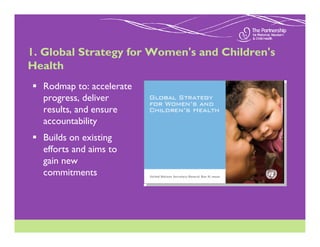
1. Global Strategy for Women's and Children's
Health
  Rodmap to: accelerate
  progress, deliver
  results, and ensure
  accountability
  Builds on existing
  efforts and aims to
  gain new
  commitments
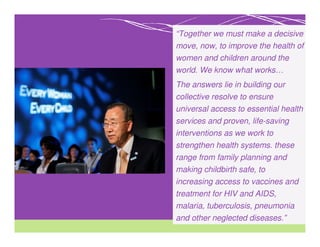
“Together we must make a decisive
move, now, to improve the health of
women and children around the
world. We know what works…
The answers lie in building our
collective resolve to ensure
universal access to essential health
services and proven, life-saving
interventions as we work to
strengthen health systems. these
range from family planning and
making childbirth safe, to
increasing access to vaccines and
treatment for HIV and AIDS,
malaria, tuberculosis, pneumonia
and other neglected diseases.”
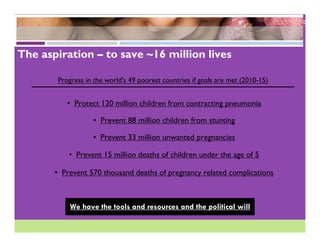
The aspiration – to save ~16 million lives

       Progress in the world's 49 poorest countries if goals are met (2010-15)


          • Protect 120 million children from contracting pneumonia

                  • Prevent 88 million children from stunting

                  • Prevent 33 million unwanted pregnancies

           • Prevent 15 million deaths of children under the age of 5

       • Prevent 570 thousand deaths of pregnancy related complications


           We have the tools and resources and the political will
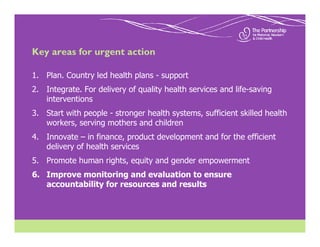
Key areas for urgent action

1. Plan. Country led health plans - support
2. Integrate. For delivery of quality health services and life-saving
   interventions
3. Start with people - stronger health systems, sufficient skilled health
   workers, serving mothers and children
4. Innovate – in finance, product development and for the efficient
   delivery of health services
5. Promote human rights, equity and gender empowerment
6. Improve monitoring and evaluation to ensure
   accountability for resources and results
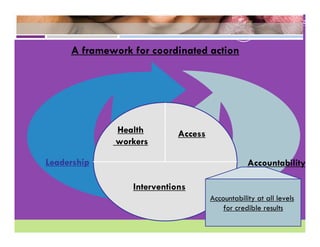
A framework for coordinated action


              Health        Access
              workers

Leadership                                       Accountability

                 Interventions
                                     Accountability at all levels
                                         for credible results
2. Commitments to Advance the Global
Strategy and the Every Woman Every
Child effort

 More than 200 commitments from a range of
 constituencies - www.everywomaneverychild.org
 Most commitments by low-income countries
 Financial, policy and service delivery
The 2011Report – analysis of comittments

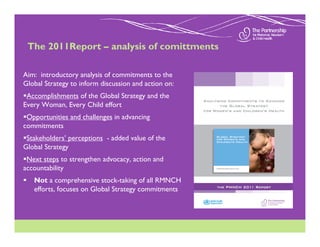
Aim: introductory analysis of commitments to the
Global Strategy to inform discussion and action on:
 Accomplishments of the Global Strategy and the
Every Woman, Every Child effort
 Opportunities and challenges in advancing
commitments
 Stakeholders’ perceptions - added value of the
Global Strategy
 Next steps to strengthen advocacy, action and
accountability
   Not a comprehensive stock-taking of all RMNCH
   efforts, focuses on Global Strategy commitments
Commitments (as of June 2011)

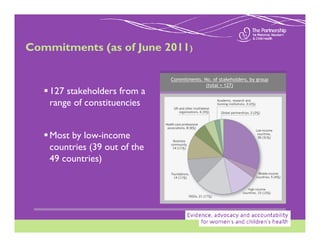
                               Commitments. No. of stakeholders, by group
                                             (total = 127)
    127 stakeholders from a
    range of constituencies


    Most by low-income
    countries (39 out of the
    49 countries)
Key Findings

 Geographic focus: high-burden countries relatively well targeted
 Continuum of care: need to focus on service delivery gaps
 Added value:
       Catalyst - more visibility of women's and children's health
       Stimulated internal dialogue
       Identified synergies and opportunities for collaboration
       Part of global movement!


Source: Analyzing Commitments to Advance the Global Strategy for Women’s and Children’s Health. PMNCH 2011
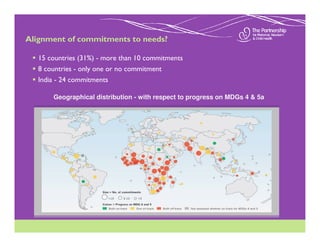
Alignment of commitments to needs?

   15 countries (31%) - more than 10 commitments
   8 countries - only one or no commitment
   India - 24 commitments

       Geographical distribution - with respect to progress on MDGs 4 & 5a
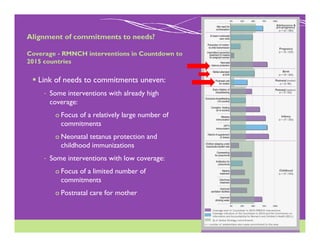
Alignment of commitments to needs?

Coverage - RMNCH interventions in Countdown to
2015 countries

   Link of needs to commitments uneven:
     - Some interventions with already high
       coverage:
        o Focus of a relatively large number of
          commitments
        o Neonatal tetanus protection and
          childhood immunizations
     - Some interventions with low coverage:
        o Focus of a limited number of
          commitments
        o Postnatal care for mother
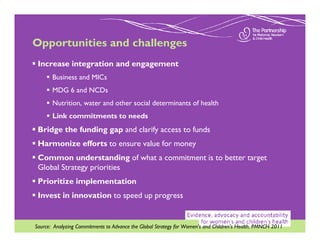
Opportunities and challenges
 Increase integration and engagement
       Business and MICs
       MDG 6 and NCDs
       Nutrition, water and other social determinants of health
       Link commitments to needs
 Bridge the funding gap and clarify access to funds
 Harmonize efforts to ensure value for money
 Common understanding of what a commitment is to better target
 Global Strategy priorities
 Prioritize implementation
 Invest in innovation to speed up progress


Source: Analyzing Commitments to Advance the Global Strategy for Women’s and Children’s Health. PMNCH 2011
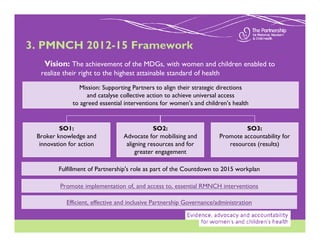
3. PMNCH 2012-15 Framework
   Vision: The achievement of the MDGs, with women and children enabled to
  realize their right to the highest attainable standard of health
                Mission: Supporting Partners to align their strategic directions
                   and catalyse collective action to achieve universal access
              to agreed essential interventions for women’s and children’s health


          SO1:                               SO2:                              SO3:
 Broker knowledge and            Advocate for mobilising and          Promote accountability for
  innovation for action           aligning resources and for             resources (results)
                                      greater engagement

         Fulfillment of Partnership's role as part of the Countdown to 2015 workplan

         Promote implementation of, and access to, essential RMNCH interventions

           Efficient, effective and inclusive Partnership Governance/administration
PMNCH contribution?

Consultation and dialogue, and action - draw on the platform (430+) to:
 Link with other accountability processes
 Identify best practices
 Draw on 2011 Report database, and adapt if useful
 Identify obstacles to implementation of COIA recommendations
 Discuss ERG findings and recommendations


 Advocacy for uptake of findings and recommendations
   - key messages and their dissemination through all constituencies and other
     networks
Thank you

Women’s and Children’s Health: Supporting Accountability - General Perspectives (English)

  • 1.
    Women's and Children'sHealth: Supporting Accountability General Perspectives Carole Presern, Director International Stakeholders Meeting on Implementing the Recommendations of the Commission on Information and Accountability Ottawa, November 20-22, 2011
  • 2.
    Outline 1. Global Strategyfor Women's and Children's Health 2. Commitments to the Global Strategy (EWEC) and the 2011 Report 3. Contribution to COIA follow up and the work of the Expert Review Group?
  • 3.
    1. Global Strategyfor Women's and Children's Health Rodmap to: accelerate progress, deliver results, and ensure accountability Builds on existing efforts and aims to gain new commitments
  • 4.
    “Together we mustmake a decisive move, now, to improve the health of women and children around the world. We know what works… The answers lie in building our collective resolve to ensure universal access to essential health services and proven, life-saving interventions as we work to strengthen health systems. these range from family planning and making childbirth safe, to increasing access to vaccines and treatment for HIV and AIDS, malaria, tuberculosis, pneumonia and other neglected diseases.”
  • 5.
    The aspiration –to save ~16 million lives Progress in the world's 49 poorest countries if goals are met (2010-15) • Protect 120 million children from contracting pneumonia • Prevent 88 million children from stunting • Prevent 33 million unwanted pregnancies • Prevent 15 million deaths of children under the age of 5 • Prevent 570 thousand deaths of pregnancy related complications We have the tools and resources and the political will
  • 6.
    Key areas forurgent action 1. Plan. Country led health plans - support 2. Integrate. For delivery of quality health services and life-saving interventions 3. Start with people - stronger health systems, sufficient skilled health workers, serving mothers and children 4. Innovate – in finance, product development and for the efficient delivery of health services 5. Promote human rights, equity and gender empowerment 6. Improve monitoring and evaluation to ensure accountability for resources and results
  • 7.
    A framework forcoordinated action Health Access workers Leadership Accountability Interventions Accountability at all levels for credible results
  • 8.
    2. Commitments toAdvance the Global Strategy and the Every Woman Every Child effort More than 200 commitments from a range of constituencies - www.everywomaneverychild.org Most commitments by low-income countries Financial, policy and service delivery
  • 9.
    The 2011Report –analysis of comittments Aim: introductory analysis of commitments to the Global Strategy to inform discussion and action on: Accomplishments of the Global Strategy and the Every Woman, Every Child effort Opportunities and challenges in advancing commitments Stakeholders’ perceptions - added value of the Global Strategy Next steps to strengthen advocacy, action and accountability Not a comprehensive stock-taking of all RMNCH efforts, focuses on Global Strategy commitments
  • 10.
    Commitments (as ofJune 2011) Commitments. No. of stakeholders, by group (total = 127) 127 stakeholders from a range of constituencies Most by low-income countries (39 out of the 49 countries)
  • 11.
    Key Findings Geographicfocus: high-burden countries relatively well targeted Continuum of care: need to focus on service delivery gaps Added value: Catalyst - more visibility of women's and children's health Stimulated internal dialogue Identified synergies and opportunities for collaboration Part of global movement! Source: Analyzing Commitments to Advance the Global Strategy for Women’s and Children’s Health. PMNCH 2011
  • 12.
    Alignment of commitmentsto needs? 15 countries (31%) - more than 10 commitments 8 countries - only one or no commitment India - 24 commitments Geographical distribution - with respect to progress on MDGs 4 & 5a
  • 13.
    Alignment of commitmentsto needs? Coverage - RMNCH interventions in Countdown to 2015 countries Link of needs to commitments uneven: - Some interventions with already high coverage: o Focus of a relatively large number of commitments o Neonatal tetanus protection and childhood immunizations - Some interventions with low coverage: o Focus of a limited number of commitments o Postnatal care for mother
  • 14.
    Opportunities and challenges Increase integration and engagement Business and MICs MDG 6 and NCDs Nutrition, water and other social determinants of health Link commitments to needs Bridge the funding gap and clarify access to funds Harmonize efforts to ensure value for money Common understanding of what a commitment is to better target Global Strategy priorities Prioritize implementation Invest in innovation to speed up progress Source: Analyzing Commitments to Advance the Global Strategy for Women’s and Children’s Health. PMNCH 2011
  • 15.
    3. PMNCH 2012-15Framework Vision: The achievement of the MDGs, with women and children enabled to realize their right to the highest attainable standard of health Mission: Supporting Partners to align their strategic directions and catalyse collective action to achieve universal access to agreed essential interventions for women’s and children’s health SO1: SO2: SO3: Broker knowledge and Advocate for mobilising and Promote accountability for innovation for action aligning resources and for resources (results) greater engagement Fulfillment of Partnership's role as part of the Countdown to 2015 workplan Promote implementation of, and access to, essential RMNCH interventions Efficient, effective and inclusive Partnership Governance/administration
  • 16.
    PMNCH contribution? Consultation anddialogue, and action - draw on the platform (430+) to: Link with other accountability processes Identify best practices Draw on 2011 Report database, and adapt if useful Identify obstacles to implementation of COIA recommendations Discuss ERG findings and recommendations Advocacy for uptake of findings and recommendations - key messages and their dissemination through all constituencies and other networks
  • 17.