Transformation of
   microFinance in India:
  Experiences, Options and
           Future

 M S Sriram and Rajesh Upadhyayula
Indian Institute of Management Ahmedabad
microFinance Defined


microFinance means many things - But
  the contours may be:
• Piloted by the alternate sector
• Focussed on the poor
• Having roots in development
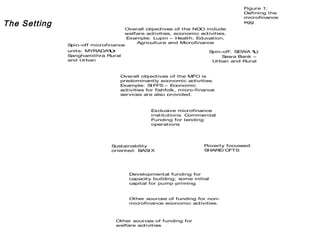
Figure 1:
                                                                                 Defining the
                                                                                 microfinance
The Setting                                                                      egg
                                   Overall objectives of the NG include
                                                                 O
                                   welfare activit ies, economic activities.
                                    Example: Lupin – Health, Education,
                                       Agriculture and Microfinance
              Spin-off microfinance
              units: MYRADAυ                                         Spin-off: SEWA υ
              Sanghamithra Rural                                          Sewa Bank –
              and Urban                                               Urban and Rural


                                  Overall obj ectives of the MFO is
                                  predominantly economic activities.
                                  Example: SI FFS – Economic
                                  activities for fishfolk, micro-finance
                                  services are also provided.


                                              Exclusive microfinance
                                              institutions. Commercial
                                              Funding for lending
                                              operations


                               Sustainability                      Poverty focussed:
                               oriented: BASI X                    SHARE/ CFTS


                                      Developmental funding for
                                      capacity building; some initial
                                      capital for pump priming.


                                      Other sources of funding for non-
                                      microfinance economic activities.


                                Other sources of funding for
                                welfare activities
What triggers transformation?


•   Size
•   Diversity of services
•   Financial sustainability
•   Focus
•   Taxation
What are the International Experiences in
                                       Transformation?


• Bolivia and Africa: Transformation of NGOs
   – To Banks
   – To FFPs
• Indonesia: Transformation of mainstream
   – To microFinance methods
• Bangladesh: Transformation of a project
   – Grameen Bank
   – Other NGOs transforming to Banks
Challenges in the Indian context

• Size
  • Growth in geographic area
  • Growth in portfolio/client size


• Diversity of Services
  • MFOs wanting to offer Savings
  • MFOs wanting to offer Risk Products
Challenges in the Indian context

• Financial Sustainability
  – Internal growth
  – Access to funds


• Focus
  – Other Developmental activities V/s mF
  – Degree of specialisation needed for mF
Challenges in the Indian context

• Tax Status
  – For-profit mF activity V/s not-for-profit NGO
    activities
  – Tax status of donor money
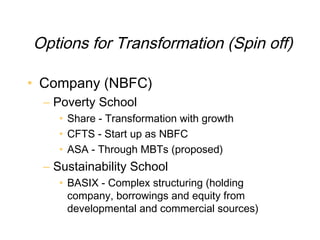
Options for Transformation (Spin off)

• Company (NBFC)
  – Poverty School
    • Share - Transformation with growth
    • CFTS - Start up as NBFC
    • ASA - Through MBTs (proposed)
  – Sustainability School
    • BASIX - Complex structuring (holding
      company, borrowings and equity from
      developmental and commercial sources)
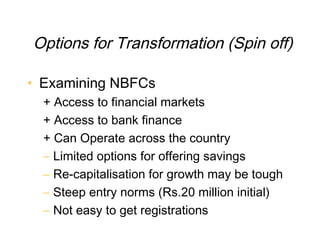
Options for Transformation (Spin off)

• Examining NBFCs
  + Access to financial markets
  + Access to bank finance
  + Can Operate across the country
  – Limited options for offering savings
  – Re-capitalisation for growth may be tough
  – Steep entry norms (Rs.20 million initial)
  – Not easy to get registrations
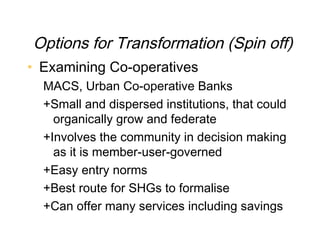
Options for Transformation (Spin off)
• Examining Co-operatives
  MACS, Urban Co-operative Banks
  +Small and dispersed institutions, that could
    organically grow and federate
  +Involves the community in decision making
    as it is member-user-governed
  +Easy entry norms
  +Best route for SHGs to formalise
  +Can offer many services including savings
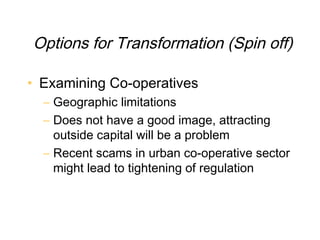
Options for Transformation (Spin off)

• Examining Co-operatives
  – Geographic limitations
  – Does not have a good image, attracting
    outside capital will be a problem
  – Recent scams in urban co-operative sector
    might lead to tightening of regulation
Options for Transformation (Spin off)

• Needs to earn enough profits to show
  that it is operationally self-sufficient
• It could also be financially self-
  sufficient, but no pressure to plow back
  profits or hit the capital market
• The concerns would be to keep costs
  under control and revenues on target to
  demonstrate
Options for Transformation (Spin off)

• Set up a Local Area Bank
  + Flexibility to offer diverse products
  + Cost of funds likely to be lower, so the
    impact on the poor with be better
  – Steep initial capital (Rs. 50 million)
  – Difficulty in getting licence
  – Limitation in geographic growth (3
    contiguous districts)
Implications for regulation
• Allow MFOs to grow organically
  – Allow for expansion in area in case of co-
    operatives and LABs, subject to minimum
    performance
• Allow for NGOs to invest in for-profit
  MFOs such as NBFCs and LABS
• No change in entry norms - ensure only
  serious players come to the field
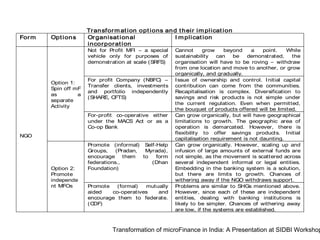
Tr an sfor m at i on opt i ons an d t h eir i m pl icat i on
For m   Opt i ons     Or ganisat i on al                I m pli cat i on
                      i ncor por at i on
                      Not for Profit MFI – a special      Cannot      grow    beyond    a    point.   While
                      vehicle only for purposes of        sustainability   can   be    demonstrated,    the
                      demonstration at scale (SRFS)       organisation will have to be roving – withdraw
                                                          from one location and move to another, or grow
                                                          organically, and gradually.
                      For profit Company (NBFC) –         I ssue of ownership and control. I nitial capital
        Option 1:
                      Transfer clients, investments       contribution can come from the communities.
        Spin off mF
                      and portfolio independently         Recapitalisation is complex. Diversification to
        as        a
                      (SHARE, CFTS)                       savings and risk products is not simple under
        separate
                                                          the current regulation. Even when permitted,
        Activity
                                                          the bouquet of products offered will be limited.
                      For-profit co-operative either      Can grow organically, but will have geographical
                      under the MACS Act or as a          limitations to growth. The geographic area of
                      Co-op Bank                          operation is demarcated. However, there is
                                                          flexibility to offer savings products. Initial
NGO
                                                          capitalisation requirement is not daunting.
                      Promote (informal) Self-Help        Can grow organically. However, scaling up and
                      Groups,    (Pradan,  Myrada),       infusion of large amounts of external funds are
                      encourage them      to  form        not simple, as the movement is scattered across
                      federations.,          (Dhan        several independent informal or legal entities.
        Option 2:     Foundation)                         Embedding in the banking system is a solution,
        Promote                                           but there are limits to growth. Chances of
        independe                                         withering away if the NGO withdraws support.
        nt MFOs       Promote   (formal)  mutually        Problems are similar to SHGs mentioned above.
                      aided   co-operatives   and         However, since each of these are independent
                      encourage them to federate.         entities, dealing with banking institutions is
                      (CDF)                               likely to be simpler. Chances of withering away
                                                          are low, if the systems are established.


                                Transformation of microFinance in India: A Presentation at SIDBI Workshop
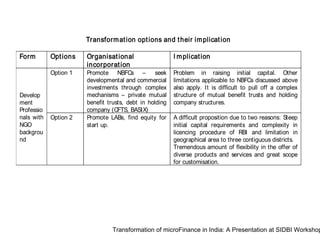
Transform at ion opt ions and t heir im plicat ion

Form        Opt ions   Organisat ional                   I m plicat ion
                       incorporat ion
            Option 1   Promote NBFCs –            seek   Problem in raising initial capital. Other
                       developmental and commercial      limitations applicable to NBFCs discussed above
                       investments through complex       also apply. It is difficult to pull off a complex
Develop                mechanisms – private mutual       structure of mutual benefit trusts and holding
ment                   benefit trusts, debt in holding   company structures.
Professio              company (CFTS, BASIX)
nals with   Option 2   Promote LABs, find equity for     A difficult proposition due to two reasons: Steep
NGO                    start up.                         initial capital requirements and complexity in
backgrou                                                 licencing procedure of RBI and limitation in
nd                                                       geographical area to three contiguous districts.
                                                         Tremendous amount of flexibility in the offer of
                                                         diverse products and services and great scope
                                                         for customisation.


                                Transformation of microFinance in India: A Presentation at SIDBI Workshop

Transformation

  • 1.
    Transformation of microFinance in India: Experiences, Options and Future M S Sriram and Rajesh Upadhyayula Indian Institute of Management Ahmedabad
  • 2.
    microFinance Defined microFinance meansmany things - But the contours may be: • Piloted by the alternate sector • Focussed on the poor • Having roots in development
  • 3.
    Figure 1: Defining the microfinance The Setting egg Overall objectives of the NG include O welfare activit ies, economic activities. Example: Lupin – Health, Education, Agriculture and Microfinance Spin-off microfinance units: MYRADAυ Spin-off: SEWA υ Sanghamithra Rural Sewa Bank – and Urban Urban and Rural Overall obj ectives of the MFO is predominantly economic activities. Example: SI FFS – Economic activities for fishfolk, micro-finance services are also provided. Exclusive microfinance institutions. Commercial Funding for lending operations Sustainability Poverty focussed: oriented: BASI X SHARE/ CFTS Developmental funding for capacity building; some initial capital for pump priming. Other sources of funding for non- microfinance economic activities. Other sources of funding for welfare activities
  • 4.
    What triggers transformation? • Size • Diversity of services • Financial sustainability • Focus • Taxation
  • 5.
    What are theInternational Experiences in Transformation? • Bolivia and Africa: Transformation of NGOs – To Banks – To FFPs • Indonesia: Transformation of mainstream – To microFinance methods • Bangladesh: Transformation of a project – Grameen Bank – Other NGOs transforming to Banks
  • 6.
    Challenges in theIndian context • Size • Growth in geographic area • Growth in portfolio/client size • Diversity of Services • MFOs wanting to offer Savings • MFOs wanting to offer Risk Products
  • 7.
    Challenges in theIndian context • Financial Sustainability – Internal growth – Access to funds • Focus – Other Developmental activities V/s mF – Degree of specialisation needed for mF
  • 8.
    Challenges in theIndian context • Tax Status – For-profit mF activity V/s not-for-profit NGO activities – Tax status of donor money
  • 9.
    Options for Transformation(Spin off) • Company (NBFC) – Poverty School • Share - Transformation with growth • CFTS - Start up as NBFC • ASA - Through MBTs (proposed) – Sustainability School • BASIX - Complex structuring (holding company, borrowings and equity from developmental and commercial sources)
  • 10.
    Options for Transformation(Spin off) • Examining NBFCs + Access to financial markets + Access to bank finance + Can Operate across the country – Limited options for offering savings – Re-capitalisation for growth may be tough – Steep entry norms (Rs.20 million initial) – Not easy to get registrations
  • 11.
    Options for Transformation(Spin off) • Examining Co-operatives MACS, Urban Co-operative Banks +Small and dispersed institutions, that could organically grow and federate +Involves the community in decision making as it is member-user-governed +Easy entry norms +Best route for SHGs to formalise +Can offer many services including savings
  • 12.
    Options for Transformation(Spin off) • Examining Co-operatives – Geographic limitations – Does not have a good image, attracting outside capital will be a problem – Recent scams in urban co-operative sector might lead to tightening of regulation
  • 13.
    Options for Transformation(Spin off) • Needs to earn enough profits to show that it is operationally self-sufficient • It could also be financially self- sufficient, but no pressure to plow back profits or hit the capital market • The concerns would be to keep costs under control and revenues on target to demonstrate
  • 14.
    Options for Transformation(Spin off) • Set up a Local Area Bank + Flexibility to offer diverse products + Cost of funds likely to be lower, so the impact on the poor with be better – Steep initial capital (Rs. 50 million) – Difficulty in getting licence – Limitation in geographic growth (3 contiguous districts)
  • 15.
    Implications for regulation •Allow MFOs to grow organically – Allow for expansion in area in case of co- operatives and LABs, subject to minimum performance • Allow for NGOs to invest in for-profit MFOs such as NBFCs and LABS • No change in entry norms - ensure only serious players come to the field
  • 16.
    Tr an sform at i on opt i ons an d t h eir i m pl icat i on For m Opt i ons Or ganisat i on al I m pli cat i on i ncor por at i on Not for Profit MFI – a special Cannot grow beyond a point. While vehicle only for purposes of sustainability can be demonstrated, the demonstration at scale (SRFS) organisation will have to be roving – withdraw from one location and move to another, or grow organically, and gradually. For profit Company (NBFC) – I ssue of ownership and control. I nitial capital Option 1: Transfer clients, investments contribution can come from the communities. Spin off mF and portfolio independently Recapitalisation is complex. Diversification to as a (SHARE, CFTS) savings and risk products is not simple under separate the current regulation. Even when permitted, Activity the bouquet of products offered will be limited. For-profit co-operative either Can grow organically, but will have geographical under the MACS Act or as a limitations to growth. The geographic area of Co-op Bank operation is demarcated. However, there is flexibility to offer savings products. Initial NGO capitalisation requirement is not daunting. Promote (informal) Self-Help Can grow organically. However, scaling up and Groups, (Pradan, Myrada), infusion of large amounts of external funds are encourage them to form not simple, as the movement is scattered across federations., (Dhan several independent informal or legal entities. Option 2: Foundation) Embedding in the banking system is a solution, Promote but there are limits to growth. Chances of independe withering away if the NGO withdraws support. nt MFOs Promote (formal) mutually Problems are similar to SHGs mentioned above. aided co-operatives and However, since each of these are independent encourage them to federate. entities, dealing with banking institutions is (CDF) likely to be simpler. Chances of withering away are low, if the systems are established. Transformation of microFinance in India: A Presentation at SIDBI Workshop
  • 17.
    Transform at ionopt ions and t heir im plicat ion Form Opt ions Organisat ional I m plicat ion incorporat ion Option 1 Promote NBFCs – seek Problem in raising initial capital. Other developmental and commercial limitations applicable to NBFCs discussed above investments through complex also apply. It is difficult to pull off a complex Develop mechanisms – private mutual structure of mutual benefit trusts and holding ment benefit trusts, debt in holding company structures. Professio company (CFTS, BASIX) nals with Option 2 Promote LABs, find equity for A difficult proposition due to two reasons: Steep NGO start up. initial capital requirements and complexity in backgrou licencing procedure of RBI and limitation in nd geographical area to three contiguous districts. Tremendous amount of flexibility in the offer of diverse products and services and great scope for customisation. Transformation of microFinance in India: A Presentation at SIDBI Workshop