Transcription of non
coding genes
• Suraj. S. Mauryav
• R.k.Talreja College
• Msc – part ll
• 2227005
Gshaj
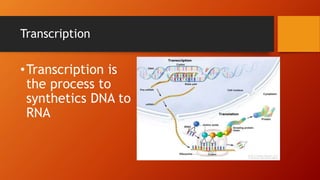
Transcription
•Transcription is
the process to
synthetics DNA to
RNA
Transcription in the non coding genes
• Enzyme works as with own unique setvof general
transcription factor.
• TBP ( TATA Binding protein) is the general transcription
factor.
• TBP is involved in initiating transcription by Pol – I and
Pol -II and as well as Pol –II.
• Pol –I required only one gene for expression that
encoding the rRNA precursor.
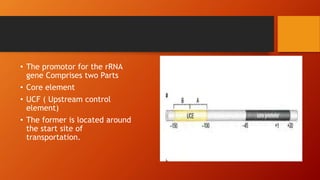
• The promotor for the rRNA
gene Comprises two Parts
• Core element
• UCF ( Upstream control
element)
• The former is located around
the start site of
transportation.
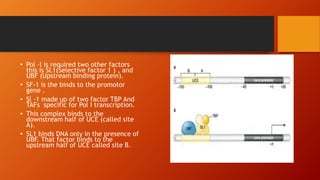
• Pol –l is required two other factors
this is SL1(Selective factor 1 ) , and
UBF (Upstream binding protein).
• SF-1 is the binds to the promotor
gene .
• Sl -1 made up of two factor TBP And
TAFs specific for Pol I transcription.
• This complex binds to the
downstream half of UCE (called site
A).
• SL1 binds DNA only in the presence of
UBF. That factor binds to the
upstream half of UCE called site B.
• Pol III promoters come in various forms, and the vast majority
havethe unusual feature of being located downstream of the
transcription start site.
• Some Pol III promoters consist of two regions, called Box A and Box
B, separated by a short element and others contain Box A and Box
C.still others contain a TATA element like those of Pol II.
• Pol II and Pol I, transcription by Pol III requires transcription
factors in addition to polymerase.
• This factors are called TFIIIB and TFIIIC (for the tRNA genes), and
those plus TFIIIA for the 5S rRNA gene.
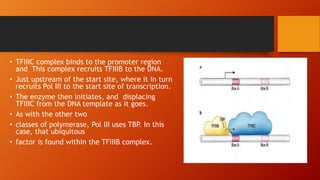
• TFIIIC complex binds to the promoter region
and This complex recruits TFIIIB to the DNA.
• Just upstream of the start site, where it in turn
recruits Pol III to the start site of transcription.
• The enzyme then initiates, and displacing
TFIIIC from the DNA template as it goes.
• As with the other two
• classes of polymerase, Pol III uses TBP. In this
case, that ubiquitous
• factor is found within the TFIIIB complex.
•Thank you

Transcription in non coding genes.pptx

  • 1.
    Transcription of non codinggenes • Suraj. S. Mauryav • R.k.Talreja College • Msc – part ll • 2227005 Gshaj
  • 2.
  • 3.
    Transcription in thenon coding genes • Enzyme works as with own unique setvof general transcription factor. • TBP ( TATA Binding protein) is the general transcription factor. • TBP is involved in initiating transcription by Pol – I and Pol -II and as well as Pol –II. • Pol –I required only one gene for expression that encoding the rRNA precursor.
  • 4.
    • The promotorfor the rRNA gene Comprises two Parts • Core element • UCF ( Upstream control element) • The former is located around the start site of transportation.
  • 5.
    • Pol –lis required two other factors this is SL1(Selective factor 1 ) , and UBF (Upstream binding protein). • SF-1 is the binds to the promotor gene . • Sl -1 made up of two factor TBP And TAFs specific for Pol I transcription. • This complex binds to the downstream half of UCE (called site A). • SL1 binds DNA only in the presence of UBF. That factor binds to the upstream half of UCE called site B.
  • 6.
    • Pol IIIpromoters come in various forms, and the vast majority havethe unusual feature of being located downstream of the transcription start site. • Some Pol III promoters consist of two regions, called Box A and Box B, separated by a short element and others contain Box A and Box C.still others contain a TATA element like those of Pol II. • Pol II and Pol I, transcription by Pol III requires transcription factors in addition to polymerase. • This factors are called TFIIIB and TFIIIC (for the tRNA genes), and those plus TFIIIA for the 5S rRNA gene.
  • 7.
    • TFIIIC complexbinds to the promoter region and This complex recruits TFIIIB to the DNA. • Just upstream of the start site, where it in turn recruits Pol III to the start site of transcription. • The enzyme then initiates, and displacing TFIIIC from the DNA template as it goes. • As with the other two • classes of polymerase, Pol III uses TBP. In this case, that ubiquitous • factor is found within the TFIIIB complex.
  • 8.