 Introduction
 Planning your Presentation
 Making Your Presentation
◦ Believing in yourself
◦ The Opening
◦ Timing
◦ Using your voice
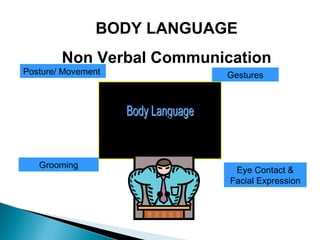
◦ Body Language & Mannerisms
 Creating effective visual aids
 Reducing your fears
 Closing Your Presentation Effectively
 Summing Up
Quote
Effective Presentations Skills
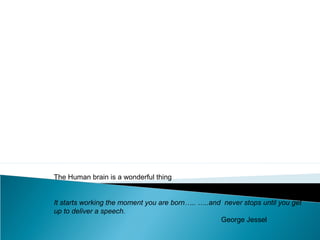
The Human brain is a wonderful thing
It starts working the moment you are born….. …..and never stops until you get
up to deliver a speech.
George Jessel
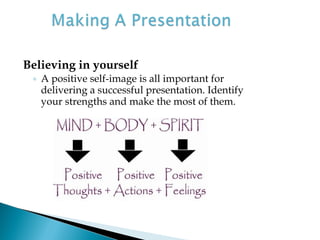
Believing in yourself
◦ A positive self-image is all important for
delivering a successful presentation. Identify
your strengths and make the most of them.
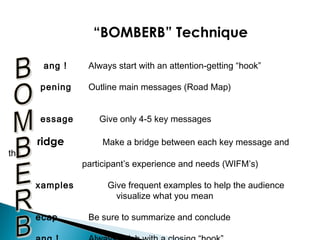
“BOMBERB” Technique
ang ! Always start with an attention-getting “hook”
pening Outline main messages (Road Map)
essage Give only 4-5 key messages
ridge Make a bridge between each key message and
the
participant’s experience and needs (WIFM’s)
xamples Give frequent examples to help the audience
visualize what you mean
ecap Be sure to summarize and conclude
1. Decide on your “talking time”
2. Find out how long it takes to deliver your material
3. Write assertions so that you don’t waffle
4. Have a clock or timekeeper
5. Start on time
*
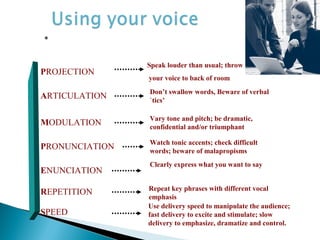
Speak louder than usual; throw
your voice to back of room
PROJECTION
ARTICULATION
MODULATION
PRONUNCIATION
ENUNCIATION
REPETITION
SPEED
Don’t swallow words, Beware of verbal
`tics’
Vary tone and pitch; be dramatic,
confidential and/or triumphant
Watch tonic accents; check difficult
words; beware of malapropisms
Clearly express what you want to say
Repeat key phrases with different vocal
emphasis
Use delivery speed to manipulate the audience;
fast delivery to excite and stimulate; slow
delivery to emphasize, dramatize and control.
Posture/ Movement Gestures
Eye Contact &
Facial Expression
Grooming
BODY LANGUAGE
Non Verbal Communication
TABLE LEANTABLE LEAN
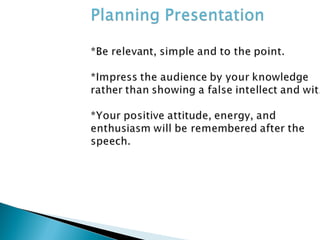
 The key to good delivery is to be yourself, to be natural.
1. Controlling Nerves
2. Being well Prepared
3. Reassuring yourself
4. Eliminating Tension
5. Reducing last minute nerves
6. Using Eye contact
7. Using Gestures
8. Developing Style
8 Steps for
effective
Delivery of
Presentation
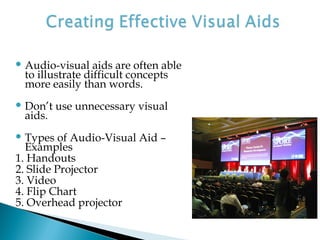
 Audio-visual aids are often able
to illustrate difficult concepts
more easily than words.
 Don’t use unnecessary visual
aids.
 Types of Audio-Visual Aid –
Examples
1. Handouts
2. Slide Projector
3. Video
4. Flip Chart
5. Overhead projector
 Many fine presentations have been ruined by poor handling
of questions raised by the audience afterwards.
 Learn to deal with difficult and awkward questions during
your preparation and you will handle anything you are
asked with confidence.
1. Preparing Well
2.Appearing Confident
3. Staying in Control
4. Handling Questions
Eye-Contact
Observe the 25% - 75% rule (25% to questioner and 75% to audience)
Tip: Only look at questioner as you finish, if you actually want the dialogue to continue.
LISTEN - rephrase or repeat question to
check understanding.
Think
Respond (NOT React)
Address the whole audience
Don’t be monopolized by a handful of
questions/questioners
*Leaving an Impression
*Delivering your summary
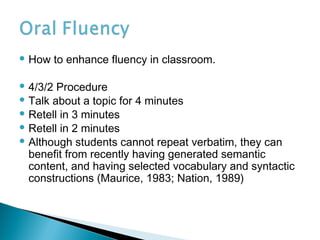
 How to enhance fluency in classroom.
 4/3/2 Procedure
 Talk about a topic for 4 minutes
 Retell in 3 minutes
 Retell in 2 minutes
 Although students cannot repeat verbatim, they can
benefit from recently having generated semantic
content, and having selected vocabulary and syntactic
constructions (Maurice, 1983; Nation, 1989)
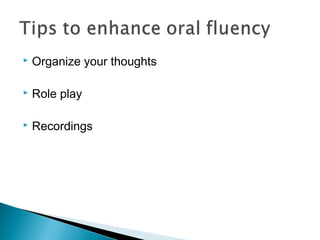
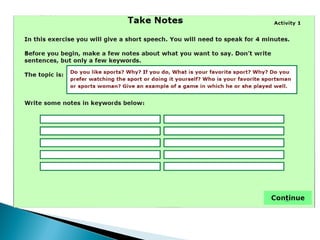
 Organize your thoughts
 Role play
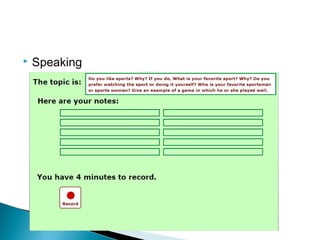
 Recordings
 Speaking

training workshop (1)

  • 1.
     Introduction  Planningyour Presentation  Making Your Presentation ◦ Believing in yourself ◦ The Opening ◦ Timing ◦ Using your voice ◦ Body Language & Mannerisms  Creating effective visual aids  Reducing your fears  Closing Your Presentation Effectively  Summing Up Quote
  • 2.
    Effective Presentations Skills TheHuman brain is a wonderful thing It starts working the moment you are born….. …..and never stops until you get up to deliver a speech. George Jessel
  • 4.
    Believing in yourself ◦A positive self-image is all important for delivering a successful presentation. Identify your strengths and make the most of them.
  • 5.
    “BOMBERB” Technique ang !Always start with an attention-getting “hook” pening Outline main messages (Road Map) essage Give only 4-5 key messages ridge Make a bridge between each key message and the participant’s experience and needs (WIFM’s) xamples Give frequent examples to help the audience visualize what you mean ecap Be sure to summarize and conclude
  • 6.
    1. Decide onyour “talking time” 2. Find out how long it takes to deliver your material 3. Write assertions so that you don’t waffle 4. Have a clock or timekeeper 5. Start on time
  • 7.
    * Speak louder thanusual; throw your voice to back of room PROJECTION ARTICULATION MODULATION PRONUNCIATION ENUNCIATION REPETITION SPEED Don’t swallow words, Beware of verbal `tics’ Vary tone and pitch; be dramatic, confidential and/or triumphant Watch tonic accents; check difficult words; beware of malapropisms Clearly express what you want to say Repeat key phrases with different vocal emphasis Use delivery speed to manipulate the audience; fast delivery to excite and stimulate; slow delivery to emphasize, dramatize and control.
  • 8.
    Posture/ Movement Gestures EyeContact & Facial Expression Grooming BODY LANGUAGE Non Verbal Communication TABLE LEANTABLE LEAN
  • 9.
     The keyto good delivery is to be yourself, to be natural. 1. Controlling Nerves 2. Being well Prepared 3. Reassuring yourself 4. Eliminating Tension 5. Reducing last minute nerves 6. Using Eye contact 7. Using Gestures 8. Developing Style 8 Steps for effective Delivery of Presentation
  • 10.
     Audio-visual aidsare often able to illustrate difficult concepts more easily than words.  Don’t use unnecessary visual aids.  Types of Audio-Visual Aid – Examples 1. Handouts 2. Slide Projector 3. Video 4. Flip Chart 5. Overhead projector
  • 12.
     Many finepresentations have been ruined by poor handling of questions raised by the audience afterwards.  Learn to deal with difficult and awkward questions during your preparation and you will handle anything you are asked with confidence.
  • 13.
    1. Preparing Well 2.AppearingConfident 3. Staying in Control 4. Handling Questions
  • 14.
    Eye-Contact Observe the 25%- 75% rule (25% to questioner and 75% to audience) Tip: Only look at questioner as you finish, if you actually want the dialogue to continue. LISTEN - rephrase or repeat question to check understanding. Think Respond (NOT React) Address the whole audience Don’t be monopolized by a handful of questions/questioners
  • 15.
  • 16.
     How toenhance fluency in classroom.  4/3/2 Procedure  Talk about a topic for 4 minutes  Retell in 3 minutes  Retell in 2 minutes  Although students cannot repeat verbatim, they can benefit from recently having generated semantic content, and having selected vocabulary and syntactic constructions (Maurice, 1983; Nation, 1989)
  • 17.
     Organize yourthoughts  Role play  Recordings
  • 19.

Editor's Notes

  • #6 The Beginning It is imperative to plan your beginning carefully; there are five main elements: Get their attention Too often in a speech, the first few minutes of the presentation are lost while people adjust their coats, drift in with coffee and finish the conversation they were having with the person next to them. You only have a limited time and every minute is precious to you so, from the beginning, make sure they pay attention. Establish a theme Basically, you need to start the audience thinking about the subject matter of your presentation. This can be done by a statement of your main objective, unless for some reason you wish to keep it hidden. They will each have some experience or opinions on this and at the beginning you must make them bring that experience into their own minds. Present a structure If you explain briefly at the beginning of a talk how it is to proceed, then the audience will know what to expect. This can help to establish the theme and also provide something concrete to hold their attention. Ultimately, it provides a sense of security in the promise that this speech too will end. Create a rapport If you can win the audience over in the first minute, you will keep them for the remainder. You should plan exactly how you wish to appear to them and use the beginning to establish that relationship. You may be presenting yourself as their friend, as an expert, perhaps even as a judge, but whatever role you choose you must establish it at the very beginning. The Ending The final impression you make on the audience is the one they will remember. Thus it is worth planning your last few sentences with extreme care. As with the beginning, it is necessary first to get their attention, which will have wandered. This requires a change of pace, a new visual aid or perhaps the introduction of one final culminating idea. In some formats the ending will be a summary of the main points of the talk. Visual Aids Most people expect visual reinforcement for any verbal message being delivered. While it would be unfair to blame television entirely for this, it is useful to understand what the audience is accustomed to. If your presentation is scruffy then your audience will notice that, and not what is written upon it. Do not clutter a presentation or it will confuse rather than assist. Make sure that your writing can be read from the back of the room. Talk to the audience, not the visual aid.
  • #9 The parts of non-verbal communication to watch out for during presentations are: Gestures – avoid playing the marker, hand inside pockets, clenched fists, locked fingers, hands behind Movement – move in a semi-circular fashion covering the audience Posture – stand straight with feet at 45 degree angle Dress Eye-contact – make eye contact with everyone Smiles and facial expressions – have a relaxed expression The Delivery Whatever you say and whatever you show; it is you, yourself which will remain the focus of the audience's attention. If you but strut and fret your hour upon the stage and then are gone, no-one will remember what you said. The presenter has the power both to kill the message and to enhance it a hundred times beyond its worth. Your job as a manager is to use the potential of the presentation to ensure that the audience is motivated and inspired rather than disconcerted or distracted. There are five key facets of the human body which deserve attention in presentation skills: the eyes, the voice, the expression, the appearance, and how you stand.