CONTENTS DISCRIPTION
 I.T.I. Profile
 About I.T.I. Naini
 Factory Division
 MajorLandmark
 OrganizationChart
 Products
 Electricity
 Power Generation and Transmission
 Power Distribution
 Conclusion
ITI PROFILE
India’s first Public Sector Unit (PSU) - ITI Ltd was established
in 1948. Ever since, as a pioneering venture in the field of
telecommunications, it has contributed to 50% of the present
national telecom network. With state-of-the-art
manufacturing facilities spread across six locations and a
countrywide network of marketing/service outlets, the
company offers a complete range of telecom products and
total solutions covering the whole spectrum of Switching,
Transmission, Access and Subscriber Premises equipment.
ITI joined the league of world class vendors of Global System
for Mobile (GSM) technology with the inauguration of mobile
equipment manufacturing facilities at its Mankapur and Rae
Bareli Plants in 2005-06. This ushered in a new era of
indigenous mobile equipment production in the country.
These two facilities supply more than nine million lines per
annum to both domestic as well as export markets.
The company is consolidating its diversification into
Information and Communication Technology (ICT) to hone its
competitive edge in the convergence market by deploying its
rich telecom expertise and vast infrastructure. Network
Management Systems, Encryption and Networking Solutions
for Internet Connectivity are some of the major initiatives
taken by the company.
Secure communications is the company's forte with a proven
record of engineering strategic communication networks for
India's Defence forces. Extensive in-house R&D work is
devoted towards specialized areas of Encryption, NMS, IT and
Access products to provide complete customized solutions to
variouscustomers.
Indian Telephone Industries Limited, commonly known as ITI
Limited, is a state-owned manufacturer of
telecommunications equipment in India. It was founded in
1948, and today has six manufacturing facilities which
produce a range of switching, transmission, access and
subscriber premises equipment. It is headquartered
at Bengaluru ( Bangalore).
It produces GSM mobile equipment at
its Mankapur and Raebareli Plants. These two facilities supply
more than nine million lines per annum to both domestic as
well as export markets. It also produces Information and
Communication Technology (ICT) equipment such as network
management systems, encryption and networking solutions
for internet connectivity, and secure communications
networks and equipment for India's military. The company
has above 3500 employees as on October 2017.
Our Human Resources Department strives to build
technological and managerial excellence in the organization
through best HR policies and practices in the industry. We
are committed to build a creative workforce with emphasis
on quality and customer satisfaction. We have realigned our
HR policies, in line with the company’sbusiness plans.
CORPORATE OBJECTIVES :
 Generate demands for Telecommunication in products
through innovation.
 To become a strong service provider with major
business thrust on telecommunication Network
operationsand value added services.
 Achieve global quality standards in a products in
shortest time.
 Introduce effective production planning and control
system delivering, schedules, streamlined ,production
over whole year and other inventory control.
 Optimization of resource utilization and to create an
atmosphere of cost consciousness.
 Promote creativity and innovation.
MISSION OF ITI
Leader in domestic market, major player in global market in
the field of voice data and image communication.Toprovide
total solution to customer to buildone crore competence for
entering the new areas of business.
QUALITY POLICY OF ITI :
ITI is commited to provide products and services of
consistent quality that will lead to customer delight. ITI has
maintained leadership in the market with competitive prices
and professional excellance though :
 Implementationof sound qualitymanagement system.
 Continuousinnovation.
 Continualimprovement in every activity.
 Involvement of people at all levels, internally and
externally.
 The qualitysystem of ITI is ISO-9000.
DESCRIPTION OF DIVISION :
1.TransmissionEquipment Division:
It mainly consists of the followinghangers:
 Hangar (Machine Shop): The shop houses various
mechanical machines like lathe shaper, drill press and
welding machines along with a well furnished tool room
and one CNC punch press machine is also available for
precision fabricatlion
 B- Hangar :This Hangar deals with the production of 2
types of equipments-
1. Analog production shop: It deals with the production
of 3 channel O/W carrier systems and 8 channel O/W
carrier systems.
2. Radio production shop: It manufactures the radio
equipments like single channel and MARR (4/30 and
8/60) in the VHF range of frequencies.
 C- Hangar: Drawing and Duplicatingdepartment
 Digital Hangar (Opto Electronics Division) : This is the
latest hangar of all and deals with the optical
equipments. The type of multiplexing used here is TDM.
This hangar deals with the production of PCM base
equipments in the PDH employing the late ‘COMBIMUX'
equipment and the SDH equipment. Work on DWDM
equipment is also going on in this hangar.
 IV Hangar :This hangarmakes STM-1 & STM-4
equipment.
 Research & Development Section : This section
concentrates on the research and the house
development of the latest techniques and the
improvements in the previous equipments.It houses the
following laboratories:-
1. Analog laboratory
2. Digital and Opticallaboratory
3. Radio laboratory
4. Micro laboratory
5. Automatic testing systems laboratory
6. Hybrid laboratory
2.Telephone Instrument Division:
 Telephoneresearch and developmentsection.
 Production and fabricationshop.
TID manufactures a variety of Telephones, which are being
used by majority of people in the nation. TID is also
subdividedinto three parts.
 MouldingShop
 Tool Room
 TID Assembly
ITI Joint Ventures:
 India Satcom Ltd Bangalore (with EPIC,USA satellite
communication)
 ITI communication private Ltd. With Valvas, Singapore &
M/S Comfort to act as exporter arms of India.
 Fibcom India Ltd, New Delhi with DSC Communication of
USA for fiber communicationequipment.
Technical Collaborations:
ITI has technical collaborationwith the following companies:
 ALCATEL of France
 BOSCH Telecom of Germany
 Qualcom of USA
 Siemens Branch of India
 AT & T of Spain
ITI Global Customers :
ITI has global customers around the world mainly in :
 Switzerland
 Botswana
 Zimbabwe
 Costa Rica
 Ireland
 South Africa
 Malaysiaand Others.
ITI Customers:
ITI has following big customers (in India) are :
 BSNL
 MTN
 Defense
 VSNL
 Railways
 Electricity Boards
 Paramilitary Police and Internal Security
ITI NAINI ALLAHABAD
The Naini unit of ITI is a prime organization in North India
that spearheads the task of manufacturing the entire range
of telecommunication transimission equipments and
telephone instruments required for building the telecomm
infrastructure of the company. It is situated as the Mirzapur
Road at about 16 km from the holy city of Prayag. Since its
inception in 1971, the unit has been marching ahead with a
steady growth and has achieved the twin objectives of
producing the vital telecommunication equipment for the
country and with a modest production of Rs 1.66 Crores with
Staff strength of about 400 during 1971-1972, produced
equipment worth Rs 174.48 Crores with staff of about 4700
in 1991-1992.
It manufactures the complete range of multiplex
equipments of range intercity and intra-city communication
needs of the National Telecommunication Network. As the
production of modern equipment is highly technology
intensive, the most modern R & D division backs the unit. The
unit has not only raised the level but also improved its
profitability by improving its productivity, efficiency and
reducing wastage. While maintaining quality level, the cost of
equipment has been reduced due to ceaseless efforts to
improve design and manufacturingprocess.
To meet the information needs of the organization,
the computer center and the R &D division has provided
internet facility through which all the key areas of the
organizationare concerned.
Some of the projects be arrived out at R&D are :
 For DAR (Fiber optics radardata remoting system)
 Single channel VHF and SMD version
 Spread spectrum multichannelsecrecy Radio
 Single channel telephonewith material
 Full handsfree telephones
 Solar power for info-Kiosk and other areas
 TCP/IP compatibleradio
 FDF (Fiber Distribution Frame)
Electricity: Electricity is a general term encompassing a
variety of phenomena resulting from the presence and flow
of electric charge. These include many easily recognizable
phenomena, such as lightening static electricity, and the flow
of electrical current in an electrical wire. In addition,
electricity compasses less familiar concepts such as the
electromagnetic field and electromagnetic induction.
Electric charge : A property of some subatomic particles
which determines their electromagnetic interaction.
Electrically charged matter is influenced by, and produces,
electromagnetic fields.
Electric current : A movement or flow of electrically
charged particles, typicallymeasured in amperes.
Electric field: An influence produced by an electric charge
on other charges in it’s vicinity.
Electric potential: The capacity of an electric field to do
work on an electric charge, typicallymeasured in volts.
Electromagnetism: A fundamental interaction between the
magnetic field and the presence and motion of an electric
charge.
The most common use of the word "electricity" is less
precise. It refers to:
Electric power : Provided commercially by the electrical
power industry. In a loose but common use of the term,
“electricity" may be used to mean "wired for electricity"
which means a working connection to an electric power
station. Such a connection grants the user of "electricity"
access to the electric field present in electrical wiring, and
thus to electric power.
Production
Generation and transmission
Electrical power is usually generated by electro-mechanical
generators driven by sleam produced from fossil fuel
combustion, or the heat released from nuclear reactions; or
from other sources such as kinetic energy extracted from
wind or flowing water. The modern steam turbine invented
by Sir Charles Parsons in 1884 today generates about 80
percent of the electric power in the world using a variety of
heat sources. Such generators bear no resemblance to
Faraday's unipolar disc generator of 1831, but they still rely
on his eleclromagnetic principle that a conductor linking a
changing magnetic field induces a potential difference across
its ends. The invention in the late nineteenth century of the
transformer meant that electrical power could be
transmitted more efficiently at a higher voltage but lower
current. Efficient electrical transmission meant in turn that
electricity could be generated at centralized power stations,
where it benefited from economies of scale, and then be
dispatchedrelativity long distances to where it was needed.
Since electrical energy cannot easily be stored in
quantities large enough to meet demands on a national scale,
at all times exactly as much must be produced as is required.
This requires electricity utilities to make careful predictions
of their electrical loads, and maintain constant co-ordination
with their power station. A certain amount of generation
must always be held in reserve to cushion an electrical grid
against inevitabledisturbances and losses.
Demand for electricity grows with great rapidity
as a nation modernises and its economy develops. The
United States showed 12% increase in demand during each
year of the first three decades of the twentieth century, a
rate of growth that is now being experienced by emerging
economies such as those of India or China. Historically, the
growth rate for electricity demand has outstripped that for
other forms of energy.
Environmental concerns with electricity generation have led
to an increased focus on generation from renewable sources,
in particular from wind and hydropower. While debate can
be expected to continue over the environmental impact of
different means of electricity production, its final form is
relativelyclean.
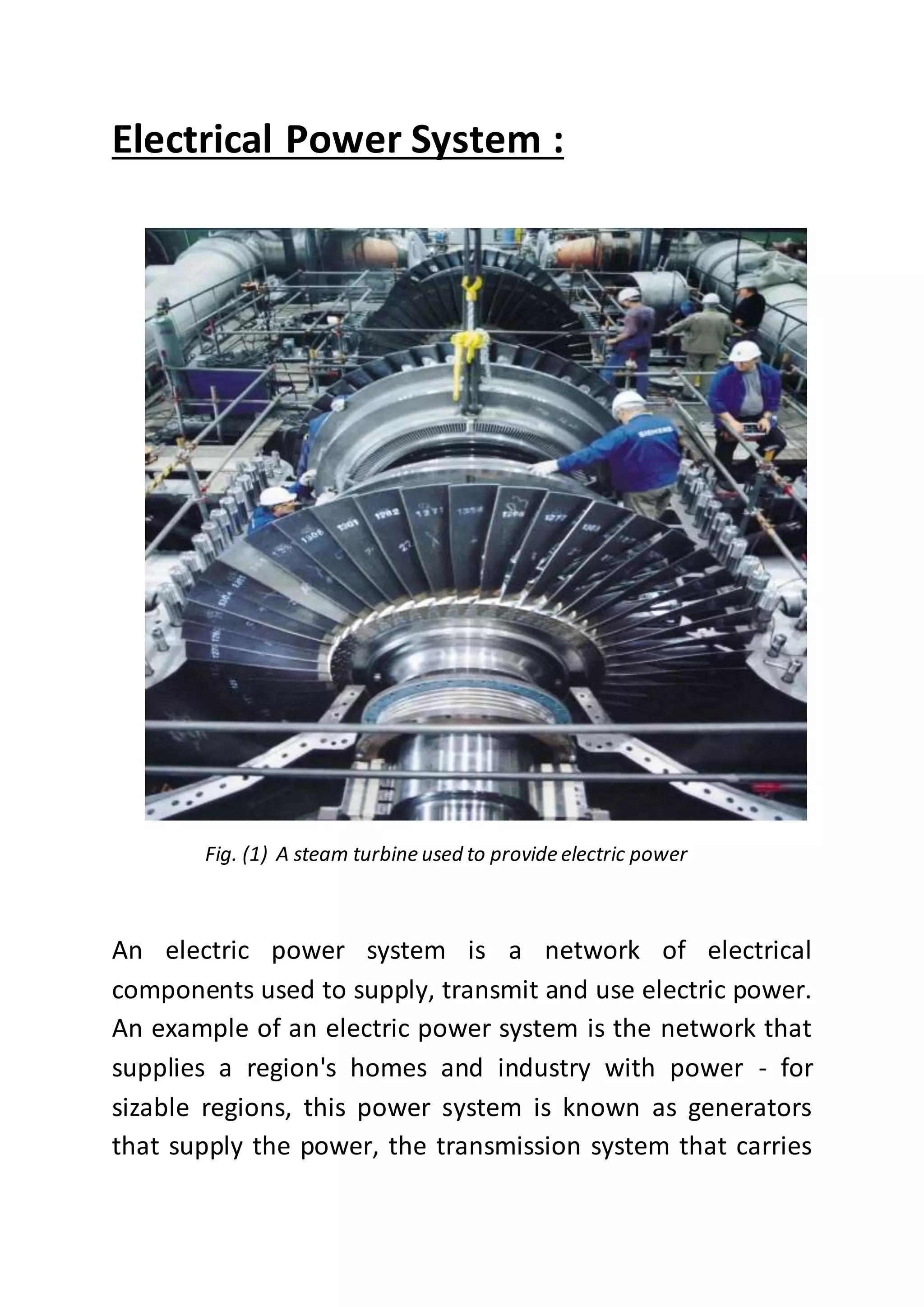
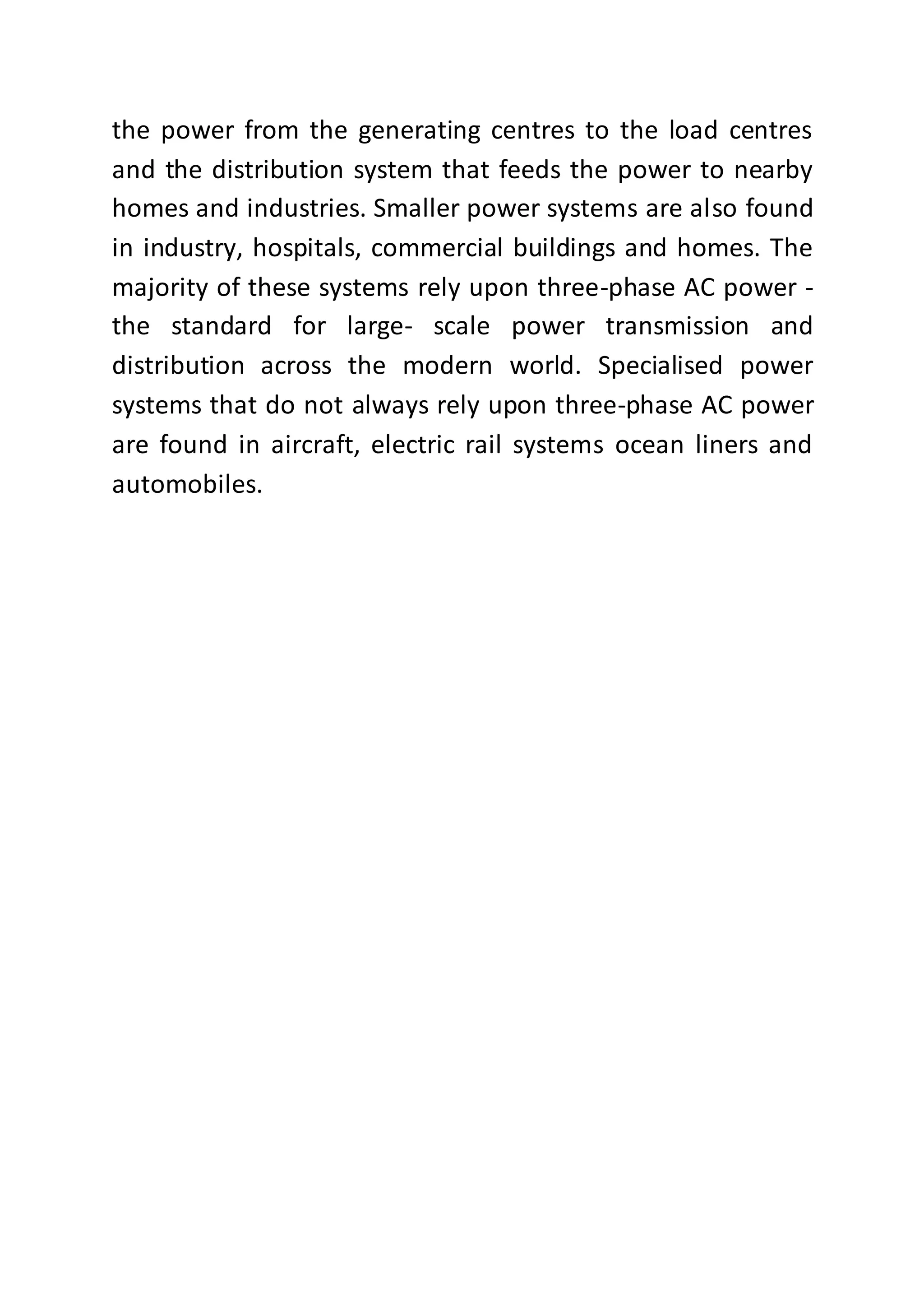
Electrical Power System :
Fig. (1) A steam turbine used to provide electric power
An electric power system is a network of electrical
components used to supply, transmit and use electric power.
An example of an electric power system is the network that
supplies a region's homes and industry with power - for
sizable regions, this power system is known as generators
that supply the power, the transmission system that carries
the power from the generating centres to the load centres
and the distribution system that feeds the power to nearby
homes and industries. Smaller power systems are also found
in industry, hospitals, commercial buildings and homes. The
majority of these systems rely upon three-phase AC power -
the standard for large- scale power transmission and
distribution across the modern world. Specialised power
systems that do not always rely upon three-phase AC power
are found in aircraft, electric rail systems ocean liners and
automobiles.
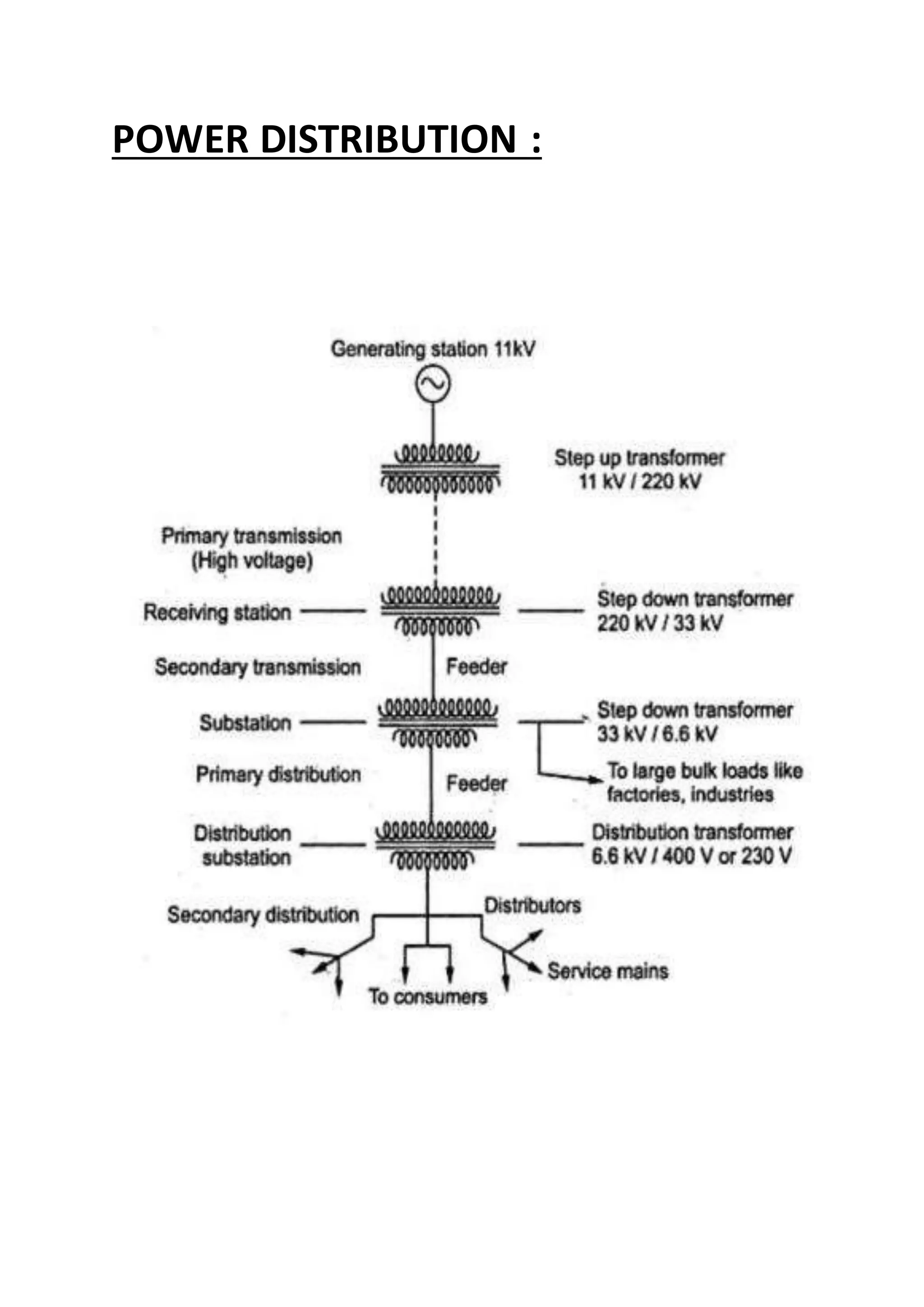
POWER DISTRIBUTION :
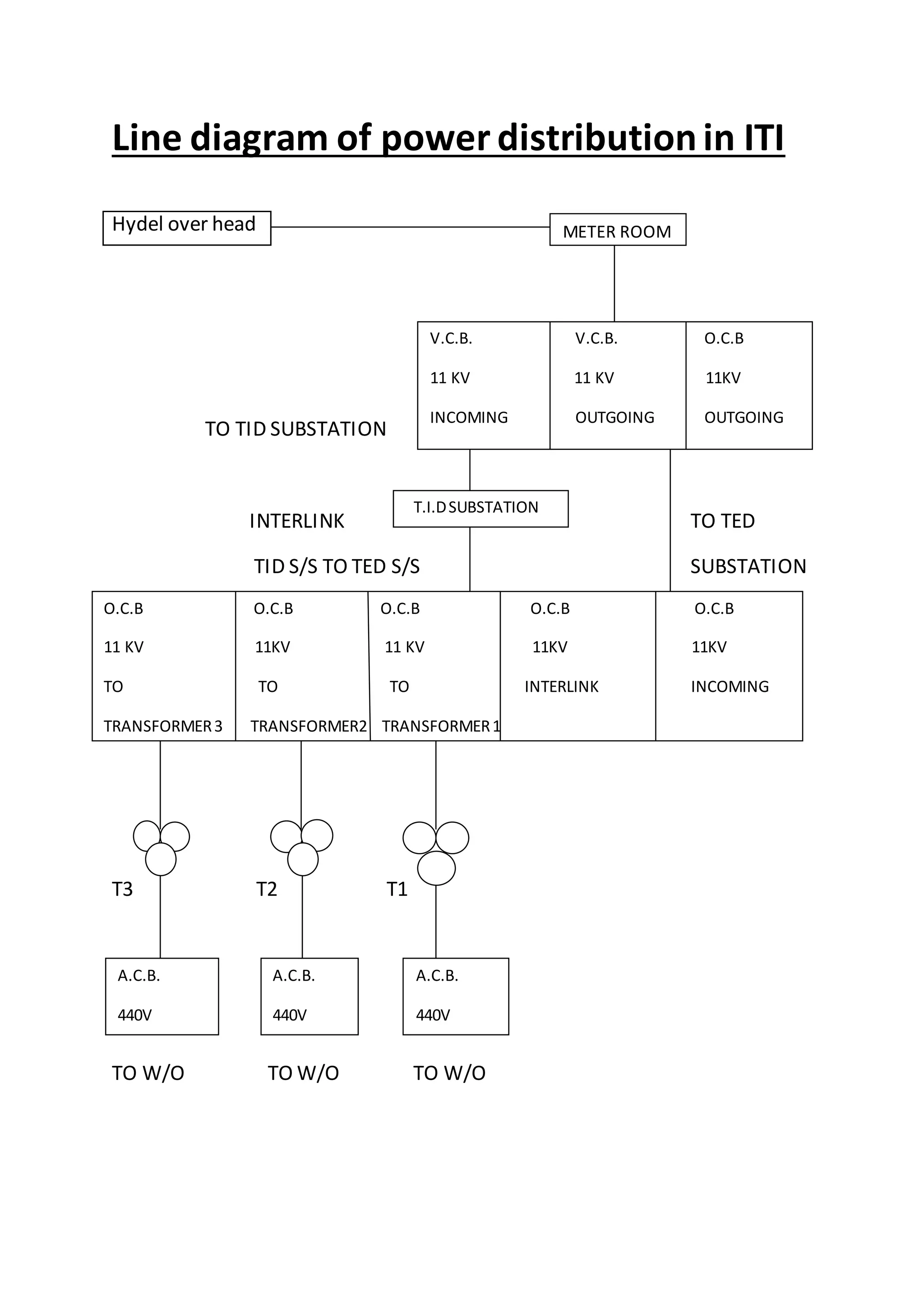
Line diagram of power distributionin ITI
TO TID SUBSTATION
INTERLINK TO TED
TID S/S TO TED S/S SUBSTATION
T3 T2 T1
TO W/O TO W/O TO W/O
Hydel over head METER ROOM
V.C.B. V.C.B. O.C.B
11 KV 11 KV 11KV
INCOMING OUTGOING OUTGOING
O.C.B O.C.B O.C.B O.C.B O.C.B
11 KV 11KV 11 KV 11KV 11KV
TO TO TO INTERLINK INCOMING
TRANSFORMER3 TRANSFORMER2 TRANSFORMER1
11 KV 11KV
TO TO
TRANSFORMER3 TRANSFORMER2
T.I.DSUBSTATION
A.C.B.
440V
A.C.B.
440V
A.C.B.
440V
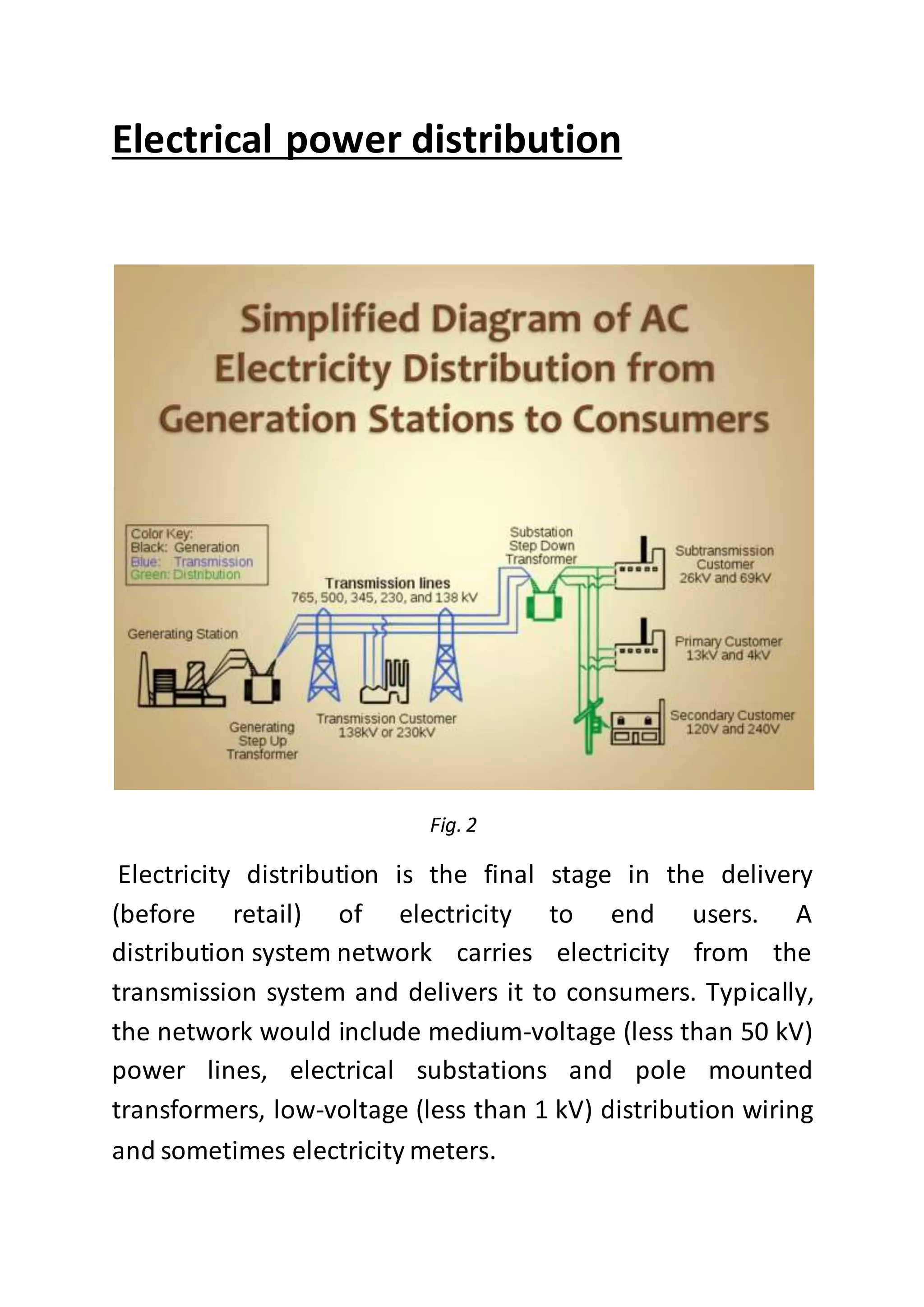
Electrical power distribution
Fig. 2
Electricity distribution is the final stage in the delivery
(before retail) of electricity to end users. A
distribution system network carries electricity from the
transmission system and delivers it to consumers. Typically,
the network would include medium-voltage (less than 50 kV)
power lines, electrical substations and pole mounted
transformers, low-voltage (less than 1 kV) distribution wiring
and sometimes electricity meters.
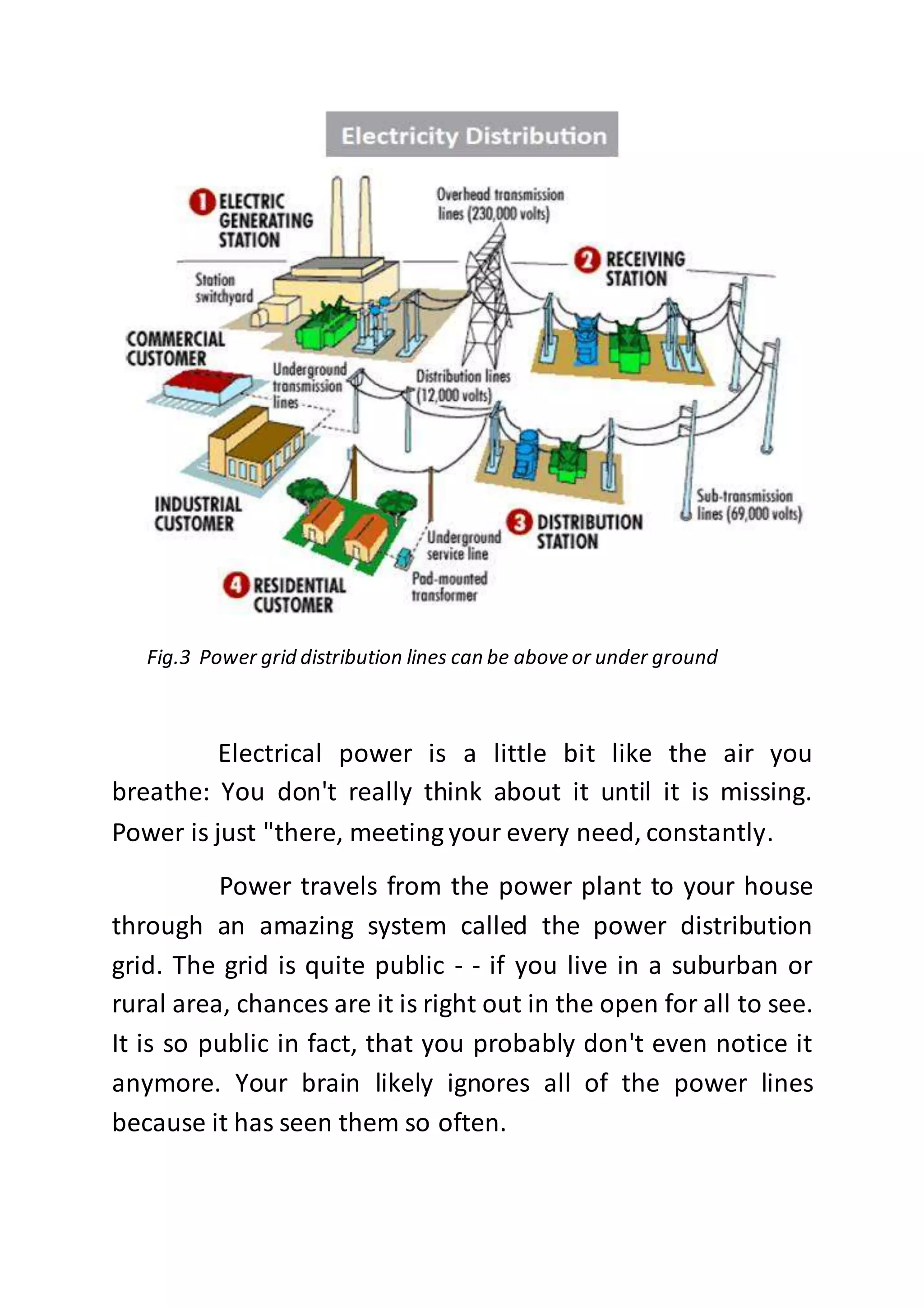
Fig.3 Power grid distribution lines can be above or under ground
Electrical power is a little bit like the air you
breathe: You don't really think about it until it is missing.
Power is just "there, meeting your every need, constantly.
Power travels from the power plant to your house
through an amazing system called the power distribution
grid. The grid is quite public - - if you live in a suburban or
rural area, chances are it is right out in the open for all to see.
It is so public in fact, that you probably don't even notice it
anymore. Your brain likely ignores all of the power lines
because it has seen them so often.
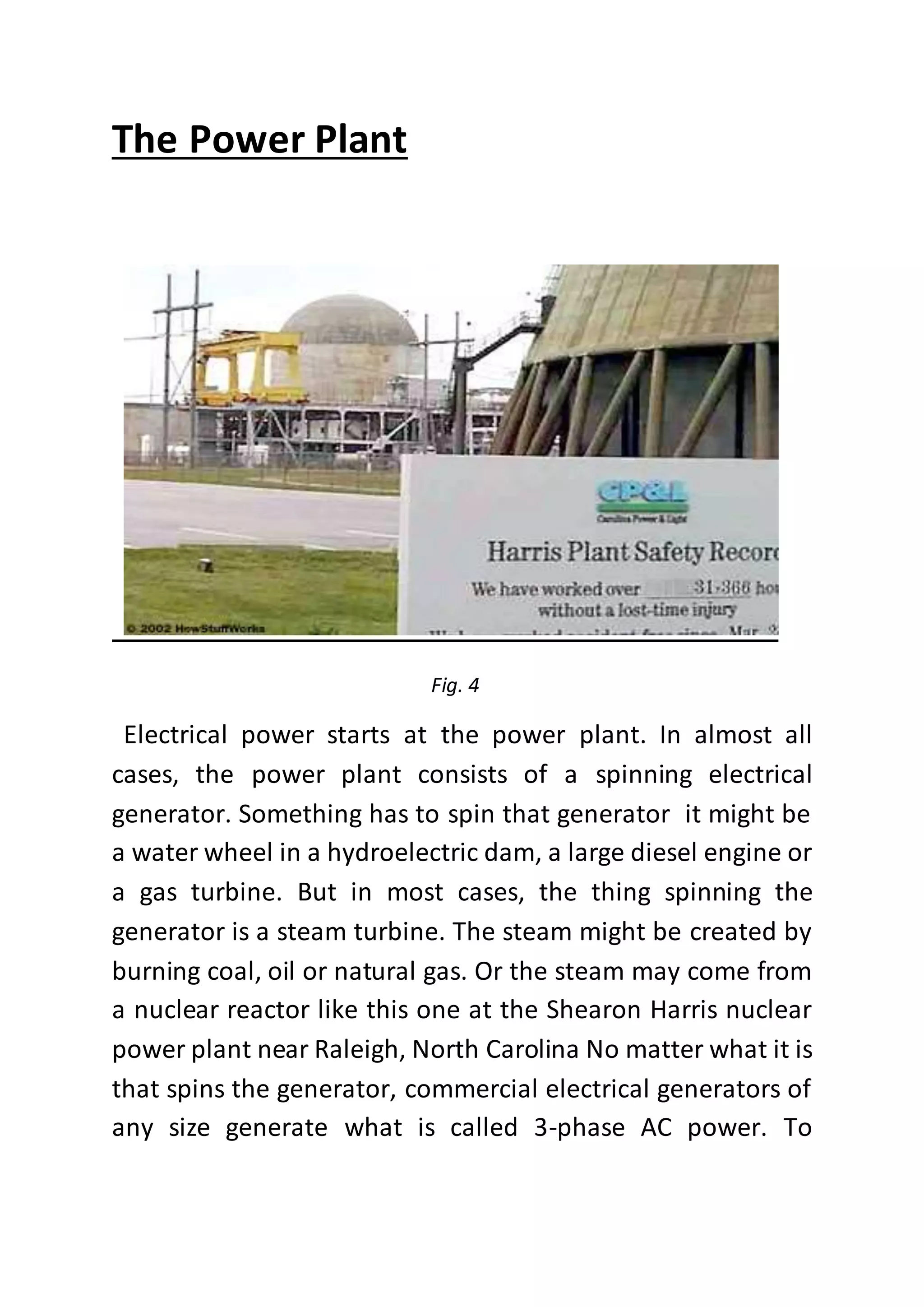
The Power Plant
Fig. 4
Electrical power starts at the power plant. In almost all
cases, the power plant consists of a spinning electrical
generator. Something has to spin that generator it might be
a water wheel in a hydroelectric dam, a large diesel engine or
a gas turbine. But in most cases, the thing spinning the
generator is a steam turbine. The steam might be created by
burning coal, oil or natural gas. Or the steam may come from
a nuclear reactor like this one at the Shearon Harris nuclear
power plant near Raleigh, North Carolina No matter what it is
that spins the generator, commercial electrical generators of
any size generate what is called 3-phase AC power. To
understand 3-phase AC power, it is helpful to understand
single-phase power first.
 ALTERNATING CURRENT
Single-phase power is what you have in your house. You
generally talk about household electrical service as single-
phase, 120-volt AC service. If you use an oscilloscope and
look at the power found at a normal wall-plate outlet in your
house, what you will find is that the power at the wall plate
looks like a sine wave, and that wave oscillates between -170
volts and 170 volts (the peaks are indeed at 170 volts; it is
the effective (rms) voltage that is 120 volts). The rate of
oscillation for the sine wave is 60 cycles per second.
Oscillating power like this is generally referred to as AC, or
alternating current. The alternative to AC is DC, or direct
current. Batteries produce DC: A steady stream of electrons
flows in one direction only, from the negative to the positive
terminal of the battery AC has at least three advantages over
DC in a power distribution grid:
1. Large electrical generators happen lo generate AC
naturally, so conversion to DC would involve an extra step
2. Transformers must have alternating current to operate,
and we will see that the power distribution grid depends on
Transformers.
3. It is easy to convert AC to DC but expensive to convert DC
to AC, so if you were going to pick one or the other AC would
be the better choice.
The power plant, therefore, produces AC. On the
next page, you'll learn about the AC power produced at the
power plant. Most notably,it is produced in three phases.
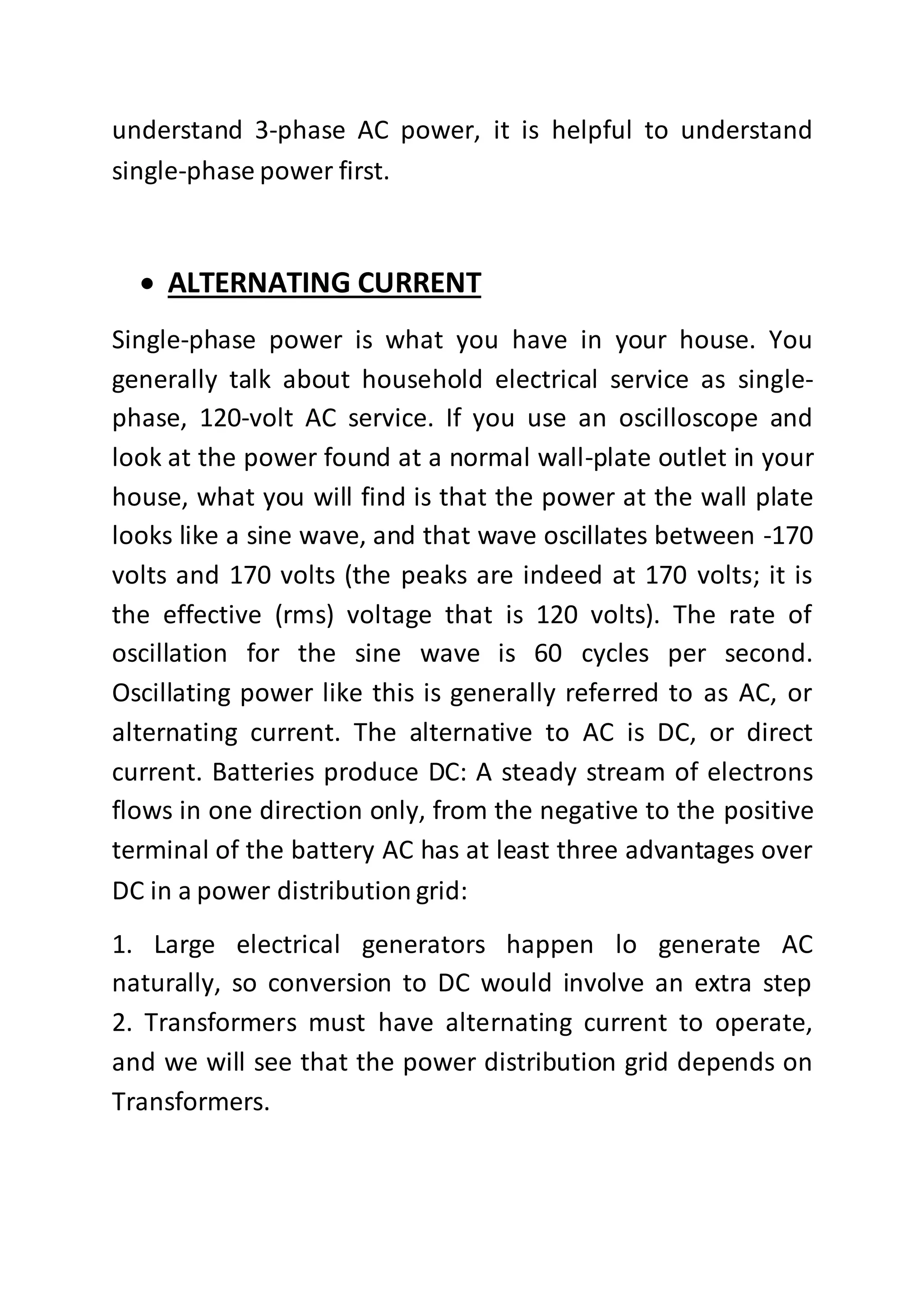
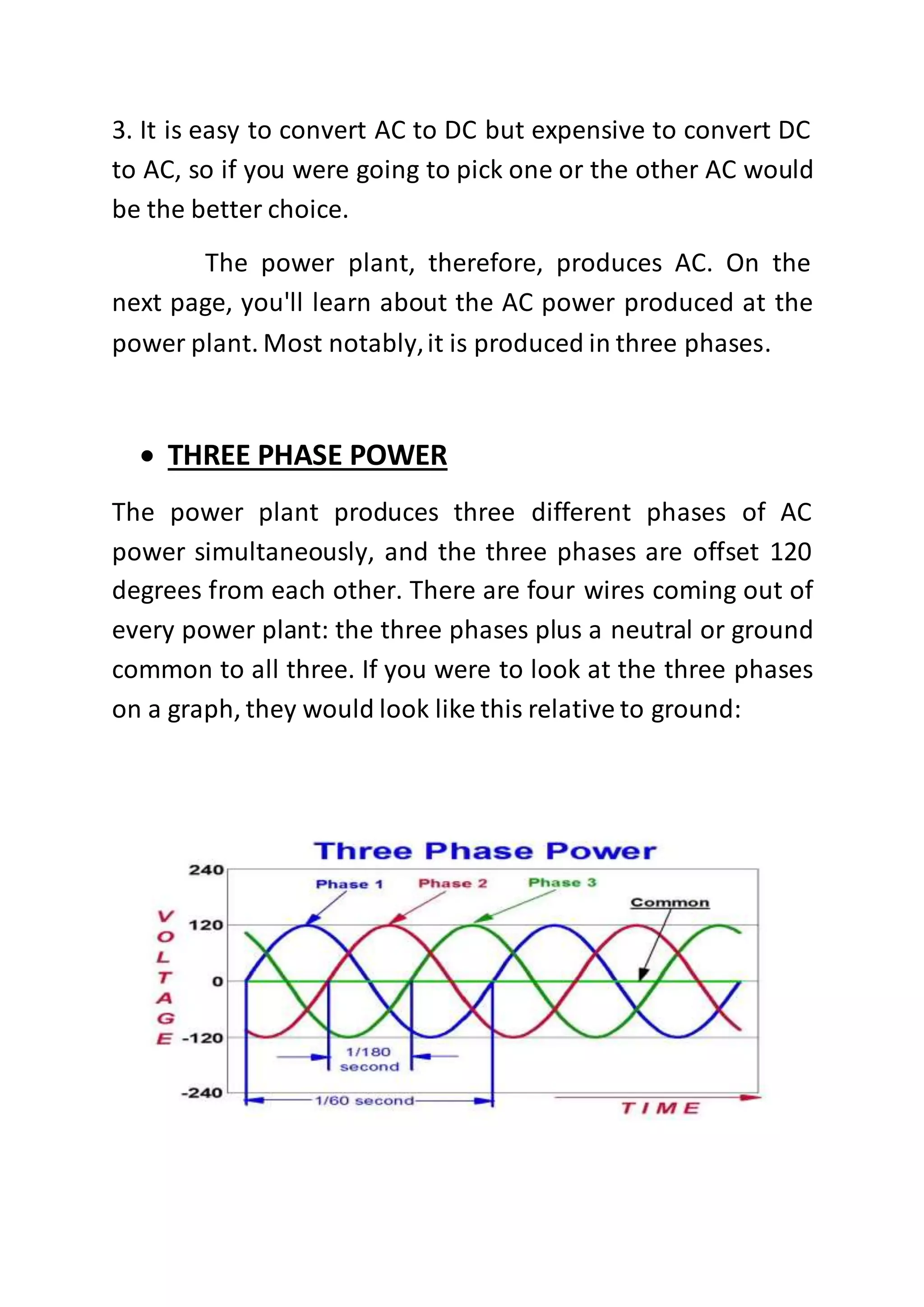
 THREE PHASE POWER
The power plant produces three different phases of AC
power simultaneously, and the three phases are offset 120
degrees from each other. There are four wires coming out of
every power plant: the three phases plus a neutral or ground
common to all three. If you were to look at the three phases
on a graph, they would look like this relative to ground:
There is nothing magical about three-phase power. It is
simply three single phases synchronized and offset by 120
degrees. Why three phases? Why not one or two or four? In
1-phase and 2-phase power, there are 120 moments per
second when a sine wave is crossing zero volts. In 3-phase
power, at any given moment one of the three phases is
nearing a peak. High-power 3-phase motors (used in
industrial applications) and things like 3-phase welding
equipment therefore have even power output. Four phases
would not significantly improve things but would add a
fourth wire, so 3-phase is the natural settling point.
And what about this "ground", as mentioned above?
The power company essentially uses the earth as one of the
wires in the power system. The earth is a pretty good
conductor and it is huge, so it makes a good return path for
electrons.
"Ground" in the power distribution grid is literally
"the ground" that's all around you when you are walking
outside. It is the dirt, rocks, groundwater, etc., of the earth.
Transmission Substation
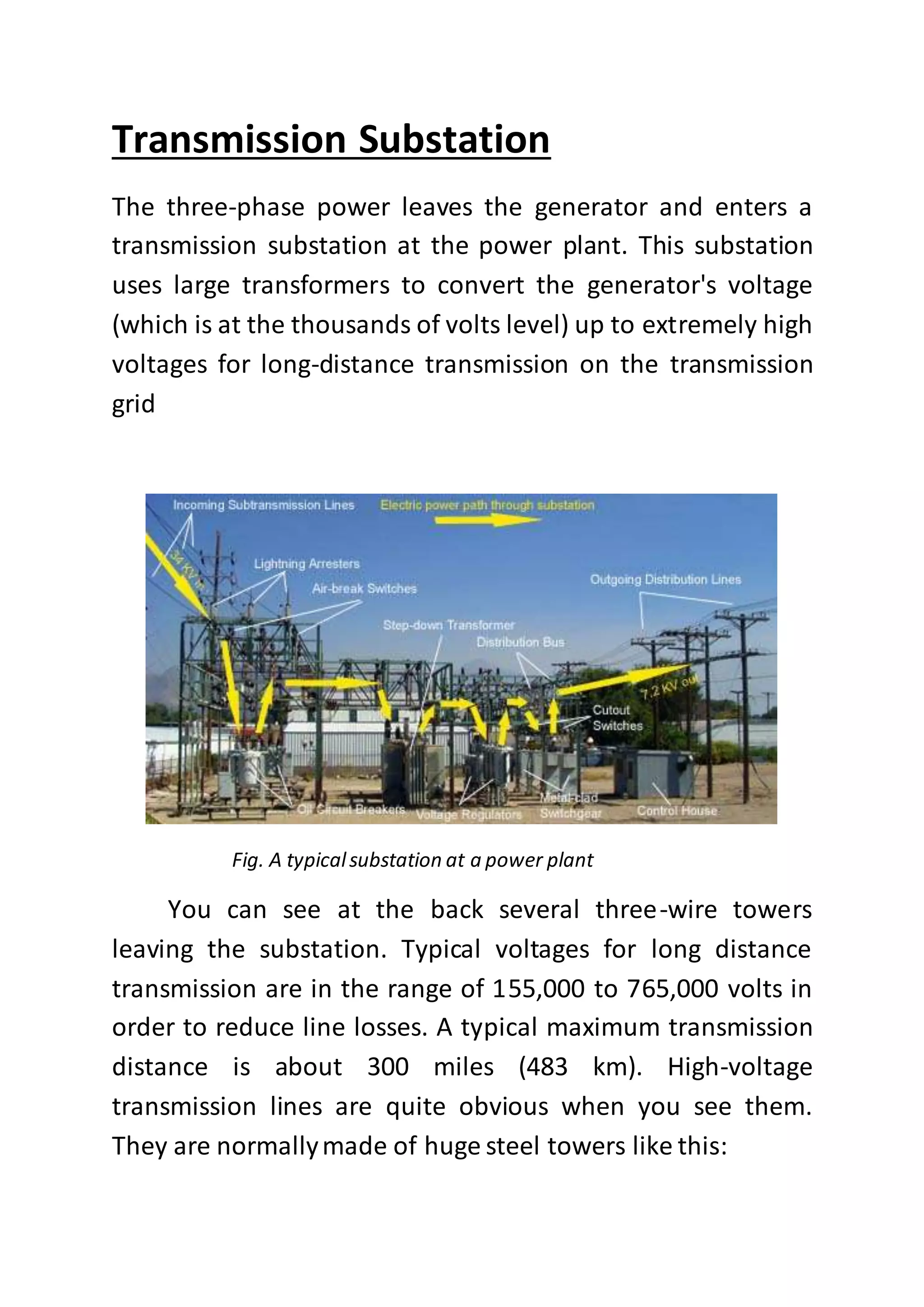
The three-phase power leaves the generator and enters a
transmission substation at the power plant. This substation
uses large transformers to convert the generator's voltage
(which is at the thousands of volts level) up to extremely high
voltages for long-distance transmission on the transmission
grid
Fig. A typicalsubstation at a power plant
You can see at the back several three-wire towers
leaving the substation. Typical voltages for long distance
transmission are in the range of 155,000 to 765,000 volts in
order to reduce line losses. A typical maximum transmission
distance is about 300 miles (483 km). High-voltage
transmission lines are quite obvious when you see them.
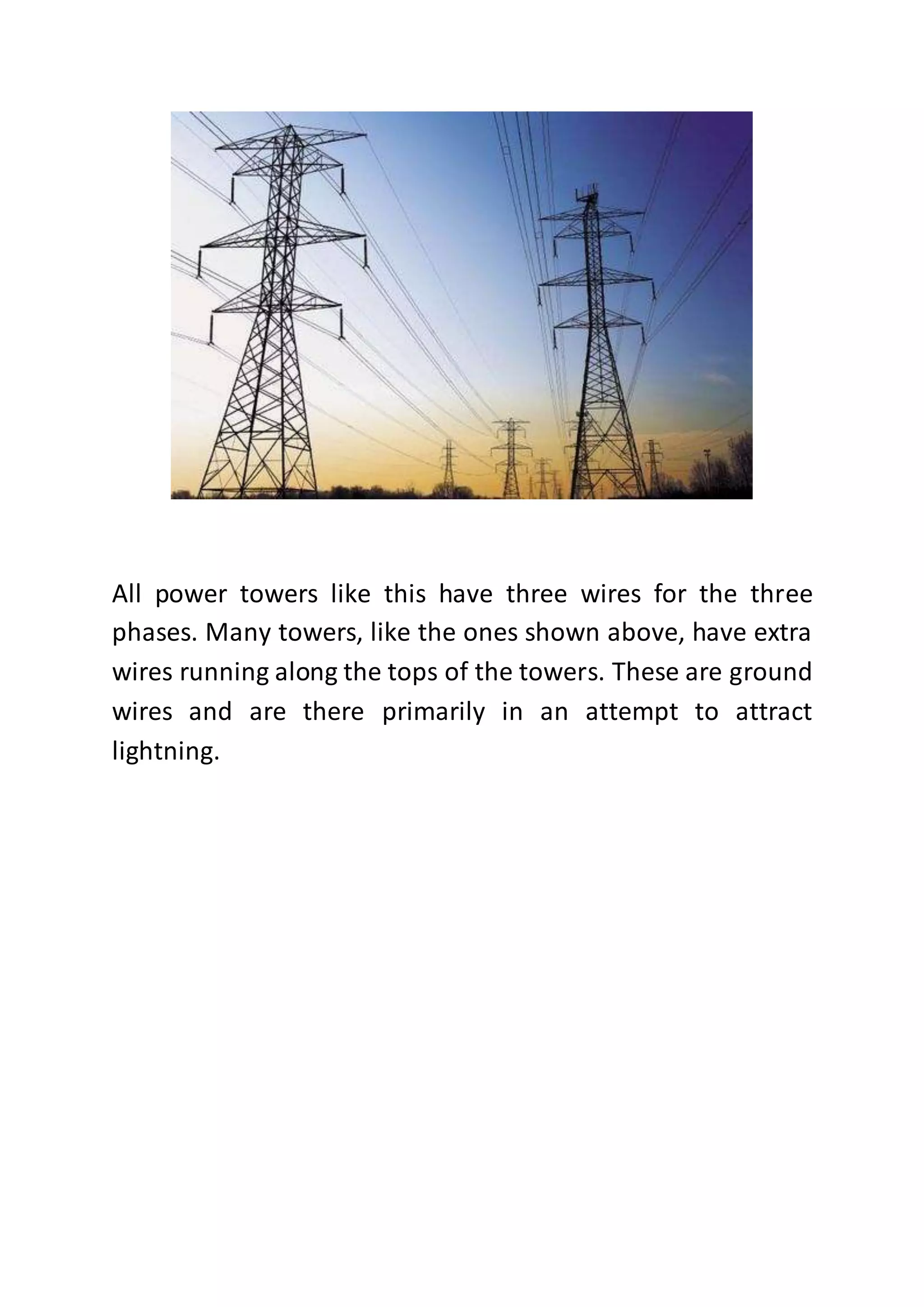
They are normallymade of huge steel towers like this:
All power towers like this have three wires for the three
phases. Many towers, like the ones shown above, have extra
wires running along the tops of the towers. These are ground
wires and are there primarily in an attempt to attract
lightning.
The Distribution Grid
For power to be useful in a home or business, it comes off
the transmission grid and is stepped-down to the distribution
grid. This may happen in several phases. The place where the
conversion from "transmission" to "distribution" occurs is in
a power substation. A power substation typically does two or
three things:
 It has transformers that step transmission voltages (in
the tens or hundreds or thousands of volts range) down
to distributionvoltages (typicallyless than 10,000 volts).
 It has a "bus" that can split the distribution power off in
multipledirection.
 It often has circuit breakers and switches so that the
substation can be disconnected from the transmission
grid or separate distribution lines can be disconnected
from the substation when necessary.
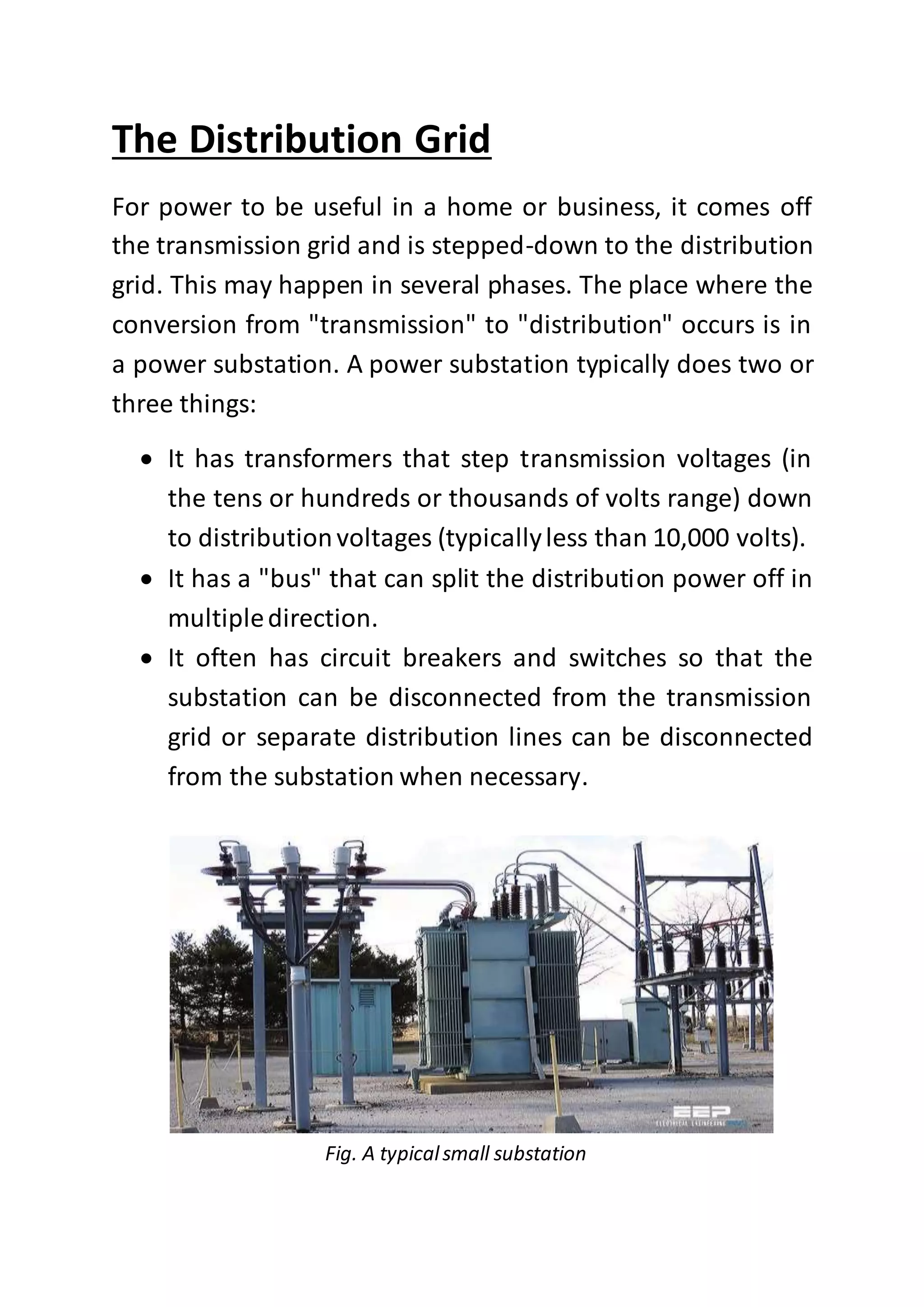
Fig. A typicalsmall substation
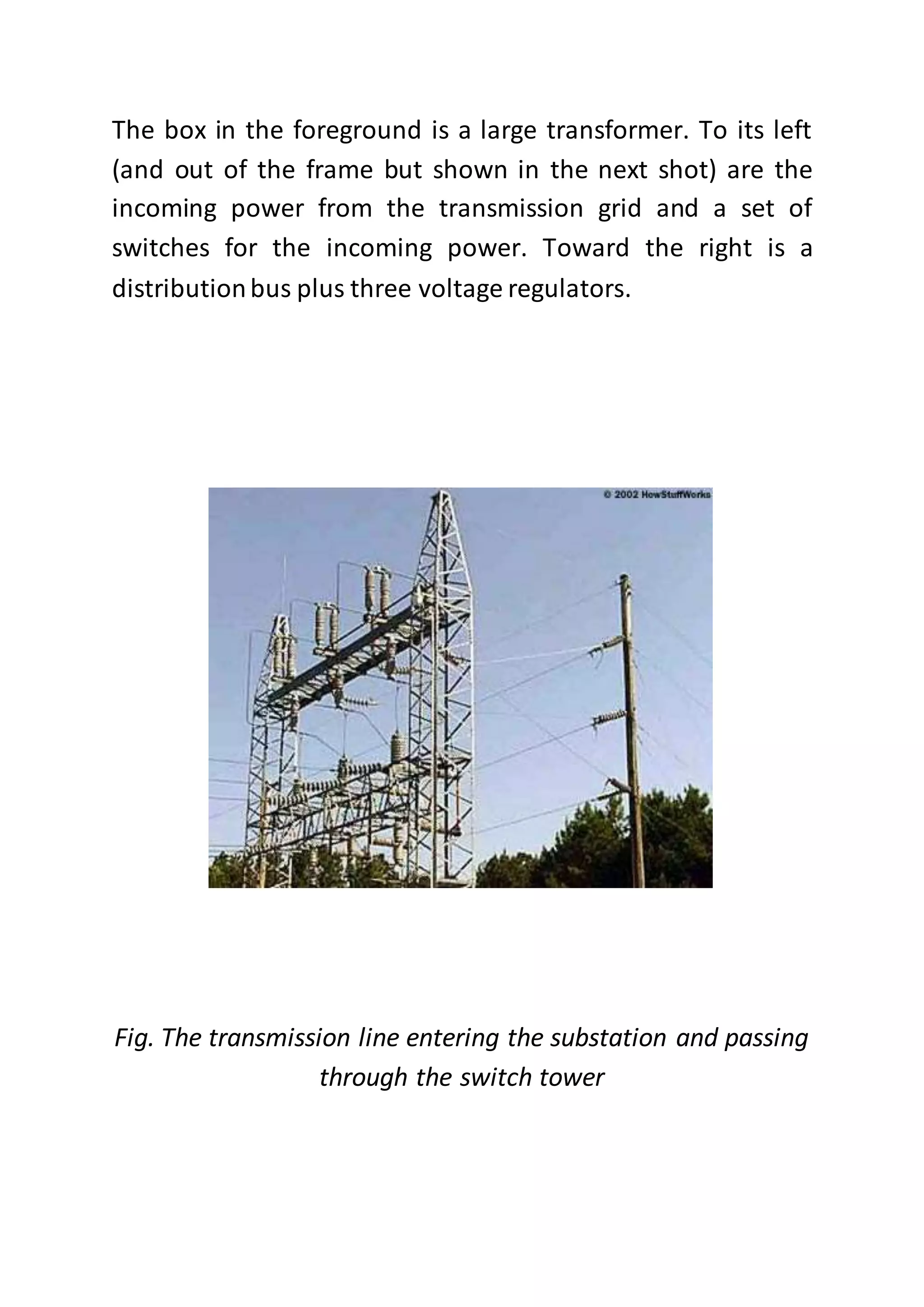
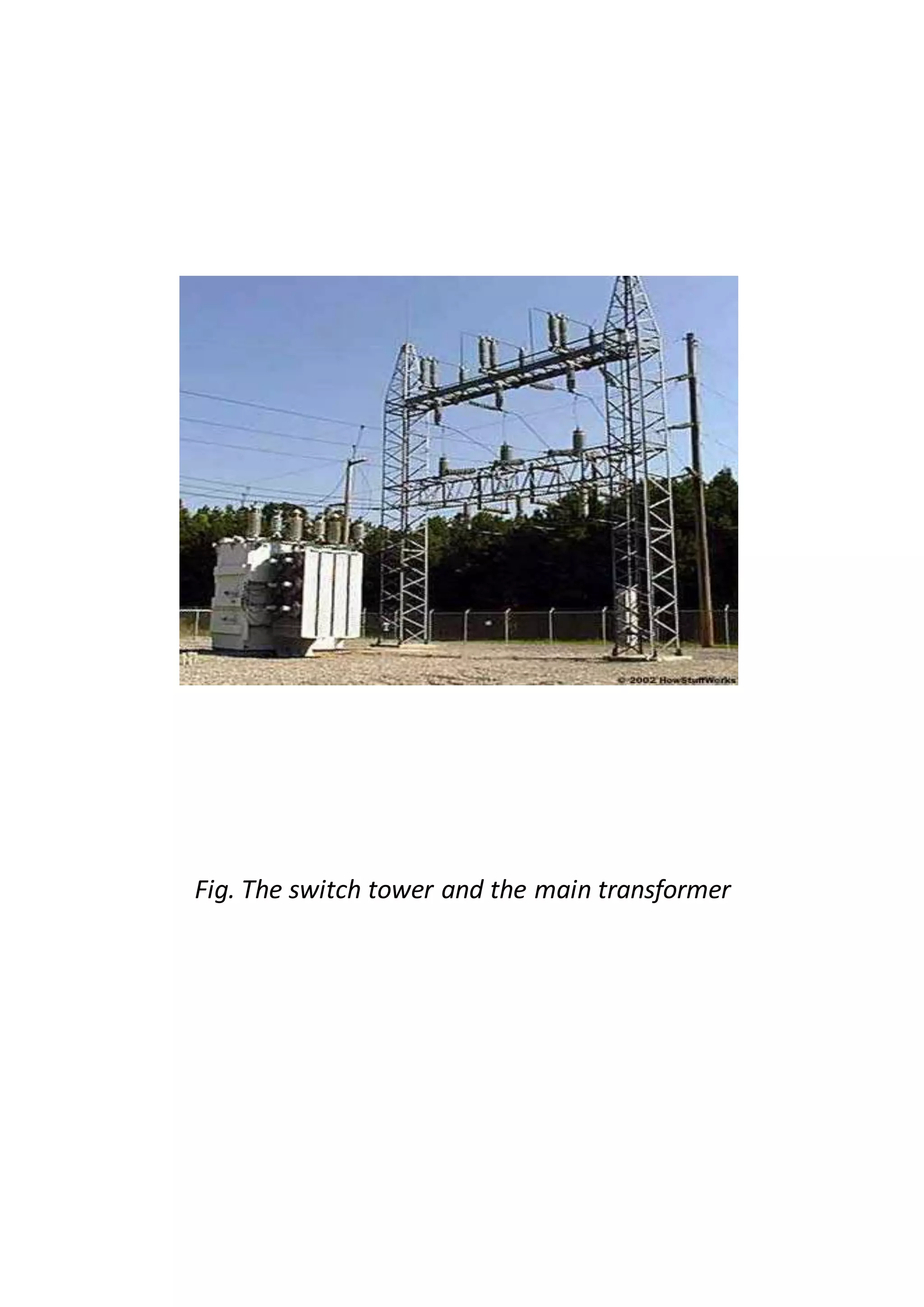
The box in the foreground is a large transformer. To its left
(and out of the frame but shown in the next shot) are the
incoming power from the transmission grid and a set of
switches for the incoming power. Toward the right is a
distributionbus plus three voltage regulators.
Fig. The transmission line entering the substation and passing
through the switch tower
Fig. The switch tower and the main transformer
Distribution Bus
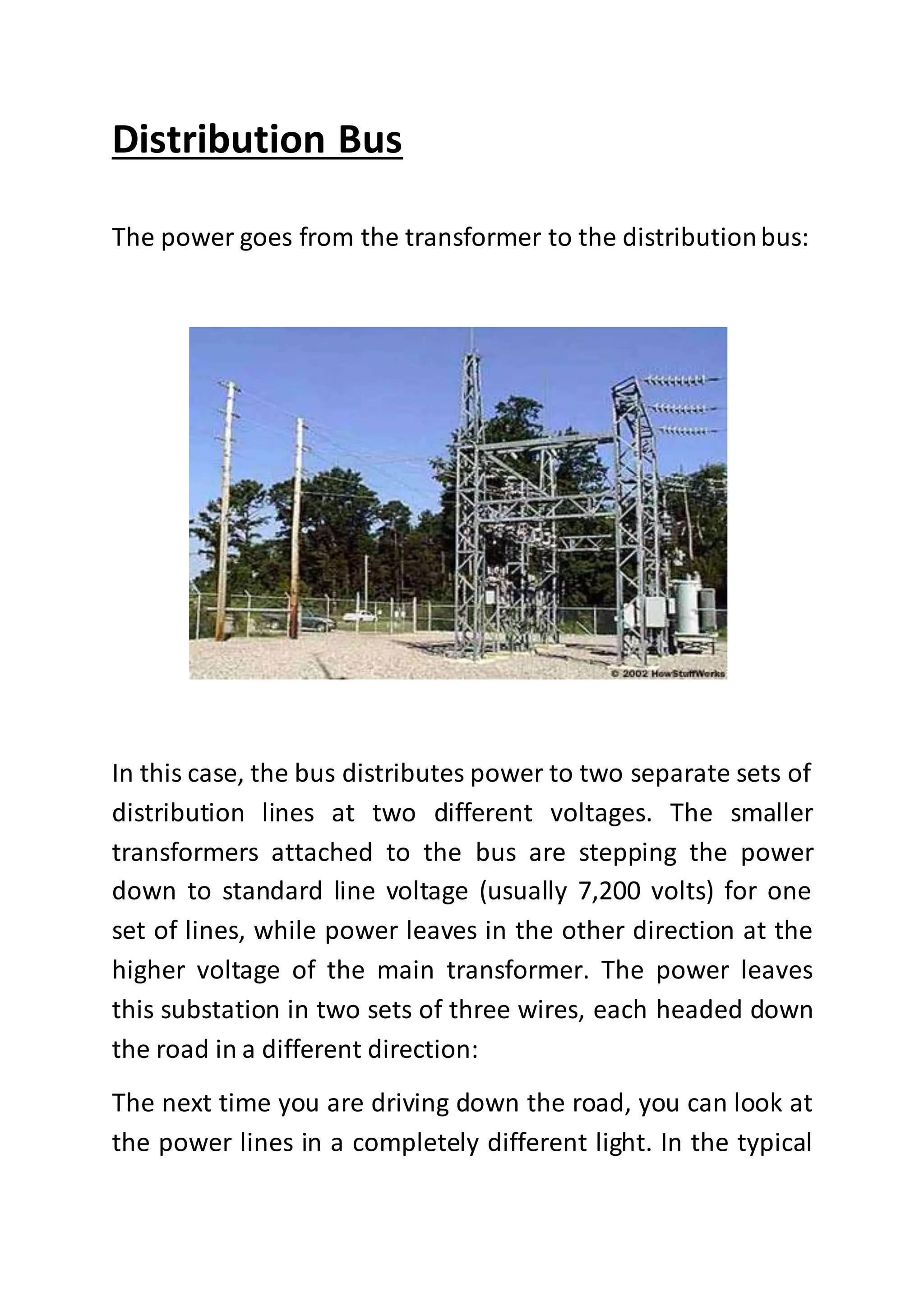
The power goes from the transformer to the distributionbus:
In this case, the bus distributes power to two separate sets of
distribution lines at two different voltages. The smaller
transformers attached to the bus are stepping the power
down to standard line voltage (usually 7,200 volts) for one
set of lines, while power leaves in the other direction at the
higher voltage of the main transformer. The power leaves
this substation in two sets of three wires, each headed down
the road in a different direction:
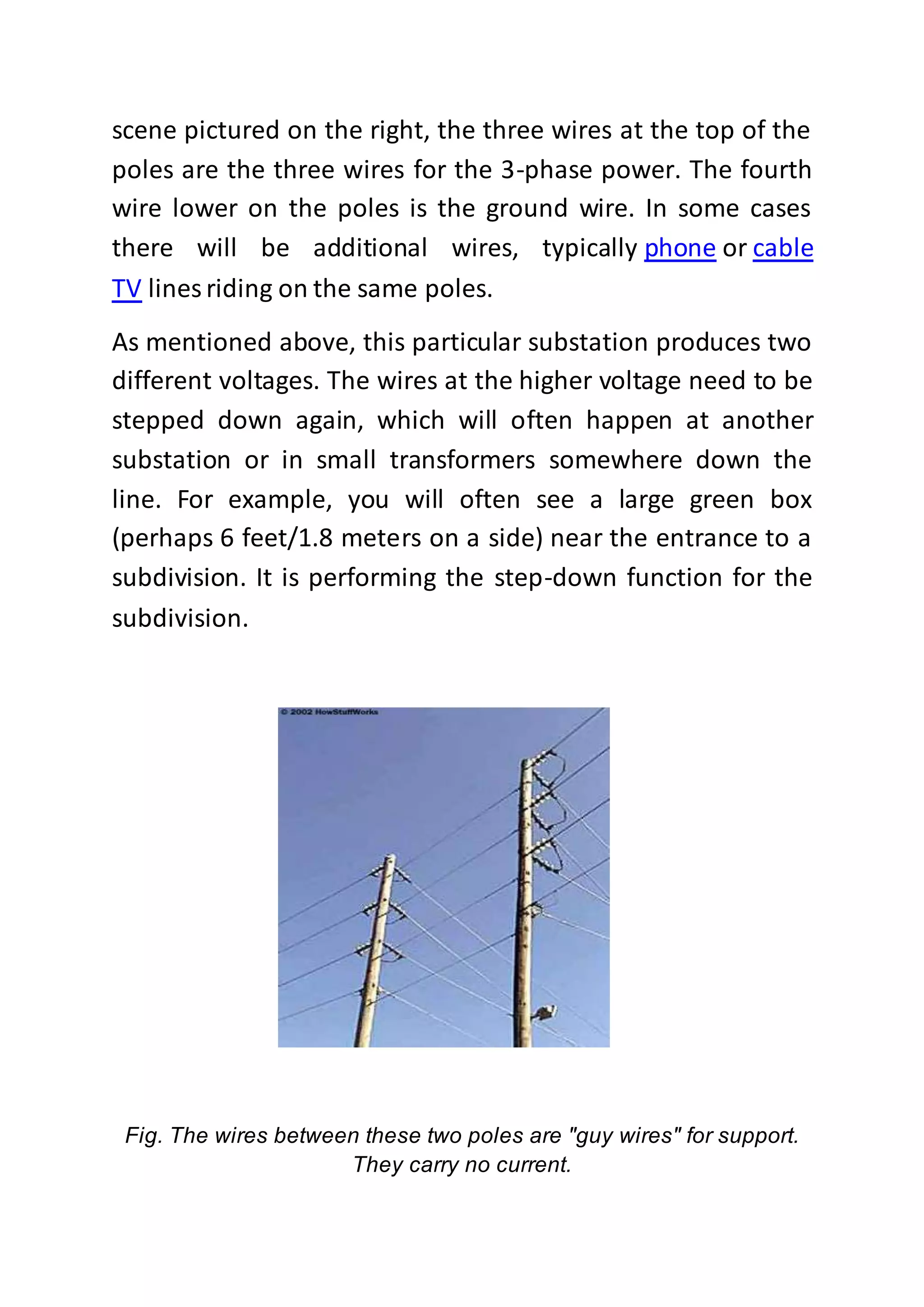
The next time you are driving down the road, you can look at
the power lines in a completely different light. In the typical
scene pictured on the right, the three wires at the top of the
poles are the three wires for the 3-phase power. The fourth
wire lower on the poles is the ground wire. In some cases
there will be additional wires, typically phone or cable
TV lines riding on the same poles.
As mentioned above, this particular substation produces two
different voltages. The wires at the higher voltage need to be
stepped down again, which will often happen at another
substation or in small transformers somewhere down the
line. For example, you will often see a large green box
(perhaps 6 feet/1.8 meters on a side) near the entrance to a
subdivision. It is performing the step-down function for the
subdivision.
Fig. The wires between these two poles are "guy wires" for support.
They carry no current.
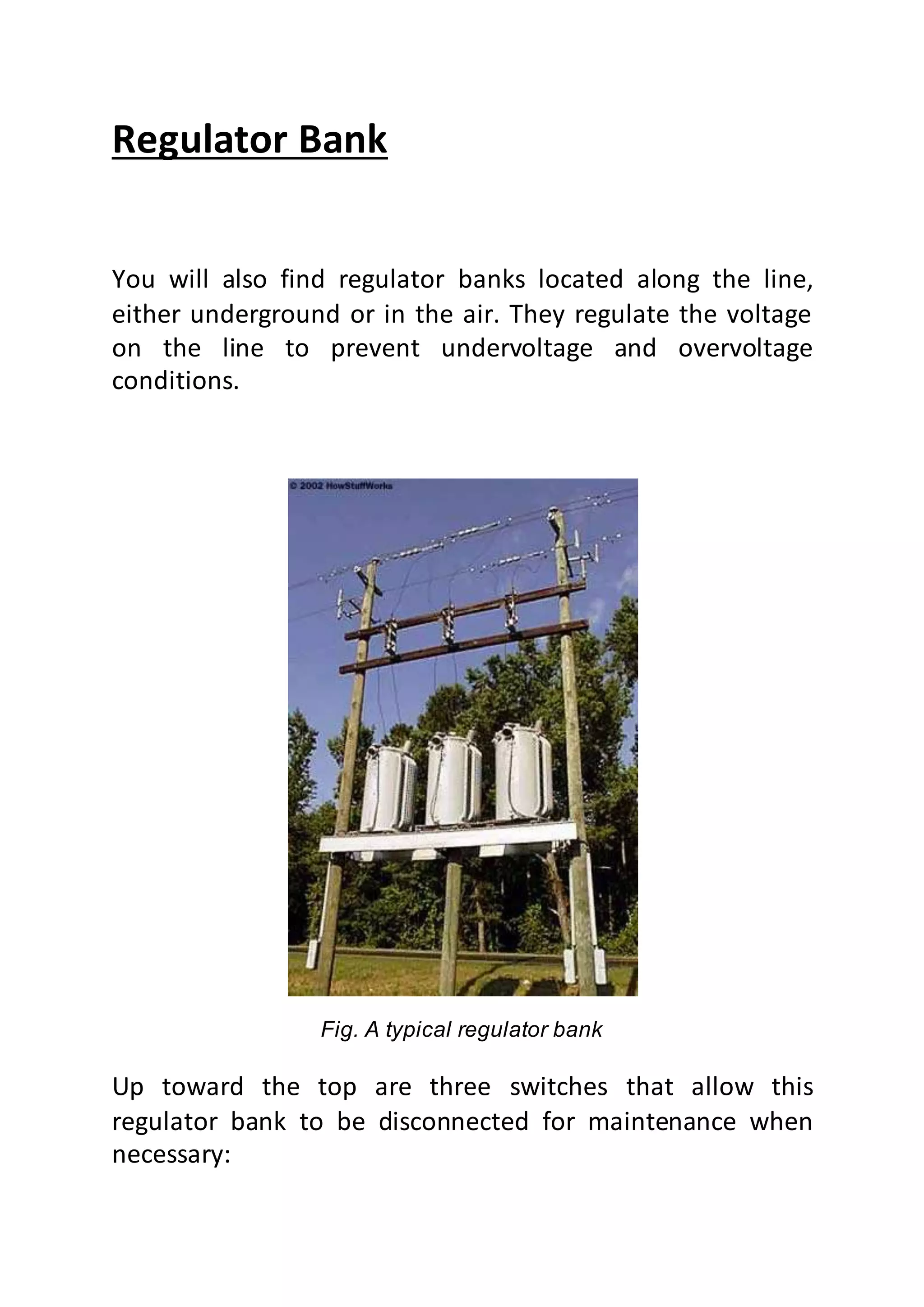
Regulator Bank
You will also find regulator banks located along the line,
either underground or in the air. They regulate the voltage
on the line to prevent undervoltage and overvoltage
conditions.
Fig. A typical regulator bank
Up toward the top are three switches that allow this
regulator bank to be disconnected for maintenance when
necessary:
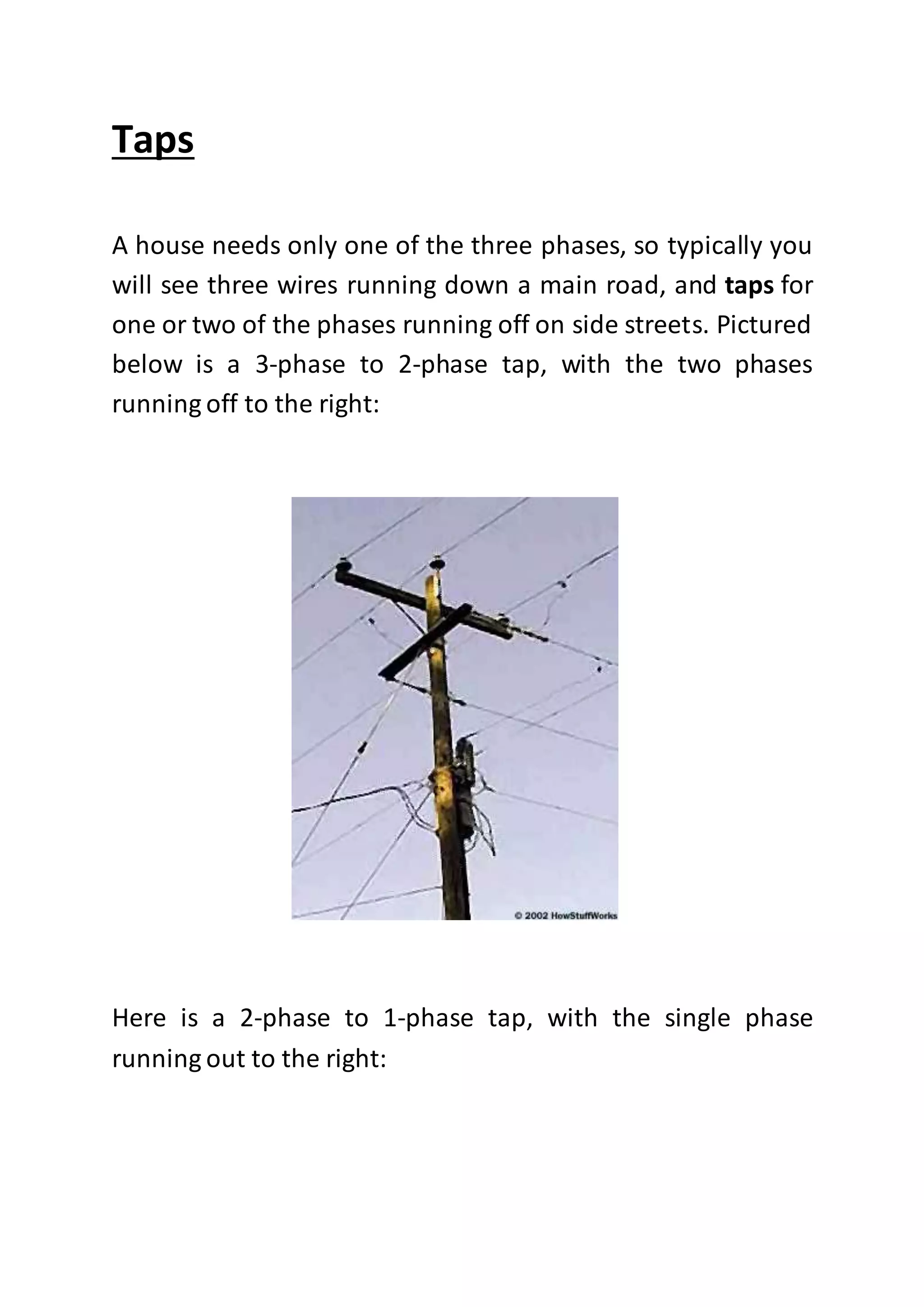
Taps
A house needs only one of the three phases, so typically you
will see three wires running down a main road, and taps for
one or two of the phases running off on side streets. Pictured
below is a 3-phase to 2-phase tap, with the two phases
running off to the right:
Here is a 2-phase to 1-phase tap, with the single phase
running out to the right:
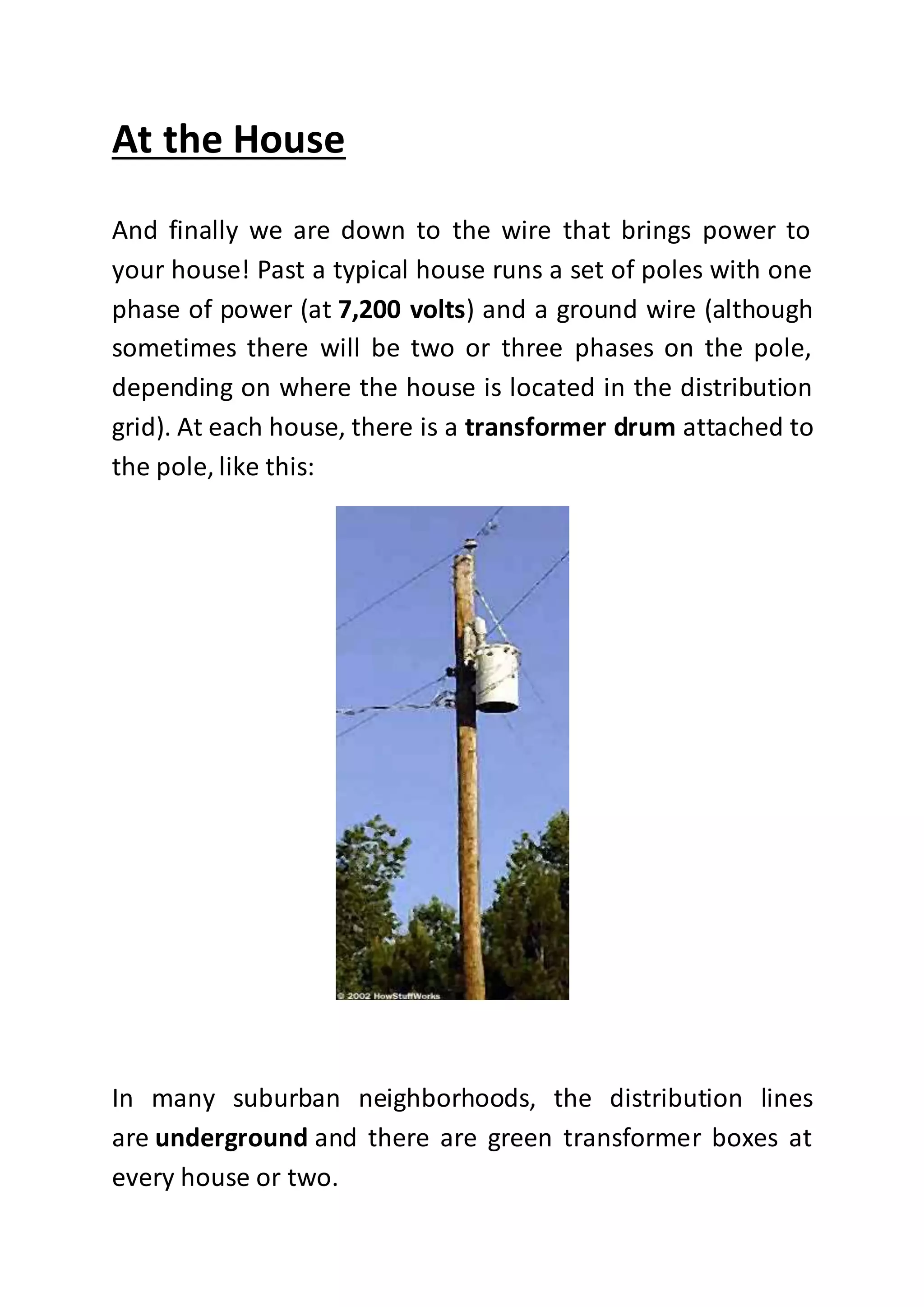
At the House
And finally we are down to the wire that brings power to
your house! Past a typical house runs a set of poles with one
phase of power (at 7,200 volts) and a ground wire (although
sometimes there will be two or three phases on the pole,
depending on where the house is located in the distribution
grid). At each house, there is a transformer drum attached to
the pole, like this:
In many suburban neighborhoods, the distribution lines
are underground and there are green transformer boxes at
every house or two.
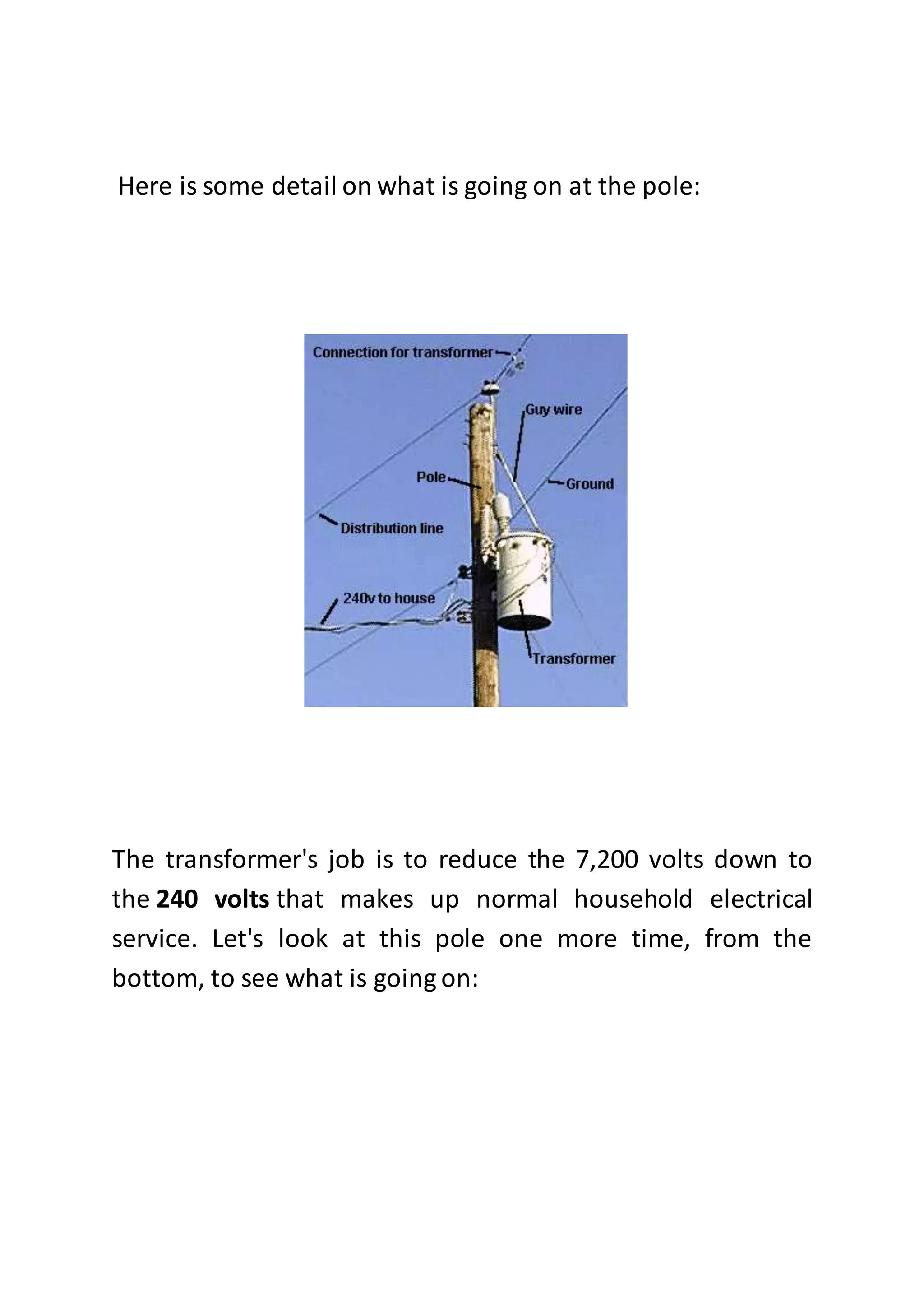
Here is some detail on what is going on at the pole:
The transformer's job is to reduce the 7,200 volts down to
the 240 volts that makes up normal household electrical
service. Let's look at this pole one more time, from the
bottom, to see what is going on:
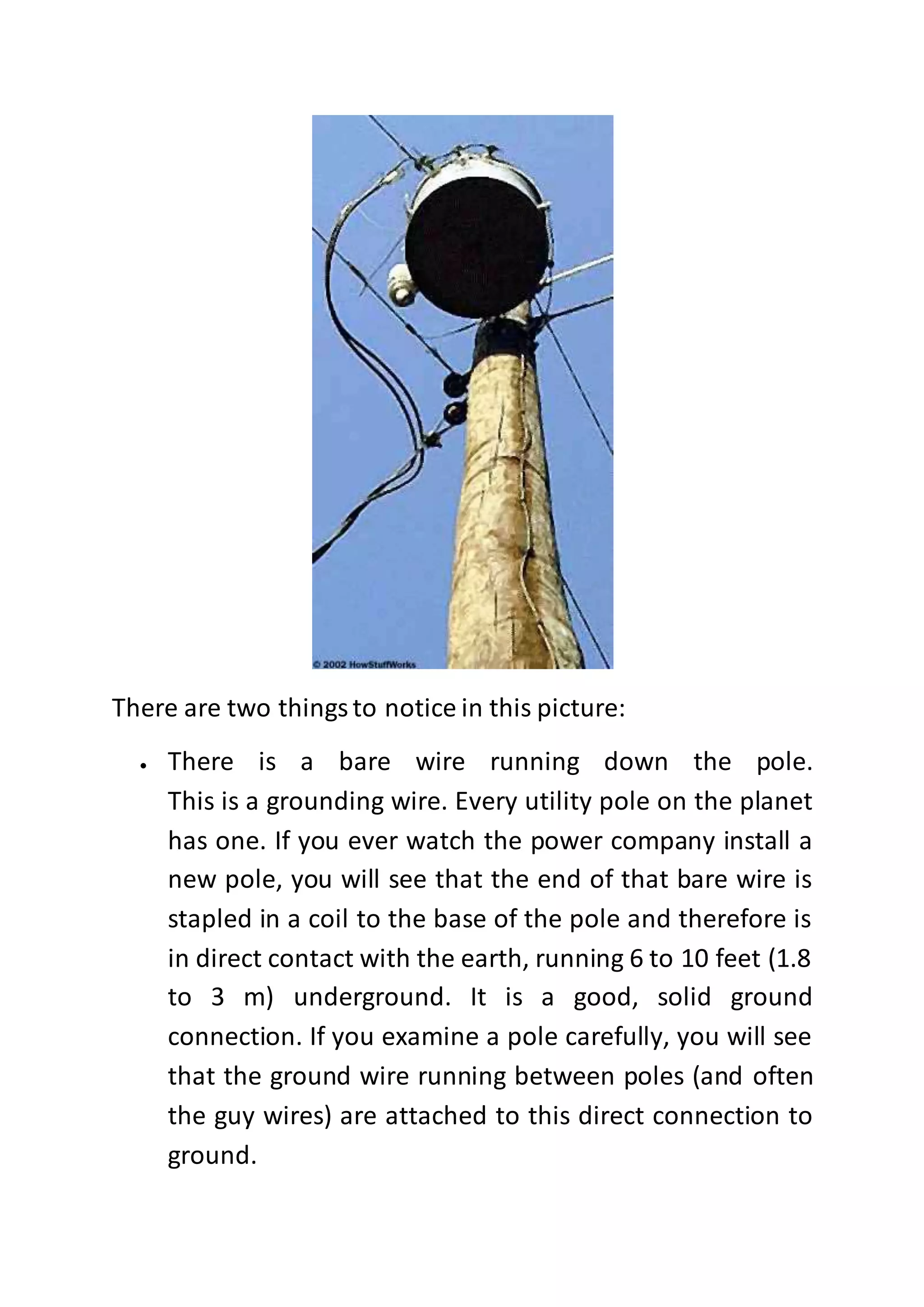
There are two thingsto notice in this picture:
 There is a bare wire running down the pole.
This is a grounding wire. Every utility pole on the planet
has one. If you ever watch the power company install a
new pole, you will see that the end of that bare wire is
stapled in a coil to the base of the pole and therefore is
in direct contact with the earth, running 6 to 10 feet (1.8
to 3 m) underground. It is a good, solid ground
connection. If you examine a pole carefully, you will see
that the ground wire running between poles (and often
the guy wires) are attached to this direct connection to
ground.
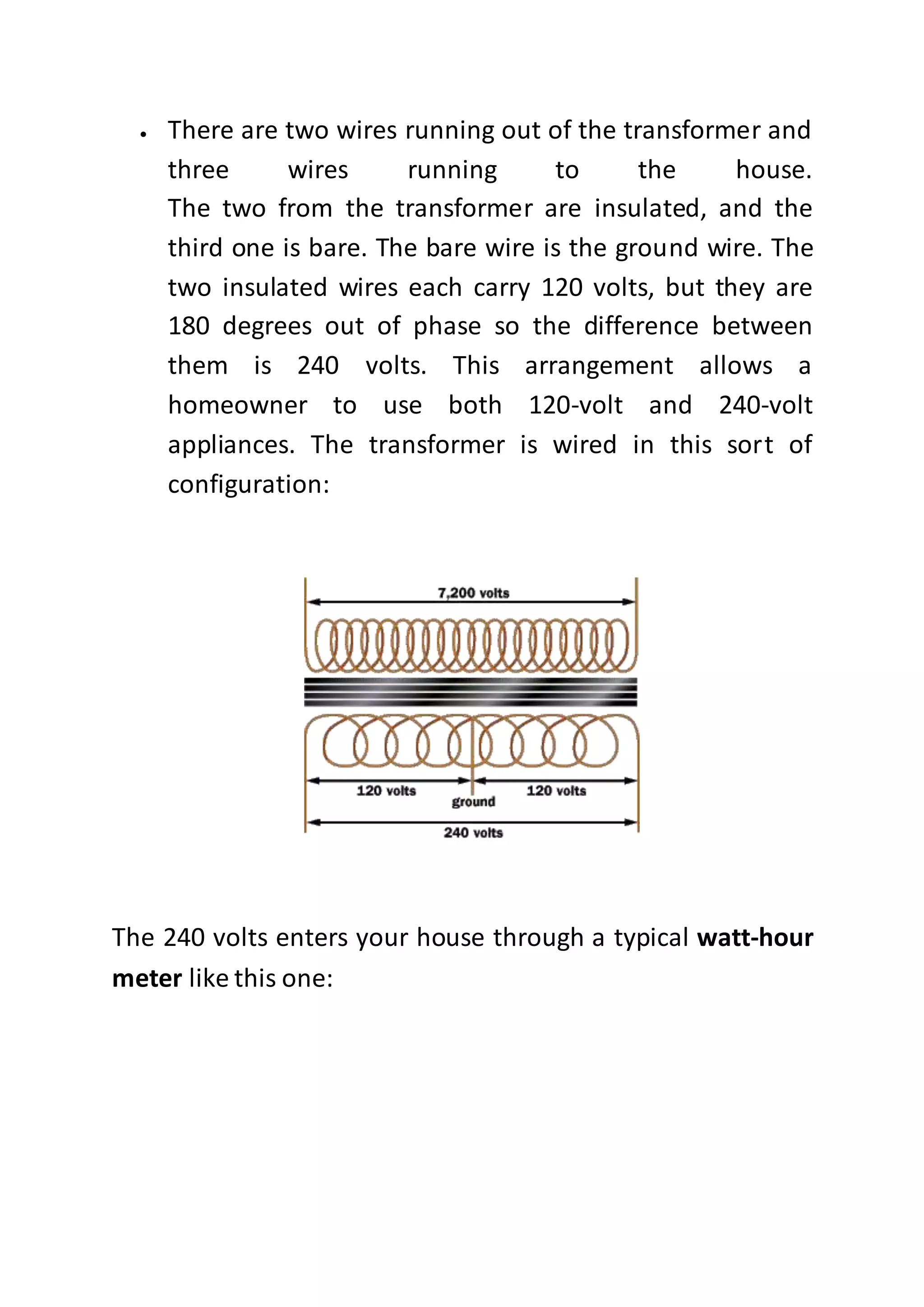
 There are two wires running out of the transformer and
three wires running to the house.
The two from the transformer are insulated, and the
third one is bare. The bare wire is the ground wire. The
two insulated wires each carry 120 volts, but they are
180 degrees out of phase so the difference between
them is 240 volts. This arrangement allows a
homeowner to use both 120-volt and 240-volt
appliances. The transformer is wired in this sort of
configuration:
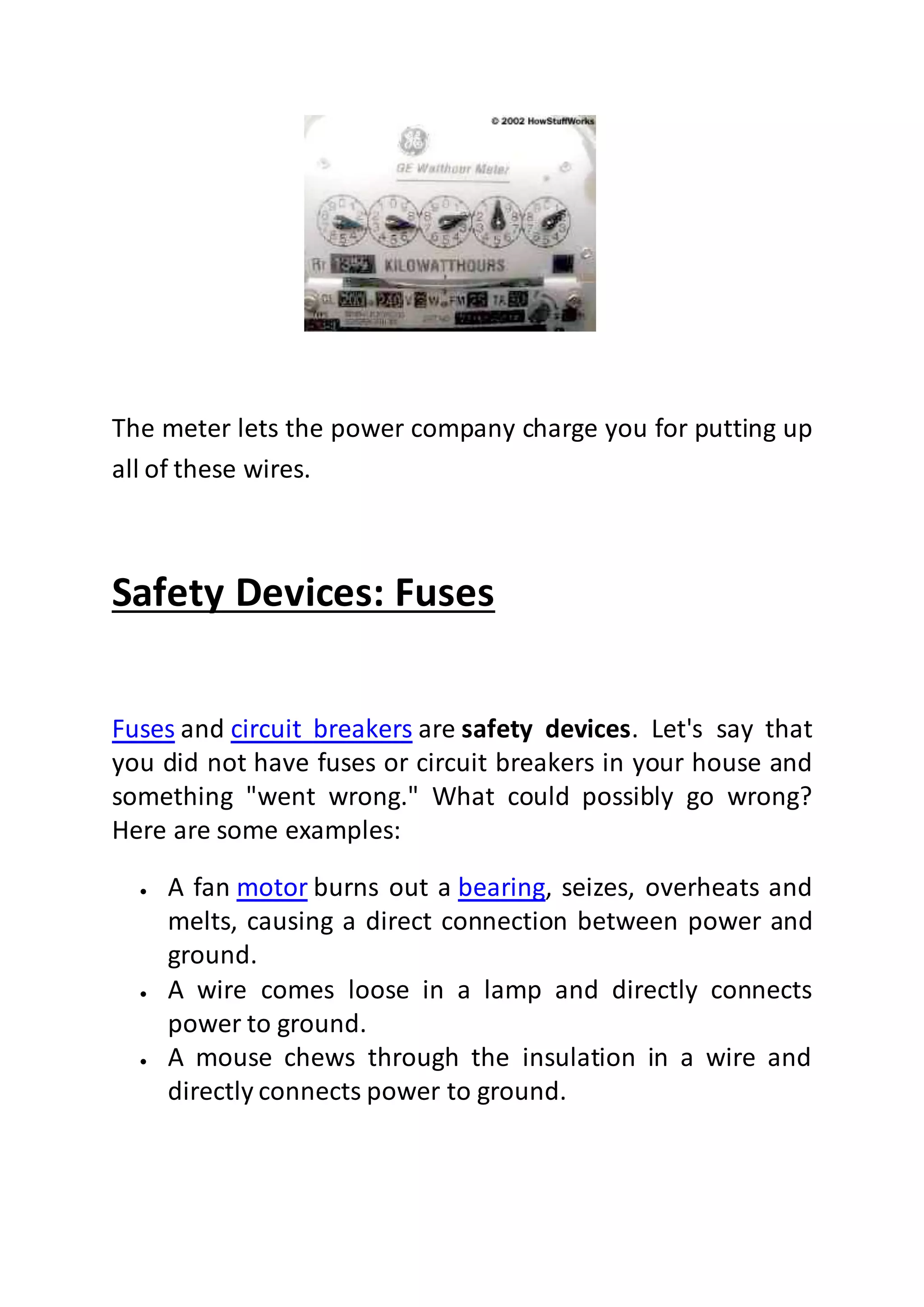
The 240 volts enters your house through a typical watt-hour
meter like this one:
The meter lets the power company charge you for putting up
all of these wires.
Safety Devices: Fuses
Fuses and circuit breakers are safety devices. Let's say that
you did not have fuses or circuit breakers in your house and
something "went wrong." What could possibly go wrong?
Here are some examples:
 A fan motor burns out a bearing, seizes, overheats and
melts, causing a direct connection between power and
ground.
 A wire comes loose in a lamp and directly connects
power to ground.
 A mouse chews through the insulation in a wire and
directly connects power to ground.
 Someone accidentally vacuums up a lamp wire with
the vacuum cleaner, cutting it in the process and directly
connecting power to ground.
 A person is hanging a picture in the living room and the
nail used for said picture happens to puncture a power
line in the wall, directly connecting power to ground.
When a 120-volt power line connects
directly to ground, its goal in life is to pump
as much electricity as possible through the
connection. Either the device or the wire in
the wall will burst into flames in such a
situation. (The wire in the wall will get hot
like the element in an electric oven gets
hot, which is to say very hot!). A fuse is a
simple device designed to overheat and
burn out extremely rapidly in such a situation. In a fuse, a
thin piece of foil or wire quickly vaporizes when an overload
of current runs through it. This kills the power to the wire
immediately, protecting it from overheating. Fuses must be
replaced each time they burn out. A circuit breaker uses the
heat from an overload to trip a switch, and circuit breakers
are therefore resettable.
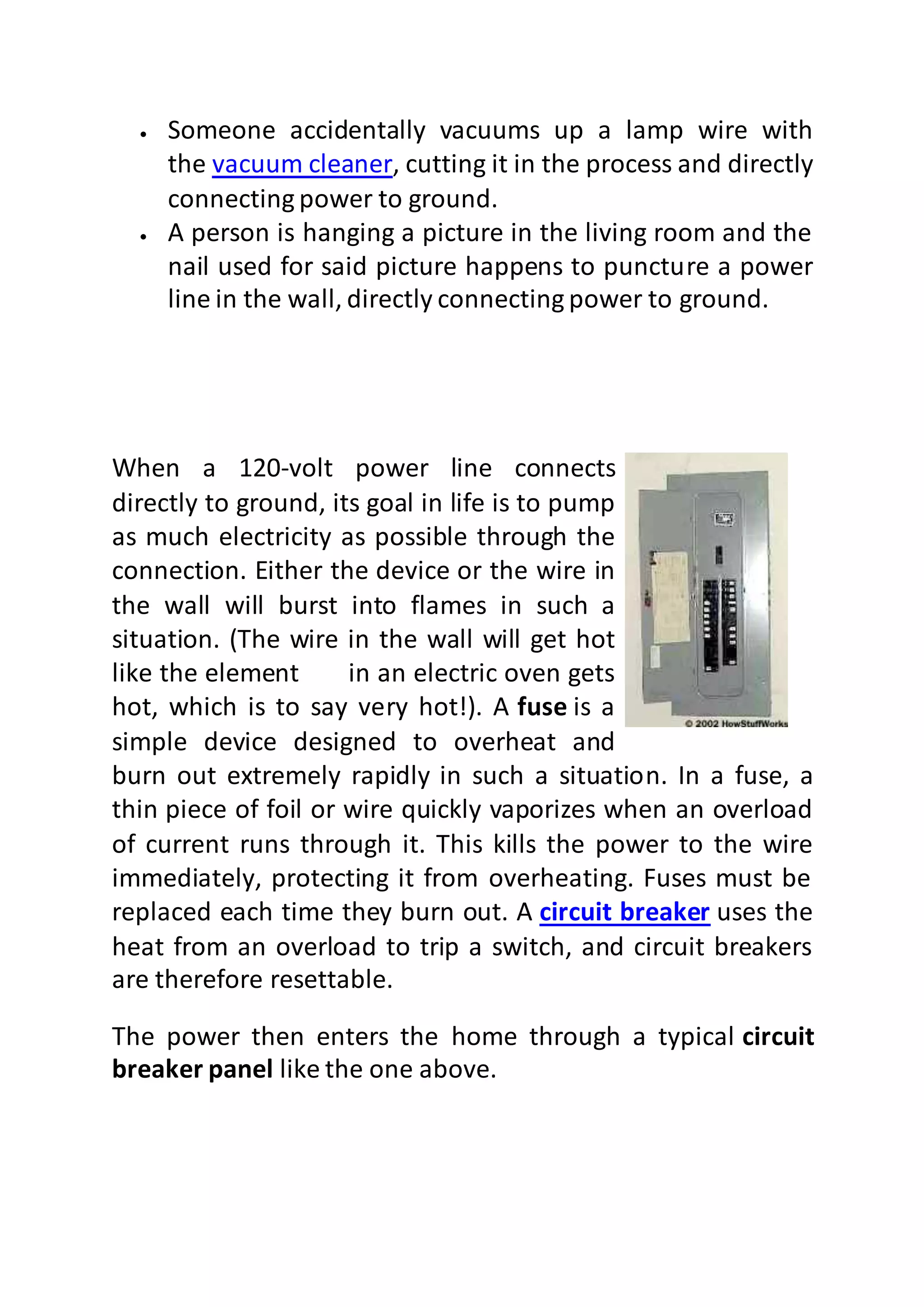
The power then enters the home through a typical circuit
breaker panel like the one above.
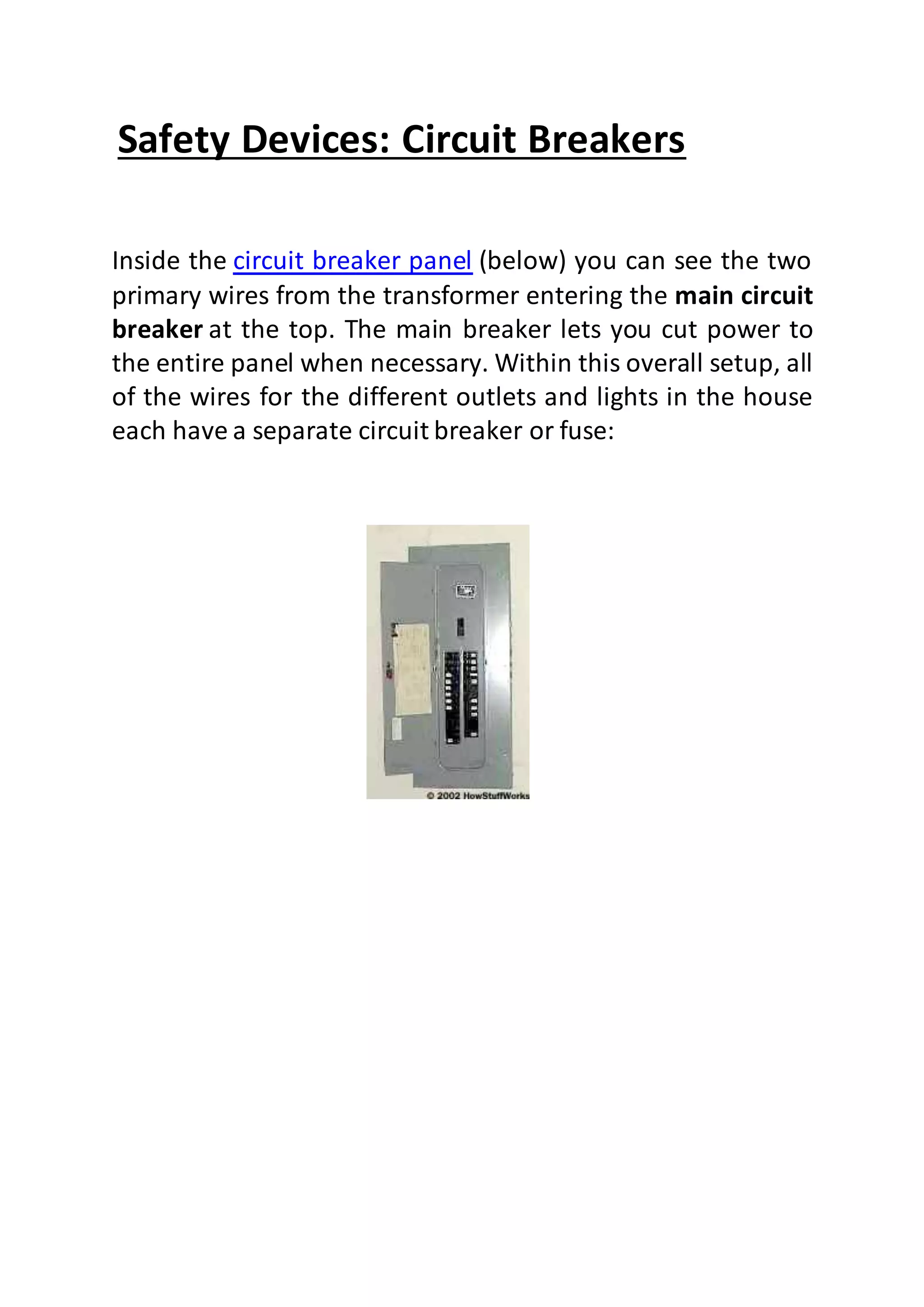
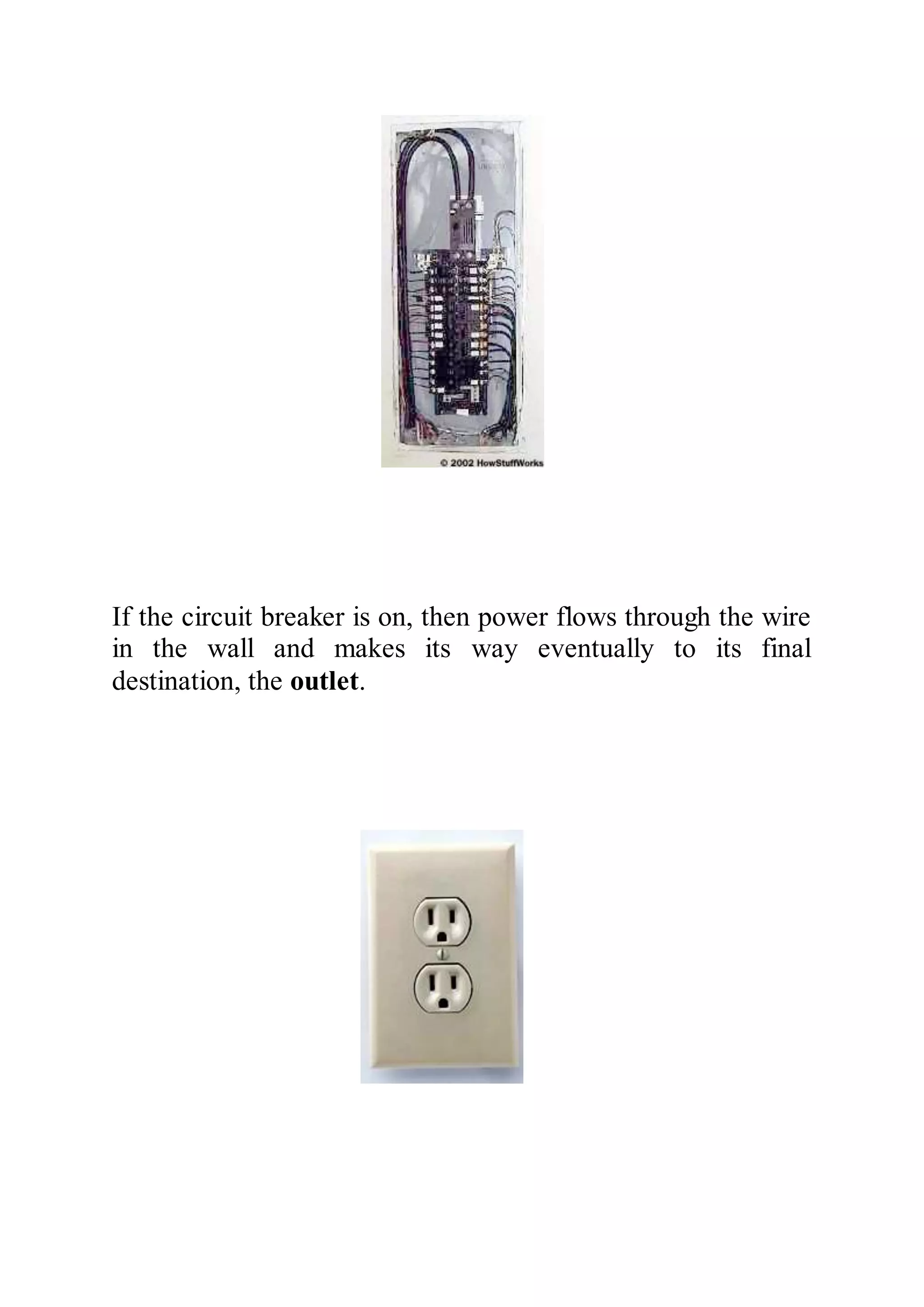
Safety Devices: Circuit Breakers
Inside the circuit breaker panel (below) you can see the two
primary wires from the transformer entering the main circuit
breaker at the top. The main breaker lets you cut power to
the entire panel when necessary. Within this overall setup, all
of the wires for the different outlets and lights in the house
each have a separate circuit breaker or fuse:
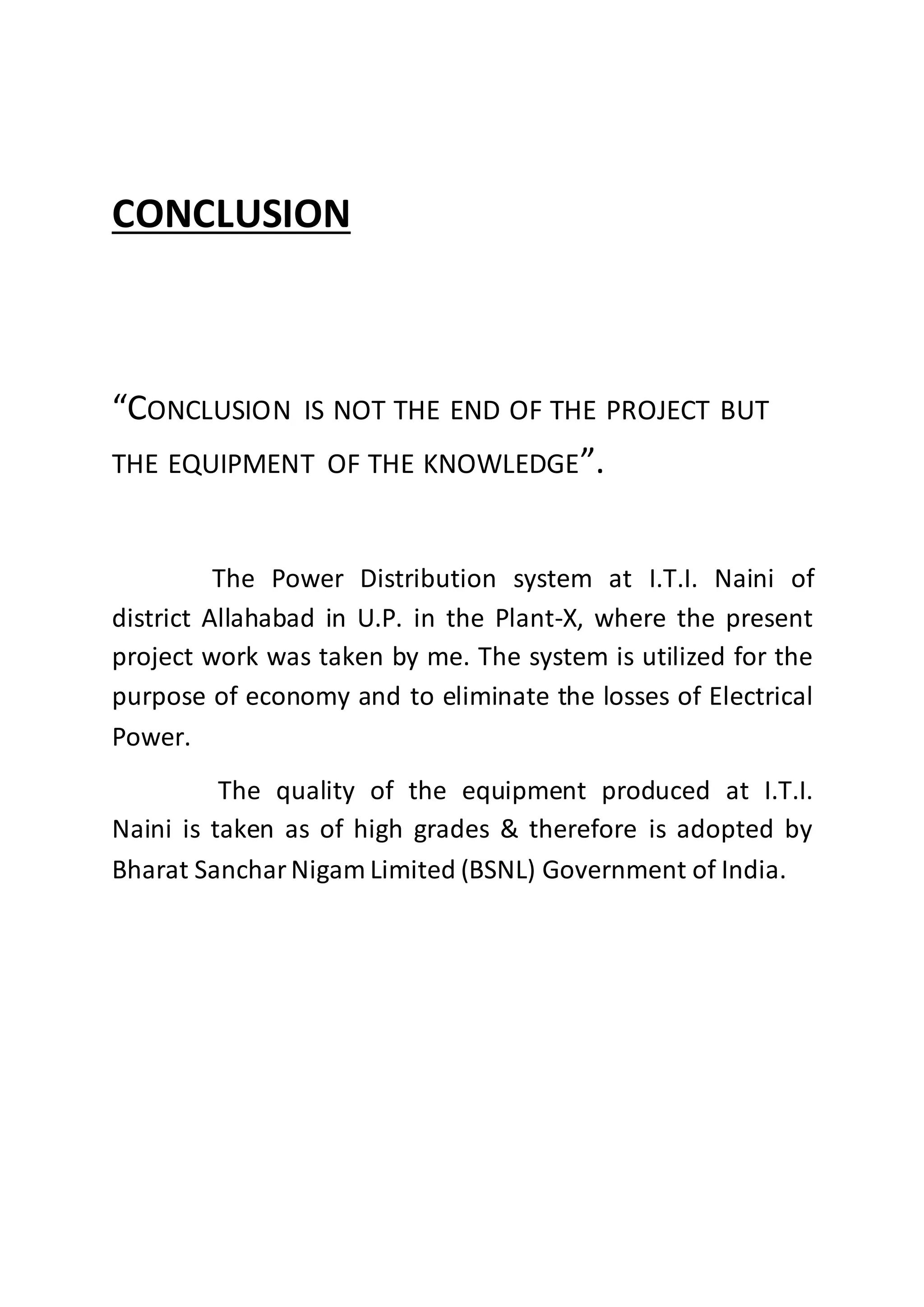
If the circuit breaker is on, then power flows through the wire
in the wall and makes its way eventually to its final
destination, the outlet.
CONCLUSION
“CONCLUSION IS NOT THE END OF THE PROJECT BUT
THE EQUIPMENT OF THE KNOWLEDGE”.
The Power Distribution system at I.T.I. Naini of
district Allahabad in U.P. in the Plant-X, where the present
project work was taken by me. The system is utilized for the
purpose of economy and to eliminate the losses of Electrical
Power.
The quality of the equipment produced at I.T.I.
Naini is taken as of high grades & therefore is adopted by
Bharat SancharNigam Limited (BSNL) Government of India.

Training project for Electrical Engineering Student

  • 2.
    CONTENTS DISCRIPTION  I.T.I.Profile  About I.T.I. Naini  Factory Division  MajorLandmark  OrganizationChart  Products  Electricity  Power Generation and Transmission  Power Distribution  Conclusion
  • 3.
    ITI PROFILE India’s firstPublic Sector Unit (PSU) - ITI Ltd was established in 1948. Ever since, as a pioneering venture in the field of telecommunications, it has contributed to 50% of the present national telecom network. With state-of-the-art manufacturing facilities spread across six locations and a countrywide network of marketing/service outlets, the company offers a complete range of telecom products and total solutions covering the whole spectrum of Switching, Transmission, Access and Subscriber Premises equipment. ITI joined the league of world class vendors of Global System for Mobile (GSM) technology with the inauguration of mobile equipment manufacturing facilities at its Mankapur and Rae Bareli Plants in 2005-06. This ushered in a new era of indigenous mobile equipment production in the country. These two facilities supply more than nine million lines per annum to both domestic as well as export markets. The company is consolidating its diversification into Information and Communication Technology (ICT) to hone its competitive edge in the convergence market by deploying its rich telecom expertise and vast infrastructure. Network Management Systems, Encryption and Networking Solutions for Internet Connectivity are some of the major initiatives taken by the company. Secure communications is the company's forte with a proven record of engineering strategic communication networks for India's Defence forces. Extensive in-house R&D work is devoted towards specialized areas of Encryption, NMS, IT and
  • 4.
    Access products toprovide complete customized solutions to variouscustomers. Indian Telephone Industries Limited, commonly known as ITI Limited, is a state-owned manufacturer of telecommunications equipment in India. It was founded in 1948, and today has six manufacturing facilities which produce a range of switching, transmission, access and subscriber premises equipment. It is headquartered at Bengaluru ( Bangalore). It produces GSM mobile equipment at its Mankapur and Raebareli Plants. These two facilities supply more than nine million lines per annum to both domestic as well as export markets. It also produces Information and Communication Technology (ICT) equipment such as network management systems, encryption and networking solutions for internet connectivity, and secure communications networks and equipment for India's military. The company has above 3500 employees as on October 2017. Our Human Resources Department strives to build technological and managerial excellence in the organization through best HR policies and practices in the industry. We are committed to build a creative workforce with emphasis on quality and customer satisfaction. We have realigned our HR policies, in line with the company’sbusiness plans.
  • 5.
    CORPORATE OBJECTIVES : Generate demands for Telecommunication in products through innovation.  To become a strong service provider with major business thrust on telecommunication Network operationsand value added services.  Achieve global quality standards in a products in shortest time.  Introduce effective production planning and control system delivering, schedules, streamlined ,production over whole year and other inventory control.  Optimization of resource utilization and to create an atmosphere of cost consciousness.  Promote creativity and innovation. MISSION OF ITI Leader in domestic market, major player in global market in the field of voice data and image communication.Toprovide total solution to customer to buildone crore competence for entering the new areas of business.
  • 6.
    QUALITY POLICY OFITI : ITI is commited to provide products and services of consistent quality that will lead to customer delight. ITI has maintained leadership in the market with competitive prices and professional excellance though :  Implementationof sound qualitymanagement system.  Continuousinnovation.  Continualimprovement in every activity.  Involvement of people at all levels, internally and externally.  The qualitysystem of ITI is ISO-9000.
  • 7.
    DESCRIPTION OF DIVISION: 1.TransmissionEquipment Division: It mainly consists of the followinghangers:  Hangar (Machine Shop): The shop houses various mechanical machines like lathe shaper, drill press and welding machines along with a well furnished tool room and one CNC punch press machine is also available for precision fabricatlion  B- Hangar :This Hangar deals with the production of 2 types of equipments- 1. Analog production shop: It deals with the production of 3 channel O/W carrier systems and 8 channel O/W carrier systems.
  • 8.
    2. Radio productionshop: It manufactures the radio equipments like single channel and MARR (4/30 and 8/60) in the VHF range of frequencies.  C- Hangar: Drawing and Duplicatingdepartment  Digital Hangar (Opto Electronics Division) : This is the latest hangar of all and deals with the optical equipments. The type of multiplexing used here is TDM. This hangar deals with the production of PCM base equipments in the PDH employing the late ‘COMBIMUX' equipment and the SDH equipment. Work on DWDM equipment is also going on in this hangar.  IV Hangar :This hangarmakes STM-1 & STM-4 equipment.  Research & Development Section : This section concentrates on the research and the house development of the latest techniques and the improvements in the previous equipments.It houses the following laboratories:- 1. Analog laboratory 2. Digital and Opticallaboratory
  • 9.
    3. Radio laboratory 4.Micro laboratory 5. Automatic testing systems laboratory 6. Hybrid laboratory 2.Telephone Instrument Division:  Telephoneresearch and developmentsection.  Production and fabricationshop. TID manufactures a variety of Telephones, which are being used by majority of people in the nation. TID is also subdividedinto three parts.  MouldingShop  Tool Room  TID Assembly
  • 10.
    ITI Joint Ventures: India Satcom Ltd Bangalore (with EPIC,USA satellite communication)  ITI communication private Ltd. With Valvas, Singapore & M/S Comfort to act as exporter arms of India.  Fibcom India Ltd, New Delhi with DSC Communication of USA for fiber communicationequipment. Technical Collaborations: ITI has technical collaborationwith the following companies:  ALCATEL of France  BOSCH Telecom of Germany  Qualcom of USA  Siemens Branch of India  AT & T of Spain
  • 11.
    ITI Global Customers: ITI has global customers around the world mainly in :  Switzerland  Botswana  Zimbabwe  Costa Rica  Ireland  South Africa  Malaysiaand Others. ITI Customers: ITI has following big customers (in India) are :  BSNL  MTN  Defense  VSNL  Railways  Electricity Boards  Paramilitary Police and Internal Security
  • 12.
    ITI NAINI ALLAHABAD TheNaini unit of ITI is a prime organization in North India that spearheads the task of manufacturing the entire range of telecommunication transimission equipments and telephone instruments required for building the telecomm infrastructure of the company. It is situated as the Mirzapur Road at about 16 km from the holy city of Prayag. Since its inception in 1971, the unit has been marching ahead with a steady growth and has achieved the twin objectives of producing the vital telecommunication equipment for the country and with a modest production of Rs 1.66 Crores with Staff strength of about 400 during 1971-1972, produced equipment worth Rs 174.48 Crores with staff of about 4700 in 1991-1992. It manufactures the complete range of multiplex equipments of range intercity and intra-city communication needs of the National Telecommunication Network. As the production of modern equipment is highly technology intensive, the most modern R & D division backs the unit. The unit has not only raised the level but also improved its profitability by improving its productivity, efficiency and reducing wastage. While maintaining quality level, the cost of equipment has been reduced due to ceaseless efforts to improve design and manufacturingprocess.
  • 13.
    To meet theinformation needs of the organization, the computer center and the R &D division has provided internet facility through which all the key areas of the organizationare concerned. Some of the projects be arrived out at R&D are :  For DAR (Fiber optics radardata remoting system)  Single channel VHF and SMD version  Spread spectrum multichannelsecrecy Radio  Single channel telephonewith material  Full handsfree telephones  Solar power for info-Kiosk and other areas  TCP/IP compatibleradio  FDF (Fiber Distribution Frame)
  • 14.
    Electricity: Electricity isa general term encompassing a variety of phenomena resulting from the presence and flow of electric charge. These include many easily recognizable phenomena, such as lightening static electricity, and the flow of electrical current in an electrical wire. In addition, electricity compasses less familiar concepts such as the electromagnetic field and electromagnetic induction. Electric charge : A property of some subatomic particles which determines their electromagnetic interaction. Electrically charged matter is influenced by, and produces, electromagnetic fields. Electric current : A movement or flow of electrically charged particles, typicallymeasured in amperes. Electric field: An influence produced by an electric charge on other charges in it’s vicinity. Electric potential: The capacity of an electric field to do work on an electric charge, typicallymeasured in volts.
  • 15.
    Electromagnetism: A fundamentalinteraction between the magnetic field and the presence and motion of an electric charge. The most common use of the word "electricity" is less precise. It refers to: Electric power : Provided commercially by the electrical power industry. In a loose but common use of the term, “electricity" may be used to mean "wired for electricity" which means a working connection to an electric power station. Such a connection grants the user of "electricity" access to the electric field present in electrical wiring, and thus to electric power. Production Generation and transmission Electrical power is usually generated by electro-mechanical generators driven by sleam produced from fossil fuel combustion, or the heat released from nuclear reactions; or from other sources such as kinetic energy extracted from wind or flowing water. The modern steam turbine invented by Sir Charles Parsons in 1884 today generates about 80 percent of the electric power in the world using a variety of heat sources. Such generators bear no resemblance to Faraday's unipolar disc generator of 1831, but they still rely
  • 16.
    on his eleclromagneticprinciple that a conductor linking a changing magnetic field induces a potential difference across its ends. The invention in the late nineteenth century of the transformer meant that electrical power could be transmitted more efficiently at a higher voltage but lower current. Efficient electrical transmission meant in turn that electricity could be generated at centralized power stations, where it benefited from economies of scale, and then be dispatchedrelativity long distances to where it was needed. Since electrical energy cannot easily be stored in quantities large enough to meet demands on a national scale, at all times exactly as much must be produced as is required. This requires electricity utilities to make careful predictions of their electrical loads, and maintain constant co-ordination with their power station. A certain amount of generation must always be held in reserve to cushion an electrical grid against inevitabledisturbances and losses. Demand for electricity grows with great rapidity as a nation modernises and its economy develops. The United States showed 12% increase in demand during each year of the first three decades of the twentieth century, a rate of growth that is now being experienced by emerging economies such as those of India or China. Historically, the growth rate for electricity demand has outstripped that for other forms of energy.
  • 17.
    Environmental concerns withelectricity generation have led to an increased focus on generation from renewable sources, in particular from wind and hydropower. While debate can be expected to continue over the environmental impact of different means of electricity production, its final form is relativelyclean.
  • 18.
    Electrical Power System: Fig. (1) A steam turbine used to provide electric power An electric power system is a network of electrical components used to supply, transmit and use electric power. An example of an electric power system is the network that supplies a region's homes and industry with power - for sizable regions, this power system is known as generators that supply the power, the transmission system that carries
  • 19.
    the power fromthe generating centres to the load centres and the distribution system that feeds the power to nearby homes and industries. Smaller power systems are also found in industry, hospitals, commercial buildings and homes. The majority of these systems rely upon three-phase AC power - the standard for large- scale power transmission and distribution across the modern world. Specialised power systems that do not always rely upon three-phase AC power are found in aircraft, electric rail systems ocean liners and automobiles.
  • 20.
  • 21.
    Line diagram ofpower distributionin ITI TO TID SUBSTATION INTERLINK TO TED TID S/S TO TED S/S SUBSTATION T3 T2 T1 TO W/O TO W/O TO W/O Hydel over head METER ROOM V.C.B. V.C.B. O.C.B 11 KV 11 KV 11KV INCOMING OUTGOING OUTGOING O.C.B O.C.B O.C.B O.C.B O.C.B 11 KV 11KV 11 KV 11KV 11KV TO TO TO INTERLINK INCOMING TRANSFORMER3 TRANSFORMER2 TRANSFORMER1 11 KV 11KV TO TO TRANSFORMER3 TRANSFORMER2 T.I.DSUBSTATION A.C.B. 440V A.C.B. 440V A.C.B. 440V
  • 22.
    Electrical power distribution Fig.2 Electricity distribution is the final stage in the delivery (before retail) of electricity to end users. A distribution system network carries electricity from the transmission system and delivers it to consumers. Typically, the network would include medium-voltage (less than 50 kV) power lines, electrical substations and pole mounted transformers, low-voltage (less than 1 kV) distribution wiring and sometimes electricity meters.
  • 23.
    Fig.3 Power griddistribution lines can be above or under ground Electrical power is a little bit like the air you breathe: You don't really think about it until it is missing. Power is just "there, meeting your every need, constantly. Power travels from the power plant to your house through an amazing system called the power distribution grid. The grid is quite public - - if you live in a suburban or rural area, chances are it is right out in the open for all to see. It is so public in fact, that you probably don't even notice it anymore. Your brain likely ignores all of the power lines because it has seen them so often.
  • 24.
    The Power Plant Fig.4 Electrical power starts at the power plant. In almost all cases, the power plant consists of a spinning electrical generator. Something has to spin that generator it might be a water wheel in a hydroelectric dam, a large diesel engine or a gas turbine. But in most cases, the thing spinning the generator is a steam turbine. The steam might be created by burning coal, oil or natural gas. Or the steam may come from a nuclear reactor like this one at the Shearon Harris nuclear power plant near Raleigh, North Carolina No matter what it is that spins the generator, commercial electrical generators of any size generate what is called 3-phase AC power. To
  • 25.
    understand 3-phase ACpower, it is helpful to understand single-phase power first.  ALTERNATING CURRENT Single-phase power is what you have in your house. You generally talk about household electrical service as single- phase, 120-volt AC service. If you use an oscilloscope and look at the power found at a normal wall-plate outlet in your house, what you will find is that the power at the wall plate looks like a sine wave, and that wave oscillates between -170 volts and 170 volts (the peaks are indeed at 170 volts; it is the effective (rms) voltage that is 120 volts). The rate of oscillation for the sine wave is 60 cycles per second. Oscillating power like this is generally referred to as AC, or alternating current. The alternative to AC is DC, or direct current. Batteries produce DC: A steady stream of electrons flows in one direction only, from the negative to the positive terminal of the battery AC has at least three advantages over DC in a power distribution grid: 1. Large electrical generators happen lo generate AC naturally, so conversion to DC would involve an extra step 2. Transformers must have alternating current to operate, and we will see that the power distribution grid depends on Transformers.
  • 26.
    3. It iseasy to convert AC to DC but expensive to convert DC to AC, so if you were going to pick one or the other AC would be the better choice. The power plant, therefore, produces AC. On the next page, you'll learn about the AC power produced at the power plant. Most notably,it is produced in three phases.  THREE PHASE POWER The power plant produces three different phases of AC power simultaneously, and the three phases are offset 120 degrees from each other. There are four wires coming out of every power plant: the three phases plus a neutral or ground common to all three. If you were to look at the three phases on a graph, they would look like this relative to ground:
  • 27.
    There is nothingmagical about three-phase power. It is simply three single phases synchronized and offset by 120 degrees. Why three phases? Why not one or two or four? In 1-phase and 2-phase power, there are 120 moments per second when a sine wave is crossing zero volts. In 3-phase power, at any given moment one of the three phases is nearing a peak. High-power 3-phase motors (used in industrial applications) and things like 3-phase welding equipment therefore have even power output. Four phases would not significantly improve things but would add a fourth wire, so 3-phase is the natural settling point. And what about this "ground", as mentioned above? The power company essentially uses the earth as one of the wires in the power system. The earth is a pretty good conductor and it is huge, so it makes a good return path for electrons. "Ground" in the power distribution grid is literally "the ground" that's all around you when you are walking outside. It is the dirt, rocks, groundwater, etc., of the earth.
  • 28.
    Transmission Substation The three-phasepower leaves the generator and enters a transmission substation at the power plant. This substation uses large transformers to convert the generator's voltage (which is at the thousands of volts level) up to extremely high voltages for long-distance transmission on the transmission grid Fig. A typicalsubstation at a power plant You can see at the back several three-wire towers leaving the substation. Typical voltages for long distance transmission are in the range of 155,000 to 765,000 volts in order to reduce line losses. A typical maximum transmission distance is about 300 miles (483 km). High-voltage transmission lines are quite obvious when you see them. They are normallymade of huge steel towers like this:
  • 29.
    All power towerslike this have three wires for the three phases. Many towers, like the ones shown above, have extra wires running along the tops of the towers. These are ground wires and are there primarily in an attempt to attract lightning.
  • 30.
    The Distribution Grid Forpower to be useful in a home or business, it comes off the transmission grid and is stepped-down to the distribution grid. This may happen in several phases. The place where the conversion from "transmission" to "distribution" occurs is in a power substation. A power substation typically does two or three things:  It has transformers that step transmission voltages (in the tens or hundreds or thousands of volts range) down to distributionvoltages (typicallyless than 10,000 volts).  It has a "bus" that can split the distribution power off in multipledirection.  It often has circuit breakers and switches so that the substation can be disconnected from the transmission grid or separate distribution lines can be disconnected from the substation when necessary. Fig. A typicalsmall substation
  • 31.
    The box inthe foreground is a large transformer. To its left (and out of the frame but shown in the next shot) are the incoming power from the transmission grid and a set of switches for the incoming power. Toward the right is a distributionbus plus three voltage regulators. Fig. The transmission line entering the substation and passing through the switch tower
  • 32.
    Fig. The switchtower and the main transformer
  • 33.
    Distribution Bus The powergoes from the transformer to the distributionbus: In this case, the bus distributes power to two separate sets of distribution lines at two different voltages. The smaller transformers attached to the bus are stepping the power down to standard line voltage (usually 7,200 volts) for one set of lines, while power leaves in the other direction at the higher voltage of the main transformer. The power leaves this substation in two sets of three wires, each headed down the road in a different direction: The next time you are driving down the road, you can look at the power lines in a completely different light. In the typical
  • 34.
    scene pictured onthe right, the three wires at the top of the poles are the three wires for the 3-phase power. The fourth wire lower on the poles is the ground wire. In some cases there will be additional wires, typically phone or cable TV lines riding on the same poles. As mentioned above, this particular substation produces two different voltages. The wires at the higher voltage need to be stepped down again, which will often happen at another substation or in small transformers somewhere down the line. For example, you will often see a large green box (perhaps 6 feet/1.8 meters on a side) near the entrance to a subdivision. It is performing the step-down function for the subdivision. Fig. The wires between these two poles are "guy wires" for support. They carry no current.
  • 35.
    Regulator Bank You willalso find regulator banks located along the line, either underground or in the air. They regulate the voltage on the line to prevent undervoltage and overvoltage conditions. Fig. A typical regulator bank Up toward the top are three switches that allow this regulator bank to be disconnected for maintenance when necessary:
  • 36.
    Taps A house needsonly one of the three phases, so typically you will see three wires running down a main road, and taps for one or two of the phases running off on side streets. Pictured below is a 3-phase to 2-phase tap, with the two phases running off to the right: Here is a 2-phase to 1-phase tap, with the single phase running out to the right:
  • 37.
    At the House Andfinally we are down to the wire that brings power to your house! Past a typical house runs a set of poles with one phase of power (at 7,200 volts) and a ground wire (although sometimes there will be two or three phases on the pole, depending on where the house is located in the distribution grid). At each house, there is a transformer drum attached to the pole, like this: In many suburban neighborhoods, the distribution lines are underground and there are green transformer boxes at every house or two.
  • 38.
    Here is somedetail on what is going on at the pole: The transformer's job is to reduce the 7,200 volts down to the 240 volts that makes up normal household electrical service. Let's look at this pole one more time, from the bottom, to see what is going on:
  • 39.
    There are twothingsto notice in this picture:  There is a bare wire running down the pole. This is a grounding wire. Every utility pole on the planet has one. If you ever watch the power company install a new pole, you will see that the end of that bare wire is stapled in a coil to the base of the pole and therefore is in direct contact with the earth, running 6 to 10 feet (1.8 to 3 m) underground. It is a good, solid ground connection. If you examine a pole carefully, you will see that the ground wire running between poles (and often the guy wires) are attached to this direct connection to ground.
  • 40.
     There aretwo wires running out of the transformer and three wires running to the house. The two from the transformer are insulated, and the third one is bare. The bare wire is the ground wire. The two insulated wires each carry 120 volts, but they are 180 degrees out of phase so the difference between them is 240 volts. This arrangement allows a homeowner to use both 120-volt and 240-volt appliances. The transformer is wired in this sort of configuration: The 240 volts enters your house through a typical watt-hour meter like this one:
  • 41.
    The meter letsthe power company charge you for putting up all of these wires. Safety Devices: Fuses Fuses and circuit breakers are safety devices. Let's say that you did not have fuses or circuit breakers in your house and something "went wrong." What could possibly go wrong? Here are some examples:  A fan motor burns out a bearing, seizes, overheats and melts, causing a direct connection between power and ground.  A wire comes loose in a lamp and directly connects power to ground.  A mouse chews through the insulation in a wire and directly connects power to ground.
  • 42.
     Someone accidentallyvacuums up a lamp wire with the vacuum cleaner, cutting it in the process and directly connecting power to ground.  A person is hanging a picture in the living room and the nail used for said picture happens to puncture a power line in the wall, directly connecting power to ground. When a 120-volt power line connects directly to ground, its goal in life is to pump as much electricity as possible through the connection. Either the device or the wire in the wall will burst into flames in such a situation. (The wire in the wall will get hot like the element in an electric oven gets hot, which is to say very hot!). A fuse is a simple device designed to overheat and burn out extremely rapidly in such a situation. In a fuse, a thin piece of foil or wire quickly vaporizes when an overload of current runs through it. This kills the power to the wire immediately, protecting it from overheating. Fuses must be replaced each time they burn out. A circuit breaker uses the heat from an overload to trip a switch, and circuit breakers are therefore resettable. The power then enters the home through a typical circuit breaker panel like the one above.
  • 43.
    Safety Devices: CircuitBreakers Inside the circuit breaker panel (below) you can see the two primary wires from the transformer entering the main circuit breaker at the top. The main breaker lets you cut power to the entire panel when necessary. Within this overall setup, all of the wires for the different outlets and lights in the house each have a separate circuit breaker or fuse:
  • 44.
    If the circuitbreaker is on, then power flows through the wire in the wall and makes its way eventually to its final destination, the outlet.
  • 45.
    CONCLUSION “CONCLUSION IS NOTTHE END OF THE PROJECT BUT THE EQUIPMENT OF THE KNOWLEDGE”. The Power Distribution system at I.T.I. Naini of district Allahabad in U.P. in the Plant-X, where the present project work was taken by me. The system is utilized for the purpose of economy and to eliminate the losses of Electrical Power. The quality of the equipment produced at I.T.I. Naini is taken as of high grades & therefore is adopted by Bharat SancharNigam Limited (BSNL) Government of India.