Q1) What year did the lecturer
at this University say...
"Society is feeling its way, with painful steps,
towards a corporate [world which considers both]
employers and employees...with the State alert to
protect the interests of the community. (From a
undergraduate lecture University of Birmingham)”
A) 1912 - This lecture talks about corporate
governance something we will touch upon later in
the course.
Q2) What year did a large
London company make this
promise?
"An ongoing donation will be made from corporate
funds to address poverty issues in our local
community" (From mission statement of large
corporation)
A) 1429 - This is from the Goldsmiths Guild, one of the
guilds we will explore these businesses later but they
were common across Europe in the Middle Ages.
Mission statements are where companies publically
disclose values and intentions. As we will see later,
sometimes they may not always deliver to these.
Q3) What year did the UK
government pass...
Laws on factory working conditions banned the
employment of children under 9 and limited
children 9-16 years to a maximum of 12 hours' per
day in the UK ? (From Act of Parliament)
A) 1819 - This is an Act of Parliament -
Manufactories Acts 1819 - this is an example of
Government acting to regulate or control
conditions in factories.
Q4) What year were...
Fines were imposed on local businesses (3 Bars,
2 Bakeries, and 5 Butchers ) for overcharging or
supplying inadequate goods? (From a small local
town in England)
A) 1491 - Market Towns had officers which
checked the quality, weights, and measures of
goods to protect customers against fraudulent
traders.
Q5) What year were…
Three businessmen were convicted for polluting
the river with chemicals and other waste? (Small
local town in England)
A) 1680 - Local pollution controls were strictly
enforced against wool manufacturers who were
damaging the towns river and water supplies.
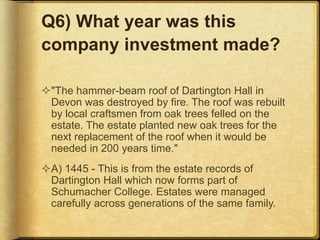
Q6) What year was this
company investment made?
"The hammer-beam roof of Dartington Hall in
Devon was destroyed by fire. The roof was rebuilt
by local craftsmen from oak trees felled on the
estate. The estate planted new oak trees for the
next replacement of the roof when it would be
needed in 200 years time."
A) 1445 - This is from the estate records of
Dartington Hall which now forms part of
Schumacher College. Estates were managed
carefully across generations of the same family.
Agenda and objectives
Explore Strategic CSR as framework
Seek to identify examples of practice
Consider the roots and evolutions of CSR
strategies
Break some preconceptions
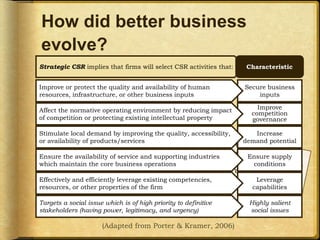
Strategic CSR implies that firms will select CSR activities that: Characteristic
Secure business
inputs
Improve
competition
governance
Increase
demand potential
Ensure supply
conditions
Leverage
capabilities
Highly salient
social issues
Improve or protect the quality and availability of human
resources, infrastructure, or other business inputs
Affect the normative operating environment by reducing impact
of competition or protecting existing intellectual property
Stimulate local demand by improving the quality, accessibility,
or availability of products/services
Ensure the availability of service and supporting industries
which maintain the core business operations
Effectively and efficiently leverage existing competencies,
resources, or other properties of the firm
Targets a social issue which is of high priority to definitive
stakeholders (having power, legitimacy, and urgency)
How did better business
evolve?
(Adapted from Porter & Kramer, 2006)
Our understanding of CSR
Conceptualisation of CSR begins rather
abruptly in 1950s America
(Carroll, 1999, Bowen 1953, Heald 1970)
Scholarship is largely cross sectional
focusing on large neo-liberal economies
of late C20th
And of the modern corporate form of
business
No systematic analysis of the roots of
phenomenon or earlier forms of the
strategies
Extremely few longitudinal analyses
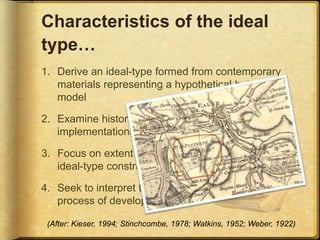
Characteristics of the ideal
type…
1. Derive an ideal-type formed from contemporary
materials representing a hypothetical but viable
model
2. Examine historical empirical evidence for earlier
implementations (archival research)
3. Focus on extent historical cases deviate from the
ideal-type construction
4. Seek to interpret the forces influential in the
process of development
(After: Kieser, 1994; Stinchcombe, 1978; Watkins, 1952; Weber, 1922)
Social responsibilities of the
Guilds
 Merchant tailors’ guild shall
“keep silver yard” and direct
“fit persons...to see that a
proper yard measure be
used” (circa 1575)
 Wardens of the crafts swear
oaths to uphold “...all the
goode reules and ordyn’nces
of the same craft that been
approved” and to report
“defautes that ye fynde in the
same Craft ydon to the
Chambleyn of y’Citee”
(circa 1375)
(Sources: Guild Archives, Herbet 1834, Ashley 1914, Olgilvy 2004)
14th -16th Centuries
 Self-regulated trading
standards “Assize”
 Negotiated license to
operate craft under Royal
Charter (Monopoly in City)
 Charters included a clause to
operate “for the greater
good and profit of the
people”
Extract from Parish Records Calne
“The alderman presented [for
punishment] 3 innkeepers, 2 bakers, 5
butchers, 1 tanner, and 1 chandler
[Candle maker] for overcharging or
supplying inadequate goods” (c1491)
Social responsibilities of the
Guilds
 They may acquire property
"tenants and rents...for
relieving their poor and infirm
and for maintaining a
chaplain and a chantry
[endowment]" (Goldsmiths
Guild c1480
 They must restrict admission
to those who have "served
the term of apprenticeship
[and been approved]…by
advice of wardens...who were
ascertain he was of good
name" (Grocers Guild c1460)
 Direct and explicit
responsibilities for social
welfare in a specified
geography
 Explicit accountability for
secular education by the
apprenticeship &
masterpiece
(Sources: Guild Archives, Herbet 1834, Ashley 1914, Olgilvy 2004)
14th -16th Centuries
Merchant philanthropy
 Church removed as provider
of social services (1530)
 Atlantic trade routes under
Royal Charter main source of
wealth
 Statute of Elizabeth (1601)
established the first state
responsibility of social
welfare
 Also defined what was
“Charitable” (Education,
religion, community
investment) thus tax-free
By 1660
 Average merchant donated
equivalent of £557,000
 3 x aristocracy
 42% of £5BN total welfare budget
 Favoured secular capital
aggregates e.g. schools &
hospitals
 Charterhouse School (c1615)
 Guys Hospital (c1730)
 From 1550 to 1660 religious
donations 53%->7% of probate
(Sources: Fuller 1662, Defoe 1724, Jordan 1959)
Extract from Parish Records Calne
“to be lett to poore craftesmaen and
artificer of this borrowe of Calne, and
alsoe to buy lands for the mayntenance
of the poore hereof”
"Mrs Wooton [Baker] for to paye in 4£
[per] yeare in bread" (c1630)
(£7,995 current value)
16th – 17th Centuries
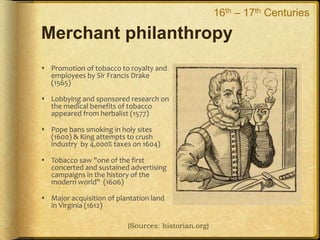
Merchant philanthropy
 Promotion of tobacco to royalty and
employees by Sir Francis Drake
(1565)
 Lobbying and sponsored research on
the medical benefits of tobacco
appeared from herbalist (1577)
 Pope bans smoking in holy sites
(1600) & King attempts to crush
industry by 4,000% taxes on 1604)
 Tobacco saw "one of the first
concerted and sustained advertising
campaigns in the history of the
modern world" (1606)
 Major acquisition of plantation land
in Virginia (1612)
(Sources: historian.org)
16th – 17th Centuries
Manufactory community
involvement
 Victorian Industrialists
subject of greater
academic attention
 Development of industrial
villages
 Provision of public goods
C&T Harris (Calne) Limited Meat Processing
(1888 capitalised @ £25M current value)
Between 1850 and 1890 the family firm had:
Donated land for a town police station
Funded the building of Calne Free Church
Paid for 50% Town Hall in 1886 (£2.5M)
Provided a public recreation ground and
sport club facilities in 1891, central town
gardens and swimming pool in 1896.
In 1905, Thomas Harris co-founded a library
in town with the American philanthropist
Andrew Carnegie (£0.6M at current value)
although the Harris family chose not to be
named on the commemorative plaque
18th – 19th Centuries
Manufactory community
involvement
18th – 19th Centuries
VIDEO
Comparisons with the ideal
type
<<INSERT PICTURE>>
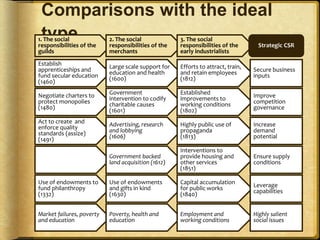
Establish
apprenticeships and
fund secular education
(1460)
Negotiate charters to
protect monopolies
(1480)
Act to create and
enforce quality
standards (assize)
(1491)
Use of endowments to
fund philanthropy
(1332)
Market failures, poverty
and education
1. The social
responsibilities of the
guilds
Large scale support for
education and health
(1600)
Government
intervention to codify
charitable causes
(1601)
Advertising, research
and lobbying
(1606)
Government backed
land acquisition (1612)
Use of endowments
and gifts in kind
(1630)
Poverty, health and
education
2. The social
responsibilities of the
merchants
Efforts to attract, train,
and retain employees
(1812)
Established
improvements to
working conditions
(1802)
Highly public use of
propaganda
(1813)
Interventions to
provide housing and
other services
(1851)
Capital accumulation
for public works
(1840)
Employment and
working conditions
3. The social
responsibilities of the
early industrialists
Strategic CSR
Secure business
inputs
Improve
competition
governance
Increase
demand
potential
Ensure supply
conditions
Leverage
capabilities
Highly salient
social issues
There is nothing new under the sun but
there are lots of old things we don’t
know*
Is strategic CSR new? (Porter & Kramer, 2006)
 Evidence that many of these “instrumental”
strategies have been present since C16th
 Not new but resurfaced from a repertoire of
strategies (Kieser, 1994)
 Largest change is possibly the geographical
concentration of stakeholders and the relative power
of system actors
(*Ambrose Bierce 1842-1914)
What CSR strategies may
resurface?
Before donating $33.5 bn to Gates foundation,
Buffet gave a copy of Carnegie’s ”Gospel of
Wealth “(1889)
Follows in the tradition of…
 Morris Motors (Nuffield Trust 1943)
 Lever Brother (Leverhulme Trust 1925)
 Rowntree of York (Rowntree Trust 1904)
 Carnegie, Rockefeller etc (1890-1900)
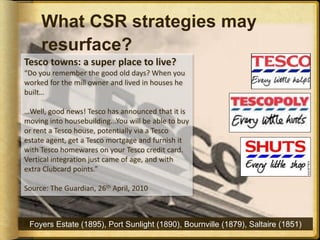
Tesco towns: a super place to live?
“Do you remember the good old days? When you
worked for the mill owner and lived in houses he
built…
…Well, good news! Tesco has announced that it is
moving into housebuilding...You will be able to buy
or rent a Tesco house, potentially via a Tesco
estate agent, get a Tesco mortgage and furnish it
with Tesco homewares on your Tesco credit card.
Vertical integration just came of age, and with
extra Clubcard points.”
Source: The Guardian, 26th April, 2010
What CSR strategies may
resurface?
Foyers Estate (1895), Port Sunlight (1890), Bournville (1879), Saltaire (1851)
Training: Evolving Better Business Deck (xvids)

Training: Evolving Better Business Deck (xvids)

  • 2.
    Q1) What yeardid the lecturer at this University say... "Society is feeling its way, with painful steps, towards a corporate [world which considers both] employers and employees...with the State alert to protect the interests of the community. (From a undergraduate lecture University of Birmingham)” A) 1912 - This lecture talks about corporate governance something we will touch upon later in the course.
  • 3.
    Q2) What yeardid a large London company make this promise? "An ongoing donation will be made from corporate funds to address poverty issues in our local community" (From mission statement of large corporation) A) 1429 - This is from the Goldsmiths Guild, one of the guilds we will explore these businesses later but they were common across Europe in the Middle Ages. Mission statements are where companies publically disclose values and intentions. As we will see later, sometimes they may not always deliver to these.
  • 4.
    Q3) What yeardid the UK government pass... Laws on factory working conditions banned the employment of children under 9 and limited children 9-16 years to a maximum of 12 hours' per day in the UK ? (From Act of Parliament) A) 1819 - This is an Act of Parliament - Manufactories Acts 1819 - this is an example of Government acting to regulate or control conditions in factories.
  • 5.
    Q4) What yearwere... Fines were imposed on local businesses (3 Bars, 2 Bakeries, and 5 Butchers ) for overcharging or supplying inadequate goods? (From a small local town in England) A) 1491 - Market Towns had officers which checked the quality, weights, and measures of goods to protect customers against fraudulent traders.
  • 6.
    Q5) What yearwere… Three businessmen were convicted for polluting the river with chemicals and other waste? (Small local town in England) A) 1680 - Local pollution controls were strictly enforced against wool manufacturers who were damaging the towns river and water supplies.
  • 7.
    Q6) What yearwas this company investment made? "The hammer-beam roof of Dartington Hall in Devon was destroyed by fire. The roof was rebuilt by local craftsmen from oak trees felled on the estate. The estate planted new oak trees for the next replacement of the roof when it would be needed in 200 years time." A) 1445 - This is from the estate records of Dartington Hall which now forms part of Schumacher College. Estates were managed carefully across generations of the same family.
  • 9.
    Agenda and objectives ExploreStrategic CSR as framework Seek to identify examples of practice Consider the roots and evolutions of CSR strategies Break some preconceptions
  • 10.
    Strategic CSR impliesthat firms will select CSR activities that: Characteristic Secure business inputs Improve competition governance Increase demand potential Ensure supply conditions Leverage capabilities Highly salient social issues Improve or protect the quality and availability of human resources, infrastructure, or other business inputs Affect the normative operating environment by reducing impact of competition or protecting existing intellectual property Stimulate local demand by improving the quality, accessibility, or availability of products/services Ensure the availability of service and supporting industries which maintain the core business operations Effectively and efficiently leverage existing competencies, resources, or other properties of the firm Targets a social issue which is of high priority to definitive stakeholders (having power, legitimacy, and urgency) How did better business evolve? (Adapted from Porter & Kramer, 2006)
  • 11.
    Our understanding ofCSR Conceptualisation of CSR begins rather abruptly in 1950s America (Carroll, 1999, Bowen 1953, Heald 1970) Scholarship is largely cross sectional focusing on large neo-liberal economies of late C20th And of the modern corporate form of business No systematic analysis of the roots of phenomenon or earlier forms of the strategies Extremely few longitudinal analyses
  • 12.
    Characteristics of theideal type… 1. Derive an ideal-type formed from contemporary materials representing a hypothetical but viable model 2. Examine historical empirical evidence for earlier implementations (archival research) 3. Focus on extent historical cases deviate from the ideal-type construction 4. Seek to interpret the forces influential in the process of development (After: Kieser, 1994; Stinchcombe, 1978; Watkins, 1952; Weber, 1922)
  • 13.
    Social responsibilities ofthe Guilds  Merchant tailors’ guild shall “keep silver yard” and direct “fit persons...to see that a proper yard measure be used” (circa 1575)  Wardens of the crafts swear oaths to uphold “...all the goode reules and ordyn’nces of the same craft that been approved” and to report “defautes that ye fynde in the same Craft ydon to the Chambleyn of y’Citee” (circa 1375) (Sources: Guild Archives, Herbet 1834, Ashley 1914, Olgilvy 2004) 14th -16th Centuries  Self-regulated trading standards “Assize”  Negotiated license to operate craft under Royal Charter (Monopoly in City)  Charters included a clause to operate “for the greater good and profit of the people” Extract from Parish Records Calne “The alderman presented [for punishment] 3 innkeepers, 2 bakers, 5 butchers, 1 tanner, and 1 chandler [Candle maker] for overcharging or supplying inadequate goods” (c1491)
  • 14.
    Social responsibilities ofthe Guilds  They may acquire property "tenants and rents...for relieving their poor and infirm and for maintaining a chaplain and a chantry [endowment]" (Goldsmiths Guild c1480  They must restrict admission to those who have "served the term of apprenticeship [and been approved]…by advice of wardens...who were ascertain he was of good name" (Grocers Guild c1460)  Direct and explicit responsibilities for social welfare in a specified geography  Explicit accountability for secular education by the apprenticeship & masterpiece (Sources: Guild Archives, Herbet 1834, Ashley 1914, Olgilvy 2004) 14th -16th Centuries
  • 15.
    Merchant philanthropy  Churchremoved as provider of social services (1530)  Atlantic trade routes under Royal Charter main source of wealth  Statute of Elizabeth (1601) established the first state responsibility of social welfare  Also defined what was “Charitable” (Education, religion, community investment) thus tax-free By 1660  Average merchant donated equivalent of £557,000  3 x aristocracy  42% of £5BN total welfare budget  Favoured secular capital aggregates e.g. schools & hospitals  Charterhouse School (c1615)  Guys Hospital (c1730)  From 1550 to 1660 religious donations 53%->7% of probate (Sources: Fuller 1662, Defoe 1724, Jordan 1959) Extract from Parish Records Calne “to be lett to poore craftesmaen and artificer of this borrowe of Calne, and alsoe to buy lands for the mayntenance of the poore hereof” "Mrs Wooton [Baker] for to paye in 4£ [per] yeare in bread" (c1630) (£7,995 current value) 16th – 17th Centuries
  • 16.
    Merchant philanthropy  Promotionof tobacco to royalty and employees by Sir Francis Drake (1565)  Lobbying and sponsored research on the medical benefits of tobacco appeared from herbalist (1577)  Pope bans smoking in holy sites (1600) & King attempts to crush industry by 4,000% taxes on 1604)  Tobacco saw "one of the first concerted and sustained advertising campaigns in the history of the modern world" (1606)  Major acquisition of plantation land in Virginia (1612) (Sources: historian.org) 16th – 17th Centuries
  • 17.
    Manufactory community involvement  VictorianIndustrialists subject of greater academic attention  Development of industrial villages  Provision of public goods C&T Harris (Calne) Limited Meat Processing (1888 capitalised @ £25M current value) Between 1850 and 1890 the family firm had: Donated land for a town police station Funded the building of Calne Free Church Paid for 50% Town Hall in 1886 (£2.5M) Provided a public recreation ground and sport club facilities in 1891, central town gardens and swimming pool in 1896. In 1905, Thomas Harris co-founded a library in town with the American philanthropist Andrew Carnegie (£0.6M at current value) although the Harris family chose not to be named on the commemorative plaque 18th – 19th Centuries
  • 18.
  • 19.
    Comparisons with theideal type <<INSERT PICTURE>> Establish apprenticeships and fund secular education (1460) Negotiate charters to protect monopolies (1480) Act to create and enforce quality standards (assize) (1491) Use of endowments to fund philanthropy (1332) Market failures, poverty and education 1. The social responsibilities of the guilds Large scale support for education and health (1600) Government intervention to codify charitable causes (1601) Advertising, research and lobbying (1606) Government backed land acquisition (1612) Use of endowments and gifts in kind (1630) Poverty, health and education 2. The social responsibilities of the merchants Efforts to attract, train, and retain employees (1812) Established improvements to working conditions (1802) Highly public use of propaganda (1813) Interventions to provide housing and other services (1851) Capital accumulation for public works (1840) Employment and working conditions 3. The social responsibilities of the early industrialists Strategic CSR Secure business inputs Improve competition governance Increase demand potential Ensure supply conditions Leverage capabilities Highly salient social issues
  • 20.
    There is nothingnew under the sun but there are lots of old things we don’t know* Is strategic CSR new? (Porter & Kramer, 2006)  Evidence that many of these “instrumental” strategies have been present since C16th  Not new but resurfaced from a repertoire of strategies (Kieser, 1994)  Largest change is possibly the geographical concentration of stakeholders and the relative power of system actors (*Ambrose Bierce 1842-1914)
  • 21.
    What CSR strategiesmay resurface? Before donating $33.5 bn to Gates foundation, Buffet gave a copy of Carnegie’s ”Gospel of Wealth “(1889) Follows in the tradition of…  Morris Motors (Nuffield Trust 1943)  Lever Brother (Leverhulme Trust 1925)  Rowntree of York (Rowntree Trust 1904)  Carnegie, Rockefeller etc (1890-1900)
  • 22.
    Tesco towns: asuper place to live? “Do you remember the good old days? When you worked for the mill owner and lived in houses he built… …Well, good news! Tesco has announced that it is moving into housebuilding...You will be able to buy or rent a Tesco house, potentially via a Tesco estate agent, get a Tesco mortgage and furnish it with Tesco homewares on your Tesco credit card. Vertical integration just came of age, and with extra Clubcard points.” Source: The Guardian, 26th April, 2010 What CSR strategies may resurface? Foyers Estate (1895), Port Sunlight (1890), Bournville (1879), Saltaire (1851)

Editor's Notes

  • #2 ”[We] must foster and support a new culture of voluntarism, philanthropy, social action…We need to create communities… in charge of their own destiny” UK Prime Minister David Cameron PM launching the "Big Society" agenda . The Guardian 19th July 2010
  • #9 ”[We] must foster and support a new culture of voluntarism, philanthropy, social action…We need to create communities… in charge of their own destiny” UK Prime Minister David Cameron PM launching the "Big Society" agenda . The Guardian 19th July 2010