Unit-1 History ,Evolution Of CSRv
• Introduction Corporate Social Responsibility (CSR) is an important
issue in contemporary business, management and politics, especially
since the launch of the United Nations Global Compact in 2000 as an
initiative to encourage businesses worldwide to adopt sustainable and
socially responsible policies, and to report on them .
• CSR is essentially a concept whereby firms integrate social and
environmental concerns in their business operations and in their
interaction with their voluntary and mandatory activities.
3.
Definition of CorporateSocial Responsibility
• “CSR is about how companies manage the business processes to
produce an overall positive impact on society.”
• According to World Business Council: “Corporate Social Responsibility
is the continuing commitment by business to behave ethically and
contribute to economic development while improving the quality of
life of the workforce and their families as well as of the local
community and society at large”.
4.
CSR In theworld
• The history of CSR is almost as long as that of firms. Concerns about the excesses of the
East India Firm were commonly expressed in the seventeenth century.
• There has been a tradition of benevolent (helping needy) capitalism in the UK for over 150
years, for example, Quaker families such as the Cadburys, Rowntrees and Hersheys who
sought to improve their standard of living as well as enhancing the communities in which
they lived.
• In the 19th century, many of owners assumed an active, and indeed, a leading role in the
development of the local communities and society where they were based.
• Business leaders helped get schools and universities built and made financial contributions
over and above their taxes to support infrastructure projects, museums, sports, and
recreation facilities.
• Great cities like Manchester, Bombay, New York, and Sydney were given many of their
public assets such as libraries and concert halls by the business leaders of the time.
5.
Cont…
• Business Leaderssuch as, Carnegie, Rockefeller and Wellcome went on to endow great
foundations to carry on the community work that they saw as their social
responsibility or good citizenship and established a new level in corporate charitable
behavior. This tradition seems to have been based on two complementary motives.
First, the ethical imperative often articulated by religious groups was that those who
have wealth and power should help those who do not, and so charitable giving was
expected of wealthy industrialists.
Second, there was an element of social investment in which businesses would gain
long-term benefits from having first-class schools, technical institutes, and universities
in their cities U.S. business schools, for example, were often started by business
leaders and still receive extensive support from firms.Carroll has described Bowen as
the modern Father of Corporate Social Responsibility and believes that his work marks
the beginning of the modern period of literature on CSR.
6.
Concept of CSR
•The concept of corporate social responsibility (CSR) has a long history associated
with how this affects the behavior of organizations.
• In the 1960s, key events, people and ideas have played an important role in
characterizing the social changes ushered in during this decade.
• In the 1970s, business leaders on traditional management functions in matters
of corporate social responsibility, while
• In 1980, the business and social interests of the company came closer and
become more responsive to their members.
• In the 1990s, the idea of CSR has become almost universally accepted, CSR also
has been associated with the strategy literature, and finally,
• In the 2000s, CSR has finally become an important strategic issue.
7.
Phases
• CSR inIndia CSR in India has evolved through different phases, like community engagement,
socially responsible production and socially responsible employee relations. Its history and
evolution can be divided into four major phases.
• PHASE 1 (1850 TO 1914)
• The first phase of CSR is known for its charity and philanthropic nature. CSR was influenced by
family values, traditions, culture and religion, as also industrialization.
• The wealth of businessmen was spent on the welfare of society, by setting up temples and
religious institutions. In times of drought and famine these businessmen opened up their
granaries for the poor and hungry.
• With the start of the colonial era, this approach to CSR underwent a significant change. In pre-
Independence times, the pioneers of industrialization, names like Tata, Birla, Godrej, Bajaj,
promoted the concept of CSR by setting up charitable foundations, educational and healthcare
institutions, and trusts for community development. During this period social benefits were
driven by political motives.
8.
• PHASE 2(1914 TO 1960)
• The second phase was during the Independence movement.
Mahatma Gandhi urged rich industrialists to share their wealth and
benefit the poor and marginalized in society.
• His concept of trusteeship helped socio-economic growth. According
to Gandhi, companies and industries were the ‘temples of modern
India’.
• He influenced industrialists to set up trusts for colleges, and research
and training institutions. These trusts were also involved in social
reform, like rural development, education and empowerment
9.
Phase3
• . PHASE3 (1960 TO 1980)
• This phase was characterized by the emergence of PSUs (Public Sector Undertakings)
to ensure better distribution of wealth in society.
• The policy on industrial licensing and taxes, and restrictions on the private sector
resulted in corporate malpractices which finally triggered suitable legislation on
corporate governance, labour and environmental issues.
• Since the success rate of PSUs was not significant there was a natural shift in
expectations from public to private sector, with the latter getting actively involved in
socio-economic development.
• In 1965, academicians, politicians and businessmen conducted a nationwide
workshop on CSR where major emphasis was given to social accountability and
transparency.
10.
Phase4
• PHASE 4(1980 ONWARDS)
• In this last phase CSR became characterized as a sustainable business
strategy.
• The wave of liberalization, privatization and globalization (LPG),
together with a comparatively relaxed licensing system, led to a boom
in the country’s economic growth.
• This further led to an increased momentum in industrial growth,
making it possible for companies to contribute more towards social
responsibility. What started as charity is now understood and
accepted as responsibility.
11.
NVG
• NATIONAL VOLUNTARYGUIDELINES (NVG) National voluntary
guidelines8 are applicable to all businesses irrespective of size, sector
or location.
• These guidelines were designed with the aim of assisting enterprises
to become responsible entities much before the CSR Act (Companies
Act-2013) came into force. In fact various propositions from NVG have
been taken into consideration for structuring the Companies Act.
12.
Principles of NVGGuidelines
• The principles behind the guidelines are as follows:
• PRINCIPLE 1 Businesses should conduct and govern themselves with
ethics, transparency and accountability.
• PRINCIPLE 2 Businesses should provide goods and services that are
safe and contribute to sustainability throughout their life cycle.
• PRINCIPLE 3 Businesses should promote the well-being of all
employees.
• PRINCIPLE 4 Businesses should respect the interests of, and be
responsive to, all stakeholders, especially those who are disadvantaged,
vulnerable and marginalized.
13.
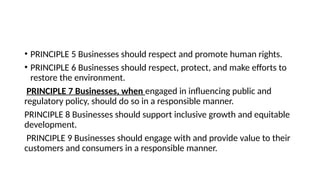
• PRINCIPLE 5Businesses should respect and promote human rights.
• PRINCIPLE 6 Businesses should respect, protect, and make efforts to
restore the environment.
PRINCIPLE 7 Businesses, when engaged in influencing public and
regulatory policy, should do so in a responsible manner.
PRINCIPLE 8 Businesses should support inclusive growth and equitable
development.
PRINCIPLE 9 Businesses should engage with and provide value to their
customers and consumers in a responsible manner.
14.
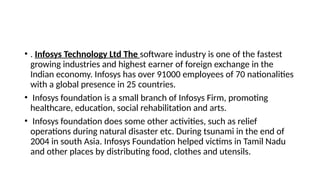
• . InfosysTechnology Ltd The software industry is one of the fastest
growing industries and highest earner of foreign exchange in the
Indian economy. Infosys has over 91000 employees of 70 nationalities
with a global presence in 25 countries.
• Infosys foundation is a small branch of Infosys Firm, promoting
healthcare, education, social rehabilitation and arts.
• Infosys foundation does some other activities, such as relief
operations during natural disaster etc. During tsunami in the end of
2004 in south Asia. Infosys Foundation helped victims in Tamil Nadu
and other places by distributing food, clothes and utensils.
15.
Education
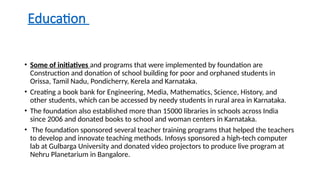
• Some ofinitiatives and programs that were implemented by foundation are
Construction and donation of school building for poor and orphaned students in
Orissa, Tamil Nadu, Pondicherry, Kerela and Karnataka.
• Creating a book bank for Engineering, Media, Mathematics, Science, History, and
other students, which can be accessed by needy students in rural area in Karnataka.
• The foundation also established more than 15000 libraries in schools across India
since 2006 and donated books to school and woman centers in Karnataka.
• The foundation sponsored several teacher training programs that helped the teachers
to develop and innovate teaching methods. Infosys sponsored a high-tech computer
lab at Gulbarga University and donated video projectors to produce live program at
Nehru Planetarium in Bangalore.