Content design
6, possibly surprising, things for all
businesses to know
1. Each piece of
content is part of
a wider action.
The journey to complete a task or
find information online could start
on Google, and end on a
competitor’s website.
Make sure the part where people
interact with your site is
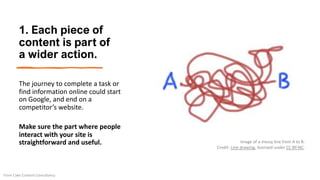
straightforward and useful. Image of a messy line from A to B.
Credit: Line drawing, licensed under CC BY-NC.
From Cake Content Consultancy
Ask:
Where has the visitor come from?
What are they trying to do?
What are they going to do next?
This helps you:
• focus content on what they need now
• minimise duplication of what they already know
• recognise related content and improve the
information architecture (IA)
From Cake Content Consultancy
2. Content design
achieves business
goals by meeting
“user needs”.
By serving site visitor needs, for example
providing clear information on ABC, we
can increase interest in XYZ.
Needs are researched and content is based
around those, rather than approaching
topics from a siloed perspective.
Designing with a user first approach is the
best way to meet business needs. It’s in
everyone’s best interest.
From Cake Content Consultancy
3. Content design is based
on data and evidence for
what users need.
Content designers don’t guess
or assume what users want and
where they are coming from,
they research it.
From Cake Content Consultancy
Content designers use:
• analytics data
• user interviews
• user behaviour studies
• usability and readability research
For example, they research
user language by looking at search
data, rather than picking words they
think are suitable.
From Cake Content Consultancy
4. Content
standards
improve
findability,
clarity,
consistency
and usability.
To produce high quality,
trustworthy information, content
principles and standards are
necessary. Following them needs
to be non-negotiable.
BBC, The Economist, GOV.UK all
hold their content up to such
checks, as do your competitors.
From Cake Content Consultancy
Usability reviews should cover accessibility
and inclusivity.
Content standards make information easier
to find and absorb in a limited timeframe.
A good start is to choose clear, simple
language. Respected research shows even
experts prefer plain language.
From Cake Content Consultancy
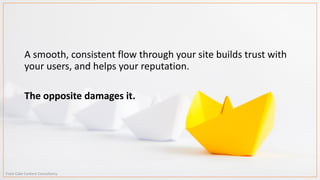
A smooth, consistent flow through your site builds trust with
your users, and helps your reputation.
The opposite damages it.
From Cake Content Consultancy
5. Content design is a continuous approach, it
goes beyond page layout and wording
Its methodologies and practices:
• help you create, organise and maintain
less, more effective content
• enable a consistent user experience
• promote relevancy and accuracy
• improve content workflow and governance
• ensure content is in line with strategy
From Cake Content Consultancy
6. Content design is a
professional skillset
Designing content for a user purpose involves:
• research
• data analytics
• user-focused, informational content writing skills
• accessibility, usability and readability knowledge
• information architecture
From Cake Content Consultancy
Benefits of content
design
• Fewer customer calls and emails,
because users can find what they need.
• Easier to keep information accurate:
concise content and no duplication
means less to review.
• Increased online accessibility – content
design techniques improve information
access for all.
From Cake Content Consultancy
Gathering your evidence
A pilot project provides opportunity
to show the improvements that result
from applying content design techniques.
Before and after:
• carry out usability testing
• track page analytics
• record service take-up data
• record product sales data
Compare your findings. Account for anything else
that may have affected performance, both
positively and negatively.
If you can’t run a pilot for whatever reason, start
small, making content design improvements
section by section.
From Cake Content Consultancy
Example:
Refining the selection field labels on a
university funding search tool made
meaning clearer to users.
It led to far fewer erroneous
applications.
This significantly reduced admin time,
and massively helped students.
From Cake Content Consultancy
Find out more about content design and
strategy, book services, and complete
online training courses at:
cakeconsultancy.com
From Cake Content Consultancy

6 essential things for businesses to know about content design

  • 1.
    Content design 6, possiblysurprising, things for all businesses to know
  • 2.
    1. Each pieceof content is part of a wider action. The journey to complete a task or find information online could start on Google, and end on a competitor’s website. Make sure the part where people interact with your site is straightforward and useful. Image of a messy line from A to B. Credit: Line drawing, licensed under CC BY-NC. From Cake Content Consultancy
  • 3.
    Ask: Where has thevisitor come from? What are they trying to do? What are they going to do next? This helps you: • focus content on what they need now • minimise duplication of what they already know • recognise related content and improve the information architecture (IA) From Cake Content Consultancy
  • 4.
    2. Content design achievesbusiness goals by meeting “user needs”. By serving site visitor needs, for example providing clear information on ABC, we can increase interest in XYZ. Needs are researched and content is based around those, rather than approaching topics from a siloed perspective. Designing with a user first approach is the best way to meet business needs. It’s in everyone’s best interest. From Cake Content Consultancy
  • 5.
    3. Content designis based on data and evidence for what users need. Content designers don’t guess or assume what users want and where they are coming from, they research it. From Cake Content Consultancy
  • 6.
    Content designers use: •analytics data • user interviews • user behaviour studies • usability and readability research For example, they research user language by looking at search data, rather than picking words they think are suitable. From Cake Content Consultancy
  • 7.
    4. Content standards improve findability, clarity, consistency and usability. Toproduce high quality, trustworthy information, content principles and standards are necessary. Following them needs to be non-negotiable. BBC, The Economist, GOV.UK all hold their content up to such checks, as do your competitors. From Cake Content Consultancy
  • 8.
    Usability reviews shouldcover accessibility and inclusivity. Content standards make information easier to find and absorb in a limited timeframe. A good start is to choose clear, simple language. Respected research shows even experts prefer plain language. From Cake Content Consultancy
  • 9.
    A smooth, consistentflow through your site builds trust with your users, and helps your reputation. The opposite damages it. From Cake Content Consultancy
  • 10.
    5. Content designis a continuous approach, it goes beyond page layout and wording Its methodologies and practices: • help you create, organise and maintain less, more effective content • enable a consistent user experience • promote relevancy and accuracy • improve content workflow and governance • ensure content is in line with strategy From Cake Content Consultancy
  • 11.
    6. Content designis a professional skillset Designing content for a user purpose involves: • research • data analytics • user-focused, informational content writing skills • accessibility, usability and readability knowledge • information architecture From Cake Content Consultancy
  • 12.
    Benefits of content design •Fewer customer calls and emails, because users can find what they need. • Easier to keep information accurate: concise content and no duplication means less to review. • Increased online accessibility – content design techniques improve information access for all. From Cake Content Consultancy
  • 13.
    Gathering your evidence Apilot project provides opportunity to show the improvements that result from applying content design techniques. Before and after: • carry out usability testing • track page analytics • record service take-up data • record product sales data Compare your findings. Account for anything else that may have affected performance, both positively and negatively. If you can’t run a pilot for whatever reason, start small, making content design improvements section by section. From Cake Content Consultancy
  • 14.
    Example: Refining the selectionfield labels on a university funding search tool made meaning clearer to users. It led to far fewer erroneous applications. This significantly reduced admin time, and massively helped students. From Cake Content Consultancy
  • 15.
    Find out moreabout content design and strategy, book services, and complete online training courses at: cakeconsultancy.com From Cake Content Consultancy