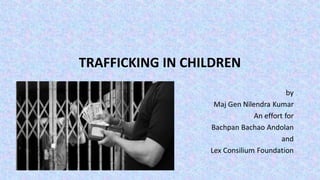

TRAFFICKING IN CHILDREN
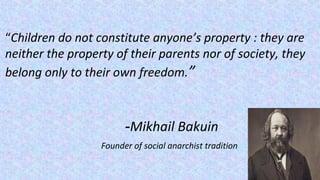
“Children do not constitute anyone’s property : they are
neither the property of their parents nor of society, they
belong only to their own freedom.”
-Mikhail Bakuin
Founder of social anarchist tradition
Human trafficking has been identified as the
largest human rights violation in the history of
mankind.
It is the trade of humans, most commonly for the
purpose of forced labour, sexual slavery or
commercial sexual exploitation for the trafficker
or others.
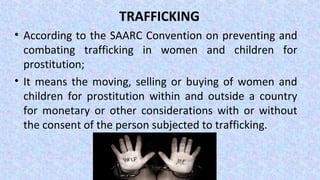
TRAFFICKING
• According to the SAARC Convention on preventing and
combating trafficking in women and children for
prostitution;
• It means the moving, selling or buying of women and
children for prostitution within and outside a country
for monetary or other considerations with or without
the consent of the person subjected to trafficking.
TRAFFICKING
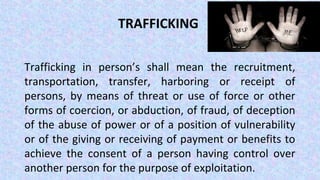
Trafficking in person’s shall mean the recruitment,
transportation, transfer, harboring or receipt of
persons, by means of threat or use of force or other
forms of coercion, or abduction, of fraud, of deception
of the abuse of power or of a position of vulnerability
or of the giving or receiving of payment or benefits to
achieve the consent of a person having control over
another person for the purpose of exploitation.
PALERMO PROTOCOL,2000
An instrument to prevent, suppress and punish trafficking in
persons especially women and children
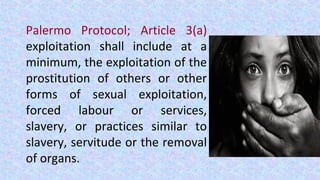
Palermo Protocol; Article 3(a)
exploitation shall include at a
minimum, the exploitation of the
prostitution of others or other
forms of sexual exploitation,
forced labour or services,
slavery, or practices similar to
slavery, servitude or the removal
of organs.
The consent of a victim of trafficking in
persons to the intended exploitation shall be
irrelevant where any of the means like threat,
force and coercion etc. has been used.
Human trafficking, without consent (or without
informed consent) is a gross violation of human
rights. In case of minors, it is also a violation of their
rights as children.
• “The trafficking in persons, particularly women and children, for
forced and exploitative labour, is one of the most egregious
violations of human rights that the UN now confronts. It is
widespread and growing. It is rooted in the social and economic
conditions in the country from which the victims come,
facilitated by practices that discriminate against women.
Furthermore, it is driven by cruel indifference to human
sufferings on the part of those who exploit the services that the
victims are forced to provide.
• The fate of these most vulnerable people in our world is an
affront to human dignity and a challenge to every state, every
person and every community.”
- Kofi Annan, the then Secretary General of the UN,
TRAFFICKER
• Any person, who is
1.Involved in any act in the
process of trafficking.
2.Who gains/ makes profit/
exploits,
a) As the trafficked
person passes through
a chain;
b) From the point of
source area to the
point of final
destination;
c) Thereafter,
throughout the
process of
ELEMENTS OF TRAFFICKING
• The act (what is done) includes recruitment, transportation,
transfer, harboring etc.
• The means (how it is done) may include threat, use of force,
coercion, abduction, fraud etc.
• The purpose (why it is done or for what it is done) i.e., for
exploitation.
CONTRIBUTING FACTORS
1. Economic deprivation.
2. Lack of employment opportunities.
3. Social status.
4. Political uprisings.
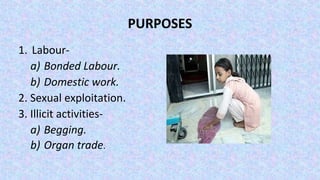
PURPOSES
1. Labour-
a) Bonded Labour.
b) Domestic work.
2. Sexual exploitation.
3. Illicit activities-
a) Begging.
b) Organ trade.
SIZE OF THE PROBLEM
• Almost every country in the world is affected by
trafficking, whether as a country of origin, transit or
destination for victims.
• Trafficking often occurs from less developed countries
to more developed countries, where people are
rendered vulnerable to trafficking by virtue of poverty,
conflict or other conditions.
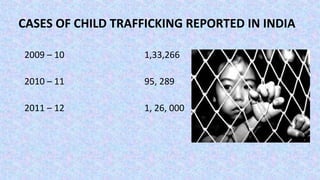
CASES OF CHILD TRAFFICKING REPORTED IN INDIA
2009 – 10 1,33,266
2010 – 11 95, 289
2011 – 12 1, 26, 000
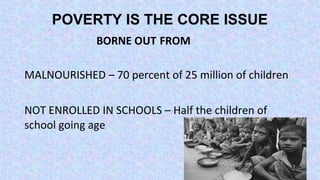
POVERTY IS THE CORE ISSUE
BORNE OUT FROM
MALNOURISHED – 70 percent of 25 million of children
NOT ENROLLED IN SCHOOLS – Half the children of
school going age
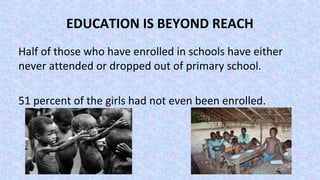
EDUCATION IS BEYOND REACH
Half of those who have enrolled in schools have either
never attended or dropped out of primary school.
51 percent of the girls had not even been enrolled.
SITUATION IN INDIA
To illustrate the impact of poverty, any one state
can be examined.
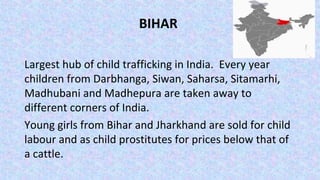
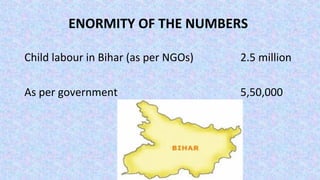
BIHAR
Largest hub of child trafficking in India. Every year
children from Darbhanga, Siwan, Saharsa, Sitamarhi,
Madhubani and Madhepura are taken away to
different corners of India.
Young girls from Bihar and Jharkhand are sold for child
labour and as child prostitutes for prices below that of
a cattle.
ENORMITY OF THE NUMBERS
Child labour in Bihar (as per NGOs) 2.5 million
As per government 5,50,000
CHILDREN TRAFFICKED IN BIHAR LAND UP IN
1. Child labour.
2. Child prostitution.
3. Street children.
4. Child trade.
CHALLENGES
1. Poor conditions in JJ homes and government run homes for children.
2. Trafficking is also from villages to the cities.
ALARMING FIGURES
In 1998, between 5000-7000 Nepalese girls, some barely 9-10
years of age were trafficked in red light areas of different
districts in India.
About 200,000 Nepalese women and girls were already in Indian
brothels.
ABSENCE OF LAW
A law to exclusively tackle the menace of trafficking
is yet to be enacted in India.`
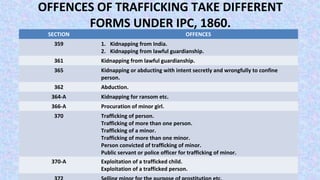
OFFENCES OF TRAFFICKING TAKE DIFFERENT
FORMS UNDER IPC, 1860.
SECTION OFFENCES
359 1. Kidnapping from India.
2. Kidnapping from lawful guardianship.
361 Kidnapping from lawful guardianship.
365 Kidnapping or abducting with intent secretly and wrongfully to confine
person.
362 Abduction.
364-A Kidnapping for ransom etc.
366-A Procuration of minor girl.
370 Trafficking of person.
Trafficking of more than one person.
Trafficking of a minor.
Trafficking of more than one minor.
Person convicted of trafficking of minor.
Public servant or police officer for trafficking of minor.
370-A Exploitation of a trafficked child.
Exploitation of a trafficked person.
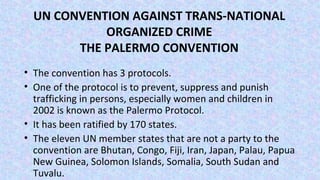
UN CONVENTION AGAINST TRANS-NATIONAL
ORGANIZED CRIME
THE PALERMO CONVENTION
• The convention has 3 protocols.
• One of the protocol is to prevent, suppress and punish
trafficking in persons, especially women and children in
2002 is known as the Palermo Protocol.
• It has been ratified by 170 states.
• The eleven UN member states that are not a party to the
convention are Bhutan, Congo, Fiji, Iran, Japan, Palau, Papua
New Guinea, Solomon Islands, Somalia, South Sudan and
Tuvalu.
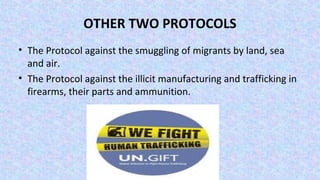
OTHER TWO PROTOCOLS
• The Protocol against the smuggling of migrants by land, sea
and air.
• The Protocol against the illicit manufacturing and trafficking in
firearms, their parts and ammunition.
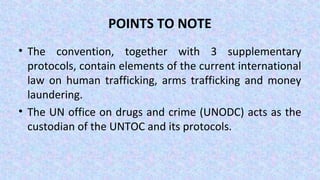
POINTS TO NOTE
• The convention, together with 3 supplementary
protocols, contain elements of the current international
law on human trafficking, arms trafficking and money
laundering.
• The UN office on drugs and crime (UNODC) acts as the
custodian of the UNTOC and its protocols.
CRIMINALIZATION
ARTICLE 5(2)
• Legislative measures yet to be adopted to establish
these acts as criminal offences:-
a)Attempting to commit
b)Participating as an accomplice.
c)Organizing or directing other persons.
COMPONENTS OF ANTI TRAFFICKING
RESPONSE
• Prevention
• Protection
• Prosecution
ASSISTANCE BY UNICEF
1. Strengthening laws, policies and services.
2. Legislative review and reforms.
3. Establishing minimum labour standards.
4. Supporting access to education.
There is no clear cut definition of missing children
in the Indian legal system (in any statute).
MISSING CHILD
However, the term has been defined in the rules
• As one whose whereabouts are not known to the parents,
legal guardian or any other person or institution legally
entrusted with the custody of the child, whatever may be
the circumstances or cause of disappearance, and shall be
considered missing and in need of care and protection until
located or his safety and well being getting established.
• Rule 92 of the Juvenile Justice (Care and Protection of
Children) Model Rules, 2016.
JUDICIAL ACTIVITISM
Absence of a statutory definition stands somewhat mitigated due
to the decision of Supreme Court in BBA v. Union of India WP(C) No
75/2012 with Contempt Petition No 186/2013, order dated May 10,
2013.
We make it clear that in case of every missing child reported, there
will be an initial presumption of either abduction or trafficking, unless
in the investigation, the same is proved otherwise. Accordingly,
whenever any complaint is filed before the police authorities
regarding a missing child the same must be entertained under
Section 154, CrPC.
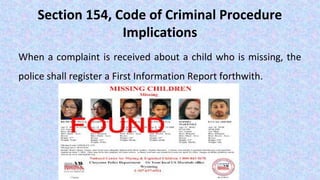
Section 154, Code of Criminal Procedure
Implications
When a complaint is received about a child who is missing, the
police shall register a First Information Report forthwith.
A missing child could be a victim of kidnapping/abduction for
various purposes :
 Ransom
 Begging
 Wrongful Confinement
 Marriage/illicit intercourse
 Murder
 Grievous hurt
 Slavery
 Unnatural Lust
 Entertainment/sports
 Adoption
 Child soldiers, etc
PLACEMENT AGENCIES.
Thousands of illegal placement agencies are active in cities like
Delhi. There is a big demand of live-in-maids who can work at
odd hours at the dictates of the employers. The maids work from
dawn till midnight and do all the household chores. They are
deprived of food, clean clothes and basic sanitation etc.
• A large number of placement agencies are in operation in
metro cities and other towns in India, who provide labourers,
cooks and drivers etc. It has observed that a large number of
such agencies are unregulated and unregistered.
Consequently, their credibility and accountability is doubtful.
• They operate primarily as recruiters, touts and middlemen
whose main interest lies in enticing young persons from rural
areas.
A NEED TO OPERATIONALISE THE PRACTICE OF
HUE AND CRY NOTICE
A process by which the help of a bystander is sought to assist in
tracing and recovery of a missing child.
HUE AND CRY
It is a loud outcry formerly used in the pursuit of one who is
suspected of a crime.
ACTION BY THE POLICE
IN CASE OF A MISSING CHILD
1. Collect a recent photograph and make copies for District
Missing Persons Unit, Missing Persons Squad, NCRB and
media etc.
2. Fill the form on the designated portal.
3. Fill ‘Missing Persons Information Form” and immediately send
to all above – CBI and other related institutions.
4. Send the copy of the FIR to the nearest Legal Service
Authority.
5. Prepare sufficient number of hue and cry notices.
6. Give wide publicity-
a) By media
b) Loud speakers
c) Railway stations, bus stands, airports etc.
7. Search areas and spots of interest such as movie theatres,
shopping malls, parks, game parlors etc.
8. Scan recordings of CCTV.
9. Inquire from under construction sites, unused buildings,
hospitals, clinics etc.
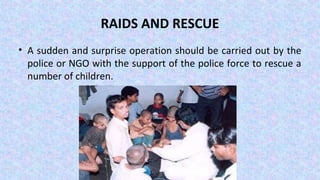
RAIDS AND RESCUE
• A sudden and surprise operation should be carried out by the
police or NGO with the support of the police force to rescue a
number of children.
QUOTE
“The words of a child trafficking victim urge us to use our voices to
fight to ensure that the children do not continue to suffer in silence.
Human beings are not property. On the international day for the
abolition of slavery, let us reaffirm the inherent dignity of all men,
women and children and let us redouble our efforts so that the words
of the Universal Declaration of Human Rights, No one shall be held in
slavery or servitude.”
- Kofi Annan
Former Secretary
General, UN

Trafficking in children

  • 1.
  • 2.
    “Children do notconstitute anyone’s property : they are neither the property of their parents nor of society, they belong only to their own freedom.” -Mikhail Bakuin Founder of social anarchist tradition
  • 3.
    Human trafficking hasbeen identified as the largest human rights violation in the history of mankind. It is the trade of humans, most commonly for the purpose of forced labour, sexual slavery or commercial sexual exploitation for the trafficker or others.
  • 4.
    TRAFFICKING • According tothe SAARC Convention on preventing and combating trafficking in women and children for prostitution; • It means the moving, selling or buying of women and children for prostitution within and outside a country for monetary or other considerations with or without the consent of the person subjected to trafficking.
  • 5.
    TRAFFICKING Trafficking in person’sshall mean the recruitment, transportation, transfer, harboring or receipt of persons, by means of threat or use of force or other forms of coercion, or abduction, of fraud, of deception of the abuse of power or of a position of vulnerability or of the giving or receiving of payment or benefits to achieve the consent of a person having control over another person for the purpose of exploitation.
  • 6.
    PALERMO PROTOCOL,2000 An instrumentto prevent, suppress and punish trafficking in persons especially women and children
  • 7.
    Palermo Protocol; Article3(a) exploitation shall include at a minimum, the exploitation of the prostitution of others or other forms of sexual exploitation, forced labour or services, slavery, or practices similar to slavery, servitude or the removal of organs.
  • 8.
    The consent ofa victim of trafficking in persons to the intended exploitation shall be irrelevant where any of the means like threat, force and coercion etc. has been used.
  • 9.
    Human trafficking, withoutconsent (or without informed consent) is a gross violation of human rights. In case of minors, it is also a violation of their rights as children.
  • 10.
    • “The traffickingin persons, particularly women and children, for forced and exploitative labour, is one of the most egregious violations of human rights that the UN now confronts. It is widespread and growing. It is rooted in the social and economic conditions in the country from which the victims come, facilitated by practices that discriminate against women. Furthermore, it is driven by cruel indifference to human sufferings on the part of those who exploit the services that the victims are forced to provide. • The fate of these most vulnerable people in our world is an affront to human dignity and a challenge to every state, every person and every community.” - Kofi Annan, the then Secretary General of the UN,
  • 11.
    TRAFFICKER • Any person,who is 1.Involved in any act in the process of trafficking. 2.Who gains/ makes profit/ exploits, a) As the trafficked person passes through a chain; b) From the point of source area to the point of final destination; c) Thereafter, throughout the process of
  • 12.
    ELEMENTS OF TRAFFICKING •The act (what is done) includes recruitment, transportation, transfer, harboring etc. • The means (how it is done) may include threat, use of force, coercion, abduction, fraud etc. • The purpose (why it is done or for what it is done) i.e., for exploitation.
  • 13.
    CONTRIBUTING FACTORS 1. Economicdeprivation. 2. Lack of employment opportunities. 3. Social status. 4. Political uprisings.
  • 14.
    PURPOSES 1. Labour- a) BondedLabour. b) Domestic work. 2. Sexual exploitation. 3. Illicit activities- a) Begging. b) Organ trade.
  • 15.
    SIZE OF THEPROBLEM • Almost every country in the world is affected by trafficking, whether as a country of origin, transit or destination for victims. • Trafficking often occurs from less developed countries to more developed countries, where people are rendered vulnerable to trafficking by virtue of poverty, conflict or other conditions.
  • 16.
    CASES OF CHILDTRAFFICKING REPORTED IN INDIA 2009 – 10 1,33,266 2010 – 11 95, 289 2011 – 12 1, 26, 000
  • 17.
    POVERTY IS THECORE ISSUE BORNE OUT FROM MALNOURISHED – 70 percent of 25 million of children NOT ENROLLED IN SCHOOLS – Half the children of school going age
  • 18.
    EDUCATION IS BEYONDREACH Half of those who have enrolled in schools have either never attended or dropped out of primary school. 51 percent of the girls had not even been enrolled.
  • 19.
    SITUATION IN INDIA Toillustrate the impact of poverty, any one state can be examined.
  • 20.
    BIHAR Largest hub ofchild trafficking in India. Every year children from Darbhanga, Siwan, Saharsa, Sitamarhi, Madhubani and Madhepura are taken away to different corners of India. Young girls from Bihar and Jharkhand are sold for child labour and as child prostitutes for prices below that of a cattle.
  • 21.
    ENORMITY OF THENUMBERS Child labour in Bihar (as per NGOs) 2.5 million As per government 5,50,000
  • 22.
    CHILDREN TRAFFICKED INBIHAR LAND UP IN 1. Child labour. 2. Child prostitution. 3. Street children. 4. Child trade. CHALLENGES 1. Poor conditions in JJ homes and government run homes for children. 2. Trafficking is also from villages to the cities.
  • 23.
    ALARMING FIGURES In 1998,between 5000-7000 Nepalese girls, some barely 9-10 years of age were trafficked in red light areas of different districts in India. About 200,000 Nepalese women and girls were already in Indian brothels.
  • 24.
    ABSENCE OF LAW Alaw to exclusively tackle the menace of trafficking is yet to be enacted in India.`
  • 25.
    OFFENCES OF TRAFFICKINGTAKE DIFFERENT FORMS UNDER IPC, 1860. SECTION OFFENCES 359 1. Kidnapping from India. 2. Kidnapping from lawful guardianship. 361 Kidnapping from lawful guardianship. 365 Kidnapping or abducting with intent secretly and wrongfully to confine person. 362 Abduction. 364-A Kidnapping for ransom etc. 366-A Procuration of minor girl. 370 Trafficking of person. Trafficking of more than one person. Trafficking of a minor. Trafficking of more than one minor. Person convicted of trafficking of minor. Public servant or police officer for trafficking of minor. 370-A Exploitation of a trafficked child. Exploitation of a trafficked person.
  • 26.
    UN CONVENTION AGAINSTTRANS-NATIONAL ORGANIZED CRIME THE PALERMO CONVENTION • The convention has 3 protocols. • One of the protocol is to prevent, suppress and punish trafficking in persons, especially women and children in 2002 is known as the Palermo Protocol. • It has been ratified by 170 states. • The eleven UN member states that are not a party to the convention are Bhutan, Congo, Fiji, Iran, Japan, Palau, Papua New Guinea, Solomon Islands, Somalia, South Sudan and Tuvalu.
  • 27.
    OTHER TWO PROTOCOLS •The Protocol against the smuggling of migrants by land, sea and air. • The Protocol against the illicit manufacturing and trafficking in firearms, their parts and ammunition.
  • 28.
    POINTS TO NOTE •The convention, together with 3 supplementary protocols, contain elements of the current international law on human trafficking, arms trafficking and money laundering. • The UN office on drugs and crime (UNODC) acts as the custodian of the UNTOC and its protocols.
  • 29.
    CRIMINALIZATION ARTICLE 5(2) • Legislativemeasures yet to be adopted to establish these acts as criminal offences:- a)Attempting to commit b)Participating as an accomplice. c)Organizing or directing other persons.
  • 30.
    COMPONENTS OF ANTITRAFFICKING RESPONSE • Prevention • Protection • Prosecution
  • 31.
    ASSISTANCE BY UNICEF 1.Strengthening laws, policies and services. 2. Legislative review and reforms. 3. Establishing minimum labour standards. 4. Supporting access to education.
  • 32.
    There is noclear cut definition of missing children in the Indian legal system (in any statute).
  • 33.
    MISSING CHILD However, theterm has been defined in the rules • As one whose whereabouts are not known to the parents, legal guardian or any other person or institution legally entrusted with the custody of the child, whatever may be the circumstances or cause of disappearance, and shall be considered missing and in need of care and protection until located or his safety and well being getting established. • Rule 92 of the Juvenile Justice (Care and Protection of Children) Model Rules, 2016.
  • 34.
    JUDICIAL ACTIVITISM Absence ofa statutory definition stands somewhat mitigated due to the decision of Supreme Court in BBA v. Union of India WP(C) No 75/2012 with Contempt Petition No 186/2013, order dated May 10, 2013. We make it clear that in case of every missing child reported, there will be an initial presumption of either abduction or trafficking, unless in the investigation, the same is proved otherwise. Accordingly, whenever any complaint is filed before the police authorities regarding a missing child the same must be entertained under Section 154, CrPC.
  • 35.
    Section 154, Codeof Criminal Procedure Implications When a complaint is received about a child who is missing, the police shall register a First Information Report forthwith.
  • 36.
    A missing childcould be a victim of kidnapping/abduction for various purposes :  Ransom  Begging  Wrongful Confinement  Marriage/illicit intercourse  Murder  Grievous hurt  Slavery  Unnatural Lust  Entertainment/sports  Adoption  Child soldiers, etc
  • 37.
    PLACEMENT AGENCIES. Thousands ofillegal placement agencies are active in cities like Delhi. There is a big demand of live-in-maids who can work at odd hours at the dictates of the employers. The maids work from dawn till midnight and do all the household chores. They are deprived of food, clean clothes and basic sanitation etc.
  • 38.
    • A largenumber of placement agencies are in operation in metro cities and other towns in India, who provide labourers, cooks and drivers etc. It has observed that a large number of such agencies are unregulated and unregistered. Consequently, their credibility and accountability is doubtful. • They operate primarily as recruiters, touts and middlemen whose main interest lies in enticing young persons from rural areas.
  • 39.
    A NEED TOOPERATIONALISE THE PRACTICE OF HUE AND CRY NOTICE A process by which the help of a bystander is sought to assist in tracing and recovery of a missing child.
  • 40.
    HUE AND CRY Itis a loud outcry formerly used in the pursuit of one who is suspected of a crime.
  • 41.
    ACTION BY THEPOLICE IN CASE OF A MISSING CHILD 1. Collect a recent photograph and make copies for District Missing Persons Unit, Missing Persons Squad, NCRB and media etc. 2. Fill the form on the designated portal. 3. Fill ‘Missing Persons Information Form” and immediately send to all above – CBI and other related institutions. 4. Send the copy of the FIR to the nearest Legal Service Authority. 5. Prepare sufficient number of hue and cry notices.
  • 42.
    6. Give widepublicity- a) By media b) Loud speakers c) Railway stations, bus stands, airports etc. 7. Search areas and spots of interest such as movie theatres, shopping malls, parks, game parlors etc. 8. Scan recordings of CCTV. 9. Inquire from under construction sites, unused buildings, hospitals, clinics etc.
  • 43.
    RAIDS AND RESCUE •A sudden and surprise operation should be carried out by the police or NGO with the support of the police force to rescue a number of children.
  • 44.
    QUOTE “The words ofa child trafficking victim urge us to use our voices to fight to ensure that the children do not continue to suffer in silence. Human beings are not property. On the international day for the abolition of slavery, let us reaffirm the inherent dignity of all men, women and children and let us redouble our efforts so that the words of the Universal Declaration of Human Rights, No one shall be held in slavery or servitude.” - Kofi Annan Former Secretary General, UN