FORENSIC SCIENCE IN LAW
Presentation
By
Maj Gen Nilendra Kumar
Executive President
Indian Society of International Law
MEANING OF FORENSICS
Relating to or dealing with the application of
scientific knowledge to legal problems
especially in regard to criminal evidence.
ORIGIN OF WORD
The English word was derived from a Latin word
forensic meaning "of the market place or form,
public," which in turn comes from the Latin
word forum, meaning
"market place, forum."
‘FORENSIC’ INVOLVES
1. Scientific analysis of physical evidence
(as from a crime scene).
2. The application of scientific knowledge to
legal problems.
RANGE
1. Forensic science comprises a diverse array of
disciplines, from fingerprint and DNA analysis to
anthropology and wildlife forensics.
2. The forensic sciences are used to resolve civil
disputes, to justly enforce criminal laws and
government regulations, and to protect public
health.
FORENSIC SCIENCE APPLICATION
1. Any science used for the purposes of the
criminal law is a forensic science.
2. Forensic science is the use of scientific
methods or expertise to investigate crimes or
examine evidence that might be presented in a
court of law.
INTER DISCIPLINARY NATURE
Forensic science is the application of many
other sciences including physics, chemistry,
biology, computer science, and engineering to
matters of law and order.
HOW APPLIED
1. Forensics science is used by investigators to
help understand what happened in a crime
scene.
2. Every single part of the crime scene is
analyzed to find the smallest bits of evidence.
3. Forensic science can help investigators to
understand how blood spatter patterns occur,
find out who was at the crime scene, when the
crime occurred, and who committed the crime.
BRANCHES OF FORENSIC SCIENCE
1. Trace Evidence Analysis
2. Forensic Toxicology
3. Forensic Psychology
4. Forensic Podiatry
5. Forensic Pathology
6. Forensic Odontology
7. Forensic Linguistics
8. Forensic Geology
LINKAGE TO TRIAL
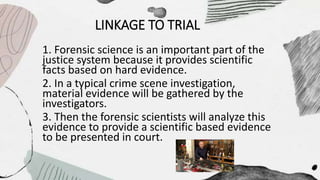
1. Forensic science is an important part of the
justice system because it provides scientific
facts based on hard evidence.
2. In a typical crime scene investigation,
material evidence will be gathered by the
investigators.
3. Then the forensic scientists will analyze this
evidence to provide a scientific based evidence
to be presented in court.
TAKE CARE
1. Each type of material evidence must be
separately collected in an appropriate fashion to
ensure that the evidence remains as intact and
un-contaminated as possible, for example;
blood that is in liquid pools should be collected
on gauze pads or sterile cotton and allowed to
air dry.
2. It should be refrigerated, if so needed.
CONNECTION OF FORENSIC SCIENCE TO
CRIMINAL TRIAL
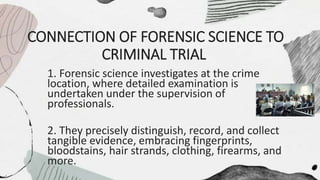
1. Forensic science investigates at the crime
location, where detailed examination is
undertaken under the supervision of
professionals.
2. They precisely distinguish, record, and collect
tangible evidence, embracing fingerprints,
bloodstains, hair strands, clothing, firearms, and
more.
IMPARTIAL MANNER
1. Forensic science provides the criminal justice
system with evidence that could be used to
establish guilt of a suspect even where an
eyewitness is not present.
2. The forensics and the law ensures both
convictions or exonerations occur without bias
or injustice.
MECHANISM
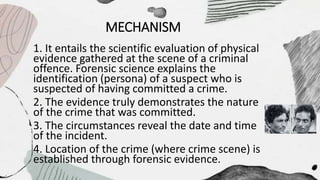
1. It entails the scientific evaluation of physical
evidence gathered at the scene of a criminal
offence. Forensic science explains the
identification (persona) of a suspect who is
suspected of having committed a crime.
2. The evidence truly demonstrates the nature
of the crime that was committed.
3. The circumstances reveal the date and time
of the incident.
4. Location of the crime (where crime scene) is
established through forensic evidence.
FINALLY
The forensic inquiry uncovers the offender’s
method of operation. Finally, it establishes the
crime’s motivation.
Forensic experts fall in the category of
specialists, but not eye witnesses.
Hence, at the trial their evidence is in the
nature of opinion given by experts.
EXPERT UNDER IEA (INDIAN EVIDENCE
ACT)
An individual with special knowledge, skill, or
experience in any of the following areas: foreign
law, science, art, handwriting, or finger
impression.
•Section 45: Opinion of an Expert:
• Section 45 allows for the opinion of an expert to be
considered as evidence.
• When the court has to form an opinion upon a
point of foreign law or of science, art, or identity
of handwriting or finger impressions, the opinions
of persons specially skilled in such foreign law,
science, or art, or in questions as to identity of
handwriting or finger impressions are considered
relevant.
EXPERT DEFINITION
An expert witness is one who is especially
skilled on those points on which he is asked
to state his opinion. His evidence on such
points is admissible to enable the tribunal
to come to a satisfactory conclusion.
A person who is a specialist in a subject, often
technical, who may present his/her expert
opinion without having been a witness to any
occurrence relating to the lawsuit or criminal
case.
Someone who is asked his opinion on a point of
law, legal dispute, or criminal trial or by the
media.
•Section 46: Facts Bearing on Opinion of Experts:
Facts, not otherwise relevant, may be admissible if
they support or are inconsistent with the opinions of
experts when such opinions are relevant.
•Section 47: Opinion as to Handwriting, when
Relevant
The opinion of experts regarding the handwriting of a
person.
•When the court forms an opinion as to the person by
whom any document was written or signed, the
expert opinions are admissible.
Section 47A: Opinion as to Digital Signature
When the Court has to form an opinion as to the electronic
signature of any person, the opinion of the Certifying
Authority which has issued the electronic Signature
Certificate is a relevant fact.
•Section 48: Opinion as to Existence of Right or Custom,
when Relevant
When the court has to form an opinion upon a point of law or
of custom, the opinions of persons who are specially skilled in
such law or custom are relevant.
•Section 49: Opinion as to Usages, Tenets, Etc.,
when Relevant
•When the court has to form an opinion as to the
usages and tenets of any body of men or family,
the opinions of persons having special means of
knowledge on the subject are relevant.
•Section 50: Opinions of Relationship when
relevant:
The opinion, expressed by conduct, as to the
existence of such relationship, of any person
who, as a member of the family or otherwise,
has special means of knowledge on the subject,
is a relevant fact:
•Provided that such opinion shall not be
sufficient to prove a marriage in proceedings
under the Indian Divorce Act, 1869, or in
prosecutions under sections 494, 495, 497 or
498 of the IPC.
•Section 51: Grounds of Opinion When
Relevant:
Whenever the opinion of any living person is
relevant, the grounds on which such opinion is
based are also relevant.
ADMISSIBILITY OF EXPERT EVIDENCE
1. Expert opinion is admissible only after the court
has allowed the request of a party to examine the
person concerned to be treated as an expert and his
opinion to be taken on a matter then relevant in the
proceedings.
2. It allows an expert to tender evidence on a
particular fact in question, and to show to the court
that his findings are unbiased and scientific.
3. Admissible evidence is evidence that may be
presented before the trier of fact (i.e., the judge or
jury) for them to consider in deciding the case.
It is widely believed that the experts
usually depose in favor of the party
which calls them.
Hence, the experts are put to extensive
cross- examination.
They are questioned on the basis or
grounds on which their opinion is based.
Examples of some trials that were
decided based on Forensic Evidences
1. Radhakrishnan, J. The appellant was accused
of carnal intercourse with a minor boy and
strangulating him to death. He was convicted
and awarded the death sentence by the Trial
Court which was confirmed by the High Court.
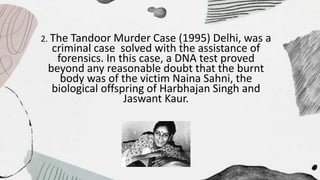
2. The Tandoor Murder Case (1995) Delhi, was a
criminal case solved with the assistance of
forensics. In this case, a DNA test proved
beyond any reasonable doubt that the burnt
body was of the victim Naina Sahni, the
biological offspring of Harbhajan Singh and
Jaswant Kaur.
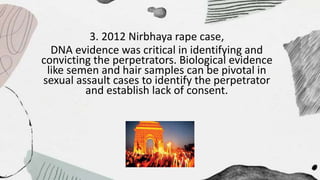
3. 2012 Nirbhaya rape case,
DNA evidence was critical in identifying and
convicting the perpetrators. Biological evidence
like semen and hair samples can be pivotal in
sexual assault cases to identify the perpetrator
and establish lack of consent.
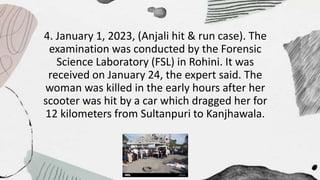
4. January 1, 2023, (Anjali hit & run case). The
examination was conducted by the Forensic
Science Laboratory (FSL) in Rohini. It was
received on January 24, the expert said. The
woman was killed in the early hours after her
scooter was hit by a car which dragged her for
12 kilometers from Sultanpuri to Kanjhawala.
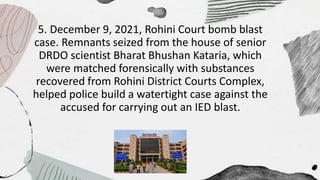
5. December 9, 2021, Rohini Court bomb blast
case. Remnants seized from the house of senior
DRDO scientist Bharat Bhushan Kataria, which
were matched forensically with substances
recovered from Rohini District Courts Complex,
helped police build a watertight case against the
accused for carrying out an IED blast.
SUGGESTION
An optional two credit course be designed for
law students on forensic law. This would be
helpful to those wanting to make a career in
criminal law practice or to join the state
judiciary.
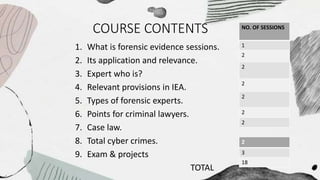
COURSE CONTENTS
1. What is forensic evidence sessions.
2. Its application and relevance.
3. Expert who is?
4. Relevant provisions in IEA.
5. Types of forensic experts.
6. Points for criminal lawyers.
7. Case law.
8. Total cyber crimes.
9. Exam & projects
TOTAL
NO. OF SESSIONS
1
2
2
2
2
2
2
2
3
18
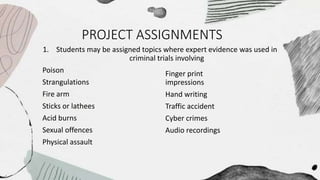
PROJECT ASSIGNMENTS
1. Students may be assigned topics where expert evidence was used in
criminal trials involving
Poison
Strangulations
Fire arm
Sticks or lathees
Acid burns
Sexual offences
Physical assault
Finger print
impressions
Hand writing
Traffic accident
Cyber crimes
Audio recordings
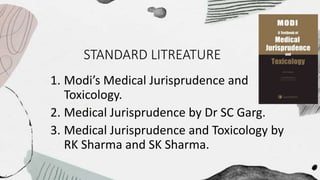
STANDARD LITREATURE
1. Modi’s Medical Jurisprudence and
Toxicology.
2. Medical Jurisprudence by Dr SC Garg.
3. Medical Jurisprudence and Toxicology by
RK Sharma and SK Sharma.
INTERNSHIPS
1. Session Courts.
2. FSL.
3. Criminal Lawyers.
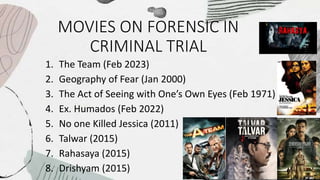
MOVIES ON FORENSIC IN
CRIMINAL TRIAL
1. The Team (Feb 2023)
2. Geography of Fear (Jan 2000)
3. The Act of Seeing with One’s Own Eyes (Feb 1971)
4. Ex. Humados (Feb 2022)
5. No one Killed Jessica (2011)
6. Talwar (2015)
7. Rahasaya (2015)
8. Drishyam (2015)
CONCLUSION
Introduction to offer an elective course on
forensics in law will hugely benefit law
students interested in criminal law practice
or work as Public Prosecutors.

Elective Course on Forensic Science in Law

  • 1.
  • 2.
    Presentation By Maj Gen NilendraKumar Executive President Indian Society of International Law
  • 3.
    MEANING OF FORENSICS Relatingto or dealing with the application of scientific knowledge to legal problems especially in regard to criminal evidence.
  • 4.
    ORIGIN OF WORD TheEnglish word was derived from a Latin word forensic meaning "of the market place or form, public," which in turn comes from the Latin word forum, meaning "market place, forum."
  • 5.
    ‘FORENSIC’ INVOLVES 1. Scientificanalysis of physical evidence (as from a crime scene). 2. The application of scientific knowledge to legal problems.
  • 6.
    RANGE 1. Forensic sciencecomprises a diverse array of disciplines, from fingerprint and DNA analysis to anthropology and wildlife forensics. 2. The forensic sciences are used to resolve civil disputes, to justly enforce criminal laws and government regulations, and to protect public health.
  • 7.
    FORENSIC SCIENCE APPLICATION 1.Any science used for the purposes of the criminal law is a forensic science. 2. Forensic science is the use of scientific methods or expertise to investigate crimes or examine evidence that might be presented in a court of law.
  • 8.
    INTER DISCIPLINARY NATURE Forensicscience is the application of many other sciences including physics, chemistry, biology, computer science, and engineering to matters of law and order.
  • 9.
    HOW APPLIED 1. Forensicsscience is used by investigators to help understand what happened in a crime scene. 2. Every single part of the crime scene is analyzed to find the smallest bits of evidence. 3. Forensic science can help investigators to understand how blood spatter patterns occur, find out who was at the crime scene, when the crime occurred, and who committed the crime.
  • 10.
    BRANCHES OF FORENSICSCIENCE 1. Trace Evidence Analysis 2. Forensic Toxicology 3. Forensic Psychology 4. Forensic Podiatry 5. Forensic Pathology 6. Forensic Odontology 7. Forensic Linguistics 8. Forensic Geology
  • 11.
    LINKAGE TO TRIAL 1.Forensic science is an important part of the justice system because it provides scientific facts based on hard evidence. 2. In a typical crime scene investigation, material evidence will be gathered by the investigators. 3. Then the forensic scientists will analyze this evidence to provide a scientific based evidence to be presented in court.
  • 12.
    TAKE CARE 1. Eachtype of material evidence must be separately collected in an appropriate fashion to ensure that the evidence remains as intact and un-contaminated as possible, for example; blood that is in liquid pools should be collected on gauze pads or sterile cotton and allowed to air dry. 2. It should be refrigerated, if so needed.
  • 13.
    CONNECTION OF FORENSICSCIENCE TO CRIMINAL TRIAL 1. Forensic science investigates at the crime location, where detailed examination is undertaken under the supervision of professionals. 2. They precisely distinguish, record, and collect tangible evidence, embracing fingerprints, bloodstains, hair strands, clothing, firearms, and more.
  • 14.
    IMPARTIAL MANNER 1. Forensicscience provides the criminal justice system with evidence that could be used to establish guilt of a suspect even where an eyewitness is not present. 2. The forensics and the law ensures both convictions or exonerations occur without bias or injustice.
  • 15.
    MECHANISM 1. It entailsthe scientific evaluation of physical evidence gathered at the scene of a criminal offence. Forensic science explains the identification (persona) of a suspect who is suspected of having committed a crime. 2. The evidence truly demonstrates the nature of the crime that was committed. 3. The circumstances reveal the date and time of the incident. 4. Location of the crime (where crime scene) is established through forensic evidence.
  • 16.
    FINALLY The forensic inquiryuncovers the offender’s method of operation. Finally, it establishes the crime’s motivation.
  • 17.
    Forensic experts fallin the category of specialists, but not eye witnesses. Hence, at the trial their evidence is in the nature of opinion given by experts.
  • 18.
    EXPERT UNDER IEA(INDIAN EVIDENCE ACT) An individual with special knowledge, skill, or experience in any of the following areas: foreign law, science, art, handwriting, or finger impression.
  • 19.
    •Section 45: Opinionof an Expert: • Section 45 allows for the opinion of an expert to be considered as evidence. • When the court has to form an opinion upon a point of foreign law or of science, art, or identity of handwriting or finger impressions, the opinions of persons specially skilled in such foreign law, science, or art, or in questions as to identity of handwriting or finger impressions are considered relevant.
  • 20.
    EXPERT DEFINITION An expertwitness is one who is especially skilled on those points on which he is asked to state his opinion. His evidence on such points is admissible to enable the tribunal to come to a satisfactory conclusion.
  • 21.
    A person whois a specialist in a subject, often technical, who may present his/her expert opinion without having been a witness to any occurrence relating to the lawsuit or criminal case. Someone who is asked his opinion on a point of law, legal dispute, or criminal trial or by the media.
  • 22.
    •Section 46: FactsBearing on Opinion of Experts: Facts, not otherwise relevant, may be admissible if they support or are inconsistent with the opinions of experts when such opinions are relevant. •Section 47: Opinion as to Handwriting, when Relevant The opinion of experts regarding the handwriting of a person. •When the court forms an opinion as to the person by whom any document was written or signed, the expert opinions are admissible.
  • 23.
    Section 47A: Opinionas to Digital Signature When the Court has to form an opinion as to the electronic signature of any person, the opinion of the Certifying Authority which has issued the electronic Signature Certificate is a relevant fact. •Section 48: Opinion as to Existence of Right or Custom, when Relevant When the court has to form an opinion upon a point of law or of custom, the opinions of persons who are specially skilled in such law or custom are relevant.
  • 24.
    •Section 49: Opinionas to Usages, Tenets, Etc., when Relevant •When the court has to form an opinion as to the usages and tenets of any body of men or family, the opinions of persons having special means of knowledge on the subject are relevant.
  • 25.
    •Section 50: Opinionsof Relationship when relevant: The opinion, expressed by conduct, as to the existence of such relationship, of any person who, as a member of the family or otherwise, has special means of knowledge on the subject, is a relevant fact: •Provided that such opinion shall not be sufficient to prove a marriage in proceedings under the Indian Divorce Act, 1869, or in prosecutions under sections 494, 495, 497 or 498 of the IPC.
  • 26.
    •Section 51: Groundsof Opinion When Relevant: Whenever the opinion of any living person is relevant, the grounds on which such opinion is based are also relevant.
  • 27.
    ADMISSIBILITY OF EXPERTEVIDENCE 1. Expert opinion is admissible only after the court has allowed the request of a party to examine the person concerned to be treated as an expert and his opinion to be taken on a matter then relevant in the proceedings. 2. It allows an expert to tender evidence on a particular fact in question, and to show to the court that his findings are unbiased and scientific. 3. Admissible evidence is evidence that may be presented before the trier of fact (i.e., the judge or jury) for them to consider in deciding the case.
  • 28.
    It is widelybelieved that the experts usually depose in favor of the party which calls them.
  • 29.
    Hence, the expertsare put to extensive cross- examination. They are questioned on the basis or grounds on which their opinion is based.
  • 30.
    Examples of sometrials that were decided based on Forensic Evidences 1. Radhakrishnan, J. The appellant was accused of carnal intercourse with a minor boy and strangulating him to death. He was convicted and awarded the death sentence by the Trial Court which was confirmed by the High Court.
  • 31.
    2. The TandoorMurder Case (1995) Delhi, was a criminal case solved with the assistance of forensics. In this case, a DNA test proved beyond any reasonable doubt that the burnt body was of the victim Naina Sahni, the biological offspring of Harbhajan Singh and Jaswant Kaur.
  • 32.
    3. 2012 Nirbhayarape case, DNA evidence was critical in identifying and convicting the perpetrators. Biological evidence like semen and hair samples can be pivotal in sexual assault cases to identify the perpetrator and establish lack of consent.
  • 33.
    4. January 1,2023, (Anjali hit & run case). The examination was conducted by the Forensic Science Laboratory (FSL) in Rohini. It was received on January 24, the expert said. The woman was killed in the early hours after her scooter was hit by a car which dragged her for 12 kilometers from Sultanpuri to Kanjhawala.
  • 34.
    5. December 9,2021, Rohini Court bomb blast case. Remnants seized from the house of senior DRDO scientist Bharat Bhushan Kataria, which were matched forensically with substances recovered from Rohini District Courts Complex, helped police build a watertight case against the accused for carrying out an IED blast.
  • 35.
    SUGGESTION An optional twocredit course be designed for law students on forensic law. This would be helpful to those wanting to make a career in criminal law practice or to join the state judiciary.
  • 36.
    COURSE CONTENTS 1. Whatis forensic evidence sessions. 2. Its application and relevance. 3. Expert who is? 4. Relevant provisions in IEA. 5. Types of forensic experts. 6. Points for criminal lawyers. 7. Case law. 8. Total cyber crimes. 9. Exam & projects TOTAL NO. OF SESSIONS 1 2 2 2 2 2 2 2 3 18
  • 37.
    PROJECT ASSIGNMENTS 1. Studentsmay be assigned topics where expert evidence was used in criminal trials involving Poison Strangulations Fire arm Sticks or lathees Acid burns Sexual offences Physical assault Finger print impressions Hand writing Traffic accident Cyber crimes Audio recordings
  • 38.
    STANDARD LITREATURE 1. Modi’sMedical Jurisprudence and Toxicology. 2. Medical Jurisprudence by Dr SC Garg. 3. Medical Jurisprudence and Toxicology by RK Sharma and SK Sharma.
  • 39.
    INTERNSHIPS 1. Session Courts. 2.FSL. 3. Criminal Lawyers.
  • 40.
    MOVIES ON FORENSICIN CRIMINAL TRIAL 1. The Team (Feb 2023) 2. Geography of Fear (Jan 2000) 3. The Act of Seeing with One’s Own Eyes (Feb 1971) 4. Ex. Humados (Feb 2022) 5. No one Killed Jessica (2011) 6. Talwar (2015) 7. Rahasaya (2015) 8. Drishyam (2015)
  • 41.
    CONCLUSION Introduction to offeran elective course on forensics in law will hugely benefit law students interested in criminal law practice or work as Public Prosecutors.