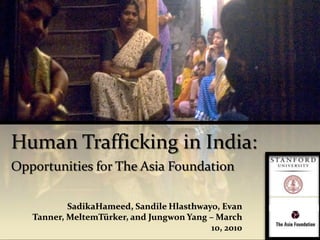
Human Trafficking in India:Opportunities for The Asia FoundationSadikaHameed, Sandile Hlasthwayo, Evan Tanner, MeltemTürker, and Jungwon Yang – March 10, 2010
AgendaPart I: Introduction & methodologyPart II: Root causes & legal framework Part III: Findings on  NGO, donor, and government intervention effortsPart IV: RecommendationsTitle photo by Kay Chernush for the U.S. State Department2
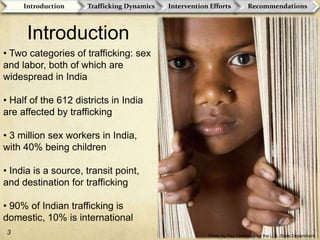
Introduction Two categories of trafficking: sex and labor, both of which are widespread in India
 Half of the 612 districts in India are affected by trafficking
 3 million sex workers in India, with 40% being children
 India is a source, transit point, and destination for trafficking
 90% of Indian trafficking is domestic, 10% is internationalPhoto by Kay Chernush for the U.S. State Department3
Formally, Trafficking in Persons (TIP) means…“the recruitment, transportation, transfer, harboring or receipt of persons, by means of:Threat or use of force or other forms of coercionAbductionFraudDeceptionThe abuse of powerA position of vulnerabilityThe giving or receiving of payments or benefits to achieve the consent of a person having control over another person for the purpose of exploitation.” (UN Palermo Protocol, 2000)4
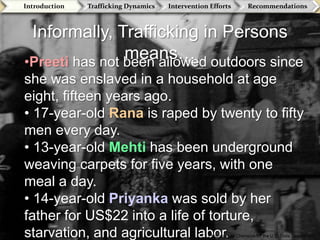
Informally, Trafficking in Persons means…Preeti has not been allowed outdoors since she was enslaved in a household at age eight, fifteen years ago.
 17-year-old Rana is raped by twenty to fifty men every day.
 13-year-old Mehti has been underground weaving carpets for five years, with one meal a day.
 14-year-old Priyanka was sold by her father for US$22 into a life of torture, starvation, and agricultural labor.Photo by Kay Chernush for the U.S. State Department5
ObjectivesEvaluate the political, social, economic, legal, and intervention landscape of the anti-trafficking movement in IndiaResearch current NGO, donor, and government efforts to combat trafficking in IndiaProvide TAF with actionable recommendations with regards to a human trafficking program in IndiaPhoto by Kay Chernush for the U.S. State Department6
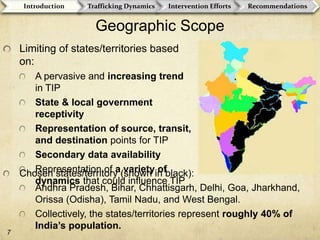
Geographic ScopeLimiting of states/territories based on:A pervasive and increasing trend in TIPState & local government receptivityRepresentation of source, transit, and destination points for TIPSecondary data availabilityRepresentation of a variety of dynamics that could influence TIPChosen states/territory (shown in black):Andhra Pradesh, Bihar, Chhattisgarh, Delhi, Goa, Jharkhand, Orissa (Odisha), Tamil Nadu, and West Bengal.Collectively, the states/territories represent roughly 40% of India’s population. 7
MethodologyStage 1: Literature Review & Synthesizing of Secondary DataStudied general global/India-specific TIP literatureAnalyzed trafficking in nine representative states/territoriesResearched anti-trafficking interventions in those regionsConducted a legal framework analysisStage 2: InterviewsSupplemented intervention research with 19 NGO/donor interviews8
Data ConstraintsThe hidden nature of human traffickingIllegalityLack of recordsEfforts to keep the practice hiddenDanger to current victims for speaking outSocial stigmatization of survivorsChallenge in distinguishing victims from voluntary migrantsScope of the problemInability to conduct field research9
II. Root Causes & Legal Framework of TIP in India
Root Causes Of Trafficking11
12NGO/Donor Perceptions of theProblem of TIP in India
Summary of Legal Framework13
Strengths and Weaknesses of Anti-Human Trafficking Efforts14
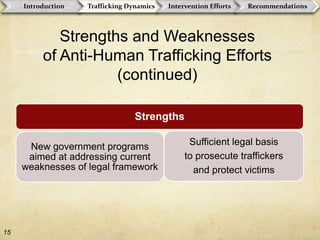
Strengths and Weaknesses of Anti-Human Trafficking Efforts (continued)15
III. Findings on Government, Donor, & NGO Efforts in Anti-TIP
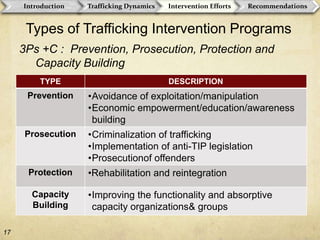
Types of Trafficking Intervention Programs3Ps +C :  Prevention, Prosecution, Protection and Capacity Building17
Representative Government Anti-TIP EffortsCentral GovernmentSwadharProgramSupports 200 shelters (> 13,000 women and girls rescued)
Annual budget: $1 million
Designing national protocols & guidelinesUjjawala ProgramCentral gov’t grants to state gov’t projects in TIP
53 state projects (> 1,700 victims)Central GovernmentIntegrated Anti-Human Trafficking Units (IAHTUs)In 2009, MoHAallocated $18 million to create 297 anti-human trafficking units
Multi disciplinary approach
Joint response by all stake holders, such as police, prosecutors, NGOs, civil society and media
Inter-departmental & inter-agency collaborationState GovernmentsTIP training to NGOs working onHIV/AIDSAndhra Pradesh and Tamil Nadu
Victims have greater risk of contracting the disease
Leverages synergies
High value multiplier effect18
Government Anti-TIP Efforts: FindingsThe central government’s programs are –Still in design/recently launched
Unclear outcomesThe state-led intervention programs emphasize –Prevention  Protection  Prosecution State government interventions often fail because –Poor coordination
Low awareness
Lack of an integrated plan
High level of corruptionNGOs’ perception of gov’t efforts generally positive; however, it was indicated that government still lacks political will, coordination, and capacity19

Taftip8 March2010 Edit Ii

  • 1.
    Human Trafficking inIndia:Opportunities for The Asia FoundationSadikaHameed, Sandile Hlasthwayo, Evan Tanner, MeltemTürker, and Jungwon Yang – March 10, 2010
  • 2.
    AgendaPart I: Introduction& methodologyPart II: Root causes & legal framework Part III: Findings on NGO, donor, and government intervention effortsPart IV: RecommendationsTitle photo by Kay Chernush for the U.S. State Department2
  • 3.
    Introduction Two categoriesof trafficking: sex and labor, both of which are widespread in India
  • 4.
    Half ofthe 612 districts in India are affected by trafficking
  • 5.
    3 millionsex workers in India, with 40% being children
  • 6.
    India isa source, transit point, and destination for trafficking
  • 7.
    90% ofIndian trafficking is domestic, 10% is internationalPhoto by Kay Chernush for the U.S. State Department3
  • 8.
    Formally, Trafficking inPersons (TIP) means…“the recruitment, transportation, transfer, harboring or receipt of persons, by means of:Threat or use of force or other forms of coercionAbductionFraudDeceptionThe abuse of powerA position of vulnerabilityThe giving or receiving of payments or benefits to achieve the consent of a person having control over another person for the purpose of exploitation.” (UN Palermo Protocol, 2000)4
  • 9.
    Informally, Trafficking inPersons means…Preeti has not been allowed outdoors since she was enslaved in a household at age eight, fifteen years ago.
  • 10.
    17-year-old Ranais raped by twenty to fifty men every day.
  • 11.
    13-year-old Mehtihas been underground weaving carpets for five years, with one meal a day.
  • 12.
    14-year-old Priyankawas sold by her father for US$22 into a life of torture, starvation, and agricultural labor.Photo by Kay Chernush for the U.S. State Department5
  • 13.
    ObjectivesEvaluate the political,social, economic, legal, and intervention landscape of the anti-trafficking movement in IndiaResearch current NGO, donor, and government efforts to combat trafficking in IndiaProvide TAF with actionable recommendations with regards to a human trafficking program in IndiaPhoto by Kay Chernush for the U.S. State Department6
  • 14.
    Geographic ScopeLimiting ofstates/territories based on:A pervasive and increasing trend in TIPState & local government receptivityRepresentation of source, transit, and destination points for TIPSecondary data availabilityRepresentation of a variety of dynamics that could influence TIPChosen states/territory (shown in black):Andhra Pradesh, Bihar, Chhattisgarh, Delhi, Goa, Jharkhand, Orissa (Odisha), Tamil Nadu, and West Bengal.Collectively, the states/territories represent roughly 40% of India’s population. 7
  • 15.
    MethodologyStage 1: LiteratureReview & Synthesizing of Secondary DataStudied general global/India-specific TIP literatureAnalyzed trafficking in nine representative states/territoriesResearched anti-trafficking interventions in those regionsConducted a legal framework analysisStage 2: InterviewsSupplemented intervention research with 19 NGO/donor interviews8
  • 16.
    Data ConstraintsThe hiddennature of human traffickingIllegalityLack of recordsEfforts to keep the practice hiddenDanger to current victims for speaking outSocial stigmatization of survivorsChallenge in distinguishing victims from voluntary migrantsScope of the problemInability to conduct field research9
  • 17.
    II. Root Causes& Legal Framework of TIP in India
  • 18.
    Root Causes OfTrafficking11
  • 19.
    12NGO/Donor Perceptions oftheProblem of TIP in India
  • 20.
    Summary of LegalFramework13
  • 21.
    Strengths and Weaknessesof Anti-Human Trafficking Efforts14
  • 22.
    Strengths and Weaknessesof Anti-Human Trafficking Efforts (continued)15
  • 23.
    III. Findings onGovernment, Donor, & NGO Efforts in Anti-TIP
  • 24.
    Types of TraffickingIntervention Programs3Ps +C : Prevention, Prosecution, Protection and Capacity Building17
  • 25.
    Representative Government Anti-TIPEffortsCentral GovernmentSwadharProgramSupports 200 shelters (> 13,000 women and girls rescued)
  • 26.
  • 27.
    Designing national protocols& guidelinesUjjawala ProgramCentral gov’t grants to state gov’t projects in TIP
  • 28.
    53 state projects(> 1,700 victims)Central GovernmentIntegrated Anti-Human Trafficking Units (IAHTUs)In 2009, MoHAallocated $18 million to create 297 anti-human trafficking units
  • 29.
  • 30.
    Joint response byall stake holders, such as police, prosecutors, NGOs, civil society and media
  • 31.
    Inter-departmental & inter-agencycollaborationState GovernmentsTIP training to NGOs working onHIV/AIDSAndhra Pradesh and Tamil Nadu
  • 32.
    Victims have greaterrisk of contracting the disease
  • 33.
  • 34.
  • 35.
    Government Anti-TIP Efforts:FindingsThe central government’s programs are –Still in design/recently launched
  • 36.
    Unclear outcomesThe state-ledintervention programs emphasize –Prevention  Protection  Prosecution State government interventions often fail because –Poor coordination
  • 37.
  • 38.
    Lack of anintegrated plan
  • 39.
    High level ofcorruptionNGOs’ perception of gov’t efforts generally positive; however, it was indicated that government still lacks political will, coordination, and capacity19