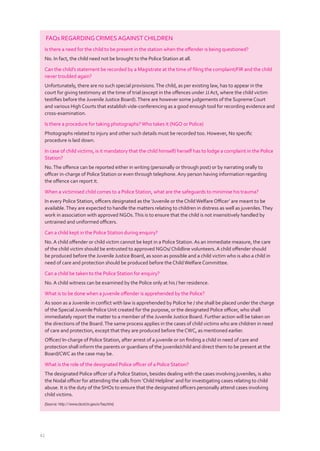




Combating
ChildTrafficking
A User’s Handbook
2
Combating ChildTrafficking : A User’s Handbook
iv
© CACT 2007
Any part of this volume may be freely reproduced with appropriate acknowledgement. Permission to translate all or any part of this volume
must be obtained from HAQ: Centre for Child Rights, New Delhi and the CACT National Secretariat.
HAQ: Centre for Child Rights
208 Shahpur Jat
New Delhi 110049
Telephone: 91-11-26490136
Telefax: 91-11-26492551
E-mail: info@haqcrc.org
Website: www.haqcrc.org
CACT National Secretariat
E-mail: cact@vsnl.net
Web : www.cactindia.in
ISBN 81-901638-8-4
Credits
Written by | Bharti Ali
Enakshi Ganguly Thukral
Research | Vijeta Singh
Bharti Ali
Illustrations | Chaitali Ray Chowdhury
Design and Typesetting | Aspire Design
Supported by | terre des homes (Germany) India Programme / BMZ
v
Foreword
All through March and April 2006 there were several news reports about a senior official in the Ministry
of External Affairs being charged for criminal conspiracy in a case of human trafficking. The case is under
investigation by the CBI. Later the media drew attention to the sex racket in the State of Jammu and
Kashmir, where people came out in protests seeking the names of politicians and bureaucrats involved in it.
Then came the Nithari case in Noida, where possibilities of trafficking of children for sexual abuse as well
as organ trade cannot be ruled out. The more recent one is the Gujarat politician Babu Bhai Katara, who
was caught trying to smuggle a woman and a child out of the country, getting the two to pose as his wife and
child.
Clearly, human trafficking is an organised crime, carried out by a nexus of individuals in connivance with or
under the patronage of high-ranking government officials and politicians. It is estimated that after drugs and
arms trafficking, human trafficking is the third largest illegal business in the world.
There is no doubt that persons below the age of 18 years
(who are defined as children under the UN Convention
on the Rights of the Child) are the most vulnerable to all
forms of exploitation, including trafficking. There is also
no doubt that therefore child trafficking needs special
attention and the treatment of trafficked children must be
different and special in law, policy and action.
As things stand today, it is not surprising to find that the
victim and the offender are brought to the court in the
same vehicle for recording their statements after a FIR
is filed. It is also not surprising that despite Supreme Court and High Court rulings on in- camera trials,
screen between the victim and the accused, video-conferencing etc., these are often not being adhered to by
the courts, either because the magistrates are not aware of such rulings or the courts are not provided with
required infrastructure. For the Labour Commissioners, raids and rescue of child workers is more important
than post-rescue care and protection of children as it has been happenning in the case of several hundreds
of child labourers rescued from the zari units in Delhi. For the electronic media, the most powerful platform
today, the face of the victim is more important than the case, and only a sensational story where they can also
film the scene or place of the crime will work.
Yet, when one sits down to collate and analyse the various interventions on human trafficking, lack of
focus on ‘child trafficking’ is starkly evident. Prosecution of offenders in cases involving minors is far more
difficult in the absence of a comprehensive legal definition of child trafficking and due to complete lack
of sensitivity of the law enforcement agencies, judiciary and the media while dealing with a case of child
trafficking.
Lack of awareness of laws that safeguard children’s right to protection, particularly the procedural law, not
only keeps people away from being able to effectively demand for proper implementation of law but is also
responsible for rendering most attempts to help a child victim futile.
A world fit for children… when, where and how remains a challenge for all of us today. But if one really
decides to help children in distressful situations, knowing the law is critical.
Any action, be it in the area of prevention, protection or restoration must be guided by established
laws, policies and guidelines. While there are several manuals developed by national and international
Children are trafficked because
there is a demand for them.The
supply comes easy as children,
more than any one else, are the
most vulnerable and can therefore
be manipulated, coerced and
bartered or bought and sold.
vi
organisations on trafficking in persons, these largely focus on trafficking of women and girls for commercial
sexual exploitation. Also, some of the existing training materials on human trafficking are specific to some
actors such as the manuals prepared by UNICEF and Ministry of Women and Child Development for social
workers and medical officers.
Through this handbook, effort has been made to facilitate every actor’s understanding of their role and
course of action while working on the issue of child trafficking, as well as develop their understanding of
the substantive and procedural laws that often come into play. Victim protection too forms an integral part
of the handbook, focussing on the protection rights of the victims as laid down in the domestic law and
established through international guidelines.
The handbook is a result of two years of developing an understanding of the domestic law and international
definitions and guidelines on child trafficking and testing various drafts of the handbook before arriving at
its present and final state. Initiated by HAQ: Centre for Child Rights when it hosted the National Secretariat
of the Campaign Against Child Trafficking (CACT), the handbook is also part of the series of IEC and
training materials developed by CACT, with support from BMZ and terre des homes (Germany) in the
year 2005-06. While the campaign had planned two separate resource guides on national and international
laws respectively, in the final outcome, national and international laws have been merged together in this
handbook itself as and where necessary, in order to build a holistic legal understanding on the issue. The
first set of inputs for the handbook came from Maharukh Adenwalla, a Mumbai based child rights activist
and lawyer. We thank her for the same. We also thank Nandini Ramchandran for her legal inputs and
suggestions before the finalisation of the handbook.
All trainings held so far using this handbook have been appreciated by the participants. A near final draft of
the handbook is also available on the CRIN site.
We would truely appreciate a feedback on the handbook and its utility.
Bharti Ali Enakshi Ganguly Thukral
1
PART I
CHILDTRAFFICKING
Understanding the Issue 2-9
PART II
FORMS AND PURPOSES OF CHILDTRAFFICKING
Distinction between Means and Ends 10-15
PART III
INTERVENING IN A CASE OF CHILDTRAFFICKING
Areas of Intervention and Fundamental Principles 16-23
PART IV
PRE-REQUISITES FOR LEGAL INTERVENTION
Role of Citizens/Social Workers/NGOs and Checklist for
Enquiries/Rescue operations 24-29
PARTV
FIGHTING CHILDTRAFFICKING
Procedural Law 30-43
PARTVI
COMBATING CHILDTRAFFICKING
Legal Provisions and their Effective use for Booking a Case 44-57
PARTVII
VICTIM PROTECTION
Applying Rights Based Approach 58-67
Contents
2
3
Buying and selling of human beings is not a new
phenomenon. Humans — women, children and men
– have been captured, bought and sold in market
places for centuries. In the past decade, the volume of
human trafficking has increased to make it one of the
fastest growing and perhaps the most lucrative criminal
activities.
People are trafficked both internationally and within the
country, from one State to another and one district to
another. However, data on trafficking and related aspects
varies in quality and in the projected estimates too.
UN estimates 1 to 4 million people are trafficked
worldwide each year1
, trafficking in women and
children being an operation worth more than $10
billion annually2
. These numbers do not include victims
who are trafficked within their own countries.
In India
12.6 million (GOI) to 100 million (unofficial sources) children are reported to be child labour.
Over 44,000 children are reported missing annually, of which only about 11,000 get traced.3
At a conservative estimate, about 200 girls and women enter prostitution daily. 20 percent of them are
below 15 years of age.
Most of these children are trafficked!
1 www.globalfundfor women.org
2 Combating Child Trafficking, Handbook for Parliamentarians No 9, UNICEF & IPU, 2005, www.unicef.org/protection/ files/
child_trafficking_handbook.pdf
3 Report of the NHRC Committee on Missing Children. Presented by P.C.Sharma , Member, NHRC & Chairman of the Committee
www.nhrc.nic.in.
Meenu, now 18, was brought from South
24 Parganas to a Delhi Brothel when she
was 13 years old. She realized this was
the “job” the friend who took her there
had promised. Mita Gurung of Beheliya,
Nepal reached Saudi Arabia, where her
eyes used to be poked with fingers while
she slaved as a domestic help for 15 hours
a day.
Vasudev Shefalee, Girls for Sale, IndiaToday, 13 October 2003
ChildTrafficking
UNDERSTANDING THE ISSUEUNDERSTANDING THE ISSUE
4
What isTrafficking in Human Beings ?
Till as late as the year 2000, there was no one single internationally accepted definition of human trafficking.
Different international instruments defined it in different contexts.
In the year 2000, the UN Protocol to Prevent, Suppress and Punish Trafficking in Persons, Especially Women and
Children (also referred to as the Palermo Protocol on Trafficking) entered into force. For the first time trafficking
was defined as an organised crime and a crime against humanity. The Palermo Protocol on trafficking supplements
the United Nations Convention against Transnational Organised Crime, 2000, and is hence limited to cross-border
trafficking. It does not address trafficking within the countries.
It defines trafficking as:
“the recruitment, transportation, transfer, harboring or receipt of persons by means of the threat or use of force or
other forms of coercion, of abduction, of fraud, of deception, of the abuse of power or of a position of vulnerability
or of the giving or receiving of payments or benefits to achieve the consent of a person having control over another
person, for the purpose of exploitation.
Exploitation shall include, at a minimum, the exploitation of the prostitution of others or other forms of sexual
exploitation, forced labour or service, slavery or practices similar to slavery, servitude or the removal of organs.
Consent is considered irrelevant in the case of children. If any of the means stated above are used, consent becomes
irrelevant in the case of adults also.”
What if the victim consents? Can children consent?
Victims often consent to the initial stage of trafficking because they are misled or deceived by traffickers.
Trafficking prosecutions are sometimes lost, though, because the evidence needed to establish the
true nature of the consent is not available. At the same time, constitutional and other human rights
protections in many countries require that those accused of trafficking must be able to raise the
possibility of consent as a defence.The Protocol therefore states that if any of the improper means
set out in the definition (i.e. coercion, fraud, deception) have been used, any alleged consent to the
subsequent exploitation is irrelevant.
Children under 18 cannot give valid consent, and any recruitment, transportation, transfer, harbouring or
receipt of children for the purpose of exploitation is a form of trafficking regardless of the means used.
Source: United Nations Office on Drugs and Crime (UNODC) 17 August 2005 | http://www.unodc.org/unodc/en/trafficking_victim_consents.html
When examining a case of suspected trafficking, look out for these three critical elements:
Action the recruitment, transportation, transfer, harbouring, procurement or receipt of persons
Means threat, force, coercion, abduction, fraud, deception, abuse of power enjoyed by the trafficker (s), abuse of
the position of vulnerability of the victim, giving or receiving payments or benefits, some consideration
Purpose exploitation, which includes exploitation of the prostitution of others, other forms of sexual exploitation,
forced labour, slavery or similar practices, servitude or removal of organs
Only when we find all three elements in a case, can we treat it as a case of ‘trafficking’.
5
What is ChildTrafficking?
The definition of human trafficking as provided in the Palermo Protocol, when adapted to a ‘Child’ defined in the
UN Convention on the Rights of the Child (UNCRC) provides a definition of Child Trafficking.
When extended to cover both transnational and national organized crime, the definition becomes more
comprehensive.
Some attempts made towards arriving at such a comprehensive definition of child trafficking include:
Working definition of CACT 4
“the recruitment, transportation, transfer, harbouring or receipt of persons below the age of 18 years, within
or across borders, legally or illegally, by means of threat or use of other forms of coercion, of abduction, of
deception, of the abuse of power or of position of vulnerability or, of the giving or receiving of payment or
benefits to achieve the consent of such person, with the intention or knowledge that it is likely to cause or
lead to exploitation.
The words ‘legally or illegally’ were inserted by CACT to cover all forms and purposes of trafficking in children
be it marriage that is valid or adoption that has met all legal procedures and formalities.
Working Definition of Save the Children Alliance 5
“all acts of recruitment, transportation, purchase, sale, transfer, receipt or harbouring of a person including a
child (as defined by the United Nations Convention on the Rights of the Child and/or the applicable national
laws of state parties) within or across borders that involve the use of deception, coercion (including the use or
threat of force or the abuse of authority) or debt bondage, whether or not any payment is given or received,
for the purpose of placing or holding such person in involuntary servitude (domestic, sexual or reproductive),
in forced or bonded labour, in slavery-like condition or for false adoption”.
Explanation of terms
1. Recruitment – a child may be recruited into circus, insurgent groups, as camel jockey or in any other employment,
which may be legal or illegal.
Recruitment may be through:
Personal contacts
Agencies
Advertisements / Internet
Kidnapping / threats or violence or other forms of coercion such as debt bondage, or with consent through
deception, when good job opportunities are promised or implied
Recruitment may seem to be out of the willingness of the person being recruited. But in the case of a child, the
question of willingness does not arise, as often recruitment is a result of abuse of authority vested in the child’s
parents or some form of deception.
Abuse of authority plays a role when for instance, parents decide to put the child to work. It also plays a role when
anyone who exercises a form of authority over the child agrees to or, is involved in recruitment resulting in trafficking.
4 Campaign Against Child Trafficking (CACT), is part of the of the International Campaign against Child Trafficking (ICaCT) initiated by the
International terre des homes (tdh) Federation in Geneva and co-ordinated by tdh (Germany) followed by tdh (Laussane). In India, CACT adapted the
Palermo Protocol to evolve its working definition of child trafficking in June 2001.
5 Training Manual for Combating Trafficking in Women and Children www.un.or.th/TraffickingProject/trafficking_manual.pdf
6
Place: People are reportedly recruited at places like cinema halls, bus stops, railway stations, airports,
streets and their homes. Other places mentioned are cafes, restaurants, beauty contests, massage parlours
and beauty parlours. State and national highways, quarry and construction work sites, and areas where
locals are displaced without proper rehabilitation may also be sites for potential victims.
Time: Some studies report that traffickers choose special times for recruitment.They take advantage of
difficult periods, either before the harvesting season or during a drought, when many locals look elsewhere
for income to survive (HRW 1995).Traffickers also keep themselves informed about severely impoverished
areas or those, which have suffered climatic, economic or political disasters (Johnston and Khan 1998: 53;
ISS 2003a).They also reportedly recruit people during festivals (ISS 2003a, and 2003c).
Source: NHRC, UNIFEM, ISS, Report onTrafficking inWomen and Children in India, 2002-2003
2. Transportation – The act of transporting a child from one place to another would result in trafficking
when it is by force as in the case of kidnapping or, when the travel is under threat or with consent taken
deceptively. Agents and brokers may restrict the children’s freedom of movement by restricting their
independence and ability to return home. Sexual harassment and rape may also occur during or after
transportation.
Some of the common means of transportation used for trafficking children within the country include
bus, boats, train, trucks, tempos and of course on foot. International trafficking and smuggling involves
transportation by air and sea unless it is a case of cross-border trafficking from Nepal and Bangladesh into
India. In that case, road, rail and waterways, all play an important role.
Transportation may be undertaken legally or illegally i.e. using fake travel documents.
3. Transfer – Sometimes, the trafficked persons are transferred from one hand to another, sold several
times to middlemen or other agents, before they reach their final destination. In situations of trafficking,
transferring children from one point to another may be carried out secretively, without informing the
child about it or under coercion, threat and other forms of violence and abuse.
4. Harbouring – In the context of trafficking, harbouring implies confinement.
5. Abuse of a position of vulnerability – Trafficking can occur without any use of force. The definition
recognizes that many trafficked people are told what to do by someone close to them, such as a parent, a
spouse or a community leader. Persons in these situations may have no culturally acceptable or legal
means to refuse and so they “submit” to the situation. They are still victims of trafficking.
6. Procurement – To acquire a child either through sale and purchase or by kidnapping, use of threat, force
or other forms of coercion, deception or fraud for the purpose of exploitation.
7. Consideration – It is the benefit received (in cash or in kind) in exchange of the child.
Points to Remember…
While all forms of trafficking are exploitative, all exploitation of children is not a result of
trafficking
For instance, trafficking may occur for various types of exploitations such as sexual exploitation, debt
bondage or other forms of bonded labour, forced labour, servitude, camel jockeying, begging, drug peddling,
illegal adoption etc.
On the other hand for example, economic exploitation of children is not always a result of trafficking.
7
Trafficking is not the same as
migration or smuggling. Although
often used interchangably, it is
wrong to do so.
Migration is usually movement of people
from one place of abode to another,
either from one district to another or
one state to another or to a different
country altogether. It may be seasonal
and therefore temporary or permanent.
When people migrate outside their
country it may be legal or illegal. The
legal migrants carry relevant documents
and papers whereas the illegal migrants
cross the border secretively, without any
legal documents like passport, visa etc.,
or with the help of fake documents.
Barriers to regular forms of migration
cause people to seek out other means of
migration, which are illegal, including
smuggling. This is also termed as migrant
smuggling or smuggling of migrants.
Smuggling is defined as illegal import
or export of goods/people across
the borders of a country secretively
without paying the custom duties or
in contravention of some enactment,
without proper legal documents or with
fake documents. It is basically assisting
someone for a fee to cross a border
illegally. Here both the smuggler and the
smuggled come to an understanding and
both the parties mutually agree upon
some consideration. Smuggling therefore
does not require coercive or deceptive
means.
Trafficking is movement of a person
from one place to another caused by use
of force or threat, fraud or deception,
for the purpose of exploitation of such
person, involving some consideration to the benefit of another person. In case of children there can be
no question of consent at all. As regards adults, what may seem consensual is actually always a result of
deception and therefore there is no informed consent on the part of the victims and no choice at all. From a
practical standpoint, victims of trafficking also tend to be more severely affected. They are in greater need of
protection from re-victimization and further abuse than smuggled migrants.
Often the traffickers prey on people being smuggled out of the country or those who are migrating from one
place to another as they are vulnerable and are looking for a better job/life.
Traffickers use coercive tactics to ensure that victims will not escape, including sexual abuse, torture,
starvation, imprisonment, and threats of violence on victims or their families at home. Traffickers may also
confiscate passports (real of fake) to manipulate their victims.
Three basic differences between human
smuggling and trafficking
Consent
The smuggling of clients/migrants involves clients/
migrants who have consented to the smuggling.
Trafficked victims, on the other hand, have either never
consented
or
if they initially consented, that consent has been
rendered meaningless by the coercive, deceptive or
abusive actions of the traffickers
Exploitation
Smuggling ends with the arrival of the clients/migrants
at their destination.
Whereas trafficking involves the ongoing exploitation of
the victims in some manner to generate illicit profits for
the traffickers.
Transnationality
Smuggling is always transnational, whereas trafficking
need not be.
Trafficking can occur regardless of whether victims are
taken to another country or only moved from one place
to another within the same country.
(United Nations Office on Drugs and Crime, 17.08.05
http://www.unodc.org/unodc/en/trafficking_victim_consents.html)
Trafficking = Exploitation
but
Exploitation ≠ Trafficking
All Migration ≠ Trafficking
All Smuggling ≠ Trafficking
8
Here are some examples to illustrate the difference between
smuggling, trafficking and migration
Example 1
Hoshiarpur has been a notorious district in the Indian Punjab for sending its children to France. The quest
for better livelihood and a better standard of living has always been an important reason for the outflow.
There is a strong nexus of travel agents operating between Hoshiarpur in Punjab and Paris in France. A deal
is struck between the parents of minors from this district and the travel agents to take their children to Paris.
The children travel on fake passports. Once in Paris, all their travel documents are taken away by the travel
agents. These are used to bring another child. Once in Paris, these children find themselves abandoned at
the airport or on the streets. The luckier ones are crowded into cheap and substandard housing, living in
very poor conditions, used as illegal labour. Only the luckiest few find a place in government run homes.
Having paid anything between Rupees 2-8 lakh, their families do not want them back. Child friendly French
laws on the other hand pledge to honour the wishes of the child—and children too do not want to go back.
Explanation: While migration is a right and young people wanting to migrate should not be stopped from doing so, when
traveling on fake documents, this becomes a case of smuggling and may be termed as ‘smuggling of migrants’. 6
Example 2
Sometimes children and their families are also given false promises of good jobs or good education and better
life in Europe by the travel agents. Their motive is only to make money. They are least concerned about what
will happen to children once in Europe. They may also have other motives of exploiting children by putting
them into the illegal labour market in the European countries or into sexual exploitation for further gain. It
has been found that in some such cases the travel agents may even abandon children mid-way. The children
may also to be used as carriers of drugs or for smuggling contraband items in the process of transportation.
Explanation: Deception, fraud, exploitation of children and gain and profit for the travel agents, all these are elements of
trafficking clearly present in such cases. Therefore these are not cases of smuggling, even if it is made out that the children,
their families and the travel agents had mutually agreed to it. These are clearly cases of child trafficking.
6 See United Nations Protocol on Smuggling of Migrants by Land, Sea and Air supplementing the United Nations Convention against
Transnational Organized Crime
Source: Mike Dottridge, Fundamentals of HumanTrafficking, Paper presented at STOP, the International Conference against ChildTrafficking
in Osnabrueck, Germany, 2-4 November 2004.
Person
considering a move to
another place
NON-HARM
Safe Migration
Great Expectations:
Good job Better life
Marriage without
dowry Acceptance
Affection Status Money
Enters Migratory
Process
Regular or Irregular
HARM Exploitative/
Slave-like situation
Transparent, legal and
informed movement
Deceptive, Fraudulent,
Coercive Movement
Trafficking outcome
9
10
11
Forms and Purposes of
ChildTrafficking
DISTINCTION BETWEEN MEANS AND ENDSDISTINCTION BETWEEN MEANS AND ENDS
Children begging on the streets, working in our homes, in factories, sweatshops, hotels, farms, agricultural
fields and a myriad other places, in the local circus as famished acrobats, on the backs of racing camels in
the Middle East or crushed by them, girls sold into marriage or duped into false marriage for labour or
prostitution, children, rich or poor, falling prey to paedophilia, sex tourism and pornography on the internet,
sale of infants, organ trade … these are not unheard of or unknown stories but a saga of endless exploitation
and trafficking.
Child trafficking takes various forms. Whether sold or kidnapped or duped or lured, the end result is
exploitation. Some known forms and purposes of Child Trafficking are: -
Labour
• Bonded labour
• Domestic work
• Agricultural labour
• Construction work
• Carpet industry, garment industry, fish/
shrimp export as well as other sites of
work in the formal and informal economy
Illegal Activities
• Begging
• Organ trade
• Drug peddling and smuggling
Sexual Exploitation
• Forced prostitution
• Socially and religiously sanctified forms
of prostitution
• Sex tourism
• Pornography
Entertainment and Sports
• Circus, dance troupes, etc.
• Camel jockey
For and through Marriage
For and through Adoption
12
Things to Know...
Child Labour and ChildTrafficking
It is important to be able to distinguish between child labour and child trafficking.
Not all child labour is trafficked.The former is a type of exploitation and an end result in
itself.The latter is a process involving or leading to such exploitation.
Example 1
Ram, aged 9 years, was unhappy with his school and did not want to attend the classes as he felt it was an utter
waste of time. He wanted to go to Mumbai and meet a couple of film stars. Jagdish used to regularly visit the
village Ram resided in and had befriended Ram. One day Jagdish gave Ram a ride on his bike; spoke about his
meeting with film stars. Ram later requested Jagdish to take him along to Mumbai. Jagdish brought Ram to
Mumbai and sold him to a Zardozi unit.
Is this a case of child trafficking or child labour?
Explanation: Ram became a child labour in a Zardozi unit. But Ram was trafficked into it by Jagdish. The means used
by Jagdish to traffick Ram was deception followed by sale. Jagdish benefited from Ram’s exploitation and violation of his
rights.
Example 2
Sarita, 15 years of age, is working as a full-time domestic worker in Delhi. She hails from a village in
Jharkhand. She was offered this job by a placement/recruitment agency in Delhi, which has its branches in
Jharkhand as well. She has not been paid any salary since she has joined work and whenever she asks for the
money due to her, she is severely beaten up by her employers. Moreover, her employers don’t allow her to leave
the house, nor write to her family. Though she wants to return home, she is forced to stay back.
Is Sarita a victim of trafficking?
Explanation: This is a case of domestic child labour, not trafficking. Sarita has been exploited by her employer and not the
placement agency. The placement agency is there to place people who approach them into suitable jobs. If this agency had
deceived Sarita in any way and placed her fraudulently or lured her into her present job for the purpose of gaining from her
economic exploitation, it would qualify as a case of child trafficking.
Child Prostitution and ChildTrafficking
To a large extent trafficking continues to be used synonymously with prostitution or
commercial sexual exploitation, both at the national and international level. However,
the former is a process and the latter a result.
While all prostitution is not a result of trafficking, in the case of child prostitutes,
trafficking is implicit.
Example 1
Rita, aged 15 years is found in a hotel in a compromising position during a police raid. A case under the
Immoral Traffic Prevention Act is registered against the brothel owner and a pimp caught during the raid. The
dream to become an actress in Mumbai’s film industry allured her into leaving her home. She had heard that
life wasn’t easy in Mumbai and had prepared herself to be ready to do anything to get into the industry. To
13
survive in Mumbai she took to prostitution, hoping that some day her dream will come true.
Is trafficking implicit in this case?
Explanation: Rita’s age rules out any scope for her consent in the matter. The hotel owner may argue in the court that
Rita had come on her own and was not forced or duped into prostitution. However, under the Indian Penal Code, the
age of consent for sexual activity is 16 years and under the Immoral Traffic Prevention Act, Rita is a child and therefore
irrespective of her consent, the hotel owner shall be liable for procuring her for prostitution as well as presumed guilty for
detaining a child in premises where prostitution is carried out.
Trafficking ‘For’ and ‘Through’ Marriage
While child marriage is a form of exploitation in itself, many young girls are sold into marriage and hence
trafficked.
Child marriage is also found to be used as a means to traffic young girls into labour or prostitution.
Example 1
14-year-old Kumari from Orissa is married off by her father to a 40 year-old man from Jhansi. The father
receives Rs. 20,000.00 for giving away the daughter in marriage. Lala, a friend of the father helps facilitate the
transaction and receives money from the bridegroom for this service. After marriage Kumari never gets to visit
her parents and all ties are cut off. She continues to live in Jhansi with her husband.
Explanation: This is a case of trafficking ‘for’ marriage. Kumari’s father, his friend Lala and her husband are guilty for
conspiring not only child marriage but also the selling and buying of the child into marriage for their benefit and gain.
If Kumari’s husband had sold her off into a brothel it would have amounted to a case of trafficking ‘through’ marriage, as
marriage would have then served as a means used to procure Kumari and sell her into prostitution.
Trafficking ‘For’ and ‘Through’ Adoption
Sale of infants implies child trafficking, often leading to illegal adoptions. Even if the adoption that results
from such sale is not illegal, the fact of sale clearly makes it a case of child trafficking.
Sometimes adoptions, legal or illegal, are used as a means to use or expose or traffic children for other
exploitative purposes such as domestic labour, begging, drug peddling, sexual exploitation etc.
Example 1
2-month-old Yamuna was the 7th child born to an impoverished family in Guntur, Karnataka. A childless
couple Kishan and Annapurna from Mumbai, wanted to adopt a healthy baby and approached Hari, a
native from the same village. Hari used to run an orphanage and facilitate the adoption of orphans to
interested families. Hari paid Yamuna’s family a sum of rupees two thousand and then sold her to Kishan and
Annapurna for a sum of rupees twenty thousand.
Explanation: This is a case of trafficking for adoption wherein Yamuna was trafficked by Hari through the means of giving
and receiving payments to his benefit.
Example 2
Naresh, a seven-year-old boy, is legally given into adoption by an adoption agency. After adoption, the adoptive
parents first use Naresh for household chores and subsequently to steal for them and courier drugs.
Explanation: In this case ‘adoption’ was used as a means to procure Naresh and use for domestic labour and illegal
activities like theft and drug peddling. The case involves abuse of power by the adoptive parents, abuse of the vulnerable
position of Naresh, exploitation of Naresh and gain/benefit for the adoptive parents. This is a case of trafficking ‘through’
adoption, where the adoptive parents are the traffickers.
14
15
16
17
Intervening in a Case of
ChildTrafficking
AREAS OF INTERVENTION AND
FUNDATMENTAL PRINCIPLES
AREAS OF INTERVENTION AND
Combating ChildTrafficking in a Holistic and Comprehensive
Manner
Combating child trafficking requires multi-pronged approach, with interventions in the
following areas:
Prevention
Protection
Rescue
Prosecution of Offenders
Rehabilitation, Repatriation and Social Reintergration of theTrafficked Child
We may choose to intervene in any or all of these.
18
We may choose to participate in the prevention of trafficking by:
detecting situations that give rise to the risk of child trafficking and informing concerned persons/
agencies about them
creating alternative ways to alleviate the socio-economic distress amongst the vulnerable populations
creating community awareness among those whose children are particularly exposed to the risk of
trafficking by working directly in the communities or, through CBOs or, as a CBO ourself
building awareness within the general community and various professional sectors (i.e. social and
health services, law enforcement, teachers, religious communities, etc.) particularly on the inverse
link between child trafficking and the community’s well being and progress
building networks of support within the general community and various professional sectors that
empower and enable individuals to take action against trafficking of children
creating public forums such as community volunteer network, child trafficking watch groups,
community action groups etc.
campaigning against child trafficking through various IEC strategies like development of effective
learning tools such as booklets, posters, stickers, story cards, information sheets, community
theatre, radio and other popular media, exhibitions, public events etc.
building capacity of self, partners, community volunteers, panchayat representatives and other
identified stakeholders
structured and on-going dialogues with various decision-makers, media, police, judiciary and other
stakeholders
research and documentation of the community’s attitudes and beliefs on children’s survival,
development, protection and participation, their sentiments against child exploitation, child
trafficking and child abuse, their needs and capacities
Child-focused prevention strategies aim to prevent children from being trafficked by reducing the
risks for children-at-risk, increasing their access to effective protection mechanisms, and addressing
the root causes of trafficking, including targeting traffickers and the demand sector. Activities may
include: raising awareness with children-at-risk; strengthening national and community-level child
protection mechanisms; and, building the capacity of duty bearers to better identify and protect
children-at-risk.
Child-focused protection strategies aim to address the direct protection needs of trafficked children
through legal, policy, or programme responses. Activities may include: programmes to identify
and “recover” victims; providing services that meet the children’s immediate needs for security,
accompaniment, food, accommodation, health care, counselling, and legal support after their initial
identification/recovery, during the initial reflection period; strengthening and/or creating operational
referral mechanisms once trafficked children are identified; and, strengthening legal frameworks to
protect them in countries of transit and destination and upon their return to their home country.
Child-focused assistance activities aim to help trafficked children “move beyond” their trafficking
experience, rebuild a sense of trust and self-esteem, integrate into a new or previous home
environment (i.e. within the country of origin or in a third country), and learn how to live
independently.This may involve addressing their medium and long term support needs in the areas of
psychosocial counselling, family mediation, education and/or vocational training, income-generating
activities, and the finding of long-term housing solutions.
Source: GalitWolfensohn, Responding to ChildTrafficking: An Introductory Handbook to Child Rights-Based Interventions drawn from Save the
Children’s experience in Southeast Europe, © 2004 Save the Children
19
capitalizing on the information collected and building a strong relationship with the community
as a strategy to prepare them for community rehabilitation and reintegration of the victims of
trafficking and avoid re-trafficking
undertaking advocacy initiatives for public awareness and social change through policy or legal
reform on child protection
We may chose to undertake rescue, protection of both actual and potential victims and prosecution
of offenders, rehabilitation, repatriation and reintegration of victims. All of this has to be undertaken
within the legal framework established in the country. This requires adequate knowledge of the laws and
the legal framework.
Fundamental Principles of Any Intervention on
ChildTrafficking
The following must be kept in mind when intervening in any situation of child trafficking:
Help the child to the best of one’s ability.
Learn to empathise. A non-discriminatory and unbiased attitude is the best support to offer. We
must always remember that it can happen to any child without any fault of their’s.
The well-being of the child should remain absolute priority under all circumstances. Exclusive
priority should not be given to furthering the case to the point of neglecting the well-being, the
security and meaningful rehabilitation of the child.
Right to freedom from all forms of exploitation should be the guiding force for all action.
Confidentiality of the child and respect for the child’s privacy must be maintained.
It is important to keep in mind that trafficking is often an organized crime with many partners and
these syndicates or mafias can be dangerous.
It is imperative to assess one’s capacity before intervening. We must identify people or groups who
can be potential partners. We may or may not have the capacity to undertake a legal intervention.
In that case certainly, a partner with such expertise will be required. Another organisation could
be approached for providing psycho-social counselling to the victimised child and yet another for
rescue or rehabilitation, repatriation and follow-up. Linking up to organizations working in the field
of securing livelihood options for adults could also be a possibility. This can economically help the
unemployed adults and distressed families in the community where the child belongs.
It is important to evaluate the risks of manipulation when any information about child trafficking
is received. For instance, if the source of information/testimonies is the media, its basis could be
political or commercial interests, defamation, lack of precision, false testimonies etc.
An effective intervention should lead to an immediate, effective and durable protection of children
from violence, abuse and exploitation.
20
How can a rights-based approach be applied in practice?
Actors can apply a rights-based approach to child trafficking interventions by building programmes
from a child rights perspective to ensure that the rights of trafficked children and children at-risk
are not violated. Such an approach ensures that fundamental social, economic, and political human
entitlements are promoted in ways that increase choices and enhance human dignity, freedom, and
empowerment.
Putting children at the centre and recognising them as rights-holders and social
actors.
Child trafficking interventions must see children as key actors, not as passive recipients of assistance.
They should give priority to enable children to actively participate in claiming their rights and should
provide and support child-friendly environments.
Calling on governments as primary duty bearers, to be accountable to children and
the international community.
Child trafficking interventions should call on governments to be accountable for ensuring and
protecting the rights of trafficked children and children-at-risk and should work to support the ability of
all duty bearers and primary caregivers to better protect children’s rights.
Taking a holistic perspective that requires a multi-sectoral response.
Child trafficking interventions must take into account a holistic view of children and their environment
to address the multiple political, social, and economic factors that increase their vulnerability to
exploitation.The immediate consequences of trafficking should be addressed as well as the root causes
and related risk factors. At the individual level, these risk factors may include, among others: domestic
violence, sexual and psychological abuse; limited family and community support; relative poverty; low
levels of education; lack of awareness of the dangers of undocumented migration and lack of options
or education for safe migration; limited personal resources to activate self-protection (e.g. low self-
esteem); and, cultural systems (e.g. sanctioning early marriages). At the structural level risk factors
can include economic, gender, and ethnic inequalities that underlie social, economic, and political
structures and policies that have an impact on individual rights.
Using participatory and empowering approaches built on ethical standards,
particularly with respect to children.
Child trafficking interventions should build upon the strengths and resilience of children and their
communities and involve them in developing, implementing, and/or evaluating interventions, as
relevant. Promoting the participation of children and their communities is a crucial part of this process.
Seeking inclusive solutions and gender-sensitive responses, which involve a focus on
those boys and girls who are at risk and discriminated against.
Child trafficking interventions should develop specific strategies to detect and target children most
at risk of being trafficked, taking into account their specific cultural, gender, geo-political and socio-
economic contexts.This must begin with a clearer understanding of the specific risk factors of children-
at-risk, of their protective environment, of what options exist, and of the dynamics of child trafficking in
their community.
21
Aiming for sustainable results for children by focusing on not only immediate, but on
structural causes of problems.
Child trafficking interventions must take into account broader socio-economic and geo-political
variables that underlie the vulnerability of individual children and their communities.These include
the growing gap between rich and poor, limited income generating opportunities at home, restrictive
migration policies, increases in corruption and organised crime, weakened social support and protection
mechanisms, and growing levels of gender inequality, discrimination, and violence, among others.
Working at multiple levels to effect change, including in countries of origin and
destination.
Child trafficking interventions must address these issues at multiple levels: directly with children-at-risk,
their families and their communities, and indirectly by building the capacity of service providers who
work with them, by facilitating and strengthening the ability of duty bearers, including in countries of
destination to protect children’s rights, and by working on the demand side of child trafficking.
Building partnerships and alliances for the promotion of the rights of the child,
including using regional and international cooperation to focus on those who are most
at risk and discriminated against.
Child trafficking interventions should aim to develop coordination and harmonisation in anti-trafficking
strategies appropriate to the specific context in the region or country. One actor cannot possibly
address all the support needs of trafficked children and children-at risk. Establishing partnerships
with other actors across sectors, working in collaboration with local and national authorities, and
participating in working groups can help ensure that change happens at the macro-level and that
a balance of work is achieved. Documenting and disseminating good practices can contribute to
collective learning and a strengthened regional response. Actors can enlist the assistance of others to
build a constituency of support for the rights of children at risk of being trafficked, while ensuring that
the best interests of the child are respected.
Actors should cooperate and coordinate with governments, regional organisations, and multilateral
agencies with the aim of informing policies and practices that address the root causes of trafficking,
protect the rights of children who have been trafficked, and ensure their safe return and rehabilitation.
Encouraging legal, policy, and institutional reform and articulating a long-term
goal which is clearly set out in international legal frameworks that are shared by
governments, donors, and civil society, in the interest of promoting long-term change
for children.
Child trafficking interventions should attempt to ensure that micro-level needs are addressed through
enabling macro-level policies.This includes calling on governments and other decision-makers to
ensure that appropriate standards, mechanisms, and guarantees are in place in legislation, policy,
and institutional frameworks to ensure and protect the rights of children most at risk. Child trafficking
interventions should also contribute towards a coherent long-term strategy, which is informed by
child rights and international legal frameworks, is clearly communicated to key stakeholders, and is
internalised by them and supported so that strategies can be resourced and harmonised across sectors.
Wolfensohn Galit, Responding to ChildTrafficking: An Introductory Handbook to Child Rights-Based Interventions drawn from Save the Children’s
experience in Southeast Europe, © 2004 Save the Children
14
23
24
25
Pre-Requisites for Legal Intervention
Child Trafficking is a ‘Crime’ and therefore it must get reported. The authorities responsible for
crimes against children and children in distress are the Police and the Child Welfare Committee
(CWC) respectively.
The child may need to be rescued or may need medical / psychological attention immediately. Any
delay in reporting will certainly be to the detriment of the child.
Once the matter is reported to the police, it is their responsibility to produce the child before the
CWC within 24 hours or in its absence, before a relevant authority such as the District Magistrate/
Collector or a Judicial Magistrate empowered in this regard.
Child Welfare Committee (CWC) is a body set up under the Juvenile Justice (Care and Protection
of Children) Act, 2000 responsible for receiving children in need of care and protection. The CWC
is supposed to conduct all necessary enquiries to order appropriate care, protection, treatment,
development and rehabilitation for such children. The law provides for establishment of a CWC
in every district. However, there may not be a CWC in all Districts/States due to inadequate and
poor implementation of the law. In such circumstances it is always better to report to the nearest
Police Station.
Pre-RequisitesForLegal
Intervention
ROLE OF CITIZENS/SOCIAL WORKERS/NGOS AND
CHECKLIST FOR ENQUIRIES/RESCUE OPERATIONS
ROLE OF CITIZENS/SOCIAL WORKERS/NGOS AND
26
Information for Citizens
If for some reason reporting to the police seems difficult, Child Line or the nearest NGO in the area/city
working in this field should be contacted.
Child Line is a helpline for children in difficult circumstances. For Child Line we can dial 1098 from
anywhere in the country.
Once the matter is before the authorities, the child may need support in filing the complaint and
throughout the legal process. We may choose to opt out of it. But as responsible citizens we must then
ensure the involvement of Child Line or the nearest NGO or a crisis intervention centre that can provide
such support to the victim child.
Giving shelter to a distressed child is indeed a good deed. But laws relating to care and protection of
children in difficult circumstances clearly require that a child may only be kept by ‘a fit person’, or in a
“fit institution” recognised so by the juvenile justice legislation.
What is a ‘fit person’ / ‘fit institution’
Under the Juvenile Justice Act as amended in 2006
“fit institution” means a government or a registered non-governmental organization or a voluntary
organization prepared to own the responsibility of a child and found fit by the State Government on
the recommandation of the competent authority [Section 2 (h)]
“fit person” means a person, being a social worker or any other person who is prepared to own the
responsibility of a child and is found fit by the competent authority to receive and take care of the
child [Section 2 (i)]
Only a competent authority (CWC in this case) or the State Government on the recommendation
of a competent authority can declare a person or an institution ‘fit’ under the juvenile justice law.
In most States it is the Department ofWomen & Child Development that acts as the competent
authority. However, in a Federal Republic like India, the States may follow different nomenclatures
for the department responsible for child protection, justice and welfare. Some States may include
juvenile justice under social welfare, while some others may see it as part of child welfare and hence
a subject of the Department ofWomen and Child Development.
Requirements for NGOs
NGOs receiving information of child trafficking may take action or may choose to refer the matter to any
other appropriate agency dealing with such issues, including Child Line. It is not necessary for all NGOs
to directly intervene and act on such cases, especially if the issue does not fall within the mandate of the
organisation and there is no expertise to handle such cases.
An NGO and/or ‘a fit institution’ under the juvenile justice legislation working on child protection
issues may choose to investigate into an incident of child trafficking in order to confirm the facts before
reporting the matter to the police or before carrying out a rescue operation. It must be remembered
that carrying out a preliminary enquiry can alert the traffickers. Also, the decision to carry out some
preliminary enquiry must be guided by the urgency of the situation as a delay may cause harm to the
child.
A good practice is that of working with the official structures rather than acting as a parallel structure for
law enforcement and social security. Lets not forget that an NGO or persons employed in an NGO have
no more rights than any other ordinary citizen has in a legal action.
It is important to always seek police assistance in any rescue operation. To reiterate, once a child is
rescued, all ‘fit persons’/ ‘fit institutions’ including the Police, the Child Line, NGOs, social workers and
27
A Checklist for NGOs Carrying Out Enquires / Fact Finding / Rescue Operation
Adapted from Bernard Boëton’s “AN NGO’S PRACTICAL GUIDE INTHE FIGHT AGAINST CHILD
TRAFFICKING”,Terre des homes, Children Rights Department, Le Mont-sur-Lausanne, February 1999.
1. Evaluation of existing or potential risks for the child involved, the NGO undertaking enquiry/
investigation/fact-finding/rescue and, for eventual partners (persons, associations etc.) is
important.Wrong information may be sent out to divert attention from a real case of trafficking.
There is also a risk for those engaged in investigations and rescue operations of being trapped into
false accusation.
2. Never simulate being the trafficker alone, in order to establish proof (it can happen that the
representative of an NGO judges that she/he can establish proof by playing the role of a client
interested in purchasing children.This can easily turn against her/him and she/he may be obliged
to prove at a later stage that she/he was in fact playing a role).
3. Operate in a group of at least two or more persons if there is a plan to follow the traffickers or trace
a deal as part of the preliminary enquiry.
If possible, identify people or groups who can be potential partners in fact-finding / investigation
/ rescuing the child or, in facilitating and participating in legal action for protecting the child and
prosecuting the offender.
4. Where accessibility to the child, her/his family/relatives/friends, people in neighbourhood is
possible, use non-threatening, non-intrusive questions with great care and sensitivity to seek any
information.
5. Evaluate the risk of further victimisation of the child and evolve ways and means to become a
companion and confidante for the victimised child.
6. Maintain the confidentiality of the child. Avoid taking pictures, videos, tape recording etc. and
under no circumstances should this be breached as it could endanger the child’s life.
7. Be prepared to help the child in terms of immediate removal from the place of victimisation and
ensuring trauma counseling.
8. Reliability of the information received and the fact of trafficking must be confirmed by reaffirming
the address/name/identity of person(s) involved (the child, the alleged offender(s), child’s family,
surrounding in which the child is confined or kept etc.). It does not imply imputing any conclusion
or judgement on the case.
public-spirited persons recognised as such, are bound to produce the child before the CWC within 24
hours. During this time some preliminary enquiry may be carried out by the concerned ‘fit person(s)’/
‘fit institutions’. Once the child is produced before the CWC, all necessary investigations will be carried
out as per the directions of the CWC.
Ensure that children are not forced to stay overnight in any police station. They must be kept in a safe
and protected environment post rescue. Delay in recording the statement of the child before a first
class judicial magistrate should not be allowed as an excuse to hold the child back in the police station.
Remember, the child is a victim and not a criminal and therefore needs to be in a conducive environment.
To be in safe custody and a place of safety is the right of every child. It is therefore very important to
ensure that a child is not kept at any police station overnight post rescue.
Attempt should be first made to ensure that the child is with her/his parents if they are around and if there
is no likelihood of the child being harmed in any way. Otherwise, insist on the police that the matter gets
reported to the juvenile justice magistrate or any first class judicial magistrate immediately, so that the child
can be sent to a children’s home established under the juvenile justice law, till such time that the child is
produced before the CWC.
28
Aiding Prosecution
1. Assist/represent the victims legally, without substituting for the victim itself, except in the
following cases:
- When the victims have no legal (or economic) power to ensure their own defence.
- When their safety is threatened (in the immediate or in the long term).
- When the victims (or their families) request it.
- When their safety can be threatened by the investigation.
2. Insist on being a prosecution witness and aid in the prosecution as far as possible.
3. Find out what has already been done - if any testimonies have already been collected, complaints
made, convictions already pronounced in similar or identical cases (by whom, in which
circumstances and on whose request?). Consult a lawyer for legal advice and assistance.
4. Find out who can contribute, in a reliable way, to the establishment of the facts?Who could
eventually participate in a partial or total counter-inquiry?
5. Evaluate what could be the personal interests that motivate each informant / witness to testify, or
falsify his/her testimony.
6. Often witnesses try their best to avoid testifying in a case at a later stage. Therefore it is important
to evaluate the possibility of such risks.
5. Proceed in such a manner that the witness has the least possible information on the names and
description of the other witnesses consulted.
6. Assess who shall ensure, in the long-term and in a reliable way, the follow-up of the child, for her/
his security and/or material and psychological support. If an NGO is unable to offer such assistance,
find partners who can and who share the common vision of guaranteeing absolute priority to the
child’s best interests. Explore possibilities of a network of organizations in different parts of the
country and across borders, as the child is inherently geographically dislocated and would need
services and help at different points in time, at different places.
9. Be as precise as possible in relation to the elements that constitute a case of trafficking: on the
description of the location, the dates, the time, the numbers, the nationality and the description
of the persons present, their presumed age, their clothes, the vehicles used for transporting the
victims, the length of the trips (night, day etc…); the brutality suffered, the food and drinks given,
the financial transactions etc.
10. Put everything into writing, and indicate what is verified and what is assumed, what is direct
testimony and what is indirect testimony through a third party, what are rumors etc.This will help
analyse the information gathered, assess areas/issues on which more information is required and
devise ways of doing so.Written observations can go a long way in conducting further inquiry and
investigation. Even while assisting in the prosecution of the offenders as a witness, the written
observations prove a great help. Never forget that at a later date the investigator will be called in
the judicial process as a witness, and the information will be submitted for cross-examination by
the counsel for the defence.
11. Keep the witnesses and victims anonymous in the first written report. Only deliver the names when
submitting to the police or the CWC or at the judicial stage.
12. Be ready to pursue the case (Complaint/FIR/Evidence/Cross-Examination/Psycho-legal support to
the victim/Rehabilitation and Reintegration of the victim).
29
30
31
Why is it Important to Know the Law?
The law reflects the intent of the policy makers and gives the pre-emptive, protective and penal measures on
what is legal and what is illegal.
Knowledge of law can be used as an effective and empowering tool for intervening in a legal matter. People
who know the law are better equipped in their fight to seek justice. Moreover, knowledge of law can be a
critical tool for monitoring and evaluating law enforcement and advocating for legal reform.
Difference between Bill, Act, Law and Rules
A bill is a document prepared either by the statutory body or by the civil society groups on a social
issue that needs to be legislated upon. It contains the reason for such legislation, reflects the greater
concerns of the society and asks for a substantive law on the issue.When a bill is tabled in the
Parliament and discussed by the Parliamentarians and passed by both the houses, that is Lok Sabha
and Rajya Sabha and has the consent of the President of India, it becomes an Act.
An Act is a piece of legislation that declares the legality of a conduct, and if the conduct within the
purview of the Act is illegal, it stipulates punishment and penalty for it besides laying down the
process of its implementation.
Law is the written code of conduct in general and basically it’s an amalgamation of all the Acts and
Rules passed by the Government. Judicial pronouncements that form precedent are part of law.
Rules are the procedural tools of implementation of any law and often each state formulates its own
set of rules for a Central Act by keeping in mind the peculiarities and specificities of the state. For
example, the State Rules under the Juvenile Justice Act have a number of variations from one State to
another to address the specificities in that State.
Fighting ChildTrafficking
FILING A LEGAL CASEFILING A LEGAL CASE
32
What are cognizable and non-cognizable offences?
Cognizable offences are offences that the police must register in the First Information Register and
investigate. It means that there is a prima facie (from a first impression) case for the Police to act
upon. In case of a cognizable offence the police can arrest without a warrant. All cognizable offences
are serious criminal offences as given in the First schedule of the Code for Criminal Procedure or
under any other law for the time being in force. In case of a cognizable crime, the complainant is
entitled to a copy of the FIRST INFORMATION REPORT (FIR).
Non-cognizable offences are those offences for which police have no authority to either investigate
the matter or arrest without the prior permission of a Judicial Magistrate.The non-cognizable
offences include petty offences such as committing public nuisance, verbal abuse, slapping, and
quarrels in the family or with neighbours etc. In such cases a non-cognizable complaint is recorded at
the police station.
In case of a non-cognizable case, the complainant will be provided an authenticated slip containing
the Non-cognizable Registration number.
What are bailable and non-bailable offences?
Cognizable crimes are of two kinds: Bailable and Non-bailable.
Bailable offences are those where the accused is entitled to bail at the Police Station level, provided
sureties and/or the bail amount/document are produced on demand.
Non-bailable offences are the ones where normally only the Court can grant bail.The Court on its
discretion may grant or refuse bail with reasons recorded for it.
The First Schedule in the Criminal Procedure Code lists all cognizable/non-cognizable and bailable /
non-bailable offences.
In case of conflict between a rule and a provision of an Act, the latter will prevail. Constitutional provisions
prevail over all.
CONSTITUTION OF INDIA
Acts Judicial Pronouncements
Rules Supreme Court
Bye Laws High Court
Filing A Legal Case: Procedural Law andThings to Know
Classification of offences
All offences are classified into two categories:
Cognizable and Non-cognizable offences
The cognizable and non-cognizable offences may be of two types:
Bailable and Non-Bailable
What is a Complaint?
33
There are two types of complaints that we must be aware of. We must also be able to distinguish between the
two if we are to use the law meaningfully.
I. When we Dial 100 and report a grievance/injury or, when we inform the police about a grievance or injury
verbally or in writing, we make a complaint to the police. Such complaints can be made by the aggrieved/
injured person or, by somebody on behalf of the aggrieved/injured person or, even an eye-witness.
A complaint may be made to the police over the phone or in person. Complaint made to the police
in person can be oral or written. A complainant may keep a photocopy of the written complaint
made to the police and receive a complaint number for it.
Ideally all written complaints must be filed by the aggrieved/injured person. This is because when
produced later in the court along with the FIR, chargesheet and other documents, the veracity of
the relevant facts and other corroboratory evidence contained in these documents present a stronger
case.
II. We can also make a complaint to a Magistrate. In fact, the Criminal Procedure Code of India recognizes
only the complaint made to a Magistrate as a legal complaint. Such a complaint is an official statement of
facts about an offence, which, when filed in a court, formally charges a person for the offence mentioned
there in.
Anyone, the aggrieved/injured person or somebody on behalf of such person, can make a legal
complaint to a Magistrate.
In some cases however, only the aggrieved person can submit the complaint to the Magistrate
(complaints under section 195, 198, 199 Cr. P.C.) These are cases of contempt of lawful authority
by Public Servants in relation to certain offences; cases of offences against marriage; and, cases of
defamation. In some matters of offences against marriage, such as, when the aggrieved person is a
minor or is the wife of the person charged for bigamy, the complaint can be made by a parent or
relative or friend of the aggrieved person.
The Police officer cannot investigate into a non-cognizable offence without the order of the court.
Hence, a legal complaint has to be filed before the Magistrate in all non-cognizable cases.
In cognizable cases however, the police must file a FIR. But if that does not happen, the aggrieved/
injured person or anyone on their behalf may submit their complaint to the Magistrate. If for
instance, the police do not file a FIR in a complaint about child trafficking, the trafficked child or
somebody on behalf of the trafficked child can file a legal complaint before the Magistrate.
Legal advice must be sought in filing a complaint before the Magistrate.
What is a Daily Diary?
All complaints received by the police, telephonic, verbal or written, have to be entered into the Daily Diary
Register maintained at every police station. In Hindi, it is called the Roznamcha. It is also sometimes referred
to as the Station Diary.
A complainant must ask for the DD No. (registration number of the case entered into the daily diary). In
case of a non-cognizable offence, the complainant is entitled to a copy of the Daily Diary entry (also referred
to as DD entry), duly signed by the officer on duty, free of cost. In case of a cognizable offence, the complaint
made to the police ought to be converted into a FIR, a copy of which must be given to the complainant free
of cost as a right.
Complaint is defined in the Code for Criminal Procedure as “any allegation made orally or in writing
to a Magistrate with a view to his taking action under this Code that some person, whether known or
unknown, has committed an offence but does not include a police record”. (Section 2 (d)).
34
What is a FIR?
The first information received by the police of the commission of a cognizable offence becomes the First
Information Report. It is the basis for further investigation by the Police. According to Section 154 of the
Criminal Procedure Code (Cr.P.C.) a criminal complaint made to the police is reduced in writing and
recorded by the officer in charge of a police station [station house officer (SHO)]. This section stipulates that
whenever a citizen informs the police, or the police learn about the occurrence of a cognizable crime the
SHO shall institute a First Information Report [FIR], which initiates the criminal investigation.1
A FIR is lodged only in cognizable offences. It is the first step for processing the case.
1 Verma Arvind, Reporting a Crime, January 2004, http://www.indiatogether.org/2004/jan/gov-policefir.htm
Sec. 154 of the CrPC: Information in cognizable cases
(1) Every information relating to the commission of a cognizable if given orally to an officer in charge
of a police station, shall be reduced to writing by him or under his direction, and be read over to the
informant; and every such information, whether given in writing or reduced to writing as aforesaid, shall
be signed by the person giving it, and the substance thereof shall be entered in a book to be kept by such
officer in such form as the State Government may prescribe in this behalf.
(2) A copy of the information as recorded under sub-section (1) shall be given free of cost to the
informant.
(3) Any person aggrieved by a refusal on the part of an officer in charge of a police station to record the
information referred to in sub-section (1) may send the substance of such information, in writing and
by post, to the Superintendent of Police concerned who, if satisfied that such information discloses the
commission of a cognizable offence, shall either investigate the case himself or direct an investigation to
be made by any police officer subordinate to him, in the manner provided by this code and such officer
shall have all the powers of an officer of a police station in relation to that offence.
Daily Diary is basically a diary of daily proceedings in the police station.The officer-in-charge records all
the cases brought before its notice in the diary and each case is given a registration number for future
reference.
The police officer on duty is required to mention the brief facts about the case in the daily diary entry,
including for instance, the name of the assailant, names of the witnesses and the weapon used.
There could be a host of daily registers within a police station as per the categories of crimes viz, IPC
crimes, crimes under other statutory laws, crimes under certain local and special laws.Within the IPC
crimes, there could be separate diaries and entries for more prevalent forms of crimes viz, kidnapping,
hurt, rape, murder etc.
Relationship between a Complaint made to the Police and FIR
By itself, a complaint made to the police is not enough as a documentary proof of a charge of an offence,
as there is no reference to cognizable charges in it.
Therefore, a complaint involving a cognizable and bailable or non-bailable offence must be converted
into a FIR.
35
Kuldip Singh vs State. 1994 Cr.L.J 2502 (Delhi)
On information being laid before the Police about the commission of a cognizable offence the Police has
no option but to register the case and then to proceed with investigation of the case under the provisions
of Chapter XII of the Code. The Police can also decide not to investigate in terms contemplated by
Section 157(1) of the Code. The Police has no right to refuse registration of a case on information being
laid before it about commission of cognizable offence and instead proceed with an enquiry and refuse
registration as a result of the said enquiry. If it is left to be determined by the Police to decide in which
cases of disclosure or commission of cognizable offence it would first hold preliminary enquiry and then
decide to register or not to register the case, it would also lead to delay in registration of the crime and in
the meantime the material evidence may not be available. … It is the duty of all organs including judiciary
to protect human rights and, therefore, it is necessary to provide safeguards for early recording of the
crime and control of Police by judiciary which would be negated if it is left to the Police to decide in which
case to register the crime on disclosure of commission of cognizable offence and in which to defer it
pending enquiry.
Munna Lal vs State of Himachal Pradesh & Others. 1992 Cr.L.J. 1558 (H.P.)
The provisions of law about the registration of FIR are very clear.When the petitioner approached
the Police… and brought the fact, which are given in this petition, to their notice and prayed for the
registration of FIR, the Police has no option but to register it and thereafter start investigation. It is
another thing that after making investigation as a result whereof the Police may come to a conclusion
that no offence is made out in which eventuality it has to submit a report to the Court for cancellation
of the FIR. Making an investigation and thereafter forming on opinion about the non-commission of an
offence followed by refusal to register FIR is a procedure not known to law.
What is the importance and significance of FIR?
The FIR has high practical value since the information is from the earliest
instance, when the memory is clear and vivid. Often however, in the
case of trafficking there is a time gap between the actual incidence of
trafficking and the filing of FIR. This does not render the FIR any less
important because:
The FIR provides some highly valuable and vital piece of
information for corroboration of evidence produced in a criminal trial.
It is the first version of the incident and is of considerable value as it reveals the materials that the
investigation commenced with and what the original version of the story was.
Who can lodge a FIR2
?
An aggrieved person or some body on her/his behalf
Any person who is aware of the offence (a) as an eyewitness and (b) as a hearsay account
2 http://www.kiranbedi.com/feature.htm
“It is necessary to
corroborate the oral
evidence in the case:
(All India Reporter 1973 Supreme
Court 501).
Complainants who cannot write can make an oral complaint also.The police is required to record
the complaint. Read it over and explain it to the complainant. If the complaint is correctly recorded,
the complainant can affix her/his thumb impression.The complainant should not sign an incorrect
complaint and must insist on correct recording if required.The complaint is the major part of a FIR.
Source:The Police And You, Our Laws, Multiple Action Research Group (MARG), 1992
36
In case of a FIR based on hearsay account, the person in possession of the hearsay is required to subscribe
her/his signature to it and mention the source of information so that it does not amount to irresponsible
rumour.
REMEMBER: The police cannot refuse to register a FIR
When can a telephone call act as FIR?
Anyone can lodge a FIR by dialing the PCR No. 100. The place from where the number 100 was dialed
flashes in the police headquarters and the beat constable of the police station nearest to the place of
incident/offence makes a preliminary enquiry and then, the duty officer can register the case if the case falls
within the ambit of cognizable offences. But this does not mean that any vague or cryptic information can be
treated as information for recording a FIR.
Every telephonic information about commission of cognizable offence irrespective of nature and details of
such information cannot be treated as FIR. Whether it amounts to “first information” or not is essentially a
question of fact depending on the circumstances in each case.
Who can write/register a F.I.R 3
?
The complainant cannot write a FIR. A FIR is always to be written by the officer in-charge of a Police Station.
The senior most Police officer available in the Police Station at any point of time, (Station House Officer i.e.
the SHO or his subordinate above the rank of a constable, is the officer-in-charge, or the duty officer. If the
SHO / Inspector is not present, a Sub-Inspector or Head Constable will be the officer-in-charge, who will
receive complaint or lodge FIRs (Sec. 2 Criminal Procedure Code.).
Police officers superior in rank to officer in charge of a police station may exercise the same powers.
Some times it so happens that the information is given by the informer to a police officer who is out in the
ilaqa (geographical area of jurisdiction) or to an in-charge of a local police post. Strictly speaking the officers
are not officers in-charge of a police station and such information lodged with them are not first information
reports. These officers record the statement of the informers and send the same to the SHO of a Police
Station for recording FIRs. These statements are however admissible in the court under section 157 of the
Indian Evidence Act.
3 ibid.
The SHO on his own knowledge or information can register a case himself under the
following circumstances:
Under the order of Magistrate under section 156(3) Criminal Procedure Code, when a complaint is
forwarded to the officer in-charge
If information is only hear say, then SHO should register the case only if person in possession of
hearsay subscribes her/his signature to it and mentions the source of information so that it does
not amount to irresponsible rumour.The information must be definite, not vague; authentic, not
baseless gossip or rumour; clearly making out a cognizable case.
If the information received by a SHO of a Police Station is a transmitted message from another
Police officer and the SHO has ascertained that the message was to narrate the circumstances of a
Crime so that the receiving Police Officer might proceed to investigate (Jagdish and others vs.The
State of Madhya Pradesh. 1992 Cr.L.J. 981 (M.P))
On receipt of a medical certificate or report of a medical doctor theSHO is required to enter it in daily diary
and go to the hospital for recording detailed statement of the injured person in order to write the FIR.
37
Jurisdiction is an essential factor in registering a FIR. A complaint can be lodged in any Police Station. After
registration of the FIR, the Police Station registering the complaint can transfer the FIR to the jurisdictional
Police Station for investigation. However, usually the officer in-charge of a police station writes a FIR only
when a case involving a cognizable offence falls within the jurisdiction of that particular police station.
Where the police refuses to register a FIR on grounds of not having jurisdiction over the place of incidence,
we must insist on their filing a ‘Zero’ FIR.
A ‘Zero’ FIR is one where the Police Station approched does not put a number to the FIR but nevertheless
registers it and later passes it on to the concerned police station having jurisdiction over the matter. Usually
the police does not follow the concept of ‘Zero’ FIR, but if we know the law, we can certainly insist upon it.
A Sample Format of the FIR4
Book No. .............................
FORM NO. 24.5 (1)
FIRST INFORMATION REPORT
First Information of a Cognizable Crime Reported under Section 154, Criminal PenalCode
Police Station .................................................. District .............................................. No ..............................
Date and hour of Occurrence .........................................................
1. Date and hour when reported
2. Name and residence of informer
and complainant.
3. Brief description of offence (with section)
and of property carried off, if any.
4. Place of occurence and distance and
direction from the Police Station.
5. Name & Address of the Criminal.
6. Steps taken regarding investigation and
explanation of delay in recording information.
7. Date and Time of despatch from Police Station.
Signature ....................................
Designation ................................
(First information to be recorded below)
NOTE:- The signature or seal or thumb impression of the informer should be at the end of the information and the signature of the writer of
FIR should be next to it in the specified space.
4 ibid.
38
What are the essentials of a FIR?
The recording officer and the complainant should know to the extent possible, the 11 Ws while recording/
reporting the FIR5
.
1. W - What information has come to convey
2. W - In what capacity
3. W - Who has committed the crime
4. W - Who is the crime committed against
5. W - When (Time)
6. W – Where (Place)
7. W - Why (Motive)
8. W - Which way (actual occurrence)
9. W - Witnesses
10. W - What was taken away
11. W - What traces were left by the accused
Medical Examination of aVictim
1) The medical condition of the child and her/his mental state must be assessed and stated as soon as
possible. Getting examined by a doctor is very important.
2) Care must be taken to explain the process and necessity of such examination to the child and the doctors
doing such examinations must be duly sensitized.
3) In a rape case, the consent of the child victim must be obtained before conducting her/his medical
5 ibid.
Points to Remember…
FIR should not be vague or indefinite but should give facts showing commission of a
cognizable offence enabling the police to take up investigation.
The complainant must go to the police station with as much of material facts as possible, with
all the relevant proof and documents, if they exist.
The matter further has to be entered in the General Diary or the Station Diary and the FIR has
to be forwarded to the local magistrate for the court records as well. Omitting information
from the station diary will not necessarily vitiate the trial, but it will have important bearing if
the date and time of lodging the FIR is questioned during trial.
If there is any delay in filing the FIR it must be mentioned therein.
At this point it is pertinent to note that the courts have dealt with delays in filing a FIR and
viewed it according to the facts and circumstances in each case.The mindset of the person
lodging the information, especially the victim in a rape case, is important, and in such cases
a delay of days has been excused.The effect of a delay must fall for consideration on all facts
and circumstances of a given case.
In case of an oral complaint made to the police, the information taken down has to be read
over to the complainant/informant, and the signature of the complainant/informant obtained.
A copy of the statement i.e. FIR has to be served free of cost to the complainant/informant.
This is mandatory.
39
examination through a person competent to give such consent on her/his behalf.
4) The police officer making investigation shall get the victim properly examined by a doctor.
5) This medical examination must be done at a government hospital or such hospitals as deemed fit by the
State Government. Where that is not possible, the victim should be taken for a medical examination to
an independent doctor. A copy of the medical report must be obtained from the independent doctor and
given to the police at the time of filing the FIR.
6) While the doctor examines the child, a woman known to the child or whom the child trusts such as a
member of her/his family or friend or a social worker or NGO staff can be with her.
7) The doctor shall make a report about the physical as well as the mental state of the victim.
8) Later this report shall be produced before the court as evidence.
In a case of sexual abuse -
Even if there is no police station nearby to lodge the FIR, the child should be taken for a medical examination
to an independent doctor as early as possible.
The doctor shall see if
there is any semen in or around vagina
hymen has been broken
there are tears, cuts, scratches or bruises or any visible signs of injury
The medical examination report of sexually abused child must state all this clearly.
The Post-FIR Stage
Examination of Witnesses
After the FIR is filed the police is required to investigate into the matter. As part of their investigation they
may examine several witnesses including the victim under Section 161 of the CrPC.
According to Section 161 and 162 CrPC
The investigating police office may examine a person who is acquainted with the facts and circumstances
of the case orally. NGOs or persons helping the victim may also be examined as a witness.
Such person shall answer all questions truly except for those which expose her/him to a criminal charge
or penalty.
The police officer can record the statement in writing. The investigating police must maintain a separate
and true record of the statement of each person examined if it is in writing.
Witnesses, including the victim, are not to sign the statement if produced in writing.
Only when a child is showing visible signs of physical and/or sexual abuse should the medical
examination be conducted immediately without any further delay.
The medical examination of the child and report of all injuries should be followed by counseling
sessions to assess the psychological damage and also to aid the child in recovering from post trauma
stress.
Medical examination should however not be a necessary pre-requisite for admitting a child into a care
institution.This will only deny the child the shelter and protection that may be needed immediately.
The Central Model Rules of the Juvenile Justice Act clearly state so in Rule 27 (8).
40
The statements recorded under Section 161 CrPC are not admissible as evidence. The reason is that these
statements are recorded as part of the police investigation and a witness, including the victim, may or may not
be forced or pressurised while being examined by the police. That is also one of the reasons why the witnesses
are not required to sign the statement recorded under this section of the CrPC.
But when a metropolitan magistrate or judicial magistrate records statement of the witnesses then that record
shall be used as evidence to the case.
Under Section 164 of the CrPC -
Any Metropolitan Magistrate or Judicial Magistrate may record a confession or statement made to her/
him in the course of an investigation but before the commencement of the inquiry or trial.
The confession or statement before the Magistrate is voluntary. There is no binding on the witnesses to
make a confession that may used as evidence against them. It is the duty of the Magistrate to explain this
to the witnesses before recording a confession. In fact, the Magistrate shall not record a confession unless
it is made voluntarily.
The statement recorded under Section 164 CrPC by a Metropolitan Magistrate is forwarded to the
Magistrate inquiring into or trying the case.
The statement before the Magistrate under Section 164 CrPC must be recorded within 24 hours of the filing
of the FIR. This is particularly important in the case of minors arrested for immoral trafficking under the
Immoral Traffic Prevention Act.
Filing the Chargesheet
What is a chargesheet?
The police must complete their investigation within 60 days of the filing of FIR in the case of minor and
petty offences and within 90 days of the filing of FIR in the case of grievous and serious offences (Section 167
CrPC).
After completion of investigation, the investigation officer shall forward a Police report to the jurisdictional
magistrate giving the result of the investigation and further action to be taken (Section173 CrPC).
When a Police officer gives a Police report under Section 173 Cr.P.C. recommending prosecution, it is called
a charge sheet.
Based on the police investigation report and after questioning the accused and hearing the arguments, the
Magistrate will frame the charges against the accused.
Significance of the chargesheet
The chargesheet is a critical document as it makes out a case for prosecution.
The Union Government is in the process of amending the age-old Criminal Procedure Code (CrPC). It
will study the recommendations of the JusticeV.S.Malimath Committee on the Criminal Justice System
in India and the suggestions of the 14th Law Commission (154th report) while amending the CrPC.
Recommendations relating to Section 164 CrPC are:
Amend Section 164 to check witnesses from turning hostile; the investigating officer must get
statements of all witnesses recorded under oath by the magistrate.
This is expected to prevent witnesses from turning hostile and help the police in investigating and
submitting a final report, based on the recorded statement.
41
Dealing with a child victim: Points the Police must follow
Care must be taken to ensure the confidentiality of the child and due protection must be given to
her/him as a witness.
The detailed interview of the victim should be done preferably by a crisis intervention centre/
members of the ChildWelfare Committee under the Juvenile Justice Act.There should be adequate
breaks and intervals during the interview with a child victim.
If the police employs child friendly approach to the entire investigation, the possibility of getting all
relevant information gets higher.This can be done by having a supportive environment for the child
at the police station wherein the needs of the child are paid attention to.This can be done at the
police station itself or at any other place co-managed by police and any NGO/CBO. Support persons
for the child should be contacted and in their absence, any civil society group working with /for
children or members ofCWC (whoever the child feels comfortable with) could be asked to be present.
Due care must be maintained to attend to issues like interpreters, translators, typist/record
maintaining personnel, audio-video recording possibilities etc.
As far as possible, the same investigation officer must follow up the case from investigation stage
to the trial stage.
There should be provision of food and water as well as toilet facilities for the child in the police
station and the hospital.
No child should be kept in a Police Station.
Where a Special Juvenile Police Unit or a Police Officer has been designated to deal with crimes
against children and crimes committed by children, cases relating to children must be reported by
such officer to the Juvenile Justice Board or the ChildWelfare Committee or the Child Line or an
NGO as the case may be.
BAIL
It is only in the case of immoral trafficking that the victims get arrested for seducing or soliciting for prostitution
and they need to be released on bail. In all other cases of trafficking the victims do not get arrested.
Where a minor is booked for seducing or soliciting for prostitution under the Immoral Traffic Prevention Act
(ITPA), the provisions of Juvenile Justice Act will apply for bail.
Every child is entitled to bail under the juvenile justice legislation in all bailable or non-bailable offences
against surety.
The only grounds on which a child may not be released on bail is when the release is likely to bring the child
into association with any known criminal or expose the child to moral, physical or psychological danger or
that the release would defeat the ends of justice. However, in such circumstances the child cannot be kept in
prison, but has to be sent to an observation home till the matter is decided by the Juvenile Justice Board. If the
Juvenile Justice Board decides not to release the child on bail, the child shall be sent to a special home instead
of a prison.
In any case in all matters involving a child trafficked into prostitution, the child shall be treated as a child in
need of care and protection rather than a criminal or a child in conflict with law. Only when minors are caught
soliciting, they are booked under section 8 of the Immoral Traffic Prevention Act and get treated as children
in conflict with law under the juvenile justice legislation in India. Thus the only exceptional case where the
question of bail arises for minors is when they are found soliciting customers.
A child under the Juvenile Justice Act, 2000 is a person below the age of 18 years.
42
FAQs REGARDINGCRIMESAGAINSTCHILDREN
Is there a need for the child to be present in the station when the offender is being questioned?
No. In fact, the child need not be brought to the Police Station at all.
Can the child’s statement be recorded by a Magistrate at the time of filing the complaint/FIR and the child
never troubled again?
Unfortunately, there are no such special provisions.The child, as per existing law, has to appear in the
court for giving testimony at the time of trial (except in the offences under JJAct, where the child victim
testifies before the Juvenile Justice Board).There are however some judgements of the Supreme Court
and various High Courts that establish vide-conferencing as a good enough tool for recording evidence and
cross-examination.
Is there a procedure for taking photographs?Who takes it (NGO or Police)
Photographs related to injury and other such details must be recorded too. However, No specific
procedure is laid down.
In case of child victims, is it mandatory that the child himself/ herself has to lodge a complaint in the Police
Station?
No.The offence can be reported either in writing (personally or through post) or by narrating orally to
officer in-charge of Police Station or even through telephone.Any person having information regarding
the offence can report it.
When a victimised child comes to a Police Station, what are the safeguards to minimise his trauma?
In every Police Station, officers designated as the ‘Juvenile or the ChildWelfare Officer’ are meant to be
available.They are expected to handle the matters relating to children in distress as well as juveniles.They
work in association with approved NGOs.This is to ensure that the child is not insensitively handled by
untrained and uniformed officers.
Can a child kept in the Police Station during enquiry?
No.A child offender or child victim cannot be kept in a Police Station.As an immediate measure, the care
of the child victim should be entrusted to approved NGOs/ Childline volunteers.A child offender should
be produced before the Juvenile Justice Board, as soon as possible and a child victim who is also a child in
need of care and protection should be produced before the ChildWelfare Committee.
Can a child be taken to the Police Station for enquiry?
No.A child witness can be examined by the Police only at his / her residence.
What is to be done when a juvenile offender is apprehended by the Police?
As soon as a Juvenile in conflict with law is apprehended by Police he / she shall be placed under the charge
of the Special Juvenile Police Unit created for the purpose, or the designated Police officer, who shall
immediately report the matter to a member of the Juvenile Justice Board. Further action will be taken on
the directions of the Board.The same process applies in the cases of child victims who are children in need
of care and protection, except that they are produced before the CWC, as mentioned earlier.
Officer/ In-charge of Police Station, after arrest of a juvenile or on finding a child in need of care and
protection shall inform the parents or guardians of the juvenile/child and direct them to be present at the
Board/CWC as the case may be.
What is the role of the designated Police officer of a Police Station?
The designated Police officer of a Police Station, besides dealing with the cases involving juveniles, is also
the Nodal officer for attending the calls from ‘Child Helpline’ and for investigating cases relating to child
abuse. It is the duty of the SHOs to ensure that the designated officers personally attend cases involving
child victims.
(Source: http://www.cbcid.tn.gov.in/faq.htm)
43
44
45
Combating
ChildTrafficking
LEGAL PROVISIONS AND
THEIR EFFECTIVE USE FOR
BOOKING A CASE
LEGAL PROVISIONS AND
The Challenge…
There is no comprehensive law on ‘human trafficking’, covering all its forms and purposes.
None of the existing national laws or legal provisions define ‘human trafficking’ per se.
The ImmoralTraffic (Prevention) Act, 1956, is the one and only one national legislation on trafficking in
India. But the term ‘trafficking’ can only be found in its title and nowhere else in the content of the law.
Moreover, the Act is limited to ‘immoral’ forms of trafficking i.e. prostitution.
The Goa Children’s Act, 2003, is the only law that defines child trafficking, but this is just a State law and
cannot be enforced countrywide.
The Substantive Law
46
What does the Constitution of India say…
The Indian Constitution prohibits and penalises human trafficking.
Article 23 and 39 of the Constitution of India clearly establish every citizen’s right to freedom from
exploitation of all forms.
Article 23 particularly prohibits traffic in human beings, ‘begar6
’ and other forms of forced labour.
National Laws
Despite a constitutional mandate, there is only one national law in the country framed specifically to deal
with trafficking. This is the ‘The Immoral Traffic (Prevention) Act, 1956 (amended in 1986)’. However, this
law limits itself to addressing trafficking for prostitution.
The Indian Penal Code, 1860
The Indian Penal Code (IPC) deals with a range of criminal offences and provides for criminal liability and
prosecution of offenders. It is the main criminal law of the country.
There is no legal provision in the IPC specifically defining ‘human trafficking’ and laying down the criminal
liability of persons responsible for the same.
Nonetheless, since trafficking involves use of means such as force, threat, assault, confinement, fraud,
deception, cheating, kidnapping/abduction etc., certain provisions in the IPC relating to these can be
applied appropriately in all cases of trafficking. These include:
Simple and grievous hurt (Sections 319 to 329);
Wrongful restraint and wrongful confinement (Sections 339, 340-346);
Criminal force and criminal assault (Sections 350 and 351);
Import / export / removal / buying / selling / disposing / accepting / receiving / detaining of any
person as a slave (Section 370);
Habitual import / export / buying / selling / trafficking / dealing in slaves (Section 371);
Kidnapping and abduction (Sections 361, 362 and 363);
Kidnapping/abduction for wrongful confinement (Section 365);
Kidnapping/abduction for slavery or to subject a person to grievous injury (Section 367);
Fraud, cheating by personation, cheating (Sections 41, 416 and 420);
Forgery and using forged documents as genuine (Sections 465, 466, 468 and 471);
Criminal intimidation (Sections 503 and 506).
Situations of cross-border trafficking can elicit application of the following sections in the IPC, in addition to
those listed above:
Kidnapping and/or abduction for export (Section 360);
Kidnapping from India (Section 363);
Importation of girl from a foreign country (Section 366B).
There are some sections in the IPC that apply to cases of certain specific forms or purposes of child
trafficking. These are included later under the legal framework described for each of those forms in detail.
6 Begar is labour without payment. It is the equivalent to slavery.
47
As an organised crime there may be many more people involved in trafficking children.
Always remember that -
Abetment of any of the offences listed under IPC is punishable under ChapterV of the Code.
Sections 34, 35, 37, 120A and 120B in the IPC deal with criminal conspiracy and can also be applied.
CBI makes good use of law…
In September 2005 a 15-member Bhangra troupe, Mehak Punjab Di, was sent by ICCR through itsTagore
Centre in Berlin to perform in Germany.Within hours of landing in Germany, nine members of the
troupe, including the group leader, “disappeared”.
Later, six of the missing artistes were traced. Investigations by the CBI so far suggest that the ‘artistes’
who disappeared in Germany paid up to Rs 6 lakh each.The money was allegedly shared by the alleged
human traffickers.
The CBI FIR charges one Mr. Rakesh Kumar, a senior MEA official and ex-DG, ICCR along with Mr.
KehkeshanTyagi (Kumar’s colleague at ICCR) for entering into a criminal conspiracy with Har Gulab
Singh and Shiv Kumar Sharma (who empanelled the troupe with ICCR in clear violations of established
procedures) to facilitate illegal trafficking of nine individuals to Berlin.
Mr. Kumar, KehkeshanTyagi, Har Gulab Singh and Shiv Kumar Sharma have been booked under Sections
120-B (criminal conspiracy), 420 (cheating), 403 (dishonest misappropriation), 467 (forgery of valuable
security), 468 (forgery for purpose of cheating), 471 (using as genuine a forged document) of Indian
Penal Code and 13(i)(d) of Prevention of Corruption Act.
The Criminal Procedure Code, 1973
The Criminal Procedure Code (CrPC) lays down the procedure under which a criminal case is registered. It
specifically deals with: -
The process and procedure for information to the police,
Investigation and interrogation of both the accused and the victim,
Arrest of persons and production before the court,
Framing of charges, release on bail, taking and recording of evidence,
Powers and jurisdiction of police,
Powers and jurisdiction of courts and
Procedure for trials.
Remember
The provisions relating to bail as contained in the CrPC do not apply in case of children. In all bail matters
relating to children the provisions of the Juvenile Justice Legislation will be applicable.
The Indian Evidence Act, 1872
The Indian Evidence Act, 1872 contains the process and procedure for establishment of relevant facts,
establishes various forms of legal evidence, defines and specifies the burden of proof and provides for
examination of witnesses during trial.
Juvenile Justice (Care and Protection of Children) Act, 2000, amended in 2006 by Amendment Act 33 of
2006
The Juvenile Justice (Care and Protection of Children) Act, 2000 (JJA) is a special legislation for children and
48
defines a ‘child’ as a person up to 18 years of age. It deals with two categories of children – those in need of
care and protection and those in conflict with law.
Inherent Contradictions
In PrernaV State of Maharashtra and Others, the Court ordered that age verification test of the rescued
victims of prostitution must be done and in case of them being minors, the case must be referred to the
CWC under the JJ Act of 2000. However, the judgment also held that victims soliciting under section 8 of
ITPA should be produced before the JJB of the JJ Act of 2000, thus classifying them as children in conflict
with the law.
Unfortunately however, under the ITPA, girls who are caught for soliciting become offenders. If they are
minors, under the JJA, they become children in conflict with law. In such cases the girls will, and have
to, go through the legal process of trial including bail, evidence, cross-examination etc. in the Juvenile
Justice Boards set up under the JJA specifically to deal with children who commit crimes.
This is a contradiction in the legal system and can only be overcome if the provisions of JJA are
implemented in both letter and spirit and if the ITPA is amended to treat all girls involved in prostitution
as victims rather than offenders, even if they are found soliciting.
With amendments to the JJ Act, trafficked children are now meant to be treated as children in need of care
and protection under the JJA.
The Act recognises certain offences against children as special offences. These clearly address trafficking of
children in general as well as for begging and labour. These include:
Cruelty against a child by a person having charge of such child, including assault, abandonment,
exposure, willful neglect or procuration of a child for any of these acts, in a manner that is likely to cause
mental or physical suffering to the child (Section 23)
Employing, using or causing a child to beg (Section 24 (1))
Abetment of the employment or use of a child for begging by a person having charge of such child
(Section 24 (2))
Procuring a child for hazardous employment, keeping such child in bondage and withholding the child’s
earnings for one’s own use (Section 26)
The juvenile justice law provides both institutional and non-institutional measures of rehabilitation of
trafficked children, including placement in foster care, adoption and sponsorship.
The Legal Services Authorities Act, 1987
Legal aid is one of the biggest hurdles in ensuring justice to the victims. The Legal Services Authorities Act,
1987 lays down the entitlements to legal services. Section 12 of the Act provides the criteria for giving legal
services.
State Laws
Goa is the only state that has framed a law to deal with offences against children, including child trafficking.
The Goa Children’s Act, 2003 not only defines ‘child trafficking’ but also provides punishment for abuse
and assault of children through child trafficking for different purposes such as labour, sale of body parts/
organs, adoption, sexual offences of paedophilia, child prostitution, child pornography and child sex
tourism. Airport authorities, border police, railway police, traffic police, hotel owners, have all have been
made responsible under the law for protection of children and for reporting offences against children.
Law and its use for different forms of trafficking
In the absence of a holistic law on trafficking, we have to depend on the existing legal provisions that have
49
to be often combined together to address the problem effectively. If a case of child trafficking comes to
your notice and you decide to inform the police, ensure that the existing legal provisions are creatively and
effectively used to book the trafficker(s) and bring justice to the child.
This is only possible if you know the law yourself.
Knowing the law -What,When and How can it be applied
Trafficking for Prostitution
The Immoral Traffic (Prevention) Act, 1956 (ITPA)
ITPA declares trafficking of minors for prostitution illegal and provides enhanced penalties for offences
involving children and minors.
Under this law, ‘prostitution’ means the sexual exploitation or abuse of persons for commercial purposes,
and it is this exploitation that is punishable. ITPA treats the following as offences:
(i) Running or managing of a brothel or the allowing of premises to be used as a brothel,
(ii) Living on the earnings of the prostitution of others,
(iii) Procuring, inducing or taking of a person for the purpose of prostitution,
(iv) Detaining a person in a brothel, and
(v) Seducing or soliciting for the purpose of prostitution.
Besides contemplating specialised machinery for its enforcement, the Act envisages a comprehensive
scheme for rescue, protection and corrective treatment of prostitutes. Section 21 deals with establishment of
protective homes by state governments.
Relevant provisions under IPC
Exposure and abandonment of child under twelve years, by parent or person having care of it
(Section 317);
Outraging the modesty of a woman (Section 354);
Kidnapping/abduction of a woman for illicit intercourse and use of criminal intimidation or any
other method of compulsion (Section 366);
Procure of minor girls for illicit intercourse (Section 366 A);
Importation of girls to force them into illicit intercourse (Section 366 B);
Kidnapping/abduction to subject a person to unnatural lust of another person (Section 367);
Selling minor girls for the purpose of prostitution (Section 372);
Buying minor girls for the purpose of prostitution (Section 373);
‘Rape’ (Section 375) and ‘unnatural offences’ (Section 377). Sexual intercourse with a woman with
or without her consent when she is under 16 years of age amounts to rape and the offender is
punishable up to imprisonment for life;
Word, gesture or act intended to insult the modesty of a woman (Section 509).
The Public at Large V State of Maharashtra and others7
, the Court ordered that Sections 336, 366 and
107 of the Indian Penal Code and sections 4 and 5 of the ITPA should be applied in case of illegal
confinement of minor girls who were thus forced into prostitution.
7 Writ Petition No.112 of 1996 and 1997 (4) Bom CP 171
50
The Andhra Pradesh Devadasi (Prohibition of Dedication) Act, 1988 and the Karnataka Devadasi
(Prohibition of Dedication) Act, 1982
Over the years, religious practices like the Devadasi tradition and the Jogin or Matamma practices, whereby
young girls are dedicated to gods and goddesses, have come to be misused by temple priests and influential
people in their villages for forcing them into prostitution or trafficking them for prostitution. In Andhra
Pradesh and Karnataka, legislations like the Andhra Pradesh Devadasi (Prohibition of Dedication) Act, 1988
and the Karnataka Devadasi (Prohibition of Dedication) Act, 1982 were brought into force to put an end to
such religious, social and customary prostitution rampant in these states.
These legislations ban customary dedication of girls to gods and goddesses and stipulate punishment for
those who perform, promote, abet, and take part in the dedication ceremony.
Both these laws do not contain any provisions specific to trafficking and prostitution as such. However, while
making out a legal case they must be applied in order to ensure that all persons responsible for “dedicating”
young girls and hence abetting the crime of trafficking can be brought to book.
Some landmark judgements of the Supreme Court of India (e.g.Vishaljeet v. Union of India 1990 and
Gaurav Jain v. Union of India 1997) have influenced government policies, programmes and schemes, as
well as law enforcement with respect to trafficking in women and children and their commercial sexual
exploitation.
Significant among the rulings and directions are:
Evaluation of Government measures and their implementation
Speedy legal action against traffickers and middlemen
Rehabilitation of victims of cultural practices
Constitution of a Committee for in-depth study of the problem of prostitution, child prostitution
and children of prostitutes for their rescue and rehabilitation
Streamlining arrangements for proper determination of the age of victims to ensure prosecution
of offenders
Proper implementation of the Juvenile Justice Act
Involvement of the National Commission forWomen in monitoring implementation of anti-
trafficking measures
Trafficking for Labour
India has a plethora of legislations to address the child labour issue. But the real problem today is trafficking
and that is not dealt with by the existing labour legislations.
Laws that come closest to deal with a situation of trafficking of children for labour are as follows:
Relevant provisions under IPC
Buying or disposing of any person as a slave (Section 370);
Habitual dealing in slaves (Section 371);
Unlawful compulsory labour (Section 374).
51
The problem
It has been found that parents are often innocent and are duped by the traffickers to send their
children away for labour. Little do they know that the traffickers may be pledging the labour of their
children for their own benefits.Today’s placement agencies for instance are the best example of those
who pledge the labour of a child.The child labour law does not deal with such agencies, middlemen
and touts. Neither is employment of children a cognizable crime under the child labour law.
Relevant provisions under the Juvenile Justice Act of 2000
Section 26 of the JJA penalises procurement of a child for the purpose of any hazardous employment,
keeping such child in bondage and withholding the child’s earnings for one’s own use.
Although not drafted to specifically deal with trafficking of children for labour, there are some special
legislations that should be applied whenever possible, at least to address economic exploitation of children or
the child labour aspect inherent in it. These are:
Children (Pledging of Labour) Act, 1933 declares any agreement by a parent or guardian to pledge the
labour of a child below 15 years of age for payment or benefit other than reasonable wages, to be illegal and
void. It also provides punishment for such parent or guardian as well as those who employ a child whose
labour is pledged.
The Bonded Labour System (Abolition) Act, 1976 prohibits forcing a person into bonded labour for
debt repayment. The act extinguishes all debt agreements and obligations. It prohibits creation of any new
bondage agreement and discharges bonded labourers from all debts for which they were bonded. Compelling
a person to render bonded labour is punishable under the law. This includes punishment for parents who
pledge their child or other family members to work as a bonded labourer.
Child Labour (Prohibition and Regulation) Act, 1986
Prohibits employment of children below 14 years in certain hazardous processes and regulates it in certain
other non-hazardous processes. However, as mentioned earlier, employment of children is not a cognizable
crime under this law.
People’s Union for Democratic Rights v. Union of India8
: Also known as the AsiadWorker’s case.
The Supreme Court held that though the Employment of Children Act, 1938 did not include the
construction work on projects because the construction industry was not a process specified in the
Schedule to the Act, yet, such construction was a hazardous occupation and under Art. 24 children
under 14 could not be employed in a hazardous occupation.The right of a child against exploitation
under Art.24 was enforceable even in the absence of implementing legislation, and in a ‘public
interest’ proceeding.
Similarly in Rajangam, Secretary, District Beedi Workers Union v. State ofTamil Nadu and
others, the Supreme Court opined that tobacco manufacturing was indeed hazardous to health
and child labour should not be engaged in it.
In People’s Union for Democratic Rights v. Union of India9
, the Supreme Court also held that
‘where a person provides labour or service to another for remuneration which is less than the
minimum wage, the labour or service provided by him clearly falls within the scope and ambit of
forced labour’.
8 (1982) 3 SCC 235; AIR 1982 SC 1473
9 1982 3 SCC 235
52
A list of other labour laws that prohibit child labour and/or regulate working conditions for child labourers
and can be used to book the employers is as follows:
The Factories Act, 1948
The Plantation Labour Act, 1951
The Mines Act, 1952
The Merchant Shipping Act, 1958
The Apprentices Act, 1961
The Motor Transport Workers Act, 1961
The Beedi and Cigar Workers (Conditions of Employment) Act, 1966
The W.B. Shops & Establishment Act, 1963
In M.C. Mehta v. State of Tamil Nadu and others10
, the Supreme Court held that the manufacturing process
of matches and fireworks is hazardous and even fatal at times.Therefore, the Court gave following
directions to eradicate child labour in the country: an adult (whose name would be suggested by the
parent guardian of the concerned child) should get a job in lieu of the child, or deposit of a sum of
Rs. 25,000/- in the Child Labour Rehabilitation-cum-Welfare Fund. In case of getting employment for an
adult, the parents/guardian shall have to withdraw his child from the job. Even if no employment would
be provided, the parent / guardian shall have to see that his child is spared form the requirement to do the
job, as an alternative source of income would have become available to him.The employment so given
could as well be the industry where the child is employed, a public undertaking and would be manual in
nature as much as the child in question must be engaged in doing manual work.The understanding chosen
for employment shall be one, which is nearest to the place of residence of the family. The employment
given or payment made would cease to be operative if the child would not be sent by the parent / guardian
for education. On discontinuation of the employment of the child, his education would be assured in
suitable institution with a view to make it a better citizen. Further, in view of the magnitude of the task,
a separate cell in the Labour Department of the appropriate Government would be created. Monitoring
of the scheme would also be necessary and the Secretary of the Department could perhaps do this work.
Over all monitoring by the Ministry of Labour Government of India, would be beneficial and worthwhile.
Insofar as the non-hazardous jobs are concerned, the inspector shall have to see that the working hours
of the child are not more than four to six hours a day and it receives education at least for two hours each
day. It would also be seen that the entire cost of education is borne by the employer.
Trafficking for Begging
Children are trafficked within the country and also across borders for begging. The following legal provisions
can be used to punish those who traffic children or use them for purposes of begging:
Relevant provisions in the IPC
Kidnapping or maiming a minor for begging (Section 363A)
10 [(1991) 1 SCC 283], [(1996) 6 SCC 756]; AIR 1997 SC 699
‘Begging’ is a subject in the Concurrent and the State lists in the Seventh Schedule to the Constitution
of India. Accordingly, ‘anti-beggary’ laws have been put in place in 16 States and 2 UnionTerritories.The
term ‘anti-beggary’ clearly suggests that these laws are about prohibiting begging, declaring it as an
offence and treating all beggars as criminals.They do not contain any provisions to deal with trafficking
of children for begging and the inherent exploitation.
53
Relevant provisions under the Juvenile Justice Act of 2000
Employment of or using a juvenile or child for begging (Section 24)
Trafficking for Sports and Entertainment
Trafficking of children for sports and entertainment such as circus and camel races is not unheard of. In
both these situations children are slaves of their owners. They have virtually no freedom of movement and
are subjected to various forms of torture and exploitation, economic, physical and mental.
IPC and trafficking of children for circus or camel jockeying
The IPC is the only law that contains some provisions to deal with trafficking of children for circus or camel
races.
Both these situations relate to cross-border trafficking. Most children in the circus industry in India are
trafficked from Nepal. As regards camel races, children from various parts of the country are trafficked to the
Middle East to work as camel jockeys. Therefore, the relevant provisions in the IPC are:
Kidnapping/abduction for slavery or to subject a person to grievous injury such as in camel racing
(Section 367);
Import / export / removal / buying / selling / disposing / accepting / receiving / detaining a
person as a slave (Section 370);
Habitual dealing in slaves (Section 371).
Trafficking for and through Marriage
As we have already seen trafficking for and through marriage has emerged as one of the biggest purposes for
buying and selling of young girls. Prevention of child marriages is one of the most effective ways of dealing
with this problem.
In Smt. Sushila Gothala vs. State of Rajasthan11
, the Supreme Court directed appointment of Child Marriage
Prevention Officers under Section 13 of the child Marriage Restraint Act 1929 for ensuring that child
marriages did not take place, at least not on a mass scale like it happens during AkhaTeej.
The Prohibition of Child Marriages Act, 2006 now provides for appointment of Prohibition Officers at the
district level.Their role is to prevent solemnization of child marriages and to report, take cognizance of,
investigate into, procure evidence as well as follow-up every case of child marriage all through the legal
process and thereafter so as to ensure rehabilitation of victims of child marriage.
The Prohibition of Child Marriages Act, 2006 came into force w.e.f. 10 January 2007 replacing the Child
Marriage Restraint Act, 1929. It applies to all citizens of India irrespective of religion, within and beyond
India.
It however, does not apply to the State of Jammu and Kashmir.
It also excludes the Renoncants of the Union Territory of Pondicherry from its application. For them the French
Civil Laws are applicable as they are treated as citizens of France.
As per this Act, the age of marriage for girls is 18 years and that for a boys is 21 years. It makes solemnization
of child marriages a cognizable and non-bailable offence.
The Act under Section 12 clearly declares a child marriage null and void when the child is sold or
trafficked for purpose of marriage or through marriage.
11 AIR 1996 Rajasthan 90, from Asha Bajpai, Child Rights in India – Law, Policy and Practice, Oxford University Press, 2003
54
Relevant provisions under IPC
Kidnapping, abducting or inducing a woman to compel her into marriage (Section 366);
Fraudulent marriage (Section 496).
Trafficking for and through adoption
Adoption rackets have been in the news for some time now. The issue of illegal adoptions, particularly inter-
country adoption has been a serious concern in Parliament as well.
There is no law that provides for dealing with offences related to illegal adoptions or buying and selling of
children for adoption.
IPC and buying and selling of children for adoption
Apart from dealing with such acts as criminal offences under the kidnapping and abduction section of the
IPC, it is important to ensure that guidelines for adoption are followed.
In Lakshmi Kant Pandey v. Union of India (1984 2 SCC 244 and 2838 of 1991 inWrit Petition (Criminal)
No. 1171 of 1986) the Supreme Court took cognizance of illegal inter-country adoptions and ordered
that in the absence of any laws on adoption, the foreign parent could take an Indian child in adoption by
applying to the court under whose jurisdiction the child ordinarily resided, become the child’s guardian
under the Guardians andWards Act, 1890 and then legally adopt the child as per the national laws of that
country. Subsequently the CARA guidelines were framed.
Central Adoption Resource Agency (CARA) is the autonomous body concerned with regulating adoption
matters. CARA provides the framework within which adoption has to be carried out within and outside the
country and is also the authority for recognising and licensing agencies working on adoption.
While CARA is responsible for enlisting foreign agencies for the purpose of inter-country adoptions, the
State Governments are required to maintain a list of children’s homes and adoption agencies working in the
state in the regard.
Scrutinising Agencies are appointed by the Supreme Court to facilitate the process of applications and other
documents for adoption as well as ensure that adoption agencies are recognised and children are declared
legally free for adoption by a Child Welfare Committee.
Voluntary Coordinating Agencies (VCAs) are established primarily to promote in-country adoptions. As per
the Supreme Court’s directives, in case of inter-country adoptions, a clearance certificate is required by the
scrutinising agencies from the VCAs.
CARA guidelines are being revised to streamline the adoption system in synchronization with the JJ Act. It is
however, important to ensure that the adaption processes do not become another avenue for sale of children.
Luring families to abandon or surrender children also needs to be checked. Where parents are duped into
signing surrender deeds, strict action must follow.
Girls fromWest Bengal, particularly Murshidabad District are being married off to men in Jammu and
Kashmir. Child marriages in Kashmir are not an unknown phenomenon. Often girls married into Kashmir
are used for labour or forced into prostitution.
55
Trafficking for illegal activities such as Drug Smuggling
Children are known to be lured or coerced into smuggling narcotic drugs. They are used as couriers.
Although the law does not cover the act of trafficking of children for this purpose specifically, the following
laws may also be invoked:
1. The Narcotic Drugs and Psychotropic Substances Act, 1985
This law declares illegal the production, possession, transportation, purchase and sale of any narcotic
drug or psychotropic substance and makes the person, addict/trafficker liable for punishment.
Use or threat of use of violence or arms by the offender, use of minors for the commission of offence,
commission of the offence in an educational institution or social service facility are some of the grounds
for higher punishment.
2. The Prevention of Illicit Traffic in Narcotic Drugs and Psychotropic Substances Act, 1988
Under this law, people who use children for drug trafficking can be booked as abettors or conspirators
in the act.
The sections on kidnapping and abduction in the IPC can always be used to book a case where
children have been enticed or kidnapped to consume, sell or smuggle drugs.
Trafficking for sexual purposes such as Pornography
Enticing and using children for production of pornographic materials is becoming increasingly common.
The Internet has made children victims to the aggression of paedophiles and cyber criminals. Paedophiles use
their false identity to trap children and contact them in various chat rooms where they befriend them and
gain personal information. They start contacting children on their e-mail addresses and drag children to the
net for the purpose of sexual assault or to use them as a sex object.
The following laws can be used to address this issue:
Young Persons Harmful Publications Act, 1956 prevents the dissemination of certain publications that
are harmful to young persons.
The Information Technology Act, 2000 amongst other things stipulates that publishing or
transmitting, or causing to be published, pornographic material in electronic form shall be punishable
(Section 67).
Relevant provisions under IPC
Offences relating to sale etc of obscene objects to young persons are dealt with in Section 293 of the
IPC.
Trafficking for OrganTransplant or OrganTrade
Organ trading is a fast growing “trade” and children are easy victims.
The Transplantation of Human Organ Act, 1994 makes removal of human organs without authority and
commercial dealing in human organs criminally liable.
Besides all the laws mentioned above, some Supreme Court rulings have become a judicial precedent and
need to be followed.
56
57
58
59
Victim Protection
Trafficked persons who escape their situation often find themselves victimised again as a result of the
treatment they receive at the hands of the authorities.
Measures for protection and assistance to trafficked persons are included in the United Nations Protocol
to Prevent, Suppress and Punish Trafficking in Persons, Especially Women and Children supplementing
the United Nations Convention Against Transnational Organised Crime (2000). However, unlike the
criminal provisions in this Protocol, which are obligatory on State Parties, the human rights protections are
discretionary.
While the protocol lists out measures to be taken by the Governments, NGOs involved in rescue and
rehabilitation of victims of trafficking should also follow them as far as possible.
Some of the important provisions in the protocol regarding protection of victims of trafficking in persons,
which NGOs can also follow are:
Article 6- Assistance to and protection of victims of trafficking in persons
To protect the privacy and identity of victims of trafficking in persons, including, inter alia, by making legal
proceedings relating to such trafficking confidential.
APPLYING A RIGHTS BASED APPROACH
60
To ensure measures that provide the victims of trafficking in persons the following:
(a) Information on relevant court and administrative proceedings;
(b) Assistance to enable their views and concerns to be presented and considered at appropriate stages
of criminal proceedings against offenders, in a manner not prejudicial to the rights of defence.
To provide for the physical, psychological and social recovery of victims of trafficking in persons, including
the provision of:
(a) Appropriate housing;
(b) Counselling and information, in particular as regards their legal rights, in a language that the
victims of trafficking in persons can understand;
(c) Medical, psychological and material assistance; and
(d) Employment, educational and training opportunities.
To take into account the age, gender and special needs of victims of trafficking in persons, in particular the
special needs of children, including appropriate housing, education and care.
To provide for the physical safety of victims of trafficking in persons.
To explore and offer the possibility of obtaining compensation for victims of trafficking in persons.
Role of the Governments with regards to victim protection in case of cross-border trafficking, as laid down
in the Protocol
Article 7- Status of victims of trafficking in persons in receiving States
Consider adopting legislative or other appropriate measures that permit victims of trafficking in persons to
remain in its territory, temporarily or permanently, with appropriate consideration to humanitarian and
compassionate factors.
Article 8 - Repatriation of victims of cross-border trafficking in persons
Facilitate the return of the victim to her/his country without undue or unreasonable delay, but with due
regard for the safety of that person.
To enable the victim to travel to and re-enter the territory where a legal case relating to her/him is pending
trial by issuing such travel documents or other authorization as may be necessary.
India signed the UN Protocol to Prevent, Suppress and Punish Trafficking in Persons, Especially Women
and Children on 12 December 2002. However, it is yet to ratify the Protocol.
Important measures recommended by Anti-Slavery International
Ensure that all persons who are suspected of being trafficked have at least a ‘reflection delay’ of three months.
The reflection delay allows trafficked persons to remain in the country legally whilst they recover from
their situation and consider their options.Three months is a reasonable time period during which a
person can make fully informed decisions about what they want to do next, and if they want to pursue
civil or criminal action against their trafficker.
The reflection delay must be accompanied by access to specialized services that can ensure appropriate
housing, legal, medical, psychological and material assistance.
For those trafficked persons who seek access to justice and are willing to testify against their traffickers,
extensive witness protection measures are required.This means ensuring that the police provide
protection from reprisals and that victims are given access to a range of measures and different levels of
protection, both formal and informal.
61
In civil law countries, it is important that the victims have their own lawyer or legal advocate to represent
them in the criminal case.
Inform trafficked persons of the available in-court measures for protecting victims and witnesses at the
earliest possible opportunity, in any event before trial.
In terms of giving evidence at trial, countries need to ensure victim/witnesses are able to give evidence
safely, and make efforts to reduce the secondary trauma that victims often face in a courtroom, such as
through the use of sworn statements, recorded testimonies, video-links and pre-trial hearings closed
to the public.Witness protection measures must balance the rights of the defendant to a fair trial, with
the rights of victims not to be traumatised or put in danger again through the experience of testifying.
Informal measures such as separate areas in courtrooms for victim/witnesses to prevent possible
confrontation by friends or family of the trafficker are equally important. Lawyers play an important
role in all countries in ensuring rights of trafficked persons are protected, particularly their right to
information about court proceedings and ensuring a trafficked person is recognised as a victim of crime.
This is especially important to ensure victims have access to legal redress and compensation.
Compensation for lost earnings, as well as for damage suffered, is an important way of both vindicating
victims, making the process of going through the criminal trial worth it, as well as addressing their
financial needs.
Train law enforcement officials (i.e. police and immigration) and the judiciary (prosecutors, judges,
lawyers) as well as service providers (e.g. medical, migrant, refugee, trade unions) to help them
understand the complex situations and decisions trafficked persons face due to their vulnerable situation.
Raise awareness and sensitise society in general about the violations of human rights that trafficked
persons experience, paying particular attention to the effects of their treatment by the State.
Widely circulate and apply guidelines and procedures on treatment of trafficked persons.
Apply existing slavery provisions to cover modern forms of slavery such as trafficking.
Victim Protection & Assistance in India - Important Legal
Provisions & Judgements
Right to Legal Representation
In Delhi Domestic Working Women’s Forum v. Union of India12
, the Supreme Court held that victims/
complainants of sexual assault are entitled legal representation starting from the moment FIR is lodged at the
police station. The Police must inform the victim of this right.
Victim’s Right to Privacy
State of Punjab vs. Gurmit Singh13
- the Supreme Court, while dealing with a case of rape said, “The
courts should, as far as possible, avoid disclosing the name of the prosecutrix in their orders to save further
embarrassment to the victim of sex crime. The anonymity of the victim of the crime must be maintained,
as far as possible, throughout”. Anonymity of victims of rape has also been reiterated in Delhi Domestic
Working Women’s Forum v. Union of India.
Right against Violation of Dignity
The Indian Evidence (Amendment) Act, 2002 has inserted a proviso below sub-section (3) of Section 146 of
the Evidence Act, 1872 thereby giving protection to a victim of rape from unnecessary questioning about her
past character.
12 1995 (1) SCC 14
13 1996 (2) SCC 384
62
Similarly, Section 114 A of the Indian Evidence Act clearly states that where a victim states before the court
that she did not consent and the fact of sexual-intercourse is established, the court shall presume that there
was no consent. To prove otherwise, the burden of proof of consent lies on the accused.
Right to Child-friendly Court Procedures
The Juvenile Justice (Care and Protection of Children) Act 2000, clearly recognizes children in prostitution
as children in need of care and protection. While Section 8 of ITPA criminalises children caught soliciting,
civil society organisations must fight to ensure that such children too are treated as children in need of care
and protection under the Juvenile Justice Act of 2000 (recently amended in 2006).
The Immoral Traffic (Prevention) Act, (ITPA), too is being amended to omit section 8 and decriminalize
soliciting for prostitution. At the same time, the amendment seeks to establish the rule of in-camera trials in
cases of commercial sexual exploitation and trafficking for commercial sexual exploitation.
On In-camera trials
Sub-section 2 of Section 327 of the Code of Criminal Procedure, 1973 (Cr.P.C.) provides that the trial
of certain sexual offences such as rape under section 376, 376-A, 376-B, 376-C and 376-D of IPC shall be
conducted in camera. A particular person may apply for access to the court room in such cases and seek
permission from the presiding judge or, the presiding judge may allow a particular person to be present if he/
she thinks fit to do so.
State of Punjab v. Gurmit Singh14
- referring to the importance of in-camera trials for protection of
witness or victim, the Supreme Court in this case said that it “would enable the victim of crime to be a
little comfortable and answer the questions with greater ease in not too familiar surroundings. Trial in
camera would not only be in keeping with the self-respect of the victim of (the) crime and in tune with
legislative intent but is also likely to improve the quality of evidence of a prosecutrix because she would
not be so hesitant or bashful to depose frankly as she may be in open court, under the gaze of (the) public.
The improved quality of her evidence would assist the courts in arriving at the truth and sifting truth from
falsehood”. It was further directed that such trials be conducted by lady judges as far as possible so that the
prosecutrix can make a statement with greater ease and assist the court to properly discharge their duties,
without allowing the truth to be sacrificed at the altar of rigid technicalities15
.
Sakshi v. Union of India and Ors.16
- in its judgement dated 26 May 2004, the Supreme Court directed that
in all cases of sexual assault against children, the trial should be in camera. It further said that there should
be a screen between the victim and the accused, the questions put in cross-examination shall be given in
writing to the Presiding Officer of the Court who may put them to the victim or witness in a language which
is clear and not embarassing, and sufficient breaks (rest intervals) should be provided to the victims of child
abuse or rape during the course of trial, as and when required.
State v. Freddie Peats and Others17
- the Court directed that the victims of child sexual abuse should be
dealt in appropriate manner and that the procedure should be child friendly, including in camera trials,
informal dress code of the people present in the court, no police officers to be present inside the chamber
where the trial is being conducted and that the child need not look at the offender while testifying.
Recording the evidence through video conferencing
State of Maharashtra v. Dr. Praful B. Desai, 2003 (4) SCC 601 was a historical decision of the Delhi High
Court because, for the first time in India, inter-state video conferencing was being utilised in criminal trials.
Once implemented, this judgment can go a long way in protecting the rights of trafficked victims and,
therefore, is a judgment truly honouring the human rights of the victims18
.
14 1996 (2) SCC 384
15 AIR 2004 SC 3566
16 Ibid.
17 Sessions case No. 24/1992,Criminal Appeal No. 4/1996
18 A Report on Trafficking in Women and Children in India, 2002, NHRC-UNIFEM-ISS, p-296
63
On 27 February 2004, the Delhi High Court gave orders for recording the evidence of the victims through
video conferencing in Crl. M. 1467/04 (initiated by the Delhi Court on its own motion) in Crl. W.
532/1992 (a PIL entitled “The Honest Organisation v. State and Others”, which undertook the task of
examining the rights of women rescued from prostitution and monitored their rehabilitation).
As a result of the intervention of the Delhi High Court, girls rescued from the brothels in Delhi were
repatriated and rehabilitated in their hometowns in several parts of India including Andhra Pradesh. The
Government of Andhra Pradesh with the involvement and participation of a Hyderabad based NGO,
Prajwala, carried out the rehabilitation work. The trial court in Delhi summoned many of these girls who
had been rehabilitated to districts like Nellore, for providing evidence against the exploiters.
Since these girls were repatriated after spending considerable time in a rescue home in Delhi, ideally
speaking, their statements should have been recorded by the trial court during that period. However, due
to the delays in the trial, this was not done, and therefore these girls were called to Delhi. The government
agencies in Andhra Pradesh tried their best to get in touch with these girls. Since their efforts failed, Prajwala
was asked to step in again.
The NGO realised that these girls were reluctant and unwilling to go to Delhi mainly because they did not
want to relive the trauma and agony which they had undergone. It was decided to move the trial court for
facilitating the recording of evidence of these girls to their hometowns. However, the court did not approve
of this for want of required infrastructure.
The matter was therefore taken up with the High Court of Delhi, which directed the government counsel
to look for alternatives. Since National Informatics Centre did not have the required facilities, the counsels
for the government and the NGO took initiative, interacted with the government of Andhra Pradesh and
found that video conferencing facility was available in Andhra Bhawan, New Delhi. The A.P. government
agreed to provide this facility, which they have in Delhi and the concerned district headquarters in Andhra
Pradesh. The High Court confirmed the availability of these facilities at A.P. Bhawan through judicial
officers and then gave orders for recording the evidence of the victims through video conferencing. The court
also directed that the state of Andhra Pradesh make appropriate arrangements for the same and that the trial
court ensure adequate safeguards enumerated in the decision of the Supreme Court in State of Maharashtra
v. Dr. Praful B. Desai.
In State of Maharashtra v Dr.Praful B. Desai the Supreme Court observed: “The evidence can be both oral
and documentary and electronic records can be produced as evidence.This means that evidence, even
in criminal matters, can also be by way of electronic records.This would include video conferencing.
The advancement of science and technology is such that now it is possible to set up video conferencing
equipments in the court itself. In that case evidence would be recorded by the magistrate or under his
dictation in the open court”.
28th July, 2004 in Crl. W.P. No. 356/2003 entitled Shiba Abadi v. State & Anr., a learned Single Judge
interpreted legal provisions holding that video conferencing can be utilized for recording of evidence of
witness in such offences. The Court directed that the father of the child would be the support person to
remain present at the time of deposition of the child and questions to be put by the defence counsel in
cross-examination would be handed over to the Presiding Judge. The trial Judge would put the questions to
child witness in the child’s language to ensure that there is no further trauma to the person. Testimonial aids
were permitted to the child and the judgement directed that the Presiding Judges must ensure that the child
victim or witness is examined in a congenial, cordial and friendly atmosphere even in Judges’ chambers and
preferably in the post-lunch session when the court is less crowded.
Right to Rehabilitation, Relief and Assistance
On Compensation
The judgement in Delhi Domestic Working Women’s Forum v. Union of India19
also directed that
19 1995 (1) SCC 14
64
in case of rape trials the anonymity of the victims must be maintained and that the victims be awarded
compensation by the Court on conviction of the offender.
Section 357 of the Code of Criminal Procedure, 1973 provides for order to pay compensation to the victims
of crimes.
On Rehabilitation Assistance
Gaurav Jain v. Union of India20
- the Supreme Court of India gave various directions for the rehabilitation
and other welfare of victims of commercial sexual exploitation and their children. The Court said that three
C’s, viz. counselling, cajoling and coercion are necessary to effectively enforce the provisions of ITPA and JJ
Act. The order further stated the need to provide such victims opportunity and facilities for livelihood and
emphasized on role of NGOs and public spirited persons in helping the victims live with dignity. Provision of
education, financial support, housing, legal aid, free counseling assistance and employment are all recognized
by the Court as important measures.
In Savera and Others v. State of Goa and Others21
, writ petition No. 365 of 1997 the High Court of
Bombay (Goa Bench) in its judgement dated 21 July 2003 gave the following direction on rehabilitation of
commercial sex workers:
1. State government to ensure necessary action as per Kamat Committee Report.
2. Ensure effective implementation of the judgment of the apex court in Gaurav Jain v. Union of
India.
3. District Collector to take steps under ITPA and other relevant laws to “close down the cubicles (250
cubicles being used for sex trade in Baina beach). If the said 250 cubicles constructions are illegal,
and are on government land or land belonging to local authorities, then to take steps to evict the
illegal occupants and then demolish them by following due process of law”.
4. State government to take adequate steps to prevent the CSWs (commercial sex workers) being
brought into the state of Goa on contract basis, as noted by the Justice Kamat Committee.
5. Since the CSWs are being brought from outside Goa, the Government of Goa is not bound to
rehabilitate them except to the extent mentioned by specific directions in the judgments of the
apex court. The rescued CSWs be deported to the state where they came from. The Goa State
Commission for Women, along with the National Commission for Women to take steps, so that the
said women are rehabilitated in the state from where they hail with assistance of the respective state
governments.
6. The National Commission for Women to report in nine months the action taken on the
implementation of the Kamat Committee Report.
HIV/AIDS and Rights of a victim of commercial sexual exploitation
In the Public at Large v. State of Maharashtra and others22
, the Court directed proper implementation of
the ITPA and specified the short term and long term stay arrangements for the rescued minors. While the
Court directed to spread AIDS awareness, it also laid down that there should not be mandatory testing
of all victims of commercial sexual exploitation and that a procedure has to be followed for testing. The
decision stated that the rehabilitation of the rescued victims must be done with keeping their best interests
in mind.
Some Recommendations from NHRC - ISS - UNIFEM Report onTrafficking inWomen and
Children in India 2002-2003
Victim perspective should be the key in justice delivery. The violation of rights of these persons should be
taken into consideration before arriving at any conclusion.
20 AIR 1997 SC 3021
21 A Report on Trafficking in Women and Children in India, 2002, NHRC-UNIFEM-ISS, p-296
22 Writ Petition No.112 of 1996 and 1997 (4) Bom CP 171
65
Every criminal act should have not only actus reus (action), but also mens rea (intention and motive).
If mens rea is absent, the person cannot be held guilty under ITPA. Therefore, investigation and
prosecution should see whether the person being charged under Section 8 ITPA, the most commonly
used section, did have the required intention or not. It is known that the trafficked woman/girl is made
to solicit under duress, coercion, lure, deceit or compulsion by the trafficker or other exploiters. In such
cases, the woman should be treated only as a witness and not as an accused. If there was no informed
intention, the person cannot and should not be prosecuted for soliciting.
Investigation and trial process need to be concluded in a specified timeframe. If the trafficked victim is
an outsider, she may have to be detained in an after-care home till her evidence recording is completed
and cross-examination is over. If she has been repatriated, she may have to be called to the court on and
off. This causes a lot of inconvenience to the witnesses. Therefore, expeditious disposal is a must.
The functioning of protective homes and corrective institutions, where the victims and the accused
respectively are to be sent, needs to be streamlined. Moreover, the distinction between the two types of
homes has to be clear to those involved in the delivery of justice.
Vocational training facilities in the protective homes should be wide ranging and focused on the interests
and choices of the persons concerned, with a view to empower them.
Counselling should be integrated with rescue and rehabilitation.
The criminal justice system should be victim-friendly, sensitive to the rights of the victims and also
proactive in ensuring their dignity and human rights. Courts must adopt such an approach even during
the trial. Effective victim-friendly procedures like video-conferencing etc., need to be brought about.
Model courts and police stations could be established, at least on an experimental basis, to ensure
expeditious disposal of such crimes and effective partnership should be formed between the various
government agencies and NGOs in addressing the issue.
Investigation has to go into the roots of trafficking. The police should be oriented and trained to be
professional in their work. Investigation should be able to expose the entire trafficking nexus. Moreover,
procedures adopted by the police have to be sensitive, responsive and victim friendly, keeping the human
rights perspective in view. Prosecution should ensure timely appearance of witnesses so that the trial is
not delayed. Courts have an important role in ensuring the compliance of these rules by the police and
prosecutors.
Judicial discretion in deciding cases and awarding punishment/fine should be exercised keeping the best
interest of the victim/survivor.
Victim compensation should be given due consideration in all cases of human rights violations.
Trafficking being an extreme form of violation of several rights, due weightage needs to be given to
compensation for the victim/survivor.
For the first time perhaps, a fast track court in the city has delivered a fast judgment as it tried and
convicted a woman accused of trafficking children just a year after her arrest. On April 23, a fast track
Sessions Court convicted Farida Pathan for buying two kidnapped minor girls, Salma and Khairun
(names changed) and forcing them into prostitution in a brothel near Kennedy Bridge, Grant Road.
The two girls were rescued in a raid in February last year. Social workers say that this conviction is
significant because cases of trafficking of children and women usually take an average of five or six
years to reach the conviction stage.Two factors helped Salma and Khairun in getting justice. One was
the transfer of the case to a fast track court set up to clear the backlog of cases in the sessions court.
The second was the involvement of IJM.
Pathan, 39, the alleged trafficker was arrested and released on bail in July. She was convicted for a
maximum term of seven years for three sections of PITA, apart from offences under the IPC and CrPC.
Manoj Nair, May16, 2004
Source - www1.mid-day.com/news/city/2004/may/83397.htm
66
Conclusion
Every human being has a right to move from one place to another. However, people’s movement is not just
a mere sociological phenomenon but a phenomenon involving questions regarding their civil and political
rights, their freedom and protection. In fact, when such movement has its basis in exploitation, it needs
to be checked immediately as it becomes a case of human trafficking or smuggling. In the initial stages of
movement from one place to another it is difficult to establish the fact of trafficking, as the element of
exploitation often comes to light after people have reached the destination. In other words, by the time the
fact of trafficking is established, it is already too late, as the crime has been committed and the only possible
recourse is legal redress, rescue and rehabilitation of the victims through due process of law. This is also one
of the reasons why governments, bilaterals and other agencies have focussed on rescue and rehabilitation
programmes more than addressing the prevention aspects of trafficking. Even the focus of IEC materials
being developed now for public awareness and education is more on what can or needs to be done once a
person is trafficked, what the law says, the rights of the victims etc. This handbook too is an attempt in that
direction.
Gender Justice and Judicial Proceedings
Writing on the procedure aspect of justice dispensation and its gender justice dimensions the Chief
Justice of India* recently formulated some best practices for courts to follow. He said:
Theoretically and strictly speaking a judge is not supposed to show favour or soft approach for a woman
who should be treated like any other party or witness before the Court. In practice the judges keep in
mind that any woman appearing either as a party or as witness, or as victim of any crime or harassment,
is to be treated with understanding and consideration so as to inculcate confidence in her during the
court proceedings. A few practices have come to be recognized well and do not offend the sense of
justice.These are:-
1. Women to be treated with courtesy and dignity while appearing in the court. Any comment,
gesture or other action on the part of any one in or around the court-room which would be
detrimental to the confidence of the women is to be curbed with a heavy hand.
2. Any gender bias is carefully guarded against in the court-room and this protection should be
extended to any female present or appearing in the court either as a member of the staff or as
party or witness or member of legal profession. A message should clearly go that any behaviour
unbecoming of the dignity of women shall not be tolerated by the Court.
3. Court proceeding involving women must begin on time and proceeded within an orderly manner
and with dispatch so that they are concluded as expeditiously as possible avoiding the need for
repeated appearance of women in the court.
4. The examination and cross-examination of women witnesses must be conducted by the court
itself or under the direct supervision of the presiding judge.
5. The female members of the Bar may be encouraged in the profession, by giving assignment as
court commissioners for inspections and recording statements of witnesses.
6. Preference may be given to female lawyers in the matter of assigning legal aid work or amicus
curiae brief so that they have more effective appearances in courts.
7. Crimes against women ought to be dealt with on priority basis so as to decide finally at an early
date lest the delay should defeat the justice.
*Hon’ble Shri Justice R.C. Lahoti, Judiciary and Gender Justice, NJA Occassional Papers No.3 (2004)
67
CACT
CACT - Campaign Against Child Trafficking in
India is part of the International Campaign
against Child Trafficking (ICaCT), supported
by the tdh Federation in Geneva and its
other European chapters. The International
campaign is functional in six regions namely
South East Asia, India, South and West Africa,
Europe and Latin America.
Formally launched in New Delhi on 12
December 2001, the India campaign presently
extends to 17 States - Andhra Pradesh, Bihar,
Delhi, Goa, Gujarat, Himachal Pradesh,
Jharkhand, Karnataka, Kerala, Madhya
Pradesh, Maharashtra, Meghalaya, Orissa,
Tamil Nadu, Uttaranchal, Uttar Pradesh and
West Bengal.
CACT believes that all children have a right
to survival, development, protection and
participation. Trafficking of children is one of
the worst violations of these rights.
The Campaign envisions a world where
children are not seen as commodities to be
bought and sold in the open market, a world
where humanity is founded upon freedom,
dignity and happiness of children and not
upon their exploitation and abuse.
Its Mission is to
STOP CHILDTRAFFICKING!

Combating Child Trafficking A User’s Handbook

  • 1.
  • 2.
  • 3.
    Combating ChildTrafficking :A User’s Handbook
  • 4.
    iv © CACT 2007 Anypart of this volume may be freely reproduced with appropriate acknowledgement. Permission to translate all or any part of this volume must be obtained from HAQ: Centre for Child Rights, New Delhi and the CACT National Secretariat. HAQ: Centre for Child Rights 208 Shahpur Jat New Delhi 110049 Telephone: 91-11-26490136 Telefax: 91-11-26492551 E-mail: info@haqcrc.org Website: www.haqcrc.org CACT National Secretariat E-mail: cact@vsnl.net Web : www.cactindia.in ISBN 81-901638-8-4 Credits Written by | Bharti Ali Enakshi Ganguly Thukral Research | Vijeta Singh Bharti Ali Illustrations | Chaitali Ray Chowdhury Design and Typesetting | Aspire Design Supported by | terre des homes (Germany) India Programme / BMZ
  • 5.
    v Foreword All through Marchand April 2006 there were several news reports about a senior official in the Ministry of External Affairs being charged for criminal conspiracy in a case of human trafficking. The case is under investigation by the CBI. Later the media drew attention to the sex racket in the State of Jammu and Kashmir, where people came out in protests seeking the names of politicians and bureaucrats involved in it. Then came the Nithari case in Noida, where possibilities of trafficking of children for sexual abuse as well as organ trade cannot be ruled out. The more recent one is the Gujarat politician Babu Bhai Katara, who was caught trying to smuggle a woman and a child out of the country, getting the two to pose as his wife and child. Clearly, human trafficking is an organised crime, carried out by a nexus of individuals in connivance with or under the patronage of high-ranking government officials and politicians. It is estimated that after drugs and arms trafficking, human trafficking is the third largest illegal business in the world. There is no doubt that persons below the age of 18 years (who are defined as children under the UN Convention on the Rights of the Child) are the most vulnerable to all forms of exploitation, including trafficking. There is also no doubt that therefore child trafficking needs special attention and the treatment of trafficked children must be different and special in law, policy and action. As things stand today, it is not surprising to find that the victim and the offender are brought to the court in the same vehicle for recording their statements after a FIR is filed. It is also not surprising that despite Supreme Court and High Court rulings on in- camera trials, screen between the victim and the accused, video-conferencing etc., these are often not being adhered to by the courts, either because the magistrates are not aware of such rulings or the courts are not provided with required infrastructure. For the Labour Commissioners, raids and rescue of child workers is more important than post-rescue care and protection of children as it has been happenning in the case of several hundreds of child labourers rescued from the zari units in Delhi. For the electronic media, the most powerful platform today, the face of the victim is more important than the case, and only a sensational story where they can also film the scene or place of the crime will work. Yet, when one sits down to collate and analyse the various interventions on human trafficking, lack of focus on ‘child trafficking’ is starkly evident. Prosecution of offenders in cases involving minors is far more difficult in the absence of a comprehensive legal definition of child trafficking and due to complete lack of sensitivity of the law enforcement agencies, judiciary and the media while dealing with a case of child trafficking. Lack of awareness of laws that safeguard children’s right to protection, particularly the procedural law, not only keeps people away from being able to effectively demand for proper implementation of law but is also responsible for rendering most attempts to help a child victim futile. A world fit for children… when, where and how remains a challenge for all of us today. But if one really decides to help children in distressful situations, knowing the law is critical. Any action, be it in the area of prevention, protection or restoration must be guided by established laws, policies and guidelines. While there are several manuals developed by national and international Children are trafficked because there is a demand for them.The supply comes easy as children, more than any one else, are the most vulnerable and can therefore be manipulated, coerced and bartered or bought and sold.
  • 6.
    vi organisations on traffickingin persons, these largely focus on trafficking of women and girls for commercial sexual exploitation. Also, some of the existing training materials on human trafficking are specific to some actors such as the manuals prepared by UNICEF and Ministry of Women and Child Development for social workers and medical officers. Through this handbook, effort has been made to facilitate every actor’s understanding of their role and course of action while working on the issue of child trafficking, as well as develop their understanding of the substantive and procedural laws that often come into play. Victim protection too forms an integral part of the handbook, focussing on the protection rights of the victims as laid down in the domestic law and established through international guidelines. The handbook is a result of two years of developing an understanding of the domestic law and international definitions and guidelines on child trafficking and testing various drafts of the handbook before arriving at its present and final state. Initiated by HAQ: Centre for Child Rights when it hosted the National Secretariat of the Campaign Against Child Trafficking (CACT), the handbook is also part of the series of IEC and training materials developed by CACT, with support from BMZ and terre des homes (Germany) in the year 2005-06. While the campaign had planned two separate resource guides on national and international laws respectively, in the final outcome, national and international laws have been merged together in this handbook itself as and where necessary, in order to build a holistic legal understanding on the issue. The first set of inputs for the handbook came from Maharukh Adenwalla, a Mumbai based child rights activist and lawyer. We thank her for the same. We also thank Nandini Ramchandran for her legal inputs and suggestions before the finalisation of the handbook. All trainings held so far using this handbook have been appreciated by the participants. A near final draft of the handbook is also available on the CRIN site. We would truely appreciate a feedback on the handbook and its utility. Bharti Ali Enakshi Ganguly Thukral
  • 7.
    1 PART I CHILDTRAFFICKING Understanding theIssue 2-9 PART II FORMS AND PURPOSES OF CHILDTRAFFICKING Distinction between Means and Ends 10-15 PART III INTERVENING IN A CASE OF CHILDTRAFFICKING Areas of Intervention and Fundamental Principles 16-23 PART IV PRE-REQUISITES FOR LEGAL INTERVENTION Role of Citizens/Social Workers/NGOs and Checklist for Enquiries/Rescue operations 24-29 PARTV FIGHTING CHILDTRAFFICKING Procedural Law 30-43 PARTVI COMBATING CHILDTRAFFICKING Legal Provisions and their Effective use for Booking a Case 44-57 PARTVII VICTIM PROTECTION Applying Rights Based Approach 58-67 Contents
  • 8.
  • 9.
    3 Buying and sellingof human beings is not a new phenomenon. Humans — women, children and men – have been captured, bought and sold in market places for centuries. In the past decade, the volume of human trafficking has increased to make it one of the fastest growing and perhaps the most lucrative criminal activities. People are trafficked both internationally and within the country, from one State to another and one district to another. However, data on trafficking and related aspects varies in quality and in the projected estimates too. UN estimates 1 to 4 million people are trafficked worldwide each year1 , trafficking in women and children being an operation worth more than $10 billion annually2 . These numbers do not include victims who are trafficked within their own countries. In India 12.6 million (GOI) to 100 million (unofficial sources) children are reported to be child labour. Over 44,000 children are reported missing annually, of which only about 11,000 get traced.3 At a conservative estimate, about 200 girls and women enter prostitution daily. 20 percent of them are below 15 years of age. Most of these children are trafficked! 1 www.globalfundfor women.org 2 Combating Child Trafficking, Handbook for Parliamentarians No 9, UNICEF & IPU, 2005, www.unicef.org/protection/ files/ child_trafficking_handbook.pdf 3 Report of the NHRC Committee on Missing Children. Presented by P.C.Sharma , Member, NHRC & Chairman of the Committee www.nhrc.nic.in. Meenu, now 18, was brought from South 24 Parganas to a Delhi Brothel when she was 13 years old. She realized this was the “job” the friend who took her there had promised. Mita Gurung of Beheliya, Nepal reached Saudi Arabia, where her eyes used to be poked with fingers while she slaved as a domestic help for 15 hours a day. Vasudev Shefalee, Girls for Sale, IndiaToday, 13 October 2003 ChildTrafficking UNDERSTANDING THE ISSUEUNDERSTANDING THE ISSUE
  • 10.
    4 What isTrafficking inHuman Beings ? Till as late as the year 2000, there was no one single internationally accepted definition of human trafficking. Different international instruments defined it in different contexts. In the year 2000, the UN Protocol to Prevent, Suppress and Punish Trafficking in Persons, Especially Women and Children (also referred to as the Palermo Protocol on Trafficking) entered into force. For the first time trafficking was defined as an organised crime and a crime against humanity. The Palermo Protocol on trafficking supplements the United Nations Convention against Transnational Organised Crime, 2000, and is hence limited to cross-border trafficking. It does not address trafficking within the countries. It defines trafficking as: “the recruitment, transportation, transfer, harboring or receipt of persons by means of the threat or use of force or other forms of coercion, of abduction, of fraud, of deception, of the abuse of power or of a position of vulnerability or of the giving or receiving of payments or benefits to achieve the consent of a person having control over another person, for the purpose of exploitation. Exploitation shall include, at a minimum, the exploitation of the prostitution of others or other forms of sexual exploitation, forced labour or service, slavery or practices similar to slavery, servitude or the removal of organs. Consent is considered irrelevant in the case of children. If any of the means stated above are used, consent becomes irrelevant in the case of adults also.” What if the victim consents? Can children consent? Victims often consent to the initial stage of trafficking because they are misled or deceived by traffickers. Trafficking prosecutions are sometimes lost, though, because the evidence needed to establish the true nature of the consent is not available. At the same time, constitutional and other human rights protections in many countries require that those accused of trafficking must be able to raise the possibility of consent as a defence.The Protocol therefore states that if any of the improper means set out in the definition (i.e. coercion, fraud, deception) have been used, any alleged consent to the subsequent exploitation is irrelevant. Children under 18 cannot give valid consent, and any recruitment, transportation, transfer, harbouring or receipt of children for the purpose of exploitation is a form of trafficking regardless of the means used. Source: United Nations Office on Drugs and Crime (UNODC) 17 August 2005 | http://www.unodc.org/unodc/en/trafficking_victim_consents.html When examining a case of suspected trafficking, look out for these three critical elements: Action the recruitment, transportation, transfer, harbouring, procurement or receipt of persons Means threat, force, coercion, abduction, fraud, deception, abuse of power enjoyed by the trafficker (s), abuse of the position of vulnerability of the victim, giving or receiving payments or benefits, some consideration Purpose exploitation, which includes exploitation of the prostitution of others, other forms of sexual exploitation, forced labour, slavery or similar practices, servitude or removal of organs Only when we find all three elements in a case, can we treat it as a case of ‘trafficking’.
  • 11.
    5 What is ChildTrafficking? Thedefinition of human trafficking as provided in the Palermo Protocol, when adapted to a ‘Child’ defined in the UN Convention on the Rights of the Child (UNCRC) provides a definition of Child Trafficking. When extended to cover both transnational and national organized crime, the definition becomes more comprehensive. Some attempts made towards arriving at such a comprehensive definition of child trafficking include: Working definition of CACT 4 “the recruitment, transportation, transfer, harbouring or receipt of persons below the age of 18 years, within or across borders, legally or illegally, by means of threat or use of other forms of coercion, of abduction, of deception, of the abuse of power or of position of vulnerability or, of the giving or receiving of payment or benefits to achieve the consent of such person, with the intention or knowledge that it is likely to cause or lead to exploitation. The words ‘legally or illegally’ were inserted by CACT to cover all forms and purposes of trafficking in children be it marriage that is valid or adoption that has met all legal procedures and formalities. Working Definition of Save the Children Alliance 5 “all acts of recruitment, transportation, purchase, sale, transfer, receipt or harbouring of a person including a child (as defined by the United Nations Convention on the Rights of the Child and/or the applicable national laws of state parties) within or across borders that involve the use of deception, coercion (including the use or threat of force or the abuse of authority) or debt bondage, whether or not any payment is given or received, for the purpose of placing or holding such person in involuntary servitude (domestic, sexual or reproductive), in forced or bonded labour, in slavery-like condition or for false adoption”. Explanation of terms 1. Recruitment – a child may be recruited into circus, insurgent groups, as camel jockey or in any other employment, which may be legal or illegal. Recruitment may be through: Personal contacts Agencies Advertisements / Internet Kidnapping / threats or violence or other forms of coercion such as debt bondage, or with consent through deception, when good job opportunities are promised or implied Recruitment may seem to be out of the willingness of the person being recruited. But in the case of a child, the question of willingness does not arise, as often recruitment is a result of abuse of authority vested in the child’s parents or some form of deception. Abuse of authority plays a role when for instance, parents decide to put the child to work. It also plays a role when anyone who exercises a form of authority over the child agrees to or, is involved in recruitment resulting in trafficking. 4 Campaign Against Child Trafficking (CACT), is part of the of the International Campaign against Child Trafficking (ICaCT) initiated by the International terre des homes (tdh) Federation in Geneva and co-ordinated by tdh (Germany) followed by tdh (Laussane). In India, CACT adapted the Palermo Protocol to evolve its working definition of child trafficking in June 2001. 5 Training Manual for Combating Trafficking in Women and Children www.un.or.th/TraffickingProject/trafficking_manual.pdf
  • 12.
    6 Place: People arereportedly recruited at places like cinema halls, bus stops, railway stations, airports, streets and their homes. Other places mentioned are cafes, restaurants, beauty contests, massage parlours and beauty parlours. State and national highways, quarry and construction work sites, and areas where locals are displaced without proper rehabilitation may also be sites for potential victims. Time: Some studies report that traffickers choose special times for recruitment.They take advantage of difficult periods, either before the harvesting season or during a drought, when many locals look elsewhere for income to survive (HRW 1995).Traffickers also keep themselves informed about severely impoverished areas or those, which have suffered climatic, economic or political disasters (Johnston and Khan 1998: 53; ISS 2003a).They also reportedly recruit people during festivals (ISS 2003a, and 2003c). Source: NHRC, UNIFEM, ISS, Report onTrafficking inWomen and Children in India, 2002-2003 2. Transportation – The act of transporting a child from one place to another would result in trafficking when it is by force as in the case of kidnapping or, when the travel is under threat or with consent taken deceptively. Agents and brokers may restrict the children’s freedom of movement by restricting their independence and ability to return home. Sexual harassment and rape may also occur during or after transportation. Some of the common means of transportation used for trafficking children within the country include bus, boats, train, trucks, tempos and of course on foot. International trafficking and smuggling involves transportation by air and sea unless it is a case of cross-border trafficking from Nepal and Bangladesh into India. In that case, road, rail and waterways, all play an important role. Transportation may be undertaken legally or illegally i.e. using fake travel documents. 3. Transfer – Sometimes, the trafficked persons are transferred from one hand to another, sold several times to middlemen or other agents, before they reach their final destination. In situations of trafficking, transferring children from one point to another may be carried out secretively, without informing the child about it or under coercion, threat and other forms of violence and abuse. 4. Harbouring – In the context of trafficking, harbouring implies confinement. 5. Abuse of a position of vulnerability – Trafficking can occur without any use of force. The definition recognizes that many trafficked people are told what to do by someone close to them, such as a parent, a spouse or a community leader. Persons in these situations may have no culturally acceptable or legal means to refuse and so they “submit” to the situation. They are still victims of trafficking. 6. Procurement – To acquire a child either through sale and purchase or by kidnapping, use of threat, force or other forms of coercion, deception or fraud for the purpose of exploitation. 7. Consideration – It is the benefit received (in cash or in kind) in exchange of the child. Points to Remember… While all forms of trafficking are exploitative, all exploitation of children is not a result of trafficking For instance, trafficking may occur for various types of exploitations such as sexual exploitation, debt bondage or other forms of bonded labour, forced labour, servitude, camel jockeying, begging, drug peddling, illegal adoption etc. On the other hand for example, economic exploitation of children is not always a result of trafficking.
  • 13.
    7 Trafficking is notthe same as migration or smuggling. Although often used interchangably, it is wrong to do so. Migration is usually movement of people from one place of abode to another, either from one district to another or one state to another or to a different country altogether. It may be seasonal and therefore temporary or permanent. When people migrate outside their country it may be legal or illegal. The legal migrants carry relevant documents and papers whereas the illegal migrants cross the border secretively, without any legal documents like passport, visa etc., or with the help of fake documents. Barriers to regular forms of migration cause people to seek out other means of migration, which are illegal, including smuggling. This is also termed as migrant smuggling or smuggling of migrants. Smuggling is defined as illegal import or export of goods/people across the borders of a country secretively without paying the custom duties or in contravention of some enactment, without proper legal documents or with fake documents. It is basically assisting someone for a fee to cross a border illegally. Here both the smuggler and the smuggled come to an understanding and both the parties mutually agree upon some consideration. Smuggling therefore does not require coercive or deceptive means. Trafficking is movement of a person from one place to another caused by use of force or threat, fraud or deception, for the purpose of exploitation of such person, involving some consideration to the benefit of another person. In case of children there can be no question of consent at all. As regards adults, what may seem consensual is actually always a result of deception and therefore there is no informed consent on the part of the victims and no choice at all. From a practical standpoint, victims of trafficking also tend to be more severely affected. They are in greater need of protection from re-victimization and further abuse than smuggled migrants. Often the traffickers prey on people being smuggled out of the country or those who are migrating from one place to another as they are vulnerable and are looking for a better job/life. Traffickers use coercive tactics to ensure that victims will not escape, including sexual abuse, torture, starvation, imprisonment, and threats of violence on victims or their families at home. Traffickers may also confiscate passports (real of fake) to manipulate their victims. Three basic differences between human smuggling and trafficking Consent The smuggling of clients/migrants involves clients/ migrants who have consented to the smuggling. Trafficked victims, on the other hand, have either never consented or if they initially consented, that consent has been rendered meaningless by the coercive, deceptive or abusive actions of the traffickers Exploitation Smuggling ends with the arrival of the clients/migrants at their destination. Whereas trafficking involves the ongoing exploitation of the victims in some manner to generate illicit profits for the traffickers. Transnationality Smuggling is always transnational, whereas trafficking need not be. Trafficking can occur regardless of whether victims are taken to another country or only moved from one place to another within the same country. (United Nations Office on Drugs and Crime, 17.08.05 http://www.unodc.org/unodc/en/trafficking_victim_consents.html) Trafficking = Exploitation but Exploitation ≠ Trafficking All Migration ≠ Trafficking All Smuggling ≠ Trafficking
  • 14.
    8 Here are someexamples to illustrate the difference between smuggling, trafficking and migration Example 1 Hoshiarpur has been a notorious district in the Indian Punjab for sending its children to France. The quest for better livelihood and a better standard of living has always been an important reason for the outflow. There is a strong nexus of travel agents operating between Hoshiarpur in Punjab and Paris in France. A deal is struck between the parents of minors from this district and the travel agents to take their children to Paris. The children travel on fake passports. Once in Paris, all their travel documents are taken away by the travel agents. These are used to bring another child. Once in Paris, these children find themselves abandoned at the airport or on the streets. The luckier ones are crowded into cheap and substandard housing, living in very poor conditions, used as illegal labour. Only the luckiest few find a place in government run homes. Having paid anything between Rupees 2-8 lakh, their families do not want them back. Child friendly French laws on the other hand pledge to honour the wishes of the child—and children too do not want to go back. Explanation: While migration is a right and young people wanting to migrate should not be stopped from doing so, when traveling on fake documents, this becomes a case of smuggling and may be termed as ‘smuggling of migrants’. 6 Example 2 Sometimes children and their families are also given false promises of good jobs or good education and better life in Europe by the travel agents. Their motive is only to make money. They are least concerned about what will happen to children once in Europe. They may also have other motives of exploiting children by putting them into the illegal labour market in the European countries or into sexual exploitation for further gain. It has been found that in some such cases the travel agents may even abandon children mid-way. The children may also to be used as carriers of drugs or for smuggling contraband items in the process of transportation. Explanation: Deception, fraud, exploitation of children and gain and profit for the travel agents, all these are elements of trafficking clearly present in such cases. Therefore these are not cases of smuggling, even if it is made out that the children, their families and the travel agents had mutually agreed to it. These are clearly cases of child trafficking. 6 See United Nations Protocol on Smuggling of Migrants by Land, Sea and Air supplementing the United Nations Convention against Transnational Organized Crime Source: Mike Dottridge, Fundamentals of HumanTrafficking, Paper presented at STOP, the International Conference against ChildTrafficking in Osnabrueck, Germany, 2-4 November 2004. Person considering a move to another place NON-HARM Safe Migration Great Expectations: Good job Better life Marriage without dowry Acceptance Affection Status Money Enters Migratory Process Regular or Irregular HARM Exploitative/ Slave-like situation Transparent, legal and informed movement Deceptive, Fraudulent, Coercive Movement Trafficking outcome
  • 15.
  • 16.
  • 17.
    11 Forms and Purposesof ChildTrafficking DISTINCTION BETWEEN MEANS AND ENDSDISTINCTION BETWEEN MEANS AND ENDS Children begging on the streets, working in our homes, in factories, sweatshops, hotels, farms, agricultural fields and a myriad other places, in the local circus as famished acrobats, on the backs of racing camels in the Middle East or crushed by them, girls sold into marriage or duped into false marriage for labour or prostitution, children, rich or poor, falling prey to paedophilia, sex tourism and pornography on the internet, sale of infants, organ trade … these are not unheard of or unknown stories but a saga of endless exploitation and trafficking. Child trafficking takes various forms. Whether sold or kidnapped or duped or lured, the end result is exploitation. Some known forms and purposes of Child Trafficking are: - Labour • Bonded labour • Domestic work • Agricultural labour • Construction work • Carpet industry, garment industry, fish/ shrimp export as well as other sites of work in the formal and informal economy Illegal Activities • Begging • Organ trade • Drug peddling and smuggling Sexual Exploitation • Forced prostitution • Socially and religiously sanctified forms of prostitution • Sex tourism • Pornography Entertainment and Sports • Circus, dance troupes, etc. • Camel jockey For and through Marriage For and through Adoption
  • 18.
    12 Things to Know... ChildLabour and ChildTrafficking It is important to be able to distinguish between child labour and child trafficking. Not all child labour is trafficked.The former is a type of exploitation and an end result in itself.The latter is a process involving or leading to such exploitation. Example 1 Ram, aged 9 years, was unhappy with his school and did not want to attend the classes as he felt it was an utter waste of time. He wanted to go to Mumbai and meet a couple of film stars. Jagdish used to regularly visit the village Ram resided in and had befriended Ram. One day Jagdish gave Ram a ride on his bike; spoke about his meeting with film stars. Ram later requested Jagdish to take him along to Mumbai. Jagdish brought Ram to Mumbai and sold him to a Zardozi unit. Is this a case of child trafficking or child labour? Explanation: Ram became a child labour in a Zardozi unit. But Ram was trafficked into it by Jagdish. The means used by Jagdish to traffick Ram was deception followed by sale. Jagdish benefited from Ram’s exploitation and violation of his rights. Example 2 Sarita, 15 years of age, is working as a full-time domestic worker in Delhi. She hails from a village in Jharkhand. She was offered this job by a placement/recruitment agency in Delhi, which has its branches in Jharkhand as well. She has not been paid any salary since she has joined work and whenever she asks for the money due to her, she is severely beaten up by her employers. Moreover, her employers don’t allow her to leave the house, nor write to her family. Though she wants to return home, she is forced to stay back. Is Sarita a victim of trafficking? Explanation: This is a case of domestic child labour, not trafficking. Sarita has been exploited by her employer and not the placement agency. The placement agency is there to place people who approach them into suitable jobs. If this agency had deceived Sarita in any way and placed her fraudulently or lured her into her present job for the purpose of gaining from her economic exploitation, it would qualify as a case of child trafficking. Child Prostitution and ChildTrafficking To a large extent trafficking continues to be used synonymously with prostitution or commercial sexual exploitation, both at the national and international level. However, the former is a process and the latter a result. While all prostitution is not a result of trafficking, in the case of child prostitutes, trafficking is implicit. Example 1 Rita, aged 15 years is found in a hotel in a compromising position during a police raid. A case under the Immoral Traffic Prevention Act is registered against the brothel owner and a pimp caught during the raid. The dream to become an actress in Mumbai’s film industry allured her into leaving her home. She had heard that life wasn’t easy in Mumbai and had prepared herself to be ready to do anything to get into the industry. To
  • 19.
    13 survive in Mumbaishe took to prostitution, hoping that some day her dream will come true. Is trafficking implicit in this case? Explanation: Rita’s age rules out any scope for her consent in the matter. The hotel owner may argue in the court that Rita had come on her own and was not forced or duped into prostitution. However, under the Indian Penal Code, the age of consent for sexual activity is 16 years and under the Immoral Traffic Prevention Act, Rita is a child and therefore irrespective of her consent, the hotel owner shall be liable for procuring her for prostitution as well as presumed guilty for detaining a child in premises where prostitution is carried out. Trafficking ‘For’ and ‘Through’ Marriage While child marriage is a form of exploitation in itself, many young girls are sold into marriage and hence trafficked. Child marriage is also found to be used as a means to traffic young girls into labour or prostitution. Example 1 14-year-old Kumari from Orissa is married off by her father to a 40 year-old man from Jhansi. The father receives Rs. 20,000.00 for giving away the daughter in marriage. Lala, a friend of the father helps facilitate the transaction and receives money from the bridegroom for this service. After marriage Kumari never gets to visit her parents and all ties are cut off. She continues to live in Jhansi with her husband. Explanation: This is a case of trafficking ‘for’ marriage. Kumari’s father, his friend Lala and her husband are guilty for conspiring not only child marriage but also the selling and buying of the child into marriage for their benefit and gain. If Kumari’s husband had sold her off into a brothel it would have amounted to a case of trafficking ‘through’ marriage, as marriage would have then served as a means used to procure Kumari and sell her into prostitution. Trafficking ‘For’ and ‘Through’ Adoption Sale of infants implies child trafficking, often leading to illegal adoptions. Even if the adoption that results from such sale is not illegal, the fact of sale clearly makes it a case of child trafficking. Sometimes adoptions, legal or illegal, are used as a means to use or expose or traffic children for other exploitative purposes such as domestic labour, begging, drug peddling, sexual exploitation etc. Example 1 2-month-old Yamuna was the 7th child born to an impoverished family in Guntur, Karnataka. A childless couple Kishan and Annapurna from Mumbai, wanted to adopt a healthy baby and approached Hari, a native from the same village. Hari used to run an orphanage and facilitate the adoption of orphans to interested families. Hari paid Yamuna’s family a sum of rupees two thousand and then sold her to Kishan and Annapurna for a sum of rupees twenty thousand. Explanation: This is a case of trafficking for adoption wherein Yamuna was trafficked by Hari through the means of giving and receiving payments to his benefit. Example 2 Naresh, a seven-year-old boy, is legally given into adoption by an adoption agency. After adoption, the adoptive parents first use Naresh for household chores and subsequently to steal for them and courier drugs. Explanation: In this case ‘adoption’ was used as a means to procure Naresh and use for domestic labour and illegal activities like theft and drug peddling. The case involves abuse of power by the adoptive parents, abuse of the vulnerable position of Naresh, exploitation of Naresh and gain/benefit for the adoptive parents. This is a case of trafficking ‘through’ adoption, where the adoptive parents are the traffickers.
  • 20.
  • 21.
  • 22.
  • 23.
    17 Intervening in aCase of ChildTrafficking AREAS OF INTERVENTION AND FUNDATMENTAL PRINCIPLES AREAS OF INTERVENTION AND Combating ChildTrafficking in a Holistic and Comprehensive Manner Combating child trafficking requires multi-pronged approach, with interventions in the following areas: Prevention Protection Rescue Prosecution of Offenders Rehabilitation, Repatriation and Social Reintergration of theTrafficked Child We may choose to intervene in any or all of these.
  • 24.
    18 We may chooseto participate in the prevention of trafficking by: detecting situations that give rise to the risk of child trafficking and informing concerned persons/ agencies about them creating alternative ways to alleviate the socio-economic distress amongst the vulnerable populations creating community awareness among those whose children are particularly exposed to the risk of trafficking by working directly in the communities or, through CBOs or, as a CBO ourself building awareness within the general community and various professional sectors (i.e. social and health services, law enforcement, teachers, religious communities, etc.) particularly on the inverse link between child trafficking and the community’s well being and progress building networks of support within the general community and various professional sectors that empower and enable individuals to take action against trafficking of children creating public forums such as community volunteer network, child trafficking watch groups, community action groups etc. campaigning against child trafficking through various IEC strategies like development of effective learning tools such as booklets, posters, stickers, story cards, information sheets, community theatre, radio and other popular media, exhibitions, public events etc. building capacity of self, partners, community volunteers, panchayat representatives and other identified stakeholders structured and on-going dialogues with various decision-makers, media, police, judiciary and other stakeholders research and documentation of the community’s attitudes and beliefs on children’s survival, development, protection and participation, their sentiments against child exploitation, child trafficking and child abuse, their needs and capacities Child-focused prevention strategies aim to prevent children from being trafficked by reducing the risks for children-at-risk, increasing their access to effective protection mechanisms, and addressing the root causes of trafficking, including targeting traffickers and the demand sector. Activities may include: raising awareness with children-at-risk; strengthening national and community-level child protection mechanisms; and, building the capacity of duty bearers to better identify and protect children-at-risk. Child-focused protection strategies aim to address the direct protection needs of trafficked children through legal, policy, or programme responses. Activities may include: programmes to identify and “recover” victims; providing services that meet the children’s immediate needs for security, accompaniment, food, accommodation, health care, counselling, and legal support after their initial identification/recovery, during the initial reflection period; strengthening and/or creating operational referral mechanisms once trafficked children are identified; and, strengthening legal frameworks to protect them in countries of transit and destination and upon their return to their home country. Child-focused assistance activities aim to help trafficked children “move beyond” their trafficking experience, rebuild a sense of trust and self-esteem, integrate into a new or previous home environment (i.e. within the country of origin or in a third country), and learn how to live independently.This may involve addressing their medium and long term support needs in the areas of psychosocial counselling, family mediation, education and/or vocational training, income-generating activities, and the finding of long-term housing solutions. Source: GalitWolfensohn, Responding to ChildTrafficking: An Introductory Handbook to Child Rights-Based Interventions drawn from Save the Children’s experience in Southeast Europe, © 2004 Save the Children
  • 25.
    19 capitalizing on theinformation collected and building a strong relationship with the community as a strategy to prepare them for community rehabilitation and reintegration of the victims of trafficking and avoid re-trafficking undertaking advocacy initiatives for public awareness and social change through policy or legal reform on child protection We may chose to undertake rescue, protection of both actual and potential victims and prosecution of offenders, rehabilitation, repatriation and reintegration of victims. All of this has to be undertaken within the legal framework established in the country. This requires adequate knowledge of the laws and the legal framework. Fundamental Principles of Any Intervention on ChildTrafficking The following must be kept in mind when intervening in any situation of child trafficking: Help the child to the best of one’s ability. Learn to empathise. A non-discriminatory and unbiased attitude is the best support to offer. We must always remember that it can happen to any child without any fault of their’s. The well-being of the child should remain absolute priority under all circumstances. Exclusive priority should not be given to furthering the case to the point of neglecting the well-being, the security and meaningful rehabilitation of the child. Right to freedom from all forms of exploitation should be the guiding force for all action. Confidentiality of the child and respect for the child’s privacy must be maintained. It is important to keep in mind that trafficking is often an organized crime with many partners and these syndicates or mafias can be dangerous. It is imperative to assess one’s capacity before intervening. We must identify people or groups who can be potential partners. We may or may not have the capacity to undertake a legal intervention. In that case certainly, a partner with such expertise will be required. Another organisation could be approached for providing psycho-social counselling to the victimised child and yet another for rescue or rehabilitation, repatriation and follow-up. Linking up to organizations working in the field of securing livelihood options for adults could also be a possibility. This can economically help the unemployed adults and distressed families in the community where the child belongs. It is important to evaluate the risks of manipulation when any information about child trafficking is received. For instance, if the source of information/testimonies is the media, its basis could be political or commercial interests, defamation, lack of precision, false testimonies etc. An effective intervention should lead to an immediate, effective and durable protection of children from violence, abuse and exploitation.
  • 26.
    20 How can arights-based approach be applied in practice? Actors can apply a rights-based approach to child trafficking interventions by building programmes from a child rights perspective to ensure that the rights of trafficked children and children at-risk are not violated. Such an approach ensures that fundamental social, economic, and political human entitlements are promoted in ways that increase choices and enhance human dignity, freedom, and empowerment. Putting children at the centre and recognising them as rights-holders and social actors. Child trafficking interventions must see children as key actors, not as passive recipients of assistance. They should give priority to enable children to actively participate in claiming their rights and should provide and support child-friendly environments. Calling on governments as primary duty bearers, to be accountable to children and the international community. Child trafficking interventions should call on governments to be accountable for ensuring and protecting the rights of trafficked children and children-at-risk and should work to support the ability of all duty bearers and primary caregivers to better protect children’s rights. Taking a holistic perspective that requires a multi-sectoral response. Child trafficking interventions must take into account a holistic view of children and their environment to address the multiple political, social, and economic factors that increase their vulnerability to exploitation.The immediate consequences of trafficking should be addressed as well as the root causes and related risk factors. At the individual level, these risk factors may include, among others: domestic violence, sexual and psychological abuse; limited family and community support; relative poverty; low levels of education; lack of awareness of the dangers of undocumented migration and lack of options or education for safe migration; limited personal resources to activate self-protection (e.g. low self- esteem); and, cultural systems (e.g. sanctioning early marriages). At the structural level risk factors can include economic, gender, and ethnic inequalities that underlie social, economic, and political structures and policies that have an impact on individual rights. Using participatory and empowering approaches built on ethical standards, particularly with respect to children. Child trafficking interventions should build upon the strengths and resilience of children and their communities and involve them in developing, implementing, and/or evaluating interventions, as relevant. Promoting the participation of children and their communities is a crucial part of this process. Seeking inclusive solutions and gender-sensitive responses, which involve a focus on those boys and girls who are at risk and discriminated against. Child trafficking interventions should develop specific strategies to detect and target children most at risk of being trafficked, taking into account their specific cultural, gender, geo-political and socio- economic contexts.This must begin with a clearer understanding of the specific risk factors of children- at-risk, of their protective environment, of what options exist, and of the dynamics of child trafficking in their community.
  • 27.
    21 Aiming for sustainableresults for children by focusing on not only immediate, but on structural causes of problems. Child trafficking interventions must take into account broader socio-economic and geo-political variables that underlie the vulnerability of individual children and their communities.These include the growing gap between rich and poor, limited income generating opportunities at home, restrictive migration policies, increases in corruption and organised crime, weakened social support and protection mechanisms, and growing levels of gender inequality, discrimination, and violence, among others. Working at multiple levels to effect change, including in countries of origin and destination. Child trafficking interventions must address these issues at multiple levels: directly with children-at-risk, their families and their communities, and indirectly by building the capacity of service providers who work with them, by facilitating and strengthening the ability of duty bearers, including in countries of destination to protect children’s rights, and by working on the demand side of child trafficking. Building partnerships and alliances for the promotion of the rights of the child, including using regional and international cooperation to focus on those who are most at risk and discriminated against. Child trafficking interventions should aim to develop coordination and harmonisation in anti-trafficking strategies appropriate to the specific context in the region or country. One actor cannot possibly address all the support needs of trafficked children and children-at risk. Establishing partnerships with other actors across sectors, working in collaboration with local and national authorities, and participating in working groups can help ensure that change happens at the macro-level and that a balance of work is achieved. Documenting and disseminating good practices can contribute to collective learning and a strengthened regional response. Actors can enlist the assistance of others to build a constituency of support for the rights of children at risk of being trafficked, while ensuring that the best interests of the child are respected. Actors should cooperate and coordinate with governments, regional organisations, and multilateral agencies with the aim of informing policies and practices that address the root causes of trafficking, protect the rights of children who have been trafficked, and ensure their safe return and rehabilitation. Encouraging legal, policy, and institutional reform and articulating a long-term goal which is clearly set out in international legal frameworks that are shared by governments, donors, and civil society, in the interest of promoting long-term change for children. Child trafficking interventions should attempt to ensure that micro-level needs are addressed through enabling macro-level policies.This includes calling on governments and other decision-makers to ensure that appropriate standards, mechanisms, and guarantees are in place in legislation, policy, and institutional frameworks to ensure and protect the rights of children most at risk. Child trafficking interventions should also contribute towards a coherent long-term strategy, which is informed by child rights and international legal frameworks, is clearly communicated to key stakeholders, and is internalised by them and supported so that strategies can be resourced and harmonised across sectors. Wolfensohn Galit, Responding to ChildTrafficking: An Introductory Handbook to Child Rights-Based Interventions drawn from Save the Children’s experience in Southeast Europe, © 2004 Save the Children
  • 28.
  • 29.
  • 30.
  • 31.
    25 Pre-Requisites for LegalIntervention Child Trafficking is a ‘Crime’ and therefore it must get reported. The authorities responsible for crimes against children and children in distress are the Police and the Child Welfare Committee (CWC) respectively. The child may need to be rescued or may need medical / psychological attention immediately. Any delay in reporting will certainly be to the detriment of the child. Once the matter is reported to the police, it is their responsibility to produce the child before the CWC within 24 hours or in its absence, before a relevant authority such as the District Magistrate/ Collector or a Judicial Magistrate empowered in this regard. Child Welfare Committee (CWC) is a body set up under the Juvenile Justice (Care and Protection of Children) Act, 2000 responsible for receiving children in need of care and protection. The CWC is supposed to conduct all necessary enquiries to order appropriate care, protection, treatment, development and rehabilitation for such children. The law provides for establishment of a CWC in every district. However, there may not be a CWC in all Districts/States due to inadequate and poor implementation of the law. In such circumstances it is always better to report to the nearest Police Station. Pre-RequisitesForLegal Intervention ROLE OF CITIZENS/SOCIAL WORKERS/NGOS AND CHECKLIST FOR ENQUIRIES/RESCUE OPERATIONS ROLE OF CITIZENS/SOCIAL WORKERS/NGOS AND
  • 32.
    26 Information for Citizens Iffor some reason reporting to the police seems difficult, Child Line or the nearest NGO in the area/city working in this field should be contacted. Child Line is a helpline for children in difficult circumstances. For Child Line we can dial 1098 from anywhere in the country. Once the matter is before the authorities, the child may need support in filing the complaint and throughout the legal process. We may choose to opt out of it. But as responsible citizens we must then ensure the involvement of Child Line or the nearest NGO or a crisis intervention centre that can provide such support to the victim child. Giving shelter to a distressed child is indeed a good deed. But laws relating to care and protection of children in difficult circumstances clearly require that a child may only be kept by ‘a fit person’, or in a “fit institution” recognised so by the juvenile justice legislation. What is a ‘fit person’ / ‘fit institution’ Under the Juvenile Justice Act as amended in 2006 “fit institution” means a government or a registered non-governmental organization or a voluntary organization prepared to own the responsibility of a child and found fit by the State Government on the recommandation of the competent authority [Section 2 (h)] “fit person” means a person, being a social worker or any other person who is prepared to own the responsibility of a child and is found fit by the competent authority to receive and take care of the child [Section 2 (i)] Only a competent authority (CWC in this case) or the State Government on the recommendation of a competent authority can declare a person or an institution ‘fit’ under the juvenile justice law. In most States it is the Department ofWomen & Child Development that acts as the competent authority. However, in a Federal Republic like India, the States may follow different nomenclatures for the department responsible for child protection, justice and welfare. Some States may include juvenile justice under social welfare, while some others may see it as part of child welfare and hence a subject of the Department ofWomen and Child Development. Requirements for NGOs NGOs receiving information of child trafficking may take action or may choose to refer the matter to any other appropriate agency dealing with such issues, including Child Line. It is not necessary for all NGOs to directly intervene and act on such cases, especially if the issue does not fall within the mandate of the organisation and there is no expertise to handle such cases. An NGO and/or ‘a fit institution’ under the juvenile justice legislation working on child protection issues may choose to investigate into an incident of child trafficking in order to confirm the facts before reporting the matter to the police or before carrying out a rescue operation. It must be remembered that carrying out a preliminary enquiry can alert the traffickers. Also, the decision to carry out some preliminary enquiry must be guided by the urgency of the situation as a delay may cause harm to the child. A good practice is that of working with the official structures rather than acting as a parallel structure for law enforcement and social security. Lets not forget that an NGO or persons employed in an NGO have no more rights than any other ordinary citizen has in a legal action. It is important to always seek police assistance in any rescue operation. To reiterate, once a child is rescued, all ‘fit persons’/ ‘fit institutions’ including the Police, the Child Line, NGOs, social workers and
  • 33.
    27 A Checklist forNGOs Carrying Out Enquires / Fact Finding / Rescue Operation Adapted from Bernard Boëton’s “AN NGO’S PRACTICAL GUIDE INTHE FIGHT AGAINST CHILD TRAFFICKING”,Terre des homes, Children Rights Department, Le Mont-sur-Lausanne, February 1999. 1. Evaluation of existing or potential risks for the child involved, the NGO undertaking enquiry/ investigation/fact-finding/rescue and, for eventual partners (persons, associations etc.) is important.Wrong information may be sent out to divert attention from a real case of trafficking. There is also a risk for those engaged in investigations and rescue operations of being trapped into false accusation. 2. Never simulate being the trafficker alone, in order to establish proof (it can happen that the representative of an NGO judges that she/he can establish proof by playing the role of a client interested in purchasing children.This can easily turn against her/him and she/he may be obliged to prove at a later stage that she/he was in fact playing a role). 3. Operate in a group of at least two or more persons if there is a plan to follow the traffickers or trace a deal as part of the preliminary enquiry. If possible, identify people or groups who can be potential partners in fact-finding / investigation / rescuing the child or, in facilitating and participating in legal action for protecting the child and prosecuting the offender. 4. Where accessibility to the child, her/his family/relatives/friends, people in neighbourhood is possible, use non-threatening, non-intrusive questions with great care and sensitivity to seek any information. 5. Evaluate the risk of further victimisation of the child and evolve ways and means to become a companion and confidante for the victimised child. 6. Maintain the confidentiality of the child. Avoid taking pictures, videos, tape recording etc. and under no circumstances should this be breached as it could endanger the child’s life. 7. Be prepared to help the child in terms of immediate removal from the place of victimisation and ensuring trauma counseling. 8. Reliability of the information received and the fact of trafficking must be confirmed by reaffirming the address/name/identity of person(s) involved (the child, the alleged offender(s), child’s family, surrounding in which the child is confined or kept etc.). It does not imply imputing any conclusion or judgement on the case. public-spirited persons recognised as such, are bound to produce the child before the CWC within 24 hours. During this time some preliminary enquiry may be carried out by the concerned ‘fit person(s)’/ ‘fit institutions’. Once the child is produced before the CWC, all necessary investigations will be carried out as per the directions of the CWC. Ensure that children are not forced to stay overnight in any police station. They must be kept in a safe and protected environment post rescue. Delay in recording the statement of the child before a first class judicial magistrate should not be allowed as an excuse to hold the child back in the police station. Remember, the child is a victim and not a criminal and therefore needs to be in a conducive environment. To be in safe custody and a place of safety is the right of every child. It is therefore very important to ensure that a child is not kept at any police station overnight post rescue. Attempt should be first made to ensure that the child is with her/his parents if they are around and if there is no likelihood of the child being harmed in any way. Otherwise, insist on the police that the matter gets reported to the juvenile justice magistrate or any first class judicial magistrate immediately, so that the child can be sent to a children’s home established under the juvenile justice law, till such time that the child is produced before the CWC.
  • 34.
    28 Aiding Prosecution 1. Assist/representthe victims legally, without substituting for the victim itself, except in the following cases: - When the victims have no legal (or economic) power to ensure their own defence. - When their safety is threatened (in the immediate or in the long term). - When the victims (or their families) request it. - When their safety can be threatened by the investigation. 2. Insist on being a prosecution witness and aid in the prosecution as far as possible. 3. Find out what has already been done - if any testimonies have already been collected, complaints made, convictions already pronounced in similar or identical cases (by whom, in which circumstances and on whose request?). Consult a lawyer for legal advice and assistance. 4. Find out who can contribute, in a reliable way, to the establishment of the facts?Who could eventually participate in a partial or total counter-inquiry? 5. Evaluate what could be the personal interests that motivate each informant / witness to testify, or falsify his/her testimony. 6. Often witnesses try their best to avoid testifying in a case at a later stage. Therefore it is important to evaluate the possibility of such risks. 5. Proceed in such a manner that the witness has the least possible information on the names and description of the other witnesses consulted. 6. Assess who shall ensure, in the long-term and in a reliable way, the follow-up of the child, for her/ his security and/or material and psychological support. If an NGO is unable to offer such assistance, find partners who can and who share the common vision of guaranteeing absolute priority to the child’s best interests. Explore possibilities of a network of organizations in different parts of the country and across borders, as the child is inherently geographically dislocated and would need services and help at different points in time, at different places. 9. Be as precise as possible in relation to the elements that constitute a case of trafficking: on the description of the location, the dates, the time, the numbers, the nationality and the description of the persons present, their presumed age, their clothes, the vehicles used for transporting the victims, the length of the trips (night, day etc…); the brutality suffered, the food and drinks given, the financial transactions etc. 10. Put everything into writing, and indicate what is verified and what is assumed, what is direct testimony and what is indirect testimony through a third party, what are rumors etc.This will help analyse the information gathered, assess areas/issues on which more information is required and devise ways of doing so.Written observations can go a long way in conducting further inquiry and investigation. Even while assisting in the prosecution of the offenders as a witness, the written observations prove a great help. Never forget that at a later date the investigator will be called in the judicial process as a witness, and the information will be submitted for cross-examination by the counsel for the defence. 11. Keep the witnesses and victims anonymous in the first written report. Only deliver the names when submitting to the police or the CWC or at the judicial stage. 12. Be ready to pursue the case (Complaint/FIR/Evidence/Cross-Examination/Psycho-legal support to the victim/Rehabilitation and Reintegration of the victim).
  • 35.
  • 36.
  • 37.
    31 Why is itImportant to Know the Law? The law reflects the intent of the policy makers and gives the pre-emptive, protective and penal measures on what is legal and what is illegal. Knowledge of law can be used as an effective and empowering tool for intervening in a legal matter. People who know the law are better equipped in their fight to seek justice. Moreover, knowledge of law can be a critical tool for monitoring and evaluating law enforcement and advocating for legal reform. Difference between Bill, Act, Law and Rules A bill is a document prepared either by the statutory body or by the civil society groups on a social issue that needs to be legislated upon. It contains the reason for such legislation, reflects the greater concerns of the society and asks for a substantive law on the issue.When a bill is tabled in the Parliament and discussed by the Parliamentarians and passed by both the houses, that is Lok Sabha and Rajya Sabha and has the consent of the President of India, it becomes an Act. An Act is a piece of legislation that declares the legality of a conduct, and if the conduct within the purview of the Act is illegal, it stipulates punishment and penalty for it besides laying down the process of its implementation. Law is the written code of conduct in general and basically it’s an amalgamation of all the Acts and Rules passed by the Government. Judicial pronouncements that form precedent are part of law. Rules are the procedural tools of implementation of any law and often each state formulates its own set of rules for a Central Act by keeping in mind the peculiarities and specificities of the state. For example, the State Rules under the Juvenile Justice Act have a number of variations from one State to another to address the specificities in that State. Fighting ChildTrafficking FILING A LEGAL CASEFILING A LEGAL CASE
  • 38.
    32 What are cognizableand non-cognizable offences? Cognizable offences are offences that the police must register in the First Information Register and investigate. It means that there is a prima facie (from a first impression) case for the Police to act upon. In case of a cognizable offence the police can arrest without a warrant. All cognizable offences are serious criminal offences as given in the First schedule of the Code for Criminal Procedure or under any other law for the time being in force. In case of a cognizable crime, the complainant is entitled to a copy of the FIRST INFORMATION REPORT (FIR). Non-cognizable offences are those offences for which police have no authority to either investigate the matter or arrest without the prior permission of a Judicial Magistrate.The non-cognizable offences include petty offences such as committing public nuisance, verbal abuse, slapping, and quarrels in the family or with neighbours etc. In such cases a non-cognizable complaint is recorded at the police station. In case of a non-cognizable case, the complainant will be provided an authenticated slip containing the Non-cognizable Registration number. What are bailable and non-bailable offences? Cognizable crimes are of two kinds: Bailable and Non-bailable. Bailable offences are those where the accused is entitled to bail at the Police Station level, provided sureties and/or the bail amount/document are produced on demand. Non-bailable offences are the ones where normally only the Court can grant bail.The Court on its discretion may grant or refuse bail with reasons recorded for it. The First Schedule in the Criminal Procedure Code lists all cognizable/non-cognizable and bailable / non-bailable offences. In case of conflict between a rule and a provision of an Act, the latter will prevail. Constitutional provisions prevail over all. CONSTITUTION OF INDIA Acts Judicial Pronouncements Rules Supreme Court Bye Laws High Court Filing A Legal Case: Procedural Law andThings to Know Classification of offences All offences are classified into two categories: Cognizable and Non-cognizable offences The cognizable and non-cognizable offences may be of two types: Bailable and Non-Bailable What is a Complaint?
  • 39.
    33 There are twotypes of complaints that we must be aware of. We must also be able to distinguish between the two if we are to use the law meaningfully. I. When we Dial 100 and report a grievance/injury or, when we inform the police about a grievance or injury verbally or in writing, we make a complaint to the police. Such complaints can be made by the aggrieved/ injured person or, by somebody on behalf of the aggrieved/injured person or, even an eye-witness. A complaint may be made to the police over the phone or in person. Complaint made to the police in person can be oral or written. A complainant may keep a photocopy of the written complaint made to the police and receive a complaint number for it. Ideally all written complaints must be filed by the aggrieved/injured person. This is because when produced later in the court along with the FIR, chargesheet and other documents, the veracity of the relevant facts and other corroboratory evidence contained in these documents present a stronger case. II. We can also make a complaint to a Magistrate. In fact, the Criminal Procedure Code of India recognizes only the complaint made to a Magistrate as a legal complaint. Such a complaint is an official statement of facts about an offence, which, when filed in a court, formally charges a person for the offence mentioned there in. Anyone, the aggrieved/injured person or somebody on behalf of such person, can make a legal complaint to a Magistrate. In some cases however, only the aggrieved person can submit the complaint to the Magistrate (complaints under section 195, 198, 199 Cr. P.C.) These are cases of contempt of lawful authority by Public Servants in relation to certain offences; cases of offences against marriage; and, cases of defamation. In some matters of offences against marriage, such as, when the aggrieved person is a minor or is the wife of the person charged for bigamy, the complaint can be made by a parent or relative or friend of the aggrieved person. The Police officer cannot investigate into a non-cognizable offence without the order of the court. Hence, a legal complaint has to be filed before the Magistrate in all non-cognizable cases. In cognizable cases however, the police must file a FIR. But if that does not happen, the aggrieved/ injured person or anyone on their behalf may submit their complaint to the Magistrate. If for instance, the police do not file a FIR in a complaint about child trafficking, the trafficked child or somebody on behalf of the trafficked child can file a legal complaint before the Magistrate. Legal advice must be sought in filing a complaint before the Magistrate. What is a Daily Diary? All complaints received by the police, telephonic, verbal or written, have to be entered into the Daily Diary Register maintained at every police station. In Hindi, it is called the Roznamcha. It is also sometimes referred to as the Station Diary. A complainant must ask for the DD No. (registration number of the case entered into the daily diary). In case of a non-cognizable offence, the complainant is entitled to a copy of the Daily Diary entry (also referred to as DD entry), duly signed by the officer on duty, free of cost. In case of a cognizable offence, the complaint made to the police ought to be converted into a FIR, a copy of which must be given to the complainant free of cost as a right. Complaint is defined in the Code for Criminal Procedure as “any allegation made orally or in writing to a Magistrate with a view to his taking action under this Code that some person, whether known or unknown, has committed an offence but does not include a police record”. (Section 2 (d)).
  • 40.
    34 What is aFIR? The first information received by the police of the commission of a cognizable offence becomes the First Information Report. It is the basis for further investigation by the Police. According to Section 154 of the Criminal Procedure Code (Cr.P.C.) a criminal complaint made to the police is reduced in writing and recorded by the officer in charge of a police station [station house officer (SHO)]. This section stipulates that whenever a citizen informs the police, or the police learn about the occurrence of a cognizable crime the SHO shall institute a First Information Report [FIR], which initiates the criminal investigation.1 A FIR is lodged only in cognizable offences. It is the first step for processing the case. 1 Verma Arvind, Reporting a Crime, January 2004, http://www.indiatogether.org/2004/jan/gov-policefir.htm Sec. 154 of the CrPC: Information in cognizable cases (1) Every information relating to the commission of a cognizable if given orally to an officer in charge of a police station, shall be reduced to writing by him or under his direction, and be read over to the informant; and every such information, whether given in writing or reduced to writing as aforesaid, shall be signed by the person giving it, and the substance thereof shall be entered in a book to be kept by such officer in such form as the State Government may prescribe in this behalf. (2) A copy of the information as recorded under sub-section (1) shall be given free of cost to the informant. (3) Any person aggrieved by a refusal on the part of an officer in charge of a police station to record the information referred to in sub-section (1) may send the substance of such information, in writing and by post, to the Superintendent of Police concerned who, if satisfied that such information discloses the commission of a cognizable offence, shall either investigate the case himself or direct an investigation to be made by any police officer subordinate to him, in the manner provided by this code and such officer shall have all the powers of an officer of a police station in relation to that offence. Daily Diary is basically a diary of daily proceedings in the police station.The officer-in-charge records all the cases brought before its notice in the diary and each case is given a registration number for future reference. The police officer on duty is required to mention the brief facts about the case in the daily diary entry, including for instance, the name of the assailant, names of the witnesses and the weapon used. There could be a host of daily registers within a police station as per the categories of crimes viz, IPC crimes, crimes under other statutory laws, crimes under certain local and special laws.Within the IPC crimes, there could be separate diaries and entries for more prevalent forms of crimes viz, kidnapping, hurt, rape, murder etc. Relationship between a Complaint made to the Police and FIR By itself, a complaint made to the police is not enough as a documentary proof of a charge of an offence, as there is no reference to cognizable charges in it. Therefore, a complaint involving a cognizable and bailable or non-bailable offence must be converted into a FIR.
  • 41.
    35 Kuldip Singh vsState. 1994 Cr.L.J 2502 (Delhi) On information being laid before the Police about the commission of a cognizable offence the Police has no option but to register the case and then to proceed with investigation of the case under the provisions of Chapter XII of the Code. The Police can also decide not to investigate in terms contemplated by Section 157(1) of the Code. The Police has no right to refuse registration of a case on information being laid before it about commission of cognizable offence and instead proceed with an enquiry and refuse registration as a result of the said enquiry. If it is left to be determined by the Police to decide in which cases of disclosure or commission of cognizable offence it would first hold preliminary enquiry and then decide to register or not to register the case, it would also lead to delay in registration of the crime and in the meantime the material evidence may not be available. … It is the duty of all organs including judiciary to protect human rights and, therefore, it is necessary to provide safeguards for early recording of the crime and control of Police by judiciary which would be negated if it is left to the Police to decide in which case to register the crime on disclosure of commission of cognizable offence and in which to defer it pending enquiry. Munna Lal vs State of Himachal Pradesh & Others. 1992 Cr.L.J. 1558 (H.P.) The provisions of law about the registration of FIR are very clear.When the petitioner approached the Police… and brought the fact, which are given in this petition, to their notice and prayed for the registration of FIR, the Police has no option but to register it and thereafter start investigation. It is another thing that after making investigation as a result whereof the Police may come to a conclusion that no offence is made out in which eventuality it has to submit a report to the Court for cancellation of the FIR. Making an investigation and thereafter forming on opinion about the non-commission of an offence followed by refusal to register FIR is a procedure not known to law. What is the importance and significance of FIR? The FIR has high practical value since the information is from the earliest instance, when the memory is clear and vivid. Often however, in the case of trafficking there is a time gap between the actual incidence of trafficking and the filing of FIR. This does not render the FIR any less important because: The FIR provides some highly valuable and vital piece of information for corroboration of evidence produced in a criminal trial. It is the first version of the incident and is of considerable value as it reveals the materials that the investigation commenced with and what the original version of the story was. Who can lodge a FIR2 ? An aggrieved person or some body on her/his behalf Any person who is aware of the offence (a) as an eyewitness and (b) as a hearsay account 2 http://www.kiranbedi.com/feature.htm “It is necessary to corroborate the oral evidence in the case: (All India Reporter 1973 Supreme Court 501). Complainants who cannot write can make an oral complaint also.The police is required to record the complaint. Read it over and explain it to the complainant. If the complaint is correctly recorded, the complainant can affix her/his thumb impression.The complainant should not sign an incorrect complaint and must insist on correct recording if required.The complaint is the major part of a FIR. Source:The Police And You, Our Laws, Multiple Action Research Group (MARG), 1992
  • 42.
    36 In case ofa FIR based on hearsay account, the person in possession of the hearsay is required to subscribe her/his signature to it and mention the source of information so that it does not amount to irresponsible rumour. REMEMBER: The police cannot refuse to register a FIR When can a telephone call act as FIR? Anyone can lodge a FIR by dialing the PCR No. 100. The place from where the number 100 was dialed flashes in the police headquarters and the beat constable of the police station nearest to the place of incident/offence makes a preliminary enquiry and then, the duty officer can register the case if the case falls within the ambit of cognizable offences. But this does not mean that any vague or cryptic information can be treated as information for recording a FIR. Every telephonic information about commission of cognizable offence irrespective of nature and details of such information cannot be treated as FIR. Whether it amounts to “first information” or not is essentially a question of fact depending on the circumstances in each case. Who can write/register a F.I.R 3 ? The complainant cannot write a FIR. A FIR is always to be written by the officer in-charge of a Police Station. The senior most Police officer available in the Police Station at any point of time, (Station House Officer i.e. the SHO or his subordinate above the rank of a constable, is the officer-in-charge, or the duty officer. If the SHO / Inspector is not present, a Sub-Inspector or Head Constable will be the officer-in-charge, who will receive complaint or lodge FIRs (Sec. 2 Criminal Procedure Code.). Police officers superior in rank to officer in charge of a police station may exercise the same powers. Some times it so happens that the information is given by the informer to a police officer who is out in the ilaqa (geographical area of jurisdiction) or to an in-charge of a local police post. Strictly speaking the officers are not officers in-charge of a police station and such information lodged with them are not first information reports. These officers record the statement of the informers and send the same to the SHO of a Police Station for recording FIRs. These statements are however admissible in the court under section 157 of the Indian Evidence Act. 3 ibid. The SHO on his own knowledge or information can register a case himself under the following circumstances: Under the order of Magistrate under section 156(3) Criminal Procedure Code, when a complaint is forwarded to the officer in-charge If information is only hear say, then SHO should register the case only if person in possession of hearsay subscribes her/his signature to it and mentions the source of information so that it does not amount to irresponsible rumour.The information must be definite, not vague; authentic, not baseless gossip or rumour; clearly making out a cognizable case. If the information received by a SHO of a Police Station is a transmitted message from another Police officer and the SHO has ascertained that the message was to narrate the circumstances of a Crime so that the receiving Police Officer might proceed to investigate (Jagdish and others vs.The State of Madhya Pradesh. 1992 Cr.L.J. 981 (M.P)) On receipt of a medical certificate or report of a medical doctor theSHO is required to enter it in daily diary and go to the hospital for recording detailed statement of the injured person in order to write the FIR.
  • 43.
    37 Jurisdiction is anessential factor in registering a FIR. A complaint can be lodged in any Police Station. After registration of the FIR, the Police Station registering the complaint can transfer the FIR to the jurisdictional Police Station for investigation. However, usually the officer in-charge of a police station writes a FIR only when a case involving a cognizable offence falls within the jurisdiction of that particular police station. Where the police refuses to register a FIR on grounds of not having jurisdiction over the place of incidence, we must insist on their filing a ‘Zero’ FIR. A ‘Zero’ FIR is one where the Police Station approched does not put a number to the FIR but nevertheless registers it and later passes it on to the concerned police station having jurisdiction over the matter. Usually the police does not follow the concept of ‘Zero’ FIR, but if we know the law, we can certainly insist upon it. A Sample Format of the FIR4 Book No. ............................. FORM NO. 24.5 (1) FIRST INFORMATION REPORT First Information of a Cognizable Crime Reported under Section 154, Criminal PenalCode Police Station .................................................. District .............................................. No .............................. Date and hour of Occurrence ......................................................... 1. Date and hour when reported 2. Name and residence of informer and complainant. 3. Brief description of offence (with section) and of property carried off, if any. 4. Place of occurence and distance and direction from the Police Station. 5. Name & Address of the Criminal. 6. Steps taken regarding investigation and explanation of delay in recording information. 7. Date and Time of despatch from Police Station. Signature .................................... Designation ................................ (First information to be recorded below) NOTE:- The signature or seal or thumb impression of the informer should be at the end of the information and the signature of the writer of FIR should be next to it in the specified space. 4 ibid.
  • 44.
    38 What are theessentials of a FIR? The recording officer and the complainant should know to the extent possible, the 11 Ws while recording/ reporting the FIR5 . 1. W - What information has come to convey 2. W - In what capacity 3. W - Who has committed the crime 4. W - Who is the crime committed against 5. W - When (Time) 6. W – Where (Place) 7. W - Why (Motive) 8. W - Which way (actual occurrence) 9. W - Witnesses 10. W - What was taken away 11. W - What traces were left by the accused Medical Examination of aVictim 1) The medical condition of the child and her/his mental state must be assessed and stated as soon as possible. Getting examined by a doctor is very important. 2) Care must be taken to explain the process and necessity of such examination to the child and the doctors doing such examinations must be duly sensitized. 3) In a rape case, the consent of the child victim must be obtained before conducting her/his medical 5 ibid. Points to Remember… FIR should not be vague or indefinite but should give facts showing commission of a cognizable offence enabling the police to take up investigation. The complainant must go to the police station with as much of material facts as possible, with all the relevant proof and documents, if they exist. The matter further has to be entered in the General Diary or the Station Diary and the FIR has to be forwarded to the local magistrate for the court records as well. Omitting information from the station diary will not necessarily vitiate the trial, but it will have important bearing if the date and time of lodging the FIR is questioned during trial. If there is any delay in filing the FIR it must be mentioned therein. At this point it is pertinent to note that the courts have dealt with delays in filing a FIR and viewed it according to the facts and circumstances in each case.The mindset of the person lodging the information, especially the victim in a rape case, is important, and in such cases a delay of days has been excused.The effect of a delay must fall for consideration on all facts and circumstances of a given case. In case of an oral complaint made to the police, the information taken down has to be read over to the complainant/informant, and the signature of the complainant/informant obtained. A copy of the statement i.e. FIR has to be served free of cost to the complainant/informant. This is mandatory.
  • 45.
    39 examination through aperson competent to give such consent on her/his behalf. 4) The police officer making investigation shall get the victim properly examined by a doctor. 5) This medical examination must be done at a government hospital or such hospitals as deemed fit by the State Government. Where that is not possible, the victim should be taken for a medical examination to an independent doctor. A copy of the medical report must be obtained from the independent doctor and given to the police at the time of filing the FIR. 6) While the doctor examines the child, a woman known to the child or whom the child trusts such as a member of her/his family or friend or a social worker or NGO staff can be with her. 7) The doctor shall make a report about the physical as well as the mental state of the victim. 8) Later this report shall be produced before the court as evidence. In a case of sexual abuse - Even if there is no police station nearby to lodge the FIR, the child should be taken for a medical examination to an independent doctor as early as possible. The doctor shall see if there is any semen in or around vagina hymen has been broken there are tears, cuts, scratches or bruises or any visible signs of injury The medical examination report of sexually abused child must state all this clearly. The Post-FIR Stage Examination of Witnesses After the FIR is filed the police is required to investigate into the matter. As part of their investigation they may examine several witnesses including the victim under Section 161 of the CrPC. According to Section 161 and 162 CrPC The investigating police office may examine a person who is acquainted with the facts and circumstances of the case orally. NGOs or persons helping the victim may also be examined as a witness. Such person shall answer all questions truly except for those which expose her/him to a criminal charge or penalty. The police officer can record the statement in writing. The investigating police must maintain a separate and true record of the statement of each person examined if it is in writing. Witnesses, including the victim, are not to sign the statement if produced in writing. Only when a child is showing visible signs of physical and/or sexual abuse should the medical examination be conducted immediately without any further delay. The medical examination of the child and report of all injuries should be followed by counseling sessions to assess the psychological damage and also to aid the child in recovering from post trauma stress. Medical examination should however not be a necessary pre-requisite for admitting a child into a care institution.This will only deny the child the shelter and protection that may be needed immediately. The Central Model Rules of the Juvenile Justice Act clearly state so in Rule 27 (8).
  • 46.
    40 The statements recordedunder Section 161 CrPC are not admissible as evidence. The reason is that these statements are recorded as part of the police investigation and a witness, including the victim, may or may not be forced or pressurised while being examined by the police. That is also one of the reasons why the witnesses are not required to sign the statement recorded under this section of the CrPC. But when a metropolitan magistrate or judicial magistrate records statement of the witnesses then that record shall be used as evidence to the case. Under Section 164 of the CrPC - Any Metropolitan Magistrate or Judicial Magistrate may record a confession or statement made to her/ him in the course of an investigation but before the commencement of the inquiry or trial. The confession or statement before the Magistrate is voluntary. There is no binding on the witnesses to make a confession that may used as evidence against them. It is the duty of the Magistrate to explain this to the witnesses before recording a confession. In fact, the Magistrate shall not record a confession unless it is made voluntarily. The statement recorded under Section 164 CrPC by a Metropolitan Magistrate is forwarded to the Magistrate inquiring into or trying the case. The statement before the Magistrate under Section 164 CrPC must be recorded within 24 hours of the filing of the FIR. This is particularly important in the case of minors arrested for immoral trafficking under the Immoral Traffic Prevention Act. Filing the Chargesheet What is a chargesheet? The police must complete their investigation within 60 days of the filing of FIR in the case of minor and petty offences and within 90 days of the filing of FIR in the case of grievous and serious offences (Section 167 CrPC). After completion of investigation, the investigation officer shall forward a Police report to the jurisdictional magistrate giving the result of the investigation and further action to be taken (Section173 CrPC). When a Police officer gives a Police report under Section 173 Cr.P.C. recommending prosecution, it is called a charge sheet. Based on the police investigation report and after questioning the accused and hearing the arguments, the Magistrate will frame the charges against the accused. Significance of the chargesheet The chargesheet is a critical document as it makes out a case for prosecution. The Union Government is in the process of amending the age-old Criminal Procedure Code (CrPC). It will study the recommendations of the JusticeV.S.Malimath Committee on the Criminal Justice System in India and the suggestions of the 14th Law Commission (154th report) while amending the CrPC. Recommendations relating to Section 164 CrPC are: Amend Section 164 to check witnesses from turning hostile; the investigating officer must get statements of all witnesses recorded under oath by the magistrate. This is expected to prevent witnesses from turning hostile and help the police in investigating and submitting a final report, based on the recorded statement.
  • 47.
    41 Dealing with achild victim: Points the Police must follow Care must be taken to ensure the confidentiality of the child and due protection must be given to her/him as a witness. The detailed interview of the victim should be done preferably by a crisis intervention centre/ members of the ChildWelfare Committee under the Juvenile Justice Act.There should be adequate breaks and intervals during the interview with a child victim. If the police employs child friendly approach to the entire investigation, the possibility of getting all relevant information gets higher.This can be done by having a supportive environment for the child at the police station wherein the needs of the child are paid attention to.This can be done at the police station itself or at any other place co-managed by police and any NGO/CBO. Support persons for the child should be contacted and in their absence, any civil society group working with /for children or members ofCWC (whoever the child feels comfortable with) could be asked to be present. Due care must be maintained to attend to issues like interpreters, translators, typist/record maintaining personnel, audio-video recording possibilities etc. As far as possible, the same investigation officer must follow up the case from investigation stage to the trial stage. There should be provision of food and water as well as toilet facilities for the child in the police station and the hospital. No child should be kept in a Police Station. Where a Special Juvenile Police Unit or a Police Officer has been designated to deal with crimes against children and crimes committed by children, cases relating to children must be reported by such officer to the Juvenile Justice Board or the ChildWelfare Committee or the Child Line or an NGO as the case may be. BAIL It is only in the case of immoral trafficking that the victims get arrested for seducing or soliciting for prostitution and they need to be released on bail. In all other cases of trafficking the victims do not get arrested. Where a minor is booked for seducing or soliciting for prostitution under the Immoral Traffic Prevention Act (ITPA), the provisions of Juvenile Justice Act will apply for bail. Every child is entitled to bail under the juvenile justice legislation in all bailable or non-bailable offences against surety. The only grounds on which a child may not be released on bail is when the release is likely to bring the child into association with any known criminal or expose the child to moral, physical or psychological danger or that the release would defeat the ends of justice. However, in such circumstances the child cannot be kept in prison, but has to be sent to an observation home till the matter is decided by the Juvenile Justice Board. If the Juvenile Justice Board decides not to release the child on bail, the child shall be sent to a special home instead of a prison. In any case in all matters involving a child trafficked into prostitution, the child shall be treated as a child in need of care and protection rather than a criminal or a child in conflict with law. Only when minors are caught soliciting, they are booked under section 8 of the Immoral Traffic Prevention Act and get treated as children in conflict with law under the juvenile justice legislation in India. Thus the only exceptional case where the question of bail arises for minors is when they are found soliciting customers. A child under the Juvenile Justice Act, 2000 is a person below the age of 18 years.
  • 48.
    42 FAQs REGARDINGCRIMESAGAINSTCHILDREN Is therea need for the child to be present in the station when the offender is being questioned? No. In fact, the child need not be brought to the Police Station at all. Can the child’s statement be recorded by a Magistrate at the time of filing the complaint/FIR and the child never troubled again? Unfortunately, there are no such special provisions.The child, as per existing law, has to appear in the court for giving testimony at the time of trial (except in the offences under JJAct, where the child victim testifies before the Juvenile Justice Board).There are however some judgements of the Supreme Court and various High Courts that establish vide-conferencing as a good enough tool for recording evidence and cross-examination. Is there a procedure for taking photographs?Who takes it (NGO or Police) Photographs related to injury and other such details must be recorded too. However, No specific procedure is laid down. In case of child victims, is it mandatory that the child himself/ herself has to lodge a complaint in the Police Station? No.The offence can be reported either in writing (personally or through post) or by narrating orally to officer in-charge of Police Station or even through telephone.Any person having information regarding the offence can report it. When a victimised child comes to a Police Station, what are the safeguards to minimise his trauma? In every Police Station, officers designated as the ‘Juvenile or the ChildWelfare Officer’ are meant to be available.They are expected to handle the matters relating to children in distress as well as juveniles.They work in association with approved NGOs.This is to ensure that the child is not insensitively handled by untrained and uniformed officers. Can a child kept in the Police Station during enquiry? No.A child offender or child victim cannot be kept in a Police Station.As an immediate measure, the care of the child victim should be entrusted to approved NGOs/ Childline volunteers.A child offender should be produced before the Juvenile Justice Board, as soon as possible and a child victim who is also a child in need of care and protection should be produced before the ChildWelfare Committee. Can a child be taken to the Police Station for enquiry? No.A child witness can be examined by the Police only at his / her residence. What is to be done when a juvenile offender is apprehended by the Police? As soon as a Juvenile in conflict with law is apprehended by Police he / she shall be placed under the charge of the Special Juvenile Police Unit created for the purpose, or the designated Police officer, who shall immediately report the matter to a member of the Juvenile Justice Board. Further action will be taken on the directions of the Board.The same process applies in the cases of child victims who are children in need of care and protection, except that they are produced before the CWC, as mentioned earlier. Officer/ In-charge of Police Station, after arrest of a juvenile or on finding a child in need of care and protection shall inform the parents or guardians of the juvenile/child and direct them to be present at the Board/CWC as the case may be. What is the role of the designated Police officer of a Police Station? The designated Police officer of a Police Station, besides dealing with the cases involving juveniles, is also the Nodal officer for attending the calls from ‘Child Helpline’ and for investigating cases relating to child abuse. It is the duty of the SHOs to ensure that the designated officers personally attend cases involving child victims. (Source: http://www.cbcid.tn.gov.in/faq.htm)
  • 49.
  • 50.
  • 51.
    45 Combating ChildTrafficking LEGAL PROVISIONS AND THEIREFFECTIVE USE FOR BOOKING A CASE LEGAL PROVISIONS AND The Challenge… There is no comprehensive law on ‘human trafficking’, covering all its forms and purposes. None of the existing national laws or legal provisions define ‘human trafficking’ per se. The ImmoralTraffic (Prevention) Act, 1956, is the one and only one national legislation on trafficking in India. But the term ‘trafficking’ can only be found in its title and nowhere else in the content of the law. Moreover, the Act is limited to ‘immoral’ forms of trafficking i.e. prostitution. The Goa Children’s Act, 2003, is the only law that defines child trafficking, but this is just a State law and cannot be enforced countrywide. The Substantive Law
  • 52.
    46 What does theConstitution of India say… The Indian Constitution prohibits and penalises human trafficking. Article 23 and 39 of the Constitution of India clearly establish every citizen’s right to freedom from exploitation of all forms. Article 23 particularly prohibits traffic in human beings, ‘begar6 ’ and other forms of forced labour. National Laws Despite a constitutional mandate, there is only one national law in the country framed specifically to deal with trafficking. This is the ‘The Immoral Traffic (Prevention) Act, 1956 (amended in 1986)’. However, this law limits itself to addressing trafficking for prostitution. The Indian Penal Code, 1860 The Indian Penal Code (IPC) deals with a range of criminal offences and provides for criminal liability and prosecution of offenders. It is the main criminal law of the country. There is no legal provision in the IPC specifically defining ‘human trafficking’ and laying down the criminal liability of persons responsible for the same. Nonetheless, since trafficking involves use of means such as force, threat, assault, confinement, fraud, deception, cheating, kidnapping/abduction etc., certain provisions in the IPC relating to these can be applied appropriately in all cases of trafficking. These include: Simple and grievous hurt (Sections 319 to 329); Wrongful restraint and wrongful confinement (Sections 339, 340-346); Criminal force and criminal assault (Sections 350 and 351); Import / export / removal / buying / selling / disposing / accepting / receiving / detaining of any person as a slave (Section 370); Habitual import / export / buying / selling / trafficking / dealing in slaves (Section 371); Kidnapping and abduction (Sections 361, 362 and 363); Kidnapping/abduction for wrongful confinement (Section 365); Kidnapping/abduction for slavery or to subject a person to grievous injury (Section 367); Fraud, cheating by personation, cheating (Sections 41, 416 and 420); Forgery and using forged documents as genuine (Sections 465, 466, 468 and 471); Criminal intimidation (Sections 503 and 506). Situations of cross-border trafficking can elicit application of the following sections in the IPC, in addition to those listed above: Kidnapping and/or abduction for export (Section 360); Kidnapping from India (Section 363); Importation of girl from a foreign country (Section 366B). There are some sections in the IPC that apply to cases of certain specific forms or purposes of child trafficking. These are included later under the legal framework described for each of those forms in detail. 6 Begar is labour without payment. It is the equivalent to slavery.
  • 53.
    47 As an organisedcrime there may be many more people involved in trafficking children. Always remember that - Abetment of any of the offences listed under IPC is punishable under ChapterV of the Code. Sections 34, 35, 37, 120A and 120B in the IPC deal with criminal conspiracy and can also be applied. CBI makes good use of law… In September 2005 a 15-member Bhangra troupe, Mehak Punjab Di, was sent by ICCR through itsTagore Centre in Berlin to perform in Germany.Within hours of landing in Germany, nine members of the troupe, including the group leader, “disappeared”. Later, six of the missing artistes were traced. Investigations by the CBI so far suggest that the ‘artistes’ who disappeared in Germany paid up to Rs 6 lakh each.The money was allegedly shared by the alleged human traffickers. The CBI FIR charges one Mr. Rakesh Kumar, a senior MEA official and ex-DG, ICCR along with Mr. KehkeshanTyagi (Kumar’s colleague at ICCR) for entering into a criminal conspiracy with Har Gulab Singh and Shiv Kumar Sharma (who empanelled the troupe with ICCR in clear violations of established procedures) to facilitate illegal trafficking of nine individuals to Berlin. Mr. Kumar, KehkeshanTyagi, Har Gulab Singh and Shiv Kumar Sharma have been booked under Sections 120-B (criminal conspiracy), 420 (cheating), 403 (dishonest misappropriation), 467 (forgery of valuable security), 468 (forgery for purpose of cheating), 471 (using as genuine a forged document) of Indian Penal Code and 13(i)(d) of Prevention of Corruption Act. The Criminal Procedure Code, 1973 The Criminal Procedure Code (CrPC) lays down the procedure under which a criminal case is registered. It specifically deals with: - The process and procedure for information to the police, Investigation and interrogation of both the accused and the victim, Arrest of persons and production before the court, Framing of charges, release on bail, taking and recording of evidence, Powers and jurisdiction of police, Powers and jurisdiction of courts and Procedure for trials. Remember The provisions relating to bail as contained in the CrPC do not apply in case of children. In all bail matters relating to children the provisions of the Juvenile Justice Legislation will be applicable. The Indian Evidence Act, 1872 The Indian Evidence Act, 1872 contains the process and procedure for establishment of relevant facts, establishes various forms of legal evidence, defines and specifies the burden of proof and provides for examination of witnesses during trial. Juvenile Justice (Care and Protection of Children) Act, 2000, amended in 2006 by Amendment Act 33 of 2006 The Juvenile Justice (Care and Protection of Children) Act, 2000 (JJA) is a special legislation for children and
  • 54.
    48 defines a ‘child’as a person up to 18 years of age. It deals with two categories of children – those in need of care and protection and those in conflict with law. Inherent Contradictions In PrernaV State of Maharashtra and Others, the Court ordered that age verification test of the rescued victims of prostitution must be done and in case of them being minors, the case must be referred to the CWC under the JJ Act of 2000. However, the judgment also held that victims soliciting under section 8 of ITPA should be produced before the JJB of the JJ Act of 2000, thus classifying them as children in conflict with the law. Unfortunately however, under the ITPA, girls who are caught for soliciting become offenders. If they are minors, under the JJA, they become children in conflict with law. In such cases the girls will, and have to, go through the legal process of trial including bail, evidence, cross-examination etc. in the Juvenile Justice Boards set up under the JJA specifically to deal with children who commit crimes. This is a contradiction in the legal system and can only be overcome if the provisions of JJA are implemented in both letter and spirit and if the ITPA is amended to treat all girls involved in prostitution as victims rather than offenders, even if they are found soliciting. With amendments to the JJ Act, trafficked children are now meant to be treated as children in need of care and protection under the JJA. The Act recognises certain offences against children as special offences. These clearly address trafficking of children in general as well as for begging and labour. These include: Cruelty against a child by a person having charge of such child, including assault, abandonment, exposure, willful neglect or procuration of a child for any of these acts, in a manner that is likely to cause mental or physical suffering to the child (Section 23) Employing, using or causing a child to beg (Section 24 (1)) Abetment of the employment or use of a child for begging by a person having charge of such child (Section 24 (2)) Procuring a child for hazardous employment, keeping such child in bondage and withholding the child’s earnings for one’s own use (Section 26) The juvenile justice law provides both institutional and non-institutional measures of rehabilitation of trafficked children, including placement in foster care, adoption and sponsorship. The Legal Services Authorities Act, 1987 Legal aid is one of the biggest hurdles in ensuring justice to the victims. The Legal Services Authorities Act, 1987 lays down the entitlements to legal services. Section 12 of the Act provides the criteria for giving legal services. State Laws Goa is the only state that has framed a law to deal with offences against children, including child trafficking. The Goa Children’s Act, 2003 not only defines ‘child trafficking’ but also provides punishment for abuse and assault of children through child trafficking for different purposes such as labour, sale of body parts/ organs, adoption, sexual offences of paedophilia, child prostitution, child pornography and child sex tourism. Airport authorities, border police, railway police, traffic police, hotel owners, have all have been made responsible under the law for protection of children and for reporting offences against children. Law and its use for different forms of trafficking In the absence of a holistic law on trafficking, we have to depend on the existing legal provisions that have
  • 55.
    49 to be oftencombined together to address the problem effectively. If a case of child trafficking comes to your notice and you decide to inform the police, ensure that the existing legal provisions are creatively and effectively used to book the trafficker(s) and bring justice to the child. This is only possible if you know the law yourself. Knowing the law -What,When and How can it be applied Trafficking for Prostitution The Immoral Traffic (Prevention) Act, 1956 (ITPA) ITPA declares trafficking of minors for prostitution illegal and provides enhanced penalties for offences involving children and minors. Under this law, ‘prostitution’ means the sexual exploitation or abuse of persons for commercial purposes, and it is this exploitation that is punishable. ITPA treats the following as offences: (i) Running or managing of a brothel or the allowing of premises to be used as a brothel, (ii) Living on the earnings of the prostitution of others, (iii) Procuring, inducing or taking of a person for the purpose of prostitution, (iv) Detaining a person in a brothel, and (v) Seducing or soliciting for the purpose of prostitution. Besides contemplating specialised machinery for its enforcement, the Act envisages a comprehensive scheme for rescue, protection and corrective treatment of prostitutes. Section 21 deals with establishment of protective homes by state governments. Relevant provisions under IPC Exposure and abandonment of child under twelve years, by parent or person having care of it (Section 317); Outraging the modesty of a woman (Section 354); Kidnapping/abduction of a woman for illicit intercourse and use of criminal intimidation or any other method of compulsion (Section 366); Procure of minor girls for illicit intercourse (Section 366 A); Importation of girls to force them into illicit intercourse (Section 366 B); Kidnapping/abduction to subject a person to unnatural lust of another person (Section 367); Selling minor girls for the purpose of prostitution (Section 372); Buying minor girls for the purpose of prostitution (Section 373); ‘Rape’ (Section 375) and ‘unnatural offences’ (Section 377). Sexual intercourse with a woman with or without her consent when she is under 16 years of age amounts to rape and the offender is punishable up to imprisonment for life; Word, gesture or act intended to insult the modesty of a woman (Section 509). The Public at Large V State of Maharashtra and others7 , the Court ordered that Sections 336, 366 and 107 of the Indian Penal Code and sections 4 and 5 of the ITPA should be applied in case of illegal confinement of minor girls who were thus forced into prostitution. 7 Writ Petition No.112 of 1996 and 1997 (4) Bom CP 171
  • 56.
    50 The Andhra PradeshDevadasi (Prohibition of Dedication) Act, 1988 and the Karnataka Devadasi (Prohibition of Dedication) Act, 1982 Over the years, religious practices like the Devadasi tradition and the Jogin or Matamma practices, whereby young girls are dedicated to gods and goddesses, have come to be misused by temple priests and influential people in their villages for forcing them into prostitution or trafficking them for prostitution. In Andhra Pradesh and Karnataka, legislations like the Andhra Pradesh Devadasi (Prohibition of Dedication) Act, 1988 and the Karnataka Devadasi (Prohibition of Dedication) Act, 1982 were brought into force to put an end to such religious, social and customary prostitution rampant in these states. These legislations ban customary dedication of girls to gods and goddesses and stipulate punishment for those who perform, promote, abet, and take part in the dedication ceremony. Both these laws do not contain any provisions specific to trafficking and prostitution as such. However, while making out a legal case they must be applied in order to ensure that all persons responsible for “dedicating” young girls and hence abetting the crime of trafficking can be brought to book. Some landmark judgements of the Supreme Court of India (e.g.Vishaljeet v. Union of India 1990 and Gaurav Jain v. Union of India 1997) have influenced government policies, programmes and schemes, as well as law enforcement with respect to trafficking in women and children and their commercial sexual exploitation. Significant among the rulings and directions are: Evaluation of Government measures and their implementation Speedy legal action against traffickers and middlemen Rehabilitation of victims of cultural practices Constitution of a Committee for in-depth study of the problem of prostitution, child prostitution and children of prostitutes for their rescue and rehabilitation Streamlining arrangements for proper determination of the age of victims to ensure prosecution of offenders Proper implementation of the Juvenile Justice Act Involvement of the National Commission forWomen in monitoring implementation of anti- trafficking measures Trafficking for Labour India has a plethora of legislations to address the child labour issue. But the real problem today is trafficking and that is not dealt with by the existing labour legislations. Laws that come closest to deal with a situation of trafficking of children for labour are as follows: Relevant provisions under IPC Buying or disposing of any person as a slave (Section 370); Habitual dealing in slaves (Section 371); Unlawful compulsory labour (Section 374).
  • 57.
    51 The problem It hasbeen found that parents are often innocent and are duped by the traffickers to send their children away for labour. Little do they know that the traffickers may be pledging the labour of their children for their own benefits.Today’s placement agencies for instance are the best example of those who pledge the labour of a child.The child labour law does not deal with such agencies, middlemen and touts. Neither is employment of children a cognizable crime under the child labour law. Relevant provisions under the Juvenile Justice Act of 2000 Section 26 of the JJA penalises procurement of a child for the purpose of any hazardous employment, keeping such child in bondage and withholding the child’s earnings for one’s own use. Although not drafted to specifically deal with trafficking of children for labour, there are some special legislations that should be applied whenever possible, at least to address economic exploitation of children or the child labour aspect inherent in it. These are: Children (Pledging of Labour) Act, 1933 declares any agreement by a parent or guardian to pledge the labour of a child below 15 years of age for payment or benefit other than reasonable wages, to be illegal and void. It also provides punishment for such parent or guardian as well as those who employ a child whose labour is pledged. The Bonded Labour System (Abolition) Act, 1976 prohibits forcing a person into bonded labour for debt repayment. The act extinguishes all debt agreements and obligations. It prohibits creation of any new bondage agreement and discharges bonded labourers from all debts for which they were bonded. Compelling a person to render bonded labour is punishable under the law. This includes punishment for parents who pledge their child or other family members to work as a bonded labourer. Child Labour (Prohibition and Regulation) Act, 1986 Prohibits employment of children below 14 years in certain hazardous processes and regulates it in certain other non-hazardous processes. However, as mentioned earlier, employment of children is not a cognizable crime under this law. People’s Union for Democratic Rights v. Union of India8 : Also known as the AsiadWorker’s case. The Supreme Court held that though the Employment of Children Act, 1938 did not include the construction work on projects because the construction industry was not a process specified in the Schedule to the Act, yet, such construction was a hazardous occupation and under Art. 24 children under 14 could not be employed in a hazardous occupation.The right of a child against exploitation under Art.24 was enforceable even in the absence of implementing legislation, and in a ‘public interest’ proceeding. Similarly in Rajangam, Secretary, District Beedi Workers Union v. State ofTamil Nadu and others, the Supreme Court opined that tobacco manufacturing was indeed hazardous to health and child labour should not be engaged in it. In People’s Union for Democratic Rights v. Union of India9 , the Supreme Court also held that ‘where a person provides labour or service to another for remuneration which is less than the minimum wage, the labour or service provided by him clearly falls within the scope and ambit of forced labour’. 8 (1982) 3 SCC 235; AIR 1982 SC 1473 9 1982 3 SCC 235
  • 58.
    52 A list ofother labour laws that prohibit child labour and/or regulate working conditions for child labourers and can be used to book the employers is as follows: The Factories Act, 1948 The Plantation Labour Act, 1951 The Mines Act, 1952 The Merchant Shipping Act, 1958 The Apprentices Act, 1961 The Motor Transport Workers Act, 1961 The Beedi and Cigar Workers (Conditions of Employment) Act, 1966 The W.B. Shops & Establishment Act, 1963 In M.C. Mehta v. State of Tamil Nadu and others10 , the Supreme Court held that the manufacturing process of matches and fireworks is hazardous and even fatal at times.Therefore, the Court gave following directions to eradicate child labour in the country: an adult (whose name would be suggested by the parent guardian of the concerned child) should get a job in lieu of the child, or deposit of a sum of Rs. 25,000/- in the Child Labour Rehabilitation-cum-Welfare Fund. In case of getting employment for an adult, the parents/guardian shall have to withdraw his child from the job. Even if no employment would be provided, the parent / guardian shall have to see that his child is spared form the requirement to do the job, as an alternative source of income would have become available to him.The employment so given could as well be the industry where the child is employed, a public undertaking and would be manual in nature as much as the child in question must be engaged in doing manual work.The understanding chosen for employment shall be one, which is nearest to the place of residence of the family. The employment given or payment made would cease to be operative if the child would not be sent by the parent / guardian for education. On discontinuation of the employment of the child, his education would be assured in suitable institution with a view to make it a better citizen. Further, in view of the magnitude of the task, a separate cell in the Labour Department of the appropriate Government would be created. Monitoring of the scheme would also be necessary and the Secretary of the Department could perhaps do this work. Over all monitoring by the Ministry of Labour Government of India, would be beneficial and worthwhile. Insofar as the non-hazardous jobs are concerned, the inspector shall have to see that the working hours of the child are not more than four to six hours a day and it receives education at least for two hours each day. It would also be seen that the entire cost of education is borne by the employer. Trafficking for Begging Children are trafficked within the country and also across borders for begging. The following legal provisions can be used to punish those who traffic children or use them for purposes of begging: Relevant provisions in the IPC Kidnapping or maiming a minor for begging (Section 363A) 10 [(1991) 1 SCC 283], [(1996) 6 SCC 756]; AIR 1997 SC 699 ‘Begging’ is a subject in the Concurrent and the State lists in the Seventh Schedule to the Constitution of India. Accordingly, ‘anti-beggary’ laws have been put in place in 16 States and 2 UnionTerritories.The term ‘anti-beggary’ clearly suggests that these laws are about prohibiting begging, declaring it as an offence and treating all beggars as criminals.They do not contain any provisions to deal with trafficking of children for begging and the inherent exploitation.
  • 59.
    53 Relevant provisions underthe Juvenile Justice Act of 2000 Employment of or using a juvenile or child for begging (Section 24) Trafficking for Sports and Entertainment Trafficking of children for sports and entertainment such as circus and camel races is not unheard of. In both these situations children are slaves of their owners. They have virtually no freedom of movement and are subjected to various forms of torture and exploitation, economic, physical and mental. IPC and trafficking of children for circus or camel jockeying The IPC is the only law that contains some provisions to deal with trafficking of children for circus or camel races. Both these situations relate to cross-border trafficking. Most children in the circus industry in India are trafficked from Nepal. As regards camel races, children from various parts of the country are trafficked to the Middle East to work as camel jockeys. Therefore, the relevant provisions in the IPC are: Kidnapping/abduction for slavery or to subject a person to grievous injury such as in camel racing (Section 367); Import / export / removal / buying / selling / disposing / accepting / receiving / detaining a person as a slave (Section 370); Habitual dealing in slaves (Section 371). Trafficking for and through Marriage As we have already seen trafficking for and through marriage has emerged as one of the biggest purposes for buying and selling of young girls. Prevention of child marriages is one of the most effective ways of dealing with this problem. In Smt. Sushila Gothala vs. State of Rajasthan11 , the Supreme Court directed appointment of Child Marriage Prevention Officers under Section 13 of the child Marriage Restraint Act 1929 for ensuring that child marriages did not take place, at least not on a mass scale like it happens during AkhaTeej. The Prohibition of Child Marriages Act, 2006 now provides for appointment of Prohibition Officers at the district level.Their role is to prevent solemnization of child marriages and to report, take cognizance of, investigate into, procure evidence as well as follow-up every case of child marriage all through the legal process and thereafter so as to ensure rehabilitation of victims of child marriage. The Prohibition of Child Marriages Act, 2006 came into force w.e.f. 10 January 2007 replacing the Child Marriage Restraint Act, 1929. It applies to all citizens of India irrespective of religion, within and beyond India. It however, does not apply to the State of Jammu and Kashmir. It also excludes the Renoncants of the Union Territory of Pondicherry from its application. For them the French Civil Laws are applicable as they are treated as citizens of France. As per this Act, the age of marriage for girls is 18 years and that for a boys is 21 years. It makes solemnization of child marriages a cognizable and non-bailable offence. The Act under Section 12 clearly declares a child marriage null and void when the child is sold or trafficked for purpose of marriage or through marriage. 11 AIR 1996 Rajasthan 90, from Asha Bajpai, Child Rights in India – Law, Policy and Practice, Oxford University Press, 2003
  • 60.
    54 Relevant provisions underIPC Kidnapping, abducting or inducing a woman to compel her into marriage (Section 366); Fraudulent marriage (Section 496). Trafficking for and through adoption Adoption rackets have been in the news for some time now. The issue of illegal adoptions, particularly inter- country adoption has been a serious concern in Parliament as well. There is no law that provides for dealing with offences related to illegal adoptions or buying and selling of children for adoption. IPC and buying and selling of children for adoption Apart from dealing with such acts as criminal offences under the kidnapping and abduction section of the IPC, it is important to ensure that guidelines for adoption are followed. In Lakshmi Kant Pandey v. Union of India (1984 2 SCC 244 and 2838 of 1991 inWrit Petition (Criminal) No. 1171 of 1986) the Supreme Court took cognizance of illegal inter-country adoptions and ordered that in the absence of any laws on adoption, the foreign parent could take an Indian child in adoption by applying to the court under whose jurisdiction the child ordinarily resided, become the child’s guardian under the Guardians andWards Act, 1890 and then legally adopt the child as per the national laws of that country. Subsequently the CARA guidelines were framed. Central Adoption Resource Agency (CARA) is the autonomous body concerned with regulating adoption matters. CARA provides the framework within which adoption has to be carried out within and outside the country and is also the authority for recognising and licensing agencies working on adoption. While CARA is responsible for enlisting foreign agencies for the purpose of inter-country adoptions, the State Governments are required to maintain a list of children’s homes and adoption agencies working in the state in the regard. Scrutinising Agencies are appointed by the Supreme Court to facilitate the process of applications and other documents for adoption as well as ensure that adoption agencies are recognised and children are declared legally free for adoption by a Child Welfare Committee. Voluntary Coordinating Agencies (VCAs) are established primarily to promote in-country adoptions. As per the Supreme Court’s directives, in case of inter-country adoptions, a clearance certificate is required by the scrutinising agencies from the VCAs. CARA guidelines are being revised to streamline the adoption system in synchronization with the JJ Act. It is however, important to ensure that the adaption processes do not become another avenue for sale of children. Luring families to abandon or surrender children also needs to be checked. Where parents are duped into signing surrender deeds, strict action must follow. Girls fromWest Bengal, particularly Murshidabad District are being married off to men in Jammu and Kashmir. Child marriages in Kashmir are not an unknown phenomenon. Often girls married into Kashmir are used for labour or forced into prostitution.
  • 61.
    55 Trafficking for illegalactivities such as Drug Smuggling Children are known to be lured or coerced into smuggling narcotic drugs. They are used as couriers. Although the law does not cover the act of trafficking of children for this purpose specifically, the following laws may also be invoked: 1. The Narcotic Drugs and Psychotropic Substances Act, 1985 This law declares illegal the production, possession, transportation, purchase and sale of any narcotic drug or psychotropic substance and makes the person, addict/trafficker liable for punishment. Use or threat of use of violence or arms by the offender, use of minors for the commission of offence, commission of the offence in an educational institution or social service facility are some of the grounds for higher punishment. 2. The Prevention of Illicit Traffic in Narcotic Drugs and Psychotropic Substances Act, 1988 Under this law, people who use children for drug trafficking can be booked as abettors or conspirators in the act. The sections on kidnapping and abduction in the IPC can always be used to book a case where children have been enticed or kidnapped to consume, sell or smuggle drugs. Trafficking for sexual purposes such as Pornography Enticing and using children for production of pornographic materials is becoming increasingly common. The Internet has made children victims to the aggression of paedophiles and cyber criminals. Paedophiles use their false identity to trap children and contact them in various chat rooms where they befriend them and gain personal information. They start contacting children on their e-mail addresses and drag children to the net for the purpose of sexual assault or to use them as a sex object. The following laws can be used to address this issue: Young Persons Harmful Publications Act, 1956 prevents the dissemination of certain publications that are harmful to young persons. The Information Technology Act, 2000 amongst other things stipulates that publishing or transmitting, or causing to be published, pornographic material in electronic form shall be punishable (Section 67). Relevant provisions under IPC Offences relating to sale etc of obscene objects to young persons are dealt with in Section 293 of the IPC. Trafficking for OrganTransplant or OrganTrade Organ trading is a fast growing “trade” and children are easy victims. The Transplantation of Human Organ Act, 1994 makes removal of human organs without authority and commercial dealing in human organs criminally liable. Besides all the laws mentioned above, some Supreme Court rulings have become a judicial precedent and need to be followed.
  • 62.
  • 63.
  • 64.
  • 65.
    59 Victim Protection Trafficked personswho escape their situation often find themselves victimised again as a result of the treatment they receive at the hands of the authorities. Measures for protection and assistance to trafficked persons are included in the United Nations Protocol to Prevent, Suppress and Punish Trafficking in Persons, Especially Women and Children supplementing the United Nations Convention Against Transnational Organised Crime (2000). However, unlike the criminal provisions in this Protocol, which are obligatory on State Parties, the human rights protections are discretionary. While the protocol lists out measures to be taken by the Governments, NGOs involved in rescue and rehabilitation of victims of trafficking should also follow them as far as possible. Some of the important provisions in the protocol regarding protection of victims of trafficking in persons, which NGOs can also follow are: Article 6- Assistance to and protection of victims of trafficking in persons To protect the privacy and identity of victims of trafficking in persons, including, inter alia, by making legal proceedings relating to such trafficking confidential. APPLYING A RIGHTS BASED APPROACH
  • 66.
    60 To ensure measuresthat provide the victims of trafficking in persons the following: (a) Information on relevant court and administrative proceedings; (b) Assistance to enable their views and concerns to be presented and considered at appropriate stages of criminal proceedings against offenders, in a manner not prejudicial to the rights of defence. To provide for the physical, psychological and social recovery of victims of trafficking in persons, including the provision of: (a) Appropriate housing; (b) Counselling and information, in particular as regards their legal rights, in a language that the victims of trafficking in persons can understand; (c) Medical, psychological and material assistance; and (d) Employment, educational and training opportunities. To take into account the age, gender and special needs of victims of trafficking in persons, in particular the special needs of children, including appropriate housing, education and care. To provide for the physical safety of victims of trafficking in persons. To explore and offer the possibility of obtaining compensation for victims of trafficking in persons. Role of the Governments with regards to victim protection in case of cross-border trafficking, as laid down in the Protocol Article 7- Status of victims of trafficking in persons in receiving States Consider adopting legislative or other appropriate measures that permit victims of trafficking in persons to remain in its territory, temporarily or permanently, with appropriate consideration to humanitarian and compassionate factors. Article 8 - Repatriation of victims of cross-border trafficking in persons Facilitate the return of the victim to her/his country without undue or unreasonable delay, but with due regard for the safety of that person. To enable the victim to travel to and re-enter the territory where a legal case relating to her/him is pending trial by issuing such travel documents or other authorization as may be necessary. India signed the UN Protocol to Prevent, Suppress and Punish Trafficking in Persons, Especially Women and Children on 12 December 2002. However, it is yet to ratify the Protocol. Important measures recommended by Anti-Slavery International Ensure that all persons who are suspected of being trafficked have at least a ‘reflection delay’ of three months. The reflection delay allows trafficked persons to remain in the country legally whilst they recover from their situation and consider their options.Three months is a reasonable time period during which a person can make fully informed decisions about what they want to do next, and if they want to pursue civil or criminal action against their trafficker. The reflection delay must be accompanied by access to specialized services that can ensure appropriate housing, legal, medical, psychological and material assistance. For those trafficked persons who seek access to justice and are willing to testify against their traffickers, extensive witness protection measures are required.This means ensuring that the police provide protection from reprisals and that victims are given access to a range of measures and different levels of protection, both formal and informal.
  • 67.
    61 In civil lawcountries, it is important that the victims have their own lawyer or legal advocate to represent them in the criminal case. Inform trafficked persons of the available in-court measures for protecting victims and witnesses at the earliest possible opportunity, in any event before trial. In terms of giving evidence at trial, countries need to ensure victim/witnesses are able to give evidence safely, and make efforts to reduce the secondary trauma that victims often face in a courtroom, such as through the use of sworn statements, recorded testimonies, video-links and pre-trial hearings closed to the public.Witness protection measures must balance the rights of the defendant to a fair trial, with the rights of victims not to be traumatised or put in danger again through the experience of testifying. Informal measures such as separate areas in courtrooms for victim/witnesses to prevent possible confrontation by friends or family of the trafficker are equally important. Lawyers play an important role in all countries in ensuring rights of trafficked persons are protected, particularly their right to information about court proceedings and ensuring a trafficked person is recognised as a victim of crime. This is especially important to ensure victims have access to legal redress and compensation. Compensation for lost earnings, as well as for damage suffered, is an important way of both vindicating victims, making the process of going through the criminal trial worth it, as well as addressing their financial needs. Train law enforcement officials (i.e. police and immigration) and the judiciary (prosecutors, judges, lawyers) as well as service providers (e.g. medical, migrant, refugee, trade unions) to help them understand the complex situations and decisions trafficked persons face due to their vulnerable situation. Raise awareness and sensitise society in general about the violations of human rights that trafficked persons experience, paying particular attention to the effects of their treatment by the State. Widely circulate and apply guidelines and procedures on treatment of trafficked persons. Apply existing slavery provisions to cover modern forms of slavery such as trafficking. Victim Protection & Assistance in India - Important Legal Provisions & Judgements Right to Legal Representation In Delhi Domestic Working Women’s Forum v. Union of India12 , the Supreme Court held that victims/ complainants of sexual assault are entitled legal representation starting from the moment FIR is lodged at the police station. The Police must inform the victim of this right. Victim’s Right to Privacy State of Punjab vs. Gurmit Singh13 - the Supreme Court, while dealing with a case of rape said, “The courts should, as far as possible, avoid disclosing the name of the prosecutrix in their orders to save further embarrassment to the victim of sex crime. The anonymity of the victim of the crime must be maintained, as far as possible, throughout”. Anonymity of victims of rape has also been reiterated in Delhi Domestic Working Women’s Forum v. Union of India. Right against Violation of Dignity The Indian Evidence (Amendment) Act, 2002 has inserted a proviso below sub-section (3) of Section 146 of the Evidence Act, 1872 thereby giving protection to a victim of rape from unnecessary questioning about her past character. 12 1995 (1) SCC 14 13 1996 (2) SCC 384
  • 68.
    62 Similarly, Section 114A of the Indian Evidence Act clearly states that where a victim states before the court that she did not consent and the fact of sexual-intercourse is established, the court shall presume that there was no consent. To prove otherwise, the burden of proof of consent lies on the accused. Right to Child-friendly Court Procedures The Juvenile Justice (Care and Protection of Children) Act 2000, clearly recognizes children in prostitution as children in need of care and protection. While Section 8 of ITPA criminalises children caught soliciting, civil society organisations must fight to ensure that such children too are treated as children in need of care and protection under the Juvenile Justice Act of 2000 (recently amended in 2006). The Immoral Traffic (Prevention) Act, (ITPA), too is being amended to omit section 8 and decriminalize soliciting for prostitution. At the same time, the amendment seeks to establish the rule of in-camera trials in cases of commercial sexual exploitation and trafficking for commercial sexual exploitation. On In-camera trials Sub-section 2 of Section 327 of the Code of Criminal Procedure, 1973 (Cr.P.C.) provides that the trial of certain sexual offences such as rape under section 376, 376-A, 376-B, 376-C and 376-D of IPC shall be conducted in camera. A particular person may apply for access to the court room in such cases and seek permission from the presiding judge or, the presiding judge may allow a particular person to be present if he/ she thinks fit to do so. State of Punjab v. Gurmit Singh14 - referring to the importance of in-camera trials for protection of witness or victim, the Supreme Court in this case said that it “would enable the victim of crime to be a little comfortable and answer the questions with greater ease in not too familiar surroundings. Trial in camera would not only be in keeping with the self-respect of the victim of (the) crime and in tune with legislative intent but is also likely to improve the quality of evidence of a prosecutrix because she would not be so hesitant or bashful to depose frankly as she may be in open court, under the gaze of (the) public. The improved quality of her evidence would assist the courts in arriving at the truth and sifting truth from falsehood”. It was further directed that such trials be conducted by lady judges as far as possible so that the prosecutrix can make a statement with greater ease and assist the court to properly discharge their duties, without allowing the truth to be sacrificed at the altar of rigid technicalities15 . Sakshi v. Union of India and Ors.16 - in its judgement dated 26 May 2004, the Supreme Court directed that in all cases of sexual assault against children, the trial should be in camera. It further said that there should be a screen between the victim and the accused, the questions put in cross-examination shall be given in writing to the Presiding Officer of the Court who may put them to the victim or witness in a language which is clear and not embarassing, and sufficient breaks (rest intervals) should be provided to the victims of child abuse or rape during the course of trial, as and when required. State v. Freddie Peats and Others17 - the Court directed that the victims of child sexual abuse should be dealt in appropriate manner and that the procedure should be child friendly, including in camera trials, informal dress code of the people present in the court, no police officers to be present inside the chamber where the trial is being conducted and that the child need not look at the offender while testifying. Recording the evidence through video conferencing State of Maharashtra v. Dr. Praful B. Desai, 2003 (4) SCC 601 was a historical decision of the Delhi High Court because, for the first time in India, inter-state video conferencing was being utilised in criminal trials. Once implemented, this judgment can go a long way in protecting the rights of trafficked victims and, therefore, is a judgment truly honouring the human rights of the victims18 . 14 1996 (2) SCC 384 15 AIR 2004 SC 3566 16 Ibid. 17 Sessions case No. 24/1992,Criminal Appeal No. 4/1996 18 A Report on Trafficking in Women and Children in India, 2002, NHRC-UNIFEM-ISS, p-296
  • 69.
    63 On 27 February2004, the Delhi High Court gave orders for recording the evidence of the victims through video conferencing in Crl. M. 1467/04 (initiated by the Delhi Court on its own motion) in Crl. W. 532/1992 (a PIL entitled “The Honest Organisation v. State and Others”, which undertook the task of examining the rights of women rescued from prostitution and monitored their rehabilitation). As a result of the intervention of the Delhi High Court, girls rescued from the brothels in Delhi were repatriated and rehabilitated in their hometowns in several parts of India including Andhra Pradesh. The Government of Andhra Pradesh with the involvement and participation of a Hyderabad based NGO, Prajwala, carried out the rehabilitation work. The trial court in Delhi summoned many of these girls who had been rehabilitated to districts like Nellore, for providing evidence against the exploiters. Since these girls were repatriated after spending considerable time in a rescue home in Delhi, ideally speaking, their statements should have been recorded by the trial court during that period. However, due to the delays in the trial, this was not done, and therefore these girls were called to Delhi. The government agencies in Andhra Pradesh tried their best to get in touch with these girls. Since their efforts failed, Prajwala was asked to step in again. The NGO realised that these girls were reluctant and unwilling to go to Delhi mainly because they did not want to relive the trauma and agony which they had undergone. It was decided to move the trial court for facilitating the recording of evidence of these girls to their hometowns. However, the court did not approve of this for want of required infrastructure. The matter was therefore taken up with the High Court of Delhi, which directed the government counsel to look for alternatives. Since National Informatics Centre did not have the required facilities, the counsels for the government and the NGO took initiative, interacted with the government of Andhra Pradesh and found that video conferencing facility was available in Andhra Bhawan, New Delhi. The A.P. government agreed to provide this facility, which they have in Delhi and the concerned district headquarters in Andhra Pradesh. The High Court confirmed the availability of these facilities at A.P. Bhawan through judicial officers and then gave orders for recording the evidence of the victims through video conferencing. The court also directed that the state of Andhra Pradesh make appropriate arrangements for the same and that the trial court ensure adequate safeguards enumerated in the decision of the Supreme Court in State of Maharashtra v. Dr. Praful B. Desai. In State of Maharashtra v Dr.Praful B. Desai the Supreme Court observed: “The evidence can be both oral and documentary and electronic records can be produced as evidence.This means that evidence, even in criminal matters, can also be by way of electronic records.This would include video conferencing. The advancement of science and technology is such that now it is possible to set up video conferencing equipments in the court itself. In that case evidence would be recorded by the magistrate or under his dictation in the open court”. 28th July, 2004 in Crl. W.P. No. 356/2003 entitled Shiba Abadi v. State & Anr., a learned Single Judge interpreted legal provisions holding that video conferencing can be utilized for recording of evidence of witness in such offences. The Court directed that the father of the child would be the support person to remain present at the time of deposition of the child and questions to be put by the defence counsel in cross-examination would be handed over to the Presiding Judge. The trial Judge would put the questions to child witness in the child’s language to ensure that there is no further trauma to the person. Testimonial aids were permitted to the child and the judgement directed that the Presiding Judges must ensure that the child victim or witness is examined in a congenial, cordial and friendly atmosphere even in Judges’ chambers and preferably in the post-lunch session when the court is less crowded. Right to Rehabilitation, Relief and Assistance On Compensation The judgement in Delhi Domestic Working Women’s Forum v. Union of India19 also directed that 19 1995 (1) SCC 14
  • 70.
    64 in case ofrape trials the anonymity of the victims must be maintained and that the victims be awarded compensation by the Court on conviction of the offender. Section 357 of the Code of Criminal Procedure, 1973 provides for order to pay compensation to the victims of crimes. On Rehabilitation Assistance Gaurav Jain v. Union of India20 - the Supreme Court of India gave various directions for the rehabilitation and other welfare of victims of commercial sexual exploitation and their children. The Court said that three C’s, viz. counselling, cajoling and coercion are necessary to effectively enforce the provisions of ITPA and JJ Act. The order further stated the need to provide such victims opportunity and facilities for livelihood and emphasized on role of NGOs and public spirited persons in helping the victims live with dignity. Provision of education, financial support, housing, legal aid, free counseling assistance and employment are all recognized by the Court as important measures. In Savera and Others v. State of Goa and Others21 , writ petition No. 365 of 1997 the High Court of Bombay (Goa Bench) in its judgement dated 21 July 2003 gave the following direction on rehabilitation of commercial sex workers: 1. State government to ensure necessary action as per Kamat Committee Report. 2. Ensure effective implementation of the judgment of the apex court in Gaurav Jain v. Union of India. 3. District Collector to take steps under ITPA and other relevant laws to “close down the cubicles (250 cubicles being used for sex trade in Baina beach). If the said 250 cubicles constructions are illegal, and are on government land or land belonging to local authorities, then to take steps to evict the illegal occupants and then demolish them by following due process of law”. 4. State government to take adequate steps to prevent the CSWs (commercial sex workers) being brought into the state of Goa on contract basis, as noted by the Justice Kamat Committee. 5. Since the CSWs are being brought from outside Goa, the Government of Goa is not bound to rehabilitate them except to the extent mentioned by specific directions in the judgments of the apex court. The rescued CSWs be deported to the state where they came from. The Goa State Commission for Women, along with the National Commission for Women to take steps, so that the said women are rehabilitated in the state from where they hail with assistance of the respective state governments. 6. The National Commission for Women to report in nine months the action taken on the implementation of the Kamat Committee Report. HIV/AIDS and Rights of a victim of commercial sexual exploitation In the Public at Large v. State of Maharashtra and others22 , the Court directed proper implementation of the ITPA and specified the short term and long term stay arrangements for the rescued minors. While the Court directed to spread AIDS awareness, it also laid down that there should not be mandatory testing of all victims of commercial sexual exploitation and that a procedure has to be followed for testing. The decision stated that the rehabilitation of the rescued victims must be done with keeping their best interests in mind. Some Recommendations from NHRC - ISS - UNIFEM Report onTrafficking inWomen and Children in India 2002-2003 Victim perspective should be the key in justice delivery. The violation of rights of these persons should be taken into consideration before arriving at any conclusion. 20 AIR 1997 SC 3021 21 A Report on Trafficking in Women and Children in India, 2002, NHRC-UNIFEM-ISS, p-296 22 Writ Petition No.112 of 1996 and 1997 (4) Bom CP 171
  • 71.
    65 Every criminal actshould have not only actus reus (action), but also mens rea (intention and motive). If mens rea is absent, the person cannot be held guilty under ITPA. Therefore, investigation and prosecution should see whether the person being charged under Section 8 ITPA, the most commonly used section, did have the required intention or not. It is known that the trafficked woman/girl is made to solicit under duress, coercion, lure, deceit or compulsion by the trafficker or other exploiters. In such cases, the woman should be treated only as a witness and not as an accused. If there was no informed intention, the person cannot and should not be prosecuted for soliciting. Investigation and trial process need to be concluded in a specified timeframe. If the trafficked victim is an outsider, she may have to be detained in an after-care home till her evidence recording is completed and cross-examination is over. If she has been repatriated, she may have to be called to the court on and off. This causes a lot of inconvenience to the witnesses. Therefore, expeditious disposal is a must. The functioning of protective homes and corrective institutions, where the victims and the accused respectively are to be sent, needs to be streamlined. Moreover, the distinction between the two types of homes has to be clear to those involved in the delivery of justice. Vocational training facilities in the protective homes should be wide ranging and focused on the interests and choices of the persons concerned, with a view to empower them. Counselling should be integrated with rescue and rehabilitation. The criminal justice system should be victim-friendly, sensitive to the rights of the victims and also proactive in ensuring their dignity and human rights. Courts must adopt such an approach even during the trial. Effective victim-friendly procedures like video-conferencing etc., need to be brought about. Model courts and police stations could be established, at least on an experimental basis, to ensure expeditious disposal of such crimes and effective partnership should be formed between the various government agencies and NGOs in addressing the issue. Investigation has to go into the roots of trafficking. The police should be oriented and trained to be professional in their work. Investigation should be able to expose the entire trafficking nexus. Moreover, procedures adopted by the police have to be sensitive, responsive and victim friendly, keeping the human rights perspective in view. Prosecution should ensure timely appearance of witnesses so that the trial is not delayed. Courts have an important role in ensuring the compliance of these rules by the police and prosecutors. Judicial discretion in deciding cases and awarding punishment/fine should be exercised keeping the best interest of the victim/survivor. Victim compensation should be given due consideration in all cases of human rights violations. Trafficking being an extreme form of violation of several rights, due weightage needs to be given to compensation for the victim/survivor. For the first time perhaps, a fast track court in the city has delivered a fast judgment as it tried and convicted a woman accused of trafficking children just a year after her arrest. On April 23, a fast track Sessions Court convicted Farida Pathan for buying two kidnapped minor girls, Salma and Khairun (names changed) and forcing them into prostitution in a brothel near Kennedy Bridge, Grant Road. The two girls were rescued in a raid in February last year. Social workers say that this conviction is significant because cases of trafficking of children and women usually take an average of five or six years to reach the conviction stage.Two factors helped Salma and Khairun in getting justice. One was the transfer of the case to a fast track court set up to clear the backlog of cases in the sessions court. The second was the involvement of IJM. Pathan, 39, the alleged trafficker was arrested and released on bail in July. She was convicted for a maximum term of seven years for three sections of PITA, apart from offences under the IPC and CrPC. Manoj Nair, May16, 2004 Source - www1.mid-day.com/news/city/2004/may/83397.htm
  • 72.
    66 Conclusion Every human beinghas a right to move from one place to another. However, people’s movement is not just a mere sociological phenomenon but a phenomenon involving questions regarding their civil and political rights, their freedom and protection. In fact, when such movement has its basis in exploitation, it needs to be checked immediately as it becomes a case of human trafficking or smuggling. In the initial stages of movement from one place to another it is difficult to establish the fact of trafficking, as the element of exploitation often comes to light after people have reached the destination. In other words, by the time the fact of trafficking is established, it is already too late, as the crime has been committed and the only possible recourse is legal redress, rescue and rehabilitation of the victims through due process of law. This is also one of the reasons why governments, bilaterals and other agencies have focussed on rescue and rehabilitation programmes more than addressing the prevention aspects of trafficking. Even the focus of IEC materials being developed now for public awareness and education is more on what can or needs to be done once a person is trafficked, what the law says, the rights of the victims etc. This handbook too is an attempt in that direction. Gender Justice and Judicial Proceedings Writing on the procedure aspect of justice dispensation and its gender justice dimensions the Chief Justice of India* recently formulated some best practices for courts to follow. He said: Theoretically and strictly speaking a judge is not supposed to show favour or soft approach for a woman who should be treated like any other party or witness before the Court. In practice the judges keep in mind that any woman appearing either as a party or as witness, or as victim of any crime or harassment, is to be treated with understanding and consideration so as to inculcate confidence in her during the court proceedings. A few practices have come to be recognized well and do not offend the sense of justice.These are:- 1. Women to be treated with courtesy and dignity while appearing in the court. Any comment, gesture or other action on the part of any one in or around the court-room which would be detrimental to the confidence of the women is to be curbed with a heavy hand. 2. Any gender bias is carefully guarded against in the court-room and this protection should be extended to any female present or appearing in the court either as a member of the staff or as party or witness or member of legal profession. A message should clearly go that any behaviour unbecoming of the dignity of women shall not be tolerated by the Court. 3. Court proceeding involving women must begin on time and proceeded within an orderly manner and with dispatch so that they are concluded as expeditiously as possible avoiding the need for repeated appearance of women in the court. 4. The examination and cross-examination of women witnesses must be conducted by the court itself or under the direct supervision of the presiding judge. 5. The female members of the Bar may be encouraged in the profession, by giving assignment as court commissioners for inspections and recording statements of witnesses. 6. Preference may be given to female lawyers in the matter of assigning legal aid work or amicus curiae brief so that they have more effective appearances in courts. 7. Crimes against women ought to be dealt with on priority basis so as to decide finally at an early date lest the delay should defeat the justice. *Hon’ble Shri Justice R.C. Lahoti, Judiciary and Gender Justice, NJA Occassional Papers No.3 (2004)
  • 73.
  • 74.
    CACT CACT - CampaignAgainst Child Trafficking in India is part of the International Campaign against Child Trafficking (ICaCT), supported by the tdh Federation in Geneva and its other European chapters. The International campaign is functional in six regions namely South East Asia, India, South and West Africa, Europe and Latin America. Formally launched in New Delhi on 12 December 2001, the India campaign presently extends to 17 States - Andhra Pradesh, Bihar, Delhi, Goa, Gujarat, Himachal Pradesh, Jharkhand, Karnataka, Kerala, Madhya Pradesh, Maharashtra, Meghalaya, Orissa, Tamil Nadu, Uttaranchal, Uttar Pradesh and West Bengal. CACT believes that all children have a right to survival, development, protection and participation. Trafficking of children is one of the worst violations of these rights. The Campaign envisions a world where children are not seen as commodities to be bought and sold in the open market, a world where humanity is founded upon freedom, dignity and happiness of children and not upon their exploitation and abuse. Its Mission is to STOP CHILDTRAFFICKING!