
WELCOME TO
OUR
PRESENTAITON
TRAFFIC SIGNAL DESIGN AND SIMULATION OF EXISTING
TRAFFIC AT MAJOR INTERSECTIONS IN SYLHET CITY
USING SYNCHRO 8
Presented By
Uday Kumar Yadav
(2008333051)
Tanvir Jobaer Kafi
(2008333017)
Supervised Member :
Supervisor
Md. Bashirul Haque
Co-supervisor
Dr. prof. Jahir Bin Alam
Externals
Prof. Dr. Md. Aktarul Islam Chowdhury
Gulam Md. Munna
Sylhet is a major city in north-eastern Bangladesh. It’s an area of
about 26.5 sq. kilometres. It is the main city of division About 0.8
million people live in this city. Average annual growth rate of this
Sylhet city is about 6.7 present (2001-2011).
Due to rapid urbanization, traffic problem is also increasing and the
several accidents occur in Sylhet city.
Traffic congestion is a major problem in cities of all sizes and
increasing the accident, it need to improve traffic performance and
the safety though out the city for better option for reducing the
travel time and delay of traffic it need to install the traffic signal at
the intersection in Sylhet city
Introduction
 To evaluate the benchmark of existing traffic in Sylhet city.
 To improve traffic operations and safety throughout the Sylhet city.
 To maximize, effectively, the traffic volume movement, increasing the
intersection capacity, reducing the total delay and travel time.
 To determine the Level of Service (LOS) of road network.
 To evaluate the existing traffic and simulation model with the help of
software, Synchro 8.
 To introduce traffic signal for better performance of traffic in Sylhet
city.
Objectives
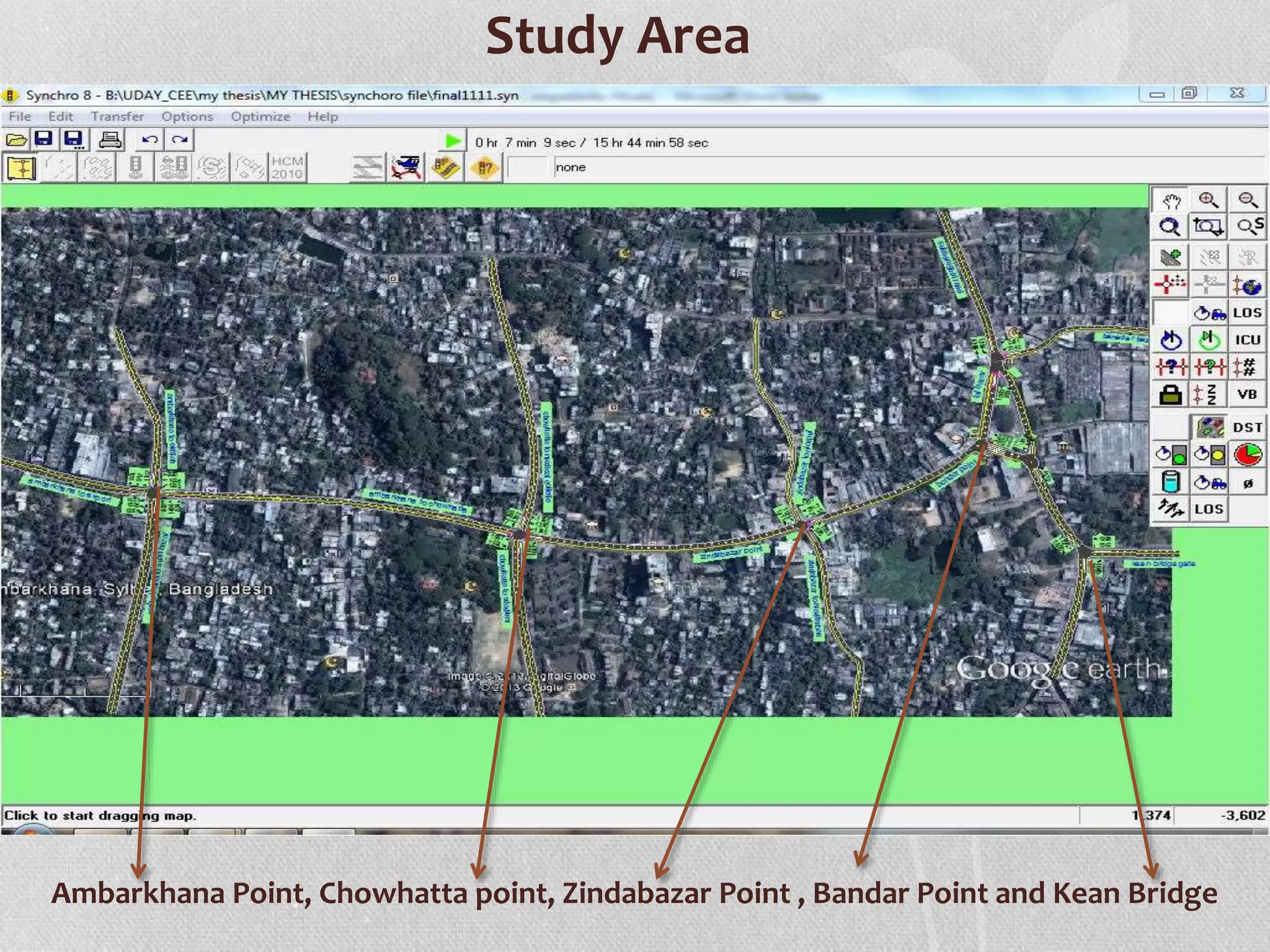
Study Area
Ambarkhana Point, Chowhatta point, Zindabazar Point , Bandar Point and Kean Bridge
Methodology
Data collection
Select intersection
Vehicle Road Pedestrian Traffic
Vehicle type
Speed
Vehicle direction
Link distance
Road width
Shoulder width
Pedestrian crossing
Pedestrian counting
Area population
Lane width
Intersection geometry
Walking speed
Vehicle volume
Peak hour
Travel time
Data analysis and input data input in Sylnchoro 8
Design the traffic signal
Phase design Intersection capacity LOS Simulation modelDelay vehicle 3D model
Data Analysis
0%
2%
4%
6%
8%
10%
12%
Percentageoftotalvehicle
Time
Percentage of vehicle vs. Time
Figure : Hourly Fluctuation of Vehicle in 12 hours
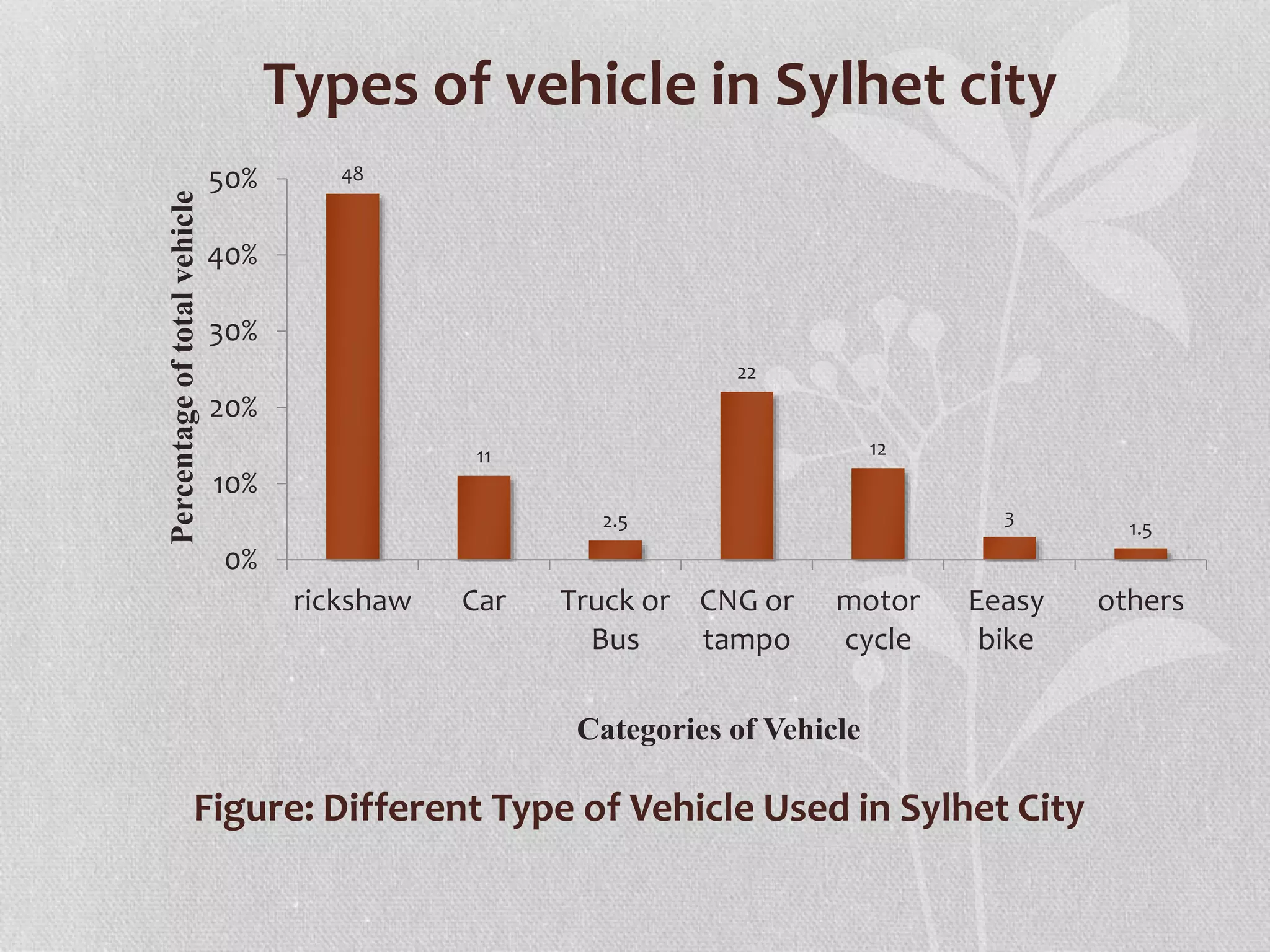
Types of vehicle in Sylhet city
48
11
2.5
22
12
3
1.5
0%
10%
20%
30%
40%
50%
rickshaw Car Truck or
Bus
CNG or
tampo
motor
cycle
Eeasy
bike
others
Percentageoftotalvehicle
Categories of Vehicle
Figure: Different Type of Vehicle Used in Sylhet City
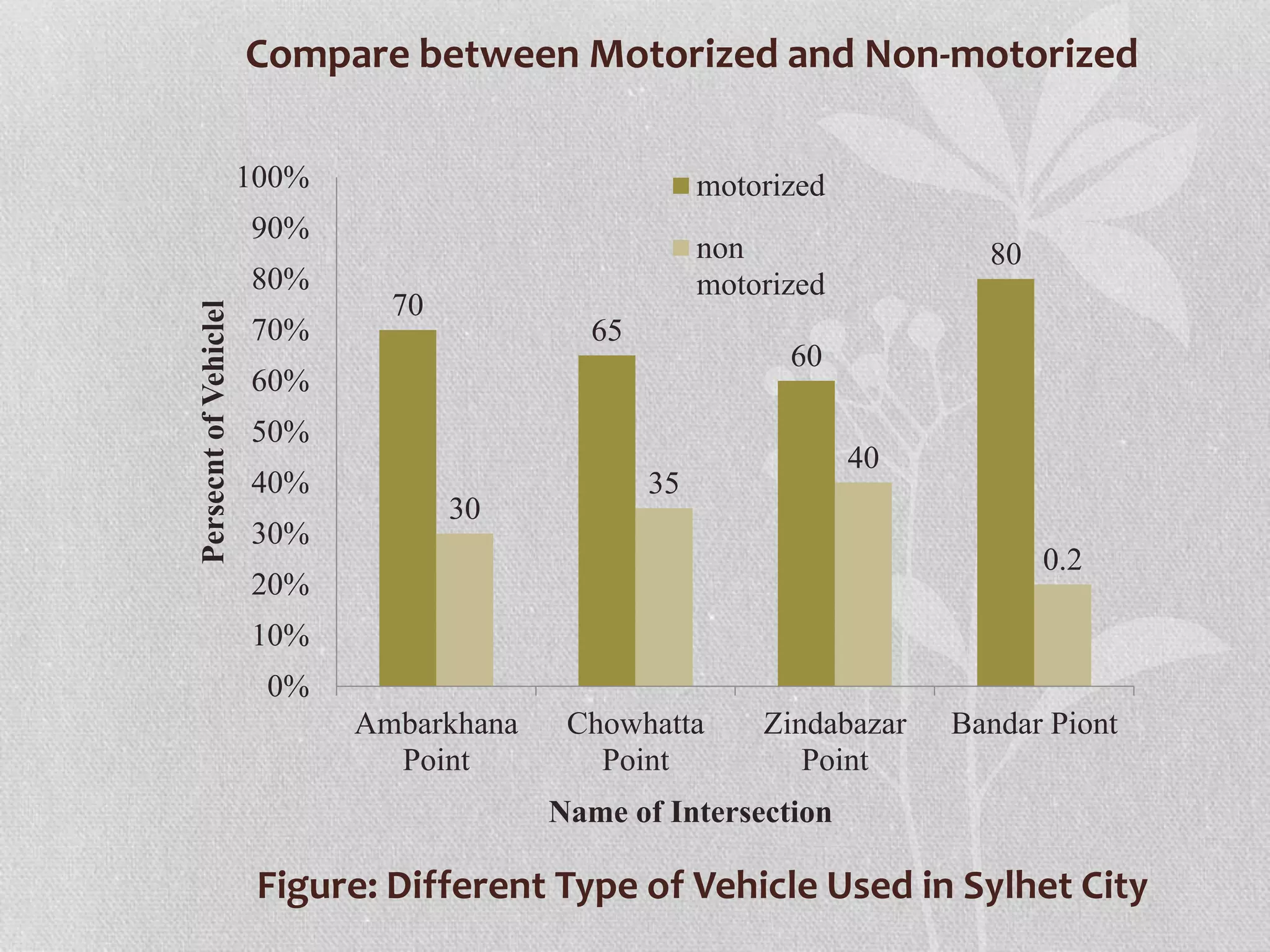
Compare between Motorized and Non-motorized
Figure: Different Type of Vehicle Used in Sylhet City
70
65
60
80
30
35
40
0.2
0%
10%
20%
30%
40%
50%
60%
70%
80%
90%
100%
Ambarkhana
Point
Chowhatta
Point
Zindabazar
Point
Bandar Piont
PersecntofVehiclel
Name of Intersection
motorized
non
motorized
RESULT
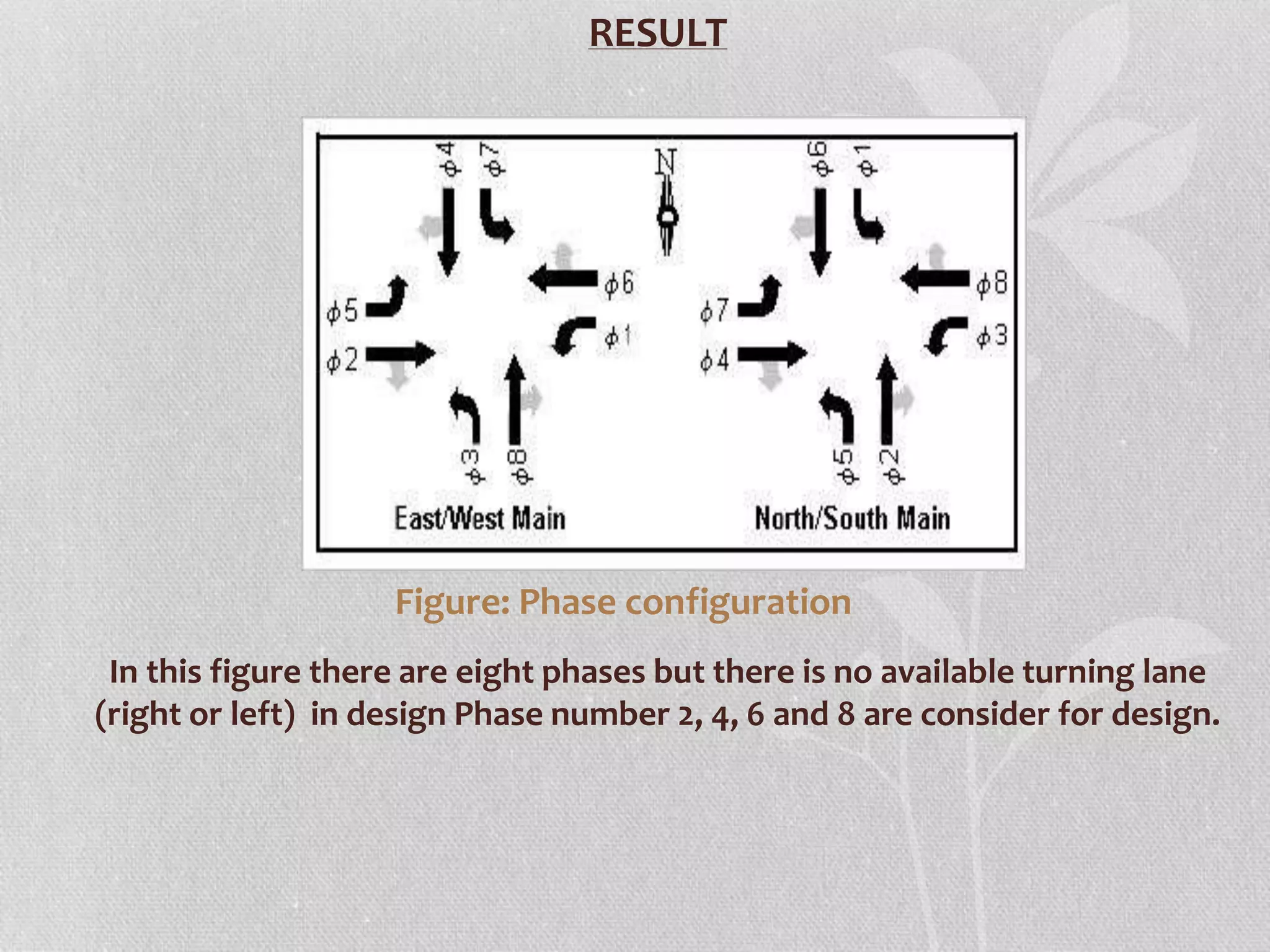
Figure: Phase configuration
In this figure there are eight phases but there is no available turning lane
(right or left) in design Phase number 2, 4, 6 and 8 are consider for design.
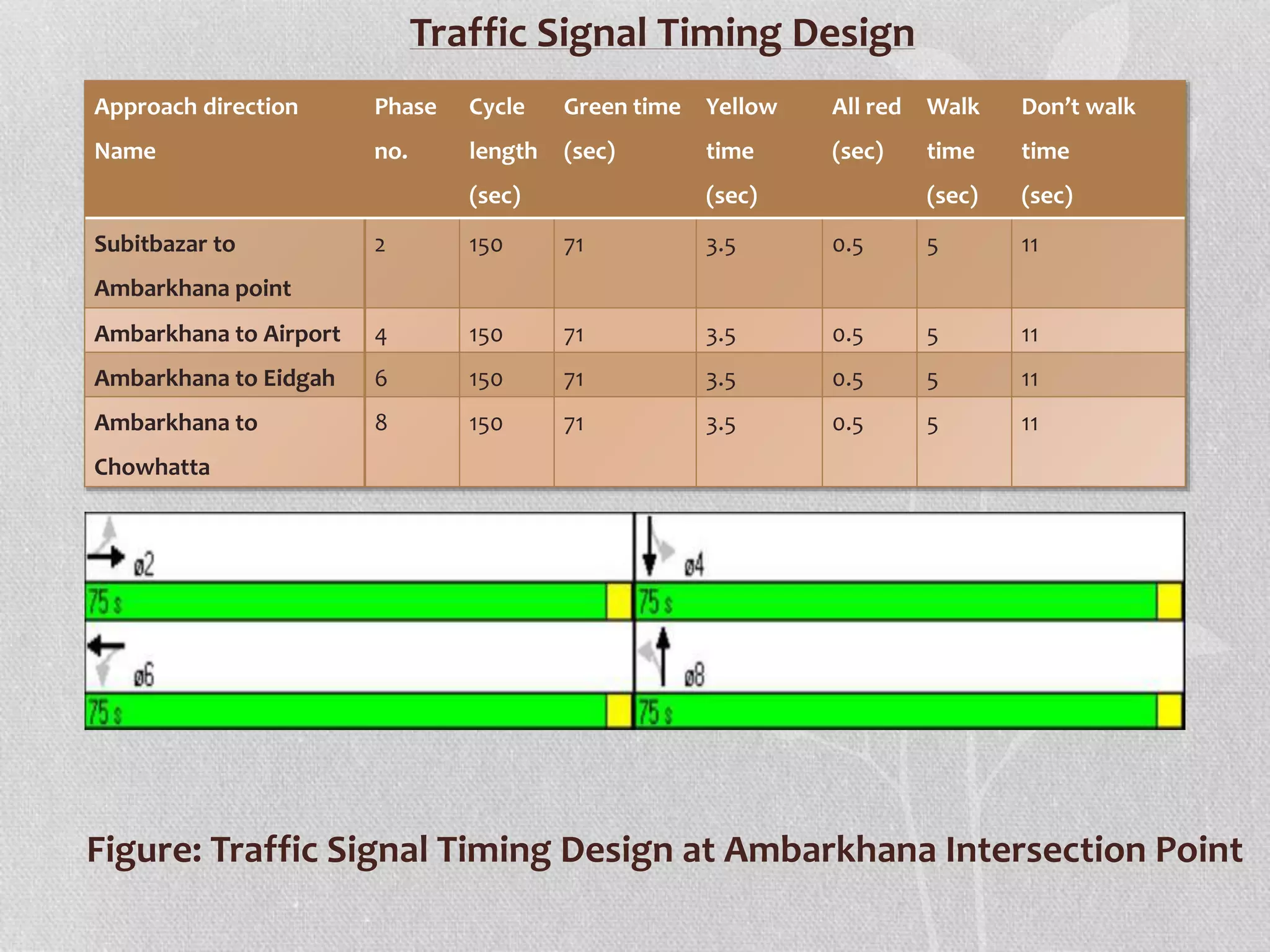
Traffic Signal Timing Design
Approach direction
Name
Phase
no.
Cycle
length
(sec)
Green time
(sec)
Yellow
time
(sec)
All red
(sec)
Walk
time
(sec)
Don’t walk
time
(sec)
Subitbazar to
Ambarkhana point
2 150 71 3.5 0.5 5 11
Ambarkhana to Airport 4 150 71 3.5 0.5 5 11
Ambarkhana to Eidgah 6 150 71 3.5 0.5 5 11
Ambarkhana to
Chowhatta
8 150 71 3.5 0.5 5 11
Figure: Traffic Signal Timing Design at Ambarkhana Intersection Point
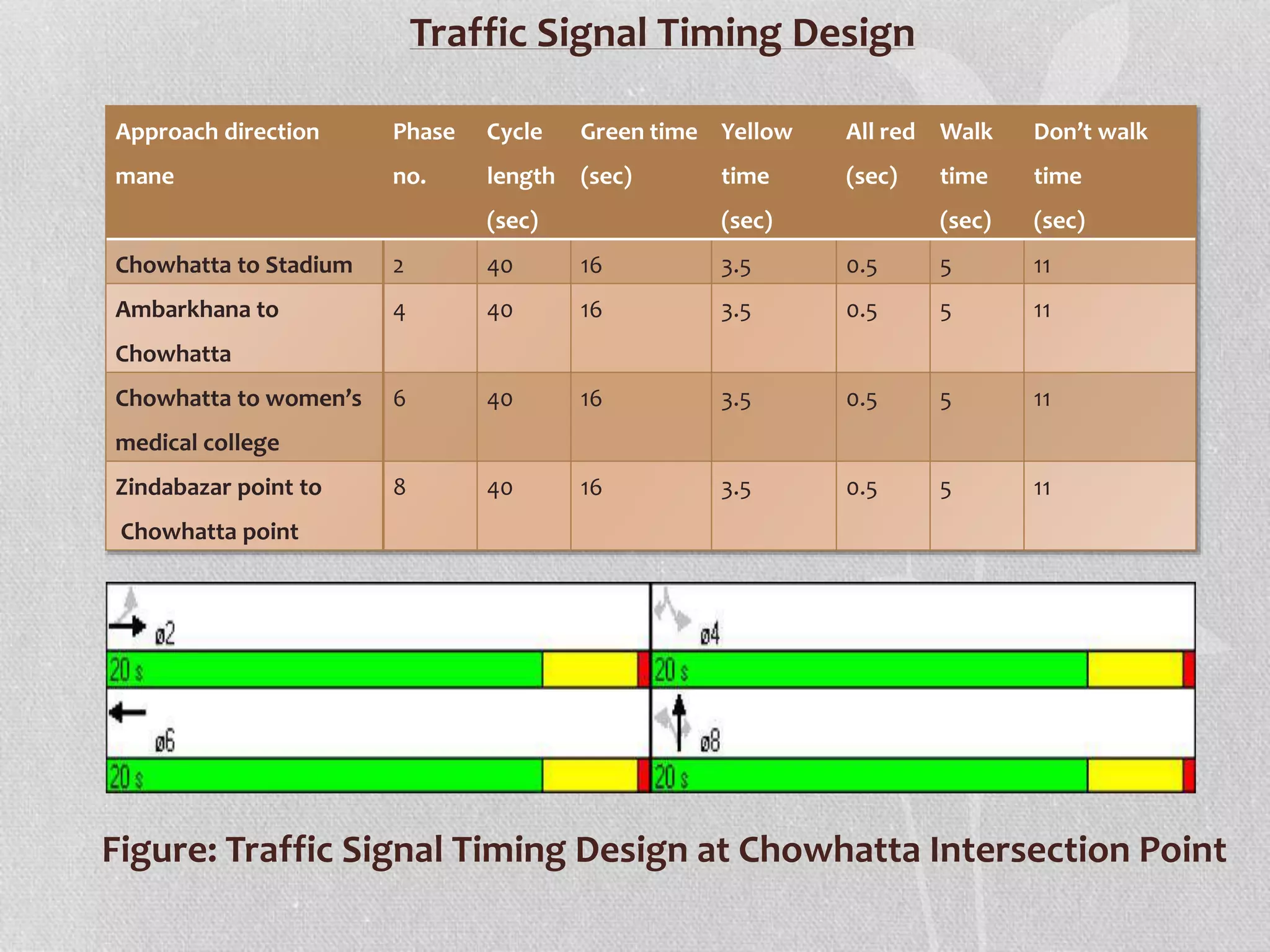
Traffic Signal Timing Design
Approach direction
mane
Phase
no.
Cycle
length
(sec)
Green time
(sec)
Yellow
time
(sec)
All red
(sec)
Walk
time
(sec)
Don’t walk
time
(sec)
Chowhatta to Stadium 2 40 16 3.5 0.5 5 11
Ambarkhana to
Chowhatta
4 40 16 3.5 0.5 5 11
Chowhatta to women’s
medical college
6 40 16 3.5 0.5 5 11
Zindabazar point to
Chowhatta point
8 40 16 3.5 0.5 5 11
Figure: Traffic Signal Timing Design at Chowhatta Intersection Point
Traffic Signal Timing Design
Figure: Signal phase diagram of Ambarkhana point and Chowhatta point
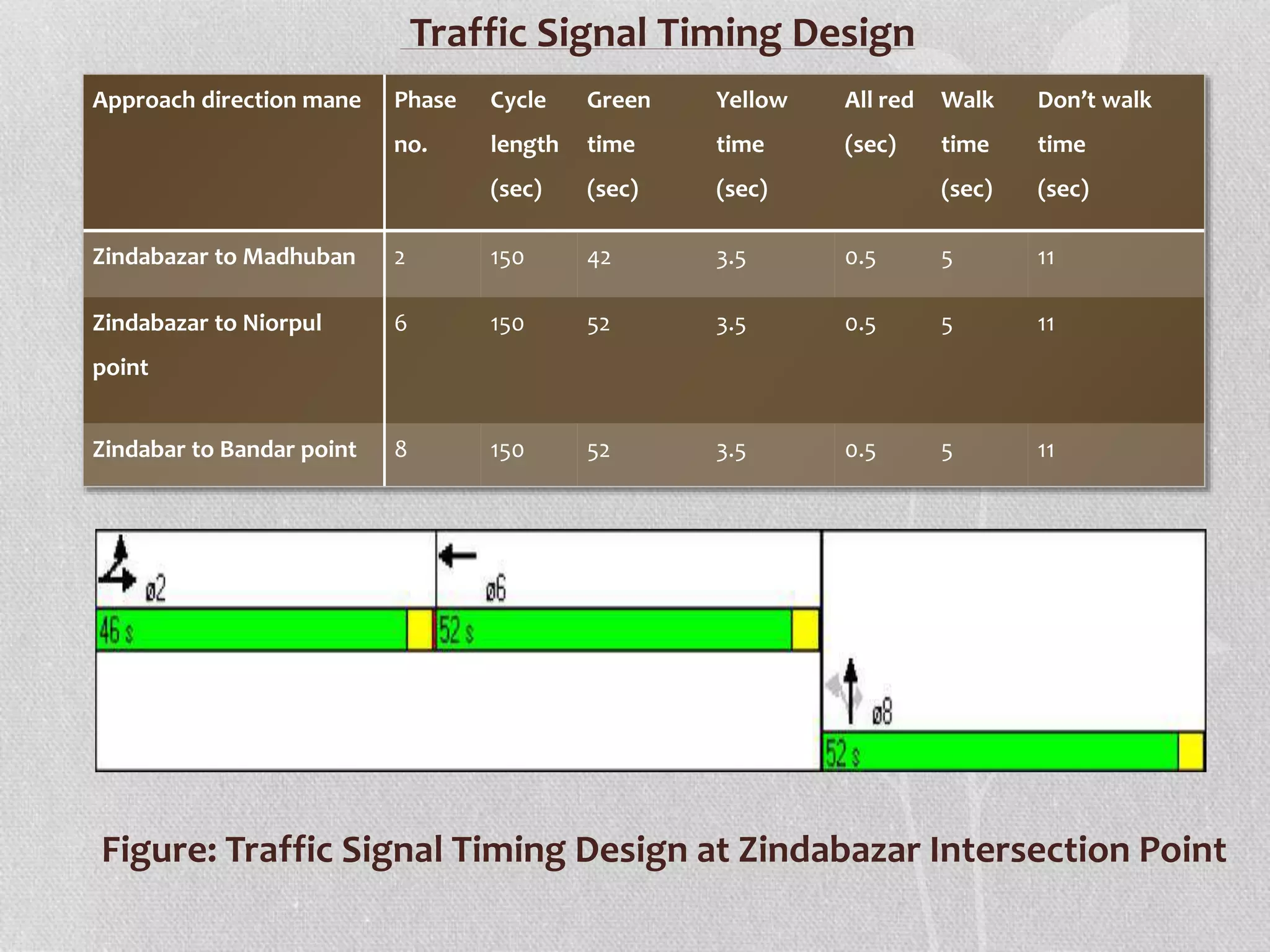
Traffic Signal Timing Design
Approach direction mane Phase
no.
Cycle
length
(sec)
Green
time
(sec)
Yellow
time
(sec)
All red
(sec)
Walk
time
(sec)
Don’t walk
time
(sec)
Zindabazar to Madhuban 2 150 42 3.5 0.5 5 11
Zindabazar to Niorpul
point
6 150 52 3.5 0.5 5 11
Zindabar to Bandar point 8 150 52 3.5 0.5 5 11
Figure: Traffic Signal Timing Design at Zindabazar Intersection Point
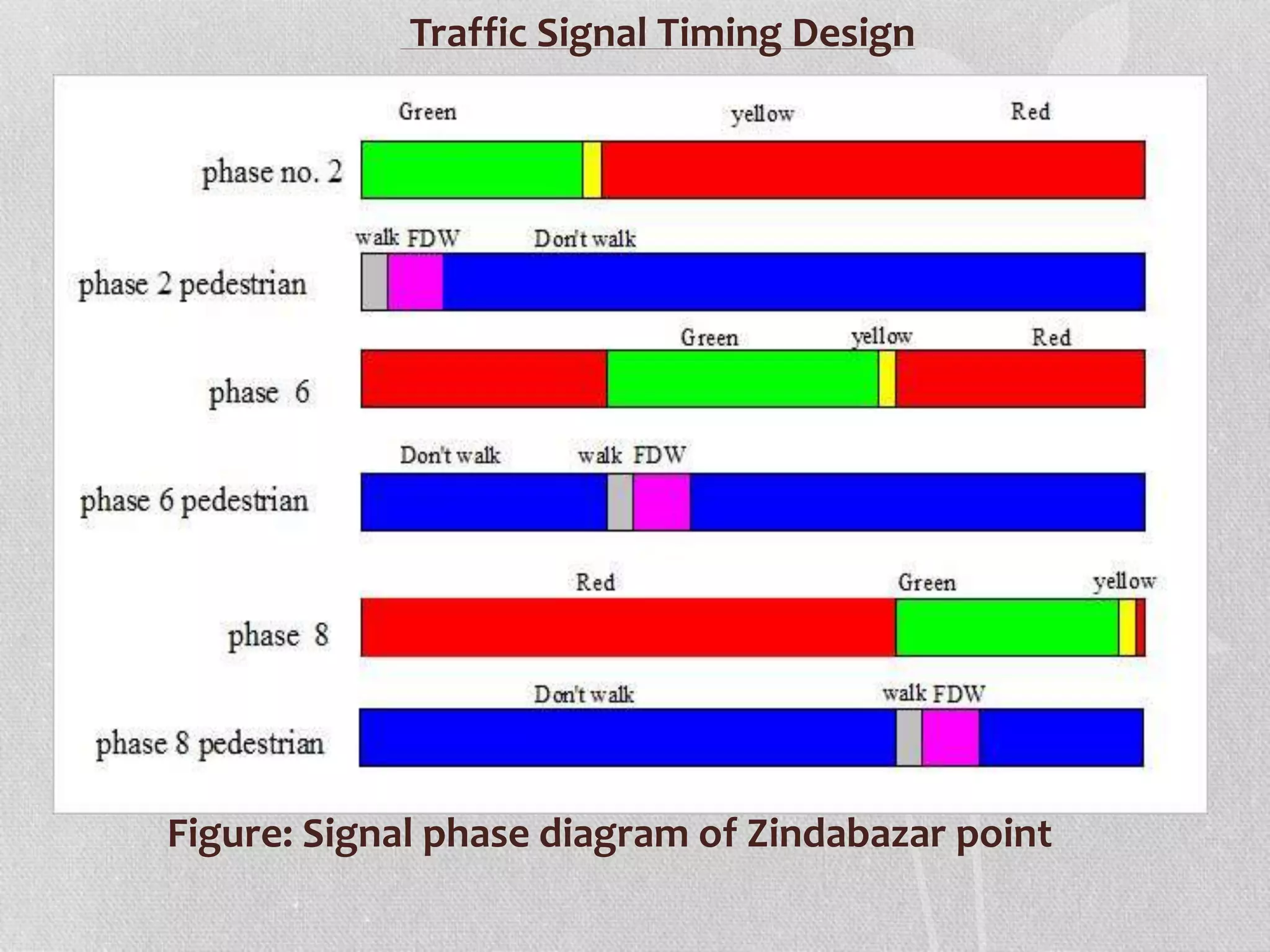
Traffic Signal Timing Design
Figure: Signal phase diagram of Zindabazar point
SOME LIMITATION
 Only 7 intersections are considered for designing the traffic signal.
 Only the major road networks are considered in software.
 The arterial road is not linked at major road.
 The vehicle goes at right-hand-side always because of the auto adjustment of
the software
 Traffic volume, approach direction volumes were manually counted. So, cent
per cent accuracy was not possible.
 All vehicles have constant speed.
 The grade (slope) of road is zero.
CONCLUSION
In this study, seven major intersections of Sylhet city under to
be taken for signal design. Cycle length of Ambarkhana ,
Chowhatta and Zindabazar is 150 sec. , 40 sec. and 150 sec.
respectively. Bandar intersection point and Kean Bridge are
accessed by the roundabout. Maximum and intersection
capacity Utilization at Ambarkhana , Chowhatta and
Zindabazar intersection point respectively.
DISCUSSION
In this study, seven major intersections of Sylhet city under to
be taken for signal design. Cycle length of Ambarkhana ,
Chowhatta and Zindabazar is 150 sec. , 40 sec. and 150 sec.
respectively. Bandar intersection point and Kean Bridge are
accessed by the roundabout. Maximum and intersection
capacity Utilization at Ambarkhana , Chowhatta and
Zindabazar intersection point respectively.
traffic singal design and model

traffic singal design and model

  • 1.
  • 2.
    TRAFFIC SIGNAL DESIGNAND SIMULATION OF EXISTING TRAFFIC AT MAJOR INTERSECTIONS IN SYLHET CITY USING SYNCHRO 8 Presented By Uday Kumar Yadav (2008333051) Tanvir Jobaer Kafi (2008333017)
  • 3.
    Supervised Member : Supervisor Md.Bashirul Haque Co-supervisor Dr. prof. Jahir Bin Alam Externals Prof. Dr. Md. Aktarul Islam Chowdhury Gulam Md. Munna
  • 4.
    Sylhet is amajor city in north-eastern Bangladesh. It’s an area of about 26.5 sq. kilometres. It is the main city of division About 0.8 million people live in this city. Average annual growth rate of this Sylhet city is about 6.7 present (2001-2011). Due to rapid urbanization, traffic problem is also increasing and the several accidents occur in Sylhet city. Traffic congestion is a major problem in cities of all sizes and increasing the accident, it need to improve traffic performance and the safety though out the city for better option for reducing the travel time and delay of traffic it need to install the traffic signal at the intersection in Sylhet city Introduction
  • 5.
     To evaluatethe benchmark of existing traffic in Sylhet city.  To improve traffic operations and safety throughout the Sylhet city.  To maximize, effectively, the traffic volume movement, increasing the intersection capacity, reducing the total delay and travel time.  To determine the Level of Service (LOS) of road network.  To evaluate the existing traffic and simulation model with the help of software, Synchro 8.  To introduce traffic signal for better performance of traffic in Sylhet city. Objectives
  • 6.
    Study Area Ambarkhana Point,Chowhatta point, Zindabazar Point , Bandar Point and Kean Bridge
  • 7.
    Methodology Data collection Select intersection VehicleRoad Pedestrian Traffic Vehicle type Speed Vehicle direction Link distance Road width Shoulder width Pedestrian crossing Pedestrian counting Area population Lane width Intersection geometry Walking speed Vehicle volume Peak hour Travel time Data analysis and input data input in Sylnchoro 8 Design the traffic signal Phase design Intersection capacity LOS Simulation modelDelay vehicle 3D model
  • 8.
    Data Analysis 0% 2% 4% 6% 8% 10% 12% Percentageoftotalvehicle Time Percentage ofvehicle vs. Time Figure : Hourly Fluctuation of Vehicle in 12 hours
  • 9.
    Types of vehiclein Sylhet city 48 11 2.5 22 12 3 1.5 0% 10% 20% 30% 40% 50% rickshaw Car Truck or Bus CNG or tampo motor cycle Eeasy bike others Percentageoftotalvehicle Categories of Vehicle Figure: Different Type of Vehicle Used in Sylhet City
  • 10.
    Compare between Motorizedand Non-motorized Figure: Different Type of Vehicle Used in Sylhet City 70 65 60 80 30 35 40 0.2 0% 10% 20% 30% 40% 50% 60% 70% 80% 90% 100% Ambarkhana Point Chowhatta Point Zindabazar Point Bandar Piont PersecntofVehiclel Name of Intersection motorized non motorized
  • 11.
    RESULT Figure: Phase configuration Inthis figure there are eight phases but there is no available turning lane (right or left) in design Phase number 2, 4, 6 and 8 are consider for design.
  • 12.
    Traffic Signal TimingDesign Approach direction Name Phase no. Cycle length (sec) Green time (sec) Yellow time (sec) All red (sec) Walk time (sec) Don’t walk time (sec) Subitbazar to Ambarkhana point 2 150 71 3.5 0.5 5 11 Ambarkhana to Airport 4 150 71 3.5 0.5 5 11 Ambarkhana to Eidgah 6 150 71 3.5 0.5 5 11 Ambarkhana to Chowhatta 8 150 71 3.5 0.5 5 11 Figure: Traffic Signal Timing Design at Ambarkhana Intersection Point
  • 13.
    Traffic Signal TimingDesign Approach direction mane Phase no. Cycle length (sec) Green time (sec) Yellow time (sec) All red (sec) Walk time (sec) Don’t walk time (sec) Chowhatta to Stadium 2 40 16 3.5 0.5 5 11 Ambarkhana to Chowhatta 4 40 16 3.5 0.5 5 11 Chowhatta to women’s medical college 6 40 16 3.5 0.5 5 11 Zindabazar point to Chowhatta point 8 40 16 3.5 0.5 5 11 Figure: Traffic Signal Timing Design at Chowhatta Intersection Point
  • 14.
    Traffic Signal TimingDesign Figure: Signal phase diagram of Ambarkhana point and Chowhatta point
  • 15.
    Traffic Signal TimingDesign Approach direction mane Phase no. Cycle length (sec) Green time (sec) Yellow time (sec) All red (sec) Walk time (sec) Don’t walk time (sec) Zindabazar to Madhuban 2 150 42 3.5 0.5 5 11 Zindabazar to Niorpul point 6 150 52 3.5 0.5 5 11 Zindabar to Bandar point 8 150 52 3.5 0.5 5 11 Figure: Traffic Signal Timing Design at Zindabazar Intersection Point
  • 16.
    Traffic Signal TimingDesign Figure: Signal phase diagram of Zindabazar point
  • 17.
    SOME LIMITATION  Only7 intersections are considered for designing the traffic signal.  Only the major road networks are considered in software.  The arterial road is not linked at major road.  The vehicle goes at right-hand-side always because of the auto adjustment of the software  Traffic volume, approach direction volumes were manually counted. So, cent per cent accuracy was not possible.  All vehicles have constant speed.  The grade (slope) of road is zero.
  • 18.
    CONCLUSION In this study,seven major intersections of Sylhet city under to be taken for signal design. Cycle length of Ambarkhana , Chowhatta and Zindabazar is 150 sec. , 40 sec. and 150 sec. respectively. Bandar intersection point and Kean Bridge are accessed by the roundabout. Maximum and intersection capacity Utilization at Ambarkhana , Chowhatta and Zindabazar intersection point respectively.
  • 19.
    DISCUSSION In this study,seven major intersections of Sylhet city under to be taken for signal design. Cycle length of Ambarkhana , Chowhatta and Zindabazar is 150 sec. , 40 sec. and 150 sec. respectively. Bandar intersection point and Kean Bridge are accessed by the roundabout. Maximum and intersection capacity Utilization at Ambarkhana , Chowhatta and Zindabazar intersection point respectively.