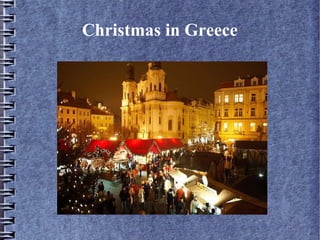
Christmas in Greece
Christmas Trees are popular in
Greece. But an older and more
traditional decoration is a shallow
wooden bowl with a piece of wire
is suspended across the rim. A
sprig of basil wrapped around a
wooden cross hangs from the wire.
Some water is kept in the bowl to
keep the basil alive and fresh.
Once a day someone, usually the
mother of the family, dips the cross
and basil into some holy water and
uses it to sprinkle water in each
room of the house. Most homes
decorate a christmas tree with
tinsel and a star.
Fishing boats are
decorated with christmas
lights during the holiday
season.
Christmas Traditions in Greece
The custom is that children go
from house to house singing the
carol, with the accompaniment
of a triangle, and residents of
the houses give them a small
amount of money. Greek
Christmas carols (calanda) are
sung on the mornings of
Christmas Eve, New Year's Eve
and January 5, the Eve of the
Epiphany.
https://www.youtube.com/watch?v=D5DbU6xsYSg
https://www.youtube.com/watch?v=OLsEDiAQt9g
According to tradition, during the
Greek 12 days of Christmas
(December 25 to January 6),
goblins come out to tease people
and eat their food. This tradition is
based on the legend that the
"waters aren't christened" since
Christ has not yet been baptized.
The goblins are renowned for their
ugliness and their impishness.
They are not very intelligent and
can't really hurt anybody. It is said
that they enter houses through
chimneys, and this is the reason
people, especially in villages, keep
the fireplace lit during the 12 days
of Christmas.
For the Greeks, Father
Christmas is St. Basil of
Caesarea or Agios Vasilios and
not the western Santa from
the North Pole. In both cases
though the figures are the
same: with red clothes and a
long white beard and carrying
presents for the children
On New Year's Eve the home entertainments concentrates
mainly on card games. The reason probably for this is the so
called Guri (Luck). Which means that if you win that night the
new year will bring you luck.
Presents are
exchanged on
January 1st, St.
Basil Day.
At 12 O'clock the lights will be
switched off for a few seconds
and every one will go out to
light fireworks. If it happens
that the town or the village
has a port the sounds from the
ships are amazing, especially
in the Port of Piraeus where
all the ships and ferries hoot
In many parts of Greece, people
hang a pomegranate above the
front door of their house. By the
New Year, when the fruit will
have dried, Greeks throw it on
the ground so it breaks, and
step into their house on their
right foot. According to tradition,
this brings good luck for the year
to come.
People in Greece also celebrate
Epiphany on the 6th January. In the
Greek Orthodox Church, Epiphany
celebrates Jesus's baptism when he
was a man. It's also known as 'The
Blessing of the Waters'. There are
many events throughout the country
where young men dive into really cold
lakes, rivers and the sea to try to be
first to get a cross which has been
blessed by a priest and thrown into
the water. Whoever gets the cross first
is meant to have good luck during the
coming year. Epiphany festivals also
include blessings of boats & ships,
music, dancing and lots of food.
Traditionally, as the New Year
arrives the head of the house,
usually the man, will step out of
the door and smash a
pomegranate for good luck and
afterwards he will cut the
"Vasilopita", the Greek New
Year's cake.
In the Vasilopita cake from
tradition the Greeks put a coin
inside. Depending on your wealth
it can be a gold sovereign or a
simple coin. The one that finds it
in his piece will be the new Year's
lucky one.
Christmas Food in Greece
Christmas, like many other
holidays in Greece, is a time
for feasting. In the past years,
Christmas turkey has become
very popular as the main dish
of the holiday. Traditionally,
the main course of Christmas
dinner in Greece is roast pork,
with a variety of side
delicacies. No matter what the
main dish is, one thing is
certain: Christmas food in
Greece is delicious!
Melomakarona and kourabiedes are the two varieties of Christmas and
New Year's cookies in Greece. The first are semolina, cinnamon, and clove
cookies drenched in honey, while the second are rosewater and fresh
butter cookies sprinkled with powdered sugar that are normally served on
New Year's but many succumb to temptation and begin consuming them
earlier.
A traditional table decoration
are loaves of 'Christopsomo'
(Christ's Bread or Christmas
bread). It's a round sweet
bread which is flavored with
cinnamon, orange and cloves.
The top is decorated with a
cross. The bread is made on
Christmas Eve ready to be
eaten on Christmas Day.
In Greek Happy/Merry
Christmas is 'Kala
Christougenna
The Christmas season ends on
6 of January with the
celebration of Epiphany and
the blessing of the waters.
Traditionally during this day
(Fota) the Christmas goblins
"Kalikantzaroi" ,after having
annoyed the mortals for 12
days, go back to the centre of
the Earth

Xmas in Greece

  • 1.
  • 2.
    Christmas Trees arepopular in Greece. But an older and more traditional decoration is a shallow wooden bowl with a piece of wire is suspended across the rim. A sprig of basil wrapped around a wooden cross hangs from the wire. Some water is kept in the bowl to keep the basil alive and fresh. Once a day someone, usually the mother of the family, dips the cross and basil into some holy water and uses it to sprinkle water in each room of the house. Most homes decorate a christmas tree with tinsel and a star.
  • 3.
    Fishing boats are decoratedwith christmas lights during the holiday season.
  • 4.
    Christmas Traditions inGreece The custom is that children go from house to house singing the carol, with the accompaniment of a triangle, and residents of the houses give them a small amount of money. Greek Christmas carols (calanda) are sung on the mornings of Christmas Eve, New Year's Eve and January 5, the Eve of the Epiphany.
  • 5.
  • 6.
    According to tradition,during the Greek 12 days of Christmas (December 25 to January 6), goblins come out to tease people and eat their food. This tradition is based on the legend that the "waters aren't christened" since Christ has not yet been baptized. The goblins are renowned for their ugliness and their impishness. They are not very intelligent and can't really hurt anybody. It is said that they enter houses through chimneys, and this is the reason people, especially in villages, keep the fireplace lit during the 12 days of Christmas.
  • 7.
    For the Greeks,Father Christmas is St. Basil of Caesarea or Agios Vasilios and not the western Santa from the North Pole. In both cases though the figures are the same: with red clothes and a long white beard and carrying presents for the children
  • 8.
    On New Year'sEve the home entertainments concentrates mainly on card games. The reason probably for this is the so called Guri (Luck). Which means that if you win that night the new year will bring you luck.
  • 9.
  • 10.
    At 12 O'clockthe lights will be switched off for a few seconds and every one will go out to light fireworks. If it happens that the town or the village has a port the sounds from the ships are amazing, especially in the Port of Piraeus where all the ships and ferries hoot
  • 11.
    In many partsof Greece, people hang a pomegranate above the front door of their house. By the New Year, when the fruit will have dried, Greeks throw it on the ground so it breaks, and step into their house on their right foot. According to tradition, this brings good luck for the year to come.
  • 12.
    People in Greecealso celebrate Epiphany on the 6th January. In the Greek Orthodox Church, Epiphany celebrates Jesus's baptism when he was a man. It's also known as 'The Blessing of the Waters'. There are many events throughout the country where young men dive into really cold lakes, rivers and the sea to try to be first to get a cross which has been blessed by a priest and thrown into the water. Whoever gets the cross first is meant to have good luck during the coming year. Epiphany festivals also include blessings of boats & ships, music, dancing and lots of food.
  • 13.
    Traditionally, as theNew Year arrives the head of the house, usually the man, will step out of the door and smash a pomegranate for good luck and afterwards he will cut the "Vasilopita", the Greek New Year's cake. In the Vasilopita cake from tradition the Greeks put a coin inside. Depending on your wealth it can be a gold sovereign or a simple coin. The one that finds it in his piece will be the new Year's lucky one.
  • 14.
    Christmas Food inGreece Christmas, like many other holidays in Greece, is a time for feasting. In the past years, Christmas turkey has become very popular as the main dish of the holiday. Traditionally, the main course of Christmas dinner in Greece is roast pork, with a variety of side delicacies. No matter what the main dish is, one thing is certain: Christmas food in Greece is delicious!
  • 15.
    Melomakarona and kourabiedesare the two varieties of Christmas and New Year's cookies in Greece. The first are semolina, cinnamon, and clove cookies drenched in honey, while the second are rosewater and fresh butter cookies sprinkled with powdered sugar that are normally served on New Year's but many succumb to temptation and begin consuming them earlier.
  • 16.
    A traditional tabledecoration are loaves of 'Christopsomo' (Christ's Bread or Christmas bread). It's a round sweet bread which is flavored with cinnamon, orange and cloves. The top is decorated with a cross. The bread is made on Christmas Eve ready to be eaten on Christmas Day.
  • 17.
    In Greek Happy/Merry Christmasis 'Kala Christougenna
  • 18.
    The Christmas seasonends on 6 of January with the celebration of Epiphany and the blessing of the waters. Traditionally during this day (Fota) the Christmas goblins "Kalikantzaroi" ,after having annoyed the mortals for 12 days, go back to the centre of the Earth