CYRPUS
EASTER TRADITIONS
Easter
• Easter is a movable celebration and it’s the
  greatest holiday of the Orthodox Church.
• It is always celebrated on the first Sunday
  following the full moon of the spring equinox.
• Holy Week is dedicated to church-going and
  to baking.
Easter Fasting is for 50 days and in Cyprus is
called “Sarakosti”. Christians must not eat
meat, dairy products and oil.
Palm Sunday
•              On this Sunday people take palm

                 leaves and olive leaves to the
    church and follow the icon of Christ around the
    church in a procession commemorating Christ's
    entry into Jerusalem.
    Olive leaves are put into
     pillow-case-like sacks and
     are kept in the church for
     forty days after which
     they can be used for incense burning.
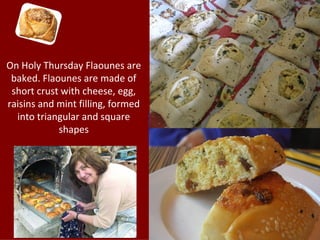
On Holy Thursday Flaounes are
 baked. Flaounes are made of
 short crust with cheese, egg,
raisins and mint filling, formed
  into triangular and square
            shapes
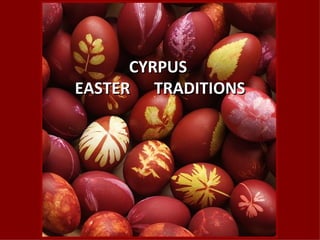
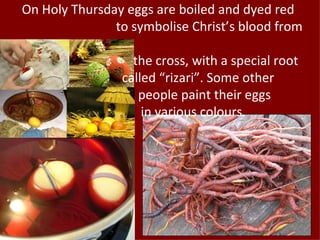
On Holy Thursday eggs are boiled and dyed red
               to symbolise Christ’s blood from

                  the cross, with a special root
                called “rizari”. Some other
                   people paint their eggs
                    in various colours.
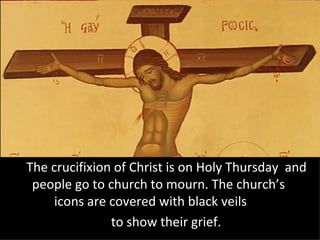
The crucifixion of Christ is on Holy Thursday and
 people go to church to mourn. The church’s
     icons are covered with black veils
               to show their grief.
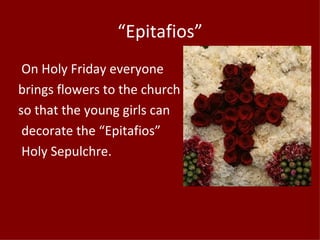
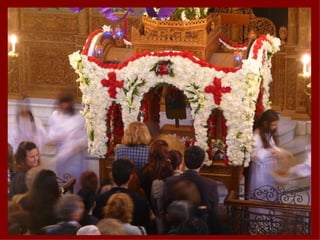
“Epitafios”
 On Holy Friday everyone
brings flowers to the church
so that the young girls can
 decorate the “Epitafios”
 Holy Sepulchre.
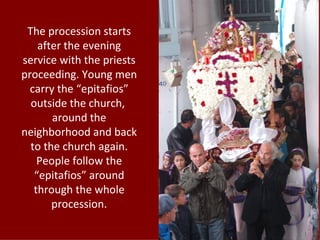
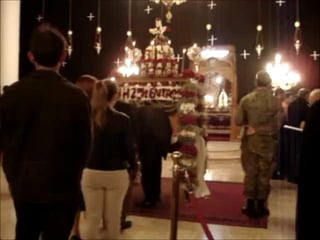
The procession starts
    after the evening
service with the priests
proceeding. Young men
  carry the “epitafios”
  outside the church,
       around the
neighborhood and back
  to the church again.
    People follow the
   “epitafios” around
   through the whole
       procession.
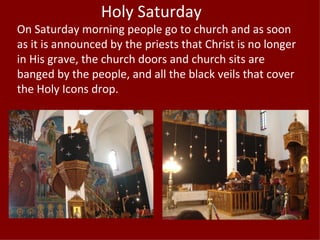
Holy Saturday
On Saturday morning people go to church and as soon
as it is announced by the priests that Christ is no longer
in His grave, the church doors and church sits are
banged by the people, and all the black veils that cover
the Holy Icons drop.
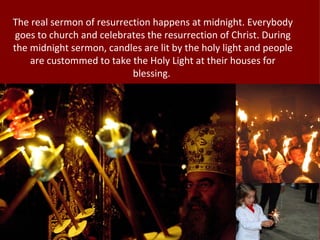
The real sermon of resurrection happens at midnight. Everybody
 goes to church and celebrates the resurrection of Christ. During
the midnight sermon, candles are lit by the holy light and people
    are custommed to take the Holy Light at their houses for
                           blessing.
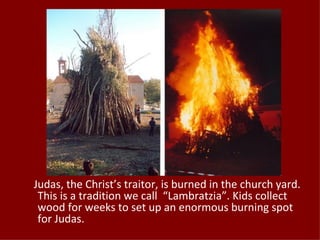
Judas, the Christ’s traitor, is burned in the church yard.
 This is a tradition we call “Lambratzia”. Kids collect
 wood for weeks to set up an enormous burning spot
 for Judas.
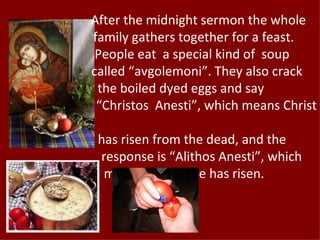
After the midnight sermon the whole
family gathers together for a feast.
 People eat a special kind of soup
called “avgolemoni”. They also crack
 the boiled dyed eggs and say
 “Christos Anesti”, which means Christ

 has risen from the dead, and the
 response is “Alithos Anesti”, which
  means indeed he has risen.
Holy Sunday
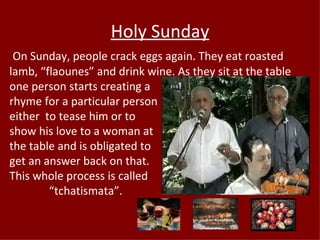
 On Sunday, people crack eggs again. They eat roasted
lamb, “flaounes” and drink wine. As they sit at the table
one person starts creating a
rhyme for a particular person
either to tease him or to
show his love to a woman at
the table and is obligated to
get an answer back on that.
This whole process is called
        “tchatismata”.
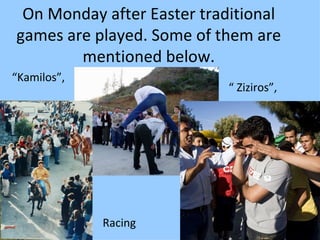
On Monday after Easter traditional
games are played. Some of them are
        mentioned below.
“Kamilos”,
                            “ Ziziros”,


         .


             Racing
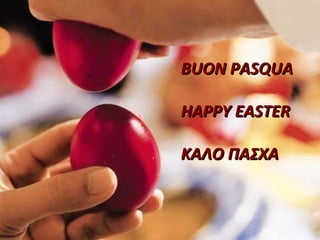
BUON PASQUA

HAPPY EASTER

ΚΑΛΟ ΠΑΣΧΑ

Easter traditions in Cyprus

  • 1.
  • 2.
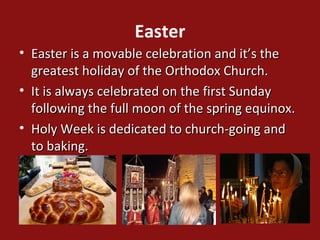
    Easter • Easter isa movable celebration and it’s the greatest holiday of the Orthodox Church. • It is always celebrated on the first Sunday following the full moon of the spring equinox. • Holy Week is dedicated to church-going and to baking.
  • 3.
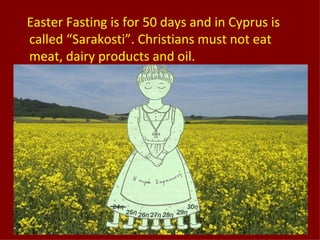
    Easter Fasting isfor 50 days and in Cyprus is called “Sarakosti”. Christians must not eat meat, dairy products and oil.
  • 4.
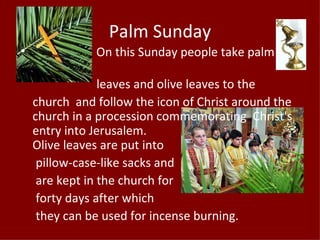
    Palm Sunday • On this Sunday people take palm leaves and olive leaves to the church and follow the icon of Christ around the church in a procession commemorating Christ's entry into Jerusalem. Olive leaves are put into pillow-case-like sacks and are kept in the church for forty days after which they can be used for incense burning.
  • 5.
    On Holy ThursdayFlaounes are baked. Flaounes are made of short crust with cheese, egg, raisins and mint filling, formed into triangular and square shapes
  • 6.
    On Holy Thursdayeggs are boiled and dyed red to symbolise Christ’s blood from the cross, with a special root called “rizari”. Some other people paint their eggs in various colours.
  • 7.
    The crucifixion ofChrist is on Holy Thursday and people go to church to mourn. The church’s icons are covered with black veils to show their grief.
  • 8.
    “Epitafios” On HolyFriday everyone brings flowers to the church so that the young girls can decorate the “Epitafios” Holy Sepulchre.
  • 10.
    The procession starts after the evening service with the priests proceeding. Young men carry the “epitafios” outside the church, around the neighborhood and back to the church again. People follow the “epitafios” around through the whole procession.
  • 12.
    Holy Saturday On Saturdaymorning people go to church and as soon as it is announced by the priests that Christ is no longer in His grave, the church doors and church sits are banged by the people, and all the black veils that cover the Holy Icons drop.
  • 13.
    The real sermonof resurrection happens at midnight. Everybody goes to church and celebrates the resurrection of Christ. During the midnight sermon, candles are lit by the holy light and people are custommed to take the Holy Light at their houses for blessing.
  • 14.
    Judas, the Christ’straitor, is burned in the church yard. This is a tradition we call “Lambratzia”. Kids collect wood for weeks to set up an enormous burning spot for Judas.
  • 16.
    After the midnightsermon the whole family gathers together for a feast. People eat a special kind of soup called “avgolemoni”. They also crack the boiled dyed eggs and say “Christos Anesti”, which means Christ has risen from the dead, and the response is “Alithos Anesti”, which means indeed he has risen.
  • 17.
    Holy Sunday OnSunday, people crack eggs again. They eat roasted lamb, “flaounes” and drink wine. As they sit at the table one person starts creating a rhyme for a particular person either to tease him or to show his love to a woman at the table and is obligated to get an answer back on that. This whole process is called “tchatismata”.
  • 18.
    On Monday afterEaster traditional games are played. Some of them are mentioned below. “Kamilos”, “ Ziziros”, . Racing
  • 19.