EASTER CUSTOMS IN
GREACE
37TH KINDERGARTEN OF THESSALONIKI
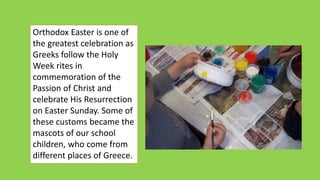
Orthodox Easter is one of
the greatest celebration as
Greeks follow the Holy
Week rites in
commemoration of the
Passion of Christ and
celebrate His Resurrection
on Easter Sunday. Some of
these customs became the
mascots of our school
children, who come from
different places of Greece.
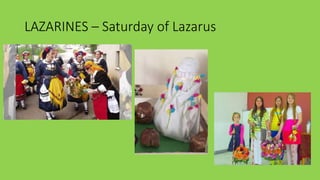
LAZARINES – Saturday of Lazarus
The last Saturday before
Holy Week begins, is the
Saturday of Lazarus. In
the past women hold
baskets in their hands,
decorated with flowers,
dance and sing songs
about the resurrection
of Lazarus by Jesus,
walking from home to
home. In later years,
only girls sing songs and
people usually give
them eggs for their
baskets.
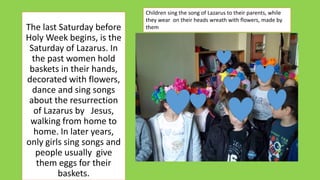
Children sing the song of Lazarus to their parents, while
they wear on their heads wreath with flowers, made by
them
In past, farmers did not work
on that day, because they
believed that whatever they
would cultivate would die.
They only collected the
woods in order to bake the
Easter cookies (koulourakia).
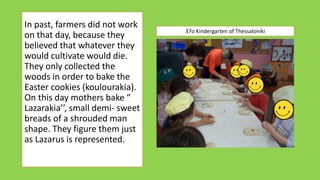
On this day mothers bake “
Lazarakia’’, small demi- sweet
breads of a shrouded man
shape. They figure them just
as Lazarus is represented.
37o Kindergarten of Thessaloniki
Lazarakia Recipe
Ingredients
1 k. flour
1 package active
dry yeast
1 cup warm milk
2 cups warm water
150 gr. sugar
1 tbs cinnamon
1/2 tsp anise
1 tsp salt
3 tbs olive oil
whole nuts
Cloves for
decoration
The night before baking, mix the yeast with some warm water
and 1 ½ cup of flour. Stir well, and set aside, covered, in a warm
place.
The next morning, in a bowl sift the remaining flour. Make a
well in the center and pour in the all the ingredients.
Knead well till the dough becomes elastic and shiny. Cover it
and let it rise for 2 hours. When the dough is doubled in size,
divide it in seven pieces. One of them must be larger than the
others. Roll the six smaller pieces into cords.
Stick a nut in one end of each cord. Cut the larger piece of
dough in 12 ropes. Stick the ends of 2 ropes near each nut and
braid forming an ancient shroud.
Place the breads on a oiled baking pan and cover them. Let
them rise for 2 hours.
Brush the Lazarakia with olive oil and bake them in preheated
Palm Sunday
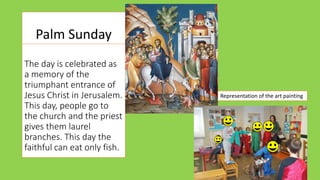
The day is celebrated as
a memory of the
triumphant entrance of
Jesus Christ in Jerusalem.
This day, people go to
the church and the priest
gives them laurel
branches. This day the
faithful can eat only fish.
Representation of the art painting
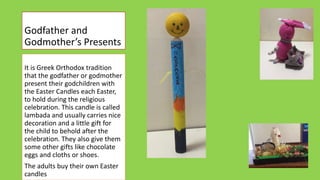
Godfather and
Godmother’s Presents
It is Greek Orthodox tradition
that the godfather or godmother
present their godchildren with
the Easter Candles each Easter,
to hold during the religious
celebration. This candle is called
lambada and usually carries nice
decoration and a little gift for
the child to behold after the
celebration. They also give them
some other gifts like chocolate
eggs and cloths or shoes.
The adults buy their own Easter
candles
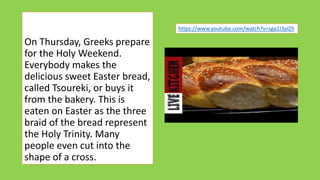
On Thursday, Greeks prepare
for the Holy Weekend.
Everybody makes the
delicious sweet Easter bread,
called Tsoureki, or buys it
from the bakery. This is
eaten on Easter as the three
braid of the bread represent
the Holy Trinity. Many
people even cut into the
shape of a cross.
https://www.youtube.com/watch?v=sga1I3plZlI
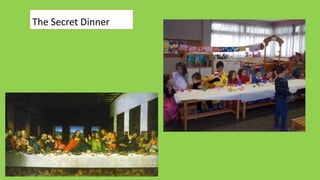
The Secret Dinner
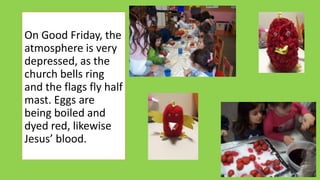
On Good Friday, the
atmosphere is very
depressed, as the
church bells ring
and the flags fly half
mast. Eggs are
being boiled and
dyed red, likewise
Jesus’ blood.
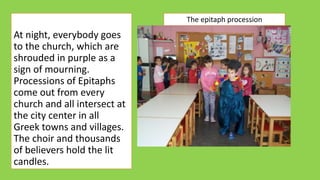
At night, everybody goes
to the church, which are
shrouded in purple as a
sign of mourning.
Processions of Epitaphs
come out from every
church and all intersect at
the city center in all
Greek towns and villages.
The choir and thousands
of believers hold the lit
candles.
The epitaph procession
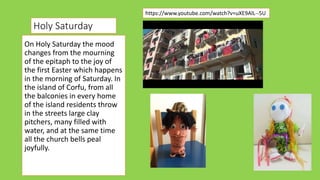
On Holy Saturday the mood
changes from the mourning
of the epitaph to the joy of
the first Easter which happens
in the morning of Saturday. In
the island of Corfu, from all
the balconies in every home
of the island residents throw
in the streets large clay
pitchers, many filled with
water, and at the same time
all the church bells peal
joyfully.
https://www.youtube.com/watch?v=uXE9AlL--5U
Holy Saturday
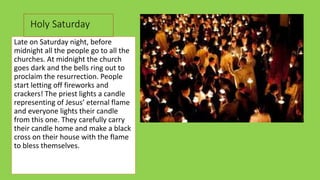
Late on Saturday night, before
midnight all the people go to all the
churches. Αt midnight the church
goes dark and the bells ring out to
proclaim the resurrection. People
start letting off fireworks and
crackers! The priest lights a candle
representing of Jesus’ eternal flame
and everyone lights their candle
from this one. They carefully carry
their candle home and make a black
cross on their house with the flame
to bless themselves.
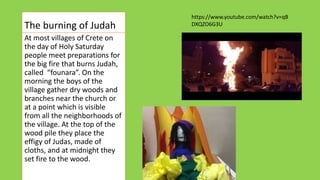
Τhe burning of Judah
At most villages of Crete on
the day of Holy Saturday
people meet preparations for
the big fire that burns Judah,
called “founara”. On the
morning the boys of the
village gather dry woods and
branches near the church or
at a point which is visible
from all the neighborhoods of
the village. At the top of the
wood pile they place the
effigy of Judas, made of
cloths, and at midnight they
set fire to the wood.
https://www.youtube.com/watch?v=qB
DXQZO6G3U
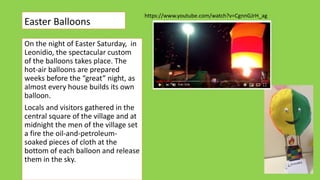
Easter Balloons
On the night of Easter Saturday, in
Leonidio, the spectacular custom
of the balloons takes place. The
hot-air balloons are prepared
weeks before the “great” night, as
almost every house builds its own
balloon.
Locals and visitors gathered in the
central square of the village and at
midnight the men of the village set
a fire the oil-and-petroleum-
soaked pieces of cloth at the
bottom of each balloon and release
them in the sky.
https://www.youtube.com/watch?v=CgnnGJrH_ag
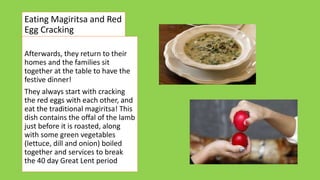
Eating Magiritsa and Red
Egg Cracking
Afterwards, they return to their
homes and the families sit
together at the table to have the
festive dinner!
They always start with cracking
the red eggs with each other, and
eat the traditional magiritsa! This
dish contains the offal of the lamb
just before it is roasted, along
with some green vegetables
(lettuce, dill and onion) boiled
together and services to break
the 40 day Great Lent period
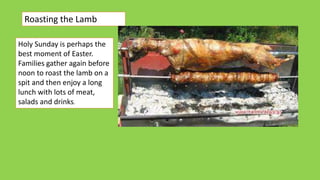
Roasting the Lamb
Holy Sunday is perhaps the
best moment of Easter.
Families gather again before
noon to roast the lamb on a
spit and then enjoy a long
lunch with lots of meat,
salads and drinks.
Βibliography - Networking
• https://1historyofgreekfood.wordpress.com/2007/04/02/9/
• https://www.christianbiblereference.org/story_PalmSunday.htm
• https://www.bluevillascollection.com/blog/taste-the-blue/greek-
life/item/539-greek-easter-traditions
• https://atcorfu.com/pasxa-stin-kerkyra/
• https://www.cretanbeaches.com/en/religious-customs/burning-of-
judah-in-easter
• https://greece.greekreporter.com/2016/05/01/easter-with-hot-air-
balloons-a-unique-greek-spectacle/

B4b7b823

  • 1.
    EASTER CUSTOMS IN GREACE 37THKINDERGARTEN OF THESSALONIKI
  • 2.
    Orthodox Easter isone of the greatest celebration as Greeks follow the Holy Week rites in commemoration of the Passion of Christ and celebrate His Resurrection on Easter Sunday. Some of these customs became the mascots of our school children, who come from different places of Greece.
  • 3.
  • 4.
    The last Saturdaybefore Holy Week begins, is the Saturday of Lazarus. In the past women hold baskets in their hands, decorated with flowers, dance and sing songs about the resurrection of Lazarus by Jesus, walking from home to home. In later years, only girls sing songs and people usually give them eggs for their baskets. Children sing the song of Lazarus to their parents, while they wear on their heads wreath with flowers, made by them
  • 5.
    In past, farmersdid not work on that day, because they believed that whatever they would cultivate would die. They only collected the woods in order to bake the Easter cookies (koulourakia). On this day mothers bake “ Lazarakia’’, small demi- sweet breads of a shrouded man shape. They figure them just as Lazarus is represented. 37o Kindergarten of Thessaloniki
  • 6.
    Lazarakia Recipe Ingredients 1 k.flour 1 package active dry yeast 1 cup warm milk 2 cups warm water 150 gr. sugar 1 tbs cinnamon 1/2 tsp anise 1 tsp salt 3 tbs olive oil whole nuts Cloves for decoration The night before baking, mix the yeast with some warm water and 1 ½ cup of flour. Stir well, and set aside, covered, in a warm place. The next morning, in a bowl sift the remaining flour. Make a well in the center and pour in the all the ingredients. Knead well till the dough becomes elastic and shiny. Cover it and let it rise for 2 hours. When the dough is doubled in size, divide it in seven pieces. One of them must be larger than the others. Roll the six smaller pieces into cords. Stick a nut in one end of each cord. Cut the larger piece of dough in 12 ropes. Stick the ends of 2 ropes near each nut and braid forming an ancient shroud. Place the breads on a oiled baking pan and cover them. Let them rise for 2 hours. Brush the Lazarakia with olive oil and bake them in preheated
  • 7.
    Palm Sunday The dayis celebrated as a memory of the triumphant entrance of Jesus Christ in Jerusalem. This day, people go to the church and the priest gives them laurel branches. This day the faithful can eat only fish. Representation of the art painting
  • 8.
    Godfather and Godmother’s Presents Itis Greek Orthodox tradition that the godfather or godmother present their godchildren with the Easter Candles each Easter, to hold during the religious celebration. This candle is called lambada and usually carries nice decoration and a little gift for the child to behold after the celebration. They also give them some other gifts like chocolate eggs and cloths or shoes. The adults buy their own Easter candles
  • 9.
    On Thursday, Greeksprepare for the Holy Weekend. Everybody makes the delicious sweet Easter bread, called Tsoureki, or buys it from the bakery. This is eaten on Easter as the three braid of the bread represent the Holy Trinity. Many people even cut into the shape of a cross. https://www.youtube.com/watch?v=sga1I3plZlI
  • 10.
  • 11.
    On Good Friday,the atmosphere is very depressed, as the church bells ring and the flags fly half mast. Eggs are being boiled and dyed red, likewise Jesus’ blood.
  • 12.
    At night, everybodygoes to the church, which are shrouded in purple as a sign of mourning. Processions of Epitaphs come out from every church and all intersect at the city center in all Greek towns and villages. The choir and thousands of believers hold the lit candles. The epitaph procession
  • 13.
    On Holy Saturdaythe mood changes from the mourning of the epitaph to the joy of the first Easter which happens in the morning of Saturday. In the island of Corfu, from all the balconies in every home of the island residents throw in the streets large clay pitchers, many filled with water, and at the same time all the church bells peal joyfully. https://www.youtube.com/watch?v=uXE9AlL--5U Holy Saturday
  • 14.
    Late on Saturdaynight, before midnight all the people go to all the churches. Αt midnight the church goes dark and the bells ring out to proclaim the resurrection. People start letting off fireworks and crackers! The priest lights a candle representing of Jesus’ eternal flame and everyone lights their candle from this one. They carefully carry their candle home and make a black cross on their house with the flame to bless themselves.
  • 15.
    Τhe burning ofJudah At most villages of Crete on the day of Holy Saturday people meet preparations for the big fire that burns Judah, called “founara”. On the morning the boys of the village gather dry woods and branches near the church or at a point which is visible from all the neighborhoods of the village. At the top of the wood pile they place the effigy of Judas, made of cloths, and at midnight they set fire to the wood. https://www.youtube.com/watch?v=qB DXQZO6G3U
  • 16.
    Easter Balloons On thenight of Easter Saturday, in Leonidio, the spectacular custom of the balloons takes place. The hot-air balloons are prepared weeks before the “great” night, as almost every house builds its own balloon. Locals and visitors gathered in the central square of the village and at midnight the men of the village set a fire the oil-and-petroleum- soaked pieces of cloth at the bottom of each balloon and release them in the sky. https://www.youtube.com/watch?v=CgnnGJrH_ag
  • 17.
    Eating Magiritsa andRed Egg Cracking Afterwards, they return to their homes and the families sit together at the table to have the festive dinner! They always start with cracking the red eggs with each other, and eat the traditional magiritsa! This dish contains the offal of the lamb just before it is roasted, along with some green vegetables (lettuce, dill and onion) boiled together and services to break the 40 day Great Lent period
  • 18.
    Roasting the Lamb HolySunday is perhaps the best moment of Easter. Families gather again before noon to roast the lamb on a spit and then enjoy a long lunch with lots of meat, salads and drinks.
  • 19.
    Βibliography - Networking •https://1historyofgreekfood.wordpress.com/2007/04/02/9/ • https://www.christianbiblereference.org/story_PalmSunday.htm • https://www.bluevillascollection.com/blog/taste-the-blue/greek- life/item/539-greek-easter-traditions • https://atcorfu.com/pasxa-stin-kerkyra/ • https://www.cretanbeaches.com/en/religious-customs/burning-of- judah-in-easter • https://greece.greekreporter.com/2016/05/01/easter-with-hot-air- balloons-a-unique-greek-spectacle/