International Economics
By Robert J. Carbaugh
8th Edition
Chapter 8:
Trade Policies for the Developing
Nations
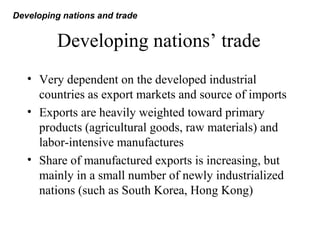
Developing nations’ trade
• Very dependent on the developed industrial
countries as export markets and source of imports
• Exports are heavily weighted toward primary
products (agricultural goods, raw materials) and
labor-intensive manufactures
• Share of manufactured exports is increasing, but
mainly in a small number of newly industrialized
nations (such as South Korea, Hong Kong)
Developing nations and trade
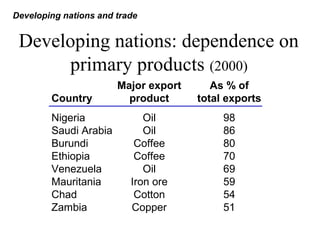
Developing nations: dependence on
primary products (2000)
Developing nations and trade
Major export As % of
Country product total exports
Nigeria Oil 98
Saudi Arabia Oil 86
Burundi Coffee 80
Ethiopia Coffee 70
Venezuela Oil 69
Mauritania Iron ore 59
Chad Cotton 54
Zambia Copper 51
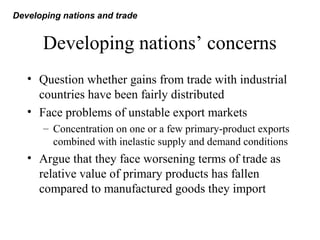
Developing nations’ concerns
• Question whether gains from trade with industrial
countries have been fairly distributed
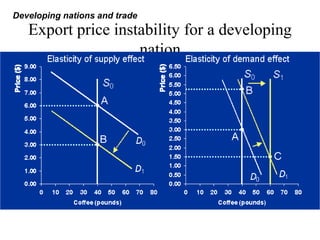
• Face problems of unstable export markets
– Concentration on one or a few primary-product exports
combined with inelastic supply and demand conditions
• Argue that they face worsening terms of trade as
relative value of primary products has fallen
compared to manufactured goods they import
Developing nations and trade
Export price instability for a developing
nation
Developing nations and trade
Remedies for developing nation
problems
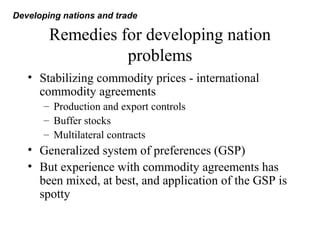
• Stabilizing commodity prices - international
commodity agreements
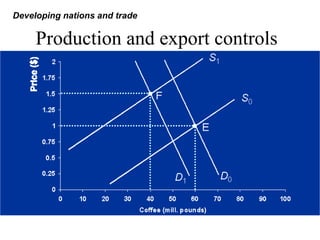
– Production and export controls
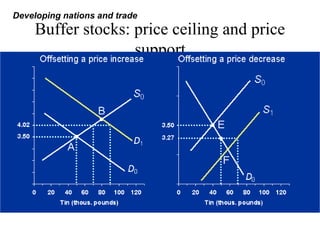
– Buffer stocks
– Multilateral contracts
• Generalized system of preferences (GSP)
• But experience with commodity agreements has
been mixed, at best, and application of the GSP is
spotty
Developing nations and trade
Production and export controls
Developing nations and trade
Buffer stocks: price ceiling and price
support
Developing nations and trade
Cartels
• Attempt to restrict competition among producers
and support higher prices for their product
• Face obstacles:
– Incentive to cheat
– Number of sellers
– Cost and demand differences
– Potential competition
– Economic downturns
– Substitute goods
Developing nations and trade
Growth strategies
• Import substitution
– Trade barriers protect emerging domestic
industries
– Popular in 1950s and 1960s
• Export-led growth
– Focus on export of manufactures as engine of
growth
– Became more common starting in 1970s
Developing nations and trade
Import substitution: pros
• Risk of establishing home import-replacing
industry is low because home market already
exists
• Easier for developing nations to protect their own
markets than to force industrial nations to open
theirs
• Gives foreign firms an incentive to locate
production in developing country, providing jobs
Growth strategies
Import substitution: cons
• Trade restrictions shelter home industry from
competition, giving no incentive for efficiency
• Small size of most developing country markets
makes it difficult to benefit from economies of
scale
• Protection of import-competing industries draws
resources away from all other sectors, including
potential exporters
Growth strategies
Export-led growth: pros
• Encourages industries in which developing
countries are likely to have a comparative
advantage - such as labor-intensive
manufactures
• Export markets allow domestic producers to
utilize economies of scale
• Low level of trade restrictions forces
domestic firms to remain competitive
Growth strategies
Export-led growth: cons
• Main disadvantage to export-led growth is
that it depends on the ability and
willingness of industrial nations to absorb
large quantities of manufactures from
developing countries
• In other words, it is sensitive to economic
cycles and protectionist pressures in the
export markets
Growth strategies
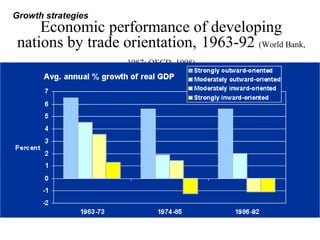
Economic performance of developing
nations by trade orientation, 1963-92 (World Bank,
1987; OECD, 1998)
Growth strategies
Growth strategies: case studies
• Brazil - import substitution in computers
– Policy backfired, and was abandoned by 1991
• East Asian newly industrialized countries - export-
led growth
– Generally very successful, until 1997 crisis
– High rates of investment and building human capital
– Problems overlooked: pollution, income distribution
– Vulnerable to protectionist reactions elsewhere
Growth strategies
Growth strategies: case studies
• China - transformation from extreme
import-substitution to focus on exports
– Dramatic change in China’s role in the world economy
has accompanied rapid growth in its domestic economy
– Heavy state role in economy (legacy of central
planning) raises issues of fairness
– Political issues, lack of enforcement of some
agreements (intellectual property) complicate economic
relations
Growth strategies
Trade Policies for the Developing Nations

Trade Policies for the Developing Nations

  • 1.
    International Economics By RobertJ. Carbaugh 8th Edition Chapter 8: Trade Policies for the Developing Nations
  • 2.
    Developing nations’ trade •Very dependent on the developed industrial countries as export markets and source of imports • Exports are heavily weighted toward primary products (agricultural goods, raw materials) and labor-intensive manufactures • Share of manufactured exports is increasing, but mainly in a small number of newly industrialized nations (such as South Korea, Hong Kong) Developing nations and trade
  • 3.
    Developing nations: dependenceon primary products (2000) Developing nations and trade Major export As % of Country product total exports Nigeria Oil 98 Saudi Arabia Oil 86 Burundi Coffee 80 Ethiopia Coffee 70 Venezuela Oil 69 Mauritania Iron ore 59 Chad Cotton 54 Zambia Copper 51
  • 4.
    Developing nations’ concerns •Question whether gains from trade with industrial countries have been fairly distributed • Face problems of unstable export markets – Concentration on one or a few primary-product exports combined with inelastic supply and demand conditions • Argue that they face worsening terms of trade as relative value of primary products has fallen compared to manufactured goods they import Developing nations and trade
  • 5.
    Export price instabilityfor a developing nation Developing nations and trade
  • 6.
    Remedies for developingnation problems • Stabilizing commodity prices - international commodity agreements – Production and export controls – Buffer stocks – Multilateral contracts • Generalized system of preferences (GSP) • But experience with commodity agreements has been mixed, at best, and application of the GSP is spotty Developing nations and trade
  • 7.
    Production and exportcontrols Developing nations and trade
  • 8.
    Buffer stocks: priceceiling and price support Developing nations and trade
  • 9.
    Cartels • Attempt torestrict competition among producers and support higher prices for their product • Face obstacles: – Incentive to cheat – Number of sellers – Cost and demand differences – Potential competition – Economic downturns – Substitute goods Developing nations and trade
  • 10.
    Growth strategies • Importsubstitution – Trade barriers protect emerging domestic industries – Popular in 1950s and 1960s • Export-led growth – Focus on export of manufactures as engine of growth – Became more common starting in 1970s Developing nations and trade
  • 11.
    Import substitution: pros •Risk of establishing home import-replacing industry is low because home market already exists • Easier for developing nations to protect their own markets than to force industrial nations to open theirs • Gives foreign firms an incentive to locate production in developing country, providing jobs Growth strategies
  • 12.
    Import substitution: cons •Trade restrictions shelter home industry from competition, giving no incentive for efficiency • Small size of most developing country markets makes it difficult to benefit from economies of scale • Protection of import-competing industries draws resources away from all other sectors, including potential exporters Growth strategies
  • 13.
    Export-led growth: pros •Encourages industries in which developing countries are likely to have a comparative advantage - such as labor-intensive manufactures • Export markets allow domestic producers to utilize economies of scale • Low level of trade restrictions forces domestic firms to remain competitive Growth strategies
  • 14.
    Export-led growth: cons •Main disadvantage to export-led growth is that it depends on the ability and willingness of industrial nations to absorb large quantities of manufactures from developing countries • In other words, it is sensitive to economic cycles and protectionist pressures in the export markets Growth strategies
  • 15.
    Economic performance ofdeveloping nations by trade orientation, 1963-92 (World Bank, 1987; OECD, 1998) Growth strategies
  • 16.
    Growth strategies: casestudies • Brazil - import substitution in computers – Policy backfired, and was abandoned by 1991 • East Asian newly industrialized countries - export- led growth – Generally very successful, until 1997 crisis – High rates of investment and building human capital – Problems overlooked: pollution, income distribution – Vulnerable to protectionist reactions elsewhere Growth strategies
  • 17.
    Growth strategies: casestudies • China - transformation from extreme import-substitution to focus on exports – Dramatic change in China’s role in the world economy has accompanied rapid growth in its domestic economy – Heavy state role in economy (legacy of central planning) raises issues of fairness – Political issues, lack of enforcement of some agreements (intellectual property) complicate economic relations Growth strategies